Markets
News
Analysis
User
24/7
Economic Calendar
Education
Data
- Names
- Latest
- Prev


After years of mounting concern over deflation and the bruising price wars that have plagued much of China’s economy, President Xi Jinping’s government is showing signs of finally taking action.
After years of mounting concern over deflation and the bruising price wars that have plagued much of China’s economy, President Xi Jinping’s government is showing signs of finally taking action.
Beijing’s messaging has noticeably shifted in recent weeks, with Xi and other top officials offering their bluntest assessment yet of the cutthroat competition that’s been dragging down prices and profits across industries, from steel and solar panels to electric vehicles. This pivot comes after nearly three years of factory-gate deflation and growing pressure from US tariffs and trade tensions.
Finding a solution would be welcome news for much of the world. A successful effort to rein in industrial overcapacity, long a source of friction with trading partners, stands to ease trade tensions and restore confidence in the globe’s second-biggest economy.
But the path forward is far from clear. Xi’s government must curb excess supply without stalling growth or putting jobs at risk, especially as external demand slows and a lasting trade deal with the US remains elusive.
“If executed right, it could be helpful to global trade, in terms of easing tensions coming from China’s overcapacity, output spilling into the global markets,” Wendy Liu, chief Asia and China equity strategist at JPMorgan Chase & Co., told Bloomberg Television on Wednesday. “But short term, it’s not GDP-friendly or employment-friendly, so it’s a balancing act.”
China reported this week that factory deflation persisted into a 33rd month in June, with the producer price index falling 3.6% from a year earlier. The decline was the most since July 2023 and sharper than any economists had forecast, underscoring the urgency of the problem.
While no formal plan has been announced, optimism is building that a more coordinated policy response is on the way. A meeting this month of the top Communist Party body in charge of economic policy acknowledged the underlying causes of the problem, ranging from local governments’ drive to promote investment to a tax system that favors output over efficiency.
Though it doesn’t directly reference deflation, until recently a taboo topic in Beijing, the assessment “represents the strongest signal yet that Chinese policymakers are intending to tackle disorderly competition and the price wars in sectors like autos,” said Duncan Wrigley, chief China economist at Pantheon Macroeconomics.
It omitted a mention of industry associations — whose efforts at self-regulation have largely failed at limiting production — in what Pantheon said could indicate a new approach “with greater top-down determination.”
Industry groups and official media have echoed the shift in tone, calling for efforts to end the price wars. Some companies in sectors ranging from steel to glassmaking are reportedly planning to cut output. The cost of reinforcing bars, a key steel product used in construction, has fallen to the lowest since 2017, while glass prices are hovering near a nine-year low.
The People’s Bank of China expressed similar concerns, naming “prices running at a low level continuously” as a key challenge of the economy for the first time in recent years. In May, the central bank offered another detailed analysis of downward pressure on prices, which highlighted the limits of relying on monetary easing to reflate the economy under a growth model that’s tilted toward investment and supply.
China’s Ministry of Industry and Information Technology, or MIIT, met with solar companies, while a group of almost three dozen construction firms signed on to an “anti-involution” initiative, a term used in China to describe intense competition sparked by excess capacity. The government also launched a platform to handle supplier complaints over late payments, part of a broader push to clean up unfair business practices.
For now, the lack of concrete policy measures is tempering expectations. If officials follow through, as they did after a similar meeting early 2024 that led to a consumer goods trade-in program — many economists expect them to reprise a playbook used between 2015 and 2017.
That supply-side reform largely consisted of aggressive cuts of heavy industry capacity including steel and coal, as well as a shantytown redevelopment program that encouraged residents to buy new homes. The effort helped revive commodity prices and home sales. Eventually, it contributed to a recovery in industrial profits and stabilized economic growth.
But the challenge now is more complex. Domestic demand remains weak, export prospects are deteriorating, and many of the sectors engaged in the most intense price wars — like EVs — are dominated by private firms, limiting the government’s ability to impose capacity cuts. Local officials, wary of unemployment, may resist moves that threaten jobs, even if it means keeping unprofitable firms alive.
And while China is eager to defuse the pressure on prices, it’s equally determined to increase its manufacturing might in the face of President Donald Trump’s push to bring more factories back to the US. Beijing is considering a new version of its “Made in 2025” campaign to boost production of high-end technological goods, Bloomberg News previously reported.
For Citigroup Inc., upcoming measures could include capacity cuts in sectors dominated by big state-owned enterprises, such as coal, steel and cement, as well as stricter enforcement of environmental, labor and quality standards in private-dominated industries.
Authorities could also reduce subsidies for industries, including those motivated by local favoritism, or cut export tax rebate, according to a Citi report last week. The latter already happened for products including aluminum, copper and batteries in late 2024.
Officials may also move to rein in bad business practices, such as exploiting suppliers to win lower prices or delaying payments. In March, new rules required firms to pay suppliers within 60 days, and several automakers have since pledged to comply.
Analysts at HSBC Holdings Plc argue that demand-side measures will be equally important, with steps such as improving the social safety net as well as stabilizing employment and the property market.
But longer-term change will require deeper reforms to the China’s growth model, one which relies on investment and production. That could mean adjusting how local officials are evaluated, shifting from pure economic expansion targets to metrics like consumption and income growth, according to Morgan Stanley.
For now, the shift in tone is notable, but the follow-through remains uncertain. “The tone is sharper, the intent more coherent,” Morgan Stanley economists led by Robin Xing wrote in a report. “But no timeline has been laid out, and no mechanism for enforcement has been introduced,” they said, adding that “the gap between diagnosis and delivery remains wide.”

728 RM B 7/F GEE LOK IND BLDG NO 34 HUNG TO RD KWUN TONG KLN HONG KONG


The risk of loss in trading financial instruments such as stocks, FX, commodities, futures, bonds, ETFs and crypto can be substantial. You may sustain a total loss of the funds that you deposit with your broker. Therefore, you should carefully consider whether such trading is suitable for you in light of your circumstances and financial resources.
No decision to invest should be made without thoroughly conducting due diligence by yourself or consulting with your financial advisors. Our web content might not suit you since we don't know your financial conditions and investment needs. Our financial information might have latency or contain inaccuracy, so you should be fully responsible for any of your trading and investment decisions. The company will not be responsible for your capital loss.
Without getting permission from the website, you are not allowed to copy the website's graphics, texts, or trademarks. Intellectual property rights in the content or data incorporated into this website belong to its providers and exchange merchants.
Not Logged In
Log in to access more features

FastBull Membership
Not yet
Purchase


Log In
Sign Up





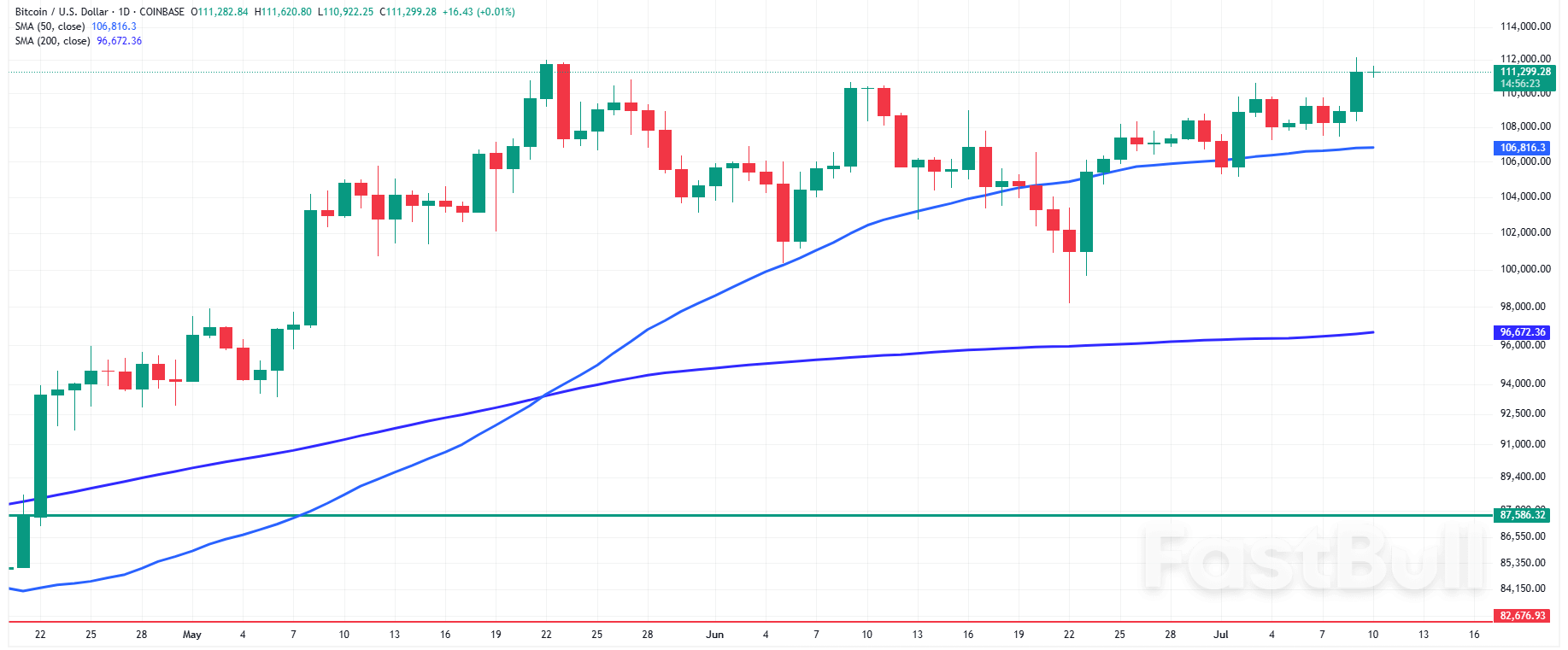 Daily Bitcoin (BTCUSD)