• Trade
  • Markets
  • Copy
  • Contests
  • News
  • 24/7
  • Calendar
  • Q&A
  • Chats
Trending
Screeners
SYMBOL
LAST
BID
ASK
HIGH
LOW
NET CHG.
%CHG.
SPREAD
SPX
S&P 500 Index
6962.44
6962.44
6962.44
6985.84
6945.70
-14.83
-0.21%
--
DJI
Dow Jones Industrial Average
49284.26
49284.26
49284.26
49589.40
49208.61
-305.93
-0.62%
--
IXIC
NASDAQ Composite Index
23711.62
23711.62
23711.62
23813.30
23607.59
-22.27
-0.09%
--
USDX
US Dollar Index
98.910
98.990
98.910
98.960
98.560
+0.280
+ 0.28%
--
EURUSD
Euro / US Dollar
1.16419
1.16426
1.16419
1.16768
1.16340
-0.00240
-0.21%
--
GBPUSD
Pound Sterling / US Dollar
1.34315
1.34326
1.34315
1.34941
1.34248
-0.00295
-0.22%
--
XAUUSD
Gold / US Dollar
4603.65
4604.06
4603.65
4634.55
4573.45
+6.48
+ 0.14%
--
WTI
Light Sweet Crude Oil
61.043
61.073
61.043
61.204
59.287
+1.387
+ 2.32%
--

Community Accounts

Signal Accounts
--
Profit Accounts
--
Loss Accounts
--
View More

Become a signal provider

Sell trading signals to earn additional income

View More

Guide to Copy Trading

Get started with ease and confidence

View More

Signal Accounts for Members

All Signal Accounts

Best Return
  • Best Return
  • Best P/L
  • Best MDD
Past 1W
  • Past 1W
  • Past 1M
  • Past 1Y

All Contests

  • All
  • Trump Updates
  • Recommend
  • Stocks
  • Cryptocurrencies
  • Central Banks
  • Featured News
Top News Only
Share

USA Labor Department Will Release Import And Export Price Data For January And Q4 Preliminary Productivity On March 5

Share

The U.S. Department Of Labor Will Release January's PPI Data On February 27

Share

WTI Crude Oil Futures Rose $2.00 On The Day, Currently Trading At $61.46 Per Barrel, A Gain Of 3.36%

Share

Greenland Mineral Resources Minister: Message To Trump Is To Respect The Wishes Of Greenland And To Collaborate

Share

Greenland Mineral Resources Minister: People In Greenland Have Clearly Stated That They Don't Want Independence Tomorrow

Share

Greenland Mineral Resources Minister: I Think We Can Accommodate Both USA Interests And Greenland's Interests

Share

Greenland Mineral Resources Minister: If One NATO Country Attacked Another NATO Member, We Would All Be Under Attack

Share

Greenland Mineral Resources Minister: We Will Work Towards Peaceful Solution With The United States, No Point In Using Weapons Against Each Other

Share

Greenland Mineral Resources Minister: There Is National Security Interest In Greenland And Interest In Our Materials, We Should Be Willing To Discuss Both

Share

Greenland Mineral Resources Minister: We Feel Betrayed By America, This Is Not Something We Sought Or Think We Deserve

Share

Greenland's Minister Of Mineral Resources: We Hope That During Our Meeting With The United States On Wednesday, We Can Get A Clearer Explanation Of The US Position On Greenland

Share

Greenland Mineral Resources Minister: We Have No Intention Of Becoming American, But Want To Work With America

Share

Colombia Is Seeking To Raise Funds Through The International Bond Market For The First Time Since April, Seeking To Issue Three-year, Five-year, And Seven-year Sovereign Bonds. Preliminary Yield Discussions Have Yielded Approximately 6%, 6.75%, And 7.1%, Respectively

Share

Canadian Trade Minister: Canada, United Arab Emirates Talks On Comprehensive Economic Accord To Start Next Month

Share

S&P 500 Energy Sector Hits More Than 13-Month High, Last Up 2%

Share

[JPMorgan CEO Says "You Have To Trust Me" Regarding Increased Spending] JPMorgan Chase CEO Jamie Dimon Stated That The Bank Will Continue To Invest The Necessary Funds To Avoid Falling Behind Competitors Such As Stripe, Sofi Technologies Inc., And Charles Schwab. "We'll Analyze What They're Doing, How They're Doing It, And How We Can Stay Ahead," Dimon Said On A Conference Call With Analysts After The Company Released Its Fourth-quarter Results. "We'll Definitely Stay Ahead, God Help US. We Won't Be Asking 10 Years From Now, 'How Did JPMorgan Fall Behind?', Just Because We Met A Certain Spending Target."

Share

Canada Trade Minister: There Are Many Areas We Can Collaborate With China, Such As Battery Storage And Energy, Which Will Explore In Visit To Beijing This Week

Share

Exxon Mobil Shares Hit All-Time High, Last Up 2.1%, Tracking Higher Oil Prices

Share

Canada Trade Minister: We Will Formally Launch Negotiations For A Free Trade Agreement With India Next Month

Share

Canada Trade Minister: We Are Looking To Add More Capacity At Existing Ports Like Montreal To Boost Non US Exports

TIME
ACT
FCST
PREV
Japan Trade Balance (Customs Data) (SA) (Nov)

A:--

F: --

P: --

U.K. BRC Overall Retail Sales YoY (Dec)

A:--

F: --

P: --

U.K. BRC Like-For-Like Retail Sales YoY (Dec)

A:--

F: --

P: --

Turkey Retail Sales YoY (Nov)

A:--

F: --

P: --

U.S. NFIB Small Business Optimism Index (SA) (Dec)

A:--

F: --

P: --

Brazil Services Growth YoY (Nov)

A:--

F: --

P: --

Canada Building Permits MoM (SA) (Nov)

A:--

F: --

P: --
U.S. CPI MoM (SA) (Dec)

A:--

F: --

P: --

U.S. CPI YoY (Not SA) (Dec)

A:--

F: --

P: --

U.S. Real Income MoM (SA) (Dec)

A:--

F: --

P: --

U.S. CPI MoM (Not SA) (Dec)

A:--

F: --

P: --

U.S. Core CPI (SA) (Dec)

A:--

F: --

P: --

U.S. Core CPI YoY (Not SA) (Dec)

A:--

F: --

P: --

U.S. Core CPI MoM (SA) (Dec)

A:--

F: --

P: --

U.S. Weekly Redbook Index YoY

A:--

F: --

P: --

U.S. Building Permits Revised YoY (SA) (Oct)

A:--

F: --

P: --

U.S. Building Permits Revised MoM (SA) (Oct)

A:--

F: --

P: --

U.S. New Home Sales Annualized MoM (Oct)

A:--

F: --

P: --
U.S. Annual Total New Home Sales (Oct)

A:--

F: --

P: --
U.S. Cleveland Fed CPI MoM (SA) (Dec)

A:--

F: --

P: --

U.S. Cleveland Fed CPI MoM (Dec)

A:--

F: --

P: --

China, Mainland Exports (Dec)

--

F: --

P: --

China, Mainland Imports YoY (CNH) (Dec)

--

F: --

P: --

China, Mainland Imports (CNH) (Dec)

--

F: --

P: --

China, Mainland Trade Balance (CNH) (Dec)

--

F: --

P: --

China, Mainland Imports YoY (USD) (Dec)

--

F: --

P: --

China, Mainland Exports YoY (USD) (Dec)

--

F: --

P: --

China, Mainland M0 Money Supply YoY (Dec)

--

F: --

P: --

China, Mainland M1 Money Supply YoY (Dec)

--

F: --

P: --

China, Mainland M2 Money Supply YoY (Dec)

--

F: --

P: --

U.S. EIA Natural Gas Production Forecast For The Next Year (Jan)

--

F: --

P: --

U.S. EIA Short-Term Crude Production Forecast For The Next Year (Jan)

--

F: --

P: --

U.S. EIA Short-Term Crude Production Forecast For The Year (Jan)

--

F: --

P: --

EIA Monthly Short-Term Energy Outlook
U.S. 30-Year Bond Auction Avg. Yield

--

F: --

P: --

U.S. Budget Balance (Dec)

--

F: --

P: --

Argentina 12-Month CPI (Dec)

--

F: --

P: --

Argentina National CPI YoY (Dec)

--

F: --

P: --

Argentina CPI MoM (Dec)

--

F: --

P: --

Richmond Federal Reserve President Barkin delivered a speech.
U.S. API Weekly Cushing Crude Oil Stocks

--

F: --

P: --

U.S. API Weekly Crude Oil Stocks

--

F: --

P: --

U.S. API Weekly Refined Oil Stocks

--

F: --

P: --

U.S. API Weekly Gasoline Stocks

--

F: --

P: --

South Korea Unemployment Rate (SA) (Dec)

--

F: --

P: --

Japan Reuters Tankan Non-Manufacturers Index (Jan)

--

F: --

P: --

Japan Reuters Tankan Manufacturers Index (Jan)

--

F: --

P: --

China, Mainland Trade Balance (USD) (Dec)

--

F: --

P: --

China, Mainland Exports YoY (CNH) (Dec)

--

F: --

P: --

China, Mainland Outstanding Loans Growth YoY (Dec)

--

F: --

P: --

U.K. 10-Year Note Auction Yield

--

F: --

P: --

Canada Leading Index MoM (Dec)

--

F: --

P: --

U.S. MBA Mortgage Application Activity Index WoW

--

F: --

P: --

U.S. Core PPI YoY (Nov)

--

F: --

P: --

U.S. PPI MoM (SA) (Nov)

--

F: --

P: --

U.S. PPI YoY (Nov)

--

F: --

P: --

U.S. Current Account (Q3)

--

F: --

P: --

U.S. PPI MoM Final (Excl. Food, Energy and Trade) (SA) (Nov)

--

F: --

P: --

U.S. PPI YoY (Excl. Food, Energy & Trade) (Nov)

--

F: --

P: --

U.S. Core Retail Sales (Nov)

--

F: --

P: --

U.S. Retail Sales MoM (Nov)

--

F: --

P: --

Q&A with Experts
    • All
    • Chatrooms
    • Groups
    • Friends
    Size flag
    Could be a good idea to wait for some consolidation or a retest of support before adding more longs, just to manage risk.@marsgents
    Size flag
    N4DLJ681JK
    I missed out on my EURUSD sell setup due to classes and it's going just fine as I predicted 🤦‍♂️😭😭😭😭
    @N4DLJ681JKOuch 😅 That’s frustrating.
    marsgents flag
    Size
    Could be a good idea to wait for some consolidation or a retest of support before adding more longs, just to manage risk.@marsgents
    @Sizei dont add more long mate😁
    3351288 flag
    Gold big correction and pump again to 4800
    Size flag
    Missing setups happens the important thing is sticking to your plan and not chasing.@N4DLJ681JK
    marsgents flag
    3351288
    Gold big correction and pump again to 4800
    @Visitor33512884k correction😁
    Size flag
    There will always be another opportunity if you stay disciplined.@N4DLJ681JK
    Size flag
    marsgents
    Smart move mate. No need to force it.@marsgents
    Size flag
    Holding what you already have and managing risk is better than chasing more.@marsgents
    marsgents flag
    Size
    @Sizei add short tho,hedge on 4630
    Size flag
    3351288
    Gold big correction and pump again to 4800
    @Visitor3351288Could happen. Gold often shakes out with a big correction before pumping again.
    Size flag
    marsgents
    @marsgentsHedging at 4630 makes sense. playing out nicely then.
    marsgents flag
    Size
    @Sizeyes,thank god😁
    DHS-II KTR flag
    Size flag
    marsgents
    Just make sure your stops are in place to manage risk on both sides@marsgents
    marsgents flag
    Size
    @Sizeok mate
    Ikeh Sunday flag
    do not hold the bag
    Ikeh Sunday flag
    its time for that on daily trade
    Mr Jimmy flag
    Mr Jimmy
    tp only one 4600
    my target hit 🎯
    marsgents flag
    Size
    @Sizewhat level to add long mate?
    Type here...
    Add Symbol or Code

      No matching data

      All
      Trump Updates
      Recommend
      Stocks
      Cryptocurrencies
      Central Banks
      Featured News
      • All
      • Russia-Ukraine Conflict
      • Middle East Flashpoint
      • All
      • Russia-Ukraine Conflict
      • Middle East Flashpoint
      Search
      Products

      Charts Free Forever

      Chats Q&A with Experts
      Screeners Economic Calendar Data Tools
      Membership Features
      Data Warehouse Market Trends Institutional Data Policy Rates Macro

      Market Trends

      Market Sentiment Order Book Forex Correlations

      Top Indicators

      Charts Free Forever
      Markets

      News

      News Analysis 24/7 Columns Education
      From Institutions From Analysts
      Topics Columnists

      Latest Views

      Latest Views

      Trending Topics

      Top Columnists

      Latest Update

      Signals

      Copy Rankings Latest Signals Become a signal provider AI Rating
      Contests
      Brokers

      Overview Brokers Assessment Rankings Regulators News Claims
      Broker listing Forex Brokers Comparison Tool Live Spread Comparison Scam
      Q&A Complaint Scam Alert Videos Tips to Detect Scam
      More

      Business
      Events
      Careers About Us Advertising Help Center

      White Label

      Data API

      Web Plug-ins

      Affiliate Program

      Awards Institution Evaluation IB Seminar Salon Event Exhibition
      Vietnam Thailand Singapore Dubai
      Fans Party Investment Sharing Session
      FastBull Summit BrokersView Expo
      Recent Searches
        Top Searches
          Markets
          News
          Analysis
          User
          24/7
          Economic Calendar
          Education
          Data
          • Names
          • Latest
          • Prev

          View All

          No data

          Scan to Download

          Faster Charts, Chat Faster!

          Download App
          English
          • English
          • Español
          • العربية
          • Bahasa Indonesia
          • Bahasa Melayu
          • Tiếng Việt
          • ภาษาไทย
          • Français
          • Italiano
          • Türkçe
          • Русский язык
          • 简中
          • 繁中
          Open Account
          Search
          Products
          Charts Free Forever
          Markets
          News
          Signals

          Copy Rankings Latest Signals Become a signal provider AI Rating
          Contests
          Brokers

          Overview Brokers Assessment Rankings Regulators News Claims
          Broker listing Forex Brokers Comparison Tool Live Spread Comparison Scam
          Q&A Complaint Scam Alert Videos Tips to Detect Scam
          More

          Business
          Events
          Careers About Us Advertising Help Center

          White Label

          Data API

          Web Plug-ins

          Affiliate Program

          Awards Institution Evaluation IB Seminar Salon Event Exhibition
          Vietnam Thailand Singapore Dubai
          Fans Party Investment Sharing Session
          FastBull Summit BrokersView Expo

          Why Latin American Markets Are Leading Global Returns in 2026

          Warren Takunda

          Economic

          Summary:

          Latin American markets such as Chile, Peru, and Argentina are leading global returns in recent months, driven by rising commodity prices, a weaker dollar, political catalysts, and reform momentum.
          Latin American financial assets have emerged among the best-performing markets worldwide at the start of 2026, driven by an unusual alignment of positive political catalysts, strong commodity prices, and renewed global appetite for emerging markets.
          Equities and currencies across the region have sharply outpaced developed markets, reversing several years of relative underperformance.
          The shift in sentiment has been triggered by a sequence of closely timed developments.
          A sustained upswing in commodity prices — particularly industrial and precious metals — has strengthened the outlook for South America’s export-driven economies.
          And while the full consequences of the recent US seizure of Venezuela’s Nicolás Maduro have yet to play out, some investors view the ousting as positive. A number hope the move will reduce geopolitical tail risks long associated with the region.
          Adding to the momentum, the announcement of the EU–Mercosur trade agreement revived expectations of deeper trade integration between Europe and Latin America, even as doubts remain over its full implementation.
          Global macro conditions have also played a decisive role. Major investment banks, including Bank of America and AllianceBernstein, indicate that a weaker US dollar in 2026 is boosting the appeal of emerging market assets.
          Historically, periods of dollar weakness have coincided with strong emerging market performance, as capital shifts toward countries where returns are higher.
          Countries most exposed to metals markets have been the primary beneficiaries. Chile and Peru — key producers of copper, silver and gold — have enjoyed substantial windfall gains from the metals rally.
          Chile, the world’s largest copper exporter, shipped 14.9 million tonnes of the metal in 2024, according to ITC Trade Map data.

          Latin America shines among top-performing global marketsWhy Latin American Markets Are Leading Global Returns in 2026_1

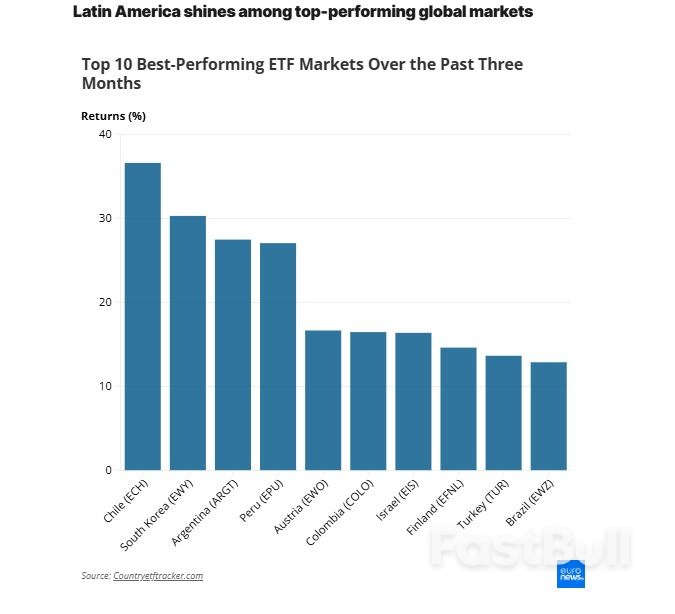
          Performance data compiled by CountryETFTracker show that five Latin American countries now rank among the world’s ten best-performing equity markets over the past three months.
          Chilean stocks are up 36.6% since mid-October, making them the best-performing investable equity market globally via exchange-traded funds. Simultaneously, the Chilean peso has appreciated more than 8% over the past two months, reflecting improved terms of trade and renewed portfolio inflows.
          Argentina has been another standout, with a 27.45% rally in equity markets since October. Investors have responded positively to the liberalisation reforms introduced by President Javier Milei, who took office in December 2023.
          The International Monetary Fund, in its latest Regional Economic Outlook, credited the Milei administration with enacting “an ambitious package of market-oriented reforms” targeting productivity, regulatory simplification, and fiscal sustainability.
          The IMF noted that, if sustained, these reforms could yield substantial medium-term gains by opening Argentina’s economy and improving investor confidence. That's despite the fact that such austerity forms were particularly unpopular with the general public when first announced, triggering protests in Argentina.
          Beyond Chile and Argentina, Peru has posted equity gains of around 27%, with the Peruvian sol now trading at its strongest level relative to the dollar in over five years.
          Elsewhere, equities in Colombia rose about 16%, and Brazil has rounded out the regional leaders with a 12.9% rally.
          By contrast, the US S&P 500 has gained just 4.8% over the same period, while Germany’s DAX is up around 5%, underscoring Latin America’s marked relative outperformance.

          EU–Mercosur agreement signals strategic shift for Latin America

          The long-awaited EU–Mercosur trade agreement, more than two decades in the making, is set to be formally signed on 17 January in Paraguay, marking a turning point in relations between Europe and South America.
          For the founding members of the Mercosur bloc — Argentina, Brazil, Paraguay and Uruguay — the accord represents their first major trade agreement with an external partner, opening preferential access to a market of nearly 450 million EU consumers.
          “The approval of the EU–Mercosur trade agreement is a landmark moment, creating the largest free trade area in the world by population,” Ángel Talavera, head of European macro at Oxford Economics, said in a note.
          Combined, the EU and Mercosur economies account for around a quarter of global GDP and roughly 780 million people.
          For Latin American markets, experts say the significance goes beyond improved agricultural access to Europe. The agreement is expected to lower tariff and non-tariff barriers on industrial inputs, particularly benefitting manufacturing-heavy economies such as Brazil and Argentina by reducing costs, improving competitiveness and strengthening supply-chain integration.
          According to a study by Banco Santander, the deal is poised to transform trade and investment flows across South America. The EU already accounts for close to €370bn in foreign direct investment into Mercosur and over €125bn in annual trade.
          Brazil’s Institute for Applied Economic Research expects the deal could lift Brazil’s GDP by around 0.5 percentage points and raise investment by 1.5 percentage points annually, reflecting stronger export prospects and increased foreign direct investment.
          Estimates from Real Instituto Elcano and the Bank of Spain suggest EU–Latin America trade could expand by up to 70% over time, while intra-regional trade within Latin America could rise by as much as 40%.

          A turning point for Latin America?

          Latin America’s recent strong performance in global financial markets seems to reflect more than just cyclical tailwinds.
          Rising commodity prices, easing geopolitical risks, and a weaker US dollar have all helped draw global investors back to the region after years of underperformance.
          At the same time, reform momentum in countries such as Argentina and renewed trade links with Europe have improved perceptions of policy stability and long-term growth potential.
          While challenges remain and many of the economic benefits will take time to materialise, markets are increasingly viewing Latin America as a relative bright spot among emerging economies.
          For now, the region’s combination of high returns, improving fundamentals, and strategic relevance in global trade is proving hard for investors to ignore.

          Source: Euronews

          To stay updated on all economic events of today, please check out our Economic calendar
          Risk Warnings and Disclaimers
          You understand and acknowledge that there is a high degree of risk involved in trading. Following any strategies or investment methods may lead to potential losses. The content on the site is provided by our contributors and analysts for information purposes only. You are solely responsible for determining whether any trading assets, securities, strategy, or any other product is suitable for investing based on your own investment objectives and financial situation.
          Add to Favorites
          Share

          Futures lower, CPI ahead, JPMorgan to report - what’s moving markets

          Adam

          Economic

          Futures linked to the major U.S. stock indices inch lower, with traders gearing up for crucial economic figures and the start of the quarterly corporate earnings season. The Trump administration faces blowback over an investigation into Federal Reserve Chair Jerome Powell, while oil prices rise as anti-government protests in Iran intensify.

          Futures dip

          U.S. stock futures pointed lower on Tuesday as investors hunkered down before the release of key inflation data and a slew of earnings from banking giants.
          By 03:05 ET (08:05 GMT), the Dow futures contract had fallen by 46 points, or 0.1%, S&P 500 futures had dipped by 6 points, or 0.1%, and Nasdaq 100 futures had slid by 39 points, or 0.2%.
          The main averages on Wall Street finished in the green on Monday, rebounding from pressure earlier in the session linked to the implications of a criminal investigation into Powell and President Donald Trump’s proposed cap on credit card rates.
          But stocks were eventually buoyed by strength across a range of sectors, including technology, consumer staples and materials.
          "Overall, the narrative is largely the same now as it was on Friday, with bulls still in control thanks to improving growth dynamics, healthy earnings, evidence of a generational improvement in productivity, and stimulus [...] anticipation," analysts at Vital Knowledge said in a note.

          White House faces blowback over Powell probe

          The Trump administration has faced a wave of criticism over its move to open the criminal investigation into Powell, with condemnation coming from both former Fed leaders and even members of the president’s Republican Party.
          Citing sources familiar with the matter, Reuters reported that the probe was approved and started by Jeanine Pirro, the U.S. Attorney for Washington and an ally Trump, but without Attorney General Pam Bondi nor Deputy Attorney General Todd Blanche being briefed.
          Writing on social media, Pirro said the Justice Department had chosen to take action against the Fed because the central bank had refused to discuss an overrun in expenses related to the refurbishment of its Washington headquarters. Pirro added that her office "makes decisions based on the merits."
          Yet the move, which cast fresh concerns over the independence of the Fed and sent U.S. Treasury bond rates higher, was slammed by former Fed Chairs Janet Yellen, Ben Bernanke and Alan Greenspan, who said "[t]his is how monetary policy is made in emerging markets with weak institutions." They warned of the "negative consequences" such actions could have on inflation and the function of the economy more broadly.
          Meanwhile, Republican Senator Thom Tillis was joined by several colleagues in hitting out at the investigation. Tillis described it as a "huge mistake."

          CPI ahead

          With investors eyeing the developments around the Fed, attention now turns to the impending publication of the December U.S. consumer price index, a closely-monitored gauge of inflation.
          Consumer prices in the world’s largest economy are seen rising by 2.7% in the twelve months to December, matching November’s rate. Month-on-month, the figure is also expected to equal November’s pace of 0.3%.
          Stripping out more volatile items like food and fuel, so-called "core" CPI is forecast to accelerate slightly to 2.7% from 2.6% year-on-year, and to 0.3% from 0.2% on a monthly basis.
          In a note, analysts at ING said they anticipate the core inflation figure will be hotter than expected, arguing that a prolonged U.S. government shutdown led to "more data collection occurr[ing] later in November, a period when Thanksgiving-related discounting is common."
          "Compared with the full month of November 2024, this timing likely skewed that inflation reading lower. Reverting to more standard collection timings in December means risks of a hotter read," the ING analysts wrote.
          Fed policymakers have recently prioritized a slowing jobs market over inflation when rolling out a series of interest rate reductions late last year. In theory, slashing rates can spur investment and hiring, albeit at the risk of reigniting prices.
          Indications of sticky price gains could give Fed officials an extra factor to consider ahead of the next rate decision later this month. The Fed is widely tipped to keep rates unchanged at a range of 3.50% to 3.75%, according to CME FedWatch.

          JPMorgan earnings loom large

          Sentiment could also be swayed by a batch of results from major Wall Street lenders this week, beginning with the largest U.S. bank, JPMorgan Chase, on Tuesday.
          On Wednesday, peers Bank of America, Citigroup and Wells Fargo will report, followed by Goldman Sachs and Morgan Stanley on Thursday.
          Coupled with the inflation data, the outcome of the bank earnings could contribute to the tone for stock markets in the early weeks of 2026.
          While the benchmark S&P has risen so far this year and posted a third straight year of double-digit growth in 2025, the outlook remains somewhat murky.
          While the Fed is anticipated to cut rates again this year, the path ahead for borrowing costs in the coming months is still relatively unclear. At the same time, intensifying geopolitical strife has been one of the hallmarks of the first days of January, particularly with the Trump administration’s actions in Venezuela earlier this month and subsequent comments about potential interventions in countries and regions around the world.
          Robust bank earnings could help paint an upbeat picture of the state of Corporate America, and possibly alleviate some worries among more jittery investors in the process.

          Oil advances

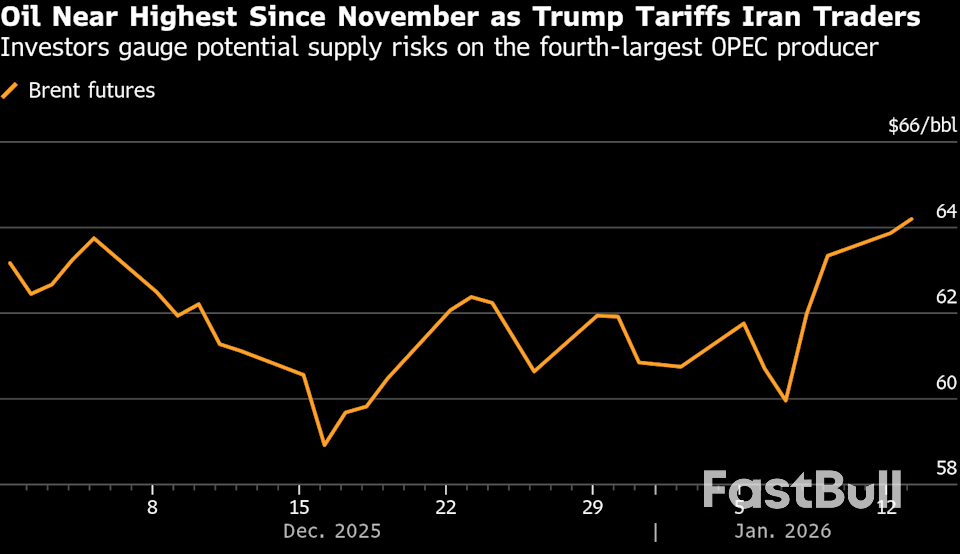
          Oil prices rose, climbing for a fourth consecutive session as intensifying anti-government protests in Iran have stoked concerns of disruption of supply from this key OPEC producer.
          Brent futures gained 0.5% to $64.16 a barrel and U.S. West Texas Intermediate crude futures rose 0.8% to $59.82 a barrel.
          The Brent contract reached a seven-week high in the previous session, while the WTI benchmark rose to a one-month high.

          Source: investing

          To stay updated on all economic events of today, please check out our Economic calendar
          Risk Warnings and Disclaimers
          You understand and acknowledge that there is a high degree of risk involved in trading. Following any strategies or investment methods may lead to potential losses. The content on the site is provided by our contributors and analysts for information purposes only. You are solely responsible for determining whether any trading assets, securities, strategy, or any other product is suitable for investing based on your own investment objectives and financial situation.
          Add to Favorites
          Share

          December Core Consumer Prices Rose at a 2.6% Annual Rate, Less Than Expected

          Michelle

          Forex

          Economic

          Core U.S. consumer prices rose less than predicted in December, reinforcing hopes that inflation is tempering as the Federal Reserve contemplates its next move on interest rates.
          Excluding volatile food and energy prices, the consumer price index showed a seasonally adjusted 0.2% gain on a monthly basis and 2.6% annually, the Bureau of Labor Statistics reported Tuesday. Both were 0.1 percentage point below expectations. Though they look at both measures, Fed officials consider core inflation a better long-run gauge of where inflation is heading.
          On a headline basis, the CPI posted an increase of 0.3% for the month, putting the all-items annual rate at 2.7%. Both were exactly in line with the Dow Jones consensus estimate.
          The Fed targets inflation at 2% annually, so the report provides some evidence that the pace of prices increases is moving back to target but remains elevated.
          Stock market futures rose following the report while Treasury yields were lower.
          Shelter, a key element of stickiness, increased 0.4%, which was the biggest item for the monthly increase, according to the BLS. The category accounts for more than one-third of the CPI weighting and was up 3.2% on an annual basis.
          Other parts of the report also showed inflation persisting.
          Food prices jumped 0.7% for the month, accompanied by increases in recreation, air fares and medical care. Some tariff-sensitive categories also posted increases, including apparel. However, household furnishings saw a decrease as President Donald Trump backed off on threatened tariff increases for imports in that sector.
          The 1.2% increase for recreation was the largest monthly gain ever for the index in data going back to 1993, the BLS said.
          To stay updated on all economic events of today, please check out our Economic calendar
          Risk Warnings and Disclaimers
          You understand and acknowledge that there is a high degree of risk involved in trading. Following any strategies or investment methods may lead to potential losses. The content on the site is provided by our contributors and analysts for information purposes only. You are solely responsible for determining whether any trading assets, securities, strategy, or any other product is suitable for investing based on your own investment objectives and financial situation.
          Add to Favorites
          Share

          Alignment, Execution And Selectivity To Define Malaysian Property Market Performance In 2026

          Justin

          Economic

          Malaysia's property market is entering 2026 with a clearer hierarchy of performance, where alignment with structural demand, capital discipline and execution certainty are expected to matter more than broad market momentum, according to Knight Frank Malaysia.

          Insights from the firm's Real Estate Highlights (REH) 2H2025 point to a market that is no longer moving in a single direction. Instead, assets that are well positioned in terms of purpose, infrastructure readiness and occupier relevance are expected to outperform, while misaligned developments face growing penalties.

          "The market is no longer moving in a single direction. Over the past six months, we have seen a clear separation between assets that are aligned with structural demand and those that are not. In this environment, performance is determined by alignment, discipline and execution, rather than momentum alone," said group managing director Keith Ooi.

          As Malaysia moves into 2026, policy support is expected to remain an enabling backdrop rather than a primary performance driver. Market outcomes will increasingly hinge on how well assets are aligned with long-term demand fundamentals, supported by delivery certainty and operational readiness.

          Industrial, data centres and hospitality to anchor forward momentum

          Looking ahead, the industrial and logistics sector is expected to remain resilient, though increasingly selective. Demand is likely to concentrate in locations that offer infrastructure readiness, power availability and operational efficiency, particularly within advanced manufacturing and logistics ecosystems.

          "Heightened trade costs and policy uncertainty have temporarily disturbed industrial demand at the margins, reinforcing occupier and investor selectivity rather than reversing underlying market resilience," said senior executive director of land and industrial solutions Allan Sim.

          The data centre sector is also transitioning into a more execution-driven phase heading into 2026. Growth is shifting away from headline investment announcements towards delivery certainty, governance readiness and access to critical resources such as power and water.

          The data centre sector is seen transitioning into a more execution-driven phase in 2026.

          "As the sector moves from commitments to delivery, project progress is increasingly shaped by execution factors such as contract timelines, customised customer requirements, the track record of operators and owners, as well as regulatory processes and available infrastructure capacity. Despite this, data centres remain a compelling alternative asset class for investors and developers," said executive director of valuation and advisory Justin Chee.

          In hospitality, the sector is entering an early positioning phase ahead of Visit Malaysia 2026, with improving travel flows and sustained cross-border demand influencing room inventory planning and pricing strategies.

          "The Visit Malaysia 2026 campaign targets millions of visitors and high tourism receipts, providing a powerful demand driver for hotel assets. This is expected to lift occupancy rates and average room rates, benefiting investment performance," said executive director of capital markets James Buckley.

          He added that demand for hotel real estate, including serviced apartments and hybrid hotel-apartment concepts, is expanding, particularly in Kuala Lumpur, Johor and Penang.

          Office, retail and residential markets remain polarised

          The office market is expected to remain structurally polarised in 2026, with occupiers continuing to prioritise quality, flexibility and ESG compliance over scale.

          Office buildings in Kuala Lumpur. (Photo by Low Yen Yeing/The Edge)

          "Leasing decisions are increasingly centred on quality, flexibility and efficiency, which is accelerating the performance gap between newer, well positioned buildings and older stock," said senior executive director of office strategy and solutions Teh Young Khean.

          The two-tier dynamics are most evident in the Klang Valley, where newer, green buildings are being absorbed earlier, while older stock faces mounting pressure unless actively repositioned.

          In retail, performance is expected to remain highly dependent on format and location, with landlords prioritising tenant retention and mix optimisation amid intensifying competition.

          "As competition intensifies, especially in overlapping catchments, landlords are prioritising tenant retention and mix optimisation over headline rental growth," said director of retail management and consultancy Yuen May Chee.

          The residential market is likely to see continued demand in 2026, though buyers are becoming more discerning amid affordability pressures and a high supply pipeline.

          "Demand remains active, but buyers are more selective due to the high housing pipeline, both existing and new inventory. We are seeing self-correction in selected markets through pricing and product discipline rather than broad-based recovery," said senior executive director of research and consultancy Judy Ong.

          Infrastructure-led corridors, including the Rapid Transit System (RTS) Link in Johor and major rail and road projects across the Klang Valley and Penang, are expected to remain key demand drivers.

          Outlook underpinned by 2H2025 research

          Data from the second half of 2025 underscores why momentum alone is no longer sufficient.

          Industrial markets continued to show resilience, with prime manufacturing facilities in the Klang Valley maintaining steady take-up, while Johor benefited from deeper cross-border integration under the Johor–Singapore Special Economic Zone. Penang recorded a 40.6% year-on-year increase in foreign direct investment, despite a decline in transaction volumes due to land scarcity.

          Across the office, retail and residential segments, performance increasingly diverged based on asset quality, location and alignment with end-user demand. Overhang levels improved selectively where pricing and product offerings were well-calibrated, pointing to gradual market self-correction rather than a broad-based recovery.

          Overall, the signals from 2H2025 suggest that the central challenge heading into 2026 is not whether demand exists, but whether strategies are aligned with the fundamentals that now matter most — infrastructure readiness, asset purpose and disciplined execution.

          Source: Theedgemarkets

          To stay updated on all economic events of today, please check out our Economic calendar
          Risk Warnings and Disclaimers
          You understand and acknowledge that there is a high degree of risk involved in trading. Following any strategies or investment methods may lead to potential losses. The content on the site is provided by our contributors and analysts for information purposes only. You are solely responsible for determining whether any trading assets, securities, strategy, or any other product is suitable for investing based on your own investment objectives and financial situation.
          Add to Favorites
          Share

          Yen tumbles on election bets, dollar still under pressure

          Adam

          Forex

          The yen fell ​to its lowest against the dollar since July 2024 on Tuesday as traders braced for a Japanese election and also ‌hit lows against European currencies, with the dollar pressured by worries about the Federal Reserve's independence.
          Those fears, after the Trump administration opened a criminal investigation into Chair Jerome Powell, remain the most important factor for markets in the long term, analysts said.
          Still, with the administration's move drawing criticism from key members of Trump's Republican Party, it had less of an impact on daily price moves.
          Instead, the Japanese yen was the main mover, briefly sliding to the weak side ‌of 159 per dollar for the first time since July 2024.
          That followed news from Kyodo that Japanese Prime Minister ​Sanae Takaichi had conveyed to a ruling party executive her intention to dissolve parliament's lower house at the outset of its regular session scheduled to start on January 23.
          The dollar was last up 0.5% on the yen at 158.9 yen.
          POLL VICTORY COULD FURTHER SPUR 'TAKAICHI TRADE'
          Takaichi is ahead in ‍the polls, and, should she achieve a decisive electoral victory, investors may further buy into the "Takaichi trade" -- a view that the premier's desire for more fiscal stimulus would push stocks higher, while sending bond yields higher and the yen lower.
          That was certainly Tuesday's trade with the Nikkei share index (.N225) hitting a new record high, and yields ⁠on 30 year Japanese government bonds surging 12 bps.
          The yen sank to record lows against the euro and the Swiss franc , while also hitting ‍its weakest level against the British pound since August 2008.
          WOULD JAPAN INTERVENE DIRECTLY TO STEM YEN'S SLIDE?
          For currency traders, the question is whether and when Japanese authorities ‌might intervene ‌directly in markets to stem the yen's slide.
          "Dollar/yen at 160 first is the obvious level, though it could be higher, and it's not necessarily about levels, but speed of yen depreciation," said Nick Rees, head of macro analysis at Monex Europe.
          He said thinking about levels could help "anchor market psychology," however.
          Japan's Finance Minister Satsuki Katayama had earlier said she and U.S. Treasury Secretary Scott Bessent shared concerns over the yen's recent depreciation, as Tokyo stepped up ⁠threats of intervention to stem its ⁠fall.
          POWELL INVESTIGATION WORRIES INVESTORS
          Other currencies ​were steady, maintaining gains from the previous session.
          The euro was little changed at $1.1671, having risen 0.27% the previous session, while sterling was up 0.14% at $1.3475, extending Monday's 0.47% gain.
          The Swiss franc was flat at 0.7976 per dollar, while the dollar index recovered marginally to 99.01, having clocked its worst day in three weeks in ‍the previous session.
          U.S. CPI later in the day could drive moves in the dollar.
          Consumer prices likely accelerated in December as some artificial lowering of inflation linked to the government shutdown in November dissipated, though uncertainty over the shutdown's impact means the data could still surprise.
          That could add volatility to the dollar, already shaken by the Fed ​speculation and global political developments this year, though no real trend in its movement ‍is evident.
          "I would have expected, given everything that's going on, to see a little more direction," said Rees.
          "But you can argue things are pushing both directions, the Fed is clearly a ​dollar negative, but at the moment, markets see the dollar functioning a bit as a safe haven on all the geopolitical developments."

          Source: reuters

          Risk Warnings and Disclaimers
          You understand and acknowledge that there is a high degree of risk involved in trading. Following any strategies or investment methods may lead to potential losses. The content on the site is provided by our contributors and analysts for information purposes only. You are solely responsible for determining whether any trading assets, securities, strategy, or any other product is suitable for investing based on your own investment objectives and financial situation.
          Add to Favorites
          Share

          Bringing Charges Against the Fed: What We Do (and Don’t) Know

          Warren Takunda

          Economic

          President Donald Trump has dramatically escalated his confrontation with the Federal Reserve, his Justice Department investigating and threatening a criminal indictment of the independent central bank and serving it with subpoenas.
          The dispute is ostensibly about Fed Chair Jerome Powell’s testimony to Congress in June over the cost of a massive renovation of Fed buildings. But in a statement Sunday, Powell, abandoning his previous attempt to ignore Trump’s relentless criticism, called the administration’s threat of criminal charges “pretexts’’ in the president’s campaign to seize control of U.S. interest rate policy from the Fed’s technocrats.
          Trump has repeatedly criticized Powell and the Fed for not moving faster to cut rates. Economists warn that a politicized Fed that caves in to the president’s demands will damage its credibility as an inflation fighter and likely lead investors to demand higher rates before investing in U.S. Treasurys.
          Here’s what to know about the dispute:

          The threat of charges arises from a $2.5 billion Fed renovation project

          The $2.5 billion renovation of two Fed buildings in Washington dates back to Trump’s first term and attracted little attention for years. But over the summer, the administration began to complain about cost overruns in the project — criticisms that coincided with Trump’s increasing pressure on the Fed to slash interest rates to stimulate the economy.
          Taxpayers are not footing the bill for the Fed renovations directly. Unlike other government agencies, which receive taxpayer money appropriated by Congress, the central bank is self-financed, drawing on interest from its massive holdings of Treasury debt.
          The Fed says its headquarters, known as the Marriner S. Eccles building, desperately needed an upgrade because its electrical, plumbing and HVAC systems, among others, are nearly obsolete; some date back to the building’s construction in the 1930s.
          The Fed is removing asbestos, lead and other hazardous elements from the building and installing modern electrical and communications systems. The H-shaped building, named after a Fed chair from the 1930s and ’40s, is located near some of Washington’s highest-profile monuments. The central bank is also renovating a building next door that it acquired in 2018.
          The Fed has said: “The construction project identified key architectural features to preserve the historic integrity of the buildings, such as stonework, including marble, façades, meeting rooms, and other spaces. Historic preservation work in the Eccles Building also includes elevators that are original to the building, and historic conference rooms.″

          The costs of the Fed overhaul have ballooned

          Originally budgeted at about $1.9 billion, the project’s costs have swelled by $600 million.
          The Fed cites many reasons for the greater expense. Construction costs, including for materials and labor, rose sharply during the inflation spike of 2021 and 2022. The project required more asbestos removal than expected. And Washington’s local restrictions on building heights forced it to build underground, which is pricier.
          Because of the rising costs, the Fed’s board canceled planned renovations of a third building in 2024.
          The Fed says the renovations will reduce costs “over time” because it will be able to pack its 3,000 Washington-based employees into fewer buildings and pay less rent.
          At a Senate Banking Committee hearing in June, Chairman Tim Scott, a South Carolina Republican, claimed that renovation included “rooftop terraces, custom elevators that open into VIP dining rooms, white marble finishes, and even a private art collection.” In his testimony, Powell disputed those details, saying “there’s no new marble. ... there are no special elevators.”
          In July, Trump visited the building site and, while standing next to Powell, overstated the cost of the renovation. Still, Trump downplayed concerns later that day, saying “they have to get it done ... Look, there’s always Monday morning quarterbacks. I don’t want to be that. I want to help them get it finished.”
          When asked if the overruns amounted to a firing offense, Trump said, “I don’t want to put that in this category.”
          But at a December 29 news conference, Trump said his administration would “probably” sue Powell for “gross incompetence” on the cost of renovations, calling it the “highest price of construction per square foot in the history of the world.”
          The Supreme Court signaled last year that Trump can’t fire Powell simply over disagreements about interest rates. But he could do so legally “for cause,” such as misconduct or dereliction of duty.

          The dispute seemed to have died down before flaring up again

          The controversy over the renovations died down after the summer.
          But Trump kept up his pressure on the Fed. In August, he said he was firing Fed governor Lisa Cook, an unprecedented step arising from allegations of mortgage fraud, which she has denied. Cook has sued to keep her job and courts have ruled she can remain in her seat while the case plays out. The Supreme Court will hear arguments in the case Jan. 21.
          Trump has repeatedly used investigations — which might or might not lead to an actual indictment — to attack other political rivals, including New York Attorney General Letitia James and James Comey, the former FBI director.
          Speaking briefly NBC News Sunday, Trump claimed that he knew nothing about the investigation into Powell. When asked if it is intended to pressure the Fed chair on rates, Trump said, “No. I wouldn’t even think of doing it that way.”
          White House press secretary Karoline Leavitt told reporters that Trump did not direct his Justice Department to investigate Powell.
          The subpoenas come at an unusual moment when Trump was teasing the likelihood of announcing his nominee this month to succeed Powell as the Fed chair. While Powell’s term as chair ends in May, he has a separate term as a Fed governor until January 2028.

          Trump has been criticized for his own renovations

          Trump has come under fire for his own decision to tear down the facade of the East Wing of the White House to put in a $250 million ballroom.
          The 90,000-square-foot ballroom will dwarf the main White House itself: The Executive Mansion occupies just 55,000 square feet. Trump says the ballroom will accommodate 999 people.
          Like the Fed’s project, Trump’s ballroom won’t cost taxpayers anything: It is being privately funded by “many generous Patriots, Great American Companies, and, yours truly,” Trump has said on social media.
          The president argues that the White House needs a large entertaining space. He has complained about the capacity of the East Room, which can hold 200 people and is currently the largest space in the White House. He also objects to the practice of past presidents hosting state dinners and other events in tents on the South Lawn.

          Source: AP

          To stay updated on all economic events of today, please check out our Economic calendar
          Risk Warnings and Disclaimers
          You understand and acknowledge that there is a high degree of risk involved in trading. Following any strategies or investment methods may lead to potential losses. The content on the site is provided by our contributors and analysts for information purposes only. You are solely responsible for determining whether any trading assets, securities, strategy, or any other product is suitable for investing based on your own investment objectives and financial situation.
          Add to Favorites
          Share

          Oil Hits $65 as Geopolitical Risks Swirl From Iran to Black Sea

          Adam

          Commodity

          Oil briefly rose above $65 a barrel for the first time since November after the US escalated pressure on Iran, while tankers were attacked near a vital terminal for Kazakh crude on Russia’s Black Sea coast.
          Brent (BZ=F) futures extended gains of more than 6% over the previous three sessions. President Donald Trump announced a 25% tariff on goods from countries “doing business” with Iran and has not ruled out military strikes on the Persian Gulf state, just days after a stunning move to take control of Venezuelan oil production.
          Meanwhile, the biggest source of crude supply disruption has been at the Caspian Pipeline Consortium terminal that loads Kazakh oil into tankers, with a combination of bad weather, drone attacks and maintenance threatening exports. On Tuesday, two vessels were struck near the facility, underscoring fresh risks to supply, with loadings already revised down by almost half to around 900,000 barrels a day.
          “Geopolitical risk is at an all-time high,” Jeff Currie, chief strategy office of energy pathways at Carlyle, said in a Bloomberg television interview. “That’s a recipe for a spike in prices now.”
          Oil Hits $65 as Geopolitical Risks Swirl From Iran to Black Sea_1
          The risk of a surge is also showing up in options markets where traders are demanding the biggest premiums for bullish contracts since Israel and the US launched airstrikes on Iran last year. A record volume of bullish Brent call options changed hands on Monday, in part led by large wagers on higher prices.
          Oil has gained ground in the early new year period, following a run of five monthly losses spurred by expectations for a glut. The climb has come amid US intervention in Venezuela, with Washington’s capture of leader Nicolás Maduro, followed by the worsening wave of unrest in Iran. The rally caught an oil market that was steeped with bearish bets off guard.
          While, authorities in Tehran have said they have now quelled the protests, the unrest appears to be persisting and an activist group warned that the civilian death toll could be in the thousands.
          The possibility of a disruption to Iran’s daily exports, which account for just under 2% of global demand, has tempered some of the concerns over the global glut.
          “Regime change in Iran could ultimately amplify the downtrend in crude markets as the strong supply picture still holds,” said Florence Schmit, an analyst at Rabobank. “But there are is a potential for another rally before that if the unrest - directly or indirectly - targets energy flows.”

          Source: Bloomberg

          Risk Warnings and Disclaimers
          You understand and acknowledge that there is a high degree of risk involved in trading. Following any strategies or investment methods may lead to potential losses. The content on the site is provided by our contributors and analysts for information purposes only. You are solely responsible for determining whether any trading assets, securities, strategy, or any other product is suitable for investing based on your own investment objectives and financial situation.
          Add to Favorites
          Share
          FastBull
          Copyright © 2026 FastBull Ltd

          728 RM B 7/F GEE LOK IND BLDG NO 34 HUNG TO RD KWUN TONG KLN HONG KONG

          TelegramInstagramTwitterfacebooklinkedin
          App Store Google Play Google Play
          Products
          Charts

          Chats

          Q&A with Experts
          Screeners
          Economic Calendar
          Data
          Tools
          Membership
          Features
          Function
          Markets
          Copy Trading
          Latest Signals
          Contests
          News
          Analysis
          24/7
          Columns
          Education
          Company
          Careers
          About Us
          Contact Us
          Advertising
          Help Center
          Feedback
          User Agreement
          Privacy Policy
          Personal Information Protection Statement
          Business

          White Label

          Data API

          Web Plug-ins

          Poster Maker

          Affiliate Program

          Risk Disclosure

          The risk of loss in trading financial instruments such as stocks, FX, commodities, futures, bonds, ETFs and crypto can be substantial. You may sustain a total loss of the funds that you deposit with your broker. Therefore, you should carefully consider whether such trading is suitable for you in light of your circumstances and financial resources.

          No decision to invest should be made without thoroughly conducting due diligence by yourself or consulting with your financial advisors. Our web content might not suit you since we don't know your financial conditions and investment needs. Our financial information might have latency or contain inaccuracy, so you should be fully responsible for any of your trading and investment decisions. The company will not be responsible for your capital loss.

          Without getting permission from the website, you are not allowed to copy the website's graphics, texts, or trademarks. Intellectual property rights in the content or data incorporated into this website belong to its providers and exchange merchants.

          Not Logged In

          Log in to access more features

          FastBull Membership

          Not yet

          Purchase

          Become a signal provider
          Help Center
          Customer Service
          Dark Mode
          Price Up/Down Colors

          Log In

          Sign Up

          Position
          Layout
          Fullscreen
          Default to Chart
          The chart page opens by default when you visit fastbull.com