• Trade
  • Markets
  • Copy
  • Contests
  • News
  • 24/7
  • Calendar
  • Q&A
  • Chats
Trending
Screeners
SYMBOL
LAST
BID
ASK
HIGH
LOW
NET CHG.
%CHG.
SPREAD
SPX
S&P 500 Index
6827.42
6827.42
6827.42
6899.86
6801.80
-73.58
-1.07%
--
DJI
Dow Jones Industrial Average
48458.04
48458.04
48458.04
48886.86
48334.10
-245.98
-0.51%
--
IXIC
NASDAQ Composite Index
23195.16
23195.16
23195.16
23554.89
23094.51
-398.69
-1.69%
--
USDX
US Dollar Index
97.950
98.030
97.950
98.500
97.950
-0.370
-0.38%
--
EURUSD
Euro / US Dollar
1.17394
1.17409
1.17394
1.17496
1.17192
+0.00011
+ 0.01%
--
GBPUSD
Pound Sterling / US Dollar
1.33707
1.33732
1.33707
1.33997
1.33419
-0.00148
-0.11%
--
XAUUSD
Gold / US Dollar
4299.39
4299.39
4299.39
4353.41
4257.10
+20.10
+ 0.47%
--
WTI
Light Sweet Crude Oil
57.233
57.485
57.233
58.011
56.969
-0.408
-0.71%
--

Community Accounts

Signal Accounts
--
Profit Accounts
--
Loss Accounts
--
View More

Become a signal provider

Sell trading signals to earn additional income

View More

Guide to Copy Trading

Get started with ease and confidence

View More

Signal Accounts for Members

All Signal Accounts

Best Return
  • Best Return
  • Best P/L
  • Best MDD
Past 1W
  • Past 1W
  • Past 1M
  • Past 1Y

All Contests

  • All
  • Trump Updates
  • Recommend
  • Stocks
  • Cryptocurrencies
  • Central Banks
  • Featured News
Top News Only
Share

USA Embassy In Lithuania: Maria Kalesnikava Is Not Going To Vilnius

Share

USA Embassy In Lithuania: Other Prisoners Are Being Sent From Belarus To Ukraine

Share

Ukraine President Zelenskiy: Five Ukrainians Released By Belarus In US-Brokered Deal

Share

USA Vilnius Embassy: USA Stands Ready For "Additional Engagement With Belarus That Advances USA Interests"

Share

USA Vilnius Embassy: Belarus, USA, Other Citizens Among The Prisoners Released Into Lithuania

Share

USA Vilnius Embassy: USA Will Continue Diplomatic Efforts To Free The Remaining Political Prisoners In Belarus

Share

USA Vilnius Embassy: Belarus Releases 123 Prisoners Following Meeting Of President Trump's Envoy Coale And Belarus President Lukashenko

Share

USA Vilnius Embassy: Masatoshi Nakanishi, Aliaksandr Syrytsa Are Among The Prisoners Released By Belarus

Share

USA Vilnius Embassy: Maria Kalesnikava And Viktor Babaryka Are Among The Prisoners Released By Belarus

Share

USA Vilnius Embassy: Nobel Peace Prize Laureate Ales Bialiatski Is Among The Prisoners Released By Belarus

Share

Belarusian Presidential Administration Telegram Channel: Lukashenko Has Pardoned 123 Prisoners As Part Of Deal With US

Share

Two Local Syrian Officials: Joint US-Syrian Military Patrol In Central Syria Came Under Fire From Unknown Assailants

Share

Israeli Military Says It Targeted 'Key Hamas Terrorist' In Gaza City

Share

Rwanda's Actions In Eastern Drc Are A Clear Violation Of Washington Accords Signed By President Trump - Secretary Of State Rubio

Share

Israeli Military Issues Evacuation Warning In Southern Lebanon Village Ahead Of Strike - Spokesperson On X

Share

Belarusian State Media Cites US Envoy Coale As Saying He Discussed Ukraine And Venezuela With Lukashenko

Share

Belarusian State Media Cites US Envoy Coale As Saying That US Removes Sanctions On Belarusian Potassium

Share

Thai Prime Minister: No Ceasefire Agreement With Cambodia

Share

US, Ukraine To Discuss Ceasefire In Berlin Ahead Of European Summit

Share

Incoming Czech Prime Minister Babis: Czech Republic Will Not Take On Guarantees For Ukraine Financing, European Commission Must Find Alternatives

TIME
ACT
FCST
PREV
U.K. Trade Balance Non-EU (SA) (Oct)

A:--

F: --

P: --

U.K. Trade Balance (Oct)

A:--

F: --

P: --

U.K. Services Index MoM

A:--

F: --

P: --

U.K. Construction Output MoM (SA) (Oct)

A:--

F: --

P: --

U.K. Industrial Output YoY (Oct)

A:--

F: --

P: --

U.K. Trade Balance (SA) (Oct)

A:--

F: --

P: --

U.K. Trade Balance EU (SA) (Oct)

A:--

F: --

P: --

U.K. Manufacturing Output YoY (Oct)

A:--

F: --

P: --

U.K. GDP MoM (Oct)

A:--

F: --

P: --

U.K. GDP YoY (SA) (Oct)

A:--

F: --

P: --

U.K. Industrial Output MoM (Oct)

A:--

F: --

P: --

U.K. Construction Output YoY (Oct)

A:--

F: --

P: --

France HICP Final MoM (Nov)

A:--

F: --

P: --

China, Mainland Outstanding Loans Growth YoY (Nov)

A:--

F: --

P: --

China, Mainland M2 Money Supply YoY (Nov)

A:--

F: --

P: --

China, Mainland M0 Money Supply YoY (Nov)

A:--

F: --

P: --

China, Mainland M1 Money Supply YoY (Nov)

A:--

F: --

P: --

India CPI YoY (Nov)

A:--

F: --

P: --

India Deposit Gowth YoY

A:--

F: --

P: --

Brazil Services Growth YoY (Oct)

A:--

F: --

P: --

Mexico Industrial Output YoY (Oct)

A:--

F: --

P: --

Russia Trade Balance (Oct)

A:--

F: --

P: --

Philadelphia Fed President Henry Paulson delivers a speech
Canada Building Permits MoM (SA) (Oct)

A:--

F: --

P: --

Canada Wholesale Sales YoY (Oct)

A:--

F: --

P: --

Canada Wholesale Inventory MoM (Oct)

A:--

F: --

P: --

Canada Wholesale Inventory YoY (Oct)

A:--

F: --

P: --

Canada Wholesale Sales MoM (SA) (Oct)

A:--

F: --

P: --

Germany Current Account (Not SA) (Oct)

A:--

F: --

P: --

U.S. Weekly Total Rig Count

A:--

F: --

P: --

U.S. Weekly Total Oil Rig Count

A:--

F: --

P: --

Japan Tankan Large Non-Manufacturing Diffusion Index (Q4)

--

F: --

P: --

Japan Tankan Small Manufacturing Outlook Index (Q4)

--

F: --

P: --

Japan Tankan Large Non-Manufacturing Outlook Index (Q4)

--

F: --

P: --

Japan Tankan Large Manufacturing Outlook Index (Q4)

--

F: --

P: --

Japan Tankan Small Manufacturing Diffusion Index (Q4)

--

F: --

P: --

Japan Tankan Large Manufacturing Diffusion Index (Q4)

--

F: --

P: --

Japan Tankan Large-Enterprise Capital Expenditure YoY (Q4)

--

F: --

P: --

U.K. Rightmove House Price Index YoY (Dec)

--

F: --

P: --

China, Mainland Industrial Output YoY (YTD) (Nov)

--

F: --

P: --

China, Mainland Urban Area Unemployment Rate (Nov)

--

F: --

P: --

Saudi Arabia CPI YoY (Nov)

--

F: --

P: --

Euro Zone Industrial Output YoY (Oct)

--

F: --

P: --

Euro Zone Industrial Output MoM (Oct)

--

F: --

P: --

Canada Existing Home Sales MoM (Nov)

--

F: --

P: --

Euro Zone Total Reserve Assets (Nov)

--

F: --

P: --

U.K. Inflation Rate Expectations

--

F: --

P: --

Canada National Economic Confidence Index

--

F: --

P: --

Canada New Housing Starts (Nov)

--

F: --

P: --

U.S. NY Fed Manufacturing Employment Index (Dec)

--

F: --

P: --

U.S. NY Fed Manufacturing Index (Dec)

--

F: --

P: --

Canada Core CPI YoY (Nov)

--

F: --

P: --

Canada Manufacturing Unfilled Orders MoM (Oct)

--

F: --

P: --

Canada Manufacturing New Orders MoM (Oct)

--

F: --

P: --

Canada Core CPI MoM (Nov)

--

F: --

P: --

Canada Manufacturing Inventory MoM (Oct)

--

F: --

P: --

Canada CPI YoY (Nov)

--

F: --

P: --

Canada CPI MoM (Nov)

--

F: --

P: --

Canada CPI YoY (SA) (Nov)

--

F: --

P: --

Canada Core CPI MoM (SA) (Nov)

--

F: --

P: --

Q&A with Experts
    • All
    • Chatrooms
    • Groups
    • Friends
    Connecting
    .
    .
    .
    Type here...
    Add Symbol or Code

      No matching data

      All
      Trump Updates
      Recommend
      Stocks
      Cryptocurrencies
      Central Banks
      Featured News
      • All
      • Russia-Ukraine Conflict
      • Middle East Flashpoint
      • All
      • Russia-Ukraine Conflict
      • Middle East Flashpoint
      Search
      Products

      Charts Free Forever

      Chats Q&A with Experts
      Screeners Economic Calendar Data Tools
      Membership Features
      Data Warehouse Market Trends Institutional Data Policy Rates Macro

      Market Trends

      Market Sentiment Order Book Forex Correlations

      Top Indicators

      Charts Free Forever
      Markets

      News

      News Analysis 24/7 Columns Education
      From Institutions From Analysts
      Topics Columnists

      Latest Views

      Latest Views

      Trending Topics

      Top Columnists

      Latest Update

      Signals

      Copy Rankings Latest Signals Become a signal provider AI Rating
      Contests
      Brokers

      Overview Brokers Assessment Rankings Regulators News Claims
      Broker listing Forex Brokers Comparison Tool Live Spread Comparison Scam
      Q&A Complaint Scam Alert Videos Tips to Detect Scam
      More

      Business
      Events
      Careers About Us Advertising Help Center

      White Label

      Data API

      Web Plug-ins

      Affiliate Program

      Awards Institution Evaluation IB Seminar Salon Event Exhibition
      Vietnam Thailand Singapore Dubai
      Fans Party Investment Sharing Session
      FastBull Summit BrokersView Expo
      Recent Searches
        Top Searches
          Markets
          News
          Analysis
          User
          24/7
          Economic Calendar
          Education
          Data
          • Names
          • Latest
          • Prev

          View All

          No data

          Scan to Download

          Faster Charts, Chat Faster!

          Download App
          English
          • English
          • Español
          • العربية
          • Bahasa Indonesia
          • Bahasa Melayu
          • Tiếng Việt
          • ภาษาไทย
          • Français
          • Italiano
          • Türkçe
          • Русский язык
          • 简中
          • 繁中
          Open Account
          Search
          Products
          Charts Free Forever
          Markets
          News
          Signals

          Copy Rankings Latest Signals Become a signal provider AI Rating
          Contests
          Brokers

          Overview Brokers Assessment Rankings Regulators News Claims
          Broker listing Forex Brokers Comparison Tool Live Spread Comparison Scam
          Q&A Complaint Scam Alert Videos Tips to Detect Scam
          More

          Business
          Events
          Careers About Us Advertising Help Center

          White Label

          Data API

          Web Plug-ins

          Affiliate Program

          Awards Institution Evaluation IB Seminar Salon Event Exhibition
          Vietnam Thailand Singapore Dubai
          Fans Party Investment Sharing Session
          FastBull Summit BrokersView Expo

          When Tariffs Backfire: Trump’s Trade War Fuels U.S. Inflation, Eases Pressure in Europe

          Gerik

          China–U.S. Trade War

          Summary:

          President Trump's tariff strategy to prioritize American industry may inadvertently fuel inflation in the U.S. while allowing Europe to benefit from cheaper Chinese imports and lower energy costs...

          An inflationary spiral triggered by protectionism

          President Donald Trump’s push to realign global trade through steep tariffs—especially against China—was meant to put "America First." However, the early consequences suggest a paradox: while aiming to revive domestic production and reduce trade dependency, the tariffs are driving up consumer prices in the U.S., while Europe, surprisingly, is poised to benefit.
          Recent tariffs imposed on imports from China and other nations have inflated the cost of goods in the U.S., with Nomura analysts suggesting they could ironically help "Make Europe Great Again." As Chinese manufacturers search for alternative export markets to offload excess inventory, Europe emerges as a natural destination, welcoming a flood of low-cost goods.

          Europe gains price relief, while the U.S. battles cost pressure

          The shifting of Chinese exports to Europe could exert downward pressure on consumer prices across the EU, especially as the euro strengthens. The euro has appreciated 3% against a basket of currencies and 4% against the U.S. dollar since Trump's tariff announcement on April 2, making imports cheaper for the eurozone.
          This contrasts sharply with the American experience. With importers passing higher costs directly to consumers, inflationary pressure mounts. The IMF has warned that such tariffs function effectively as a consumption tax, reducing purchasing power. Adidas’ CEO confirmed that U.S. retail prices will rise due to tariffs, while no such increase is planned elsewhere.
          Research by the New York Fed in 2019 further validates this concern: nearly the entire burden of earlier tariffs was transferred to domestic prices. Even local producers not directly affected by tariffs took advantage of reduced foreign competition to raise their own prices, compounding inflation.

          Monetary policy divergence: A tale of two continents

          As the Federal Reserve faces mounting difficulty in cutting interest rates amid persistent inflation, the European Central Bank (ECB) may soon have room to ease policy. If Chinese goods depress price levels in Europe and energy prices continue to fall, the ECB could consider stimulative measures.
          The World Bank projects a continued drop in European natural gas prices for the next year, while U.S. prices are expected to rise. Brent crude has fallen 17% since early April, driven by fears of a trade-induced global slowdown. These falling energy costs, coupled with a stronger euro and disinflationary Chinese exports, give Europe short-term inflationary breathing room.
          However, Europe’s disinflation advantage may be tempered by structural factors, including delayed but sizable fiscal commitments such as Germany’s national defense spending and broader EU green investment plans. Though these could eventually raise inflation, their rollout will likely span years, muting immediate effects.

          Confidence erosion and consumer caution weigh on U.S. outlook

          In the U.S., the policy-induced uncertainty is also eroding consumer and corporate confidence. As companies hold back on investment and households curtail spending amid price volatility, aggregate demand may soften—not through policy success, but through economic anxiety.
          This behavioral drag reinforces inflation from the supply side while depressing growth from the demand side, an undesirable combination for any central bank.

          Strategic intent, economic reality

          Trump’s intention to reconstruct global trade flows and reduce U.S. dependency on Chinese goods is clear. Yet, the practical effect of broad, sudden tariffs—especially in a tightly interlinked global supply chain—often involves unintended feedback loops. Rather than protecting consumers, tariffs have imposed higher costs, complicated monetary policy, and invited foreign competitors to step into the void.
          Meanwhile, Europe, though not actively seeking confrontation, benefits from diverted trade, falling energy prices, and improved policy flexibility. In this evolving geopolitical and economic environment, the true cost of unilateral protectionism may be borne at home before gains materialize abroad.

          Source: CNN

          Risk Warnings and Disclaimers
          You understand and acknowledge that there is a high degree of risk involved in trading. Following any strategies or investment methods may lead to potential losses. The content on the site is provided by our contributors and analysts for information purposes only. You are solely responsible for determining whether any trading assets, securities, strategy, or any other product is suitable for investing based on your own investment objectives and financial situation.
          Add to Favorites
          Share

          CBDC Versus Stablecoin: Collaboration, Not Substitution, in the Future of Digital Money

          Gerik

          Economic

          Cryptocurrency

          Digital currencies at a turning point in global finance

          April 2025 marked a watershed moment in the digital currency landscape. On one side, central banks intensified their CBDC pilots and legal frameworks. On the other, stablecoins reached record highs in capitalization and utility. The CoinDesk Data report highlights this dual momentum, suggesting not a rivalry but a structural convergence—where CBDCs provide regulatory stability and stablecoins offer the market-driven adaptability essential for decentralized finance (DeFi).
          At the heart of this transformation lies a deeper ideological divergence: CBDCs represent centralized, state-backed control of digital payments, while stablecoins reflect market innovation, speed, and global integration.

          CBDCs: A government-led shift toward programmable money

          Several countries advanced their CBDC agendas in April. Kyrgyzstan granted legal recognition to its digital som, while the UAE and Belarus announced formal issuance plans. South Korea launched a 100,000-person retail pilot of the digital won, allowing bank deposits to be converted into CBDC and used at 7-Eleven stores with a 10% discount—marking one of the most comprehensive consumer-facing CBDC experiments to date.
          Unlike traditional currencies, CBDCs are designed to integrate into national payment infrastructures. Transactions occur through digital wallets authorized by the central bank, reducing intermediation costs and enabling real-time, targeted monetary policy interventions—such as direct fiscal stimulus distribution.
          However, this model is not without systemic risks. A significant shift of deposits from commercial banks into CBDCs could trigger liquidity imbalances, weakening the role of traditional banks. Furthermore, cross-border utility remains limited; no CBDC to date offers competitive international settlement capabilities compared to the fluidity of stablecoins. The absence of published CBDC supply ratios indicates that most programs remain experimental and have not yet reshaped macro-financial architecture.

          Stablecoins: Market dynamism, DeFi integration, and global reach

          In contrast, stablecoins continue to dominate liquidity on centralized exchanges and increasingly infiltrate decentralized platforms. According to CoinDesk, stablecoins reached a market cap of $238 billion in April, extending a 19-month growth streak. While their share of the total crypto market fell from 8.64% to 7.88%—due to Bitcoin’s surge from $74,496 to $95,000—stablecoin trading volume soared to $1.32 trillion.
          Tether (USDT) led with 75.2% market share, followed by USDC at 18.0%. USDC reached $62.1 billion in capitalization and captured 26% of trading activity—the highest since February 2023. Even non-USD stablecoins like EURC surged 54.1% to $231 million as the USD/EUR rate dropped to 0.87 amid U.S.–EU tariff tensions.
          Institutional-grade stablecoins linked to traditional assets are also gaining traction. BlackRock’s BUIDL, pegged to short-term bond funds, expanded 32.5% in April to $2.54 billion. Conversely, First Digital USD (FDUSD) lost its dollar peg, slipping to $0.86 and losing 46.2% of its value—demonstrating the critical role of asset transparency and redemption mechanisms.

          Parallel systems, distinct strengths

          The CBDC-stablecoin divide is less about competition and more about differentiated functionality. CBDCs offer a policy lever for governments—supporting domestic stability, social transfers, and national financial sovereignty. Stablecoins, meanwhile, serve as agile instruments for cross-border transactions, non-bank financial services, and DeFi participation.
          Circle’s April 1 IPO filing, under ticker CRCL, reflects this shift. With $1.68 billion in reserve income in 2024—up from $1.45 billion in 2023—and partnerships with Deutsche Bank, Santander, and Standard Chartered, Circle is building infrastructure for interbank payments using USDC. CBDCs, in contrast, have yet to demonstrate interoperability with smart contracts or DeFi protocols.
          Each model still faces limitations. CBDCs remain bounded by national legal frameworks and lack DeFi compatibility. Stablecoins, while more flexible, are exposed to peg instability, regulatory scrutiny, and divergent collateralization standards. As these ecosystems mature, technological convergence may blur these distinctions—but regulatory alignment and governance remain key variables.

          Toward a hybrid digital monetary architecture

          Rather than replacing one another, CBDCs and stablecoins are carving out symbiotic niches in an increasingly fragmented monetary landscape. The future will likely involve functional coordination: CBDCs ensuring domestic monetary control and policy precision, stablecoins facilitating global liquidity flows, financial inclusion, and decentralized innovation.
          In this post-globalization era—marked by geopolitical tension, de-dollarization debates, and digital acceleration—a hybrid architecture combining state-backed trust and market-based innovation is not just possible but necessary. The coexistence of CBDCs and stablecoins represents not a struggle for dominance, but a reflection of the multifaceted demands of a complex, digitally-driven global economy.
          To stay updated on all economic events of today, please check out our Economic calendar
          Risk Warnings and Disclaimers
          You understand and acknowledge that there is a high degree of risk involved in trading. Following any strategies or investment methods may lead to potential losses. The content on the site is provided by our contributors and analysts for information purposes only. You are solely responsible for determining whether any trading assets, securities, strategy, or any other product is suitable for investing based on your own investment objectives and financial situation.
          Add to Favorites
          Share

          Hong Kong's Record USD Purchase Signals Renewed Defense of Currency Peg Amid Global Instability

          Gerik

          Economic

          Forex

          A historic intervention to uphold a decades-old commitment

          On May 3, 2025, the Hong Kong Monetary Authority (HKMA) made its largest foreign exchange market intervention on record, purchasing $6 billion USD in a single day. This action was aimed at preserving the integrity of Hong Kong’s currency peg to the U.S. dollar, a mechanism that has anchored financial stability in the city since 1983.
          The HKMA confirmed the move through its New York representative office, stating that this marked its first intervention since 2020. The catalyst was the strengthening of the Hong Kong dollar, which approached the upper limit of its fixed trading band at 7.75–7.85 HKD/USD, compelling the authority to step in to prevent further appreciation.
          This surge in the local currency’s value was primarily triggered by the recent depreciation of the U.S. dollar and a broader wave of regional currency volatility, as Asian central banks struggle to manage external shocks and shifting trade dynamics.

          USD weakness and geopolitical signals reshape currency dynamics

          The April 2025 drop in the U.S. dollar—its worst monthly performance since 2022—was driven by a confluence of factors. Chief among them was investor unease surrounding President Donald Trump's aggressive trade policies, particularly the “Liberation Day” tariff regime launched earlier in the year. These moves destabilized global trade expectations and eroded the U.S. dollar’s traditional role as a financial safe haven.
          The Bloomberg Dollar Spot Index, which tracks the greenback against a basket of major currencies, fell 6.5% from the start of the year, indicating a broad loss in relative strength. This depreciation created upward pressure on regional currencies, including the Hong Kong dollar and Taiwan’s new dollar (TWD), prompting both jurisdictions to intervene to avoid destabilizing capital inflows and preserve export competitiveness.
          Taiwan, for instance, was forced to intervene on April 25 after the TWD jumped 3% against the USD in a single day—its steepest appreciation since 1988. Such movements underscore the contagious nature of currency shocks in an increasingly fragile global macroeconomic environment.

          Peg mechanism under pressure, but remains intact

          Hong Kong’s linked exchange rate system was originally introduced during the 1980s to restore market confidence during the uncertain period surrounding the negotiations between the UK and China over the city’s sovereignty. Since then, the HKMA has been tasked with maintaining the currency within a fixed band by automatically buying or selling USD.
          This system was slightly liberalized in 2005 to allow trading within a defined range of 7.75–7.85. While the peg has weathered repeated speculative attacks over the years, it has remained intact—thanks largely to HKMA’s deep reserves and policy consistency. Renowned hedge fund managers like Kyle Bass and Bill Ackman have previously bet on the peg’s collapse, but their predictions have yet to materialize.
          The current intervention flips the trend seen in 2022–2023, when the HKMA sold USD to defend against a weakening local currency. Now, the pressure has reversed, with the USD’s decline drawing capital toward Hong Kong and necessitating large-scale USD purchases to maintain parity.

          Strategic motives and long-term implications

          The broader context behind this surge in interventions is not limited to currency management. It also reflects Hong Kong's strategic positioning as a financial hub amid shifting global power dynamics. With signs of renewed U.S.–China trade negotiations emerging, local currency strength may mirror market optimism for de-escalation—but it also amplifies risks for export-driven economies if left unchecked.
          By stepping in aggressively, the HKMA reinforces its credibility and signals resilience, especially at a time when doubts are resurfacing about the long-term viability of pegged regimes in a world of floating currencies and fragmented trade.
          Moreover, investor sentiment has clearly shifted. In recent months, gold has surged to record highs in Hong Kong as residents seek inflation hedges. Meanwhile, talk of legalizing sports betting with expected revenues of $6.7 billion reflects Hong Kong's broader efforts to diversify fiscal revenue sources amid global economic turbulence.

          Stability through decisive action

          Hong Kong’s $6 billion USD intervention serves as a stark reminder that currency pegs, while rigid, remain powerful tools for financial stability—especially when defended with conviction and liquidity. While global trade disruptions, declining faith in the U.S. dollar, and rising geopolitical tensions have stirred volatility, Hong Kong's rapid and large-scale response underscores its determination to remain a stable outpost in a shifting economic landscape.
          Whether future interventions will be required depends on the trajectory of U.S. monetary policy, the durability of global risk sentiment, and the resilience of Hong Kong’s economic fundamentals. For now, the peg holds firm—but the cost of defending it has never been higher.

          Source: Financial Times

          To stay updated on all economic events of today, please check out our Economic calendar
          Risk Warnings and Disclaimers
          You understand and acknowledge that there is a high degree of risk involved in trading. Following any strategies or investment methods may lead to potential losses. The content on the site is provided by our contributors and analysts for information purposes only. You are solely responsible for determining whether any trading assets, securities, strategy, or any other product is suitable for investing based on your own investment objectives and financial situation.
          Add to Favorites
          Share

          Soaring Import Tariffs Spark a Surprising Trend: Americans Fly to China for Bargain Shopping

          Gerik

          China–U.S. Trade War

          Policy change reshapes consumer behavior

          On May 2, 2025, the U.S. government officially eliminated tax exemptions on imported goods valued under $800 from China—a decision that has quickly reshaped American consumer habits. Previously, online shoppers could take advantage of this loophole to receive small parcels duty-free, but now face import tariffs as high as 120% of the item’s value, with each package potentially incurring a $100 fee. This abrupt cost spike has sparked a wave of unconventional responses.
          Instead of abandoning access to affordable goods, a growing number of American consumers—ranging from middle-class shoppers to small business owners—are turning to a novel alternative: traveling directly to China. The phenomenon has gained momentum on social media platforms under the trending term "China Shopping", as individuals seek to bypass heavy taxes by sourcing products firsthand.

          Economic logic behind a cross-border shopping spree

          At first glance, international airfare might seem prohibitive. However, the price differential between Chinese and American retail markets has reached a point where the savings can not only offset travel costs, but even make the journey profitable. For example, according to Sina Finance, prices at major Chinese supermarkets are estimated to be 30–40% lower than in the U.S. A Huawei Mate60 phone retails for around $600 in China—half the price in the U.S.—and locally produced cosmetics often sell for just one-third of their American counterparts.
          The economic rationale becomes even more compelling when considering favorable visa policies. U.S. citizens benefit from China’s 240-hour visa-free transit policy, allowing up to 10 days of travel without a visa, and a 13% VAT refund at departure airports. These incentives reduce logistical friction, transforming what would be a niche workaround into a viable alternative for cost-conscious consumers and micro-entrepreneurs alike.

          E-commerce disruption and the rise of alternative platforms

          Prior to this travel boom, many Americans had turned to Chinese e-commerce platforms like DHgate, which surged in popularity as consumers sought affordable alternatives to domestic options. According to market trackers, DHgate briefly ranked among the most downloaded apps in the U.S., second only to ChatGPT. Its rise illustrates not just a search for cheaper goods, but a larger pattern of consumers circumventing traditional supply chains to access global pricing.
          The new import duties, however, threaten the viability of such platforms by making small-scale shipping prohibitively expensive. As a result, physical travel—previously unthinkable for everyday shopping—is being reframed as a rational economic strategy. For some consumers, particularly influencers and livestreamers, the journey also doubles as content generation and audience engagement, blending commerce with entertainment.

          Strategic trade motivations and unintended outcomes

          From a policy standpoint, the U.S. administration’s move aims to rebalance the trade deficit with China and encourage domestic consumption. Yet the immediate effect has been paradoxical. Rather than redirect spending toward U.S. goods, the tax hike has motivated a segment of consumers to spend more abroad—and more creatively. This suggests a divergence between the intended economic effect of protectionist tariffs and the actual behavioral response of market-savvy consumers.
          Chinese media has been quick to highlight this unintended outcome, portraying the trend as evidence of China’s manufacturing competitiveness and consumer appeal. Meanwhile, small businesses and informal resellers in the U.S. are embracing the travel-and-shop model as a new supply chain tactic—purchasing goods in person, claiming tax refunds, and reselling domestically with minimal overhead.

          Policy, price, and the power of adaptation

          The sharp rise in import taxes has not curtailed American demand for affordable Chinese products—it has simply rerouted it. With price gaps persisting across sectors, and with tools like visa waivers and tax refunds making travel more feasible, “China Shopping” is becoming more than just a trend. It reflects a larger dynamic: when trade barriers rise, adaptable consumers find new paths—sometimes literally across borders.
          Whether this behavior will remain a niche workaround or grow into a mainstream solution depends on future policy shifts in both Washington and Beijing. But for now, it underscores the complexity of global trade, and the surprising lengths to which consumers will go to beat the system.

          Source: The New York Times

          Risk Warnings and Disclaimers
          You understand and acknowledge that there is a high degree of risk involved in trading. Following any strategies or investment methods may lead to potential losses. The content on the site is provided by our contributors and analysts for information purposes only. You are solely responsible for determining whether any trading assets, securities, strategy, or any other product is suitable for investing based on your own investment objectives and financial situation.
          Add to Favorites
          Share

          A Global Shift Toward Regulatory Maturity in Cryptocurrency Governance

          Gerik

          Cryptocurrency

          Rising prominence of digital assets on a global scale

          The exponential rise of digital currencies—led by Bitcoin, which alone accounts for over 60% of the $3 trillion market capitalization as of May 1, 2025—has compelled governments worldwide to reassess their regulatory frameworks. With Bitcoin’s individual market cap equaling 6% of the U.S. GDP and over three times that of Vietnam’s 2024 GDP, the scale and influence of cryptocurrencies have clearly moved beyond speculative assets to systemic financial actors.
          The penetration of crypto into everyday economic life is also reflected in user adoption. Vietnam ranks second globally in cryptocurrency ownership, with over 20% of its population holding crypto, trailing only the UAE’s 34.4%. These trends have forced governments to confront both the opportunities and systemic risks posed by these assets.

          Divergent regulatory responses and strategic priorities

          China’s prohibition-based model offers the clearest example of a zero-tolerance approach. Since 2013, the People's Bank of China has systematically restricted crypto-related activities, culminating in a total ban in 2021 on trading and mining. These moves reflect China’s prioritization of state-controlled financial instruments such as the central bank digital currency (CBDC), the digital yuan. Yet, China’s parallel investment in blockchain technologies shows it does not reject innovation entirely—only those innovations beyond state control.
          Japan and the European Union, by contrast, represent structured regulatory models that embrace crypto within existing financial ecosystems. Japan has treated crypto as a legal asset since 2017, mandating strict KYC and AML requirements and offering investor protection through financial regulators like the FSA. The EU, through the MiCA regulation effective December 2024, has harmonized crypto oversight across member states. MiCA introduces strict registration and compliance standards, especially for stablecoins, and aligns digital assets with broader financial risk management frameworks.
          These strategies reflect not just a parallel movement but a clear interdependence: as crypto gains prominence, jurisdictions with robust financial systems are increasingly compelled to integrate these assets rather than ignore or reject them.

          Toward an innovation-friendly yet cautious approach

          The United States illustrates a more fragmented yet evolving regulatory landscape. Various federal and state agencies currently oversee crypto through disparate frameworks. While the SEC historically viewed most crypto assets as securities and pursued enforcement-first strategies, 2025 has seen a softening of this stance. The establishment of a Crypto Task Force and reduced legal pressure on firms like Coinbase reflect a shift toward clarification over litigation.
          Political support is also reshaping regulatory tone. Former President Donald Trump, having returned to the White House, has openly embraced the digital asset economy—proposing a Bitcoin reserve, easing restrictions on mining, and urging crypto integration into banking. His executive order in January 2025 signaled a national strategy to establish U.S. leadership in fintech and digital currency, moving the country closer to regulatory consolidation.
          Singapore, the UK, and Dubai have positioned themselves as crypto-friendly hubs. Singapore’s Payment Services Act offers clear guidelines on digital tokens while embedding anti-money laundering standards. The UK aspires to be a global crypto and blockchain hub, focusing on investor protection and technological leadership. Meanwhile, Dubai’s dedicated regulatory authority has attracted a large number of crypto exchanges, making the emirate a prime location for crypto business expansion in the Middle East.

          Regulatory alignment and future outlook

          The regulatory adjustments seen globally point toward a converging realization: digital assets cannot remain in a legal gray zone. However, the methods differ significantly. Some countries use regulation to facilitate adoption within conventional finance, while others prioritize sovereign control or risk aversion.
          What remains consistent is the causal relationship between rising crypto adoption and regulatory evolution. As digital currencies become more embedded in financial markets and consumer behavior, the regulatory focus is shifting from reactionary controls to proactive governance.
          In essence, governments are not merely responding to crypto—they are recalibrating the architecture of financial regulation itself. This pivot underscores the shared need to protect consumers, mitigate systemic risks, and harness the potential of digital innovation in a controlled yet forward-thinking manner.
          Risk Warnings and Disclaimers
          You understand and acknowledge that there is a high degree of risk involved in trading. Following any strategies or investment methods may lead to potential losses. The content on the site is provided by our contributors and analysts for information purposes only. You are solely responsible for determining whether any trading assets, securities, strategy, or any other product is suitable for investing based on your own investment objectives and financial situation.
          Add to Favorites
          Share

          A Defining End to an Era: Warren Buffett Prepares to Step Down After 60 Years at Berkshire Hathaway

          Gerik

          Economic

          A historic moment during the annual shareholders’ meeting

          The 2025 annual meeting of Berkshire Hathaway unexpectedly turned into a landmark event when Warren Buffett announced his intention to step down as CEO at the end of the year. After six decades of transforming Berkshire from a struggling textile business into a $1.2 trillion conglomerate, the legendary investor is preparing to hand over the reins.
          Buffett made the announcement during an extended Q&A session on Sunday, stating that he had already proposed the transition to the board. Only his two children were informed prior to the public disclosure. While many had long speculated about succession, the actual timing caught shareholders off guard. As Jim Ross, a longtime investor from Omaha, expressed, “I didn’t think this moment would come so soon.”

          A planned succession and early indicators of change

          Greg Abel, who currently leads Berkshire’s energy division, is set to take over as CEO—pending board approval. While Buffett will retain involvement in certain capacities and has no intention of selling his Berkshire shares, his departure from the top executive role marks a symbolic turning point. Few leadership tenures in corporate America have matched Buffett’s in both longevity and cultural impact.
          Hints of this transition had been present for some time. In his 2024 annual letter to shareholders, Buffett hinted that it wouldn’t be long before Abel began writing those letters in his place. He also referenced the physical limitations of old age, such as now relying on a cane—another quiet signal that the transition was approaching.

          Market sentiment and investor reaction

          While the news did not cause immediate market volatility, its emotional impact on shareholders and the broader investment community was significant. Buffett’s decision to announce the succession proactively helped reduce uncertainty and gave the market time to absorb and adapt to the change. Grant Macklem, a software engineer from Colorado, noted, “I always knew this time would come, just not this year. Still, it’s better that the announcement came from him directly.”
          This year’s shareholder meeting also revealed subtle changes that reinforced the shifting landscape—such as a shorter Q&A session and the absence of the traditional opening video. These adjustments, while minor on the surface, contributed to the growing sense of transition and marked a departure from long-held traditions.

          A legacy beyond business performance

          Warren Buffett’s legacy extends far beyond his investing prowess. Thousands of attendees stood and applauded after his announcement, with many wearing shirts bearing his image. His approach to life and values has earned him admiration not only as an investor but also as a moral compass. “He’s not just an investor—he’s a way of life,” said Brazilian shareholder Polliana Elena Varnier.
          Buffett’s closest business partner, Charlie Munger, passed away in 2023, marking the first significant leadership loss at Berkshire in decades. The absence of the Buffett–Munger duo—once synonymous with the company’s identity—further cements the significance of this transition. Bill Smead, CIO at Smead Capital, remarked, “Losing Charlie and the aging of Warren brings an era to an end.”
          Despite the leadership change, shareholders expressed unwavering respect for Buffett’s lasting influence. His presence has symbolized consistency and trust, two qualities highly valued by institutional investors who have long associated Berkshire’s stability with Buffett’s leadership.

          The next chapter for Berkshire Hathaway and Omaha

          Buffett’s impact also resonates deeply with his hometown. Jim Ross noted how much Omaha has transformed since Buffett moved back from New York in the late 1950s, attributing part of that evolution to Buffett’s presence and civic contributions.
          Though the official handover signals the end of a historic leadership era, it also opens the door to a new phase for Berkshire Hathaway. While leadership may evolve, the principles and culture that Buffett built are likely to endure. His legacy, built not only on financial success but also on ethical leadership and long-term vision, will remain a cornerstone for future generations of investors.

          Source: CNBC

          To stay updated on all economic events of today, please check out our Economic calendar
          Risk Warnings and Disclaimers
          You understand and acknowledge that there is a high degree of risk involved in trading. Following any strategies or investment methods may lead to potential losses. The content on the site is provided by our contributors and analysts for information purposes only. You are solely responsible for determining whether any trading assets, securities, strategy, or any other product is suitable for investing based on your own investment objectives and financial situation.
          Add to Favorites
          Share

          Emerging markets and tariffs: Asia will bear the brunt

          Owen Li

          Economic

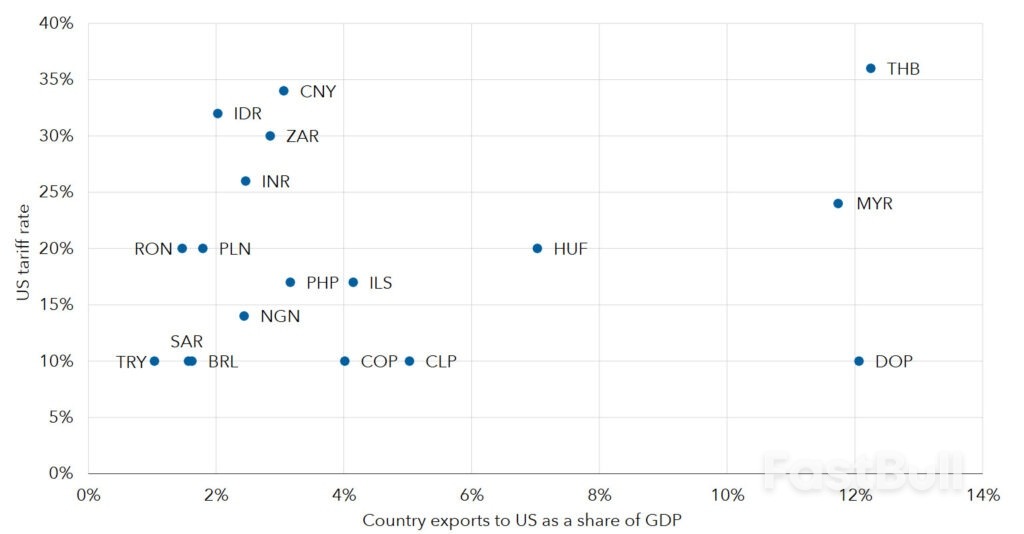
          It is difficult to determine the precise impact of tariffs on emerging market economic activity. There are too many moving parts, including the possibility of negotiated reductions, retaliatory actions by US trading partners and fluctuations in the currencies of affected economies.
          That said, we can look at the current level of tariffs and exports to the US to give us an idea about the extent of EM gross domestic product that is at risk (see Figure 1). Economic theory suggests that tariffs should lead to weaker exports and reduce domestic inflation in the tradable goods sector.

          First-order impact

          Based on the level of tariffs as of 8 April, Asia will bear the brunt, with Latin America coming off better. Elsewhere, Central and Eastern Europe countries have limited trade with the US, so any direct impact will be relatively muted. Most Middle Eastern countries are only facing the baseline tariffs, while energy might be excluded. Africa is a mixed bag, with some markets at or close to the baseline and others more significant.
          There is also a more indirect impact that will be felt by countries that are more trade-orientated and integrated in global supply chains. Tariffs will result in a drag to the overall trade cycle, reducing exports and growth. Asia will be in the firing line, given trade links with China, but also CEE and Türkiye given their links to the European Union.

          Figure 1. Direct impact from tariffs on EM countries

          Tariff rate and exports to the US
          Emerging markets and tariffs: Asia will bear the brunt_1

          Source: DataStream and White House. As at 7 April 2025.

          THB = Thailand, MYR = Malaysia, DOP = Dominican Republic, HUF = Hungary, CLP = Chile, COP = Colombia, ILS = Israel, PHP = Philippines, NGN = Nigeria, CNY = China, ZAR = South Africa, INR = India, IDR = Indonesia, PLN = Poland, BRL = Brazil, SAR = Saudi Arabia, RON = Romania, TRY = Türkiye.

          Secondary effects

          Secondary effects are likely to dominate EMs through the following channels.
          Slower US growth is expected, but there is a possible upside from China stimulus. Higher US import prices will negatively impact domestic consumers, while the uncertainty around tariffs might cause businesses to postpone investment and hiring. Slower US/global growth (and potentially a recession) has the potential to impact EM countries through weaker demand for exports, lower tourism and remittances. That said, a significant stimulus package from China, if it materialises, could offset some of the weakness in US growth.
          Oil prices have dropped, which will affect EM countries differently. Saudi Arabia is the most exposed among Gulf Cooperation Council economies, while the United Arab Emirates remains the most diversified. Meanwhile, lower oil prices will be a significant positive for the big energy importers like India and Türkiye, where the benefits could outweigh the negative impact of slower US growth.
          Lower EM inflation looks likely. Unlike the US, which is facing higher inflation risks, tariffs might heighten deflationary pressure in China, which may then spill over to other EMs. With Chinese exporters increasingly excluded from the US market, Chinese goods might be redirected to other countries, thereby lowering prices in those economies. Weaker global growth and lower commodity prices may also lead to lower EM inflation.
          Market sentiment is currently weak, but core EM should be resilient. The last few years have seen a bifurcated EM universe emerge, consisting of higher-rated core EM countries and lower-rated frontier economies. Lower-rated economies may struggle with a prolonged downturn in market sentiment, with some of them only regaining access to international markets fairly recently. The more developed core countries, meanwhile, have altered their borrowing characteristics to become less reliant on short-term foreign borrowing than in the past. Many of these countries have strong enough external balance sheets and access to capital to withstand any volatility.
          With tariffs specifically, markets will also be determining which EMs have a higher share of household consumption in their GDP and a higher share of services in their export basket, as well as those that have the fiscal and monetary headroom to support their economies if needed.

          Investing in this environment

          EM credit: EMs with lower external vulnerabilities and smaller internal imbalances offer greater market resilience and more flexibility for policy-makers to address external risks. That said, spreads are generally fairly tight in these higher-rated economies. Currently, we see opportunities in certain Latin American corporates, where companies are expected to have a competitive advantage due to the relatively lower tariffs imposed. Additionally, the companies and sectors we favour are generally not overly dependent on the US.
          Exchange rates: In theory, the dollar should be stronger because there is greater demand for US dollars and lower demand for foreign currencies. But longer term, tariffs may reduce US growth, leading to lower real rates, which both tend to weaken the dollar. Current dollar weakness most likely reflects the lack of clarity on tariffs and their impact on US growth.
          As well as any impact from the dollar, EM currencies could be more directly impacted through the trade channel and growth concerns/market sentiment. Regionally, EM Asian currencies might weaken the most, especially if this supports exports in the face of tariffs. CEE could fare better given their higher correlation to the euro, while Latin American currencies could outperform given the region’s relatively better outcome.
          EM local currency debt: During the pandemic, many major EM central banks allowed weaker currencies and cut interest rates to support growth. We could see a similar approach now, especially given current levels of real rates, inflation dynamics, lower commodity prices and the softening dollar. More developed EM countries might focus more on their domestic mandates, relying less on guidance from the Federal Reserve.
          We anticipate the most policy easing in Asia, where inflation is at or below target levels and real interest rates remain in restrictive territory. There are several opportunities in Asian duration, particularly in Indonesia, which offers high real rates and stable low inflation. India’s large deficits are mitigated by local funding and a multi-year tightening trend, making it an attractive option for longer-duration investments.
          We also see duration opportunities in Latin American countries. Mexico and Brazil are particularly noteworthy, both offering relatively high yields. Mexico is experiencing a slowdown in inflation and economic activity, combined with a relatively stable currency, which should pave the way for further rate cuts. Brazil has historically been less affected by tariff-induced volatility due to its relatively closed economy, and aggressive rate hikes have helped stabilise its macroeconomic environment.
          Overall, the high carry of select EM positions should provide a sufficient income cushion against any meaningful slowdown in global growth.

          Source:Kirstie Spence

          To stay updated on all economic events of today, please check out our Economic calendar
          Risk Warnings and Disclaimers
          You understand and acknowledge that there is a high degree of risk involved in trading. Following any strategies or investment methods may lead to potential losses. The content on the site is provided by our contributors and analysts for information purposes only. You are solely responsible for determining whether any trading assets, securities, strategy, or any other product is suitable for investing based on your own investment objectives and financial situation.
          Add to Favorites
          Share
          FastBull
          Copyright © 2025 FastBull Ltd

          728 RM B 7/F GEE LOK IND BLDG NO 34 HUNG TO RD KWUN TONG KLN HONG KONG

          TelegramInstagramTwitterfacebooklinkedin
          App Store Google Play Google Play
          Products
          Charts

          Chats

          Q&A with Experts
          Screeners
          Economic Calendar
          Data
          Tools
          Membership
          Features
          Function
          Markets
          Copy Trading
          Latest Signals
          Contests
          News
          Analysis
          24/7
          Columns
          Education
          Company
          Careers
          About Us
          Contact Us
          Advertising
          Help Center
          Feedback
          User Agreement
          Privacy Policy
          Business

          White Label

          Data API

          Web Plug-ins

          Poster Maker

          Affiliate Program

          Risk Disclosure

          The risk of loss in trading financial instruments such as stocks, FX, commodities, futures, bonds, ETFs and crypto can be substantial. You may sustain a total loss of the funds that you deposit with your broker. Therefore, you should carefully consider whether such trading is suitable for you in light of your circumstances and financial resources.

          No decision to invest should be made without thoroughly conducting due diligence by yourself or consulting with your financial advisors. Our web content might not suit you since we don't know your financial conditions and investment needs. Our financial information might have latency or contain inaccuracy, so you should be fully responsible for any of your trading and investment decisions. The company will not be responsible for your capital loss.

          Without getting permission from the website, you are not allowed to copy the website's graphics, texts, or trademarks. Intellectual property rights in the content or data incorporated into this website belong to its providers and exchange merchants.

          Not Logged In

          Log in to access more features

          FastBull Membership

          Not yet

          Purchase

          Become a signal provider
          Help Center
          Customer Service
          Dark Mode
          Price Up/Down Colors

          Log In

          Sign Up

          Position
          Layout
          Fullscreen
          Default to Chart
          The chart page opens by default when you visit fastbull.com