• Trade
  • Markets
  • Copy
  • Contests
  • News
  • 24/7
  • Calendar
  • Q&A
  • Chats
Trending
Screeners
SYMBOL
LAST
BID
ASK
HIGH
LOW
NET CHG.
%CHG.
SPREAD
SPX
S&P 500 Index
6827.42
6827.42
6827.42
6899.86
6801.80
-73.58
-1.07%
--
DJI
Dow Jones Industrial Average
48458.04
48458.04
48458.04
48886.86
48334.10
-245.98
-0.51%
--
IXIC
NASDAQ Composite Index
23195.16
23195.16
23195.16
23554.89
23094.51
-398.69
-1.69%
--
USDX
US Dollar Index
97.990
98.070
97.990
98.070
97.920
+0.040
+ 0.04%
--
EURUSD
Euro / US Dollar
1.17301
1.17308
1.17301
1.17447
1.17283
-0.00093
-0.08%
--
GBPUSD
Pound Sterling / US Dollar
1.33572
1.33582
1.33572
1.33740
1.33546
-0.00135
-0.10%
--
XAUUSD
Gold / US Dollar
4340.10
4340.53
4340.10
4345.46
4294.68
+40.71
+ 0.95%
--
WTI
Light Sweet Crude Oil
57.474
57.511
57.474
57.601
57.194
+0.241
+ 0.42%
--

Community Accounts

Signal Accounts
--
Profit Accounts
--
Loss Accounts
--
View More

Become a signal provider

Sell trading signals to earn additional income

View More

Guide to Copy Trading

Get started with ease and confidence

View More

Signal Accounts for Members

All Signal Accounts

Best Return
  • Best Return
  • Best P/L
  • Best MDD
Past 1W
  • Past 1W
  • Past 1M
  • Past 1Y

All Contests

  • All
  • Trump Updates
  • Recommend
  • Stocks
  • Cryptocurrencies
  • Central Banks
  • Featured News
Top News Only
Share

India's November Soyoil Imports At 370661 Tonnes Versus 454619 Tonnes In October

Share

India's November Sunflower Oil Imports At 142953 Tonnes Versus 260548 Tonnes In October

Share

India's November Palm Oil Imports At 632341 Tonnes Versus 602381 Tonnes In October

Share

India's November Vegetable Oil Imports At 1183,832 Tonnes Versus 1332,173 Million Tonnes In October

Share

Reuters Poll - Bank Indonesia To Keep 7-Day Reverse Repo Rate Unchanged At 4.75% On December 17, Say 18 Of 31 Economists

Share

Statistics Finland - Finland Nov CPI -0.1% Year-On-Year

Share

Saudi Nov CPI 0.1% Month-On-Month

Share

Saudi Nov CPI 1.9% Year-On-Year

Share

South Korea Petrochemical Exports To Fall 6.1% In 2026 - Kcci

Share

U.S. Stock Futures Rose Slightly, With S&P 500 Futures And Dow Jones Futures Up 0.3% And NASDAQ 100 Futures Up Nearly 0.3%

Share

Spot Gold Rose $9 To $4,338.5 Per Ounce In The Short Term; New York Gold Futures Rose 1.00% On The Day, Currently Trading At $4,371.60 Per Ounce

Share

Dollar/Yen Extends Fall, Down 0.47% To 155.10

Share

Bank Of Japan: Two Branches Expect Higher Pay Rises In Fiscal Year 2026, While Two Other Branches Expect Wage Growth To Slow

Share

Bloomberg News: Bank Of Japan To Start Selling ETF Holdings As Early As January

Share

Malaysia Says Special ASEAN Foreign Ministers Meeting Scheduled For Dec 16 Delayed To Dec 22 At Thailand's Request

Share

Bank Of Japan: Wages Of Part-Time Employees Are Being Raised Reflecting Relatively High Minimum Wage Growth In Fiscal 2025

Share

Bank Of Japan: Firms' Wage Growth Outlook Due To Need For Retaining Staff Amid Persistent, Severe Labour Shortages

Share

Bank Of Japan - While Large And Medium-Sized Firms Were Likely To Be Able To Raise As Much Wages In FY 2026 As They Did In FY 2025, It Would Be Difficult For Small Firms To Raise As Much Wages In FY 2026 As In FY 2025

Share

Bank Of Japan: Most Companies Seem To Believe That Wage Increases In Fiscal Year 2026 Should Be The Same As Or Similar To Those In Fiscal Year 2025

Share

Bank Of Japan: Number Of Firms Expecting A Clear Improvement In Their Profits Is Not Large

TIME
ACT
FCST
PREV
U.K. Trade Balance Non-EU (SA) (Oct)

A:--

F: --

P: --

France HICP Final MoM (Nov)

A:--

F: --

P: --

China, Mainland Outstanding Loans Growth YoY (Nov)

A:--

F: --

P: --

China, Mainland M2 Money Supply YoY (Nov)

A:--

F: --

P: --

China, Mainland M0 Money Supply YoY (Nov)

A:--

F: --

P: --

China, Mainland M1 Money Supply YoY (Nov)

A:--

F: --

P: --

India CPI YoY (Nov)

A:--

F: --

P: --

India Deposit Gowth YoY

A:--

F: --

P: --

Brazil Services Growth YoY (Oct)

A:--

F: --

P: --

Mexico Industrial Output YoY (Oct)

A:--

F: --

P: --

Russia Trade Balance (Oct)

A:--

F: --

P: --

Philadelphia Fed President Henry Paulson delivers a speech
Canada Building Permits MoM (SA) (Oct)

A:--

F: --

P: --

Canada Wholesale Sales YoY (Oct)

A:--

F: --

P: --

Canada Wholesale Inventory MoM (Oct)

A:--

F: --

P: --

Canada Wholesale Inventory YoY (Oct)

A:--

F: --

P: --

Canada Wholesale Sales MoM (SA) (Oct)

A:--

F: --

P: --

Germany Current Account (Not SA) (Oct)

A:--

F: --

P: --

U.S. Weekly Total Rig Count

A:--

F: --

P: --

U.S. Weekly Total Oil Rig Count

A:--

F: --

P: --

Japan Tankan Small Manufacturing Outlook Index (Q4)

A:--

F: --

P: --

Japan Tankan Large Non-Manufacturing Diffusion Index (Q4)

A:--

F: --

P: --

Japan Tankan Large Non-Manufacturing Outlook Index (Q4)

A:--

F: --

P: --

Japan Tankan Large Manufacturing Outlook Index (Q4)

A:--

F: --

P: --

Japan Tankan Small Manufacturing Diffusion Index (Q4)

A:--

F: --

P: --

Japan Tankan Large Manufacturing Diffusion Index (Q4)

A:--

F: --

P: --

Japan Tankan Large-Enterprise Capital Expenditure YoY (Q4)

A:--

F: --

P: --

U.K. Rightmove House Price Index YoY (Dec)

A:--

F: --

P: --

China, Mainland Industrial Output YoY (YTD) (Nov)

A:--

F: --

P: --

China, Mainland Urban Area Unemployment Rate (Nov)

A:--

F: --

P: --

Saudi Arabia CPI YoY (Nov)

A:--

F: --

P: --

Euro Zone Industrial Output YoY (Oct)

--

F: --

P: --

Euro Zone Industrial Output MoM (Oct)

--

F: --

P: --

Canada Existing Home Sales MoM (Nov)

--

F: --

P: --

Euro Zone Total Reserve Assets (Nov)

--

F: --

P: --

U.K. Inflation Rate Expectations

--

F: --

P: --

Canada National Economic Confidence Index

--

F: --

P: --

Canada New Housing Starts (Nov)

--

F: --

P: --

U.S. NY Fed Manufacturing Employment Index (Dec)

--

F: --

P: --

U.S. NY Fed Manufacturing Index (Dec)

--

F: --

P: --

Canada Core CPI YoY (Nov)

--

F: --

P: --

Canada Manufacturing Unfilled Orders MoM (Oct)

--

F: --

P: --

U.S. NY Fed Manufacturing Prices Received Index (Dec)

--

F: --

P: --

U.S. NY Fed Manufacturing New Orders Index (Dec)

--

F: --

P: --

Canada Manufacturing New Orders MoM (Oct)

--

F: --

P: --

Canada Core CPI MoM (Nov)

--

F: --

P: --

Canada Trimmed CPI YoY (SA) (Nov)

--

F: --

P: --

Canada Manufacturing Inventory MoM (Oct)

--

F: --

P: --

Canada CPI YoY (Nov)

--

F: --

P: --

Canada CPI MoM (Nov)

--

F: --

P: --

Canada CPI YoY (SA) (Nov)

--

F: --

P: --

Canada Core CPI MoM (SA) (Nov)

--

F: --

P: --

Canada CPI MoM (SA) (Nov)

--

F: --

P: --

Federal Reserve Board Governor Milan delivered a speech
U.S. NAHB Housing Market Index (Dec)

--

F: --

P: --

Australia Composite PMI Prelim (Dec)

--

F: --

P: --

Australia Services PMI Prelim (Dec)

--

F: --

P: --

Australia Manufacturing PMI Prelim (Dec)

--

F: --

P: --

Japan Manufacturing PMI Prelim (SA) (Dec)

--

F: --

P: --

U.K. Unemployment Claimant Count (Nov)

--

F: --

P: --

U.K. Unemployment Rate (Nov)

--

F: --

P: --

Q&A with Experts
    • All
    • Chatrooms
    • Groups
    • Friends
    Connecting
    .
    .
    .
    Type here...
    Add Symbol or Code

      No matching data

      All
      Trump Updates
      Recommend
      Stocks
      Cryptocurrencies
      Central Banks
      Featured News
      • All
      • Russia-Ukraine Conflict
      • Middle East Flashpoint
      • All
      • Russia-Ukraine Conflict
      • Middle East Flashpoint
      Search
      Products

      Charts Free Forever

      Chats Q&A with Experts
      Screeners Economic Calendar Data Tools
      Membership Features
      Data Warehouse Market Trends Institutional Data Policy Rates Macro

      Market Trends

      Market Sentiment Order Book Forex Correlations

      Top Indicators

      Charts Free Forever
      Markets

      News

      News Analysis 24/7 Columns Education
      From Institutions From Analysts
      Topics Columnists

      Latest Views

      Latest Views

      Trending Topics

      Top Columnists

      Latest Update

      Signals

      Copy Rankings Latest Signals Become a signal provider AI Rating
      Contests
      Brokers

      Overview Brokers Assessment Rankings Regulators News Claims
      Broker listing Forex Brokers Comparison Tool Live Spread Comparison Scam
      Q&A Complaint Scam Alert Videos Tips to Detect Scam
      More

      Business
      Events
      Careers About Us Advertising Help Center

      White Label

      Data API

      Web Plug-ins

      Affiliate Program

      Awards Institution Evaluation IB Seminar Salon Event Exhibition
      Vietnam Thailand Singapore Dubai
      Fans Party Investment Sharing Session
      FastBull Summit BrokersView Expo
      Recent Searches
        Top Searches
          Markets
          News
          Analysis
          User
          24/7
          Economic Calendar
          Education
          Data
          • Names
          • Latest
          • Prev

          View All

          No data

          Scan to Download

          Faster Charts, Chat Faster!

          Download App
          English
          • English
          • Español
          • العربية
          • Bahasa Indonesia
          • Bahasa Melayu
          • Tiếng Việt
          • ภาษาไทย
          • Français
          • Italiano
          • Türkçe
          • Русский язык
          • 简中
          • 繁中
          Open Account
          Search
          Products
          Charts Free Forever
          Markets
          News
          Signals

          Copy Rankings Latest Signals Become a signal provider AI Rating
          Contests
          Brokers

          Overview Brokers Assessment Rankings Regulators News Claims
          Broker listing Forex Brokers Comparison Tool Live Spread Comparison Scam
          Q&A Complaint Scam Alert Videos Tips to Detect Scam
          More

          Business
          Events
          Careers About Us Advertising Help Center

          White Label

          Data API

          Web Plug-ins

          Affiliate Program

          Awards Institution Evaluation IB Seminar Salon Event Exhibition
          Vietnam Thailand Singapore Dubai
          Fans Party Investment Sharing Session
          FastBull Summit BrokersView Expo

          What do Trump's revised tariff rates mean for global markets?

          Adam

          Economic

          Summary:

          Trump’s delayed tariffs and revised rates sparked mild market volatility. Stocks dipped, currencies of targeted countries weakened, and traders eyed key technical levels amid uncertainty and ongoing trade negotiations.
          Trump pushes back tariff timeline with revised rates

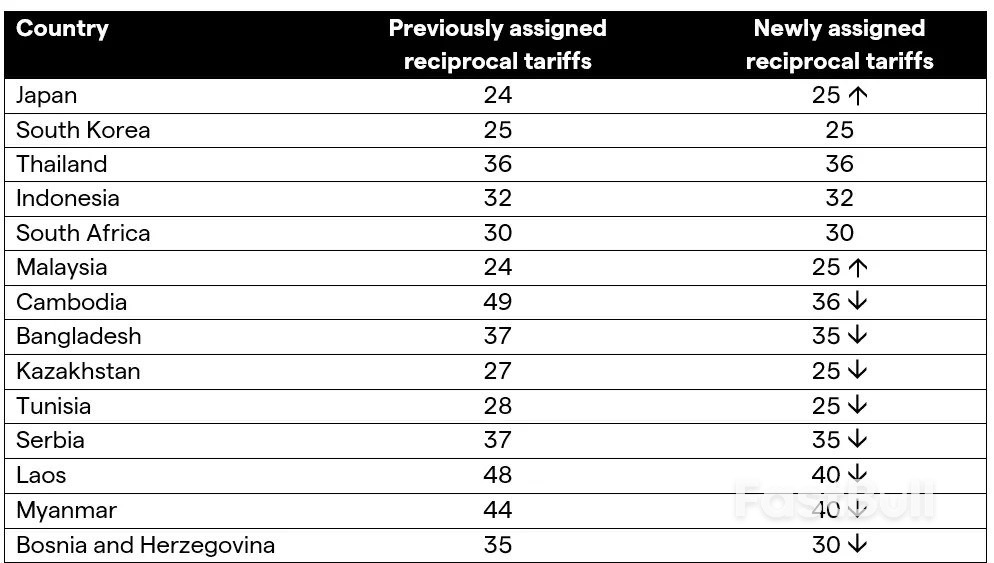
          President Trump announced overnight a significant shift in his trade policy, postponing the implementation of reciprocal tariffs from 9 July to 1 August. The revised plan includes adjusted tariff rates for 14 countries, with the White House indicating more announcements will follow.
          The latest development has created considerable uncertainty across global markets. The timing change suggests the administration is still fine-tuning its approach to international trade relationships.

          Strategic tariff approach targets countries and sectors

          The latest tariff announcement covers 14 countries with rates ranging from 25% to 40%. Japan's rate increased from 24% to 25%, while Cambodia saw a significant reduction from 49% to 36%.
          Notable exclusions from this round include major trading partners such as the European Union, Taiwan, and India, suggesting these economies maybe still under trade negotiations. China, Mexico, and Canada are expected to have separate discussions due to existing trade agreements.
          Beyond country-specific measures, the Trump administration is expected to announce sector-specific levies in due course. So far, automobiles, steel and aluminium already face specific tariffs. The probe on other sectors have begun with current investigations covering industries such as semiconductors, pharmaceutical goods, copper, and timber. When combined with country-specific tariffs, the impact on prices of goods and services can be far more severe than current levels suggest.
          Figure 1: Reciprocal tariffs assigned
          What do Trump's revised tariff rates mean for global markets?_1
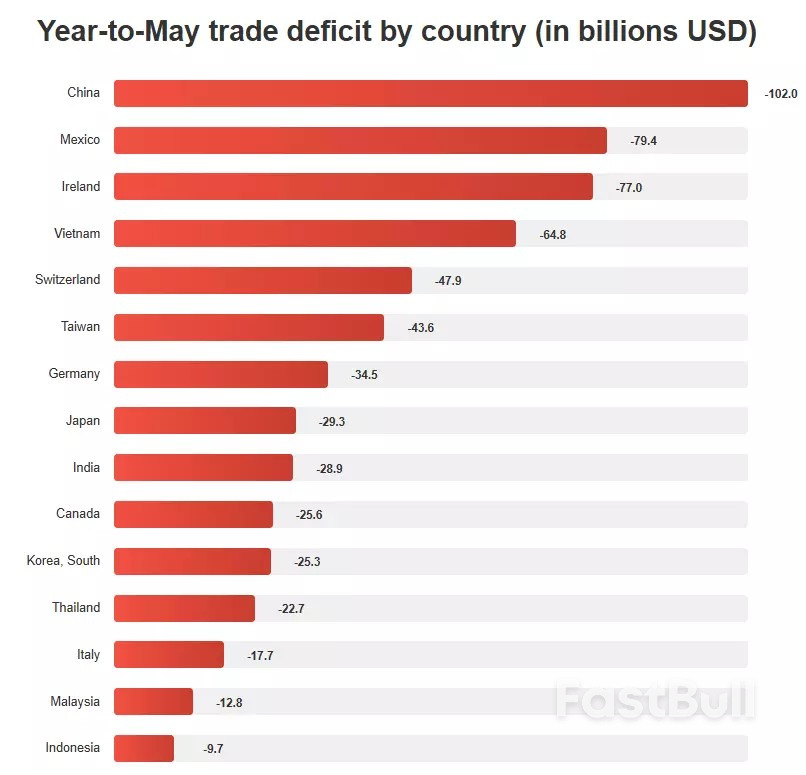
          Figure 2: Year-to-May trade deficit by country
          What do Trump's revised tariff rates mean for global markets?_2

          Market reaction remains contained despite uncertainty

          US equity markets responded negatively to the tariff announcement, with the Dow Jones falling 422 points or 0.9%. The Nasdaq 100 declined by 0.8%, reflecting investor concerns about trade disruptions. Export-focused companies bore the brunt of the selling pressure. Toyota Motor's ADR declined 4% in US trading.
          The VIX volatility index spiked to 18.5 before settling at 17.8, indicating heightened market anxiety. Gold prices remained relatively stable despite the uncertainty.
          Currency markets showed more dramatic moves, with affected countries' currencies weakening sharply against the US dollar. The South African Rand plunged 1.95%, while the Japanese Yen and Korean Won dropped 1.2% and 1.0% respectively.
          However, compared to the market's reaction in April following the Liberation Day announcements, which triggered a sell-off of over 6% and 8% in a day for the S&P 500 and Nikkei 225 indices respectively, the moves we have seen are relatively small. This suggests markets may be becoming more accustomed to flip flops in Trump's policies or welcomed the delayed implementation as this provided three more weeks for countries to negotiate.

          Technical analysis reveals key market levels

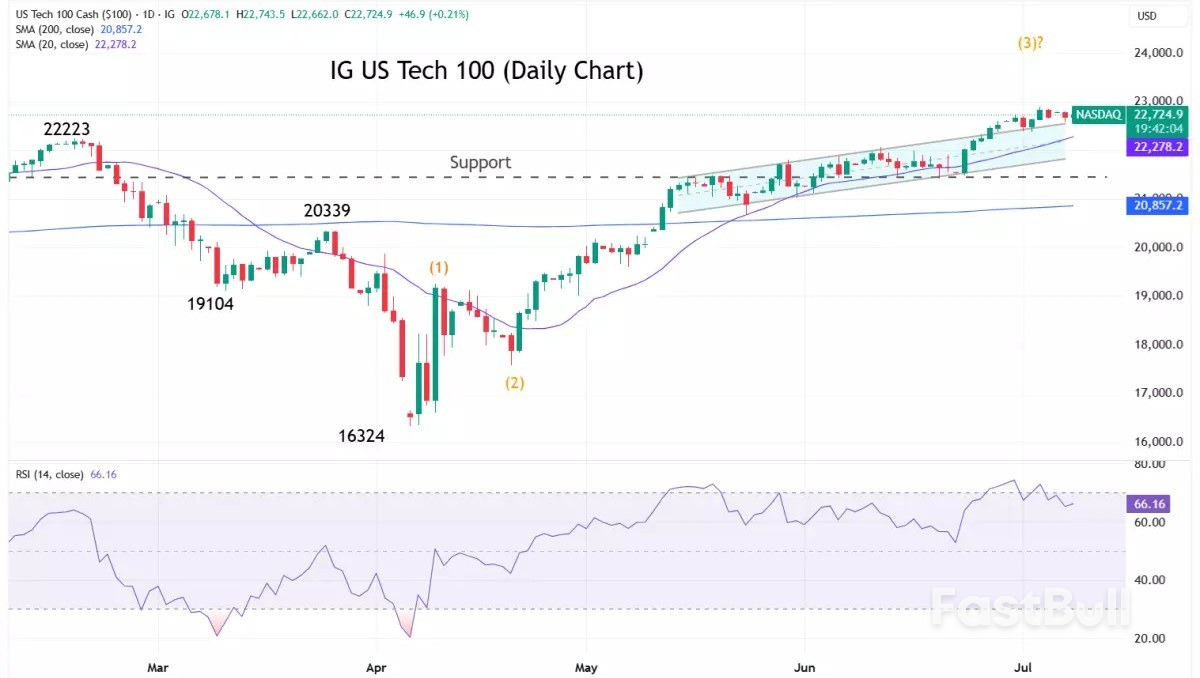
          The US Tech 100 index sits at a crucial technical juncture following yesterday's decline. The pullback has brought the index back to the upper boundary of its ascending channel from mid-May.
          Support at 22,500 represents a critical level for the index. Failure to hold above this point could trigger a deeper correction towards 21,500 support.
          A decisive rebound from current levels could see the index test the psychological resistance at 23,000. This level would represent a continuation of the recent upward trend.
          Figure 3: US Tech 100 index (daily) price chart
          What do Trump's revised tariff rates mean for global markets?_3
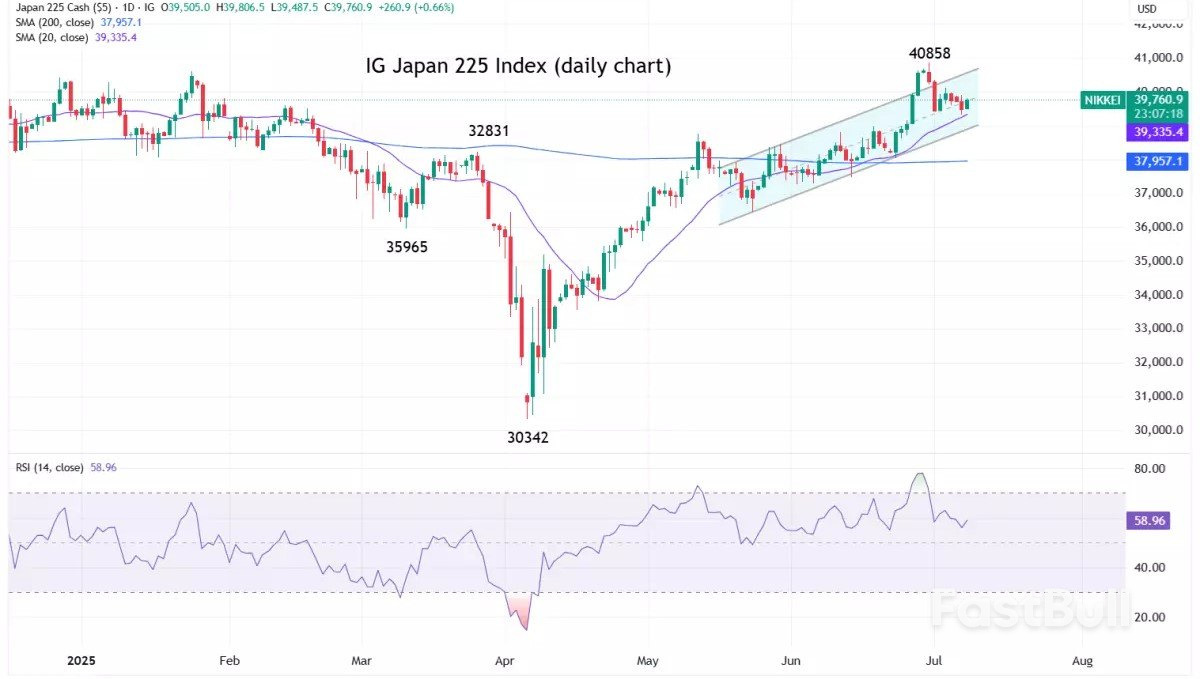
          The Japan 225 index shows a robust uptrend, trading comfortably above its 200-day simple moving average. The ascending channel's lower boundary from mid-May provides solid support around 38,930, though upside potential remains capped by the recent peak at 40,858. This technical setup suggests the index maintains bullish momentum despite short-term headwinds from tariff concerns.
          Figure 4: Japan 225 index (daily) price chart
          What do Trump's revised tariff rates mean for global markets?_4
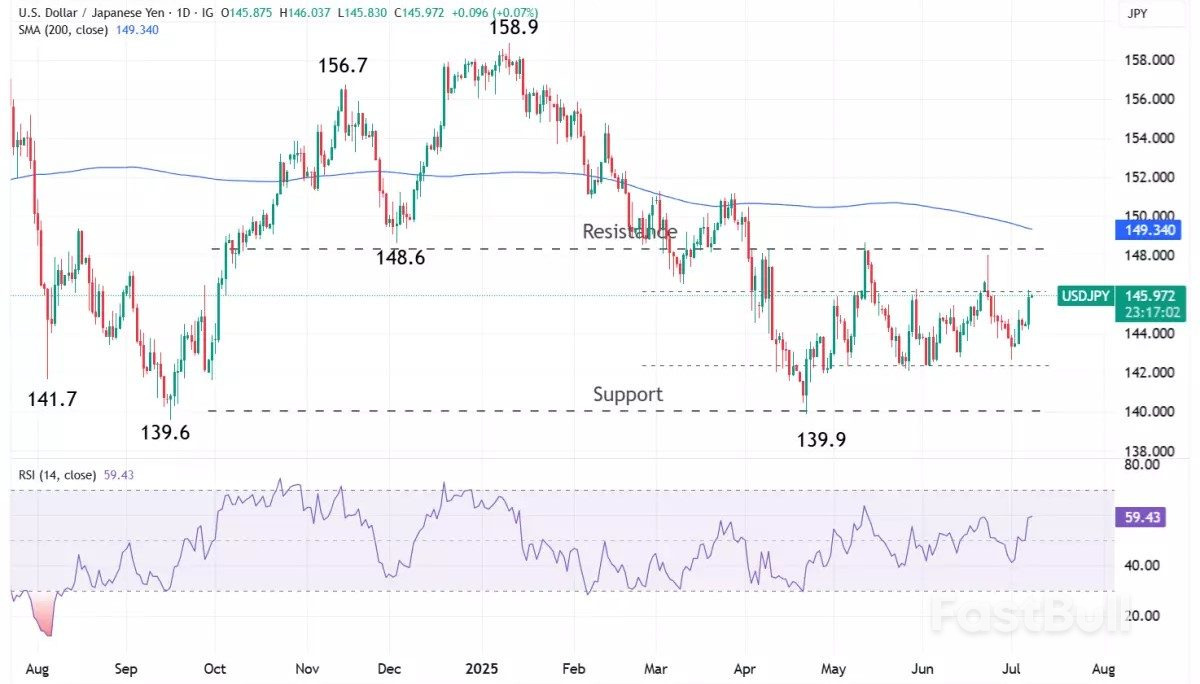
          The USD/JPY pair faces a critical decision point at the 146 resistance level. This level has capped advances on three occasions over the past three months.
          A break above 146 would likely propel the pair towards 148 before encountering selling pressure. This move would signal renewed dollar strength against the yen. Conversely, a decline below 142.5 could trigger a test of April's low at 139.9. Such a move would indicate tariff concerns are weighing on dollar sentiment.
          Figure 5: USD/JPY (daily) price chart
          What do Trump's revised tariff rates mean for global markets?_5

          Source: ig

          To stay updated on all economic events of today, please check out our Economic calendar
          Risk Warnings and Disclaimers
          You understand and acknowledge that there is a high degree of risk involved in trading. Following any strategies or investment methods may lead to potential losses. The content on the site is provided by our contributors and analysts for information purposes only. You are solely responsible for determining whether any trading assets, securities, strategy, or any other product is suitable for investing based on your own investment objectives and financial situation.
          Add to Favorites
          Share

          In the Fed's hunt for a reason to cut rates, surveys and tariffs make answers elusive

          Adam

          Economic

          Recent national and global surveys of business executives have highlighted the U.S. Federal Reserve's dilemma in determining if slowing growth or inflation is the greater risk to the U.S. economy, with interest rate decisions hinging on how policymakers reconcile conflicting information in a still volatile trade environment.
          With new economic data pulling the Fed in both directions, surveys of U.S. chief financial officers from the Fed and of global executives from Dun & Bradstreet show business leaders expect the tension to continue as they plan price increases while also anticipating weaker revenue and demand.
          That outlook, and the uncertainty around it, could leave the Fed waiting longer than expected before cutting interest rates, a recipe for even more tension with President Donald Trump. Trump last week repeated his call for steep rate cuts and for Fed Chair Jerome Powell to resign, while Treasury Secretary Scott Bessent said the Fed's rate posture was "a little off."
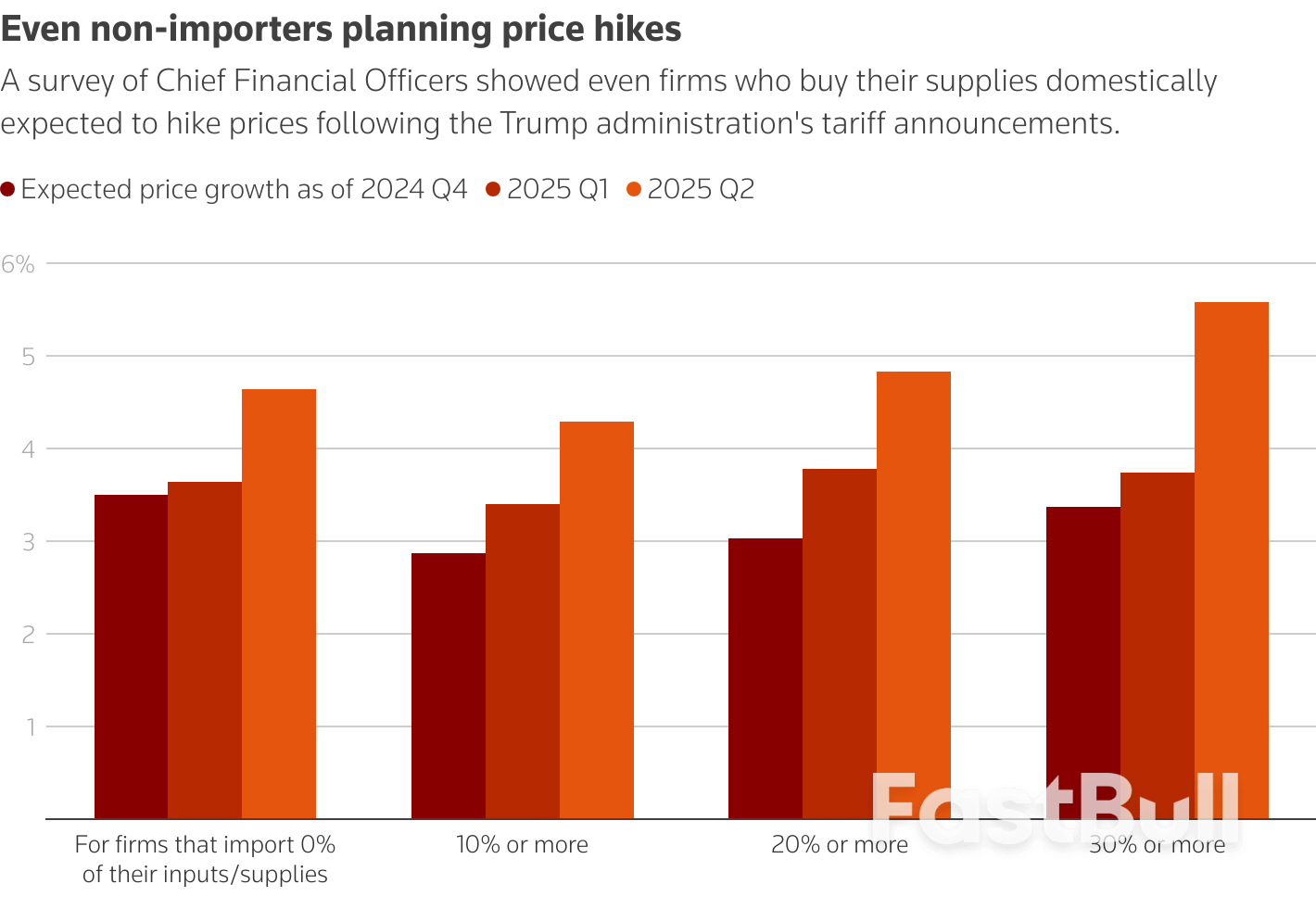
          The CFO survey, conducted by the Atlanta and Richmond Federal Reserve banks with Duke University, indicated executives plan to increase prices, even at companies not exposed to rising tariffs, a dynamic many Fed officials fear could mean more persistent inflation is on the way. Policymakers inclined to cut rates sooner argue that tariffs may cause a one-time price shock but not ongoing inflation.
          In the Fed's hunt for a reason to cut rates, surveys and tariffs make answers elusive _1

          Bar chart showing expected price increases for firms based on their import dependence.

          "The concern you'd have in this environment is...the price pressures broaden beyond those that are just directly impacted" by tariffs, Atlanta Fed economist and assistant vice president Brent Meyer told Reuters. "We're seeing some evidence of that, at least an expectation," in CFO survey responses.
          Atlanta Fed President Raphael Bostic said recently he worried it could take a year or more for firms to adjust to coming tariffs, with "a pretty significant risk that upward pressure on prices and inflation is going to be with us for some time."
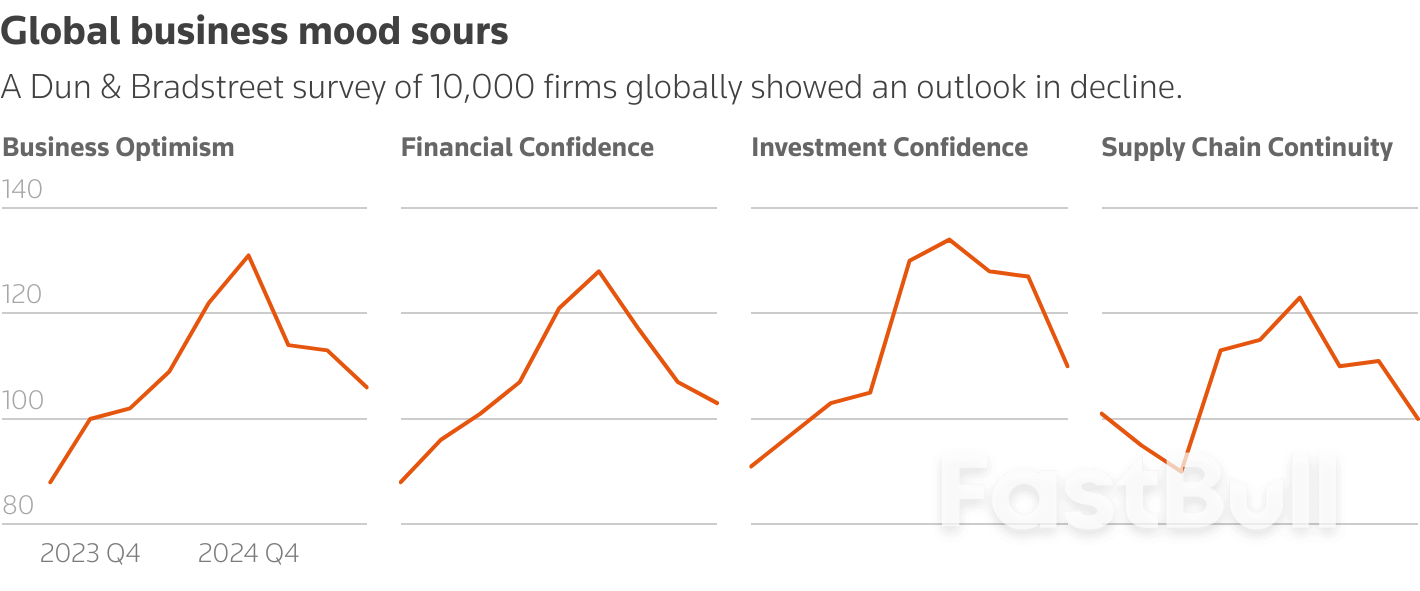
          A Dun & Bradstreet survey of 10,000 businesses globally, meanwhile, showed a clear break in sentiment early this year when Trump's tariff plans became clear, with firms scrambling to reorganize supply chains and become less dependent on U.S. markets or production. While that could embed higher cost into supply chains, Dun & Bradstreet Chief Global Economist Arun Singh said the survey overall told a story of slower expected growth.
          In the Fed's hunt for a reason to cut rates, surveys and tariffs make answers elusive _2

          Line charts showing global business mood.

          The quarterly poll has tracked steady declines in overall optimism, worries about the durability of supply chains, and concern that central bank interest rate cuts had "not yet translated into tangible improvements in borrowing conditions for many businesses."
          Businesses "do not seem to be in a mood to think well, okay, we'll get some tariffs and that will be that. We'll all move on," Singh said. "The overall economic concern is not going to be short-lived...There's a delay in capital expenditure. They're delaying payment to their vendors...They're trying to de-lever."
          Powell at a press conference following the Fed's June meeting said businesses had been "in a bit of shock" following Trump's April 2 announcement of steep global tariffs, but sentiment now "feels much more positive and constructive than it did three months ago."
          Nevertheless, he said, firms still must decide how to cope with far higher-than-expected tariffs, with many rates still not finalized. After markets reacted poorly to Trump's April 2 announcement, he postponed many tariffs until July 9 while his administration negotiated with other countries, then moved the deadline back to August 1 while beginning to roll out large, unilateral levies in the absence of finished deals.
          Given the high level of uncertainty surrounding White House policy, Fed officials say they are paying particular attention to surveys, interviews with business leaders, and other "soft" data to provide a real-time sense of how decision makers are responding.
          The broad sense among corporate officials that they will be raising prices, for example, is a key reason the Fed is reluctant to cut rates and risk adding to any coming inflation with looser credit that could encourage more household and business spending. Its rate has been in the 4.25%-to-4.50% range since December.
          Investors expect cuts beginning in September.
          But the Fed's 19 policymakers were closely divided in their most recent projections, with 10 seeing several cuts this year and nine effectively pushing easier monetary policy into 2026.
          Powell has said repeatedly, and over Trump's calls for big rate cuts, that data and the outlook will determine if cuts are warranted, and so far the case has not been made.
          The unemployment rate fell to 4.1% in June and firms added a healthy 147,000 new jobs. Consumer spending may be slowing, but recent inflation was higher than expected.
          A recent JPMorgan Chase Institute study showed why the current moment is tough to assess.
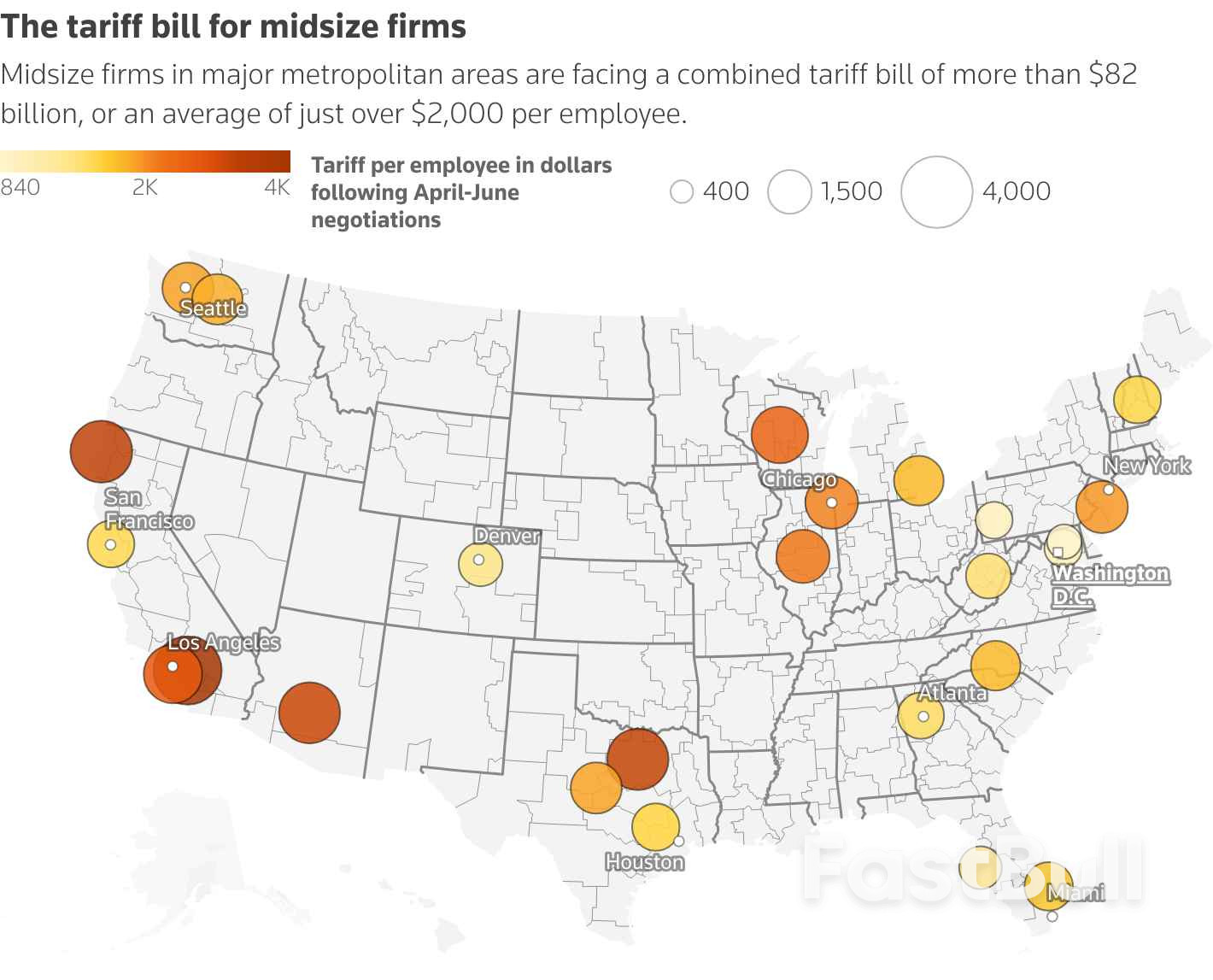
          Middle-market firms with between $10 million and $1 billion in revenue, accounting for about a third of U.S. employment, face a tariff bill exceeding $82 billion based on levies currently in place. They must determine whether that can be forced back on producers, passed on to consumers, or must be absorbed through lower profits or internal cost-cutting.
          In the Fed's hunt for a reason to cut rates, surveys and tariffs make answers elusive _3

          Map showing which metro area's firms are facing the largest tariff bills.

          "They are large enough to be exposed to tariffs, large enough to be direct importers, but not large enough to have the power to manage margins," as effectively as major national retailers, for example, said institute president Chris Wheat, adding it will take time to determine how much of the extra costs end up paid by producers, passed on to consumers, or absorbed through lower profits and internal cost-cutting.
          CFOs in the Fed survey said they had in some cases doubled planned price increases for the coming year. Often those planned price hikes outstripped expected revenue growth, implying that firms also expect slower business, an outcome that could leave the Fed coping with stagflation.
          "Our sense is that these tariffs for the U.S. economy will be a stag-flationary shock," said Citi Chief Global Economist Nathan Sheets, pushing the economy "in the direction of having higher inflation, lower growth."

          source :reuters

          To stay updated on all economic events of today, please check out our Economic calendar
          Risk Warnings and Disclaimers
          You understand and acknowledge that there is a high degree of risk involved in trading. Following any strategies or investment methods may lead to potential losses. The content on the site is provided by our contributors and analysts for information purposes only. You are solely responsible for determining whether any trading assets, securities, strategy, or any other product is suitable for investing based on your own investment objectives and financial situation.
          Add to Favorites
          Share

          Treasury Secretary Bessent To Visit Japan Next Week For Expo

          Thomas

          Economic

          US Treasury Secretary Scott Bessent is planning to visit Japan next week for the 2025 World Expo in Osaka, according to people familiar with the matter.

          The Expo is taking place in Osaka through to mid-October. The US will celebrate its National Day at the Expo on July 19.

          The visit would come after US President Donald Trump sent a letter on Monday stating his intention to raise tariffs on all Japanese imports to 25%, effective Aug. 1, slightly higher than the 24% rate initially announced in April.

          The trip would also mark Bessent’s first visit to Japan since the trade negotiations started in April. Tokyo’s point man on trade talks, Ryosei Akazawa, has traveled to Washington seven times during that time.

          Bessent and Akazawa spoke on the phone for 30 minutes Tuesday following the issuing of Trump’s letter, according to a statement by Japan’s Ministry of Foreign Affairs. The statement said the two officials had a frank, in-depth discussion and agreed to continue vigorous consultations. The statement didn’t mention any upcoming visit to Japan.

          A senior US official said the purpose of the trip to Japan is in Bessent’s capacity as head of the American delegation to the Expo. There will be no formal bilateral meetings or discussions of trade, the official said.

          Treasury did not immediately respond to a request for comment. Officials from Japan’s Ministry of Foreign Affairs were not immediately available for comment.

          Japan was initially seen as a promising partner for a quick deal, but the negotiations hit a roadblock over car tariffs. The sector accounts for more than 80% of the US’s trade deficit with Japan, while it’s a key employer and growth engine for the Japanese economy.

          Source: Bloomberg Europe

          To stay updated on all economic events of today, please check out our Economic calendar
          Risk Warnings and Disclaimers
          You understand and acknowledge that there is a high degree of risk involved in trading. Following any strategies or investment methods may lead to potential losses. The content on the site is provided by our contributors and analysts for information purposes only. You are solely responsible for determining whether any trading assets, securities, strategy, or any other product is suitable for investing based on your own investment objectives and financial situation.
          Add to Favorites
          Share

          USD/JPY Eyes Fresh Highs Amid Growing Tariff Pressure, Diverging CB Policies

          Adam

          Forex

          Given the actions of Donald Trump’s administration recently, it wasn’t a surprise when they announced new tariffs on Japan and South Korea yesterday. The announcement said that a 25% tariff will be placed on Tokyo because talks haven’t made enough progress.
          Right now, the USD/JPY currency exchange rate is stable within its usual range. The market will likely watch for signs of progress in the talks and any changes in the decision, as well as how the Bank of Japan will react. The bank’s leaders have often said they need more time to see how the trade war affects Japan’s economy, but if the tariffs remain, the Bank of Japan will have a challenging situation to handle.

          Bank of Japan Rate Decision Nears

          The Bank of Japan has been following a cautious approach this year. At its last meeting, it decided not to change interest rates, citing uncertainty about how potential tariffs might affect the Japanese economy. But this wait-and-see approach cannot continue forever, especially since inflation has stayed above the target for a long time. One clear sign of this is the sharp rise in rice prices, a key part of the Japanese diet.
          If the 25% tariffs remain in place, it would be bad news for BOJ Governor Ueda and his team. On one hand, tariffs could push inflation even higher, making a stronger case for more interest rate hikes. On the other hand, these tariffs—especially on cars—could hurt Japan’s economic growth, and higher interest rates would make things worse.
          This puts the BOJ in a tough spot where it will soon have to make some difficult decisions if the US sticks to its plan.

          Fed Awaits More Data

          The US Federal Reserve is also in a wait-and-see mode, holding off on more interest rate cuts for now. Like the Bank of Japan, it is being cautious due to uncertainty around the impact of tariffs.
          As of now, the next likely interest rate cut in the US is expected in September, with a 57% chance of a 25-basis-point reduction. The next key data release—focused on inflation—will come next week. Although recent inflation readings have been lower than expected, they are still above the Fed’s target.

          USD/JPY Nears Range High—Breakout or Reversal Ahead?

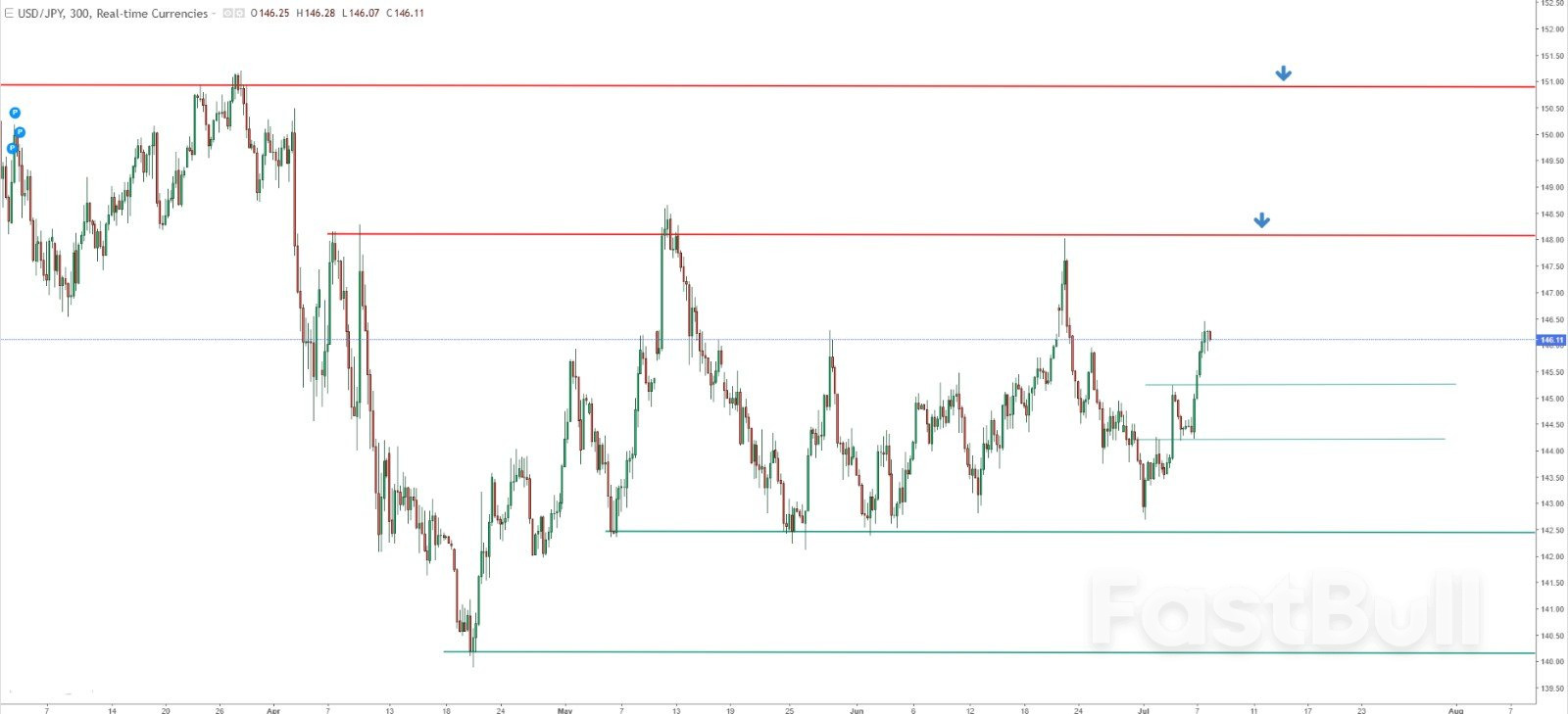
          Since early July, the US dollar has shown some short-term weakness. However, this has not changed the broader trend in the USD/JPY pair, which remains in a consolidation phase. If the dollar continues to weaken, the next target for buyers would be around 148 yen per dollar, near the upper end of the current range.
          USD/JPY Eyes Fresh Highs Amid Growing Tariff Pressure, Diverging CB Policies_1
          In the short term, traders watching for a possible upward move should keep an eye on support levels around 145 and 144 yen per dollar. If the price falls below the key support at 142 yen, that would suggest this upward scenario is no longer likely.

          source :investing

          Risk Warnings and Disclaimers
          You understand and acknowledge that there is a high degree of risk involved in trading. Following any strategies or investment methods may lead to potential losses. The content on the site is provided by our contributors and analysts for information purposes only. You are solely responsible for determining whether any trading assets, securities, strategy, or any other product is suitable for investing based on your own investment objectives and financial situation.
          Add to Favorites
          Share

          Ethereum 'Mega Whales' Are Stacking Harder Than Pre-95% Rally in 2022

          Warren Takunda

          Cryptocurrency

          Key takeaways:
          Ethereum mega whales have increased their holdings by 9.31%, a stronger buildup than before the 2022 rally.
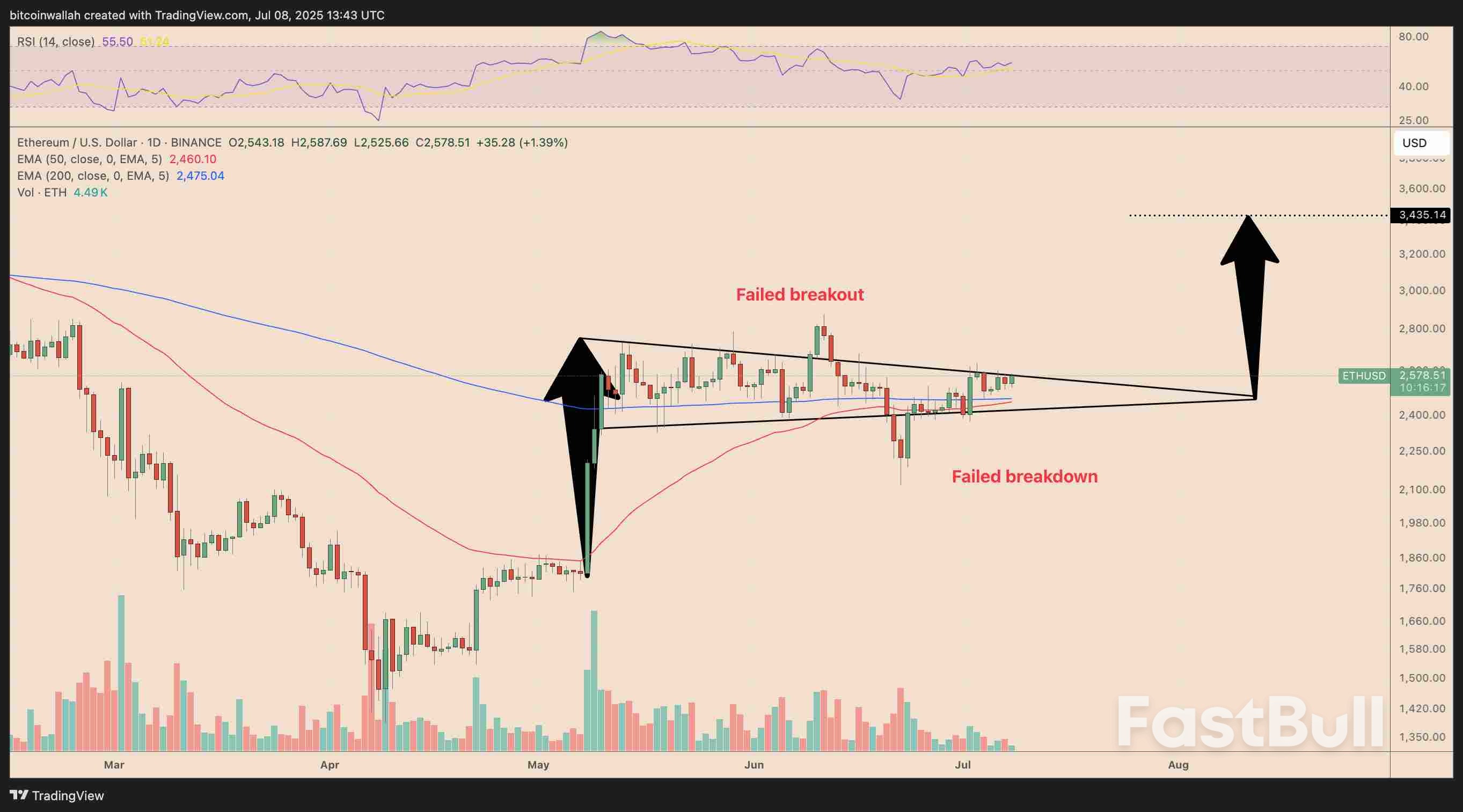
          ETH is consolidating inside a bull pennant, with a breakout potentially targeting $3,400 by August.
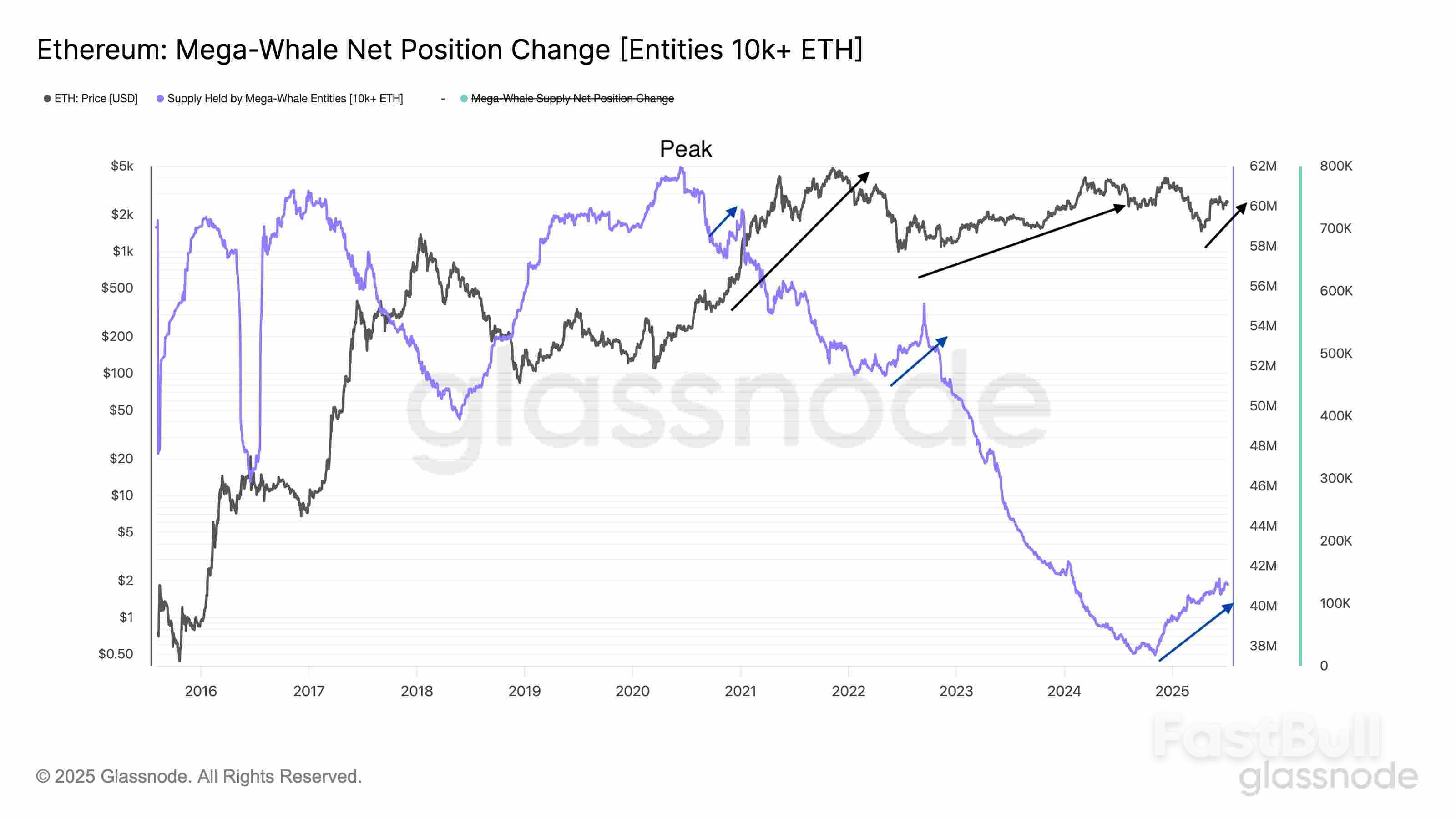
          Ethereum wallets holding at least 10,000 Ether ETH $2,561 are ramping up accumulation faster than before the 95% rally in mid-2022.

          Ether whales reclaim the most supply since 2020

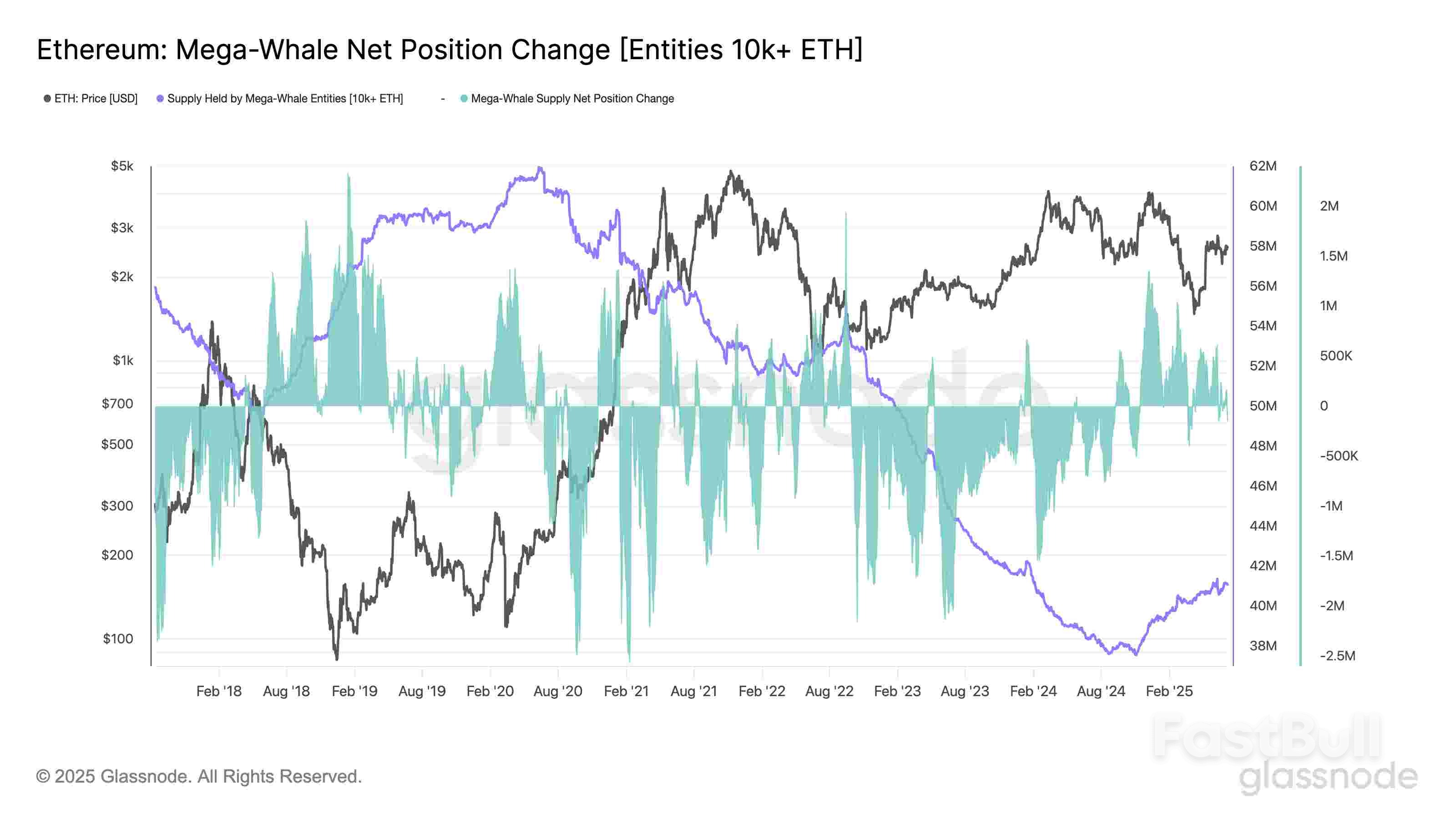
          The total ETH held by these “mega whales” recovered to over 41.06 million ETH as of July 7 from 37.56 million ETH—a record low—in October 2024, according to Glassnode data.Ethereum 'Mega Whales' Are Stacking Harder Than Pre-95% Rally in 2022_1

          Ethereum mega-whale net position change vs. supply. Source: Glassnode

          That marks a 9.31% increase, almost double the accumulation pace seen between May and September 2022, before ETH price rallied from ~$1,000 to over $1,950, a 95% increase.
          A similar trend played out between November 2020 and January 2021, when whale holdings rose 4%, and ETH jumped from $460 to $1,220.Ethereum 'Mega Whales' Are Stacking Harder Than Pre-95% Rally in 2022_2

          Ethereum mega-whale supply. Source: Glassnode

          Large holders began accumulating well before the broader market caught on in both instances. ETH price action has remained relatively flat in recent weeks, suggesting that the current accumulation phase is still flying under the radar.
          This silent buildup could be a precursor to a significant upside move that may not be priced in yet, if the past patterns play out again.
          The ongoing rise in mega whales’ Ether holdings further coincides with increasing flows into Ethereum-focused investment funds, including ETFs. The supply recovery is also the strongest and most sustained since the metric’s long-term downtrend began in June 2020.

          Bull pennant targets 30% ETH price gains

          Ether is also trading within a textbook bull pennant pattern on the daily chart. The setup typically signals a continuation move, often resolved by a breakout in the direction of the prior trend.
          Interestingly, both a failed breakout and a failed breakdown have occurred within the structure, suggesting strong consolidation.Ethereum 'Mega Whales' Are Stacking Harder Than Pre-95% Rally in 2022_3

          ETH/USD daily price chart. Source: TradingView

          A decisive move above the pennant’s upper boundary could push ETH toward the $3,400 level by August. Some indicators even see the price hitting $5,000 by year’s end.
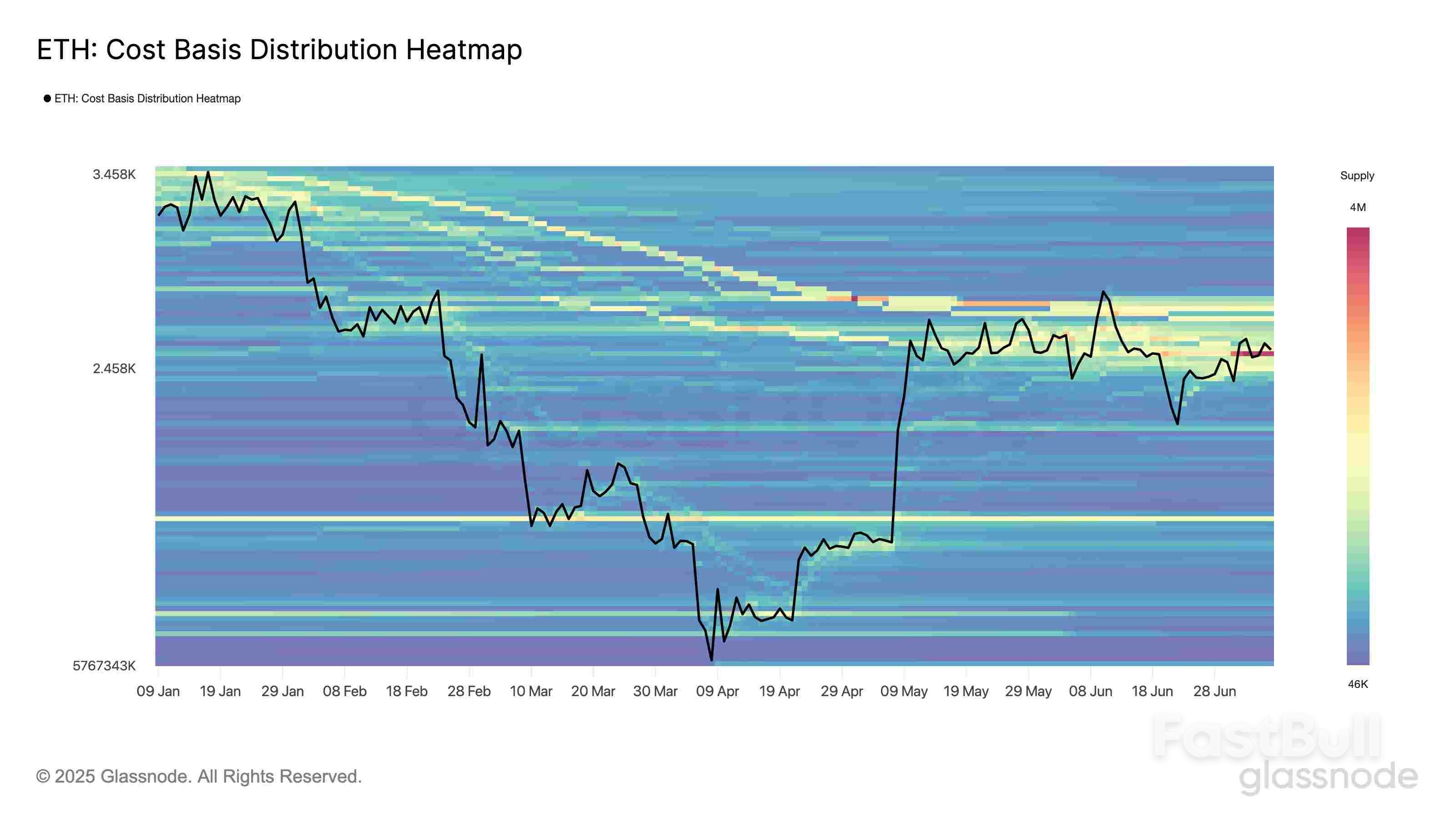
          Ethereum’s cost basis distribution heatmap shows the $2,500–$2,536 range as one of the strongest accumulation zones in recent months, according to Glassnode data.Ethereum 'Mega Whales' Are Stacking Harder Than Pre-95% Rally in 2022_4

          ETH cost basis distribution heatmap. Source: Glassnode

          Over 3.45 million ETH have their cost basis within this range, underscoring it as a key support level.
          Such a heavy concentration of long-term holders near $2,500 reinforces the idea that Ether’s current consolidation phase is forming a solid foundation for the next leg up.

          Source: Cointelegraph

          Risk Warnings and Disclaimers
          You understand and acknowledge that there is a high degree of risk involved in trading. Following any strategies or investment methods may lead to potential losses. The content on the site is provided by our contributors and analysts for information purposes only. You are solely responsible for determining whether any trading assets, securities, strategy, or any other product is suitable for investing based on your own investment objectives and financial situation.
          Add to Favorites
          Share

          Tariffs, explained: What Trump wants from all these trade deals

          Adam

          Economic

          President Donald Trump and his administration are racing to get trade deals done ahead of a self-imposed deadline, at which point tariffs are set to rise for dozens of countries across the world.
          News about the on-again, off-again tariffs has become such a daily fixture of the second Trump administration that, at times, it can be hard to remember why the president started down this path in the first place. Trump has given many different reasons for why he believes tariffs are a crucial part of his policy agenda, but they can be categorized into four main goals:
          Restore America’s manufacturing prowess.
          Grow US revenue.
          Equalize the balance of trade.
          Pressure foreign countries into setting policies that benefit the United States.
          Trump has often treated tariffs like a panacea — a catch-all economic tool that can simultaneously restore blue-collar jobs, pay off the US deficit, bring foreign nations to heel on key disputes and reduce Americans’ tax burdens.
          In his first months in office, Trump has used tariffs to make progress on each of those goals.
          Some companies have announced that they’ll invest in US factories, citing the costly tariffs. Tens of billions of dollars of tariff revenue are coming in to the United States every month. America’s trade deficit was cut in half in April — a dramatic decrease. And Trump has brought several countries to the negotiating table after threatening high tariffs — all without dramatically increasing inflation.
          However, early indicators of success may be more of a sign of an initial shock to the system, as companies, consumers and businesses make rapid adjustments to the new reality of higher US tariffs.
          Economists and business leaders maintain that tariffs probably won’t lead to a major American factory boom. They argue revenue from tariffs will remain a drop in the bucket compared to the massive budget deficit that was just exacerbated by Trump signing his expensive domestic policy agenda and tax cuts into law. Tariffs and trade deals probably won’t dramatically increase demand for US goods in foreign countries. And some trading partners have already shown there’s a limit to how much tariff threats can achieve.
          Manufacturing jobs
          “I’m telling you, you just watch. We’re going to have jobs. We’re going to have open factories. It’s going to be great,” Trump said on Air Force One in March.
          To accomplish that, Trump has often advocated for lower taxes at home and higher taxes for goods made abroad.
          Trump during his joint address to Congress in March made an oft-since-repeated threat: “If you don’t make your product in America, … under the Trump administration, you will pay a tariff and, in some cases, a rather large one.”
          Trump has notched a handful of early PR victories after imposing tariffs. Apple in February said it would invest $500 billion in US manufacturing. GE Appliances said last month it would also spend a half a billion dollars to move a factory from China to make washing machines in the United States. And General Motors said in June it would spend $4 billion to increase its production in the United States. Many other companies have made similar announcements.
          However, many of those decisions were made prior to or independently of Trump’s tariffs, the companies say. That’s because factories can take years to plan, build and begin operations.
          Another major complication: Skilled manufacturing labor is hard to come by in the United States. That’s why in May, the Labor Department reported 414,000 job openings in the manufacturing sector: There just aren’t enough people in the United States who want to or are skilled enough to complete the work. And American labor can be much more expensive than in other countries. That’s why some industry experts estimate the cost of an iPhone would surge to over $3,000 if it were made in the USA.
          Meanwhile, manufacturing jobs are not booming — quite the opposite. After Trump declared victory with gains of 9,000 manufacturing jobs in his first two full months in office, they have since tumbled by 7,000 jobs in each of the past two months, and the number of manufacturing jobs is now lower since Trump took office than when he started.
          Tariffs may ultimately help to restore some manufacturing in America. But as Trump routinely reminds companies: If you make products in America, you pay no tariffs. That means if companies do as Trump asks, then America can’t raise tariff revenue from them.

          Raising revenue

          Trump has made astronomical estimates about how much money tariffs can raise, arguing tariffs could bring in trillions of dollars in annual revenue.
          “We’re going to make a lot of money, and we’re going to cut taxes for the people of this country,” Trump said before boarding Air Force One for his return from Pope Francis’ funeral in April. “It’ll take a little while before we do that, but we’re going to be cutting taxes, and it’s possible we’ll do a complete tax cut, because I think the tariffs will be enough to cut all of the income tax.”
          To accomplish that, tariffs would need to be exceedingly high — significantly higher than the already historic levels at which the Trump administration has set them today, or even the 60% to 70% Trump threatened to impose on some countries beginning in August.
          The federal government raises about $3 trillion a year from income taxes. The United States also happens to import around $3 trillion worth of goods annually. So that means tariffs would have to be at least 100% on all imported goods for the levies to replace income taxes, said Torsten Slok, chief economist at Apollo Global Management.
          It’s not quite that simple: Demand would fall as prices rise. So Slok estimates tariffs may have to be set at 200% to replace all federal income tax revenue.
          Tariffs aren’t bringing in anything close to that amount right now: The Treasury Department said Trump has raised less than $100 billion in tariff revenue since taking office, bringing in around $20 billion a month in each of the past several months.
          But there’s a problem: Some of the most punishing tariffs aren’t designed to remain in place that long. The Trump administration, for example, has placed 25% tariffs on Canada and Mexico and 20% on China to incentivize them to reduce the flow of fentanyl into the United States. If that is successful, Trump has said the tariffs will “come off.” And his trade deals are set to lower the tariff rate on some countries’ goods and services — not raise them.

          Restoring fairness

          Trump has often spoken about tariffs in terms of “fairness,” saying other countries are “ripping off” Americans with high trade barriers. He has repeatedly said he envisions America as a highly desirable department store and views tariffs as a “cost of doing business in America.”
          As a result, Trump on April 2 introduced “reciprocal” tariffs, which were calculated by effectively measuring America’s goods trade deficit with foreign countries and cutting that in half. So the countries from which America imported a large number of goods but exported little were punished with the highest reciprocal tariffs.
          When America is charged a higher tariff and has a trade imbalance with other countries, Trump has often incorrectly labeled that a “subsidy” or a “loss.” But economists largely agree that trade deficits are not losses or subsidies. In fact, they can be a reflection of a strong economy.
          Nevertheless, Trump’s tariffs initially had a major effect on the goods trade deficit, narrowing it from about $130 billion in April to around $60 billion in May, according to the US Commerce Department. US imports tumbled, primarily as 145% tariffs the Trump administration imposed on Canada created an effective blockade on Chinese goods entering the United States. The trade gap widened again in May after tariffs fell on Chinese goods and as foreign countries reduced their purchases of US exports.
          Over time, however, tariffs aren’t likely to meaningfully narrow the trade gap America has with other countries, economists argue. Many countries make goods more cheaply in other countries, and many products simply cannot be grown or produced in America.
          If the trade gap continued to fall, it could be a signal that America’s spending power was diminishing.

          Pressuring countries

          Trump has repeatedly threatened tariffs as a kind of anvil dangling over the heads of countries, companies or industries. On Monday, he posted two letters on Truth Social, to the heads of South Korea and Japan, noting that both countries will face a 25% tariff come August 1. That deadline potentially gives countries more time to negotiate deals. And the subjects of Trump’s tariff threats have, at times, immediately come to the negotiating table.
          The most recent example was last week, when Canada backed off its digital services tax that was set to go into effect. Trump had railed against the tax on online companies, including US corporations that do business in Canada. He threatened to end trade talks with America’s northern neighbor. Trump also said he would set a new tariff for Canada, which ultimately backed down, saying it would drop the tax to help bring the countries back to the table.
          But it doesn’t always work. Trump’s tariffs have not stopped the flow of fentanyl into the United States, although that was always an unreasonably lofty goal. The threat of tariffs has also failed to convince Apple to bring iPhone manufacturing to the United States, Hollywood to make more movies in Los Angeles, or US automakers to close their Canadian and Mexican factories.
          If and when targets of tariffs ultimately acquiesce to Trump’s demands, those tariffs also have to go away, which hurts the administration’s revenue-raising goals.

          The big contradiction

          Trump has notched several early wins with his tariffs — both politically and economically. But, in the long run, tariffs probably can’t achieve all of his lofty goals at the same time. That’s because Trump’s aims are often contradictory.
          For example, if tariffs are a pressure campaign, they have to go away once the countries acquiesce — meaning there will be no tariffs to restore the trade balance. If tariffs are designed to promote America’s manufacturing sector, they can’t also raise revenue to offset deficits. If Americans switch to made-in-the-USA goods, then who pays the tariff on foreign products?
          When used effectively, tariffs can help boost production at home by making foreign goods more expensive. Because America is an enormous and diverse economy that doesn’t rely on trade as much as its neighbors, the United States could use tariffs to inflict serious damage on other countries’ economies without plunging itself into a recession. Revenue raised by tariffs could help offset some of its deficits.
          Achieving all those outcomes simultaneously, however, may not be possible.

          Source : cnn

          To stay updated on all economic events of today, please check out our Economic calendar
          Risk Warnings and Disclaimers
          You understand and acknowledge that there is a high degree of risk involved in trading. Following any strategies or investment methods may lead to potential losses. The content on the site is provided by our contributors and analysts for information purposes only. You are solely responsible for determining whether any trading assets, securities, strategy, or any other product is suitable for investing based on your own investment objectives and financial situation.
          Add to Favorites
          Share

          Here’s How the New Trump Accounts Work — and Why Financial Experts Don’t Love Them

          Warren Takunda

          Economic

          Pretty soon, every newborn American will be the proud owner of their very own “Trump account.”
          President Trump's sprawling tax law creates a new, tax-advantaged investment account prefunded with $1,000 for each child born from the beginning of 2025 through the end of 2028. Kids born before this year are eligible for the IRA-style accounts but not the $1,000 seed money.
          The idea’s backers say the accounts are a way to get all kids into saving and investing early in life, while helping them save for goals like college or a home.
          But financial advisers who spoke with Yahoo Finance warned that, aside from the free seed money, the benefits the accounts offer are relatively paltry compared to other tax-shielded savings options Americans already have available, including the 529 accounts parents use to put away money for college and IRAs for retirement. The new Trump accounts also come tied up with a fairly complex and potentially confusing set of rules.
          As a result, putting any money into them beyond what the government offers might not make sense for most families, they said.
          “It’s not very attractive,” Ann Reilley, CEO of Alpha Financial Advisors, said of the program. “It just seems like they’re complicating things for no reason.”
          Under the new program, parents will have the option to open Trump accounts for any child under age 18 at a bank of their choice. Contributions will be capped at $5,000 per year, including up to $2,500 tax-free from a parent's employer. The money grows tax-free until it’s withdrawn and must be invested in a broad stock index.
          Account holders can make partial withdrawals when they turn 18 and access the full amount at age 25, but only for "qualified purposes" including paying for college, starting a business, or buying a first home. They get full access to the funds at age 30 to use for any purpose.
          Once cashed out, distributions will be taxed as long-term capital gains if the funds are used for a qualifying purpose. Money spent on anything else will be treated as ordinary income.
          Overall, it’s a less generous deal than putting money into a 529 account for higher education or Roth IRA for retirement, since both of those options allow investors to withdraw their money entirely tax-free.
          The Trump account could theoretically be useful for families who are already comfortable with their retirement savings and whose children don’t plan to pursue college, since the money can be used for other purposes like homebuying without a penalty. But even then, there might be pitfalls.
          For instance: Say a child ends up spending the money on anything other than education, a business, or a house and gets hit with the higher ordinary income rate. In that case, their family would have been better off investing in a normal brokerage account, said Zach Teutsch, a managing partner at Values Added Financial.
          “The giving kids money aspect is generally good,” Teutsch said. “The account structure seems ill-considered.” He added that a family would need to be “shockingly sure” that their child wasn’t going to college before it would make sense to invest in a Trump account instead of a 529.
          The concept of providing every child a small, prefunded investment account isn’t new in Washington. Progressives have long-pitched a version of the idea known as “baby bonds,” which they’ve argued could help close the racial wealth gap. Among Republicans, Texas Sen. Ted Cruz is credited for originating the Trump account proposal — he called them Invest In America Accounts — which he has described as a way to help hook kids on investing and broader capitalist values.
          “There are many Americans who don’t own stocks or bonds, are not invested in the market, and may not feel particularly invested in the American free enterprise system. This will give everyone a stake,” Cruz recently told Semafor.
          The experiment is not especially expensive in the scheme of the GOP’s massive tax package: Trump accounts will cost the government about $17 billion over 10 years, according to Congress’s Joint Committee on Taxation. But Republicans appear to have kept costs down in large part by loading the proposal with restrictions that limit the value of the program, said Alan Cole, a senior economist at the Tax Foundation.
          “It’s like, thank you, government, for the free money, but I care about the usefulness,” Cole said. “And realistically, this is the sixth or seventh best tax-free savings account option.”

          Source: Yahoofinance

          To stay updated on all economic events of today, please check out our Economic calendar
          Risk Warnings and Disclaimers
          You understand and acknowledge that there is a high degree of risk involved in trading. Following any strategies or investment methods may lead to potential losses. The content on the site is provided by our contributors and analysts for information purposes only. You are solely responsible for determining whether any trading assets, securities, strategy, or any other product is suitable for investing based on your own investment objectives and financial situation.
          Add to Favorites
          Share
          FastBull
          Copyright © 2025 FastBull Ltd

          728 RM B 7/F GEE LOK IND BLDG NO 34 HUNG TO RD KWUN TONG KLN HONG KONG

          TelegramInstagramTwitterfacebooklinkedin
          App Store Google Play Google Play
          Products
          Charts

          Chats

          Q&A with Experts
          Screeners
          Economic Calendar
          Data
          Tools
          Membership
          Features
          Function
          Markets
          Copy Trading
          Latest Signals
          Contests
          News
          Analysis
          24/7
          Columns
          Education
          Company
          Careers
          About Us
          Contact Us
          Advertising
          Help Center
          Feedback
          User Agreement
          Privacy Policy
          Business

          White Label

          Data API

          Web Plug-ins

          Poster Maker

          Affiliate Program

          Risk Disclosure

          The risk of loss in trading financial instruments such as stocks, FX, commodities, futures, bonds, ETFs and crypto can be substantial. You may sustain a total loss of the funds that you deposit with your broker. Therefore, you should carefully consider whether such trading is suitable for you in light of your circumstances and financial resources.

          No decision to invest should be made without thoroughly conducting due diligence by yourself or consulting with your financial advisors. Our web content might not suit you since we don't know your financial conditions and investment needs. Our financial information might have latency or contain inaccuracy, so you should be fully responsible for any of your trading and investment decisions. The company will not be responsible for your capital loss.

          Without getting permission from the website, you are not allowed to copy the website's graphics, texts, or trademarks. Intellectual property rights in the content or data incorporated into this website belong to its providers and exchange merchants.

          Not Logged In

          Log in to access more features

          FastBull Membership

          Not yet

          Purchase

          Become a signal provider
          Help Center
          Customer Service
          Dark Mode
          Price Up/Down Colors

          Log In

          Sign Up

          Position
          Layout
          Fullscreen
          Default to Chart
          The chart page opens by default when you visit fastbull.com