Markets
News
Analysis
User
24/7
Economic Calendar
Education
Data
- Names
- Latest
- Prev


Signal Accounts for Members
All Signal Accounts
All Contests


India CPI YoY (Nov)A:--
F: --
P: --
India Deposit Gowth YoYA:--
F: --
P: --
Brazil Services Growth YoY (Oct)A:--
F: --
P: --
Mexico Industrial Output YoY (Oct)A:--
F: --
P: --
Russia Trade Balance (Oct)A:--
F: --
P: --
Philadelphia Fed President Henry Paulson delivers a speech
Canada Building Permits MoM (SA) (Oct)A:--
F: --
P: --
Canada Wholesale Sales YoY (Oct)A:--
F: --
P: --
Canada Wholesale Inventory MoM (Oct)A:--
F: --
P: --
Canada Wholesale Inventory YoY (Oct)A:--
F: --
P: --
Canada Wholesale Sales MoM (SA) (Oct)A:--
F: --
P: --
Germany Current Account (Not SA) (Oct)A:--
F: --
P: --
U.S. Weekly Total Rig CountA:--
F: --
P: --
U.S. Weekly Total Oil Rig CountA:--
F: --
P: --
Japan Tankan Small Manufacturing Outlook Index (Q4)A:--
F: --
P: --
Japan Tankan Large Non-Manufacturing Diffusion Index (Q4)A:--
F: --
P: --
Japan Tankan Large Non-Manufacturing Outlook Index (Q4)A:--
F: --
P: --
Japan Tankan Large Manufacturing Outlook Index (Q4)A:--
F: --
P: --
Japan Tankan Small Manufacturing Diffusion Index (Q4)A:--
F: --
P: --
Japan Tankan Large Manufacturing Diffusion Index (Q4)A:--
F: --
P: --
Japan Tankan Large-Enterprise Capital Expenditure YoY (Q4)A:--
F: --
P: --
U.K. Rightmove House Price Index YoY (Dec)A:--
F: --
P: --
China, Mainland Industrial Output YoY (YTD) (Nov)A:--
F: --
P: --
China, Mainland Urban Area Unemployment Rate (Nov)A:--
F: --
P: --
Saudi Arabia CPI YoY (Nov)A:--
F: --
P: --
Euro Zone Industrial Output YoY (Oct)A:--
F: --
P: --
Euro Zone Industrial Output MoM (Oct)A:--
F: --
P: --
Canada Existing Home Sales MoM (Nov)A:--
F: --
P: --
Canada National Economic Confidence IndexA:--
F: --
P: --
Canada New Housing Starts (Nov)A:--
F: --
U.S. NY Fed Manufacturing Employment Index (Dec)--
F: --
P: --
U.S. NY Fed Manufacturing Index (Dec)--
F: --
P: --
Canada Core CPI YoY (Nov)--
F: --
P: --
Canada Manufacturing Unfilled Orders MoM (Oct)--
F: --
P: --
U.S. NY Fed Manufacturing Prices Received Index (Dec)--
F: --
P: --
U.S. NY Fed Manufacturing New Orders Index (Dec)--
F: --
P: --
Canada Manufacturing New Orders MoM (Oct)--
F: --
P: --
Canada Core CPI MoM (Nov)--
F: --
P: --
Canada Trimmed CPI YoY (SA) (Nov)--
F: --
P: --
Canada Manufacturing Inventory MoM (Oct)--
F: --
P: --
Canada CPI YoY (Nov)--
F: --
P: --
Canada CPI MoM (Nov)--
F: --
P: --
Canada CPI YoY (SA) (Nov)--
F: --
P: --
Canada Core CPI MoM (SA) (Nov)--
F: --
P: --
Canada CPI MoM (SA) (Nov)--
F: --
P: --
Federal Reserve Board Governor Milan delivered a speech
U.S. NAHB Housing Market Index (Dec)--
F: --
P: --
Australia Composite PMI Prelim (Dec)--
F: --
P: --
Australia Services PMI Prelim (Dec)--
F: --
P: --
Australia Manufacturing PMI Prelim (Dec)--
F: --
P: --
Japan Manufacturing PMI Prelim (SA) (Dec)--
F: --
P: --
U.K. 3-Month ILO Employment Change (Oct)--
F: --
P: --
U.K. Unemployment Claimant Count (Nov)--
F: --
P: --
U.K. Unemployment Rate (Nov)--
F: --
P: --
U.K. 3-Month ILO Unemployment Rate (Oct)--
F: --
P: --
U.K. Average Weekly Earnings (3-Month Average, Including Bonuses) YoY (Oct)--
F: --
P: --
U.K. Average Weekly Earnings (3-Month Average, Excluding Bonuses) YoY (Oct)--
F: --
P: --
France Services PMI Prelim (Dec)--
F: --
P: --
France Composite PMI Prelim (SA) (Dec)--
F: --
P: --
France Manufacturing PMI Prelim (Dec)--
F: --
P: --
Germany Manufacturing PMI Prelim (SA) (Dec)--
F: --
P: --


No matching data
Latest Views
Latest Views
Trending Topics
Top Columnists
Latest Update
White Label
Data API
Web Plug-ins
Affiliate Program
View All

No data
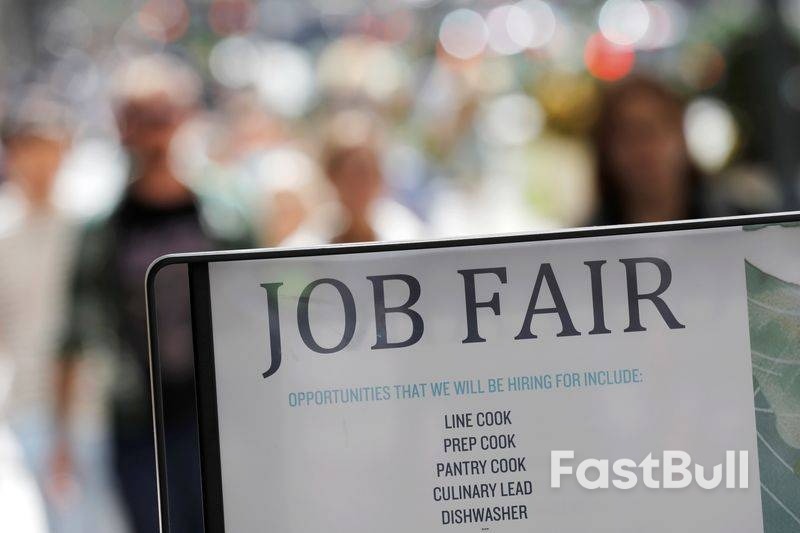
Jobless claims jumped to 241,000 last week, the highest since February, signaling potential economic trouble amid GDP contraction and rising layoffs, especially in New York, despite stable longer-term trends.

The number of Americans filing new applications for unemployment benefits increased more than expected last week, potentially hinting at a pick-up in layoffs from tariffs, which weighed on the economy in the first quarter.
Initial claims for state unemployment benefits jumped 18,000 a seasonally adjusted 241,000 for the week ended April 26, the Labor Department said on Thursday. Economists polled by Reuters had forecast 224,000 claims for the latest week.
The economy contracted last quarter for the first time in three years, swamped by a flood of imports as businesses tried to avoid duties from President Donald Trump's tariffs.
Economists expect the aggressive trade policy to result in a wave of job losses. The tariffs, expected to be a drag on domestic demand, are already prompting some companies to reduce staff. United Parcel Service said on Tuesday it would slash 20,000 jobs and shut 73 facilities as part of a planned reduction in deliveries for Amazon.com.
Businesses in general have mostly adopted a wait-and-see attitude and are retaining their workforces, while remaining cautious about adding headcount.
The number of people receiving benefits after an initial week of aid, a proxy for hiring, soared 83,000 to a seasonally adjusted 1.916 million during the week ending April 19, the claims report showed.
The claims data have no bearing on April's employment report, scheduled for release on Friday. Nonfarm payrolls likely increased by 130,000 jobs last month after rising 228,000 in March, a Reuters survey of economists showed. The unemployment rate is forecast unchanged at 4.2%.
Citi, a major player in global finance, has put forth a view that the USD/JPY pair is likely to see a move upward, or a ‘correction higher’. This prediction isn’t pulled out of thin air; it’s based on a detailed analysis of various economic indicators and central bank policies affecting both the United States Dollar and the Japanese Yen.
Here are some key factors that likely underpin Citi’s expectation:
The Forex market, or foreign exchange market, is the largest and most liquid financial market globally. It’s where currencies are traded. The USD/JPY pair is one of the most actively traded pairs, often reflecting the economic health and monetary policy stances of the world’s largest and third-largest economies, respectively.
Movements in USD/JPY are influenced by a complex interplay of factors, including:
Citi’s view suggests that despite recent movements, the underlying fundamentals favor a stronger dollar against the yen, leading to this expected correction.
The Japanese Yen has been particularly sensitive to interest rate differentials in recent years. The Bank of Japan’s long-standing commitment to ultra-low interest rates, even as other central banks tightened policy, led to significant yen weakness. While the BoJ made a historic shift away from negative rates in March 2024, their forward guidance remains dovish, suggesting a slow and cautious approach to further policy normalization.
This cautious stance contrasts with the Federal Reserve’s position, where although future rate cuts are anticipated, the timing and pace remain uncertain and dependent on inflation data. This persistent policy divergence is a core reason why analysts like those at Citi see potential for the USD/JPY to move higher, even if temporarily correcting from recent levels.
Citi’s prediction of a correction higher for USD/JPY highlights the ongoing influence of interest rate policies and economic fundamentals on the Forex market. While no forecast is definitive, understanding the rationale behind a major institution’s view provides valuable context for navigating the complexities of currency trading. The persistent divergence in monetary policy between the US and Japan, coupled with economic data, forms the basis for expecting a potential strengthening of the dollar against the Japanese Yen. Traders should remain vigilant, combining such insights with their own analysis and risk management strategies as they approach the market based on this Citi forecast.
Gold fell more than 2% to a two-week low on Thursday, weakened as signs of easing trade tensions enhanced risk appetite and reduced bullion's safe-haven appeal, while a stronger U.S. dollar also weighed on prices.
Spot gold fell 2.1% to $3,219.57 an ounce as of 0957 GMT, after hitting its lowest since April 15.
U.S. gold futures lost 2.8% to $3,227.20.
The dollar index (.DXY), opens new tab rose 0.4%, making dollar-denominated gold more expensive for buyers holding other currencies.
"There is ongoing hope that some trade deals are signed soon allowing lower tariffs to stay," said UBS analyst Giovanni Staunovo, adding that this optimism, combined with a stronger dollar, is exerting pressure on the gold.
U.S. President Donald Trump said on Wednesday trade deals were possible with India, Japan and South Korea. He also said there was a "very good chance" of a deal with China.
The U.S. has approached China seeking talks over Trump's 145% tariffs, a social media account affiliated with Chinese state media said.
The U.S. economy contracted for the first time in three years in first quarter, weakened by a surge of imports as businesses sought to pre-empt the imposition of higher tariffs.
However, Federal Reserve policymakers indicated that short-term interest rates would remain unchanged until there are clear signs of inflation nearing the central bank's 2% goal or potential job market deterioration.
Investors await Friday's nonfarm payrolls report for further insight into the Fed's policy direction.
"A weaker payroll report should support calls for more rate cuts by the Fed this year and allow gold to move back to $3,500/oz over the coming months," said Giovanni Staunovo.
Analysts in a quarterly Reuters poll have forecast an average annual gold price above $3,000 for the first time.
Gold, a non-yielding metal considered a hedge against political and financial turmoil, briefly hit $3,500 last week.
Spot silver fell 1.5% to $32.11 an ounce, platinum shed 0.2% to $965.10 and palladium was up 0.9% to$946.08.
(May 1): Janet Yellen warned that the risk of a US recession has “gone way up” after Donald Trump’s sweeping tariffs rattled financial markets, consumers and businesses.
The former Federal Reserve (Fed) chair said in an interview with the Financial Times that the tariffs on major trading partners will have “tremendously adverse consequences” for American consumers and firms.
“I am not yet ready to say that I’m forecasting a recession, but certainly the odds have gone way up,” Yellen said. She added that targeting Chinese goods could “hobble” American industries by curtailing the supply of critical minerals.
Her comments came after figures on Wednesday revealed that the US economy contracted in the first quarter as firms boosted imports to stockpile goods before the April 2 tariffs announcement. The 0.3% drop in gross domestic product on an annualised basis was the US’s worst quarterly performance in three years.
Yellen — who also served as the Treasury secretary under Joe Biden — is the latest to warn of a rising risk of recession after US business and consumer confidence surveys tumbled in response to the tariffs.
While Trump has handed many countries a temporary reprieve from the highest tariffs first unveiled last month, the US president remained defiant on Wednesday, saying the turbulence seen in markets has “nothing to do with tariffs”.
Yellen warned that the US is “highly dependent on China for most of the critical minerals that go into clean energy technologies, batteries and the like”.
“By putting enormous tariffs on them, I think we potentially hobble industries that could have a chance,” she said.
White Label
Data API
Web Plug-ins
Poster Maker
Affiliate Program
The risk of loss in trading financial instruments such as stocks, FX, commodities, futures, bonds, ETFs and crypto can be substantial. You may sustain a total loss of the funds that you deposit with your broker. Therefore, you should carefully consider whether such trading is suitable for you in light of your circumstances and financial resources.
No decision to invest should be made without thoroughly conducting due diligence by yourself or consulting with your financial advisors. Our web content might not suit you since we don't know your financial conditions and investment needs. Our financial information might have latency or contain inaccuracy, so you should be fully responsible for any of your trading and investment decisions. The company will not be responsible for your capital loss.
Without getting permission from the website, you are not allowed to copy the website's graphics, texts, or trademarks. Intellectual property rights in the content or data incorporated into this website belong to its providers and exchange merchants.
Not Logged In
Log in to access more features

FastBull Membership
Not yet
Purchase
Log In
Sign Up