• Trade
  • Markets
  • Copy
  • Contests
  • News
  • 24/7
  • Calendar
  • Q&A
  • Chats
Trending
Screeners
SYMBOL
LAST
BID
ASK
HIGH
LOW
NET CHG.
%CHG.
SPREAD
SPX
S&P 500 Index
6827.42
6827.42
6827.42
6899.86
6801.80
-73.58
-1.07%
--
DJI
Dow Jones Industrial Average
48458.04
48458.04
48458.04
48886.86
48334.10
-245.98
-0.51%
--
IXIC
NASDAQ Composite Index
23195.16
23195.16
23195.16
23554.89
23094.51
-398.69
-1.69%
--
USDX
US Dollar Index
97.950
98.030
97.950
98.500
97.950
-0.370
-0.38%
--
EURUSD
Euro / US Dollar
1.17394
1.17409
1.17394
1.17496
1.17192
+0.00011
+ 0.01%
--
GBPUSD
Pound Sterling / US Dollar
1.33707
1.33732
1.33707
1.33997
1.33419
-0.00148
-0.11%
--
XAUUSD
Gold / US Dollar
4299.39
4299.39
4299.39
4353.41
4257.10
+20.10
+ 0.47%
--
WTI
Light Sweet Crude Oil
57.233
57.485
57.233
58.011
56.969
-0.408
-0.71%
--

Community Accounts

Signal Accounts
--
Profit Accounts
--
Loss Accounts
--
View More

Become a signal provider

Sell trading signals to earn additional income

View More

Guide to Copy Trading

Get started with ease and confidence

View More

Signal Accounts for Members

All Signal Accounts

Best Return
  • Best Return
  • Best P/L
  • Best MDD
Past 1W
  • Past 1W
  • Past 1M
  • Past 1Y

All Contests

  • All
  • Trump Updates
  • Recommend
  • Stocks
  • Cryptocurrencies
  • Central Banks
  • Featured News
Top News Only
Share

USA Embassy In Lithuania: Maria Kalesnikava Is Not Going To Vilnius

Share

USA Embassy In Lithuania: Other Prisoners Are Being Sent From Belarus To Ukraine

Share

Ukraine President Zelenskiy: Five Ukrainians Released By Belarus In US-Brokered Deal

Share

USA Vilnius Embassy: USA Stands Ready For "Additional Engagement With Belarus That Advances USA Interests"

Share

USA Vilnius Embassy: Belarus, USA, Other Citizens Among The Prisoners Released Into Lithuania

Share

USA Vilnius Embassy: USA Will Continue Diplomatic Efforts To Free The Remaining Political Prisoners In Belarus

Share

USA Vilnius Embassy: Belarus Releases 123 Prisoners Following Meeting Of President Trump's Envoy Coale And Belarus President Lukashenko

Share

USA Vilnius Embassy: Masatoshi Nakanishi, Aliaksandr Syrytsa Are Among The Prisoners Released By Belarus

Share

USA Vilnius Embassy: Maria Kalesnikava And Viktor Babaryka Are Among The Prisoners Released By Belarus

Share

USA Vilnius Embassy: Nobel Peace Prize Laureate Ales Bialiatski Is Among The Prisoners Released By Belarus

Share

Belarusian Presidential Administration Telegram Channel: Lukashenko Has Pardoned 123 Prisoners As Part Of Deal With US

Share

Two Local Syrian Officials: Joint US-Syrian Military Patrol In Central Syria Came Under Fire From Unknown Assailants

Share

Israeli Military Says It Targeted 'Key Hamas Terrorist' In Gaza City

Share

Rwanda's Actions In Eastern Drc Are A Clear Violation Of Washington Accords Signed By President Trump - Secretary Of State Rubio

Share

Israeli Military Issues Evacuation Warning In Southern Lebanon Village Ahead Of Strike - Spokesperson On X

Share

Belarusian State Media Cites US Envoy Coale As Saying He Discussed Ukraine And Venezuela With Lukashenko

Share

Belarusian State Media Cites US Envoy Coale As Saying That US Removes Sanctions On Belarusian Potassium

Share

Thai Prime Minister: No Ceasefire Agreement With Cambodia

Share

US, Ukraine To Discuss Ceasefire In Berlin Ahead Of European Summit

Share

Incoming Czech Prime Minister Babis: Czech Republic Will Not Take On Guarantees For Ukraine Financing, European Commission Must Find Alternatives

TIME
ACT
FCST
PREV
U.K. Trade Balance Non-EU (SA) (Oct)

A:--

F: --

P: --

U.K. Trade Balance (Oct)

A:--

F: --

P: --

U.K. Services Index MoM

A:--

F: --

P: --

U.K. Construction Output MoM (SA) (Oct)

A:--

F: --

P: --

U.K. Industrial Output YoY (Oct)

A:--

F: --

P: --

U.K. Trade Balance (SA) (Oct)

A:--

F: --

P: --

U.K. Trade Balance EU (SA) (Oct)

A:--

F: --

P: --

U.K. Manufacturing Output YoY (Oct)

A:--

F: --

P: --

U.K. GDP MoM (Oct)

A:--

F: --

P: --

U.K. GDP YoY (SA) (Oct)

A:--

F: --

P: --

U.K. Industrial Output MoM (Oct)

A:--

F: --

P: --

U.K. Construction Output YoY (Oct)

A:--

F: --

P: --

France HICP Final MoM (Nov)

A:--

F: --

P: --

China, Mainland Outstanding Loans Growth YoY (Nov)

A:--

F: --

P: --

China, Mainland M2 Money Supply YoY (Nov)

A:--

F: --

P: --

China, Mainland M0 Money Supply YoY (Nov)

A:--

F: --

P: --

China, Mainland M1 Money Supply YoY (Nov)

A:--

F: --

P: --

India CPI YoY (Nov)

A:--

F: --

P: --

India Deposit Gowth YoY

A:--

F: --

P: --

Brazil Services Growth YoY (Oct)

A:--

F: --

P: --

Mexico Industrial Output YoY (Oct)

A:--

F: --

P: --

Russia Trade Balance (Oct)

A:--

F: --

P: --

Philadelphia Fed President Henry Paulson delivers a speech
Canada Building Permits MoM (SA) (Oct)

A:--

F: --

P: --

Canada Wholesale Sales YoY (Oct)

A:--

F: --

P: --

Canada Wholesale Inventory MoM (Oct)

A:--

F: --

P: --

Canada Wholesale Inventory YoY (Oct)

A:--

F: --

P: --

Canada Wholesale Sales MoM (SA) (Oct)

A:--

F: --

P: --

Germany Current Account (Not SA) (Oct)

A:--

F: --

P: --

U.S. Weekly Total Rig Count

A:--

F: --

P: --

U.S. Weekly Total Oil Rig Count

A:--

F: --

P: --

Japan Tankan Large Non-Manufacturing Diffusion Index (Q4)

--

F: --

P: --

Japan Tankan Small Manufacturing Outlook Index (Q4)

--

F: --

P: --

Japan Tankan Large Non-Manufacturing Outlook Index (Q4)

--

F: --

P: --

Japan Tankan Large Manufacturing Outlook Index (Q4)

--

F: --

P: --

Japan Tankan Small Manufacturing Diffusion Index (Q4)

--

F: --

P: --

Japan Tankan Large Manufacturing Diffusion Index (Q4)

--

F: --

P: --

Japan Tankan Large-Enterprise Capital Expenditure YoY (Q4)

--

F: --

P: --

U.K. Rightmove House Price Index YoY (Dec)

--

F: --

P: --

China, Mainland Industrial Output YoY (YTD) (Nov)

--

F: --

P: --

China, Mainland Urban Area Unemployment Rate (Nov)

--

F: --

P: --

Saudi Arabia CPI YoY (Nov)

--

F: --

P: --

Euro Zone Industrial Output YoY (Oct)

--

F: --

P: --

Euro Zone Industrial Output MoM (Oct)

--

F: --

P: --

Canada Existing Home Sales MoM (Nov)

--

F: --

P: --

Euro Zone Total Reserve Assets (Nov)

--

F: --

P: --

U.K. Inflation Rate Expectations

--

F: --

P: --

Canada National Economic Confidence Index

--

F: --

P: --

Canada New Housing Starts (Nov)

--

F: --

P: --

U.S. NY Fed Manufacturing Employment Index (Dec)

--

F: --

P: --

U.S. NY Fed Manufacturing Index (Dec)

--

F: --

P: --

Canada Core CPI YoY (Nov)

--

F: --

P: --

Canada Manufacturing Unfilled Orders MoM (Oct)

--

F: --

P: --

Canada Manufacturing New Orders MoM (Oct)

--

F: --

P: --

Canada Core CPI MoM (Nov)

--

F: --

P: --

Canada Manufacturing Inventory MoM (Oct)

--

F: --

P: --

Canada CPI YoY (Nov)

--

F: --

P: --

Canada CPI MoM (Nov)

--

F: --

P: --

Canada CPI YoY (SA) (Nov)

--

F: --

P: --

Canada Core CPI MoM (SA) (Nov)

--

F: --

P: --

Q&A with Experts
    • All
    • Chatrooms
    • Groups
    • Friends
    Connecting
    .
    .
    .
    Type here...
    Add Symbol or Code

      No matching data

      All
      Trump Updates
      Recommend
      Stocks
      Cryptocurrencies
      Central Banks
      Featured News
      • All
      • Russia-Ukraine Conflict
      • Middle East Flashpoint
      • All
      • Russia-Ukraine Conflict
      • Middle East Flashpoint
      Search
      Products

      Charts Free Forever

      Chats Q&A with Experts
      Screeners Economic Calendar Data Tools
      Membership Features
      Data Warehouse Market Trends Institutional Data Policy Rates Macro

      Market Trends

      Market Sentiment Order Book Forex Correlations

      Top Indicators

      Charts Free Forever
      Markets

      News

      News Analysis 24/7 Columns Education
      From Institutions From Analysts
      Topics Columnists

      Latest Views

      Latest Views

      Trending Topics

      Top Columnists

      Latest Update

      Signals

      Copy Rankings Latest Signals Become a signal provider AI Rating
      Contests
      Brokers

      Overview Brokers Assessment Rankings Regulators News Claims
      Broker listing Forex Brokers Comparison Tool Live Spread Comparison Scam
      Q&A Complaint Scam Alert Videos Tips to Detect Scam
      More

      Business
      Events
      Careers About Us Advertising Help Center

      White Label

      Data API

      Web Plug-ins

      Affiliate Program

      Awards Institution Evaluation IB Seminar Salon Event Exhibition
      Vietnam Thailand Singapore Dubai
      Fans Party Investment Sharing Session
      FastBull Summit BrokersView Expo
      Recent Searches
        Top Searches
          Markets
          News
          Analysis
          User
          24/7
          Economic Calendar
          Education
          Data
          • Names
          • Latest
          • Prev

          View All

          No data

          Scan to Download

          Faster Charts, Chat Faster!

          Download App
          English
          • English
          • Español
          • العربية
          • Bahasa Indonesia
          • Bahasa Melayu
          • Tiếng Việt
          • ภาษาไทย
          • Français
          • Italiano
          • Türkçe
          • Русский язык
          • 简中
          • 繁中
          Open Account
          Search
          Products
          Charts Free Forever
          Markets
          News
          Signals

          Copy Rankings Latest Signals Become a signal provider AI Rating
          Contests
          Brokers

          Overview Brokers Assessment Rankings Regulators News Claims
          Broker listing Forex Brokers Comparison Tool Live Spread Comparison Scam
          Q&A Complaint Scam Alert Videos Tips to Detect Scam
          More

          Business
          Events
          Careers About Us Advertising Help Center

          White Label

          Data API

          Web Plug-ins

          Affiliate Program

          Awards Institution Evaluation IB Seminar Salon Event Exhibition
          Vietnam Thailand Singapore Dubai
          Fans Party Investment Sharing Session
          FastBull Summit BrokersView Expo

          Wall Street's potential winners and losers from Trump's tax bill

          Adam

          Economic

          China–U.S. Trade War

          Summary:

          Trump’s proposed tax bill could boost defense and domestic producers through tax breaks and spending, while hurting renewable energy, health insurers, and real estate due to funding cuts and higher interest rates.

          As President Donald Trump's sweeping tax-cut and spending bill heads to the Senate, analysts examine how his broad-ranging policies could turn the fortunes of U.S. companies if the package is enacted as law.
          What Trump has dubbed a "big, beautiful bill", narrowly passed the Republican-controlled House on May 22.
          The bill seeks to extend tax breaks, set during Trump's first term in 2017 and on track to expire at the end of 2025, for multinational corporations. It is also expected to fulfill many of Trump's populist campaign pledges, including an immigration crackdown and ending some green energy incentives.
          The tax breaks are largely expected to be positive for the U.S. stock markets, but some analysts see only a modest upside.
          "Since the 2025 tax cuts are primarily an extension of the current tax code, we expect changes to provide only marginal benefits to equity performance," Morgan Stanley analysts said in a note last month.
          Overall, the bill is expected to add about $2.4 trillion to the $36.2 trillion U.S. debt pile, the Congressional Budget Office said on Wednesday.
          Here is a list of industries and companies that are likely to be affected by the bill:
          AEROSPACE AND DEFENSE - WINNERS
          Defense companies could see renewed interest from investors as the new bill looks to step up spending on air and missile defense, munitions and border security.
          "There should be some benefit there to the defense contractors," said Chris Haverland, global equity strategist at Wells Fargo Investment Institute.
          "We currently rate industrials at a neutral. There'll be some offsets there, but there should be some benefits to the defense area."
          Brian Mulberry, client portfolio manager at Zacks Investment Management, named defense contractors RTX and General Dynamics as potential beneficiaries. The iShares US Aerospace & Defense ETF is trading at all-time highs.
          RENEWABLE ENERGY - LOSERS
          Shares of U.S. solar companies slumped on May 22, as the bill aims to cancel funding for green-energy grant programs, which were established under the Biden administration in the 2022 Inflation Reduction Act.
          "If the bill passes, that's going to be a huge negative for renewable (energy stocks)," said Dave Grecsek, managing director of investment strategy and research at wealth management firm Aspiriant.
          "We could have a little bit more downside to the renewable energy space, but a lot of it is already priced in."
          Companies including First Solar, Enphase Energy and Sunrun are all in the red for the year.
          HEALTH INSURERS - LOSERS
          The bill includes substantial funding cuts for the U.S. Medicaid program, with fiscal hawks pushing for cuts to partly offset the cost of the bill's tax components.
          "Reductions to Medicaid funding also shift the cost to state and local governments that may be burdened by increased health care costs. This may cause notable revenue losses for hospitals, potentially pressuring (the) credit quality of both state and nonprofit health care municipal bonds," Morgan Stanley said.
          Shares of major health insurers CVS, Humana, UnitedHealth, Elevance and Cigna would be in focus. The S&P 500 managed healthcare index is down 30.6% year to date.
          HOUSING & REAL ESTATE - LOSERS
          BofA Global Research said it expects interest rates to remain high if the bill does not meaningfully address deficit reduction, and flagged several companies that could be hurt by higher rates.
          SBA Communications, Equinix and Alexandria Real Estate Equities are some of the real estate-linked companies that are at risk, BofA Global Research said.
          "Homebuilders need to take a margin hit on the house to increase affordability. So that's a very simple translation of how fiscal stimulus is leading to a negative consequence for the stock market," said Viresh Kanabar, macro strategist - asset allocation at Macro Hive.
          DOMESTIC PRODUCERS - WINNERS
          The bill also includes legislation to extend or expand Tax Cuts and Jobs Act (TCJA) provisions that are set to expire at the end of 2025.
          The provisions include 100% bonus depreciation for equipment investment, immediate deduction of domestic research and development (R&D) expenses and looser business interest expensing through 2029.
          BofA Global Research named a slew of S&P 500 companies with no overseas sales that could benefit from these items, including utility firms Alliant Energy, Ameren Corp and American Electric Power Company.

          Source: Reuters

          To stay updated on all economic events of today, please check out our Economic calendar
          Risk Warnings and Disclaimers
          You understand and acknowledge that there is a high degree of risk involved in trading. Following any strategies or investment methods may lead to potential losses. The content on the site is provided by our contributors and analysts for information purposes only. You are solely responsible for determining whether any trading assets, securities, strategy, or any other product is suitable for investing based on your own investment objectives and financial situation.
          Add to Favorites
          Share

          Aide To EU Chief Joins Tariff Negotiation Team To Spur US Talks, Sources Say

          Thomas

          Economic

          Central Bank

          The European Union has changed its team locked in trade talks with the Trump administration, bringing in a close aide to European Commission President Ursula von der Leyen to deal more swiftly with political questions arising from the technical negotiations, three sources familiar with the talks said.

          The move follows frequent outbursts of frustration by U.S. President Donald Trump at what the White House perceives as slow progress in talks with the EU. Late in May he recommended a 50% tariff on most European goods from June, before backtracking.

          The move to bring more political decision-making to the EU team reflects challenges confronting the bloc as it negotiates a trading relationship with a U.S. president who has said repeatedly the EU was established to screw the United States.

          It also reflects the difficulties negotiating trade terms in isolation when Trump has sought to fold non-tariff barriers such as digital services taxes and food standards into the talks.

          "If you are a trade negotiator you need to be sure you have full political backing, so if the top level is there you feel stronger," one of the sources said.

          The expanded team, which apart from the von der Leyen aide now also includes a cabinet member of Trade Commissioner Maros Sefcovic, was dispatched to Washington this week after a call between Trump and von der Leyen in which they agreed to fast-track negotiations.

          Following that call Trump agreed to allow more time for talks between Washington and the 27-nation bloc to produce a deal by July 9.

          "It was a merger of Commission layers to reinforce and act fast," a second of the sources said of the team's expansion, adding the team's shape could change again as talks continue.

          U.S. Trade Representative Jamieson Greer said a meeting with Sefcovic in Paris on Wednesday had been constructive and that he was pleased negotiations were advancing quickly. He noted "a willingness by the EU to work with us to find a concrete way forward to achieve reciprocal trade".

          Sefcovic told reporters that both sides had concluded talks were "advancing in the right direction, at pace," and that high-level contacts would follow shortly. He and Greer had agreed how to "restructure" the focus of negotiations with the United States, he added.

          Washington was focused on four areas in its negotiations with other countries: tariffs, non-tariff barriers, purchases and economic security, one of the sources said.

          Trump has already hit Europe with a 50% tariff on steel and aluminium as well as a heightened levy on car imports. The EU is racing to secure a deal before July 9 when "reciprocal" tariffs on most other goods could surge from 10% to as high as 50%.

          Unlike Britain, the first major economy to reach a narrow trade agreement with the Trump administration, the EU is pushing for a comprehensive deal, with a baseline tariff rate below the 10% now in force.

          Two of the three sources said additional technical expertise had also been added to the negotiating team, but there had been no changes to the team's leadership.

          "I think it suits everyone to have the political cover," the first source said.

          Source: TradingView

          To stay updated on all economic events of today, please check out our Economic calendar
          Risk Warnings and Disclaimers
          You understand and acknowledge that there is a high degree of risk involved in trading. Following any strategies or investment methods may lead to potential losses. The content on the site is provided by our contributors and analysts for information purposes only. You are solely responsible for determining whether any trading assets, securities, strategy, or any other product is suitable for investing based on your own investment objectives and financial situation.
          Add to Favorites
          Share

          Goldman Sachs pares risk after tariff move, braces for more uncertainty

          Adam

          Economic

          China–U.S. Trade War

          Goldman Sachs has moderated its risk-taking since U.S. President Donald Trump's April tariff announcement, and the Wall Street bank is braced for more uncertainty, a top executive said.
          "We have moderated our risk positioning since April 2nd - I think that's a sensible thing for us to do," Goldman President John Waldron said in a podcast released by the investment bank on Thursday.
          "We're absorbing a lot of risk from our clients. We want to continue to do that, but we also, where we can, we (pare) our risk and stay a little bit closer to home."
          Goldman is readying for continued uncertainty in the coming months, which means keeping a greater liquidity cushion, he said.
          Financial markets have been turbulent since Trump's so-called "Liberation Day," when he announced plans to increase tariffs on trading partners.
          Waldron, who is widely seen as the likely successor to Goldman CEO David Solomon, said the tariff move was "very, very disruptive."
          Some companies are now starting to make business decisions based on assumptions that tariffs will be raised to a range of 10% to 15%, he said.
          "We're moving into now an adjustment phase, and you'll see, I think, some more decision-making on capital spend, M&A transactions, capital return, stock buybacks," Waldron said.
          The U.S. economy is still strong, backed by a solid labor market and consumer spending, he said.
          "All those factors in the U.S. to me lead to a likely scenario where we don't have a recession," he said.
          Meanwhile, Waldron warned investors were getting concerned about an unsustainable U.S. fiscal deficit.
          "The bond market is starting to be heard, and I hope that gets some attention in the halls of Congress," he said.
          Rating agency Moody's cut the pristine U.S. sovereign credit rating by one notch last month, the last of the major ratings agencies to downgrade the country, citing concerns about the nation's growing $36 trillion debt pile.
          The biggest question for markets is the path of interest rates, particularly in the long term, Waldron said.
          "We're seeing a lot of increase in duration in the rate curves in the United States and Japan and many other countries - and I think that could be a brake on economic growth," he said.

          Source: Reuters

          To stay updated on all economic events of today, please check out our Economic calendar
          Risk Warnings and Disclaimers
          You understand and acknowledge that there is a high degree of risk involved in trading. Following any strategies or investment methods may lead to potential losses. The content on the site is provided by our contributors and analysts for information purposes only. You are solely responsible for determining whether any trading assets, securities, strategy, or any other product is suitable for investing based on your own investment objectives and financial situation.
          Add to Favorites
          Share

          ECB Cuts Rates But Lagarde Hints At Pause

          Thomas

          Central Bank

          Economic

          The European Central Bank cut interest rates as expected on Thursday but hinted at a pause in its year-long easing cycle after inflation finally returned to its 2% target.

          The ECB has lowered borrowing costs eight times, or by 2 percentage points, since last June, seeking to prop up a euro zone economy that was struggling even before erratic U.S. economic and trade policies dealt it further blows.

          With inflation now just below 2%, ECB President Christine Lagarde said the central bank for the 20 countries that share the euro was in a "good position", which investors took as signalling a break in cuts, if not an end to policy easing.

          "We are well-positioned after that 25 basis point rate cut and with the rate path as it is," Lagarde told a press conference. "With today's cut, at the current level of interest rates, we believe we are in a good position."

          The interest rate path implied by markets sees a pause in July and anticipates just one more cut in the deposit rate toward the end of the year, possibly in December.

          "I think we are getting to the end of a monetary policy cycle that was responding to compounded shocks, including COVID, including the war in Ukraine, the illegitimate war in Ukraine, and the energy crisis," Lagarde said.

          Economists also saw her words as a clear indication of a pause and some even bet that the ECB's most aggressive easing cycle since the global financial crisis of 2008-2009 might be at a close.

          "We think the ECB is done cutting rates now, but this view is contingent on no major negative surprises surfacing and economic outlook to gradually become more robust in line with the ECB's forecasts," Nordea said in a note to clients.

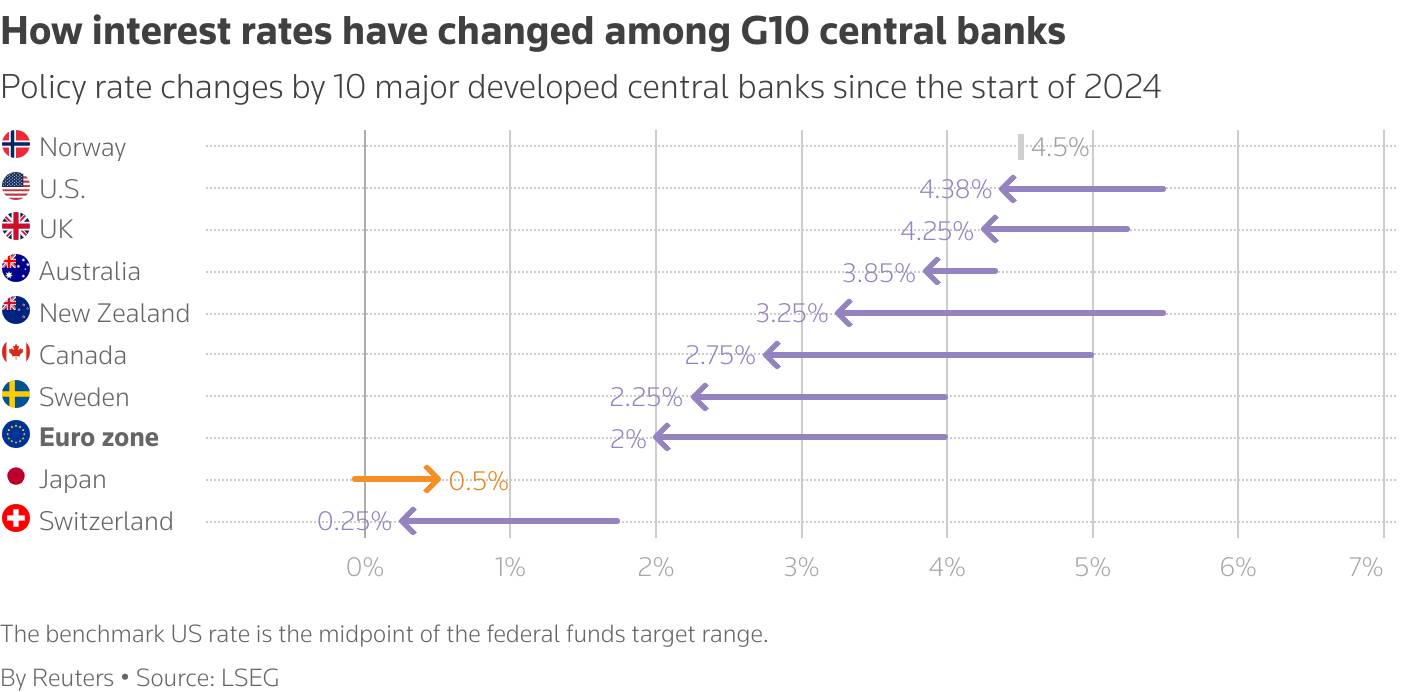
          Change in policy rates by 10 major developed central banks since March

          Lagarde said the decision on Thursday was virtually unanimous, with only one policymaker objecting to a cut.

          "Our central view is that today's cut is likely the last for some time," HSBC said in a note.

          Lagarde also said the euro zone appeared to be attracting more foreign investment, a sign of growing investor confidence and part of the reason why the euro has firmed so much since the U.S. administration embarked on its global trade war.

          But there is exceptional uncertainty in the outlook.

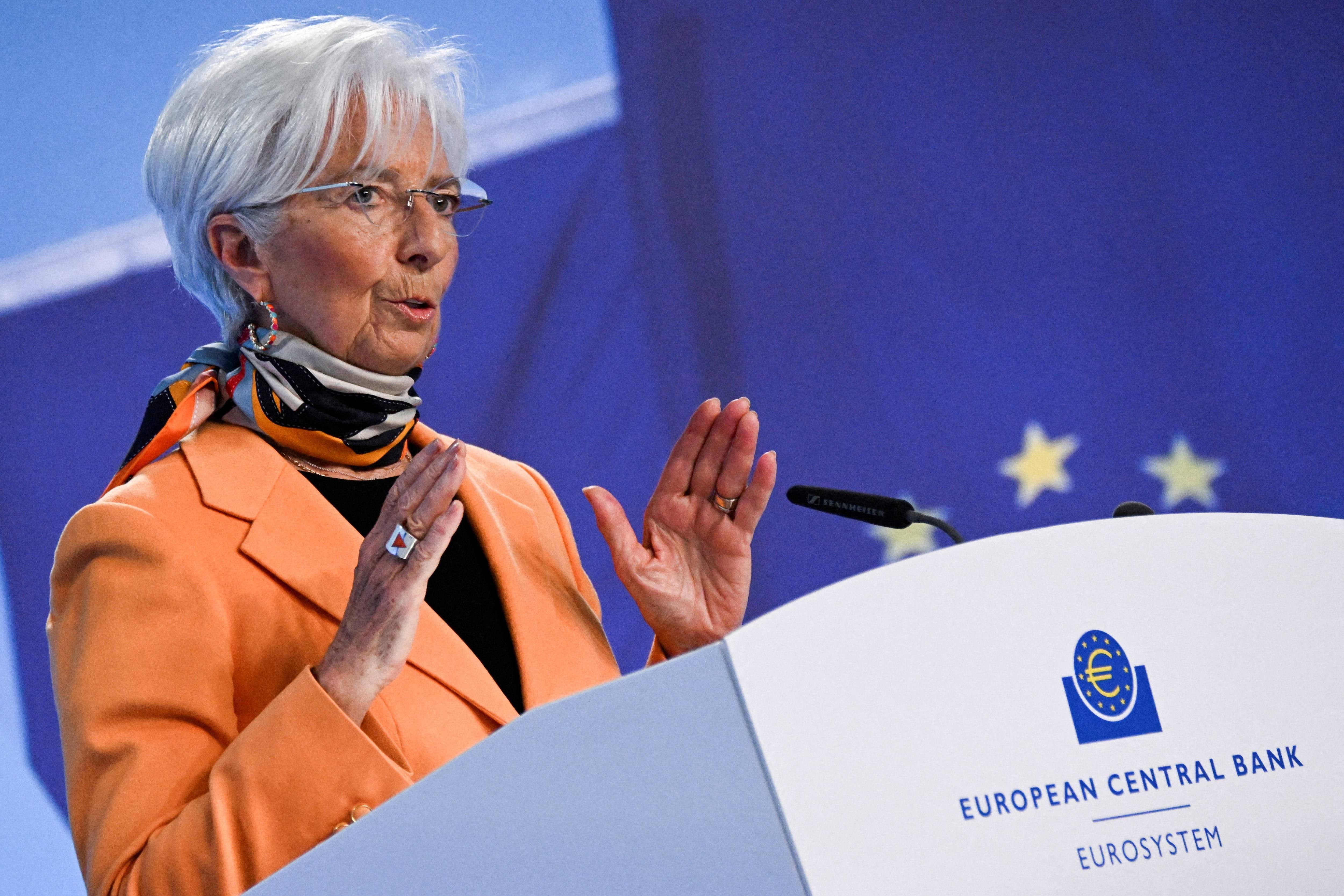
          European Central Bank (ECB) President Christine Lagarde speaks to the media following the Governing Council's monthly monetary policy meeting in Frankfurt, Germany, March 6, 2025. REUTERS/Jana Rodenbusch/File Photo Purchase Licensing Rights, opens new tab

          Falling energy prices and a stronger euro could put further downward pressure on inflation, said Lagarde, adding that effect could be reinforced if higher tariffs led to lower demand for euro exports and re-routing of overcapacity to Europe.

          Depending on the outcome of the trade war with the United States, inflation and growth could significantly differ from projections, the ECB said, as it took the unusual step of releasing alternative scenarios to its forecasts.

          PAUSE CASE

          The case for a pause rests on the premise that the short- and medium-term prospects for the currency bloc differ greatly and may require different policy responses.

          Inflation is set to dip in the short term and undershoot the ECB's target next year, but increased government spending and higher trade barriers will add to price pressures later.

          The added complication is that monetary policy impacts the economy with a 12-to-18 month lag, so support approved now could be giving help to a bloc that no longer needs it.

          "In our baseline, we expect the ECB to pause at the July meeting and deliver a final rate cut in September," PIMCO portfolio manager Konstantin Veit said. "A more recessionary configuration will likely be needed for the ECB to go faster and further in this cutting cycle."

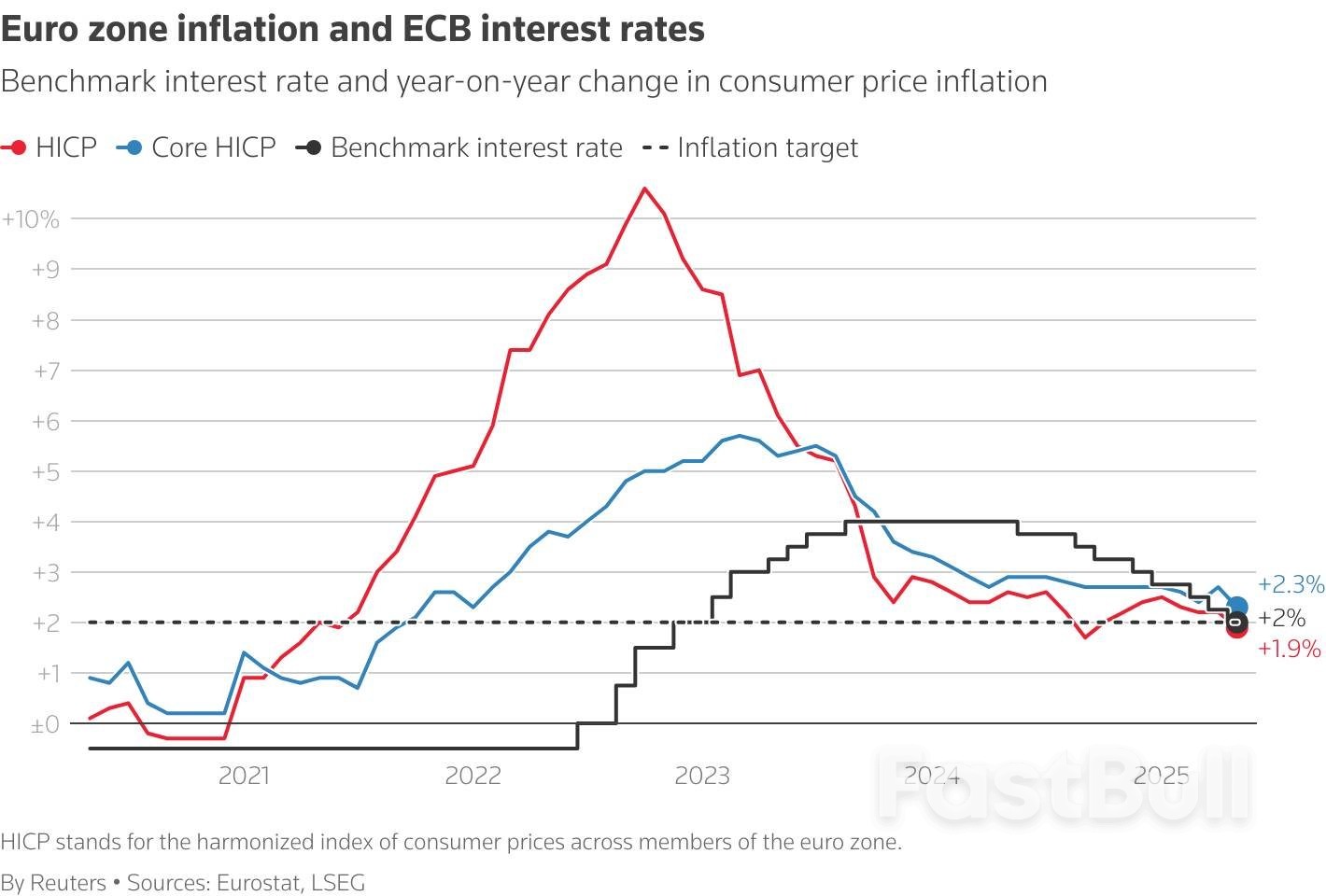
          A line chart comparing inflation metrics over the past five years.

          Acknowledging near-term weakness, the ECB cut its inflation projection for next year.

          U.S. President Donald Trump's tariffs are already damaging activity and will have a lasting impact even if an amicable resolution is found, given the hit to confidence and investment.

          Most economists think inflation could fall below the ECB's 2% target next year, triggering memories of the pre-pandemic decade when price growth persistently undershot 2%, even if projections show it back at target in 2027.

          Further ahead, the outlook changes significantly.

          The European Union is likely to retaliate against any permanent U.S. tariffs, raising the cost of trade. Firms could relocate some activity to avoid trade barriers but changes to corporate value chains are also likely to raise costs.

          Higher European defence spending, particularly by Germany, and the cost of the green transition could add to inflation while a shrinking workforce due to an ageing population will keep wage pressures elevated.

          Source: Reuters

          To stay updated on all economic events of today, please check out our Economic calendar
          Risk Warnings and Disclaimers
          You understand and acknowledge that there is a high degree of risk involved in trading. Following any strategies or investment methods may lead to potential losses. The content on the site is provided by our contributors and analysts for information purposes only. You are solely responsible for determining whether any trading assets, securities, strategy, or any other product is suitable for investing based on your own investment objectives and financial situation.
          Add to Favorites
          Share

          Big central banks' forecasting lens gets fogged by US tariffs

          Adam

          Economic

          Central Bank

          China–U.S. Trade War

          Unpredictable White House tariff rhetoric and its impact on currency markets, oil prices and the inflation outlook have put central banks across the world in a tight spot.
          The European Central Bank cut interest rates on Thursday and looks set to pause, Switzerland appears to be moving back towards negative rates, Japan's resolve to drop ultra-easy monetary policy is wobbling, and baffling U.S. data could keep the Federal Reserve in wait-and-see mode.
          Here's a look at where 10 developed-market central banks stand.

          SWITZERLAND

          The Swiss National Bank next meets on June 19, and traders see a one in three chance that it will pull rates back into negative territory from 0.25% currently after consumer prices fell for the first time in four years.
          The safe-haven Swiss franc has gained 10% against the dollar so far this year on geopolitical and market volatility. That's challenging Switzerland's export-heavy economy and cheapened imports, giving the SNB reasons to be wary about deflation.

          CANADA

          The Bank of Canada held rates at 2.75% on Wednesday and said another cut might be necessary if the economy weakened in the face of tariffs.
          The BoC has held rates for a second time in a row after an aggressive cutting cycle which shrunk rates by 225 basis points over nine months. Markets price in a roughly 85% chance of another quarter-point cut by September.

          NEW ZEALAND

          Money markets expect the Reserve Bank of New Zealand to hold steady on July 9 after a 25 bps rate cut to 3.25% in May to protect the China-focused economy. The RBNZ also warned that global trade uncertainties made future moves unclear.

          SWEDEN

          Sweden's central bank left its key rate unchanged at 2.25% in May but with on-again-off-again U.S. tariffs now having contributed to an economic contraction in the first quarter, the Riksbank has signaled more easing ahead. Its next rate decision is on June 18.

          EURO ZONE

          The ECB cut rates as expected on Thursday and kept all options on the table for its next meetings even as the case grows for a summer pause in its year-long easing cycle.
          It has lowered rates eight times in the last year, and markets price in one more rate cut by year-end.

          UNITED STATES

          The Fed, under consistent fire from President Donald Trump for resisting rate cuts, is expected to hold steady at its next June 18 meeting as tariff uncertainty makes wait-and-see its best option for now.
          With businesses spooked by Trump's aggressive trade talk, layoffs have increased, manufacturing orders have slumped and factory gate prices have surged, indicating stagflation risks that could moderate if the White House softens its stance.
          The Fed has held rates in the 4.25%-4.5% range since December, following 100 bps of cuts last year. Money markets price roughly 50 bps of further easing by year-end.

          BRITAIN

          The Bank of England, which has lowered borrowing costs slowly to accommodate bumpy inflation trends, cut rates by 25 bps to 4.25% last month and revealed an unexpected three-way split among its policymakers that signaled uncertainty ahead.
          Governor Andrew Bailey says the BoE was staying cautious amid unpredictable global trends. Traders expect no move in June and a 60% chance of a cut by August.

          AUSTRALIA

          Weak growth data and fears of Aussie commodities producers and miners taking big blows from a U.S.-China trade war means the Reserve Bank of Australia stands ready to ride to the rescue with rapid rate cuts.
          The RBA cut rates by 25 bps to 3.85% in May and traders see borrowing costs dropping to about 3% by year-end.

          NORWAY

          Norway's central bank has ditched plans to ease monetary policy as its oil-linked currency weakens amid global trade uncertainty, posing a fresh inflationary threat.
          The Norges Bank kept rates on hold at a 17-year high of 4.50% in May, and markets anticipate no change at the June 19 meeting.

          JAPAN

          The Bank of Japan, long expected to pursue rate hikes, faces a challenging mix of economic trends if tariffs hurt exports but inflation keeps rising.
          After the BoJ held borrowing costs steady at 0.5% in May, Governor Kazuo Ueda steadfastly refused to comment on the possible timing of the next increase.

          Source: Reuters

          To stay updated on all economic events of today, please check out our Economic calendar
          Risk Warnings and Disclaimers
          You understand and acknowledge that there is a high degree of risk involved in trading. Following any strategies or investment methods may lead to potential losses. The content on the site is provided by our contributors and analysts for information purposes only. You are solely responsible for determining whether any trading assets, securities, strategy, or any other product is suitable for investing based on your own investment objectives and financial situation.
          Add to Favorites
          Share

          ECB Officials Expect July Pause With Some Seeing 2% As End Point

          James Whitman

          Central Bank

          Economic

          European Central Bank officials envisage a pause in their interest rate-cutting campaign when they next set policy in July, according to people familiar with the matter.

          Given the uncertainty surrounding US President Donald Trump’s tariffs, a timeout following eight reductions in borrowing costs is currently seen as the most likely scenario, the people said, declining to be identified discussing confidential talks.

          Some officials see reductions in borrowing costs as maybe already finished, while others still back another move — probably in September, according to the people.

          They stressed policymakers’ thinking could yet shift, with the July 9 deadline for US-European trade negotiations looming. The next rate meeting is scheduled for July 23-24.

          An ECB spokesperson declined to comment.

          The ECB lowered its deposit rate to 2% on Thursday, saying inflation — which dipped to 1.9% in May — is “currently at around” its target. Addressing reporters later, President Christine Lagarde said ECB policy is “in a good position to navigate the uncertain conditions” that are likely to come from global trade and a jump in spending in Europe.

          “We are getting to the end of a monetary-policy cycle that was responding to compounded shocks — including Covid, the illegitimate war in Ukraine and the energy crisis,” she told reporters in Frankfurt.

          Traders trimmed wagers on additional cuts, with another quarter-point move this year no longer seen as a certainty.

          Source: Bloomberg Europe

          To stay updated on all economic events of today, please check out our Economic calendar
          Risk Warnings and Disclaimers
          You understand and acknowledge that there is a high degree of risk involved in trading. Following any strategies or investment methods may lead to potential losses. The content on the site is provided by our contributors and analysts for information purposes only. You are solely responsible for determining whether any trading assets, securities, strategy, or any other product is suitable for investing based on your own investment objectives and financial situation.
          Add to Favorites
          Share

          Trump, Xi Spoke by Phone as Trade and Tech Disputes Strain Ties

          Adam

          Economic

          US President Donald Trump and Chinese President Xi Jinping spoke Thursday, according to China’s Foreign Ministry, as trade tensions roil relations between the world’s two largest economies.
          Relations between the two rivals have soured in recent weeks, with both sides accusing the other of violating a trade truce that brought down tariffs from massive highs.
          With the fresh conflict threatening the fragile détente, market analysts were hopeful the conversation would pave the way to a trade off-ramp. Stocks rose on news of the call, with the S&P 500 extending gains into a fourth straight day.
          The phone call between the leaders marks their first known formal contact since Trump took office. The last conversation between Trump and Xi took place in January before the US president’s inauguration.
          The Chinese Foreign Ministry said the call was initiated at Trump’s request. The White House did not immediately respond to a request for comment.
          Rare earths have emerged in recent days as a key flashpoint. The US has accused China of reneging on a promise to relax export controls on such metals needed for cutting-edge electronics. Beijing has been frustrated by fresh US restrictions on the sale of chip design software and plans to start revoking visas for Chinese students.
          Trump has long said direct talks with Xi were the only way to resolve differences between the nations, but the Chinese leader had thus far been reluctant to get on the phone with his American counterpart — preferring that advisers negotiate key issues.
          Export controls and US actions on student visas and technology curbs will likely be central to future negotiations. US and Chinese trade chiefs only agreed in Geneva last month to lower tariffs for 90 days, as they worked toward a broader deal.
          History suggests that any final deal could be a long time coming. In 2018 during Trump’s first term as president, the two sides agreed to put their dispute “on hold” after a round of negotiations, but the US soon backed away from that deal, leading to more than 18 months of further tariffs and talks before the signing of the “Phase One” deal in January 2020.
          One goal for China this time around will be seeking relief from US export controls on cutting-edge chips vital for AI and military advancement. That’s likely to be a sticking point in Washington, with both Democrats and Republicans in rare agreement that Beijing poses a national security threat.
          Beyond strains in economic ties, geopolitical frictions are also growing. Foreign Ministry officials this month protested US Defense Secretary Pete Hegseth’s assertion at a gathering of military chiefs in Singapore that China poses an imminent threat to Taiwan, a self-ruled island claimed by Beijing.

          Source : Bloomberg

          To stay updated on all economic events of today, please check out our Economic calendar
          Risk Warnings and Disclaimers
          You understand and acknowledge that there is a high degree of risk involved in trading. Following any strategies or investment methods may lead to potential losses. The content on the site is provided by our contributors and analysts for information purposes only. You are solely responsible for determining whether any trading assets, securities, strategy, or any other product is suitable for investing based on your own investment objectives and financial situation.
          Add to Favorites
          Share
          FastBull
          Copyright © 2025 FastBull Ltd

          728 RM B 7/F GEE LOK IND BLDG NO 34 HUNG TO RD KWUN TONG KLN HONG KONG

          TelegramInstagramTwitterfacebooklinkedin
          App Store Google Play Google Play
          Products
          Charts

          Chats

          Q&A with Experts
          Screeners
          Economic Calendar
          Data
          Tools
          Membership
          Features
          Function
          Markets
          Copy Trading
          Latest Signals
          Contests
          News
          Analysis
          24/7
          Columns
          Education
          Company
          Careers
          About Us
          Contact Us
          Advertising
          Help Center
          Feedback
          User Agreement
          Privacy Policy
          Business

          White Label

          Data API

          Web Plug-ins

          Poster Maker

          Affiliate Program

          Risk Disclosure

          The risk of loss in trading financial instruments such as stocks, FX, commodities, futures, bonds, ETFs and crypto can be substantial. You may sustain a total loss of the funds that you deposit with your broker. Therefore, you should carefully consider whether such trading is suitable for you in light of your circumstances and financial resources.

          No decision to invest should be made without thoroughly conducting due diligence by yourself or consulting with your financial advisors. Our web content might not suit you since we don't know your financial conditions and investment needs. Our financial information might have latency or contain inaccuracy, so you should be fully responsible for any of your trading and investment decisions. The company will not be responsible for your capital loss.

          Without getting permission from the website, you are not allowed to copy the website's graphics, texts, or trademarks. Intellectual property rights in the content or data incorporated into this website belong to its providers and exchange merchants.

          Not Logged In

          Log in to access more features

          FastBull Membership

          Not yet

          Purchase

          Become a signal provider
          Help Center
          Customer Service
          Dark Mode
          Price Up/Down Colors

          Log In

          Sign Up

          Position
          Layout
          Fullscreen
          Default to Chart
          The chart page opens by default when you visit fastbull.com