• Trade
  • Markets
  • Copy
  • Contests
  • News
  • 24/7
  • Calendar
  • Q&A
  • Chats
Trending
Screeners
SYMBOL
LAST
BID
ASK
HIGH
LOW
NET CHG.
%CHG.
SPREAD
SPX
S&P 500 Index
6827.42
6827.42
6827.42
6899.86
6801.80
-73.58
-1.07%
--
DJI
Dow Jones Industrial Average
48458.04
48458.04
48458.04
48886.86
48334.10
-245.98
-0.51%
--
IXIC
NASDAQ Composite Index
23195.16
23195.16
23195.16
23554.89
23094.51
-398.69
-1.69%
--
USDX
US Dollar Index
97.950
98.030
97.950
98.500
97.950
-0.370
-0.38%
--
EURUSD
Euro / US Dollar
1.17394
1.17409
1.17394
1.17496
1.17192
+0.00011
+ 0.01%
--
GBPUSD
Pound Sterling / US Dollar
1.33707
1.33732
1.33707
1.33997
1.33419
-0.00148
-0.11%
--
XAUUSD
Gold / US Dollar
4299.39
4299.39
4299.39
4353.41
4257.10
+20.10
+ 0.47%
--
WTI
Light Sweet Crude Oil
57.233
57.485
57.233
58.011
56.969
-0.408
-0.71%
--

Community Accounts

Signal Accounts
--
Profit Accounts
--
Loss Accounts
--
View More

Become a signal provider

Sell trading signals to earn additional income

View More

Guide to Copy Trading

Get started with ease and confidence

View More

Signal Accounts for Members

All Signal Accounts

Best Return
  • Best Return
  • Best P/L
  • Best MDD
Past 1W
  • Past 1W
  • Past 1M
  • Past 1Y

All Contests

  • All
  • Trump Updates
  • Recommend
  • Stocks
  • Cryptocurrencies
  • Central Banks
  • Featured News
Top News Only
Share

Iranian Media Says 18 Crew Members Of Foreign Tanker Seized In Gulf Of Oman Over Carrying 'Smuggled Fuel' Detained

Share

Regional Governor: Two Killed In Ukrainian Drone Strike On Russia's Saratov

Share

Chinese Foreign Ministry - China Foreign Minister Met With United Arab Emirates Counterpart On Dec 12

Share

China's Central Financial And Economic Affairs Commission Deputy Director: Will Expand Export And Increase Import In 2026

Share

Thai Leader Anutin: Landmine Blast That Killed Thai Soldiers 'Not A Roadside Accident'

Share

Thai Leader Anutin: Thailand To Continue Military Action Until 'We Feel No More Harm'

Share

Cambodian Prime Minister Hun Manet Says He Had Phone Calls With Trump And Malaysian Leader Anwar About Ceasefire

Share

Cambodia's Hun Manet Says USA, Malaysia Should Verify 'Which Side Fired First' In Latest Conflict

Share

Cambodia's Hun Manet: Cambodia Maintains Its Stance In Seeking Peaceful Resolution Of Disputes

Share

Nasdaq Companies: Allergan, Ferrovia, Insmed, Monolithic Power Systems, Seagate Technology, And Western Digital Will Be Added To The NASDAQ 100 Index. Biogen, CdW, GlobalFoundries, Lululemon, ON Semiconductor, And Tradedesk Will Be Removed From The NASDAQ 100 Index

Share

Witkoff Headed To Berlin This Weekend To Meet With Zelenskiy, European Leaders -Wsj Reporter On X

Share

Russia Attacks Two Ukrainian Ports, Damaging Three Turkish-Owned Vessels

Share

[Historic Flooding Occurs In At Least Four Rivers In Washington State Due To Days Of Torrential Rains] Multiple Areas In Washington State Have Been Hit By Severe Flooding Due To Days Of Torrential Rains, With At Least Four Rivers Experiencing Historic Flooding. Reporters Learned On The 12th That The Floods Caused By The Torrential Rains In Washington State Have Destroyed Homes And Closed Several Highways. Experts Warn That Even More Severe Flooding May Occur In The Future. A State Of Emergency Has Been Declared In Washington State

Share

Trump Says Proposed Free Economic Zone In Donbas Would Work

Share

Trump: I Think My Voice Should Be Heard

Share

Trump Says Will Be Choosing New Fed Chair In Near Future

Share

Trump Says Proposed Free Economic Zone In Donbas Complex But Would Work

Share

Trump Says Land Strikes In Venezuela Will Start Happening

Share

US President Trump: Thailand And Cambodia Are In A Good Situation

Share

State Media: North Korean Leader Kim Hails Troops Returning From Russia Mission

TIME
ACT
FCST
PREV
U.K. Trade Balance Non-EU (SA) (Oct)

A:--

F: --

P: --

U.K. Trade Balance (Oct)

A:--

F: --

P: --

U.K. Services Index MoM

A:--

F: --

P: --

U.K. Construction Output MoM (SA) (Oct)

A:--

F: --

P: --

U.K. Industrial Output YoY (Oct)

A:--

F: --

P: --

U.K. Trade Balance (SA) (Oct)

A:--

F: --

P: --

U.K. Trade Balance EU (SA) (Oct)

A:--

F: --

P: --

U.K. Manufacturing Output YoY (Oct)

A:--

F: --

P: --

U.K. GDP MoM (Oct)

A:--

F: --

P: --

U.K. GDP YoY (SA) (Oct)

A:--

F: --

P: --

U.K. Industrial Output MoM (Oct)

A:--

F: --

P: --

U.K. Construction Output YoY (Oct)

A:--

F: --

P: --

France HICP Final MoM (Nov)

A:--

F: --

P: --

China, Mainland Outstanding Loans Growth YoY (Nov)

A:--

F: --

P: --

China, Mainland M2 Money Supply YoY (Nov)

A:--

F: --

P: --

China, Mainland M0 Money Supply YoY (Nov)

A:--

F: --

P: --

China, Mainland M1 Money Supply YoY (Nov)

A:--

F: --

P: --

India CPI YoY (Nov)

A:--

F: --

P: --

India Deposit Gowth YoY

A:--

F: --

P: --

Brazil Services Growth YoY (Oct)

A:--

F: --

P: --

Mexico Industrial Output YoY (Oct)

A:--

F: --

P: --

Russia Trade Balance (Oct)

A:--

F: --

P: --

Philadelphia Fed President Henry Paulson delivers a speech
Canada Building Permits MoM (SA) (Oct)

A:--

F: --

P: --

Canada Wholesale Sales YoY (Oct)

A:--

F: --

P: --

Canada Wholesale Inventory MoM (Oct)

A:--

F: --

P: --

Canada Wholesale Inventory YoY (Oct)

A:--

F: --

P: --

Canada Wholesale Sales MoM (SA) (Oct)

A:--

F: --

P: --

Germany Current Account (Not SA) (Oct)

A:--

F: --

P: --

U.S. Weekly Total Rig Count

A:--

F: --

P: --

U.S. Weekly Total Oil Rig Count

A:--

F: --

P: --

Japan Tankan Large Non-Manufacturing Diffusion Index (Q4)

--

F: --

P: --

Japan Tankan Small Manufacturing Outlook Index (Q4)

--

F: --

P: --

Japan Tankan Large Non-Manufacturing Outlook Index (Q4)

--

F: --

P: --

Japan Tankan Large Manufacturing Outlook Index (Q4)

--

F: --

P: --

Japan Tankan Small Manufacturing Diffusion Index (Q4)

--

F: --

P: --

Japan Tankan Large Manufacturing Diffusion Index (Q4)

--

F: --

P: --

Japan Tankan Large-Enterprise Capital Expenditure YoY (Q4)

--

F: --

P: --

U.K. Rightmove House Price Index YoY (Dec)

--

F: --

P: --

China, Mainland Industrial Output YoY (YTD) (Nov)

--

F: --

P: --

China, Mainland Urban Area Unemployment Rate (Nov)

--

F: --

P: --

Saudi Arabia CPI YoY (Nov)

--

F: --

P: --

Euro Zone Industrial Output YoY (Oct)

--

F: --

P: --

Euro Zone Industrial Output MoM (Oct)

--

F: --

P: --

Canada Existing Home Sales MoM (Nov)

--

F: --

P: --

Euro Zone Total Reserve Assets (Nov)

--

F: --

P: --

U.K. Inflation Rate Expectations

--

F: --

P: --

Canada National Economic Confidence Index

--

F: --

P: --

Canada New Housing Starts (Nov)

--

F: --

P: --

U.S. NY Fed Manufacturing Employment Index (Dec)

--

F: --

P: --

U.S. NY Fed Manufacturing Index (Dec)

--

F: --

P: --

Canada Core CPI YoY (Nov)

--

F: --

P: --

Canada Manufacturing Unfilled Orders MoM (Oct)

--

F: --

P: --

Canada Manufacturing New Orders MoM (Oct)

--

F: --

P: --

Canada Core CPI MoM (Nov)

--

F: --

P: --

Canada Manufacturing Inventory MoM (Oct)

--

F: --

P: --

Canada CPI YoY (Nov)

--

F: --

P: --

Canada CPI MoM (Nov)

--

F: --

P: --

Canada CPI YoY (SA) (Nov)

--

F: --

P: --

Canada Core CPI MoM (SA) (Nov)

--

F: --

P: --

Q&A with Experts
    • All
    • Chatrooms
    • Groups
    • Friends
    Connecting
    .
    .
    .
    Type here...
    Add Symbol or Code

      No matching data

      All
      Trump Updates
      Recommend
      Stocks
      Cryptocurrencies
      Central Banks
      Featured News
      • All
      • Russia-Ukraine Conflict
      • Middle East Flashpoint
      • All
      • Russia-Ukraine Conflict
      • Middle East Flashpoint
      Search
      Products

      Charts Free Forever

      Chats Q&A with Experts
      Screeners Economic Calendar Data Tools
      Membership Features
      Data Warehouse Market Trends Institutional Data Policy Rates Macro

      Market Trends

      Market Sentiment Order Book Forex Correlations

      Top Indicators

      Charts Free Forever
      Markets

      News

      News Analysis 24/7 Columns Education
      From Institutions From Analysts
      Topics Columnists

      Latest Views

      Latest Views

      Trending Topics

      Top Columnists

      Latest Update

      Signals

      Copy Rankings Latest Signals Become a signal provider AI Rating
      Contests
      Brokers

      Overview Brokers Assessment Rankings Regulators News Claims
      Broker listing Forex Brokers Comparison Tool Live Spread Comparison Scam
      Q&A Complaint Scam Alert Videos Tips to Detect Scam
      More

      Business
      Events
      Careers About Us Advertising Help Center

      White Label

      Data API

      Web Plug-ins

      Affiliate Program

      Awards Institution Evaluation IB Seminar Salon Event Exhibition
      Vietnam Thailand Singapore Dubai
      Fans Party Investment Sharing Session
      FastBull Summit BrokersView Expo
      Recent Searches
        Top Searches
          Markets
          News
          Analysis
          User
          24/7
          Economic Calendar
          Education
          Data
          • Names
          • Latest
          • Prev

          View All

          No data

          Scan to Download

          Faster Charts, Chat Faster!

          Download App
          English
          • English
          • Español
          • العربية
          • Bahasa Indonesia
          • Bahasa Melayu
          • Tiếng Việt
          • ภาษาไทย
          • Français
          • Italiano
          • Türkçe
          • Русский язык
          • 简中
          • 繁中
          Open Account
          Search
          Products
          Charts Free Forever
          Markets
          News
          Signals

          Copy Rankings Latest Signals Become a signal provider AI Rating
          Contests
          Brokers

          Overview Brokers Assessment Rankings Regulators News Claims
          Broker listing Forex Brokers Comparison Tool Live Spread Comparison Scam
          Q&A Complaint Scam Alert Videos Tips to Detect Scam
          More

          Business
          Events
          Careers About Us Advertising Help Center

          White Label

          Data API

          Web Plug-ins

          Affiliate Program

          Awards Institution Evaluation IB Seminar Salon Event Exhibition
          Vietnam Thailand Singapore Dubai
          Fans Party Investment Sharing Session
          FastBull Summit BrokersView Expo

          Wall Street Futures Dip as Investors Eye Tariff Clarity and Political Unrest

          Gerik

          Economic

          Summary:

          U.S. stock futures edged lower Monday as uncertainty around escalating U.S. tariff policy and political tensions particularly involving Elon Musk and the White House clouded the near-term market outlook following record highs last week....

          Futures Slip Amid Trade Policy Uncertainty

          Wall Street’s record-breaking rally hit a pause Monday as U.S. index futures declined, weighed down by renewed trade policy uncertainty and shifting political dynamics. At 5:30 a.m. ET, Dow futures fell 0.18%, S&P 500 futures dropped 0.45%, and Nasdaq 100 futures sank 0.61%, as markets struggled to price in the impact of potentially sweeping tariff measures threatened by President Donald Trump.
          Trump confirmed over the weekend that the White House will finalize new trade pacts in the coming days and will notify countries of revised tariff rates by July 9, with implementation set for August 1. While some countries have been granted a short reprieve, the tariff landscape remains fluid, which has created a risk-off tone at the start of a week lacking major economic releases.

          BRICS Tariff Threat Increases Market Fragility

          In a particularly aggressive shift, Trump threatened to impose an additional 10% tariff on any nation aligned with the "anti-American policies" of BRICS members Brazil, Russia, India, China, and South Africa. This stance injects new geopolitical risk into the market narrative, as the BRICS bloc encompasses major U.S. trading partners and global growth engines. The threat compounds the confusion following Trump’s earlier April proposal of base tariffs of 10%, with some as high as 50%, which remain partially delayed until July 9.
          The lack of detailed implementation strategy and the possibility of sudden policy reversals have increased perceived policy risk. Investors are reacting to what appears to be a reactive, non-transparent trade framework, which poses challenges for forward-looking investment strategies.

          Musk's Political Foray Adds Another Layer of Uncertainty

          Tesla shares plunged 6.6% in premarket trading following CEO Elon Musk’s announcement of a new political party. The move escalates Musk’s ongoing public feud with Trump and adds to investor concern about leadership distraction during a period of operational stress at Tesla. The company’s global vehicle sales have declined for two straight quarters, and its position in key markets like Europe and China has weakened due to intensifying EV competition.
          The political development is being viewed as a non-economic variable with tangible market consequences, particularly because Musk’s entanglements now potentially expose Tesla and other Musk-led ventures to regulatory risk, while further alienating them from federal incentives.

          Tech Sector Sees Profit-Taking After Recent Surge

          Tech stocks, which have been leading the 2025 market rally, were also under pressure. Nvidia, which recently neared a $4 trillion market cap, was down nearly 1% on Monday. The pullback suggests profit-taking after a massive run-up in valuations, as traders become more selective amid increased macro and policy uncertainty.
          Despite strong labor data reported last Thursday pushing the S&P 500 and Nasdaq to record highs market enthusiasm appears tempered by the unpredictability of fiscal and trade policy under Trump’s administration.

          Fed in Focus as Rate Outlook Shifts

          The Federal Reserve remains caught in a delicate balancing act. Trump’s expansive tax-and-spend bill, passed by House Republicans and projected to increase the national debt by $3.4 trillion, introduces both stimulus and inflation risk. While the package may temporarily boost GDP growth, it complicates the Fed’s rate-setting calculus at a time when markets had been anticipating rate cuts.
          Minutes from the Fed’s June meeting, expected Wednesday, are likely to offer critical insight into how policymakers are interpreting these fiscal developments. For now, markets have removed expectations of a July rate cut. The likelihood of a September cut has dropped to 66%, according to CME’s FedWatch tool.
          Investors began the week in a defensive posture, balancing strong macro data against fresh geopolitical risk and unresolved trade policy. The combination of Trump’s erratic tariff threats, Elon Musk’s political detour, and uncertainty about the Fed’s next move has introduced a layer of complexity that could constrain equity momentum through July. Until clarity emerges particularly on trade execution and monetary guidance volatility may return as investors reassess valuations against a shifting policy backdrop.

          Source: Reuters

          To stay updated on all economic events of today, please check out our Economic calendar
          Risk Warnings and Disclaimers
          You understand and acknowledge that there is a high degree of risk involved in trading. Following any strategies or investment methods may lead to potential losses. The content on the site is provided by our contributors and analysts for information purposes only. You are solely responsible for determining whether any trading assets, securities, strategy, or any other product is suitable for investing based on your own investment objectives and financial situation.
          Add to Favorites
          Share

          Trump’s Rate-Cut Pressure Risks Undermining Fed Credibility Before New Chair Arrives

          Gerik

          Economic

          Political Pressure Casts Shadow Over Fed’s Autonomy

          President Donald Trump’s escalating demands for lower interest rates have reignited concerns about political interference at the Federal Reserve. By openly promising to appoint a future Fed chair who supports rate cuts, Trump has introduced new uncertainty into monetary policy expectations and increased skepticism among investors about the central bank’s independence.
          Trump has acknowledged that his public criticism may be complicating Powell’s ability to act, writing that “strong criticism” makes it more difficult for the chair to lower rates. This admission reveals a feedback loop in which political rhetoric distorts market perception, potentially undermining confidence in the Fed’s ability to act based solely on economic data.

          Undermining the Next Chair’s Authority Before Appointment

          Trump’s insistence that he will nominate “somebody that wants to cut rates” preconditions both the nominee’s public reputation and the market’s expectations. Jon Faust, a former adviser to Powell, warned that such comments could make the nominee appear beholden to political motivations rather than institutional independence. This perception could erode credibility from the outset, regardless of the individual’s qualifications or intentions.
          The risk is not just reputational. If markets begin to anticipate policy decisions driven more by political preference than macroeconomic fundamentals, the Fed could face rising bond yields, increased inflation expectations, and a more volatile financial environment. Historical precedents, such as the Nixon-era pressure on the Fed, highlight the long-term economic costs of compromised independence.

          Powell Remains Defiant, But Policy Stays Cautious

          Jerome Powell has not directly responded to Trump’s provocations, instead reiterating that the Fed remains committed to its dual mandate of price stability and maximum employment. With inflation cooling and the economic outlook uncertain due to Trump’s own trade and fiscal policies, the Fed has chosen to delay rate cuts for now. Powell emphasized on July 1 that he and his colleagues want to deliver a stable economy, but remain cautious about premature easing.
          Trump’s frustration stems in part from what he views as a sluggish response to changing conditions. He points to lower global rates and recent disinflation trends as justification for cutting now. However, the Fed has signaled it wants more clarity, especially as tariffs and tax cuts could fuel inflationary pressures, contradicting Trump’s argument.

          Next Fed Chair Faces a Difficult Balancing Act

          The shortlist of potential successors includes several figures aligned with Trump’s economic views, including Scott Bessent, Kevin Hassett, David Malpass, and Kevin Warsh. Most of these candidates support rate cuts in the near term. One exception is Christopher Waller, a current Fed governor, who has also suggested cuts may be warranted soon but who has publicly defended the institution’s independence.
          The challenge for any nominee will be to simultaneously satisfy the political expectations of the White House while maintaining market trust. As Derek Tang of LHMeyer/Monetary Policy Analytics explains, the nominee will need to articulate a compelling, data-driven rationale for easing policy to preserve legitimacy. If inflation expectations spike after the announcement, it may indicate markets are losing faith in the Fed’s credibility.

          Structural Checks May Limit Political Influence, But Not Market Reaction

          Despite the political noise, institutional safeguards remain. The Fed chair is only one vote among 12 on the Federal Open Market Committee. Any future chair will need consensus to change the policy stance. Still, perception matters: if financial markets believe the chair is a proxy for the president’s agenda, it could distort bond pricing, fuel inflation fears, and reduce the effectiveness of monetary guidance.
          Julia Coronado, founder of MacroPolicy Perspectives, noted that future Fed leadership may not overtly dismantle independence, but subtle shifts toward politically convenient decisions could still have meaningful consequences. Even incremental erosion of institutional norms may introduce lasting volatility into financial markets and complicate economic management.

          Market Trust in the Fed Faces a Stress Test

          Trump’s vocal campaign to steer the Fed toward immediate rate cuts, and his intent to appoint a like-minded successor, present a direct test of central bank independence. While the next chair will inherit structural checks and a data-dependent policy environment, the public framing of the nomination process already risks undermining trust in the institution.
          Whether markets view the eventual nominee as credible will depend not only on their credentials but also on their ability to assert policy decisions rooted in economic logic, not political loyalty. Until then, financial markets will remain watchful for signs that the Fed’s carefully preserved autonomy is yielding to short-term political demands.

          Source: Reuters

          To stay updated on all economic events of today, please check out our Economic calendar
          Risk Warnings and Disclaimers
          You understand and acknowledge that there is a high degree of risk involved in trading. Following any strategies or investment methods may lead to potential losses. The content on the site is provided by our contributors and analysts for information purposes only. You are solely responsible for determining whether any trading assets, securities, strategy, or any other product is suitable for investing based on your own investment objectives and financial situation.
          Add to Favorites
          Share

          Europe’s Equity Rally Slows, But the Euro Still Tells a Winning Story

          Gerik

          Economic

          Forex

          European Equities Lose Momentum as Wall Street Recovers

          The early-year advantage for European equities has largely faded. As of Friday’s close, the STOXX 600 index is up 6.6% year-to-date, nearly equal to the S&P 500’s 6.8% gain. This marks a sharp contraction from March, when the STOXX 600 had led the US benchmark by a full 10 percentage points, sparking hopes of sustained European outperformance after years of lagging behind.
          The reversal stems partly from a renewed surge in US tech stocks and improving investor sentiment toward American assets. However, beneath the surface of equities, a different narrative continues to unfold one where the euro is the outperformer and may still shift the balance in favor of European holdings.

          US Tech Surge Reclaims Global Investor Attention

          A major factor behind Wall Street’s comeback is the strength of the technology sector. After initial jitters from renewed trade tensions, optimism returned when US tech executives delivered robust earnings guidance during the latest reporting season. Tech now accounts for about one-third of the S&P 500’s market capitalization, and since early April, the sector has rallied 24%, led by Nvidia’s extraordinary 45% surge.
          Europe lacks comparable exposure to mega-cap technology stocks, leaving its indices structurally underweight in the very companies driving global equity momentum. This structural difference explains part of the performance divergence and highlights why European equity rallies are more sector-dependent and vulnerable to shifts in investor preference.

          Valuation Disparities Offer Room for Cautious Optimism

          Despite Wall Street’s renewed strength, many investors remain wary. The S&P 500’s record levels have prompted concerns about stretched valuations, especially given the fragility exposed by recent tariff announcements. In contrast, European equities still trade at lower valuation multiples, which many analysts argue better reflect current earnings dynamics.
          Madeleine Ronner of DWS notes that while slower earnings growth had previously justified the valuation gap, the trajectory is changing. European corporate earnings per share are rebounding, narrowing the differential with the US and potentially justifying a valuation rerating. DWS forecasts similar GDP growth rates for the US and Europe in 2025 and 2026, reinforcing expectations for steady earnings expansion across European markets.

          Sector Concentration Masks Broader Equity Weakness

          Though the STOXX 600 has risen this year, its gains are highly concentrated. Defence and banking stocks account for more than half of the index’s returns despite making up only 16% of its total weight. Defence stocks alone are up 50% year-to-date, driven by renewed NATO commitments and Germany’s defense spending overhaul. Banks have added 28% amid rising rate environments.
          However, this narrow breadth reflects a lingering lack of confidence in the broader European equity space. The strong performance of these sectors masks weakness in consumer, industrial, and technology segments. This concentration, paired with high valuation multiples Rheinmetall trades at over 50 times forward earnings suggests that sector-specific gains may not be sustainable if macro conditions shift.

          Currency Gains Reinforce European Advantage

          Where Europe has clearly outperformed in 2025 is in the currency market. The euro has appreciated 14% against the US dollar this year, reaching levels not seen in nearly four years and approaching the $1.20 mark. Initially forecasted to weaken below parity, the euro’s rally has been driven by a shift in global investor behavior. As appetite for US assets declined and concerns about dollar depreciation rose, many international investors increased their currency hedges or diverted flows to the eurozone.
          George Saravelos of Deutsche Bank points out that dollar weakness now requires only a pause in foreign buying not net selling. This shift in sentiment is reinforcing euro strength even without major capital flight from the US.

          Currency Translation Shapes Investor Returns

          This currency dynamic significantly impacts equity returns. For euro-based investors, gains in US stocks have been eroded by the euro’s strength. Although the S&P 500 is at an all-time high in dollar terms, when priced in euros, it is 9% below its February peak. Conversely, the STOXX 600 priced in dollars hit a new record in late June, despite still trailing its own euro-denominated highs from March.
          This divergence emphasizes that currency risk is now a key driver of cross-border investment performance. For European investors, the stronger euro has shielded them from some of the volatility in global equities. For American investors, rising costs of foreign assets have made European stocks less accessible despite attractive fundamentals.
          While the early-year equity lead for Europe has faded under the pressure of a US tech rebound, the euro’s strength continues to provide a compelling case for European asset allocation. As corporate earnings growth in Europe gradually recovers and currency appreciation enhances returns, especially for domestic investors, the broader narrative of European resurgence remains intact albeit through the lens of FX performance rather than equity indices alone. For now, the outperformance baton may have passed from stocks to the single currency.

          Source: Reuters

          To stay updated on all economic events of today, please check out our Economic calendar
          Risk Warnings and Disclaimers
          You understand and acknowledge that there is a high degree of risk involved in trading. Following any strategies or investment methods may lead to potential losses. The content on the site is provided by our contributors and analysts for information purposes only. You are solely responsible for determining whether any trading assets, securities, strategy, or any other product is suitable for investing based on your own investment objectives and financial situation.
          Add to Favorites
          Share

          Asia mid-session: Tariff uncertainty weighs on Asia equities; Gold, Oil Slip as US dollar rebounds US_United_States_Government_Flag

          MarketPulse by OANDA Group
          Most major Asia Pacific equity indices started the week on a weaker note, as investors turned cautious ahead of the expiration of the White House’s 90-day pause on higher global reciprocal tariffs (excluding China), scheduled for Wednesday, 9 July.

          Asia Pacific equities (except Singapore) weaken as tariff uncertainty looms

          Japan’s Nikkei 225 slipped 0.6% to 39,576, while Hong Kong’s Hang Seng Index edged 0.3% lower to 23,845, though it remained above its 50-day moving average near 23,330. US equity futures were also under pressure, with both the S&P 500 and Nasdaq 100 E-mini contracts declining 0.5% during Asia trading hours. Bucking the regional trend, Singapore’s Straits Times Index rose 0.3% to notch a fresh all-time intraday high of 4,026.

          Conflicting tariff signals from the White House

          Confusion surrounding the tariff timeline added to market jitters. Commerce Secretary Lutnick indicated that the higher tariffs would be implemented from 1 August, suggesting room for a deadline extension. However, President Trump stated over the weekend that formal letters announcing tariff hikes would be sent out on Monday and Tuesday, ahead of the 9 July deadline.

          US dollar gains; commodity currencies underperform

          The US Dollar Index rebounded 0.2% to 97.15 but remained capped by its 20-day moving average near 97.85. In today’s Asian session, the Japanese yen (-0.4%), Australian dollar (-0.6%), and New Zealand dollar (-0.7%) were the weakest performers against the greenback.

          Gold and Oil retreat

          Gold (XAU/USD) slipped 0.8% intraday to US$3,310, falling below its 50-day moving average at US$3,320. West Texas Intermediate (WTI) crude oil extended last week’s losses, down 0.4% to US$66.85 per barrel, breaching its 200-day moving average at US$69.15. The decline was driven by oversupply concerns after OPEC+ agreed to increase August production by 548,000 barrels per day, well above market expectations of 411,000 barrels.

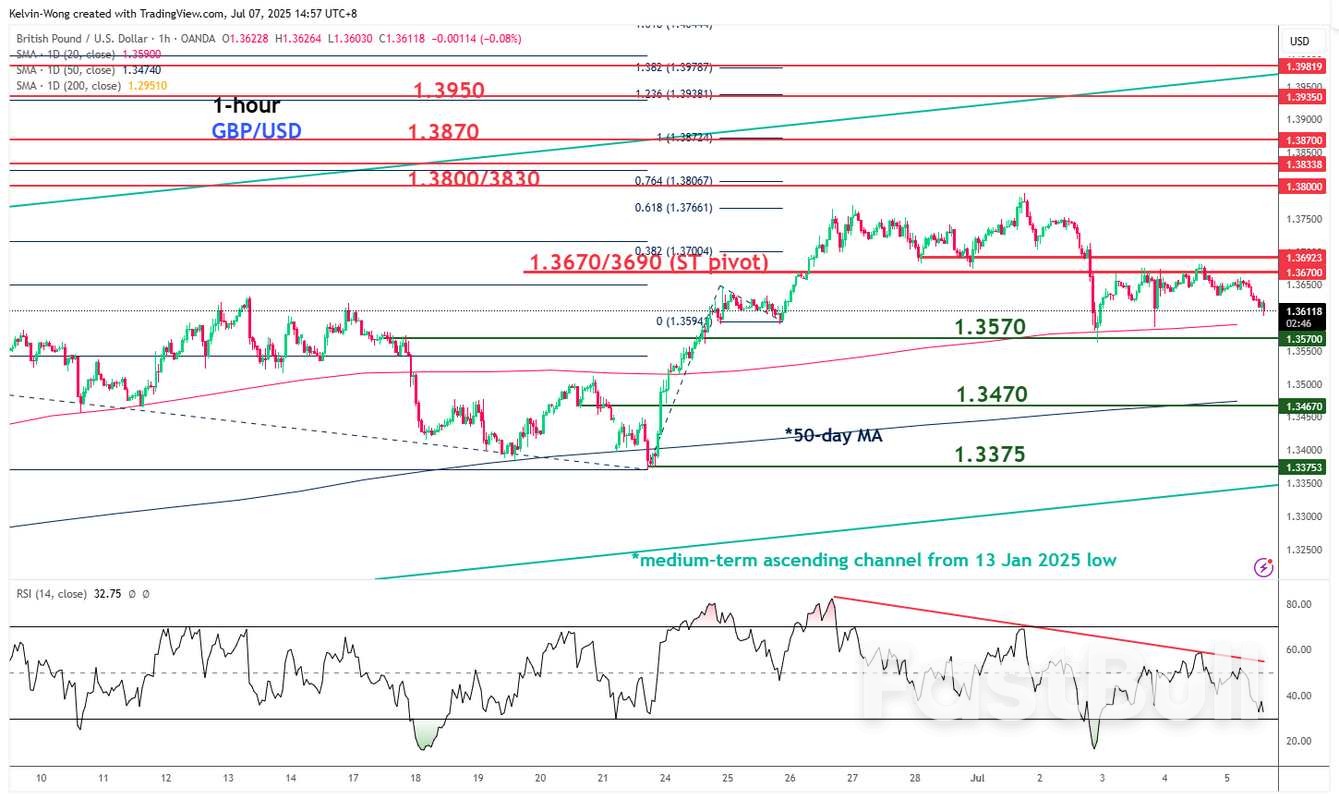
          Chart of the day – GBP/USD at risk of breaking below 20-day moving average

           Asia mid-session: Tariff uncertainty weighs on Asia equities; Gold, Oil Slip as US dollar rebounds US_United_States_Government_Flag _1
          The GBP/USD has failed to make any significant recoveries since last Wednesday, 7 July, dramatic intraday decline of -150 pips to a 6-day low of 1.3563 on the onset of a possible replacement of UK Chancellor Reeves.
          Thereafter, the sterling pound has managed to bounce after a retest at 1.3570 (also the 20-day moving average) against the US dollar, but the hourly RSI momentum indicator has continued to flash out bearish momentum conditions since 4 July (see Fig 2).
          These observations suggest a potential minor corrective decline sequence within its medium-term uptrend phase. Watch the 1.3670/3690 key short-term pivotal resistance, and a break below 1.3570 exposes the next intermediate support at 1.3470 (also the 50-day moving average)
          On the flip side, a clearance above 1.3690 invalidates the bearish scenario to kickstart another bullish impulsive up move sequence for the next intermediate resistances to come in at 1.3800/3830 and 1.3870.

          Source: OANDA

          Risk Warnings and Disclaimers
          You understand and acknowledge that there is a high degree of risk involved in trading. Following any strategies or investment methods may lead to potential losses. The content on the site is provided by our contributors and analysts for information purposes only. You are solely responsible for determining whether any trading assets, securities, strategy, or any other product is suitable for investing based on your own investment objectives and financial situation.
          Add to Favorites
          Share

          Markets Meander As Tariff Letter Wait Goes On

          Pepperstone
          Friday was, unsurprisingly, a pretty dull day for financial markets, with Independence Day seeing US desks shut, and little going on elsewhere.
          As always, any market moves seen on a public holiday, especially a US one, need to be taken with a huge pinch of salt, given the incredibly thin conditions in which they take place. Conditions which, typically, exacerbate even the smallest of moves, leading to a tendency for some to be blown out of all proportion.
          In any case, despite equity futures finding some downside on both sides of the pond, the bull case remains intact, especially on Wall Street. Thursday’s jobs report spoke to the continued resilience of the economy, which in turn should see the pace of earnings growth remain strong, while continued progress towards trade deals, and cooler rhetoric, helps to provide further support. The path of least resistance continues to lead to the upside.
          On the subject of trade, probably the most interesting development has been President Trump’s promise to soon send out letters informing countries of the tariffs that they will have to pay, if they are unable to reach a trade deal with the US. Of course, this comes as the ‘Liberation Day’ tariffs are due to go back into effect on Wednesday, as the pause implemented in early-April expires. While the US has agreed just 2 trade deals (UK & Vietnam) in that time, far short of the ’90 deals in 90 days’ that we were promised, I don’t think there’s too much reason to panic.
          Not only have the Trump Admin shown, numerous times, that they are unwilling, unable, or both, to stomach super-high tariff levels akin to a trade embargo, even those letters give plenty of wriggle room. Not only are they being sent before the pause expires, but the tariffs in said letters won’t actually come into effect until 1st August. Hence, this has all the hallmarks of another ‘escalate to de-escalate’ strategy, teeing us up nicely for another TACO moment in pretty short order.
          Besides that, the weekend’s most interesting development came in the crude space, with OPEC+ agreeing a larger than expected 550k bpd output hike from August. Clearly, the focus here remains on the ‘war for market share’ idea that I’ve been talking about in these notes for some time, with Saudi likely also seeking to punish some producers for non-compliance.
          Anyway, from a market perspective all this means one thing – downside for crude benchmarks. The market was already over-supplied, amid a dour demand outlook, now OPEC+ are bringing back more barrels, at the same time as the Trump Admin seek to ramp up the ‘drill baby, drill’ agenda. It’s tough to build a sustainable bull case for crude against that backdrop.
          I also find it tough to build a durable bull case for the dollar right now, though for very different reasons. At its core, the greenback remains highly unattractive, with participants focused not on the resiliency of the US economy, nor the FOMC’s relatively more hawkish stance in comparison to G10 peers. Instead, it is the continued erosion of Fed policy independence, and the highly unorthodox style of policymaking in Washington DC, which is giving international investors cause for concern. Capital outflows show no sign of slowing, and with a barren data docket this week, further declines could well be on the cards for the greenback.
          I’ve still got 1.20 in the EUR and 1.40 in the GBP pencilled in as medium-term targets. While neither are exactly bastions of political stability right now, both continue to be viewed as safer, and more predictable, options than sitting in the buck – the Swissie fits this bill too, incidentally, though with the SNB lurking, longs here are harder to have conviction in.
          LOOK AHEAD – The week ahead docket is pretty sparse (see below), meaning focus will almost certainly fall on what feels like an inevitable deluge of trade- and tariff-related headlines as we move through the week ahead.
          As for scheduled events, though, it’s very slim pickings. The RBA will deliver a very well-telegraphed 25bp cut in the early hours of tomorrow morning, with this set to be followed by the RBNZ standing pat on Wednesday. Minutes from the June FOMC meeting are also due, though with July having now become a nothingburger, these probably won’t be worth worrying about.
          On the data front, Friday’s monthly UK GDP data is too noisy to be of any use, while the weekly US jobless claims data, and Canadian employment stats, will probably get a cursory glance, and little else.
          There is, though, a fairly chunky week of Treasury supply on deck, with 3-, 10- and 30-year sales due. The latter two are likely to be of particular interest, especially with fiscal jitters remaining in light of the ‘One Big Beautiful Bill’ having been signed into law on Friday. Were one, or both, of those sales to be poorly received, fears over the unsustainable trajectory of US debt will be re-ignited once more.

          Source: Pepperstone

          Risk Warnings and Disclaimers
          You understand and acknowledge that there is a high degree of risk involved in trading. Following any strategies or investment methods may lead to potential losses. The content on the site is provided by our contributors and analysts for information purposes only. You are solely responsible for determining whether any trading assets, securities, strategy, or any other product is suitable for investing based on your own investment objectives and financial situation.
          Add to Favorites
          Share

          Portugal Sees EU, US Reaching Trade Deal With ‘Very Low’ Tariffs

          Daniel Carter

          Economic

          Political

          Portuguese Finance Minister Joaquim Miranda Sarmento said he sees the European Union and the US reaching an agreement with tariffs potentially below 10% that would help keep trade flowing.
          “It's possible to have an agreement with very low tariffs, an agreement that could be perceived as beneficial to both parties and that could continue to allow us to trade and to increase value for our citizens,” Sarmento said in a Bloomberg Television interview in Brussels. “We expect to have an update of what the Commission was able to negotiate with the US administration,” in the EU finance ministers' meetings to be held today and on Tuesday.
          Asked how low those tariffs could be, he later told Bloomberg Radio's Stephen Carroll “probably less than 10%, but let's see what's the outcome.”
          The EU has until July 9 to clinch a trade arrangement with US President Donald Trump before tariffs on nearly all of the bloc's exports to the US jump to 50%. Trump has imposed tariffs on almost all its trading partners, saying he wanted to bring back domestic manufacturing, needed to pay for a tax-cut extension and stop other countries from taking advantage of the US.
          “If the terms of the deal are not favorable for the EU then there is no agreement,” he said. “If an agreement is not possible on Wednesday there will mostly likely be a new deadline. If at the end of the day an agreement” is not possible, Europe should not retaliate on a full scale and should be very selective.”
          Sarmento added that Portugal will support Eurogroup President Paschal Donohoe's bid for a second term heading the meetings of euro-area finance ministers. Sarmento also said the government is still evaluating whether to name a new Bank of Portugal governor or reappoint Mario Centeno, as his term heading the central bank ends this month.
          Separately, the government will announce the start of the privatization process of state-owned airline TAP SA in the coming weeks, the minister said.
          A plan to privatize TAP was delayed earlier this year after parliament toppled the center-right minority government in a confidence vote in March. Portugal held an early election in May that was won by the ruling coalition, which added seats in parliament while still falling short of an absolute majority.

          Source: Bloomberg Europe

          To stay updated on all economic events of today, please check out our Economic calendar
          Risk Warnings and Disclaimers
          You understand and acknowledge that there is a high degree of risk involved in trading. Following any strategies or investment methods may lead to potential losses. The content on the site is provided by our contributors and analysts for information purposes only. You are solely responsible for determining whether any trading assets, securities, strategy, or any other product is suitable for investing based on your own investment objectives and financial situation.
          Add to Favorites
          Share

          Metals Decline as Trump’s BRICS Tariff Threat Fuels Global Trade Anxiety

          Gerik

          Commodity

          Economic

          Fresh Tariff Threat Rattles Metal Markets

          President Donald Trump’s unexpected announcement of a sweeping new tariff targeting all countries aligned with the BRICS bloc has reignited volatility in global commodities markets. In a late Sunday post on Truth Social, Trump declared that a 10% tariff would be imposed on BRICS nations Brazil, Russia, India, China, and South Africa with no exceptions and in addition to existing duties. This sudden policy signal has injected new uncertainty into an already fragile global trade environment.
          Following the announcement, industrial metals swiftly reversed recent gains. Copper dropped 0.7% to $9,800.50 per ton in Shanghai, marking a third consecutive decline on the London Metal Exchange after previously breaching $10,000. Aluminum also fell 0.8%, and broader declines were recorded across major base metals. Iron ore futures on the Singapore Exchange slipped 0.5% to $95.30 per ton, underscoring the widespread nature of the risk-off sentiment.

          Market Sensitivity to Trade Policy Surprises

          The reaction in commodity prices underscores a clear causal link between unexpected shifts in US trade rhetoric and investor sentiment across raw material markets. While industrial metals had shown resilience in recent months thanks to rising US imports, shrinking global inventories, and a weaker dollar the renewed threat of protectionism directly undermines the demand outlook.
          Trump’s tariff policy threatens to disrupt trade flows with some of the world’s largest metal-producing and consuming economies. China, the world’s largest consumer of copper and aluminum, sits at the core of this risk, with Brazil and South Africa also being key resource exporters. A blanket tariff on BRICS nations, if implemented without exceptions, would not only raise transaction costs but also introduce fresh supply chain disruptions for global manufacturers.

          Timing of the Policy Escalation Heightens Market Risks

          The announcement comes as Trump prepares to escalate pressure on trade partners more broadly. Treasury Secretary Scott Bessent confirmed that as many as 15 countries will receive formal tariff warning letters, with new rates scheduled to take effect on August 1. While Bessent suggested there may be room for bilateral negotiation beyond the July 9 deadline, the lack of clarity has left investors and producers bracing for broader disruption.
          The timing is particularly sensitive as metals markets had only recently shown signs of stabilization. Copper’s rise above $10,000 last week was fueled by surging US-bound shipments and declining stockpiles, suggesting recovering demand in the West. Trump’s tariff threat now casts doubt on that trajectory by introducing the potential for retaliatory measures and supply chain rerouting.

          Risk of Retaliation and Strategic Recalibration

          The BRICS bloc, while economically diverse, shares an interest in countering US trade dominance. A coordinated response to Trump’s policy could include counter-tariffs or reallocation of commodity flows toward non-Western markets. Such realignment would likely take time but would introduce structural inefficiencies and cost burdens across logistics and procurement systems. In this context, the metals market’s initial reaction reflects not only short-term pricing risk but a longer-term strategic recalibration.
          Trump’s unilateral tariff threat toward BRICS nations has exposed underlying fragilities in the industrial metals market. While recent gains were supported by positive fundamentals, the sudden shift in trade policy sentiment highlights the vulnerability of globally integrated supply chains. As the August 1 tariff deadline approaches, markets will remain sensitive to any further developments or clarifications, with the potential for a deeper correction if retaliatory measures emerge or if trade flows become more restricted. The episode reinforces the market’s ongoing dependency on geopolitical stability for price momentum and supply continuity.

          Source: Bloomberg

          To stay updated on all economic events of today, please check out our Economic calendar
          Risk Warnings and Disclaimers
          You understand and acknowledge that there is a high degree of risk involved in trading. Following any strategies or investment methods may lead to potential losses. The content on the site is provided by our contributors and analysts for information purposes only. You are solely responsible for determining whether any trading assets, securities, strategy, or any other product is suitable for investing based on your own investment objectives and financial situation.
          Add to Favorites
          Share
          FastBull
          Copyright © 2025 FastBull Ltd

          728 RM B 7/F GEE LOK IND BLDG NO 34 HUNG TO RD KWUN TONG KLN HONG KONG

          TelegramInstagramTwitterfacebooklinkedin
          App Store Google Play Google Play
          Products
          Charts

          Chats

          Q&A with Experts
          Screeners
          Economic Calendar
          Data
          Tools
          Membership
          Features
          Function
          Markets
          Copy Trading
          Latest Signals
          Contests
          News
          Analysis
          24/7
          Columns
          Education
          Company
          Careers
          About Us
          Contact Us
          Advertising
          Help Center
          Feedback
          User Agreement
          Privacy Policy
          Business

          White Label

          Data API

          Web Plug-ins

          Poster Maker

          Affiliate Program

          Risk Disclosure

          The risk of loss in trading financial instruments such as stocks, FX, commodities, futures, bonds, ETFs and crypto can be substantial. You may sustain a total loss of the funds that you deposit with your broker. Therefore, you should carefully consider whether such trading is suitable for you in light of your circumstances and financial resources.

          No decision to invest should be made without thoroughly conducting due diligence by yourself or consulting with your financial advisors. Our web content might not suit you since we don't know your financial conditions and investment needs. Our financial information might have latency or contain inaccuracy, so you should be fully responsible for any of your trading and investment decisions. The company will not be responsible for your capital loss.

          Without getting permission from the website, you are not allowed to copy the website's graphics, texts, or trademarks. Intellectual property rights in the content or data incorporated into this website belong to its providers and exchange merchants.

          Not Logged In

          Log in to access more features

          FastBull Membership

          Not yet

          Purchase

          Become a signal provider
          Help Center
          Customer Service
          Dark Mode
          Price Up/Down Colors

          Log In

          Sign Up

          Position
          Layout
          Fullscreen
          Default to Chart
          The chart page opens by default when you visit fastbull.com