• Trade
  • Markets
  • Copy
  • Contests
  • News
  • 24/7
  • Calendar
  • Q&A
  • Chats
Screeners
SYMBOL
LAST
ASK
BID
HIGH
LOW
NET CHG.
%CHG.
SPREAD
SPX
S&P 500 Index
6976.45
6976.45
6976.45
6991.91
6916.63
+37.42
+ 0.54%
--
DJI
Dow Jones Industrial Average
49407.67
49407.67
49407.67
49484.95
48673.58
+515.21
+ 1.05%
--
IXIC
NASDAQ Composite Index
23592.10
23592.10
23592.10
23686.83
23356.40
+130.29
+ 0.56%
--
USDX
US Dollar Index
97.450
97.530
97.450
97.460
97.170
+0.040
+ 0.04%
--
EURUSD
Euro / US Dollar
1.17915
1.17924
1.17915
1.18241
1.17809
+0.00017
+ 0.01%
--
GBPUSD
Pound Sterling / US Dollar
1.36629
1.36638
1.36629
1.37061
1.36598
-0.00040
-0.03%
--
XAUUSD
Gold / US Dollar
4918.02
4918.43
4918.02
4949.73
4665.80
+259.42
+ 5.57%
--
WTI
Light Sweet Crude Oil
61.981
62.011
61.981
62.191
60.864
-0.101
-0.16%
--

Community Accounts

Signal Accounts
--
Profit Accounts
--
Loss Accounts
--
View More

Become a signal provider

Sell trading signals to earn additional income

View More

Guide to Copy Trading

Get started with ease and confidence

View More

Signal Accounts for Members

All Signal Accounts

Best Return
  • Best Return
  • Best P/L
  • Best MDD
Past 1W
  • Past 1W
  • Past 1M
  • Past 1Y

All Contests

  • All
  • Trump Updates
  • Recommend
  • Stocks
  • Cryptocurrencies
  • Central Banks
  • Featured News
Top News Only
Share

Russian Deputy Prime Minister Novak Expects Oil Demand To Pick Up In March, April

Share

Russia Deputy Prime Minister Novak: Our Commodity Resources Are In Demand

Share

Russian Deputy Prime Minister Novak On India Possibly Cutting Russian Oil Imports: We Have Only Seen Public Statements

Share

Russian Deputy Prime Minister Novak On Expectations Of OPEC+ Actions In April: We Are Seeing Oil Demand And Supply Balance

Share

Finance Minister: Tanzania's Spending To Rise 10% Next Fiscal Year

Share

Qatar's Foreign Ministry Spokesperson On Iran: There Are Regional Collaboration And Ongoing Efforts In Order To Ensure Deescalation

Share

Russian Investment In Northern Fleet, In Particular Subsurface Capabilities Is Undiminished - Royal Navy First Sea Lord

Share

French Finance Minister Lescure: Forex Volatility Is A Subject That I Can Put On The G7 Agenda Depending On Develeopments

Share

French Finance Minister Lescure: Joint Instruments Can Have A Sectoral Focus, Such As Rare Earths

Share

China - Uruguay Joint Declaration: Both Sides Hope To Begin Negotiations On Free Trade Agreement Between China And MERCOSUR As Soon As Possible

Share

Dubai - Bridgewater Associates Founder Ray Dalio: Change Of Regime In Iran Would Make Middle East Region More Investable

Share

India's Nifty 50 Index Provisionally Ends 2.49% Higher

Share

China - Uruguay Joint Declaration: Uruguay Approves Of Participation Of Chinese Companies In Uruguay's 5G Network

Share

Kremlin Says Looming Absence Of Nuclear Arms Limits Would Be Very Bad For Global Security

Share

Dutch Prime Minister Rutte: Purl Program Supplying 90% Of Ukraine's Air Defence Missiles

Share

Kremlin: We Intend To Develop Our Strategic Partnership With India

Share

Kremlin On New Start: Putin's Offer Is Still On The Table But We Have Received No Response From The US

Share

[Bitcoin Drops Below $78,000] February 3Rd, According To Htx Market Data, Bitcoin Fell Below $78,000, With A 24-Hour Growth Of 0.87%

Share

Regional Official: Format Of Istanbul Talks Unclear Still, But Priority Is To Avoid Conflict And De-Escalate

Share

Regional Official: Saudi Arabia, Qatar, Oman, Pakistan, Egypt, United Arab Emirates Have Been Invited To Talks In Istanbul On Iran

TIME
ACT
FCST
PREV
Italy Manufacturing PMI (SA) (Jan)

A:--

F: --

P: --

South Africa Manufacturing PMI (Jan)

A:--

F: --

P: --

Euro Zone Manufacturing PMI Final (Jan)

A:--

F: --

P: --

U.K. Manufacturing PMI Final (Jan)

A:--

F: --

P: --

Turkey Trade Balance (Jan)

A:--

F: --

P: --

Brazil IHS Markit Manufacturing PMI (Jan)

A:--

F: --

P: --

Canada National Economic Confidence Index

A:--

F: --

P: --

Canada Manufacturing PMI (SA) (Jan)

A:--

F: --

P: --

U.S. IHS Markit Manufacturing PMI Final (Jan)

A:--

F: --

P: --

U.S. ISM Output Index (Jan)

A:--

F: --

P: --

U.S. ISM Inventories Index (Jan)

A:--

F: --

P: --

U.S. ISM Manufacturing Employment Index (Jan)

A:--

F: --

P: --

U.S. ISM Manufacturing New Orders Index (Jan)

A:--

F: --

P: --

U.S. ISM Manufacturing PMI (Jan)

A:--

F: --

P: --

US President Trump delivered a speech
South Korea CPI YoY (Jan)

A:--

F: --

P: --

Japan Monetary Base YoY (SA) (Jan)

A:--

F: --

P: --

Australia Building Approval Total YoY (Dec)

A:--

F: --

P: --
Australia Building Permits MoM (SA) (Dec)

A:--

F: --

P: --
Australia Building Permits YoY (SA) (Dec)

A:--

F: --

P: --

Australia Private Building Permits MoM (SA) (Dec)

A:--

F: --

P: --
Australia Overnight (Borrowing) Key Rate

A:--

F: --

P: --

RBA Rate Statement
Japan 10-Year Note Auction Yield

A:--

F: --

P: --

The U.S. House of Representatives voted on a short-term spending bill to end the partial government shutdown.
Saudi Arabia IHS Markit Composite PMI (Jan)

A:--

F: --

P: --

RBA Press Conference
Turkey PPI YoY (Jan)

A:--

F: --

P: --

Turkey CPI YoY (Jan)

A:--

F: --

P: --

Turkey CPI YoY (Excl. Energy, Food, Beverage, Tobacco & Gold) (Jan)

A:--

F: --

P: --

Richmond Federal Reserve President Barkin delivered a speech.
U.S. Weekly Redbook Index YoY

--

F: --

P: --

Mexico Manufacturing PMI (Jan)

--

F: --

P: --

U.S. API Weekly Refined Oil Stocks

--

F: --

P: --

U.S. API Weekly Gasoline Stocks

--

F: --

P: --

U.S. API Weekly Cushing Crude Oil Stocks

--

F: --

P: --

U.S. API Weekly Crude Oil Stocks

--

F: --

P: --

Japan IHS Markit Services PMI (Jan)

--

F: --

P: --

Japan IHS Markit Composite PMI (Jan)

--

F: --

P: --

China, Mainland Caixin Services PMI (Jan)

--

F: --

P: --

China, Mainland Caixin Composite PMI (Jan)

--

F: --

P: --

India HSBC Services PMI Final (Jan)

--

F: --

P: --

India IHS Markit Composite PMI (Jan)

--

F: --

P: --

Russia IHS Markit Services PMI (Jan)

--

F: --

P: --

South Africa IHS Markit Composite PMI (SA) (Jan)

--

F: --

P: --

Italy Services PMI (SA) (Jan)

--

F: --

P: --

Italy Composite PMI (Jan)

--

F: --

P: --

Germany Composite PMI Final (SA) (Jan)

--

F: --

P: --

Euro Zone Composite PMI Final (Jan)

--

F: --

P: --

Euro Zone Services PMI Final (Jan)

--

F: --

P: --

U.K. Composite PMI Final (Jan)

--

F: --

P: --

U.K. Total Reserve Assets (Jan)

--

F: --

P: --

U.K. Services PMI Final (Jan)

--

F: --

P: --

U.K. Official Reserves Changes (Jan)

--

F: --

P: --

Euro Zone Core CPI Prelim YoY (Jan)

--

F: --

P: --

Euro Zone Core HICP Prelim YoY (Jan)

--

F: --

P: --

Euro Zone PPI MoM (Dec)

--

F: --

P: --

Euro Zone HICP Prelim YoY (Jan)

--

F: --

P: --

Euro Zone Core HICP Prelim MoM (Jan)

--

F: --

P: --

Italy HICP Prelim YoY (Jan)

--

F: --

P: --

Euro Zone PPI YoY (Dec)

--

F: --

P: --

Q&A with Experts
    • All
    • Chatrooms
    • Groups
    • Friends
    Nawhdir Øt flag
    EuroTrader
    @EuroTraderAUD RBA, was my saviors my cousin
    Visxa Benfica flag
    ling sun
    Will the US dollar index fall after Richmond Federal Reserve President Barkin's speech?
    @ling sunToday, Barkin of the Richmond Fed is giving a speech at 8 AM ET, so there won't be an immediate reaction yet because it's about to happen bro
    Nawhdir Øt flag
    Mayor
    @Mayor🫂🫂
    SlowBear ⛅ flag
    srinivas
    @srinivas Humm, that is insightful nto!
    Visxa Benfica flag
    ANDY
    Hi, good afternoon
    @ANDY Good afternoon man
    Visxa Benfica flag
    How are you today?
    SlowBear ⛅ flag
    ANDY
    Hi, good afternoon
    @ANDYHey bro, welcome back how are you doing today?
    Tomasodoma flag
    hello everyone’s
    "Visxa Benfica" recalled a message
    srinivas flag
    SlowBear ⛅
    @SlowBear ⛅if the market is below i don't short
    Visxa Benfica flag
    Nawhdir Øt
    @Nawhdir ØtOh, it seems more advantageous to trade XAU than that, bro
    Visxa Benfica flag
    Tomasodoma
    hello everyone’s
    @Tomasodoma yeah nice to meet you man
    SlowBear ⛅ flag
    Tomasodoma
    hello everyone’s
    @TomasodomaHi mate
    Visxa Benfica flag
    Tomasodoma
    hello everyone’s
    @TomasodomaAre you trading right now?
    EuroTrader flag
    Nawhdir Øt
    @Nawhdir Øtwoww .you should be saying a very big thank you to them for saving the day for you cousin
    Visxa Benfica flag
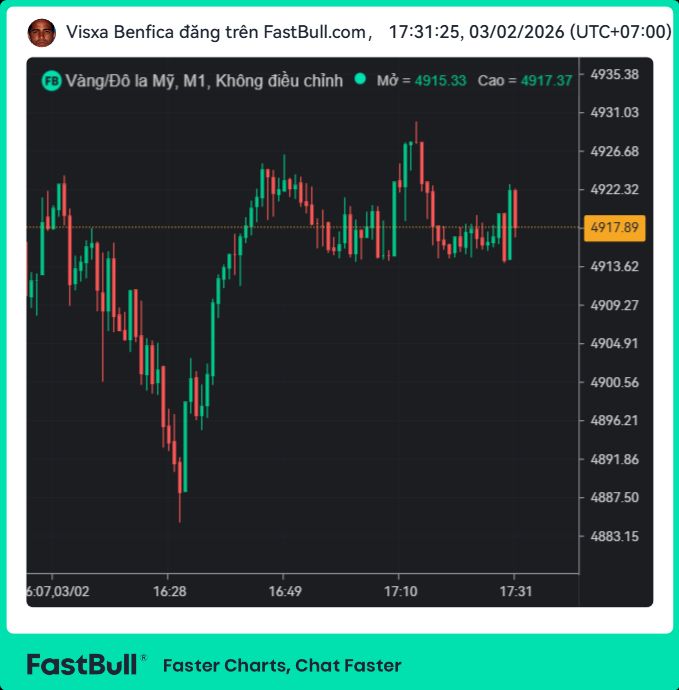
    I think gold will rebound to 5110 before continuing to fall today
    SlowBear ⛅ flag
    srinivas
    @srinivasOkay so marjet an fall below VWAP or Above VWAP - and when that jappen what do you do?
    Visxa Benfica flag
    EuroTrader flag
    Tomasodoma
    hello everyone’s
    @Tomasodomahi. how you doing today. hope you've got some good trades today
    srinivas flag
    SlowBear ⛅
    @SlowBear ⛅i don't sell below vwap
    Type here...
    Add Symbol or Code

      No matching data

      All
      Trump Updates
      Recommend
      Stocks
      Cryptocurrencies
      Central Banks
      Featured News
      • All
      • Russia-Ukraine Conflict
      • Middle East Flashpoint
      • All
      • Russia-Ukraine Conflict
      • Middle East Flashpoint
      Search
      Products

      Charts Free Forever

      Chats Q&A with Experts
      Screeners Economic Calendar Data Tools
      Membership Features
      Data Warehouse Market Trends Institutional Data Policy Rates Macro

      Market Trends

      Market Sentiment Order Book Forex Correlations

      Top Indicators

      Charts Free Forever
      Markets

      News

      News Analysis 24/7 Columns Education
      From Institutions From Analysts
      Topics Columnists

      Latest Views

      Latest Views

      Trending Topics

      Top Columnists

      Latest Update

      Signals

      Copy Rankings Latest Signals Become a signal provider AI Rating
      Contests
      Brokers

      Overview Brokers Assessment Rankings Regulators News Claims
      Broker listing Forex Brokers Comparison Tool Live Spread Comparison Scam
      Q&A Complaint Scam Alert Videos Tips to Detect Scam
      More

      Business
      Events
      Careers About Us Advertising Help Center

      White Label

      Broker API

      Data API

      Web Plug-ins

      Affiliate Program

      Awards Institution Evaluation IB Seminar Salon Event Exhibition
      Vietnam Thailand Singapore Dubai
      Fans Party Investment Sharing Session
      FastBull Summit BrokersView Expo
      Recent Searches
        Top Searches
          Markets
          News
          Analysis
          User
          24/7
          Economic Calendar
          Education
          Data
          • Names
          • Latest
          • Prev

          View All

          No data

          Scan to Download

          Faster Charts, Chat Faster!

          Download App
          English
          • English
          • Español
          • العربية
          • Bahasa Indonesia
          • Bahasa Melayu
          • Tiếng Việt
          • ภาษาไทย
          • Français
          • Italiano
          • Türkçe
          • Русский язык
          • 简中
          • 繁中
          Open Account
          Search
          Products
          Charts Free Forever
          Markets
          News
          Signals

          Copy Rankings Latest Signals Become a signal provider AI Rating
          Contests
          Brokers

          Overview Brokers Assessment Rankings Regulators News Claims
          Broker listing Forex Brokers Comparison Tool Live Spread Comparison Scam
          Q&A Complaint Scam Alert Videos Tips to Detect Scam
          More

          Business
          Events
          Careers About Us Advertising Help Center

          White Label

          Broker API

          Data API

          Web Plug-ins

          Affiliate Program

          Awards Institution Evaluation IB Seminar Salon Event Exhibition
          Vietnam Thailand Singapore Dubai
          Fans Party Investment Sharing Session
          FastBull Summit BrokersView Expo

          Vietnam Manufacturing Stays in Expansion Mode as PMI Holds Above 50 for Seventh Month

          Gerik

          Economic

          Summary:

          Vietnam’s manufacturing PMI remained firmly in expansion territory in January 2026, signaling continued recovery momentum despite rising cost pressures....

          PMI Signals Sustained Expansion Despite Slight Cooling

          Vietnam’s manufacturing sector continued to expand in January 2026, with the Purchasing Managers’ Index reaching 52.5, according to the latest survey released by S&P Global. Although this marked a modest decline from December’s 53.0 reading, the index remained above the 50-point threshold for the seventh consecutive month, confirming an ongoing improvement in overall business conditions.
          The marginal easing in the headline PMI reflects a slowdown in the pace of expansion rather than a reversal in trend. Manufacturing activity continues to benefit from recovering demand, positioning the sector on a stable growth trajectory at the beginning of 2026.

          Production Accelerates on Stronger New Orders

          Notably, actual production growth strengthened in January, outpacing the previous month. Surveyed firms reported that higher output was largely driven by an increase in new orders, supported by improving customer demand. This indicates a direct relationship between order inflows and production decisions, with manufacturers responding quickly to market signals.
          Export orders provided additional support, even though new export orders recorded their third decline in four months. The contraction, however, was mild, and several firms cited increased orders from Asian markets, including India. This suggests that external demand remains broadly resilient, albeit uneven across regions.

          Employment And Purchasing Activity Reinforce Momentum

          Labor market conditions within the manufacturing sector remained supportive. Employment rose for the fourth consecutive month, with the fastest rate of job creation since June 2024, though overall hiring growth stayed modest. Companies indicated that most new hires were on short-term contracts, reflecting cautious optimism rather than aggressive expansion.
          Higher production needs also led firms to increase purchasing activity for the seventh straight month. This sustained rise underscores confidence in near-term demand. At the same time, inventories of inputs fell for the first time since September 2025, as materials were actively consumed to meet production requirements. Finished goods inventories also declined at the fastest pace in four months, pointing to efficient order fulfillment and steady delivery to customers.

          Supply Conditions And Cost Pressures Remain Challenging

          Despite improvements in output and order management, supplier delivery times continued to lengthen. Encouragingly, the extent of delays was the weakest in eight months, suggesting some easing of supply-side frictions. Firms attributed delivery delays primarily to higher input demand and lingering material shortages.
          These supply constraints fed into continued input cost inflation. While cost pressures eased slightly from the three-and-a-half-year high recorded in December 2025, they remained elevated. As a result, manufacturers raised selling prices again in January, with the pace of price increases reaching the fastest level since April 2022. This dynamic reflects a cost pass-through mechanism rather than purely demand-driven pricing power.

          Business Confidence Reaches Multi-Year High

          Even amid rising costs, business sentiment strengthened further. Optimism about output over the next 12 months improved for the fourth consecutive month, reaching its highest level since March 2024. Around 55 percent of surveyed firms expect production to increase over the coming year, driven by expectations of stronger new orders as market conditions continue to normalize.
          Andrew Harker, Economics Director at S&P Global Market Intelligence, described January as a solid start to the year for Vietnamese manufacturing. He noted that firms are scaling up production to meet rising orders while improving their ability to respond promptly to customer demand, building on momentum carried over from late 2025.

          Inflation Risks A Key Variable To Watch

          Harker also cautioned that inflationary pressures could emerge as a meaningful headwind. Ongoing material shortages are keeping input costs elevated, forcing companies to accelerate price increases. While demand has not yet been affected, any sustained weakening in new orders in the months ahead would be an important signal to monitor.
          Overall, Vietnam’s manufacturing sector enters 2026 with solid underlying momentum. The PMI data point to a recovery that is broad-based and increasingly entrenched, though its durability will depend on how effectively firms and policymakers manage rising cost pressures and evolving external demand conditions.
          To stay updated on all economic events of today, please check out our Economic calendar
          Risk Warnings and Disclaimers
          You understand and acknowledge that there is a high degree of risk involved in trading. Following any strategies or investment methods may lead to potential losses. The content on the site is provided by our contributors and analysts for information purposes only. You are solely responsible for determining whether any trading assets, securities, strategy, or any other product is suitable for investing based on your own investment objectives and financial situation.
          Add to Favorites
          Share

          India Signals Shift Away From Russian Oil As Trump Hails Historic Trade Breakthrough

          Gerik

          Economic

          Commodity

          A Surprise Turn In U.S.–India Relations

          U.S. President Donald Trump declared that Washington and New Delhi had reached a landmark trade agreement following a phone call with Indian Prime Minister Narendra Modi. According to Trump, the deal takes effect immediately and includes reciprocal tariff reductions, with U.S. tariffs on Indian goods cut to 18% from 25%.
          Trump also said Modi had committed to buying U.S. products “at a much higher level,” framing the agreement as a decisive step toward rebalancing bilateral trade. The announcement was made via Trump’s Truth Social account and was presented as both an economic and geopolitical breakthrough.

          Energy Commitments And The Russia Dimension

          The most geopolitically significant element of Trump’s statement was the claim that India would stop buying Russian oil and instead increase purchases from the United States and potentially Venezuela. Trump linked this shift directly to broader strategic goals, arguing that cutting off Russian energy revenues would weaken Moscow’s ability to fund the war in Ukraine.
          From a causal perspective, the logic is clear: reducing India’s dependence on discounted Russian crude would pressure Russia’s fiscal position. However, whether this commitment can be implemented swiftly remains uncertain, given India’s existing supply contracts, refinery configurations and cost considerations.

          Tariffs, Market Access And Massive Purchase Pledges

          Trump said the agreement goes beyond energy. He claimed India would reduce tariffs and non-tariff barriers on U.S. goods to zero and purchase more than $500 billion worth of American energy, technology, agricultural products, coal and other items over time. These statements, if realized, would represent one of the most ambitious bilateral trade expansions in recent history.
          Modi later confirmed the tariff reduction in a post on X, welcoming the cut to 18% for “Made in India” products entering the U.S. market and praising Trump’s leadership. Modi emphasized that cooperation between the world’s two largest democracies would support global peace, stability and prosperity, signaling political alignment alongside economic concessions.

          Legal And Procedural Uncertainty Persists

          Despite Trump’s insistence that the deal is effective immediately, no official text has been released and it remains unclear whether any binding documents have been signed. The White House and the Office of the U.S. Trade Representative have not yet provided further clarification.
          Legal experts and Democratic lawmakers have questioned whether Trump has the authority to conclude binding trade agreements without congressional approval. Trump and his supporters counter that Congress has already delegated sufficient negotiating power to the executive branch, an argument that has surfaced repeatedly during his return to office.
          Industry participants are taking a cautious stance. Lori Mullins, chief executive of Rogers & Brown Custom Brokers, noted that her sector has learned not to react too quickly to high-profile trade announcements. In practice, she said, changes only become real once they are formally published in the Federal Register with clear tariff codes, dates and implementation rules.

          Context Of Earlier Trade Tensions

          The announcement marks a sharp reversal from last year, when trade talks between the Trump and Modi administrations stalled, partly due to India’s continued reliance on Russian oil. In August, Trump imposed a 25% tariff on Indian goods in response to those purchases, on top of existing reciprocal duties.
          That backdrop helps explain the strong political signaling embedded in the current announcement. By publicly committing to reduce Russian oil imports, India addresses one of Washington’s core grievances, while securing meaningful tariff relief for its exporters.

          A Deal With Momentum, Not Finality

          The agreement has generated optimism in markets and diplomatic circles, but its real impact will depend on formalization and execution. For now, it functions more as a strategic declaration than a fully codified trade pact.
          If implemented as described, the deal would reshape U.S.–India trade flows and carry significant implications for global energy markets and Russia’s war financing. Until official documents are released, however, investors and policymakers are likely to treat the announcement as an important signal of intent rather than a completed transaction.
          To stay updated on all economic events of today, please check out our Economic calendar
          Risk Warnings and Disclaimers
          You understand and acknowledge that there is a high degree of risk involved in trading. Following any strategies or investment methods may lead to potential losses. The content on the site is provided by our contributors and analysts for information purposes only. You are solely responsible for determining whether any trading assets, securities, strategy, or any other product is suitable for investing based on your own investment objectives and financial situation.
          Add to Favorites
          Share

          India’s Record $187 Billion Borrowing Plan Puts Bond Market on Edge

          Gerik

          Bond

          Economic

          Record Borrowing Signals A New Stress Test For Bonds

          The government of Prime Minister Narendra Modi is preparing to issue an unprecedented volume of government bonds in the coming fiscal year, a move that risks adding significant strain to India’s domestic bond market at a time when demand is showing signs of fatigue.
          Presenting the budget on February 1, Finance Minister Nirmala Sitharaman announced that New Delhi plans to borrow 17.2 trillion rupees, equivalent to about $187 billion, in the fiscal year starting April 1. This figure is around 18% higher than the revised borrowing estimate for the current year and exceeds market expectations of roughly 16.5 trillion rupees, marking the largest annual borrowing program in India’s history.

          Supply Surge Meets Weakening Demand

          The sharp increase in borrowing comes as government bond yields are already hovering near their highest levels in almost a year. The situation is being compounded by heavier issuance from state governments and softer demand from traditional long-term buyers such as pension funds and insurance companies. Together, these factors are amplifying concerns that the market may struggle to absorb the rising supply without a further increase in yields.
          Higher borrowing costs could add pressure to India’s broader economy, particularly as the country faces elevated U.S. tariffs and diminishing room for interest rate cuts from the central bank. The interaction here is largely causal: more bond supply, combined with limited monetary easing, tends to push yields higher as investors demand greater compensation to hold government debt.

          Yields At Risk Of Breaking Higher

          According to Abhishek Upadhyay, an economist at ICICI Securities Primary Dealership, the combination of heavy debt issuance and the absence of near-term rate cuts could push the benchmark 10-year government bond yield toward 7% in the coming weeks. The yield closed at around 6.70% on January 30 and had already climbed to 6.73% last week, the highest level since March 2025.
          This upward drift reflects mounting supply pressure rather than a sudden deterioration in credit fundamentals, but sustained higher yields would nonetheless tighten financial conditions across the economy.

          Fiscal Consolidation Progress Slows

          The government has set a fiscal deficit target of 4.3% of GDP for the next fiscal year, compared with revised estimates of 4.2% and 4.4% for the current year. While this points to a gradual consolidation path, analysts argue that progress remains modest.
          Upadhyay noted that the pace of fiscal tightening appears restrained, suggesting that the government is running out of room to cut spending meaningfully. This limits its ability to offset higher borrowing through sharper deficit reduction, reinforcing investor concerns about the medium-term debt trajectory.

          Rollover Needs Add To Pressure

          Net borrowing, after accounting for maturities, is projected at 11.7 trillion rupees in the coming fiscal year, slightly above the revised 11.3 trillion rupees for the current year. At the same time, bonds worth an estimated 5.5 trillion rupees are set to mature, nearly 70% higher than the comparable figure this year. These rollover requirements further increase gross issuance and intensify the supply challenge facing the market.
          India’s bond market is entering a delicate phase where fiscal ambitions, investor appetite and monetary policy constraints intersect. The planned borrowing surge underscores the government’s commitment to sustaining growth and welfare spending, but it also raises the risk of higher yields becoming entrenched if demand does not keep pace.
          How smoothly the market digests this record issuance will depend on investor confidence, the pace of state-level borrowing and any signals from the central bank regarding liquidity management. For now, the bond market is bracing for a period of heightened volatility as it absorbs the largest supply shock in years.
          To stay updated on all economic events of today, please check out our Economic calendar
          Risk Warnings and Disclaimers
          You understand and acknowledge that there is a high degree of risk involved in trading. Following any strategies or investment methods may lead to potential losses. The content on the site is provided by our contributors and analysts for information purposes only. You are solely responsible for determining whether any trading assets, securities, strategy, or any other product is suitable for investing based on your own investment objectives and financial situation.
          Add to Favorites
          Share

          Americans Rush to Sell Gold and Silver as Record Prices Trigger a Retail Liquidation Wave

          Gerik

          Economic

          Retail Precious Metals See Unprecedented Activity

          Outside Witter Coin in San Francisco, long queues monitored by security staff have become a daily sight. This is not a cultural venue or a popular restaurant, but a precious metals dealer overwhelmed by Americans eager to sell gold and silver. According to owner Seth Chandler, who has run the business since 2016, the current volume of transactions has no precedent in his experience, with both buying and selling activity surging simultaneously.
          Similar scenes are playing out across the country. Pawn shops and coin dealers report a sharp rise in customers bringing gold bars, silver bullion, household silverware and broken jewelry to sell. At Witter Coin alone, customer traffic is now four to five times higher than two years ago and has nearly doubled over the past six months, forcing the business to expand staffing to cope with demand.

          Record Prices Meet Household Financial Pressure

          The immediate driver is price. Over the past year, gold prices have doubled, breaking above $5,000 per ounce for the first time, while silver prices have tripled. These gains have occurred as the cost of living in the United States remains elevated, pushing many households to unlock value from assets accumulated over decades.
          From a financial perspective, the relationship is largely causal rather than coincidental. High prices make selling especially attractive, while inflation and economic uncertainty increase the incentive to convert dormant assets into cash. Many sellers are not only parting with family heirlooms but also combing through drawers for scrap gold and damaged jewelry that suddenly carry meaningful value.

          Safe-Haven Demand Continues To Support Prices

          Despite heavy retail selling, gold and silver remain firmly positioned as safe-haven assets. Investor demand typically rises during periods of concern about U.S. economic prospects, inflation or geopolitical risk. Recent trade tensions and firm policy rhetoric from U.S. President Donald Trump have reinforced these dynamics, contributing to the sharp run-up in precious metal prices.
          Ole Hansen, head of commodity strategy at Saxo Bank, has noted that many investors expect gold and silver to preserve real value if equity markets correct sharply or inflation pressures re-emerge. This expectation underpins continued buying interest even as retail investors rush to realize gains.
          Major financial institutions have echoed this constructive outlook. Goldman Sachs and Bank of America have forecast gold prices in the range of $5,400 to $6,000 per ounce by year-end, reinforcing bullish sentiment and helping to sustain elevated valuations.

          Historical Value Sacrificed To Economics

          At current price levels, dealers say it is often more profitable to melt items down for refining rather than resell them intact. Witter Coin now regularly handles not only standard bullion but also collectible coins, antique watches and vintage jewelry, with some single metal transactions reaching $1 million in value.
          The economic calculus has had cultural consequences. Chandler recounted the case of a handcrafted 18-karat gold pocket watch from the 1880s, comprising more than 180 individual components, that was ultimately melted down. In a high-price environment, the decision was driven purely by financial return rather than historical preservation, illustrating how market incentives can override sentimental or cultural considerations.

          Silver’s Breakout Adds Momentum

          Silver has been the surprise performer. While gold’s ascent has unfolded over several years, silver’s explosive rally has caught many observers off guard. In 2025, silver prices rose more than 140 percent, the strongest annual increase since 1979, and climbed another 30 percent this year before a short-term correction.
          Kelly Swisher, who runs Arlington Jewelry and Pawn in Illinois, said he now purchases tens of thousands of dollars’ worth of precious metals each week. Seth Gold, vice chairman of American Jewelry and Loan in Detroit, reported that the number of people selling silver has jumped from a few cases per week to dozens each day. Beyond safe-haven appeal, silver prices are also supported by strong industrial demand and persistent supply shortages, making the rally more structurally grounded than pure speculation.

          Precious Metals As A Household Safety Net

          For many American families under pressure from high living costs, selling gold and silver has delivered unexpectedly large cash inflows. These windfalls underline a broader shift in how precious metals function in the real economy. Beyond their role as investment assets, gold and silver are increasingly acting as a last-resort store of value for households navigating economic volatility.
          The current wave of selling does not signal a loss of faith in precious metals. Instead, it reflects a moment where record prices intersect with household needs, turning long-held assets into immediate financial relief while investors continue to view gold and silver as essential hedges against uncertainty.

          Source: CNN

          To stay updated on all economic events of today, please check out our Economic calendar
          Risk Warnings and Disclaimers
          You understand and acknowledge that there is a high degree of risk involved in trading. Following any strategies or investment methods may lead to potential losses. The content on the site is provided by our contributors and analysts for information purposes only. You are solely responsible for determining whether any trading assets, securities, strategy, or any other product is suitable for investing based on your own investment objectives and financial situation.
          Add to Favorites
          Share

          Vietnam Interbank Rates Spike as Liquidity Tightens at the Start of February 2026

          Gerik

          Economic

          Overnight Rates Jump Out of The Low-Rate Zone

          At the turn of January to early February 2026, overnight VND interbank rates moved abruptly from below 3 percent per year to levels close to 10 percent per year. On February 2, the average overnight rate reached about 9.10 percent, while one-week rates hovered around 9.60 percent and one-month tenors stood near 7.50 percent. Some overnight transactions were reportedly matched above 10 percent, highlighting the sudden increase in short-term funding demand compared with the relatively calm conditions seen earlier.
          This sharp repricing reflects how sensitive the interbank market becomes when liquidity buffers thin out, particularly during periods when large, predictable cash outflows occur simultaneously.

          OMO Injections Expanded To Absorb Liquidity Stress

          In response, the State Bank of Vietnam stepped up liquidity provision through open market operations. In early February sessions, the central bank offered VND 100 trillion via repo operations. Of this amount, VND 80.363 trillion was absorbed, while VND 25 trillion matured, resulting in a net injection of roughly VND 55.363 trillion. Outstanding OMO repos rose to around VND 376 trillion, broadly comparable with levels seen at the end of 2025 and the highest point in more than a year.
          The OMO bid rate remained at 4.5 percent per year, substantially lower than prevailing overnight and one-week interbank rates. This pricing structure made OMO the preferred funding channel for banks facing temporary shortfalls, helping to stabilize market functioning without forcing institutions to borrow at elevated interbank rates.

          Tax Payments Drain Short-Term Banking Liquidity

          A key driver of the liquidity squeeze was the end-January tax payment peak. During this period, corporate funds move from commercial bank accounts to State Treasury accounts held at the central bank. Settlement takes place through the national interbank electronic payment system under existing regulatory frameworks, meaning large-scale tax payments temporarily reduce the funds available in commercial banks’ settlement balances.
          System-wide Citad balances, which capture banks’ non-term deposits at the central bank including required and excess reserves, fell to around VND 268 trillion by the end of January. This represented a sharp drop from roughly VND 632 trillion at the end of December 2025, while estimated required reserves were near VND 300 trillion. When balances approach or dip below this threshold, banks tend to increase their demand for short-term funding either through the interbank market or directly from the central bank.

          Tet Cash Demand Adds Additional Pressure

          Seasonal factors linked to the Lunar New Year further amplified the pressure. Ahead of Tet, households and businesses typically withdraw cash to pay wages, bonuses, settle obligations and finance holiday consumption. Although cash in vaults remains a banking asset, it does not sit in accounts at the central bank and therefore cannot be used for interbank settlement. As cash withdrawals rise, the pool of immediately usable reserves shrinks, leaving banks more exposed to intraday and overnight liquidity swings.
          When higher cash demand coincides with large tax-related outflows, banks often opt to hold higher precautionary reserves, intensifying short-term funding needs across the system.

          Policy Signal From The Central Bank

          By maintaining an OMO rate well below market levels and scaling up liquidity provision, the central bank signaled a clear intention to smooth short-term volatility rather than tolerate a prolonged tightening in money market conditions. The approach suggests that the spike in interbank rates reflects short-term liquidity frictions rather than a shift in broader monetary policy stance.
          As tax flows normalize and Treasury spending returns funds to the banking system, interbank conditions are expected to ease. Until then, OMO remains the primary stabilizing tool, ensuring that temporary liquidity stress does not spill over into broader credit conditions or disrupt financial stability.
          To stay updated on all economic events of today, please check out our Economic calendar
          Risk Warnings and Disclaimers
          You understand and acknowledge that there is a high degree of risk involved in trading. Following any strategies or investment methods may lead to potential losses. The content on the site is provided by our contributors and analysts for information purposes only. You are solely responsible for determining whether any trading assets, securities, strategy, or any other product is suitable for investing based on your own investment objectives and financial situation.
          Add to Favorites
          Share

          Trump Says He's Seeking $1 Billion From Harvard University

          Daniel Carter

          Economic

          President Donald Trump said "we are now seeking one billion dollars in damages" from Harvard University after the New York Times reported that his administration had backed off on demands for $200 million to satisfy accusations of wrongdoing by the Ivy League institution.
          "This case will continue until justice is served," Trump said in a post on his Truth Social platform late Monday night. He asserted that Harvard had been "feeding a lot of 'nonsense' to the failing New York Times."
          In an article earlier Monday, the Times reported that administration officials had dropped their demands for the $200 million "amid sagging approval ratings for Mr. Trump, and as he faces outrage over immigration enforcement tactics and the shooting deaths of two Americans by federal agents in Minnesota."
          In his Truth Social post, Trump not specify under what authority he would seek the $1 billion. Harvard didn't immediately respond to a request for comment.
          In a later post after midnight Tuesday, Trump called the Times article "completely wrong" and demanded that it be changed.
          Since the beginning of his second administration, Trump and his administration have waged an aggressive campaign against Harvard and other universities over accusations of antisemitism linked in part to campus protests against Israel's military campaign in the Gaza Strip.
          Conservatives have also long contended that they and their ideas have largely been frozen out of American academia by a liberal establishment, and they now have allies in the Trump administration.
          Harvard sued the government twice and won a court victory in September when a federal judge ruled that the US illegally halted research funding and said the administration "used antisemitism as a smokescreen for a targeted, ideologically-motivated assault on this country's premier universities."
          The administration said it would appeal that ruling, but the frozen funds have been largely restored. Unlike other Ivy League universities such as Columbia and Brown, Harvard hasn't reached a settlement with the White House.
          In December, Harvard announced that its president, Alan Garber, had agreed to stay on for "an indefinite time beyond" mid-2027, extending his leadership of the oldest and richest US university.

          Source: Bloomberg Europe

          To stay updated on all economic events of today, please check out our Economic calendar
          Risk Warnings and Disclaimers
          You understand and acknowledge that there is a high degree of risk involved in trading. Following any strategies or investment methods may lead to potential losses. The content on the site is provided by our contributors and analysts for information purposes only. You are solely responsible for determining whether any trading assets, securities, strategy, or any other product is suitable for investing based on your own investment objectives and financial situation.
          Add to Favorites
          Share

          India Commits to Buying U.S. Energy, Defence and Aircraft in First Phase of Trade Deal

          Gerik

          Economic

          A Broad Purchase Commitment Anchors The Deal

          India has agreed to buy petroleum, defence goods, electronics, pharmaceuticals, telecom products and aircraft from the United States under a newly announced trade agreement, according to a senior government official familiar with the discussions. The purchases form part of a first tranche of a broader U.S.–India trade framework that will be negotiated further in the coming months.
          U.S. President Donald Trump announced on Monday that Washington would slash tariffs on Indian goods to 18% from as high as 50%. In return, India committed to halting purchases of Russian oil, lowering trade barriers and significantly expanding imports of American products. Trump said India had agreed to “buy American at a much higher level,” including energy, coal, technology, agricultural goods and other products, potentially amounting to $500 billion over time.

          Reducing The Bilateral Trade Imbalance

          According to the Indian official, the agreement is designed in part to narrow the trade deficit the United States runs with India. Data from India’s commerce ministry show that Indian exports to the U.S. rose 15.88% year-on-year to $85.5 billion in the January–November period, while imports from the U.S. stood at $46.08 billion. Expanding imports of U.S. energy, defence and capital goods is therefore intended to rebalance trade flows rather than disrupt India’s export momentum.
          The commitment to buy U.S. products spans multiple strategic sectors and will be implemented over several years, indicating a phased approach rather than an immediate surge in imports. India has also offered market access in certain agricultural products, though specific details have not yet been disclosed.

          Tariff Cuts And Sector-Specific Concessions

          As part of Washington’s initial demands, India has agreed to cut tariffs on automobiles, a politically sensitive sector that has long been a point of friction in bilateral trade talks. While the current agreement addresses urgent trade imbalances, officials stressed that it represents only the first step toward a more comprehensive deal that will be negotiated in subsequent rounds.
          The structure of the agreement reflects a pragmatic compromise. Lower U.S. tariffs provide immediate relief for Indian exporters, while India’s commitments on energy and defence procurement align with longer-term strategic and security interests.

          Markets Respond With A Relief Rally

          Financial markets reacted positively to the announcement. India’s benchmark Nifty 50 rose nearly 3% in early trading, while the rupee strengthened more than 1% to around 90.40 per dollar. The rally reflects renewed investor confidence after months of uncertainty, during which the absence of a U.S. trade deal weighed heavily on Indian assets.
          The relationship between the agreement and market performance is largely causal, as reduced tariff barriers improve earnings visibility for exporters and lower the risk premium applied to Indian equities and currency markets.

          A Foundation For Deeper Economic Alignment

          While many operational details remain to be finalized, the scope of the initial agreement signals a meaningful shift in U.S.–India economic relations. By combining tariff relief with large-scale commitments in energy, defence and aviation, the deal goes beyond a narrow trade fix and lays the groundwork for deeper strategic alignment.
          As further tranches are negotiated, the effectiveness of the agreement will depend on execution timelines, sector-specific implementation and follow-through on both sides. For now, the announcement has delivered what markets were waiting for: clarity, momentum and a credible pathway toward a more balanced and durable trade relationship between the two economies.

          Source: AP

          To stay updated on all economic events of today, please check out our Economic calendar
          Risk Warnings and Disclaimers
          You understand and acknowledge that there is a high degree of risk involved in trading. Following any strategies or investment methods may lead to potential losses. The content on the site is provided by our contributors and analysts for information purposes only. You are solely responsible for determining whether any trading assets, securities, strategy, or any other product is suitable for investing based on your own investment objectives and financial situation.
          Add to Favorites
          Share
          FastBull
          Copyright © 2026 FastBull Ltd

          728 RM B 7/F GEE LOK IND BLDG NO 34 HUNG TO RD KWUN TONG KLN HONG KONG

          TelegramInstagramTwitterfacebooklinkedin
          App Store Google Play Google Play
          Products
          Charts

          Chats

          Q&A with Experts
          Screeners
          Economic Calendar
          Data
          Tools
          Membership
          Features
          Function
          Markets
          Copy Trading
          Latest Signals
          Contests
          News
          Analysis
          24/7
          Columns
          Education
          Company
          Careers
          About Us
          Contact Us
          Advertising
          Help Center
          Feedback
          User Agreement
          Privacy Policy
          Personal Information Protection Statement
          Business

          White Label

          Broker API

          Data API

          Web Plug-ins

          Poster Maker

          Affiliate Program

          Risk Disclosure

          The risk of loss in trading financial instruments such as stocks, FX, commodities, futures, bonds, ETFs and crypto can be substantial. You may sustain a total loss of the funds that you deposit with your broker. Therefore, you should carefully consider whether such trading is suitable for you in light of your circumstances and financial resources.

          No decision to invest should be made without thoroughly conducting due diligence by yourself or consulting with your financial advisors. Our web content might not suit you since we don't know your financial conditions and investment needs. Our financial information might have latency or contain inaccuracy, so you should be fully responsible for any of your trading and investment decisions. The company will not be responsible for your capital loss.

          Without getting permission from the website, you are not allowed to copy the website's graphics, texts, or trademarks. Intellectual property rights in the content or data incorporated into this website belong to its providers and exchange merchants.

          Not Logged In

          Log in to access more features

          Connect Broker
          Become a signal provider
          Help Center
          Customer Service
          Dark Mode
          Price Up/Down Colors

          Log In

          Sign Up

          Position
          Layout
          Fullscreen
          Default to Chart
          The chart page opens by default when you visit fastbull.com