• Trade
  • Markets
  • Copy
  • Contests
  • News
  • 24/7
  • Calendar
  • Q&A
  • Chats
Trending
Screeners
SYMBOL
LAST
BID
ASK
HIGH
LOW
NET CHG.
%CHG.
SPREAD
SPX
S&P 500 Index
6827.42
6827.42
6827.42
6899.86
6801.80
-73.58
-1.07%
--
DJI
Dow Jones Industrial Average
48458.04
48458.04
48458.04
48886.86
48334.10
-245.98
-0.51%
--
IXIC
NASDAQ Composite Index
23195.16
23195.16
23195.16
23554.89
23094.51
-398.69
-1.69%
--
USDX
US Dollar Index
97.950
98.030
97.950
98.500
97.950
-0.370
-0.38%
--
EURUSD
Euro / US Dollar
1.17394
1.17409
1.17394
1.17496
1.17192
+0.00011
+ 0.01%
--
GBPUSD
Pound Sterling / US Dollar
1.33707
1.33732
1.33707
1.33997
1.33419
-0.00148
-0.11%
--
XAUUSD
Gold / US Dollar
4299.39
4299.39
4299.39
4353.41
4257.10
+20.10
+ 0.47%
--
WTI
Light Sweet Crude Oil
57.233
57.485
57.233
58.011
56.969
-0.408
-0.71%
--

Community Accounts

Signal Accounts
--
Profit Accounts
--
Loss Accounts
--
View More

Become a signal provider

Sell trading signals to earn additional income

View More

Guide to Copy Trading

Get started with ease and confidence

View More

Signal Accounts for Members

All Signal Accounts

Best Return
  • Best Return
  • Best P/L
  • Best MDD
Past 1W
  • Past 1W
  • Past 1M
  • Past 1Y

All Contests

  • All
  • Trump Updates
  • Recommend
  • Stocks
  • Cryptocurrencies
  • Central Banks
  • Featured News
Top News Only
Share

USA Embassy In Lithuania: Maria Kalesnikava Is Not Going To Vilnius

Share

USA Embassy In Lithuania: Other Prisoners Are Being Sent From Belarus To Ukraine

Share

Ukraine President Zelenskiy: Five Ukrainians Released By Belarus In US-Brokered Deal

Share

USA Vilnius Embassy: USA Stands Ready For "Additional Engagement With Belarus That Advances USA Interests"

Share

USA Vilnius Embassy: Belarus, USA, Other Citizens Among The Prisoners Released Into Lithuania

Share

USA Vilnius Embassy: USA Will Continue Diplomatic Efforts To Free The Remaining Political Prisoners In Belarus

Share

USA Vilnius Embassy: Belarus Releases 123 Prisoners Following Meeting Of President Trump's Envoy Coale And Belarus President Lukashenko

Share

USA Vilnius Embassy: Masatoshi Nakanishi, Aliaksandr Syrytsa Are Among The Prisoners Released By Belarus

Share

USA Vilnius Embassy: Maria Kalesnikava And Viktor Babaryka Are Among The Prisoners Released By Belarus

Share

USA Vilnius Embassy: Nobel Peace Prize Laureate Ales Bialiatski Is Among The Prisoners Released By Belarus

Share

Belarusian Presidential Administration Telegram Channel: Lukashenko Has Pardoned 123 Prisoners As Part Of Deal With US

Share

Two Local Syrian Officials: Joint US-Syrian Military Patrol In Central Syria Came Under Fire From Unknown Assailants

Share

Israeli Military Says It Targeted 'Key Hamas Terrorist' In Gaza City

Share

Rwanda's Actions In Eastern Drc Are A Clear Violation Of Washington Accords Signed By President Trump - Secretary Of State Rubio

Share

Israeli Military Issues Evacuation Warning In Southern Lebanon Village Ahead Of Strike - Spokesperson On X

Share

Belarusian State Media Cites US Envoy Coale As Saying He Discussed Ukraine And Venezuela With Lukashenko

Share

Belarusian State Media Cites US Envoy Coale As Saying That US Removes Sanctions On Belarusian Potassium

Share

Thai Prime Minister: No Ceasefire Agreement With Cambodia

Share

US, Ukraine To Discuss Ceasefire In Berlin Ahead Of European Summit

Share

Incoming Czech Prime Minister Babis: Czech Republic Will Not Take On Guarantees For Ukraine Financing, European Commission Must Find Alternatives

TIME
ACT
FCST
PREV
U.K. Trade Balance Non-EU (SA) (Oct)

A:--

F: --

P: --

U.K. Trade Balance (Oct)

A:--

F: --

P: --

U.K. Services Index MoM

A:--

F: --

P: --

U.K. Construction Output MoM (SA) (Oct)

A:--

F: --

P: --

U.K. Industrial Output YoY (Oct)

A:--

F: --

P: --

U.K. Trade Balance (SA) (Oct)

A:--

F: --

P: --

U.K. Trade Balance EU (SA) (Oct)

A:--

F: --

P: --

U.K. Manufacturing Output YoY (Oct)

A:--

F: --

P: --

U.K. GDP MoM (Oct)

A:--

F: --

P: --

U.K. GDP YoY (SA) (Oct)

A:--

F: --

P: --

U.K. Industrial Output MoM (Oct)

A:--

F: --

P: --

U.K. Construction Output YoY (Oct)

A:--

F: --

P: --

France HICP Final MoM (Nov)

A:--

F: --

P: --

China, Mainland Outstanding Loans Growth YoY (Nov)

A:--

F: --

P: --

China, Mainland M2 Money Supply YoY (Nov)

A:--

F: --

P: --

China, Mainland M0 Money Supply YoY (Nov)

A:--

F: --

P: --

China, Mainland M1 Money Supply YoY (Nov)

A:--

F: --

P: --

India CPI YoY (Nov)

A:--

F: --

P: --

India Deposit Gowth YoY

A:--

F: --

P: --

Brazil Services Growth YoY (Oct)

A:--

F: --

P: --

Mexico Industrial Output YoY (Oct)

A:--

F: --

P: --

Russia Trade Balance (Oct)

A:--

F: --

P: --

Philadelphia Fed President Henry Paulson delivers a speech
Canada Building Permits MoM (SA) (Oct)

A:--

F: --

P: --

Canada Wholesale Sales YoY (Oct)

A:--

F: --

P: --

Canada Wholesale Inventory MoM (Oct)

A:--

F: --

P: --

Canada Wholesale Inventory YoY (Oct)

A:--

F: --

P: --

Canada Wholesale Sales MoM (SA) (Oct)

A:--

F: --

P: --

Germany Current Account (Not SA) (Oct)

A:--

F: --

P: --

U.S. Weekly Total Rig Count

A:--

F: --

P: --

U.S. Weekly Total Oil Rig Count

A:--

F: --

P: --

Japan Tankan Large Non-Manufacturing Diffusion Index (Q4)

--

F: --

P: --

Japan Tankan Small Manufacturing Outlook Index (Q4)

--

F: --

P: --

Japan Tankan Large Non-Manufacturing Outlook Index (Q4)

--

F: --

P: --

Japan Tankan Large Manufacturing Outlook Index (Q4)

--

F: --

P: --

Japan Tankan Small Manufacturing Diffusion Index (Q4)

--

F: --

P: --

Japan Tankan Large Manufacturing Diffusion Index (Q4)

--

F: --

P: --

Japan Tankan Large-Enterprise Capital Expenditure YoY (Q4)

--

F: --

P: --

U.K. Rightmove House Price Index YoY (Dec)

--

F: --

P: --

China, Mainland Industrial Output YoY (YTD) (Nov)

--

F: --

P: --

China, Mainland Urban Area Unemployment Rate (Nov)

--

F: --

P: --

Saudi Arabia CPI YoY (Nov)

--

F: --

P: --

Euro Zone Industrial Output YoY (Oct)

--

F: --

P: --

Euro Zone Industrial Output MoM (Oct)

--

F: --

P: --

Canada Existing Home Sales MoM (Nov)

--

F: --

P: --

Euro Zone Total Reserve Assets (Nov)

--

F: --

P: --

U.K. Inflation Rate Expectations

--

F: --

P: --

Canada National Economic Confidence Index

--

F: --

P: --

Canada New Housing Starts (Nov)

--

F: --

P: --

U.S. NY Fed Manufacturing Employment Index (Dec)

--

F: --

P: --

U.S. NY Fed Manufacturing Index (Dec)

--

F: --

P: --

Canada Core CPI YoY (Nov)

--

F: --

P: --

Canada Manufacturing Unfilled Orders MoM (Oct)

--

F: --

P: --

Canada Manufacturing New Orders MoM (Oct)

--

F: --

P: --

Canada Core CPI MoM (Nov)

--

F: --

P: --

Canada Manufacturing Inventory MoM (Oct)

--

F: --

P: --

Canada CPI YoY (Nov)

--

F: --

P: --

Canada CPI MoM (Nov)

--

F: --

P: --

Canada CPI YoY (SA) (Nov)

--

F: --

P: --

Canada Core CPI MoM (SA) (Nov)

--

F: --

P: --

Q&A with Experts
    • All
    • Chatrooms
    • Groups
    • Friends
    Connecting
    .
    .
    .
    Type here...
    Add Symbol or Code

      No matching data

      All
      Trump Updates
      Recommend
      Stocks
      Cryptocurrencies
      Central Banks
      Featured News
      • All
      • Russia-Ukraine Conflict
      • Middle East Flashpoint
      • All
      • Russia-Ukraine Conflict
      • Middle East Flashpoint
      Search
      Products

      Charts Free Forever

      Chats Q&A with Experts
      Screeners Economic Calendar Data Tools
      Membership Features
      Data Warehouse Market Trends Institutional Data Policy Rates Macro

      Market Trends

      Market Sentiment Order Book Forex Correlations

      Top Indicators

      Charts Free Forever
      Markets

      News

      News Analysis 24/7 Columns Education
      From Institutions From Analysts
      Topics Columnists

      Latest Views

      Latest Views

      Trending Topics

      Top Columnists

      Latest Update

      Signals

      Copy Rankings Latest Signals Become a signal provider AI Rating
      Contests
      Brokers

      Overview Brokers Assessment Rankings Regulators News Claims
      Broker listing Forex Brokers Comparison Tool Live Spread Comparison Scam
      Q&A Complaint Scam Alert Videos Tips to Detect Scam
      More

      Business
      Events
      Careers About Us Advertising Help Center

      White Label

      Data API

      Web Plug-ins

      Affiliate Program

      Awards Institution Evaluation IB Seminar Salon Event Exhibition
      Vietnam Thailand Singapore Dubai
      Fans Party Investment Sharing Session
      FastBull Summit BrokersView Expo
      Recent Searches
        Top Searches
          Markets
          News
          Analysis
          User
          24/7
          Economic Calendar
          Education
          Data
          • Names
          • Latest
          • Prev

          View All

          No data

          Scan to Download

          Faster Charts, Chat Faster!

          Download App
          English
          • English
          • Español
          • العربية
          • Bahasa Indonesia
          • Bahasa Melayu
          • Tiếng Việt
          • ภาษาไทย
          • Français
          • Italiano
          • Türkçe
          • Русский язык
          • 简中
          • 繁中
          Open Account
          Search
          Products
          Charts Free Forever
          Markets
          News
          Signals

          Copy Rankings Latest Signals Become a signal provider AI Rating
          Contests
          Brokers

          Overview Brokers Assessment Rankings Regulators News Claims
          Broker listing Forex Brokers Comparison Tool Live Spread Comparison Scam
          Q&A Complaint Scam Alert Videos Tips to Detect Scam
          More

          Business
          Events
          Careers About Us Advertising Help Center

          White Label

          Data API

          Web Plug-ins

          Affiliate Program

          Awards Institution Evaluation IB Seminar Salon Event Exhibition
          Vietnam Thailand Singapore Dubai
          Fans Party Investment Sharing Session
          FastBull Summit BrokersView Expo

          US Trade Deficit Narrows Sharply in April; Imports Post Record Drop

          Michelle

          Economic

          Forex

          Summary:

          The U.S. trade deficit narrowed sharply in April, with imports decreasing by the most on record as the front-running of goods ahead of tariffs ebbed, which could provide a lift to economic growth this quarter.
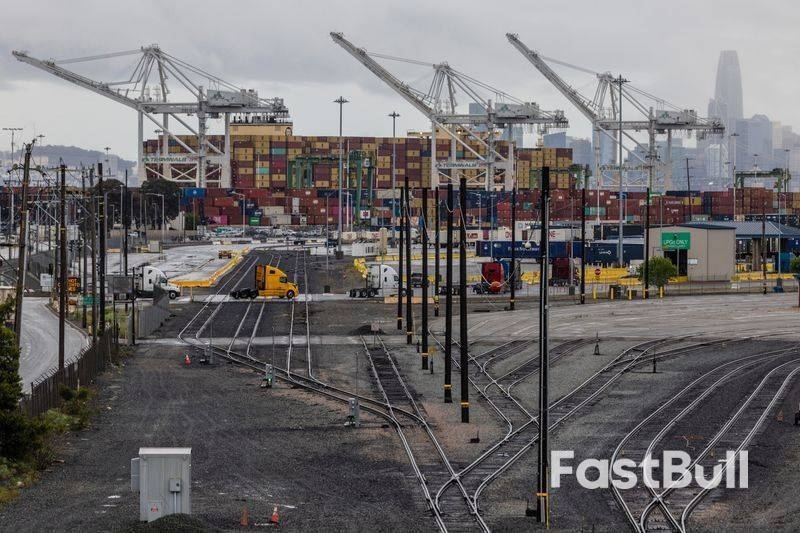
          The U.S. trade deficit narrowed sharply in April, with imports decreasing by the most on record as the front-running of goods ahead of tariffs ebbed, which could provide a lift to economic growth this quarter.

          The trade gap contracted by a record 55.5% to $61.6 billion, the lowest level since September 2023, the Commerce Department's Bureau of Economic Analysis said on Thursday. Data for March was revised to show the trade deficit having widened to an all-time high of $138.3 billion rather than the previously reported $140.5 billion.

          Economists polled by Reuters forecast the deficit narrowing to $70.0 billion. The goods trade deficit eased by a record 46.2% to $87.4 billion, the lowest level since October 2023.

          A rush to beat import duties helped to widen the trade deficit in the first quarter, which accounted for a large part of the 0.2% annualized rate of decline in gross domestic product last quarter. The contraction in the deficit, at face value, suggests that trade could significantly add to GDP this quarter, but much would depend on the state of inventories.

          Imports decreased by a record 16.3% to $351.0 billion in April. Goods imports slumped by a record 19.9% to $277.9 billion. They were held down by a $33.0 billion decline in imports of consumer goods, mostly pharmaceutical preparations from Ireland. Imports of cellphones and other household goods fell $3.5 billion.

          Imports of industrial supplies and materials declined $23.3 billion, reflecting decreases in finished metal shapes and other precious metals.

          Motor vehicle, parts and engines imports fell $8.3 billion with passenger cars accounting for much of the decline. The front-loading of imports is probably not over. Higher duties for most countries have been postponed until July, while those for Chinese goods have been delayed until mid-August.

          President Donald Trump's administration had given U.S. trade partners until Wednesday to make their "best offers" to avoid other punishing import levies from taking effect in early July.

          Imports from Canada were the lowest since May 2021, while those from China were the lowest since March 2020. But imports from Vietnam and Taiwan were the highest on record.

          Exports rose 3.0% to $289.4 billion, an all-time high. Goods exports increased 3.4% to a record $190.5 billion. They were boosted by a $10.4 billion jump in industrial supplies and materials, mostly finished metal shapes, nonmonetary gold and crude oil.

          Capital goods exports advanced $1.0 billion, lifted by computers. But exports of motor vehicles, parts and engines fell $3.3 billion, held down by passenger cars as well as trucks, buses and special purpose vehicles.

          Source: Yahoo Finance

          To stay updated on all economic events of today, please check out our Economic calendar
          Risk Warnings and Disclaimers
          You understand and acknowledge that there is a high degree of risk involved in trading. Following any strategies or investment methods may lead to potential losses. The content on the site is provided by our contributors and analysts for information purposes only. You are solely responsible for determining whether any trading assets, securities, strategy, or any other product is suitable for investing based on your own investment objectives and financial situation.
          Add to Favorites
          Share

          Bitcoin Supply Shock? Percentage of BTC on Exchanges Nears 2018 Levels

          Warren Takunda

          Cryptocurrency

          Key takeaways:
          Bitcoin’s percent supply on exchanges has dropped below 11% for the first time since 2018.
          Institutional adoption is accelerating BTC withdrawals from public exchanges.
          Trust in centralized platforms is shaky post-FTX.
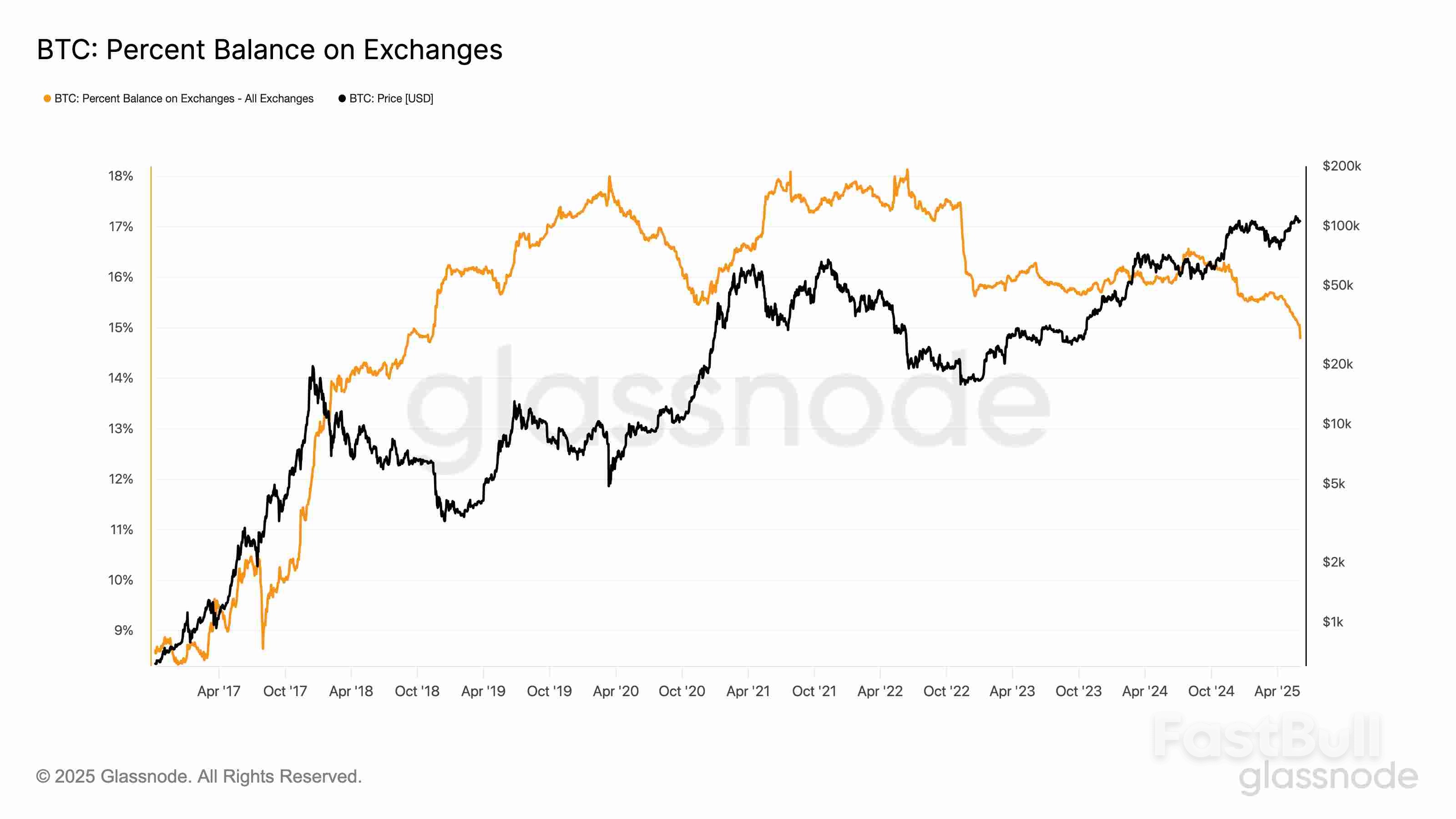
          Bitcoin's percent supply on exchanges has dropped to near seven-year lows, falling below 11% for the first time since March 2018, according to Glassnode data.
          The peak occurred around March 2020, when over 17.2% of the BTC supply was held on exchanges. Since then, over 6% of the total supply, or roughly 1.26 million BTC, has been withdrawn from exchange wallets.Bitcoin Supply Shock? Percentage of BTC on Exchanges Nears 2018 Levels_1

          BTC percent balance on exchanges. Source: Glassnode

          Let’s examine the key reasons behind Bitcoin’s growing withdrawals from crypto exchanges.

          Bitcoin’s HODLing rises to a two-year high

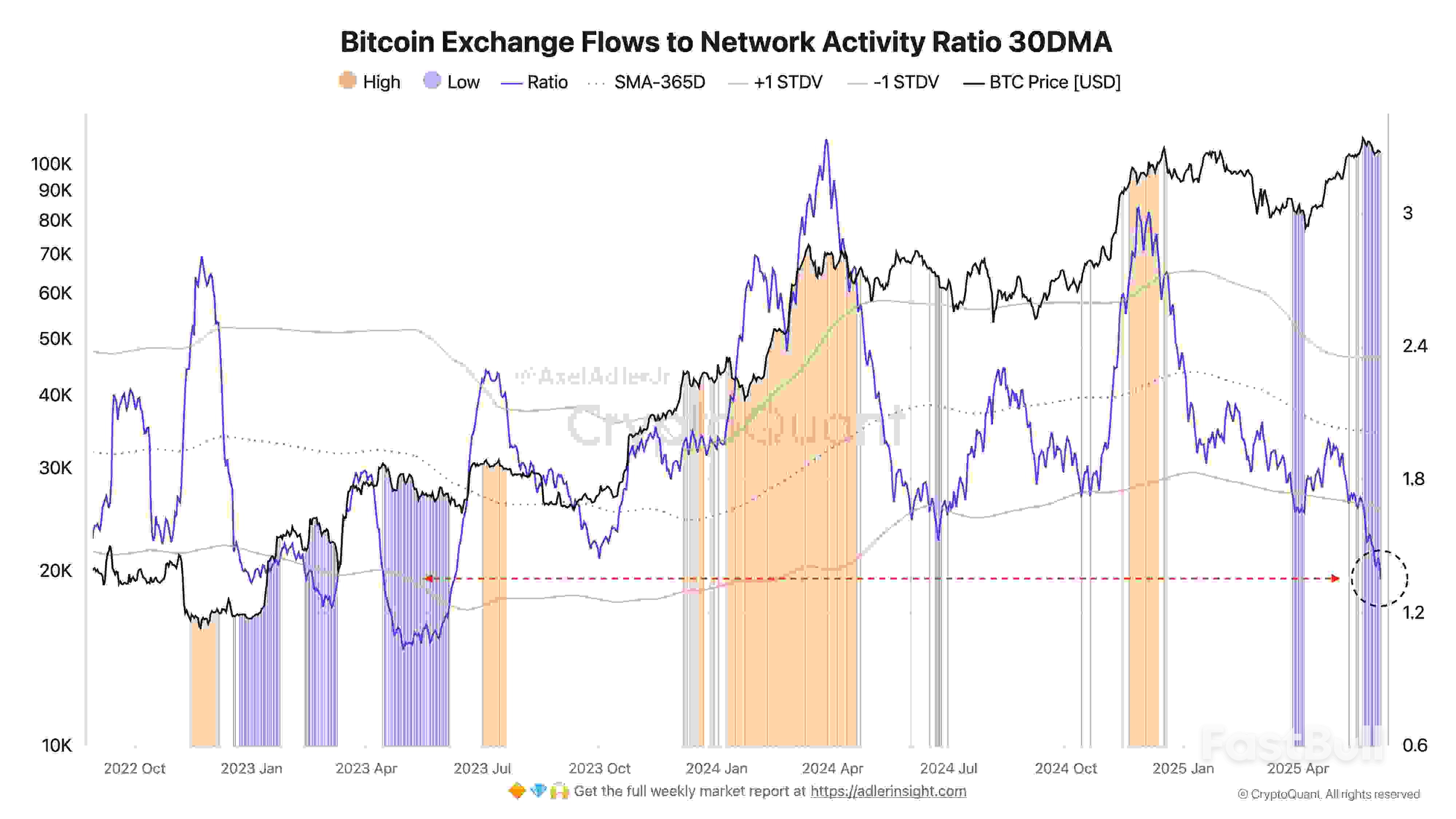
          Bitcoin investors are holding onto their coins at the highest level in over two years, according to the latest Exchange Flows to Network Activity Ratio chart by CryptoQuant.
          The ratio, measuring the volume of BTC flowing to exchanges relative to onchain network activity, has fallen to its lowest reading since early 2023, signaling subdued exchange deposits despite rising prices.Bitcoin Supply Shock? Percentage of BTC on Exchanges Nears 2018 Levels_2

          Bitcoin exchange flows to network activity ratio 30-day moving average. Source: CryptoQuant

          As of early June 2025, the 30-day moving average of the ratio sits near 1.2, well below its 365-day average and approaching -1 standard deviation.
          Historically, such low levels have marked periods of strong conviction among long-term Bitcoin holders, with investors preferring cold storage to trading.
          This reduces available supply, with fewer coins potentially up for sale even as Bitcoin nears all-time highs.

          Institutional custodians replacing crypto exchanges

          The rise of institutional custody solutions is another major factor behind Bitcoin’s decreasing supply across exchanges.
          Instead of public exchanges, large financial institutions like BlackRock, Fidelity, and Franklin Templeton prefer third-party custody platforms.
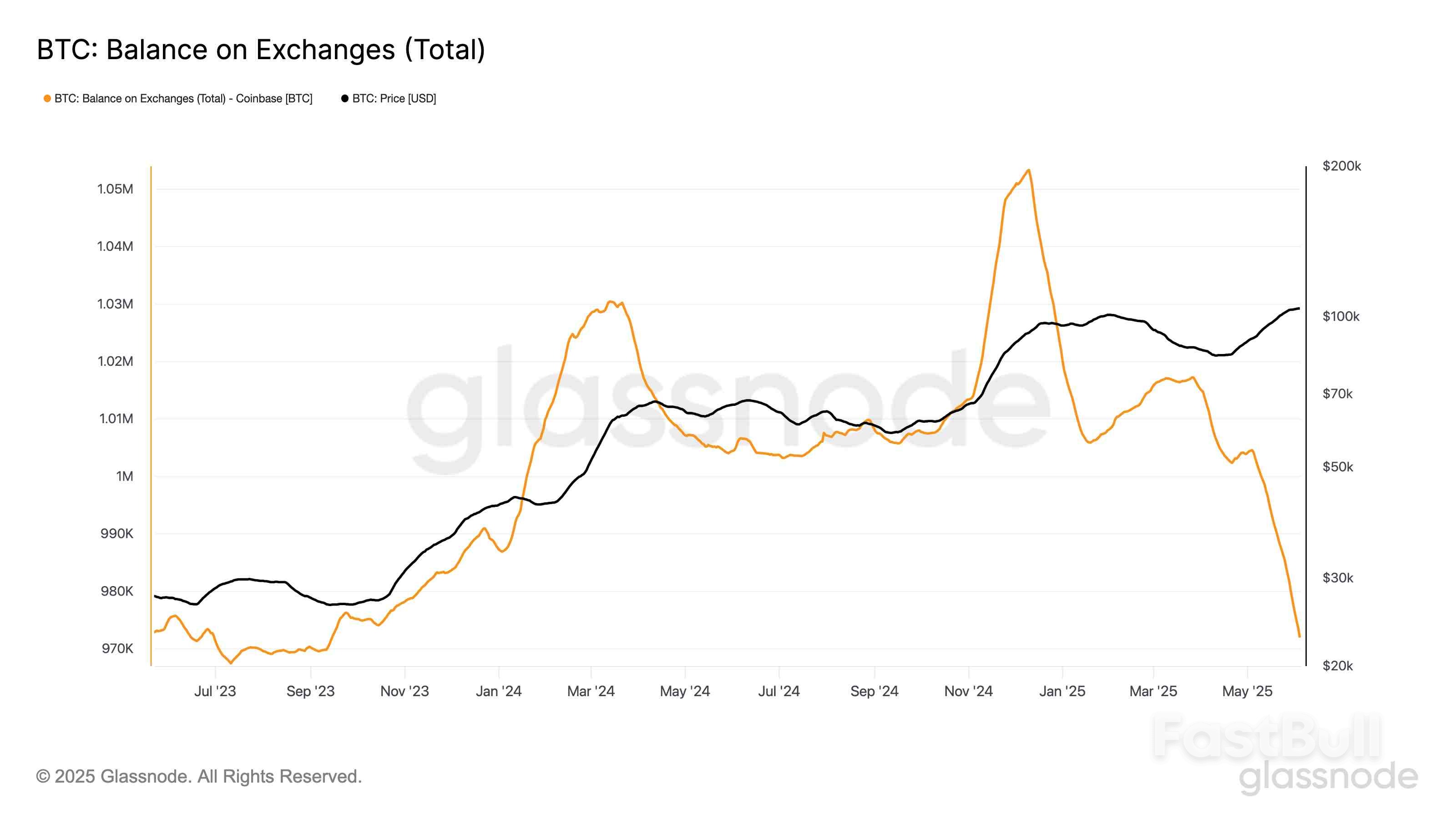
          Coinbase Prime, for example, reported over $212 billion in assets under custody in Q1 2025, driven by “inflows from ETF issuers, corporations, and high net worth individuals.”
          The Coinbase crypto exchange, on the other hand, witnessed over $500 million worth of BTC outflows in the same quarter.Bitcoin Supply Shock? Percentage of BTC on Exchanges Nears 2018 Levels_3

          BTC balance on the Coinbase exchange. Source: Glassnode

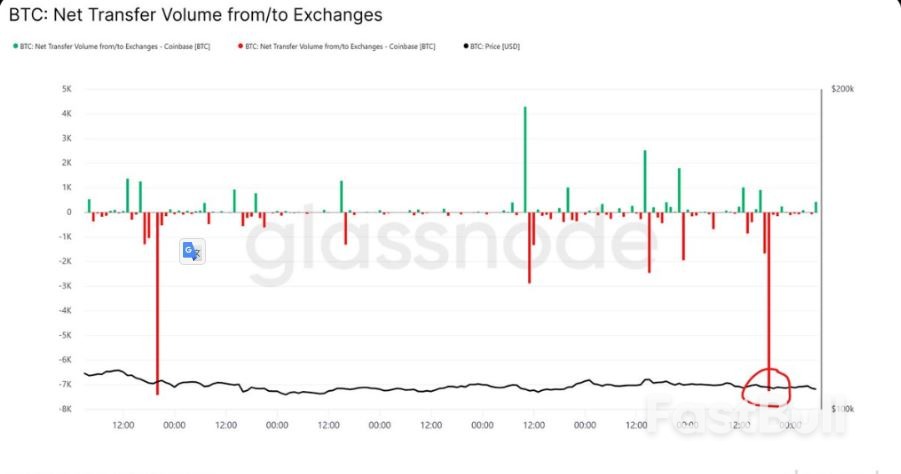
          The outflows have continued into the second quarter, including 761 million worth of withdrawals witnessed on June 5.Bitcoin Supply Shock? Percentage of BTC on Exchanges Nears 2018 Levels_4

          Source: André Dragosch

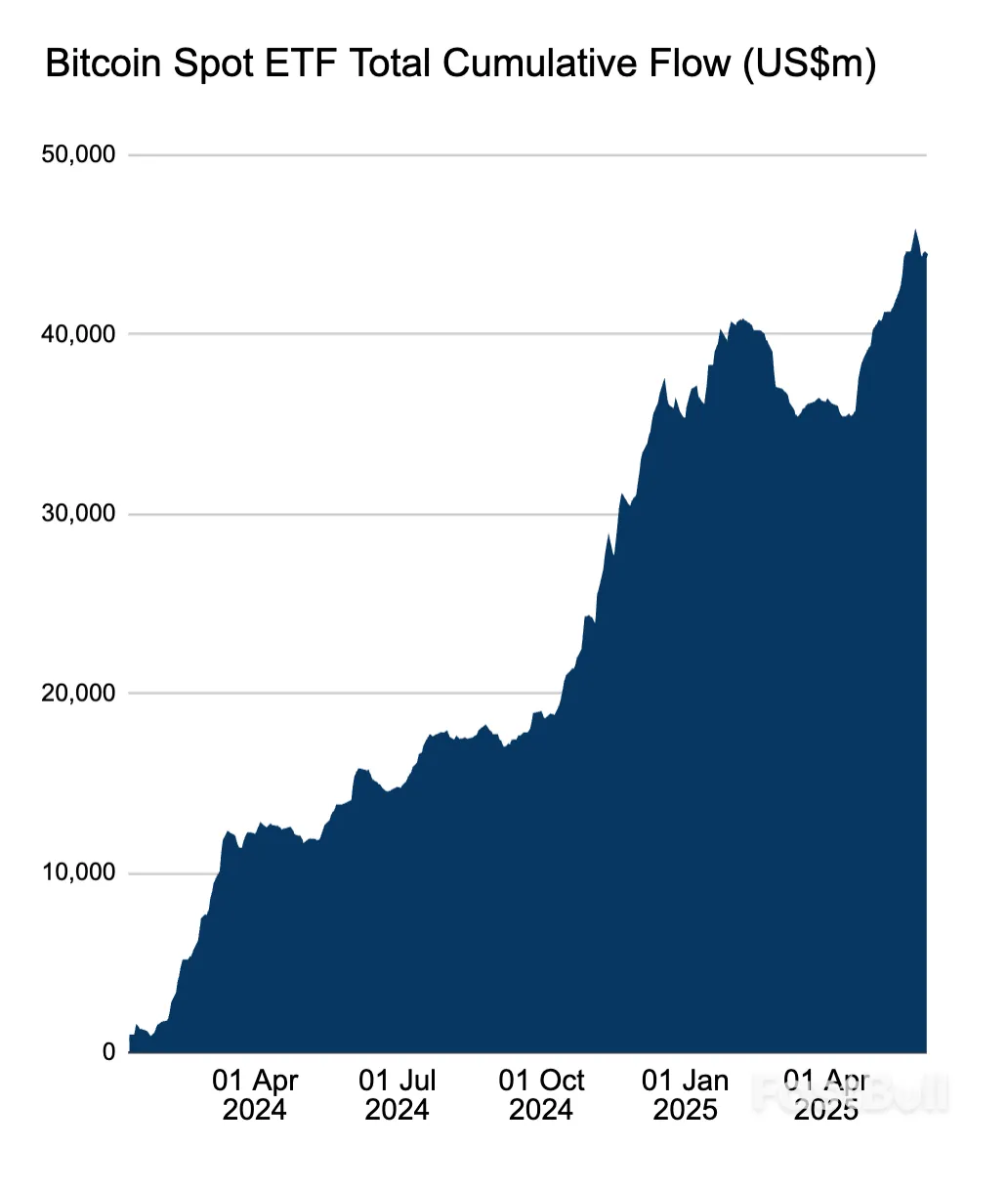
          ETFs have attracted a large portion of the Bitcoin to their coffers.
          The net worth of assets managed across spot Bitcoin ETFs was $44.54 billion as of June 5, up from around $1 billion at their launch in January last year.Bitcoin Supply Shock? Percentage of BTC on Exchanges Nears 2018 Levels_5

          Spot Bitcoin ETF cumulative flows. Source: Farside Investors

          Supporting this trend, a 2025 survey by Coinbase and EY-Parthenon found that 83% of institutional investors plan to increase their crypto exposure, with nearly 60% allocating over 5% of their AUM to digital assets.
          About 61 public companies already control over 3% of the total Bitcoin supply of 21 million tokens, according to Standard Chartered.

          Trust in exchanges dwindles post-FTX collapse

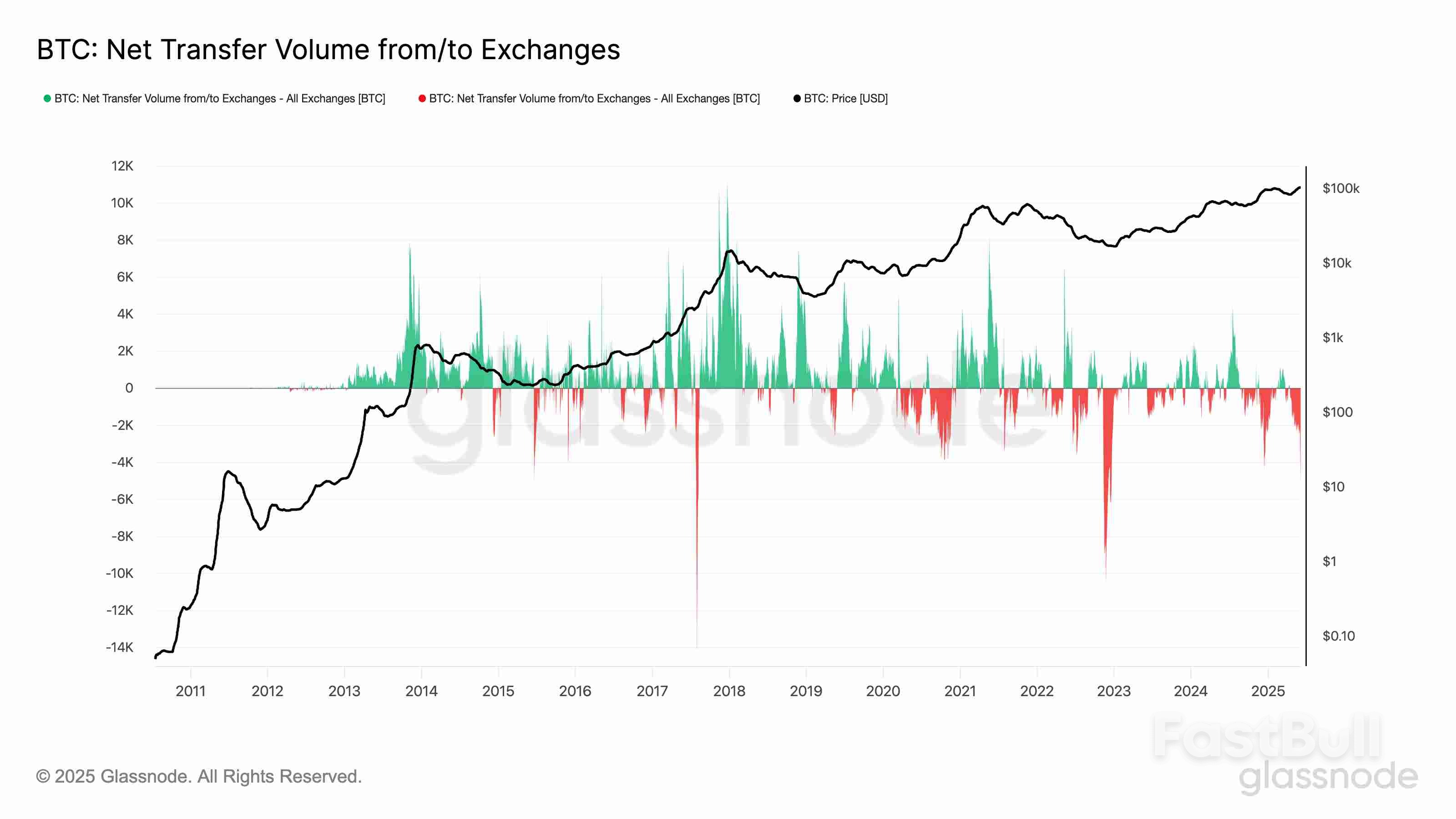
          Following the collapse of FTX in late 2022, Bitcoin experienced a dramatic shift in exchange flows, as seen in the Glassnode chart.Bitcoin Supply Shock? Percentage of BTC on Exchanges Nears 2018 Levels_6

          BTC net transfer volume from/to exchanges. Source: Glassnode

          The net transfer volume (red bars) shows sustained outflows through early to mid-2023, marking one of the biggest withdrawal periods in Bitcoin’s history.
          From November 2022 to May 2023, weekly outflows repeatedly exceeded 10,000 BTC, totaling well over 200,000 BTC withdrawn from centralized exchanges.
          This suggests that trust in crypto exchanges has declined since the FTX collapse, accelerating Bitcoin withdrawals to self-custody and alternative platforms for trading.

          Source: Cointelegraph

          Risk Warnings and Disclaimers
          You understand and acknowledge that there is a high degree of risk involved in trading. Following any strategies or investment methods may lead to potential losses. The content on the site is provided by our contributors and analysts for information purposes only. You are solely responsible for determining whether any trading assets, securities, strategy, or any other product is suitable for investing based on your own investment objectives and financial situation.
          Add to Favorites
          Share

          U.S. Economy Shows Signs of 'Paralysis' as New Data Reveals Hiring Slowdown, Activity Contraction in May

          Warren Takunda

          Economic

          For months US economic data has shown resilience, with layoffs remaining low and business activity staying steady despite fears over policy uncertainty. But the tide may be shifting. Multiple data points this week have shown signs of slowing as a wide swath of tariffs have been in effect.
          On Thursday, weekly filings for unemployment benefits hit their highest level since October 2024, adding to a slew of data that's showed cooling in the economy leading into the release of the May jobs report on Friday morning.
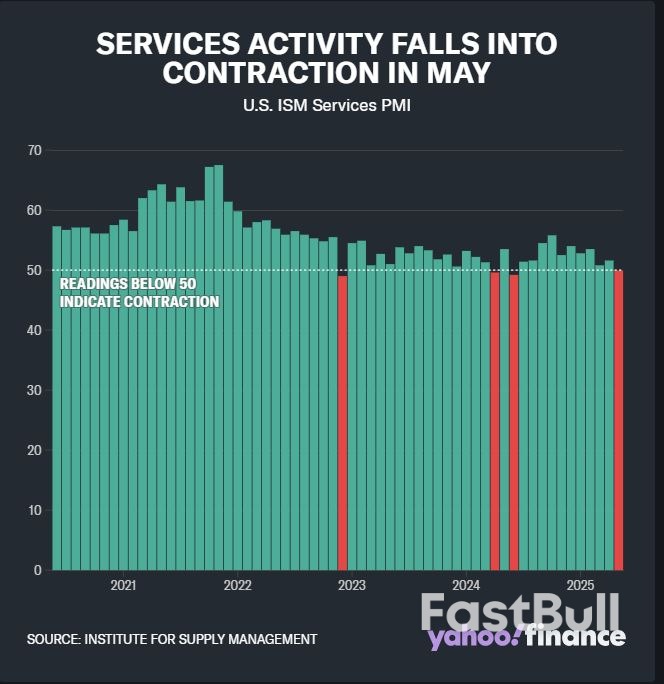
          Earlier in the week, the Institute for Supply Management's Services PMI registered a reading of 49.9 in May, below the 51.6 seen in April. Readings above 50 for this index indicate an expansion in activity, while readings below 50 indicate contraction. May's data marked just the fourth time the services sector has fallen into contraction in the past five years.
          Jefferies US economist Tom Simons wrote in a note to clients the ISM services data likely reflect "more signs of a pause in activity rather than a steep contraction."
          "A broad pause is not a good thing, and the uncertainty that precipitated this pause has not shown any signs of lifting," Simons wrote.U.S. Economy Shows Signs of 'Paralysis' as New Data Reveals Hiring Slowdown, Activity Contraction in May_1
          And it's not just one sector pressing pause as tariffs take hold either. On Monday the ISM's manufacturing PMI also showed contraction in May as imports hit their lowest level since 2009, with a wide swath of President Trump's tariffs taking hold.
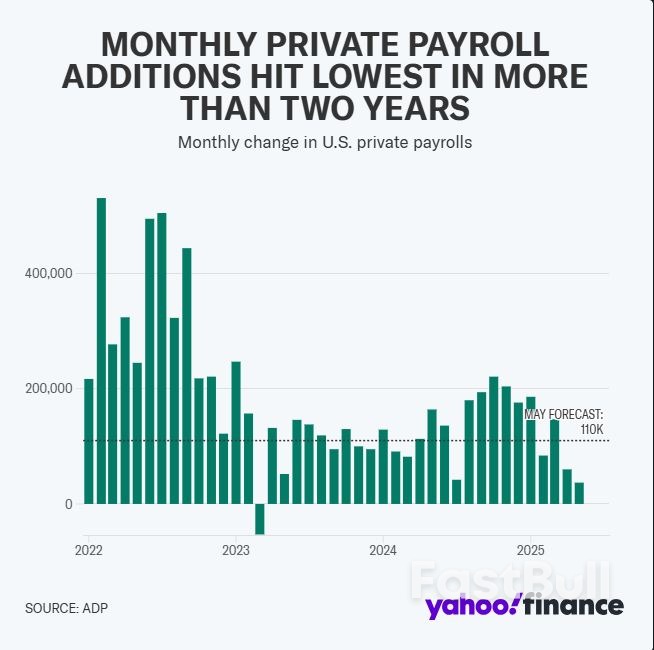
          Economists have reasoned that it's not just the tariffs themselves causing businesses to slow activity. It's the uncertainty of where policy —and eventually the broader economy — is headed in 2025. That includes the labor market: In May, the private sector added 37,000 jobs, the lowest monthly total in more than two years, per ADP data released Wednesday.
          "When it comes to hiring, there's a hesitancy because of a wide level of uncertainty," ADP chief economist Nela Richardson told Yahoo Finance during a call with reporters.
          "We're in a situation now where businesses are facing a level of paralysis," RBC Capital Markets economist Carrie Freestone told Yahoo Finance on Wednesday. "Nobody is wanting to ramp up hiring when they don't know what's going to happen down the line."U.S. Economy Shows Signs of 'Paralysis' as New Data Reveals Hiring Slowdown, Activity Contraction in May_2
          The slowdown in hiring has likely led to an increasing number of workers staying unemployed for longer. Data from the Department of Labor released Thursday morning showed 1.904 million workers filed for continuing unemployment benefits in the week ending May 24. The data is hovering near its highest level since November 2021.
          ADP's Richardson said the challenge facing corporates is akin to driving through fog. Usually the driver keeps moving forward but drives slower and more carefully. Whether the fog gets worse, or clears in time for the labor market rebound remains key to the economic story as the summer approaches and investors receive more data showing how tariffs are impacting the outlook.
          "I do think that once the uncertainty clears a bit, you'll see more activity in the labor market," Richardson said.
          But other economists have pointed out that the data shows a clear sign that the labor market is on thin ice.
          "We're getting close to some soft employment numbers," Renaissance Macro head of economics Neil Dutta wrote in a note following Thursday's unemployment benefits release. "The broader story here is that with the hiring rate still quite low, it would not take much in the way of layoffs to generate some weak payroll prints."

          Source: YahooFinance

          To stay updated on all economic events of today, please check out our Economic calendar
          Risk Warnings and Disclaimers
          You understand and acknowledge that there is a high degree of risk involved in trading. Following any strategies or investment methods may lead to potential losses. The content on the site is provided by our contributors and analysts for information purposes only. You are solely responsible for determining whether any trading assets, securities, strategy, or any other product is suitable for investing based on your own investment objectives and financial situation.
          Add to Favorites
          Share

          Trump Finally Gets His Phone Call With Chinese Counterpart, Xi Jinping

          Glendon

          Economic

          Political

          Donald Trump picked up the phone and called Xi Jinping on Thursday, and the Chinese president finally answered.

          The conversation, reported by Xinhua and confirmed by Beijing’s foreign ministry, was initiated by Trump, who had been pushing for direct talks after weeks of rising trade tension between the US and China.

          But details of the chat were not shared.

          This was only their second call of the year, the first being on January 17, before Trump returned to the White House. In recent days, Washington has accused Beijing of dragging its feet on following through with trade promises, especially around critical mineral exports.

          Those promises came from talks in Switzerland, where both sides had agreed to temporarily lower tariffs. But that deal started falling apart fast. Trump’s administration wasn’t seeing the deliveries it expected, and China wasn’t happy about the new waves of restrictions coming from Washington.

          Trump pushes Xi on trade slowdown and new export blocks

          During the call, Trump raised issues over China’s delay in exporting key minerals that were part of the post-Geneva understanding. He also brought up semiconductors, where his administration had just issued fresh export bans and advised US firms to avoid relying on Chinese chips.

          The White House claimed the decision was for national security, but Beijing called it punishment disguised as protection. Adding fuel to the fire, China was already frustrated by a new rule tightening visa access for Chinese students, something it viewed as politically motivated.

          Officials in Beijing said the US was “undermining recent progress” by targeting young people and education exchanges. Trump didn’t back down. The administration believes these moves are necessary to protect American strategic interests.

          The economic impact of all this was already showing. On the day of the call, US stock futures climbed. The Dow went up 89 points, while S&P 500 and Nasdaq-100 futures both gained 0.2%. Investors reacted quickly to any hint that the two countries were at least talking again, even if the problems weren’t solved.

          Meanwhile, new numbers showed the US trade deficit had dropped to $61.6 billion in May, its lowest point since September 2023. That’s a $76.7 billion drop from April, and the fastest monthly decline since 1992.

          Exports were up $8.3 billion, while imports had collapsed by $68.4 billion, a 16.3% slide. Companies had rushed to bring goods in ahead of Trump’s April 2 “liberation day” tariffs, knowing costs were about to go up.

          Source: CryptoSlate

          To stay updated on all economic events of today, please check out our Economic calendar
          Risk Warnings and Disclaimers
          You understand and acknowledge that there is a high degree of risk involved in trading. Following any strategies or investment methods may lead to potential losses. The content on the site is provided by our contributors and analysts for information purposes only. You are solely responsible for determining whether any trading assets, securities, strategy, or any other product is suitable for investing based on your own investment objectives and financial situation.
          Add to Favorites
          Share

          ECB Cuts Interest Rates for Eighth Time Amid Trade Tensions, Cooling Inflation

          Glendon

          Economic

          Forex

          The European Central Bank slashed interest rates at its latest policy meeting on Thursday as expected, bringing its key deposit rate down by 25 basis points to 2.0%, although officials did not provide outright guidance for changes later this year.

          In a statement, the ECB said its decision to lower borrowing costs for the eighth time since last June comes as the euro area economy faces waning inflation but persistent uncertainty around the impact of global trade tensions.

          Thursday’s cut was widely anticipated by markets, meaning that much of the debate among analysts heading into the announcement swirled around the central bank’s plans for rates over the rest of the year. Particularly with inflation easing back down to the ECB’s 2% target, some investors have bet that policymakers will push pause on the rate-reduction cycle in July and potentially roll out one more drawdown before the end of 2025.

          "We forecast one more rate cut in the second half of the year with risks skewed towards deeper cuts," said Jack Allen-Reynolds, Deputy Chief Euro Zone Economist at Capital Economics, in a note following the decision.

          Officials did not provide any specific rate guidance in their statement, but ratcheted down their expectations for future price gains. Estimates for headline inflation in 2025 and 2026 were lowered to 2.0% and 1.6%, respectively, a drop of 0.3 percentage points compared to the ECB’s projections in March. Inflation is seen returning to 2.0% in 2027.

          Speaking at a press conference, ECB President Christine Lagarde added that the ECB is "not pre-committing to a particular rate path".

          Consumer price inflation in the 20 countries using the euro eased to 1.9% in May, thanks to sliding energy prices and declining services costs. In the prior month, the figure came in at 2.2%. So-called "core" inflation, which strips out volatile items like food and fuel, decelerated to 2.3% from 2.7%, data from Eurostat, the European Union’s statistics agency, found.

          The ECB also left its growth projections for 2025 unchanged, anticipating average gross domestic product expansion of 0.9%. While the first quarter was stronger than expected, the central bank flagged that the euro zone’s prospects for the remainder of the year are "weaker".

          Murkiness is also surrounding the impact of U.S. President Donald Trump’s tariff plans. The White House has especially targeted the European Union -- which includes several euro zone countries -- with elevated so-called "reciprocal" levies. The ECB warned that the uncertainty may weigh on business investment and exports in the short term, although medium-term growth is tipped to be bolstered by increased government spending on defense and infrastructure.

          "Inflationary pressures in the euro zone are receding faster than expected. Not only did [...] Trump make the European economy great again -- for one quarter, as frontloading of exports and industrial production boosted economic activity -- he also made inflation almost disappear," said Carsten Brzeski, Global Head of Macro at ING, in a note.

          Trump referenced the ECB’s rate-cutting campaign earlier this week in a social media post urging Federal Reserve Chair Jerome Powell to bring borrowing costs down at a faster pace. The Fed drew down rates by one percentage point in 2024, but has left them unchanged since December, noting that the tariff turmoil could place renewed upward pressure on inflation in the U.S.

          Source: Investing

          To stay updated on all economic events of today, please check out our Economic calendar
          Risk Warnings and Disclaimers
          You understand and acknowledge that there is a high degree of risk involved in trading. Following any strategies or investment methods may lead to potential losses. The content on the site is provided by our contributors and analysts for information purposes only. You are solely responsible for determining whether any trading assets, securities, strategy, or any other product is suitable for investing based on your own investment objectives and financial situation.
          Add to Favorites
          Share

          Big Central Banks' Forecasting Lens Gets Fogged by US Tariffs

          Warren Takunda

          Economic

          China–U.S. Trade War

          Unpredictable White House tariff rhetoric and its impact on currency markets, oil prices and the inflation outlook have put central banks across the world in a tight spot.
          The European Central Bank cut interest rates on Thursday and looks set to pause, Switzerland appears to be moving back towards negative rates, Japan's resolve to drop ultra-easy monetary policy is wobbling, and baffling U.S. data could keep the Federal Reserve in wait-and-see mode.
          Here's a look at where 10 developed-market central banks stand.
          Big Central Banks' Forecasting Lens Gets Fogged by US Tariffs_1

          Change in policy rates by 10 major developed central banks since March

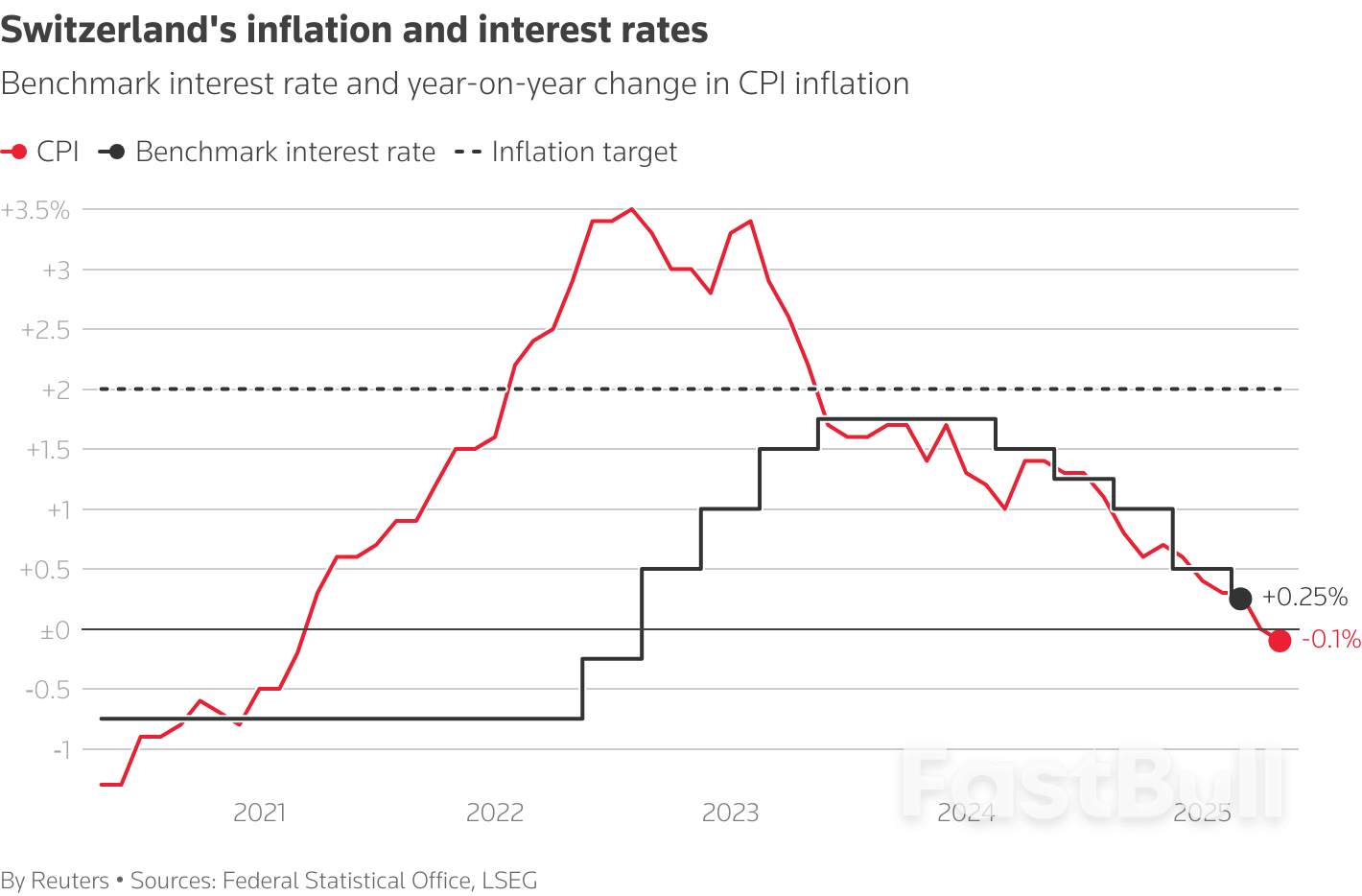
          1/ SWITZERLAND

          The Swiss National Bank next meets on June 19, and traders see a one in three chance that it will pull rates back into negative territory from 0.25% currently after consumer prices fell for the first time in four years.
          The safe-haven Swiss franc has gained 10% against the dollar so far this year on geopolitical and market volatility. That's challenging Switzerland's export-heavy economy and cheapened imports, giving the SNB reasons to be wary about deflation.
          Big Central Banks' Forecasting Lens Gets Fogged by US Tariffs_2

          A line chart comparing inflation metrics over the past five years.

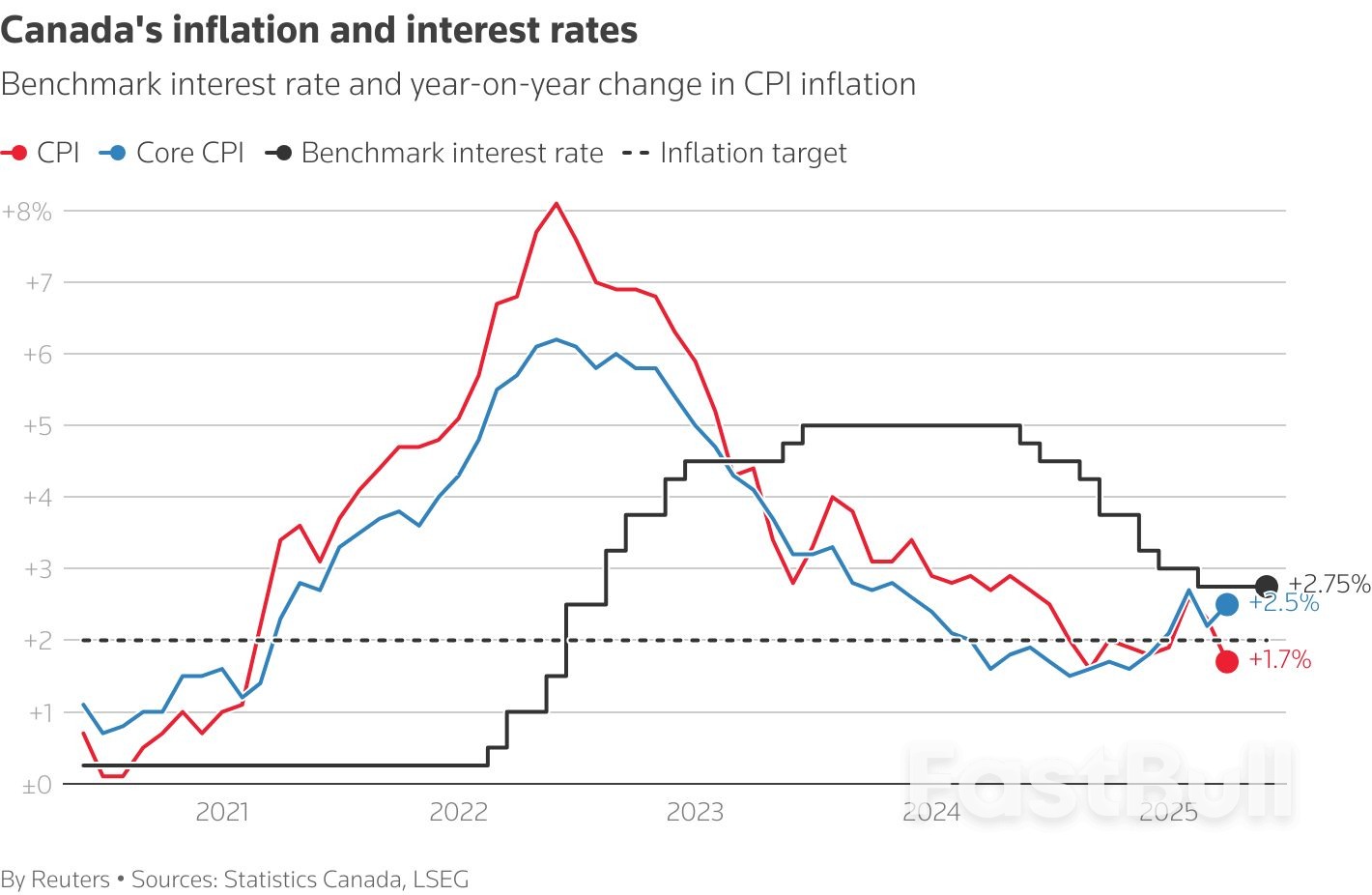
          2/ CANADA

          The Bank of Canada held rates at 2.75% on Wednesday and said another cut might be necessary if the economy weakened in the face of tariffs.
          The BoC has held rates for a second time in a row after an aggressive cutting cycle which shrunk rates by 225 basis points over nine months. Markets price in a roughly 85% chance of another quarter-point cut by September.Big Central Banks' Forecasting Lens Gets Fogged by US Tariffs_3

          A line chart comparing inflation metrics over the past five years.

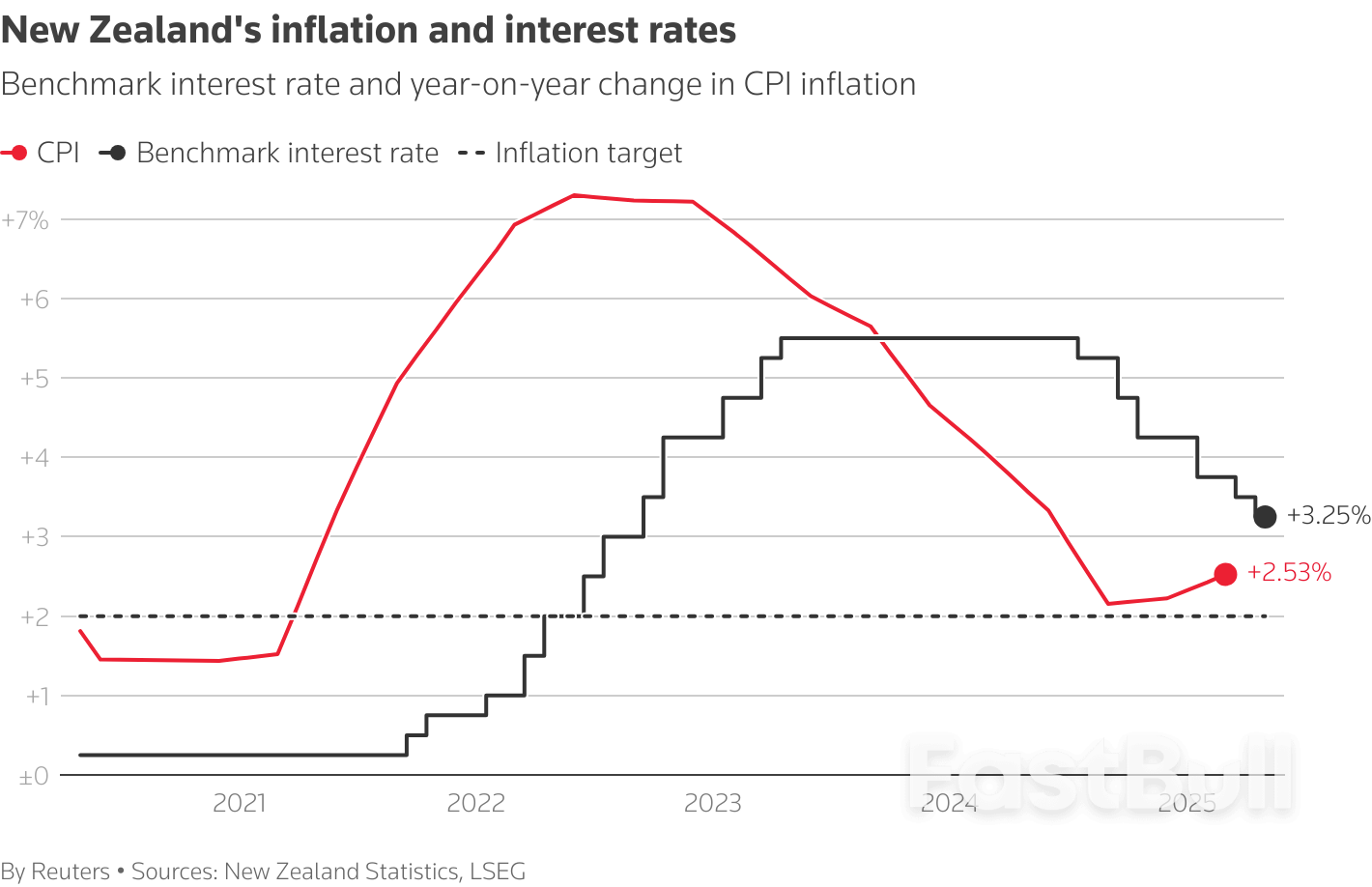
          3/ NEW ZEALAND

          Money markets expect the Reserve Bank of New Zealand to hold steady on July 9 after a 25 bps rate cut to 3.25% in May to protect the China-focused economy. The RBNZ also warned that global trade uncertainties made future moves unclear.Big Central Banks' Forecasting Lens Gets Fogged by US Tariffs_4

          A line chart comparing inflation metrics over the past five years.

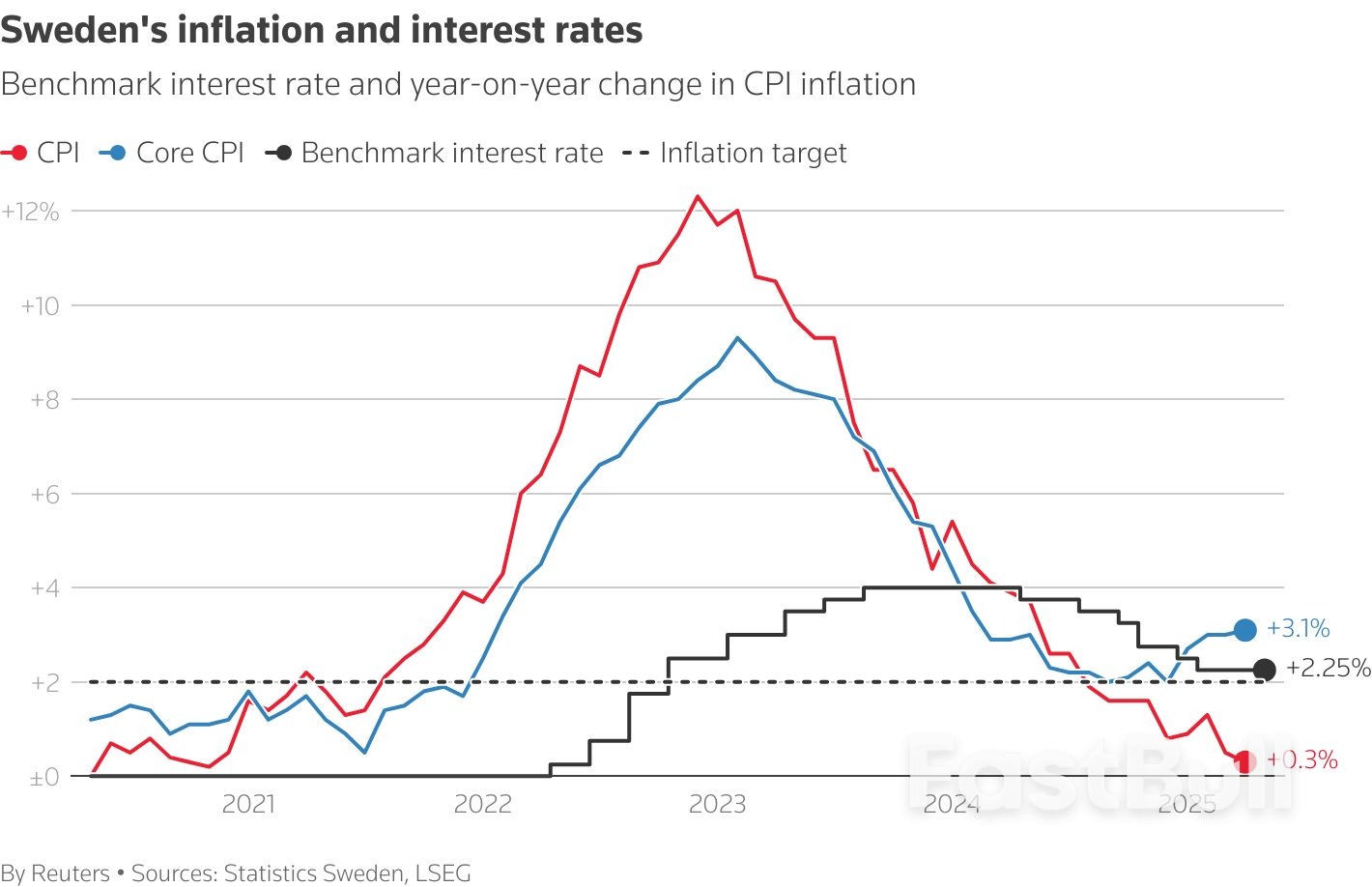
          4/ SWEDEN

          Sweden's central bank left its key rate unchanged at 2.25% in May but with on-again-off-again U.S. tariffs now having contributed to an economic contraction in the first quarter, the Riksbank has signaled more easing ahead. Its next rate decision is on June 18.Big Central Banks' Forecasting Lens Gets Fogged by US Tariffs_5

          A line chart comparing inflation metrics over the past five years.

          5/ EURO ZONE

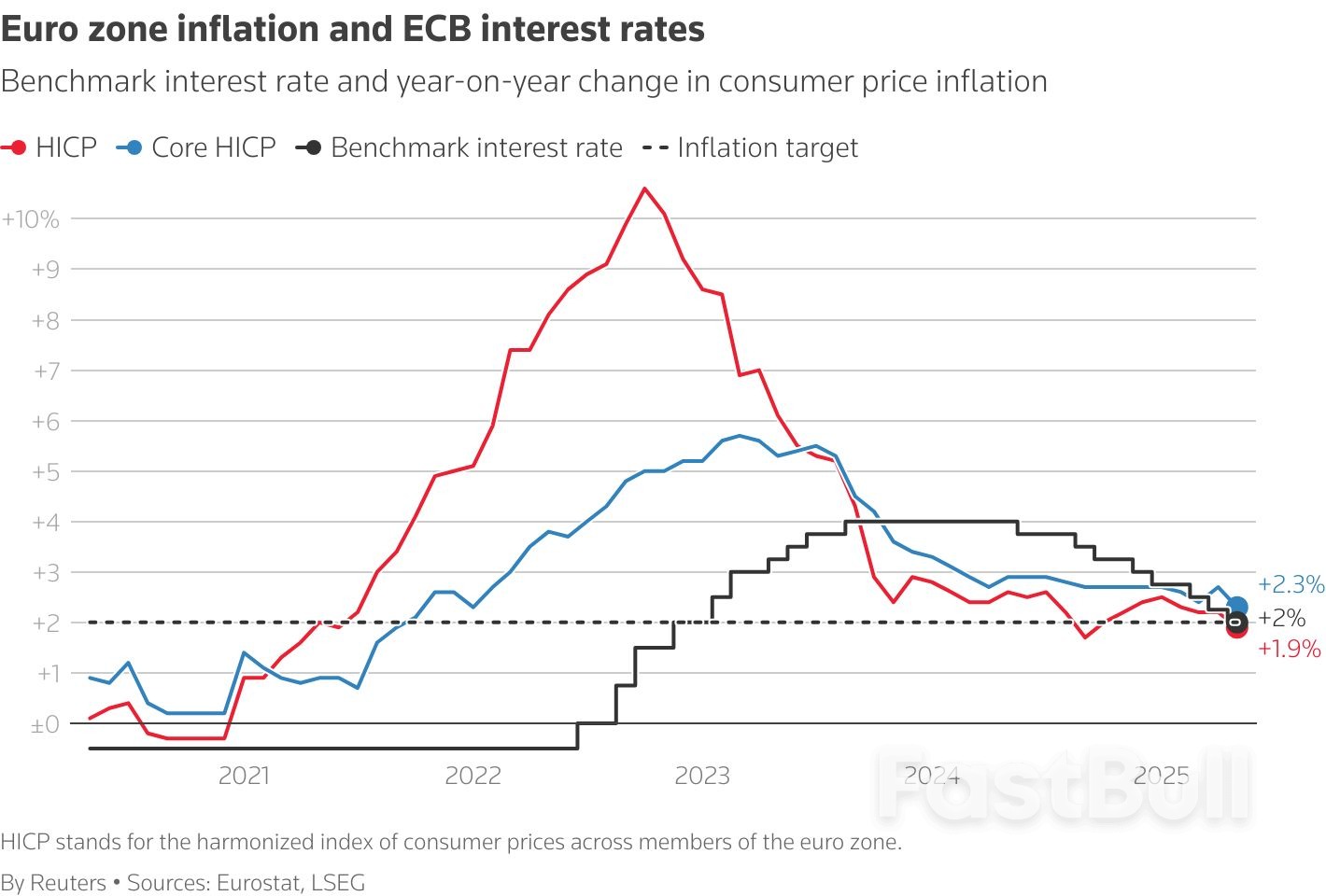
          The ECB cut rates as expected on Thursday and kept all options on the table, opens new tab for its next meetings even as the case grows for a summer pause in its year-long easing cycle.
          That's now below target in the euro zone and it's trying to work out how to handle President Trump's trade war on the EU. That means it may be more cautious going forward.
          It has lowered rates eight times in the last year, and markets price in one more rate cut by year-end.Big Central Banks' Forecasting Lens Gets Fogged by US Tariffs_6

          A line chart comparing inflation metrics over the past five years.

          6/ UNITED STATES

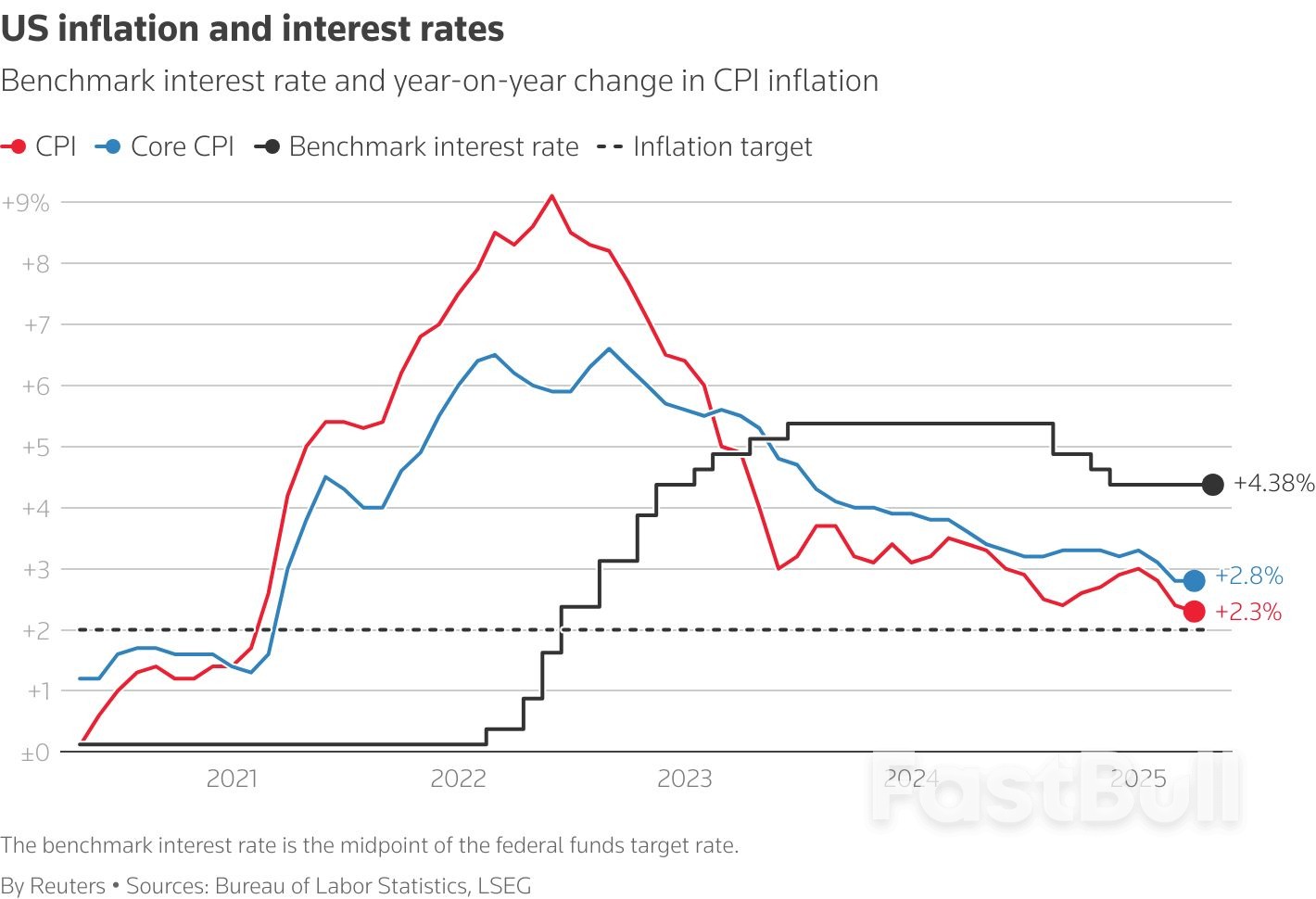
          The Fed, under consistent fire from President Donald Trump for resisting rate cuts, is expected to hold steady at its next June 18 meeting as tariff uncertainty makes wait-and-see its best option for now.
          With businesses spooked by Trump's aggressive trade talk, have increased, manufacturing orders have slumped and factory gate prices have surged, indicating stagflation risks that could moderate if the White House softens its stance.
          The Fed has held rates in the 4.25%-4.5% range since December, following 100 bps of cuts last year. Money markets price roughly 50 bps of further easing by year-end.Big Central Banks' Forecasting Lens Gets Fogged by US Tariffs_7

          A line chart comparing inflation metrics over the past five years.

          7/ BRITAIN

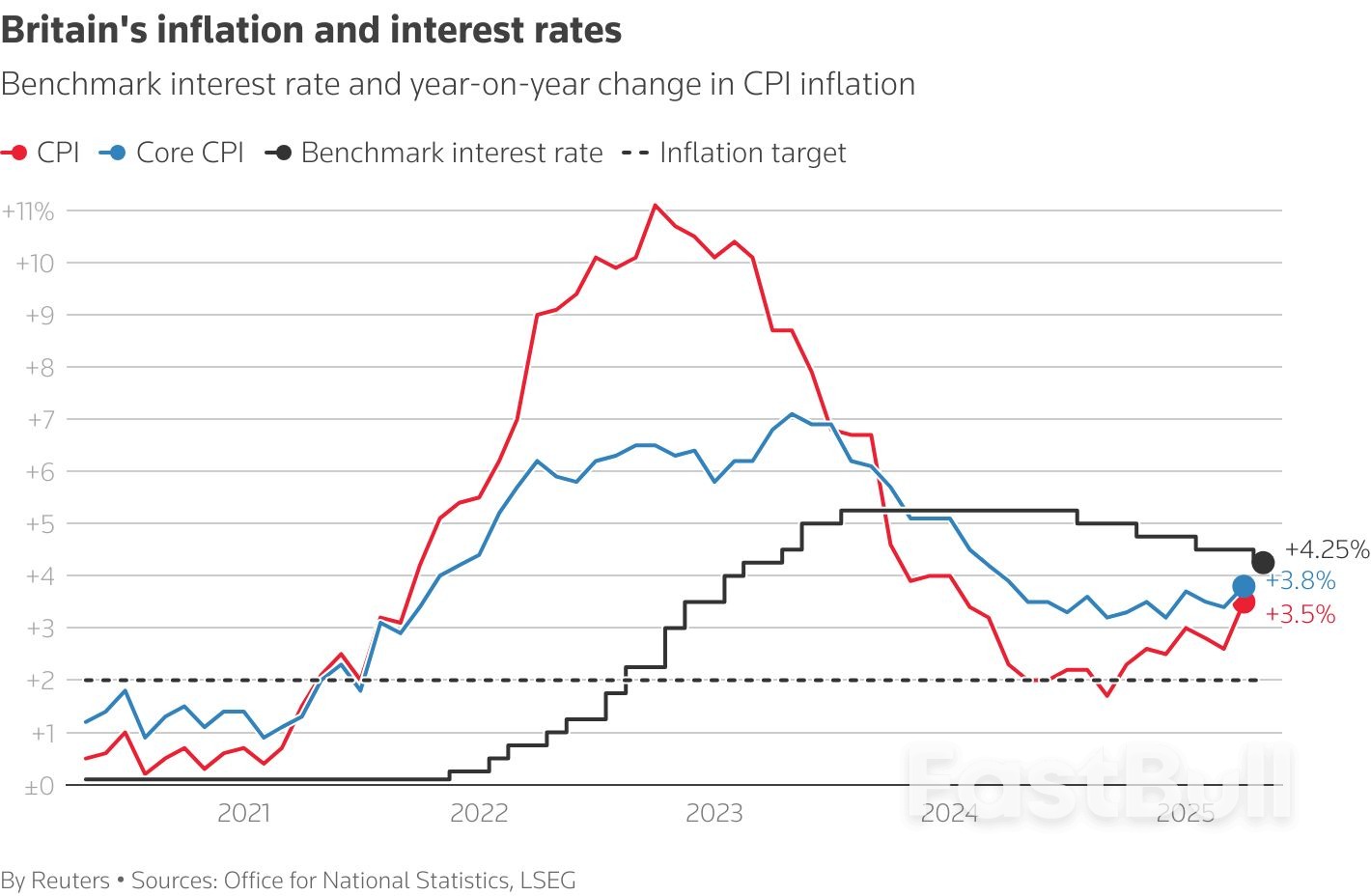
          The Bank of England, which has lowered borrowing costs slowly to accommodate bumpy inflation trends, cut rates by 25 bps to 4.25% last month and revealed an unexpected three-way split among its policymakers that signaled uncertainty ahead.
          Governor Andrew Bailey says the BoE was staying cautious amid unpredictable global trends. Traders expect no move in June and a 60% chance of a cut by August.Big Central Banks' Forecasting Lens Gets Fogged by US Tariffs_8

          A line chart comparing inflation metrics over the past five years.

          8/ AUSTRALIA

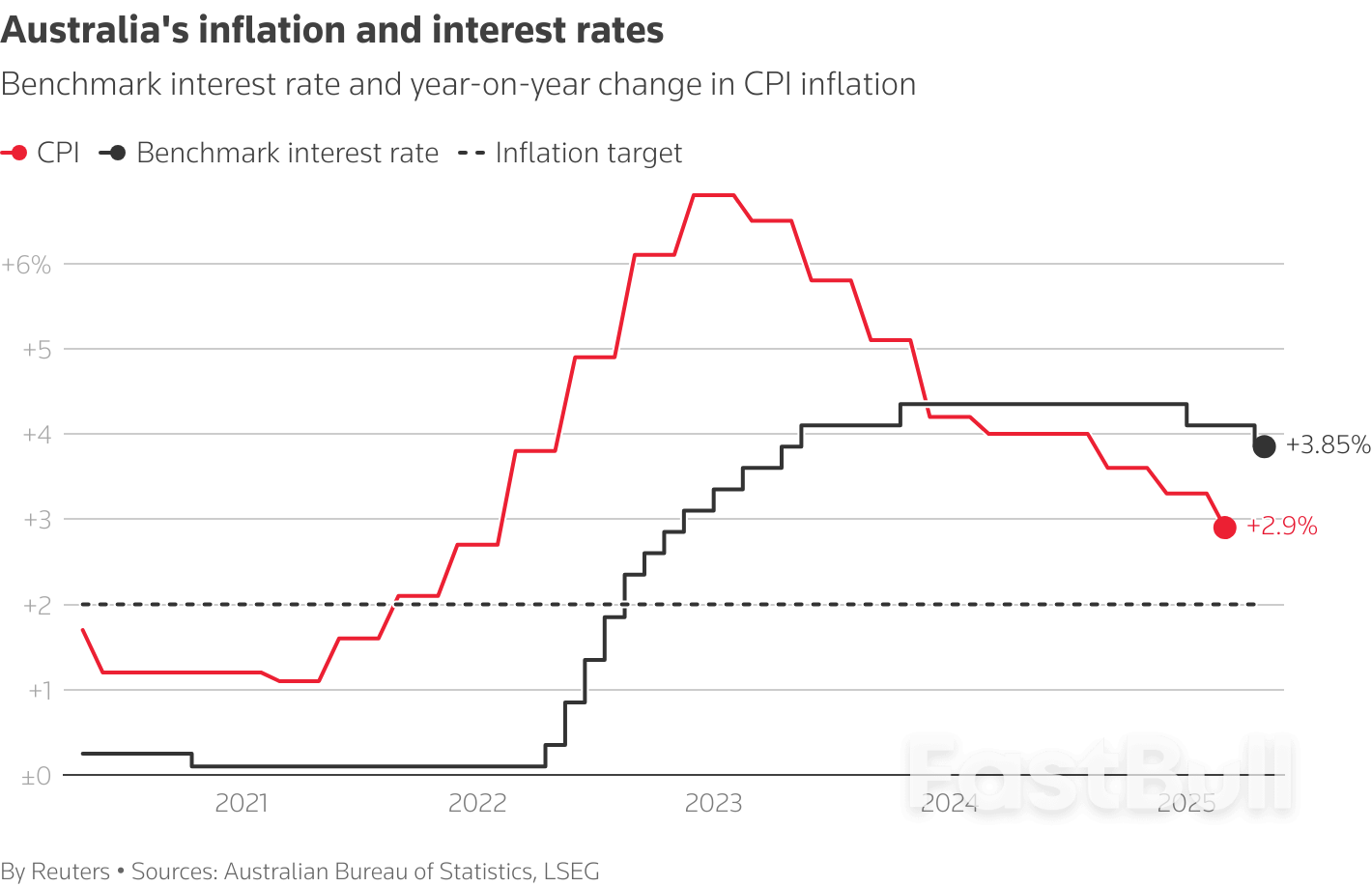
          Weak growth data and fears of Aussie commodities producers and miners taking big blows from a U.S.-China trade war means the Reserve Bank of Australia stands ready to ride to the rescue with rapid rate cuts.
          The RBA cut rates by 25 bps to 3.85% in May and traders see borrowing costs dropping to about 3% by year-end.Big Central Banks' Forecasting Lens Gets Fogged by US Tariffs_9

          A line chart comparing inflation metrics over the past five years.

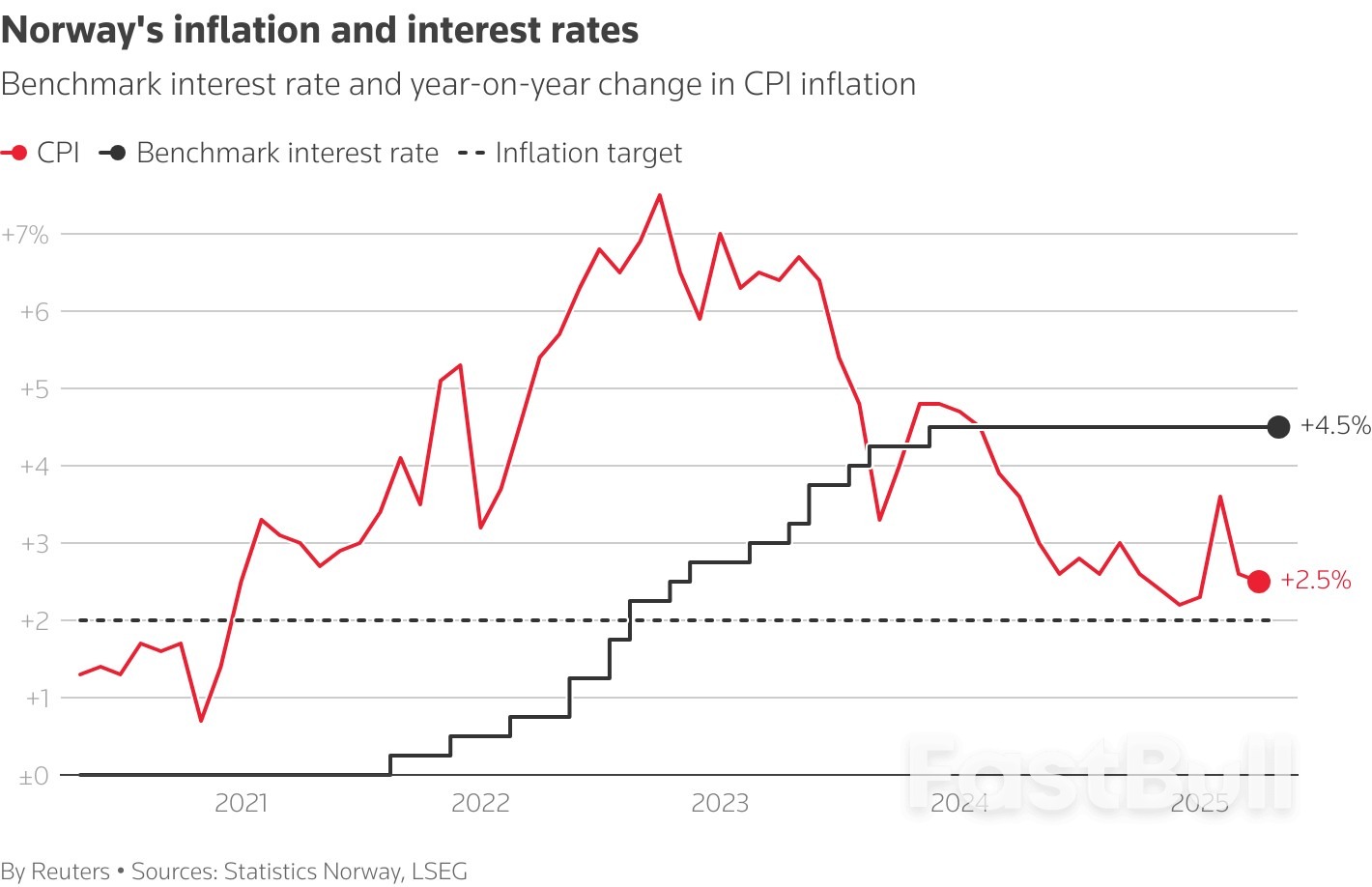
          9/ NORWAY

          Norway's central bank has ditched plans to ease monetary policy as its oil-linked currency weakens amid global trade uncertainty, posing a fresh inflationary threat.
          The Norges Bank kept rates on hold at a 17-year high of 4.50% in May, and markets anticipate no change at the June 19 meeting.Big Central Banks' Forecasting Lens Gets Fogged by US Tariffs_10

          A line chart comparing inflation metrics over the past five years.

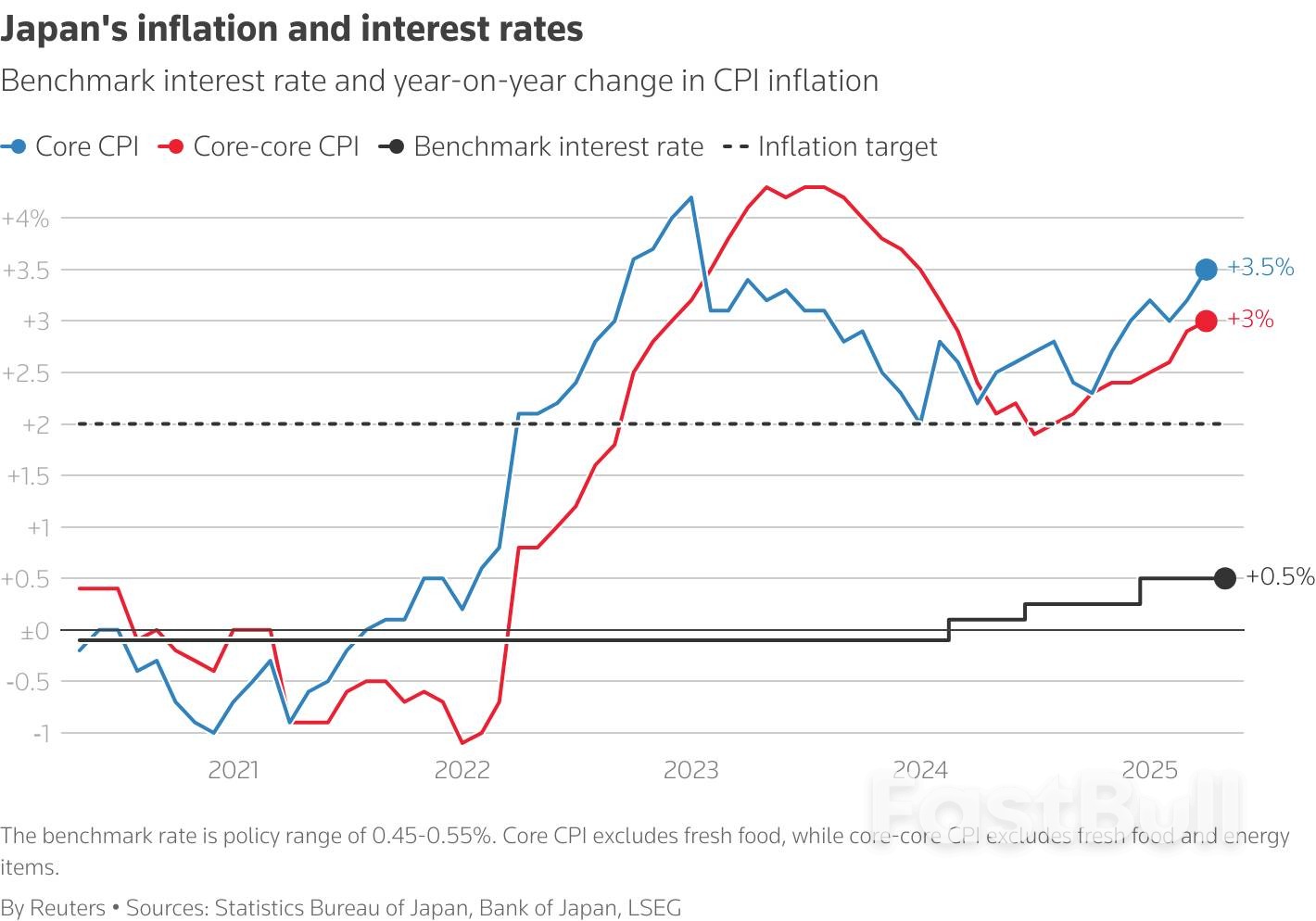
          10/ JAPAN

          The Bank of Japan, long expected to pursue rate hikes, faces a challenging mix of economic trends if tariffs hurt exports but inflation keeps rising.
          After the BoJ held borrowing costs steady at 0.5% in May, Governor Kazuo Ueda steadfastly refused to comment on the possible timing of the next increase.
          Big Central Banks' Forecasting Lens Gets Fogged by US Tariffs_11

          A line chart comparing inflation metrics over the past five years.

          Source: Reuters

          To stay updated on all economic events of today, please check out our Economic calendar
          Risk Warnings and Disclaimers
          You understand and acknowledge that there is a high degree of risk involved in trading. Following any strategies or investment methods may lead to potential losses. The content on the site is provided by our contributors and analysts for information purposes only. You are solely responsible for determining whether any trading assets, securities, strategy, or any other product is suitable for investing based on your own investment objectives and financial situation.
          Add to Favorites
          Share

          Canada's April Trade Deficit Widens to Historic High As Tariffs Cripple Exports

          Michelle

          Economic

          Forex

          Canada's trade deficit in April widened to an all-time high of a whopping C$7.1 billion ($5.2 billion), data showed on Thursday, as tariffs imposed by President Donald Trump sucked out demand for Canadian goods from the United States.

          Its exports to the rest of the world rose, but could not compensate for the drop in exports to the U.S., data from Statistics Canada showed.Exports to the U.S. shrank by 15.7%, a third consecutive monthly decline, Statscan said, adding that exports south of the border have fallen by over 26% since the peak seen in January.Analysts polled by Reuters had expected the trade deficit to widen to C$1.5 billion for April. Statistics Canada also made a big revision to the trade deficit recorded in March to C$2.3 billion from C$506 million.

          Canada shipped 76% of its total exports to the U.S. last year and the trade between the two countries exceeded a trillion Canadian dollars for a third consecutive year in 2024.

          But a barrage of tariffs from Trump on Canada and its C$90 billion worth of retaliatory tariffs on U.S. imports have started disrupting trade between the two.

          Total exports in April plunged by 10.8% to C$60.4 billion, the lowest level seen in almost two years, Statscan said. This was the third consecutive monthly decline and the strongest percentage decrease in five years, it said.While exports to the U.S. led the drop, lower crude oil prices and a stronger Canadian dollar also contributed.

          The Canadian dollar was trading up 0.17% to 1.3651 to the U.S. dollar, or 73.25 U.S. cents. Yields on the two-year government bonds were down 0.4 basis points to 2.613%.

          Exports to the rest of the world were up 2.9% and in volume terms total exports registered a big decline of 9.1% in April.

          The biggest drop in exports came from motor vehicles and parts which lost 17.4% of trade in April from March and was almost entirely attributable to exports of passenger cars and light trucks, which fell 22.9% in April, Statscan said.

          Imports were down 3.5% in April to C$67.58 billion, but were partly offset by imports of unwrought gold.

          Due to the sharp decline in exports to the U.S., Canada's merchandise trade surplus with the United States narrowed to C$3.6 billion, the smallest surplus since December 2020, the statistics agency said.

          The deficit with rest of the world marginally increased to C$10.7 billion in April from C$9 billion in March.

          Source: Kitco

          To stay updated on all economic events of today, please check out our Economic calendar
          Risk Warnings and Disclaimers
          You understand and acknowledge that there is a high degree of risk involved in trading. Following any strategies or investment methods may lead to potential losses. The content on the site is provided by our contributors and analysts for information purposes only. You are solely responsible for determining whether any trading assets, securities, strategy, or any other product is suitable for investing based on your own investment objectives and financial situation.
          Add to Favorites
          Share
          FastBull
          Copyright © 2025 FastBull Ltd

          728 RM B 7/F GEE LOK IND BLDG NO 34 HUNG TO RD KWUN TONG KLN HONG KONG

          TelegramInstagramTwitterfacebooklinkedin
          App Store Google Play Google Play
          Products
          Charts

          Chats

          Q&A with Experts
          Screeners
          Economic Calendar
          Data
          Tools
          Membership
          Features
          Function
          Markets
          Copy Trading
          Latest Signals
          Contests
          News
          Analysis
          24/7
          Columns
          Education
          Company
          Careers
          About Us
          Contact Us
          Advertising
          Help Center
          Feedback
          User Agreement
          Privacy Policy
          Business

          White Label

          Data API

          Web Plug-ins

          Poster Maker

          Affiliate Program

          Risk Disclosure

          The risk of loss in trading financial instruments such as stocks, FX, commodities, futures, bonds, ETFs and crypto can be substantial. You may sustain a total loss of the funds that you deposit with your broker. Therefore, you should carefully consider whether such trading is suitable for you in light of your circumstances and financial resources.

          No decision to invest should be made without thoroughly conducting due diligence by yourself or consulting with your financial advisors. Our web content might not suit you since we don't know your financial conditions and investment needs. Our financial information might have latency or contain inaccuracy, so you should be fully responsible for any of your trading and investment decisions. The company will not be responsible for your capital loss.

          Without getting permission from the website, you are not allowed to copy the website's graphics, texts, or trademarks. Intellectual property rights in the content or data incorporated into this website belong to its providers and exchange merchants.

          Not Logged In

          Log in to access more features

          FastBull Membership

          Not yet

          Purchase

          Become a signal provider
          Help Center
          Customer Service
          Dark Mode
          Price Up/Down Colors

          Log In

          Sign Up

          Position
          Layout
          Fullscreen
          Default to Chart
          The chart page opens by default when you visit fastbull.com