• Trade
  • Markets
  • Copy
  • Contests
  • News
  • 24/7
  • Calendar
  • Q&A
  • Chats
Trending
Screeners
SYMBOL
LAST
BID
ASK
HIGH
LOW
NET CHG.
%CHG.
SPREAD
SPX
S&P 500 Index
6870.39
6870.39
6870.39
6895.79
6858.28
+13.27
+ 0.19%
--
DJI
Dow Jones Industrial Average
47954.98
47954.98
47954.98
48133.54
47871.51
+104.05
+ 0.22%
--
IXIC
NASDAQ Composite Index
23578.12
23578.12
23578.12
23680.03
23506.00
+72.99
+ 0.31%
--
USDX
US Dollar Index
98.930
99.010
98.930
98.960
98.730
-0.020
-0.02%
--
EURUSD
Euro / US Dollar
1.16490
1.16497
1.16490
1.16717
1.16341
+0.00064
+ 0.05%
--
GBPUSD
Pound Sterling / US Dollar
1.33174
1.33182
1.33174
1.33462
1.33136
-0.00138
-0.10%
--
XAUUSD
Gold / US Dollar
4211.92
4212.26
4211.92
4218.85
4190.61
+14.01
+ 0.33%
--
WTI
Light Sweet Crude Oil
59.147
59.177
59.147
60.084
59.124
-0.662
-1.11%
--

Community Accounts

Signal Accounts
--
Profit Accounts
--
Loss Accounts
--
View More

Become a signal provider

Sell trading signals to earn additional income

View More

Guide to Copy Trading

Get started with ease and confidence

View More

Signal Accounts for Members

All Signal Accounts

Best Return
  • Best Return
  • Best P/L
  • Best MDD
Past 1W
  • Past 1W
  • Past 1M
  • Past 1Y

All Contests

  • All
  • Trump Updates
  • Recommend
  • Stocks
  • Cryptocurrencies
  • Central Banks
  • Featured News
Top News Only
Share

German Foreign Minister Wadephul: Chinese Partners Say They Want To Give Priority To Resolving Bottlenecks In Germany, Europe

Share

India Foreign Ministry: New Deputy USA Trade Representative Will Visit India On Dec 10-11

Share

India Foreign Ministry: Advise Indian Nationals To Exercise Caution While Travelling To Or Transiting Through China

Share

Agrural - Brazil's 2025/26 Total Corn Output Seen At 135.3 Million Tonnes Versus 141.1 Million Tonnes In Previous Season

Share

Agrural - Brazil's 2025/26 Soybean Planting Hits 94% Of Expected Area As Of Last Thursday

Share

SEBI: Modalities For Migration To Ai Only Schemes And Relaxations To Large Value Funds For Accredited Investors

Share

All 6 Bank Of Israel Monetary Policy Committee Members Voted To Lower Benchmark Interest Rate 25 Bps To 4.25% On Nov 24

Share

India Government: Cancellations Are On Account Of Developer Delays And Not Due To Transmission Side Delays

Share

Fitch: We See Moderation Of Export Performance In China In 2026

Share

India Government: Revokes Grid Access Permissions For Renewable Energy Projects

Share

Stats Office - Tanzania Inflation At 3.4% Year-On-Year In November

Share

Temasek CEO Dilhan Pillay: We Are Taking A Conservative Stance On Allocating Capital

Share

Brazil Economists See Brazilian Real At 5.40 Per Dollar By Year-End 2025 Versus 5.40 In Previous Estimate - Central Bank Poll

Share

Brazil Economists See Year-End 2026 Interest Rate Selic At 12.25% Versus 12.00% In Previous Estimate - Central Bank Poll

Share

Brazil Economists See Year-End 2025 Interest Rate Selic At 15.00% Versus 15.00% In Previous Estimate - Central Bank Poll

Share

EU Commission Says Meta Has Committed To Give EU Users Choice On Personalised Ads

Share

Sources Revealed That The Bank Of England Has Invited Employees To Voluntarily Apply For Layoffs

Share

The Bank Of England Plans To Cut Staff Due To Budget Pressures

Share

Traders Believe There Is Less Than A 10% Chance That The European Central Bank Will Cut Interest Rates By 25 Basis Points In 2026

Share

Egypt, European Bank For Reconstruction And Development Sign $100 Million Financing Agreement

TIME
ACT
FCST
PREV
France Industrial Output MoM (SA) (Oct)

A:--

F: --

P: --
France Trade Balance (SA) (Oct)

A:--

F: --

P: --
Euro Zone Employment YoY (SA) (Q3)

A:--

F: --

P: --
Canada Part-Time Employment (SA) (Nov)

A:--

F: --

P: --

Canada Unemployment Rate (SA) (Nov)

A:--

F: --

P: --

Canada Full-time Employment (SA) (Nov)

A:--

F: --

P: --

Canada Labor Force Participation Rate (SA) (Nov)

A:--

F: --

P: --

Canada Employment (SA) (Nov)

A:--

F: --

P: --

U.S. PCE Price Index MoM (Sept)

A:--

F: --

P: --

U.S. Personal Income MoM (Sept)

A:--

F: --

P: --

U.S. Core PCE Price Index MoM (Sept)

A:--

F: --

P: --

U.S. PCE Price Index YoY (SA) (Sept)

A:--

F: --

P: --

U.S. Core PCE Price Index YoY (Sept)

A:--

F: --

P: --

U.S. Personal Outlays MoM (SA) (Sept)

A:--

F: --

P: --
U.S. 5-10 Year-Ahead Inflation Expectations (Dec)

A:--

F: --

P: --

U.S. Real Personal Consumption Expenditures MoM (Sept)

A:--

F: --

P: --
U.S. Weekly Total Rig Count

A:--

F: --

P: --

U.S. Weekly Total Oil Rig Count

A:--

F: --

P: --

U.S. Consumer Credit (SA) (Oct)

A:--

F: --

P: --
China, Mainland Foreign Exchange Reserves (Nov)

A:--

F: --

P: --

Japan Trade Balance (Oct)

A:--

F: --

P: --

Japan Nominal GDP Revised QoQ (Q3)

A:--

F: --

P: --

China, Mainland Imports YoY (CNH) (Nov)

A:--

F: --

P: --

China, Mainland Exports (Nov)

A:--

F: --

P: --

China, Mainland Imports (CNH) (Nov)

A:--

F: --

P: --

China, Mainland Trade Balance (CNH) (Nov)

A:--

F: --

P: --

China, Mainland Exports YoY (USD) (Nov)

A:--

F: --

P: --

China, Mainland Imports YoY (USD) (Nov)

A:--

F: --

P: --

Germany Industrial Output MoM (SA) (Oct)

A:--

F: --

P: --
Euro Zone Sentix Investor Confidence Index (Dec)

A:--

F: --

P: --

Canada National Economic Confidence Index

--

F: --

P: --

U.K. BRC Like-For-Like Retail Sales YoY (Nov)

--

F: --

P: --

U.K. BRC Overall Retail Sales YoY (Nov)

--

F: --

P: --

Australia Overnight (Borrowing) Key Rate

--

F: --

P: --

RBA Rate Statement
RBA Press Conference
Germany Exports MoM (SA) (Oct)

--

F: --

P: --

U.S. NFIB Small Business Optimism Index (SA) (Nov)

--

F: --

P: --

Mexico 12-Month Inflation (CPI) (Nov)

--

F: --

P: --

Mexico Core CPI YoY (Nov)

--

F: --

P: --

Mexico PPI YoY (Nov)

--

F: --

P: --

U.S. Weekly Redbook Index YoY

--

F: --

P: --

U.S. JOLTS Job Openings (SA) (Oct)

--

F: --

P: --

China, Mainland M1 Money Supply YoY (Nov)

--

F: --

P: --

China, Mainland M0 Money Supply YoY (Nov)

--

F: --

P: --

China, Mainland M2 Money Supply YoY (Nov)

--

F: --

P: --

U.S. EIA Short-Term Crude Production Forecast For The Year (Dec)

--

F: --

P: --

U.S. EIA Natural Gas Production Forecast For The Next Year (Dec)

--

F: --

P: --

U.S. EIA Short-Term Crude Production Forecast For The Next Year (Dec)

--

F: --

P: --

EIA Monthly Short-Term Energy Outlook
U.S. API Weekly Gasoline Stocks

--

F: --

P: --

U.S. API Weekly Cushing Crude Oil Stocks

--

F: --

P: --

U.S. API Weekly Crude Oil Stocks

--

F: --

P: --

U.S. API Weekly Refined Oil Stocks

--

F: --

P: --

South Korea Unemployment Rate (SA) (Nov)

--

F: --

P: --

Japan Reuters Tankan Non-Manufacturers Index (Dec)

--

F: --

P: --

Japan Reuters Tankan Manufacturers Index (Dec)

--

F: --

P: --

Japan Domestic Enterprise Commodity Price Index MoM (Nov)

--

F: --

P: --

Japan Domestic Enterprise Commodity Price Index YoY (Nov)

--

F: --

P: --

China, Mainland PPI YoY (Nov)

--

F: --

P: --

China, Mainland CPI MoM (Nov)

--

F: --

P: --

Q&A with Experts
    • All
    • Chatrooms
    • Groups
    • Friends
    Connecting
    .
    .
    .
    Type here...
    Add Symbol or Code

      No matching data

      All
      Trump Updates
      Recommend
      Stocks
      Cryptocurrencies
      Central Banks
      Featured News
      • All
      • Russia-Ukraine Conflict
      • Middle East Flashpoint
      • All
      • Russia-Ukraine Conflict
      • Middle East Flashpoint
      Search
      Products

      Charts Free Forever

      Chats Q&A with Experts
      Screeners Economic Calendar Data Tools
      Membership Features
      Data Warehouse Market Trends Institutional Data Policy Rates Macro

      Market Trends

      Market Sentiment Order Book Forex Correlations

      Top Indicators

      Charts Free Forever
      Markets

      News

      News Analysis 24/7 Columns Education
      From Institutions From Analysts
      Topics Columnists

      Latest Views

      Latest Views

      Trending Topics

      Top Columnists

      Latest Update

      Signals

      Copy Rankings Latest Signals Become a signal provider AI Rating
      Contests
      Brokers

      Overview Brokers Assessment Rankings Regulators News Claims
      Broker listing Forex Brokers Comparison Tool Live Spread Comparison Scam
      Q&A Complaint Scam Alert Videos Tips to Detect Scam
      More

      Business
      Events
      Careers About Us Advertising Help Center

      White Label

      Data API

      Web Plug-ins

      Affiliate Program

      Awards Institution Evaluation IB Seminar Salon Event Exhibition
      Vietnam Thailand Singapore Dubai
      Fans Party Investment Sharing Session
      FastBull Summit BrokersView Expo
      Recent Searches
        Top Searches
          Markets
          News
          Analysis
          User
          24/7
          Economic Calendar
          Education
          Data
          • Names
          • Latest
          • Prev

          View All

          No data

          Scan to Download

          Faster Charts, Chat Faster!

          Download App
          English
          • English
          • Español
          • العربية
          • Bahasa Indonesia
          • Bahasa Melayu
          • Tiếng Việt
          • ภาษาไทย
          • Français
          • Italiano
          • Türkçe
          • Русский язык
          • 简中
          • 繁中
          Open Account
          Search
          Products
          Charts Free Forever
          Markets
          News
          Signals

          Copy Rankings Latest Signals Become a signal provider AI Rating
          Contests
          Brokers

          Overview Brokers Assessment Rankings Regulators News Claims
          Broker listing Forex Brokers Comparison Tool Live Spread Comparison Scam
          Q&A Complaint Scam Alert Videos Tips to Detect Scam
          More

          Business
          Events
          Careers About Us Advertising Help Center

          White Label

          Data API

          Web Plug-ins

          Affiliate Program

          Awards Institution Evaluation IB Seminar Salon Event Exhibition
          Vietnam Thailand Singapore Dubai
          Fans Party Investment Sharing Session
          FastBull Summit BrokersView Expo

          U.S. Revises Tariffs on Low-Value Shipments from China Amid Trade Truce

          Gerik

          Economic

          China–U.S. Trade War

          Summary:

          The U.S. will reduce the tariff on low-value Chinese shipments from 120% to 54% and cap the fixed fee at $100, softening earlier plans amid a broader 90-day trade truce with Beijing....

          Policy Shift Reflects Thawing U.S.-China Trade Tensions

          In a move signaling de-escalation in the ongoing trade tensions, the Biden administration has announced an adjustment to tariffs on low-value Chinese shipments under the "de minimis" rule. According to a White House executive order cited by CNBC on May 13, effective May 14, the U.S. will lower the imposed tariff rate on low-value shipments from China from 120% to 54%, alongside a reduced fixed processing fee of $100—down from the originally proposed $200.
          This change comes shortly after Washington and Beijing agreed to a 90-day tariff truce, during which both countries committed to roll back the majority of tariffs implemented since April 2025. The announcement reflects a strategic pivot by the U.S. to moderate protectionist measures that have sharply increased import costs for e-commerce products and strained consumer supply chains.

          The Rise and Controversy of “De Minimis” Shipments

          Under U.S. law, “de minimis” shipments—packages valued below $800—can enter the country duty-free and with minimal customs checks. Initially designed to facilitate small-scale imports, the rule has been heavily exploited by fast-growing e-commerce players such as Temu and Shein. These platforms rely on direct-to-consumer shipping models, routing millions of parcels through the de minimis channel each month.
          Statistics reveal that over 90% of packages entering the U.S. now use the de minimis exception, with Chinese shipments accounting for about 60% of that volume. As a result, concerns have surged among both Democratic and Republican lawmakers that the rule has created a loophole allowing an unchecked influx of cheap Chinese goods—undermining domestic industries and increasing vulnerability to illicit trade, particularly in the case of drug precursors.

          Trump-Era Hardline Approach Faces Revision

          Back in February, former President Donald Trump reinstated a punitive interpretation of the de minimis rule by imposing a 120% tariff or a flat $200 fee—whichever was higher—on low-value shipments, set to take effect in June 2025. The measures were widely seen as targeting Chinese e-commerce giants that had begun dominating the U.S. consumer goods market with aggressive pricing.
          However, the latest executive order walks back some of these harsher conditions. The flat fee has been revised down to $100, and the tariff rate halved to 54%. The implementation timeline has also been accelerated, now going into effect at 12:01 a.m. on May 14, 2025.

          Broader Strategic Implications

          This adjustment in trade policy aligns with the broader diplomatic tone shift between the U.S. and China, emphasizing mutual restraint and economic recalibration rather than confrontation. Yet, skepticism remains high within Washington’s policymaking circles. Critics argue that unless more structural reforms are introduced to regulate low-value imports, the U.S. risks continued dependency on low-cost Chinese supply chains and further erosion of domestic manufacturing competitiveness.
          While the softened tariff terms may provide immediate relief for U.S. consumers and retailers relying on affordable Chinese imports, they also underscore the complexity of balancing trade enforcement with economic pragmatism. The upcoming months will be a key test of whether this temporary détente can evolve into a more sustainable trade framework—or if protectionist pressures will once again take precedence in the lead-up to the 2026 U.S. elections.

          Source: CNBC

          To stay updated on all economic events of today, please check out our Economic calendar
          Risk Warnings and Disclaimers
          You understand and acknowledge that there is a high degree of risk involved in trading. Following any strategies or investment methods may lead to potential losses. The content on the site is provided by our contributors and analysts for information purposes only. You are solely responsible for determining whether any trading assets, securities, strategy, or any other product is suitable for investing based on your own investment objectives and financial situation.
          Add to Favorites
          Share

          Is the Euro Ready for Reserve Currency Supremacy? Europe’s Chance in a Shifting Financial Order

          Gerik

          Economic

          Forex

          China–U.S. Trade War

          A Renewed Bid for Global Financial Leadership

          For decades, the euro has lingered in the shadow of the U.S. dollar, fulfilling only part of its original promise as a global reserve currency. Today, as the international system confronts a more fragmented and multipolar reality, the euro is quietly but steadily positioning itself as a contender in the global currency arena. With the return of Donald Trump to the White House and a renewed wave of American protectionism, the case for diversification away from the dollar is gaining traction.
          While the euro still holds just around 20% of global foreign exchange reserves—far behind the dollar’s 60%—recent structural reforms, combined with geopolitical realignments, are nudging Europe closer to a pivotal moment.

          From Vulnerable to Viable: Europe’s Evolving Financial Foundations

          The European financial architecture has matured significantly since the eurozone debt crisis. The European Central Bank (ECB) now possesses powerful tools to intervene in markets, having launched a €1.8 trillion bond-buying program during COVID-19 and mechanisms to prevent bond yield divergence. In parallel, the EU has for the first time issued large-scale joint debt—€807 billion in recovery bonds—introducing a long-missing asset class of safe euro-denominated securities.
          Additionally, the ECB directly supervises 114 major banks covering 82% of eurozone banking assets, significantly strengthening systemic stability. These advancements suggest the euro’s fundamental vulnerabilities have been partly resolved.

          Attractive Investment Environment and Relative Monetary Tightness

          Europe is also becoming a more attractive investment destination. Germany’s €1 trillion defense and infrastructure package, along with similar fiscal expansions in France, Italy, and Spain, promises to generate growth and additional euro-denominated financial instruments. Goldman Sachs forecasts that this stimulus will raise Germany’s GDP by 1% and the eurozone’s by 0.2% by 2026.
          Furthermore, diverging monetary paths between the U.S. and Europe are favoring the euro. As the Federal Reserve begins to ease rates, the ECB remains cautious due to inflationary concerns, enhancing the euro’s relative yield and attractiveness.

          Governance Stability and Geopolitical Neutrality

          In an era of increasing politicization of currencies, the euro benefits from institutional independence and legal predictability. Unlike the U.S. dollar, which may be weaponized under aggressive U.S. administrations, the euro’s use in foreign policy remains constrained by the EU’s complex consensus mechanisms. This makes the euro more appealing to central banks seeking a politically neutral reserve asset.
          The ECB’s independence and the EU’s commitment to legal stability provide confidence to global investors and policymakers considering alternatives to the dollar.

          Trade Dynamics Shift Toward Europe

          With the U.S. retreating from multilateral trade leadership, Europe could emerge as a central node in global trade flows. A rise in euro-denominated transactions would naturally increase demand for euro liquidity, financial hedging instruments, and reserves.
          As euro usage in international contracts grows, particularly in sectors like green energy, industrial automation, and pharmaceuticals, central banks may increasingly opt to hold euros to stabilize exchange rates and settle trade balances.

          Barriers to Overcome: Fragmentation, Fiscal Unity, and Market Depth

          Despite these tailwinds, the euro’s path to reserve dominance is far from assured. The EU still suffers from a fragmented fiscal landscape. Countries like France and Italy are heavily indebted, while Germany and the Netherlands run fiscal surpluses—creating inconsistent policy responses and limiting joint investment in euro-denominated safe assets.
          To rival the dollar, the EU must advance toward a harmonized fiscal union. This includes coordinated public investment, a robust unified bond market, and further consolidation of capital markets. Reforms in bankruptcy laws, accounting standards, and regulatory frameworks will also be necessary to build trust and increase liquidity in euro-based assets.

          Digital Euro: A Strategic Leap Forward

          One of the euro’s most ambitious initiatives is the development of a digital euro. As most of Europe’s digital payments currently rely on U.S.-based platforms like Visa, Mastercard, and PayPal, the EU remains vulnerable to external disruptions. A digital euro could reduce this dependence, bolster payment sovereignty, and modernize cross-border transactions.
          It would also enhance financial resilience in crises—providing offline functionality and anonymous cash-like features while adhering to strict EU data protection laws. For consumers and SMEs, it promises lower transaction costs and seamless usage across the eurozone.
          If successful, the digital euro could significantly boost the euro’s appeal in international trade and central bank reserves—especially for countries seeking alternatives to the dollar.

          A Moment of Opportunity, Not Destiny

          While the euro may not dethrone the dollar in the short term, the global financial order is clearly shifting. The foundations for a multipolar reserve system—where the euro, dollar, renminbi, and yen coexist—are becoming more apparent. For Europe, seizing this moment will require decisive institutional reforms, deeper fiscal unity, and a bold vision for financial integration.
          The “Iron Throne” of reserve currency status may still belong to the dollar, but the euro is no longer a passive observer. With strategic commitment, political will, and financial innovation, the euro could rise as a credible co-ruler in the evolving global monetary landscape.

          Source: FT

          To stay updated on all economic events of today, please check out our Economic calendar
          Risk Warnings and Disclaimers
          You understand and acknowledge that there is a high degree of risk involved in trading. Following any strategies or investment methods may lead to potential losses. The content on the site is provided by our contributors and analysts for information purposes only. You are solely responsible for determining whether any trading assets, securities, strategy, or any other product is suitable for investing based on your own investment objectives and financial situation.
          Add to Favorites
          Share

          U.S.-China Tariff Truce Sparks Rush for Imports, But Businesses Still Struggle with Elevated Costs

          Gerik

          Economic

          China–U.S. Trade War

          Temporary Relief Unleashes Shipment Wave, But Margin Pressures Remain

          The recently announced 90-day tariff truce between the United States and China—reducing U.S. tariffs on Chinese imports from 145% to 30%—has prompted a swift response from American businesses that had been bracing for deeper trade disruption. For many, it is a rare window of opportunity in what has been described as a “trade winter” since early April.
          Mark Barrocas, CEO of SharkNinja, immediately mobilized Chinese suppliers to release hundreds of containers loaded with products like coffee makers and slushie machines once the announcement was made. Similar urgency was seen at Hightail Hair, where co-founder Jennifer Burch reported 4,000 units of helmet accessories finally ready for export after weeks on hold.

          Wall Street Rallies, But Main Street Worries

          Markets responded favorably: U.S. stocks surged, the dollar strengthened, and expectations of a near-term rate cut by the Federal Reserve were dialed back. However, the sentiment among import-dependent businesses remains cautious. While the 30% tariff represents a significant relief from the punitive 145% rate, many executives argue it is still a steep cost burden.
          Steve Greenspon, CEO of Honey-Can-Do International, captured this duality bluntly: “A 30% tariff was already a nightmare before. Now it looks good only because we were staring at 145%.”

          Limited Window Spurs Tactical Moves, Not Strategic Overhauls

          Gene Seroka, CEO of the Port of Los Angeles, noted that some companies—especially those dealing in seasonal or medical goods—are rushing to restock inventories. However, he cautioned against expecting an immediate flood of Chinese imports. Categories like furniture and large appliances won’t arrive in time to significantly impact short-term volumes.
          In fact, many businesses had already expedited shipments earlier in the year to avoid tariff spikes, but the April escalation led to widespread order cancellations and postponements. Now, retailers and manufacturers are facing supply gaps heading into the back-to-school and holiday seasons.

          Long-Term Shifts in Supply Chains Continue

          While companies like CMCBrands quickly resumed production in China following the tariff pause, others remain committed to relocation strategies. At Musgrave Pencil, President Scott Johnson emphasized that even with reduced tariffs, the total cost of Chinese imports still approaches 60%. His firm is moving most operations to Vietnam.
          SharkNinja, too, has been diversifying its supply chain. By July 2025, the company expects that nearly 90% of its U.S.-sold products will be made outside China, primarily in Cambodia, Vietnam, and Indonesia. The 90-day truce has not reversed—but merely delayed—structural shifts in global manufacturing patterns.

          Uncertainty Beyond the Ceasefire

          Despite the flurry of activity, concern looms over what happens after the truce expires. If tariffs revert to elevated levels in August, firms may once again face investment paralysis and operational disorder. "If this is just a 90-day pause followed by another round of hikes, it will throw supply chains and planning into chaos again,” Barrocas warned.
          His question reflects a broader unease shared across the U.S. business landscape: What lies beyond the ceasefire? Without clarity, firms are hedging their bets, front-loading imports, and continuing to diversify away from China—all while bracing for the next policy swing.
          While the tariff truce has offered a temporary lifeline to import-heavy American businesses, it has not resolved the deeper instability surrounding U.S.-China trade. For now, companies are racing to seize this short reprieve—but many are already planning for a post-truce future that may demand new sourcing strategies and even leaner profit expectations. The real challenge lies not in what is shipped over the next 90 days, but in what follows.

          Source: WSJ

          To stay updated on all economic events of today, please check out our Economic calendar
          Risk Warnings and Disclaimers
          You understand and acknowledge that there is a high degree of risk involved in trading. Following any strategies or investment methods may lead to potential losses. The content on the site is provided by our contributors and analysts for information purposes only. You are solely responsible for determining whether any trading assets, securities, strategy, or any other product is suitable for investing based on your own investment objectives and financial situation.
          Add to Favorites
          Share

          World’s Largest Sovereign Wealth Fund Divests from Israeli Fuel Company over West Bank Operations

          Gerik

          Economic

          Norway’s Wealth Fund Targets ESG Violations in West Bank

          On May 11, Norway’s Government Pension Fund Global—the world’s largest sovereign wealth fund—announced it had fully divested from Israel’s Paz Retail and Energy due to the company’s involvement in fueling infrastructure in occupied West Bank settlements. The fund cited ethical concerns over Paz’s direct support for operations deemed illegal under international law.
          Paz, Israel’s largest gas station network operator, runs at least nine fueling stations in the West Bank. According to the fund’s independent Ethics Council, Paz contributes materially to maintaining Israeli settlements—whose continued expansion the International Court of Justice (ICJ) ruled unlawful in 2024.
          This move aligns with Norway’s enhanced ethical investment framework, which emphasizes corporate responsibility in conflict zones and upholds rigorous environmental, social, and governance (ESG) standards. The divestment reflects growing international scrutiny of companies linked to operations in occupied Palestinian territories.

          A Broader ESG Shift in Sovereign Investing

          This is not the first such action by the Norwegian fund. In December 2024, it divested from Israeli telecom giant Bezeq under the same revised ethical guidelines, which were tightened in August 2024. These new standards forbid investment in companies that support Israeli settlement infrastructure or profit from prolonged occupation.
          The fund, which holds stakes in roughly 9,000 publicly listed companies across 70 countries and controls around 1.5% of all globally listed equities, operates under principles set by the Norwegian Parliament. It is widely regarded as a global benchmark for responsible and ethical investing.
          By taking this step, the fund reinforces its commitment to aligning capital with international law and human rights. The divestment signals that ESG concerns now extend beyond carbon emissions and labor practices to include geopolitical risk and corporate complicity in contested territories.

          Legal and Political Implications Mount

          The divestment follows the 2024 ICJ ruling, which deemed Israeli settlements in occupied Palestinian territory illegal and called for immediate withdrawal. The ruling intensified global pressure on both Israel and companies operating in these areas. However, Israeli authorities rejected the ICJ’s verdict, labeling it as “entirely false” and politically biased.
          Despite the legal and diplomatic tensions, Norway’s sovereign wealth fund has remained consistent in enforcing its ethical mandate. The divestment from Paz is expected to prompt further corporate reassessments among companies operating in high-risk geopolitical environments.

          Ethics Take Center Stage in Global Capital Strategy

          The decision by Norway’s sovereign wealth fund to drop Paz Oil underscores a deepening trend in global finance where compliance with international law and human rights norms are becoming essential investment criteria. It also sends a strong signal to multinational firms that involvement in contested zones may carry tangible financial consequences.
          As ESG investing becomes more sophisticated and politically sensitive, state-backed funds like Norway’s are poised to lead by example—leveraging capital not just for return, but also for ethical accountability.

          Source: Reuters


          To stay updated on all economic events of today, please check out our Economic calendar
          Risk Warnings and Disclaimers
          You understand and acknowledge that there is a high degree of risk involved in trading. Following any strategies or investment methods may lead to potential losses. The content on the site is provided by our contributors and analysts for information purposes only. You are solely responsible for determining whether any trading assets, securities, strategy, or any other product is suitable for investing based on your own investment objectives and financial situation.
          Add to Favorites
          Share

          US Stock Futures Down As Trade Truce Rally Fades, Inflation Data In Focus

          Catherine Richards

          Economic

          Stocks

          U.S. stock index futures were down on Tuesday, pulling back after a sharp rally fueled by a U.S.-China trade truce, as investors turned their focus to a key U.S. inflation reading that could shape the outlook for monetary policy.

          April consumer price inflation (CPI) is due at 8:30 a.m. ET, with economists polled by Reuters expecting a 0.3% monthly rise and an annual rate holding steady at 2.4%.

          "Today's inflation data is highly anticipated, as higher figures could further diminish the outlook for additional rate cuts — potentially leading to no cuts at all by 2025," said Jochen Stanzl, chief market analyst at CMC Markets.

          Traders currently see at least two 25-basis-point rate reduction by the year-end, with the first cut expected in September, according to data compiled by LSEG.

          A number of Federal Reserve officials are slated to speak this week, including Chair Jerome Powell on Thursday.

          All three main U.S. indexes closed sharply higher on Monday, with the S&P 500 notching its highest closing level since March 5, as a relief rally ensued after the U.S. and China agreed to temporarily slash harsh reciprocal tariffs and cooperate to avoid rupturing the global economy.

          The U.S. will cut extra tariffs it imposed on Chinese imports to 30% from 145% for the next three months, while Chinese duties on U.S. imports will fall to 10% from 125%.

          A White House executive order said that the U.S. will cut the low value "de minimis" tariff on China shipments.

          Following the tariff truce, Goldman Sachs became the first major brokerage to lower its probability of a U.S. recession.

          All three major indexes have recouped their losses since April 2 - dubbed "Liberation Day" - when U.S. President Donald Trump announced reciprocal tariffs on almost all trading partners.

          A 90-day pause announced on April 9 for countries other than China, along with solid earnings reports and a limited U.S.-UK trade agreement last week, have helped the S&P 500 and tech-heavy Nasdaq regain lost ground.

          Still, the S&P 500 remains nearly 5% below its February record high.

          At 05:02 a.m. ET, Dow E-minis were down 97 points, or 0.23%, S&P 500 E-minis were down 26.25 points, or 0.45%, and Nasdaq 100 E-minis were down 113.75 points, or 0.54%.

          Most megacap and growth stocks inched lower after rallying in the previous session, with Tesla and Nvidia down about 1% each in premarket trading.

          Among the early movers were crypto exchange operator Coinbase Global, which jumped 9.3% after being slated to join the S&P 500 on May 19.

          The earnings season is winding down, and more than 90% of S&P 500 companies have reported, while results from retail giant Walmart are due later this week.

          Source: Yahoo Finance

          To stay updated on all economic events of today, please check out our Economic calendar
          Risk Warnings and Disclaimers
          You understand and acknowledge that there is a high degree of risk involved in trading. Following any strategies or investment methods may lead to potential losses. The content on the site is provided by our contributors and analysts for information purposes only. You are solely responsible for determining whether any trading assets, securities, strategy, or any other product is suitable for investing based on your own investment objectives and financial situation.
          Add to Favorites
          Share

          What Has Trump Said About Cutting Drug Prices?

          Michelle

          Economic

          Stocks

          U.S. PresidentDonald Trumpsigned a broad executive order on Monday directing drugmakers to lower the prices of their prescription drugs to align with what other countries pay.

          The order said the Trump administration will give drugmakers price targets within a month and, if they fail to make "significant progress", may pursue regulatory actions or measures like importing medicines -- though analysts and legal experts say such steps would be difficult to implement.

          Here is what you need to know:

          WHAT IS TRUMP'S STANCE ON PRESCRIPTION DRUG PRICES?

          Trump has sharply criticised the pharmaceutical industry for years over the price of medicines in the United States. He has also chided other wealthy nations for "freeloading" on U.S. pharmaceutical innovation.

          During his first term, in 2017, he accused the industry of "getting away with murder" in the prices they charge the government for prescription drugs.

          Trump's proposed international reference pricing program was blocked by a court in 2020.

          During his 2024 presidential campaign, Trump said Americans were being overcharged for medicines compared to other nations and pledged to take action.

          On Monday, he said he wants to "equalize" prices with other countries by implementingtariffs.

          ARE U.S. DRUG PRICES MORE EXPENSIVE?

          Yes. The U.S. pays the most for prescription medicines in the world, often nearly three times that of other developed nations.

          Top-selling blood thinner Eliquis from Bristol Myers Squibband Pfizercarries a U.S. list price of $606 for a month's supply. The previous administration of Democratic President Joe Biden negotiated that down to $295 for Medicare, which goes into effect in 2026, but the drug costs $114 in Sweden and just $20 in Japan.

          WHAT IS TRUMP GOING TO DO ABOUT IT?

          Since taking office in January, Trump has reiterated that he wants to end this inequity. On Sunday, he announced on Truth Social that he would sign an executive order to pursue "most favoured nation" pricing.

          Also known as international reference pricing, it seeks to narrow the gap between the U.S. and foreign drug prices. Reuters reported in April such a policy was under consideration.

          The executive order on Monday differed from what drugmakers had been expecting. Lobbyist sources had told Reuters ahead of the order's signing on Monday that they expected the "most favored nation" pricing to apply to drugs for Medicare patients. But the order appeared to apply to all medicines.

          Separately, Trump has also pushed for drugmakers to boost U.S. manufacturing. His administration is conducting an investigation into imports of pharmaceuticals in a bid to levy tariffs on grounds that reliance on foreign production of medicine threatens national security.

          HOW DOES THIS DIFFER FROM PREVIOUS PRICE REDUCTION EFFORTS?

          Biden's Inflation Reduction Act allows the government to negotiate the price of its most expensive drugs within Medicare.

          The prices for the first 10 prescription drugs it negotiated were still on average more than double, and in some cases five times, what drugmakers had agreed to in four other high-income countries, Reuters previously reported.

          WHAT IS THE PHARMA INDUSTRY'S RESPONSE?

          The industry is strongly opposed to the prospect of dramatically lower drug prices in the United States, the world's largest pharmaceuticals market.

          Two industry sources told Reuters last month that any such policy was more concerning to the industry than other potential government moves such as tariffs on imported medicines.

          The main U.S. lobby group for drugmakers, the Pharmaceutical Research and Manufacturers of America, known as PhRMA, said, "to lower costs for Americans, we need to address the real reasons U.S. prices are higher: foreign countries not paying their fair share and middlemen driving up prices for U.S. patients."

          "Most favored nation is a deeply flawed proposal that would devastate our nation's small- and mid-size biotech companies," said John Crowley, CEO of BIO, the main U.S. trade group for biotechnology companies, in a statement.

          WHAT ARE THE CHALLENGES IN CARRYING OUT THE ORDER?

          Experts warn that referencing prices from other countries is complex, as many drugs sold in the U.S. are not available abroad, and some nations do not publish what they pay for drugs or take years to negotiate prices.

          The U.S. does not buy drugs directly for a national health system, as countries such as England and Germany do, instead relying on the private sector to manage drug price negotiations for both government and private health plans.

          Analysts said implementing the broad order would be difficult.

          The executive order is also likely to face legal challenges, particularly for exceeding limits set by U.S. law, including on imports of drugs from abroad, legal experts said.

          Source: TradingView

          To stay updated on all economic events of today, please check out our Economic calendar
          Risk Warnings and Disclaimers
          You understand and acknowledge that there is a high degree of risk involved in trading. Following any strategies or investment methods may lead to potential losses. The content on the site is provided by our contributors and analysts for information purposes only. You are solely responsible for determining whether any trading assets, securities, strategy, or any other product is suitable for investing based on your own investment objectives and financial situation.
          Add to Favorites
          Share

          Global Fund Managers Show Record Bearishness On US Dollar

          Diana Wallace

          Economic

          Cryptocurrency

          Key Points:

          Bank of America's survey shows highest bearishness on US dollar since 2006.
          80% predict global slowdown; 42% foresee recession.
          Shift to risk-off assets like gold amid dollar weakness.

          Global fund managers, polled by Bank of America, reported the highest bearish sentiment on the US dollar since 2006. The survey conducted in May highlights the impact of U.S. trade policies.

          This sentiment signals potential shifts in investment strategy, with broader implications for global markets and risk asset allocations.

          Fund Manager Sentiment on US Dollar at 17-Year Low

          Bank of America's recent survey indicates a dive in confidence among global fund managers regarding the US dollar, recording the highest bearish sentiment in almost 20 years. Managers have notably cut their dollar holdings, already down to levels last achieved in 2006, marking a critical shift. The survey shows a reduction in cash holdings, reflecting a slightly more robust market sentiment compared to April.

          The report shows profound changes in investor strategy, emphasizing political events like President Trump's trade policies. These have led to a substantial movement towards risk-off assets, including gold, now deemed the most crowded trade. Investor sentiment remains low despite a slight improvement over the previous month, indicating potential further reductions in cash and dollar allocations.

          Investor sentiment has deteriorated rapidly...the largest monthly increase in pessimism in the survey’s 31-year history. Michael Hartnett, Bank of America's Chief Investment Strategist

          Bitcoin and Gold as Potential Hedge Amid Dollar Weakness

          Did you know? The last time bearish sentiment on the US dollar was this high, in 2006, major repositioning led to increased investments in alternative assets such as gold, signaling similar possible trends now.

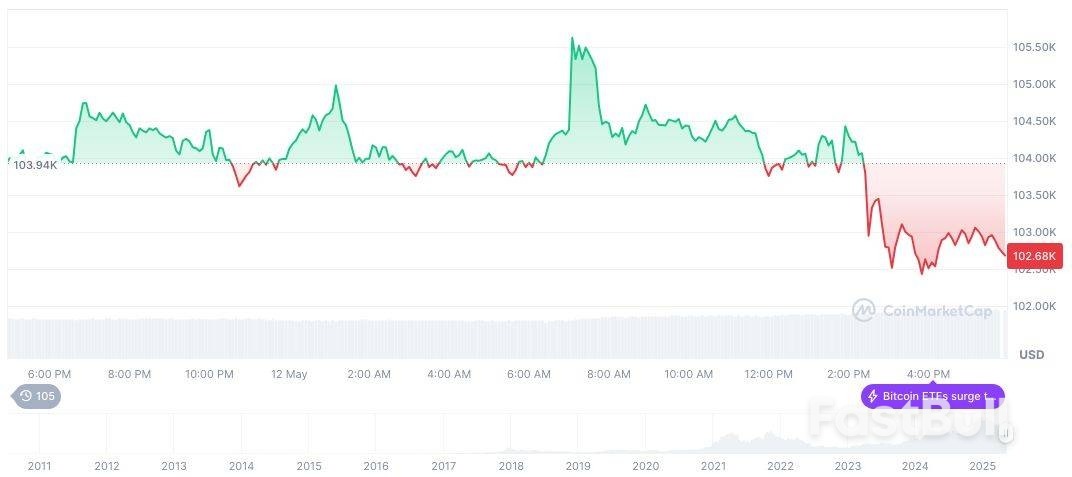
          Bitcoin (BTC) experienced a minor dip of -1.71% over 24 hours, trading at $102,692.66. It boasts a market cap of $2.04 trillion, according to CoinMarketCap, dominating 61.93% of the market. Over 60 days, Bitcoin’s price has risen by 24.85%, reflecting strong quarterly gains, influenced by global financial trends.

          Bitcoin(BTC), daily chart, screenshot on CoinMarketCap at 07:51 UTC on May 13, 2025. Source: CoinMarketCap

          Coincu research suggests significant shifts could impact the regulatory landscape and digital asset appeal. The flow from US equities to asset classes like gold and Bitcoin reflects broader uncertainty in traditional markets, positioning these assets as potential hedges amid weakening investor confidence.

          Source: CryptoSlate

          To stay updated on all economic events of today, please check out our Economic calendar
          Risk Warnings and Disclaimers
          You understand and acknowledge that there is a high degree of risk involved in trading. Following any strategies or investment methods may lead to potential losses. The content on the site is provided by our contributors and analysts for information purposes only. You are solely responsible for determining whether any trading assets, securities, strategy, or any other product is suitable for investing based on your own investment objectives and financial situation.
          Add to Favorites
          Share
          FastBull
          Copyright © 2025 FastBull Ltd

          728 RM B 7/F GEE LOK IND BLDG NO 34 HUNG TO RD KWUN TONG KLN HONG KONG

          TelegramInstagramTwitterfacebooklinkedin
          App Store Google Play Google Play
          Products
          Charts

          Chats

          Q&A with Experts
          Screeners
          Economic Calendar
          Data
          Tools
          Membership
          Features
          Function
          Markets
          Copy Trading
          Latest Signals
          Contests
          News
          Analysis
          24/7
          Columns
          Education
          Company
          Careers
          About Us
          Contact Us
          Advertising
          Help Center
          Feedback
          User Agreement
          Privacy Policy
          Business

          White Label

          Data API

          Web Plug-ins

          Poster Maker

          Affiliate Program

          Risk Disclosure

          The risk of loss in trading financial instruments such as stocks, FX, commodities, futures, bonds, ETFs and crypto can be substantial. You may sustain a total loss of the funds that you deposit with your broker. Therefore, you should carefully consider whether such trading is suitable for you in light of your circumstances and financial resources.

          No decision to invest should be made without thoroughly conducting due diligence by yourself or consulting with your financial advisors. Our web content might not suit you since we don't know your financial conditions and investment needs. Our financial information might have latency or contain inaccuracy, so you should be fully responsible for any of your trading and investment decisions. The company will not be responsible for your capital loss.

          Without getting permission from the website, you are not allowed to copy the website's graphics, texts, or trademarks. Intellectual property rights in the content or data incorporated into this website belong to its providers and exchange merchants.

          Not Logged In

          Log in to access more features

          FastBull Membership

          Not yet

          Purchase

          Become a signal provider
          Help Center
          Customer Service
          Dark Mode
          Price Up/Down Colors

          Log In

          Sign Up

          Position
          Layout
          Fullscreen
          Default to Chart
          The chart page opens by default when you visit fastbull.com