• Trade
  • Markets
  • Copy
  • Contests
  • News
  • 24/7
  • Calendar
  • Q&A
  • Chats
Trending
Screeners
SYMBOL
LAST
BID
ASK
HIGH
LOW
NET CHG.
%CHG.
SPREAD
SPX
S&P 500 Index
6827.42
6827.42
6827.42
6899.86
6801.80
-73.58
-1.07%
--
DJI
Dow Jones Industrial Average
48458.04
48458.04
48458.04
48886.86
48334.10
-245.98
-0.51%
--
IXIC
NASDAQ Composite Index
23195.16
23195.16
23195.16
23554.89
23094.51
-398.69
-1.69%
--
USDX
US Dollar Index
97.950
98.030
97.950
98.500
97.950
-0.370
-0.38%
--
EURUSD
Euro / US Dollar
1.17394
1.17409
1.17394
1.17496
1.17192
+0.00011
+ 0.01%
--
GBPUSD
Pound Sterling / US Dollar
1.33707
1.33732
1.33707
1.33997
1.33419
-0.00148
-0.11%
--
XAUUSD
Gold / US Dollar
4299.39
4299.39
4299.39
4353.41
4257.10
+20.10
+ 0.47%
--
WTI
Light Sweet Crude Oil
57.233
57.485
57.233
58.011
56.969
-0.408
-0.71%
--

Community Accounts

Signal Accounts
--
Profit Accounts
--
Loss Accounts
--
View More

Become a signal provider

Sell trading signals to earn additional income

View More

Guide to Copy Trading

Get started with ease and confidence

View More

Signal Accounts for Members

All Signal Accounts

Best Return
  • Best Return
  • Best P/L
  • Best MDD
Past 1W
  • Past 1W
  • Past 1M
  • Past 1Y

All Contests

  • All
  • Trump Updates
  • Recommend
  • Stocks
  • Cryptocurrencies
  • Central Banks
  • Featured News
Top News Only
Share

Iranian Media Says 18 Crew Members Of Foreign Tanker Seized In Gulf Of Oman Over Carrying 'Smuggled Fuel' Detained

Share

Regional Governor: Two Killed In Ukrainian Drone Strike On Russia's Saratov

Share

Chinese Foreign Ministry - China Foreign Minister Met With United Arab Emirates Counterpart On Dec 12

Share

China's Central Financial And Economic Affairs Commission Deputy Director: Will Expand Export And Increase Import In 2026

Share

Thai Leader Anutin: Landmine Blast That Killed Thai Soldiers 'Not A Roadside Accident'

Share

Thai Leader Anutin: Thailand To Continue Military Action Until 'We Feel No More Harm'

Share

Cambodian Prime Minister Hun Manet Says He Had Phone Calls With Trump And Malaysian Leader Anwar About Ceasefire

Share

Cambodia's Hun Manet Says USA, Malaysia Should Verify 'Which Side Fired First' In Latest Conflict

Share

Cambodia's Hun Manet: Cambodia Maintains Its Stance In Seeking Peaceful Resolution Of Disputes

Share

Nasdaq Companies: Allergan, Ferrovia, Insmed, Monolithic Power Systems, Seagate Technology, And Western Digital Will Be Added To The NASDAQ 100 Index. Biogen, CdW, GlobalFoundries, Lululemon, ON Semiconductor, And Tradedesk Will Be Removed From The NASDAQ 100 Index

Share

Witkoff Headed To Berlin This Weekend To Meet With Zelenskiy, European Leaders -Wsj Reporter On X

Share

Russia Attacks Two Ukrainian Ports, Damaging Three Turkish-Owned Vessels

Share

[Historic Flooding Occurs In At Least Four Rivers In Washington State Due To Days Of Torrential Rains] Multiple Areas In Washington State Have Been Hit By Severe Flooding Due To Days Of Torrential Rains, With At Least Four Rivers Experiencing Historic Flooding. Reporters Learned On The 12th That The Floods Caused By The Torrential Rains In Washington State Have Destroyed Homes And Closed Several Highways. Experts Warn That Even More Severe Flooding May Occur In The Future. A State Of Emergency Has Been Declared In Washington State

Share

Trump Says Proposed Free Economic Zone In Donbas Would Work

Share

Trump: I Think My Voice Should Be Heard

Share

Trump Says Will Be Choosing New Fed Chair In Near Future

Share

Trump Says Proposed Free Economic Zone In Donbas Complex But Would Work

Share

Trump Says Land Strikes In Venezuela Will Start Happening

Share

US President Trump: Thailand And Cambodia Are In A Good Situation

Share

State Media: North Korean Leader Kim Hails Troops Returning From Russia Mission

TIME
ACT
FCST
PREV
U.K. Trade Balance Non-EU (SA) (Oct)

A:--

F: --

P: --

U.K. Trade Balance (Oct)

A:--

F: --

P: --

U.K. Services Index MoM

A:--

F: --

P: --

U.K. Construction Output MoM (SA) (Oct)

A:--

F: --

P: --

U.K. Industrial Output YoY (Oct)

A:--

F: --

P: --

U.K. Trade Balance (SA) (Oct)

A:--

F: --

P: --

U.K. Trade Balance EU (SA) (Oct)

A:--

F: --

P: --

U.K. Manufacturing Output YoY (Oct)

A:--

F: --

P: --

U.K. GDP MoM (Oct)

A:--

F: --

P: --

U.K. GDP YoY (SA) (Oct)

A:--

F: --

P: --

U.K. Industrial Output MoM (Oct)

A:--

F: --

P: --

U.K. Construction Output YoY (Oct)

A:--

F: --

P: --

France HICP Final MoM (Nov)

A:--

F: --

P: --

China, Mainland Outstanding Loans Growth YoY (Nov)

A:--

F: --

P: --

China, Mainland M2 Money Supply YoY (Nov)

A:--

F: --

P: --

China, Mainland M0 Money Supply YoY (Nov)

A:--

F: --

P: --

China, Mainland M1 Money Supply YoY (Nov)

A:--

F: --

P: --

India CPI YoY (Nov)

A:--

F: --

P: --

India Deposit Gowth YoY

A:--

F: --

P: --

Brazil Services Growth YoY (Oct)

A:--

F: --

P: --

Mexico Industrial Output YoY (Oct)

A:--

F: --

P: --

Russia Trade Balance (Oct)

A:--

F: --

P: --

Philadelphia Fed President Henry Paulson delivers a speech
Canada Building Permits MoM (SA) (Oct)

A:--

F: --

P: --

Canada Wholesale Sales YoY (Oct)

A:--

F: --

P: --

Canada Wholesale Inventory MoM (Oct)

A:--

F: --

P: --

Canada Wholesale Inventory YoY (Oct)

A:--

F: --

P: --

Canada Wholesale Sales MoM (SA) (Oct)

A:--

F: --

P: --

Germany Current Account (Not SA) (Oct)

A:--

F: --

P: --

U.S. Weekly Total Rig Count

A:--

F: --

P: --

U.S. Weekly Total Oil Rig Count

A:--

F: --

P: --

Japan Tankan Large Non-Manufacturing Diffusion Index (Q4)

--

F: --

P: --

Japan Tankan Small Manufacturing Outlook Index (Q4)

--

F: --

P: --

Japan Tankan Large Non-Manufacturing Outlook Index (Q4)

--

F: --

P: --

Japan Tankan Large Manufacturing Outlook Index (Q4)

--

F: --

P: --

Japan Tankan Small Manufacturing Diffusion Index (Q4)

--

F: --

P: --

Japan Tankan Large Manufacturing Diffusion Index (Q4)

--

F: --

P: --

Japan Tankan Large-Enterprise Capital Expenditure YoY (Q4)

--

F: --

P: --

U.K. Rightmove House Price Index YoY (Dec)

--

F: --

P: --

China, Mainland Industrial Output YoY (YTD) (Nov)

--

F: --

P: --

China, Mainland Urban Area Unemployment Rate (Nov)

--

F: --

P: --

Saudi Arabia CPI YoY (Nov)

--

F: --

P: --

Euro Zone Industrial Output YoY (Oct)

--

F: --

P: --

Euro Zone Industrial Output MoM (Oct)

--

F: --

P: --

Canada Existing Home Sales MoM (Nov)

--

F: --

P: --

Euro Zone Total Reserve Assets (Nov)

--

F: --

P: --

U.K. Inflation Rate Expectations

--

F: --

P: --

Canada National Economic Confidence Index

--

F: --

P: --

Canada New Housing Starts (Nov)

--

F: --

P: --

U.S. NY Fed Manufacturing Employment Index (Dec)

--

F: --

P: --

U.S. NY Fed Manufacturing Index (Dec)

--

F: --

P: --

Canada Core CPI YoY (Nov)

--

F: --

P: --

Canada Manufacturing Unfilled Orders MoM (Oct)

--

F: --

P: --

Canada Manufacturing New Orders MoM (Oct)

--

F: --

P: --

Canada Core CPI MoM (Nov)

--

F: --

P: --

Canada Manufacturing Inventory MoM (Oct)

--

F: --

P: --

Canada CPI YoY (Nov)

--

F: --

P: --

Canada CPI MoM (Nov)

--

F: --

P: --

Canada CPI YoY (SA) (Nov)

--

F: --

P: --

Canada Core CPI MoM (SA) (Nov)

--

F: --

P: --

Q&A with Experts
    • All
    • Chatrooms
    • Groups
    • Friends
    Connecting
    .
    .
    .
    Type here...
    Add Symbol or Code

      No matching data

      All
      Trump Updates
      Recommend
      Stocks
      Cryptocurrencies
      Central Banks
      Featured News
      • All
      • Russia-Ukraine Conflict
      • Middle East Flashpoint
      • All
      • Russia-Ukraine Conflict
      • Middle East Flashpoint
      Search
      Products

      Charts Free Forever

      Chats Q&A with Experts
      Screeners Economic Calendar Data Tools
      Membership Features
      Data Warehouse Market Trends Institutional Data Policy Rates Macro

      Market Trends

      Market Sentiment Order Book Forex Correlations

      Top Indicators

      Charts Free Forever
      Markets

      News

      News Analysis 24/7 Columns Education
      From Institutions From Analysts
      Topics Columnists

      Latest Views

      Latest Views

      Trending Topics

      Top Columnists

      Latest Update

      Signals

      Copy Rankings Latest Signals Become a signal provider AI Rating
      Contests
      Brokers

      Overview Brokers Assessment Rankings Regulators News Claims
      Broker listing Forex Brokers Comparison Tool Live Spread Comparison Scam
      Q&A Complaint Scam Alert Videos Tips to Detect Scam
      More

      Business
      Events
      Careers About Us Advertising Help Center

      White Label

      Data API

      Web Plug-ins

      Affiliate Program

      Awards Institution Evaluation IB Seminar Salon Event Exhibition
      Vietnam Thailand Singapore Dubai
      Fans Party Investment Sharing Session
      FastBull Summit BrokersView Expo
      Recent Searches
        Top Searches
          Markets
          News
          Analysis
          User
          24/7
          Economic Calendar
          Education
          Data
          • Names
          • Latest
          • Prev

          View All

          No data

          Scan to Download

          Faster Charts, Chat Faster!

          Download App
          English
          • English
          • Español
          • العربية
          • Bahasa Indonesia
          • Bahasa Melayu
          • Tiếng Việt
          • ภาษาไทย
          • Français
          • Italiano
          • Türkçe
          • Русский язык
          • 简中
          • 繁中
          Open Account
          Search
          Products
          Charts Free Forever
          Markets
          News
          Signals

          Copy Rankings Latest Signals Become a signal provider AI Rating
          Contests
          Brokers

          Overview Brokers Assessment Rankings Regulators News Claims
          Broker listing Forex Brokers Comparison Tool Live Spread Comparison Scam
          Q&A Complaint Scam Alert Videos Tips to Detect Scam
          More

          Business
          Events
          Careers About Us Advertising Help Center

          White Label

          Data API

          Web Plug-ins

          Affiliate Program

          Awards Institution Evaluation IB Seminar Salon Event Exhibition
          Vietnam Thailand Singapore Dubai
          Fans Party Investment Sharing Session
          FastBull Summit BrokersView Expo

          US Labor Dept Lifts Biden-Era Crypto Restrictions For 401(k) Retirement Plans

          Daniel Carter

          Economic

          Cryptocurrency

          Political

          Summary:

          The U.S. Department of Labor on Wednesday withdrew its 2022 guidance on including crypto in 401(k) retirement plans. This may enable fiduciaries in retirement plans to invest in Bitcoin and other cryptocurrencies, moving away from guidance that urged “extreme care.”

          Labor Department Eases Crypto Investments in 401(k) Plans

          The U.S. Department of Labor's Employee Benefits Security Administration rescinded a Biden-era compliance guideline, as per an official announcement on May 28.
          The 2022 guidance prevented fiduciaries from including crypto options such as Bitcoin in 401(k) retirement plans due to volatility, fraud, and regulatory uncertainty. Notably, the “extreme care” language shifted from the requirements of the Employee Retirement Income Security Act (ERISA).
          U.S. Secretary of Labor Lori Chavez-DeRemer slammed the earlier stance as government overreach, sticking to the rationale that investment decisions should be left to fiduciaries, not bureaucrats.
          “The Biden administration's Department of Labor made a choice to put their thumb on the scale,” said Chavez-DeRemer, adding.
          “We're rolling back this overreach and making it clear that investment decisions should be made by fiduciaries, not DC bureaucrats.”
          With this reversal, the labor department has returned to its neutral position. It neither encourages nor opposes crypto investments in retirement savings plans.

          Mainstream Adoption of Bitcoin and Crypto Gets Broader

          With the guidance lifted, it could lead to 401(k) retirement plans to offer Bitcoin or crypto-related investments, such as exposure to spot Bitcoin ETFs.
          Moreover, an increased demand for Bitcoin and crypto exposure from 401(k) plans might further legitimize Bitcoin as an asset class. The broader Wall Street companies are adding Bitcoin as a reserve asset, diversifying their investment assets.
          Led by Michael Saylor's Strategy, other companies such as Trump Media, Metaplanet, and GameStop have purchased Bitcoin. President Donald Trump's focus on making Bitcoin a strategic reserve asset significantly fueled and eased Bitcoin buying in the United States and overseas.
          Similarly, spot Bitcoin ETFs such as BlackRock's iShares Bitcoin ETF (IBIT) and Fidelity's FBTC are likely to witness increased demand from 401(k) providers. As per BlackRock data, IBIT holds Bitcoin worth $71.9 billion at the time of writing.

          What Does It Mean for Bitcoin Price?

          Bitcoin price could witness a significant rally with retirement plans beginning to include crypto-related investments. While fiduciaries must still adhere to ERISA's prudent investor rule and evaluate crypto's risks, including volatility, security, and regulatory shifts, against potential returns.
          Analysts from Standard Chartered and Intellectia AI predicted Bitcoin to hit as high as $200K by the year-end. BTC price recently hit a new ATH of $111,970, but tariff war, macro risks, and selloffs by miners as well as whales kept the price at bay.
          Bitcoin price fell 0.68% in the past 24 hours, with the price trading at $108,261 at the time of writing. The 24-hour low and high were $106,968 and $109,094, respectively. Moreover, the trading was slightly upby 0.33% at $52.13 billion in the last 24 hours, indicating a rising interest among traders.
          The sentiment remained mixed in the derivatives market today, as per CoinGlass data. BTC futures open interest (OI) on CME declined 0.95% to $17.63 billion. Whereas, BTC futures OI jumped 1.50% on OKX, Bybit, and Bitget.

          Source: CryptoSlate

          To stay updated on all economic events of today, please check out our Economic calendar
          Risk Warnings and Disclaimers
          You understand and acknowledge that there is a high degree of risk involved in trading. Following any strategies or investment methods may lead to potential losses. The content on the site is provided by our contributors and analysts for information purposes only. You are solely responsible for determining whether any trading assets, securities, strategy, or any other product is suitable for investing based on your own investment objectives and financial situation.
          Add to Favorites
          Share

          EURUSD Dips to The 1.1200 Area; Will The Decline Continue?

          Blue River

          Technical Analysis

          The EURUSD pair came under pressure following a US Trade Court ruling and the release of the latest FOMC meeting minutes. Full out more in our analysis for 29 May 2025.

          EURUSD forecast: key trading points

          • Market focus: the US Court of International Trade blocked President Donald Trump’s tariffs
          • Current trend: correcting downwards
          • EURUSD forecast for 29 May 2025: 1.1200 and 1.1300

          Fundamental analysis

          The EURUSD rate declined as the US dollar strengthened after the US Court of International Trade overturned tariffs imposed by President Donald Trump. The court ruled that the tariffs were unlawful, directly challenging Trump’s trade agenda. The administration is expected to appeal the decision.

          Meanwhile, yesterday’s release of the FOMC meeting minutes revealed the Fed’s cautious stance amid current economic uncertainty. Committee members highlighted the need for patience and greater clarity on inflation and broader economic trends before taking further policy action.

          EURUSD technical analysis

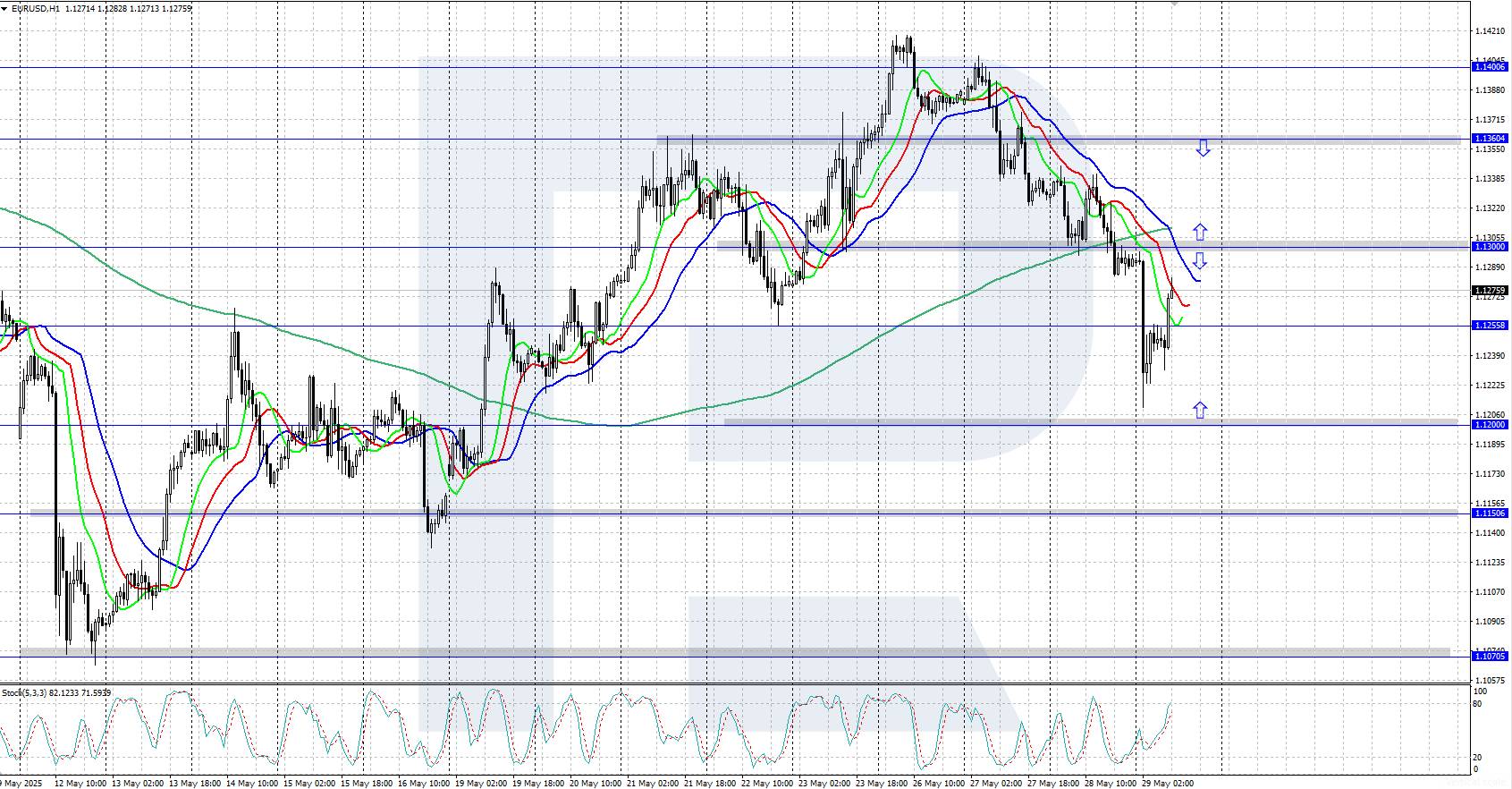
          On the H4 chart, the EURUSD pair is undergoing a downward correction, retreating to the support area around 1.1200. Bulls are attempting to regain control and reverse the move. With the overall daily trend remaining upward, the pair will likely continue its upward trajectory following the correction.

          The EURUSD forecast suggests a rebound towards 1.1300 and higher in the short term if bulls hold the price above 1.1200. However, if bears push quotes below this level, the downward correction could deepen towards the next support at 1.1150.

          Summary

          The EURUSD pair plunged to the 1.1200 area amid renewed dollar strength. The market will keep a close eye on tomorrow’s US inflation data.

          Source: RoboForex

          Risk Warnings and Disclaimers
          You understand and acknowledge that there is a high degree of risk involved in trading. Following any strategies or investment methods may lead to potential losses. The content on the site is provided by our contributors and analysts for information purposes only. You are solely responsible for determining whether any trading assets, securities, strategy, or any other product is suitable for investing based on your own investment objectives and financial situation.
          Add to Favorites
          Share

          U.S. Faces Severe Shortage of Critical Materials as China Tightens Rare Earth Exports

          Gerik

          Economic

          China–U.S. Trade War

          The Growing Challenge of Rare Earth Dependence

          The U.S. is rapidly seeking alternative sources for rare earth elements as trade tensions with China continue to escalate. These minerals, which are crucial for the production of electronics, electric vehicles, and defense systems, have long been dominated by China, which controls a significant share of the global supply.
          In 2024, China accounted for 69% of global rare earth production and holds nearly half of the world's reserves. It also controls more than 90% of the processed rare earth supply needed for permanent magnets used in electric vehicle motors, including key elements like neodymium, praseodymium, dysprosium, and terbium. As a result, the U.S. is scrambling to find ways to reduce its dependence on China, which has been tightening its grip on the global rare earth market.

          U.S. Investment in Recycling and Alternative Technologies

          In response to the growing pressure, the U.S. government has started investing in rare earth recycling companies. In September 2024, the U.S. Department of Defense allocated $4.2 million to Rare Earth Salts, a company specializing in extracting rare earth oxides from recycled products like fluorescent light bulbs. Japanese companies, such as Toyota, are also investing in technology to reduce rare earth usage in their products.
          According to AlixPartners, a consulting firm, an electric vehicle (EV) with a single-motor battery requires approximately 550 grams of rare earths, compared to only 140 grams for a gasoline-powered car. For hybrid cars using nickel-metal hydride (NiMH) batteries, the figure can rise to 4.45 kg due to the use of lanthanum. Despite the U.S. having only 7.5% of its car sales in EVs in Q1 of 2025, EV sales are rapidly growing in China, where over 50% of new cars are electric or hybrid.

          China's Recent Export Restrictions

          In April 2025, China implemented export restrictions on seven types of rare earth elements, including terbium, which is used in electric vehicles. China also limited exports of cerium, another key element for the auto industry. These restrictions are forcing Western economies to confront the reality of their over-reliance on Chinese rare earth supply.
          Western countries are actively seeking alternatives but face significant challenges. Developing new mining operations and processing facilities for rare earths would take years and require highly specialized expertise. Meanwhile, recycling technologies, while a long-term solution, are still costly and energy-intensive. According to Henry Sanderson, a member of the Royal United Services Institute (RUSI), 70% of the 200 kg of minerals in each EV is tied to China, highlighting the difficulty of shifting away from Chinese supply chains.
          Even as EV sales slow in the U.S., rare earths remain vital for the defense sector. For example, the F-35 fighter jet uses approximately 408 kg of rare earths. The reliance on rare earths extends beyond the automotive industry, with key minerals such as gallium, germanium, and tungsten also controlled by China. These materials are crucial for semiconductors, military applications, and energy storage.

          A Critical Shortage Looms for Strategic Sectors

          China’s control over tungsten, an element used in cutting tools, semiconductors, batteries, and weapons, is particularly concerning. China produces around 80% of the world's tungsten, and the U.S. imports 27% of its tungsten from China. The potential shortage of tungsten and other critical materials could severely impact industries such as automotive, healthcare, and aerospace.
          As new sources of tungsten come online in countries like South Korea in 2025, supply for defense needs might be met, but critical shortages will persist in industries like automotive and aerospace. The global scramble for rare earths and other strategic materials underscores the need for diversification and self-sufficiency to safeguard both economic and national security interests.
          The U.S. is facing a severe challenge as China continues to tighten its control over rare earth elements and other critical materials. While efforts to develop alternative sources and improve recycling technology are underway, the scale of the problem means that Western economies will continue to struggle with supply shortages for years to come. The situation is further complicated by geopolitical tensions, forcing countries to rethink their reliance on Chinese supply chains and seek more secure, diversified sources of these vital resources.

          Source: CNBC

          To stay updated on all economic events of today, please check out our Economic calendar
          Risk Warnings and Disclaimers
          You understand and acknowledge that there is a high degree of risk involved in trading. Following any strategies or investment methods may lead to potential losses. The content on the site is provided by our contributors and analysts for information purposes only. You are solely responsible for determining whether any trading assets, securities, strategy, or any other product is suitable for investing based on your own investment objectives and financial situation.
          Add to Favorites
          Share

          Fed Warns of Dual Risks from Inflation and Unemployment, Signals Caution on Rate Cuts

          Gerik

          Economic

          China–U.S. Trade War

          Fed’s Caution Amid Growing Risks

          In the minutes released from its May meeting, the Federal Reserve acknowledged that inflation and unemployment could rise simultaneously, posing complex challenges for U.S. economic policy. The minutes, which followed the May 6–7 meeting of the Federal Open Market Committee (FOMC), indicated that the Fed may need to make tough trade-offs between combating inflation with higher interest rates or supporting job growth by lowering rates.
          The Fed’s decision to maintain its policy rate at 4.25% to 4.5% reflects its careful stance as it assesses the economic impact of President Donald Trump’s tariff policies. The minutes noted that while inflation has remained persistent, the effects of the tariffs on the U.S. economy are still unfolding, and the Fed will need more clarity before taking further action.

          Tariff-Related Uncertainty and Its Economic Consequences

          One of the key points raised in the minutes was the uncertainty surrounding the new tariffs, particularly those targeting countries like China. While some tariffs were temporarily delayed, the Fed remains cautious, as these policies could continue to affect both inflation and the broader economy. The minutes also referenced concerns over rising Treasury yields and their potential impact on financial stability.
          Despite these concerns, the minutes emphasized that U.S. economic growth remains "solid," with the labor market in a “relatively balanced” state and consumer spending still strong. However, the potential for inflation to stay higher than expected and the possibility of a weakening job market as the year progresses were key concerns.

          Dual Risks: Inflation and Unemployment

          The minutes stressed the growing risks posed by the potential combination of rising inflation and higher unemployment, which could create difficult decisions for the Fed. If inflation remains stubbornly high while employment slows, the Fed may face the dilemma of choosing between further tightening to control inflation or easing to stimulate the economy and protect jobs.
          The Fed’s new growth projections reflect some moderation. The Fed’s research team has lowered its 2025 growth forecast to 0.8%, nearly halving its previous estimate of 1.5%. The U.S. labor market, while still strong, is showing signs of weakness, with the unemployment rate expected to exceed the natural rate of employment by the end of the year and remain elevated for the next two years.
          The continued uncertainty around tariffs and trade negotiations, especially with China, remains a significant concern. As of now, the tariffs that were imposed earlier in the year are on hold, with talks set to continue through July. Despite this, the uncertainty surrounding these policies remains high.

          Fed’s Path Forward

          The Federal Reserve is set to meet again on June 17-18, when it will provide new projections for inflation, job growth, and economic expansion, along with updates on its expected interest rate path. The meeting will likely provide more clarity on whether the Fed will continue with its cautious approach or move toward easing in response to slowing growth and persistent inflation.
          With inflation risks lingering and concerns about rising unemployment, the Federal Reserve faces a challenging balancing act in managing U.S. monetary policy. While tariff delays provide temporary relief, long-term uncertainty remains, and the Fed will continue to assess the evolving situation before making further decisions on interest rates.

          Source: Investing

          To stay updated on all economic events of today, please check out our Economic calendar
          Risk Warnings and Disclaimers
          You understand and acknowledge that there is a high degree of risk involved in trading. Following any strategies or investment methods may lead to potential losses. The content on the site is provided by our contributors and analysts for information purposes only. You are solely responsible for determining whether any trading assets, securities, strategy, or any other product is suitable for investing based on your own investment objectives and financial situation.
          Add to Favorites
          Share

          U.S. Court Blocks Trump’s Tariffs, Boosting Global Markets and Dollar

          Gerik

          Economic

          Court Ruling and Immediate Market Reactions

          On May 29, 2025, a U.S. federal court blocked President Trump’s sweeping tariffs on imports, leading to a surge in both U.S. and Asian equities, and a strengthening of the U.S. dollar. The Manhattan-based Court of International Trade ruled that the president had exceeded his authority in imposing tariffs under the International Emergency Economic Powers Act (IEEPA), arguing that the power to regulate tariffs belongs solely to Congress.
          While the ruling temporarily paused Trump's broad tariff impositions, the White House swiftly filed an appeal, and it remains unclear how the case will unfold. This ruling offers a momentary relief from the trade uncertainties that have rattled global markets for the past two months, leading to optimism among investors. The dollar saw a sharp increase, rising against safe-haven currencies like the Swiss franc and Japanese yen.

          Uncertainty and Impact on Trade Negotiations

          Despite the positive reaction in financial markets, analysts caution that the ruling does not eliminate the risk of prolonged policy uncertainty. The decision only blocks some of Trump's tariff actions, leaving room for sector-specific tariffs to remain in place or for alternative legal avenues to be pursued. Goldman Sachs analysts highlighted that the ruling does not fundamentally alter the long-term tariff policies or trade negotiations with major U.S. trading partners.
          The court’s decision may also encourage other countries to delay trade negotiations with the U.S. while awaiting further developments on the legal challenges to Trump's tariff agenda. Market analysts believe that this extended uncertainty could affect corporate investment decisions, as businesses remain cautious about future trade relations and potential tariffs.

          Market Reactions: Asia Leads the Way

          Asian stock markets were quick to react positively to the court’s decision, with Japan's Nikkei 225 rising 1.7% and South Korea's Kospi advancing by 1.8%. The broader MSCI Asia-Pacific index also saw an uptick of 0.5%, with Chinese blue-chip stocks gaining 0.6%. In the U.S., S&P 500 futures climbed 1.6%, while Nasdaq futures rose by 2.0%, buoyed by positive earnings reports from companies like Nvidia.
          Nvidia’s strong earnings and optimistic revenue forecast helped offset other concerns, including reports of new restrictions on U.S. technology exports to China. Despite these geopolitical tensions, the relief from the court ruling provided a temporary boost to market sentiment.

          Commodity and Bond Markets Respond

          The legal decision also influenced commodity markets. Gold prices fell 0.5% to $3,271 per ounce, while oil prices continued their upward trend, with Brent crude rising by 96 cents to $65.87 a barrel, driven by supply concerns and geopolitical tensions.
          In the bond market, U.S. 10-year Treasury yields rose 3 basis points to 4.51%, as the ruling further reduced expectations for a Federal Reserve rate cut in the near future. The probability of a rate cut in July dropped to just 22%, with September now seen as the more likely timeframe.
          While the U.S. court’s decision to block Trump’s tariffs has provided a temporary respite for global markets, the uncertainty over future tariff actions continues to hang over economic outlooks. The ruling has temporarily boosted investor sentiment, but it is unclear how long the optimism will last as the legal process moves forward and trade negotiations remain in flux. The situation underscores the broader concerns about U.S. trade policy and its long-term impact on global markets and economic growth.

          Source: Reuters

          To stay updated on all economic events of today, please check out our Economic calendar
          Risk Warnings and Disclaimers
          You understand and acknowledge that there is a high degree of risk involved in trading. Following any strategies or investment methods may lead to potential losses. The content on the site is provided by our contributors and analysts for information purposes only. You are solely responsible for determining whether any trading assets, securities, strategy, or any other product is suitable for investing based on your own investment objectives and financial situation.
          Add to Favorites
          Share

          Japan Considers U.S. Defense Gear as Leverage in Tariff Negotiations

          Gerik

          Economic

          China–U.S. Trade War

          Japan’s Strategic Approach in Tariff Negotiations

          As Japan heads into a fourth round of tariff talks with the U.S., the country is considering using the purchase of U.S. defense equipment as a potential bargaining chip. Ryosei Akazawa, Japan’s top tariff negotiator, emphasized that the purchase of defense equipment could contribute to the U.S. trade surplus, making it a valuable consideration in the trade discussions. Akazawa, who will meet with U.S. Treasury Secretary Scott Bessent in Washington, outlined that Japan’s proposals would also include cooperation on shipbuilding, revisions to inspection standards for imported automobiles, and increased imports of U.S. farm products.
          The discussions come as Japan faces a 24% tariff rate starting in July unless it can negotiate a favorable deal with the U.S. Akazawa’s comments signal Japan’s determination to use defense procurement, such as fighter jets, to reduce trade tensions and secure a more balanced trade relationship with the U.S.

          Defensive Equipment and Broader Trade Strategies

          While the specific defense equipment Japan is considering has not been finalized, media reports suggest that President Trump pitched the F-47 fighter jet in a recent call with Japanese Prime Minister Shigeru Ishiba. The inclusion of defense purchases in the negotiation package is seen as a way for Japan to sweeten the deal while addressing the U.S.’s trade deficit with Japan.
          Despite the U.S. court’s recent ruling to block President Trump’s sweeping tariffs, which has added another layer of uncertainty, a source close to the negotiations stated that Japan’s strategy would remain unaffected. Japan is focused on not only addressing “reciprocal” tariffs but also tackling sector-specific tariffs, especially those imposed on automobiles. The ruling, which blocks broad tariffs, does not alter Japan's approach to these specific issues in its discussions with the U.S.

          Currency and Military Spending Issues Remain Separate

          Although the initial rounds of negotiations included concerns over currency rates, with past U.S. claims about Japan's weak yen, these issues have been separated from the ongoing tariff talks. Akazawa and U.S. officials have reiterated that currency matters would be dealt with separately, and the Treasury Department has noted that the current dollar-yen rate reflects economic fundamentals. Japan has also denied reports suggesting that it would increase its share of the costs for U.S. troops stationed in Japan, with officials asserting that the existing sharing arrangement remains appropriate.
          The G7 summit in mid-June, where U.S. President Trump and Japan’s Prime Minister Ishiba are set to meet, is expected to play a significant role in advancing the trade talks. For now, Japan continues to push for a resolution that eliminates both reciprocal and industry-specific tariffs, particularly on its key export sectors. While uncertainty remains in the wake of the court ruling, Japan’s strategic approach, combining defense procurement and trade concessions, reflects a calculated effort to mitigate tariffs and strengthen the economic partnership between the two nations.

          Source: Reuters

          To stay updated on all economic events of today, please check out our Economic calendar
          Risk Warnings and Disclaimers
          You understand and acknowledge that there is a high degree of risk involved in trading. Following any strategies or investment methods may lead to potential losses. The content on the site is provided by our contributors and analysts for information purposes only. You are solely responsible for determining whether any trading assets, securities, strategy, or any other product is suitable for investing based on your own investment objectives and financial situation.
          Add to Favorites
          Share

          Court Ruling Against Trump’s Tariffs Brings Temporary Relief but Long-Term Uncertainty for Markets

          Gerik

          Economic

          Short-Term Optimism Follows Legal Victory

          On May 29, 2025, a U.S. court's decision to temporarily block many of President Trump’s tariffs lifted market sentiment, with major equity indexes rising, particularly in Asia. The court ruled that Trump overstepped his authority in implementing broad tariffs on imports, a decision that immediately appealed to risk assets and the U.S. dollar, which had suffered under the tariff confusion. The ruling temporarily alleviated concerns that the tariffs would continue escalating global trade tensions and economic challenges.
          However, the ruling’s long-term impact remains uncertain. While the immediate market reaction has been positive, the U.S. administration quickly filed an appeal, signaling that policy uncertainty may persist for the foreseeable future.

          Economic Impact of Prolonged Trade Uncertainty

          Despite the temporary optimism sparked by the ruling, analysts warn that ongoing trade uncertainty could harm business operations and investment. David Chao, global market strategist for Asia Pacific at Invesco, expressed concerns that businesses may delay key decisions, such as hiring, capital expenditure, and wage increases, which could dampen earnings and consumption in the long term. Chao stressed that the uncertainty surrounding tariff policies makes it difficult for companies to plan for future growth, creating a risk of economic stagnation.
          The ruling, while a marginal positive for market sentiment, does not resolve the underlying issues of policy uncertainty. Charu Chanana, chief investment strategist at Saxo, noted that while the decision may reduce the most pessimistic growth projections, businesses still lack clarity about the future direction of trade policy. The volatility created by Trump's back-and-forth tariff changes has led to a shift in investment strategies, with investors opting for shorter-term horizons and tactical trades rather than long-term commitments.

          Global Stock Reactions and Regional Growth

          The court’s decision sent Asian stock markets higher, particularly in South Korea and Japan, where the Kospi and Nikkei indexes gained more than 7% from the time of Trump’s "Liberation Day" tariffs. Global markets, which had been under pressure from Trump's trade wars, saw a rebound, with the S&P 500 rising 3.8% since the tariffs were first announced.
          However, while the immediate pressure has eased, concerns remain about the potential for higher courts to overturn the ruling, keeping the trade environment volatile. Sean Callow of ITC Markets in Sydney noted that investors are betting on the likelihood of U.S. courts preventing further economic damage, which could brighten growth prospects and strengthen the U.S. dollar.

          Uncertainty Continues to Hinder Long-Term Economic Decisions

          For businesses and central banks, the prolonged policy uncertainty is proving detrimental. Executives and policymakers are hesitant to make long-term decisions, which could take years to implement. Kei Okamura, a portfolio manager at Neuberger Berman in Tokyo, highlighted how the “stop-and-go” nature of trade policies hampers strategic decision-making, reinforcing the wait-and-see stance taken by central banks and investors.
          While the U.S. court ruling against Trump’s tariffs offers short-term relief for global markets, the continuing uncertainty over U.S. trade policies and the potential for future appeals creates a challenging environment for businesses and investors. As long as tariff-related volatility persists, the outlook for global economic growth remains clouded, making it difficult for firms to make long-term investment decisions.

          Source: Reuters

          To stay updated on all economic events of today, please check out our Economic calendar
          Risk Warnings and Disclaimers
          You understand and acknowledge that there is a high degree of risk involved in trading. Following any strategies or investment methods may lead to potential losses. The content on the site is provided by our contributors and analysts for information purposes only. You are solely responsible for determining whether any trading assets, securities, strategy, or any other product is suitable for investing based on your own investment objectives and financial situation.
          Add to Favorites
          Share
          FastBull
          Copyright © 2025 FastBull Ltd

          728 RM B 7/F GEE LOK IND BLDG NO 34 HUNG TO RD KWUN TONG KLN HONG KONG

          TelegramInstagramTwitterfacebooklinkedin
          App Store Google Play Google Play
          Products
          Charts

          Chats

          Q&A with Experts
          Screeners
          Economic Calendar
          Data
          Tools
          Membership
          Features
          Function
          Markets
          Copy Trading
          Latest Signals
          Contests
          News
          Analysis
          24/7
          Columns
          Education
          Company
          Careers
          About Us
          Contact Us
          Advertising
          Help Center
          Feedback
          User Agreement
          Privacy Policy
          Business

          White Label

          Data API

          Web Plug-ins

          Poster Maker

          Affiliate Program

          Risk Disclosure

          The risk of loss in trading financial instruments such as stocks, FX, commodities, futures, bonds, ETFs and crypto can be substantial. You may sustain a total loss of the funds that you deposit with your broker. Therefore, you should carefully consider whether such trading is suitable for you in light of your circumstances and financial resources.

          No decision to invest should be made without thoroughly conducting due diligence by yourself or consulting with your financial advisors. Our web content might not suit you since we don't know your financial conditions and investment needs. Our financial information might have latency or contain inaccuracy, so you should be fully responsible for any of your trading and investment decisions. The company will not be responsible for your capital loss.

          Without getting permission from the website, you are not allowed to copy the website's graphics, texts, or trademarks. Intellectual property rights in the content or data incorporated into this website belong to its providers and exchange merchants.

          Not Logged In

          Log in to access more features

          FastBull Membership

          Not yet

          Purchase

          Become a signal provider
          Help Center
          Customer Service
          Dark Mode
          Price Up/Down Colors

          Log In

          Sign Up

          Position
          Layout
          Fullscreen
          Default to Chart
          The chart page opens by default when you visit fastbull.com