• Trade
  • Markets
  • Copy
  • Contests
  • News
  • 24/7
  • Calendar
  • Q&A
  • Chats
Trending
Screeners
SYMBOL
LAST
BID
ASK
HIGH
LOW
NET CHG.
%CHG.
SPREAD
SPX
S&P 500 Index
6849.47
6849.47
6849.47
6878.28
6841.15
-20.93
-0.30%
--
DJI
Dow Jones Industrial Average
47807.26
47807.26
47807.26
47971.51
47709.38
-147.72
-0.31%
--
IXIC
NASDAQ Composite Index
23535.97
23535.97
23535.97
23698.93
23505.52
-42.14
-0.18%
--
USDX
US Dollar Index
99.150
99.230
99.150
99.160
98.730
+0.200
+ 0.20%
--
EURUSD
Euro / US Dollar
1.16173
1.16180
1.16173
1.16717
1.16162
-0.00253
-0.22%
--
GBPUSD
Pound Sterling / US Dollar
1.33127
1.33135
1.33127
1.33462
1.33053
-0.00185
-0.14%
--
XAUUSD
Gold / US Dollar
4192.69
4193.12
4192.69
4218.85
4175.92
-5.22
-0.12%
--
WTI
Light Sweet Crude Oil
58.918
58.948
58.918
60.084
58.837
-0.891
-1.49%
--

Community Accounts

Signal Accounts
--
Profit Accounts
--
Loss Accounts
--
View More

Become a signal provider

Sell trading signals to earn additional income

View More

Guide to Copy Trading

Get started with ease and confidence

View More

Signal Accounts for Members

All Signal Accounts

Best Return
  • Best Return
  • Best P/L
  • Best MDD
Past 1W
  • Past 1W
  • Past 1M
  • Past 1Y

All Contests

  • All
  • Trump Updates
  • Recommend
  • Stocks
  • Cryptocurrencies
  • Central Banks
  • Featured News
Top News Only
Share

Israeli Prime Minister Netanyahu: Hamas Has Violated The Ceasefire Agreement, And We Will Never Allow Its Members To Re-arm Themselves And Threaten US

Share

Israeli Prime Minister Netanyahu: We Are Working To Return The Body Of Another Detainee From The Gaza Strip

Share

Iraq's West Qurna 2 Oil Field Will Increase Oil Production Beyond Normal Levels To Compensate For The Production Stoppage Caused By The Trump Administration's Sanctions Against Russia

Share

Israeli Prime Minister Netanyahu: We Are Close To Completing The First Phase Of Trump’s Plan And Will Now Focus On Disarming Gaza And Seizing Hamas Weapons

Share

Moody's Affirmed Burberry's Long-term Rating Of Baa3 And Revised Its Outlook (from Negative) To Stable

Share

The Trump Administration Supports Iraq's Plan To Transfer Russian Oil Company Lukoil Pjsc's Assets In The West Qurna 2 Oil Field To An American Company

Share

JMA: Tsunami Of 70 Centimetres Observed In Japan's Kuji Port In Iwate Prefecture

Share

The U.S. Bureau Of Labor Statistics Plans To Release A Press Release On January 15, 2026, For November 2025, Along With Data For October

Share

Tiger Global Has Established A New Fund, Aiming To Raise $2 Billion To $3 Billion

Share

The U.S. Bureau Of Labor Statistics Announced That It Will Not Release A Press Release Regarding The U.S. Import And Export Price Index (MXP) For October 2025

Share

The U.S. Bureau Of Labor Statistics (BLS) Will Not Release U.S. October CPI Data

Share

Government Negotiator: Dutch Political Center And Center Right Parties D66,  Cda And Vvd Advised To Start Talks On Possible Government

Share

New York Fed: November Home Price Rise Expectation Steady At 3%

Share

New York Fed: US Households' Personal Finance Worries Grew In November

Share

New York Fed: November Five-Year-Ahead Expected Inflation Rate Unchanged At 3%

Share

New York Fed: Households More Pessimistic On Current, Future Financial Situations In November

Share

New York Fed Report: USA Households' Year-Ahead Expected Inflation Rate Unchanged At 3.2% In November

Share

New York Fed: November Year-Ahead Expected Rise In Medical Costs Highest Since January 2014

Share

New York Fed: Labor Market Expectations Improved In November

Share

New York Fed: November Three-Year-Ahead Expected Inflation Rate Unchanged At 3%

TIME
ACT
FCST
PREV
France Trade Balance (SA) (Oct)

A:--

F: --

P: --
Euro Zone Employment YoY (SA) (Q3)

A:--

F: --

P: --
Canada Part-Time Employment (SA) (Nov)

A:--

F: --

P: --

Canada Unemployment Rate (SA) (Nov)

A:--

F: --

P: --

Canada Full-time Employment (SA) (Nov)

A:--

F: --

P: --

Canada Labor Force Participation Rate (SA) (Nov)

A:--

F: --

P: --

Canada Employment (SA) (Nov)

A:--

F: --

P: --

U.S. PCE Price Index MoM (Sept)

A:--

F: --

P: --

U.S. Personal Income MoM (Sept)

A:--

F: --

P: --

U.S. Core PCE Price Index MoM (Sept)

A:--

F: --

P: --

U.S. PCE Price Index YoY (SA) (Sept)

A:--

F: --

P: --

U.S. Core PCE Price Index YoY (Sept)

A:--

F: --

P: --

U.S. Personal Outlays MoM (SA) (Sept)

A:--

F: --

P: --
U.S. 5-10 Year-Ahead Inflation Expectations (Dec)

A:--

F: --

P: --

U.S. Real Personal Consumption Expenditures MoM (Sept)

A:--

F: --

P: --
U.S. Weekly Total Rig Count

A:--

F: --

P: --

U.S. Weekly Total Oil Rig Count

A:--

F: --

P: --

U.S. Consumer Credit (SA) (Oct)

A:--

F: --

P: --
China, Mainland Foreign Exchange Reserves (Nov)

A:--

F: --

P: --

Japan Trade Balance (Oct)

A:--

F: --

P: --

Japan Nominal GDP Revised QoQ (Q3)

A:--

F: --

P: --

China, Mainland Imports YoY (CNH) (Nov)

A:--

F: --

P: --

China, Mainland Exports (Nov)

A:--

F: --

P: --

China, Mainland Imports (CNH) (Nov)

A:--

F: --

P: --

China, Mainland Trade Balance (CNH) (Nov)

A:--

F: --

P: --

China, Mainland Exports YoY (USD) (Nov)

A:--

F: --

P: --

China, Mainland Imports YoY (USD) (Nov)

A:--

F: --

P: --

Germany Industrial Output MoM (SA) (Oct)

A:--

F: --

P: --
Euro Zone Sentix Investor Confidence Index (Dec)

A:--

F: --

P: --

Canada National Economic Confidence Index

A:--

F: --

P: --

U.K. BRC Like-For-Like Retail Sales YoY (Nov)

--

F: --

P: --

U.K. BRC Overall Retail Sales YoY (Nov)

--

F: --

P: --

Australia Overnight (Borrowing) Key Rate

--

F: --

P: --

RBA Rate Statement
RBA Press Conference
Germany Exports MoM (SA) (Oct)

--

F: --

P: --

U.S. NFIB Small Business Optimism Index (SA) (Nov)

--

F: --

P: --

Mexico 12-Month Inflation (CPI) (Nov)

--

F: --

P: --

Mexico Core CPI YoY (Nov)

--

F: --

P: --

Mexico PPI YoY (Nov)

--

F: --

P: --

U.S. Weekly Redbook Index YoY

--

F: --

P: --

U.S. JOLTS Job Openings (SA) (Oct)

--

F: --

P: --

China, Mainland M1 Money Supply YoY (Nov)

--

F: --

P: --

China, Mainland M0 Money Supply YoY (Nov)

--

F: --

P: --

China, Mainland M2 Money Supply YoY (Nov)

--

F: --

P: --

U.S. EIA Short-Term Crude Production Forecast For The Year (Dec)

--

F: --

P: --

U.S. EIA Natural Gas Production Forecast For The Next Year (Dec)

--

F: --

P: --

U.S. EIA Short-Term Crude Production Forecast For The Next Year (Dec)

--

F: --

P: --

EIA Monthly Short-Term Energy Outlook
U.S. API Weekly Gasoline Stocks

--

F: --

P: --

U.S. API Weekly Cushing Crude Oil Stocks

--

F: --

P: --

U.S. API Weekly Crude Oil Stocks

--

F: --

P: --

U.S. API Weekly Refined Oil Stocks

--

F: --

P: --

South Korea Unemployment Rate (SA) (Nov)

--

F: --

P: --

Japan Reuters Tankan Non-Manufacturers Index (Dec)

--

F: --

P: --

Japan Reuters Tankan Manufacturers Index (Dec)

--

F: --

P: --

Japan Domestic Enterprise Commodity Price Index MoM (Nov)

--

F: --

P: --

Japan Domestic Enterprise Commodity Price Index YoY (Nov)

--

F: --

P: --

China, Mainland PPI YoY (Nov)

--

F: --

P: --

China, Mainland CPI MoM (Nov)

--

F: --

P: --

Q&A with Experts
    • All
    • Chatrooms
    • Groups
    • Friends
    Connecting
    .
    .
    .
    Type here...
    Add Symbol or Code

      No matching data

      All
      Trump Updates
      Recommend
      Stocks
      Cryptocurrencies
      Central Banks
      Featured News
      • All
      • Russia-Ukraine Conflict
      • Middle East Flashpoint
      • All
      • Russia-Ukraine Conflict
      • Middle East Flashpoint
      Search
      Products

      Charts Free Forever

      Chats Q&A with Experts
      Screeners Economic Calendar Data Tools
      Membership Features
      Data Warehouse Market Trends Institutional Data Policy Rates Macro

      Market Trends

      Market Sentiment Order Book Forex Correlations

      Top Indicators

      Charts Free Forever
      Markets

      News

      News Analysis 24/7 Columns Education
      From Institutions From Analysts
      Topics Columnists

      Latest Views

      Latest Views

      Trending Topics

      Top Columnists

      Latest Update

      Signals

      Copy Rankings Latest Signals Become a signal provider AI Rating
      Contests
      Brokers

      Overview Brokers Assessment Rankings Regulators News Claims
      Broker listing Forex Brokers Comparison Tool Live Spread Comparison Scam
      Q&A Complaint Scam Alert Videos Tips to Detect Scam
      More

      Business
      Events
      Careers About Us Advertising Help Center

      White Label

      Data API

      Web Plug-ins

      Affiliate Program

      Awards Institution Evaluation IB Seminar Salon Event Exhibition
      Vietnam Thailand Singapore Dubai
      Fans Party Investment Sharing Session
      FastBull Summit BrokersView Expo
      Recent Searches
        Top Searches
          Markets
          News
          Analysis
          User
          24/7
          Economic Calendar
          Education
          Data
          • Names
          • Latest
          • Prev

          View All

          No data

          Scan to Download

          Faster Charts, Chat Faster!

          Download App
          English
          • English
          • Español
          • العربية
          • Bahasa Indonesia
          • Bahasa Melayu
          • Tiếng Việt
          • ภาษาไทย
          • Français
          • Italiano
          • Türkçe
          • Русский язык
          • 简中
          • 繁中
          Open Account
          Search
          Products
          Charts Free Forever
          Markets
          News
          Signals

          Copy Rankings Latest Signals Become a signal provider AI Rating
          Contests
          Brokers

          Overview Brokers Assessment Rankings Regulators News Claims
          Broker listing Forex Brokers Comparison Tool Live Spread Comparison Scam
          Q&A Complaint Scam Alert Videos Tips to Detect Scam
          More

          Business
          Events
          Careers About Us Advertising Help Center

          White Label

          Data API

          Web Plug-ins

          Affiliate Program

          Awards Institution Evaluation IB Seminar Salon Event Exhibition
          Vietnam Thailand Singapore Dubai
          Fans Party Investment Sharing Session
          FastBull Summit BrokersView Expo

          US Judge Reaffirms Nationwide Injunction Blocking Trump Executive Order on Birthright Citizenship

          Manuel

          Political

          Summary:

          White House spokeswoman Abigail Jackson said in a statement that "courts are misinterpreting the purpose and the text" of the U.S. Constitution's 14th Amendment.

          A federal judge in Massachusetts ruled on Friday that a nationwide injunction he issued in February that blocked President Donald Trump's executive order limiting birthright citizenship should remain in place.
          In a written ruling, U.S. District Judge Leo Sorokin in Boston said his earlier nationwide injunction was the only way to provide complete relief to a coalition of Democratic-led states that brought the lawsuit before him, rejecting the Trump administration's argument that a narrower ruling was warranted because of a June decision from the U.S. Supreme Court.
          Sorokin wrote that the evidence before him "does not support a finding that any narrower option would feasibly and adequately protect the plaintiffs from the injuries they have shown they are likely to suffer if the unlawful policy announced in the Executive Order takes effect during the pendency of this lawsuit."
          White House spokeswoman Abigail Jackson said in a statement that "courts are misinterpreting the purpose and the text" of the U.S. Constitution's 14th Amendment.
          "We look forward to being vindicated on appeal," Jackson said.
          New Jersey Attorney General Matthew J. Platkin, a Democrat, said in a statement that the states were thrilled with the decision.
          "American-born babies are American, just as they have been at every other time in our nation’s history. The president cannot change that legal rule with the stroke of a pen.”
          The Supreme Court's June 27 ruling in litigation over Trump's birthright citizenship order limited the ability of judges to issue so-called "universal" injunctions -- in which a single district court judge can block enforcement of a federal policy across the country -- and directed lower courts that had blocked the Republican president's policy nationally to reconsider the scope of their orders.
          But the ruling contained exceptions allowing courts to potentially still block it across the country again.
          That has already allowed a judge in New Hampshire to once again halt Trump's order from taking effect by issuing an injunction in a nationwide class action of children who would be denied citizenship under the policy.
          A federal appeals court in California on Wednesday said Trump's executive order violated the citizenship clause of the U.S. Constitution's 14th Amendment by denying citizenship to many persons born in the U.S., and blocked its enforcement nationwide.
          Trump signed the executive order on January 20, his first day back in office, as part of his crackdown on immigration.
          The executive order directed federal agencies to refuse to recognize the citizenship of U.S.-born children who do not have at least one parent who is an American citizen or lawful permanent resident, also known as a "green card" holder.
          It was swiftly challenged in court by Democratic attorneys general from 22 states and immigrant rights advocates who argued it was unconstitutional.
          Last week, the states had argued at a hearing before Sorokin that a nationwide injunction was essential. They said restricting birthright citizenship in some states but not others would make it difficult to administer federal benefits programs like Medicaid. A patchwork approach would also lead to confusion among immigrant parents and a surge of people moving to states where Trump's executive order is on hold, straining resources, they argued.
          The Justice Department had countered that the states, by continuing to advocate for universal relief, had failed to come to grips with the Supreme Court's decision.

          Source: Reuters

          Risk Warnings and Disclaimers
          You understand and acknowledge that there is a high degree of risk involved in trading. Following any strategies or investment methods may lead to potential losses. The content on the site is provided by our contributors and analysts for information purposes only. You are solely responsible for determining whether any trading assets, securities, strategy, or any other product is suitable for investing based on your own investment objectives and financial situation.
          Add to Favorites
          Share

          US Appeals Court Strikes Down SEC Rule on 'Audit Trail' Funding

          Manuel

          Political

          A federal appeals court on Friday struck down 2023 regulations adopted by the U.S. Securities and Exchange Commission on funding a comprehensive market surveillance system, finding that Wall Street's top regulator had not provided a sufficient basis for allowing stock exchanges to pass on its costs to their members, court papers showed.
          The unanimous decision represented another blow to SEC regulations adopted under the previous Biden administration, which faced concerted opposition from industry and Republican lawmakers. It was also a setback for the Consolidated Audit Trail, a repository of investor and transaction data meant to give regulators overarching visibility into U.S. market operations, but which has faced delays and obstacles for more than a decade.
          The American Securities Association and Citadel Securities, which brought the lawsuit, both hailed the outcome.
          The ruling "prevents a tax hike on every American investor who buys or sells a share of stock," ASA President Chris Iacovella said in a statement.
          The SEC did not immediately respond to requests for comment.
          Over the objections of its Republican members, the SEC in 2023 split the operating costs among buyers, sellers, and exchanges. Officials said at the time this would divide costs evenly but also allow exchanges several years to recoup hundreds of millions already spent.
          This drew stiff objections from the investment industry, which said it could be left paying an unfairly large share. The two Republicans are now part of the five-member commission's controlling majority.
          In an opinion for a three-judge panel of the U.S. Court of Appeals for 11th Circuit, Circuit Judge Andrew Brasher said that, because the SEC had not advanced a sufficient justification in deciding how the system's cost would fall on different actors in the marketplace, "we conclude that the 2023 Funding Order is arbitrary and capricious" and therefore in violation of federal laws governing the crafting of regulations.
          The appeals court sent the rule back to the SEC for further processing in line with the court's decision.
          The SEC mandated the CAT's creation in 2012 as a response to the "flash crash" of 2010 when major Wall Street indexes temporarily erased nearly $1 trillion in market value in a matter of minutes. Officials say it can allow regulators to spot market manipulation and have cited its data in enforcement actions.

          Source: Reuters

          Risk Warnings and Disclaimers
          You understand and acknowledge that there is a high degree of risk involved in trading. Following any strategies or investment methods may lead to potential losses. The content on the site is provided by our contributors and analysts for information purposes only. You are solely responsible for determining whether any trading assets, securities, strategy, or any other product is suitable for investing based on your own investment objectives and financial situation.
          Add to Favorites
          Share

          EU´s Von der Leyen to Meet Trump in Bid to Clinch Trade Deal EU´s

          Manuel

          Political

          Economic

          European Commission President Ursula von der Leyen said she will travel to Scotland this weekend to meet with US President Donald Trump, as the two sides aim to conclude a trade deal ahead of an Aug. 1 deadline when 30% tariffs on the bloc’s exports are otherwise due to kick in.
          After months of talks and shuttle diplomacy between Brussels and Washington DC, the two sides have been zeroing in on an agreement this past week that would see the EU face 15% tariffs on most of its trade. Limited exemptions are expected for aviation, some medical devices and generic medicines, several spirits, and a specific set of manufacturing equipment that the US needs, Bloomberg previously reported.
          Steel and aluminum imports would likely benefit from a quota under the arrangements under discussion but above that threshold they would face a higher tariff of 50%.
          “We’ll see if we make a deal,” Trump said as he arrived in Scotland on Friday. “Ursula will be here, highly respected woman. So we look forward to that.”
          Trump reiterated that he believed there was “a 50-50 chance” of a deal with the EU, saying there were sticking points on “maybe 20 different things” that he did not want to detail publicly.
          “That would be actually the biggest deal of them all if we make it,” the president said.
          Trump gave similar odds of an agreement with European negotiators in Washington before leaving, but also said the EU had a “pretty good chance” of reaching an agreement.
          Trump announced tariffs on almost all US trading partners in April, declaring his intent to bring back domestic manufacturing, to pay for a massive tax-cut extension and to stop the rest of the world from taking advantage of the US. He has also sought to remove what he describes as barriers for American companies to do business around the world.
          Alongside a universal levy, the US president has hit cars and auto parts with a 25% levy, and steel and aluminum with double that. He’s also threatened to target pharmaceuticals and semiconductors with new duties as early as next month, and recently announced a 50% tariff on copper.
          The EU has been seeking quotas and a ceiling on future sectoral tariffs that the US has yet to implement but it’s unclear if an initial agreement will shield the bloc from potential future levies at this stage.
          The agreement would also cover non-tariff barriers, cooperation on economic security matters and strategic purchases by the EU in sectors such as energy and artificial intelligence.
          The terms of any initial deal, which is expected to take the form of a short joint statement, would need to be approved by member states, according to people familiar with the matter. The statement is seen as a stepping stone toward more detailed negotiations.
          Because of the ongoing uncertainty, the EU has in parallel put together countermeasures in the event of a no-deal scenario, which would see it quickly hit American exports with up to 30% tariffs on some €100 billion ($117 billion) worth of goods — including Boeing Co. aircraft, US-made cars and bourbon whiskey — in the event of no-deal and if Trump carries through with his threat to impose that rate on most of the bloc’s exports after Aug. 1 or in future. The package also includes some export restrictions on scrap metals.
          In a no-deal scenario, the bloc is also prepared to move forward with its anti-coercion instrument, a potent trade tool that would eventually allow it to also target other areas such as market access, services and restrictions on public contracts, provided that there is a majority of member states backing its use.
          While Trump didn’t explicitly link negotiations to non-trade matters on Friday, he did suggest that he planned to raise concerns over migration flows. Trump has imposed strict anti-immigration policies since returning to office, carrying out a mass deportation effort of those in the US illegally while also reducing pathways to legally move to the US.
          “You got to stop this horrible invasion that’s happening to Europe, many countries in Europe,” Trump said, adding that he believed “this immigration is killing Europe.”

          Source: Bloomberg

          To stay updated on all economic events of today, please check out our Economic calendar
          Risk Warnings and Disclaimers
          You understand and acknowledge that there is a high degree of risk involved in trading. Following any strategies or investment methods may lead to potential losses. The content on the site is provided by our contributors and analysts for information purposes only. You are solely responsible for determining whether any trading assets, securities, strategy, or any other product is suitable for investing based on your own investment objectives and financial situation.
          Add to Favorites
          Share

          Trump Tariffs Weigh on Brazil Chemical Exporters, Spark Order Cancellations

          Manuel

          Commodity

          Political

          Chemical products companies in Brazil, which exported $2.4 billion to the U.S. last year, face a slew of contract cancellations as President Donald Trump has threatened a new 50% tariff on the South American nation's exports from August 1.
          Since Trump's announcement, export orders have been canceled for certain resins and compounds used to make fertilizers, which Brazil supplies to the U.S. agriculture sector, Andre Cordeiro, head of Brazilian chemical lobby Abiquim, said on Friday.
          "Fundamentally, these decisions are being made because the bet is that he will actually apply the tariff," Cordeiro said.
          One company in Brazil had all its contracts for exports to the U.S. canceled, Cordeiro said, adding that other businesses have seen some of their contracts canceled. There are also cases where sellers had secured export financing for the order, which was later revoked.
          He declined to name the affected exporters.
          Losses associated with the tariffs go beyond direct exports, as almost every industry uses chemicals in manufacturing processes, from oil to steel, from machinery to production of agricultural commodities, he said.
          "No one produces coffee, even grains, without some kind of chemical product in the process."
          Cordeiro added that chemical companies are losing export business and also local sales to clients that export goods into the U.S. market.
          Brazilian plywood exporters, for example, use chemicals for bonding and themselves have faced U.S. order cancellations, he said. Orange juice makers, which sent 42% of their exports to the U.S. last year, also use chemical preservatives.
          Brazilian companies like Braskem have operations in the U.S. and could be affected.
          Dow Chemical (DOW), which has 10 plants in Brazil and sizeable exports of silicon metal for processing in the U.S., is also at risk.
          Braskem and Dow did not immediately comment.
          Exxon Mobil (XOM), which declined to comment, operates in Brazil and serves clients in various industries.
          Tariffs are unjustified because Brazil's chemical sector runs a $7.9 billion trade deficit with the U.S., Abiquim said.

          Source: Reuters

          Risk Warnings and Disclaimers
          You understand and acknowledge that there is a high degree of risk involved in trading. Following any strategies or investment methods may lead to potential losses. The content on the site is provided by our contributors and analysts for information purposes only. You are solely responsible for determining whether any trading assets, securities, strategy, or any other product is suitable for investing based on your own investment objectives and financial situation.
          Add to Favorites
          Share

          Will Trump’s Tariff Deadline Drive USD/EUR Uncertainty in H2 2025?

          Adam

          Forex

          President Trump’s return to the White House has certainly paved the way for an eventful first half of 2025. Now, as the long-awaited August 1 deadline for reciprocal tariff deals between the US and its trading partners approaches, the dollar is once again heading into uncharted territory.
          Much of the market uncertainty that’s been prompted by the president’s bold stance on tariffs has played out in real-time in the USD/EUR spot rate, which has been steadily losing strength since Trump’s inauguration in January.
          Uncertainty has been a key theme for the dollar in 2025, and the unpredictability of the president’s stance on trade is about to reach new levels as his deadline for nations to agree to a trade deal with the United States is due to expire in the coming days.
          While it’s likely that a number of deals will be confirmed prior to the August 1 deadline, President Trump has suggested that top trading partners like Canada, Mexico, and the European Union could soon face tariffs as high as 50%.
          Trump has suggested that reciprocal tariffs on US trading partners are likely to range from 15% to 50%, with higher rates reserved for nations that are deemed to have made the negotiations process more challenging.
          Should sweeping levies be put into effect, the cost of importing goods across countless industries could lead to price hikes for a number of everyday products and the possibility of confounding inflation rates returning in the United States.
          But what does it mean for the strength of the dollar when faced with the euro and other trading pairs?

          The Uneven Impact of Trade Uncertainty

          Positive news emerging from the United States surrounding a trade deal with Japan and high expectations of a deal soon to be made with the European Union saw USD/EUR break out of a two-week low amid a sharp decline in the days prior.
          But will the imposition of high tariffs on trading partners strengthen or weaken the US dollar? The answer appears to depend on which impacts on higher import costs take hold the most.
          Strategists at Goldman Sachs suggested that trade uncertainty would carry a heavier burden on foreign countries than the US, but have since acknowledged that soft data in the United States has weighed in at odds with resilience in European sentiment.
          As well as tariff policy uncertainty, federal spending cuts and concerns over a weakening labor market have also contributed to a shaky economic outlook for the US that’s entered the USD/EUR mix.
          There have also been suggestions that a weaker US dollar could see more challenges among BRICS currencies to attempt to accelerate de-dollarization.
          Despite this, the dollar still dominates the forex landscape, and while China’s renminbi is reportedly used in 50% of all intra-BRICS trade, it still accounted for just 2% of global transactions in May 2025, according to Swift data.
          According to the Centre for Economic Policy Research (CEPR), Europe may be forced to deal with a ‘dollar revaluation scenario’ in which USD experiences a prolonged period of weakness as opposed to the initial expectation of appreciation in response to tariffs.
          This could occur because of the frequency with which global investors have increased their bond holdings, which has contributed to a strong dollar in recent years. If this process were to reverse as the appeal of US Treasuries weakens, CEPR estimates that the dollar may face fresh doubts over its safe-haven status.

          What’s Next for USD/EUR?

          It’s unlikely that the European Union will face exceptionally high tariffs as a result of its negotiations with the United States, and a softer trade deal will likely help the case for USD/EUR appreciation.
          But adopting a more long-term outlook, many challenges could see currency appreciation fail to materialize for the dollar.
          The prospect of uneven tariff deals means that import activities can shift between countries that are facing lower tariffs, or nearshoring businesses look to take advantage of neighbors close to the US to make the most of softer trade levies.
          The coffee trade, for instance, is expected to lean more towards Colombia, Brazil, or Indonesia based on the outcome of different tariff rates, and this price-conscious selection process is expected to ring true for many trading partners.
          There’s also the danger of foreign retaliation for the dollar to contend with, which could eat into the economic advantages of higher tariff rates on US imports.
          The inflationary impact of tariffs may have the final say on the long-term outlook for USD/EUR. Should the August 1 deadline on negotiations lead to increased consumer costs, the higher cost of goods and weaker competition could lead to a rate of inflation that weakens the dollar as a whole, regardless of the outcome of US and EU trade negotiations.

          Preparing for Uncertainty

          President Donald Trump has long identified tariffs as a leading revenue stream for the United States, and after August, we’ll gain a more holistic view of what the outlook for trade means for the nation’s economy.
          For now, the emphasis for forex traders remains focused on the rolling news surrounding US trade deals and their impact on trading pairs. For USD/EUR, a deal between the two partners appears close, but it’s far from the end of trading volatility as that all-important August 1 deadline approaches.

          Source: fxempire

          Risk Warnings and Disclaimers
          You understand and acknowledge that there is a high degree of risk involved in trading. Following any strategies or investment methods may lead to potential losses. The content on the site is provided by our contributors and analysts for information purposes only. You are solely responsible for determining whether any trading assets, securities, strategy, or any other product is suitable for investing based on your own investment objectives and financial situation.
          Add to Favorites
          Share

          Oil Prices Dip to Settle at 3-Week Low on US and China Economic Concerns

          Manuel

          Commodity

          Economic

          Oil prices eased on Friday and settled at a three-week low as traders worried about negative economic news from the U.S. and China and signs of growing supply.
          Losses were limited by optimism U.S. trade deals could boost global economic growth and oil demand in the future.Brent crude futures fell 74 cents, or 1.1%, to settle at $68.44, while U.S. West Texas Intermediate (WTI) crude fell 87 cents, or 1.3%, to settle at $65.16.Those were the lowest settlement levels for Brent since July 4 and WTI since June 30.
          For the week, Brent was down about 1% with WTI down about 3%.
          European Commission President Ursula von der Leyen will meet U.S. President Donald Trump on Sunday in Scotland. European Union officials and diplomats said they expected to reach a framework trade deal this weekend.
          The euro zone economy has remained resilient to the pervasive uncertainty caused by a global trade war, a slew of data showed on Friday, even as European Central Bank policymakers appeared to temper market bets on no more rate cuts.
          In the U.S., new orders for U.S.-manufactured capital goods unexpectedly fell in June while shipments of those products increased moderately, suggesting business spending on equipment slowed considerably in the second quarter.Trump said he had a good meeting with Federal Reserve Chair Jerome Powell and got the impression that the head of the U.S. central bank might be ready to lower interest rates.
          Lower interest rates reduce consumer borrowing costs and can boost economic growth and demand for oil.
          In China, the world's second-biggest economy, fiscal revenue dipped 0.3% in the first six months from a year earlier, the finance ministry said, maintaining the rate of decline seen between January and May.

          GROWING SUPPLIES?

          The U.S. is preparing to allow partners of Venezuela's state-run PDVSA (PDVSA.UL), starting with U.S. oil major Chevron (CVX.N), to operate with limitations in the sanctioned nation, sources said on Thursday.
          That could boost Venezuelan oil exports by a little more than 200,000 barrels per day (bpd), news U.S. refiners would welcome, as it would ease tightness in the heavier crude market, ING analysts wrote.
          Iran said it would continue nuclear talks with European powers after "serious, frank, and detailed" conversations on Friday, the first such face-to-face meeting since Israel and the U.S. bombed Iran last month.
          Venezuela and Iran are members of the Organization of the Petroleum Exporting Countries (OPEC). Any deal that could increase the amount of oil either sanctioned country could export would boost the amount of crude available to global markets.
          OPEC said the joint ministerial monitoring committee (JMMC) scheduled to convene on Monday does not hold decision-making authority over production levels.
          Four OPEC+ delegates said an OPEC+ panel is to raise oil output when it meets, noting the producer group is keen to recover market share while summer demand is helping to absorb the extra barrels. OPEC+ includes OPEC and allies like Russia.
          In Russia, the world's No. 2 crude producer behind the U.S., daily oil exports from its western ports are set to be around 1.77 million bpd in August, down from 1.93 million bpd in July's plan, Reuters calculations based on data from two sources show.
          In the U.S., energy firms this week cut the number of oil and natural gas rigs operating for the 12th time in 13 weeks, energy services firm Baker Hughes <BKR.O> said in its closely followed report on Friday.

          Source: Reuters

          To stay updated on all economic events of today, please check out our Economic calendar
          Risk Warnings and Disclaimers
          You understand and acknowledge that there is a high degree of risk involved in trading. Following any strategies or investment methods may lead to potential losses. The content on the site is provided by our contributors and analysts for information purposes only. You are solely responsible for determining whether any trading assets, securities, strategy, or any other product is suitable for investing based on your own investment objectives and financial situation.
          Add to Favorites
          Share

          Week Ahead – Fed Decides Ahead of NFP, Tariff Deadline as BoC and BoJ Meet Too

          Adam

          Economic

          Fed to Hold Rates, Unlikely to Bow to Trump’s Pressure

          The meets on Tuesday amid a cooling trade war and is widely expected to leave unchanged on Wednesday for the fifth time this year, even as President Trump relentlessly pressures the central bank to slash borrowing costs. But aside from the drama with the White House, the July meeting will be significant nevertheless, as a dovish tilt is possible, amid the doves within the Fed becoming more vocal. Not only that, but September is one meeting away and some kind of messaging will be necessary if a rate cut then is on the cards.
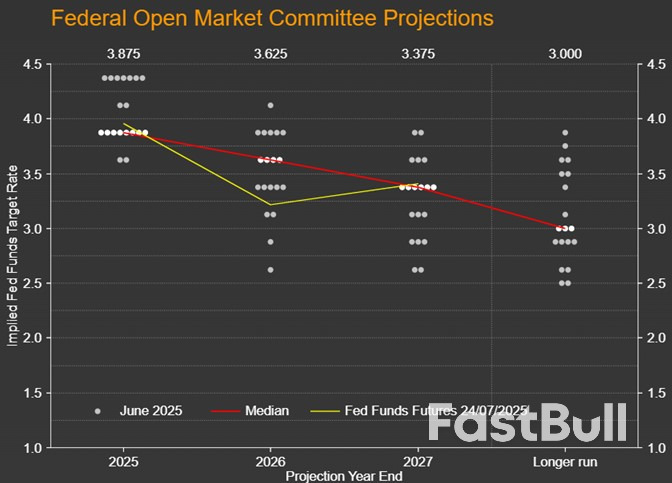
          The latest dot plot and minutes of the June meeting revealed an almost 50-50 split among participants between those that prefer to lower rates sooner rather than later and those that are inclined to remain on pause for the foreseeable future. Not so long ago, there was growing talk that the Fed might surprise with a cut in July, but the subsequent data quashed the speculation.
          Week Ahead – Fed Decides Ahead of NFP, Tariff Deadline as BoC and BoJ Meet Too_1
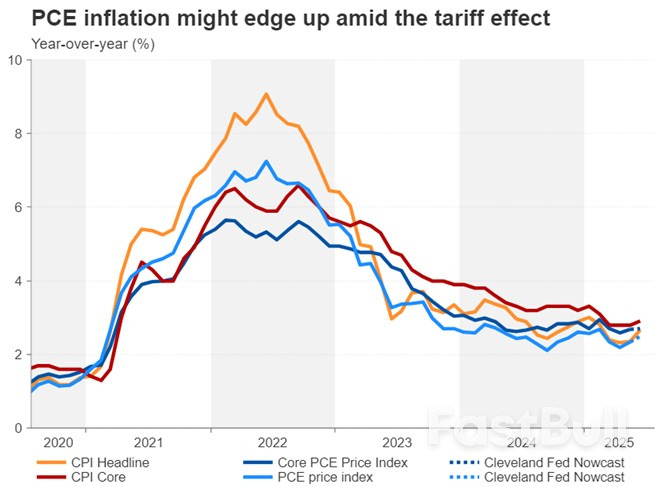
          inflation measures edged up in June and there was a solid increase in . Unfortunately for the Fed, the next NFP report isn’t due until two days after it meets, while the next inflation data – the PCE price indices – will be released the following day. This makes the July gathering a tricky one for Chair Jerome Powell, who faces a daily barrage of insults by Trump.
          But Powell himself had left the door open to a July cut, amid lack of clarity about the strength of the economy and the inflationary effects of Trump’s tariffs, and his instincts may be right. Underneath the hood, the June jobs report wasn’t so strong as there was a notable slowdown in private sector employment. And with the number of trade deals being agreed finally gathering pace, the risk of a sharp jump in average import duties on August 1 has come down substantially.
          Thus, the Fed is on track to resume its easing cycle in September as the majority of policymakers have been predicting. Flagging the likelihood of a rate cut in September while holding them steady for now is probably the best compromise Powell can achieve at this moment in time. This would unlikely be enough to satisfy his critics, but all the indications are that Trump is not currently planning on firing Powell – whether by upping the pressure on him to resign or finding legal grounds to do so such as using the costly renovations of the Fed headquarters building to allege misconduct.

          All Eyes on NFP, PCE and GDP Reports

          On the data front, it’s going to be a jam-packed agenda, as apart from the NFP and PCE inflation figures, there’s also the advance GDP report, as well as a slew of other releases.
          First up on Tuesday are the S&P CoreLogic Case-Shiller 20-City Composite Home Price Index, the for July and the job openings for June. Pending home sales and the ADP employment change will follow on Wednesday, while on Thursday, Challenger Layoffs and the Chicago PMI for July will be the other second-tier releases.
          All those indicators will be watched closely for wider clues on the health of the economy but are unlikely to attract as much attention as the week’s data highlights, the first of which is Wednesday’s advance reading for the second quarter.
          The jump in imports in the first quarter before higher tariffs kicked in was a big drag on GDP, which contracted by 0.5%. It’s expected to have rebounded by 2.5% in the June quarter as most tariffs were put on pause. Still, this data will be seen as somewhat outdated as investors and policymakers are more eager to see where the economy is headed.
          The Fed is worried about how much inflation will rise over the coming months while keeping one eye firmly on the labour market. The June CPI numbers already pointed to some price hikes due to higher tariffs. If Thursday’s PCE inflation readings do the same, particularly core PCE, then the Fed might even forego September, and this is why a 25-bps rate cut at that meeting is only two-thirds priced in.
          Week Ahead – Fed Decides Ahead of NFP, Tariff Deadline as BoC and BoJ Meet Too_2
          The Cleveland Fed’s own Nowcast model isn’t predicting any fireworks, however. The price index is estimated to have stayed unchanged at 2.7% year-on-year in June, but headline PCE is forecast to have picked up to 2.5% from 2.3%.
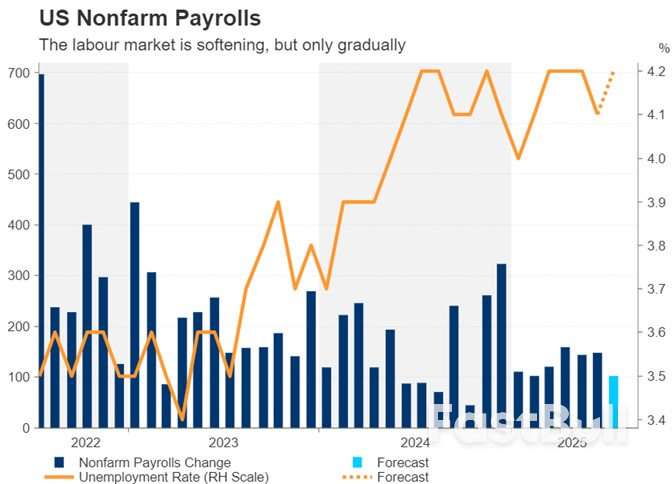
          Potentially even more crucial will be the July payrolls numbers out on Friday. The headline print is expected at 102k, down from 147k in the prior month. The unemployment rate is projected to tick up to 4.2%, and growth in average hourly earnings to accelerate slightly to 0.3% month-on-month.
          Week Ahead – Fed Decides Ahead of NFP, Tariff Deadline as BoC and BoJ Meet Too_3
          Also important on Friday will be the ISM manufacturing PMI, which is expected to improve from 49.0 in June to 49.6 in July.
          Any weakness in the upcoming data would likely boost rate cut bets for September but investors are increasingly sceptical about the possibility of a third reduction in 2025 so the downside risks to the US dollar are somewhat limited.

          Will the BoJ Talk Up Rate Hike Expectations?

          If the greenback does come under greater selling pressure, it’s more likely to be down to the strength of other currencies, such as the yen, which received a leg up from the US-Japan trade agreement.
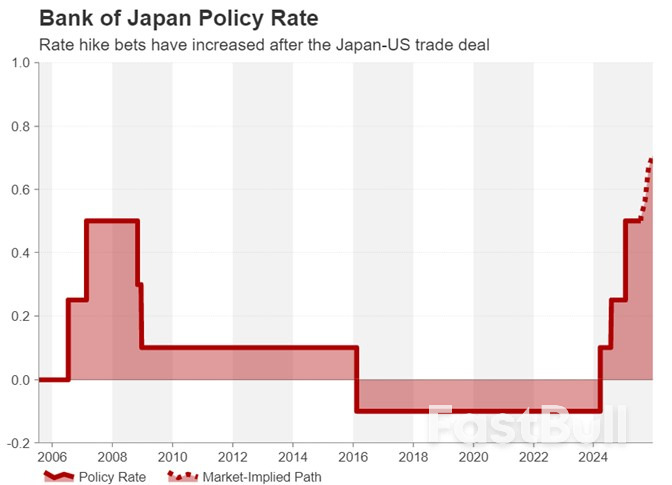
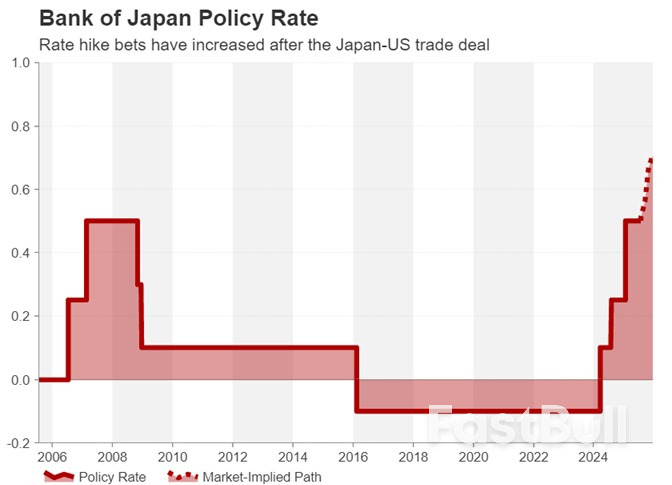
          Whilst there’s a sizable risk that Japan’s economy will take a hit from this new deal, as it still leaves Japanese exporters worse off from where they were before the trade war, the end of the uncertainty does potentially pave the way for the Bank of Japan to restart its tightening campaign. The BoJ last hiked rates in January and following the deal, investors have ratcheted up their bets of another 25-bps increase in the policy rate by year end, helping the yen to recover from near the 150 level against the dollar.
          For the July meeting, which takes place on Wednesday and Thursday, the odds of a policy change are near zero, although the Bank will publish its latest quarterly outlook report. Should policymakers revise up their forecasts for inflation and see reduced risks to growth, rate hike expectations could further intensify, boosting the yen.
          Week Ahead – Fed Decides Ahead of NFP, Tariff Deadline as BoC and BoJ Meet Too_4
          In terms of data, preliminary industrial output for June is out on Thursday, along with retail sales for the same month.

          BoC to Stay on Hold as Canada Hopes to Avert 35% Tariffs

          Before the Fed and Bank of Japan decisions, it will be the Bank of Canada’s turn on Wednesday to set rates. But the meeting could turn out to be a non-event as the BoC is not anticipated to announce any changes, keeping its overnight rate at 2.75%.
          It’s been a tough few months for Canadians, least of all for BoC policymakers who’ve had to worry about both a resurgence in inflation and a recession as the country’s biggest trading partner is threatening tariffs of up to 35%. Although the steeper levy rate won’t apply to goods covered under the USMCA agreement, it could nevertheless cause significant disruption to trade between the two neighbouring countries, potentially pushing the economy into a recession.
          Week Ahead – Fed Decides Ahead of NFP, Tariff Deadline as BoC and BoJ Meet Too_5
          According to the ’s latest outlook survey, businesses are a little less pessimistic than in the prior quarter, as the recent trade deals have boosted hopes that Trump and Prime Minister Mark Carney will be able to reach some kind of an agreement before August 1.
          But with more than 70% of Canada’s exports destined for the United States, it’s probably too soon to rule out a recession. (Thursday’s monthly GDP reading will provide an update for May). At the same time, Canada’s retaliatory tariffs of 25% on certain US goods is pushing up prices domestically. Even before the onset of the trade war, underlying inflation in Canada began to head higher and this limits the scope for rate cuts should the economic picture deteriorate further.
          For now, and in the absence of a trade deal announcement over the next few days, the BoC will likely maintain the same tone as in the June meeting, with the risks to the Canadian dollar being tilted sightly to the downside.

          Eurozone Data May Fail to Excite

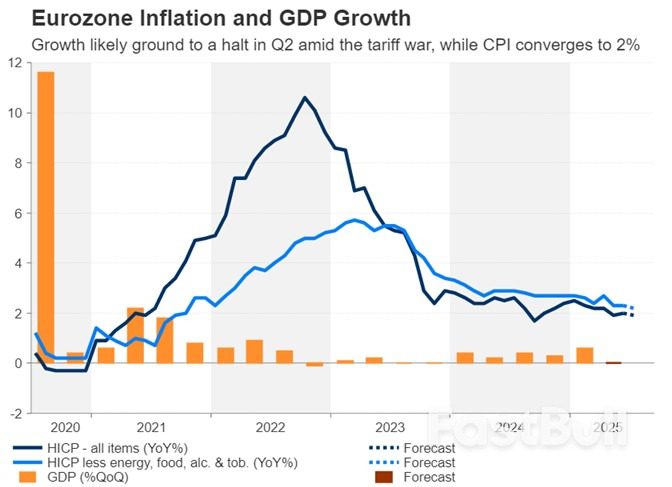
          It’s not just Canada that’s in a rush to reach a trade agreement with the US as the European Union has also not struck a deal yet, although reports suggest that negotiators are closing in on one. The European Central Bank has already done its bit to safeguard the Eurozone economy from the trade war risks and decided to keep rates on hold in July for the first time in eight meetings, having halved the deposit rate to 2.0%.
          Policymakers likely want to retain some firepower in case trade tensions with America escalate again as time is running out before the August 1 deadline. But assuming that a deal is agreed, it could be several months before the ECB cuts again, if at all. Hence, next week’s data may not spur much reaction in the euro.
          The preliminary GDP estimates for the second quarter are due on Wednesday, followed by flash CPI numbers for July on Friday.
          Week Ahead – Fed Decides Ahead of NFP, Tariff Deadline as BoC and BoJ Meet Too_6

          Will Australian CPI Give RBA the Green Nod

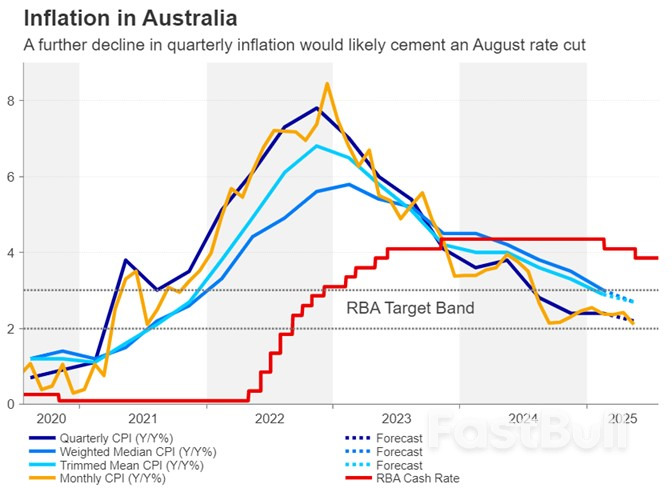
          In Australia, quarterly CPI data could be crucial for the Reserve Bank of Australia’s next policy decision, something that Governor Michelle Bullock had referenced when justifying the surprise hold in July.
          Australia’s statistics office won’t begin publishing a complete monthly CPI dataset until November. Until then, the RBA is putting more weight on the quarterly release than the experimental monthly reads.
          The second quarter figures are due on Wednesday when the RBA will be hoping to see a further moderation in the core CPI measures. As for headline CPI, it dipped to 2.1% in May, but the RBA wants to see a similar decline in the quarterly print before trimming rates again.
          Week Ahead – Fed Decides Ahead of NFP, Tariff Deadline as BoC and BoJ Meet Too_7
          A rate cut at the RBA’s next meeting in August is not fully priced in so the Australian dollar could extend its recent gains if the CPI figures are stronger than expected, further denting easing bets. Meanwhile, traders will also be watching Chinese manufacturing PMI due on Thursday.

          Source:investing

          To stay updated on all economic events of today, please check out our Economic calendar
          Risk Warnings and Disclaimers
          You understand and acknowledge that there is a high degree of risk involved in trading. Following any strategies or investment methods may lead to potential losses. The content on the site is provided by our contributors and analysts for information purposes only. You are solely responsible for determining whether any trading assets, securities, strategy, or any other product is suitable for investing based on your own investment objectives and financial situation.
          Add to Favorites
          Share
          FastBull
          Copyright © 2025 FastBull Ltd

          728 RM B 7/F GEE LOK IND BLDG NO 34 HUNG TO RD KWUN TONG KLN HONG KONG

          TelegramInstagramTwitterfacebooklinkedin
          App Store Google Play Google Play
          Products
          Charts

          Chats

          Q&A with Experts
          Screeners
          Economic Calendar
          Data
          Tools
          Membership
          Features
          Function
          Markets
          Copy Trading
          Latest Signals
          Contests
          News
          Analysis
          24/7
          Columns
          Education
          Company
          Careers
          About Us
          Contact Us
          Advertising
          Help Center
          Feedback
          User Agreement
          Privacy Policy
          Business

          White Label

          Data API

          Web Plug-ins

          Poster Maker

          Affiliate Program

          Risk Disclosure

          The risk of loss in trading financial instruments such as stocks, FX, commodities, futures, bonds, ETFs and crypto can be substantial. You may sustain a total loss of the funds that you deposit with your broker. Therefore, you should carefully consider whether such trading is suitable for you in light of your circumstances and financial resources.

          No decision to invest should be made without thoroughly conducting due diligence by yourself or consulting with your financial advisors. Our web content might not suit you since we don't know your financial conditions and investment needs. Our financial information might have latency or contain inaccuracy, so you should be fully responsible for any of your trading and investment decisions. The company will not be responsible for your capital loss.

          Without getting permission from the website, you are not allowed to copy the website's graphics, texts, or trademarks. Intellectual property rights in the content or data incorporated into this website belong to its providers and exchange merchants.

          Not Logged In

          Log in to access more features

          FastBull Membership

          Not yet

          Purchase

          Become a signal provider
          Help Center
          Customer Service
          Dark Mode
          Price Up/Down Colors

          Log In

          Sign Up
          Position
          Layout
          Fullscreen
          Default to Chart
          The chart page opens by default when you visit fastbull.com