• Trade
  • Markets
  • Copy
  • Contests
  • News
  • 24/7
  • Calendar
  • Q&A
  • Chats
Trending
Screeners
SYMBOL
LAST
BID
ASK
HIGH
LOW
NET CHG.
%CHG.
SPREAD
SPX
S&P 500 Index
6827.42
6827.42
6827.42
6899.86
6801.80
-73.58
-1.07%
--
DJI
Dow Jones Industrial Average
48458.04
48458.04
48458.04
48886.86
48334.10
-245.98
-0.51%
--
IXIC
NASDAQ Composite Index
23195.16
23195.16
23195.16
23554.89
23094.51
-398.69
-1.69%
--
USDX
US Dollar Index
97.990
98.070
97.990
98.020
97.980
+0.040
+ 0.04%
--
EURUSD
Euro / US Dollar
1.17385
1.17396
1.17385
1.17385
1.17285
-0.00009
-0.01%
--
GBPUSD
Pound Sterling / US Dollar
1.33679
1.33696
1.33679
1.33732
1.33580
-0.00028
-0.02%
--
XAUUSD
Gold / US Dollar
4304.24
4304.68
4304.24
4304.65
4294.68
+4.85
+ 0.11%
--
WTI
Light Sweet Crude Oil
57.274
57.311
57.274
57.348
57.194
+0.041
+ 0.07%
--

Community Accounts

Signal Accounts
--
Profit Accounts
--
Loss Accounts
--
View More

Become a signal provider

Sell trading signals to earn additional income

View More

Guide to Copy Trading

Get started with ease and confidence

View More

Signal Accounts for Members

All Signal Accounts

Best Return
  • Best Return
  • Best P/L
  • Best MDD
Past 1W
  • Past 1W
  • Past 1M
  • Past 1Y

All Contests

  • All
  • Trump Updates
  • Recommend
  • Stocks
  • Cryptocurrencies
  • Central Banks
  • Featured News
Top News Only
Share

Nomura CEO: Aim To Develop Japanese Direct Lending Market

Share

Nomura CEO: Aim To Bring Private Debt Know-How From Overseas

Share

HSBC - Scheme Consideration Refers To Proposal For Privatisation Of Hang Seng Bank

Share

[Report: SpaceX Launches Bake-Off Process To Select Underwriters For Potential IPO] According To Sources Familiar With The Matter, SpaceX Executives Have Initiated A Process To Select Wall Street Investment Banks To Advise The Company On Its Initial Public Offering (IPO). Several Investment Banks Are Scheduled To Submit Their First Round Of Proposals This Week, A Process Known As "bake-off," Which Represents The Most Concrete Step The Rocket Maker Has Taken Towards A Potentially "blockbuster IPO," According To The Sources

Share

RBNZ: ASB Has Co-Operated With The Reserve Bank And Has Admitted Liability For All Seven Causes Of Action

Share

RBNZ: Court Proceedings For Breaches Of Core Requirements Under Anti-Money Laundering And Countering Financing Of Terrorism Act From At Least December 2019

Share

Jose Antonio Kast Leads Chile Presidential Election's Runoff Vote With 4.46% Of Ballots Counted: Official Count

Share

Mayor: Russian Air Defence Units Destroy Drone Heading For Moscow

Share

Australia's ASIC - ASIC And Reserve Bank Of Australia Will Step Up Their Review To Uplift Their Joint Supervisory Model

Share

US Envoy Witkoff Says A Lot Of Progress Was Made At Berlin Talks On Russia/Ukraine War

Share

Syria's President Sharaa Sends Condolences To Trump Over Killing Of USA Soldiers In Syria - Syrian Presidency

Share

ECOWAS Commission President: ECOWAS Rejects Guinea-Bissau Junta Transition Plan, Demands Return To Constitutional Order

Share

On Sunday (December 14), The Bangladesh DSE Broad Index Closed Down 0.62% At 4932.97 Points

Share

US President Trump: A New Federal Reserve Chairman Will Be Chosen Soon

Share

US President Trump: Inflation Is “completely Offset” And You Don’t Want To See Deflation

Share

Trump: Will Be A Lot Of Damage Done To The People That Attacked Troops In Syria

Share

Trump: Terrible Attack In Bondi Beach

Share

Interior Ministry - Syria Arrests Five Suspects In Shooting Of USA And Syrian Troops In Palmyra

Share

France Says Conditions For EU Vote On MERCOSUR Deal Not Yet Met, Despite Recent Progress — Prime Minister's Office

Share

CEO: Tokyo Gas To Steer More Than Half Of Overseas Investments To US In Next 3 Years

TIME
ACT
FCST
PREV
U.K. Trade Balance (Oct)

A:--

F: --

P: --

U.K. Services Index MoM

A:--

F: --

P: --

U.K. Construction Output MoM (SA) (Oct)

A:--

F: --

P: --

U.K. Industrial Output YoY (Oct)

A:--

F: --

P: --

U.K. Trade Balance (SA) (Oct)

A:--

F: --

P: --

U.K. Trade Balance EU (SA) (Oct)

A:--

F: --

P: --

U.K. Manufacturing Output YoY (Oct)

A:--

F: --

P: --

U.K. GDP MoM (Oct)

A:--

F: --

P: --

U.K. GDP YoY (SA) (Oct)

A:--

F: --

P: --

U.K. Industrial Output MoM (Oct)

A:--

F: --

P: --

U.K. Construction Output YoY (Oct)

A:--

F: --

P: --

France HICP Final MoM (Nov)

A:--

F: --

P: --

China, Mainland Outstanding Loans Growth YoY (Nov)

A:--

F: --

P: --

China, Mainland M2 Money Supply YoY (Nov)

A:--

F: --

P: --

China, Mainland M0 Money Supply YoY (Nov)

A:--

F: --

P: --

China, Mainland M1 Money Supply YoY (Nov)

A:--

F: --

P: --

India CPI YoY (Nov)

A:--

F: --

P: --

India Deposit Gowth YoY

A:--

F: --

P: --

Brazil Services Growth YoY (Oct)

A:--

F: --

P: --

Mexico Industrial Output YoY (Oct)

A:--

F: --

P: --

Russia Trade Balance (Oct)

A:--

F: --

P: --

Philadelphia Fed President Henry Paulson delivers a speech
Canada Building Permits MoM (SA) (Oct)

A:--

F: --

P: --

Canada Wholesale Sales YoY (Oct)

A:--

F: --

P: --

Canada Wholesale Inventory MoM (Oct)

A:--

F: --

P: --

Canada Wholesale Inventory YoY (Oct)

A:--

F: --

P: --

Canada Wholesale Sales MoM (SA) (Oct)

A:--

F: --

P: --

Germany Current Account (Not SA) (Oct)

A:--

F: --

P: --

U.S. Weekly Total Rig Count

A:--

F: --

P: --

U.S. Weekly Total Oil Rig Count

A:--

F: --

P: --

Japan Tankan Large Non-Manufacturing Diffusion Index (Q4)

--

F: --

P: --

Japan Tankan Small Manufacturing Outlook Index (Q4)

--

F: --

P: --

Japan Tankan Large Non-Manufacturing Outlook Index (Q4)

--

F: --

P: --

Japan Tankan Large Manufacturing Outlook Index (Q4)

--

F: --

P: --

Japan Tankan Small Manufacturing Diffusion Index (Q4)

--

F: --

P: --

Japan Tankan Large Manufacturing Diffusion Index (Q4)

--

F: --

P: --

Japan Tankan Large-Enterprise Capital Expenditure YoY (Q4)

--

F: --

P: --

U.K. Rightmove House Price Index YoY (Dec)

--

F: --

P: --

China, Mainland Industrial Output YoY (YTD) (Nov)

--

F: --

P: --

China, Mainland Urban Area Unemployment Rate (Nov)

--

F: --

P: --

Saudi Arabia CPI YoY (Nov)

--

F: --

P: --

Euro Zone Industrial Output YoY (Oct)

--

F: --

P: --

Euro Zone Industrial Output MoM (Oct)

--

F: --

P: --

Canada Existing Home Sales MoM (Nov)

--

F: --

P: --

Euro Zone Total Reserve Assets (Nov)

--

F: --

P: --

U.K. Inflation Rate Expectations

--

F: --

P: --

Canada National Economic Confidence Index

--

F: --

P: --

Canada New Housing Starts (Nov)

--

F: --

P: --

U.S. NY Fed Manufacturing Employment Index (Dec)

--

F: --

P: --

U.S. NY Fed Manufacturing Index (Dec)

--

F: --

P: --

Canada Core CPI YoY (Nov)

--

F: --

P: --

Canada Manufacturing Unfilled Orders MoM (Oct)

--

F: --

P: --

Canada Manufacturing New Orders MoM (Oct)

--

F: --

P: --

Canada Core CPI MoM (Nov)

--

F: --

P: --

Canada Manufacturing Inventory MoM (Oct)

--

F: --

P: --

Canada CPI YoY (Nov)

--

F: --

P: --

Canada CPI MoM (Nov)

--

F: --

P: --

Canada CPI YoY (SA) (Nov)

--

F: --

P: --

Canada Core CPI MoM (SA) (Nov)

--

F: --

P: --

Canada CPI MoM (SA) (Nov)

--

F: --

P: --

Q&A with Experts
    • All
    • Chatrooms
    • Groups
    • Friends
    Connecting
    .
    .
    .
    Type here...
    Add Symbol or Code

      No matching data

      All
      Trump Updates
      Recommend
      Stocks
      Cryptocurrencies
      Central Banks
      Featured News
      • All
      • Russia-Ukraine Conflict
      • Middle East Flashpoint
      • All
      • Russia-Ukraine Conflict
      • Middle East Flashpoint
      Search
      Products

      Charts Free Forever

      Chats Q&A with Experts
      Screeners Economic Calendar Data Tools
      Membership Features
      Data Warehouse Market Trends Institutional Data Policy Rates Macro

      Market Trends

      Market Sentiment Order Book Forex Correlations

      Top Indicators

      Charts Free Forever
      Markets

      News

      News Analysis 24/7 Columns Education
      From Institutions From Analysts
      Topics Columnists

      Latest Views

      Latest Views

      Trending Topics

      Top Columnists

      Latest Update

      Signals

      Copy Rankings Latest Signals Become a signal provider AI Rating
      Contests
      Brokers

      Overview Brokers Assessment Rankings Regulators News Claims
      Broker listing Forex Brokers Comparison Tool Live Spread Comparison Scam
      Q&A Complaint Scam Alert Videos Tips to Detect Scam
      More

      Business
      Events
      Careers About Us Advertising Help Center

      White Label

      Data API

      Web Plug-ins

      Affiliate Program

      Awards Institution Evaluation IB Seminar Salon Event Exhibition
      Vietnam Thailand Singapore Dubai
      Fans Party Investment Sharing Session
      FastBull Summit BrokersView Expo
      Recent Searches
        Top Searches
          Markets
          News
          Analysis
          User
          24/7
          Economic Calendar
          Education
          Data
          • Names
          • Latest
          • Prev

          View All

          No data

          Scan to Download

          Faster Charts, Chat Faster!

          Download App
          English
          • English
          • Español
          • العربية
          • Bahasa Indonesia
          • Bahasa Melayu
          • Tiếng Việt
          • ภาษาไทย
          • Français
          • Italiano
          • Türkçe
          • Русский язык
          • 简中
          • 繁中
          Open Account
          Search
          Products
          Charts Free Forever
          Markets
          News
          Signals

          Copy Rankings Latest Signals Become a signal provider AI Rating
          Contests
          Brokers

          Overview Brokers Assessment Rankings Regulators News Claims
          Broker listing Forex Brokers Comparison Tool Live Spread Comparison Scam
          Q&A Complaint Scam Alert Videos Tips to Detect Scam
          More

          Business
          Events
          Careers About Us Advertising Help Center

          White Label

          Data API

          Web Plug-ins

          Affiliate Program

          Awards Institution Evaluation IB Seminar Salon Event Exhibition
          Vietnam Thailand Singapore Dubai
          Fans Party Investment Sharing Session
          FastBull Summit BrokersView Expo

          US JOLTs Job Openings Surge, Beating Both Forecast And Previous Numbers

          Glendon

          Economic

          Forex

          Summary:

          The US Bureau of Labor Statistics has released its latest JOLTs Job Openings data, revealing an increase in job vacancies across...

          The US Bureau of Labor Statistics has released its latest JOLTs Job Openings data, revealing an increase in job vacancies across the country. The actual number of job openings, as defined by JOLTs, reached 7.391 million, surpassing both forecasted and previous numbers.

          The reported number of 7.391 million job openings significantly outpaced the forecasted figure of 7.110 million. This substantial increase indicates a stronger job market than initially anticipated, suggesting a robust demand for labor and a vigorous US economy.

          In comparison to the previous figure of 7.200 million, the actual number also marked an impressive rise. This upward trajectory in job openings signifies an expanding labor market, offering more employment opportunities for job seekers.

          The JOLTs survey is a crucial indicator of the health of the US job market, measuring job vacancies and collecting data on employment, recruitment, hires, and separations from employers. A job is considered "open" according to JOLTs if a specific position exists, can start within 30 days, and there is active recruitment for workers from outside the establishment location.

          The stronger than forecast reading of the JOLTs job openings is generally supportive for the USD, making it bullish. A robust job market often leads to increased consumer spending, which in turn, can boost the economy and strengthen the currency.

          In contrast, a weaker than forecast reading could have been negative or bearish for the USD, indicating a sluggish job market and potentially dampening consumer spending and economic growth.

          The latest JOLTs data, therefore, provides a positive outlook for the US economy and the USD, reflecting a robust labor market with increasing job opportunities. The continued growth in job openings could further bolster consumer spending and economic growth, strengthening the USD in the process.
          Source: Investing

          To stay updated on all economic events of today, please check out our Economic calendar
          Risk Warnings and Disclaimers
          You understand and acknowledge that there is a high degree of risk involved in trading. Following any strategies or investment methods may lead to potential losses. The content on the site is provided by our contributors and analysts for information purposes only. You are solely responsible for determining whether any trading assets, securities, strategy, or any other product is suitable for investing based on your own investment objectives and financial situation.
          Add to Favorites
          Share

          FX options market positioned for further dollar weakness

          Adam

          Forex

          Economic

          The U.S. dollar has steadied after a sharp tumble this year but traders in the foreign exchange options market are positioned for the U.S. currency to weaken further amid growing concern about the U.S. economy and persistent trade-related tensions.
          Investors started the year expecting the Trump administration's policies to boost the dollar, helped by his tax cuts and safe haven demand stemming from protectionist policies.
          But that view quickly soured when U.S. President Donald Trump unveiled levies in April that were larger and broader than anticipated, spiking volatility and sending the dollar to a three-year low.
          While a temporary pause in some of the reciprocal tariffs has helped calm nerves, the options market still paints a dour outlook for the dollar.
          The options market can offer a view on how investors and traders expect currencies to fare months down the line.
          "FX option prices in general continue to point to a greater risk of further dollar weakening," said Tim Brooks, head of FX options at Optiver. "From our perspective there is no clear single large position, but relative to the past 5-10 years, we see unprecedented demand from investors to own USD puts in comparison with at-the-money options or USD calls."
          Put options confer the right to sell the underlying security at a fixed price and date and are typically bought to express a bearish view. Their bullish counterpart is the call option, which grants the right to buy at a set price and known time frame.
          Because the foreign exchange market quotes currencies in pairs like dollars per euro , and yen per dollar , a bullish position on the euro indicates a bearish view on the dollar.
          FX risk reversals, a type of options strategy that involves the simultaneous purchase of a put option and sale of a call, or vice versa, are useful indicators of which currency is seeing more demand. Pricing on several of these currency pairs remains near multi-year highs despite the pause in the dollar's slide this year, highlighting the market's bearish stance on the buck.
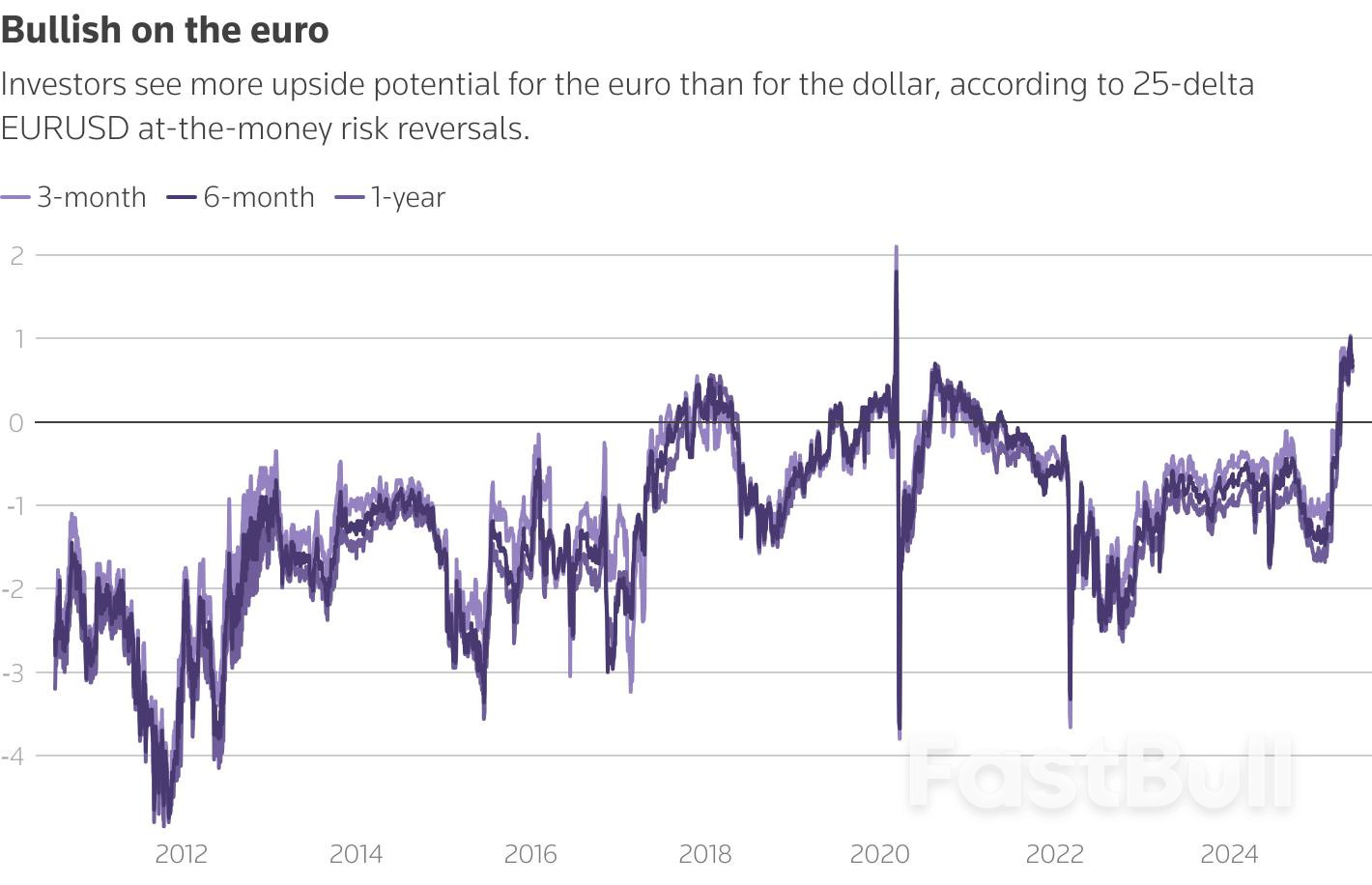
          According to LSEG data, the three-month , six-month , and one-year 25-delta EURUSD at-the-money risk reversal measures just edged off their highest level of bullishness for the euro against the dollar on records dating to 2007, apart from a brief interlude during the 2020 pandemic's market disruption.
          FX options market positioned for further dollar weakness_1

          Lin chart showing Investors see more upside potential for the euro than for the dollar, according to 25-delta EURUSD at-the-money risk reversals.

          "Positioning remains extremely bearish on the dollar," Karl Schamotta, chief market strategist at Corpay, said.
          "Pricing increases across the curve, with one-year risk reversals trading well above their shorter-term equivalents, suggest that options market participants expect the euro to continue its gradual grind higher," he said. The euro is up nearly 10% against the dollar this year.

          DOLLAR BEARS AT PLAY

          Other popular bets being placed are for the dollar to fall against the yen, Sagar Sambrani, senior FX options trader at Nomura, said.
          Investors are building up positions in dollar puts, trades to sell the U.S. currency particularly against currencies like the euro and sterling, suggesting they remain convinced the greenback has more losses in store.
          CME Group's options data show USD puts have drawn strong demand, both in aggregate and against most major currencies. In May, USD puts made up just over 59% of traded FX options volume, said Chris Povey, head of FX options at CME Group.
          Demand for dollar puts over calls was especially apparent in the yen and the Australian dollar, Povey said, making up more than 65% of the options volume in those pairs.
          Options data hint at expectations that the pace of decline in the dollar from here may be more measured relative to the sharp drop seen since the start of the year.
          The dollar is down about 9% against the euro, and the yen, respectively, for the year. The euro was last at $1.1443, and the dollar was trading at 142.70 yen.
          "Traders think spot market momentum will fade in the short term, but are betting on a gradual narrowing in relative growth differentials between the advanced economies by the autumn, along with a slow-motion diversification push over the next year, with major investors reallocating resources toward structurally undervalued markets outside the United States," Corpay's Schamotta said.

          CONTRARIANS BEWARE

          Investor confidence in the U.S. economy outperforming the rest of the world has taken a knock in recent months. Worries about rising U.S. debt and a widening budget deficit have also come to the fore, bolstering investors' desire to lighten up on U.S. assets.
          "I don't think we have the conviction to fight this consensus," Jayati Bharadwaj, a global FX strategist at TD Securities.
          "The new announcements that we have seen since the start of the year ... after a long time there are fundamental reasons to be bearish on the dollar," she said.
          With trade policy in flux, the dollar could well experience modest relief rallies. It also has the great advantage of being the No. 1 central bank reserve currency, backed by the world's safest and most liquid government debt market, with higher interest rates than rival developed-economy currencies. But on balance, the path of least resistance for the dollar is lower, strategists and investors said.
          "We've seen a significant amount of buying of dollar puts coming from a number of different types of clients," said an FX options trader at a large U.S. bank, who did not want to be named because of the private nature of these trades.
          "We still want to have exposure to dollar weakness, because that's the trade that when you add up all the things that are going on in the world probably makes the most sense," the trader said.

          source : reuters

          To stay updated on all economic events of today, please check out our Economic calendar
          Risk Warnings and Disclaimers
          You understand and acknowledge that there is a high degree of risk involved in trading. Following any strategies or investment methods may lead to potential losses. The content on the site is provided by our contributors and analysts for information purposes only. You are solely responsible for determining whether any trading assets, securities, strategy, or any other product is suitable for investing based on your own investment objectives and financial situation.
          Add to Favorites
          Share

          Trump's "Revenge Tax" a Major Dollar Headwind

          Warren Takunda

          Economic

          A "revenge tax" provision in Section 899 of the "One Big Beautiful Bill Act" is the latest headache facing global investors and the U.S. Dollar.
          It would authorise the U.S. Treasury to impose up to a 20% tax on passive income - such as dividends, interest, and royalties - earned by foreign investors from countries identified as having "discriminatory" tax regimes against U.S. firms.
          The tax is expected by analysts to accelerate the diversification of investment allocations away from the U.S., potentially exacerbating USD weakness.
          "The White House provides many other reasons for the U.S. dollar to weaken, such as the risk of imminent taxes on U.S. investments and the generally erratic policies that make investing difficult," says Michael Pfister, FX strategist at Commerzbank.
          Currency analysts argue that because the U.S. runs a significant trade deficit, it must continue to attract foreign investment in order to maintain the Dollar's value.
          This tax proposal would obviously jeopardise foreign demand."The damage to the USD has been done and the funding of the dollar's two big holes - the budget and the current account - is now emerging as a market driver," says George Saravelos, head of FX analysis at Deutsche Bank.
          Trump's "Revenge Tax" a Major Dollar Headwind_1

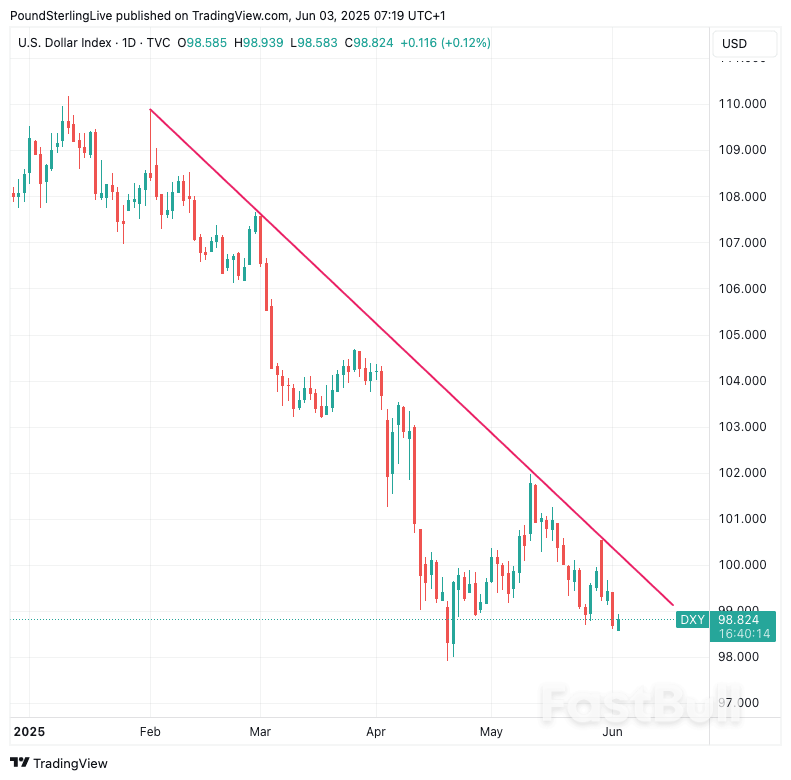
          Above: The Dollar index, a measure of broader USD performance.

          "The U.S. in a precarious position to fund its deficits, which relies on the kindness of strangers," says Mark McCormick, analyst at TD Securities.
          The ambiguity surrounding the scope of Section 899, particularly whether it applies to holdings like U.S. Treasury bonds, has unsettled financial markets. Analysts warn that taxing foreign-held U.S. Treasuries could diminish demand.
          "A sharp slowdown in US inflows appears to be materialising," says Saravelos.
          The post-WWII order allowed the U.S. government "to sell a slew of Treasury bonds to foreign investors, and the dollar to assume the position of dominant currency," explains Goldman Sachs. But, "re-making that order has the potential to erode these advantages."
          Trump's "Revenge Tax" a Major Dollar Headwind_2

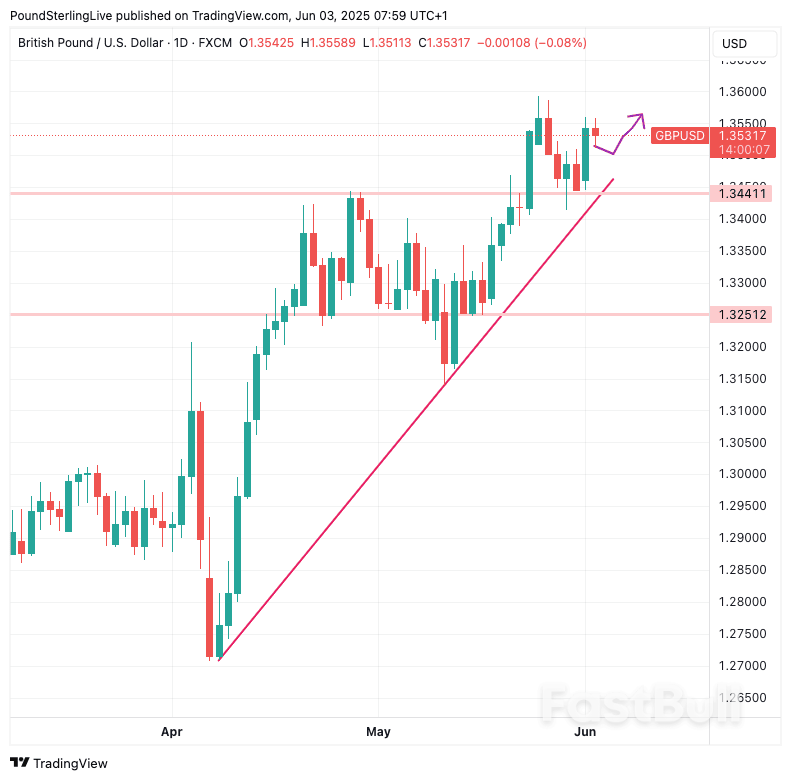
          Above: GBP/USD at daily intervals, with the annotations made in our latest Week Ahead Forecast.

          The Dollar reached its highest levels since 2002 in 2024 as foreign investors sucked up U.S. bonds, stocks and other assets as the economy's strong growth promised outsized returns.
          Although 2024 represented a peak, the U.S. exceptionalism trade started to build momentum in the mid-2010s as the U.S. economy refashioned itself following 2008's financial crisis, testament to its unrelenting dynamism.
          The foreign investor tax adds to a growing list of concerns that end the exceptionalism trade, with tariffs being the chief focus up until now.
          "We expect President Trump’s erratic policymaking is set to increase the number of 'Sell America' days," wrote Mansoor Mohi-uddin, Chief Economist at the Bank of Singapore. "That keeps us cautious on long-term Treasuries and the U.S. dollar."
          Trump's "Revenge Tax" a Major Dollar Headwind_3

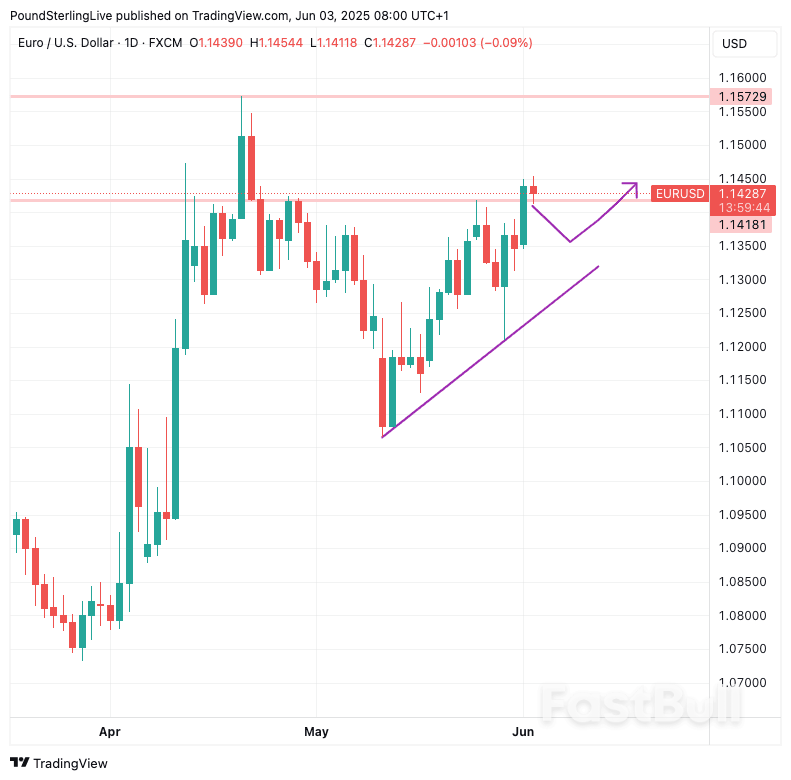
          Above: EUR/USD at daily intervals with the annotations made in our latest Euro-Dollar Week Ahead Forecast call.

          An extension of the 2017 Tax Cuts and Jobs Act (TCJA) - a key component of the One Big Beautiful Bill Act - will cost $3.3 trillion over the next decade and $5.2 trillion if the package is made permanent, according to the Committee for a Responsible Federal Budget.
          "The impact is also less sudden and dramatic, leaving more scope for this to play out over a longer period of time. The fiscal largesse points to upside risks to US long-term interest rates, which could eventually prove to be a headwind for both the economy and financial markets," says Rogier Quaedvlieg, an economist at ABN AMRO Bank N.V.
          The One Big Beautiful Bill Act is expected to be signed into law by the President on July 04.

          Source: Poundsterlinglive

          To stay updated on all economic events of today, please check out our Economic calendar
          Risk Warnings and Disclaimers
          You understand and acknowledge that there is a high degree of risk involved in trading. Following any strategies or investment methods may lead to potential losses. The content on the site is provided by our contributors and analysts for information purposes only. You are solely responsible for determining whether any trading assets, securities, strategy, or any other product is suitable for investing based on your own investment objectives and financial situation.
          Add to Favorites
          Share

          Euro Slips on Softer CPI, But Trading Largely Listless

          Michelle

          Economic

          Forex

          The currency markets remain largely listless today, with all major pairs and crosses still trapped within last week’s ranges. Euro edged slightly lower following the release of Eurozone CPI data, which showed inflation falling below the ECB’s 2% target for the first time since September last year. The core measure also softened notably, reinforcing the view that disinflationary pressures—particularly within services—are well entrenched. With inflation now comfortably back within target, markets have little doubt that ECB will proceed with a 25bps rate cut this Thursday.

          Uncertainty over tariffs continues to hover as a key wildcard. With little clarity on whether the US will escalate its trade actions further, markets are reluctant to commit. A July pause from ECB remains the base case, but further action could hinge on whether tariffs ultimately push inflation up through cost channels—or suppress demand and contribute to disinflation. This dilemma is front and center as policymakers navigate crosscurrents in growth and prices.

          Adding to the cautious mood, the OECD revised its global growth forecasts downward. It now sees world GDP expanding just 2.9% in both 2025 and 2026, citing increased trade barriers and lingering policy uncertainty as key drags. OECD Secretary General Mathias Cormann warned that a further 10 percentage point hike in US bilateral tariffs could shave 0.3% off global output over two years, while likely adding to inflation in affected countries.

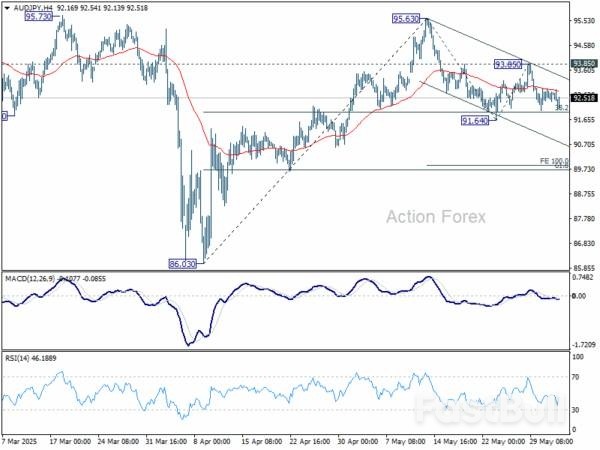
          Technically, AUD/JPY continues to press 38.2% retracement of 86.03 to 95.63 at 91.96. Firm break of this fibonacci level will extend the correction from 95.63 to 100% projection of 95.63 to 91.64 from 93.85 at 89.86. Nevertheless, strong bounce from current level, followed by break of 93.85 resistance, will argue that rise from 86.03 is ready to resume through 95.63.
          In Europe, at the time of writing, FTSE is up 0.17%. DAX is up 0.16%. CAC is down -0.15%. UK 10-year yield is down -0.038 at 4.632. Germany 10-year yield is down -0.019 at 2.51. Earlier in Asia, Nikkei fell -0.06%. Hong Kong HSI rose 1.53%. China Shanghai SSE rose 0.43%. Singapore Strait times rose 0.10%. Japan 10-year JGB yield fell -0.27 to 1.482.

          BoE’s Bailey: Rate path still downward, but clouded by unpredictability

          BoE Governor Andrew Bailey told the Treasury Committee today that while the direction for interest rates remains downward, the outlook has become increasingly uncertain.

          Declining to pre-commit to a vote at the upcoming June meeting, Bailey said, “the path remains downwards, but how far and how quickly is now shrouded in a lot more uncertainty.”

          He emphasized the role of external forces, noting that the Bank has revised its language to reflect the “unpredictable” nature of the current global environment.

          His comments were echoed by fellow policymakers Catherine Mann and Sarah Breeden, who both acknowledged that rates are likely headed lower but stressed the difficulty in forecasting the exact pace or scale of future cuts.

          Mann warned against assuming a fixed glide path, while Breeden said “there is uncertainty about how far, how fast.”

          Eurozone CPI falls to 1.9%, below ECB target for first time since Sep 2024

          Eurozone inflation dipped back below the ECB’s 2% target for the first time since September 2024. Headline CPI fell from 2.2% yoy to 1.9% yoy in May, undershooting expectations of 2.0%. Core CPI (ex-energy, food, alcohol & tobacco) also eased more than forecast to 2.3% from 2.7%.

          The disinflation was led by a sharp slowdown in services inflation, which dropped from 4.0% yoy to 3.2% yoy. Non-energy industrial goods remained unchanged at 0.6% yoy. Energy prices continued to contract at -3.6% yoy, reinforcing the broader downward pressure. Despite a slight uptick in food and alcohol inflation to 3.3% yoy, the overall picture confirms easing price momentum across key sectors.

          Swiss CPI falls to -0.1% yoy, first negative since 2021

          Swiss consumer inflation turned negative in May for the first time since March 2021, with headline CPI falling -0.1% yoy, down from 0.0% in April yoy. Core inflation, which strips out volatile components such as fresh food and energy, slipped to 0.5% yoy from 0.6% yoy previously.

          On a monthly basis, both headline and core CPI rose 0.1%, in line with expectations.

          The breakdown reveals that domestic product prices grew just 0.2% mom and decelerated to from 0.8% yoy to 0.6% yoy. Imported goods prices were flat on the month and fell -2.4% yoy, ticked up from -2.5% yoy.

          BoJ’s Ueda: Ready to hike if wage growth recovers from tariff drag

          BoJ Governor Kazuo Ueda told parliament today that recently imposed U.S. tariffs could weigh on Japanese corporate sentiment, potentially impacting winter bonus payments and next year’s wage negotiations.

          He acknowledged that wage growth may “slow somewhat” in the near term due to these external pressures. However, Ueda expressed confidence that wage momentum would eventually “re-accelerate”, helping to sustain a moderate growth in household consumption.

          Looking ahead, Ueda reiterated the BoJ’s readiness to adjust its ultra-loose policy if the economy evolves in line with its projections. “If we’re convinced our forecast will materialize, we will adjust the degree of monetary support by raising interest rates,” he said.

          However, he cautioned that uncertainty surrounding the economic outlook remains “extremely high.”

          RBA’s Hunter: AUD’s recent resilience linked to global shift away from USD exposure

          RBA Chief Economist Sarah Hunter addressed the unusual behavior of the Australian Dollar in recent months in a speech today. She highlighted that while initial moves were consistent with past risk-off episodes, the currency’s subsequent rebound against the US Dollar stood out as “more unusual”.

          On a “trade-weighted” basis, AUD has remained broadly stable, even though it has appreciated against the greenback and the Chinese renminbi, while weakening against most other major currencies.

          This divergence, Hunter explained, stems from “offsetting factors”. Global growth concerns have pressured the AUD against safe-haven and cyclical peers, while simultaneous outflows from US assets have weakened the US Dollar.

          Hunter cautioned that it’s too soon to tell whether this trend will persist, but acknowledged that recent market behavior reflects shifting investor sentiment, particularly toward capital reallocation away from US assets. As a result, Australian Dollar’s relative resilience against USD may be underpinned by portfolio rebalancing and perceived relative economic stability.

          Hunter noted that the trade-weighted index has reverted to “pre-shock values”, suggesting minimal net change in the foreign-currency value of Australian exports. However, the “relative move of capital” into Australia, at a time when the US is facing policy and tariff-related volatility, could offer some support to “domestic investment activity”, providing a cushion to the broader economy amid global uncertainties.

          RBA Minutes: 25bps cut chosen for caution and predictability after debating hold and 50bps options

          RBA’s May 20 meeting minutes revealed that policymakers weighed three policy options—holding rates, a 25bps cut, or a larger 50bps reduction—before ultimately opting for a modest 25bps cut to 3.85%.

          The case for easing hinged on three key factors: sustained progress in bringing inflation back toward target without upside surprises, weakening global conditions and household consumption, and the view that a cut would be the “path of least regret” given the risk distribution.

          While members discussed a 50bps reduction after deciding to ease, they found the case for a larger move unconvincing. Australian data at the time showed little evidence that trade-related global uncertainty was materially harming domestic activity. Furthermore, some scenarios might even result in upward pressure on inflation, prompting caution. The Board also assessed that it was “not yet time to move monetary policy to an expansionary stance”.

          Ultimately, the Board judged that to move “cautiously and predictably” was more appropriate.

          Caixin PMI manufacturing drops to 48.3, as China faces marked weakening at start of Q2

          China’s manufacturing sector unexpectedly shrank in May, with Caixin PMI falling to 48.3 from 50.4, well below market expectations of 50.6. This marked the first contraction in eight months and the lowest reading since September 2022.

          According to Caixin Insight’s Wang Zhe, both supply and demand weakened, with a particularly notable drag from overseas demand. Employment continued to contract, pricing pressures remained subdued, and logistics saw moderate delays. Although business optimism saw a marginal recovery, the broader picture points to intensifying headwinds.

          The report highlights the fragile start to Q2, with Wang pointing to a “marked weakening” in key economic indicators and a “significantly intensified” level of downward pressure.

          EUR/USD Mid-Day Outlook

          Daily Pivots: (S1) 1.1377; (P) 1.1413; (R1) 1.1480; More…

          Intraday bias in EUR/USD is turned neutral with current retreat. Rebound from 1.1064 could extend higher, but strong resistance should be seen from 1.1572 to limit upside, at least on first attempt. On the downside, break of 1.1209 support will indicate that the corrective pattern from 1.1572 has started the third leg, and target 1.1064 support.
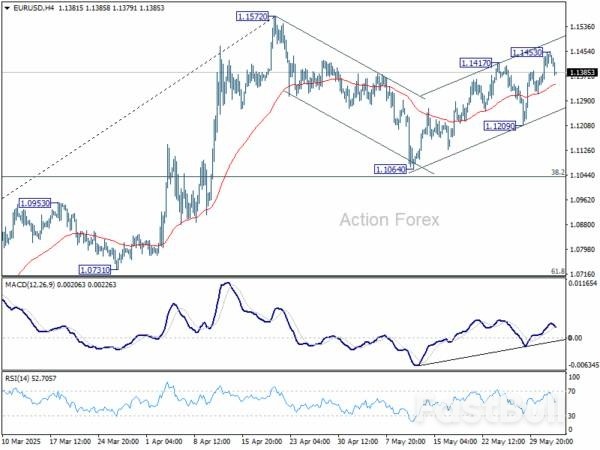
          In the bigger picture, rise from 0.9534 long term bottom could be correcting the multi-decade downtrend or the start of a long term up trend. In either case, further rise should be seen to 100% projection of 0.9534 to 1.1274 from 1.0176 at 1.1916. This will now remain the favored case as long as 55 W EMA (now at 1.0856) holds.
          Source: ACTIONFOREX

          To stay updated on all economic events of today, please check out our Economic calendar
          Risk Warnings and Disclaimers
          You understand and acknowledge that there is a high degree of risk involved in trading. Following any strategies or investment methods may lead to potential losses. The content on the site is provided by our contributors and analysts for information purposes only. You are solely responsible for determining whether any trading assets, securities, strategy, or any other product is suitable for investing based on your own investment objectives and financial situation.
          Add to Favorites
          Share

          Oil News: Crude Oil Futures Hold Above 50-Day Average as Bullish Outlook Builds

          Adam

          Commodity

          Crude Oil Holds Above Key Support as Geopolitical Risk and Weaker Dollar Lend Strength

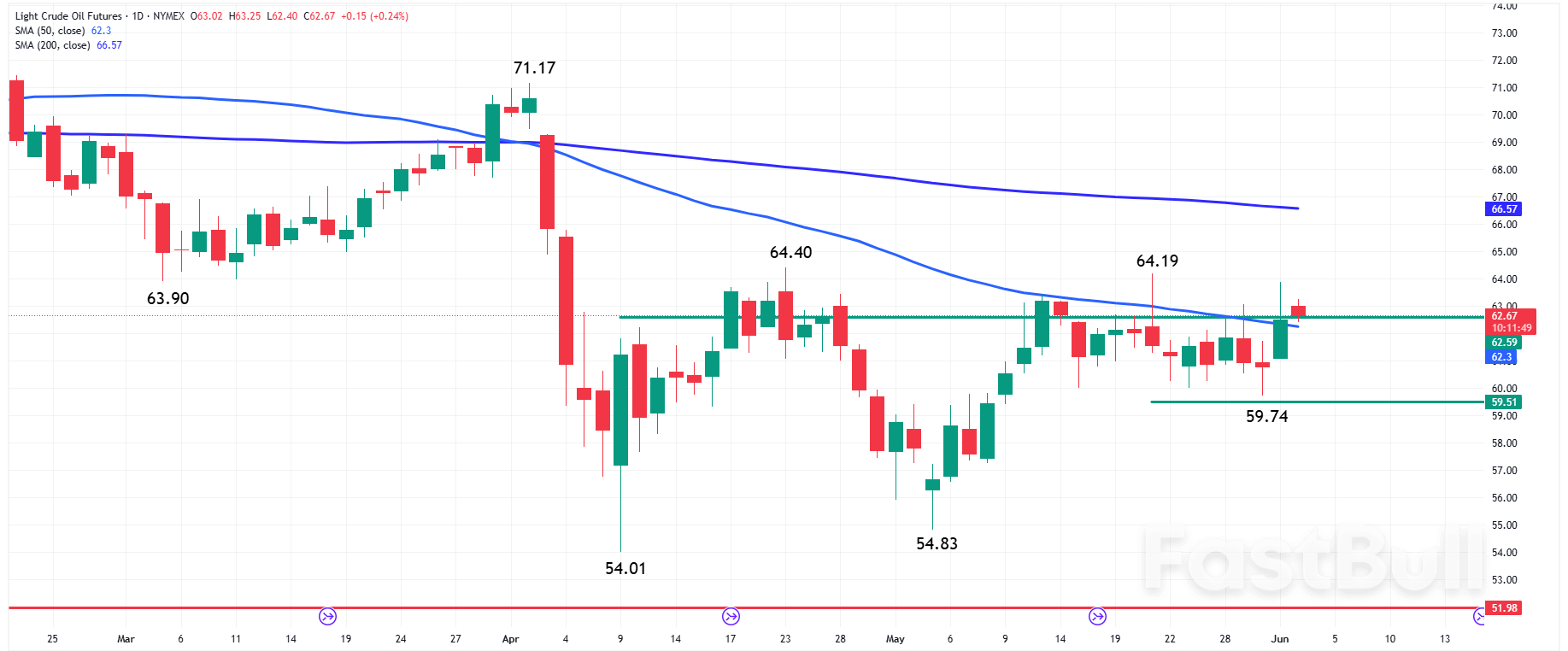
          Light crude oil futures ticked higher in early Tuesday trade, stabilizing above their 50-day moving average after a strong start to the week. Monday’s rally saw prices spike nearly 3% before easing off highs at $63.88, falling just short of recent resistance levels. The market’s ability to stay above its 50-day average remains a key technical marker, with traders eyeing the 200-day moving average at $66.57 as the next upside target.

          OPEC+ Production Steady, Market Reacts Favorably

          Oil’s early-week strength was largely driven by OPEC+ holding firm on its output hike of 411,000 barrels per day for July. This decision came as a relief to traders who had braced for a potentially larger increase. With supply additions remaining limited, traders perceived the group’s stance as supportive for prices in the near term.

          Russia-Ukraine Escalation and Iran Talks Cloud Supply Outlook

          Geopolitical concerns are once again playing into oil markets. Over the weekend, Ukraine launched one of its largest drone offensives on Russian targets, including a strike on a key highway bridge and bombers deep inside Siberia. These developments have revived risk premiums across energy markets.
          At the same time, Iran is expected to reject a U.S. nuclear deal proposal, which would likely extend sanctions on Iranian oil exports. As one Iranian diplomat stated, the offer fails to meet Tehran’s demands regarding uranium enrichment and sanctions relief. Traders now see limited risk of near-term increases in Iranian crude supply, tightening global balances further.

          U.S. Dollar Weakness Adds Tailwind to Crude Oil Prices

          A weaker U.S. dollar is also lending support to crude prices. The dollar index is trading near six-week lows as investors assess the potential economic fallout from the Trump administration’s tariff policy. For oil traders, a softer dollar makes crude more affordable for foreign buyers, boosting demand.

          Canadian Wildfires Add to Supply Pressures

          In North America, wildfires in Alberta have disrupted roughly 344,000 barrels per day of oil sands output—roughly 7% of Canada’s total crude production. This unplanned supply loss is yet another bullish factor for prices, especially if U.S. crude inventory data later this week shows a drawdown.

          Oil Prices Forecast: Bullish Near-Term Outlook Holds

          Oil News: Crude Oil Futures Hold Above 50-Day Average as Bullish Outlook Builds_1Daily Light Crude Oil Futures

          With geopolitical tensions high, OPEC+ maintaining moderate output increases, and the dollar under pressure, the bullish case for oil remains intact. As long as light crude holds above its 50-day moving average, traders will likely test higher levels, with the 200-day average at $66.57 now in sight.

          Source: fxempire

          Risk Warnings and Disclaimers
          You understand and acknowledge that there is a high degree of risk involved in trading. Following any strategies or investment methods may lead to potential losses. The content on the site is provided by our contributors and analysts for information purposes only. You are solely responsible for determining whether any trading assets, securities, strategy, or any other product is suitable for investing based on your own investment objectives and financial situation.
          Add to Favorites
          Share

          US Growth Likely to Slow to 1.6% This Year, Hobbled by Trump’s Trade Wars, OECD Says

          Warren Takunda

          Economic

          China–U.S. Trade War

          U.S. economic growth will slow to 1.6% this year from 2.8% last year as President Donald Trump’s erratic trade wars disrupt global commerce, drive up costs and leave businesses and consumers paralyzed by uncertainty.
          The Organization for Economic Cooperation and Development forecast Tuesday that the U.S. economy — the world’s largest — will slow further to just 1.5% in 2026. Trump’s policies have raised average U.S. tariff rates from around 2.5% when he returned to the White House to 15.4%, highest since 1938, according to the OECD. Tariffs raise costs for consumers and American manufacturers that rely on imported raw materials and components.
          World economic growth will slow to just 2.9% this year and stay there in 2026, according to the OECD’s forecast. It marks a substantial deceleration from growth of 3.3% global growth last year and 3.4% in 2023.
          The world economy has proven remarkably resilient in recent years, continuing to expand steadily — though unspectacularly — in the face of global shocks such as the COVID-19 pandemic and Russia’s invasion of Ukraine.
          But global trade and the economic outlook have been clouded by Trump’s sweeping taxes on imports, the unpredictable way he’s rolled them out and the threat of retaliation from other countries.
          Reversing decades of U.S. policy in favor of freer world trade, Trump has levied 10% taxes — tariffs — on imports from almost every country on earth along with specific duties on steel, aluminum and autos. He’s also threatened more import taxes, including a doubling of his tariffs on steel and aluminum to 50%.
          Without mentioning Trump by name, OECD chief economist Álvaro Pereira wrote in a commentary that accompanied the forecast that “we have seen a significant increase in trade barriers as well as in economic and trade policy uncertainty. This sharp rise in uncertainty has negatively impacted business and consumer confidence and is set to hold back trade and investment.’'
          Adding to the uncertainty over Trump’s trade wars: A federal court in New York last week blocked most of Trump’s tariffs, ruling that he’d overstepped his authority in imposing them. Then an appeals court allowed the Trump administration to continue collecting the taxes while appeals worked their way through the U.S. courts.
          China — the world’s second-biggest economy — is forecast to see growth decelerate from 5% last year to 4.7% in 2025 and 4.3% in 2026. Chinese exporters will be hurt by Trump’s tariffs, hobbling an economy already weakened by the collapse of the nation’s real estate market. Some of the damage will be offset by help from the government: Beijing last month outlined plans to cut interest rates and encourage bank lending as well as allocating more money for factory upgrades and elder care, among other things.
          The 20 countries that share the euro currency will collectively see economic growth pick up from 0.8% last year to 1% in 2025 and 1.2% next year, the OECD said, helped by interest rate cuts from the European Central Bank.
          The Paris-based OECD, comprising 38 member countries, works to promote international trade and prosperity and issues periodic reports and analyses.

          Source: AP

          To stay updated on all economic events of today, please check out our Economic calendar
          Risk Warnings and Disclaimers
          You understand and acknowledge that there is a high degree of risk involved in trading. Following any strategies or investment methods may lead to potential losses. The content on the site is provided by our contributors and analysts for information purposes only. You are solely responsible for determining whether any trading assets, securities, strategy, or any other product is suitable for investing based on your own investment objectives and financial situation.
          Add to Favorites
          Share

          Shares cautious, dollar slips as trade concerns persist

          Adam

          Stocks

          Forex

          European shares slid on Tuesday, along with U.S. stock futures, while the dollar lingered around a six-week low as erratic U.S. trade policies clouded market sentiment and investors turned defensive ahead of key developments later in the week.
          U.S. President Donald Trump and Chinese leader Xi Jinping will probably speak this week, the White House said on Monday, days after Trump accused Beijing of violating an agreement to roll back tariffs and trade restrictions.
          The call between the two leaders will be closely watched by markets, which have been roiled by tariff-induced trade tensions between the world's two largest economies that continue to simmer.
          The gloomy global trade situation left U.S. futures slightly lower, failing to sustain the slight gains made during the cash session on Wall Street overnight.
          Nasdaq futures were only slightly down, while S&P 500 futures fell 0.2%.
          "We are going to remain in an environment where uncertainty has receded a lot, but remains higher than what we had in (the past two and half years,)" said Samy Chaar, chief economist at Lombard Odier, with the effect that economic agents "freeze" while awaiting clarity.
          The Trump administration wants countries to provide their best offer on trade negotiations by Wednesday as officials seek to accelerate talks with multiple partners ahead of a self-imposed deadline in just five weeks.
          Data on Monday showed U.S. manufacturing contracted for a third straight month in May, while China's factory activity in May also shrank for the first time in eight months, a private-sector survey showed on Tuesday, indicating U.S. tariffs are starting to hurt manufacturers.
          Meanwhile, euro zone inflation eased below the European Central Bank's target last month, data showed on Tuesday, underpinning expectations for another interest rate cut this week.
          This, coupled with a strong Japanese auction earlier in the day, sent long-dated euro zone government bond yields lower.
          "It's still, I would say, a subpar type of growth environment, (...) but nothing particularly worrying either," Chaar said.
          The pan-European STOXX 600 (.STOXX), index fell slightly by 0.2%, while London's blue-chip FTSE 100 (.FTSE) , was trading flat.
          PAYROLLS ON DECK
          The dollar fell to a six-week low against a basket of currencies early on Tuesday, ahead of U.S. job openings data later in the day and Friday's U.S. nonfarm payrolls, which will offer a timely reading on the health of the U.S. economy.
          The index was last half a percentage point higher at 99.07, erasing earlier losses.
          The currency edged higher to 0.8181 Swiss francs after Swiss inflation turned negative in May, marking the first decline in consumer prices for more than four years and adding pressure on the Swiss National Bank to cut its interest rate steeply later this month.
          "Supposedly investors are trying to reduce dollar holdings or hedging dollar exposure," said Kenneth Broux, head of corporate research FX and rates at Societe Generale.
          "However, if you have countries such as Switzerland where inflation is returning to negative territory and rate differentials keep widening, that may prompt intervention to slow the appreciation of the franc and depreciation of the dollar," Broux said.
          Typically a currency will appreciate if its country's rates are higher than those elsewhere.
          The euro scaled a six-week top before trading lower on the day at $1.1389, while sterling dipped 0.34% to $1.3498.
          Later in the week, a rise in unemployment, among other factors, could get the Federal Reserve to start thinking of easing policy again, with investors having largely given up on a cut this month or next.
          A softer U.S. jobs report would be a relief for the Treasury market, where 30-year yields continue to flirt with the 5% barrier as investors demand a higher premium to offset the ever-expanding supply of debt.
          The Senate will start considering a tax-and-spending bill this week that would add an estimated $3.8 trillion to the federal government's $36.2 trillion in debt.
          In commodities, oil prices rose on concerns about supply, with Brent crude futures up 0.43% to $64.91 a barrel, while U.S. crude gained 0.48% to $62.82 per barrel.
          Spot gold retreated from a four-week high and last stood at $3,358 an ounce.

          source : reuters

          Risk Warnings and Disclaimers
          You understand and acknowledge that there is a high degree of risk involved in trading. Following any strategies or investment methods may lead to potential losses. The content on the site is provided by our contributors and analysts for information purposes only. You are solely responsible for determining whether any trading assets, securities, strategy, or any other product is suitable for investing based on your own investment objectives and financial situation.
          Add to Favorites
          Share
          FastBull
          Copyright © 2025 FastBull Ltd

          728 RM B 7/F GEE LOK IND BLDG NO 34 HUNG TO RD KWUN TONG KLN HONG KONG

          TelegramInstagramTwitterfacebooklinkedin
          App Store Google Play Google Play
          Products
          Charts

          Chats

          Q&A with Experts
          Screeners
          Economic Calendar
          Data
          Tools
          Membership
          Features
          Function
          Markets
          Copy Trading
          Latest Signals
          Contests
          News
          Analysis
          24/7
          Columns
          Education
          Company
          Careers
          About Us
          Contact Us
          Advertising
          Help Center
          Feedback
          User Agreement
          Privacy Policy
          Business

          White Label

          Data API

          Web Plug-ins

          Poster Maker

          Affiliate Program

          Risk Disclosure

          The risk of loss in trading financial instruments such as stocks, FX, commodities, futures, bonds, ETFs and crypto can be substantial. You may sustain a total loss of the funds that you deposit with your broker. Therefore, you should carefully consider whether such trading is suitable for you in light of your circumstances and financial resources.

          No decision to invest should be made without thoroughly conducting due diligence by yourself or consulting with your financial advisors. Our web content might not suit you since we don't know your financial conditions and investment needs. Our financial information might have latency or contain inaccuracy, so you should be fully responsible for any of your trading and investment decisions. The company will not be responsible for your capital loss.

          Without getting permission from the website, you are not allowed to copy the website's graphics, texts, or trademarks. Intellectual property rights in the content or data incorporated into this website belong to its providers and exchange merchants.

          Not Logged In

          Log in to access more features

          FastBull Membership

          Not yet

          Purchase

          Become a signal provider
          Help Center
          Customer Service
          Dark Mode
          Price Up/Down Colors

          Log In

          Sign Up

          Position
          Layout
          Fullscreen
          Default to Chart
          The chart page opens by default when you visit fastbull.com