Markets
News
Analysis
User
24/7
Economic Calendar
Education
Data
- Names
- Latest
- Prev


Signal Accounts for Members
All Signal Accounts
All Contests


U.K. Trade Balance Non-EU (SA) (Oct)A:--
F: --
P: --
U.K. Trade Balance (Oct)A:--
F: --
P: --
U.K. Services Index MoMA:--
F: --
P: --
U.K. Construction Output MoM (SA) (Oct)A:--
F: --
P: --
U.K. Industrial Output YoY (Oct)A:--
F: --
P: --
U.K. Trade Balance (SA) (Oct)A:--
F: --
P: --
U.K. Trade Balance EU (SA) (Oct)A:--
F: --
P: --
U.K. Manufacturing Output YoY (Oct)A:--
F: --
P: --
U.K. GDP MoM (Oct)A:--
F: --
P: --
U.K. GDP YoY (SA) (Oct)A:--
F: --
P: --
U.K. Industrial Output MoM (Oct)A:--
F: --
P: --
U.K. Construction Output YoY (Oct)A:--
F: --
P: --
France HICP Final MoM (Nov)A:--
F: --
P: --
China, Mainland Outstanding Loans Growth YoY (Nov)A:--
F: --
P: --
China, Mainland M2 Money Supply YoY (Nov)A:--
F: --
P: --
China, Mainland M0 Money Supply YoY (Nov)A:--
F: --
P: --
China, Mainland M1 Money Supply YoY (Nov)A:--
F: --
P: --
India CPI YoY (Nov)A:--
F: --
P: --
India Deposit Gowth YoYA:--
F: --
P: --
Brazil Services Growth YoY (Oct)A:--
F: --
P: --
Mexico Industrial Output YoY (Oct)A:--
F: --
P: --
Russia Trade Balance (Oct)A:--
F: --
P: --
Philadelphia Fed President Henry Paulson delivers a speech
Canada Building Permits MoM (SA) (Oct)A:--
F: --
P: --
Canada Wholesale Sales YoY (Oct)A:--
F: --
P: --
Canada Wholesale Inventory MoM (Oct)A:--
F: --
P: --
Canada Wholesale Inventory YoY (Oct)A:--
F: --
P: --
Canada Wholesale Sales MoM (SA) (Oct)A:--
F: --
P: --
Germany Current Account (Not SA) (Oct)A:--
F: --
P: --
U.S. Weekly Total Rig CountA:--
F: --
P: --
U.S. Weekly Total Oil Rig CountA:--
F: --
P: --
Japan Tankan Large Non-Manufacturing Diffusion Index (Q4)--
F: --
P: --
Japan Tankan Small Manufacturing Outlook Index (Q4)--
F: --
P: --
Japan Tankan Large Non-Manufacturing Outlook Index (Q4)--
F: --
P: --
Japan Tankan Large Manufacturing Outlook Index (Q4)--
F: --
P: --
Japan Tankan Small Manufacturing Diffusion Index (Q4)--
F: --
P: --
Japan Tankan Large Manufacturing Diffusion Index (Q4)--
F: --
P: --
Japan Tankan Large-Enterprise Capital Expenditure YoY (Q4)--
F: --
P: --
U.K. Rightmove House Price Index YoY (Dec)--
F: --
P: --
China, Mainland Industrial Output YoY (YTD) (Nov)--
F: --
P: --
China, Mainland Urban Area Unemployment Rate (Nov)--
F: --
P: --
Saudi Arabia CPI YoY (Nov)--
F: --
P: --
Euro Zone Industrial Output YoY (Oct)--
F: --
P: --
Euro Zone Industrial Output MoM (Oct)--
F: --
P: --
Canada Existing Home Sales MoM (Nov)--
F: --
P: --
Euro Zone Total Reserve Assets (Nov)--
F: --
P: --
U.K. Inflation Rate Expectations--
F: --
P: --
Canada National Economic Confidence Index--
F: --
P: --
Canada New Housing Starts (Nov)--
F: --
P: --
U.S. NY Fed Manufacturing Employment Index (Dec)--
F: --
P: --
U.S. NY Fed Manufacturing Index (Dec)--
F: --
P: --
Canada Core CPI YoY (Nov)--
F: --
P: --
Canada Manufacturing Unfilled Orders MoM (Oct)--
F: --
P: --
Canada Manufacturing New Orders MoM (Oct)--
F: --
P: --
Canada Core CPI MoM (Nov)--
F: --
P: --
Canada Manufacturing Inventory MoM (Oct)--
F: --
P: --
Canada CPI YoY (Nov)--
F: --
P: --
Canada CPI MoM (Nov)--
F: --
P: --
Canada CPI YoY (SA) (Nov)--
F: --
P: --
Canada Core CPI MoM (SA) (Nov)--
F: --
P: --


No matching data
Latest Views
Latest Views
Trending Topics
Top Columnists
Latest Update
White Label
Data API
Web Plug-ins
Affiliate Program
View All

No data
A decision by Washington to halt some shipments of critical weapons to Ukraine triggered warnings in Kyiv on Wednesday that the move would weaken its ability to defend against intensifying Russian air strikes and battlefield advances.
Ukraine said it had called in the acting U.S. envoy in Kyiv to stress the importance of continuing military aid from Washington, saying any cut-off would embolden Russia as diplomatic efforts to end the war falter.
The Pentagon's pause due to concerns that U.S. stockpiles are too low came in recent days and includes precision munitions and air defence interceptors that knock down Russian drones and missiles, two people familiar with the decision said on Tuesday.
"The Ukrainian side emphasised that any delay or procrastination in supporting Ukraine's defense capabilities will only encourage the aggressor to continue the war and terror, rather than seek peace," Kyiv's foreign ministry said in a statement.
Ukraine's defence ministry said it had not been officially notified of any halt in U.S. shipments and was seeking clarity from its American counterparts.
Dozens of people have been killed in recent weeks during air strikes on Ukrainian cities, including the capital Kyiv, that have involved hundreds of attack drones in addition to ballistic and cruise missiles.
Russian forces, which control about a fifth of Ukraine, have also made gains in a grinding summer campaign in the east.
Since U.S. President Donald Trump took office in January, he has softened Washington's position toward Russia, seeking a diplomatic solution to the war and raising doubts about future U.S. military support for Kyiv's war effort.
Last week, Trump said he was considering selling more Patriot air defense missiles to Ukraine following a meeting with President Volodymyr Zelenskiy.
Politico, which reported the pause on Tuesday, said it includes the critical Patriot air defence missiles which Ukraine has relied on to destroy fast-moving ballistic missiles.
Fedir Venislavskyi, a member of the Ukrainian parliament's national security and defense committee, called the decision to halt the shipments "very unpleasant for us".
"It's painful, and against the background of the terrorist attacks which Russia commits against Ukraine, it's a very unpleasant situation," he told reporters in Kyiv.
In an email, the Pentagon said it was providing Trump with options to continue military aid to Ukraine in line with the goal of ending Russia's war there.
"At the same time, the department is rigorously examining and adapting its approach to achieving this objective while also preserving U.S. forces' readiness for administration defense priorities," said Elbridge Colby, the undersecretary for policy.
All weapons aid was briefly paused in February with a second, longer pause in March. The Trump administration resumed sending the last of the aid approved under Biden but no new policy has been announced.
The Kremlin on Wednesday welcomed the news of a halt, saying the conflict would end sooner if fewer arms flowed to Ukraine.
Residents in the Ukrainian capital, where missile strikes on residential neighbourhoods over the past two weeks had killed more than two dozen people, expressed alarm at the Pentagon's decision.
"If we end up in a situation where there's no air defence left, I will move (out of Kyiv), because my safety is my first concern," Oksana Kurochkina, a 35-year-old lawyer told Reuters in central Kyiv.
"I am already having thoughts about moving out now."
On the battlefield, a halt in precision munitions would limit the capacity of Ukrainian troops to strike Russian positions farther behind the front line, said Jack Watling, a military analyst at the Royal United Services Institute.
"In short, this decision will cost Ukrainian lives and territory."
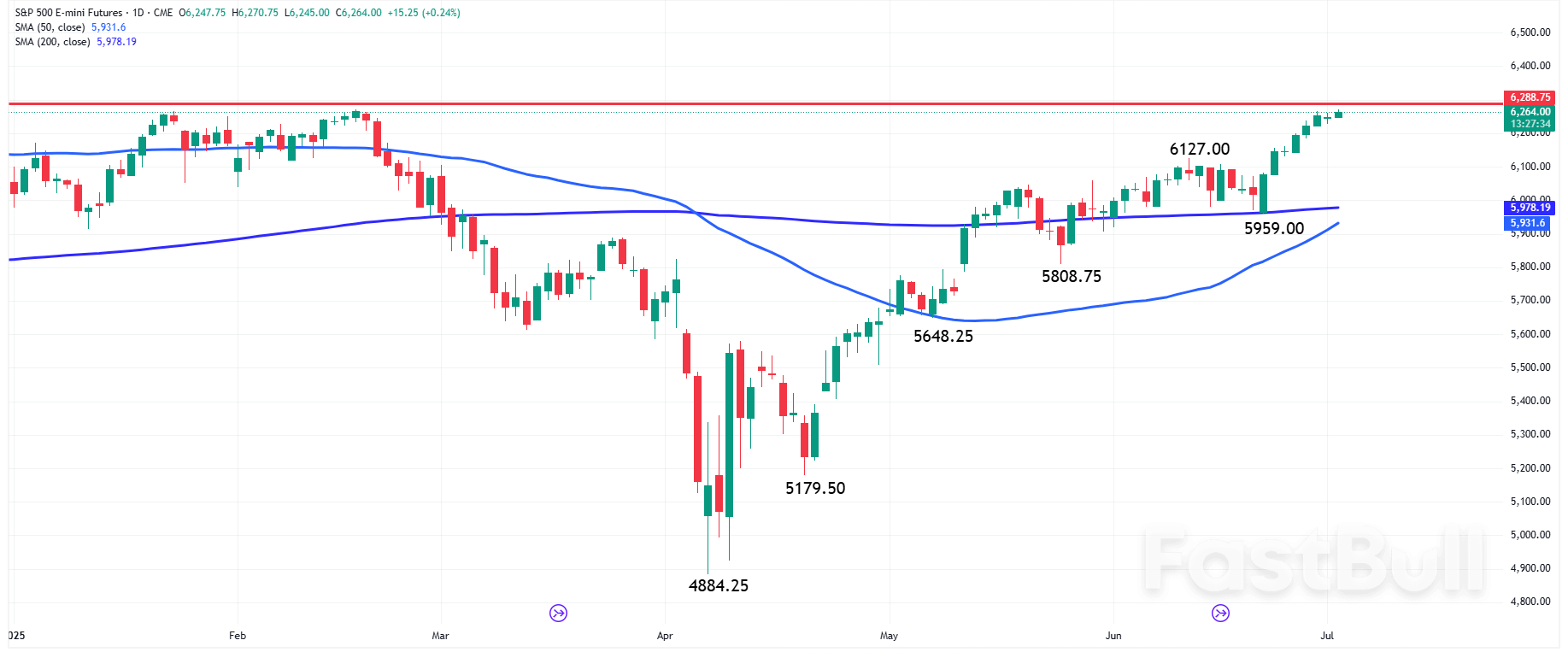
Daily E-mini S&P 500 Index
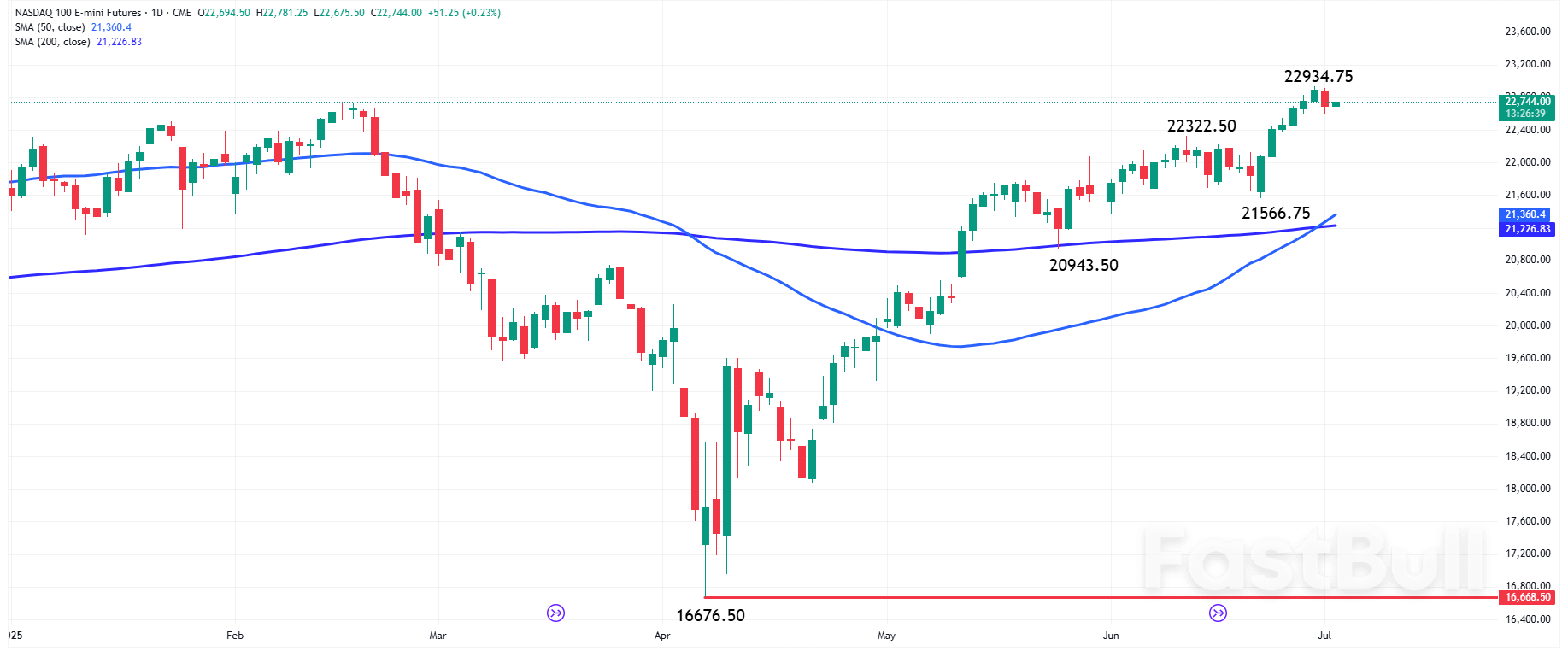
Daily E-mini Nasdaq 100 Index Futures
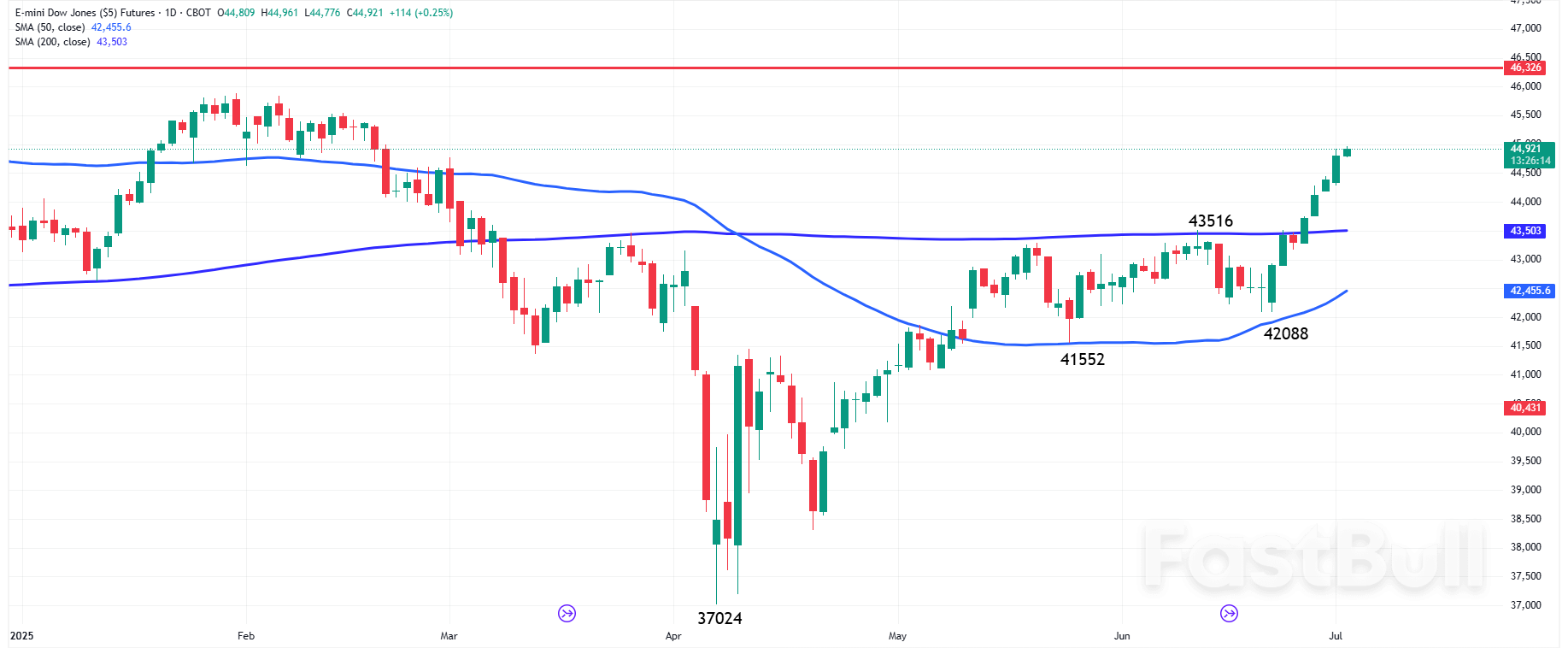
Daily E-mini Dow Jones Industrial AverageIf the Trump administration’s tariff policies result in higher overall inflation, a scenario that will play out in the coming weeks, the question is who will pay for it. A surge in prices will presumably raise the cost of doing business. Less clear is whether and to what extent companies will pass on those higher costs to consumers.
Any inflationary impact from tariffs should first show up in the Producer Price Index, which reflects changes in the cost of producing goods and services sold to consumers. Over time, producer inflation is passed on to consumers and shows up in the better-known Consumer Price Index.
The PPI and CPI’s long history shows that the two are closely related. They’ve grown at roughly similar rates — the PPI by 2.8% a year since 1913 through May and the CPI at a slightly higher rate of 3.2% a year. Annual changes in the two indexes have also been highly correlated over that time (0.8, counting monthly). The relationship was as strong during the past 30 years (0.81), marked by the increasing globalization of trade, as it was during the first three decades of the data series (0.79). That long and consistent history supports the intuition that in the long run, businesses do — indeed, must — pass on their higher costs to consumers.
Looking at shorter periods, however, the numbers tell a more nuanced story. The first thing that jumps out is that annual changes in the PPI have been twice as volatile as those of the CPI, as measured by annualized standard deviation. This suggests that businesses have routinely shielded consumers from much of the turbulence in producer inflation.
Notably, most of that shielding occurred when producer inflation spiked. The median annual change in PPI was 2.3% since 1913. During 12-month periods when producer inflation was lower than the median, roughly half the time, CPI outpaced PPI more than 90% of the time and by a median of 2.2 percentage points. But when annual producer inflation was higher than 2.3%, it was just the opposite. On those occasions, PPI outstripped CPI more than 70% of the time and by a median of 1.6 percentage points. The results are nearly identical when annual changes in PPI and CPI are compared on a six- or 12-month lag.
In other words, the higher the inflation, the more likely businesses were to absorb most of the higher cost, at least in the near term, and vice versa. One way to understand that divergence is that there may be a limit to how much price inflation consumers can digest at one time. It would explain why businesses seem to have little trouble passing on their own higher costs to consumers in normal inflation environments but struggle to do so when inflation spikes.
Companies may also have a strategic incentive to internalize cost surges given competing considerations of volume and margin. Raising prices would protect profit margins in the near term but could imperil them down the road if higher prices result in lower volume and market share. Passing on higher costs to consumers gradually might be a way to protect both, particularly if companies have margin to spare. Fortunately, many big US companies do — the profit margin for the S&P 500 Equal Weight Index is near an all-time high and expected to grow this year and next.
That may explain why the stock market has been so sensitive to tariff news this year. The White House’s Liberation Day announcement was greeted with one of the worst two-day US stock market routs on record, while tariff delays were routinely celebrated with surging stock prices. The seemingly single-minded focus on levies makes sense if companies have the most to lose.
One countervailing consideration is that heightened inflation expectations may give companies more room than usual to raise prices. A notable outlier in the data is that during the hyper inflationary years of the late 1970s and early 1980s, CPI mostly kept pace with PPI despite double-digit producer inflation. Businesses may have been able to raise prices more aggressively because consumers had come to expect big price hikes. Memories of the pandemic’s price surge are a big reason Federal Reserve Chair Jerome Powell has called for caution on cutting interest rates until the implications of tariffs are more clear. With inflation expectations for next year nearly double the long-term inflation rate, businesses may be able to push costs to consumers more quickly.
The PPI and CPI don’t overlap perfectly, so they can only be a rough guide to the way businesses and consumers navigate higher prices. But given the behavior of producer and consumer inflation during previous periods of surging prices, don’t be surprised if any tariff-related inflation is initially absorbed mostly by companies.
White Label
Data API
Web Plug-ins
Poster Maker
Affiliate Program
The risk of loss in trading financial instruments such as stocks, FX, commodities, futures, bonds, ETFs and crypto can be substantial. You may sustain a total loss of the funds that you deposit with your broker. Therefore, you should carefully consider whether such trading is suitable for you in light of your circumstances and financial resources.
No decision to invest should be made without thoroughly conducting due diligence by yourself or consulting with your financial advisors. Our web content might not suit you since we don't know your financial conditions and investment needs. Our financial information might have latency or contain inaccuracy, so you should be fully responsible for any of your trading and investment decisions. The company will not be responsible for your capital loss.
Without getting permission from the website, you are not allowed to copy the website's graphics, texts, or trademarks. Intellectual property rights in the content or data incorporated into this website belong to its providers and exchange merchants.
Not Logged In
Log in to access more features

FastBull Membership
Not yet
Purchase
Log In
Sign Up