• Trade
  • Markets
  • Copy
  • Contests
  • News
  • 24/7
  • Calendar
  • Q&A
  • Chats
Trending
Screeners
SYMBOL
LAST
BID
ASK
HIGH
LOW
NET CHG.
%CHG.
SPREAD
SPX
S&P 500 Index
6846.50
6846.50
6846.50
6878.28
6827.18
-23.90
-0.35%
--
DJI
Dow Jones Industrial Average
47739.31
47739.31
47739.31
47971.51
47611.93
-215.67
-0.45%
--
IXIC
NASDAQ Composite Index
23545.89
23545.89
23545.89
23698.93
23455.05
-32.22
-0.14%
--
USDX
US Dollar Index
99.000
99.080
99.000
99.000
99.000
+0.050
+ 0.05%
--
EURUSD
Euro / US Dollar
1.16338
1.16394
1.16338
1.16365
1.16322
-0.00026
-0.02%
--
GBPUSD
Pound Sterling / US Dollar
1.33177
1.33282
1.33177
1.33213
1.33140
-0.00028
-0.02%
--
XAUUSD
Gold / US Dollar
4189.70
4190.14
4189.70
4218.85
4175.92
-8.21
-0.20%
--
WTI
Light Sweet Crude Oil
58.555
58.807
58.555
60.084
58.495
-1.254
-2.10%
--

Community Accounts

Signal Accounts
--
Profit Accounts
--
Loss Accounts
--
View More

Become a signal provider

Sell trading signals to earn additional income

View More

Guide to Copy Trading

Get started with ease and confidence

View More

Signal Accounts for Members

All Signal Accounts

Best Return
  • Best Return
  • Best P/L
  • Best MDD
Past 1W
  • Past 1W
  • Past 1M
  • Past 1Y

All Contests

  • All
  • Trump Updates
  • Recommend
  • Stocks
  • Cryptocurrencies
  • Central Banks
  • Featured News
Top News Only
Share

Senior USA Administration Official: We Continue To Monitor Drc-Rwanda Situation Closely, Continue To Work With All Sides To Ensure Commitments Are Honored

Share

Israeli Military Says It Has Struck Infrastructure Belonging To Hezbollah In Several Areas In Southern Lebanon

Share

SPDR Gold Holdings Down 0.11%, Or 1.14 Tonnes

Share

On Monday (December 8), In Late New York Trading, S&P 500 Futures Fell 0.21%, Dow Jones Futures Fell 0.43%, NASDAQ 100 Futures Fell 0.08%, And Russell 2000 Futures Fell 0.04%

Share

Morgan Stanley: Data Center ABS Spreads Are Expected To Widen In 2026

Share

(US Stocks) The Philadelphia Gold And Silver Index Closed Down 2.34% At 311.01 Points. (Global Session) The NYSE Arca Gold Miners Index Closed Down 2.17%, Hitting A Daily Low Of 2235.45 Points; US Stocks Remained Slightly Down Before The Opening Bell—holding Steady Around 2280 Points—before Briefly Rising Slightly

Share

IMF: IMF Executive Board Approves Extension Of The Extended Credit Facility Arrangement With Nepal

Share

Trump: Same Approach Will Apply To Amd, Intel, And Other Great American Companies

Share

Trump: Department Of Commerce Is Finalizing Details

Share

Trump: $25% Will Be Paid To United States Of America

Share

Trump: President Xi Responded Positively

Share

[Consumer Discretionary ETFs Fell Over 1.4%, Leading The Decline Among US Sector ETFs; Semiconductor ETFs Rose Over 1.1%] On Monday (December 8), The Consumer Discretionary ETF Fell 1.45%, The Energy ETF Fell 1.09%, The Internet ETF Fell 0.18%, The Regional Banks ETF Rose 0.34%, The Technology ETF Rose 0.70%, The Global Technology ETF Rose 0.93%, And The Semiconductor ETF Rose 1.13%

Share

Trump: I Have Informed President Xi, Of China, That United States Will Allow Nvidia To Ship Its H200 Products To Approved Customers In China

Share

Argentina's Merval Index Closed Up 0.02% At 3.047 Million Points. It Rose To A New Daily High Of 3.165 Million Points In Early Trading In Buenos Aires Before Gradually Giving Back Its Gains

Share

US Stock Market Closing Report | On Monday (December 8), The Magnificent 7 Index Fell 0.20% To 208.33 Points. The "mega-cap" Tech Stock Index Fell 0.33% To 405.00 Points

Share

Pentagon - USA State Dept Approves Potential Sale Of Hellfire Missiles To Belgium For An Estimated $79 Million

Share

Toronto Stock Index .GSPTSE Unofficially Closes Down 141.44 Points, Or 0.45 Percent, At 31169.97

Share

The Nasdaq Golden Dragon China Index Closed Up Less Than 0.1%. Nxtt Rose 21%, Microalgo Rose 7%, Daqo New Energy Rose 4.3%, And 21Vianet, Baidu, And Miniso All Rose More Than 3%

Share

The S&P 500 Initially Closed Down More Than 0.4%, With The Telecom Sector Down 1.9%, And Materials, Consumer Discretionary, Utilities, Healthcare, And Energy Sectors Down By As Much As 1.6%, While The Technology Sector Rose 0.7%. The NASDAQ 100 Initially Closed Down 0.3%, With Marvell Technology Down 7%, Fortinet Down 4%, And Netflix And Tesla Down 3.4%

Share

IMF: Review Pakistan Authorities To Draw The Equivalent Of About US$1 Billion

TIME
ACT
FCST
PREV
France Trade Balance (SA) (Oct)

A:--

F: --

P: --
Euro Zone Employment YoY (SA) (Q3)

A:--

F: --

P: --
Canada Part-Time Employment (SA) (Nov)

A:--

F: --

P: --

Canada Unemployment Rate (SA) (Nov)

A:--

F: --

P: --

Canada Full-time Employment (SA) (Nov)

A:--

F: --

P: --

Canada Labor Force Participation Rate (SA) (Nov)

A:--

F: --

P: --

Canada Employment (SA) (Nov)

A:--

F: --

P: --

U.S. PCE Price Index MoM (Sept)

A:--

F: --

P: --

U.S. Personal Income MoM (Sept)

A:--

F: --

P: --

U.S. Core PCE Price Index MoM (Sept)

A:--

F: --

P: --

U.S. PCE Price Index YoY (SA) (Sept)

A:--

F: --

P: --

U.S. Core PCE Price Index YoY (Sept)

A:--

F: --

P: --

U.S. Personal Outlays MoM (SA) (Sept)

A:--

F: --

P: --
U.S. 5-10 Year-Ahead Inflation Expectations (Dec)

A:--

F: --

P: --

U.S. Real Personal Consumption Expenditures MoM (Sept)

A:--

F: --

P: --
U.S. Weekly Total Rig Count

A:--

F: --

P: --

U.S. Weekly Total Oil Rig Count

A:--

F: --

P: --

U.S. Consumer Credit (SA) (Oct)

A:--

F: --

P: --
China, Mainland Foreign Exchange Reserves (Nov)

A:--

F: --

P: --

Japan Trade Balance (Oct)

A:--

F: --

P: --

Japan Nominal GDP Revised QoQ (Q3)

A:--

F: --

P: --

China, Mainland Imports YoY (CNH) (Nov)

A:--

F: --

P: --

China, Mainland Exports (Nov)

A:--

F: --

P: --

China, Mainland Imports (CNH) (Nov)

A:--

F: --

P: --

China, Mainland Trade Balance (CNH) (Nov)

A:--

F: --

P: --

China, Mainland Exports YoY (USD) (Nov)

A:--

F: --

P: --

China, Mainland Imports YoY (USD) (Nov)

A:--

F: --

P: --

Germany Industrial Output MoM (SA) (Oct)

A:--

F: --

P: --
Euro Zone Sentix Investor Confidence Index (Dec)

A:--

F: --

P: --

Canada National Economic Confidence Index

A:--

F: --

P: --

U.K. BRC Like-For-Like Retail Sales YoY (Nov)

--

F: --

P: --

U.K. BRC Overall Retail Sales YoY (Nov)

--

F: --

P: --

Australia Overnight (Borrowing) Key Rate

--

F: --

P: --

RBA Rate Statement
RBA Press Conference
Germany Exports MoM (SA) (Oct)

--

F: --

P: --

U.S. NFIB Small Business Optimism Index (SA) (Nov)

--

F: --

P: --

Mexico 12-Month Inflation (CPI) (Nov)

--

F: --

P: --

Mexico Core CPI YoY (Nov)

--

F: --

P: --

Mexico PPI YoY (Nov)

--

F: --

P: --

U.S. Weekly Redbook Index YoY

--

F: --

P: --

U.S. JOLTS Job Openings (SA) (Oct)

--

F: --

P: --

China, Mainland M1 Money Supply YoY (Nov)

--

F: --

P: --

China, Mainland M0 Money Supply YoY (Nov)

--

F: --

P: --

China, Mainland M2 Money Supply YoY (Nov)

--

F: --

P: --

U.S. EIA Short-Term Crude Production Forecast For The Year (Dec)

--

F: --

P: --

U.S. EIA Natural Gas Production Forecast For The Next Year (Dec)

--

F: --

P: --

U.S. EIA Short-Term Crude Production Forecast For The Next Year (Dec)

--

F: --

P: --

EIA Monthly Short-Term Energy Outlook
U.S. API Weekly Gasoline Stocks

--

F: --

P: --

U.S. API Weekly Cushing Crude Oil Stocks

--

F: --

P: --

U.S. API Weekly Crude Oil Stocks

--

F: --

P: --

U.S. API Weekly Refined Oil Stocks

--

F: --

P: --

South Korea Unemployment Rate (SA) (Nov)

--

F: --

P: --

Japan Reuters Tankan Non-Manufacturers Index (Dec)

--

F: --

P: --

Japan Reuters Tankan Manufacturers Index (Dec)

--

F: --

P: --

Japan Domestic Enterprise Commodity Price Index MoM (Nov)

--

F: --

P: --

Japan Domestic Enterprise Commodity Price Index YoY (Nov)

--

F: --

P: --

China, Mainland PPI YoY (Nov)

--

F: --

P: --

China, Mainland CPI MoM (Nov)

--

F: --

P: --

Italy Industrial Output YoY (SA) (Oct)

--

F: --

P: --

Q&A with Experts
    • All
    • Chatrooms
    • Groups
    • Friends
    Connecting
    .
    .
    .
    Type here...
    Add Symbol or Code

      No matching data

      All
      Trump Updates
      Recommend
      Stocks
      Cryptocurrencies
      Central Banks
      Featured News
      • All
      • Russia-Ukraine Conflict
      • Middle East Flashpoint
      • All
      • Russia-Ukraine Conflict
      • Middle East Flashpoint
      Search
      Products

      Charts Free Forever

      Chats Q&A with Experts
      Screeners Economic Calendar Data Tools
      Membership Features
      Data Warehouse Market Trends Institutional Data Policy Rates Macro

      Market Trends

      Market Sentiment Order Book Forex Correlations

      Top Indicators

      Charts Free Forever
      Markets

      News

      News Analysis 24/7 Columns Education
      From Institutions From Analysts
      Topics Columnists

      Latest Views

      Latest Views

      Trending Topics

      Top Columnists

      Latest Update

      Signals

      Copy Rankings Latest Signals Become a signal provider AI Rating
      Contests
      Brokers

      Overview Brokers Assessment Rankings Regulators News Claims
      Broker listing Forex Brokers Comparison Tool Live Spread Comparison Scam
      Q&A Complaint Scam Alert Videos Tips to Detect Scam
      More

      Business
      Events
      Careers About Us Advertising Help Center

      White Label

      Data API

      Web Plug-ins

      Affiliate Program

      Awards Institution Evaluation IB Seminar Salon Event Exhibition
      Vietnam Thailand Singapore Dubai
      Fans Party Investment Sharing Session
      FastBull Summit BrokersView Expo
      Recent Searches
        Top Searches
          Markets
          News
          Analysis
          User
          24/7
          Economic Calendar
          Education
          Data
          • Names
          • Latest
          • Prev

          View All

          No data

          Scan to Download

          Faster Charts, Chat Faster!

          Download App
          English
          • English
          • Español
          • العربية
          • Bahasa Indonesia
          • Bahasa Melayu
          • Tiếng Việt
          • ภาษาไทย
          • Français
          • Italiano
          • Türkçe
          • Русский язык
          • 简中
          • 繁中
          Open Account
          Search
          Products
          Charts Free Forever
          Markets
          News
          Signals

          Copy Rankings Latest Signals Become a signal provider AI Rating
          Contests
          Brokers

          Overview Brokers Assessment Rankings Regulators News Claims
          Broker listing Forex Brokers Comparison Tool Live Spread Comparison Scam
          Q&A Complaint Scam Alert Videos Tips to Detect Scam
          More

          Business
          Events
          Careers About Us Advertising Help Center

          White Label

          Data API

          Web Plug-ins

          Affiliate Program

          Awards Institution Evaluation IB Seminar Salon Event Exhibition
          Vietnam Thailand Singapore Dubai
          Fans Party Investment Sharing Session
          FastBull Summit BrokersView Expo

          US Dollar Forecast: Bullish Outlook After 90-Day U.S.-China Tariff Pause

          Adam

          Stocks

          China–U.S. Trade War

          Summary:

          The U.S. dollar rallied after a 90-day U.S.-China tariff truce boosted global sentiment, driving Treasury yields higher and strengthening the dollar index, with markets now eyeing key inflation data.
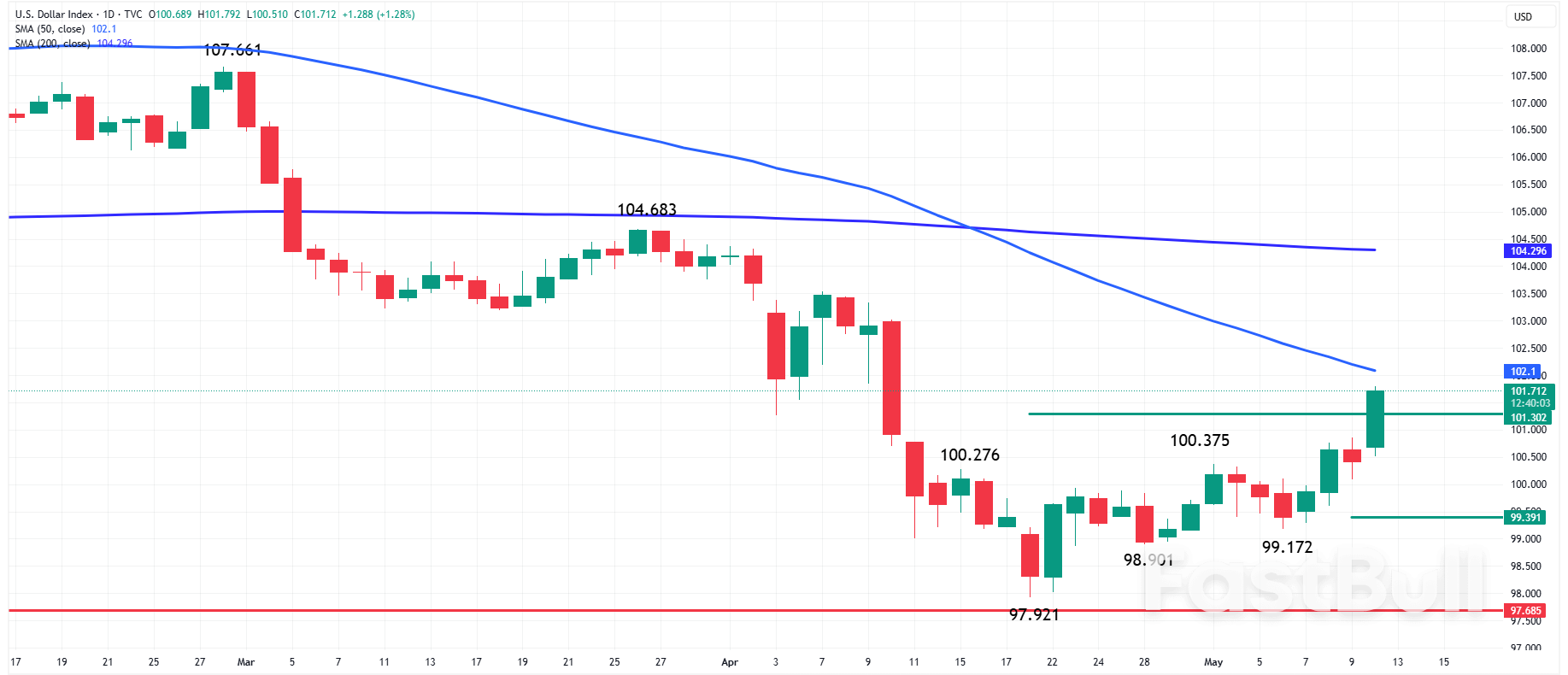
          U.S. Dollar Index Rallies as U.S.-China Tariff Deal Boosts Risk Appetite

          The U.S. Dollar Index (DXY) climbed sharply Monday, extending its recent rebound as markets digested a significant breakthrough in U.S.-China trade negotiations. A 90-day truce to slash reciprocal tariffs has revived confidence in the global growth outlook, fueling demand for the dollar and sending Treasury yields higher.

          Dollar Breaks Key Resistance as Trade Deal Spurs Buying

          US Dollar Forecast: Bullish Outlook After 90-Day U.S.-China Tariff Pause_1Daily US Dollar Index (DXY)

          The dollar index surged above its short-term pivot of 101.302, signaling bullish momentum and setting the stage for a potential test of the 50-day moving average near 102.10. A sustained push through that level could open the path toward the 200-day moving average at 104.297. The greenback strengthened broadly, gaining 1.7% against the yen to 147.835 and 1.5% versus the Swiss franc at 0.84405, as traders rotated out of safe-haven assets.

          Tariff Reduction Agreement Shifts Market Sentiment

          Monday’s rally followed the announcement that the U.S. and China had agreed to reduce tariffs significantly for a 90-day period. U.S. duties on Chinese imports will fall from 145% to 30%, while Chinese tariffs on U.S. goods will decline from 125% to 10%. The agreement, brokered in Geneva, alleviated fears of a prolonged economic standoff. U.S. Treasury Secretary Scott Bessent said the deal avoids “the equivalent of an embargo” and reflects both nations’ interest in continued trade engagement.

          Treasury Yields Surge as Risk Premium Recedes

          Bond markets responded sharply, with the U.S. 2-year Treasury yield jumping 10 basis points to 3.996%, and the 10-year rising nearly 6 basis points to 4.433%. The easing of geopolitical tensions—including a ceasefire between India and Pakistan and scheduled talks between Ukrainian and Russian leaders—added to the global risk-on tone, further pressuring bond prices and lifting yields.

          Market Eyes Key U.S. Economic Data for Confirmation

          Attention now turns to upcoming U.S. macroeconomic releases, including Tuesday’s consumer price index and Thursday’s retail sales and producer price index data. These indicators will be closely watched for signs of inflation pressure and consumer resilience, which could influence the Fed’s rate outlook.

          Market Forecast: Dollar Bulls Eye 200-Day Average

          With trade risks easing and Treasury yields rising, the backdrop favors further upside in the DXY. A successful breach of the 50-day moving average at 102.10 would strengthen bullish conviction, potentially targeting the 200-day moving average at 104.297. Near-term momentum hinges on the CPI print and whether it aligns with stronger demand fundamentals following the tariff reprieve.

          Source: fxempire

          Risk Warnings and Disclaimers
          You understand and acknowledge that there is a high degree of risk involved in trading. Following any strategies or investment methods may lead to potential losses. The content on the site is provided by our contributors and analysts for information purposes only. You are solely responsible for determining whether any trading assets, securities, strategy, or any other product is suitable for investing based on your own investment objectives and financial situation.
          Add to Favorites
          Share

          Investors Cheer US-China Tariff Truce, But Cautious Over A Final Deal

          Glendon

          Economic

          Forex

          A breakthrough in U.S.-China trade talks has propelled world stocks and the dollar higher, but investors fear further negotiations could prove a long slog, tempering optimism, as risks of a global economic slowdown persist.

          Speaking after two days of talks with Chinese officials in Geneva, U.S. Treasury Secretary Scott Bessent said on Monday the two sides had agreed a 90-day pause on measures and that tariffs would fall by over 100 percentage points.

          That leaves U.S. tariffs on Chinese goods at 30% from May 14 to August 12 and Chinese duties on U.S. imports at 10%, beating investors' best-case scenarios going into the talks.

          The dollar jumped by the most in almost a month against a basket of major currencies , as the yen and Swiss franc fell along with other safe-haven assets like gold and government bonds.

          S&P 500 stock futures leapt almost 3%, suggesting a hefty rally at the opening bell, while U.S. Treasury prices sagged, sending yields to one-month highs above 4.4% .

          But relief that the worst of a global trade war could be avoided was tempered by caution, given a more permanent deal needs to be struck and that higher tariffs overall are still likely to weigh on the global economy.

          "It's long-term positive plus 90 days of uncertainty," said Charles Wang, chairman of Shenzhen Dragon Pacific Capital Management Co.

          Michael Metcalfe, head of macro strategy at State Street Global Markets in London, estimated that Monday's U.S.-China trade deal implied an average effective tariff rate of around 15%.

          "Given where expectations were, it's a net positive," he said. "You basically reverse the reciprocal tariff announcement, and if you reverse the reciprocal tariff announcement you are back to square one."

          After taking office in January, U.S. President Donald Trump had imposed tariffs of 145% on imports of Chinese goods, with China in turn raising tariffs on U.S. goods to 125% and limiting exports on some vital rare earth minerals.

          Those measures had brought nearly $600 billion in two-way trade to a standstill, disrupting supply chains and sparking fears of an immediate cratering of the global economy.

          Trump's April 2 "Liberation Day" announcement of sweeping tariffs on China and others sparked a sharp exit from U.S. assets, including the dollar and Treasuries - the mainstays of the global financial system - before being paused.

          Heightened uncertainty caused by U.S. trade policy has hurt business and consumer confidence. The dollar index, while up over 1% on Monday, remains down some 7% so far this year.
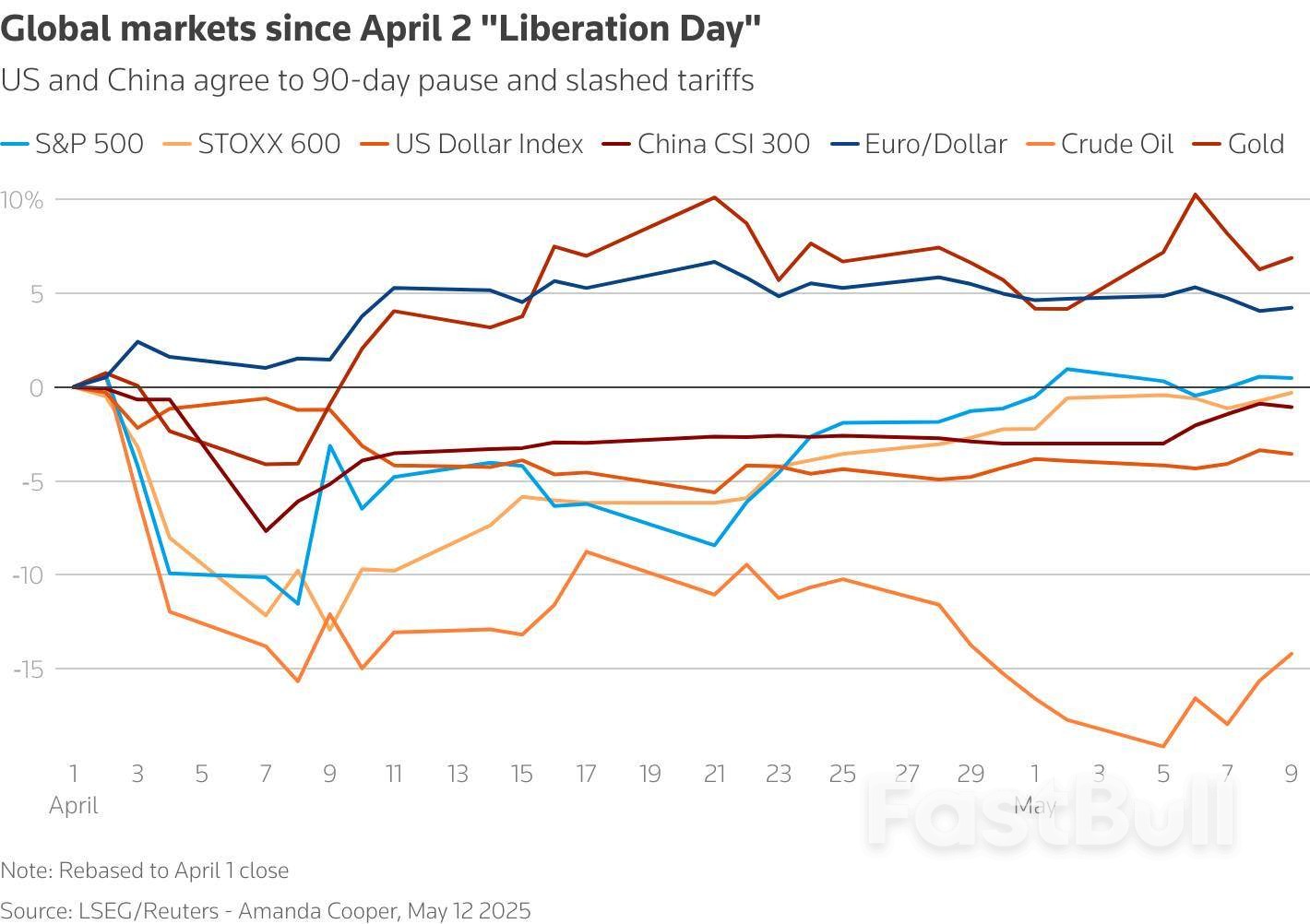
          A line chart showing the relative performance of US, European and Chinese stocks, as well as the dollar, crude oil and gold since April 2

          SOFTENING STANCE

          Reassuring for markets are signs that Trump may be rethinking his trade strategy, given the damage caused already, as economic indicators have turned south and central bankers warn of the risk of slowing growth and rising inflation.

          A deal last week with Britain, plus positive noises from Japan, Vietnam and South Korea, have helped restore some confidence, along with a cooling in geopolitical tensions.

          U.S. stocks are already roughly where they were prior to April 2, while beneficiaries of the "sell America" trade, such as European and Chinese stocks have given up a big chunk of those gains (.STOXX), opens new tab, (.CSI300), opens new tab.

          "This is only a three-month temporary reduction of tariffs. So this is the beginning of a long process," Zhiwei Zhang, chief economist at Pinpoint Asset Management in Hong Kong, said.

          "The two sides will spend months probably, to come up with a resolution, or reach a final trade deal, but this is a very good starting point."

          Rabobank's head of FX strategy Jane Foley said there was more optimism that the tariffs will not have the devastating impact many had feared, but this did not mean a return to the pre-Trump status quo.

          "The overall scenario is not as bad as it could have been, but we still have a fair amount of uncertainty about where these tariffs will settle, their impact on world growth and central bank policy," she said.

          State Street's Metcalfe said as uncertainty over trade lifts, the focus could also turn to other hot spots - such as Trump's plans for tax cuts and what that means for U.S. debt levels, especially as revenues from tariffs drop.

          "It (the U.S./China deal) doesn't mean the policy uncertainty has gone away, it's moved on to a new area," he said.

          Reporting by Alun John, Amanda Cooper and Dhara Ranasinghe in London, Samuel Shen in Shanghai and Summer Zhen in Hong Kong; Graphic by Amanda Cooper; Editing by Dhara Ranasinghe and Catherine Evans
          Source: Reuters

          To stay updated on all economic events of today, please check out our Economic calendar
          Risk Warnings and Disclaimers
          You understand and acknowledge that there is a high degree of risk involved in trading. Following any strategies or investment methods may lead to potential losses. The content on the site is provided by our contributors and analysts for information purposes only. You are solely responsible for determining whether any trading assets, securities, strategy, or any other product is suitable for investing based on your own investment objectives and financial situation.
          Add to Favorites
          Share

          Canada’s Unemployment Rate Hits 6.9% Amid US Tariff Shock

          Gerik

          Economic

          US Tariffs Deal a Direct Blow to Canada’s Labor Market

          Canada’s jobless rate rose to a new post-pandemic high in April, reaching 6.9%. This increase occurred despite the creation of 7,400 jobs—most of which were temporary roles in the public sector for the federal election. Behind the headline figure lies a deeper issue: growing fragility in Canada’s private sector, particularly industries tied to international trade.
          The tariff hike implemented by the United States in early April disrupted Canada's exports, especially in key manufacturing sectors like automotive and machinery. The impact has rippled across the country, forcing factories to scale down production and shed jobs.

          Sharp Declines in Manufacturing and Retail Employment

          While finance and real estate recorded modest gains, the manufacturing sector shed 31,000 jobs, and wholesale and retail lost 27,000. These sectors are heavily exposed to trade uncertainty and global supply chains. Without the temporary hiring tied to the election, Canada’s economy would have lost over 30,000 jobs in April alone.
          Ontario, Canada’s manufacturing heartland, suffered the most. The province lost 33,000 factory jobs, and Windsor—the auto industry hub—saw unemployment surge to 10.7%, driven by US tariffs on car imports. The manufacturing contraction in Ontario alone significantly dragged down national figures.

          Rising Joblessness Signals Growing Economic Vulnerability

          According to Statistics Canada, the April jobless rate matches that of November 2024, which had been the highest since the pre-COVID era. Most worryingly, newly unemployed workers are struggling more than before to find new jobs. Layoffs are rising, with 0.7% of March hires losing their jobs by April due to termination—highlighting a troubling labor market trend.
          Senior economist Brendon Bernard warned that these data are the first official signs of the trade war's direct hit to Canada’s job market. Meanwhile, wage-sensitive sectors remain under pressure as businesses brace for potential economic slowdown.

          Implications for Monetary Policy and Future Outlook

          Doug Porter, chief economist at the Bank of Montreal, said the job data strengthen the case for the Bank of Canada to lower interest rates by 25 basis points in June. The policy shift would aim to ease financial pressure on businesses and consumers amid growing uncertainty.
          With consumer confidence wavering and inflation remaining sticky, the combination of weaker trade and higher unemployment could pull the economy closer to a technical recession by mid-year if conditions do not improve.
          April’s labor market report makes one thing clear: the US tariff escalation is not just a geopolitical maneuver—it is triggering real economic consequences for Canada. Without targeted fiscal and monetary interventions, Canada could see the current wave of unemployment spill over into broader economic malaise.

          Source: AOL

          To stay updated on all economic events of today, please check out our Economic calendar
          Risk Warnings and Disclaimers
          You understand and acknowledge that there is a high degree of risk involved in trading. Following any strategies or investment methods may lead to potential losses. The content on the site is provided by our contributors and analysts for information purposes only. You are solely responsible for determining whether any trading assets, securities, strategy, or any other product is suitable for investing based on your own investment objectives and financial situation.
          Add to Favorites
          Share

          Market navigator: week of 12 May 2025

          Adam

          Economic

          China–U.S. Trade War

          What happened last week

          Trade negotiations advance:US established its first country-level trade framework US with UK, reducing US duties on British automotive, steel and aluminium sectors, while British tariffs on US goods will decrease from 5.1% to 1.8%. Markets responded positively on anticipation of additional trade agreements, with US-China discussions commencing in Switzerland on 10 May.
          Central bank policy decisions:Fed funds rates remained unchanged at 4.25-4.5% despite political pressure from President Trump. Chair Powell indicated the US economy remains robust but cautioned that sustained tariffs could accelerate inflation and increase unemployment. The Bank of England implemented a 25 basis point (bp) rate reduction, though the non-unanimous decision prompted traders to recalibrate expectations for a potential June cut.
          Asian currency fluctuations:The Taiwan dollar appreciated 8% against USD across two sessions, reaching a three-year high amid speculation that currency appreciation is necessary to secure a US trade agreement. The Hong Kong Monetary Authority intervened by selling over HK$100 billion to maintain its USD peg ahead of CATL's IPO. The People's Bank of China (PBOC) also intervened as USD/CNH declined to a six-month low. Most gains subsequently reversed on trade optimism.
          China's monetary easing:The PBOC reduced policy rates from 1.5% to 1.4% and decreased the reserve requirement ratio (RRR) by 50 bp, introducing 1 trillion yuan of liquidity. Additional measures include reductions in mortgage rates and targeted lending facilities to technology enterprises.

          Markets in focus

          US markets navigate trade policy shifts and tech sector developments
          Major US equity indices concluded last week with minimal variation following several mixed trading sessions. Regarding trade policies, negative headlines concerning potential tariffs on non-US produced films and pharmaceutical products were counterbalanced by positive developments in negotiations with the UK and China. The Trump administration is also considering revising the framework for artificial intelligence technology restrictions, potentially allowing numerous countries beyond China to negotiate access to advanced semiconductor components.
          Company-specific developments also contributed to divergent stock performance last week. Share prices of Apple and Alphabet declined 3% and 7% respectively after Apple revealed plans to transform the Safari browser to incorporate an AI-powered search engine, potentially terminating a longstanding partnership with Google. Conversely, Tesla's share price appreciated 4%, bolstered by easing trade tension headlines. Other Magnificent Seven stocks traded within a narrow range.
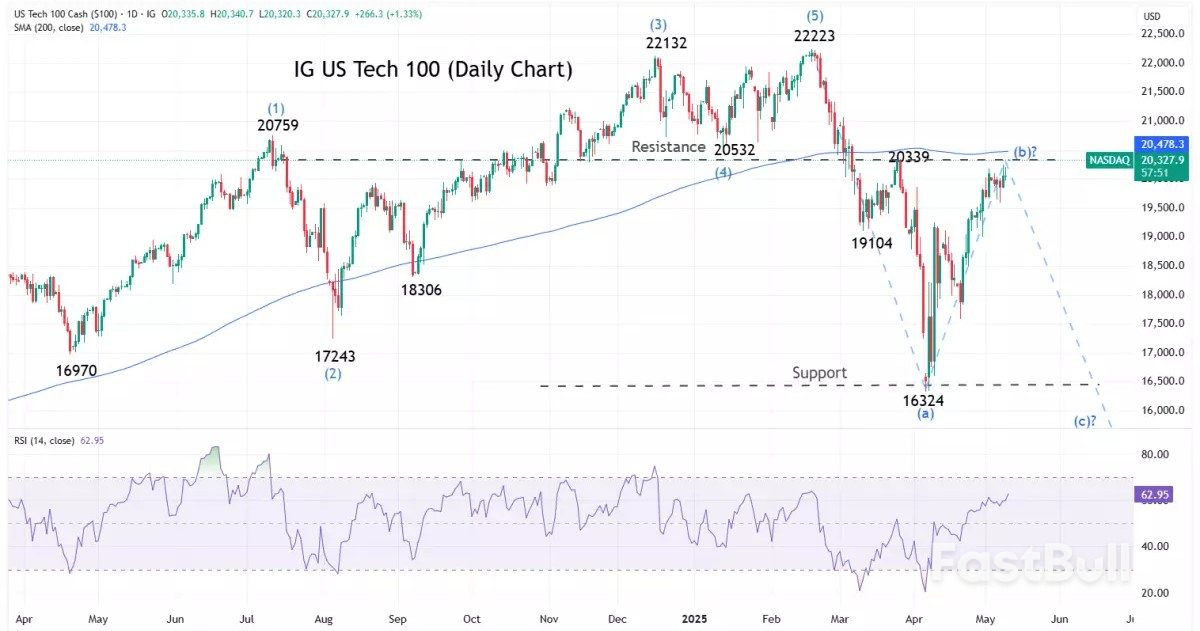
          The US Tech 100 Index has reached a critical technical juncture as it approaches the 200-day simple moving average (SMA) at 20,478 following breakthroughs of both the 20-day and 50-day SMA. Price action exhibits characteristics consistent with Elliott Wave structures, with the current advance potentially representing a corrective Wave B formation, which may subsequently yield to a bearish move towards 16,000. Should the index maintain levels above its 200-day SMA, the corrective phase would likely be completed, potentially enabling the index to challenge its February peak at 22,223.
          Figure 1: US Tech 100 index (daily) price chart
          Market navigator: week of 12 May 2025_1

          as of 11 May 2025. Past performance is not a reliable indicator of future performance.
          Hang Seng gains amid Chinese monetary stimulus
          The Hang Seng Index (HSI) continued its upward trajectory, extending its winning streak to seven consecutive trading sessions since 29 April; month-to-date, the benchmark has appreciated 3%.
          This positive market momentum is primarily attributable to two key catalysts. Firstly, the PBOC has announced a series of accommodative monetary measures. Beyond the RRR and reverse repo rate reductions, the central bank has introduced specialised lending facilities to support technology firms, elderly care initiatives, agricultural enterprises and the residential property market. Secondly, US and Chinese officials are convening in Switzerland over the weekend for trade negotiations, marking the first formal discussions since the Trump administration elevated tariffs to as high as 145% on Chinese imports.
          The probability of reaching a comprehensive agreement during the initial round of discussions remains low. Consequently, investors should maintain a cautious approach and prepare for potential market volatility in the coming week. Market participants will also closely monitor upcoming earnings reports from Tencent and Alibaba, which have historically served as key indicators of Chinese economic health.
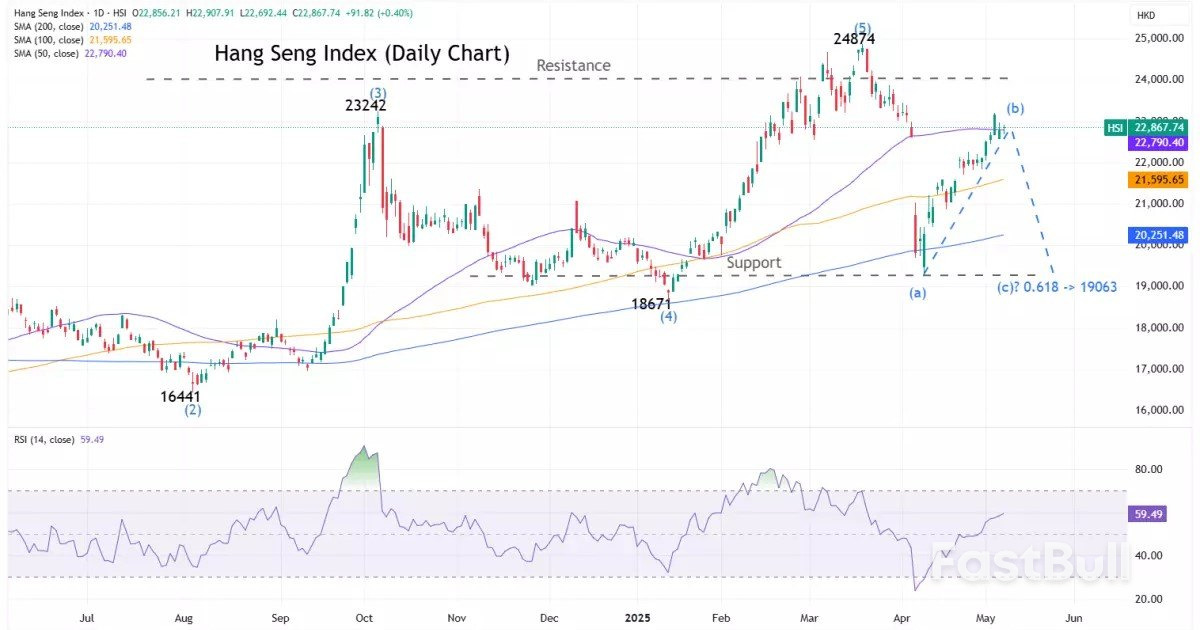
          Technical analysis continues to indicate a medium-term bullish trend for the HSI. However, after successfully breaching the 50-day SMA, momentum has moderated and the index has entered a consolidation phase as markets await greater clarity from US-China trade negotiations. Constructive progress could propel the index towards the psychologically significant 24,000 threshold. Conversely, should the weekend discussions yield limited substantive outcomes, the index may conform to Wave C trajectory within the Elliott Wave framework and potentially retrace towards 19,000.
          Figure 2: Hang Seng index (daily) price chart

          Market navigator: week of 12 May 2025_2as of 9 May 2025. Past performance is not a reliable indicator of future performance.
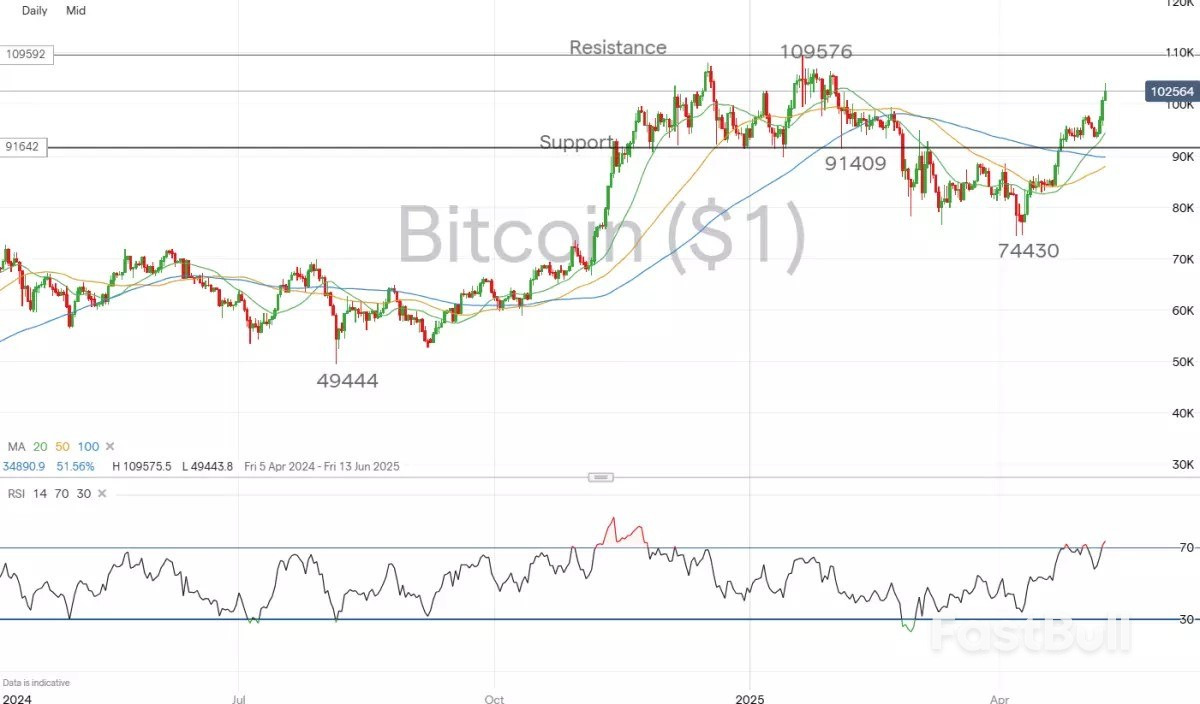
          Bitcoin surpasses $100,000 threshold
          Bitcoin has demonstrated remarkable recovery, rebounding nearly 40% from April lows, and exceeding $100,000 for the first time since February. The cryptocurrency surpassed this psychologically significant milestone following the US-UK trade framework announcement last Thursday. Risk appetite has noticeably strengthened over the past fortnight as optimism regarding trade agreements has emerged. Any positive developments from the US-China discussions in Switzerland this weekend could further catalyse price appreciation.
          Robust month-to-date net inflows of US$2 billion through exchange-traded funds (ETF), alongside accumulation by Bitcoin whales, have contributed significantly to the price advancement. Market observers have also noted substantial short-covering pressure at the $98,000 level.
          Technical analysis suggests that the corrective phase has likely concluded, with a new bullish trend commencing. In the near term, Bitcoin may experience a technical correction with support anticipated around $91,400, given elevated valuations and excessively bullish market sentiment. The relative strength index (RSI) has surpassed the 70 threshold, while the Crypto Fear and Greed Index approaches "extreme greed" territory, indicating overbought conditions. A 100% Fibonacci extension of the uptrend between September and December 2024 suggests the cryptocurrency could potentially advance towards $130,000 over the medium term if it breaks through the historical high and resistance level at $109,576.
          Figure 3: Bitcoin (daily) price chart

          Market navigator: week of 12 May 2025_3as of 9 May 2025. Past performance is not a reliable indicator of future performance.

          The week ahead

          The upcoming week features crucial US economic data with metrics - Consumer Price Index (CPI) and Producer Price Index (PPI) - likely to provide valuable insights into the Federal Reserve's next policy moves. Consumer sentiment readings will whether household spending intentions have improved as trade tensions moderate. On the corporate earnings front, major Chinese technology enterprises including Alibaba, Tencent, and JD.com are scheduled to report results, potentially offering important signals regarding China's digital economy and consumer trends amid persistent deflationary pressures.
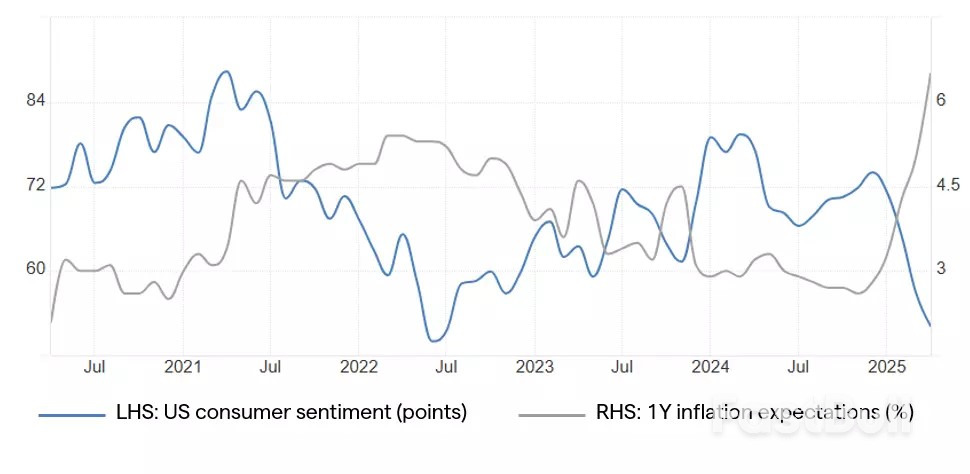
          US consumer sentiment has declined for four consecutive months, reaching 52.2. One-year inflation expectations have surged to 6.5%, the highest level since 1981, fuelled by recession concerns and anticipated price increases resulting from the Trump's tariff policies. As the government advances trade negotiations, market participants will monitor upcoming data releases closely for indications of recovering consumer confidence, which could potentially propel risk assets back towards pre-'Liberation Day' peak levels.
          Figure 4: University of Michigan survey results

          Market navigator: week of 12 May 2025_4 as of 9 May 2025

          Source:ig

          To stay updated on all economic events of today, please check out our Economic calendar
          Risk Warnings and Disclaimers
          You understand and acknowledge that there is a high degree of risk involved in trading. Following any strategies or investment methods may lead to potential losses. The content on the site is provided by our contributors and analysts for information purposes only. You are solely responsible for determining whether any trading assets, securities, strategy, or any other product is suitable for investing based on your own investment objectives and financial situation.
          Add to Favorites
          Share

          Trump Might Claim China Tariff Victory – But This Is Capitulation Day

          Warren Takunda

          Economic

          China–U.S. Trade War

          Donald Trump will inevitably claim Monday’s temporary truce in the US-China trade war as a victory, but financial markets seem to have read it for what it is – a capitulation.
          Stocks were up and bond yields were higher after the US treasury secretary Scott Bessent’s early morning press conference in Geneva, where he has been holding talks with China.
          As with the UK “trade deal” last week, the US is not reverting to the status quo before Trump arrived in the White House.
          Instead, tariffs on Chinese goods will be cut from 145% to 30% – initially for a 90-day period. In return, China has cut its own tariffs on US imports to 10%, from the 125% it had imposed in retaliation against the White House.
          That still marks a big shift in the terms of trade between the two countries since before Trump came to power, but falls far short of what was in effect a trade embargo.
          The two sides have pledged to keep talking, but there was no reference in the statement put out by the White House to other gripes it has previously raised about China, including the weakness of the yuan.
          Instead, the statement hailed “the importance of a sustainable, long-term and mutually beneficial economic and trade relationship”. The language was rather different to Trump’s Liberation Day speech, about the US being “looted, pillaged, raped and plundered by nations near and far”.
          In other words, the president has caved. He may have been swayed by market wobbles but it seems more plausible that dire warnings from retailers about empty shelves – backed up by data showing shipments into US ports collapsing – may have strengthened the hands of trade moderates in the administration.
          Confronted with warnings of a shortage of toys, Trump told reporters that children should be happy with “two dolls instead of 30 dolls”, and they might “cost a couple bucks more” than usual. But it is difficult to imagine even this most bullish of presidents withstanding the attacks that would come his way if he began to be seen as responsible for Covid-style shortages of key goods in the world’s largest economy.
          Instead, the White House seems to have opted for tactical retreat. The China-US conflict was always the hottest theatre of confrontation in Trump’s trade war, with a longer history and deeper public support than his quixotic attacks on Mexico and Canada.
          If Trump is indeed ready to give in even with Beijing, it sends a signal that some of the other aggressive aspects of his trade policy may be negotiable.
          What Bessent and his Chinese counterparts have not erased, however, is the corrosive uncertainty that has gripped investors across the global economy since Trump’s “Liberation Day” tariff announcement.
          China tariffs have only been slashed temporarily, for now and many other countries are still awaiting negotiations on where their tariff levels will end up, after that other 90-day pause, on Trump’s “reciprocal” levies, due to end in July.
          Meanwhile, companies throughout the global trading system are left wondering which particular iteration of the policy is likely to stick, and may well be tempted to continue working around the US, where possible.
          And with 30% tariffs remaining on Chinese exports to the US, the bigger picture remains of two great economic powers pulling apart.

          Source: Theguardian

          To stay updated on all economic events of today, please check out our Economic calendar
          Risk Warnings and Disclaimers
          You understand and acknowledge that there is a high degree of risk involved in trading. Following any strategies or investment methods may lead to potential losses. The content on the site is provided by our contributors and analysts for information purposes only. You are solely responsible for determining whether any trading assets, securities, strategy, or any other product is suitable for investing based on your own investment objectives and financial situation.
          Add to Favorites
          Share

          Wall Street stock futures surge as U.S.-China agree to trade deal; Nasdaq up 4%

          Adam

          Stocks

          U.S. stock futures surged Monday after the White House announced a trade deal with China had been reached, with both sides agreeing to lower their respective levies.
          At 06:30 ET (10:30 GMT), Dow futures gained 975 points, or 2.4%, S&P 500 futures climbed 170 points, or 3%, and Nasdaq 100 futures rose 785 points, or 3.9%.
          Gains in futures come after a positive week on Wall Street, as the prospect of a Sino-U.S. trade deal lifted spirits and spurred buying into risk-driven assets.

          U.S.-China tariffs to be cut

          U.S. Treasury Secretary Scott Bessent and Trade Representative Jamieson Greer said on Sunday afternoon that a trade deal had been struck with China after negotiations over the weekend in Geneva, and more substance surrounding the agreement was subsequently announced on Monday.
          The two sides have agreed to a 90-day pause to soaring tariffs placed on each other, Washington has moved to slash tariffs on China to 30% and Beijing’s duties on U.S. imports are being cut to 10%, the nations said in a rare joint statement following high-stakes trade talks over the weekend.
          Heading into the talks, U.S. President Donald Trump had raised tariffs on China to at least 145%, leading China to respond with retaliatory levies on American imports of 125%.
          "The consensus from both delegations is that neither side wanted a decoupling," U.S. Treasury Secretary Scott Bessent said in a news conference.
          More trade negotiations are planned between the two, while both sides may conduct working-level consultations on relevant economic and trade issues.
          Investors, who have been worried that the trade spat could spiral into a global crisis that threatened economic activity and increased uncertainty for businesses, have welcomed the changes.
          “The tone of stock markets has been downward over the last two months, weighed down by fear of the effects of a possible tariff war and other tough-line measures by Donald Trump, but the situation shows signs of some stabilization and even moderate upturns have been seen in the most recent sessions," said Alberto Matellan, managing director at La Financiere Responsable.
          “All of this is explained by the loss of confidence caused by the White House, something that has not been reversed; however, if progress is made toward a clearer scenario, the market’s performance will be positive.
          “What has happened over the past two months, even before ‘Liberation Day,’ is that Trump has broken trust—the market doesn’t trust Trump or the economy. And once trust is broken, it’s difficult to rebuild it, but also harder to destroy it further. Only by making things clearer can there be a positive development for the stock markets in general.”

          India and Pakistan ceasefire

          In another potential market-moving development, India and Pakistan agreed to a ceasefire after increased tensions in recent days. U.S. President Donald Trump said U.S.-led mediation allowed cooler heads to prevail.
          “After a long night of talks mediated by the United States, I am pleased to announce that India and Pakistan have agreed to a FULL AND IMMEDIATE CEASEFIRE,” Trump said on Saturday. Pakistan praised the U.S.’s role in the ceasefire, although India downplayed it.
          The ceasefire appeared to be holding, although both India and Pakistan had accused each other of violations.

          Trump to slash pharma prices

          Elsewhere, the pharmaceutical sector is likely to be in focus Monday after Trump said on Sunday that he plans to sign an executive order lowering prescription drug and pharmaceutical prices by between 30% and 80%.
          Trump said he will "be signing one of the most consequential executive orders in our Country’s history," in the White House on Monday morning.
          Trump claimed that pharma prices will "rise throughout the world" in order to bring fairness to America.
          In other pharma news, Eli Lilly and Company (NYSE:LLY) said that its Zepbound weight loss drug had outperformed rival Novo Nordisk’s (NYSE:NVO) Wegovy in a recent head-to-head trial.
          There are more earnings to digest this week, in what has generally been a mostly positive first quarter, with prints from Home Depot (NYSE:HD), Palo Alto Networks (NASDAQ:PANW), Lowe’s (NYSE:LOW), Target (NYSE:TGT), and Snowflake (NYSE:SNOW) due in the coming days.

          Crude soars on trade deal

          Oil prices rose Monday, building on last week’s sharp gains as the announcement of a China-U.S. trade deal raised hope that the world’s two largest crude users may be moving toward a resolution of their dispute.

          Source: investing

          Risk Warnings and Disclaimers
          You understand and acknowledge that there is a high degree of risk involved in trading. Following any strategies or investment methods may lead to potential losses. The content on the site is provided by our contributors and analysts for information purposes only. You are solely responsible for determining whether any trading assets, securities, strategy, or any other product is suitable for investing based on your own investment objectives and financial situation.
          Add to Favorites
          Share

          Oil Prices Soar After U.S.-China Trade Deal

          Glendon

          Commodity

          Economic

          Oil prices soared Monday, adding to last week’s sharp gains, after the U.S. and China announced a trade deal which would ease some of their tariff measures, raising hopes of an end to the trade war between the world’s two largest consumers of crude oil.

          At 08:20 ET (12:20 GMT), Brent Oil Futures expiring in June rose 3.7% to $66.28 per barrel, while West Texas Intermediate (WTI) crude futures gained 4% to $63.43 per barrel.

          Both contracts rose by more than 4% last week on optimism over a potential de-escalation in Trump’s tariff agenda.

          U.S.-China deal eases tensions

          Monday’s surge was driven by the news that the U.S. and China have agreed to a 90-day pause to soaring tariffs placed on each other and will temporarily lower their respective levies.

          Washington has agreed to cut U.S. President Donald Trump’s so-called "reciprocal" tariffs on China to 10%, while a 20% tariff related to Beijing’s alleged role in the flow of the illegal drug fentanyl remains in force. Meanwhile, China’s duties on U.S. imports are being cut to 10%, the nations said in a rare joint statement following high-stakes trade talks over the weekend.

          More negotiations are planned between the two sides, while both sides may conduct working-level consultations on relevant economic and trade issues, the countries said.

          Crude prices have been hit hard over the last month or so on worries that the trade spat may spiral into a crisis that could threaten global economic activity and increase uncertainty for businesses.

          As the world’s two largest economies move toward a more stable trade relationship, expectations of stronger industrial activity and consumer demand, especially in China, lifted sentiment around the demand outlook.

          OPEC+ hike decision weighs heavily

          Despite the positive outlook, oil price gains were tempered by plans from OPEC+ to increase oil output in May and June.

          “These changes to its production schedule ultimately shorten the timeline for the full return of the 2.2 mm b/d tranche of its production cuts to 14 months from the 18 months initially announced in December 2024,” said analysts at BCA Research, in a note dated May 12.

          The hike decision comes at a time when there is already plenty of demand uncertainty.

          The timing of these production hikes suggests that geopolitical considerations are also at play, BCA added. Specifically, U.S.-Saudi relations.

          President Trump has been explicit about his preference for low oil prices, and Saudi Arabia is hoping to secure greater military, defence, and civil nuclear cooperation.

          By unwinding some support for oil prices ahead of Trump’s visit this week, Saudi Arabia may be hoping to demonstrate that it is willing to negotiate in good faith.

          Elsewhere, U.S.-Iran nuclear talks concluded on Sunday, with further negotiations planned, leaving the potential for increased Iranian oil exports uncertain.

          The fourth round of talks occurred in advance of Trump’s trip to the Middle East.

          Investors also closely watched increased geopolitical tensions between India and Pakistan, as the nuclear-armed neighbors engaged in their worst fighting in decades.

          The two countries reached a ceasefire agreement on Saturday, though reports of violations emerged shortly afterward.

          Source: Investing

          To stay updated on all economic events of today, please check out our Economic calendar
          Risk Warnings and Disclaimers
          You understand and acknowledge that there is a high degree of risk involved in trading. Following any strategies or investment methods may lead to potential losses. The content on the site is provided by our contributors and analysts for information purposes only. You are solely responsible for determining whether any trading assets, securities, strategy, or any other product is suitable for investing based on your own investment objectives and financial situation.
          Add to Favorites
          Share
          FastBull
          Copyright © 2025 FastBull Ltd

          728 RM B 7/F GEE LOK IND BLDG NO 34 HUNG TO RD KWUN TONG KLN HONG KONG

          TelegramInstagramTwitterfacebooklinkedin
          App Store Google Play Google Play
          Products
          Charts

          Chats

          Q&A with Experts
          Screeners
          Economic Calendar
          Data
          Tools
          Membership
          Features
          Function
          Markets
          Copy Trading
          Latest Signals
          Contests
          News
          Analysis
          24/7
          Columns
          Education
          Company
          Careers
          About Us
          Contact Us
          Advertising
          Help Center
          Feedback
          User Agreement
          Privacy Policy
          Business

          White Label

          Data API

          Web Plug-ins

          Poster Maker

          Affiliate Program

          Risk Disclosure

          The risk of loss in trading financial instruments such as stocks, FX, commodities, futures, bonds, ETFs and crypto can be substantial. You may sustain a total loss of the funds that you deposit with your broker. Therefore, you should carefully consider whether such trading is suitable for you in light of your circumstances and financial resources.

          No decision to invest should be made without thoroughly conducting due diligence by yourself or consulting with your financial advisors. Our web content might not suit you since we don't know your financial conditions and investment needs. Our financial information might have latency or contain inaccuracy, so you should be fully responsible for any of your trading and investment decisions. The company will not be responsible for your capital loss.

          Without getting permission from the website, you are not allowed to copy the website's graphics, texts, or trademarks. Intellectual property rights in the content or data incorporated into this website belong to its providers and exchange merchants.

          Not Logged In

          Log in to access more features

          FastBull Membership

          Not yet

          Purchase

          Become a signal provider
          Help Center
          Customer Service
          Dark Mode
          Price Up/Down Colors

          Log In

          Sign Up

          Position
          Layout
          Fullscreen
          Default to Chart
          The chart page opens by default when you visit fastbull.com
