Markets
News
Analysis
User
24/7
Economic Calendar
Education
Data
- Names
- Latest
- Prev


Signal Accounts for Members
All Signal Accounts
All Contests


Euro Zone IHS Markit Construction PMI (Nov)A:--
F: --
P: --
Italy IHS Markit Construction PMI (Nov)A:--
F: --
P: --
U.K. Markit/CIPS Construction PMI (Nov)A:--
F: --
P: --
France 10-Year OAT Auction Avg. YieldA:--
F: --
P: --
Euro Zone Retail Sales MoM (Oct)A:--
F: --
P: --
Euro Zone Retail Sales YoY (Oct)A:--
F: --
P: --
Brazil GDP YoY (Q3)A:--
F: --
P: --
U.S. Challenger Job Cuts (Nov)A:--
F: --
P: --
U.S. Challenger Job Cuts MoM (Nov)A:--
F: --
P: --
U.S. Challenger Job Cuts YoY (Nov)A:--
F: --
P: --
U.S. Initial Jobless Claims 4-Week Avg. (SA)A:--
F: --
P: --
U.S. Weekly Initial Jobless Claims (SA)A:--
F: --
P: --
U.S. Weekly Continued Jobless Claims (SA)A:--
F: --
P: --
Canada Ivey PMI (SA) (Nov)A:--
F: --
P: --
Canada Ivey PMI (Not SA) (Nov)A:--
F: --
P: --
U.S. Non-Defense Capital Durable Goods Orders Revised MoM (Excl. Aircraft) (SA) (Sept)A:--
F: --
U.S. Factory Orders MoM (Excl. Transport) (Sept)A:--
F: --
P: --
U.S. Factory Orders MoM (Sept)A:--
F: --
P: --
U.S. Factory Orders MoM (Excl. Defense) (Sept)A:--
F: --
P: --
U.S. EIA Weekly Natural Gas Stocks ChangeA:--
F: --
P: --
Saudi Arabia Crude Oil ProductionA:--
F: --
P: --
U.S. Weekly Treasuries Held by Foreign Central BanksA:--
F: --
P: --
Japan Foreign Exchange Reserves (Nov)A:--
F: --
P: --
India Repo RateA:--
F: --
P: --
India Benchmark Interest RateA:--
F: --
P: --
India Reverse Repo RateA:--
F: --
P: --
India Cash Reserve RatioA:--
F: --
P: --
Japan Leading Indicators Prelim (Oct)A:--
F: --
P: --
U.K. Halifax House Price Index YoY (SA) (Nov)A:--
F: --
P: --
U.K. Halifax House Price Index MoM (SA) (Nov)A:--
F: --
P: --
France Current Account (Not SA) (Oct)--
F: --
P: --
France Trade Balance (SA) (Oct)--
F: --
P: --
France Industrial Output MoM (SA) (Oct)--
F: --
P: --
Italy Retail Sales MoM (SA) (Oct)--
F: --
P: --
Euro Zone Employment YoY (SA) (Q3)--
F: --
P: --
Euro Zone GDP Final YoY (Q3)--
F: --
P: --
Euro Zone GDP Final QoQ (Q3)--
F: --
P: --
Euro Zone Employment Final QoQ (SA) (Q3)--
F: --
P: --
Euro Zone Employment Final (SA) (Q3)--
F: --
Brazil PPI MoM (Oct)--
F: --
P: --
Mexico Consumer Confidence Index (Nov)--
F: --
P: --
Canada Unemployment Rate (SA) (Nov)--
F: --
P: --
Canada Labor Force Participation Rate (SA) (Nov)--
F: --
P: --
Canada Employment (SA) (Nov)--
F: --
P: --
Canada Part-Time Employment (SA) (Nov)--
F: --
P: --
Canada Full-time Employment (SA) (Nov)--
F: --
P: --
U.S. Personal Income MoM (Sept)--
F: --
P: --
U.S. Dallas Fed PCE Price Index YoY (Sept)--
F: --
P: --
U.S. PCE Price Index YoY (SA) (Sept)--
F: --
P: --
U.S. PCE Price Index MoM (Sept)--
F: --
P: --
U.S. Personal Outlays MoM (SA) (Sept)--
F: --
P: --
U.S. Core PCE Price Index MoM (Sept)--
F: --
P: --
U.S. UMich 5-Year-Ahead Inflation Expectations Prelim YoY (Dec)--
F: --
P: --
U.S. Core PCE Price Index YoY (Sept)--
F: --
P: --
U.S. Real Personal Consumption Expenditures MoM (Sept)--
F: --
P: --
U.S. 5-10 Year-Ahead Inflation Expectations (Dec)--
F: --
P: --
U.S. UMich Current Economic Conditions Index Prelim (Dec)--
F: --
P: --
U.S. UMich Consumer Sentiment Index Prelim (Dec)--
F: --
P: --
U.S. UMich 1-Year-Ahead Inflation Expectations Prelim (Dec)--
F: --
P: --
U.S. UMich Consumer Expectations Index Prelim (Dec)--
F: --
P: --


No matching data
Latest Views
Latest Views
Trending Topics
Top Columnists
Latest Update
White Label
Data API
Web Plug-ins
Affiliate Program
View All

No data
Senior US and Chinese negotiators meet in Stockholm on Monday to tackle longstanding economic disputes at the centre of a trade war between the world's top two economies, aiming to extend a truce keeping sharply higher tariffs at bay.
China is facing an Aug 12 deadline to reach a durable tariff agreement with President Donald Trump's administration, after Beijing and Washington reached a preliminary deal in June to end weeks of escalating tit-for-tat tariffs.
Without an agreement, global supply chains could face renewed turmoil from duties exceeding 100%.
The Stockholm talks, led by US Treasury Secretary Scott Bessent and Chinese Vice Premier He Lifeng, come right on the heels of Trump's biggest trade deal yet, with the European Union accepting a 15% tariff on its goods exports to the US and agreeing to make significant EU purchases of US energy and military equipment.
That deal struck with European Commission President Ursula von der Leyen on Sunday in Scotland also calls for US$600 billion (RM2.53 trillion) in investments in the US by the EU, Trump told reporters.
No similar breakthrough is expected in the US-China talks, but trade analysts said that another 90-day extension of a tariff and export control truce struck in mid-May was likely.
An extension of that length would prevent further escalation and help create conditions for a potential meeting between Trump and Chinese President Xi Jinping in late October or early November.
Spokespersons for the White House and US Trade Representative's office did not immediately respond to requests for comment on a South China Morning Post report quoting unnamed sources as saying the two sides would refrain from introducing new tariffs or take other steps that could escalate the trade war for another 90 days.
Trump's administration is poised to impose new sectoral tariffs that will impact China, including on semiconductors, pharmaceuticals, ship-to-shore cranes and other products.
"We're very close to a deal with China. We really sort of made a deal with China, but we'll see how that goes," Trump told reporters before his meeting with von der Leyen, providing no further details.
Previous US-China trade talks in Geneva and London in May and June focused on bringing US and Chinese retaliatory tariffs down from triple-digit levels and restoring the flow of rare earth minerals halted by China and Nvidia's H20 AI chips and other goods halted by the US.
So far, the talks have not delved into broader economic issues. They include US complaints that China's state-led, export-driven model is flooding world markets with cheap goods, and Beijing's complaints that US national security export controls on tech goods seek to stunt Chinese growth.
"Stockholm will be the first meaningful round of US-China trade talks," said Bo Zhengyuan, Shanghai-based partner at China consultancy firm Plenum.
Trump has been successful in pressuring some other trading partners, including Japan, Vietnam and the Philippines, into deals accepting higher US tariffs of 15% to 20%.
Analysts say the US-China negotiations are far more complex and will require more time. China's grip on the global market for rare earth minerals and magnets, used in everything from military hardware to car windshield wiper motors, has proved to be an effective leverage point on US industries.
In the background of the talks is speculation about a possible meeting between Trump and Xi in late October.
Trump has said he will decide soon whether to visit China in a landmark trip to address trade and security tensions. A new flare-up of tariffs and export controls would likely derail any plans for a meeting with Xi.
"The Stockholm meeting is an opportunity to start laying the groundwork for a Trump visit to China," said Wendy Cutler, vice president at the Asia Society Policy Institute.
Bessent has already said he wants to work out an extension of the Aug 12 deadline to prevent tariffs snapping back to 145% on the US side and 125% on the Chinese side.
Still, China will likely request a reduction of multi-layered US tariffs totaling 55% on most goods and further easing of US high-tech export controls, analysts said. Beijing has argued that such purchases would help reduce the US trade deficit with China, which reached US$295.5 billion in 2024.
China is currently facing a 20% tariff related to the US fentanyl crisis, a 10% reciprocal tariff, and 25% duties on most industrial goods imposed during Trump's first term.
Bessent has also said he would discuss with He the need for China to rebalance its economy away from exports toward domestic consumer demand. The shift would require China to put an end to a protracted property crisis and boost social safety nets to encourage household spending.
Michael Froman, a former US trade representative during Barack Obama's administration, said such a shift has been a goal of US policymakers for two decades.
"Can we effectively use tariffs to get China to fundamentally change their economic strategy? That remains to be seen," said Froman, now president of the Council on Foreign Relations think tank.
Market expectations for the Fed’s rate decision are becoming increasingly pronounced, and it appears that Fed Chairman Jerome Powell and his team are facing growing pressure.
With just three days left for the FOMC meeting, discussions around interest rates have intensified. Economic experts continue to evaluate how current interest rates will affect market volatility and inflationary pressures. The decisions taken by the Fed are closely monitored, both in terms of their impact on the American economy and on global markets.Rick Rieder’s call for a rate cut has reverberated widely in the market. He suggests that a potential rate reduction could help stabilize housing market prices. Additionally, it was emphasized that a rate cut might have a positive impact against inflation pressures.
Economists are making various predictions about whether the Fed will change its policy rate. One school of thought believes that a rate cut under current investment conditions could accelerate economic recovery. In contrast, another viewpoint holds that maintaining current rate levels would be more suitable for controlling inflation rates. Rick Rieder’s assessments are being closely followed, particularly in the real estate and financial markets. Market representatives underscore that rate cuts could lower the costs of housing loans. This situation is expected to yield positive outcomes for prospective homeowners and real estate investors.Rieder’s statements have added to the curiosity surrounding the approach that Fed Chairman Jerome Powell will adopt. Recently rising inflation rates have prompted various economists to propose different solution suggestions. It’s emphasized that the Fed is trying to balance price stability with economic growth.
The upcoming decisions by the Fed are anticipated to play a critical role in achieving market stability. Experts assert that the repercussions of these decisions on both the U.S. economy and the global financial system should be carefully observed. The anticipated rate cut from the meeting stands out particularly for its potential effects on housing prices and inflation. Investors and market participants will continue to follow the Fed’s new steps toward balancing price stability and growth.
The U.S. struck a framework trade agreement with the European Union on Sunday, imposing a 15% import tariff on most EU goods - half the threatened rate - and averting a bigger trade war between the two allies that account for almost a third of global trade.
U.S. President Donald Trump and European Commission President Ursula von der Leyen announced the deal at Trump's luxury golf course in western Scotland after an hour-long meeting that pushed the hard-fought deal over the line, following months of negotiations.
"I think this is the biggest deal ever made," Trump told reporters, lauding EU plans to invest some $600 billion in the United States and dramatically increase its purchases of U.S. energy and military equipment.
Trump said the deal, which tops a $550 billion deal signed with Japan last week, would expand ties between the trans-Atlantic powers after years of what he called unfair treatment of U.S. exporters.
Von der Leyen, describing Trump as a tough negotiator, said the 15% tariff applied "across the board", later telling reporters it was "the best we could get."
"We have a trade deal between the two largest economies in the world, and it's a big deal. It's a huge deal. It will bring stability. It will bring predictability," she said.
The agreement mirrors key parts of the framework accord reached by the U.S. with Japan, but like that deal, it leaves many questions open, including tariff rates on spirits, a highly charged topic for many on both sides of the Atlantic.
The deal, which Trump said calls for $750 billion of EU purchases of U.S. energy in coming years and "hundreds of billions of dollars" of arms purchases, likely spells good news for a host of EU companies, including Airbus (AIR.PA), opens new tab, Mercedes-Benz (MBGn.DE), opens new tab and Novo Nordisk (NOVOb.CO), opens new tab, if all the details hold.
German Chancellor Friedrich Merz welcomed the deal, saying it averted a trade conflict that would have hit Germany's export-driven economy and its large auto sector hard. German carmakers, VW, Mercedes and BMW were some of the hardest hit by the 27.5% U.S. tariff on car and parts imports now in place.
The baseline 15% tariff will still be seen by many in Europe as too high, compared with Europe's initial hopes to secure a zero-for-zero tariff deal.
Bernd Lange, the German Social Democrat who heads the European Parliament's trade committee, said the tariffs were imbalanced and the hefty EU investment earmarked for the U.S. would likely come at the bloc's own expense.
Trump retains the ability to increase the tariffs in the future if European countries do not live up to their investment commitments, a senior U.S. administration official told reporters on Sunday evening.
The euro rose around 0.2% against the dollar, sterling and yen within an hour of the deal's being announced.
Carsten Nickel, deputy director of research at Teneo, said Sunday's accord was "merely a high-level, political agreement" that could not replace a carefully hammered out trade deal: "This, in turn, creates the risk of different interpretations along the way, as seen immediately after the conclusion of the U.S.-Japan deal."
While the tariff applies to most goods, including semiconductors and pharmaceuticals, there are exceptions.
The U.S. will keep in place a 50% tariff on steel and aluminum. Von der Leyen suggested the tariff could be replaced with a quota system; a senior administration official said EU leaders had asked that the two sides continue to talk about the issue.
Von der Leyen said there would be no tariffs from either side on aircraft and aircraft parts, certain chemicals, certain generic drugs, semiconductor equipment, some agricultural products, natural resources and critical raw materials.
"We will keep working to add more products to this list," von der Leyen said, adding that spirits were still under discussion.
A U.S. official said the tariff rate on commercial aircraft would remain at zero for now, and the parties would decide together what to do after a U.S. review is completed, adding there is a "reasonably good chance" they could agree to a lower tariff than 15%. No timing was given for when that probe would be completed.
The deal will be sold as a triumph for Trump, who is seeking to reorder the global economy and reduce decades-old U.S. trade deficits, and has already reached similar framework accords with Britain, Japan, Indonesia and Vietnam, although his administration has not hit its goal of "90 deals in 90 days."
U.S. officials said the EU had agreed to lower non-tariff barriers for automobiles and some agricultural products, though EU officials suggested the details of those standards were still under discussion.
"Remember, their economy is $20 trillion ... they are five times bigger than Japan," a senior U.S. official told reporters during a briefing. "So the opportunity of opening their market is enormous for our farmers, our fishermen, our ranchers, all our industrial products, all our businesses."
Trump has periodically railed against the EU, saying it was "formed to screw the United States" on trade. He has fumed for years about the U.S. merchandise trade deficit with the EU, which in 2024 reached $235 billion, according to U.S. Census Bureau data.
The EU points to the U.S. surplus in services, which it says partially redresses the balance.
Trump has argued that his tariffs are bringing in "hundreds of billions of dollars" in revenues for the U.S. while dismissing warnings from economists about the risk of inflation.
On July 12, Trump threatened to apply a 30% tariff on imports from the EU starting on August 1, after weeks of negotiations failed to reach a comprehensive trade deal.
The EU had prepared countertariffs on 93 billion euros ($109 billion) of U.S. goods in the event a deal to avoid the tariffs could not be struck.
Key points:
The U.S. struck a framework trade agreement with the European Union, imposing a 15% import tariff on most EU goods - half the threatened rate, a week after agreeing to a trade deal with Japan that lowered tariffs on auto imports.
Countries are scrambling to finalise trade deals ahead of the August 1 deadline, with talks between the U.S. and China set for Monday in Stockholm amid expectation of another 90-day extension to the truce between the top two economies."A 15% tariff on European goods, forced purchases of U.S. energy and military equipment and zero tariff retaliation by Europe, that's not negotiation, that's the art of the deal," said Prashant Newnaha, senior Asia-Pacific rates strategist at TD Securities. "A big win for the U.S."
S&P 500 futuresrose 0.4% and the Nasdaq futuresgained 0.5% while the eurofirmed across the board, rising against the dollar, sterling and yen. European futuressurged nearly 1%.In Asia, Japan's Nikkei slipped after touching a one-year high last week while MSCI's broadest index of Asia-Pacific shares outside Japan (.MIAPJ0000PUS) was up 0.27%, just shy of the almost four-year high it touched last week.While the baseline 15% tariff will still be seen by many in Europe as too high, compared with Europe's initial hopes to secure a zero-for-zero tariff deal, it is better than the threatened 30% rate.
The deal with the EU provides clarity to companies and averts a bigger trade war between the two allies that account for almost a third of global trade."Putting it all together, what we've seen with Japan, with the EU, with the talks which are due to be held in Stockholm between the U.S. and China, it really does negate the risk of a prolonged trade war," said Tony Sycamore, market analyst at IG.
"The importance of the August tariff deadline has significantly been diffused."The Australian dollar, often seen as a proxy for risk sentiment, was 0.12% higher at $0.65725 in early trading, hovering around the near eight-month peak scaled last week.
In an action-packed week, investors will watch out for the monetary policy meetings from the Fed and the BOJ as well as the monthly U.S. employment report and earnings reports from megacap companies Apple, Microsoftand Amazon.While the Fed and the BOJ are expected to stand pat on rates, comments from the officials will be crucial for investors to gauge the interest rate path. The trade deal with Japan has opened the door for the BOJ to raise rates again this year.
Meanwhile, the Fed is likely to be cautious on any rate cuts as officials seek more data to determine if tariffs are worsening inflation before they ease rates further.But tensions between the White House and the central bank over monetary policy have heightened, with Trump repeatedly denouncing Fed Chair Jerome Powell for not cutting rates. Two of the Fed Board's Trump appointees have articulated reasons for supporting a rate cut this month.
ING economists expect December to be the likely starting point for rate cuts, but it "may be a 50 basis point cut, if the evidence on weaker jobs and GDP growth becomes more apparent as we anticipate.""This would be a similar playbook to the Federal Reserve’s actions in 2024, where it waited until it was completely comfortable to commit to a lower interest rate environment," they said in a note.
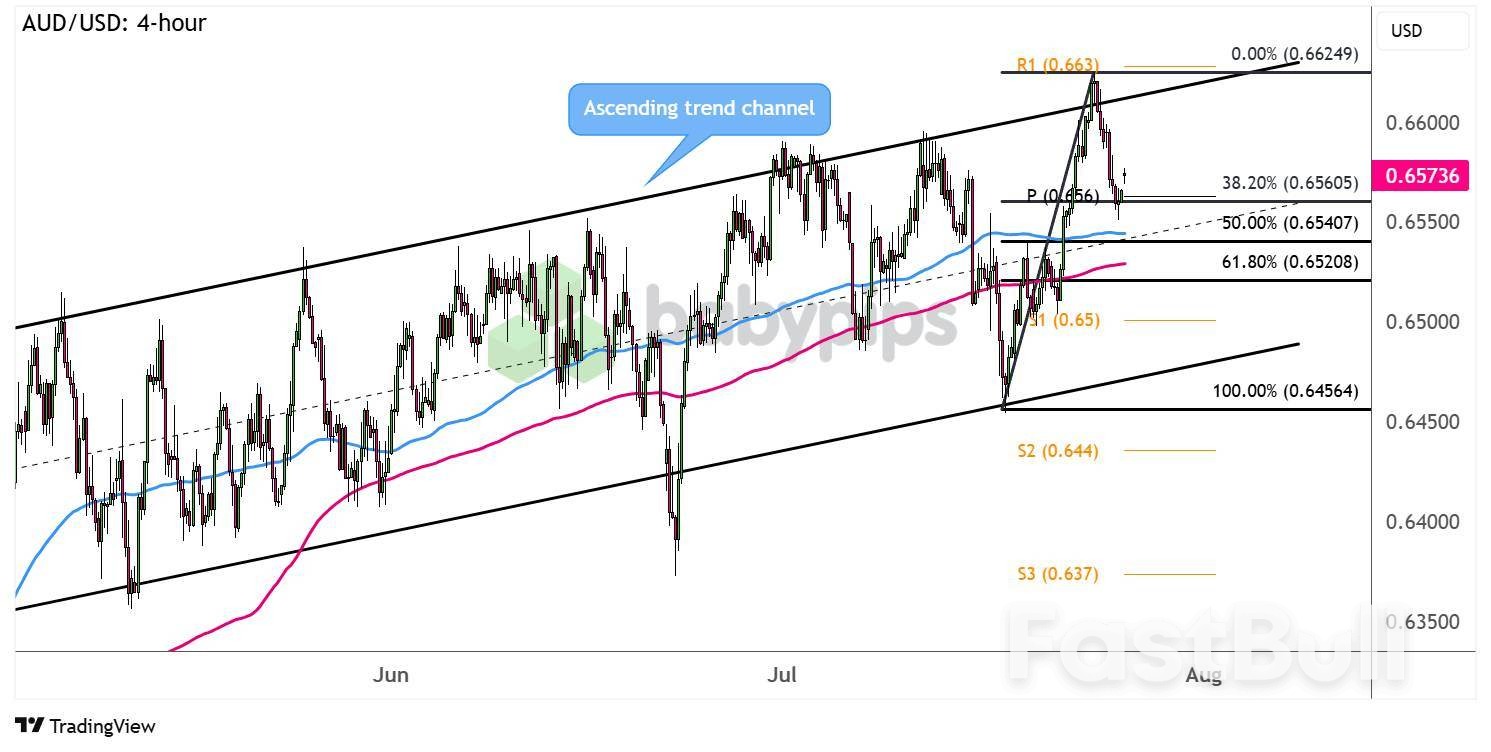
AUD/USD has been cruising higher with its rising lows and highs inside an ascending channel and looks ready for a pullback.
Here are the potential support zones that could attract more buyers.

Improving global trade sentiment has enabled this Aussie pair to trend higher inside a rising channel since May while the RBA’s surprise decision to hold in July gave an extra boost.
AUD/USD is hitting a ceiling at the top of its channel near R1 (.6630) while traders brace for the upcoming Australian quarterly CPI report, putting the pair in correction mode.
Can it find support at any of these Fib levels soon?
Remember that directional biases and volatility conditions in market price are typically driven by fundamentals. If you haven’t yet done your fundie homework on the Australian dollar and the U.S. dollar, then it’s time to check out the economic calendar and stay updated on daily fundamental news!
The pair is testing the 38.2% retracement level in line with the pivot point (.6560) at the moment but could still be in for a deeper pullback to the 50% Fib closer to the mid-channel area of interest and the .6550 minor psychological support.
Support could also be found at the 61.8% level then S1 (.6500) that coincides with a major psychological mark, so look out for reversal candlesticks that could suggest the uptrend is ready to resume. If this happens, bulls could set sights back on upside targets at the channel top or higher.
On the other hand, long red candles closing below the channel bottom could signal that a reversal may be in order, possibly dragging AUD/USD further south to S2 (.6440) then S3 (.6370).
Whichever bias you end up trading, don’t forget to practice proper risk management and stay aware of top-tier catalysts that could influence overall market sentiment.
What to Know:
President Donald Trump announced a preliminary US-EU trade agreement on July 27, 2025, featuring new tariffs, energy and military equipment purchases, and increased European investment in the United States.
The deal potentially stabilizes transatlantic trade, averting a trade war and influencing energy and defense sectors, though immediate effects on crypto markets remain unclear.
President Donald Trump announced a preliminary US-EU trade agreement featuring new tariffs, energy, and military purchases and increased EU investment in the US on July 27, 2025.
The agreement aims to reinforce economic ties, averting a more severe trade war. Immediate market reactions remain limited, with specific details pending further discussion and negotiations.
The US-EU trade agreement, introduced by President Trump, includes reduced tariffs and increased trans-Atlantic trade commitments. The deal emphasizes sectors like energy and defense, reflecting past US trade policies.
Ursula von der Leyen represented Europe's interests while major players like US-based defense companies anticipate benefits. This effort showcases the ongoing commitment to bolster economic collaboration between the regions. Jörn Fleck, Senior Director, Atlantic Council Europe Center, noted in his analysis that "The United States and Europe seem to have avoided a self-destructive trade war for now in the biggest and deepest commercial and investment relationship the global economy knows." Atlantic Council
The deal introduces a 15% tariff on most EU goods, potentially stimulating US export growth. However, new concessions and foreign direct investments mark significant financial impacts yet to fully materialize.
The trade agreement holds potential political and social implications centered on trade stability. Experts note that this could help in mitigating economic tensions, though reactions in crypto markets remain speculative.
Analysts draw parallels with former US-EU trade decisions where tariffs and investments have been central themes. These moves continue to aim at strengthening bilateral economic relations. Barbara C. Matthews, Nonresident Senior Fellow, Atlantic Council, shared that "The EU deal follows the pattern of other recent agreements ... new tariffs, purchases of US energy, and increased foreign direct investment (FDI) in the United States."
Future outcomes are anticipated to entail increased bilateral investments and commerce.
White Label
Data API
Web Plug-ins
Poster Maker
Affiliate Program
The risk of loss in trading financial instruments such as stocks, FX, commodities, futures, bonds, ETFs and crypto can be substantial. You may sustain a total loss of the funds that you deposit with your broker. Therefore, you should carefully consider whether such trading is suitable for you in light of your circumstances and financial resources.
No decision to invest should be made without thoroughly conducting due diligence by yourself or consulting with your financial advisors. Our web content might not suit you since we don't know your financial conditions and investment needs. Our financial information might have latency or contain inaccuracy, so you should be fully responsible for any of your trading and investment decisions. The company will not be responsible for your capital loss.
Without getting permission from the website, you are not allowed to copy the website's graphics, texts, or trademarks. Intellectual property rights in the content or data incorporated into this website belong to its providers and exchange merchants.
Not Logged In
Log in to access more features

FastBull Membership
Not yet
Purchase
Log In
Sign Up