• Trade
  • Markets
  • Copy
  • Contests
  • News
  • 24/7
  • Calendar
  • Q&A
  • Chats
Trending
Screeners
SYMBOL
LAST
BID
ASK
HIGH
LOW
NET CHG.
%CHG.
SPREAD
SPX
S&P 500 Index
6870.39
6870.39
6870.39
6895.79
6858.28
+13.27
+ 0.19%
--
DJI
Dow Jones Industrial Average
47954.98
47954.98
47954.98
48133.54
47871.51
+104.05
+ 0.22%
--
IXIC
NASDAQ Composite Index
23578.12
23578.12
23578.12
23680.03
23506.00
+72.99
+ 0.31%
--
USDX
US Dollar Index
98.920
99.000
98.920
98.960
98.730
-0.030
-0.03%
--
EURUSD
Euro / US Dollar
1.16510
1.16517
1.16510
1.16717
1.16341
+0.00084
+ 0.07%
--
GBPUSD
Pound Sterling / US Dollar
1.33158
1.33168
1.33158
1.33462
1.33136
-0.00154
-0.12%
--
XAUUSD
Gold / US Dollar
4211.31
4211.74
4211.31
4218.85
4190.61
+13.40
+ 0.32%
--
WTI
Light Sweet Crude Oil
59.236
59.266
59.236
60.084
59.160
-0.573
-0.96%
--

Community Accounts

Signal Accounts
--
Profit Accounts
--
Loss Accounts
--
View More

Become a signal provider

Sell trading signals to earn additional income

View More

Guide to Copy Trading

Get started with ease and confidence

View More

Signal Accounts for Members

All Signal Accounts

Best Return
  • Best Return
  • Best P/L
  • Best MDD
Past 1W
  • Past 1W
  • Past 1M
  • Past 1Y

All Contests

  • All
  • Trump Updates
  • Recommend
  • Stocks
  • Cryptocurrencies
  • Central Banks
  • Featured News
Top News Only
Share

India Foreign Ministry: Expect China To Give Assurance That Indians Transiting Through China Will Not Be 'Selectively Targeted'

Share

Christian Association Of Nigeria: Nigerian Government Rescues 100 Schoolchildren Kidnapped From Catholic School Last Month

Share

Mother Of Last Gaza Hostage Says Israel Won't Heal Until He's Back

Share

Agrural - Brazil's 2025/26 Total Corn Output Seen At 135.3 Million Tonnes Versus 141.1 Million Tonnes In Previous Season

Share

Agrural - Brazil's 2025/26 Soybean Planting Hits 94% Of Expected Area As Of Last Thursday

Share

S.Africa's Eskom Says Regulator Nersa Is Processing An Application For An Interim Tariff Adjustment For The Smelters, While Government Is Working On A Complementary Mechanism To Support A More Competitive Pricing Path For The Sector

Share

SEBI: Modalities For Migration To Ai Only Schemes And Relaxations To Large Value Funds For Accredited Investors

Share

All 6 Bank Of Israel Monetary Policy Committee Members Voted To Lower Benchmark Interest Rate 25 Bps To 4.25% On Nov 24

Share

India Government: Cancellations Are On Account Of Developer Delays And Not Due To Transmission Side Delays

Share

Fitch: We See Moderation Of Export Performance In China In 2026

Share

India Government: Revokes Grid Access Permissions For Renewable Energy Projects

Share

Stats Office - Tanzania Inflation At 3.4% Year-On-Year In November

Share

Temasek CEO Dilhan Pillay: We Are Taking A Conservative Stance On Allocating Capital

Share

Brazil Economists See Brazilian Real At 5.40 Per Dollar By Year-End 2025 Versus 5.40 In Previous Estimate - Central Bank Poll

Share

Brazil Economists See Year-End 2026 Interest Rate Selic At 12.25% Versus 12.00% In Previous Estimate - Central Bank Poll

Share

Brazil Economists See Year-End 2025 Interest Rate Selic At 15.00% Versus 15.00% In Previous Estimate - Central Bank Poll

Share

EU Commission Says Meta Has Committed To Give EU Users Choice On Personalised Ads

Share

Sources Revealed That The Bank Of England Has Invited Employees To Voluntarily Apply For Layoffs

Share

The Bank Of England Plans To Cut Staff Due To Budget Pressures

Share

Traders Believe There Is Less Than A 10% Chance That The European Central Bank Will Cut Interest Rates By 25 Basis Points In 2026

TIME
ACT
FCST
PREV
France Industrial Output MoM (SA) (Oct)

A:--

F: --

P: --
France Trade Balance (SA) (Oct)

A:--

F: --

P: --
Euro Zone Employment YoY (SA) (Q3)

A:--

F: --

P: --
Canada Part-Time Employment (SA) (Nov)

A:--

F: --

P: --

Canada Unemployment Rate (SA) (Nov)

A:--

F: --

P: --

Canada Full-time Employment (SA) (Nov)

A:--

F: --

P: --

Canada Labor Force Participation Rate (SA) (Nov)

A:--

F: --

P: --

Canada Employment (SA) (Nov)

A:--

F: --

P: --

U.S. PCE Price Index MoM (Sept)

A:--

F: --

P: --

U.S. Personal Income MoM (Sept)

A:--

F: --

P: --

U.S. Core PCE Price Index MoM (Sept)

A:--

F: --

P: --

U.S. PCE Price Index YoY (SA) (Sept)

A:--

F: --

P: --

U.S. Core PCE Price Index YoY (Sept)

A:--

F: --

P: --

U.S. Personal Outlays MoM (SA) (Sept)

A:--

F: --

P: --
U.S. 5-10 Year-Ahead Inflation Expectations (Dec)

A:--

F: --

P: --

U.S. Real Personal Consumption Expenditures MoM (Sept)

A:--

F: --

P: --
U.S. Weekly Total Rig Count

A:--

F: --

P: --

U.S. Weekly Total Oil Rig Count

A:--

F: --

P: --

U.S. Consumer Credit (SA) (Oct)

A:--

F: --

P: --
China, Mainland Foreign Exchange Reserves (Nov)

A:--

F: --

P: --

Japan Trade Balance (Oct)

A:--

F: --

P: --

Japan Nominal GDP Revised QoQ (Q3)

A:--

F: --

P: --

China, Mainland Imports YoY (CNH) (Nov)

A:--

F: --

P: --

China, Mainland Exports (Nov)

A:--

F: --

P: --

China, Mainland Imports (CNH) (Nov)

A:--

F: --

P: --

China, Mainland Trade Balance (CNH) (Nov)

A:--

F: --

P: --

China, Mainland Exports YoY (USD) (Nov)

A:--

F: --

P: --

China, Mainland Imports YoY (USD) (Nov)

A:--

F: --

P: --

Germany Industrial Output MoM (SA) (Oct)

A:--

F: --

P: --
Euro Zone Sentix Investor Confidence Index (Dec)

A:--

F: --

P: --

Canada National Economic Confidence Index

--

F: --

P: --

U.K. BRC Like-For-Like Retail Sales YoY (Nov)

--

F: --

P: --

U.K. BRC Overall Retail Sales YoY (Nov)

--

F: --

P: --

Australia Overnight (Borrowing) Key Rate

--

F: --

P: --

RBA Rate Statement
RBA Press Conference
Germany Exports MoM (SA) (Oct)

--

F: --

P: --

U.S. NFIB Small Business Optimism Index (SA) (Nov)

--

F: --

P: --

Mexico 12-Month Inflation (CPI) (Nov)

--

F: --

P: --

Mexico Core CPI YoY (Nov)

--

F: --

P: --

Mexico PPI YoY (Nov)

--

F: --

P: --

U.S. Weekly Redbook Index YoY

--

F: --

P: --

U.S. JOLTS Job Openings (SA) (Oct)

--

F: --

P: --

China, Mainland M1 Money Supply YoY (Nov)

--

F: --

P: --

China, Mainland M0 Money Supply YoY (Nov)

--

F: --

P: --

China, Mainland M2 Money Supply YoY (Nov)

--

F: --

P: --

U.S. EIA Short-Term Crude Production Forecast For The Year (Dec)

--

F: --

P: --

U.S. EIA Natural Gas Production Forecast For The Next Year (Dec)

--

F: --

P: --

U.S. EIA Short-Term Crude Production Forecast For The Next Year (Dec)

--

F: --

P: --

EIA Monthly Short-Term Energy Outlook
U.S. API Weekly Gasoline Stocks

--

F: --

P: --

U.S. API Weekly Cushing Crude Oil Stocks

--

F: --

P: --

U.S. API Weekly Crude Oil Stocks

--

F: --

P: --

U.S. API Weekly Refined Oil Stocks

--

F: --

P: --

South Korea Unemployment Rate (SA) (Nov)

--

F: --

P: --

Japan Reuters Tankan Non-Manufacturers Index (Dec)

--

F: --

P: --

Japan Reuters Tankan Manufacturers Index (Dec)

--

F: --

P: --

Japan Domestic Enterprise Commodity Price Index MoM (Nov)

--

F: --

P: --

Japan Domestic Enterprise Commodity Price Index YoY (Nov)

--

F: --

P: --

China, Mainland PPI YoY (Nov)

--

F: --

P: --

China, Mainland CPI MoM (Nov)

--

F: --

P: --

Q&A with Experts
    • All
    • Chatrooms
    • Groups
    • Friends
    Connecting
    .
    .
    .
    Type here...
    Add Symbol or Code

      No matching data

      All
      Trump Updates
      Recommend
      Stocks
      Cryptocurrencies
      Central Banks
      Featured News
      • All
      • Russia-Ukraine Conflict
      • Middle East Flashpoint
      • All
      • Russia-Ukraine Conflict
      • Middle East Flashpoint
      Search
      Products

      Charts Free Forever

      Chats Q&A with Experts
      Screeners Economic Calendar Data Tools
      Membership Features
      Data Warehouse Market Trends Institutional Data Policy Rates Macro

      Market Trends

      Market Sentiment Order Book Forex Correlations

      Top Indicators

      Charts Free Forever
      Markets

      News

      News Analysis 24/7 Columns Education
      From Institutions From Analysts
      Topics Columnists

      Latest Views

      Latest Views

      Trending Topics

      Top Columnists

      Latest Update

      Signals

      Copy Rankings Latest Signals Become a signal provider AI Rating
      Contests
      Brokers

      Overview Brokers Assessment Rankings Regulators News Claims
      Broker listing Forex Brokers Comparison Tool Live Spread Comparison Scam
      Q&A Complaint Scam Alert Videos Tips to Detect Scam
      More

      Business
      Events
      Careers About Us Advertising Help Center

      White Label

      Data API

      Web Plug-ins

      Affiliate Program

      Awards Institution Evaluation IB Seminar Salon Event Exhibition
      Vietnam Thailand Singapore Dubai
      Fans Party Investment Sharing Session
      FastBull Summit BrokersView Expo
      Recent Searches
        Top Searches
          Markets
          News
          Analysis
          User
          24/7
          Economic Calendar
          Education
          Data
          • Names
          • Latest
          • Prev

          View All

          No data

          Scan to Download

          Faster Charts, Chat Faster!

          Download App
          English
          • English
          • Español
          • العربية
          • Bahasa Indonesia
          • Bahasa Melayu
          • Tiếng Việt
          • ภาษาไทย
          • Français
          • Italiano
          • Türkçe
          • Русский язык
          • 简中
          • 繁中
          Open Account
          Search
          Products
          Charts Free Forever
          Markets
          News
          Signals

          Copy Rankings Latest Signals Become a signal provider AI Rating
          Contests
          Brokers

          Overview Brokers Assessment Rankings Regulators News Claims
          Broker listing Forex Brokers Comparison Tool Live Spread Comparison Scam
          Q&A Complaint Scam Alert Videos Tips to Detect Scam
          More

          Business
          Events
          Careers About Us Advertising Help Center

          White Label

          Data API

          Web Plug-ins

          Affiliate Program

          Awards Institution Evaluation IB Seminar Salon Event Exhibition
          Vietnam Thailand Singapore Dubai
          Fans Party Investment Sharing Session
          FastBull Summit BrokersView Expo

          US Buyers Circumvent China’s Mineral Ban Through Third-Party Routes and Shadow Supply Chains

          Gerik

          Economic

          China–U.S. Trade War

          Commodity

          Summary:

          Despite China’s export ban on critical minerals to the United States, American firms continue to receive antimony, gallium, and germanium through third countries such as Thailand and Mexico...

          Uncovering the New Trade Routes in the Mineral War

          Following China's December 2024 ban on exporting key minerals antimony, gallium, and germanium to the United States, recent trade data reveal that US companies continue to access these critical resources through indirect channels. Notably, exports of antimony oxides from Thailand and Mexico to the US surged between December and April, surpassing volumes seen over the past three years combined. This redirection illustrates the effectiveness of rerouting minerals through intermediary nations, sidestepping China’s restrictions without violating US law.
          Since the ban took effect, Thailand and Mexico have emerged as major export hubs for Chinese antimony, rising from obscurity in 2023 to top positions by mid-2025. Neither country mines significant quantities of the metal and each only operates a single antimony smelter, further indicating that they are primarily transit points. Chinese customs data confirm that exports of antimony to these nations have increased sharply in 2025, coinciding with a proportional rise in US imports from them.
          The causative factor behind this shift is China's restriction policy, which, instead of curbing global availability, has merely redirected supply routes. The correlation between China’s export licensing controls and the spike in intermediary country trade suggests that enforcement gaps are allowing continued flows to the US.

          Evidence of Transshipment and Concealment

          Several US importers and industry experts confirm that shipments are proceeding under alternative labels and routing methods. According to Levi Parker of Gallant Metals, gallium purchased from China is mislabelled as other goods such as iron or art supplies before being sent through third countries. Although this practice allows continued access to the mineral, it is expensive and logistically complex, with increased scrutiny limiting shipment sizes.
          In particular, one company, Thai Unipet Industries a subsidiary of China's Youngsun Chemicals was documented shipping over 3,300 tons of antimony products to the US between December and May, a volume 27 times higher than in the same period a year earlier. These shipments were received by Texas-based Youngsun & Essen, a known importer of Chinese antimony prior to the ban. While the records do not confirm the origin of the raw materials, the scale of growth and the affiliations involved suggest a strong likelihood of Chinese origin minerals continuing to enter the US market through rebranding and third-party processing.

          China's Legal Response and the Limits of Enforcement

          In response to these rerouting strategies, China launched a crackdown in May targeting transshipment and smuggling of strategic minerals. The laws governing these exports hold Chinese sellers accountable for due diligence, including tracing the final destination of goods even if transactions occur abroad. Violations can lead to fines, export bans, or prison sentences exceeding five years in serious cases.
          However, these legal mechanisms are only effective if enforced consistently. Experts such as Ram Ben Tzion of Publican emphasize that while regulations exist, their real-world application is often limited. The disparity between policy and enforcement reveals structural weaknesses in China’s control regime, which faces the dual challenge of maintaining national security while sustaining global demand-driven profit motives.

          Price Incentives and Global Market Dynamics

          Despite higher prices resulting from the ban, US imports of antimony, gallium, and germanium are on pace to match or exceed pre-ban levels. The market's response has been clear: where demand exists, supply chains will adapt, even at higher costs and legal risks. Profit margins on these scarce resources have risen dramatically, incentivizing continued trade regardless of the regulatory landscape.
          While China's export data shows that its shipments remain below pre-restriction levels, the persistence of mineral flows to the US underscores the limitations of unilateral bans in globally integrated supply chains. The causal mechanism here is economic: restrictions raise prices, which then incentivize circumvention strategies, maintaining supply continuity through unofficial channels.

          The Real Battle Lies in Enforcement, Not Policy

          Beijing’s efforts to exert control over critical mineral flows highlight a fundamental tension between political strategy and economic reality. While it possesses near-monopolistic control over global production of certain minerals, its ability to enforce export restrictions remains imperfect. On the other side, US firms continue to demonstrate adaptability and resilience by leveraging indirect supply routes, ensuring minimal disruption to sectors reliant on these inputs.
          As the geopolitical competition between the US and China intensifies, the trade in critical minerals will remain a key battlefield not just in terms of access, but also in the global contest of regulatory enforcement versus market creativity.

          Source: Reuters

          To stay updated on all economic events of today, please check out our Economic calendar
          Risk Warnings and Disclaimers
          You understand and acknowledge that there is a high degree of risk involved in trading. Following any strategies or investment methods may lead to potential losses. The content on the site is provided by our contributors and analysts for information purposes only. You are solely responsible for determining whether any trading assets, securities, strategy, or any other product is suitable for investing based on your own investment objectives and financial situation.
          Add to Favorites
          Share

          RBA Holds Steady Amid Global Tariff Uncertainty and Waits for Clearer Inflation Signals

          Gerik

          Economic

          RBA Cautions Amid Heightened Global Uncertainty

          The Reserve Bank of Australia (RBA) has chosen to maintain its cash rate at 3.85% during its latest policy meeting, defying market expectations for further tightening. This decision underscores a cautious stance from the central bank as it navigates growing international uncertainties, particularly those tied to the evolving US tariff regime. According to Deputy Governor Andrew Hauser, the global landscape is currently marked by heightened instability, and developments in American trade policy are commanding close attention from the Australian monetary authority.
          Hauser emphasized that while the impact of these US tariff changes on Australia is still in the early stages, the RBA is not taking their potential lightly. Unlike in the United States and parts of Europe, where business and consumer confidence has seen a notable decline, sentiment within Australia’s domestic economy remains relatively stable for now. This difference may reflect the time lag between policy announcements abroad and tangible effects on Australian markets.
          The relationship between US tariff measures and the Australian economy at this stage appears to be more of a correlation than a direct causation. However, should the trade environment deteriorate further through escalated tariffs or retaliatory measures Australia could begin to experience more pronounced economic spillovers, particularly in trade-sensitive sectors such as agriculture and manufacturing.

          Why the RBA Is Pausing Despite Inflation Concerns

          The RBA’s decision to pause rate hikes stems from an internal majority that prefers to wait for clearer data confirming a sustained slowdown in inflation. Although price pressures remain elevated, the central bank believes it prudent to assess whether previous monetary tightening has begun to have the intended dampening effect on inflationary trends. This approach reflects a more data-dependent strategy, rather than pre-committing to a set path of interest rate adjustments.
          Such a stance suggests that the RBA is attempting to balance two competing risks: tightening too much and choking off economic growth, or doing too little and allowing inflation to become entrenched. In this context, the uncertainty stemming from US policy actions adds a further layer of complexity, reinforcing the case for a more measured pace.

          Market Reactions and Economic Outlook

          Financial markets were caught off guard by the RBA’s decision, having priced in at least one additional hike before year-end. The central bank’s caution signals a shift toward patience as global developments unfold. Nevertheless, the tone from Deputy Governor Hauser makes it clear that vigilance remains high, and any acceleration in global trade disruptions or domestic inflation data could reignite policy tightening.
          In conclusion, the RBA is entering a phase of careful observation. Its attention to US tariff developments is not merely reactive but part of a broader attempt to anticipate secondary effects on Australia's open and trade-reliant economy. For now, the bank has chosen stability over preemptive action, relying on real-time data to guide its next move.

          Source: Reuters

          To stay updated on all economic events of today, please check out our Economic calendar
          Risk Warnings and Disclaimers
          You understand and acknowledge that there is a high degree of risk involved in trading. Following any strategies or investment methods may lead to potential losses. The content on the site is provided by our contributors and analysts for information purposes only. You are solely responsible for determining whether any trading assets, securities, strategy, or any other product is suitable for investing based on your own investment objectives and financial situation.
          Add to Favorites
          Share

          Israel's Army Still Taking On Mass Casualties After 640 Days Of War In Gaza

          George Anderson

          Over 630 days of war later and much of Hamas' top command has been wiped out, and large swathes of the Gaza Strip obliterated. It's been no secret that the Netanyahu government is pursuing the complete annihilation of Hamas, ensuring that it can never again return to rule, but the reality is that the Israeli army is still taking on mass casualties.

          This shows that the Hamas insurgency, using the Strip's hundreds of miles of tunnels, is still fierce and ongoing. "Five Israeli soldiers were killed in combat in the Gaza Strip, the Israeli army admitted on Tuesday, in one of the deadliest days for Israeli forces in the devastated Palestinian territory this year," regional media reports.

          The five soldiers "fell during combat in the northern Gaza Strip," the IDF announced. In total 14 others were wounded. Included were two that were severely wounded and "evacuated to a hospital to receive medical treatment."

          They came under attack near Beit Hanoun in the north of Gaza,when improvised explosive devices were detonated, after which Israeli soldiers who sought to rescue the wounded came under fire again. Thus it's clear that either Hamas or Islamic Jihad militants set a trap and ambush for the soldiers.

          The IDF and Israeli media have described that the infantry troops were operating on foot when the blast happened. One detail which highlights the ongoing extreme difficulty of uprooting the Palestinian insurgency is that the area where the attack occurred was subject of Israeli aerial raids just prior:

          The military said the area where the attack took place was targeted from the air ahead of the troops’ operations.

          The Netzah Yehuda soldiers were operating under the Gaza Division’s Northern Brigade as part of a fresh offensive with the 646th Reserve Paratroopers Brigade in Beit Hanoun, which began on Saturday, aimed at clearing the area of terror operatives who remain holed up there.

          Israeli opposition leader Yair Lapid wrote on X in the wake of the large-scale casualties, "For the sake of the fighters, for the sake of their families, for the sake of the hostages, for the sake of the State of Israel: this war must be ended."

          Israeli society has remained fiercely divided over Netanyahu policy, with hostage victims' family members outraged that efforts to negotiate a deal to release the remaining captives have completely stalled.

          Meanwhile, there is some activity on this front, with Qatar’s foreign ministry on Tuesday saying that renewed indirect negotiations will "need time". The White House has been supportive of peace efforts, but has sided with Israeli actions in Gaza time and again in its public rhetoric.

          "I don’t think that I can give any timeline at the moment, but I can say right now that we will need time for this," spokesman Majed Al-Ansari said as Doha-hosted discussion entered a third day.

          "What is happening right now is that both delegations are in Doha. We are speaking with them separately on a framework for the talks. So talks have not begun, as of yet, but we are talking to both sides over that framework," he tells a Doha news conference.

          Source: Zero Hedge

          Risk Warnings and Disclaimers
          You understand and acknowledge that there is a high degree of risk involved in trading. Following any strategies or investment methods may lead to potential losses. The content on the site is provided by our contributors and analysts for information purposes only. You are solely responsible for determining whether any trading assets, securities, strategy, or any other product is suitable for investing based on your own investment objectives and financial situation.
          Add to Favorites
          Share

          Gold Holds Decline As Extended US Negotiations Ease Trade Fears

          Michael Ross

          Gold held a decline after President Donald Trump said the new August deadline for the start of so-called “reciprocal” tariffs won’t be delayed, with nations expected to use the extended window to continue negotiating with the US.

          Bullion traded near $3,300 an ounce, after a 1% loss in the previous session. Trump’s move to postpone the imposition of all “Liberation Day” duties — which were first announced in April and then delayed to July 9 — to next month is partly an effort to clinch more agreements from nations still willing to deal with the US, denting haven demand for the precious metal.

          While the delay has eased some concerns about the potential negative impact that Trump’s tariff agenda could have on the global economy, the president also indicated he could announce substantial new rates on imports of copper and pharmaceuticals. If those materialize, that could see renewed demand for havens.

          Gold was also impacted on Tuesday as US Treasuries fell. Yields have been rising as investors pare bets on Federal Reserve interest-rate cuts by year-end, following a report last week that showed a surprisingly resilient US labor market. Higher borrowing costs tend to pose a headwind for non-yielding bullion.

          The precious metal has rallied by more than a quarter this year, setting a record in April, as Trump’s efforts to overhaul trade policies stoked uncertainty, driving investors to seek safety in gold. The advance has been supported by central-bank accumulation, with China announcing an eighth straight month of purchases earlier this week.

          Spot gold was little changed at $3,300.23 an ounce as of 7:40 a.m. in Singapore. The Bloomberg Dollar Spot Index was little changed. Silver, palladium and platinum edged lower.

          Source: Bloomberg Europe

          Risk Warnings and Disclaimers
          You understand and acknowledge that there is a high degree of risk involved in trading. Following any strategies or investment methods may lead to potential losses. The content on the site is provided by our contributors and analysts for information purposes only. You are solely responsible for determining whether any trading assets, securities, strategy, or any other product is suitable for investing based on your own investment objectives and financial situation.
          Add to Favorites
          Share

          Trump, Netanyahu Meet A Second Time As Gaps Said To Narrow In Gaza Ceasefire Talks

          Alice Winters

          U.S. President Donald Trump on Tuesday met for a second time in two days with Israeli Prime Minister Benjamin Netanyahu to discuss Gaza as Trump's Middle East envoy said Israel and Hamas were closing their differences on a ceasefire deal.

          The Israeli leader departed the White House on Tuesday evening after just over an hour's meeting with Trump in the Oval Office, with no press access. The two men also met for several hours during a dinner at the White House on Monday during Netanyahu's third U.S. visit since the president began his second term on January 20.

          Netanyahu met with Vice President JD Vance and then visited the U.S. Capitol on Tuesday, and is due back in Congress on Wednesday to meet with U.S. Senate leaders.

          He told reporters after a meeting with the Republican House of Representatives Speaker Mike Johnson that while he did not think Israel's campaign in the Palestinian enclave was done, negotiators are "certainly working" on a ceasefire.

          "We have still to finish the job in Gaza, release all our hostages, eliminate and destroy Hamas' military and government capabilities," Netanyahu said.

          Shortly after Netanyahu spoke, Trump's special envoy to the Middle East, Steve Witkoff, said the issues keeping Israel and Hamas from agreeing had dropped to one from four and he hoped to reach a temporary ceasefire agreement this week.

          "We are hopeful that by the end of this week, we'll have an agreement that will bring us into a 60-day ceasefire. Ten live hostages will be released. Nine deceased will be released," Witkoff told reporters at a meeting of Trump's Cabinet.

          A delegation from Qatar, which has been hosting indirect talks between Israeli negotiators and the Hamas Palestinian militant group, met with senior White House officials for several hours before Netanyahu's arrival on Tuesday, Axios reported, citing a source familiar with the details.

          The White House had no immediate comment on the report.

          The Gaza war erupted when Hamas attacked southern Israel in October 2023, killing around 1,200 people and taking 251 hostages, according to Israeli figures. Some 50 hostages remain in Gaza, with 20 believed to be alive.

          Israel's retaliatory war in Gaza has killed over 57,000 Palestinians, according to the enclave's health ministry. Most of Gaza's population has been displaced by the war and nearly half a million people are facing famine within months, according to United Nations estimates.

          Trump had strongly supported Netanyahu, even wading into domestic Israeli politics by criticizing prosecutors over a corruption trial against the Israeli leader on bribery, fraud and breach-of-trust charges that Netanyahu denies.

          In his remarks to reporters at the U.S. Congress, Netanyahu praised Trump, saying there has never been closer coordination between the U.S. and Israel in his country's history.

          Source: Reuters

          Risk Warnings and Disclaimers
          You understand and acknowledge that there is a high degree of risk involved in trading. Following any strategies or investment methods may lead to potential losses. The content on the site is provided by our contributors and analysts for information purposes only. You are solely responsible for determining whether any trading assets, securities, strategy, or any other product is suitable for investing based on your own investment objectives and financial situation.
          Add to Favorites
          Share

          US Used Car Prices Surge As Tariffs Drive Market Volatility

          James Riley

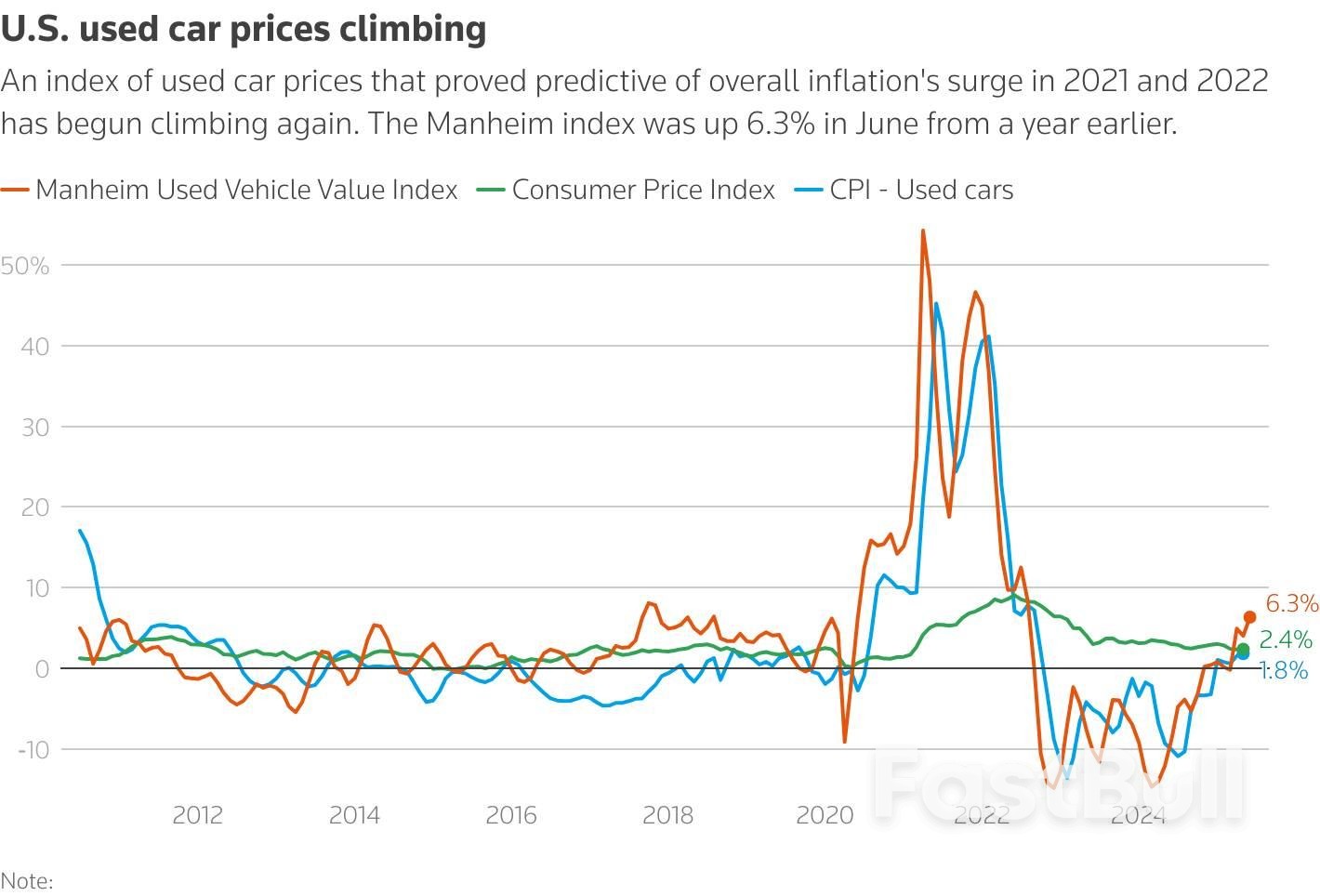
          A gauge of U.S. used vehicle prices sold at wholesale auctions that proved predictive ahead of the inflation surge following the COVID pandemic is climbing again, last month notching its largest annual increase in nearly three years.

          The rise comes amid ongoing vehicle price and sales volatility connected to auto tariffs imposed by President Donald Trump.

          The Manheim Used Vehicle Value Index rose 1.6% in June from May on a seasonally adjusted basis and surged 6.3% from a year earlier, the largest year-over-year increase since August 2022, according to data released on Tuesday. At 208.5, the index has been trending upward for a year and is now at its highest since October 2023.

          “Wholesale appreciation trends have been more volatile over Q2 as tariffs really impacted new sales and supply, which impacted the used marketplace as well,” said Jeremy Robb, senior director of economic and industry insights at Cox Automotive, which provides the index.

          Price pressures typically ease in the second half of the year, but Robb said retail vehicle sales remain "a bit hotter than prior years" and the supply of vehicles coming off lease into the used-car market has been trending downward, "two factors which should be fairly supportive of higher values as we move onward.”

          Trump's 25% tariff on imported autos prompted a surge in new vehicle-buying during the early spring as consumers sought to front-run anticipated price increases from the levies. Sales fell off substantially in May and dropped again in June.

          Overall inflation has so far defied the predictions of most economists, but many Federal Reserve officials remain convinced some sort of price surge will follow and are hesitant to cut interest rates until satisfied that risk has passed.

          Manheim's index in recent years has caught the eye of private economists and some Fed officials who saw it as among the early indicators auguring for a more substantial, and long-lasting, bout of inflation as the economy emerged from the pandemic in 2021 and 2022.

          The index began a sharp climb in late 2020 that persisted for more than a year. By mid-2022, overall U.S. inflation as measured by the Consumer Price Index had topped 9% and was the highest since the 1980s.

          Fed Governor Christopher Waller in the fall of 2021 warned against "selectively ignoring data series - be it used car prices, food and energy prices or household surveys of inflation expectations. All of these series convey important information about the evolution of inflation, and one should exhibit caution in dismissing data as outliers."

          At the time, Waller was building the case for interest rate hikes to combat still-building inflation that some of his colleagues considered "transitory."

          Now, though, Waller, who is viewed to be among those Trump is considering as a successor to Fed Chair Jerome Powell, appears more concerned the tariff increases will hurt demand rather than stoke another lasting bout of inflation. Waller said recently he was open to cutting rates as early as the Fed's meeting later in July.

          Source: Reuters

          Risk Warnings and Disclaimers
          You understand and acknowledge that there is a high degree of risk involved in trading. Following any strategies or investment methods may lead to potential losses. The content on the site is provided by our contributors and analysts for information purposes only. You are solely responsible for determining whether any trading assets, securities, strategy, or any other product is suitable for investing based on your own investment objectives and financial situation.
          Add to Favorites
          Share

          Supreme Court Lets Trump Pursue Mass Federal Layoffs

          James Whitman

          Political

          Handing President Donald Trump another victory, the U.S. Supreme Court gave the go-ahead on Tuesday for his administration to pursue mass federal job cuts potentially numbering in the hundreds of thousands and the restructuring of numerous agencies.

          Workforce reductions are being planned by the administration at the U.S. Departments of Agriculture, Commerce, Health and Human Services, State, Treasury, Veterans Affairs and more than a dozen other agencies.

          The Supreme Court lifted San Francisco-based U.S. District Judge Susan Illston's May 22 order that blocked large-scale federal layoffs called "reductions in force" while litigation in the case proceeds.

          White House spokesperson Harrison Fields welcomed the court's action, calling it "another definitive victory for the president and his administration" that reinforced Trump's authority to implement "efficiency across the federal government."

          The Supreme Court in recent months has sided with Trump in several cases that were acted upon on an emergency basis since he returned to office in January including clearing the way for implementation of some of his hardline immigration policies. In addition, Trump last week also claimed the biggest legislative win of his second presidential term with congressional passage of a massive package of tax and spending cuts.

          The court, in a brief unsigned order on Tuesday, said Trump's administration was "likely to succeed on its argument that the executive order" and a memorandum implementing his order were lawful. The court said it was not assessing the legality of any specific plans for layoffs at federal agencies.

          Liberal Justice Ketanji Brown Jackson was the sole member of the nine-person court to publicly dissent from the decision. Jackson wrote that Illston's "temporary, practical, harm-reducing preservation of the status quo was no match for this court's demonstrated enthusiasm for greenlighting this president's legally dubious actions in an emergency posture."

          Trump in February announced "a critical transformation of the federal bureaucracy" in an executive order directing agencies to prepare for a government overhaul aimed at significantly reducing the federal workforce and gutting offices and programs opposed by his administration.

          A group of unions, non-profits and local governments that sued to block the administration's mass layoffs said Tuesday's Supreme Court ruling "dealt a serious blow to our democracy and puts services that the American people rely on in grave jeopardy."

          "This decision does not change the simple and clear fact that reorganizing government functions and laying off federal workers en masse haphazardly without any congressional approval is not allowed by our Constitution," the plaintiffs said in a statement, adding that they would "continue to fight on behalf of the communities we represent."

          Illston had ruled that Trump exceeded his authority in ordering the government downsizing.

          "As history demonstrates, the president may broadly restructure federal agencies only when authorized by Congress," Illston wrote.

          The judge's ruling was the broadest of its kind against the government overhaul being pursued by Trump and the Department of Government Efficiency, a key player in the Republican president's drive to slash the federal workforce.

          Formerly spearheaded by billionaire Elon Musk, DOGE has sought to eliminate federal jobs, shrink and reshape the U.S. government and root out what they see as wasteful spending. Musk formally ended his government work on May 30 and subsequently had a public falling out with Trump.

          The judge blocked the agencies from carrying out mass layoffs and limited their ability to cut or overhaul federal programs. Illston also ordered the reinstatement of workers who had lost their jobs, though she delayed implementing this portion of her ruling while the appeals process plays out.

          Don Moynihan, a public policy professor at the University of Michigan, said the Supreme Court's decision allows Trump to move forward with mass firings of federal workers, without adjudicating the legality of those layoffs.

          "These are not minor reductions in force," Moynihan said. "Trump has made clear he wants a major downsizing of the federal government. The court is willing to let him move forward and do severe and irreparable damage to public services."

          Americans narrowly favor on Trump's campaign to downsize the federal government, with about 56% saying they supported the effort and 40% opposed, according to April Reuters/Ipsos polling. Their views broke down along party lines with 89% of Republicans, but just 26% of Democrats, supportive.

          'SUPERVISORY POWERS'

          The San Francisco-based 9th U.S. Circuit Court of Appeals in a 2-1 ruling on May 30 denied the administration's request to halt the judge's ruling. That prompted the Justice Department's June 2 emergency request to the Supreme Court to halt Illston's order.

          "The Constitution does not erect a presumption against presidential control of agency staffing, and the president does not need special permission from Congress to exercise core Article II powers," the Justice Department told the court, referring to the constitution's section delineating presidential authority.

          Allowing the Trump administration to move forward with its "breakneck reorganization," the plaintiffs told the court, would mean that "programs, offices and functions across the federal government will be abolished, agencies will be radically downsized from what Congress authorized, critical government services will be lost and hundreds of thousands of federal employees will lose their jobs."

          The Supreme Court in recent months has let Trump's administration resume deporting migrants to countries other than their own without offering them a chance to show the harms they could face and end temporary legal status previously granted on humanitarian grounds to hundreds of thousands of migrants.

          In addition, it has allowed Trump to implement his ban on transgender people in the U.S. military, blocked a judge's order for the administration to rehire thousands of fired employees, twice sided with DOGE and curbed the power of federal judges to impose nationwide rulings impeding presidential policies.

          Source: Reuters

          Risk Warnings and Disclaimers
          You understand and acknowledge that there is a high degree of risk involved in trading. Following any strategies or investment methods may lead to potential losses. The content on the site is provided by our contributors and analysts for information purposes only. You are solely responsible for determining whether any trading assets, securities, strategy, or any other product is suitable for investing based on your own investment objectives and financial situation.
          Add to Favorites
          Share
          FastBull
          Copyright © 2025 FastBull Ltd

          728 RM B 7/F GEE LOK IND BLDG NO 34 HUNG TO RD KWUN TONG KLN HONG KONG

          TelegramInstagramTwitterfacebooklinkedin
          App Store Google Play Google Play
          Products
          Charts

          Chats

          Q&A with Experts
          Screeners
          Economic Calendar
          Data
          Tools
          Membership
          Features
          Function
          Markets
          Copy Trading
          Latest Signals
          Contests
          News
          Analysis
          24/7
          Columns
          Education
          Company
          Careers
          About Us
          Contact Us
          Advertising
          Help Center
          Feedback
          User Agreement
          Privacy Policy
          Business

          White Label

          Data API

          Web Plug-ins

          Poster Maker

          Affiliate Program

          Risk Disclosure

          The risk of loss in trading financial instruments such as stocks, FX, commodities, futures, bonds, ETFs and crypto can be substantial. You may sustain a total loss of the funds that you deposit with your broker. Therefore, you should carefully consider whether such trading is suitable for you in light of your circumstances and financial resources.

          No decision to invest should be made without thoroughly conducting due diligence by yourself or consulting with your financial advisors. Our web content might not suit you since we don't know your financial conditions and investment needs. Our financial information might have latency or contain inaccuracy, so you should be fully responsible for any of your trading and investment decisions. The company will not be responsible for your capital loss.

          Without getting permission from the website, you are not allowed to copy the website's graphics, texts, or trademarks. Intellectual property rights in the content or data incorporated into this website belong to its providers and exchange merchants.

          Not Logged In

          Log in to access more features

          FastBull Membership

          Not yet

          Purchase

          Become a signal provider
          Help Center
          Customer Service
          Dark Mode
          Price Up/Down Colors

          Log In

          Sign Up

          Position
          Layout
          Fullscreen
          Default to Chart
          The chart page opens by default when you visit fastbull.com