• Trade
  • Markets
  • Copy
  • Contests
  • News
  • 24/7
  • Calendar
  • Q&A
  • Chats
Trending
Screeners
SYMBOL
LAST
BID
ASK
HIGH
LOW
NET CHG.
%CHG.
SPREAD
SPX
S&P 500 Index
6827.42
6827.42
6827.42
6899.86
6801.80
-73.58
-1.07%
--
DJI
Dow Jones Industrial Average
48458.04
48458.04
48458.04
48886.86
48334.10
-245.98
-0.51%
--
IXIC
NASDAQ Composite Index
23195.16
23195.16
23195.16
23554.89
23094.51
-398.69
-1.69%
--
USDX
US Dollar Index
97.950
98.030
97.950
98.500
97.950
-0.370
-0.38%
--
EURUSD
Euro / US Dollar
1.17394
1.17409
1.17394
1.17496
1.17192
+0.00011
+ 0.01%
--
GBPUSD
Pound Sterling / US Dollar
1.33707
1.33732
1.33707
1.33997
1.33419
-0.00148
-0.11%
--
XAUUSD
Gold / US Dollar
4299.39
4299.39
4299.39
4353.41
4257.10
+20.10
+ 0.47%
--
WTI
Light Sweet Crude Oil
57.233
57.485
57.233
58.011
56.969
-0.408
-0.71%
--

Community Accounts

Signal Accounts
--
Profit Accounts
--
Loss Accounts
--
View More

Become a signal provider

Sell trading signals to earn additional income

View More

Guide to Copy Trading

Get started with ease and confidence

View More

Signal Accounts for Members

All Signal Accounts

Best Return
  • Best Return
  • Best P/L
  • Best MDD
Past 1W
  • Past 1W
  • Past 1M
  • Past 1Y

All Contests

  • All
  • Trump Updates
  • Recommend
  • Stocks
  • Cryptocurrencies
  • Central Banks
  • Featured News
Top News Only
Share

Iranian Media Says 18 Crew Members Of Foreign Tanker Seized In Gulf Of Oman Over Carrying 'Smuggled Fuel' Detained

Share

Regional Governor: Two Killed In Ukrainian Drone Strike On Russia's Saratov

Share

Chinese Foreign Ministry - China Foreign Minister Met With United Arab Emirates Counterpart On Dec 12

Share

China's Central Financial And Economic Affairs Commission Deputy Director: Will Expand Export And Increase Import In 2026

Share

Thai Leader Anutin: Landmine Blast That Killed Thai Soldiers 'Not A Roadside Accident'

Share

Thai Leader Anutin: Thailand To Continue Military Action Until 'We Feel No More Harm'

Share

Cambodian Prime Minister Hun Manet Says He Had Phone Calls With Trump And Malaysian Leader Anwar About Ceasefire

Share

Cambodia's Hun Manet Says USA, Malaysia Should Verify 'Which Side Fired First' In Latest Conflict

Share

Cambodia's Hun Manet: Cambodia Maintains Its Stance In Seeking Peaceful Resolution Of Disputes

Share

Nasdaq Companies: Allergan, Ferrovia, Insmed, Monolithic Power Systems, Seagate Technology, And Western Digital Will Be Added To The NASDAQ 100 Index. Biogen, CdW, GlobalFoundries, Lululemon, ON Semiconductor, And Tradedesk Will Be Removed From The NASDAQ 100 Index

Share

Witkoff Headed To Berlin This Weekend To Meet With Zelenskiy, European Leaders -Wsj Reporter On X

Share

Russia Attacks Two Ukrainian Ports, Damaging Three Turkish-Owned Vessels

Share

[Historic Flooding Occurs In At Least Four Rivers In Washington State Due To Days Of Torrential Rains] Multiple Areas In Washington State Have Been Hit By Severe Flooding Due To Days Of Torrential Rains, With At Least Four Rivers Experiencing Historic Flooding. Reporters Learned On The 12th That The Floods Caused By The Torrential Rains In Washington State Have Destroyed Homes And Closed Several Highways. Experts Warn That Even More Severe Flooding May Occur In The Future. A State Of Emergency Has Been Declared In Washington State

Share

Trump Says Proposed Free Economic Zone In Donbas Would Work

Share

Trump: I Think My Voice Should Be Heard

Share

Trump Says Will Be Choosing New Fed Chair In Near Future

Share

Trump Says Proposed Free Economic Zone In Donbas Complex But Would Work

Share

Trump Says Land Strikes In Venezuela Will Start Happening

Share

US President Trump: Thailand And Cambodia Are In A Good Situation

Share

State Media: North Korean Leader Kim Hails Troops Returning From Russia Mission

TIME
ACT
FCST
PREV
U.K. Trade Balance Non-EU (SA) (Oct)

A:--

F: --

P: --

U.K. Trade Balance (Oct)

A:--

F: --

P: --

U.K. Services Index MoM

A:--

F: --

P: --

U.K. Construction Output MoM (SA) (Oct)

A:--

F: --

P: --

U.K. Industrial Output YoY (Oct)

A:--

F: --

P: --

U.K. Trade Balance (SA) (Oct)

A:--

F: --

P: --

U.K. Trade Balance EU (SA) (Oct)

A:--

F: --

P: --

U.K. Manufacturing Output YoY (Oct)

A:--

F: --

P: --

U.K. GDP MoM (Oct)

A:--

F: --

P: --

U.K. GDP YoY (SA) (Oct)

A:--

F: --

P: --

U.K. Industrial Output MoM (Oct)

A:--

F: --

P: --

U.K. Construction Output YoY (Oct)

A:--

F: --

P: --

France HICP Final MoM (Nov)

A:--

F: --

P: --

China, Mainland Outstanding Loans Growth YoY (Nov)

A:--

F: --

P: --

China, Mainland M2 Money Supply YoY (Nov)

A:--

F: --

P: --

China, Mainland M0 Money Supply YoY (Nov)

A:--

F: --

P: --

China, Mainland M1 Money Supply YoY (Nov)

A:--

F: --

P: --

India CPI YoY (Nov)

A:--

F: --

P: --

India Deposit Gowth YoY

A:--

F: --

P: --

Brazil Services Growth YoY (Oct)

A:--

F: --

P: --

Mexico Industrial Output YoY (Oct)

A:--

F: --

P: --

Russia Trade Balance (Oct)

A:--

F: --

P: --

Philadelphia Fed President Henry Paulson delivers a speech
Canada Building Permits MoM (SA) (Oct)

A:--

F: --

P: --

Canada Wholesale Sales YoY (Oct)

A:--

F: --

P: --

Canada Wholesale Inventory MoM (Oct)

A:--

F: --

P: --

Canada Wholesale Inventory YoY (Oct)

A:--

F: --

P: --

Canada Wholesale Sales MoM (SA) (Oct)

A:--

F: --

P: --

Germany Current Account (Not SA) (Oct)

A:--

F: --

P: --

U.S. Weekly Total Rig Count

A:--

F: --

P: --

U.S. Weekly Total Oil Rig Count

A:--

F: --

P: --

Japan Tankan Large Non-Manufacturing Diffusion Index (Q4)

--

F: --

P: --

Japan Tankan Small Manufacturing Outlook Index (Q4)

--

F: --

P: --

Japan Tankan Large Non-Manufacturing Outlook Index (Q4)

--

F: --

P: --

Japan Tankan Large Manufacturing Outlook Index (Q4)

--

F: --

P: --

Japan Tankan Small Manufacturing Diffusion Index (Q4)

--

F: --

P: --

Japan Tankan Large Manufacturing Diffusion Index (Q4)

--

F: --

P: --

Japan Tankan Large-Enterprise Capital Expenditure YoY (Q4)

--

F: --

P: --

U.K. Rightmove House Price Index YoY (Dec)

--

F: --

P: --

China, Mainland Industrial Output YoY (YTD) (Nov)

--

F: --

P: --

China, Mainland Urban Area Unemployment Rate (Nov)

--

F: --

P: --

Saudi Arabia CPI YoY (Nov)

--

F: --

P: --

Euro Zone Industrial Output YoY (Oct)

--

F: --

P: --

Euro Zone Industrial Output MoM (Oct)

--

F: --

P: --

Canada Existing Home Sales MoM (Nov)

--

F: --

P: --

Euro Zone Total Reserve Assets (Nov)

--

F: --

P: --

U.K. Inflation Rate Expectations

--

F: --

P: --

Canada National Economic Confidence Index

--

F: --

P: --

Canada New Housing Starts (Nov)

--

F: --

P: --

U.S. NY Fed Manufacturing Employment Index (Dec)

--

F: --

P: --

U.S. NY Fed Manufacturing Index (Dec)

--

F: --

P: --

Canada Core CPI YoY (Nov)

--

F: --

P: --

Canada Manufacturing Unfilled Orders MoM (Oct)

--

F: --

P: --

Canada Manufacturing New Orders MoM (Oct)

--

F: --

P: --

Canada Core CPI MoM (Nov)

--

F: --

P: --

Canada Manufacturing Inventory MoM (Oct)

--

F: --

P: --

Canada CPI YoY (Nov)

--

F: --

P: --

Canada CPI MoM (Nov)

--

F: --

P: --

Canada CPI YoY (SA) (Nov)

--

F: --

P: --

Canada Core CPI MoM (SA) (Nov)

--

F: --

P: --

Q&A with Experts
    • All
    • Chatrooms
    • Groups
    • Friends
    Connecting
    .
    .
    .
    Type here...
    Add Symbol or Code

      No matching data

      All
      Trump Updates
      Recommend
      Stocks
      Cryptocurrencies
      Central Banks
      Featured News
      • All
      • Russia-Ukraine Conflict
      • Middle East Flashpoint
      • All
      • Russia-Ukraine Conflict
      • Middle East Flashpoint
      Search
      Products

      Charts Free Forever

      Chats Q&A with Experts
      Screeners Economic Calendar Data Tools
      Membership Features
      Data Warehouse Market Trends Institutional Data Policy Rates Macro

      Market Trends

      Market Sentiment Order Book Forex Correlations

      Top Indicators

      Charts Free Forever
      Markets

      News

      News Analysis 24/7 Columns Education
      From Institutions From Analysts
      Topics Columnists

      Latest Views

      Latest Views

      Trending Topics

      Top Columnists

      Latest Update

      Signals

      Copy Rankings Latest Signals Become a signal provider AI Rating
      Contests
      Brokers

      Overview Brokers Assessment Rankings Regulators News Claims
      Broker listing Forex Brokers Comparison Tool Live Spread Comparison Scam
      Q&A Complaint Scam Alert Videos Tips to Detect Scam
      More

      Business
      Events
      Careers About Us Advertising Help Center

      White Label

      Data API

      Web Plug-ins

      Affiliate Program

      Awards Institution Evaluation IB Seminar Salon Event Exhibition
      Vietnam Thailand Singapore Dubai
      Fans Party Investment Sharing Session
      FastBull Summit BrokersView Expo
      Recent Searches
        Top Searches
          Markets
          News
          Analysis
          User
          24/7
          Economic Calendar
          Education
          Data
          • Names
          • Latest
          • Prev

          View All

          No data

          Scan to Download

          Faster Charts, Chat Faster!

          Download App
          English
          • English
          • Español
          • العربية
          • Bahasa Indonesia
          • Bahasa Melayu
          • Tiếng Việt
          • ภาษาไทย
          • Français
          • Italiano
          • Türkçe
          • Русский язык
          • 简中
          • 繁中
          Open Account
          Search
          Products
          Charts Free Forever
          Markets
          News
          Signals

          Copy Rankings Latest Signals Become a signal provider AI Rating
          Contests
          Brokers

          Overview Brokers Assessment Rankings Regulators News Claims
          Broker listing Forex Brokers Comparison Tool Live Spread Comparison Scam
          Q&A Complaint Scam Alert Videos Tips to Detect Scam
          More

          Business
          Events
          Careers About Us Advertising Help Center

          White Label

          Data API

          Web Plug-ins

          Affiliate Program

          Awards Institution Evaluation IB Seminar Salon Event Exhibition
          Vietnam Thailand Singapore Dubai
          Fans Party Investment Sharing Session
          FastBull Summit BrokersView Expo

          US And Chinese Officials to Meet in London for Pivotal Trade Talks

          Michelle

          Economic

          Political

          Summary:

          Sides look to get Geneva trade pact back on track; Inclusion of US official Lutnick signals importance of rare earths; Geneva deal had fostered a global relief rally in stocks.

          Top U.S. and Chinese officials were due to meet in London on Monday for talks aimed at defusing the high-stakes trade dispute that has widened in recent weeks beyond tit-for-tat tariffs to export controls over goods critical to global supply chains.

          Officials from the two superpowers were due to meet at the ornate Lancaster House to try to get back on track with a preliminary agreement struck last month in Geneva that had briefly lowered the temperature between Washington and Beijing.

          The talks, which were due to start around 1130 GMT on Monday, come at a crucial time for both economies, with investors looking for some relief from U.S. President Donald Trump's cascade of tariff orders since his return to the White House in January.

          "The next round of trade talks between the U.S. and China will be held in the UK on Monday," a UK government spokesperson said on Sunday. "We are a nation that champions free trade and have always been clear that a trade war is in nobody’s interests, so we welcome these talks."

          Gathering there will be a U.S. delegation led by Treasury Secretary Scott Bessent, Commerce Secretary Howard Lutnick and U.S. Trade Representative Jamieson Greer, and a Chinese contingent helmed by Vice Premier He Lifeng.

          In Geneva the two sides agreed to reduce steep import taxes on each other's goods that had had the effect of erecting a trade embargo between the world's No. 1 and 2 economies, but U.S. officials in recent weeks accused China of slow-walking on its commitments, particularly around rare earths shipments.

          The inclusion of Lutnick, whose agency oversees export controls for the U.S., is one indication of how central rare earths has become. He did not attend the Geneva talks, at which the countries struck a 90-day deal to roll back some of the triple-digit tariffs they had placed on each other.

          POSITIVE CONCLUSION

          The second round of meetings comes four days after Trump and Chinese leader Xi Jinping spoke by phone, their first direct interaction since Trump's January 20 inauguration.

          During the more than one-hour-long call, Xi told Trump to back down from trade measures that roiled the global economy and warned him against threatening steps on Taiwan, according to a Chinese government summary.

          But Trump said on social media the talks focused primarily on trade led to "a very positive conclusion," setting the stage for Monday's meeting in London.

          The next day, Trump said Xi had agreed to resume shipments to the U.S. of rare earths minerals and magnets. China's decision in April to suspend exports of a wide range of critical minerals and magnets upended the supply chains central to automakers, aerospace manufacturers, semiconductor companies and military contractors around the world.

          "We want China and the United States to continue moving forward with the agreement that was struck in Geneva," White House spokeswoman Karoline Leavitt told the Fox News program "Sunday Morning Futures" on Sunday. "The administration has been monitoring China's compliance with the deal, and we hope that this will move forward to have more comprehensive trade talks."

          The preliminary deal in Geneva sparked a global relief rally in stock markets, and U.S. indexes that had been in or near bear market levels have recouped the lion's share of their losses.

          The S&P 500 Index, which at its lowest point in early April was down nearly 18% after Trump unveiled his sweeping "Liberation Day" tariffs on goods from across the globe, is now only about 2% below its record high from mid-February. The final third of that rally followed the U.S.-China truce struck in Geneva.

          Still, that temporary deal did not address broader concerns that strain the bilateral relationship, from the illicit fentanyl trade to the status of democratically governed Taiwan and U.S. complaints about China's state-dominated, export-driven economic model.

          While the UK government will provide a venue for Monday's discussions, it will not be party to them but will have separate talks later in the week with the Chinese delegation.

          The dollar slipped against all major currencies on Monday as investors waited for news, while oil prices were little changed.

          Source: TradingView

          To stay updated on all economic events of today, please check out our Economic calendar
          Risk Warnings and Disclaimers
          You understand and acknowledge that there is a high degree of risk involved in trading. Following any strategies or investment methods may lead to potential losses. The content on the site is provided by our contributors and analysts for information purposes only. You are solely responsible for determining whether any trading assets, securities, strategy, or any other product is suitable for investing based on your own investment objectives and financial situation.
          Add to Favorites
          Share

          Trump’s Leverage Wobbles As China Trade Talks Get Started

          Glendon

          China–U.S. Trade War

          One argument made for President Donald Trump’s tariffs is that they give him leverage over other countries. But what happens when signs emerge that his leverage is a diminishing asset?

          It’s a very real and immediate question. As US and Chinese negotiators gather in London on Monday it’s hard to make the case the US has the strengthening hand. Or that Trump’s bargaining position is about to improve.

          Ever since April 2 and the Rose Garden rollout of his “Liberation Day” tariffs, Trump’s been engaged in tactical retreats.

          You can argue those have all been in support of the ultimate strategic aim — erecting a tariff wall around the US. But they’ve also come at a cost to Trump’s credibility in negotiations.

          That was before a US court ruled those tariffs were illegal, raising the very real prospect the new import taxes at the center of his strategy will eventually be defunct. Even if Trump manages to piece together some more duties using other available authorities, that will take time. And as time passes, leverage evaporates.

          ‘TACO’ Trade

          In financial markets the president’s weakening position is manifested in the now infamous TACO — ‘Trump always chickens out’ — trade. If equities markets are up, it holds, it’s not because of Trump’s policies. It’s because he always backs down from the most extreme version of them. Which implies less revolution, or economic damage, and therefore higher valuations.

          There’s a good chance investors underestimate the damage remaining tariffs will do, or the weakness in the US and global economies in which uncertainty is causing companies to hit the brakes on investment and hiring.

          It’s still early. But as Jason Miller, a Michigan State University supply chains expert, pointed out last week, US trade data is already signaling alarming things. The US in April exported a fifth as many cars from Michigan to Canada as it did in a normal month in 2024, by his calculations. Which is not a good omen for Michigan autoworkers.

          A weaker economy provides less leverage for Trump in negotiations with other countries, especially if his own policies cause the slowdown. Which may be one reason he is applying so much pressure on Jerome Powell and the Federal Reserve to cut rates. And why Republicans are so eager to pass a tax bill that is prompting growing fiscal concerns in the markets and turning routine bond auctions into meaningful tests.

          But the biggest sign of Trump’s diminishing power lies in those negotiations with China.

          London Talks

          The talks that kick off Monday in London continue a conversation begun in Geneva last month that led to a de-escalation of tariffs sitting at blockade levels.

          They are proceeding after a period of growing alarm in the US, Asia and Europe about Chinese export controls over rare earths used in magnets. China’s slow approval of export licenses led to meaningful production slowdowns. More importantly, it served as a reminder of Chinese leverage. And led to a call between Trump and China’s Xi Jinping that Chinese readouts pointed out came at Trump’s request and led to this week’s encounter.

          For both sides the incentive is to keep talking. But whether the talks will lead somewhere meaningful is unlikely to be clear for weeks or even months.

          All this is also coming as the clock ticks on Trump’s negotiations with other countries, which face a self-imposed July 9 deadline.

          Deal Deadline

          Trump’s tariffs, the White House likes to say, have forced the world to come visit America’s negotiating table. But so far, as Bloomberg’s Josh Wingrove wrote Friday, the evidence is scant that meaningful deals are really coming.

          The location of these latest talks between the US and China is a reminder of that. A much-touted agreement with the UK, which until now is the closest Trump has come to landing a new pact, turned out really to be a sketch of what talks might lead to.

          In the coming days US tanks are due to parade through the streets of Washington in a showcase of American military might. After which Trump will head to a summit of G-7 leaders in Canada, where he will be eager to project more strength and will undoubtedly command the most attention. It’s just not clear Trump will enter those meetings with fellow G-7 leaders with as much leverage as he had even a few weeks ago.

          Source: Bloomberg Europe

          Risk Warnings and Disclaimers
          You understand and acknowledge that there is a high degree of risk involved in trading. Following any strategies or investment methods may lead to potential losses. The content on the site is provided by our contributors and analysts for information purposes only. You are solely responsible for determining whether any trading assets, securities, strategy, or any other product is suitable for investing based on your own investment objectives and financial situation.
          Add to Favorites
          Share

          Citi Lifts S&P 500 Target

          Michelle

          Economic

          Stocks

          Citi analysts said they raised their year-end 2025 S&P 500 target to 6300, driven by "a marginally more constructive fundamental view and an expectation for persistency of the current valuation backdrop."

          Looking further ahead, the bank’s mid-2026 target of 6500 implies a high-single-digit percentage upside over the next twelve months, underscoring their "structural bullishness on U.S. large cap."

          Citi maintains a preference for growth stocks, as the artificial intelligence (AI) theme continues to gain momentum.

          The first half of 2025 saw a "whipsaw" market, according to Citi. Their initial expectation for a flat first half followed by a stronger second half was challenged in April, when tariff risks led to a target downgrade.

          However, a subsequent rally, fueled by Q1 results and renewed confidence in the AI trade, demonstrated "broader confidence in corporate adaptability and, with it, fundamental stability."

          Citi’s revised S&P 500 base case of 6300 for year-end 2025 and 6500 for mid-2026 effectively brings them back to their initial directional outlook for the year.

          They have also increased their full-year index earnings estimate to $261 from a previous $255. While this remains below the initial $270 projection and the current $264 consensus, Citi notes that "as worst-case tariff impacts are negated, a modestly higher terminal multiple is applied."

          Regarding valuation, Citi acknowledges that the S&P 500 is trading "toward the higher end of its historic valuation range," but they "presume the index can hold 21x forward."

          Citi also highlights an "ongoing structural shift in earnings contribution away from Cyclicals and toward Growth," which provides context for historical valuation comparisons.

          Citi notes that while concerns persist regarding consumption trends and policy implications on rates/currency, the “AI trade seems to be gaining renewed momentum.”

          Source: Investing

          To stay updated on all economic events of today, please check out our Economic calendar
          Risk Warnings and Disclaimers
          You understand and acknowledge that there is a high degree of risk involved in trading. Following any strategies or investment methods may lead to potential losses. The content on the site is provided by our contributors and analysts for information purposes only. You are solely responsible for determining whether any trading assets, securities, strategy, or any other product is suitable for investing based on your own investment objectives and financial situation.
          Add to Favorites
          Share

          Fake Routes, Real Damage”: U.S. Loses $600M in One Week to Southeast Asia Transshipment Fraud

          Gerik

          Economic

          Rising Tariffs, Rising Fraud

          Since President Trump reinstated sweeping import tariffs—some as high as 145%—Chinese firms and American importers have turned to dubious schemes to evade taxes. Thousands of solicitations offering “legal” loopholes flood inboxes and social media platforms like TikTok. The most common offer? Shipping goods through third countries like Malaysia or Mexico, disguising their Chinese origin.This deceptive maneuver, called transshipment, allows firms to pay lower tariffs. A garment made in China might be relabeled as “Made in Cambodia” and shipped to the U.S. under a 10% tariff rather than 145%. While sellers claim legality, U.S. customs experts call it a clear violation.

          Illegal Tactics Go Mainstream

          Chinese logistics firms offer to falsify invoices, underreport declared values, or manipulate origin documents—services promoted via slick videos or WhatsApp messages. Some even promise “fixed 10% duty, zero risk,” and “paperwork guaranteed.”From April to May 2025, direct shipments from China to the U.S. dropped by 21%, while exports from China to Southeast Asian nations spiked. The numbers align almost perfectly—evidence that goods are merely rerouted, not locally manufactured. Analysts estimate over 3,000 firms in Mexico now rely on Chinese components for 75% of their supply chains, many of which are fronts for re-export into the U.S.

          Impact on Honest U.S. Businesses

          Firms like Charlotte Pipe and Foundry and Plews & Edelmann are fighting to stay competitive while playing by the rules. Leslie Jordan, a veteran apparel maker in Oregon, has faced repeated offers to manipulate customs filings—offers she refuses. Yet she pays tens of thousands in legitimate duties while fraudulent competitors slash costs and undercut her in the market.“This has become systemic,” said Jordan. “When good businesses are punished and cheats profit, trust in the system collapses.”

          Government Response: Whac-a-Mole Enforcement

          The Trump administration has declared trade fraud a top DOJ priority, and U.S. Customs and Border Protection (CBP) collected over $630 million from 2,000 flagged shipments in just one week in May. However, staffing shortages and shifting political priorities have undermined enforcement. Many trade officers were reassigned to immigration tasks, and fraudulent shippers quickly rebrand as new shell companies when caught.As one executive put it, “It’s like Whac-a-Mole. You shut one down, and another pops up across the street.”

          To shield U.S. firms from liability, Chinese suppliers now offer Delivered Duty Paid (DDP) terms, where the foreign seller retains ownership through customs, pays the duties, and transfers the goods only upon U.S. delivery. This makes tracing and prosecuting fraud nearly impossible, as the responsible party is often a phantom entity abroad.Trade attorney John Foote warns, “Even with DDP, if the deal only works because of customs fraud, you’re still liable.”

          Congress Urged to Step In

          While Trump’s trade strategy aims to punish unfair foreign practices, industry leaders say tariffs without structural reform only breed fraud. Executives are calling for systemic legislative solutions, including: Greater CBP funding, Real-time trade data sharing, Stiffer criminal penalties for fraud, Revised customs laws for third-country transshipment.
          Brad Muller of Charlotte Pipe supports tariffs but urges Congress to replace “shoot-first” policies with long-term strategic reforms. “Both parties have ignored this problem for too long,” he said. “We need coordinated enforcement, not reactionary chaos.
          As trade fraud surges under the pressure of triple-digit tariffs, the U.S. is hemorrhaging revenue and sacrificing fair competition. Southeast Asia has become the preferred detour, and Washington’s enforcement tools are lagging behind. Without comprehensive reform, the price of evasion will only rise—not just in lost taxes, but in weakened industry and trust in the rule of law.

          Source: The New York Times

          To stay updated on all economic events of today, please check out our Economic calendar
          Risk Warnings and Disclaimers
          You understand and acknowledge that there is a high degree of risk involved in trading. Following any strategies or investment methods may lead to potential losses. The content on the site is provided by our contributors and analysts for information purposes only. You are solely responsible for determining whether any trading assets, securities, strategy, or any other product is suitable for investing based on your own investment objectives and financial situation.
          Add to Favorites
          Share

          Bitcoin Price Could Explode After June 11 CPI Report, Says Analyst

          Glendon

          Economic

          Forex

          Bitcoin could be on the verge of a massive breakout, according to popular crypto analyst Doctor Profit, who predicts a potential price surge of up to 170% in the coming months. With a Golden Cross formation, key support near $100K, and a pivotal CPI inflation report just days away, the market may be heading for explosive gains.

          Bitcoin Eyes Breakout as Key Resistance Is Tested

          At the start of June, Bitcoin was trading at $104,588.85, but briefly dipped 4.10% between June 3–5. However, it bounced back sharply from $100,400 on June 6, rising 2.74% in a single day. Since then, BTC has gained another 5.07%, currently sitting around $106,663.68.

          Doctor Profit shared on X (formerly Twitter) that Bitcoin is attempting to break a diagonal resistance line—a move he believes could launch BTC into a new all-time high soon.

          “A confirmed Golden Cross and strong $100K support signal a bullish breakout. BTC could rise 70–170% if macro factors align,” he wrote.

          Why CPI Inflation Data Could Make or Break BTC Rally

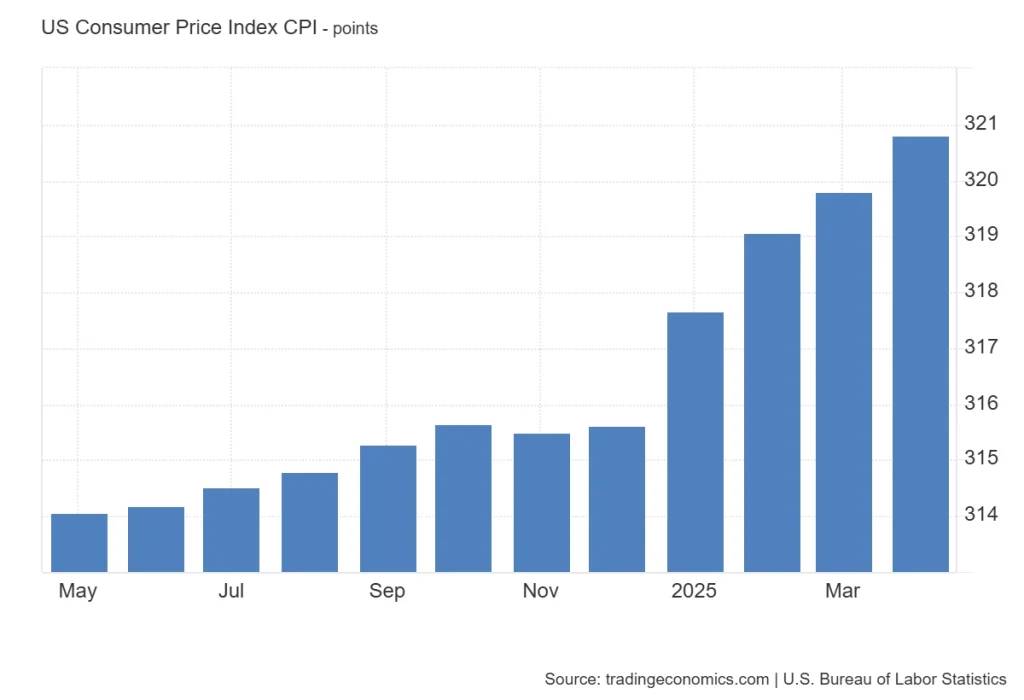
          All eyes are on the U.S. Consumer Price Index (CPI) data release scheduled for June 11, 2025. In April, CPI rose from 319.799 to 320.795 points. This month, it's projected to reach 321.9, according to TEForecast.

          More importantly, the U.S. inflation rate, which dropped to 2.3% in April, is expected by Wall Street to rise slightly to 2.5%. However, Doctor Profit believes the number could surprise to the downside—possibly between 2.1% and 2.3%. A lower-than-expected CPI could spark optimism, increasing chances of a Fed rate cut—a bullish catalyst for Bitcoin.

          Next Bitcoin Price Target: $108K–$110K?

          Doctor Profit also notes a liquidity cluster between $108K and $110K, which may be BTC's next short-term target before a bigger breakout. If Bitcoin pushes through that zone, it could open the path for a sustained rally.

          Source: CryptoSlate

          To stay updated on all economic events of today, please check out our Economic calendar
          Risk Warnings and Disclaimers
          You understand and acknowledge that there is a high degree of risk involved in trading. Following any strategies or investment methods may lead to potential losses. The content on the site is provided by our contributors and analysts for information purposes only. You are solely responsible for determining whether any trading assets, securities, strategy, or any other product is suitable for investing based on your own investment objectives and financial situation.
          Add to Favorites
          Share

          ECB to Continue Cutting Rates in Second Half Of 2025: Barclays

          Michelle

          Economic

          Forex

          The European Central Bank is likely to continue cutting interest rates in the second half of 2025, according to analysts at Barclays.

          Despite President Christine Lagarde’s signal that the current monetary easing cycle may be nearing its end, Barclays expects two additional 25-basis-point reductions at the ECB’s September and December meetings. This would bring the deposit facility rate down to 1.5% by year-end.

          At its June meeting, the ECB lowered policy rates by 25 basis points, citing lower inflation projections.

          However, Lagarde struck a more hawkish tone than expected, stating, “We are getting to the end of the monetary policy cycle,” and dismissed inflation undershoots in 2026 as largely driven by energy prices and currency effects.

          Barclays analysts believe that, despite the rhetoric, a majority on the Governing Council will support further easing based on current economic and inflation data.

          Headline inflation dropped to 1.9% year-on-year in May, below the ECB’s 2% medium-term target. Core inflation also eased, falling to 2.3% from 2.7% the previous month.

          Services inflation saw a notable decline, partly reversing holiday-related price spikes. Barclays’ inflation tracker projects headline inflation will stay below target through 2026, bottoming at 1.4% in early 2026 and settling at 1.7% later that year. This path is broadly consistent with updated ECB staff forecasts.

          On the growth front, euro area GDP expanded 0.6% quarter-on-quarter in the first quarter, but this figure was inflated by a 9.7% surge in Irish GDP, which reflects multinational activity rather than domestic demand.

          Excluding Ireland, the euro area grew 0.3%. Barclays noted that the boost from U.S. firms’ front-loading purchases ahead of tariffs, which temporarily lifted exports, is already fading.

          Recent data suggest a slowdown in activity. April industrial production declined across Germany, France and Spain, while factory orders in Germany rose only on the back of strength in two volatile sectors.

          Services and retail data were more stable, and the unemployment rate fell slightly in April. Still, Barclays sees overall momentum as weak.

          Barclays also questioned the ECB’s baseline growth assumptions, which remain unchanged for 2025 at 0.9% and were revised only slightly downward for 2026.

          Analysts said these appear optimistic in light of persistent economic headwinds and delays in fiscal stimulus, especially in Germany, where tax reforms and infrastructure spending are expected to have more impact after 2027.

          While the ECB maintains a meeting-by-meeting approach, Barclays sees sufficient evidence for continued policy easing.

          Analysts argue that the projected inflation undershoot, combined with fragile growth, supports further rate cuts even if the central bank refrains from signaling them in advance.

          Source: Investing

          To stay updated on all economic events of today, please check out our Economic calendar
          Risk Warnings and Disclaimers
          You understand and acknowledge that there is a high degree of risk involved in trading. Following any strategies or investment methods may lead to potential losses. The content on the site is provided by our contributors and analysts for information purposes only. You are solely responsible for determining whether any trading assets, securities, strategy, or any other product is suitable for investing based on your own investment objectives and financial situation.
          Add to Favorites
          Share

          U.S. Pours Billions into Reviving Shipbuilding to Counter China: 5x the Cost, Less than 1% Output—Is It Too Late?

          Gerik

          Economic

          China–U.S. Trade War

          Strategic Urgency: Why the U.S. is Betting Big on Domestic Shipbuilding

          President Trump and a bipartisan group in Congress are pushing for a full-scale revival of the U.S. shipbuilding industry, aiming to counter China's overwhelming dominance in global ship production. China has delivered nearly half of all commercial ships over the past decade, while the U.S. has built only 37.
          Reviving this sector will require more than policy—it demands a long-term commitment to investment. A key testing ground is the Hanwha Philly Shipyard in Philadelphia, recently acquired by South Korean industrial giant Hanwha. CEO David Kim insists the facility is ready to scale up, but only if it gets consistent orders and government support.

          Policy Moves: Heavy Subsidies, Penalties for Foreign Ships, U.S.-First Mandates

          Trump recently signed an executive order aimed at restoring American shipbuilding, pledging massive spending. The U.S. Trade Representative's office followed up with rules penalizing Chinese-built vessels and requiring certain commercial ships to be built domestically.
          Congress is drafting a major bill to subsidize a 250-vessel “Strategic Commercial Fleet,” built in the U.S. and crewed by Americans, which could be deployed for national defense logistics. The bill also offers financial incentives to offset the high cost of U.S. labor and production, aiming to both stabilize orders and encourage industrial growth.

          David vs. Goliath: America's Late Start Against China's Shipyard Juggernaut

          In sheer numbers, the U.S. is trailing badly. Chinese shipyards delivered 6,765 commercial vessels over the past decade, while the U.S. managed fewer than 40. Even Japan and South Korea remain far ahead. Hanwha’s shipyard in Philadelphia, for example, produces just 1.5 ships a year, while its South Korean facilities build one per week.
          Cost disparities are staggering. A Jones Act-compliant container ship built in the U.S. costs roughly $330 million, versus $70 million in Asia. The Jones Act requires vessels transporting goods between U.S. ports to be American-built, but critics argue this inflates costs without creating competitive scale.

          Revival Dreams Meet Labor Reality

          Even if Hanwha can transfer advanced technology to its U.S. shipyard, finding skilled labor is a major bottleneck. The company hopes to double its workforce from 1,500 in less than 10 years, and increase apprentices to 240 next year. But worker retention remains a serious issue—many leave within their first year.
          Union leaders and defense officials support training programs to build a long-term maritime workforce. Maritime officers on U.S. international routes can earn over $200,000 per year and retire after two decades, making it a potentially lucrative career. Still, attracting and retaining workers in this demanding industry is a hurdle.

          Not Just Business—A National Strategy

          Supporters argue this is more than an economic initiative—it’s a national security imperative. With China subsidizing its shipbuilding at scale, U.S. policymakers see domestic shipyards as critical infrastructure. New Trump-era rules will require an increasing share of LNG carriers to be U.S.-built in the coming years, adding urgency.
          While critics suggest outsourcing to allies like Japan or South Korea would be more cost-effective, Hanwha’s Kim contends that outsourcing has weakened American industry. “This is about more than business,” he said. “It’s about national priorities, labor, and strategic choices.”
          America’s attempt to rebuild its shipbuilding capability from near collapse is a massive undertaking—financially, industrially, and politically. With China advancing at high speed, the U.S. is betting on protectionism, patriotism, and persistence. Whether this strategy pays off remains uncertain, but Washington has made it clear: losing the seas is not an option.

          Source: The New York Times

          To stay updated on all economic events of today, please check out our Economic calendar
          Risk Warnings and Disclaimers
          You understand and acknowledge that there is a high degree of risk involved in trading. Following any strategies or investment methods may lead to potential losses. The content on the site is provided by our contributors and analysts for information purposes only. You are solely responsible for determining whether any trading assets, securities, strategy, or any other product is suitable for investing based on your own investment objectives and financial situation.
          Add to Favorites
          Share
          FastBull
          Copyright © 2025 FastBull Ltd

          728 RM B 7/F GEE LOK IND BLDG NO 34 HUNG TO RD KWUN TONG KLN HONG KONG

          TelegramInstagramTwitterfacebooklinkedin
          App Store Google Play Google Play
          Products
          Charts

          Chats

          Q&A with Experts
          Screeners
          Economic Calendar
          Data
          Tools
          Membership
          Features
          Function
          Markets
          Copy Trading
          Latest Signals
          Contests
          News
          Analysis
          24/7
          Columns
          Education
          Company
          Careers
          About Us
          Contact Us
          Advertising
          Help Center
          Feedback
          User Agreement
          Privacy Policy
          Business

          White Label

          Data API

          Web Plug-ins

          Poster Maker

          Affiliate Program

          Risk Disclosure

          The risk of loss in trading financial instruments such as stocks, FX, commodities, futures, bonds, ETFs and crypto can be substantial. You may sustain a total loss of the funds that you deposit with your broker. Therefore, you should carefully consider whether such trading is suitable for you in light of your circumstances and financial resources.

          No decision to invest should be made without thoroughly conducting due diligence by yourself or consulting with your financial advisors. Our web content might not suit you since we don't know your financial conditions and investment needs. Our financial information might have latency or contain inaccuracy, so you should be fully responsible for any of your trading and investment decisions. The company will not be responsible for your capital loss.

          Without getting permission from the website, you are not allowed to copy the website's graphics, texts, or trademarks. Intellectual property rights in the content or data incorporated into this website belong to its providers and exchange merchants.

          Not Logged In

          Log in to access more features

          FastBull Membership

          Not yet

          Purchase

          Become a signal provider
          Help Center
          Customer Service
          Dark Mode
          Price Up/Down Colors

          Log In

          Sign Up

          Position
          Layout
          Fullscreen
          Default to Chart
          The chart page opens by default when you visit fastbull.com