
• Trade
  • Markets
  • Copy
  • Contests
  • News
  • 24/7
  • Calendar
  • Q&A
  • Chats
Trending
Screeners
SYMBOL
LAST
BID
ASK
HIGH
LOW
NET CHG.
%CHG.
SPREAD
SPX
S&P 500 Index
6827.42
6827.42
6827.42
6899.86
6801.80
-73.58
-1.07%
--
DJI
Dow Jones Industrial Average
48458.04
48458.04
48458.04
48886.86
48334.10
-245.98
-0.51%
--
IXIC
NASDAQ Composite Index
23195.16
23195.16
23195.16
23554.89
23094.51
-398.69
-1.69%
--
USDX
US Dollar Index
97.950
98.030
97.950
98.500
97.950
-0.370
-0.38%
--
EURUSD
Euro / US Dollar
1.17394
1.17409
1.17394
1.17496
1.17192
+0.00011
+ 0.01%
--
GBPUSD
Pound Sterling / US Dollar
1.33707
1.33732
1.33707
1.33997
1.33419
-0.00148
-0.11%
--
XAUUSD
Gold / US Dollar
4299.39
4299.39
4299.39
4353.41
4257.10
+20.10
+ 0.47%
--
WTI
Light Sweet Crude Oil
57.233
57.485
57.233
58.011
56.969
-0.408
-0.71%
--

Community Accounts

Signal Accounts
--
Profit Accounts
--
Loss Accounts
--
View More

Become a signal provider

Sell trading signals to earn additional income

View More

Guide to Copy Trading

Get started with ease and confidence

View More

Signal Accounts for Members

All Signal Accounts

Best Return
  • Best Return
  • Best P/L
  • Best MDD
Past 1W
  • Past 1W
  • Past 1M
  • Past 1Y

All Contests

  • All
  • Trump Updates
  • Recommend
  • Stocks
  • Cryptocurrencies
  • Central Banks
  • Featured News
Top News Only
Share

USA Embassy In Lithuania: Maria Kalesnikava Is Not Going To Vilnius

Share

USA Embassy In Lithuania: Other Prisoners Are Being Sent From Belarus To Ukraine

Share

Ukraine President Zelenskiy: Five Ukrainians Released By Belarus In US-Brokered Deal

Share

USA Vilnius Embassy: USA Stands Ready For "Additional Engagement With Belarus That Advances USA Interests"

Share

USA Vilnius Embassy: Belarus, USA, Other Citizens Among The Prisoners Released Into Lithuania

Share

USA Vilnius Embassy: USA Will Continue Diplomatic Efforts To Free The Remaining Political Prisoners In Belarus

Share

USA Vilnius Embassy: Belarus Releases 123 Prisoners Following Meeting Of President Trump's Envoy Coale And Belarus President Lukashenko

Share

USA Vilnius Embassy: Masatoshi Nakanishi, Aliaksandr Syrytsa Are Among The Prisoners Released By Belarus

Share

USA Vilnius Embassy: Maria Kalesnikava And Viktor Babaryka Are Among The Prisoners Released By Belarus

Share

USA Vilnius Embassy: Nobel Peace Prize Laureate Ales Bialiatski Is Among The Prisoners Released By Belarus

Share

Belarusian Presidential Administration Telegram Channel: Lukashenko Has Pardoned 123 Prisoners As Part Of Deal With US

Share

Two Local Syrian Officials: Joint US-Syrian Military Patrol In Central Syria Came Under Fire From Unknown Assailants

Share

Israeli Military Says It Targeted 'Key Hamas Terrorist' In Gaza City

Share

Rwanda's Actions In Eastern Drc Are A Clear Violation Of Washington Accords Signed By President Trump - Secretary Of State Rubio

Share

Israeli Military Issues Evacuation Warning In Southern Lebanon Village Ahead Of Strike - Spokesperson On X

Share

Belarusian State Media Cites US Envoy Coale As Saying He Discussed Ukraine And Venezuela With Lukashenko

Share

Belarusian State Media Cites US Envoy Coale As Saying That US Removes Sanctions On Belarusian Potassium

Share

Thai Prime Minister: No Ceasefire Agreement With Cambodia

Share

US, Ukraine To Discuss Ceasefire In Berlin Ahead Of European Summit

Share

Incoming Czech Prime Minister Babis: Czech Republic Will Not Take On Guarantees For Ukraine Financing, European Commission Must Find Alternatives

TIME
ACT
FCST
PREV
U.K. Trade Balance Non-EU (SA) (Oct)

A:--

F: --

P: --

U.K. Trade Balance (Oct)

A:--

F: --

P: --

U.K. Services Index MoM

A:--

F: --

P: --

U.K. Construction Output MoM (SA) (Oct)

A:--

F: --

P: --

U.K. Industrial Output YoY (Oct)

A:--

F: --

P: --

U.K. Trade Balance (SA) (Oct)

A:--

F: --

P: --

U.K. Trade Balance EU (SA) (Oct)

A:--

F: --

P: --

U.K. Manufacturing Output YoY (Oct)

A:--

F: --

P: --

U.K. GDP MoM (Oct)

A:--

F: --

P: --

U.K. GDP YoY (SA) (Oct)

A:--

F: --

P: --

U.K. Industrial Output MoM (Oct)

A:--

F: --

P: --

U.K. Construction Output YoY (Oct)

A:--

F: --

P: --

France HICP Final MoM (Nov)

A:--

F: --

P: --

China, Mainland Outstanding Loans Growth YoY (Nov)

A:--

F: --

P: --

China, Mainland M2 Money Supply YoY (Nov)

A:--

F: --

P: --

China, Mainland M0 Money Supply YoY (Nov)

A:--

F: --

P: --

China, Mainland M1 Money Supply YoY (Nov)

A:--

F: --

P: --

India CPI YoY (Nov)

A:--

F: --

P: --

India Deposit Gowth YoY

A:--

F: --

P: --

Brazil Services Growth YoY (Oct)

A:--

F: --

P: --

Mexico Industrial Output YoY (Oct)

A:--

F: --

P: --

Russia Trade Balance (Oct)

A:--

F: --

P: --

Philadelphia Fed President Henry Paulson delivers a speech
Canada Building Permits MoM (SA) (Oct)

A:--

F: --

P: --

Canada Wholesale Sales YoY (Oct)

A:--

F: --

P: --

Canada Wholesale Inventory MoM (Oct)

A:--

F: --

P: --

Canada Wholesale Inventory YoY (Oct)

A:--

F: --

P: --

Canada Wholesale Sales MoM (SA) (Oct)

A:--

F: --

P: --

Germany Current Account (Not SA) (Oct)

A:--

F: --

P: --

U.S. Weekly Total Rig Count

A:--

F: --

P: --

U.S. Weekly Total Oil Rig Count

A:--

F: --

P: --

Japan Tankan Large Non-Manufacturing Diffusion Index (Q4)

--

F: --

P: --

Japan Tankan Small Manufacturing Outlook Index (Q4)

--

F: --

P: --

Japan Tankan Large Non-Manufacturing Outlook Index (Q4)

--

F: --

P: --

Japan Tankan Large Manufacturing Outlook Index (Q4)

--

F: --

P: --

Japan Tankan Small Manufacturing Diffusion Index (Q4)

--

F: --

P: --

Japan Tankan Large Manufacturing Diffusion Index (Q4)

--

F: --

P: --

Japan Tankan Large-Enterprise Capital Expenditure YoY (Q4)

--

F: --

P: --

U.K. Rightmove House Price Index YoY (Dec)

--

F: --

P: --

China, Mainland Industrial Output YoY (YTD) (Nov)

--

F: --

P: --

China, Mainland Urban Area Unemployment Rate (Nov)

--

F: --

P: --

Saudi Arabia CPI YoY (Nov)

--

F: --

P: --

Euro Zone Industrial Output YoY (Oct)

--

F: --

P: --

Euro Zone Industrial Output MoM (Oct)

--

F: --

P: --

Canada Existing Home Sales MoM (Nov)

--

F: --

P: --

Euro Zone Total Reserve Assets (Nov)

--

F: --

P: --

U.K. Inflation Rate Expectations

--

F: --

P: --

Canada National Economic Confidence Index

--

F: --

P: --

Canada New Housing Starts (Nov)

--

F: --

P: --

U.S. NY Fed Manufacturing Employment Index (Dec)

--

F: --

P: --

U.S. NY Fed Manufacturing Index (Dec)

--

F: --

P: --

Canada Core CPI YoY (Nov)

--

F: --

P: --

Canada Manufacturing Unfilled Orders MoM (Oct)

--

F: --

P: --

Canada Manufacturing New Orders MoM (Oct)

--

F: --

P: --

Canada Core CPI MoM (Nov)

--

F: --

P: --

Canada Manufacturing Inventory MoM (Oct)

--

F: --

P: --

Canada CPI YoY (Nov)

--

F: --

P: --

Canada CPI MoM (Nov)

--

F: --

P: --

Canada CPI YoY (SA) (Nov)

--

F: --

P: --

Canada Core CPI MoM (SA) (Nov)

--

F: --

P: --

Q&A with Experts
    • All
    • Chatrooms
    • Groups
    • Friends
    Connecting
    .
    .
    .
    Type here...
    Add Symbol or Code

      No matching data

      All
      Trump Updates
      Recommend
      Stocks
      Cryptocurrencies
      Central Banks
      Featured News
      • All
      • Russia-Ukraine Conflict
      • Middle East Flashpoint
      • All
      • Russia-Ukraine Conflict
      • Middle East Flashpoint
      Search
      Products

      Charts Free Forever

      Chats Q&A with Experts
      Screeners Economic Calendar Data Tools
      Membership Features
      Data Warehouse Market Trends Institutional Data Policy Rates Macro

      Market Trends

      Market Sentiment Order Book Forex Correlations

      Top Indicators

      Charts Free Forever
      Markets

      News

      News Analysis 24/7 Columns Education
      From Institutions From Analysts
      Topics Columnists

      Latest Views

      Latest Views

      Trending Topics

      Top Columnists

      Latest Update

      Signals

      Copy Rankings Latest Signals Become a signal provider AI Rating
      Contests
      Brokers

      Overview Brokers Assessment Rankings Regulators News Claims
      Broker listing Forex Brokers Comparison Tool Live Spread Comparison Scam
      Q&A Complaint Scam Alert Videos Tips to Detect Scam
      More

      Business
      Events
      Careers About Us Advertising Help Center

      White Label

      Data API

      Web Plug-ins

      Affiliate Program

      Awards Institution Evaluation IB Seminar Salon Event Exhibition
      Vietnam Thailand Singapore Dubai
      Fans Party Investment Sharing Session
      FastBull Summit BrokersView Expo
      Recent Searches
        Top Searches
          Markets
          News
          Analysis
          User
          24/7
          Economic Calendar
          Education
          Data
          • Names
          • Latest
          • Prev

          View All

          No data

          Scan to Download

          Faster Charts, Chat Faster!

          Download App
          English
          • English
          • Español
          • العربية
          • Bahasa Indonesia
          • Bahasa Melayu
          • Tiếng Việt
          • ภาษาไทย
          • Français
          • Italiano
          • Türkçe
          • Русский язык
          • 简中
          • 繁中
          Open Account
          Search
          Products
          Charts Free Forever
          Markets
          News
          Signals

          Copy Rankings Latest Signals Become a signal provider AI Rating
          Contests
          Brokers

          Overview Brokers Assessment Rankings Regulators News Claims
          Broker listing Forex Brokers Comparison Tool Live Spread Comparison Scam
          Q&A Complaint Scam Alert Videos Tips to Detect Scam
          More

          Business
          Events
          Careers About Us Advertising Help Center

          White Label

          Data API

          Web Plug-ins

          Affiliate Program

          Awards Institution Evaluation IB Seminar Salon Event Exhibition
          Vietnam Thailand Singapore Dubai
          Fans Party Investment Sharing Session
          FastBull Summit BrokersView Expo

          UK Market Volatility Adds To Bets BOE Will Pause Bond Sales

          Catherine Richards

          Economic

          Central Bank

          Summary:

          Investors will seek clues over the future of the Bank of England's (BOE) bond-selling programme at its monetary policy meeting on Thursday, amid speculation that recent market turmoil may encourage officials to cease it later this year.
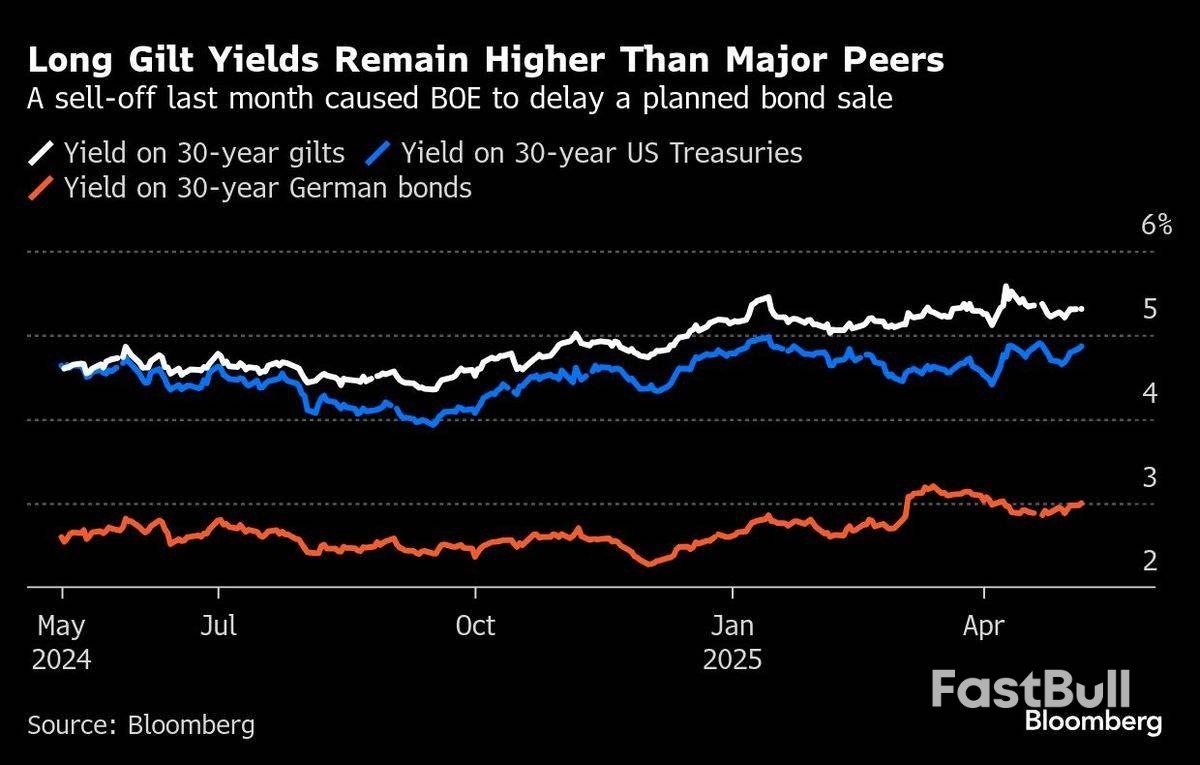
          Investors will seek clues over the future of the Bank of England's (BOE) bond-selling programme at its monetary policy meeting on Thursday, amid speculation that recent market turmoil may encourage officials to cease it later this year.
          Strategists at Bank of America Corp and BNP Paribas SA are bullish on long-maturity gilts in a bet that the BOE could stop the bond sales from October. That view is growing after the central bank's unusual decision to delay an auction of securities last month in the wake of global market turbulence.
          The bond sales are part of BOE's efforts to unwind its vast stimulus since the financial crisis and the pandemic. While it may be too early for officials to give a firm steer on the future of this so-called active quantitative tightening, any commentary will be studied ahead of a decision expected in September.
          “The Bank is keeping a close eye on market fragility and may be coming round to the idea that QT is having a more meaningful impact on the market,” said Bank of America strategists including Agne Stengeryte. They recommend buying 30-year gilts versus equivalent interest-rate swaps on the prospect of sales stopping.
          The country's 30-year debt has been buffeted the most by political and economic turmoil in recent years, as demand from traditional investors such as pension funds wanes. That led the UK's Debt Management Office to announce a historic skew away from longer-maturity debt this year, a move that supported the market.
          While the central bank has repeatedly said its QT programme has had minimal market impact, it temporarily halted the sale of long-dated bonds in April in “light of recent market volatility”. The BOE's chief economist Huw Pill said that reflected a “tactical approach”, adding that there is a question over whether QT may exacerbate rises in bond yields in times of market stress.
          “We have seen both the BOE and the DMO adapting to the recent market volatility, showing transparency and flexibility as they take steps to shield the gilt market from unjustified international pressure,” said a BNP Paribas team including Katherine Yoon. They now expect the BOE to pause its active gilt sales this year, citing it as a reason for their positive stance on long-maturity gilts.
          The BOE is not scheduled to share its quantitative-tightening plan for the year starting in October until the month beforehand, though officials have guided investors leading up to such decisions in the past.
          Policymakers use a mix of actively selling bonds and stopping reinvestments upon maturity to reduce the BOE’s balance sheet. Last year, officials voted to reduce its Asset Purchase Facility portfolio by £100 billion (US$134 billion or RM566.48 billion) over 12 months. Active sales accounted for £13 billion of that, with redemptions making up the rest.
          The BOE's decision later this year will follow the Federal Reserve slowing its QT programme. In March, the US central bank slashed its cap for how much in Treasuries it lets roll off its balance sheet every month to US$5 billion, from US$25 billion.
          “The way gilts have been caught up in US Treasury volatility is bound to pose questions about active QT, especially beyond September,” said Citigroup Inc strategists including Jamie Searle. “Long-end gilts may find a little comfort if the BOE reaffirms that ongoing QT is subject to market conditions and targeted QE is still a backstop.”

          Source: Theedgemarkets

          To stay updated on all economic events of today, please check out our Economic calendar
          Risk Warnings and Disclaimers
          You understand and acknowledge that there is a high degree of risk involved in trading. Following any strategies or investment methods may lead to potential losses. The content on the site is provided by our contributors and analysts for information purposes only. You are solely responsible for determining whether any trading assets, securities, strategy, or any other product is suitable for investing based on your own investment objectives and financial situation.
          Add to Favorites
          Share

          Global Debt Hits All-Time High Amid Uneven Recovery and Policy Uncertainty

          Gerik

          Economic

          Global Debt Reaches Record Levels in Q1 2025

          According to the latest report released by the Institute of International Finance (IIF) on May 6, global debt surged by approximately $7.5 trillion in the first quarter of 2025, pushing the total to a historic high of over $324 trillion. This sharp escalation underscores the persistent financial burden carried by governments, businesses, and households worldwide as they continue to navigate post-pandemic economic adjustments and geopolitical uncertainties.
          The most significant contributors to this increase were China, France, and Germany. In contrast, countries such as Canada, the United Arab Emirates, and Turkey managed to slightly reduce their total debt. The report reflects a broader divergence in fiscal trajectories between economies that are heavily investing in stimulus and industrial support and those adopting more conservative debt management approaches.

          Emerging Markets Show Accelerated Debt Accumulation

          Debt levels among emerging markets rose by more than $3.5 trillion in the same quarter, reaching a new peak of $106 trillion. China alone accounted for over $2 trillion of this increase, driven by ongoing infrastructure spending and state-backed financial support. Even when excluding China, emerging markets such as Brazil, India, and Poland experienced substantial increases in debt when measured in U.S. dollar terms.
          Interestingly, the report notes that a weaker U.S. dollar served as a partial buffer for emerging markets, making dollar-denominated debt less burdensome in local currency terms. However, this temporary relief does not negate the growing structural risks associated with debt service sustainability, especially in economies with volatile exchange rates or rising import costs.

          U.S. Fiscal Policy and Trade Uncertainty Raise Additional Red Flags

          The IIF also expressed concern about the mounting debt in the United States, particularly in light of its increasing financing needs. These are partially driven by the tax cuts implemented under President Donald Trump's administration. While these cuts were intended to stimulate investment, their impact on revenue has contributed to a widening fiscal deficit.
          Moreover, the Trump administration’s reliance on tariffs to offset revenue losses has added a layer of unpredictability to international trade. This policy inconsistency has created hesitation among investors and businesses, slowing capital expenditures and potentially hampering growth in both the U.S. and its trade-dependent partners.

          Policy Flexibility and Debt Management in a Fragile Environment

          As trade tensions and geopolitical instability continue to cast uncertainty on the global economic outlook, the IIF emphasizes the need for more adaptable fiscal policies, particularly in countries closely tied to U.S. trade dynamics. The risk lies not only in the absolute level of debt but also in how governments respond to changing economic conditions and political pressures.
          Without strategic debt management and clearer policy guidance, particularly from major economies, rising debt could exert downward pressure on sovereign bond yields, weaken investor confidence, and further strain global financial markets. This growing burden requires coordinated global oversight to prevent systemic imbalances and ensure sustainable growth.
          To stay updated on all economic events of today, please check out our Economic calendar
          Risk Warnings and Disclaimers
          You understand and acknowledge that there is a high degree of risk involved in trading. Following any strategies or investment methods may lead to potential losses. The content on the site is provided by our contributors and analysts for information purposes only. You are solely responsible for determining whether any trading assets, securities, strategy, or any other product is suitable for investing based on your own investment objectives and financial situation.
          Add to Favorites
          Share

          Chinese Banks Raise Entry Barriers for Gold Savings Services Amid Surging Prices

          Gerik

          Economic

          Commodity

          Gold Price Surge Triggers Policy Adjustment Among Banks

          Over recent months, the Chinese gold market has witnessed substantial volatility, with gold prices in both the London spot market and Shanghai climbing more than 20%. This price movement has prompted several commercial banks in China to raise the minimum required amount for customers to access gold accumulation services. This shift reflects not only market dynamics but also a growing institutional emphasis on risk screening and investment control.
          The gold savings service allows individual investors to buy gold shares through bank-issued accounts, which can later be redeemed either for physical gold or converted into cash. With the minimum trade unit typically set at just 1 gram, the product has long been favored for its accessibility. However, the steep price rally has driven banks to reassess their entry requirements to ensure that participants possess sufficient financial resilience and awareness of investment risks.

          Consumer Demand Meets Institutional Risk Management

          The decision by banks to elevate investment thresholds aligns with broader efforts to manage client exposure to rapid price fluctuations. In the context of rising prices, there has been a noticeable uptick in both spontaneous and scheduled gold accumulation among retail investors. According to Wu Zewei, a special researcher at Suzhou Commercial Bank, the flexibility and ease of use—enabled by mobile applications and online platforms—have made gold saving plans a preferred choice for small-scale investors.
          However, this popularity also brings challenges. The link between gold price increases and investor enthusiasm may not reflect sustainable patterns. Some individuals have reportedly gone so far as to use consumer loans to finance gold purchases, which, while technically feasible, can lead to contract breaches and negative credit implications if not used in accordance with loan terms.

          Volatility and Investment Discipline in a Heated Market

          While gold retains its reputation as a long-term store of value, its short-term fluctuations pose serious risks. Market experts warn against uninformed or emotionally driven investments, especially as gold faces potential technical corrections following sharp price surges. The current environment suggests that prudent investment behavior—such as setting clear goals, diversifying assets, and assessing market entry points—is crucial for safeguarding against potential losses.
          Importantly, investors must be cautious not to over-concentrate their portfolios in gold, regardless of its hedging qualities. The relationship between rising prices and increasing minimum thresholds reflects an attempt by banks to ensure that only individuals with sufficient risk tolerance and long-term strategy participate in gold accumulation schemes.
          The rising threshold for participation does not signify exclusivity but rather a calibrated response to protect both institutions and investors from impulsive financial decisions. By tightening access, banks aim to reinforce informed participation while avoiding the pitfalls of speculative excess. As the market remains subject to external shocks and macroeconomic shifts, the emphasis is shifting toward sustainable financial behavior rooted in understanding, planning, and adaptability.

          Source: The Economic Times

          To stay updated on all economic events of today, please check out our Economic calendar
          Risk Warnings and Disclaimers
          You understand and acknowledge that there is a high degree of risk involved in trading. Following any strategies or investment methods may lead to potential losses. The content on the site is provided by our contributors and analysts for information purposes only. You are solely responsible for determining whether any trading assets, securities, strategy, or any other product is suitable for investing based on your own investment objectives and financial situation.
          Add to Favorites
          Share

          Vietnam Outshines Indonesia in Q1 2025 GDP Growth, Leading Southeast Asia’s Economic Recovery

          Gerik

          Economic

          Vietnam’s Q1 Growth Surpasses Regional Expectations

          Vietnam recorded a remarkable GDP growth of 6.93% in the first quarter of 2025, marking the strongest Q1 performance since the onset of the COVID-19 pandemic. According to data from the General Statistics Office, this figure exceeded the official growth target outlined in Resolution 01/NQ-CP and reinforced the country's trajectory as a regional economic powerhouse.
          Despite ongoing global trade disruptions and geopolitical uncertainties, Vietnam’s growth was broad-based and driven by three main sectors. The services sector grew by 7.70%, contributing over 53% to overall economic expansion, supported by recovering domestic tourism, rising international arrivals, and strong momentum in tech-driven service industries. The industrial and construction sector rose by 7.42%, driven by renewed foreign direct investment in electronics and manufacturing. Meanwhile, the agriculture, forestry, and fisheries sector posted a steady 3.74% increase.

          Indonesia Faces Its Slowest Q1 Growth in Three Years

          In contrast, Indonesia—the largest economy in Southeast Asia—reported a GDP growth of 4.87% for Q1 2025, the slowest first-quarter expansion since 2021. This performance came in below the 5% threshold that the country has typically maintained in recent years. According to Indonesia’s Central Statistics Agency (BPS), the slowdown was partly due to the base effect of last year’s general election, which triggered a one-off spike in government spending in Q1 2024, thereby making current year comparisons weaker.
          Private consumption in Indonesia contributed 2.61 percentage points to GDP growth, followed by fixed capital formation (0.65%), net exports (0.83%), and other components (0.86%). Notably, government spending shrank by 0.08%, reflecting fiscal adjustments in the post-election period. Although still outperforming Malaysia (4.4%) and Singapore (3.8%) in the same quarter, Indonesia’s growth trailed behind Vietnam’s pace, a point acknowledged by Indonesian Coordinating Minister for Economic Affairs Airlangga Hartarto.

          Vietnam Emerges as ASEAN’s Growth Leader

          Vietnam’s Q1 growth performance not only reaffirmed its post-pandemic recovery strength but also underscored its ability to navigate trade uncertainties and shifting global demand. The Ministry of Planning and Investment emphasized that while geopolitical risks and rising tariffs have affected Vietnam’s export-driven sectors, targeted fiscal stimulus and domestic consumption have continued to support economic momentum.
          In its latest Asia Development Outlook, the Asian Development Bank projected Vietnam’s GDP to grow 6.6% in 2025 and 6.5% in 2026, following a robust 7.1% expansion in 2024. This outlook is fueled by sustained foreign investment, improvements in business environment reforms, and rising demand for Vietnamese goods and services in regional and global markets.

          Indonesia: Challenges Ahead Despite Strong Fundamentals

          Although Indonesia remains a critical player in ASEAN, its short-term growth outlook is clouded by fiscal tightening and export dependency. Rising commodity price volatility, uncertainty over U.S. tariffs, and slow recovery in global demand are posing challenges to its manufacturing and infrastructure sectors. However, officials are optimistic that economic performance will rebound in the latter half of the year as consumer confidence improves and public investment projects resume.
          Despite the current divergence, both Vietnam and Indonesia are poised to benefit from broader shifts in global supply chains and regional trade integration. However, Vietnam’s ability to outpace expectations and secure one of the highest Q1 growth rates globally places it in a favorable position as ASEAN’s most dynamic economy in early 2025.
          To stay updated on all economic events of today, please check out our Economic calendar
          Risk Warnings and Disclaimers
          You understand and acknowledge that there is a high degree of risk involved in trading. Following any strategies or investment methods may lead to potential losses. The content on the site is provided by our contributors and analysts for information purposes only. You are solely responsible for determining whether any trading assets, securities, strategy, or any other product is suitable for investing based on your own investment objectives and financial situation.
          Add to Favorites
          Share

          China Confirms U.S. Trade Talks Amid Rising Tariffs

          Grace Montgomery

          China–U.S. Trade War

          Economic

          Key Points:
          ● U.S.-China trade talks announced, impacting global crypto markets.
          ● High volatility expected in crypto.
          ● Tariff removal remains a key negotiation issue.

          China Confirms U.S. Trade Talks amid Rising Tariffs

          China has confirmed its intentions to initiate trade negotiations with the United States. This decision involves high-level figures, including U.S. Treasury Secretary Scott Bessent and Chinese Vice President Han Zheng, with talks scheduled to occur in Switzerland.
          The talks hold significance due to their potential to stabilize markets and reduce tariffs. Immediate reactions include heightened speculative activity in cryptocurrencies, often a barometer for macroeconomic uncertainty.
          Both nations prepare for impactful discussions led by key officials. Scott Bessent emphasizes economic security, while the Chinese Ministry of Commerce demands the U.S. end its unilateral tariff practices.
          Cryptocurrencies like BTC and ETH may experience volatility. Market observers note historical fluctuations following similar talks, often leading to increased trading volume and price shifts in these assets.
          Financial implications are vast. Economic cooperation between two of the world's largest economies could stabilize fast-moving assets like stablecoins. Confirmed negotiation settings are expected to shape cryptocurrency strategies.
          On-chain metrics suggest potential waves of trading activity. Historically, such negotiations lead to rapid market response, particularly in assets tied to U.S.-China trade relations.
          Anticipated trade talks may recalibrate economic policies, potentially reshaping financial landscapes. Historical patterns have shown crypto assets react strongly to geopolitical movements, emphasizing the broader implications of these talks.
          Economic security is national security, and President Donald J. Trump is leading the way both at home and abroad for a stronger, more prosperous America. I look forward to productive talks as we work towards rebalancing the international economic system towards better serving the interests of the United States. — Scott Bessent, U.S. Treasury Secretary, United States, France24.

          Source: CryptoSlate

          To stay updated on all economic events of today, please check out our Economic calendar
          Risk Warnings and Disclaimers
          You understand and acknowledge that there is a high degree of risk involved in trading. Following any strategies or investment methods may lead to potential losses. The content on the site is provided by our contributors and analysts for information purposes only. You are solely responsible for determining whether any trading assets, securities, strategy, or any other product is suitable for investing based on your own investment objectives and financial situation.
          Add to Favorites
          Share

          Hong Kong Injects $9.45 Billion to Stabilize Currency Amid Global Capital Shifts

          Gerik

          Economic

          Forex

          Hong Kong Steps In to Defend Currency Peg as Capital Inflows Intensify

          In response to surging demand for the Hong Kong dollar (HKD) and a sharp appreciation to the strong end of its exchange band (7.75 HKD/USD), the Hong Kong Monetary Authority (HKMA) intervened again on May 6, injecting HK$60.543 billion during the New York session and HK$12.788 billion during the Hong Kong session. This marks the fourth such intervention in recent days, with total liquidity injections climbing to over HK$129 billion.
          These actions are part of Hong Kong’s commitment to maintain its linked exchange rate system — a fixed peg in place since 1983. Under this system, the HKMA buys or sells U.S. dollars to keep the HKD within a band of 7.75–7.85 per USD. The latest moves have brought the aggregate balance of the banking system up to a projected HK$174.1 billion by May 8, reinforcing interbank liquidity.

          Drivers Behind the Surge in HKD Demand

          According to HKMA Chief Executive Eddie Yue, the capital inflow stems from a combination of rising foreign investment via the Hong Kong Stock Connect program and a broader shift in investor positioning. The weakening of the U.S. dollar and unwinding of short positions in Asian currencies — triggered partly by U.S. tariff retaliation measures announced in early April — have led to increased demand for HKD as a regional safe haven.
          In addition, anticipation of new major stock listings in Hong Kong is prompting investors to pre-purchase HKD in preparation. This demand has not only strengthened the local currency but also pushed interbank HKD interest rates downward.

          Currency Stability and Global Reserve Shifts

          Despite the recent strength of the HKD, Yue cautioned about possible interest rate arbitrage if local rates fall below those in the U.S., potentially incentivizing investors to sell HKD in favor of USD. However, he emphasized that in the current volatile environment, such trades remain limited in scale.
          Globally, investors and central banks are gradually diversifying away from U.S. dollar assets, although this remains a slow-moving trend. HKMA data shows that USD-denominated assets now make up 79% of Hong Kong’s Exchange Fund, down from over 90% in previous years. Still, Yue acknowledged that U.S. Treasuries remain the most liquid global reserve assets, and the USD will likely continue playing a dominant role in official reserves for the foreseeable future.

          Source: The Business Times

          To stay updated on all economic events of today, please check out our Economic calendar
          Risk Warnings and Disclaimers
          You understand and acknowledge that there is a high degree of risk involved in trading. Following any strategies or investment methods may lead to potential losses. The content on the site is provided by our contributors and analysts for information purposes only. You are solely responsible for determining whether any trading assets, securities, strategy, or any other product is suitable for investing based on your own investment objectives and financial situation.
          Add to Favorites
          Share

          Markets Tread Carefully as U.S.–China Trade Talks Begin Amid Global Tensions

          Gerik

          China–U.S. Trade War

          Economic

          U.S.–China to Resume Trade Talks, But Markets Remain Skeptical About a Quick Breakthrough

          Markets welcomed news of a planned meeting between U.S. Treasury Secretary Scott Bessent and top Chinese trade officials this weekend in Geneva, but the response was restrained. The long-anticipated dialogue marks a tentative step towards de-escalation in a growing tariff war, yet both Washington and Beijing remain wary.
          Bessent described the meeting as preliminary, intended to “work out what to talk about,” rather than produce immediate results. China, meanwhile, issued a cryptic yet pointed statement citing a proverb: “Listen to what is said, and watch what is done,” warning against any deceptive U.S. maneuvers under the guise of diplomacy.

          Muted Optimism in Global Markets

          U.S. futures held modest gains in Asian trading hours, while Hong Kong stocks jumped, supported not just by trade talk optimism but also by fresh signals of potential policy support from Beijing. The People's Bank of China hinted at interest rate cuts and widened access for insurers to invest in the stock market. While these measures cheered some investors, the response was modest as the more decisive move — aggressive fiscal stimulus — remains elusive.
          In currency markets, Asian currencies — which had recently gained ground against the dollar — softened again, with the Indian rupee slipping further amid escalating tensions between India and Pakistan, marking their worst flare-up in over 20 years.

          Investor Focus Shifts to Fed and Global Risk Trends

          As the world watches the Geneva meeting, investor attention is also turning to the upcoming U.S. Federal Reserve policy update. No immediate rate change is expected, but markets will be parsing every word for signs of the Fed’s sensitivity to persistent inflation and resilient labor market data.
          Recent employment figures showed a surprisingly strong U.S. jobs market, prompting traders to scale back expectations for interest rate cuts in the near future. This backdrop complicates both monetary and geopolitical decision-making, leaving financial markets in a state of uncertainty.

          Broader Geopolitical and Earnings Watch

          Beyond trade and central banks, European markets await earnings from major healthcare players like Fresenius and Novo Nordisk. While macroeconomic data releases today are secondary in importance, geopolitical developments — including the India-Pakistan conflict and broader global tariff rhetoric — continue to drive the narrative.
          Though the U.S.–China meeting is a step forward, the path to a trade deal remains steep and strewn with mistrust. Until clearer commitments emerge — either through fiscal policy in China or tariff relief from Washington — markets are likely to stay cautious. For now, investors are pricing in risk, not resolution.

          Source: Reuters

          To stay updated on all economic events of today, please check out our Economic calendar
          Risk Warnings and Disclaimers
          You understand and acknowledge that there is a high degree of risk involved in trading. Following any strategies or investment methods may lead to potential losses. The content on the site is provided by our contributors and analysts for information purposes only. You are solely responsible for determining whether any trading assets, securities, strategy, or any other product is suitable for investing based on your own investment objectives and financial situation.
          Add to Favorites
          Share
          FastBull
          Copyright © 2025 FastBull Ltd

          728 RM B 7/F GEE LOK IND BLDG NO 34 HUNG TO RD KWUN TONG KLN HONG KONG

          TelegramInstagramTwitterfacebooklinkedin
          App Store Google Play Google Play
          Products
          Charts

          Chats

          Q&A with Experts
          Screeners
          Economic Calendar
          Data
          Tools
          Membership
          Features
          Function
          Markets
          Copy Trading
          Latest Signals
          Contests
          News
          Analysis
          24/7
          Columns
          Education
          Company
          Careers
          About Us
          Contact Us
          Advertising
          Help Center
          Feedback
          User Agreement
          Privacy Policy
          Business

          White Label

          Data API

          Web Plug-ins

          Poster Maker

          Affiliate Program

          Risk Disclosure

          The risk of loss in trading financial instruments such as stocks, FX, commodities, futures, bonds, ETFs and crypto can be substantial. You may sustain a total loss of the funds that you deposit with your broker. Therefore, you should carefully consider whether such trading is suitable for you in light of your circumstances and financial resources.

          No decision to invest should be made without thoroughly conducting due diligence by yourself or consulting with your financial advisors. Our web content might not suit you since we don't know your financial conditions and investment needs. Our financial information might have latency or contain inaccuracy, so you should be fully responsible for any of your trading and investment decisions. The company will not be responsible for your capital loss.

          Without getting permission from the website, you are not allowed to copy the website's graphics, texts, or trademarks. Intellectual property rights in the content or data incorporated into this website belong to its providers and exchange merchants.

          Not Logged In

          Log in to access more features

          FastBull Membership

          Not yet

          Purchase

          Become a signal provider
          Help Center
          Customer Service
          Dark Mode
          Price Up/Down Colors

          Log In

          Sign Up

          Position
          Layout
          Fullscreen
          Default to Chart
          The chart page opens by default when you visit fastbull.com