• Trade
  • Markets
  • Copy
  • Contests
  • News
  • 24/7
  • Calendar
  • Q&A
  • Chats
Trending
Screeners
SYMBOL
LAST
BID
ASK
HIGH
LOW
NET CHG.
%CHG.
SPREAD
SPX
S&P 500 Index
6827.42
6827.42
6827.42
6899.86
6801.80
-73.58
-1.07%
--
DJI
Dow Jones Industrial Average
48458.04
48458.04
48458.04
48886.86
48334.10
-245.98
-0.51%
--
IXIC
NASDAQ Composite Index
23195.16
23195.16
23195.16
23554.89
23094.51
-398.69
-1.69%
--
USDX
US Dollar Index
97.950
98.030
97.950
98.500
97.950
-0.370
-0.38%
--
EURUSD
Euro / US Dollar
1.17394
1.17409
1.17394
1.17496
1.17192
+0.00011
+ 0.01%
--
GBPUSD
Pound Sterling / US Dollar
1.33707
1.33732
1.33707
1.33997
1.33419
-0.00148
-0.11%
--
XAUUSD
Gold / US Dollar
4299.39
4299.39
4299.39
4353.41
4257.10
+20.10
+ 0.47%
--
WTI
Light Sweet Crude Oil
57.233
57.485
57.233
58.011
56.969
-0.408
-0.71%
--

Community Accounts

Signal Accounts
--
Profit Accounts
--
Loss Accounts
--
View More

Become a signal provider

Sell trading signals to earn additional income

View More

Guide to Copy Trading

Get started with ease and confidence

View More

Signal Accounts for Members

All Signal Accounts

Best Return
  • Best Return
  • Best P/L
  • Best MDD
Past 1W
  • Past 1W
  • Past 1M
  • Past 1Y

All Contests

  • All
  • Trump Updates
  • Recommend
  • Stocks
  • Cryptocurrencies
  • Central Banks
  • Featured News
Top News Only
Share

Iranian Media Says 18 Crew Members Of Foreign Tanker Seized In Gulf Of Oman Over Carrying 'Smuggled Fuel' Detained

Share

Regional Governor: Two Killed In Ukrainian Drone Strike On Russia's Saratov

Share

Chinese Foreign Ministry - China Foreign Minister Met With United Arab Emirates Counterpart On Dec 12

Share

China's Central Financial And Economic Affairs Commission Deputy Director: Will Expand Export And Increase Import In 2026

Share

Thai Leader Anutin: Landmine Blast That Killed Thai Soldiers 'Not A Roadside Accident'

Share

Thai Leader Anutin: Thailand To Continue Military Action Until 'We Feel No More Harm'

Share

Cambodian Prime Minister Hun Manet Says He Had Phone Calls With Trump And Malaysian Leader Anwar About Ceasefire

Share

Cambodia's Hun Manet Says USA, Malaysia Should Verify 'Which Side Fired First' In Latest Conflict

Share

Cambodia's Hun Manet: Cambodia Maintains Its Stance In Seeking Peaceful Resolution Of Disputes

Share

Nasdaq Companies: Allergan, Ferrovia, Insmed, Monolithic Power Systems, Seagate Technology, And Western Digital Will Be Added To The NASDAQ 100 Index. Biogen, CdW, GlobalFoundries, Lululemon, ON Semiconductor, And Tradedesk Will Be Removed From The NASDAQ 100 Index

Share

Witkoff Headed To Berlin This Weekend To Meet With Zelenskiy, European Leaders -Wsj Reporter On X

Share

Russia Attacks Two Ukrainian Ports, Damaging Three Turkish-Owned Vessels

Share

[Historic Flooding Occurs In At Least Four Rivers In Washington State Due To Days Of Torrential Rains] Multiple Areas In Washington State Have Been Hit By Severe Flooding Due To Days Of Torrential Rains, With At Least Four Rivers Experiencing Historic Flooding. Reporters Learned On The 12th That The Floods Caused By The Torrential Rains In Washington State Have Destroyed Homes And Closed Several Highways. Experts Warn That Even More Severe Flooding May Occur In The Future. A State Of Emergency Has Been Declared In Washington State

Share

Trump Says Proposed Free Economic Zone In Donbas Would Work

Share

Trump: I Think My Voice Should Be Heard

Share

Trump Says Will Be Choosing New Fed Chair In Near Future

Share

Trump Says Proposed Free Economic Zone In Donbas Complex But Would Work

Share

Trump Says Land Strikes In Venezuela Will Start Happening

Share

US President Trump: Thailand And Cambodia Are In A Good Situation

Share

State Media: North Korean Leader Kim Hails Troops Returning From Russia Mission

TIME
ACT
FCST
PREV
U.K. Trade Balance Non-EU (SA) (Oct)

A:--

F: --

P: --

U.K. Trade Balance (Oct)

A:--

F: --

P: --

U.K. Services Index MoM

A:--

F: --

P: --

U.K. Construction Output MoM (SA) (Oct)

A:--

F: --

P: --

U.K. Industrial Output YoY (Oct)

A:--

F: --

P: --

U.K. Trade Balance (SA) (Oct)

A:--

F: --

P: --

U.K. Trade Balance EU (SA) (Oct)

A:--

F: --

P: --

U.K. Manufacturing Output YoY (Oct)

A:--

F: --

P: --

U.K. GDP MoM (Oct)

A:--

F: --

P: --

U.K. GDP YoY (SA) (Oct)

A:--

F: --

P: --

U.K. Industrial Output MoM (Oct)

A:--

F: --

P: --

U.K. Construction Output YoY (Oct)

A:--

F: --

P: --

France HICP Final MoM (Nov)

A:--

F: --

P: --

China, Mainland Outstanding Loans Growth YoY (Nov)

A:--

F: --

P: --

China, Mainland M2 Money Supply YoY (Nov)

A:--

F: --

P: --

China, Mainland M0 Money Supply YoY (Nov)

A:--

F: --

P: --

China, Mainland M1 Money Supply YoY (Nov)

A:--

F: --

P: --

India CPI YoY (Nov)

A:--

F: --

P: --

India Deposit Gowth YoY

A:--

F: --

P: --

Brazil Services Growth YoY (Oct)

A:--

F: --

P: --

Mexico Industrial Output YoY (Oct)

A:--

F: --

P: --

Russia Trade Balance (Oct)

A:--

F: --

P: --

Philadelphia Fed President Henry Paulson delivers a speech
Canada Building Permits MoM (SA) (Oct)

A:--

F: --

P: --

Canada Wholesale Sales YoY (Oct)

A:--

F: --

P: --

Canada Wholesale Inventory MoM (Oct)

A:--

F: --

P: --

Canada Wholesale Inventory YoY (Oct)

A:--

F: --

P: --

Canada Wholesale Sales MoM (SA) (Oct)

A:--

F: --

P: --

Germany Current Account (Not SA) (Oct)

A:--

F: --

P: --

U.S. Weekly Total Rig Count

A:--

F: --

P: --

U.S. Weekly Total Oil Rig Count

A:--

F: --

P: --

Japan Tankan Large Non-Manufacturing Diffusion Index (Q4)

--

F: --

P: --

Japan Tankan Small Manufacturing Outlook Index (Q4)

--

F: --

P: --

Japan Tankan Large Non-Manufacturing Outlook Index (Q4)

--

F: --

P: --

Japan Tankan Large Manufacturing Outlook Index (Q4)

--

F: --

P: --

Japan Tankan Small Manufacturing Diffusion Index (Q4)

--

F: --

P: --

Japan Tankan Large Manufacturing Diffusion Index (Q4)

--

F: --

P: --

Japan Tankan Large-Enterprise Capital Expenditure YoY (Q4)

--

F: --

P: --

U.K. Rightmove House Price Index YoY (Dec)

--

F: --

P: --

China, Mainland Industrial Output YoY (YTD) (Nov)

--

F: --

P: --

China, Mainland Urban Area Unemployment Rate (Nov)

--

F: --

P: --

Saudi Arabia CPI YoY (Nov)

--

F: --

P: --

Euro Zone Industrial Output YoY (Oct)

--

F: --

P: --

Euro Zone Industrial Output MoM (Oct)

--

F: --

P: --

Canada Existing Home Sales MoM (Nov)

--

F: --

P: --

Euro Zone Total Reserve Assets (Nov)

--

F: --

P: --

U.K. Inflation Rate Expectations

--

F: --

P: --

Canada National Economic Confidence Index

--

F: --

P: --

Canada New Housing Starts (Nov)

--

F: --

P: --

U.S. NY Fed Manufacturing Employment Index (Dec)

--

F: --

P: --

U.S. NY Fed Manufacturing Index (Dec)

--

F: --

P: --

Canada Core CPI YoY (Nov)

--

F: --

P: --

Canada Manufacturing Unfilled Orders MoM (Oct)

--

F: --

P: --

Canada Manufacturing New Orders MoM (Oct)

--

F: --

P: --

Canada Core CPI MoM (Nov)

--

F: --

P: --

Canada Manufacturing Inventory MoM (Oct)

--

F: --

P: --

Canada CPI YoY (Nov)

--

F: --

P: --

Canada CPI MoM (Nov)

--

F: --

P: --

Canada CPI YoY (SA) (Nov)

--

F: --

P: --

Canada Core CPI MoM (SA) (Nov)

--

F: --

P: --

Q&A with Experts
    • All
    • Chatrooms
    • Groups
    • Friends
    Connecting
    .
    .
    .
    Type here...
    Add Symbol or Code

      No matching data

      All
      Trump Updates
      Recommend
      Stocks
      Cryptocurrencies
      Central Banks
      Featured News
      • All
      • Russia-Ukraine Conflict
      • Middle East Flashpoint
      • All
      • Russia-Ukraine Conflict
      • Middle East Flashpoint
      Search
      Products

      Charts Free Forever

      Chats Q&A with Experts
      Screeners Economic Calendar Data Tools
      Membership Features
      Data Warehouse Market Trends Institutional Data Policy Rates Macro

      Market Trends

      Market Sentiment Order Book Forex Correlations

      Top Indicators

      Charts Free Forever
      Markets

      News

      News Analysis 24/7 Columns Education
      From Institutions From Analysts
      Topics Columnists

      Latest Views

      Latest Views

      Trending Topics

      Top Columnists

      Latest Update

      Signals

      Copy Rankings Latest Signals Become a signal provider AI Rating
      Contests
      Brokers

      Overview Brokers Assessment Rankings Regulators News Claims
      Broker listing Forex Brokers Comparison Tool Live Spread Comparison Scam
      Q&A Complaint Scam Alert Videos Tips to Detect Scam
      More

      Business
      Events
      Careers About Us Advertising Help Center

      White Label

      Data API

      Web Plug-ins

      Affiliate Program

      Awards Institution Evaluation IB Seminar Salon Event Exhibition
      Vietnam Thailand Singapore Dubai
      Fans Party Investment Sharing Session
      FastBull Summit BrokersView Expo
      Recent Searches
        Top Searches
          Markets
          News
          Analysis
          User
          24/7
          Economic Calendar
          Education
          Data
          • Names
          • Latest
          • Prev

          View All

          No data

          Scan to Download

          Faster Charts, Chat Faster!

          Download App
          English
          • English
          • Español
          • العربية
          • Bahasa Indonesia
          • Bahasa Melayu
          • Tiếng Việt
          • ภาษาไทย
          • Français
          • Italiano
          • Türkçe
          • Русский язык
          • 简中
          • 繁中
          Open Account
          Search
          Products
          Charts Free Forever
          Markets
          News
          Signals

          Copy Rankings Latest Signals Become a signal provider AI Rating
          Contests
          Brokers

          Overview Brokers Assessment Rankings Regulators News Claims
          Broker listing Forex Brokers Comparison Tool Live Spread Comparison Scam
          Q&A Complaint Scam Alert Videos Tips to Detect Scam
          More

          Business
          Events
          Careers About Us Advertising Help Center

          White Label

          Data API

          Web Plug-ins

          Affiliate Program

          Awards Institution Evaluation IB Seminar Salon Event Exhibition
          Vietnam Thailand Singapore Dubai
          Fans Party Investment Sharing Session
          FastBull Summit BrokersView Expo

          UK Investment Platform Issues Strong Warning on Bitcoin Amid Relaxed Crypto Rules

          Gerik

          Economic

          Summary:

          Hargreaves Lansdowne, the United Kingdom’s largest retail investment platform, has urged caution for investors considering cryptocurrencies, particularly in light of the recent lifting of a long-standing ban on retail access to crypto exchange-traded notes (ETNs)...

          The new rules, effective October 8, allow British investors to hold crypto ETNs in tax-advantaged stocks and shares ISA accounts, potentially increasing retail exposure to digital assets.

          Bitcoin Is Not Considered an Asset Class

          Despite the regulatory changes, Hargreaves Lansdowne emphasized that bitcoin and other cryptocurrencies lack the characteristics of traditional asset classes. The platform stated that cryptocurrencies have no intrinsic value, are highly volatile, and cannot be reliably analyzed for performance.
          While bitcoin has produced significant long-term returns, periods of extreme losses make it much riskier than conventional stocks or bonds, the firm warned. Investors are advised not to rely on crypto for portfolio growth or income, given its unpredictable nature.

          Market Volatility and Investment Opportunities

          The cryptocurrency market remains highly decentralized and unregulated, leading to significant swings in value. Bitcoin, for example, is trading around $121,500 but has experienced dramatic declines in previous “crypto winter” episodes. Nonetheless, some investors remain eager to speculate, and Hargreaves Lansdowne plans to offer appropriately qualified clients access to cryptocurrency ETNs starting in early 2026.
          Institutional interest in cryptocurrencies continues to grow. Morgan Stanley has moved to offer bitcoin trading to retail clients, while JPMorgan is entering the stablecoin space despite CEO Jamie Dimon’s criticism of digital currencies. Some experts argue that cryptocurrencies, including bitcoin, can serve as a hedge against volatility in traditional markets and may function alongside gold as a non-fiat asset. Nigel Green of the DeVere Group noted that bitcoin’s recent price surge reflects a structural shift toward greater institutional adoption, creating “productive volatility” and enhancing its credibility as an investment for strategic, long-term investors.
          While regulatory changes in the U.K. open the door for broader retail participation in cryptocurrencies, Hargreaves Lansdowne’s guidance underscores the inherent risks of digital assets. Investors are encouraged to approach crypto with caution, understanding its volatility and speculative nature, and to view it as a potential complement rather than a core component of a diversified investment portfolio.

          Source: Bloomberg

          To stay updated on all economic events of today, please check out our Economic calendar
          Risk Warnings and Disclaimers
          You understand and acknowledge that there is a high degree of risk involved in trading. Following any strategies or investment methods may lead to potential losses. The content on the site is provided by our contributors and analysts for information purposes only. You are solely responsible for determining whether any trading assets, securities, strategy, or any other product is suitable for investing based on your own investment objectives and financial situation.
          Add to Favorites
          Share

          European Stocks Set for Tepid Start as Markets Weigh Gaza Ceasefire and Regional Developments

          Gerik

          Economic

          Futures indicate mixed signals: London’s FTSE 100 is down 0.2%, the French CAC 40 is up 0.1%, and German DAX futures are largely unchanged. Swiss SMI and Italy’s FTSE MIB futures are also showing little movement, reflecting cautious sentiment among European investors.

          Gaza Ceasefire and Geopolitical Uncertainty

          The Israeli government approved the first stage of a peace plan, which will see the release of hostages held by Hamas. While the ceasefire is expected to take effect within 24 hours, key issues, such as Hamas disarmament and compliance with Trump’s broader plan, remain unresolved. The tentative nature of the agreement has kept markets cautious, as investors weigh the potential for renewed tensions in the region.
          Back in Europe, political developments continue to influence investor sentiment. European Commission President Ursula von der Leyen survived two no-confidence votes on Thursday, securing more support than in a prior vote in July, signaling relative political stability. Nonetheless, ongoing uncertainty in countries like France has weighed on equities, as investors remain attentive to domestic political dynamics.
          Economic data releases scheduled for Friday will also be monitored closely. Italian industrial production, Russian inflation figures, and Swiss consumer confidence indices are expected to provide insights into the health of key European economies. Switzerland, in particular, faces headwinds from a 39% tariff imposed by the Trump administration in August, a factor the Swiss central bank flagged as a “major challenge” in its September assessment.

          Market Drivers and Global Sentiment

          Overnight activity in Asia saw chip stocks rally following a week of AI-related deals, highlighting the continuing influence of technology sectors on global equity sentiment. In the U.S., stock futures were little changed, with major indices having recently reached fresh record highs. This mixed backdrop underscores the cautious approach investors are taking in Europe, balancing optimism from geopolitical progress with lingering uncertainties at both regional and global levels.
          With a combination of geopolitical developments, political dynamics, and pending economic data shaping the market landscape, European equities are expected to open with limited movement. Investors appear to be treading carefully, factoring in both the tentative Gaza ceasefire and ongoing domestic and international uncertainties that could influence market trajectories in the near term.

          Source: CNBC

          To stay updated on all economic events of today, please check out our Economic calendar
          Risk Warnings and Disclaimers
          You understand and acknowledge that there is a high degree of risk involved in trading. Following any strategies or investment methods may lead to potential losses. The content on the site is provided by our contributors and analysts for information purposes only. You are solely responsible for determining whether any trading assets, securities, strategy, or any other product is suitable for investing based on your own investment objectives and financial situation.
          Add to Favorites
          Share

          Big Banks Navigate a Political and Regulatory Tightrope in Trump’s Washington

          Gerik

          Economic

          CEOs from top institutions, including JPMorgan Chase, Goldman Sachs, Bank of America, Citigroup, Morgan Stanley, and Wells Fargo, are vying to lead a lucrative public offering for mortgage giants Fannie Mae and Freddie Mac. This competition has included appearances in the Oval Office, highlighting the political dimension of their corporate strategies.

          Regulatory Shifts and Oversight Challenges

          At the same time, banks are contending with heightened oversight from regulators concerning alleged “debanking” of conservative customers. The Office of the Comptroller of the Currency and other agencies are reviewing account closures, while banks’ legal teams comb through records to ensure compliance. The Small Business Administration recently directed thousands of lenders to make reasonable efforts to reinstate or serve customers previously cut off for political reasons, underscoring the attention on fair access to financial services.
          Meanwhile, regulators are proposing significant rollbacks to rules implemented after the 2008 financial crisis under Dodd-Frank. The Federal Reserve has introduced measures to relax bank capital requirements and is reviewing smaller community banks’ oversight, reflecting a broader effort to modernize financial regulation. Michelle Bowman, the Fed’s top banking supervisor, emphasized the need to update rules based on lessons learned over the past 15 years.

          The Rise of Crypto and Competition for Banks

          Adding another layer of complexity, the Trump administration has provided regulatory relief to the emerging cryptocurrency sector. Crypto firms such as Coinbase are seeking banking licenses and offering interest on stablecoin balances, encroaching on traditional banks’ territory. Bank lobbyists are pushing for legislation that would restrict such activities by non-bank platforms, arguing that it creates lightly regulated “pseudo-banks.” The crypto sector’s expansion is forcing traditional banks to navigate both competitive and regulatory pressures simultaneously.
          Banks are also dealing with political scrutiny over past actions that the Trump administration considers discriminatory, particularly regarding account closures or service denials. President Trump has publicly criticized banks such as JPMorgan Chase, Capital One, and Bank of America for allegedly restricting his accounts and those of politically affiliated customers after leaving office. While banks maintain that these actions were based on financial and legal risk assessments, they remain under close observation, and some anticipate negotiations or potential lawsuits arising from the investigations.

          The Delicate Balancing Act

          For U.S. banks, the current environment requires a careful balancing of offense and defense. They must compete aggressively for major financial opportunities while defending against regulatory and political pressures. The interplay of traditional banking operations, cryptocurrency competition, and political scrutiny has created a multifaceted and high-stakes landscape. Executives like Greg Baer of the Bank Policy Institute describe it as “a very complicated battlefield,” highlighting the intricate coordination required to navigate both markets and politics successfully.
          As banks pursue growth opportunities, they must simultaneously manage compliance, regulatory reforms, and political sensitivities. Success in this environment depends not only on strategic market decisions but also on careful navigation of Washington’s political currents. With both public and regulatory eyes fixed on their actions, the largest U.S. banks face a high-stakes environment where missteps could have significant financial and reputational consequences.

          Source: Reuters

          To stay updated on all economic events of today, please check out our Economic calendar
          Risk Warnings and Disclaimers
          You understand and acknowledge that there is a high degree of risk involved in trading. Following any strategies or investment methods may lead to potential losses. The content on the site is provided by our contributors and analysts for information purposes only. You are solely responsible for determining whether any trading assets, securities, strategy, or any other product is suitable for investing based on your own investment objectives and financial situation.
          Add to Favorites
          Share

          China Tightens Semiconductor Controls as Samsung Rides AI Chip Surge

          Gerik

          Economic

          According to a Financial Times report, teams of customs officers have been deployed to major ports over the past few weeks to perform rigorous inspections on semiconductor shipments. The move follows directives from Chinese regulators, led by the Cyberspace Administration of China (CAC), instructing major tech companies including ByteDance and Alibaba to halt orders and testing of Nvidia chips.
          Customs checks have reportedly been expanded to encompass all advanced semiconductor products, aiming to curb sensitive technology transfers and protect national interests. The enforcement comes as the U.S. has approved certain Nvidia chip sales to the United Arab Emirates, underscoring a nuanced balance between trade restrictions and selective approvals in strategic sectors.

          Implications for Nvidia and Global Supply Chains

          The tightened customs measures could have significant implications for Nvidia and its global supply chains. Restrictions on importing U.S. AI chips into China may affect domestic technology firms’ access to high-performance processors, potentially slowing the adoption of AI applications and impacting research and development pipelines. While the full extent of enforcement remains uncertain, the policy is a reminder of the geopolitical risks inherent in high-tech trade, particularly in semiconductors that underpin AI, cloud computing, and data center operations.

          Samsung Shares Surge Amid AI Optimism

          In contrast, South Korea’s Samsung Electronics is capitalizing on the global AI chip boom, with shares reaching record highs and climbing as much as 6.1% to 94,400 won in Seoul. The company’s market capitalization has surged to $391 billion, driven by investor enthusiasm for its potential in supplying high-bandwidth memory (HBM) to Nvidia and other AI developers.
          Samsung is reportedly finalizing a major supply deal with Nvidia and OpenAI, resolving earlier limitations in its HBM production capabilities. Morgan Stanley analysts have raised their price target for Samsung by 14% to 111,000 won, citing robust fourth-quarter memory pricing and an expected supercycle in DRAM and NAND markets extending into 2026.

          Broader Market Dynamics

          The rally in Samsung and SK Hynix, which is up 144% year-to-date, has contributed to South Korea’s Kospi index becoming one of the world’s best-performing stock markets in 2025, up 50% for the year. Analysts note that the surge reflects not just strong fundamentals but also investor confidence that Samsung will successfully participate in the AI revolution after previously missing out on the early gains in the sector. This shift underscores how geopolitical developments, including China’s tightening controls, and corporate positioning in AI technology, are shaping investment flows in the global semiconductor market.
          China’s clampdown highlights the ongoing tension between national security concerns and the globalized nature of semiconductor supply chains, raising risks for multinational technology firms. Meanwhile, companies like Samsung are positioned to benefit from growing AI demand, demonstrating how market participants are recalibrating expectations in response to both policy actions and technological opportunities. Investors will likely continue to monitor the intersection of geopolitics and technology supply closely, as these factors influence both market valuations and strategic planning in the semiconductor sector.

          Source: CNBC

          To stay updated on all economic events of today, please check out our Economic calendar
          Risk Warnings and Disclaimers
          You understand and acknowledge that there is a high degree of risk involved in trading. Following any strategies or investment methods may lead to potential losses. The content on the site is provided by our contributors and analysts for information purposes only. You are solely responsible for determining whether any trading assets, securities, strategy, or any other product is suitable for investing based on your own investment objectives and financial situation.
          Add to Favorites
          Share

          Has the Fed Failed to Tame Inflation? A Closer Look at the Challenges Ahead

          Gerik

          Economic

          The Fed's dual mandate of managing both inflation and employment has been particularly difficult in the face of President Donald Trump’s trade policies, which have exacerbated inflationary pressures.

          The Fed’s Struggle with Inflation and Employment

          In September 2025, the Fed cut interest rates by a quarter point, responding to a slowdown in hiring. However, while the labor market shows signs of strain, inflation remains an ongoing issue. The central bank had nearly reached its 2% inflation target by the end of 2024, but Trump’s aggressive trade policies, including tariffs, have disrupted the economy and raised prices, particularly in key sectors like consumer goods.
          Cleveland Fed President Beth Hammack has expressed concerns about inflation, noting that the Fed has been unable to meet its inflation target for more than four and a half years. While the Fed has been cautious in raising rates to balance inflation and employment, some policymakers believe that inflation control has been sidelined due to the economic impact of trade policies.

          The Impact of Trump's Trade War

          Trump’s second term has seen increased trade tensions that have compounded inflationary pressures. His trade war has paralyzed businesses, disrupted hiring, and contributed to price hikes in various sectors. The uncertainty surrounding tariffs has also affected businesses' ability to plan for the future, making it more difficult for the Fed to gauge the broader economic landscape.
          While the Fed initially responded too slowly to inflation in 2021, it quickly shifted course by raising rates starting in 2022. These rate hikes brought inflation down in 2023 and 2024, but Trump’s tariffs reintroduced new pressures on prices, complicating the Fed’s task.

          The Economic Toll on Americans

          Despite the Fed’s actions, inflation continues to strain American households, especially lower- and middle-income families. With price hikes reaching 20% since January 2021, many Americans are feeling the pinch. Retailers report that consumers are trading down to cheaper alternatives, and credit scores are falling at the fastest pace since the Great Recession. Meanwhile, housing remains unaffordable for many, with high mortgage rates and low housing supply persisting as major challenges.

          The Fed's Dilemma: Balancing Inflation and Employment

          The Fed has kept interest rates steady for nine months to assess the impact of tariffs and to avoid exacerbating unemployment. The U.S. unemployment rate remains relatively low at 4.3%, but job growth has slowed, and the number of job openings has fallen. The central bank faces the delicate task of preventing unemployment from rising while also taming inflation, a situation that Fed Chair Jerome Powell acknowledges is challenging.
          The political landscape adds further complexity, as Trump continues to influence the Fed’s decisions, including through public pressure and changes to the leadership of the central bank. His criticisms of Powell and other Fed officials, along with his efforts to reshape the board, create additional uncertainties regarding the central bank’s independence and decision-making.

          What Lies Ahead for the Fed and the Economy?

          Despite the hurdles, the Fed is expected to lower rates two more times by the end of 2025 in hopes of preventing a surge in unemployment. However, with inflation still above target and economic uncertainty continuing, the central bank may need to make difficult choices in the months ahead. A key question remains: Will the Fed be able to manage inflation without sacrificing employment, or will external factors, such as Trump’s trade policies and global economic shifts, continue to complicate its efforts?
          In the meantime, Americans are left to contend with the ongoing economic challenges, waiting for the Fed’s actions to restore stability and ensure that the country’s dual goals of inflation control and maximum employment are achieved.

          Source: CNN

          To stay updated on all economic events of today, please check out our Economic calendar
          Risk Warnings and Disclaimers
          You understand and acknowledge that there is a high degree of risk involved in trading. Following any strategies or investment methods may lead to potential losses. The content on the site is provided by our contributors and analysts for information purposes only. You are solely responsible for determining whether any trading assets, securities, strategy, or any other product is suitable for investing based on your own investment objectives and financial situation.
          Add to Favorites
          Share

          Surprise Rate Moves in Asia Highlight Growing Economic Uncertainty

          Gerik

          Economic

          Over a two-day period, New Zealand, Thailand, and the Philippines made policy moves that diverged from consensus expectations, underscoring the fragility of regional economic sentiment amid ongoing trade disruptions and political challenges.

          New Zealand and the Philippines Lead Surprises

          In New Zealand, the Reserve Bank slashed its key policy rate by 50 basis points twice the size forecast by most analysts citing weak economic activity and poor business sentiment. The country continues to grapple with the lingering effects of a recession in 2024, with slower-than-expected recovery prompting policymakers to adopt aggressive easing measures. Finance Minister Nicola Willis emphasized that the rate cut reflected a reaction to the latest data, aimed at supporting growth. Following the announcement, the New Zealand dollar fell by 1% against the U.S. dollar, reflecting market expectations of a more accommodative stance for the months ahead.
          The Philippines central bank also defied expectations by cutting rates by 25 basis points, in response to a high-profile corruption scandal involving flood-control projects that has dampened government spending and business confidence. Central bank chief Eli Remolona noted that the episode reduces fiscal support for the economy and could weigh on investment sentiment, providing policymakers with more leeway to lower interest rates. Analysts now anticipate a cumulative 75 basis points of cuts over the next three meetings, revising earlier projections for a terminal rate closer to 4%.

          Thailand Holds Steady Amid Currency and Political Pressures

          Thailand’s central bank surprised markets by keeping rates unchanged, despite low inflation, a strong baht, and expectations for a cut under a dovish new governor. Analysts described the decision as a “dovish pause,” suggesting that further easing is likely later this year. The Thai economy is contending with high household debt, domestic political uncertainties, and a currency that has strengthened more than 6% over the past six months, which has negatively affected both tourism and exports.
          These policy surprises highlight a broader theme across Asia: central banks are increasingly responding to downside risks to growth, compounded by trade disruptions linked to President Donald Trump’s tariffs and other international policies. Export-oriented economies in the region have faced headwinds as tariffs and trade frictions upset established supply chains, forcing monetary authorities to weigh the trade-offs between supporting growth and maintaining inflation targets.
          Other regional moves have been similarly cautious. Indonesia implemented a surprise rate cut last month to pursue a pro-growth agenda aligned with President Prabowo Subianto’s objectives, while the Reserve Bank of India left its rate unchanged, reflecting the uncertainty that many economists described as a near-even call.

          Growth Outlook and Market Implications

          Despite these challenges, regional growth remains moderately resilient. The ASEAN+3 Macroeconomic Research Office forecasts GDP growth of 4.1% for 2025, a slight upward revision from July’s 3.8%, though still slightly below 2024’s 4.3%. IMF Managing Director Kristalina Georgieva highlighted that while economies have performed “better than feared, but worse than needed,” complacency is unwarranted given the volatility in global financial markets and trade flows.
          The recent spate of surprise rate decisions in Asia reflects the tension between supporting growth and managing domestic risks amid trade uncertainty and political shocks. Investors and policymakers will closely monitor upcoming economic data, including inflation and employment figures, as central banks calibrate their responses to shifting economic realities. These moves also underscore the sensitivity of the Asia-Pacific region to external shocks, particularly from global trade policy, and highlight the complex balancing act that central banks face in sustaining growth without igniting inflationary pressures.

          Source: Bloomberg

          To stay updated on all economic events of today, please check out our Economic calendar
          Risk Warnings and Disclaimers
          You understand and acknowledge that there is a high degree of risk involved in trading. Following any strategies or investment methods may lead to potential losses. The content on the site is provided by our contributors and analysts for information purposes only. You are solely responsible for determining whether any trading assets, securities, strategy, or any other product is suitable for investing based on your own investment objectives and financial situation.
          Add to Favorites
          Share

          Yen Recovers As Tokyo Steps In, Worst Of Selling May Be Past

          Samantha Luan

          Economic

          Forex

          Political

          Yen recovered modestly in Asian session as Tokyo officials reissued verbal warnings against excessive moves in the currency market. After the week’s accelerated selling following Sanae Takaichi’s election as LDP leader, the latest remarks from Finance Minister Katsunobu Kato suggest Japan may be nearing an intervention threshold, at least rhetorically. For now, traders appear to be scaling back short positions, hinting that Yen’s near-term selling climax could be behind it.

          Kato said authorities were closely watching “one-sided, rapid moves on the foreign exchange market,” reiterating that exchange rates should reflect economic fundamentals and move in an orderly manner. “The government will thoroughly monitor for excessive fluctuations and disorderly movements,” he emphasized. Still, he struck a balanced note on the impact of the weaker Yen, acknowledging that “the extent and nature of these effects vary depending on the domestic and global environment”, suggesting that actual intervention is not imminent.

          Former BoJ board member Atsushi Takeuchi also weighed in, telling Reuters that authorities would likely tolerate gradual declines but intervene if speculation about the Yen sliding to 160–170 per Dollar gains traction. “If the Yen falls that much, authorities could and must step in,” he said. While intervention “can’t change the broad market trend”, it can “put a pause to sharp Yen declines.”

          Meanwhile, Prime Minister-designate Sanae Takaichi is trying to walk a fine line. On one hand, she said she does not want to trigger excessive depreciation. On the other, she stressed that the BoJ’s policy decisions must align with government priorities, hinting at a preference for demand-driven inflation and cautioning against premature rate hikes. That stance could delay further BoJ tightening and leave Yen vulnerable in a risk-on environment.

          Elsewhere, attention turns to Canada’s employment report due later today, a key input for the BoC’s October 29 rate decision. The BoC resumed rate cuts in September after a soft patch in the labor market and cited export weakness—linked to U.S. tariff policy—as a major uncertainty. A steady employment reading could justify a pause, but another downbeat print—particularly in manufacturing and export-heavy sectors—could tilt the balance toward more easing. USD/CAD is now pressing key resistance level at 1.4, and the next move is decisive for the near-term trend.In the broader currency markets, Dollar is currently the week’s strongest performer, followed by Loonie and Aussie. Yen still sits at the bottom, trailed by Euro and Swiss Franc, while Sterling and the Kiwi hover in the middle of the pack.

          In Asia, at the time of writing, Nikkei is down -0.98%. Hong Kong HSI is down -1.14%. China Shanghai SSE is down -0.51%. Singapore Strait Times is down -0.08%. Japan 10-year JGB yield is up 0.02 at 1.699. Overnight, DOW fell -0.52%. S&P 500 fell -0.28%. NASDAQ fell -0.08%. 10-year yield rose 0.019 to 4.148.

          Fed’s Barr sees need for caution, notes stronger spending and sticky inflation

          Fed Governor Michael Barr said in a speech overnight that monetary policy remains “modestly restrictive”, and supported the decision to lower the federal funds rate by 25 bps at the September meeting. He said the move brought the stance “a bit closer toward neutral,” but emphasized that further adjustments should depend on new data and the evolving balance of risks.Barr noted that since the September meeting, consumer spending has surprised to the upside, with data showing activity on a “notably stronger trajectory” than previously thought. That, he said, prompted most observers to revise up forecasts for GDP growth through the remainder of the year. Inflation, meanwhile, “moved up as expected,” with core PCE remaining well above the 2% target.

          The Fed governor cautioned that “considerable uncertainty” continues to cloud the outlook. Slower payroll growth could be a “harbinger of worse to come,” he said, though it might also stabilize given the low unemployment rate and solid growth backdrop. On inflation, he warned that tariffs could have only a modest effect on prices—or, conversely, trigger renewed price pressures if expectations begin to rise.Barr concluded that the FOMC should remain “cautious” about adjusting policy until more evidence clarifies the direction of the economy. “If we see inflation moving further away from our target, it may be necessary to keep policy at least modestly restrictive for longer,” he said. “If we see heightened risks in the labor market, we may need to move more quickly to ease policy.”

          Fed’s Williams sees lower rates this year, tariff impact on inflation as limited

          New York Fed President John Williams said in an interview with The New York Times that he still expects interest rates to be lower by year-end, but emphasized that the pace and extent of easing will depend on incoming data.

          When asked about the possibility of two additional 25bps reductions, Williams said that would depend on whether inflation and employment evolve broadly in line with his outlook. He expects inflation to “move up a bit to around near 3%” and unemployment to edge slightly higher, in which case “policy should evolve the way we expect.”But he warned against complacency, noting that it would be “very damaging to the economy and the Fed’s credibility” if inflation were allowed to rise well above 2% without action.

          Williams downplayed fears that President Donald Trump’s tariffs were fueling persistent inflation. He estimated the measures have lifted the price level by only 0.25 to 0.5 percentage point, adding that “underlying inflation seems to be moving gradually lower toward 2%.” He also said there were no signs of second-round effects, suggesting tariffs are having limited spillovers on broader price dynamics.At the same time, Williams pointed to rising downside risks to employment, which he said were offsetting some of the upside risk to inflation.

          Japan producer prices hold at 2.7% as import declines ease in September

          Japan’s corporate goods price index rose 2.7% yoy in September, unchanged from August and slightly above expectations of 2.5%. The data suggest that while upstream cost pressures remain contained, they have yet to fade meaningfully.Yen-based import price index declined -0.8% yoy, a much smaller drop than August’s -3.9%, pointing to easing import deflation as Yen’s weakness and rising global input costs filter through.In terms of components, food and beverage prices climbed 4.7% yoy, following a 4.9% in August. Agricultural goods prices, including rice, jumped 30.5%, moderating from August’s 41% surge.

          RBA’s Bullock: Inflation back in band but services still sticky, jobs market tight

          RBA Governor Michele Bullock told lawmakers today that the economy is in a “pretty good spot,” with inflation back within the 2–3% target band and the labor market still tight. Speaking before a parliamentary committee in Canberra, she said, “the key now is to make sure it stays there sustainably.”She said that services inflation remains the main concern, running “a little sticky” at around 3%, even as goods inflation continues to moderate. That offset has kept headline inflation contained for now.

          On employment, Bullock said the labor market is in “a pretty good place”, though “possibly a little bit tight” in certain sectors. The RBA expects unemployment to edge higher over the coming months, a move consistent with a gradual rebalancing.She also highlighted that household consumption is picking up, filling the gap left by weaker public demand—an important transition, she said, to keep growth on track.

          NZ BNZ manufacturing flat at 49.9, firms cite soft demand and rising costs

          New Zealand’s BNZ Performance of Manufacturing Index held steady at 49.9 in September, marking another month of contraction and remaining below its long-term average of 52.4.The data highlighted a mixed picture across key components — production edged up from 47.8 to 50.1, barely returning to expansion, while employment dropped from 49.1 to 47.5, weighing on the overall index. New orders also slipped from 54.7 to 50.3, suggesting softening demand momentum.

          BusinessNZ Director of Advocacy Catherine Beard said it was encouraging that the PMI did not show deeper contraction, but the sector remained “agonizingly close to returning to expansion mode.” She added weakness in employment prevented the headline figure from crossing the 50 threshold.Survey respondents continued to highlight muted customer demand and rising cost pressures, with 60% of comments negative, up from August. Manufacturers reported lower order volumes, tight margins, and competitive pricing pressures, reflecting both domestic uncertainty and subdued export demand.

          GBP/JPY Daily Outlook

          Daily Pivots: (S1) 203.03; (P) 203.96; (R1) 204.61;

          A temporary top was formed at 205.30 with current retreat, and intraday bias in GBP/JPY is turned neutral for consolidations. Downside should b contained above 201.24 resistance turned support to bring another rally. On the upside, break of 205.30 will resume the rise from 197.47 to 61.8% projection of 184.35 to 199.96 from 197.47 at 207.11.
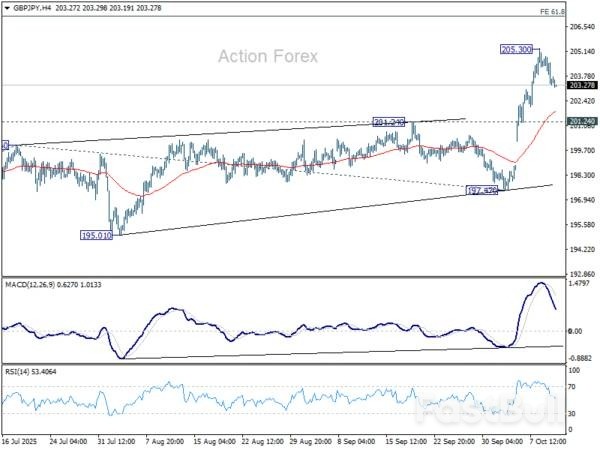
          In the bigger picture, price actions from 208.09 (2024 high) are seen as a corrective pattern which might have completed at 184.35. Firm break of 208.09 high will resume the up trend from 123.94 (2020 low). Next target is 61.8% projection of 148.93 to 208.09 from 184.35 at 220.90. This will now remain the favored case long as 197.47 support holds.

          Source: ACTIONFOREX

          To stay updated on all economic events of today, please check out our Economic calendar
          Risk Warnings and Disclaimers
          You understand and acknowledge that there is a high degree of risk involved in trading. Following any strategies or investment methods may lead to potential losses. The content on the site is provided by our contributors and analysts for information purposes only. You are solely responsible for determining whether any trading assets, securities, strategy, or any other product is suitable for investing based on your own investment objectives and financial situation.
          Add to Favorites
          Share
          FastBull
          Copyright © 2025 FastBull Ltd

          728 RM B 7/F GEE LOK IND BLDG NO 34 HUNG TO RD KWUN TONG KLN HONG KONG

          TelegramInstagramTwitterfacebooklinkedin
          App Store Google Play Google Play
          Products
          Charts

          Chats

          Q&A with Experts
          Screeners
          Economic Calendar
          Data
          Tools
          Membership
          Features
          Function
          Markets
          Copy Trading
          Latest Signals
          Contests
          News
          Analysis
          24/7
          Columns
          Education
          Company
          Careers
          About Us
          Contact Us
          Advertising
          Help Center
          Feedback
          User Agreement
          Privacy Policy
          Business

          White Label

          Data API

          Web Plug-ins

          Poster Maker

          Affiliate Program

          Risk Disclosure

          The risk of loss in trading financial instruments such as stocks, FX, commodities, futures, bonds, ETFs and crypto can be substantial. You may sustain a total loss of the funds that you deposit with your broker. Therefore, you should carefully consider whether such trading is suitable for you in light of your circumstances and financial resources.

          No decision to invest should be made without thoroughly conducting due diligence by yourself or consulting with your financial advisors. Our web content might not suit you since we don't know your financial conditions and investment needs. Our financial information might have latency or contain inaccuracy, so you should be fully responsible for any of your trading and investment decisions. The company will not be responsible for your capital loss.

          Without getting permission from the website, you are not allowed to copy the website's graphics, texts, or trademarks. Intellectual property rights in the content or data incorporated into this website belong to its providers and exchange merchants.

          Not Logged In

          Log in to access more features

          FastBull Membership

          Not yet

          Purchase

          Become a signal provider
          Help Center
          Customer Service
          Dark Mode
          Price Up/Down Colors

          Log In

          Sign Up

          Position
          Layout
          Fullscreen
          Default to Chart
          The chart page opens by default when you visit fastbull.com
