Markets
News
Analysis
User
24/7
Economic Calendar
Education
Data
- Names
- Latest
- Prev


Signal Accounts for Members
All Signal Accounts
All Contests


Japan Tankan Small Manufacturing Outlook Index (Q4)A:--
F: --
P: --
Japan Tankan Large Non-Manufacturing Outlook Index (Q4)A:--
F: --
P: --
Japan Tankan Large Manufacturing Outlook Index (Q4)A:--
F: --
P: --
Japan Tankan Small Manufacturing Diffusion Index (Q4)A:--
F: --
P: --
Japan Tankan Large-Enterprise Capital Expenditure YoY (Q4)A:--
F: --
P: --
U.K. Rightmove House Price Index YoY (Dec)A:--
F: --
P: --
China, Mainland Industrial Output YoY (YTD) (Nov)A:--
F: --
P: --
China, Mainland Urban Area Unemployment Rate (Nov)A:--
F: --
P: --
Saudi Arabia CPI YoY (Nov)A:--
F: --
P: --
Euro Zone Industrial Output YoY (Oct)A:--
F: --
P: --
Euro Zone Industrial Output MoM (Oct)A:--
F: --
P: --
Canada Existing Home Sales MoM (Nov)A:--
F: --
P: --
Canada National Economic Confidence IndexA:--
F: --
P: --
Canada New Housing Starts (Nov)A:--
F: --
U.S. NY Fed Manufacturing Employment Index (Dec)A:--
F: --
P: --
U.S. NY Fed Manufacturing Index (Dec)A:--
F: --
P: --
Canada Core CPI YoY (Nov)A:--
F: --
P: --
Canada Manufacturing Unfilled Orders MoM (Oct)A:--
F: --
P: --
U.S. NY Fed Manufacturing Prices Received Index (Dec)A:--
F: --
P: --
U.S. NY Fed Manufacturing New Orders Index (Dec)A:--
F: --
P: --
Canada Manufacturing New Orders MoM (Oct)A:--
F: --
P: --
Canada Core CPI MoM (Nov)A:--
F: --
P: --
Canada Trimmed CPI YoY (SA) (Nov)A:--
F: --
P: --
Canada Manufacturing Inventory MoM (Oct)A:--
F: --
P: --
Canada CPI YoY (Nov)A:--
F: --
P: --
Canada CPI MoM (Nov)A:--
F: --
P: --
Canada CPI YoY (SA) (Nov)A:--
F: --
P: --
Canada Core CPI MoM (SA) (Nov)A:--
F: --
P: --
Canada CPI MoM (SA) (Nov)A:--
F: --
P: --
Federal Reserve Board Governor Milan delivered a speech
U.S. NAHB Housing Market Index (Dec)A:--
F: --
P: --
Australia Composite PMI Prelim (Dec)--
F: --
P: --
Australia Services PMI Prelim (Dec)--
F: --
P: --
Australia Manufacturing PMI Prelim (Dec)--
F: --
P: --
Japan Manufacturing PMI Prelim (SA) (Dec)--
F: --
P: --
U.K. 3-Month ILO Employment Change (Oct)--
F: --
P: --
U.K. Unemployment Claimant Count (Nov)--
F: --
P: --
U.K. Unemployment Rate (Nov)--
F: --
P: --
U.K. 3-Month ILO Unemployment Rate (Oct)--
F: --
P: --
U.K. Average Weekly Earnings (3-Month Average, Including Bonuses) YoY (Oct)--
F: --
P: --
U.K. Average Weekly Earnings (3-Month Average, Excluding Bonuses) YoY (Oct)--
F: --
P: --
France Services PMI Prelim (Dec)--
F: --
P: --
France Composite PMI Prelim (SA) (Dec)--
F: --
P: --
France Manufacturing PMI Prelim (Dec)--
F: --
P: --
Germany Services PMI Prelim (SA) (Dec)--
F: --
P: --
Germany Manufacturing PMI Prelim (SA) (Dec)--
F: --
P: --
Germany Composite PMI Prelim (SA) (Dec)--
F: --
P: --
Euro Zone Composite PMI Prelim (SA) (Dec)--
F: --
P: --
Euro Zone Services PMI Prelim (SA) (Dec)--
F: --
P: --
Euro Zone Manufacturing PMI Prelim (SA) (Dec)--
F: --
P: --
U.K. Services PMI Prelim (Dec)--
F: --
P: --
U.K. Manufacturing PMI Prelim (Dec)--
F: --
P: --
U.K. Composite PMI Prelim (Dec)--
F: --
P: --
Euro Zone ZEW Economic Sentiment Index (Dec)--
F: --
P: --
Germany ZEW Current Conditions Index (Dec)--
F: --
P: --
Germany ZEW Economic Sentiment Index (Dec)--
F: --
P: --
Euro Zone Trade Balance (Not SA) (Oct)--
F: --
P: --
Euro Zone ZEW Current Conditions Index (Dec)--
F: --
P: --
Euro Zone Trade Balance (SA) (Oct)--
F: --
P: --
Euro Zone Total Reserve Assets (Nov)--
F: --
P: --
U.K. Inflation Rate Expectations--
F: --
P: --


No matching data
Latest Views
Latest Views
Trending Topics
Top Columnists
Latest Update
White Label
Data API
Web Plug-ins
Affiliate Program
View All

No data
Preliminary headline PMI slows to 51 in July vs 52 in June; CBI: manufacturing more stable but outlook weak; Both surveys suggest further weakness in the jobs market; Bank of England contending with slowdown and inflation.
British companies are struggling to grow and the job market continues to weaken, but inflation pressures are still lurking in the economy, according to surveys that are likely to keep the Bank of England on course for only gradual interest rate cuts.
S&P Global's preliminary UK Composite Purchasing Managers' Index (PMI) slowed to 51.0 in July from 52.0 in June, not far above the 50.0 level that separates growth from contraction. A Reuters poll had forecast a smaller fall to 51.8.
The survey's employment gauge dropped to its lowest since February, with businesses in part blaming the decision by finance minister Rachel Reeves to make them pay more in staff social security contributions from April.
"Particularly worrying is the sustained impact of the budget measures on employment," Chris Williamson, chief business economist at S&P Global Market Intelligence, said.
The impact of highertrade tariffs, launched by U.S.President Donald Trump, also weighed on firms.
A separate survey by the Confederation of British Industry suggested Britain's manufacturing sector, which accounts for about 10% of the economy, had stabilised after a downturn. But the outlook remains fragile with factories cutting jobs again.
The BoE is expected to reduce interest rates for the fifth time in 12 months on August 7 as it focuses on the slowdown in the jobs market, despite inflation rising further above the central bank's 2% target to 3.6% in June.
Thursday's surveys underscored the BoE's dilemma with companies facing price pressures as well as weaker demand.
The PMI showed prices charged by firms speeding up for the first time since April as suppliers sought to offset some of Reeves' tax increase and higher wage bills.
"In our view, the Bank should be more concerned about the ominous state of the jobs market and what it implies for wage growth," James Smith, an economist with ING, said.
However, another three-way split on the BoE's Monetary Policy Committee was possible in August similar to May's voting pattern, Smith said.
At that meeting, two members voted for a big half-point rate cut due to their worries about the jobs market, while five backed a smaller quarter-point cut and two said borrowing costs should stay on hold because of inflation risks.
Matt Swannell, chief economic advisor to the EY ITEM Club, a forecasting organisation, said it remained unlikely that the BoE would speed up its rate cuts after August's reduction.
"We're yet to see the sort of deterioration in the official labour market or activity data that could prompt a pivot to faster rate cuts," Swannell said.
S&P Global's Williamson said the PMI survey suggested Britain's economy was growing at a quarterly pace of just 0.1% with a risk that it could prove weaker.
The PMI for the services sector slipped to 51.2 in July from June's 52.8. The manufacturing sector PMI rose for a fourth month in a row to 48.2 from 47.7 but remained in contraction territory for a 10th consecutive month.
The number of Americans filing new applications for jobless benefits unexpectedly fell last week, pointing to stable labor market conditions, though sluggish hiring is making it harder for many laid-off workers to land new opportunities.
Initial claims for state unemployment benefits dropped 4,000 to a seasonally adjusted 217,000 for the week ended July 19, the Labor Department said on Thursday. Economists polled by Reuters had forecast 226,000 claims for the latest week.
Claims have pulled back after surging to an eight-month high in June. Though there have been some layoffs, employers have been mostly reluctant to lay off workers, opting instead to scale back on hiring while awaiting more clarity on President DonaldTrump'sprotectionist trade policy.
There is still a chance that claims could push higher. Claims have tended to increase in July, in part related to annual closures of motor vehicle assembly plants, whose unknown timing can throw off the model that the government uses to strip out seasonal fluctuations from the data.
"But as long as the level is within recent ranges, the increase would not be concerning," said Gisela Young, an economist at Citigroup.
Though job growth has slowed from last year, the labor market remains stable and has provided scope for the Federal Reserve to delay resuming cutting interest rates while watching for potential inflation from the import duties. Trump is demanding the U.S. central bank lower borrowing costs.
Economists expect the Fed will keep its benchmark overnight interest rate in the 4.25%-4.50% range next Wednesday. The Fed cut rates three times in 2024, with the last move coming in December.
Though the labor market remains on a solid footing, the hesitancy by businesses to boost hiring has left many people losing their jobs to experience long spells of unemployment.
The number of people receiving benefits after an initial week of aid, a proxy for hiring, increased 4,000 to a seasonally adjusted 1.955 million during the week ending July 12, the claims report showed. The so-called continuing claims covered the period during which the government surveyed households for July's unemployment rate.
While economists said the elevated continuing claims reading posed an upside risk to the unemployment rate, they mostly expected it to hold steady at 4.1% this month. A decline in labor supply amid reduced immigrant flows means the economy now only needs to create roughly 100,000 or less per month to keep up with growth in the working age population.
The drop in the unemployment rate in June after holding at 4.2% for three straight months was mostly because people dropped out of the labor force.
"Looking ahead, we expect the gradual slowdown in immigration to bring the breakeven rate, the rate of payroll job growth needed to keep the unemployment rate stable, down to 70,000 per month by the end of 2025 from our 90,000 estimate of the current pace," said Goldman Sachs economist Elsie Peng in a note.
The European Central Bank kept interest rates unchanged for the first time in more than a year after inflation hit 2% and messy trade negotiations with the US continued to cast a shadow over the economy.
The deposit rate was left at 2% on Thursday — as predicted by the overwhelming majority of analysts in a Bloomberg survey. Still lacking clarity on the eventual level of tariffs, the ECB offered no guidance on future steps.
“Inflation is currently at the 2% medium-term target,” it said in a statement. “The economy has so far proven resilient overall in a challenging global environment. At the same time, the environment remains exceptionally uncertain, especially because of trade disputes.”
The question now is whether policymakers will add to the eight reductions in borrowing costs they’ve made since June 2024 or whether their monetary-easing campaign is over. President Christine Lagarde has said the ECB is in a good place to handle other challenges beyond trade, including the strength of the euro and an upcoming jump in public spending on infrastructure and defense.
Investors maintained bets on 22 basis points of rate cuts by year-end. Economists polled before the decision predict a final quarter-point move of the cycle in September.
Lagarde may offer an updated view on the euro zone’s 20-nation economy in a Frankfurt press conference at 2:45 p.m. The ECB warned at its last meeting in June that an adverse scenario with steep tariffs would lead to considerably weaker growth and inflation lower than predicted.
The ECB met just over a week before US President Donald Trump’s latest deadline for the European Union to strike a trade agreement. While the bloc has readied countermeasures — at potentially high economic cost — diplomats briefed on the negotiations are hopeful that progress is being made toward a deal with levy of 15%.
ECB Vice President Luis de Guindos has already cautioned that growth will be “almost flat” in the second and third quarters after firms front-loaded business at the start of 2025 to dodge higher levies later on. A reading for gross domestic product between April and June is due on July 30.
Recent data have backed Guindos’s assessment. Companies’ appetite for loans remained subdued in the second quarter, while a gauge of private-sector business activity showed the region is only regaining momentum gradually.
The euro’s more than 13% ascent against the dollar this year poses another test, threatening to weigh too heavily on consumer prices. The ECB is already forecasting inflation will fall short of its goal next year.
That’s prompted Governing Council members including France’s Francois Villeroy de Galhau and Finland’s Olli Rehn to warn of a prolonged undershoot. Executive Board member Isabel Schnabel, however, reckons the economy is resilient and deems the bar for another rate cut “very high.”
Joining this debate is Olaf Sleijpen, who’s just succeeded Klaas Knot as head of the Dutch central bank. Austria’s Robert Holzmann will retire in August, while Portugal’s Mario Centeno may not be reappointed after his term recently expired.
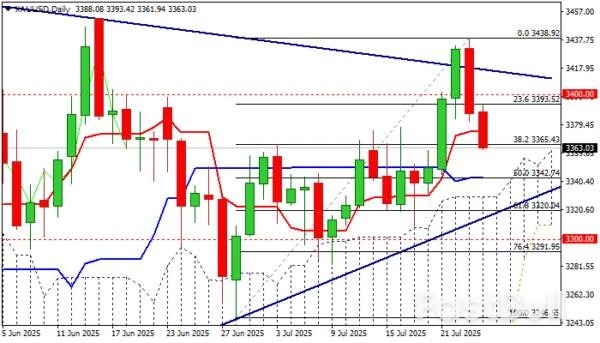
Gold price falls for the second day, as growing optimism over possible US-EU trade deal continues to fuel risk appetite and deflates safe-haven demand.
Fresh weakness emerged after bulls failed to register a clear break above trendline resistance (daily chart triangle’s upper boundary) with return below the trendline signaling a false break higher and generating bearish signal.
The yellow metal’s price lost around 2% since Wednesday’s opening and cracked pivotal support at $3365 (Fibo 38.2% of $3246/$3438, reinforced by 10DMA, with sustained break here to confirm reversal signal, following Wednesday’s completion of bearish engulfing and close below psychological $3400 support.
Technical picture on daily chart has weakened, although studies are still positive overall, suggesting that current weakness needs to find ground above the top of daily Ichimoku cloud ($3330) to keep larger picture bullishly aligned.
Otherwise, violation of cloud top and nearby lower triangle boundary ($3317) would generate stronger bearish signal and bring the downside at increased risk.
Res: 3393; 3400; 3419; 3438.Sup: 3342; 3330; 3317; 3309.

The Japanese central bank's deputy governor, Shinichi Uchida, said a trade deal with Washington had reduced economic uncertainty, comments that fueled optimism in the market about the potential resumption of interest rate hikes.Still, some analysts think the yen faces persistent headwinds due to domestic political uncertainty following Sunday's upper house election.
The European Union is nearing a deal that would impose a broad 15% tariff on EU goods entering the United States, roughly in line with economists' expectations.Meanwhile, risk assets rallied as the trade deals eased fears over the economic fallout of a global trade war.The risk-sensitive Australian dollar rose to an eight-month high of $0.661 on Thursday.
The euro fell 0.2% at $1.175, not far from a high of $1.1830 it hit earlier this month, which marked its strongest level in more than three years."We maintain our view that we would see some wobbles in risky assets in August as we see some slowdown in the (U.S.) employment data," said Mohit Kumar, economist at Jefferies."As of now, there has been very little tariff impact on the hard data. But that does not mean it's not coming," he added, arguing it would take at least three months to see the fallout of trade duties on hard economic figures.
Against the yen, the dollar nudged up to 146.57, or 0.06%, as it sought to prevent a fall against the Japanese currency to a fourth straight session.Olivier Korber, forex strategist at Societe Generale, expects the yen to strengthen further, citing support from the trade deal and prospects for higher interest rates.
"The local press reported that he (Prime Minister Shigeru Ishiba) should decide if he will resign in late August and, if that were to happen, a new party leader would probably be selected in September," Korber said."This would ensure a smoother political transition, thus limiting market uncertainty," he added.Ishiba denied on Wednesday he had decided to quit after a source and media reports said he planned to announce his resignation to take responsibility for a bruising upper house election defeat.
Trade negotiations aside, market focus is also on a rate decision from the European Central Bank later in the day.Expectations are for policymakers to keep rates unchanged, though markets will look out for what they say about the outlook for monetary policy. Investors generally expect one more ECB rate cut by the end of the year, most likely in December.Data showed that German business activity continued to grow marginally in July.
Currencies mostly shrugged off news that U.S. President Donald Trump, a vocal critic of Federal Reserve Chair Jerome Powell, will visit the central bank on Thursday, a surprise move that escalates tensions between the administration and the Fed.
The path of least resistance for oil prices from here is higher.
That’s what analysts at Standard Chartered Bank, including the company’s commodities research head Paul Horsnell, think, a report sent to Rigzone by the Standard Chartered Bank team late Tuesday revealed.
The analysts noted in the report, however, that “there is likely to be a period of significant trader confusion before they lock on to the three key factors that should create an upwards trend”.
“Namely, one; non-OPEC+ supply is under-performing and U.S. supply is likely to fall, two; short- and long-term demand are far more robust than consensus believed, and three; OPEC+ policy is becoming increasingly proactive, with the background of a sustained campaign by key members to increase the effectiveness of the organization,” the analysts added.
In the report, the analysts stated that, “on the surface, one could conclude that the oil market has already lapsed into a summer torpor”.
They said front-month Brent has generated little excitement over the past week, pointing out that it was “unchanged week on week, settling at $69.21 per barrel” and highlighting that the last six daily settlements “have all been in a $68.52 - 69.52 per barrel range”.
“Volatility is declining; for example, 30-day realized annualized Brent volatility has fallen by 10.5 percentage points week on week to 39.4 percent and options markets have moved from marked nervousness about the upside manifested in a call skew to modest bearishness shown in a limited put skew,” the analysts said in the report.
The Standard Chartered Bank analysts stated in the report, however, that, despite the overall somnolent air, there are some more discordant data points and intimations of instability.
“Money-manager positioning provides one such set of instability red flags,” the analysts highlighted in the report.
“Our crude oil money-manager positioning index for the main WTI contract indicates a high degree of bearishness at -75.7, a week on week decline of 35.0. In sharp contrast, the money-manager positioning index for the main Brent contract shows modest bullishness at +29.3, a week on week increase of 6.2,” they said.
“This is the third week in a row that the Brent and WTI positioning indices have moved in opposite directions; there were no such three-week runs in either 2023 or 2024. Over the past two weeks alone, money managers have cut net longs in WTI by 82.9 million barrels (mb), while money-manager net longs in Brent have increased by 72.3mb,” they added.
“The data, and discussions with participants, imply to us that there is a high degree of confusion among traders; while the majority feel they should be doing something, there is little consensus as to precisely what they should be doing and what they should be reacting to,” the analysts stated.
“U.S.-based traders appear to [be] more bearish than Europe-, Asia- or Middle East-based traders but are more likely to follow general asset markets and concentrate heavily on tariff deals and FOMC leadership news flow,” they continued.
Outside the U.S., the confusion seems to be more about oil market fundamentals, the analysts said in the report.
“On the one hand, many traders appear to believe that the rolling back of OPEC+ voluntary cuts has revealed significantly less spare capacity than they previously thought; but on the other hand they worry that this revelation has come from greater short-term supply which they fear could unbalance the market early next year,” they noted.
“That leads to the question of how to price a market that has less spare capacity but might have looser balances; views on this issue have yet to crystallize fully,” they pointed out.
Standard Chartered Bank’s report shows that the company expects the ICE Brent nearby future crude oil price to average $65 per barrel in the fourth quarter of this year and $61 per barrel overall in 2025.
White Label
Data API
Web Plug-ins
Poster Maker
Affiliate Program
The risk of loss in trading financial instruments such as stocks, FX, commodities, futures, bonds, ETFs and crypto can be substantial. You may sustain a total loss of the funds that you deposit with your broker. Therefore, you should carefully consider whether such trading is suitable for you in light of your circumstances and financial resources.
No decision to invest should be made without thoroughly conducting due diligence by yourself or consulting with your financial advisors. Our web content might not suit you since we don't know your financial conditions and investment needs. Our financial information might have latency or contain inaccuracy, so you should be fully responsible for any of your trading and investment decisions. The company will not be responsible for your capital loss.
Without getting permission from the website, you are not allowed to copy the website's graphics, texts, or trademarks. Intellectual property rights in the content or data incorporated into this website belong to its providers and exchange merchants.
Not Logged In
Log in to access more features

FastBull Membership
Not yet
Purchase
Log In
Sign Up