• Trade
  • Markets
  • Copy
  • Contests
  • News
  • 24/7
  • Calendar
  • Q&A
  • Chats
Trending
Screeners
SYMBOL
LAST
BID
ASK
HIGH
LOW
NET CHG.
%CHG.
SPREAD
SPX
S&P 500 Index
6848.15
6848.15
6848.15
6861.30
6843.84
+20.74
+ 0.30%
--
DJI
Dow Jones Industrial Average
48625.18
48625.18
48625.18
48679.14
48557.21
+167.14
+ 0.34%
--
IXIC
NASDAQ Composite Index
23243.79
23243.79
23243.79
23345.56
23239.56
+48.63
+ 0.21%
--
USDX
US Dollar Index
97.820
97.900
97.820
98.070
97.810
-0.130
-0.13%
--
EURUSD
Euro / US Dollar
1.17576
1.17583
1.17576
1.17596
1.17262
+0.00182
+ 0.16%
--
GBPUSD
Pound Sterling / US Dollar
1.33952
1.33961
1.33952
1.33970
1.33546
+0.00245
+ 0.18%
--
XAUUSD
Gold / US Dollar
4330.80
4331.23
4330.80
4350.16
4294.68
+31.41
+ 0.73%
--
WTI
Light Sweet Crude Oil
56.858
56.888
56.858
57.601
56.789
-0.375
-0.66%
--

Community Accounts

Signal Accounts
--
Profit Accounts
--
Loss Accounts
--
View More

Become a signal provider

Sell trading signals to earn additional income

View More

Guide to Copy Trading

Get started with ease and confidence

View More

Signal Accounts for Members

All Signal Accounts

Best Return
  • Best Return
  • Best P/L
  • Best MDD
Past 1W
  • Past 1W
  • Past 1M
  • Past 1Y

All Contests

  • All
  • Trump Updates
  • Recommend
  • Stocks
  • Cryptocurrencies
  • Central Banks
  • Featured News
Top News Only
Share

The Nasdaq Golden Dragon China Index Fell 0.9% In Early Trading

Share

The S&P 500 Opened 32.78 Points Higher, Or 0.48%, At 6860.19; The Dow Jones Industrial Average Opened 136.31 Points Higher, Or 0.28%, At 48594.36; And The Nasdaq Composite Opened 134.87 Points Higher, Or 0.58%, At 23330.04

Share

Miran: Goods Inflation Could Be Settling In At A Higher Level Than Was Normal Before The Pandemic, But That Will Be More Than Offset By Housing Disinflation

Share

Miran, Who Dissented In Favor Of A Larger Cut At Last Fed Meeting, Repeats Keeping Policy Too Tight Will Lead To Job Losses

Share

Miran: Does Not Think Higher Goods Inflation Is Mostly From Tariffs, But Acknowledges Does Not Have A Full Explanation For It

Share

Toronto Stock Index .GSPTSE Rises 67.16 Points, Or 0.21 Percent, To 31594.55 At Open

Share

Miran: Excluding Housing And Non-Market Based Items, Core Pce Inflation May Be Below 2.3%, “Within Noise” Of The Fed's 2% Target

Share

Polish State Assets Minister Balczun Says Jsw Needs Over USD 830 Million Financing To Keep Liquidity For A Year

Share

Miran: Prices Are “Once Again Stable” And Monetary Policy Should Reflect That

Share

Fed's Miran: Current Excess Inflation Is Not Reflective Of Underlying Supply And Demand In The Economy

Share

Portugal Treasury Puts 2026 Net Financing Needs At 13 Billion Euros, Up From 10.8 Billion In 2025

Share

Portugal Treasury Expects 2026 Net Financing Needs At 29.4 Billion Euros, Up From 25.8 Billion In 2025

Share

Bank Of America Says With Indonesia's Smelter Now Ramping Up, It Expects Aluminium Supply Growth To Accelerate To 2.6% Year On Year In 2026

Share

Bank Of America Expects A Deficit In Aluminium Next Year And Sees Prices Pushing Above $3000/T

Share

Fed Data - USA Effective Federal Funds Rate At 3.64 Percent On 12 December On $102 Billion In Trades Versus 3.64 Percent On $99 Billion On 11 December

Share

Brazil's Petrobras Says No Impact Seen On Oil, Petroleum Products Output As Workers Start Planned Strike

Share

Statement: US Travel Group Warns New Proposed Trump Administration Requirements For Foreign Tourists To Provide Social Media Histories Could Mean Millions Of People Opting Not To Visit

Share

Blackrock: Kerry White Will Become Head Of Citi Investment Management At Citi Wealth

Share

Blackrock: Rob Jasminski, Head Of Citi Investment Management, Has Joined With Team

Share

Blackrock: Effective Dec 15, Citi Investment Management Employees Will Join Blackrock

TIME
ACT
FCST
PREV
Japan Tankan Small Manufacturing Outlook Index (Q4)

A:--

F: --

P: --

Japan Tankan Large Non-Manufacturing Outlook Index (Q4)

A:--

F: --

P: --

Japan Tankan Large Manufacturing Outlook Index (Q4)

A:--

F: --

P: --

Japan Tankan Small Manufacturing Diffusion Index (Q4)

A:--

F: --

P: --

Japan Tankan Large Manufacturing Diffusion Index (Q4)

A:--

F: --

P: --

Japan Tankan Large-Enterprise Capital Expenditure YoY (Q4)

A:--

F: --

P: --

U.K. Rightmove House Price Index YoY (Dec)

A:--

F: --

P: --

China, Mainland Industrial Output YoY (YTD) (Nov)

A:--

F: --

P: --

China, Mainland Urban Area Unemployment Rate (Nov)

A:--

F: --

P: --

Saudi Arabia CPI YoY (Nov)

A:--

F: --

P: --

Euro Zone Industrial Output YoY (Oct)

A:--

F: --

P: --

Euro Zone Industrial Output MoM (Oct)

A:--

F: --

P: --

Canada Existing Home Sales MoM (Nov)

A:--

F: --

P: --

Canada National Economic Confidence Index

A:--

F: --

P: --

Canada New Housing Starts (Nov)

A:--

F: --

P: --
U.S. NY Fed Manufacturing Employment Index (Dec)

A:--

F: --

P: --

U.S. NY Fed Manufacturing Index (Dec)

A:--

F: --

P: --

Canada Core CPI YoY (Nov)

A:--

F: --

P: --

Canada Manufacturing Unfilled Orders MoM (Oct)

A:--

F: --

P: --

U.S. NY Fed Manufacturing Prices Received Index (Dec)

A:--

F: --

P: --

U.S. NY Fed Manufacturing New Orders Index (Dec)

A:--

F: --

P: --

Canada Manufacturing New Orders MoM (Oct)

A:--

F: --

P: --

Canada Core CPI MoM (Nov)

A:--

F: --

P: --

Canada Trimmed CPI YoY (SA) (Nov)

A:--

F: --

P: --

Canada Manufacturing Inventory MoM (Oct)

A:--

F: --

P: --

Canada CPI YoY (Nov)

A:--

F: --

P: --

Canada CPI MoM (Nov)

A:--

F: --

P: --

Canada CPI YoY (SA) (Nov)

A:--

F: --

P: --

Canada Core CPI MoM (SA) (Nov)

A:--

F: --

P: --

Canada CPI MoM (SA) (Nov)

A:--

F: --

P: --

Federal Reserve Board Governor Milan delivered a speech
U.S. NAHB Housing Market Index (Dec)

--

F: --

P: --

Australia Composite PMI Prelim (Dec)

--

F: --

P: --

Australia Services PMI Prelim (Dec)

--

F: --

P: --

Australia Manufacturing PMI Prelim (Dec)

--

F: --

P: --

Japan Manufacturing PMI Prelim (SA) (Dec)

--

F: --

P: --

U.K. 3-Month ILO Employment Change (Oct)

--

F: --

P: --

U.K. Unemployment Claimant Count (Nov)

--

F: --

P: --

U.K. Unemployment Rate (Nov)

--

F: --

P: --

U.K. 3-Month ILO Unemployment Rate (Oct)

--

F: --

P: --

U.K. Average Weekly Earnings (3-Month Average, Including Bonuses) YoY (Oct)

--

F: --

P: --

U.K. Average Weekly Earnings (3-Month Average, Excluding Bonuses) YoY (Oct)

--

F: --

P: --

France Services PMI Prelim (Dec)

--

F: --

P: --

France Composite PMI Prelim (SA) (Dec)

--

F: --

P: --

France Manufacturing PMI Prelim (Dec)

--

F: --

P: --

Germany Services PMI Prelim (SA) (Dec)

--

F: --

P: --

Germany Manufacturing PMI Prelim (SA) (Dec)

--

F: --

P: --

Germany Composite PMI Prelim (SA) (Dec)

--

F: --

P: --

Euro Zone Composite PMI Prelim (SA) (Dec)

--

F: --

P: --

Euro Zone Services PMI Prelim (SA) (Dec)

--

F: --

P: --

Euro Zone Manufacturing PMI Prelim (SA) (Dec)

--

F: --

P: --

U.K. Services PMI Prelim (Dec)

--

F: --

P: --

U.K. Manufacturing PMI Prelim (Dec)

--

F: --

P: --

U.K. Composite PMI Prelim (Dec)

--

F: --

P: --

Euro Zone ZEW Economic Sentiment Index (Dec)

--

F: --

P: --

Germany ZEW Current Conditions Index (Dec)

--

F: --

P: --

Germany ZEW Economic Sentiment Index (Dec)

--

F: --

P: --

Euro Zone Trade Balance (Not SA) (Oct)

--

F: --

P: --

Euro Zone ZEW Current Conditions Index (Dec)

--

F: --

P: --

Euro Zone Trade Balance (SA) (Oct)

--

F: --

P: --

U.S. Retail Sales MoM (Excl. Automobile) (SA) (Oct)

--

F: --

P: --

Q&A with Experts
    • All
    • Chatrooms
    • Groups
    • Friends
    Connecting
    .
    .
    .
    Type here...
    Add Symbol or Code

      No matching data

      All
      Trump Updates
      Recommend
      Stocks
      Cryptocurrencies
      Central Banks
      Featured News
      • All
      • Russia-Ukraine Conflict
      • Middle East Flashpoint
      • All
      • Russia-Ukraine Conflict
      • Middle East Flashpoint
      Search
      Products

      Charts Free Forever

      Chats Q&A with Experts
      Screeners Economic Calendar Data Tools
      Membership Features
      Data Warehouse Market Trends Institutional Data Policy Rates Macro

      Market Trends

      Market Sentiment Order Book Forex Correlations

      Top Indicators

      Charts Free Forever
      Markets

      News

      News Analysis 24/7 Columns Education
      From Institutions From Analysts
      Topics Columnists

      Latest Views

      Latest Views

      Trending Topics

      Top Columnists

      Latest Update

      Signals

      Copy Rankings Latest Signals Become a signal provider AI Rating
      Contests
      Brokers

      Overview Brokers Assessment Rankings Regulators News Claims
      Broker listing Forex Brokers Comparison Tool Live Spread Comparison Scam
      Q&A Complaint Scam Alert Videos Tips to Detect Scam
      More

      Business
      Events
      Careers About Us Advertising Help Center

      White Label

      Data API

      Web Plug-ins

      Affiliate Program

      Awards Institution Evaluation IB Seminar Salon Event Exhibition
      Vietnam Thailand Singapore Dubai
      Fans Party Investment Sharing Session
      FastBull Summit BrokersView Expo
      Recent Searches
        Top Searches
          Markets
          News
          Analysis
          User
          24/7
          Economic Calendar
          Education
          Data
          • Names
          • Latest
          • Prev

          View All

          No data

          Scan to Download

          Faster Charts, Chat Faster!

          Download App
          English
          • English
          • Español
          • العربية
          • Bahasa Indonesia
          • Bahasa Melayu
          • Tiếng Việt
          • ภาษาไทย
          • Français
          • Italiano
          • Türkçe
          • Русский язык
          • 简中
          • 繁中
          Open Account
          Search
          Products
          Charts Free Forever
          Markets
          News
          Signals

          Copy Rankings Latest Signals Become a signal provider AI Rating
          Contests
          Brokers

          Overview Brokers Assessment Rankings Regulators News Claims
          Broker listing Forex Brokers Comparison Tool Live Spread Comparison Scam
          Q&A Complaint Scam Alert Videos Tips to Detect Scam
          More

          Business
          Events
          Careers About Us Advertising Help Center

          White Label

          Data API

          Web Plug-ins

          Affiliate Program

          Awards Institution Evaluation IB Seminar Salon Event Exhibition
          Vietnam Thailand Singapore Dubai
          Fans Party Investment Sharing Session
          FastBull Summit BrokersView Expo

          Trump-Backed World Liberty Financial Token Slumps on Market Debut

          Gerik

          Cryptocurrency

          Summary:

          The World Liberty Financial token (WLFI), promoted by President Donald Trump and his family, dropped in value on its first day of trading, signaling weak investor confidence despite high-profile backing....

          Disappointing Market Debut for WLFI

          The highly publicized launch of the World Liberty Financial token, branded as WLFI, opened to intense media attention due to its association with President Donald Trump and his family. However, the token quickly fell in value during its first trading session on Monday, casting doubt on the project’s ability to attract sustained investor enthusiasm.
          While the Trump brand provided global visibility, the immediate market response suggests that investor appetite was far weaker than anticipated. The decline underscores a gap between political prominence and financial credibility, a dynamic often seen when high-profile endorsements fail to translate into long-term demand for speculative assets.

          Investor Sentiment and Market Context

          The WLFI launch occurred at a time when global financial markets are already grappling with volatility stemming from trade disputes, legal battles over U.S. tariffs, and eroding confidence in fiat currencies. Gold has surged to fresh record highs above $3,550 per ounce, reflecting a broad shift by investors into traditional safe-haven assets. Against this backdrop, speculative projects like WLFI face steeper hurdles in building confidence.
          The token’s decline may also reflect broader skepticism about the utility and governance of politically linked cryptocurrencies. While association with a sitting U.S. president guarantees attention, it also raises regulatory and legal risks that discourage institutional participation.

          Outlook for the Project

          The early performance of WLFI highlights the challenges facing politically branded digital assets. Without clear use cases, strong infrastructure, or institutional adoption, the token risks being perceived primarily as a vehicle for political signaling rather than as a sustainable investment. The debut serves as a reminder that crypto projects, even with high-profile backers, remain vulnerable to rapid market corrections when investor trust is uncertain.
          World Liberty Financial’s underwhelming debut illustrates the limits of brand-driven speculation in crypto markets. Despite the Trump family’s involvement, WLFI’s initial decline points to a market that is increasingly cautious, prioritizing stability and proven utility over political endorsement. The token’s future will depend on whether it can establish credibility beyond the sphere of politics and deliver tangible value to investors.

          Source: FT

          Risk Warnings and Disclaimers
          You understand and acknowledge that there is a high degree of risk involved in trading. Following any strategies or investment methods may lead to potential losses. The content on the site is provided by our contributors and analysts for information purposes only. You are solely responsible for determining whether any trading assets, securities, strategy, or any other product is suitable for investing based on your own investment objectives and financial situation.
          Add to Favorites
          Share

          Trump Tariffs Head to the Supreme Court as Legal and Geopolitical Tensions Mount

          Gerik

          Economic

          Tariffs Face Judicial Scrutiny but Alternatives Remain

          The long-running debate over Trump’s tariff policy entered a new phase after a federal appeals court ruled that much of the administration’s tariff program lacked proper legal justification. While the ruling marked a major legal setback, Treasury Secretary Scott Bessent underscored that other statutory powers, including the Smoot-Hawley Tariff Act, could still be invoked to maintain restrictions. The reference to Smoot-Hawley is significant, as the 1930 law is historically remembered for worsening the Great Depression, raising questions about whether its revival could amplify modern trade tensions.
          Markets were closed on Monday for the U.S. Labor Day holiday, leaving investors unable to immediately react to the court decision or Bessent’s comments. Futures remained steady, suggesting market participants have grown accustomed to the volatility surrounding Trump-era trade policies. This muted response may reflect the perception that legal challenges are only one step in what could become a prolonged confrontation.

          India and the Tariff Diplomacy Narrative

          President Trump added further complexity by declaring that India had offered to remove tariffs on U.S. goods, though he provided no detail. At the same time, he sharply criticized India’s trade policy as “a totally one-sided disaster.” These remarks followed Indian Prime Minister Narendra Modi’s visit to China for the Shanghai Cooperation Organization (SCO) summit, where new alignments and strategic partnerships were emphasized.
          The timing suggests a correlation between India’s outreach to China and Trump’s harsher rhetoric on bilateral trade. Whether Trump’s claim of tariff concessions reflects genuine negotiation progress or political posturing remains unclear, but it highlights the interwoven dynamics between U.S. trade policy and Asia’s shifting geopolitical landscape.
          The SCO summit underscored Beijing’s push for a more multipolar world order. Key developments included warming India-China relations, visible alignment between Xi Jinping, Vladimir Putin, and Narendra Modi, as well as proposals for AI collaboration and the creation of a new development bank. These initiatives represent more than symbolic gestures; they indicate the consolidation of alternative power structures designed to challenge Western-led institutions.
          For Washington, this evolving bloc presents both economic and strategic risks. By tightening ties, SCO members could reduce reliance on Western trade and financial systems, further eroding the influence of U.S. tariffs as a tool of leverage.

          Regional Market Responses Highlight Policy Sensitivity

          Asian markets traded mixed on Tuesday. South Korea’s Kospi climbed nearly 0.8% as lower-than-expected August inflation provided some relief, while U.S. futures remained flat in the absence of domestic trading. The subdued response suggests investors are waiting for clarity on both the legal trajectory of tariffs and broader macroeconomic indicators due later this week.
          Meanwhile, European markets edged higher on Monday, with Germany’s DAX rising 0.6%. This divergence reflects regional differences in how global trade and tariff uncertainty is being priced, with European investors appearing more focused on manufacturing and inflation data.

          A Parallel Business Story: Pickleball’s Rise in China

          In contrast to the political turbulence, niche markets such as sports are showing remarkable growth. Suzhou Shishan, a Chinese sports club, opened the city’s first pickleball court in 2024, and sales of pickleball equipment have since surged to $1.2 million per month as of July 2025, a sixfold increase year-on-year. Unlike suburban U.S. growth, which is community-driven, China’s urban expansion of pickleball is being led by private operators capitalizing on new commercial opportunities.
          The Supreme Court’s upcoming deliberations on Trump’s tariffs mark only the beginning of a drawn-out legal and political contest. Even if the court rules against the administration, Bessent’s insistence on fallback legal authorities ensures tariffs will remain a central feature of U.S. trade strategy. At the same time, shifting alliances highlighted by the SCO summit, coupled with uneven market reactions, point to a world economy caught between judicial processes, political brinkmanship, and emerging global power blocs. Investors remain cautious, aware that the outcomes of these battles will shape trade, markets, and geopolitical stability well beyond 2025.

          Source: CNBC

          To stay updated on all economic events of today, please check out our Economic calendar
          Risk Warnings and Disclaimers
          You understand and acknowledge that there is a high degree of risk involved in trading. Following any strategies or investment methods may lead to potential losses. The content on the site is provided by our contributors and analysts for information purposes only. You are solely responsible for determining whether any trading assets, securities, strategy, or any other product is suitable for investing based on your own investment objectives and financial situation.
          Add to Favorites
          Share

          AUDUSD In Correction: A Pause Needed Before The Next Growth Wave

          Blue River

          Economic

          Forex

          The AUDUSD pair declined to 0.6540. Australian statistics remain highly mixed. Find more details in our analysis for 2 September 2025.

          AUDUSD forecast: key trading points

          ● The AUDUSD pair entered a correction after steady gains
          ● Economic data looks mixed, with investors awaiting signals from the RBA
          ● AUDUSD forecast for 2 September 2025: 0.6570

          Fundamental analysis

          On Tuesday, the AUDUSD rate dropped to 0.6540, breaking its five-session winning streak. Investors paused amid conflicting economic signals.

          Support for the Aussie came from trade and industry data. The current account deficit in Q2 narrowed to its lowest level in a year. The manufacturing PMI reached nearly a three-year high in August, remaining above the 50-point threshold for the eighth consecutive month.

          However, alongside these positives, weak spots stood out. Business inventories posted their smallest increase in the past year. Overall building permits dropped sharply, erasing June’s growth. Meanwhile, private house permits showed only a very modest recovery.

          Investors’ focus now shifts to the PMI release, GDP data, and tomorrow’s speech by RBA Governor Michele Bullock. This could provide further guidance on the monetary policy trajectory.

          The AUDUSD forecast is moderate.

          AUDUSD technical analysis

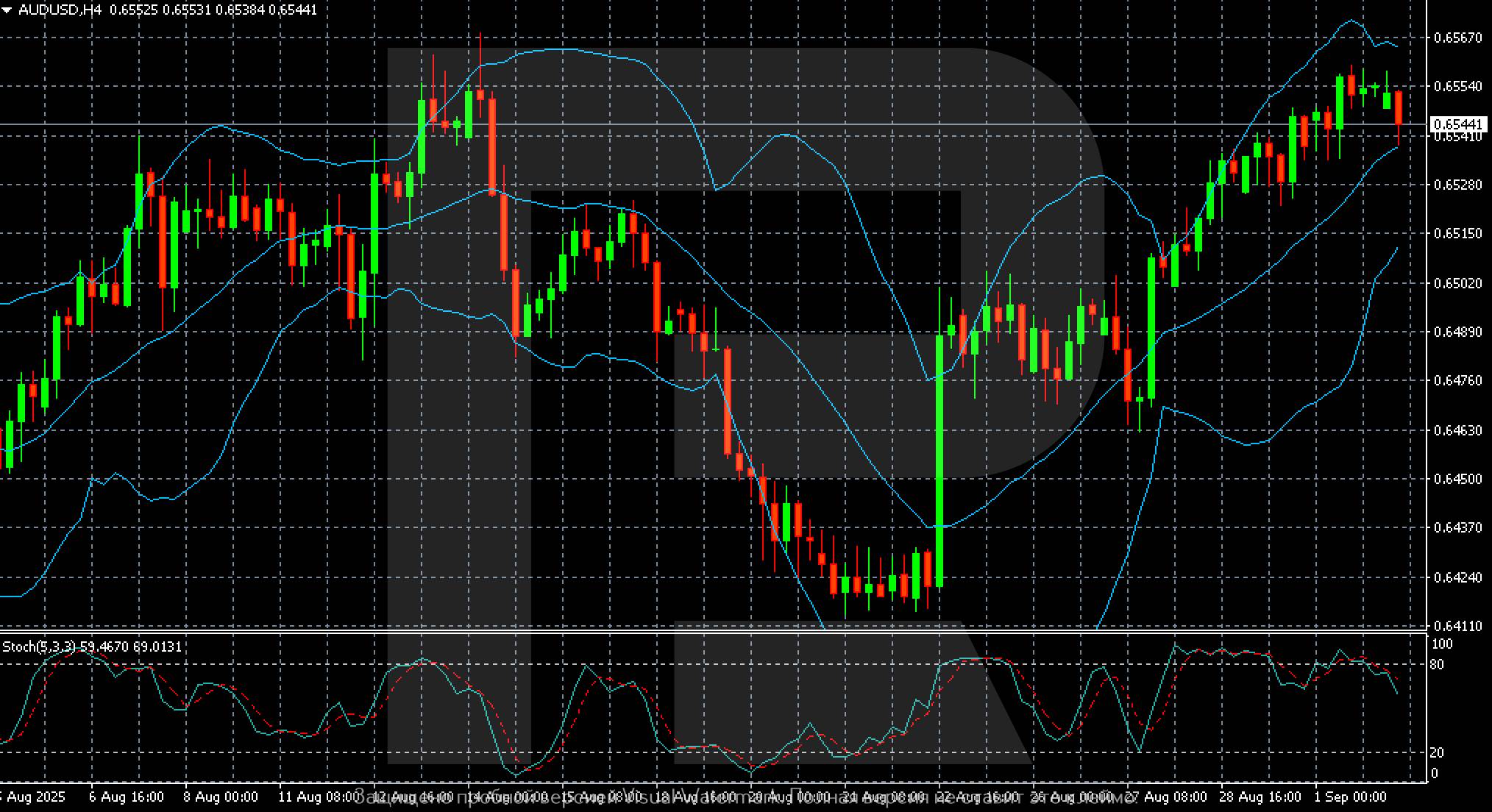
          The AUDUSD H4 chart shows a strong rebound after the decline in the second half of August. Quotes reached the 0.6550-0.6560 area, from where a minor correction is observed. Support forms at 0.6500-0.6520, while resistance is located around 0.6565-0.6570, where local highs are clustered.

          Bollinger Bands are expanding upwards, confirming the sustained bullish momentum, although current movement is near the channel’s upper boundary. The Stochastic is in overbought territory, signaling the likelihood of a short-term correction. MACD remains in positive territory, supporting medium-term growth.

          In the short term, consolidation within the 0.6500-0.6570 range is likely. To continue the uptrend, the pair needs to secure a breakout above 0.6570, with targets at 0.6600-0.6620. A breakout below 0.6500 could open the way for a correction towards 0.6460-0.6440.
          Summary

          The AUDUSD pair entered a mild correction after five days of growth. The AUDUSD forecast for today, 2 September 2025, suggests short-term consolidation and a return to 0.6570.

          Source: RoboForex

          To stay updated on all economic events of today, please check out our Economic calendar
          Risk Warnings and Disclaimers
          You understand and acknowledge that there is a high degree of risk involved in trading. Following any strategies or investment methods may lead to potential losses. The content on the site is provided by our contributors and analysts for information purposes only. You are solely responsible for determining whether any trading assets, securities, strategy, or any other product is suitable for investing based on your own investment objectives and financial situation.
          Add to Favorites
          Share

          Gold Surges to Record High as Global Markets React to Dollar Doubts and Geopolitical Strains

          Gerik

          Commodity

          Economic

          Historic Gold Rally Reflects Declining Faith in the Dollar

          The spot price of gold surged to a record $3,571.50 per ounce on Tuesday, marking a dramatic milestone for the safe-haven asset. This new high surpasses the previous intraday peak of $3,509.90 set in April 2025, continuing a rally that has nearly doubled the metal’s value since early 2023. The renewed momentum comes amid intensifying skepticism toward fiat currencies, particularly the U.S. dollar, following political instability and central bank criticism from President Donald Trump.
          According to Stephen Innes of SPI Asset Management, the rally represents more than just price movement it signals a broader erosion in faith toward fiat-based financial systems. This sentiment has been building for years as investors gradually distanced themselves from U.S. Treasuries, but the pace of this shift has accelerated sharply in 2025.

          Political Uncertainty and Tariff Backlash Add Pressure

          The latest wave of uncertainty stems from a 7-4 ruling by the U.S. Court of Appeals, which challenged the legality of Trump's widespread tariffs imposed under the guise of national emergencies. Although the ruling upheld prior decisions, it delayed immediate rollback, granting the administration time to appeal to the Supreme Court. This legal battle has amplified market anxieties regarding the rule of law in trade policy and the broader reliability of U.S. economic governance.
          Investors’ wariness over escalating U.S. government debt, combined with renewed global trade tensions and the shifting geopolitical landscape, has bolstered the case for non-dollar assets. Ipek Ozkardeskaya of Swissquote Bank emphasized that this multifaceted risk environment has led many institutional investors to seek refuge in hard assets such as gold.

          Asia’s Diverging Market Response Signals Regional Fragility

          Without Wall Street’s lead due to the Labor Day holiday, Asian stock markets displayed mixed reactions. Tokyo’s Nikkei 225 edged up 0.1% to 42,229.39, suggesting cautious bargain-hunting by local investors ahead of a key 10-year JGB auction. In contrast, Chinese markets declined, with the Hang Seng down 0.6% and the Shanghai Composite slipping 0.8%, as investors pulled back from recent rallies.
          These declines came amid the Tianjin Summit of the Shanghai Cooperation Organization, which featured leaders from Russia and North Korea and emphasized strengthening ties. The gathering is widely viewed as a geopolitical counterweight to the West, with Mizuho Bank’s Ong Ju Hong suggesting it sets China and its allies on a confrontational trajectory with Trump-era U.S. policies.
          Meanwhile, South Korea’s Kospi rose 0.9% to 3,170.18, and India’s Sensex added 0.4%, highlighting regional discrepancies in investor sentiment. Australia’s ASX 200 lost 0.3%, while Thailand’s SET index rose 0.7%, reflecting local economic resilience.

          Commodity and Currency Markets Signal Volatility Ahead

          Oil markets remained relatively stable, with U.S. benchmark crude rising to $64.90 per barrel and Brent crude increasing to $68.41. These modest gains reflect ongoing uncertainty around global demand and supply chain dynamics amid heightened geopolitical activity.
          Currency markets mirrored broader risk aversion. The U.S. dollar appreciated against the yen, reaching 147.75 from 147.18, while the euro declined slightly to $1.1693. The dollar’s strength despite weakening institutional trust may reflect a temporary haven status amid global trade instability and uneven equity performances.

          Data Releases in Focus as Market Looks for Clarity

          Traders are now turning their attention to a series of key economic indicators due later in the week. In the U.S., upcoming data on durable goods orders, jobless claims, and manufacturing performance are expected to shed light on the economy’s resilience under the weight of trade disruptions and fiscal uncertainty.
          In Europe, investors await preliminary inflation data and manufacturing output reports, which will help clarify whether the eurozone’s economy can maintain stability amid the twin forces of energy volatility and sluggish consumer confidence.
          The record-breaking surge in gold prices underscores growing anxiety over the credibility of fiat currencies and long-term economic governance in the U.S., especially in light of trade policy unpredictability. Simultaneously, Asia’s mixed market responses reflect a fragmented regional outlook shaped by localized risks, geopolitical realignment, and divergent policy responses. With investors flocking to gold and sidestepping traditional safe assets like Treasuries, the global financial narrative is increasingly defined by distrust, volatility, and the search for tangible security.

          Source: Reuters

          To stay updated on all economic events of today, please check out our Economic calendar
          Risk Warnings and Disclaimers
          You understand and acknowledge that there is a high degree of risk involved in trading. Following any strategies or investment methods may lead to potential losses. The content on the site is provided by our contributors and analysts for information purposes only. You are solely responsible for determining whether any trading assets, securities, strategy, or any other product is suitable for investing based on your own investment objectives and financial situation.
          Add to Favorites
          Share

          Global Funds Drive Japan's Reflation Trade as Domestic Investors Stay on the Sidelines

          Gerik

          Economic

          Foreign Capital Leads as Japanese Investors Hold Back

          Despite Japan entering a reflationary phase marked by surging equities and rising long-term bond yields, domestic investors remain surprisingly absent from the rally. Foreign investors have been the primary force behind the recent upswing in Tokyo’s financial markets. Since April, the Topix index has surged by 34.2%, yet retail and institutional Japanese investors have shown limited enthusiasm.
          CLSA strategist Nicholas Smith attributes the momentum to overseas buying, supported by favorable government policies and a landmark shift in the Bank of Japan’s monetary stance. For the first time since before the 2008 financial crisis, the BOJ raised interest rates and began paring back its extensive government bond holdings. This move triggered a broad asset rotation away from bonds and toward equities, especially in traditional industrial sectors, while depressing demand for long-duration fixed income.

          Retail Investor Sentiment Slowly Recovers

          Retail investors have withdrawn roughly $23 billion from the market so far this year. Analysts from Bernstein suggest that this hesitation stems from economic uncertainty, particularly surrounding the impact of U.S. tariffs on Japan’s export-heavy economy, as well as general market volatility. However, retail sentiment has recently turned slightly positive. If this recovery continues, it could provide further upside, reinforcing current market momentum already fueled by foreign confidence and rising corporate earnings.
          Interestingly, it is not just foreign investors contributing to the stock rally. Japanese corporations, sitting on substantial cash reserves, have aggressively ramped up share buybacks. According to Smith, the scale of corporate purchases has exceeded that of foreign inflows, indicating strong internal support for equity prices. This suggests a strategic shift in capital allocation by Japanese firms choosing to reinvest in themselves and boost shareholder value rather than hoarding cash or expanding overseas.

          Currency Stability Despite Market Shifts

          Despite these major moves in the equity and bond markets, the yen has remained unusually stable. It continues to fluctuate within a 140–160 band against the U.S. dollar and has not strengthened in response to higher domestic bond yields or booming equity returns. The key reason lies in the absence of repatriation flows.
          Brad Setser from the Council on Foreign Relations points out that many Japanese institutional portfolios had heavily invested in U.S. Treasuries before the pandemic. Due to post-COVID interest rate hikes by the Federal Reserve, these holdings are now underwater, disincentivizing repatriation. As a result, domestic capital remains locked abroad, failing to respond to the domestic reflation narrative.

          Market Dynamics Behind the Rotation

          Japan’s current market environment displays classic signs of a reflationary shift. Investors seeking stronger economic growth have rotated from bonds into equities, with the Nikkei 225 and Topix both reaching record highs. Moreover, value stocks typically representative of broader economic participation are outperforming high-growth firms, echoing similar trends observed globally during reflation cycles. This outperformance suggests a more balanced and sustainable growth profile rather than one dependent solely on technology or export-led sectors.
          A critical dynamic in the fixed-income market has enabled foreign investors to profit from Japan’s bonds. When Japanese government bonds (JGBs) are swapped into U.S. dollars, they yield nearly 5%, outperforming equivalent U.S. Treasuries offering just 3.86%. This arbitrage is a direct result of the wide interest rate differential between the BOJ and the Fed. However, for Japanese investors, the story is different. Hedging U.S. investments against yen depreciation is increasingly costly due to Japan’s low rates, eroding the appeal of overseas bonds.

          Potential for Capital Repatriation Remains Unlocked

          Japan remains one of the world’s largest net asset holders, although it recently ceded its top creditor position to Germany. A significant portion of its wealth is parked overseas. In theory, these assets could be repatriated to support domestic markets. But for now, high hedging costs and unrealized losses deter such a move. Until a broader reversal occurs either through improved yen carry conditions or reduced overseas losses this capital is likely to remain inert.
          Japan’s financial resurgence is currently being led by foreign capital and corporate initiatives, while domestic investors remain cautious spectators. The divergence highlights both structural and behavioral hurdles within Japan’s investment culture, shaped by legacy overseas exposures, tariff-related uncertainties, and unfavorable currency hedging dynamics. If retail flows return and institutional repatriation picks up, the rally may gain broader depth. However, for now, the reflation story in Japan belongs more to Wall Street than to Tokyo’s retail or pension funds.

          Source: Reuters

          To stay updated on all economic events of today, please check out our Economic calendar
          Risk Warnings and Disclaimers
          You understand and acknowledge that there is a high degree of risk involved in trading. Following any strategies or investment methods may lead to potential losses. The content on the site is provided by our contributors and analysts for information purposes only. You are solely responsible for determining whether any trading assets, securities, strategy, or any other product is suitable for investing based on your own investment objectives and financial situation.
          Add to Favorites
          Share

          Resilient But Cautious: ECB’s Medium-Term Focus Amid Global Shifts

          Gerik

          Economic

          Economic Growth Stabilizing Around Potential Output

          Recent data confirms that the euro area economy has steadily expanded at a rate of 0.3% per quarter over the last eighteen months, matching estimates of potential growth. This consistency is notable given the prevailing geopolitical and trade tensions, suggesting a recovery driven not by temporary surges but by structurally improving domestic demand. Lower trade policy uncertainty and the emergence of a supportive fiscal impulse have further encouraged this momentum. Purchasing managers' indexes reinforce the expectation of continued economic activity, while international resilience especially in the US and China has also supported the euro area’s outlook.
          Current inflation readings hover close to 2%, in line with ECB expectations. Schnabel emphasized that in a world affected by frequent supply-side shocks, perfect price stability at exactly 2% is unrealistic. Short-term fluctuations, particularly from energy base effects and fiscal measures, should not distract from the medium-term goal. Market-based inflation expectations, drawn from professional surveys, remain centered around the ECB’s target, reinforcing confidence in the current policy stance.

          Identifying Key Inflationary Pressures

          Despite general inflation stability, several upside risks remain. Food price inflation has surged due to weather disruptions and remains a key factor influencing public inflation expectations. Notably, food import inflation has remained elevated even as the euro appreciated, implying a weaker-than-expected exchange rate pass-through. Tariffs also present a latent inflationary risk. While retaliatory responses have been muted, global input price increases such as those triggered by tariffs on rare earths or the US de minimis rule are likely to propagate through global value chains. Schnabel stresses that such supply-side factors, typically underestimated in standard economic models, must be acknowledged for their cumulative inflationary potential.
          Additionally, a forthcoming fiscal expansion is anticipated to place inflationary pressure on the economy. However, the magnitude of its effect will depend on whether or not the economy faces capacity constraints.
          Schnabel dismissed concerns over recent euro appreciation. From a historical and real effective exchange rate perspective, current fluctuations are moderate. Moreover, in the current context of strong internal demand, the typical elasticity of exchange rate movements on consumer prices appears diminished. The appreciation reflects revised global growth expectations rather than competitive devaluation, hence its subdued effect on inflation.

          Chinese Exports and Tariff Implications

          Some analysts had predicted a deflationary effect in Europe from Chinese exporters offloading surplus production due to US tariffs. However, Schnabel observed no major dumping of goods in the euro area. Instead, Chinese export prices have rebounded, especially in consumer electronics, possibly due to reduced scope for aggressive price competition as emphasized in Beijing’s anti-involution policy. Import volumes from China remain too small to significantly influence euro area inflation, particularly in consumer goods where Germany reports a modest 1.4% Chinese share.
          Schnabel affirmed that interest rates are well-calibrated, with inflation expectations anchored and the economy near full employment. Given current projections, there is no immediate need to alter the monetary stance. The ECB’s focus remains on preventing persistent deviations from its inflation target, especially those that could unanchor expectations.
          Although some market participants anticipate another rate cut, Schnabel argued that such decisions are not driven by fine-tuning models but by holistic assessments. Her view is that the current policy is already mildly accommodative, and no further easing is required unless new developments shift the medium-term inflation trajectory.
          Tariffs and Their Delayed Impact on Inflation
          While Schnabel acknowledged that tariffs’ effects often unfold with delay, initial signs in the US already show rising inflation in tariff-sensitive sectors like electronics and furniture. As inventories deplete and firms pass costs onto consumers, upward pressure on prices may rise. These dynamics require close monitoring since, as seen during the pandemic, global inflationary forces often transcend borders.

          Monetary Policy Independence in a Politicized Global Environment

          Responding to questions on the potential politicization of the US Federal Reserve, Schnabel reiterated the foundational role of central bank independence in maintaining investor confidence and managing risk premia. She pointed to strong capital inflows into the euro area following the April tariff shocks as evidence of trust in the ECB’s independence. Should US central bank independence weaken, global financial stability could be at risk, though the euro might gain relatively as an alternative.
          Nonetheless, she cautioned that a loss of dollar dominance would be globally destabilizing, as no other currency currently holds the institutional depth to replace it.

          European Fiscal Fragmentation and ECB’s Role

          Addressing France’s ongoing fiscal strain, Schnabel emphasized this as a national rather than systemic concern. She noted that ECB tools like the Transmission Protection Instrument (TPI) are designed to prevent market disorder, not to intervene in politically driven fiscal challenges. Current market repricing in France does not yet justify activating the TPI.
          Schnabel reported that the March 2024 operational framework, which began balance sheet normalization, is functioning as intended. Market-based bank financing has grown while standard refinancing operations remain subdued due to residual excess liquidity. Liquidity withdrawal has proceeded slower than expected due to weak banknote demand and rapid declines in government deposits, providing more flexibility in adjusting operational parameters. Structural refinancing operations will only commence once demand for central bank liquidity stabilizes at higher levels.
          A review of the framework is expected to begin in 2026, but preparations will start in 2025 to provide the banking sector with clarity.

          Europe’s Role in Technological Transformation

          On innovation, Schnabel expressed concern that Europe continues to lag behind the United States and China in the AI revolution. Although innovative activity exists, it remains fragmented due to regulatory heterogeneity. She advocated for a unified European regulatory regime specifically the "28th regime" that would allow startups to scale across borders under a single regulatory structure. Without structural integration through initiatives like the Capital Markets Union, Europe risks marginalization in future technological transformations.
          Schnabel’s interview reinforces a narrative of cautious optimism. The euro area economy is performing steadily, and inflation is largely under control, though risks from food, tariffs, and fiscal expansion remain. Policy is likely to remain stable barring unexpected shocks, and the ECB remains committed to preserving independence and anchoring expectations. As global challenges evolve ranging from the Fed’s political risks to Europe’s innovation gaps Schnabel underscores the need for resilience through policy clarity, structural reform, and institutional trust.

          Source: Reuters

          To stay updated on all economic events of today, please check out our Economic calendar
          Risk Warnings and Disclaimers
          You understand and acknowledge that there is a high degree of risk involved in trading. Following any strategies or investment methods may lead to potential losses. The content on the site is provided by our contributors and analysts for information purposes only. You are solely responsible for determining whether any trading assets, securities, strategy, or any other product is suitable for investing based on your own investment objectives and financial situation.
          Add to Favorites
          Share

          Gold (XAU/USD) Technical: Bullish Acceleration Supported Rising Implied Volatility

          MarketPulse by OANDA Group

          Commodity

          Forex

          Economic

          The price actions of Gold (XAU/USD) have staged the expected bullish move, rallied by 2.3% and hit the US$3,435 resistance as highlighted in our earlier publication last Friday, 29 August.The price actions of Gold (XAU/USD) have staged the expected bullish move, rallied by 2.3% and hit the US$3,435 resistance as highlighted in our earlier publication last Friday, 29 August.

          For a quick recap, the US$3,435 is considered a significant range resistance on Gold (XAU/USD) as this level has managed to stall prior rallies since its current all-time high of US$3,500 printed on 22 April 2025 and caused Gold (XAU/USD) to oscillate in a choppy sideways range in the past four months.

          Gold (XAU/USD) has finally managed to have a proper bullish breakout above the four-month range resistance of US$3,435 in last Friday’s US session, as it recorded a daily close of US$3,447 on 29 August in light of an anticipation of a US Federal Reserve’s dovish pivot in September.Gold (XAU/USD) extended its upward momentum at the start of the week, advancing 0.8% to close at US$3,476 on Monday, 1 September.In this latest report, we will highlight several key technical elements that Gold (XAU/USD) has entered into a potential short to medium-term bullish acceleration phase.

          Let’s discuss them in detail, as well as the next short-term directional bias and key levels to watch on Gold (XAU/USD)
          Gold (XAU/USD) Technical: Bullish Acceleration Supported Rising Implied Volatility_1

          Fig. 1: Gold (XAU/USD) minor trend as of 2 Sep 2025 (Source: TradingView)

          Gold (XAU/USD) Technical: Bullish Acceleration Supported Rising Implied Volatility_2

          Fig. 2: Gold (XAU/USD) medium-term trend as of 2 Sep 2025 (Source: TradingView)

          Gold (XAU/USD) Technical: Bullish Acceleration Supported Rising Implied Volatility_3

          Fig. 3: Gold (XAU/USD) with GVZ (implied volatility of Gold ETF) as of 2 Sep2025 (Source: TradingView)

          Preferred trend bias (1-3 days)

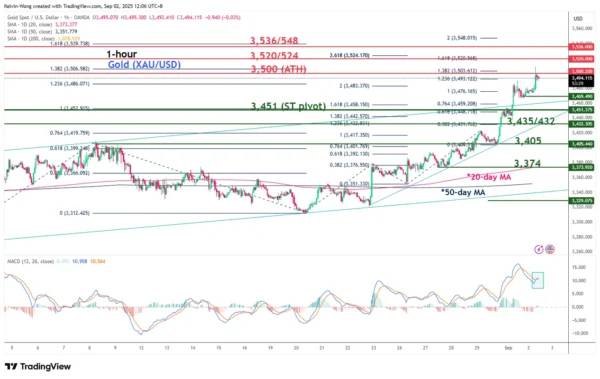
          Maintain bullish bias on Gold (XAU/USD) as the yellow metal kickstarts a potential bullish acceleration phase (see Fig. 1).Watch the US$3,451 key short-term pivotal support. A clearance above US$3,500 (the current all-time high) will see the next intermediate resistances coming in at US$3,520/3,524 and US$3,536/3,548 (Fibonacci extension clusters).

          Key elements

          ● The hourly MACD trend indicator of Gold (XAU/USD) has just flashed out an impending bullish crossover signal above its centreline, which suggests that short-term bullish momentum remains intact (see Fig. 1).
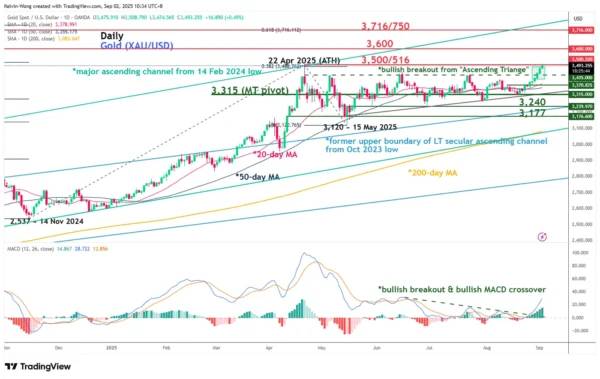
          ● The recent bullish breakout in the Gold (XAU/USD) above US$3,435 marks an exit from a bullish continuation range configuration, defined as a bullish “Ascending Triangle”. These observations increase the odds of a continuation of its prior impulsive up move sequence (see Fig. 2).
          ● The daily MACD trend indicator of Gold (XAU/USD) has continued to trend upwards above its centreline after its earlier bullish crossover on Monday, August 25, 2025, which supports a potential change in medium-term trend conditions from sideways to bullish (see Fig. 2).
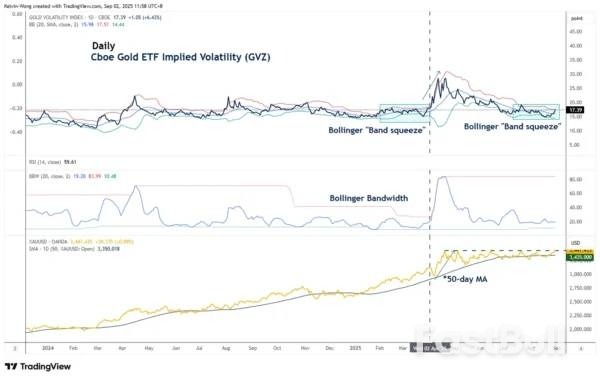
          ● The Cboe Gold exchange-traded fund implied volatility (GVZ) has entered into a low volatility environment, as depicted by the narrowing of the Bollinger Bands, called the “Band Squeeze” since mid-July 2025. A “Band Squeeze” or a low “Bandwidth” reading is a prelude to a potential expansion in volatility. An increased implied volatility (GVZ) may trigger a significant up move in Gold (XAU/USD) (see Fig. 3).
          ● Recent observations between February and March 2025, when a Bollinger “Band Squeeze” in GVZ occurred, preceded a notable rally in Gold (XAU/USD) in April 2025 (see Fig. 3).

          Alternative trend bias (1 to 3 days)

          Failure to hold at the US$3,451 key short-term support on Gold (XAU/USD) negates the bullish tone for another round of minor corrective decline to retest US$3,435/3,432 pull-back support of the former medium-term “Ascending Triangle” range resistance.

          Source: OANDA

          To stay updated on all economic events of today, please check out our Economic calendar
          Risk Warnings and Disclaimers
          You understand and acknowledge that there is a high degree of risk involved in trading. Following any strategies or investment methods may lead to potential losses. The content on the site is provided by our contributors and analysts for information purposes only. You are solely responsible for determining whether any trading assets, securities, strategy, or any other product is suitable for investing based on your own investment objectives and financial situation.
          Add to Favorites
          Share
          FastBull
          Copyright © 2025 FastBull Ltd

          728 RM B 7/F GEE LOK IND BLDG NO 34 HUNG TO RD KWUN TONG KLN HONG KONG

          TelegramInstagramTwitterfacebooklinkedin
          App Store Google Play Google Play
          Products
          Charts

          Chats

          Q&A with Experts
          Screeners
          Economic Calendar
          Data
          Tools
          Membership
          Features
          Function
          Markets
          Copy Trading
          Latest Signals
          Contests
          News
          Analysis
          24/7
          Columns
          Education
          Company
          Careers
          About Us
          Contact Us
          Advertising
          Help Center
          Feedback
          User Agreement
          Privacy Policy
          Business

          White Label

          Data API

          Web Plug-ins

          Poster Maker

          Affiliate Program

          Risk Disclosure

          The risk of loss in trading financial instruments such as stocks, FX, commodities, futures, bonds, ETFs and crypto can be substantial. You may sustain a total loss of the funds that you deposit with your broker. Therefore, you should carefully consider whether such trading is suitable for you in light of your circumstances and financial resources.

          No decision to invest should be made without thoroughly conducting due diligence by yourself or consulting with your financial advisors. Our web content might not suit you since we don't know your financial conditions and investment needs. Our financial information might have latency or contain inaccuracy, so you should be fully responsible for any of your trading and investment decisions. The company will not be responsible for your capital loss.

          Without getting permission from the website, you are not allowed to copy the website's graphics, texts, or trademarks. Intellectual property rights in the content or data incorporated into this website belong to its providers and exchange merchants.

          Not Logged In

          Log in to access more features

          FastBull Membership

          Not yet

          Purchase

          Become a signal provider
          Help Center
          Customer Service
          Dark Mode
          Price Up/Down Colors

          Log In

          Sign Up

          Position
          Layout
          Fullscreen
          Default to Chart
          The chart page opens by default when you visit fastbull.com