

Markets
News
Analysis
User
24/7
Economic Calendar
Education
Data
- Names
- Latest
- Prev



Signal Accounts for Members
All Signal Accounts
All Contests
 U.K. Trade Balance Non-EU (SA) (Oct)
A:--
F: --
P: --
U.K. Trade Balance (Oct)A:--
F: --
P: --
U.K. Services Index MoMA:--
F: --
P: --
U.K. Construction Output MoM (SA) (Oct)A:--
F: --
P: --
U.K. Industrial Output YoY (Oct)A:--
F: --
P: --
U.K. Trade Balance (SA) (Oct)A:--
F: --
P: --
U.K. Trade Balance EU (SA) (Oct)A:--
F: --
P: --
U.K. Manufacturing Output YoY (Oct)A:--
F: --
P: --
U.K. GDP MoM (Oct)A:--
F: --
P: --
U.K. GDP YoY (SA) (Oct)A:--
F: --
P: --
U.K. Industrial Output MoM (Oct)A:--
F: --
P: --
U.K. Construction Output YoY (Oct)A:--
F: --
P: --
 France HICP Final MoM (Nov)
A:--
F: --
P: --
 China, Mainland Outstanding Loans Growth YoY (Nov)
A:--
F: --
P: --
China, Mainland M2 Money Supply YoY (Nov)A:--
F: --
P: --
China, Mainland M0 Money Supply YoY (Nov)A:--
F: --
P: --
China, Mainland M1 Money Supply YoY (Nov)A:--
F: --
P: --
 India CPI YoY (Nov)
A:--
F: --
P: --
India Deposit Gowth YoYA:--
F: --
P: --
 Brazil Services Growth YoY (Oct)
A:--
F: --
P: --
 Mexico Industrial Output YoY (Oct)
A:--
F: --
P: --
 Russia Trade Balance (Oct)
A:--
F: --
P: --
 Philadelphia Fed President Henry Paulson delivers a speech
 Canada Building Permits MoM (SA) (Oct)
A:--
F: --
P: --
Canada Wholesale Sales YoY (Oct)A:--
F: --
P: --
Canada Wholesale Inventory MoM (Oct)A:--
F: --
P: --
Canada Wholesale Inventory YoY (Oct)A:--
F: --
P: --
Canada Wholesale Sales MoM (SA) (Oct)A:--
F: --
P: --
 Germany Current Account (Not SA) (Oct)
A:--
F: --
P: --
U.S. Weekly Total Rig CountA:--
F: --
P: --
U.S. Weekly Total Oil Rig CountA:--
F: --
P: --
 Japan Tankan Large Non-Manufacturing Diffusion Index (Q4)
--
F: --
P: --
Japan Tankan Small Manufacturing Outlook Index (Q4)--
F: --
P: --
Japan Tankan Large Non-Manufacturing Outlook Index (Q4)--
F: --
P: --
Japan Tankan Large Manufacturing Outlook Index (Q4)--
F: --
P: --
Japan Tankan Small Manufacturing Diffusion Index (Q4)--
F: --
P: --
Japan Tankan Large Manufacturing Diffusion Index (Q4)--
F: --
P: --
Japan Tankan Large-Enterprise Capital Expenditure YoY (Q4)--
F: --
P: --
U.K. Rightmove House Price Index YoY (Dec)--
F: --
P: --
China, Mainland Industrial Output YoY (YTD) (Nov)--
F: --
P: --
China, Mainland Urban Area Unemployment Rate (Nov)--
F: --
P: --
 Saudi Arabia CPI YoY (Nov)
--
F: --
P: --
 Euro Zone Industrial Output YoY (Oct)
--
F: --
P: --
Euro Zone Industrial Output MoM (Oct)--
F: --
P: --
Canada Existing Home Sales MoM (Nov)--
F: --
P: --
Euro Zone Total Reserve Assets (Nov)--
F: --
P: --
U.K. Inflation Rate Expectations--
F: --
P: --
Canada National Economic Confidence Index--
F: --
P: --
Canada New Housing Starts (Nov)--
F: --
P: --
U.S. NY Fed Manufacturing Employment Index (Dec)--
F: --
P: --
U.S. NY Fed Manufacturing Index (Dec)--
F: --
P: --
Canada Core CPI YoY (Nov)--
F: --
P: --
Canada Manufacturing Unfilled Orders MoM (Oct)--
F: --
P: --
Canada Manufacturing New Orders MoM (Oct)--
F: --
P: --
Canada Core CPI MoM (Nov)--
F: --
P: --
Canada Manufacturing Inventory MoM (Oct)--
F: --
P: --
Canada CPI YoY (Nov)--
F: --
P: --
Canada CPI MoM (Nov)--
F: --
P: --
Canada CPI YoY (SA) (Nov)--
F: --
P: --
Canada Core CPI MoM (SA) (Nov)--
F: --
P: --


No matching data

Latest Views
Latest Views
Trending Topics
Top Columnists
Latest Update
White Label
Data API
Web Plug-ins
Affiliate Program
View All
No data
U.S. President Donald Trump said he will push to cut prescription drug prices by 59%, but gave no further details about his plan to lower medicine costs ahead of a health-related event at the White House later on Monday.
U.S. President Donald Trump said he will push to cut prescription drug prices by 59%, but gave no further details about his plan to lower medicine costs ahead of a health-related event at the White House later on Monday.
On Sunday, Trump said he would sign an executive order to pursue what is known as "most favored nation" pricing or international reference pricing. The Republican president previously tried to implement such a program during his first term in office but was blocked by the courts.
"Drug prices to be cut by 59%" Trump wrote on Monday in capital letters on his social media platform as global pharma shares traded lower. Shares of U.S. drugmakers fell between 2% and 3% following his weekend comments before Trump's latest post Monday morning.
Trump is scheduled to hold an event at the White House with U.S. Health Secretary Robert F. Kennedy Jr. at 9:30 a.m. (1330 GMT)
Drugmakers have been expecting an order focusing on the federal Medicare health insurance program for people aged 65 and older and the disabled, according to four drug industry lobbyists who said they had been briefed by the White House.
Reuters previously reported such a policy was under consideration.
The United States pays the highest prices for prescription drugs, often nearly three times more than other developed nations. Trump has pledged to close the gap but not detailed how he will implement it.
WTI oil price jumped over $2 on Monday following success of US-China trade talks over the weekend that eased tensions and signaled that world’s two largest oil consumers are on the way to resolve their trade conflict.
The markets welcomed positive move that significantly brightened the demand outlook and further lifted oil price.
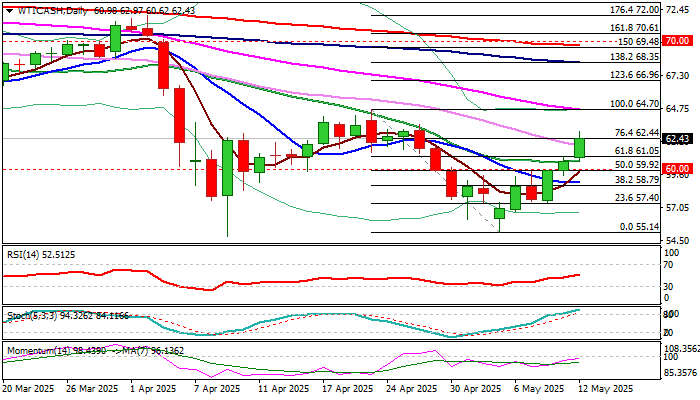
The WTI contract resumed strong rally of the last week (up almost 8%) on Monday and hit the highest in two weeks, marking retracement of over 76.4% of $64.70/$55.14 bear leg.
Bulls focus target at $63.55 (Apr 28 high) the last obstacle en-route to $64.70 breakpoint (Apr 24 high), violation of which to generate reversal signal on completion of daily bullish failure swing pattern.
However, a pause in current rally (due to overbought conditions and 14-d momentum indicator being still in negative territory) may precede fresh push higher, with shallow dips to ideally find ground at $61.00 zone and offer better levels to re-enter bullish market.
Only loss $60 pivot, which previously marked strong barrier and now reverted to solid support, would sideline bulls.
Res: 62.97; 63.55; 64.70; 65.00.
Sup: 61.90; 61.05; 60.71; 60.00.
The price of a troy ounce of gold fell to 3,273 USD on Monday, losing about 1% compared to the previous session’s level.
The primary reason for the decline is positive signals regarding trade talks between the US and China, which have reduced the demand for safe-haven assets.
Negotiations between representatives of the two countries concluded over the weekend, and the results offer some grounds for optimism. Beijing announced plans to initiate formal talks, while Washington reported progress towards an agreement.
US Treasury Secretary Scott Bessent stated that he could provide further details at a full briefing on Monday. Today’s developments are expected to generate significant market reactions.
Geopolitically, the ceasefire between India and Pakistan remained in place until Sunday, despite mutual accusations of violations shortly after its conclusion.
Earlier, additional pressure on gold came from statements made by the Federal Reserve. The regulator warned of rising inflation and risks within the labour market. At the same time, Chairman Jerome Powell ruled out the possibility of a pre-emptive rate cut in response to tariff threats.
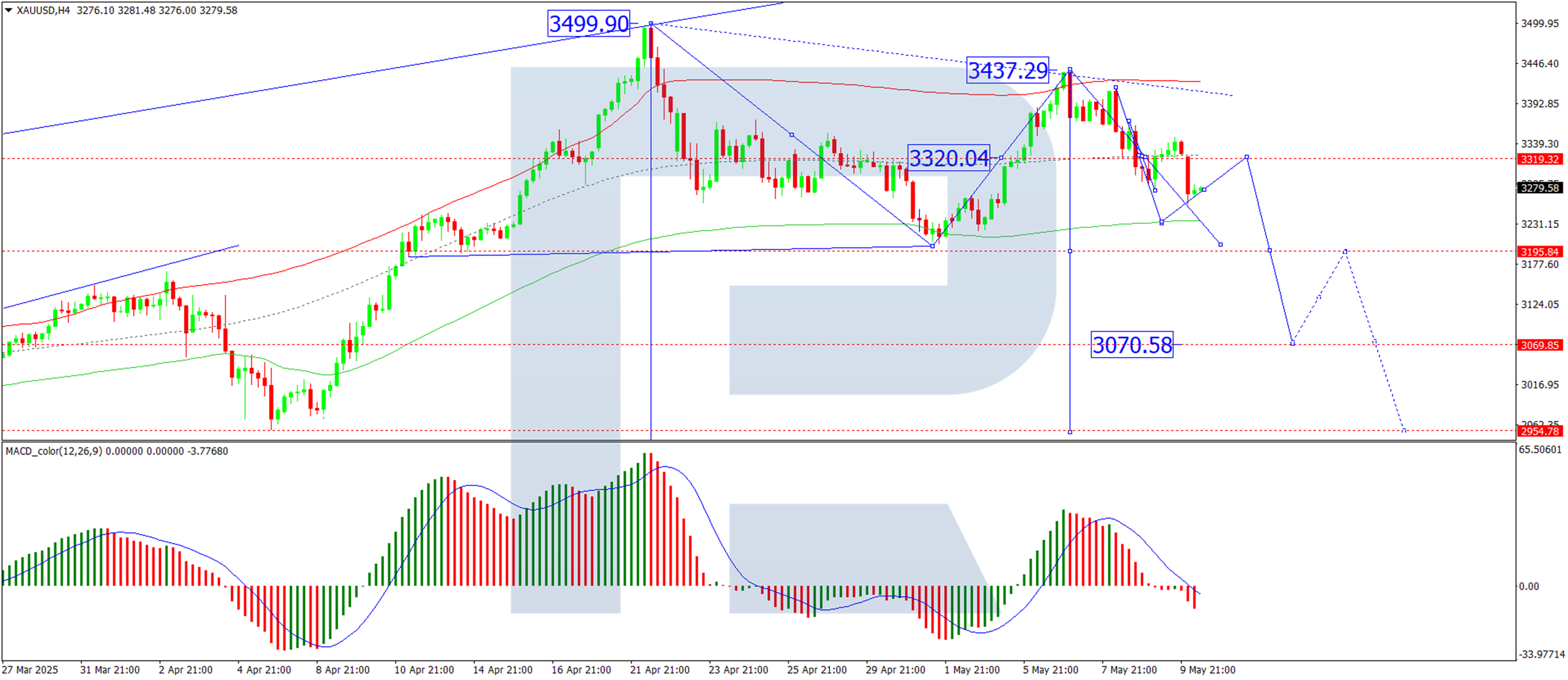
On the H4 chart, XAU/USD has formed a consolidation range around the 3,322 level. Today, we expect a possible decline to 3,195. After reaching this target, a correction to the 3,255 level is possible. Upon completing this correction, a new wave of decline to the local target of 3,070 may follow. Technically, this scenario is confirmed by the MACD indicator, as its signal line is below the zero level and is pointed decisively downwards.
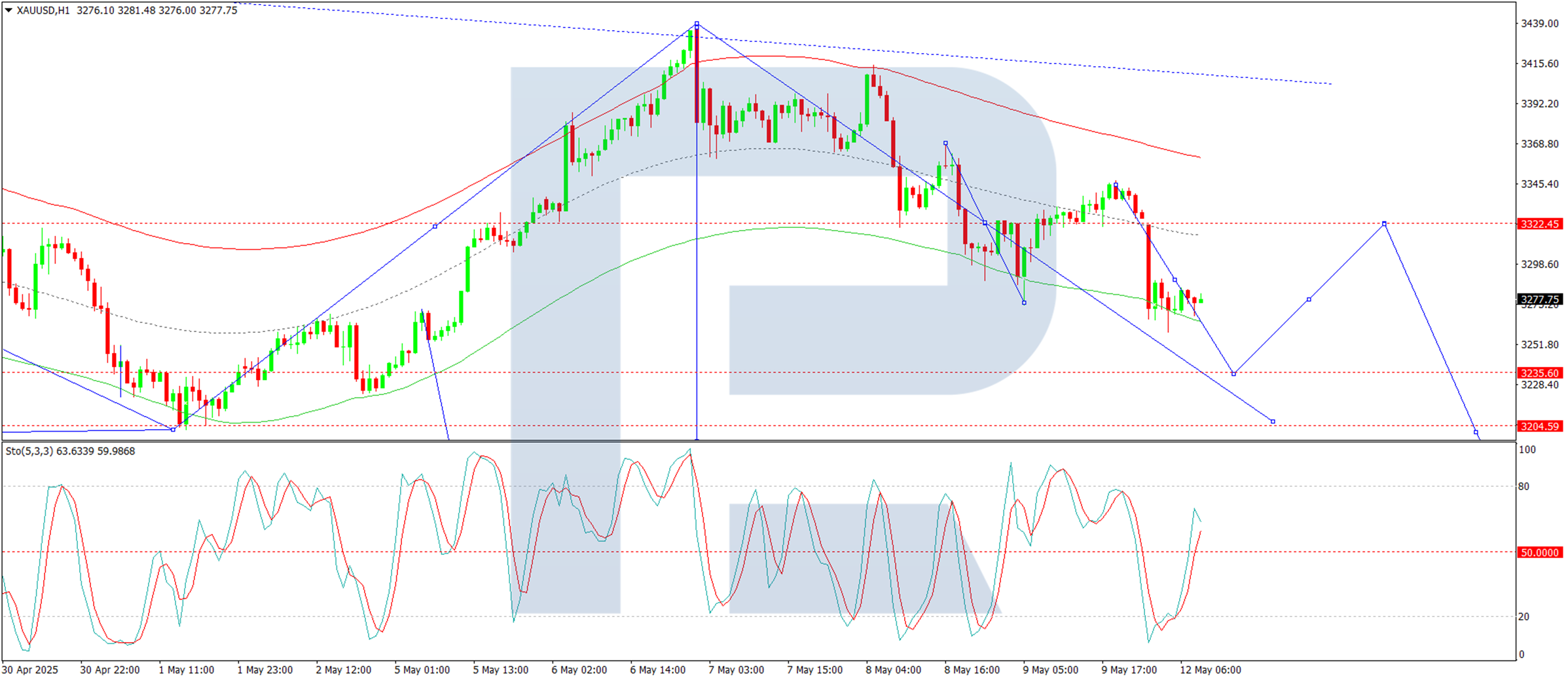
On the H1 chart, XAU/USD has broken below the 3,290 level and continues to move towards 3,235. This target level will likely be reached today. A corrective move towards the 3,322 level cannot be ruled out. Subsequently, a decline to at least 3,200 is expected. Technically, this scenario is confirmed by the Stochastic oscillator; its signal line is below the 80 level and is directed steadily downwards towards the 20 level.
Gold remains under pressure amid improving trade sentiment and hawkish commentary from the Fed, with technical indicators pointing to further downside potential. Traders will be closely watching today’s briefing for any new market-moving details.
Global equity markets jumped on Monday after the US and China agreed to walk back sky-high tariffs they had built up during weeks of tit-for-tat escalation.
Following talks in Switzerland, officials from the world’s two largest economies said in a joint statement that several recent tariff increases would be altered or suspended, resulting in a remaining 30% US tariff on Chinese goods and a 10% Chinese tariff on US goods. Before the weekend, those figures had stood at 145% and 125%.
Europe’s Stoxx 600 index rose 1%, led higher by stocks most exposed to global trade including shipping giant A.P. Moeller-Maersk MAERSK B, up 11%, and car maker Stellantis STLA, up 7%.
US equity futures pointed to sharp increases at the opening, with contracts on the S&P 500 benchmark up 2.5% and on the technology-focused Nasdaq 100 index up 3.3%. Tech mega-caps outperformed in pre-market trading as Tesla TSLA rose 7%, Apple AAPL rose 5% and Nvidia NVDA rose 4.5%.
There’s “a lot of potential for good news, but the markets are getting very excited too early,” Morningstar’s chief European markets strategist Michael Field said. “The US-China deal has 30% import taxes on Chinese goods which could stem trade flow still. The EU hasn’t even begun negotiations with the US, and if we get anything like the UK deal, then it’s bad news.”
The risk-on sentiment on equity markets weighed on safe-haven assets, with the euro erasing the past month’s gains against the dollar.
Meanwhile, both German bund yields and 10-year US treasury yields jumped to their highest levels in about a month. Bunds were up seven basis points to 2.62% and treasury yields at 4.43%.
“Although the reductions are temporary, they represent a notable shift in the overall effective tariff burden,” according to Stuart Rumble, head of investment directing in the Asia-Pacific region at Fidelity International. “The high US-China tariff regime has already caused major disruption, reducing bilateral trade between the world’s two largest economies and increasing the risk of a broader global slowdown.”
Also over the weekend, US President Donald Trump said on social media that he’d force a reduction in prescription drug prices by 30-80% in the US by mandating that manufacturers charge US consumers in line with the lowest prices offered in other nations.
The announcement sent health care stocks plunging in Asia and Europe. Takeda Pharmaceuticals TAK dropped 6.5% in Tokyo while Europe’s Stoxx 600 Health Care sector index fell 2.8% on Monday morning, led lower by Genmab GMAB‘s 8% decline and Novo Nordisk NVO falling 5.7%.
Reports over the weekend indicate Ukraine’s Volodymyr Zelensky may be set to meet Russian leader Vladimir Putin in Istanbul as soon as Thursday, aiming to pave the way to peace talks with an initial ceasefire of 30 days, the first pause in fighting since Russia’s illegal full-scale invasion more than three years ago.
Shares of weapons makers declined on Monday morning, including Germany’s Rheinmetall RHM, Italy’s Leonardo LDO, and France’s Dassault Aviation AM all down by more than 7%.
The U.S. dollar surged higher Monday, boosted by the announcement of a trade deal between China and the U.S. over the weekend, raising hopes that the U.S. economy can avoid a damaging prolonged trade war.
At 03:30 ET (08:30 GMT), the Dollar Index, which tracks the greenback against a basket of six other currencies, rose 1.3% to 101.455, trading at a one-month high.
That said, the gauge is still down over 3% from the April 2 announcement of Trump’s "Liberation Day"
The White House on Sunday announced that a trade deal with China had been reached after U.S. officials spent the weekend negotiating with their Chinese counterparts in Geneva.
More substance emerged Monday, with the two sides agreeing to a 90-day pause to soaring tariffs placed on each other. Additionally, Washington has moved to slash tariffs on China to 30% and Beijing’s duties on U.S. imports are being cut to 10%, the nations said in a rare joint statement.
Heading into the talks, U.S. President Donald Trump had raised tariffs on China to at least 145%, leading China to respond with retaliatory levies on American imports of 125%.
More trade negotiations are planned between the two, while both sides may conduct working-level consultations on relevant economic and trade issues.
“We have argued in recent weeks that the dollar likely requires a constant flow of positive news on trade de-escalation to keep recovering,” said analysts at ING, in a note.
“The Trump administration has so far provided it, and while the dollar’s recovery hasn’t been nearly as spectacular as in equities, there is a strong sense that Trump’s pragmatic shift on trade has trimmed the tail risks for the greenback.”
Aside from more trade news, this week’s focus is likely to center around the release of the latest consumer price index on Tuesday, as investors look for indications of how the trade spat has impacted the economy and thus expectations for further rate cuts by the U.S. Federal Reserve.
The odds for a June easing are now priced at just 17%, with July at 59%.
In Europe, EUR/USD traded 1.2% lower to 1.1109, with the single currency hit hard as traders surged back into the dollar in the wake of the news of a U.S.-China trade deal.
“A decisive break lower looks on the cards,” said ING. “The pair is trading 3% off its 21 April peak, but remains around 3% overvalued according to our short-term fair value model. That misvaluation is largely justified by the short-term rate differentials, which continue to heavily favor the dollar.”
The European Central Bank has cut interest rates seven times in the past year as inflation has been rapidly retreating, and policymakers have already started to lay the groundwork for another cut in early June.
Financial markets see a 90% chance of a rate cut in June and see another cut or two in subsequent months, while the odds of Fed rate cut next week are considerably lower.
Traders are also keeping an eye on events in Ukraine, after President Volodymyr Zelenskiy said he was ready to meet Russian President Vladimir Putin in Turkey on Thursday for talks.
“A breakthrough in peace negotiations will be beneficial for EUR/USD, but the extent of the impact will be highly dependent on the market’s assessment of the sustainability of any truce,” ING added.
GBP/USD fell 1% to 1.3180, with sterling holding up slightly better than the single currency after last week’s announcement of a trade deal between the U.S> and the U.K..
In Asia, USD/JPY traded 1.8% higher to 147.92, with the safe haven yen hit hard by the announcement of a U.S.-China trade deal.
USD/CNY traded 0.3% lower to 7.2143, with the Chinese currency supported by the easing trade tensions between Washington and Beijing.
Data on Saturday showed that China’s inflationary pressures persisted in April, with consumer prices declining for the third consecutive month and factory-gate prices experiencing their sharpest drop in six months.
The nation continues to grapple with the economic fallout from its ongoing trade battle with the U.S..
728 RM B 7/F GEE LOK IND BLDG NO 34 HUNG TO RD KWUN TONG KLN HONG KONG


White Label
Data API
Web Plug-ins
Poster Maker
Affiliate Program
The risk of loss in trading financial instruments such as stocks, FX, commodities, futures, bonds, ETFs and crypto can be substantial. You may sustain a total loss of the funds that you deposit with your broker. Therefore, you should carefully consider whether such trading is suitable for you in light of your circumstances and financial resources.
No decision to invest should be made without thoroughly conducting due diligence by yourself or consulting with your financial advisors. Our web content might not suit you since we don't know your financial conditions and investment needs. Our financial information might have latency or contain inaccuracy, so you should be fully responsible for any of your trading and investment decisions. The company will not be responsible for your capital loss.
Without getting permission from the website, you are not allowed to copy the website's graphics, texts, or trademarks. Intellectual property rights in the content or data incorporated into this website belong to its providers and exchange merchants.
Not Logged In
Log in to access more features

FastBull Membership
Not yet
Purchase


Log In
Sign Up


