• Trade
  • Markets
  • Copy
  • Contests
  • News
  • 24/7
  • Calendar
  • Q&A
  • Chats
Trending
Screeners
SYMBOL
LAST
BID
ASK
HIGH
LOW
NET CHG.
%CHG.
SPREAD
SPX
S&P 500 Index
6827.42
6827.42
6827.42
6899.86
6801.80
-73.58
-1.07%
--
DJI
Dow Jones Industrial Average
48458.04
48458.04
48458.04
48886.86
48334.10
-245.98
-0.51%
--
IXIC
NASDAQ Composite Index
23195.16
23195.16
23195.16
23554.89
23094.51
-398.69
-1.69%
--
USDX
US Dollar Index
97.950
98.030
97.950
98.500
97.950
-0.370
-0.38%
--
EURUSD
Euro / US Dollar
1.17394
1.17409
1.17394
1.17496
1.17192
+0.00011
+ 0.01%
--
GBPUSD
Pound Sterling / US Dollar
1.33707
1.33732
1.33707
1.33997
1.33419
-0.00148
-0.11%
--
XAUUSD
Gold / US Dollar
4299.39
4299.39
4299.39
4353.41
4257.10
+20.10
+ 0.47%
--
WTI
Light Sweet Crude Oil
57.233
57.485
57.233
58.011
56.969
-0.408
-0.71%
--

Community Accounts

Signal Accounts
--
Profit Accounts
--
Loss Accounts
--
View More

Become a signal provider

Sell trading signals to earn additional income

View More

Guide to Copy Trading

Get started with ease and confidence

View More

Signal Accounts for Members

All Signal Accounts

Best Return
  • Best Return
  • Best P/L
  • Best MDD
Past 1W
  • Past 1W
  • Past 1M
  • Past 1Y

All Contests

  • All
  • Trump Updates
  • Recommend
  • Stocks
  • Cryptocurrencies
  • Central Banks
  • Featured News
Top News Only
Share

China's Central Financial And Economic Affairs Commission Deputy Director: Will Expand Export And Increase Import In 2026

Share

Thai Leader Anutin: Landmine Blast That Killed Thai Soldiers 'Not A Roadside Accident'

Share

Thai Leader Anutin: Thailand To Continue Military Action Until 'We Feel No More Harm'

Share

Cambodian Prime Minister Hun Manet Says He Had Phone Calls With Trump And Malaysian Leader Anwar About Ceasefire

Share

Cambodia's Hun Manet Says USA, Malaysia Should Verify 'Which Side Fired First' In Latest Conflict

Share

Cambodia's Hun Manet: Cambodia Maintains Its Stance In Seeking Peaceful Resolution Of Disputes

Share

Nasdaq Companies: Allergan, Ferrovia, Insmed, Monolithic Power Systems, Seagate Technology, And Western Digital Will Be Added To The NASDAQ 100 Index. Biogen, CdW, GlobalFoundries, Lululemon, ON Semiconductor, And Tradedesk Will Be Removed From The NASDAQ 100 Index

Share

Witkoff Headed To Berlin This Weekend To Meet With Zelenskiy, European Leaders -Wsj Reporter On X

Share

Russia Attacks Two Ukrainian Ports, Damaging Three Turkish-Owned Vessels

Share

[Historic Flooding Occurs In At Least Four Rivers In Washington State Due To Days Of Torrential Rains] Multiple Areas In Washington State Have Been Hit By Severe Flooding Due To Days Of Torrential Rains, With At Least Four Rivers Experiencing Historic Flooding. Reporters Learned On The 12th That The Floods Caused By The Torrential Rains In Washington State Have Destroyed Homes And Closed Several Highways. Experts Warn That Even More Severe Flooding May Occur In The Future. A State Of Emergency Has Been Declared In Washington State

Share

Trump Says Proposed Free Economic Zone In Donbas Would Work

Share

Trump: I Think My Voice Should Be Heard

Share

Trump Says Will Be Choosing New Fed Chair In Near Future

Share

Trump Says Proposed Free Economic Zone In Donbas Complex But Would Work

Share

Trump Says Land Strikes In Venezuela Will Start Happening

Share

US President Trump: Thailand And Cambodia Are In A Good Situation

Share

State Media: North Korean Leader Kim Hails Troops Returning From Russia Mission

Share

The 10-year Treasury Yield Rose About 5 Basis Points During The "Fed Rate Cut Week," And The 2/10-year Yield Spread Widened By About 9 Basis Points. On Friday (December 12), In Late New York Trading, The Yield On The Benchmark 10-year US Treasury Note Rose 2.75 Basis Points To 4.1841%, A Cumulative Increase Of 4.90 Basis Points For The Week, Trading Within A Range Of 4.1002%-4.2074%. It Rose Steadily From Monday To Wednesday (before The Fed Announced Its Rate Cut And Treasury Bill Purchase Program), Subsequently Exhibiting A V-shaped Recovery. The 2-year Treasury Yield Fell 1.82 Basis Points To 3.5222%, A Cumulative Decrease Of 3.81 Basis Points For The Week, Trading Within A Range Of 3.6253%-3.4989%

Share

Trump: Lots Of Progress Being Made On Russia-Ukraine

Share

NOPA November US Soybean Crush Estimated At 220.285 Million Bushels

TIME
ACT
FCST
PREV
U.K. Trade Balance Non-EU (SA) (Oct)

A:--

F: --

P: --

U.K. Trade Balance (Oct)

A:--

F: --

P: --

U.K. Services Index MoM

A:--

F: --

P: --

U.K. Construction Output MoM (SA) (Oct)

A:--

F: --

P: --

U.K. Industrial Output YoY (Oct)

A:--

F: --

P: --

U.K. Trade Balance (SA) (Oct)

A:--

F: --

P: --

U.K. Trade Balance EU (SA) (Oct)

A:--

F: --

P: --

U.K. Manufacturing Output YoY (Oct)

A:--

F: --

P: --

U.K. GDP MoM (Oct)

A:--

F: --

P: --

U.K. GDP YoY (SA) (Oct)

A:--

F: --

P: --

U.K. Industrial Output MoM (Oct)

A:--

F: --

P: --

U.K. Construction Output YoY (Oct)

A:--

F: --

P: --

France HICP Final MoM (Nov)

A:--

F: --

P: --

China, Mainland Outstanding Loans Growth YoY (Nov)

A:--

F: --

P: --

China, Mainland M2 Money Supply YoY (Nov)

A:--

F: --

P: --

China, Mainland M0 Money Supply YoY (Nov)

A:--

F: --

P: --

China, Mainland M1 Money Supply YoY (Nov)

A:--

F: --

P: --

India CPI YoY (Nov)

A:--

F: --

P: --

India Deposit Gowth YoY

A:--

F: --

P: --

Brazil Services Growth YoY (Oct)

A:--

F: --

P: --

Mexico Industrial Output YoY (Oct)

A:--

F: --

P: --

Russia Trade Balance (Oct)

A:--

F: --

P: --

Philadelphia Fed President Henry Paulson delivers a speech
Canada Building Permits MoM (SA) (Oct)

A:--

F: --

P: --

Canada Wholesale Sales YoY (Oct)

A:--

F: --

P: --

Canada Wholesale Inventory MoM (Oct)

A:--

F: --

P: --

Canada Wholesale Inventory YoY (Oct)

A:--

F: --

P: --

Canada Wholesale Sales MoM (SA) (Oct)

A:--

F: --

P: --

Germany Current Account (Not SA) (Oct)

A:--

F: --

P: --

U.S. Weekly Total Rig Count

A:--

F: --

P: --

U.S. Weekly Total Oil Rig Count

A:--

F: --

P: --

Japan Tankan Large Non-Manufacturing Diffusion Index (Q4)

--

F: --

P: --

Japan Tankan Small Manufacturing Outlook Index (Q4)

--

F: --

P: --

Japan Tankan Large Non-Manufacturing Outlook Index (Q4)

--

F: --

P: --

Japan Tankan Large Manufacturing Outlook Index (Q4)

--

F: --

P: --

Japan Tankan Small Manufacturing Diffusion Index (Q4)

--

F: --

P: --

Japan Tankan Large Manufacturing Diffusion Index (Q4)

--

F: --

P: --

Japan Tankan Large-Enterprise Capital Expenditure YoY (Q4)

--

F: --

P: --

U.K. Rightmove House Price Index YoY (Dec)

--

F: --

P: --

China, Mainland Industrial Output YoY (YTD) (Nov)

--

F: --

P: --

China, Mainland Urban Area Unemployment Rate (Nov)

--

F: --

P: --

Saudi Arabia CPI YoY (Nov)

--

F: --

P: --

Euro Zone Industrial Output YoY (Oct)

--

F: --

P: --

Euro Zone Industrial Output MoM (Oct)

--

F: --

P: --

Canada Existing Home Sales MoM (Nov)

--

F: --

P: --

Euro Zone Total Reserve Assets (Nov)

--

F: --

P: --

U.K. Inflation Rate Expectations

--

F: --

P: --

Canada National Economic Confidence Index

--

F: --

P: --

Canada New Housing Starts (Nov)

--

F: --

P: --

U.S. NY Fed Manufacturing Employment Index (Dec)

--

F: --

P: --

U.S. NY Fed Manufacturing Index (Dec)

--

F: --

P: --

Canada Core CPI YoY (Nov)

--

F: --

P: --

Canada Manufacturing Unfilled Orders MoM (Oct)

--

F: --

P: --

Canada Manufacturing New Orders MoM (Oct)

--

F: --

P: --

Canada Core CPI MoM (Nov)

--

F: --

P: --

Canada Manufacturing Inventory MoM (Oct)

--

F: --

P: --

Canada CPI YoY (Nov)

--

F: --

P: --

Canada CPI MoM (Nov)

--

F: --

P: --

Canada CPI YoY (SA) (Nov)

--

F: --

P: --

Canada Core CPI MoM (SA) (Nov)

--

F: --

P: --

Q&A with Experts
    • All
    • Chatrooms
    • Groups
    • Friends
    Connecting
    .
    .
    .
    Type here...
    Add Symbol or Code

      No matching data

      All
      Trump Updates
      Recommend
      Stocks
      Cryptocurrencies
      Central Banks
      Featured News
      • All
      • Russia-Ukraine Conflict
      • Middle East Flashpoint
      • All
      • Russia-Ukraine Conflict
      • Middle East Flashpoint
      Search
      Products

      Charts Free Forever

      Chats Q&A with Experts
      Screeners Economic Calendar Data Tools
      Membership Features
      Data Warehouse Market Trends Institutional Data Policy Rates Macro

      Market Trends

      Market Sentiment Order Book Forex Correlations

      Top Indicators

      Charts Free Forever
      Markets

      News

      News Analysis 24/7 Columns Education
      From Institutions From Analysts
      Topics Columnists

      Latest Views

      Latest Views

      Trending Topics

      Top Columnists

      Latest Update

      Signals

      Copy Rankings Latest Signals Become a signal provider AI Rating
      Contests
      Brokers

      Overview Brokers Assessment Rankings Regulators News Claims
      Broker listing Forex Brokers Comparison Tool Live Spread Comparison Scam
      Q&A Complaint Scam Alert Videos Tips to Detect Scam
      More

      Business
      Events
      Careers About Us Advertising Help Center

      White Label

      Data API

      Web Plug-ins

      Affiliate Program

      Awards Institution Evaluation IB Seminar Salon Event Exhibition
      Vietnam Thailand Singapore Dubai
      Fans Party Investment Sharing Session
      FastBull Summit BrokersView Expo
      Recent Searches
        Top Searches
          Markets
          News
          Analysis
          User
          24/7
          Economic Calendar
          Education
          Data
          • Names
          • Latest
          • Prev

          View All

          No data

          Scan to Download

          Faster Charts, Chat Faster!

          Download App
          English
          • English
          • Español
          • العربية
          • Bahasa Indonesia
          • Bahasa Melayu
          • Tiếng Việt
          • ภาษาไทย
          • Français
          • Italiano
          • Türkçe
          • Русский язык
          • 简中
          • 繁中
          Open Account
          Search
          Products
          Charts Free Forever
          Markets
          News
          Signals

          Copy Rankings Latest Signals Become a signal provider AI Rating
          Contests
          Brokers

          Overview Brokers Assessment Rankings Regulators News Claims
          Broker listing Forex Brokers Comparison Tool Live Spread Comparison Scam
          Q&A Complaint Scam Alert Videos Tips to Detect Scam
          More

          Business
          Events
          Careers About Us Advertising Help Center

          White Label

          Data API

          Web Plug-ins

          Affiliate Program

          Awards Institution Evaluation IB Seminar Salon Event Exhibition
          Vietnam Thailand Singapore Dubai
          Fans Party Investment Sharing Session
          FastBull Summit BrokersView Expo

          Transatlantic Trade Strains: EU Exports to US Falter Under Tariff Pressure

          Gerik

          Traders' Opinions

          Economic

          Summary:

          In May, EU exports to the US dropped by €1.5 billion as tensions over potential 30% tariffs intensified. Although trade remains resilient year-over-year, signs of stress are mounting across sectors...

          Recent Decline in EU Exports Reflects Growing Tariff Tensions

          The European Union's export value to the United States declined to €46.2 billion in May, down from €47.7 billion in April, marking the second consecutive month of contraction. This drop follows a period of robust growth earlier in the year, particularly in March when US importers increased stockpiling to preempt potential tariff hikes. Despite the monthly decline, May’s export level still surpassed the same period last year, suggesting that bilateral trade retains structural momentum for now.
          However, the marginal 0.8% fall in export volume contrasts with a rise in the EU’s overall trade surplus to €13.4 billion, indicating diverging trends in external trade performance. The contraction is not yet dramatic, but persistent policy uncertainty is starting to erode business confidence.

          US Tariff Threats Shift Trade Patterns and Strategic Planning

          The announcement by US President Donald Trump to impose 30% tariffs on most EU goods by August 1, up from the current 10% base rate, has sparked a wave of concern across European industries. While negotiations are still ongoing, the threats are influencing business behavior. Economists, including Adrian Prettejohn of Capital Economics, warn that while current exports are relatively stable compared to a year ago, the cumulative impact of stockpiling and looming tariffs could weigh heavily on the eurozone’s trade performance going forward.
          The correlation between US policy announcements and EU export fluctuations underscores how speculative risks are influencing tangible trade flows. Importers’ anticipatory strategies, such as front-loading purchases, have temporarily cushioned the decline but are not sustainable in the long term.

          Germany’s Export Reliance Poses Broader Economic Risk

          Germany, the EU’s largest economy, is particularly exposed. Chancellor Friedrich Merz emphasized that a 30% tariff would deliver a severe blow to the country’s export-led growth. In 2024, the United States surpassed China as Germany’s top trade partner, with bilateral trade exceeding €250 billion. Any disruption in this dynamic could cascade through Europe’s industrial base, especially in the automotive and machinery sectors.
          Simultaneously, trade redirection is already visible. China’s exports to the EU rose 7.6% in June compared to the previous year, while its exports to the US dropped 16%, suggesting that market access shifts are already underway as firms re-evaluate global trade routes.

          Pharmaceuticals and High-Tech Sectors Now in the Crosshairs

          European pharmaceutical exports, particularly from Ireland where the sector represents one-third of US-bound shipments, may soon face direct tariff exposure. Trump’s proposal to tax pharmaceuticals by the end of July introduces a new risk to a previously protected sector. Any such move could disrupt supply chains critical not just economically but also for public health.
          Additionally, tech companies like ASML Holding are experiencing market jitters. The Dutch chip equipment giant, among the largest in Europe by market capitalization, warned that current uncertainties jeopardize their growth targets for 2026. This reaction reflects not only sector-specific sensitivity but also market perception of policy credibility. ASML’s stock decline following these announcements indicates an investor response to rising unpredictability in US-EU relations.

          Policy Response and the Risk of Retaliation

          The European Commission has prepared a potential retaliatory tariff list totaling €72 billion, targeting American exports such as cars, aircraft, and whiskey. EU Trade Commissioner Maros Sefcovic cautioned that maintaining current trade volumes would become “nearly impossible” under a 30% US tariff regime. His remarks suggest a shift from diplomatic engagement to open economic confrontation if negotiations collapse.
          Moreover, the rising value of the euro against the dollar is further complicating export dynamics. A stronger euro makes European goods more expensive for US buyers, intensifying the export headwinds already present due to tariff anxiety.

          Prospects for Eurozone Growth Now Hinges on Trade Policy Outcomes

          The European Central Bank has acknowledged that a more protectionist US stance could slow eurozone growth significantly. Given that early-year economic momentum in the EU was heavily export-driven, the changing trade environment introduces a major vulnerability. In fact, the eurozone’s non-durable goods segment, including pharmaceuticals, saw its fastest monthly output growth since records began in 1991. But this trend is now threatened by both tariff escalation and currency pressures.
          The distinction between correlation and causality is critical here. While the decline in exports correlates with US tariff threats, the root cause of long-term disruption will be policy decisions enacted in the coming weeks. Should both blocs proceed with retaliatory measures, trade flow deterioration may become structurally embedded, reshaping global supply chains and undermining transatlantic economic integration.
          The US-EU trade relationship, accounting for roughly 30% of global goods trade, is entering a phase of heightened uncertainty. What began as negotiation pressure has evolved into real-time disruptions across key sectors. The next phase will likely be determined not by economic fundamentals but by political maneuvering and policy execution. The resilience of EU exports so far has masked underlying fragility, and without resolution, a prolonged trade conflict may become the new normal.
          To stay updated on all economic events of today, please check out our Economic calendar
          Risk Warnings and Disclaimers
          You understand and acknowledge that there is a high degree of risk involved in trading. Following any strategies or investment methods may lead to potential losses. The content on the site is provided by our contributors and analysts for information purposes only. You are solely responsible for determining whether any trading assets, securities, strategy, or any other product is suitable for investing based on your own investment objectives and financial situation.
          Add to Favorites
          Share

          UK Unemployment Rises to Four-Year High as Reeves’ Tax Hikes Shake Labour Market

          Gerik

          Economic

          A Sudden Shift: Labour Market Weakens Under Weight of Tax Hikes

          In a troubling turn for the UK economy, official data from the Office for National Statistics (ONS) revealed that unemployment climbed to 4.7% in the three months to May well above analyst expectations of 4.6%. This marks the highest unemployment rate since the early months of 2021 and comes in the wake of new National Insurance contribution hikes and minimum wage increases imposed by Chancellor Rachel Reeves in April. The private sector responded sharply, with job losses accelerating in cost-sensitive industries.
          The number of payroll employees fell by 41,000 in June alone, bringing total losses over the past year to 178,000. Economists at Capital Economics and PwC emphasized that employers are offsetting higher labour costs through layoffs and hiring freezes. The retail and hospitality sectors, where younger workers and low-wage earners are concentrated, were hit hardest with over 170,000 combined job losses across the past year. In contrast, health and social work remained a rare bright spot, adding 67,000 workers.

          Wage Growth Slows as Real Earnings Stagnate

          Simultaneously, wage growth softened significantly. Average regular pay growth excluding bonuses dropped to 5% in May its weakest pace since mid-2022 while private sector pay dipped to 4.9%, the lowest since early 2022. Real earnings have essentially flatlined, with adjusted income only 1% higher than a year earlier. Alarmingly, real average pay remains on par with February 2008 levels, reinforcing the long-term stagnation trend in living standards.
          ONS Director Liz McKeown confirmed that the labour market “continues to weaken,” noting that vacancies have declined for 36 consecutive months and now sit at 727,000 the lowest figure since April 2021 outside the Covid era. Retail job vacancies have plunged to levels not seen since the aftermath of the 2008 financial crisis.

          Political Fallout: Labour Defends, Tories Attack

          The rising jobless figures have sparked fierce political debate. Conservative Shadow Business Secretary Andrew Griffith accused the Labour government of overseeing an “unemployment spike,” blaming Reeves’s tax-heavy Employment Bill for undermining business confidence. Meanwhile, Home Office Minister Jess Phillips admitted the figures are “worrying,” but defended the government’s economic strategy, citing structural issues and a long-term effort to reverse years of stagnant growth.
          At the business level, groups such as the Institute of Directors have called for a “significant rethink” of current policy, warning that employers are losing incentives to hire. According to Alex Hall-Chen of the IoD, tax increases combined with new labour regulation have dramatically increased the risks and costs associated with expanding payrolls.

          Markets Price in Rate Cut as Growth Risks Mount

          In response to the labour market data, the pound dipped 0.2% against the U.S. dollar to $1.338. Equity markets opened higher on the belief that weakening employment conditions solidify the case for a Bank of England rate cut next month. The FTSE 100 gained 0.3%, while the FTSE 250 mirrored the move.
          Analysts at PwC suggest that the data, combined with stagnating GDP and muted inflation in services, gives Governor Andrew Bailey a strong argument to initiate easing. The focus now turns to how quickly and deeply the BoE will cut, and whether further deterioration in the job market will accelerate that trajectory.
          The surge in unemployment and falling wage momentum present a pivotal challenge for the UK economy. The intended fiscal discipline under Rachel Reeves’s leadership appears to be triggering unintended side effects in employment and growth. As businesses cut back and political tensions rise, the Bank of England’s decision next month will be a key moment either acting as a stabilizer or revealing deeper fractures within the post-pandemic economic recovery.

          Source: The Telegraph

          To stay updated on all economic events of today, please check out our Economic calendar
          Risk Warnings and Disclaimers
          You understand and acknowledge that there is a high degree of risk involved in trading. Following any strategies or investment methods may lead to potential losses. The content on the site is provided by our contributors and analysts for information purposes only. You are solely responsible for determining whether any trading assets, securities, strategy, or any other product is suitable for investing based on your own investment objectives and financial situation.
          Add to Favorites
          Share

          Oil Prices Inch Up Amid Trade-War Drama and Tight Diesel Inventories

          Gerik

          Economic

          Commodity

          Oil Pauses Slide as Mixed Fundamentals Create Volatility

          After three consecutive sessions of losses exceeding 2%, oil markets found modest support on Thursday. Brent crude approached $69 per barrel, while West Texas Intermediate hovered near $67. The rebound was modest but notable, driven by a combination of geopolitical friction and persistent supply tightness in key fuel categories.
          Although U.S. Energy Information Administration (EIA) data showed a weekly increase in distillate inventories, crude oil stockpiles fell, signaling some resilience in underlying demand. However, the overarching market narrative remains conflicted, as fears of an oil glut in the coming months loom over the fragile price recovery.

          Trade-War Rhetoric and Powell Uncertainty Cloud Market Sentiment

          President Donald Trump’s announcement of plans to notify over 150 countries about new tariff rates ranging from 10% to 15% rekindled anxiety across commodity and financial markets. These measures, if implemented, could undercut global economic activity and erode oil demand just as seasonal consumption peaks begin to fade.
          Trump’s ambiguous stance on Federal Reserve Chair Jerome Powell also kept markets on edge, with investors questioning the stability of U.S. monetary policy. While the president denied an imminent dismissal, the political interference narrative has added another layer of uncertainty to already jittery markets.

          Diesel Supply Crunch Offers Short-Term Price Support

          Despite broader market headwinds, tight diesel supplies in both the U.S. and Europe have underpinned near-term price action. Distillate stockpiles in the U.S. remain at their lowest seasonal levels since 1996, even after last week’s marginal build. The September spread between low-sulfur gasoil and Brent an important proxy for diesel refining margins has risen approximately 7% this month, signaling continued pressure on supply.
          Zhou Mi, an analyst with Chaos Ternary Futures, noted that “low inventories of crude and diesel in the U.S. and Europe are lending strength to prices,” but warned that this trend might reverse as OPEC+ resumes production and global inventories begin to rise again.

          Geopolitical Tensions: Drone Strikes in Kurdistan

          Adding to the list of concerns was news of drone attacks on oil fields in Iraq’s semi-autonomous Kurdistan region. Although the region hasn’t exported crude since its pipeline was shuttered two years ago, repeated attacks highlight the vulnerability of energy infrastructure in geopolitically unstable zones. So far, the market impact has been limited, but the situation remains a risk factor for supply disruption.
          In the short run, oil prices appear to be supported by supply constraints in diesel and low inventories. However, the broader landscape remains bearish, shaped by the possibility of increased OPEC+ output, weakening global demand amid trade tensions, and political instability within major economies. Traders should expect continued volatility with prices responding to both hard inventory data and rapidly evolving macro-political signals.

          Source: Bloomberg

          To stay updated on all economic events of today, please check out our Economic calendar
          Risk Warnings and Disclaimers
          You understand and acknowledge that there is a high degree of risk involved in trading. Following any strategies or investment methods may lead to potential losses. The content on the site is provided by our contributors and analysts for information purposes only. You are solely responsible for determining whether any trading assets, securities, strategy, or any other product is suitable for investing based on your own investment objectives and financial situation.
          Add to Favorites
          Share

          Global Stocks Pause Ahead of Tech Earnings as Powell Uncertainty Shadows Markets

          Gerik

          Economic

          Markets on Hold Amid Tech Anticipation and Fed Turbulence

          Asian and global stock markets entered a holding pattern Thursday as investors awaited crucial second-quarter earnings from major technology firms, including Netflix and TSMC. The overall tone was cautious, shaped by political noise from Washington and nervousness about the independence of the Federal Reserve.
          TSMC, the world’s foremost supplier of AI chips, is anticipated to report record profits. However, analysts warned that U.S. tariffs and a stronger Taiwan dollar could dampen forward guidance. Meanwhile, expectations for Netflix are high given its 33% year-to-date outperformance relative to the S&P 500. Chris Weston from Pepperstone cautioned that “Netflix will need to blow the lights out” to justify its premium valuation, suggesting heightened risk of market disappointment if results fall short.
          The MSCI Asia-Pacific index outside Japan rose just 0.07%, and Japan’s Nikkei advanced 0.2%. In contrast, S&P 500 and Nasdaq futures fell marginally, suggesting Wall Street was preparing for potential earnings volatility.

          Political Noise Erodes Confidence in Fed Stability

          Market sentiment has been shaken this week by reports that U.S. President Donald Trump might seek to fire Fed Chair Jerome Powell. Although Trump later denied taking immediate action, his ongoing criticism and refusal to fully rule out the option have reignited fears about political interference in monetary policy.
          Carlos Casanova, economist at UBP, stated that Powell is likely to remain until the end of his term next year but added that “episodes of volatility” in the dollar are inevitable given the political tension. The controversy has revived concerns about the Fed’s independence, a bedrock principle for financial market stability.
          The dollar index, which measures the greenback against major currencies, recovered slightly to 98.47 after falling 0.33% overnight. However, both the euro and British pound eased on Thursday after prior gains, trading at $1.1625 and $1.3395, respectively.

          Bonds and Commodities Mixed as Markets Search for Direction

          U.S. Treasury yields remained stable after a Wednesday pullback driven by expectations that Powell’s dismissal if realized would prompt accelerated rate cuts. The two-year yield stood at 3.9087%, while the 10-year benchmark yield was little changed at 4.4754%.
          In Australia, employment data disappointed, with a meager 2,000 job gain in June and the jobless rate climbing to 4.3%, the highest in over three years. This pushed the Aussie dollar down 0.56% to $0.6492, reinforcing expectations of an RBA rate cut in August.
          Crude oil prices rose, supported by optimistic U.S. crude inventory data and easing global trade tensions. Brent climbed 0.4% to $68.78 per barrel, while WTI advanced to $66.71. However, gains were capped by larger-than-expected builds in gasoline and diesel stocks.
          Spot gold dipped 0.16% to $3,340.99 an ounce, as market participants awaited clearer cues on interest rates and political developments.
          As investors brace for key earnings reports and monitor central bank developments, financial markets remain suspended between confidence and caution. The fate of Fed Chair Powell, the trajectory of interest rates, and the resilience of tech giants will likely determine near-term direction. With political risk resurging and inflation still in focus, the global investment landscape remains vulnerable to sudden shifts in narrative.

          Source: Reuters

          To stay updated on all economic events of today, please check out our Economic calendar
          Risk Warnings and Disclaimers
          You understand and acknowledge that there is a high degree of risk involved in trading. Following any strategies or investment methods may lead to potential losses. The content on the site is provided by our contributors and analysts for information purposes only. You are solely responsible for determining whether any trading assets, securities, strategy, or any other product is suitable for investing based on your own investment objectives and financial situation.
          Add to Favorites
          Share

          Australia’s Labour Market Weakens Sharply, Paving Way for Imminent RBA Rate Cut

          Gerik

          Economic

          Labour Market Shows Signs of Structural Softening

          Australia’s jobs data released Thursday revealed a sharp deterioration in labour market conditions, with the unemployment rate rising to 4.3%, the highest since November 2021. This outcome exceeded market forecasts for stability at 4.1% and followed a similarly weak reading in May, indicating that the recent resilience in the job market may have been temporary.
          Employment increased by only 2,000 roles in June, entirely due to a gain of 40,200 in part-time jobs. Full-time employment, which offers a clearer picture of economic strength, fell by 38,200. The participation rate inched up to 67.1%, meaning more Australians are actively seeking work, adding upward pressure on the jobless rate. Annual job growth decelerated to 2%, far below the 2022–2024 average of 3.4%. The underemployment rate rose to 6%, while underutilization a broader measure of labour slack climbed to 10.3%.
          This shift indicates not just a cyclical pause in hiring, but a structural weakening that could feed through into lower wage growth and reduced household spending. As Westpac’s Ryan Wells noted, the numbers suggest a “gradual softening” is now firmly underway, dismantling the notion of a labour market immune to broader economic pressures.
          Markets Price in Aggressive Monetary Easing
          Financial markets reacted swiftly, with the Australian dollar falling more than 0.5% and three-year bond yields sliding by nearly 10 basis points. Equity markets rallied modestly on expectations of monetary support. Money market pricing now fully reflects an RBA rate cut at its August meeting, with a second cut projected before year-end and over 50% odds of a third.
          The Reserve Bank had previously shocked markets by holding the cash rate steady at 3.85% earlier this month, despite back-to-back cuts earlier in the year. Policymakers had cited concerns that further easing could reignite inflation. However, Thursday’s weak jobs report may tip the balance, especially given that full-time employment most sensitive to business confidence and economic activity is now contracting.

          CPI Report and RBA Commentary Under the Spotlight

          The next major data point, the quarterly Consumer Price Index due July 30, will play a decisive role in shaping the RBA’s outlook. If inflation continues to moderate, it would further clear the way for rate reductions. Upcoming speeches by Governor Michele Bullock and Deputy Governor Andrew Hauser will also be closely scrutinized for policy cues.
          Bloomberg Economics’ James McIntyre stated that the weak June jobs print “all but locks in” an August rate cut. Economists also expect the RBA to revise down its employment forecasts when it releases its next Statement on Monetary Policy in August.

          External Uncertainty and Tariff Risk Add to Domestic Pressures

          Adding to domestic fragility is rising global uncertainty, particularly related to President Trump’s impending August 1 tariff deadline. While Australia faces a relatively mild 10% baseline tariff from the U.S., its trade-reliant economy is vulnerable to broader slowdowns in global demand and investment. Treasurer Jim Chalmers acknowledged that global conditions and high interest rates are weighing on employment and investment decisions.
          Prime Minister Anthony Albanese’s current visit to China the country’s largest trading partner is part of an effort to fortify bilateral trade, attract investment, and support domestic job creation. The joint statement released by Beijing and Canberra promises closer cooperation across trade, climate, and people-to-people exchanges, reflecting Australia’s strategic economic balancing act between the U.S. and China.

          Policy Easing Now Appears Inevitable

          With the unemployment rate reaching the RBA’s own forecast peak, full-time job losses mounting, and underutilization rising, the Reserve Bank is now under mounting pressure to act. Monetary easing, once seen as a cautious path, has become a necessary response to prevent further economic deterioration.
          Unless the upcoming inflation report surprises on the upside, a rate cut in August appears inevitable, with the RBA poised to re-engage its easing cycle more decisively. For the Albanese government, navigating global headwinds while supporting local job creation will require a careful policy mix, especially as the global economic climate grows more uncertain in the months ahead.

          Source: AP

          To stay updated on all economic events of today, please check out our Economic calendar
          Risk Warnings and Disclaimers
          You understand and acknowledge that there is a high degree of risk involved in trading. Following any strategies or investment methods may lead to potential losses. The content on the site is provided by our contributors and analysts for information purposes only. You are solely responsible for determining whether any trading assets, securities, strategy, or any other product is suitable for investing based on your own investment objectives and financial situation.
          Add to Favorites
          Share

          UK Pay Growth Slows, Employee Numbers Fall

          Glendon

          Economic

          Forex

          British annual wage growth, excluding bonuses, was slightly higher than expected at 5.0% in the three months to May, official figures showed on Thursday while a sharp drop in employee numbers was much less drastic than first reported.

          Overall, the figures suggest Britain's labour market is cooling, but perhaps less rapidly than the Bank of England had expected.

          Economists polled by Reuters had a median forecast that regular pay growth would slow to 4.9% from a rate of 5.2% originally reported for the three months to the end of April.

          The April figure for pay growth was revised up slightly to 5.3%, while a provisional estimate that employee numbers dropped by 109,000 in May - the largest drop since the pandemic - was scaled back significantly to a drop of 25,000.

          June's fall in employee numbers was provisionally estimated at 41,000. The figures published by the Office for National Statistics come from tax office data.

          The Bank of England is closely watching wage growth and employee numbers for signs of how persistent domestic price pressures are likely to prove, especially after data on Wednesday showed inflation in June rose to its highest since January 2024 at 3.6%.

          Most BoE policymakers view annual wage growth of around 3% as desirable for consumer price inflation to stay near its 2% target over the medium term.

          In May, the BoE forecast that annual private-sector wage growth, excluding bonuses, would be 5.2% in the three months to June and slow to 3.8% in the final quarter of this year.

          Thursday's data showed that this measure of pay growth slowed to 4.9% in the three months to May.

          Some employers have been saying that they expect to scale back hiring due to an increase in the minimum wage and employers' social security contributions that took effect in April, as well as a planned tightening of employment laws.

          The combination of fewer job vacancies and more people looking for work is one of the key reasons why the BoE expects to continue to keep cutting interest rates at a gradual pace, despite above-target inflation.

          Source: Reuters

          To stay updated on all economic events of today, please check out our Economic calendar
          Risk Warnings and Disclaimers
          You understand and acknowledge that there is a high degree of risk involved in trading. Following any strategies or investment methods may lead to potential losses. The content on the site is provided by our contributors and analysts for information purposes only. You are solely responsible for determining whether any trading assets, securities, strategy, or any other product is suitable for investing based on your own investment objectives and financial situation.
          Add to Favorites
          Share

          May 2025 UK Jobs Report: Further Slack Develops

          Olivia Brooks

          Economic

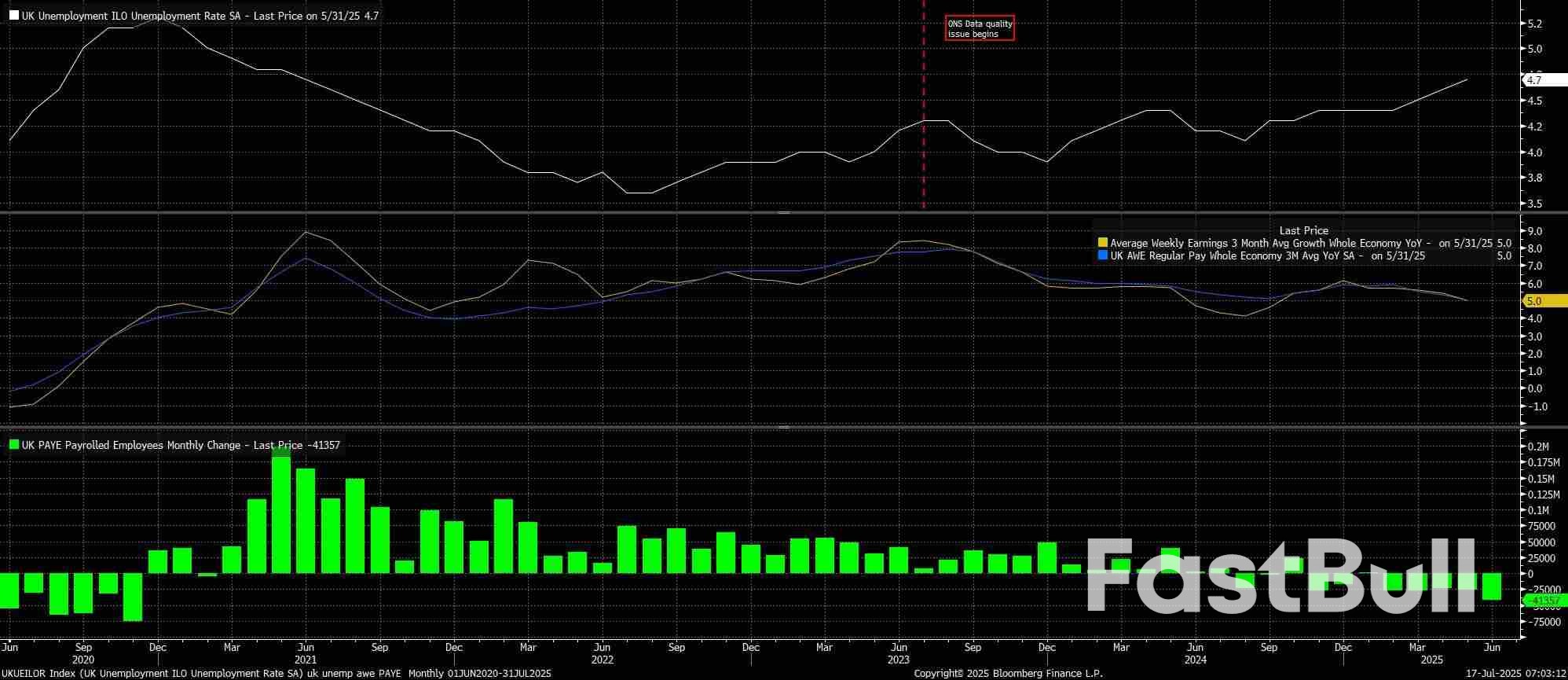
          Unemployment, in the three months to May, rose to 4.7%, above consensus estimates, and the highest such level since mid-2021.

          Meanwhile, earnings growth continued to cool. Regular pay rose 5.0% YoY, the slowest pace since the middle of 2022, while overall earnings rose 5.0% YoY, the slowest such pace since last September, with both moderating from the pace seen in April.

          The more timely HMRC PAYE payrolls indicator, for June, pointed to further 41,000 jobs having been lost last month, meaning that payrolled employment has now declined for 8 months in a row. In other words, the UK economy has lost jobs every month since last October's tax hiking Budget.

          All in all, this morning's figures pointed to a greater margin of slack continuing to develop in the labour market, where risks remain clearly tilted to the downside, amid not only the continued effects of April's National Insurance hike, but also the impact of a higher minimum wage, and the significant degree of uncertainty which clouds the outlook.

          Despite this, today's data is unlikely to see the BoE pursue a faster pace of easing, with a dovish turn still prohibited by stubborn price pressures, particularly after the hotter than expected June CPI released yesterday. Consequently, the Bank's ‘gradual and careful' guidance looks set to stay in place for now, likely leading to just two 25bp cuts being delivered over the remainder of the year.

          This continued tight monetary policy stance, combined with the prospect of further fiscal tightening in the autumn, means headwinds facing the labour market are set to persist. The employment backdrop looks set to sour much further in the months ahead.

          Source: Pepperstone

          To stay updated on all economic events of today, please check out our Economic calendar
          Risk Warnings and Disclaimers
          You understand and acknowledge that there is a high degree of risk involved in trading. Following any strategies or investment methods may lead to potential losses. The content on the site is provided by our contributors and analysts for information purposes only. You are solely responsible for determining whether any trading assets, securities, strategy, or any other product is suitable for investing based on your own investment objectives and financial situation.
          Add to Favorites
          Share
          FastBull
          Copyright © 2025 FastBull Ltd

          728 RM B 7/F GEE LOK IND BLDG NO 34 HUNG TO RD KWUN TONG KLN HONG KONG

          TelegramInstagramTwitterfacebooklinkedin
          App Store Google Play Google Play
          Products
          Charts

          Chats

          Q&A with Experts
          Screeners
          Economic Calendar
          Data
          Tools
          Membership
          Features
          Function
          Markets
          Copy Trading
          Latest Signals
          Contests
          News
          Analysis
          24/7
          Columns
          Education
          Company
          Careers
          About Us
          Contact Us
          Advertising
          Help Center
          Feedback
          User Agreement
          Privacy Policy
          Business

          White Label

          Data API

          Web Plug-ins

          Poster Maker

          Affiliate Program

          Risk Disclosure

          The risk of loss in trading financial instruments such as stocks, FX, commodities, futures, bonds, ETFs and crypto can be substantial. You may sustain a total loss of the funds that you deposit with your broker. Therefore, you should carefully consider whether such trading is suitable for you in light of your circumstances and financial resources.

          No decision to invest should be made without thoroughly conducting due diligence by yourself or consulting with your financial advisors. Our web content might not suit you since we don't know your financial conditions and investment needs. Our financial information might have latency or contain inaccuracy, so you should be fully responsible for any of your trading and investment decisions. The company will not be responsible for your capital loss.

          Without getting permission from the website, you are not allowed to copy the website's graphics, texts, or trademarks. Intellectual property rights in the content or data incorporated into this website belong to its providers and exchange merchants.

          Not Logged In

          Log in to access more features

          FastBull Membership

          Not yet

          Purchase

          Become a signal provider
          Help Center
          Customer Service
          Dark Mode
          Price Up/Down Colors

          Log In

          Sign Up

          Position
          Layout
          Fullscreen
          Default to Chart
          The chart page opens by default when you visit fastbull.com