• Trade
  • Markets
  • Copy
  • Contests
  • News
  • 24/7
  • Calendar
  • Q&A
  • Chats
Trending
Screeners
SYMBOL
LAST
BID
ASK
HIGH
LOW
NET CHG.
%CHG.
SPREAD
SPX
S&P 500 Index
6827.42
6827.42
6827.42
6899.86
6801.80
-73.58
-1.07%
--
DJI
Dow Jones Industrial Average
48458.04
48458.04
48458.04
48886.86
48334.10
-245.98
-0.51%
--
IXIC
NASDAQ Composite Index
23195.16
23195.16
23195.16
23554.89
23094.51
-398.69
-1.69%
--
USDX
US Dollar Index
97.860
97.940
97.860
98.070
97.810
-0.090
-0.09%
--
EURUSD
Euro / US Dollar
1.17523
1.17530
1.17523
1.17596
1.17262
+0.00129
+ 0.11%
--
GBPUSD
Pound Sterling / US Dollar
1.33912
1.33919
1.33912
1.33961
1.33546
+0.00205
+ 0.15%
--
XAUUSD
Gold / US Dollar
4341.18
4341.61
4341.18
4350.16
4294.68
+41.79
+ 0.97%
--
WTI
Light Sweet Crude Oil
56.860
56.890
56.860
57.601
56.848
-0.373
-0.65%
--

Community Accounts

Signal Accounts
--
Profit Accounts
--
Loss Accounts
--
View More

Become a signal provider

Sell trading signals to earn additional income

View More

Guide to Copy Trading

Get started with ease and confidence

View More

Signal Accounts for Members

All Signal Accounts

Best Return
  • Best Return
  • Best P/L
  • Best MDD
Past 1W
  • Past 1W
  • Past 1M
  • Past 1Y

All Contests

  • All
  • Trump Updates
  • Recommend
  • Stocks
  • Cryptocurrencies
  • Central Banks
  • Featured News
Top News Only
Share

According To Data From The Federal Reserve Bank Of New York, The Secured Overnight Funding Rate (Sofr) Was 3.67% On The Previous Trading Day (December 15), Compared To 3.66% The Day Before

Share

Peru Energy And Mines Ministry: Copper Production Up 4.8% Year-On-Year In October To 248192 Metric Tons

Share

Security Source: Ukrainian Drones Hits Russian Oil Infrastructure In Caspian Sea For Third Time

Share

Spot Palladium Extends Gains, Last Up 5% To $1562.7/Oz

Share

Mexico's Economy Ministry Announces Start Of Anti-Dumping Investigation And Anti-Subsidy Investigations Into USA Pork Imports

Share

Canada Nov CPI Common +2.8%, CPI Median +2.8%, CPI Trim +2.8% On Year

Share

NY Fed's Empire State Prices Paid Index +37.6 In December Versus+49.0 In November

Share

Canada Nov Consumer Prices +0.1% On Month, +2.2% On Year

Share

Canada Nov CPI Core -0.1% On Month, +2.9% On Year

Share

Canada Nov Core CPI, Seasonally Adjusted +0.2% On Month, Oct +0.3% (Unrevised)

Share

UK Health Minister Streeting On Doctors' Strike: Vote To Go Ahead Reveals The Bma's Shocking Disregard For Patient Safety

Share

Venezuelan State Oil Company Pdvsa Says Was Subject To Cyber Attack But Operations Unaffected

Share

Russia Central Bank Says January-October Current Account Surplus At $37.1 Billion

Share

Polish Current Account Balance At +1924 Million Euros In October Versus+130 Million Euros Seen In Reuters Poll

Share

Statement: Germany, Ukraine Propose 10-Point Plan To Strengthen Armament Cooperation

Share

London Metal Exchange Three Month Copper Falls More Than 3% To $11541.50 A Metric Ton

Share

[Market Update] Spot Silver Surged $2.00 During The Day, Returning To $64/ounce, A Gain Of 3.23%

Share

European Central Bank: Italy's Recurrent Ad Hoc Tax Provisions Cause Uncertainty, Damage Investor Confidence, And May Affect Banks' Funding Costs

Share

Stats Office: Nigeria Consumer Inflation At 14.45% Year-On-Year In November

Share

European Central Bank: Italy's Budget Measures Weighing On Domestic Banks Could Have "Negative Implications" On Their Credit Liquidity

TIME
ACT
FCST
PREV
Japan Tankan Small Manufacturing Outlook Index (Q4)

A:--

F: --

P: --

Japan Tankan Large Non-Manufacturing Outlook Index (Q4)

A:--

F: --

P: --

Japan Tankan Large Manufacturing Outlook Index (Q4)

A:--

F: --

P: --

Japan Tankan Small Manufacturing Diffusion Index (Q4)

A:--

F: --

P: --

Japan Tankan Large Manufacturing Diffusion Index (Q4)

A:--

F: --

P: --

Japan Tankan Large-Enterprise Capital Expenditure YoY (Q4)

A:--

F: --

P: --

U.K. Rightmove House Price Index YoY (Dec)

A:--

F: --

P: --

China, Mainland Industrial Output YoY (YTD) (Nov)

A:--

F: --

P: --

China, Mainland Urban Area Unemployment Rate (Nov)

A:--

F: --

P: --

Saudi Arabia CPI YoY (Nov)

A:--

F: --

P: --

Euro Zone Industrial Output YoY (Oct)

A:--

F: --

P: --

Euro Zone Industrial Output MoM (Oct)

A:--

F: --

P: --

Canada Existing Home Sales MoM (Nov)

A:--

F: --

P: --

Canada National Economic Confidence Index

A:--

F: --

P: --

Canada New Housing Starts (Nov)

A:--

F: --

P: --
U.S. NY Fed Manufacturing Employment Index (Dec)

A:--

F: --

P: --

U.S. NY Fed Manufacturing Index (Dec)

A:--

F: --

P: --

Canada Core CPI YoY (Nov)

A:--

F: --

P: --

Canada Manufacturing Unfilled Orders MoM (Oct)

A:--

F: --

P: --

U.S. NY Fed Manufacturing Prices Received Index (Dec)

A:--

F: --

P: --

U.S. NY Fed Manufacturing New Orders Index (Dec)

A:--

F: --

P: --

Canada Manufacturing New Orders MoM (Oct)

A:--

F: --

P: --

Canada Core CPI MoM (Nov)

A:--

F: --

P: --

Canada Trimmed CPI YoY (SA) (Nov)

A:--

F: --

P: --

Canada Manufacturing Inventory MoM (Oct)

A:--

F: --

P: --

Canada CPI YoY (Nov)

A:--

F: --

P: --

Canada CPI MoM (Nov)

A:--

F: --

P: --

Canada CPI YoY (SA) (Nov)

A:--

F: --

P: --

Canada Core CPI MoM (SA) (Nov)

A:--

F: --

P: --

Canada CPI MoM (SA) (Nov)

A:--

F: --

P: --

Federal Reserve Board Governor Milan delivered a speech
U.S. NAHB Housing Market Index (Dec)

--

F: --

P: --

Australia Composite PMI Prelim (Dec)

--

F: --

P: --

Australia Services PMI Prelim (Dec)

--

F: --

P: --

Australia Manufacturing PMI Prelim (Dec)

--

F: --

P: --

Japan Manufacturing PMI Prelim (SA) (Dec)

--

F: --

P: --

U.K. 3-Month ILO Employment Change (Oct)

--

F: --

P: --

U.K. Unemployment Claimant Count (Nov)

--

F: --

P: --

U.K. Unemployment Rate (Nov)

--

F: --

P: --

U.K. 3-Month ILO Unemployment Rate (Oct)

--

F: --

P: --

U.K. Average Weekly Earnings (3-Month Average, Including Bonuses) YoY (Oct)

--

F: --

P: --

U.K. Average Weekly Earnings (3-Month Average, Excluding Bonuses) YoY (Oct)

--

F: --

P: --

France Services PMI Prelim (Dec)

--

F: --

P: --

France Composite PMI Prelim (SA) (Dec)

--

F: --

P: --

France Manufacturing PMI Prelim (Dec)

--

F: --

P: --

Germany Services PMI Prelim (SA) (Dec)

--

F: --

P: --

Q&A with Experts
    • All
    • Chatrooms
    • Groups
    • Friends
    Connecting
    .
    .
    .
    Type here...
    Add Symbol or Code

      No matching data

      All
      Trump Updates
      Recommend
      Stocks
      Cryptocurrencies
      Central Banks
      Featured News
      • All
      • Russia-Ukraine Conflict
      • Middle East Flashpoint
      • All
      • Russia-Ukraine Conflict
      • Middle East Flashpoint
      Search
      Products

      Charts Free Forever

      Chats Q&A with Experts
      Screeners Economic Calendar Data Tools
      Membership Features
      Data Warehouse Market Trends Institutional Data Policy Rates Macro

      Market Trends

      Market Sentiment Order Book Forex Correlations

      Top Indicators

      Charts Free Forever
      Markets

      News

      News Analysis 24/7 Columns Education
      From Institutions From Analysts
      Topics Columnists

      Latest Views

      Latest Views

      Trending Topics

      Top Columnists

      Latest Update

      Signals

      Copy Rankings Latest Signals Become a signal provider AI Rating
      Contests
      Brokers

      Overview Brokers Assessment Rankings Regulators News Claims
      Broker listing Forex Brokers Comparison Tool Live Spread Comparison Scam
      Q&A Complaint Scam Alert Videos Tips to Detect Scam
      More

      Business
      Events
      Careers About Us Advertising Help Center

      White Label

      Data API

      Web Plug-ins

      Affiliate Program

      Awards Institution Evaluation IB Seminar Salon Event Exhibition
      Vietnam Thailand Singapore Dubai
      Fans Party Investment Sharing Session
      FastBull Summit BrokersView Expo
      Recent Searches
        Top Searches
          Markets
          News
          Analysis
          User
          24/7
          Economic Calendar
          Education
          Data
          • Names
          • Latest
          • Prev

          View All

          No data

          Scan to Download

          Faster Charts, Chat Faster!

          Download App
          English
          • English
          • Español
          • العربية
          • Bahasa Indonesia
          • Bahasa Melayu
          • Tiếng Việt
          • ภาษาไทย
          • Français
          • Italiano
          • Türkçe
          • Русский язык
          • 简中
          • 繁中
          Open Account
          Search
          Products
          Charts Free Forever
          Markets
          News
          Signals

          Copy Rankings Latest Signals Become a signal provider AI Rating
          Contests
          Brokers

          Overview Brokers Assessment Rankings Regulators News Claims
          Broker listing Forex Brokers Comparison Tool Live Spread Comparison Scam
          Q&A Complaint Scam Alert Videos Tips to Detect Scam
          More

          Business
          Events
          Careers About Us Advertising Help Center

          White Label

          Data API

          Web Plug-ins

          Affiliate Program

          Awards Institution Evaluation IB Seminar Salon Event Exhibition
          Vietnam Thailand Singapore Dubai
          Fans Party Investment Sharing Session
          FastBull Summit BrokersView Expo

          The Dollar Still Rules, But US Policy Is Making It Less Special

          Samantha Luan

          Economic

          Forex

          Cryptocurrency

          Summary:

          President Donald Trump’s push to redesign the global economic order in favor of the US is shaking one of the foundations of its post-World War II supremacy: the dollar’s undisputed role as the world’s reserve currency.

          President Donald Trump’s push to redesign the global economic order in favor of the US is shaking one of the foundations of its post-World War II supremacy: the dollar’s undisputed role as the world’s reserve currency.It’s a status that shows the dollar is used in roughly nine out of 10 foreign exchange transactions and about half of all merchandise trade conducted globally, and is making up almost 60% of reserves held by governments around the world. That dominance helps Washington to run gaping budget deficits and US consumers to spend more than they make—all funded by overseas investors eager to snap up assets denominated in greenbacks adorned with the motto “In God We Trust.”

          But trust in the dollar is faltering. In 2022 the Biden administration’s curbs on Russia’s access to the currency after the invasion of Ukraine spurred a first round of diversification. If the US could freeze out the world’s 11th-largest economy, so deeply entrenched in global oil markets, is anyone safe? The Great Inflation, and a rapidly deteriorating fiscal trajectory since then, has added to doubts about American economic exceptionalism. And most recently, the haphazard rollout and rollback of Trump’s tariff campaign in April sparked a rare weakening in both the dollar’s value and that of US Treasuries. The US dollar index tumbled more than 10% in the first six months of the year, its worst first-half performance since 1973.

          Like an uncorked genie, the “sell America” talk is proving hard to bottle up again. Banks and brokers are seeing rising demand for currency products that bypass the dollar, and some of Asia’s richest families are cutting exposure to US assets, saying Trump’s tariffs have made the country much less predictable. Geopolitical rivals within BRICS—a loose group of large economies led by Brazil, Russia, India, China and South Africa—are continuing their long push for a new cross-border payments system. Even long-term allies such as Europe see an opportunity to erode the dominance of the dollar.

          Not everyone is so dour. JPMorgan Chase & Co.’s Jamie Dimon said in May that the US remains the most “prosperous, innovative nation on the planet” and that he doesn’t fret over short-term fluctuations in the dollar. Secretary of the Treasury Scott Bessent has tried to convince investors that the strong dollar policy remains intact, and his boss has threatened 100% tariffs against anyone who dares challenge it. Yet for all the tough talk, the reality is that the greenback’s greatest relative strength is actually the lack of any single challenger to its standing atop the global monetary order.

          There’s talk of a “global euro moment” in which the European common currency plays a bigger role, but history has shown that the bloc struggles to move in sync, and its institutions are too fragmented to create the markets deep enough to rival those of the US. China’s central bank governor is talking up his nation’s currency as an option for those seeking to shift from the dollar, but it’s hard to imagine how that will be embraced when capital controls still impede the free flow of assets across Chinese capital borders.

          Central banks and investors have piled into the ultimate haven asset—gold—but it’s cumbersome to hold, offers no yield and can’t easily be used in trade or financial transactions the way the dollar can. Speculation for dollar replacements range as far as Bitcoin and other digital assets, though few outside El Salvador (which in 2021 adopted the cryptocurrency as legal tender) are ready to shift toward anything that’s not government-backed. Other financial innovations such as stablecoins—digital tokens meant to substitute for traditional cash—may entrench rather than dislodge the dollar’s primacy as they peg their value to the greenback.

          With no viable alternative to the US dollar as the world’s currency on the horizon, the more likely change is to a multicurrency world. The dollar would still be dominant, but other currencies would play a larger role. Although this may not be as revolutionary as a complete breakdown in the global monetary order that some dollar doomsayers are foreseeing, the resulting currency competition will still have profound effects on the US’s hard and soft geopolitical power. Indeed, no one is really ready for what a feeding frenzy of currency competition will mean in ­practice—especially not Americans.

          The US would have to give up some of the benefits of the strong-dollar regime, a key one being lower interest rates as fewer overseas investors buy dollar-denominated bonds. Barry Eichengreen, an economist at the University of California at Berkeley, who’s written extensively on the dollar, has calculated that in a scenario where the US withdraws from the global stage, the dollar’s share of reserves in countries that rely on its security could decline by about 30 percentage points. Long-term US interest rates could increase by as much as 0.8 of a percentage point, he estimates.

          US banks will need to pay more to raise money and charge more for mortgages as a result. Higher home loan rates tend to slow the economy because they leave less income for consumers to spend on vacations, home improvements and the like. And though a weaker foreign exchange rate may be good for rebalancing the trade deficit—by making American exports cheaper and more competitive and deterring spending on costlier imports—that’s not great for household wealth.

          The federal government will also feel the pinch. It finances its annual budget gap, a little less than $2 trillion, through Treasuries. In a world where euro- or yen-denominated assets are more strongly vying for investor attention, borrowing costs for the US government would need to rise. In fact, we’re already noticing signs of that: Thirty-year Treasury yields have more than doubled since the start of 2022 and exceeded 5% at one point in May. That means America will pay more for new borrowing and more to keep rolling over its existing debt too. Annual payments on US government debt by some measures are now larger than what the country spends on national defense.

          The globalized dollar has long shielded lawmakers in Washington from having to decide between guns or butter—or tax cuts. And even as doubts in the dollar grow as the budget deficit swells, legislators still aren’t ready to tighten their belts. Elon Musk promised $1 trillion in savings through the so-called Department of Government Efficiency, or DOGE; the cuts so far have saved less than $200 billion. Meanwhile, a key legislative win for Trump, the One Big Beautiful Bill, will add as much as $3 trillion to the budget deficit over the next decade, according to estimates from the Congressional Budget Office. But in a world where investors continue moving away from the greenback, markets could eventually force difficult trade-offs to cut the deficit—meaning that social safety nets and public research-and-development spending that’s long spurred private-sector innovation in areas including Big Tech and Big Pharma will start to have limits imposed on them.

          A less hegemonic dollar would affect America’s geopolitical prowess. With a weaker currency, overseas military bases would become more expensive to keep up. With less use of the dollar in global transactions, economic sanctions would have less bite. And policing the financial system for malign activities, such as financing terrorist undertakings or laundering money, would be harder because flows outside of dollar-based networks won’t be visible to American policymakers.

          “We don’t appreciate how good we have it,” says Josh Lipsky, senior director of the GeoEconomics Center at the Atlantic Council in Washington and a former adviser at the International Monetary Fund. “Ownership of the reserved asset means cheaper credit for Americans and the federal government, it means more transparency of US policymakers in the financial system to carry out economic statecraft that aligns with US foreign policy objectives. That is what’s at risk.”

          US Treasury secretaries, the stewards of the dollar and American currency policy, have long said that it’s up to the nation itself to guard the treasure that the reserve asset is. Whether it’s Bob Rubin, Hank Paulson or Janet Yellen, these leaders have said that a strong economy bolstered by independent institutions and the rule of law will protect the dollar’s status. Yet the Trump administration has sent mixed signals. Bessent has stuck largely to the script of predecessors, but Stephen Miran, chair of the White House’s Council of Economic Advisers and Trump’s latest pick to serve as governor of the Federal Reserve, has referred to the dollar’s status as a “burden.”

          Trump’s efforts to shift executive authority into independent agencies like regulators and even the Federal Reserve, his consistent challenges to the courts, and Washington’s disregard for record-high federal debt are adding to the dollar’s headwinds. Trust is the cornerstone of the world’s choice of the dollar as king, and Trump is chipping away at that credibility. “For the first time, the dollar’s future status may be determined by how other currencies develop,” Lipsky says. “And those will develop faster if people are looking for them—that’s the lesson of capitalism.”

          The world economy is more financialized and knit together than the last time it saw a tectonic shift in global currency power about 80 years ago, when the dollar eclipsed the British pound. Indeed, the dollar’s status has faced a reckoning before and persevered. President Richard Nixon unilaterally abandoned the gold peg in 1971 and imposed a 10% import tariff after nations including France sought to swap dollars for bullion, threatening the monetary system agreed at Bretton Woods after World War II. The American-made global financial crisis earlier in the 2000s also triggered questions, particularly in China, about whether the US continued to merit its role as cornerstone of the global monetary order.

          Previous eras have had mixed currency use, but typically those were anchored to either gold or silver. There’s never been a period when multiple fiat currencies competed for dominance. This fact makes some people nervous about what lies ahead. A multicurrency era could provoke instability as investors run from one to another in reaction to financial conditions, compounding the challenge for businesses already grappling with how they’ll rewire supply chains in an era of rising tariff walls.

          Today’s steward of US currency policy, Bessent, is pushing back against the dollar doubters: “Since World War II, the demise of the dollar as a reserve currency has been predicted,” he said on Bloomberg TV on July 3. “Once again, the skeptic is going to be wrong.” And he’s right: The US dollar isn’t about to disappear from central bank hoards or as a medium for global finance. But it will face more competition in a multipolar world. And that will have unpredictable repercussions both at home and abroad.

          Source: Bloomberg Europe

          To stay updated on all economic events of today, please check out our Economic calendar
          Risk Warnings and Disclaimers
          You understand and acknowledge that there is a high degree of risk involved in trading. Following any strategies or investment methods may lead to potential losses. The content on the site is provided by our contributors and analysts for information purposes only. You are solely responsible for determining whether any trading assets, securities, strategy, or any other product is suitable for investing based on your own investment objectives and financial situation.
          Add to Favorites
          Share

          Bitcoin Climbs Toward Record High as Institutional and Treasury Demand Surges

          Gerik

          Economic

          Cryptocurrency

          Institutional Demand and Treasury Accumulation Drive Rally

          Bitcoin rose as much as 3.2% on Monday to surpass $122,000, narrowing the gap to its mid-July record. The move comes alongside a broader surge in digital assets, with Ether climbing above $4,300 for the first time since December 2021. Data from Coingecko show that corporate treasury vehicles dedicated to Bitcoin now hold $113 billion worth of the cryptocurrency, while equivalent Ether-focused entities have accumulated around $13 billion, according to strategicethreserve.xyz. This steady accumulation reflects a structural shift in how large institutions and listed entities are allocating capital toward crypto assets.
          Market analysts point to a shift in investor preference as US tariffs on imported gold bars add a new layer of cost and policy risk to the traditional safe-haven asset. Rachael Lucas, a crypto analyst at BTC Markets, notes that Bitcoin’s appeal as a borderless, tariff-free store of value has gained traction, especially given logistical bottlenecks in physical gold supply. This macro backdrop is reinforcing institutional confidence in crypto as a hedge against both inflationary pressures and trade policy disruptions.

          Derivatives Positioning Signals Bullish Outlook

          The options market reflects an overwhelmingly positive bias. Ether’s put-call ratio stands at 0.40, with the largest concentration of December 26 call options at $6,000, according to Deribit data. For Bitcoin, options flows are heavily skewed toward September and December calls, aligning with expectations of global interest rate cuts and continued mainstream adoption. Sean McNulty of FalconX highlights that this alignment between macroeconomic timing and derivatives positioning could amplify price momentum into year-end.
          With the all-time high of $123,205 in sight, traders are watching for a potential breakout that could spark another leg higher. Should momentum falter, initial support is seen around $116,000. The sustained inflows from exchange-traded funds, corporate balance sheets, and institutional desks suggest underlying demand strength, but profit-taking at psychological levels remains a short-term risk.
          The bullish sentiment is also being boosted by high-profile endorsements and market activity. Ether’s rally drew praise from Eric Trump, who has ties to digital-asset ventures. Bloomberg recently reported that the Trump-backed World Liberty Financial is exploring a public listing to hold its WLFI tokens, a move that could further blend political influence with the crypto market’s growth story.

          Source: Bloomberg

          To stay updated on all economic events of today, please check out our Economic calendar
          Risk Warnings and Disclaimers
          You understand and acknowledge that there is a high degree of risk involved in trading. Following any strategies or investment methods may lead to potential losses. The content on the site is provided by our contributors and analysts for information purposes only. You are solely responsible for determining whether any trading assets, securities, strategy, or any other product is suitable for investing based on your own investment objectives and financial situation.
          Add to Favorites
          Share

          Over Half of India’s Exports to US Hit by New 50% Tariff After Russian Oil Dispute

          Gerik

          Economic

          Sharp Tariff Escalation and Trade Exposure

          The Indian government disclosed Monday that more than half of its goods exports to the United States will be affected by the latest tariff increase, which took effect last week. The new measure, announced as a punitive response to India’s continued imports of Russian oil, doubles the total duty on Indian goods from 25% to 50%. This puts India among the highest-taxed trading partners in the American market, significantly altering cost dynamics for exporters.
          Goods trade between the US and India totaled approximately $87 billion in the most recent fiscal year, making the US a critical export destination for Indian manufacturers. With 55% of these exports now subject to the elevated rate, the tariff burden is expected to weigh heavily on sectors ranging from textiles and engineering goods to chemicals and electronics. The Ministry of Finance’s estimate accounts for both the original 25% tariff and the newly imposed surcharge.

          Government and Industry Coordination

          Junior Finance Minister Pankaj Chaudhary told lawmakers that the Department of Commerce is actively consulting exporters and industry bodies to assess the potential economic fallout. The process involves gathering sector-specific feedback on cost pass-throughs, market substitution risks, and potential supply chain adjustments. While no formal retaliatory measures have been announced, such high exposure could prompt India to seek negotiated relief or diversification of export markets.
          The tariff escalation underscores the intersection of trade policy and geopolitical positioning. Washington’s move directly links market access to foreign policy alignment, signaling to other US partners the costs of maintaining energy ties with Moscow. For India, which has sought to balance its relationships with both Western allies and Russia, the increased duty could become a lever in broader strategic negotiations, potentially influencing defense, technology, and investment agreements with the US.
          The immediate risk is an erosion of price competitiveness for Indian products in the US market, which could lead to lost market share to lower-tariff competitors. Longer term, the impact will depend on the duration of the 50% tariff and whether it is expanded to cover more categories of goods. If talks between Washington and Delhi do not produce concessions, exporters may need to accelerate efforts to reorient sales toward alternative markets such as the EU, Middle East, and Southeast Asia, while seeking cost efficiencies to absorb part of the tariff shock.

          Source: Reuters

          To stay updated on all economic events of today, please check out our Economic calendar
          Risk Warnings and Disclaimers
          You understand and acknowledge that there is a high degree of risk involved in trading. Following any strategies or investment methods may lead to potential losses. The content on the site is provided by our contributors and analysts for information purposes only. You are solely responsible for determining whether any trading assets, securities, strategy, or any other product is suitable for investing based on your own investment objectives and financial situation.
          Add to Favorites
          Share

          AUD/USD & NZD/USD Much Higher—Uptrend Shows Strength

          FXOpen

          Forex

          Economic

          AUD/USD started a decent increase above the 0.6480 and 0.6500 levels. NZD/USD is also rising and might aim for more gains above 0.5970.

          Important Takeaways for AUD/USD and NZD/USD Analysis Today

          ● The Aussie Dollar started a decent increase above the 0.6450 level against the US Dollar.
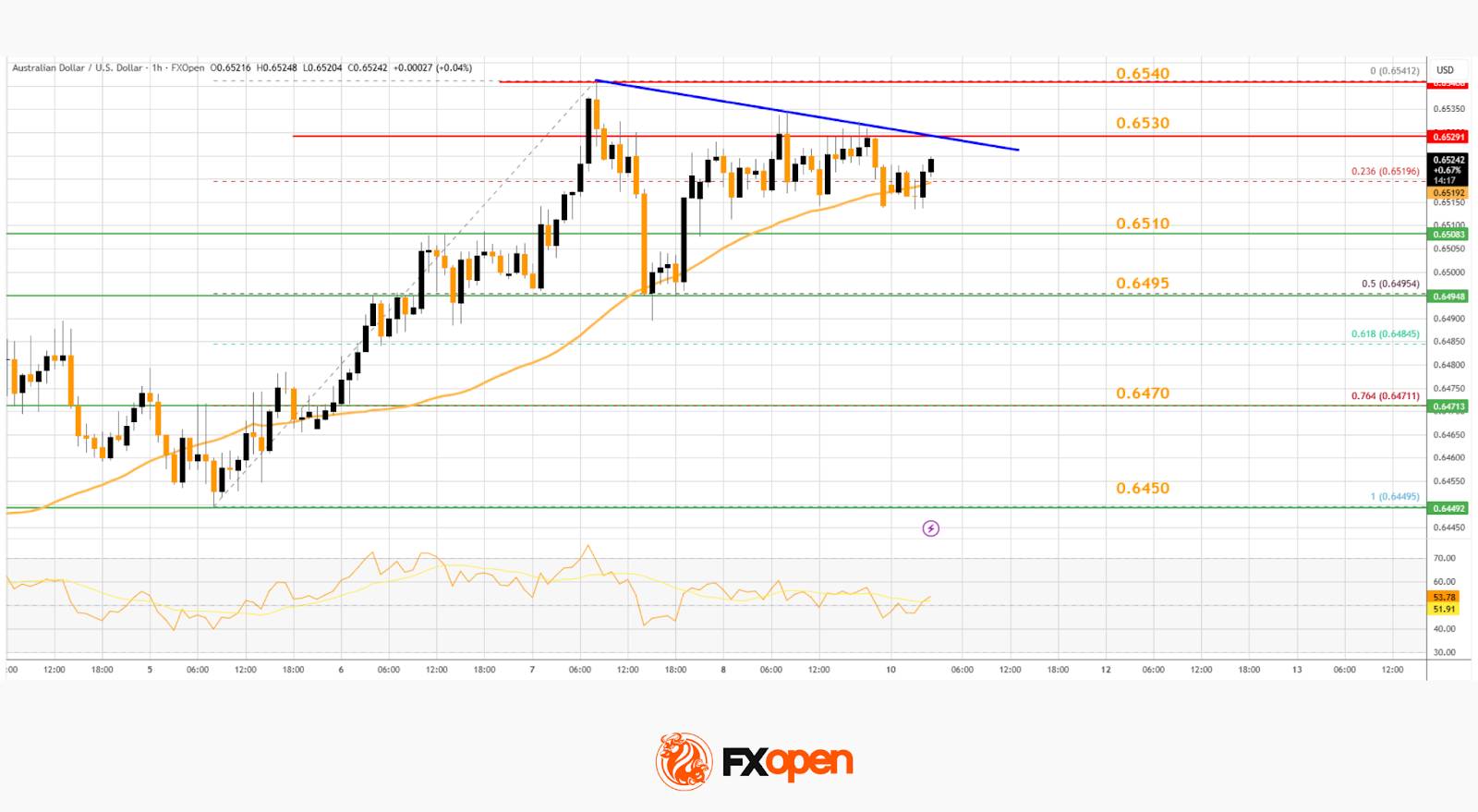
          ● There is a connecting bearish trend line forming with resistance at 0.6530 on the hourly chart of AUD/USD at FXOpen.
          ● NZD/USD is consolidating gains above the 0.5940 zone.
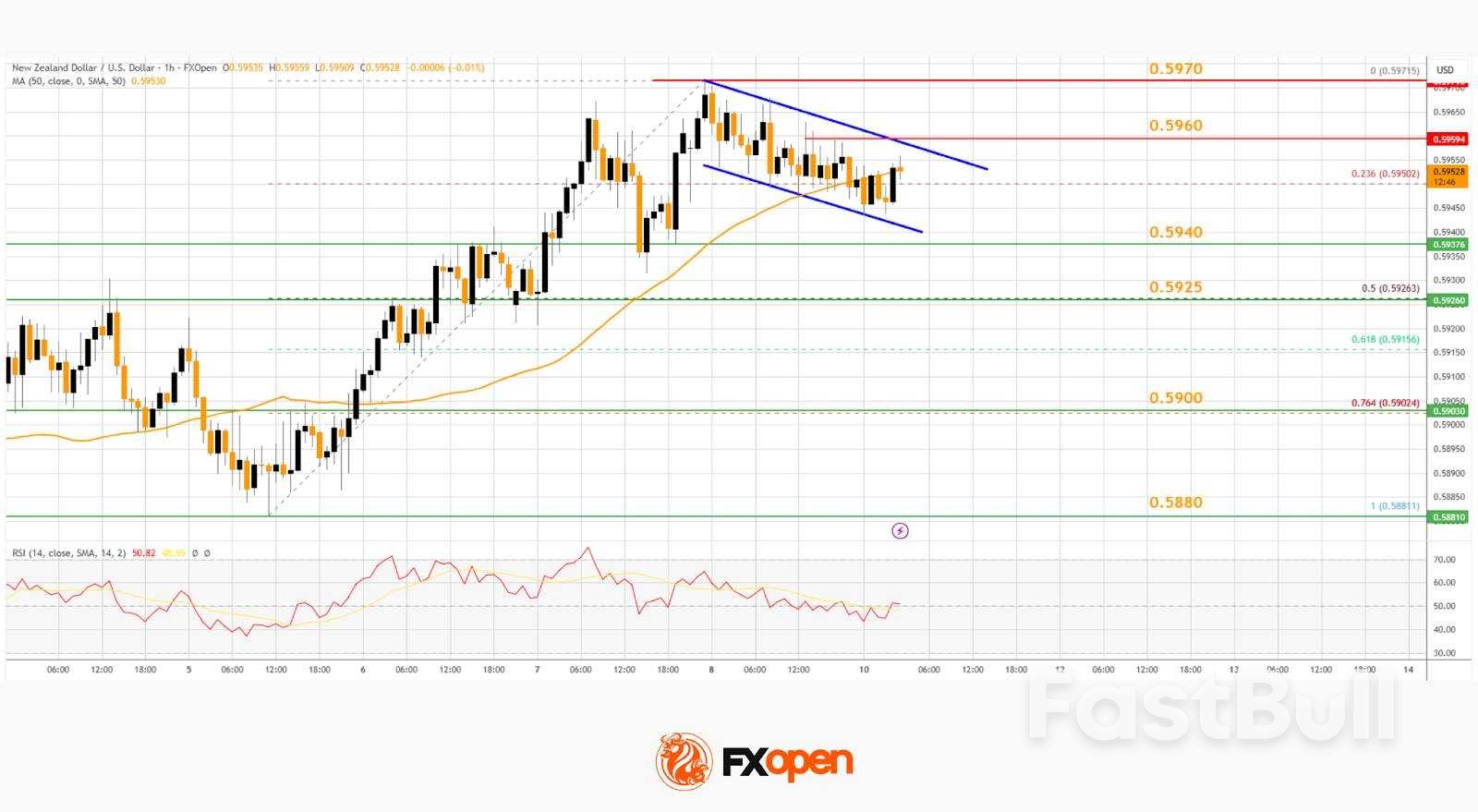
          ● There is a short-term declining channel forming with resistance at 0.5960 on the hourly chart of NZD/USD at FXOpen.

          AUD/USD Technical Analysis

          AUD/USD & NZD/USD Much Higher—Uptrend Shows Strength_1

          On the hourly chart of AUD/USD on FXOpen, the pair started a fresh increase from the 0.6450 support. The Aussie Dollar was able to clear the 0.6470 resistance to move into a positive zone against the US Dollar.There was a close above the 0.6500 resistance and the 50-hour simple moving average. Finally, the pair tested the 0.6540 zone. A high was formed near 0.6541 and the pair recently started a consolidation phase.There was a move below the 23.6% Fib retracement level of the upward move from the 0.6449 swing low to the 0.6541 high. On the downside, initial support is near the 0.6510 level.

          The next major support is near the 0.6495 zone or the 50% Fib retracement level. If there is a downside break below 0.6495, the pair could extend its decline toward the 0.6470 level. Any more losses might signal a move toward 0.6450.On the upside, the AUD/USD chart indicates that the pair is now facing resistance near 0.6530. There is also a connecting bearish trend line forming with resistance at 0.6530.The first major resistance might be 0.6540. An upside break above it might send the pair further higher. The next major resistance is near the 0.6580 level. Any more gains could clear the path for a move toward the 0.6600 resistance zone.

          NZD/USD Technical Analysis

          AUD/USD & NZD/USD Much Higher—Uptrend Shows Strength_2

          On the hourly chart of NZD/USD on FXOpen, the pair started a steady increase from the 0.5880 zone. The New Zealand Dollar broke the 0.5925 resistance to start the recent increase against the US Dollar.The pair settled above 0.5940 and the 50-hour simple moving average. It tested the 0.5970 zone and is currently consolidating gains. There was a move below the 23.6% Fib retracement level of the upward move from the 0.5881 swing low to the 0.5971 high.

          The NZD/USD chart suggests that the RSI is stable above 50. On the upside, the pair might struggle near 0.5960. There is also a short-term declining channel forming with resistance at 0.5960.The next major resistance is near the 0.5970 level. A clear move above the 0.5970 level might even push the pair toward the 0.6000 level. Any more gains might clear the path for a move toward the 0.6020 resistance zone in the coming days.

          On the downside, immediate support is near the 0.5940 level. The first key support is near the 0.5925 level. It is close to the 50% Fib retracement level of the upward move from the 0.5881 swing low to the 0.5971 high.The next major support is near the 0.5900 level. If there is a downside break below it, the pair might slide toward 0.5880. Any more losses could lead NZD/USD to 0.5820.

          Source: FXOpen

          To stay updated on all economic events of today, please check out our Economic calendar
          Risk Warnings and Disclaimers
          You understand and acknowledge that there is a high degree of risk involved in trading. Following any strategies or investment methods may lead to potential losses. The content on the site is provided by our contributors and analysts for information purposes only. You are solely responsible for determining whether any trading assets, securities, strategy, or any other product is suitable for investing based on your own investment objectives and financial situation.
          Add to Favorites
          Share

          Swiss Economy Expected to Withstand Initial Impact of US Tariffs, Though Risks Remain

          Gerik

          Economic

          Moderate Growth Impact in Baseline Forecasts

          A Bloomberg survey of eight economists indicates Switzerland’s GDP growth outlook has been trimmed by just 0.1 percentage point for both 2025 and 2026, to 1.4% and 1.1% respectively, even after the US imposed its steepest tariff on any developed economy. While a mild contraction is expected in the second quarter largely a correction after an export surge early in the year ahead of tariff implementation forecasters anticipate a rebound by year-end. Bloomberg Economics’ Jean Dalbard noted that while growth will be subdued, recession risk is not part of the base case.
          The US levy, set at 39%, represents a severe escalation in trade costs for Swiss exporters. Bank J Safra Sarasin’s Chief Economist Karsten Junius warns that without swift resolution, job losses in manufacturing are “all but certain” and production could shift to EU countries to bypass tariffs. This risk underscores the structural exposure of Switzerland’s export sector, especially for goods dependent on US market access.

          Policy Response and Monetary Outlook

          The Swiss National Bank (SNB) cut borrowing costs to zero in June to support the economy, and most surveyed economists expect rates to remain at this level through at least 2027. However, Junius suggests that if high tariffs persist, negative rates could return to counteract trade-driven weakness. The underlying assumption in most forecasts is that US tariffs will revert to around 15% in the near term, but the risk case involves a delay in any deal until 2026.
          A further escalation would occur if the US extends tariffs to pharmaceuticals, a key Swiss export category dominated by Roche and Novartis. UBS economist Matteo Mosimann notes that such a move would necessitate a downward revision to growth forecasts. The Swiss government plans direct consultations with top executives from these firms to assess potential impacts and coordinate strategic responses.
          The current consensus reflects confidence in Switzerland’s ability to absorb the near-term tariff shock without a systemic downturn, supported by policy stability and a diversified export base. However, the combination of prolonged high tariffs, potential expansion to pharmaceuticals, and the possibility of production relocation to the EU could erode competitiveness over time. The path of US-Swiss trade talks in the coming months will be critical in determining whether the moderate slowdown projected for 2025–2026 holds, or whether more severe adjustments will be required in both monetary policy and industrial strategy.

          Source: Bloomberg

          To stay updated on all economic events of today, please check out our Economic calendar
          Risk Warnings and Disclaimers
          You understand and acknowledge that there is a high degree of risk involved in trading. Following any strategies or investment methods may lead to potential losses. The content on the site is provided by our contributors and analysts for information purposes only. You are solely responsible for determining whether any trading assets, securities, strategy, or any other product is suitable for investing based on your own investment objectives and financial situation.
          Add to Favorites
          Share

          US-China Tariff Truce Nears Expiry as Negotiations Broaden to Energy, Tech, and Geopolitical Leverage

          Gerik

          Economic

          China–U.S. Trade War

          Tariff Truce Deadline and Negotiation Stakes

          The 90-day tariff truce agreed in May which reduced prohibitive tariffs from April’s 145% peak and paused additional punitive measures is set to expire without clear confirmation of an extension. While Beijing has signaled optimism after the July talks in Stockholm, Washington has left the decision in President Trump’s hands. The unresolved status raises the risk of renewed escalation between the world’s two largest economies.
          The tariff framework remains complex. Chinese exports to the US face a layered system of duties, including a 20% fentanyl-related tariff, a 10% baseline tariff, and a 25% Trump-era levy on select goods. US exports to China encounter average tariffs above 32.6%. Analysts anticipate a potential summit between Trump and Xi in Beijing within months, but Eurasia Group warns that even with such a meeting, both sides are moving structurally toward deeper economic separation.

          Trade Commitments and Agricultural Signals

          A prospective deal may echo the phase-one agreement of January 2020, with China committing to increased US goods purchases, notably energy, agriculture, and potentially semiconductors and chipmaking equipment. Trump has publicly urged Beijing to quadruple soybean orders, coinciding with a notable rebound in China’s soybean imports in recent months. However, bilateral trade remains strained, with Chinese exports to the US down 21.7% year-on-year in July and imports from the US down 10.3% for the January–July period.
          China’s export growth to Southeast Asia up 13.5% this year has sparked US scrutiny over “transshipment,” prompting Trump to threaten a 40% blanket tariff on goods routed through third countries, though the operational definition remains unclear.
          Semiconductor Controls and Strategic Concessions
          The negotiations are further complicated by disputes over semiconductor export controls. While Nvidia is set to resume sales of its H20 chip to China, analysts view this as a tactical adjustment rather than a major policy reversal. The Trump administration remains divided over the scope of restrictions, balancing national security concerns against the risk of accelerating China’s domestic chip independence. Beijing has lobbied for eased controls on high-bandwidth memory chips, while US firms Nvidia and AMD have agreed to remit 15% of Chinese sales revenue to the US government in exchange for export licenses a development some see as the monetization of trade policy.
          China’s dominance in rare-earth supply has become another negotiation lever. After agreeing in June to relax its export ban on rare-earth metals and magnets, Beijing boosted global shipments by 60% to 7,742 metric tons before moderating exports in July. Rare-earth magnet shipments to the US spiked more than sevenfold in June, underscoring the resource’s strategic role. The August 20 release of country-specific data will reveal whether this surge represents a sustained supply shift or a tactical gesture ahead of talks.

          Geopolitical Pressures and Russian Crude

          A further flashpoint is Trump’s threat to impose secondary tariffs on China for its Russian oil imports, echoing the recent tariff hike on India’s Russian crude purchases from 25% to 50%. China imported $10.06 billion worth of Russian goods in July its highest monthly total since March though cumulative imports are down 7.7% from 2024.
          The diplomatic dimension is heightened by Xi Jinping’s recent call with Vladimir Putin during Xi’s annual summer retreat. Analysts suggest the timing was deliberate, adding uncertainty to US perceptions of Sino-Russian alignment and potentially influencing Trump’s negotiating posture on both trade and security matters.

          Source: CNBC

          To stay updated on all economic events of today, please check out our Economic calendar
          Risk Warnings and Disclaimers
          You understand and acknowledge that there is a high degree of risk involved in trading. Following any strategies or investment methods may lead to potential losses. The content on the site is provided by our contributors and analysts for information purposes only. You are solely responsible for determining whether any trading assets, securities, strategy, or any other product is suitable for investing based on your own investment objectives and financial situation.
          Add to Favorites
          Share

          Taiwan Pushes for Tariff Relief as US Negotiations Center on Semiconductors and Strategic Technology Exports

          Gerik

          Economic

          Active Negotiations Amid Heightened Trade Pressures

          Taiwan’s Vice Premier Cheng Li-chiun confirmed on Monday that the government remains in continuous dialogue with US officials in an effort to secure more favorable tariff terms. The 20% levy, imposed by President Donald Trump earlier this year, has quickly become a central issue in bilateral economic relations. Cheng emphasized that Taiwan aims for a “more reasonable” rate and has pledged to keep parliament updated on progress, signaling the political and economic weight of the negotiations domestically.
          These talks run parallel to a US national security investigation under Section 232 of the Trade Expansion Act of 1962, a legal framework that allows tariffs on imports deemed a threat to US security. The linkage between tariff decisions and security assessments elevates the stakes for Taiwan, particularly in sectors where the island plays an indispensable role in global supply chains.

          Semiconductors as the Strategic Core

          The trade imbalance between the US and Taiwan the sixth-largest for Washington is overwhelmingly concentrated in semiconductors, which account for roughly 90% of the deficit. Taiwan Semiconductor Manufacturing Co. (TSMC), the world’s largest contract chip producer, manufactures high-performance chips for leading technology companies such as Nvidia, Apple, and AMD. These components are critical to the AI, data center, and advanced computing markets, making the sector a central point of both economic negotiation and strategic scrutiny.
          While the blanket 20% tariff is in effect, Washington has yet to finalize sector-specific duties for semiconductors, electronics, and information and communications technology (ICT) products. These categories form the bulk of Taiwan’s exports to the US, meaning that any adjustments will directly influence export volumes, pricing competitiveness, and the broader investment climate for Taiwanese manufacturers.

          Intersection of Trade Policy and National Security

          The concurrent Section 232 investigation suggests that tariff determinations will extend beyond traditional trade considerations to encompass geopolitical and security objectives. US policymakers have increasingly tied trade policy to the protection of critical technology sectors, particularly amid strategic competition with China. While Taiwan is a key US partner, the centrality of its semiconductor exports to both civilian and defense applications means its trade terms are subject to the same national security calculus shaping US relations with other tech-heavy exporters.
          The outcome of these negotiations will have repercussions far beyond bilateral trade statistics. For Taiwan, securing reduced tariffs is essential to maintaining its cost competitiveness in the US market and protecting its dominant role in global chip production. For the US, the decision must balance domestic manufacturing ambitions with the reality that Taiwanese chips remain critical to its own technology ecosystem.
          If tariffs remain high, US importers may face increased costs, potentially slowing AI hardware deployment, cloud infrastructure upgrades, and consumer electronics production. Conversely, more favorable rates could reinforce the deep integration between US tech firms and Taiwanese foundries, supporting a stable flow of advanced semiconductors while the US ramps up its domestic fabrication capacity under the CHIPS and Science Act.
          The tariff talks come at a delicate moment in global trade, with multiple fronts of tension from US-China tariff disputes to semiconductor export controls converging to reshape supply chain strategies. Taiwan’s ability to secure concessions will likely hinge on demonstrating its irreplaceable role in the technology value chain, while aligning with US strategic priorities on secure and diversified sourcing. The next phase of the negotiations will reveal whether Washington is willing to apply more flexible tariff policies toward a key ally in exchange for continued supply chain stability in one of the world’s most strategically important industries.

          Source: Reuters

          To stay updated on all economic events of today, please check out our Economic calendar
          Risk Warnings and Disclaimers
          You understand and acknowledge that there is a high degree of risk involved in trading. Following any strategies or investment methods may lead to potential losses. The content on the site is provided by our contributors and analysts for information purposes only. You are solely responsible for determining whether any trading assets, securities, strategy, or any other product is suitable for investing based on your own investment objectives and financial situation.
          Add to Favorites
          Share
          FastBull
          Copyright © 2025 FastBull Ltd

          728 RM B 7/F GEE LOK IND BLDG NO 34 HUNG TO RD KWUN TONG KLN HONG KONG

          TelegramInstagramTwitterfacebooklinkedin
          App Store Google Play Google Play
          Products
          Charts

          Chats

          Q&A with Experts
          Screeners
          Economic Calendar
          Data
          Tools
          Membership
          Features
          Function
          Markets
          Copy Trading
          Latest Signals
          Contests
          News
          Analysis
          24/7
          Columns
          Education
          Company
          Careers
          About Us
          Contact Us
          Advertising
          Help Center
          Feedback
          User Agreement
          Privacy Policy
          Business

          White Label

          Data API

          Web Plug-ins

          Poster Maker

          Affiliate Program

          Risk Disclosure

          The risk of loss in trading financial instruments such as stocks, FX, commodities, futures, bonds, ETFs and crypto can be substantial. You may sustain a total loss of the funds that you deposit with your broker. Therefore, you should carefully consider whether such trading is suitable for you in light of your circumstances and financial resources.

          No decision to invest should be made without thoroughly conducting due diligence by yourself or consulting with your financial advisors. Our web content might not suit you since we don't know your financial conditions and investment needs. Our financial information might have latency or contain inaccuracy, so you should be fully responsible for any of your trading and investment decisions. The company will not be responsible for your capital loss.

          Without getting permission from the website, you are not allowed to copy the website's graphics, texts, or trademarks. Intellectual property rights in the content or data incorporated into this website belong to its providers and exchange merchants.

          Not Logged In

          Log in to access more features

          FastBull Membership

          Not yet

          Purchase

          Become a signal provider
          Help Center
          Customer Service
          Dark Mode
          Price Up/Down Colors

          Log In

          Sign Up

          Position
          Layout
          Fullscreen
          Default to Chart
          The chart page opens by default when you visit fastbull.com