

Markets
News
Analysis
User
24/7
Economic Calendar
Education
Data
- Names
- Latest
- Prev



Signal Accounts for Members
All Signal Accounts
All Contests
 U.K. Trade Balance Non-EU (SA) (Oct)
A:--
F: --
P: --
U.K. Trade Balance (Oct)A:--
F: --
P: --
U.K. Services Index MoMA:--
F: --
P: --
U.K. Construction Output MoM (SA) (Oct)A:--
F: --
P: --
U.K. Industrial Output YoY (Oct)A:--
F: --
P: --
U.K. Trade Balance (SA) (Oct)A:--
F: --
P: --
U.K. Trade Balance EU (SA) (Oct)A:--
F: --
P: --
U.K. Manufacturing Output YoY (Oct)A:--
F: --
P: --
U.K. GDP MoM (Oct)A:--
F: --
P: --
U.K. GDP YoY (SA) (Oct)A:--
F: --
P: --
U.K. Industrial Output MoM (Oct)A:--
F: --
P: --
U.K. Construction Output YoY (Oct)A:--
F: --
P: --
 France HICP Final MoM (Nov)
A:--
F: --
P: --
 China, Mainland Outstanding Loans Growth YoY (Nov)
A:--
F: --
P: --
China, Mainland M2 Money Supply YoY (Nov)A:--
F: --
P: --
China, Mainland M0 Money Supply YoY (Nov)A:--
F: --
P: --
China, Mainland M1 Money Supply YoY (Nov)A:--
F: --
P: --
 India CPI YoY (Nov)
A:--
F: --
P: --
India Deposit Gowth YoYA:--
F: --
P: --
 Brazil Services Growth YoY (Oct)
A:--
F: --
P: --
 Mexico Industrial Output YoY (Oct)
A:--
F: --
P: --
 Russia Trade Balance (Oct)
A:--
F: --
P: --
 Philadelphia Fed President Henry Paulson delivers a speech
 Canada Building Permits MoM (SA) (Oct)
A:--
F: --
P: --
Canada Wholesale Sales YoY (Oct)A:--
F: --
P: --
Canada Wholesale Inventory MoM (Oct)A:--
F: --
P: --
Canada Wholesale Inventory YoY (Oct)A:--
F: --
P: --
Canada Wholesale Sales MoM (SA) (Oct)A:--
F: --
P: --
 Germany Current Account (Not SA) (Oct)
A:--
F: --
P: --
U.S. Weekly Total Rig CountA:--
F: --
P: --
U.S. Weekly Total Oil Rig CountA:--
F: --
P: --
 Japan Tankan Large Non-Manufacturing Diffusion Index (Q4)
--
F: --
P: --
Japan Tankan Small Manufacturing Outlook Index (Q4)--
F: --
P: --
Japan Tankan Large Non-Manufacturing Outlook Index (Q4)--
F: --
P: --
Japan Tankan Large Manufacturing Outlook Index (Q4)--
F: --
P: --
Japan Tankan Small Manufacturing Diffusion Index (Q4)--
F: --
P: --
Japan Tankan Large Manufacturing Diffusion Index (Q4)--
F: --
P: --
Japan Tankan Large-Enterprise Capital Expenditure YoY (Q4)--
F: --
P: --
U.K. Rightmove House Price Index YoY (Dec)--
F: --
P: --
China, Mainland Industrial Output YoY (YTD) (Nov)--
F: --
P: --
China, Mainland Urban Area Unemployment Rate (Nov)--
F: --
P: --
 Saudi Arabia CPI YoY (Nov)
--
F: --
P: --
 Euro Zone Industrial Output YoY (Oct)
--
F: --
P: --
Euro Zone Industrial Output MoM (Oct)--
F: --
P: --
Canada Existing Home Sales MoM (Nov)--
F: --
P: --
Euro Zone Total Reserve Assets (Nov)--
F: --
P: --
U.K. Inflation Rate Expectations--
F: --
P: --
Canada National Economic Confidence Index--
F: --
P: --
Canada New Housing Starts (Nov)--
F: --
P: --
U.S. NY Fed Manufacturing Employment Index (Dec)--
F: --
P: --
U.S. NY Fed Manufacturing Index (Dec)--
F: --
P: --
Canada Core CPI YoY (Nov)--
F: --
P: --
Canada Manufacturing Unfilled Orders MoM (Oct)--
F: --
P: --
Canada Manufacturing New Orders MoM (Oct)--
F: --
P: --
Canada Core CPI MoM (Nov)--
F: --
P: --
Canada Manufacturing Inventory MoM (Oct)--
F: --
P: --
Canada CPI YoY (Nov)--
F: --
P: --
Canada CPI MoM (Nov)--
F: --
P: --
Canada CPI YoY (SA) (Nov)--
F: --
P: --
Canada Core CPI MoM (SA) (Nov)--
F: --
P: --


No matching data

Latest Views
Latest Views
Trending Topics
Top Columnists
Latest Update
White Label
Data API
Web Plug-ins
Affiliate Program
View All
No data
The Swiss National Bank (SNB) is likely to cut its policy rate by 50 basis points next week, bringing it back...
The Swiss National Bank (SNB) is likely to cut its policy rate by 50 basis points next week, bringing it back into negative territory for the first time since 2022, according to a new forecast from Capital Economics.
The SNB reduced its policy rate by 25 basis points to 0.25% at its last meeting, but inflation has since fallen into negative territory in May, significantly below the central bank’s March forecast of 0.3% for the second quarter. Core inflation dropped to just 0.5% in May, suggesting underlying price pressures are weaker than previously anticipated.
The Swiss franc has appreciated approximately 4% on a trade-weighted basis since the SNB’s March meeting, following what Capital Economics refers to as Trump’s "Liberation Day." According to an SNB working paper, this currency strength could reduce inflation by 0.5% annually over the next three years.
Capital Economics notes the risks are skewed toward the SNB undershooting its price stability target of 0-2% inflation. While there may be a short-term boost to demand as businesses front-run potential tariffs, particularly in the pharmaceutical sector, U.S. trade policy will likely have a negative impact on Swiss demand over the medium term.
If Switzerland secures a trade deal with the United States, it may include reduced barriers to agricultural trade, which could further weigh on inflation given the high level of Swiss food prices, according to the research firm.
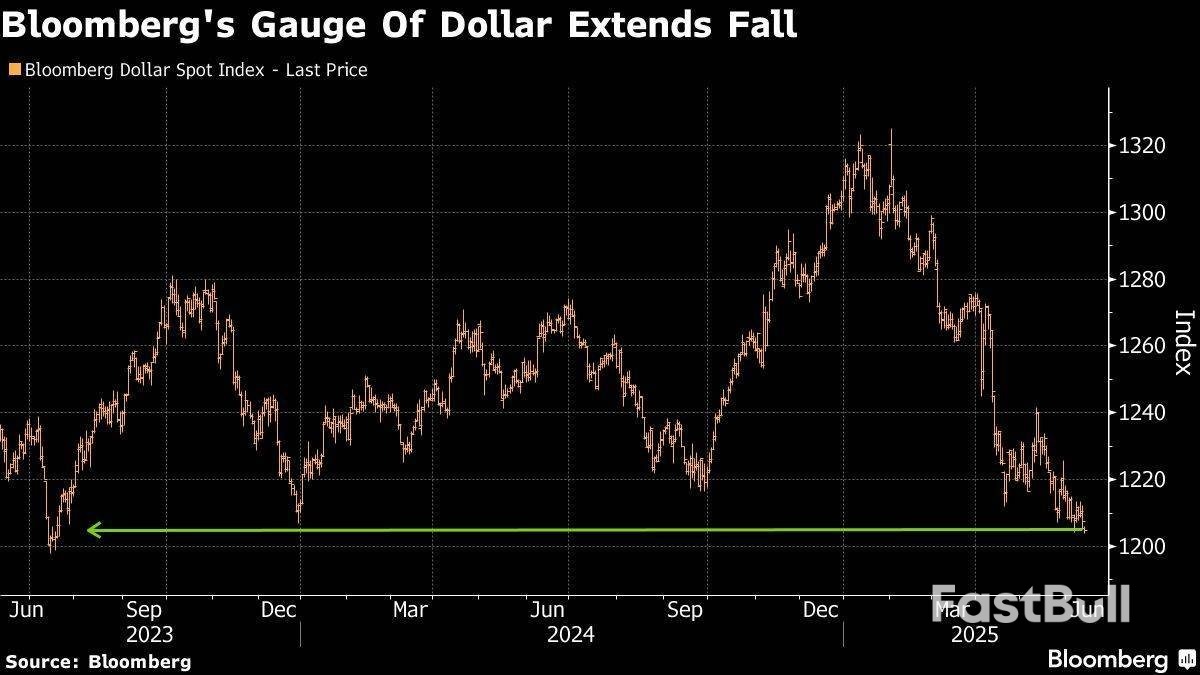
The dollar extended its decline as worries over US tariffs increased after President Donald Trump said he would notify trading partners soon of unilateral levies.
The Bloomberg Dollar Spot Index slid as much as 0.6% to the lowest level since July 2023 on Thursday, extending the previous day’s drop spurred by softer US inflation data. The euro rose to its strongest since November 2021.
Traders will be monitoring US producer-price data due later Thursday for confirmation of subdued pressures. Some of its components feed into core personal consumption expenditure, the Federal Reserve’s preferred measure of inflation. They will also watch an auction of 30-year Treasuries after yields surged last month on fiscal concerns.
“Dollar weakness has much more room to run,” said Vasileios Gkionakis, senior economist and strategist at Aviva Investors. He added the greenback’s weakness despite rising yields show eroding investor confidence in US assets.
The dollar’s decline spilled into the currency volatility market, reinforcing the inverse correlation between the greenback and hedging costs recently. Demand was particularly pronounced in the one-week tenor, which captures the Fed’s June 18 policy meeting.
“Trader pricing still favors more Federal Reserve interest rate cuts, although the precise timing flips around depending on the prevailing investor mood. But what is consistent is the US dollar ploughing a path to the downside as FX trader convictions firm.”
— Mark Cranfield, Markets Live Strategist, Singapore
Currency traders will also be watching the upcoming Group-of-Seven summit for any trade negotiation developments.
“We are watching the G-7 summit closely for pending trade deals between the US and its key trading partners (e.g., Mexico and Canada),” said Alex Loo, macro strategist at TD Securities in Singapore. “Leaks this week may boost sentiment, especially the likes of Canadian dollar and Mexican peso.”
The euro hit its highest level in almost four years against the U.S. dollar as investors rushed into safe-haven assets on Thursday while remaining cautious about the impact of the U.S.-China trade deal.
Geopolitical risks were in focus after U.S. President Donald Trump said some U.S. personnel were being moved out of the Middle East because “it could be a dangerous place,” adding that Washington would not allow Iran to develop a nuclear weapon.
A cocktail of rising Middle East tensions and concern over the fragility of the trade truce between the U.S. and China drew investors into safe-haven assets.
Analysts noted that the U.S. dollar serves as a key barometer of trade talks sentiment, while geopolitical instability prompted investors to buy safe-haven Swiss francs and yen.
The franc rose 0.8% to 0.8138 versus the greenback, its highest level since April 22, and the yen climbed 0.6% to 143.70.
The euro reached its highest since late 2021 at $1.1589 and was last up 0.70% at $1.1568.
Some analysts said the euro has also drawn support from a hawkish European Central Bank, which hinted at a pause in its year-long easing cycle after inflation finally returned to its 2% target.
However, ECB policymaker Isabel Schnabel said on Thursday the strong euro exchange rate is driven by a positive confidence shock in Europe - investors being drawn to the euro as a safe haven - and not by interest rate differentials.
On the trade front, Trump said he would be willing to extend a July 8 deadline for completing trade talks with countries. But he added that the U.S. would send out letters in coming weeks specifying the terms for trade deals to dozens of other countries, which they could then embrace or reject.
Investors argued that such a move keeps the risk of a July 9 jump in U.S. import tariffs on the table, which is regarded as negative for the dollar. The greenback and U.S. Treasuries dropped sharply after Trump announced a blitz of reciprocal tariffs - which he dubbed “Liberation Day” - in early April.
Against a basket of currencies, the U.S. dollar fell to its weakest since April 22 at 98.072 and was last down 0.35% at 98.108. It hit 97.861, its lowest since April 2022.
U.S. Treasury yields dropped on Wednesday as the closely watched “core” consumer price index eased some pressure on the Federal Reserve to maintain higher interest rates for longer.
However, analysts remain cautious about the inflation outlook ahead of Thursday’s release of the producer price index.
“We suspect the core Personal Consumption Expenditures Price Index (PCE) reading will prove modestly firmer, although the result will also hinge on the inputs from core PPI,” said David Doyle, head of economics at Macquarie.
“Despite the subdued figures, through year-end, we expect year-on-year core inflation to remain elevated and potentially (to) rise as price pressures flow from recent tariff implementation.”
Markets priced two Fed rate cuts of 25 basis points by year-end, with an 80% chance of the first move in September and 100 bps by September 2026.
The onshore yuan rose 0.1% to 7.1818 per U.S. dollar, though gains were capped by the still-fragile truce in the U.S.-China trade war and the uncertainty surrounding the next moves of the two countries.
Barclays sees plenty of headwinds over the medium term that could push the currency back onto a depreciation path, even if it might gain a little further from below 7.20.
728 RM B 7/F GEE LOK IND BLDG NO 34 HUNG TO RD KWUN TONG KLN HONG KONG


White Label
Data API
Web Plug-ins
Poster Maker
Affiliate Program
The risk of loss in trading financial instruments such as stocks, FX, commodities, futures, bonds, ETFs and crypto can be substantial. You may sustain a total loss of the funds that you deposit with your broker. Therefore, you should carefully consider whether such trading is suitable for you in light of your circumstances and financial resources.
No decision to invest should be made without thoroughly conducting due diligence by yourself or consulting with your financial advisors. Our web content might not suit you since we don't know your financial conditions and investment needs. Our financial information might have latency or contain inaccuracy, so you should be fully responsible for any of your trading and investment decisions. The company will not be responsible for your capital loss.
Without getting permission from the website, you are not allowed to copy the website's graphics, texts, or trademarks. Intellectual property rights in the content or data incorporated into this website belong to its providers and exchange merchants.
Not Logged In
Log in to access more features

FastBull Membership
Not yet
Purchase


Log In
Sign Up


