• Trade
  • Markets
  • Copy
  • Contests
  • News
  • 24/7
  • Calendar
  • Q&A
  • Chats
Trending
Screeners
SYMBOL
LAST
BID
ASK
HIGH
LOW
NET CHG.
%CHG.
SPREAD
SPX
S&P 500 Index
6818.37
6818.37
6818.37
6861.30
6801.50
-9.04
-0.13%
--
DJI
Dow Jones Industrial Average
48380.35
48380.35
48380.35
48679.14
48285.67
-77.69
-0.16%
--
IXIC
NASDAQ Composite Index
23107.30
23107.30
23107.30
23345.56
23012.00
-87.86
-0.38%
--
USDX
US Dollar Index
97.960
98.040
97.960
98.070
97.740
+0.010
+ 0.01%
--
EURUSD
Euro / US Dollar
1.17438
1.17445
1.17438
1.17686
1.17262
+0.00044
+ 0.04%
--
GBPUSD
Pound Sterling / US Dollar
1.33688
1.33697
1.33688
1.34014
1.33546
-0.00019
-0.01%
--
XAUUSD
Gold / US Dollar
4302.50
4302.91
4302.50
4350.16
4285.08
+3.11
+ 0.07%
--
WTI
Light Sweet Crude Oil
56.369
56.399
56.369
57.601
56.233
-0.864
-1.51%
--

Community Accounts

Signal Accounts
--
Profit Accounts
--
Loss Accounts
--
View More

Become a signal provider

Sell trading signals to earn additional income

View More

Guide to Copy Trading

Get started with ease and confidence

View More

Signal Accounts for Members

All Signal Accounts

Best Return
  • Best Return
  • Best P/L
  • Best MDD
Past 1W
  • Past 1W
  • Past 1M
  • Past 1Y

All Contests

  • All
  • Trump Updates
  • Recommend
  • Stocks
  • Cryptocurrencies
  • Central Banks
  • Featured News
Top News Only
Share

Turkey: Shoots Down A Drone In The Black Sea Using F-16 Fighter Jets

Share

Goldman Sachs Says They Believe That The Copper Price Is Vulnerable To An Ai-Linked Price Correction

Share

Goldman Sachs Upgrades 2026 Copper Price Forecast To $11400 From $10,650

Share

Attempts By Ukrainian Troops To Advance From The South-West To Outskirts Of Kupiansk Are Being Thwarted

Share

Russian Troops Control All Of Kupiansk - IFX Cites Russian Military

Share

On Monday (December 15), The South Korean Won Ultimately Rose 0.60% Against The US Dollar, Closing At 1468.91 Won. The Won Was On An Upward Trend Throughout The Day, Rising Significantly At 17:00 Beijing Time And Reaching A Daily High Of 1463.04 Won At 17:36

Share

Health Ministry: Israeli Forces Kill Palestinian Teen In West Bank

Share

New York Federal Reserve President Williams: Over Time, The Size Of Reserves Could Grow From $2.9 Trillion

Share

New York Fed President Williams: AI Valuations Are High, But There Is A Real Driving Factor

Share

New York Federal Reserve President Williams: The Job Market Is In Very Good Shape

Share

New York Fed President Williams: 'Very Supportive' Of USA Central Bank's Decision To Cut Interest Rates Last Week

Share

New York Fed President Williams: 'Too Early To Say' What Central Bank Should Do At January Meeting

Share

New York Fed President Williams: Strong Markets Part Of Reason Why Economy Will Grow Robustly In 2026

Share

New York Fed President Williams: What Constitutes Ample Reserves Will Change Over Time

Share

New York Fed President Williams: Market Valuations 'Elevated,' But There Are Reasons For Pricing

Share

New York Fed President Williams: Ample Reserves System Working Very Well

Share

New York Fed President Williams: Some Signs That Parts Of Underlying Economy Not As Strong As GDP Data Suggests

Share

New York Fed President Williams: Expects Coming Job Data Will Show Gradual Cooling

Share

Ukraine President Zelenskiy: Monitoring Of Ceasefire Should Be Part Of Security Guarantees

Share

Ukraine President Zelenskiy: Ukraine Needs Clear Understanding On Security Guarantees Before Taking Any Decisions Regarding Frontlines

TIME
ACT
FCST
PREV
Japan Tankan Small Manufacturing Outlook Index (Q4)

A:--

F: --

P: --

Japan Tankan Large Non-Manufacturing Outlook Index (Q4)

A:--

F: --

P: --

Japan Tankan Large Manufacturing Outlook Index (Q4)

A:--

F: --

P: --

Japan Tankan Small Manufacturing Diffusion Index (Q4)

A:--

F: --

P: --

Japan Tankan Large-Enterprise Capital Expenditure YoY (Q4)

A:--

F: --

P: --

U.K. Rightmove House Price Index YoY (Dec)

A:--

F: --

P: --

China, Mainland Industrial Output YoY (YTD) (Nov)

A:--

F: --

P: --

China, Mainland Urban Area Unemployment Rate (Nov)

A:--

F: --

P: --

Saudi Arabia CPI YoY (Nov)

A:--

F: --

P: --

Euro Zone Industrial Output YoY (Oct)

A:--

F: --

P: --

Euro Zone Industrial Output MoM (Oct)

A:--

F: --

P: --

Canada Existing Home Sales MoM (Nov)

A:--

F: --

P: --

Canada National Economic Confidence Index

A:--

F: --

P: --

Canada New Housing Starts (Nov)

A:--

F: --

P: --
U.S. NY Fed Manufacturing Employment Index (Dec)

A:--

F: --

P: --

U.S. NY Fed Manufacturing Index (Dec)

A:--

F: --

P: --

Canada Core CPI YoY (Nov)

A:--

F: --

P: --

Canada Manufacturing Unfilled Orders MoM (Oct)

A:--

F: --

P: --

U.S. NY Fed Manufacturing Prices Received Index (Dec)

A:--

F: --

P: --

U.S. NY Fed Manufacturing New Orders Index (Dec)

A:--

F: --

P: --

Canada Manufacturing New Orders MoM (Oct)

A:--

F: --

P: --

Canada Core CPI MoM (Nov)

A:--

F: --

P: --

Canada Trimmed CPI YoY (SA) (Nov)

A:--

F: --

P: --

Canada Manufacturing Inventory MoM (Oct)

A:--

F: --

P: --

Canada CPI YoY (Nov)

A:--

F: --

P: --

Canada CPI MoM (Nov)

A:--

F: --

P: --

Canada CPI YoY (SA) (Nov)

A:--

F: --

P: --

Canada Core CPI MoM (SA) (Nov)

A:--

F: --

P: --

Canada CPI MoM (SA) (Nov)

A:--

F: --

P: --

Federal Reserve Board Governor Milan delivered a speech
U.S. NAHB Housing Market Index (Dec)

A:--

F: --

P: --

Australia Composite PMI Prelim (Dec)

--

F: --

P: --

Australia Services PMI Prelim (Dec)

--

F: --

P: --

Australia Manufacturing PMI Prelim (Dec)

--

F: --

P: --

Japan Manufacturing PMI Prelim (SA) (Dec)

--

F: --

P: --

U.K. 3-Month ILO Employment Change (Oct)

--

F: --

P: --

U.K. Unemployment Claimant Count (Nov)

--

F: --

P: --

U.K. Unemployment Rate (Nov)

--

F: --

P: --

U.K. 3-Month ILO Unemployment Rate (Oct)

--

F: --

P: --

U.K. Average Weekly Earnings (3-Month Average, Including Bonuses) YoY (Oct)

--

F: --

P: --

U.K. Average Weekly Earnings (3-Month Average, Excluding Bonuses) YoY (Oct)

--

F: --

P: --

France Services PMI Prelim (Dec)

--

F: --

P: --

France Composite PMI Prelim (SA) (Dec)

--

F: --

P: --

France Manufacturing PMI Prelim (Dec)

--

F: --

P: --

Germany Services PMI Prelim (SA) (Dec)

--

F: --

P: --

Germany Manufacturing PMI Prelim (SA) (Dec)

--

F: --

P: --

Germany Composite PMI Prelim (SA) (Dec)

--

F: --

P: --

Euro Zone Composite PMI Prelim (SA) (Dec)

--

F: --

P: --

Euro Zone Services PMI Prelim (SA) (Dec)

--

F: --

P: --

Euro Zone Manufacturing PMI Prelim (SA) (Dec)

--

F: --

P: --

U.K. Services PMI Prelim (Dec)

--

F: --

P: --

U.K. Manufacturing PMI Prelim (Dec)

--

F: --

P: --

U.K. Composite PMI Prelim (Dec)

--

F: --

P: --

Euro Zone ZEW Economic Sentiment Index (Dec)

--

F: --

P: --

Germany ZEW Current Conditions Index (Dec)

--

F: --

P: --

Germany ZEW Economic Sentiment Index (Dec)

--

F: --

P: --

Euro Zone Trade Balance (Not SA) (Oct)

--

F: --

P: --

Euro Zone ZEW Current Conditions Index (Dec)

--

F: --

P: --

Euro Zone Trade Balance (SA) (Oct)

--

F: --

P: --

Euro Zone Total Reserve Assets (Nov)

--

F: --

P: --

U.K. Inflation Rate Expectations

--

F: --

P: --

Q&A with Experts
    • All
    • Chatrooms
    • Groups
    • Friends
    Connecting
    .
    .
    .
    Type here...
    Add Symbol or Code

      No matching data

      All
      Trump Updates
      Recommend
      Stocks
      Cryptocurrencies
      Central Banks
      Featured News
      • All
      • Russia-Ukraine Conflict
      • Middle East Flashpoint
      • All
      • Russia-Ukraine Conflict
      • Middle East Flashpoint
      Search
      Products

      Charts Free Forever

      Chats Q&A with Experts
      Screeners Economic Calendar Data Tools
      Membership Features
      Data Warehouse Market Trends Institutional Data Policy Rates Macro

      Market Trends

      Market Sentiment Order Book Forex Correlations

      Top Indicators

      Charts Free Forever
      Markets

      News

      News Analysis 24/7 Columns Education
      From Institutions From Analysts
      Topics Columnists

      Latest Views

      Latest Views

      Trending Topics

      Top Columnists

      Latest Update

      Signals

      Copy Rankings Latest Signals Become a signal provider AI Rating
      Contests
      Brokers

      Overview Brokers Assessment Rankings Regulators News Claims
      Broker listing Forex Brokers Comparison Tool Live Spread Comparison Scam
      Q&A Complaint Scam Alert Videos Tips to Detect Scam
      More

      Business
      Events
      Careers About Us Advertising Help Center

      White Label

      Data API

      Web Plug-ins

      Affiliate Program

      Awards Institution Evaluation IB Seminar Salon Event Exhibition
      Vietnam Thailand Singapore Dubai
      Fans Party Investment Sharing Session
      FastBull Summit BrokersView Expo
      Recent Searches
        Top Searches
          Markets
          News
          Analysis
          User
          24/7
          Economic Calendar
          Education
          Data
          • Names
          • Latest
          • Prev

          View All

          No data

          Scan to Download

          Faster Charts, Chat Faster!

          Download App
          English
          • English
          • Español
          • العربية
          • Bahasa Indonesia
          • Bahasa Melayu
          • Tiếng Việt
          • ภาษาไทย
          • Français
          • Italiano
          • Türkçe
          • Русский язык
          • 简中
          • 繁中
          Open Account
          Search
          Products
          Charts Free Forever
          Markets
          News
          Signals

          Copy Rankings Latest Signals Become a signal provider AI Rating
          Contests
          Brokers

          Overview Brokers Assessment Rankings Regulators News Claims
          Broker listing Forex Brokers Comparison Tool Live Spread Comparison Scam
          Q&A Complaint Scam Alert Videos Tips to Detect Scam
          More

          Business
          Events
          Careers About Us Advertising Help Center

          White Label

          Data API

          Web Plug-ins

          Affiliate Program

          Awards Institution Evaluation IB Seminar Salon Event Exhibition
          Vietnam Thailand Singapore Dubai
          Fans Party Investment Sharing Session
          FastBull Summit BrokersView Expo

          Stocks up as EU hopes for US trade deal soon

          Adam

          Stocks

          Summary:

          European stocks rose on hopes of an imminent EU–US trade deal, despite Trump’s tariff threats. Markets remain resilient, with investors awaiting Fed minutes and monitoring risks from further sectoral levies.

          Stock prices in Europe pushed higher on Wednesday, aided by optimism that the EU can strike a trade agreement with the US and avoid lofty tariffs.
          The EU wants to strike a deal with the US "in the coming days" to avoid sweeping tariffs, a spokesman said Wednesday.
          "The US has moved its deadline for finalising deals with partner countries to the first of August. However, we aim to reach a deal before then, potentially even in the coming days, we have shown our readiness to reach an agreement in principle," EU trade spokesman Olof Gill said.
          The FTSE 100 index rose 29.03 points, 0.3%, to 8,883.21. The FTSE 250 was up 26.31 points, 0.1%, at 21,607.99, but the AIM All-Share was down 2.33 points, 0.3%, at 773.17.
          The Cboe UK 100 was up 0.5% at 885.91, the Cboe UK 250 rose 0.1% to 19,106.76, and the Cboe Small Companies gave back 0.1% to 17,569.02.
          In European equities on Wednesday, the CAC 40 in Paris jumped 1.2%, while the DAX 40 in Frankfurt surged 1.1%. Only a handful of blue-chips in Paris and Frankfurt traded lower.
          Germany's Chancellor Friedrich Merz said Wednesday he was "cautiously optimistic" about the prospects of a deal between the EU and the US to avert increased tariffs threatened by President Donald Trump.
          "I am cautiously optimistic that we may succeed in reaching an agreement with the US in the next few days or at the latest by the end of the month," Merz told parliament.
          Rostro analyst Joshua Mahony said investors a positioning "themselves in anticipation of a potential breakthrough in trade talks between the US and EU".
          "German Chancellor Merz provided one such voice, noting that he is cautiously optimistic thanks to ongoing intensive contact with the US government. However, whilst there is a potential framework for a deal being put together, the apparent US insistence of a 17% tariff on EU agricultural goods does provide a potential roadblock going forward. This is where it becomes difficult to please all parties, as the priorities of the German (autos) will be very different to the French (agri)," the analyst added.
          The yield on the US 10-year Treasury was quoted at 4.41% early Wednesday afternoon, slimming from 4.42%, where it stood at the time of the London equities close on Tuesday. The yield on the US 30-year Treasury was quoted at 4.93%, easing from 4.96%.
          Stocks in New York are called to open higher. The Dow Jones Industrial Average is called up 0.2%, and the S&P 500 and Nasdaq Composite up 0.1%.
          President Trump said Tuesday that he would not extend an August 1 deadline for higher US tariffs to take effect on dozens of economies, while announcing plans for a 50% duty on copper imports.
          "That's a shift in tone from Trump's own comments on Monday evening, as Trump had said that the August 1 date was "not 100% firm", and investors had been hopeful that ongoing negotiations and trade deals could avoid that. So it's a clear hardening up of the rhetoric," analysts at Deutsche Bank commented.
          "In addition, the president took a more hawkish tone, indicating that some countries would be seeing a 60% or 70% tariff rate and that sectoral tariffs are coming."
          Trump also said Washington would soon make an announcement on pharmaceuticals, but officials would allow manufacturers time to relocate their operations into the country.
          "We're going to give people about a year, a year and a half to come in, and after that, they're going to be tariffed," he said. "They're going to be tariffed at a very, very high rate, like 200%."
          Apart from copper and pharmaceuticals, Trump has ordered probes into imports of lumber, semiconductors and critical minerals that could lead to further levies.
          Rostro's Mahony added: "With roughly half of US copper coming from abroad, there is a clear desire to remove this dependency."
          In London, Glencore was down 2.6%, Anglo American shed 2.2%, while Antofagasta fell 1.6%.
          WPP was the worst FTSE 100 performer, however, slumping 17%. The advertising firm cut guidance following a tricky first half. WPP now expects a 2025 like-for-like revenue decline, excluding pass through costs, between 3% and 5%. It predicts a decline in headline operating profit margin of 50 to 175 basis points, excluding foreign exchange.
          It also sees "continued macro uncertainty weighing on client spend" going forward.
          The pound rose to USD1.3586 early Wednesday afternoon, from USD1.3574 at the time of the London equities close on Tuesday. The euro fell to USD1.1704 from USD1.1709 while against the yen, the dollar fell to JPY146.61 from JPY146.82.
          Trade tariffs could increase the risk of some businesses falling behind on loans, while a high proportion of the UK workforce is in sectors more exposed to global shocks, the Bank of England has warned.
          Households and businesses nonetheless remain resilient, and the UK banking system is equipped to support them even if conditions significantly worsen, the Bank's Financial Policy Committee, FPC, said in its latest report.
          The FPC said there was a high degree of unpredictability about how global trade will evolve, with US President Donald Trump hiking tariff rates in April but negotiations with other countries over possible trade deals ongoing.
          Conflict in the Middle East has also raised the risk of energy prices spiking, particularly if the supply of oil and gas were disrupted, it found.
          However, the FPC concluded that despite pockets of vulnerability, UK businesses would typically be able to pay their debts even in the face of further global volatility such as lower demand and supply.
          Furthermore, the report found that the UK banking system has the capacity to support households and businesses even if economic and business conditions became substantially worse than expected.
          A barrel of Brent traded at USD69.85 midday Wednesday, flat from USD69.87 late Tuesday afternoon. Gold fell to USD3,295.22 an ounce from USD3,297.61.
          Back in London, Galliford Try rose 3.2%. It expects to report a full-year performance ahead of forecasts.
          The construction company predicted revenue and adjusted pretax profit ahead of the current market forecasts for the year ended June 30. It puts the consensus range for revenue between GBP1.86 billion and GBP1.89 billion, and the profit range between GBP40.1 million and GBP41.6 million.
          "I am delighted that all our operations continued to perform strongly throughout the second half of the year and we expect to report another year of increased revenue and profit in September," CEO Bill Hocking said.
          Over in Paris, EssilorLuxottica was on the rise, surging 5.9%. Meta Platforms has snapped up a roughly 3% stake in Ray-Ban maker, Bloomberg reported on Tuesday.
          Meta has bought a stake worth roughly EUR3 billion, now owning just under 3% of Paris-listed EssilorLuxottica. Bloomberg cited people familiar with the matter.
          The sources said Menlo Park, California-based Meta could build its stake to around 5%.
          The duo currently team for the Meta AI range of products, which include Ray-Ban and Oakley smart glasses.
          Still to come on Wednesday, minutes from the Federal Reserve's most recent meeting are released at 1900 BST.
          "Tonight's minutes could tilt sentiment if they reveal more dovish consensus than currently priced," SPI Asset Management analyst Stephen Innes commented.

          source : Alliance News

          Risk Warnings and Disclaimers
          You understand and acknowledge that there is a high degree of risk involved in trading. Following any strategies or investment methods may lead to potential losses. The content on the site is provided by our contributors and analysts for information purposes only. You are solely responsible for determining whether any trading assets, securities, strategy, or any other product is suitable for investing based on your own investment objectives and financial situation.
          Add to Favorites
          Share

          Trump’s Trade Blitz Produces Few Deals but Lots of Uncertainty

          Warren Takunda

          Economic

          President Donald Trump and his advisers promised a lightning round of global trade negotiations with dozens of countries back in April.
          White House trade adviser Peter Navarro predicted “90 deals in 90 days.’’ Administration officials declared that other countries were desperate to make concessions to avoid the massive import taxes – tariffs -- that Trump was threatening to plaster on their products starting July 9.
          But the 90 days have come and gone. And the tally of trade deals stands at two – one with the United Kingdom and one with Vietnam. Trump has also announced the framework for a deal with China, the details of which remain fuzzy.
          Trump has now extended the deadline for negotiations to Aug. 1 and tinkered with his threatened tariffs, leaving the global trading system pretty much where it stood three months ago — in a state of limbo as businesses delay decisions on investments, contracts and hiring because they don’t know what the rules will be.
          “It’s a rerun, basically,’’ said William Reinsch, a former U.S. trade official who’s now an adviser with the Center for Strategic and International Studies think tank. Trump and his team “don’t have the deals they want. So they’re piling on the threats.”
          The pattern has repeated itself enough times to earn Trump the label TACO — an acronym coined by The Financial Times’ Robert Armstrong that stands for “Trump Always Chickens Out.”
          “This is classic Trump: Threaten, threaten more, but then extend the deadline,” Reinsch said. “July 30 arrives, does he do it again if he still doesn’t have the deals?’’ (Trump said Tuesday that there will be no more extensions.)
          The deal drought represents a collision with reality.
          Negotiating simultaneously with every country on earth was always an impossible task, as Trump himself belatedly admitted last month in an interview with the Fox News Channel. (“There’s 200 countries,’’ the president said. “You can’t talk to all of them.’’) And many trading partners — such as Japan and the European Union — were always likely to balk at Trump’s demands, at least without getting something in return.
          “It’s really, really hard to negotiate trade agreements,” which usually takes several months even when it involves just one country or a small regional group, said Chad Bown, an economic adviser in the Obama White House and now senior fellow at the Peterson Institute for International Economics. “What the administration is doing is negotiating a bunch of these at the same time.’’
          The drama began April 2 – “Liberation Day,’' Trump called it — when the tariff-loving president announced a so-called baseline 10% import tax on everybody and what he called “reciprocal’’ levies of up to 50% on countries with which the United States runs trade deficits.
          The 10% baseline tariffs appear to be here to stay. Trump needs them to raise money to patch the hole his massive tax-cut bill is blasting into the federal budget deficit.
          By themselves, the baseline tariffs represent a massive shift in American trade policy: Tariffs averaged around 2.5% when Trump returned to the White House and were even lower before he started raising them in his first term.
          But the reciprocal tariffs are an even bigger deal.
          In announcing them, Trump effectively blew up the rules governing world trade. For decades, the United States and most other countries abided by tariff rates set through a series of complex negotiations known as the Uruguay round. Countries could set their own tariffs – but under the “most favored nation’’ approach, they couldn’t charge one country more than they charged another.
          Now Trump is setting the tariff rates himself, creating “tailor-made trade plans for each and every country on this planet,’’ in the words of White House press secretary Karoline Leavitt.
          But investors have recoiled at the audacious plan, fearing that it will disrupt trade and damage the world economy. Trump’s Liberation Day tariffs, for instance, set off a four-day rout in global financial markets. Trump blinked. Less than 13 hours after the reciprocal tariffs took effect April 9, he abruptly suspended them for 90 days, giving countries time to negotiate with his trade team.
          Despite the Trump administration’s expressions of confidence, the talks turned into a slog.
          “Countries have their own politics, their own domestic politics,” Reinsch said. “Trump structured this ideally so that all the concessions are made by the other guys and the only U.S. concession is: We don’t impose the tariffs.’’
          But countries like South Korea and Japan needed “to come back with something,’’ he said. Their thinking: “We have to get some concessions out of the United States to make it look like this is a win-win agreement and not a we-fold-and-surrender agreement. ”
          Japan, for example, wanted relief from another Trump tariff — 50% levies on steel and aluminum.
          Countries may also be hesitant to reach a deal with the United States while the Trump administration conducts investigations that might result in new tariffs on a range of products, including pharmaceuticals and semiconductors.
          Frustrated by the lack of progress, Trump on Monday sent letters to Japan, South Korea and 12 other countries, saying he’d hit them with tariffs Aug. 1 if they couldn’t reach an agreement. The levies were close to what he’d announced on April 2; Japan’s, for example, would be 25%, compared to the 24% unveiled April 2.
          Trump did sign an agreement last month with the United Kingdom that, among other provisions, reduced U.S. tariffs on British automotive and aerospace products while opening the U.K. market for American beef and ethanol. But the pact kept the baseline tariff on British products mostly in place, underlining Trump’s commitment to the 10% tax despite the United States running a trade surplus — not a deficit — with the U.K. for 19 straight years, according to the U.S. Commerce Department.
          On July 2. Trump announced a deal with Vietnam. The Vietnamese agreed to let U.S. products into the country duty free while accepting a 20% tax on their exports to the United States, Trump said, though details of the agreement have not been released.
          The lopsided deal with Vietnam suggests that Trump can successfully use the tariff threat to bully concessions out of smaller economies.
          “They just can’t really negotiate in the same way that the (European Union) or Korea or Japan (or) Canada can negotiate with the United States,’’ said Dan McCarthy, principal in McCarthy Consulting and a former official with the Office of the U.S. Trade Representative in the Biden administration. “A lot of (smaller) countries just want to get out of this and are willing to cut their losses.’’
          But wrangling a deal with bigger trading partners is likely to remain tougher.
          “The U.S. is gambling that these countries will ultimately be intimidated and fold,” Reinsch said. “And the countries are gambling that the longer this stretches out, and the longer it goes without Trump producing any more deals, the more desperate he gets; and he lowers his standards.
          “It’s kind of a giant game of chicken.’’

          Source: AP

          To stay updated on all economic events of today, please check out our Economic calendar
          Risk Warnings and Disclaimers
          You understand and acknowledge that there is a high degree of risk involved in trading. Following any strategies or investment methods may lead to potential losses. The content on the site is provided by our contributors and analysts for information purposes only. You are solely responsible for determining whether any trading assets, securities, strategy, or any other product is suitable for investing based on your own investment objectives and financial situation.
          Add to Favorites
          Share

          EU Seeks Trade Deal With Trump This Month, New Tariff Notices Due

          Glendon

          Economic

          Forex

          The European Union said it was working on sealing a trade deal with the United States by the end of the month, while U.S. President Donald Trump promised that he would deliver further tariff notices on unnamed countries on Wednesday.

          Trump broadened out a trade war that has cast a shadow over the global economic outlook when he said on Tuesday he would impose a 50% tariff on imported copper and soon introduce long-threatened levies on semiconductors and pharmaceuticals.

          Trump said late on Tuesday that "a minimum of seven" tariff notices would be released on Wednesday morning, and more in the afternoon. He gave no other details in his Truth Social post.

          The threat came a day after he pressured 14 trading partners, including powerhouse U.S. suppliers South Korea and Japan, with tariff letters imposing levies of 25% and upwards to take effect from August 1.

          NEGOTIATIONS WITH THE EU

          Trump said trade talks have been going well with China and the European Union, which is the biggest bilateral trading partner of the U.S.

          Trump said he would "probably" tell the EU within two days what rate it could expect for its exports to the U.S., adding that the 27-nation EU had become much more cooperative.

          "They treated us very badly until recently, and now they're treating us very nicely. It's like a different world, actually," he said.

          European Commission President Ursula von der Leyen gave a guarded response.

          "We stick to our principles, we defend our interests, we continue to work in good faith, and we get ready for all scenarios," von der Leyen told the European Parliament.

          A European Commission spokesperson said that the EU aimed to reach a trade deal before August 1, potentially even in the coming days.

          However, Italian Economy Minister Giancarlo Giorgetti warned that talks between the two sides were "very complicated" and could continue right up to the deadline.

          HIGHEST TARIFF LEVELS SINCE 1934

          Equity markets shrugged off Trump's latest tariff salvo on Wednesday, while the yen remained on the back foot after the levies set for Japan.

          Following Trump's announcement of higher tariffs for imports from the 14 countries, U.S. research group Yale Budget Lab estimated consumers face an effective U.S. tariff rate of 17.6%, up from 15.8% previously and the highest in nine decades.

          Trump's administration has been touting those tariffs as a significant revenue source. Treasury Secretary Scott Bessent said Washington has taken in about $100 billion so far and could collect $300 billion by the end of the year. The United States has taken in about $80 billion annually in tariff revenue in recent years.

          Source: Yahoo Finance

          To stay updated on all economic events of today, please check out our Economic calendar
          Risk Warnings and Disclaimers
          You understand and acknowledge that there is a high degree of risk involved in trading. Following any strategies or investment methods may lead to potential losses. The content on the site is provided by our contributors and analysts for information purposes only. You are solely responsible for determining whether any trading assets, securities, strategy, or any other product is suitable for investing based on your own investment objectives and financial situation.
          Add to Favorites
          Share

          The Day Ahead: Markets Brace for Today’s Fed Minutes, Oil Data, Tariff Risks

          Adam

          Economic

          Market Overview

          U.S. stock futures are little changed early Wednesday as traders monitor additional tariff developments from President Trump.
          Dow futures rise 23 points (0.05%), S&P 500 futures add 0.02%, and Nasdaq 100 futures are flat.
          Tuesday’s session was cautious, with the S&P 500 down 0.07%, Nasdaq up 0.03%, and Dow off 0.4% following Trump’s new 25%–40% tariffs on 14 countries effective August 1.
          Trump reiterated there will be no extensions, announced a 50% levy on copper imports, and hinted at potential 200% tariffs on pharmaceuticals within 12–18 months. Traders remain focused on additional sector-specific levies, with Global X’s Scott Helfstein noting persistent trade policy volatility as markets recalibrate inflation risk and supply chain disruptions.

          Key Economic Releases

          At 1400 GMT, Final Wholesale Inventories m/m will be released (forecast -0.2%, previous -0.3%), providing insight into Q2 GDP tracking.
          At 1430 GMT, the EIA Crude Oil Inventories report is expected, with a forecast draw of -1.7M barrels vs. last week’s +3.8M build, following API data showing a 7.1M build while refined products fell.
          At 1701 GMT, the 10-year Bond Auction will proceed, with the prior yield at 2.5% and current indicative yield near 4.42%, reflecting tightening financial conditions.

          Central Bank Activity

          At 1800 GMT, the FOMC Meeting Minutes will be released, closely watched for clues on rate path amid trade uncertainties.
          Deutsche Bank’s Amy Yang notes a Fed split: dovish members focusing on labor market downside risks despite potential tariff-driven inflation, hawkish members preferring to wait for data confirmation, and Powell maintaining a middle-ground stance.
          The September meeting is seen as the earliest “live” cut unless labor data weakens sharply, with market pricing for a potential cut before December rising as trade tensions persist.

          Notable Earnings

          No major pre-market reports are scheduled. Post-close, AZZ (AZZ) is set to report, with consensus at $1.58 per share.

          Commodities, Crypto, and Bonds

          Gold hovers near a one-week low under pressure from a firmer dollar and higher Treasury yields as fresh tariff threats unsettle markets. The NY Fed’s survey shows one-year inflation expectations easing to 3% from 3.2%, with three- and five-year expectations steady at 3% and 2.6%.
          Copper futures surged over 12% to record highs on Trump’s 50% tariff announcement, while SHFE and LME prices retreated as arbitrage closed.
          Oil prices ease from two-week highs as traders await tariff clarity and potential OPEC+ output hikes, while EIA data will confirm if the recent large API-reported build is sustained.

          Technical Outlook

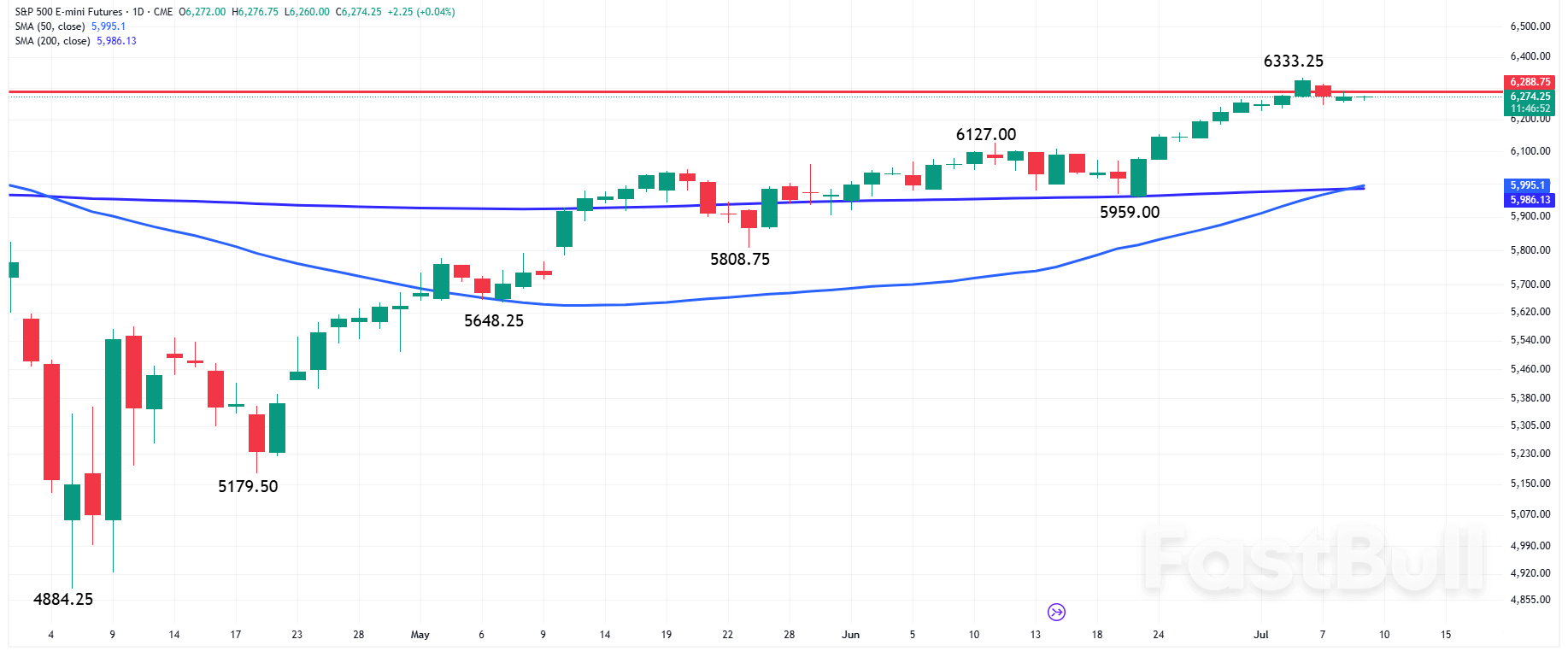
          The Day Ahead: Markets Brace for Today’s Fed Minutes, Oil Data, Tariff Risks_1Daily E-mini S&P 500 Index

          S&P 500 E-mini Futures (ES): Trading at 6274.25, near the recent high of 6333.25. Immediate resistance remains at 6333.25. Supports below are 6127.00 and 5959.00, with the 200-day SMA at 5986.1 followed by the 50-day SMA at 5995.1 providing layered support if momentum fades.
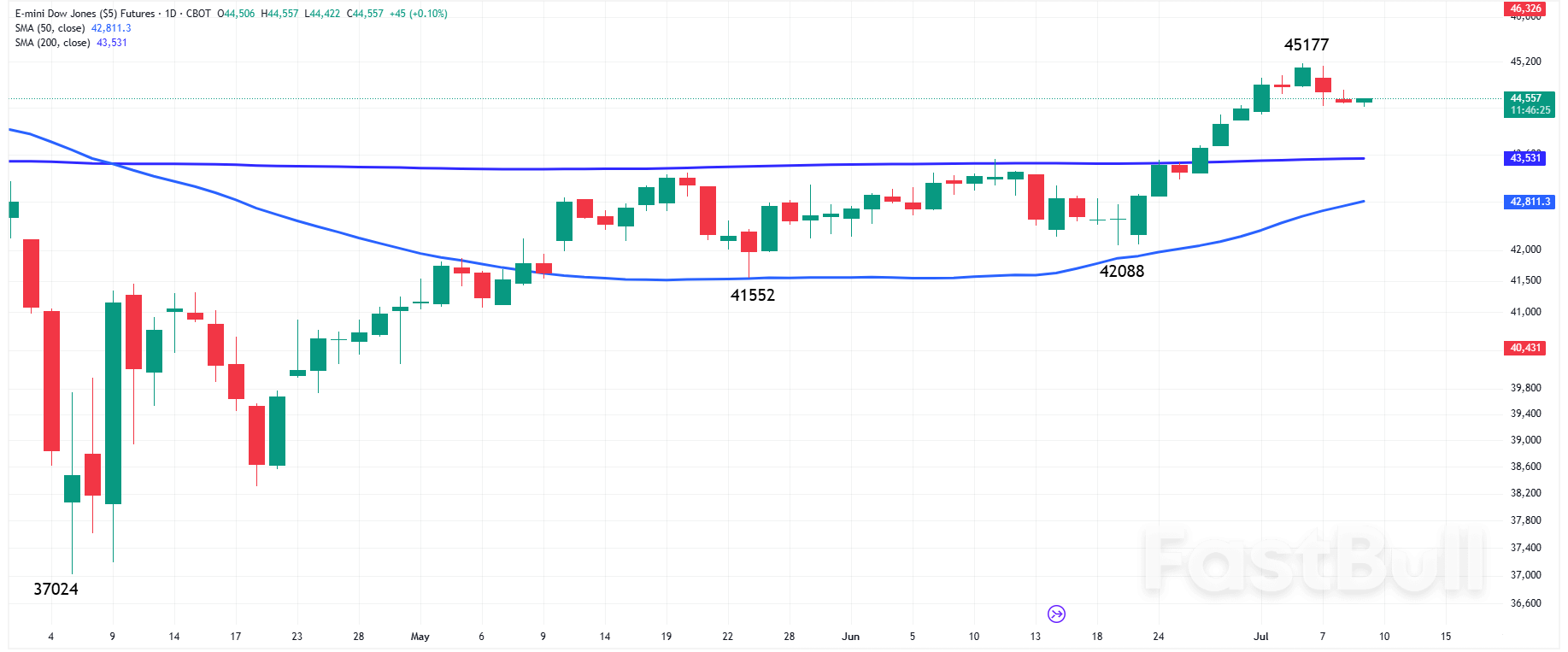
          The Day Ahead: Markets Brace for Today’s Fed Minutes, Oil Data, Tariff Risks_2

          Daily E-mini Dow Jones Industrial Average

          Dow E-mini Futures (YM): Trading at 44,561, below the 45,177 high. Immediate resistance is 45,177. Supports below are the 200-day SMA at 43,531, the 50-day SMA at 42,811.4, followed by 42,088 and 41,552. This layered structure offers clear downside markers while the trend remains intact.
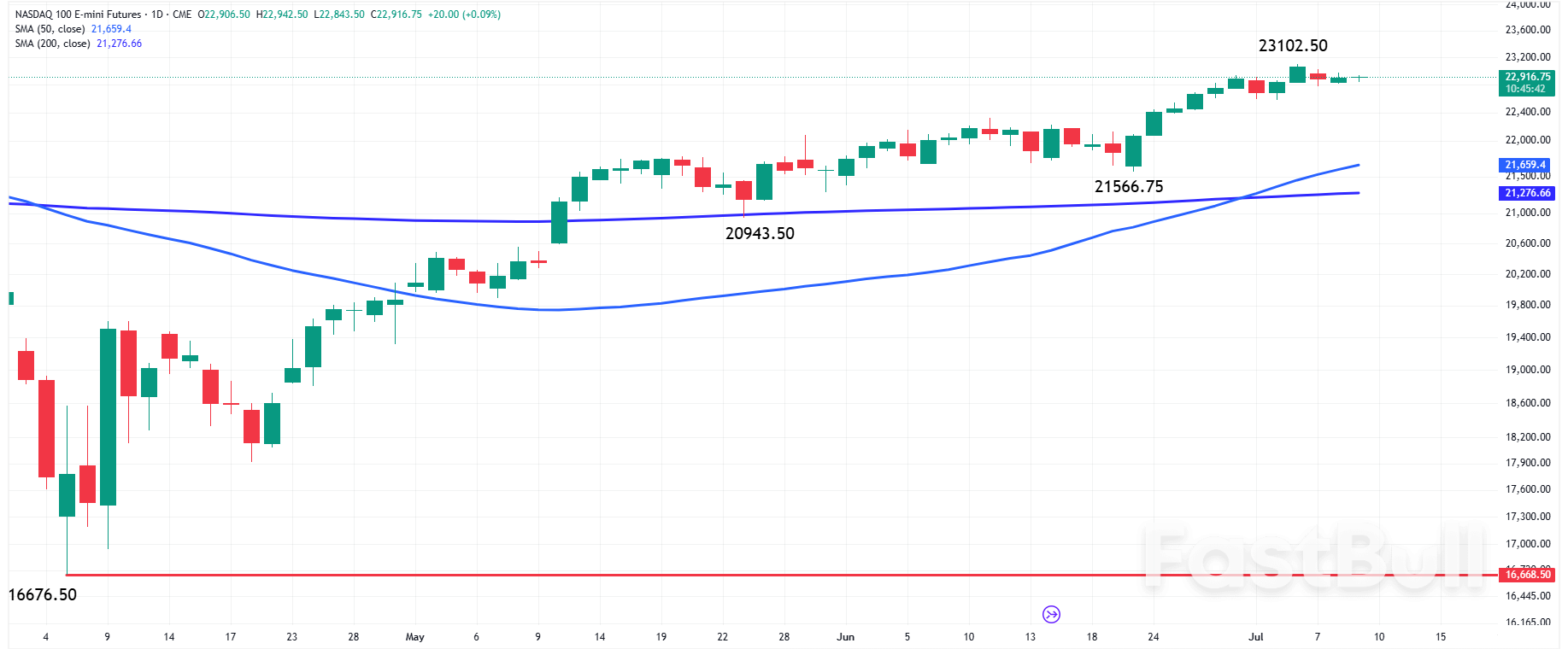
          The Day Ahead: Markets Brace for Today’s Fed Minutes, Oil Data, Tariff Risks_3

          Daily E-mini Nasdaq 100 Index Futures

          Nasdaq 100 E-mini Futures (NQ): Trading at 22,916.75 after a recent high of 23,102.50. Immediate resistance is 23,102.50. Supports are 21,566.75 and 20,943.50, with the 200-day SMA at 21,276.7 followed by the 50-day SMA at 21,659.4 acting as layered downside supports should momentum soften near highs.

          Outlook

          Tariff developments and FOMC minutes remain key drivers, with traders monitoring potential sector-specific levies and Fed language for policy direction.
          Wholesale inventories and EIA crude data will influence GDP tracking and energy sentiment intraday.
          Expect choppy trade around tariff headlines and Fed positioning as markets gauge the timing of potential rate cuts amid persistent trade-driven risks.

          Source: fxempire

          To stay updated on all economic events of today, please check out our Economic calendar
          Risk Warnings and Disclaimers
          You understand and acknowledge that there is a high degree of risk involved in trading. Following any strategies or investment methods may lead to potential losses. The content on the site is provided by our contributors and analysts for information purposes only. You are solely responsible for determining whether any trading assets, securities, strategy, or any other product is suitable for investing based on your own investment objectives and financial situation.
          Add to Favorites
          Share

          Stocks and oil gain as traders shrug off Trump's tariff news

          Adam

          Stocks

          Commodity

          European stocks rose on Wednesday as traders seemed untroubled by U.S. President Donald Trump's announcement that he would impose a 50% tariff on imported copper and soon introduce levies of up to 200% for pharmaceuticals.
          Trump's comments on Tuesday sent the price of copper soaring to record highs and caused Wall Street to close lower.
          But equity markets soon shrugged off the news. Asian stocks were mixed overnight and at 0956 GMT the MSCI World Equity Index was up 0.1% on the day.
          London's FTSE 100 was up 0.2% and the pan-European STOXX 600 was up 0.8%.
          Wall Street futures pointed to the gains continuing, with S&P 500 and Nasdaq futures both up by 0.1% , .
          The U.S. dollar index was little changed at 97.567 and the euro was down 0.1% at $1.1714 .
          The dollar touched its highest level in more than two weeks against the yen, as Japan, which is dependent on exports, stands out among major U.S. trading partners as being the farthest from reaching a trade deal with Washington.
          U.S. copper futures jumped by more than 10% to a record high after Trump threatened new duties on the metal that is critical to electric vehicles, military hardware, the power grid and many consumer goods.
          Traders are awaiting further developments in Trump's trade war in the coming days, after he told 14 nations on Monday that they will face sharply higher tariffs from a new deadline of August 1.
          Trump said he would "probably" tell the European Union within two days what rate it can expect for its exports to the United States.
          The EU is struggling to get immediate tariff relief from the U.S. and a commitment not to introduce new measures, the head of the European Parliament's trade committee, which has been negotiating on behalf of the bloc, said on Wednesday.
          Investors are concerned that higher tariffs will increase inflation and slow economic growth, and so will pay attention to the latest meeting minutes from the U.S. Federal Reserve, due to be released later on Wednesday, for any clues as to how volatility will affect the outlook for rates.
          "We're really in the dark when it comes to tariffs, because it's very difficult to know the impact on end-inflation, the impact on margins for U.S. corporates, or corporates in general," said Amelie Derambure, senior multi-asset portfolio manager at Amundi.
          "The uncertainty is immense."
          Derambure said that while equity markets are expecting tariffs to be manageable and are supported by underlying expectations of growth, the impact of tariffs could be seen in the rising yields in fixed income.
          U.S. Treasury yields rose on Tuesday, and an auction of three-year Treasury bills saw weak demand.
          The Treasury will sell $39 billion in 10-year notes on Wednesday and $22 billion in 30-year bonds on Thursday.
          The 10-year U.S. Treasury yield edged back down early on Wednesday, at 4.4072%, compared to Tuesday's peak of 4.435%, which was its highest in more than three weeks.
          European government bonds were little changed, with the benchmark 10-year German yield at 2.637% .
          Gold was in its third day of declines, down 0.3% on the day at $3,290 per ounce .
          Oil prices rose slightly, with Brent crude futures up by 0.4% at $70.42.

          Source: reuters

          Risk Warnings and Disclaimers
          You understand and acknowledge that there is a high degree of risk involved in trading. Following any strategies or investment methods may lead to potential losses. The content on the site is provided by our contributors and analysts for information purposes only. You are solely responsible for determining whether any trading assets, securities, strategy, or any other product is suitable for investing based on your own investment objectives and financial situation.
          Add to Favorites
          Share

          UK Shipping Rates Climb in Fresh Inflation Worry for BOE

          Michelle

          Economic

          Forex

          Spare a thought for the squeezed British shopper. After a tax hike just reheated inflation, now comes round two as shipping costs surge due to the fallout from US tariffs.

          So far, the UK has escaped the worst of President Donald Trump’s trade salvos. Downing Street sealed a limited trade accord with the US last month. Bank of England interest-rate setters are more worried about an increase in domestic labor costs than foreign trade wars. And in the long run, an influx of cheap Chinese goods avoiding the US’s tariff barriers can actually push down inflation.

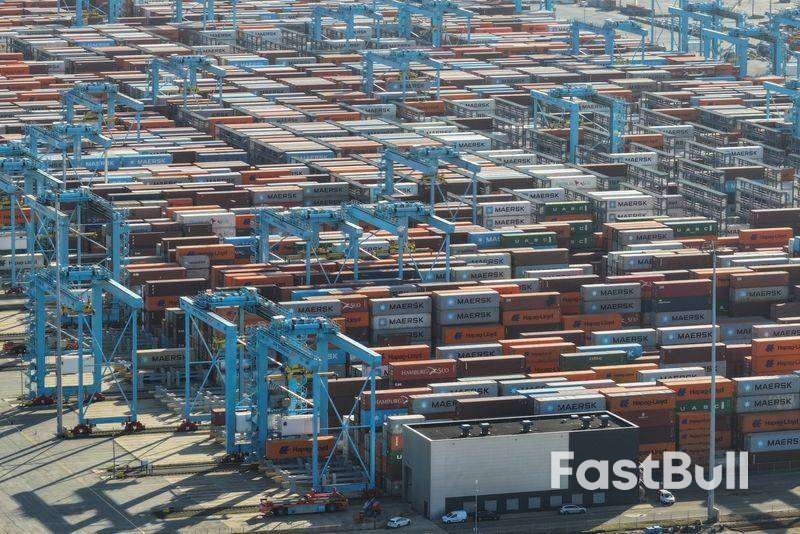
          A surge in the cost of shipping goods from Asia to the UK challenges that narrative. The price of transporting a 40-foot container from China, for instance, has jumped about 60% over the past three months to $3,305, according to data from Xeneta. A separate weekly gauge from Drewry showed a similar rise. (Read the full story here.)

          The main culprit: American businesses rushing to import goods from China before Trump’s higher tariffs kick in. That’s gobbled up containers and pushed up transport costs on other trade routes to mainland Europe and the UK.

          Adding insult to injury for British businesses is the reality that Asia-to-US container rates are currently coming down fast amid overcapacity and a slowdown in the tariff front-loading.

          British retailers operating on razor-thin margins warn they’ll have to pass on the higher expense. They’re already cutting jobs and raising prices to cope with the Labour government’s rise in employment taxes and a higher minimum wage.

          The rise in shipping costs could push up inflation to 3.6% this quarter — almost twice the level where policymakers want it to be, according to Jonathan Steenberg, UK and Ireland economist at Coface.

          “We are a pretty open economy in the UK,” Jonathan Steenberg, UK and Ireland economist at Coface, said. “We saw a more extreme version of this back in 2021-2022, when we saw this clearly feed into import prices and the prices of several goods. So we are quite sensitive to this.”

          Source: Bloomberg Europe

          To stay updated on all economic events of today, please check out our Economic calendar
          Risk Warnings and Disclaimers
          You understand and acknowledge that there is a high degree of risk involved in trading. Following any strategies or investment methods may lead to potential losses. The content on the site is provided by our contributors and analysts for information purposes only. You are solely responsible for determining whether any trading assets, securities, strategy, or any other product is suitable for investing based on your own investment objectives and financial situation.
          Add to Favorites
          Share

          Pound-to-Euro Still Tracking Lower

          Warren Takunda

          Economic

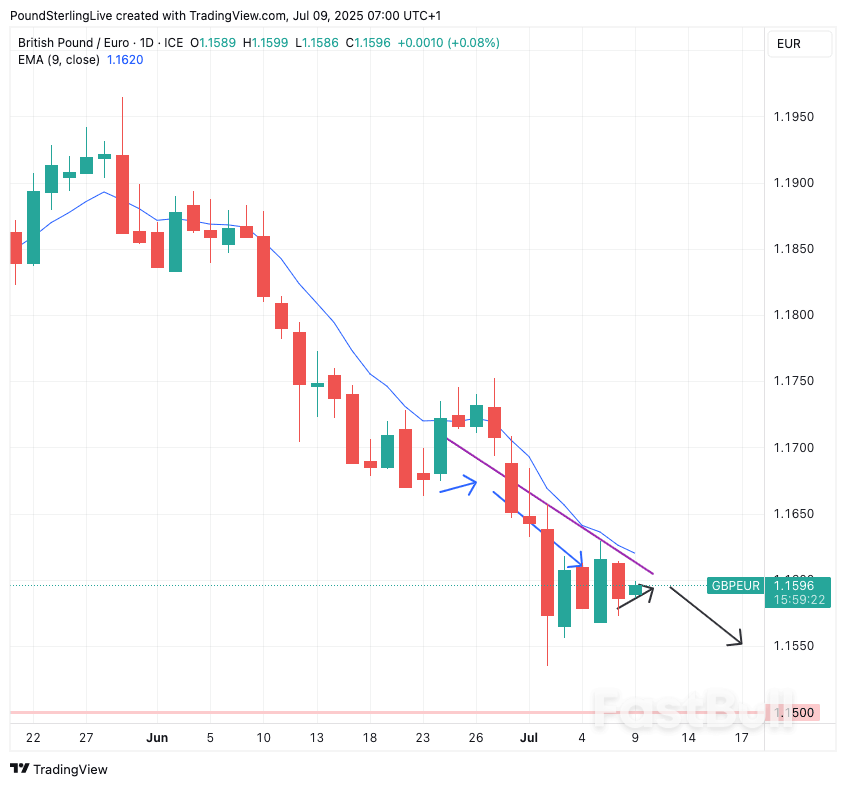
          The Pound to Euro exchange rate is expected to stay under pressure in the near term and periods of strength are likely to be brief.
          The UK currency came under fresh pressure on Tuesday as UK debt fears resurfaced, with the Office for Budget Responsibility (OBR) issuing its latest risk report that warned the government's debt path is on an unsustainable footing.
          Remarkably, the country is on course to have a debt-to-GDP ratio of 270% by 2070, meaning our national debt will be nearly three times the size of the entire economy. This would be triple the current debt burden.
          "From the perspective of financial markets, this report suggests that UK bond market volatility will be a regular feature in the coming months and years and may lead to elevated bond yields compared to our global peers. It also suggests that sterling could be at risk from sharp, sudden declines, even if it has remained well supported in recent years," says Kathleen Brooks, Research Director at XTB.
          "The U.K. government continues to struggle with fiscal credibility," says Geoff Yu, EMEA Macro Strategist at Bank of New York (BNY). "We believe current positioning in U.K. assets by foreign investors is too benign."
          Yu suspects the Pound should have adjusted much lower by now to compensate investors for idiosyncratic risks relating to the UK, but thinks a trigger for such a move is still needed. Such a trigger could be a decision by the Bank of England to accelerate the pace it cuts interest rates, he says.
          This spells nervous times for the Pound as we move into the second half of the year, with risks seemingly building.
          For now, the Pound-Euro exchange rate decline remains orderly, with the downtrend being a result of growing unease over the UK's economy and national debt, as well as exogenous drivers that includes improving demand for European assets.
          Technically, the exchange rate looks to be stuck below 1.16, and a slow descent towards 1.15 now looks the most likely outcome for July:Pound-to-Euro Still Tracking Lower_1

          Above: GBP/EUR at daily intervals

          Consistent with this technical downtrend, the British Pound has been unable to fully recoup last Wednesday's fall that was triggered by the sight of Rachel Reeves, the Chancellor of the Exchequer, crying in Parliament.
          Her tears followed Prime Minister Keir Starmer's u-turn on attempts to reform the benefit system to save some money. Failure to do so, and a visibly shaken Reeves, brought the issue of UK debt dynamics into clear view.
          Nearly a week later, the government's spending watchdog, the OBR, said:
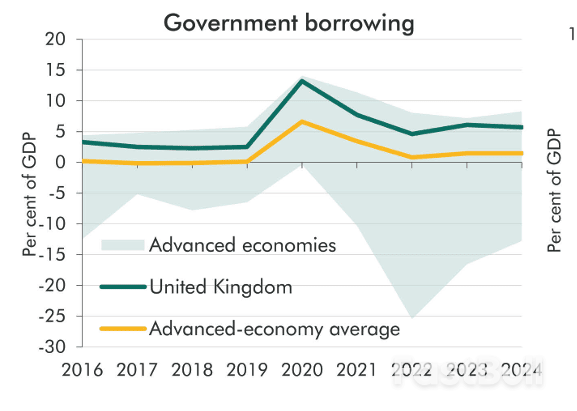
          "Efforts to put the UK's public finances on a sustainable footing after a series of global shocks have met with only limited and temporary success in recent years, leaving the UK with the sixth-highest debt, fifth-highest deficit, and third-highest borrowing costs among 36 advanced economies."
          Pound-to-Euro Still Tracking Lower_2

          The UK's debt dynamics are comparatively worse than elsewhere. This means the market will likely test the UK first, causing jitters in Sterling and gilts.

          Tax rises are incoming and the domination of the public sector over the private sector will continue, ensuring resources are continually funnelled into a non-productive state at the expense of the UK's entrepreneurs, small businesses and corporations.
          Markets are nervous: gilts are rising, meaning investors are demanding greater returns for holding UK debt as compensation for future risks.
          The UK bond markets (gilts) are heavily subsidised by foreigners, and foreign inflows are crucial to ensuring the Pound maintains current values.
          If the UK loses the confidence of these international investors, both risk falling in a more serious manner. "As I/we keep warning, we are utterly and completely dependent on the kindness of strangers, and their kindness and patience is wearing thin," says Robert Colville, Director at think tank the CPS.
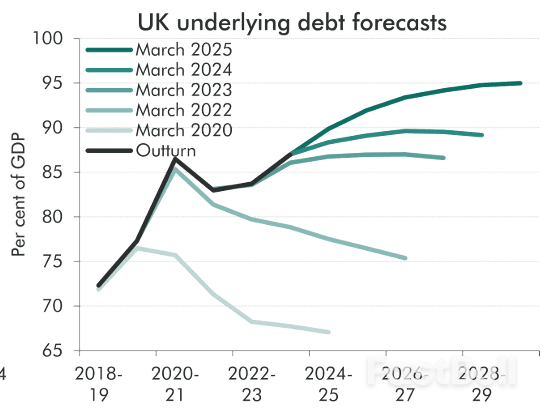
          Pound-to-Euro Still Tracking Lower_3

          The UK's debt burden is seemingly continually revised higher, defying the fantastical expectation that it will magically fall.

          "Yet the public's expectation of what the government can do, and should spend, is completely out of line with fiscal reality," he warns.
          Julian Jessop, Economics Fellow at the Institute of Economic Affairs, says the UK government's cost of borrowing is now consistently the highest in the G7, and no sign that public spending is being brought under control.
          "Too many subjects are still taboo, such as real reform of the NHS, or unpicking the 'triple lock' on the state pension. Politicians must be more honest with the public about the costs and trade-offs involved - and voters need to be more willing to listen," he says.
          A reckoning is coming, but the timing is still up for debate. It's hard to see the Pound thrive under such circumstances.

          Source: Poundsterlinglive

          To stay updated on all economic events of today, please check out our Economic calendar
          Risk Warnings and Disclaimers
          You understand and acknowledge that there is a high degree of risk involved in trading. Following any strategies or investment methods may lead to potential losses. The content on the site is provided by our contributors and analysts for information purposes only. You are solely responsible for determining whether any trading assets, securities, strategy, or any other product is suitable for investing based on your own investment objectives and financial situation.
          Add to Favorites
          Share
          FastBull
          Copyright © 2025 FastBull Ltd

          728 RM B 7/F GEE LOK IND BLDG NO 34 HUNG TO RD KWUN TONG KLN HONG KONG

          TelegramInstagramTwitterfacebooklinkedin
          App Store Google Play Google Play
          Products
          Charts

          Chats

          Q&A with Experts
          Screeners
          Economic Calendar
          Data
          Tools
          Membership
          Features
          Function
          Markets
          Copy Trading
          Latest Signals
          Contests
          News
          Analysis
          24/7
          Columns
          Education
          Company
          Careers
          About Us
          Contact Us
          Advertising
          Help Center
          Feedback
          User Agreement
          Privacy Policy
          Business

          White Label

          Data API

          Web Plug-ins

          Poster Maker

          Affiliate Program

          Risk Disclosure

          The risk of loss in trading financial instruments such as stocks, FX, commodities, futures, bonds, ETFs and crypto can be substantial. You may sustain a total loss of the funds that you deposit with your broker. Therefore, you should carefully consider whether such trading is suitable for you in light of your circumstances and financial resources.

          No decision to invest should be made without thoroughly conducting due diligence by yourself or consulting with your financial advisors. Our web content might not suit you since we don't know your financial conditions and investment needs. Our financial information might have latency or contain inaccuracy, so you should be fully responsible for any of your trading and investment decisions. The company will not be responsible for your capital loss.

          Without getting permission from the website, you are not allowed to copy the website's graphics, texts, or trademarks. Intellectual property rights in the content or data incorporated into this website belong to its providers and exchange merchants.

          Not Logged In

          Log in to access more features

          FastBull Membership

          Not yet

          Purchase

          Become a signal provider
          Help Center
          Customer Service
          Dark Mode
          Price Up/Down Colors

          Log In

          Sign Up

          Position
          Layout
          Fullscreen
          Default to Chart
          The chart page opens by default when you visit fastbull.com