

Markets
News
Analysis
User
24/7
Economic Calendar
Education
Data
- Names
- Latest
- Prev



Signal Accounts for Members
All Signal Accounts
All Contests
 France Industrial Output MoM (SA) (Oct)
A:--
F: --
France Trade Balance (SA) (Oct)A:--
F: --
 Euro Zone Employment YoY (SA) (Q3)
A:--
F: --
 Canada Part-Time Employment (SA) (Nov)
A:--
F: --
P: --
Canada Unemployment Rate (SA) (Nov)A:--
F: --
P: --
Canada Full-time Employment (SA) (Nov)A:--
F: --
P: --
Canada Labor Force Participation Rate (SA) (Nov)A:--
F: --
P: --
Canada Employment (SA) (Nov)A:--
F: --
P: --
 U.S. PCE Price Index MoM (Sept)
A:--
F: --
P: --
U.S. Personal Income MoM (Sept)A:--
F: --
P: --
U.S. Core PCE Price Index MoM (Sept)A:--
F: --
P: --
U.S. PCE Price Index YoY (SA) (Sept)A:--
F: --
P: --
U.S. Core PCE Price Index YoY (Sept)A:--
F: --
P: --
U.S. Personal Outlays MoM (SA) (Sept)A:--
F: --
U.S. 5-10 Year-Ahead Inflation Expectations (Dec)A:--
F: --
P: --
U.S. Real Personal Consumption Expenditures MoM (Sept)A:--
F: --
U.S. Weekly Total Rig CountA:--
F: --
P: --
U.S. Weekly Total Oil Rig CountA:--
F: --
P: --
U.S. Consumer Credit (SA) (Oct)A:--
F: --
 China, Mainland Foreign Exchange Reserves (Nov)
A:--
F: --
P: --
 Japan Trade Balance (Oct)
A:--
F: --
P: --
Japan Nominal GDP Revised QoQ (Q3)A:--
F: --
P: --
China, Mainland Imports YoY (CNH) (Nov)A:--
F: --
P: --
China, Mainland Exports (Nov)A:--
F: --
P: --
China, Mainland Imports (CNH) (Nov)A:--
F: --
P: --
China, Mainland Trade Balance (CNH) (Nov)A:--
F: --
P: --
China, Mainland Exports YoY (USD) (Nov)A:--
F: --
P: --
China, Mainland Imports YoY (USD) (Nov)A:--
F: --
P: --
 Germany Industrial Output MoM (SA) (Oct)
A:--
F: --
Euro Zone Sentix Investor Confidence Index (Dec)A:--
F: --
P: --
Canada National Economic Confidence Index--
F: --
P: --
 U.K. BRC Like-For-Like Retail Sales YoY (Nov)
--
F: --
P: --
U.K. BRC Overall Retail Sales YoY (Nov)--
F: --
P: --
 Australia Overnight (Borrowing) Key Rate
--
F: --
P: --
RBA Rate Statement RBA Press Conference Germany Exports MoM (SA) (Oct)--
F: --
P: --
U.S. NFIB Small Business Optimism Index (SA) (Nov)--
F: --
P: --
 Mexico 12-Month Inflation (CPI) (Nov)
--
F: --
P: --
Mexico Core CPI YoY (Nov)--
F: --
P: --
Mexico PPI YoY (Nov)--
F: --
P: --
U.S. Weekly Redbook Index YoY--
F: --
P: --
U.S. JOLTS Job Openings (SA) (Oct)--
F: --
P: --
China, Mainland M1 Money Supply YoY (Nov)--
F: --
P: --
China, Mainland M0 Money Supply YoY (Nov)--
F: --
P: --
China, Mainland M2 Money Supply YoY (Nov)--
F: --
P: --
U.S. EIA Short-Term Crude Production Forecast For The Year (Dec)--
F: --
P: --
U.S. EIA Natural Gas Production Forecast For The Next Year (Dec)--
F: --
P: --
U.S. EIA Short-Term Crude Production Forecast For The Next Year (Dec)--
F: --
P: --
EIA Monthly Short-Term Energy Outlook U.S. API Weekly Gasoline Stocks--
F: --
P: --
U.S. API Weekly Cushing Crude Oil Stocks--
F: --
P: --
U.S. API Weekly Crude Oil Stocks--
F: --
P: --
U.S. API Weekly Refined Oil Stocks--
F: --
P: --
 South Korea Unemployment Rate (SA) (Nov)
--
F: --
P: --
Japan Reuters Tankan Non-Manufacturers Index (Dec)--
F: --
P: --
Japan Reuters Tankan Manufacturers Index (Dec)--
F: --
P: --
Japan Domestic Enterprise Commodity Price Index MoM (Nov)--
F: --
P: --
Japan Domestic Enterprise Commodity Price Index YoY (Nov)--
F: --
P: --
China, Mainland PPI YoY (Nov)--
F: --
P: --


No matching data

Latest Views
Latest Views
Trending Topics
Top Columnists
Latest Update
White Label
Data API
Web Plug-ins
Affiliate Program
View All
No data
The S&P 500 continuesto be supported given the lack of bearish drivers. We haven’t got anymeaningful catalyst since the NFP report other than Trump’s tariff letters thatwere largely ignored by the market given that everyone expects them to be justthe usual negotiating tactic.
The S&P 500 continuesto be supported given the lack of bearish drivers. We haven’t got anymeaningful catalyst since the NFP report other than Trump’s tariff letters thatwere largely ignored by the market given that everyone expects them to be justthe usual negotiating tactic.
Next week, we have the USCPI report and that could trigger some big moves in the market. To keep thetrend going, we would likely need soft inflation figures as a hot report mighttrigger a deeper pullback given the positioning.
In the bigger picturethough, given that the Fed's reaction function remains to either wait more orcut, the market should eventually get back to its upward trend.
S&P 500Technical Analysis – Daily Timeframe
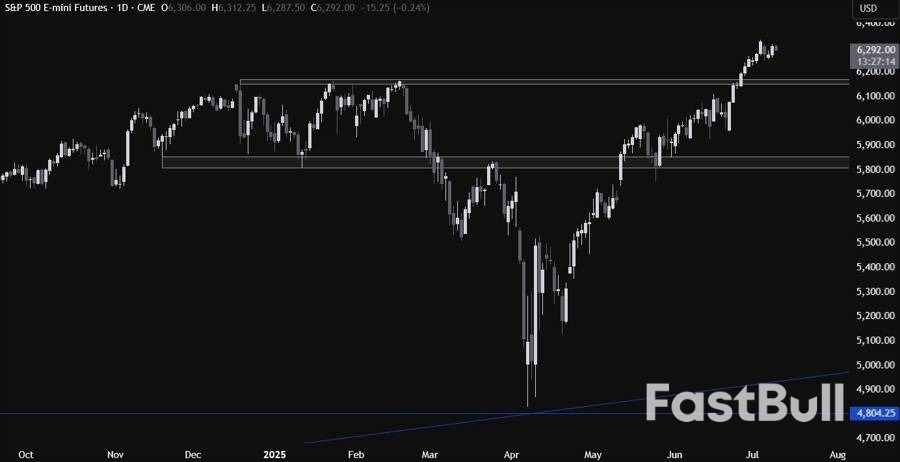
On the daily chart, we cansee that the S&P 500 is consolidating around the all-time highs after avery strong rally. From a risk management perspective, the buyers will have abetter risk to reward setup around the previous all-time high at 6,160-ishlevel to position for the continuation of the uptrend. The sellers, on theother hand, will want to see the price breaking lower to pile in for a dropinto the 6,000 level next.
S&P 500 TechnicalAnalysis – 4 hour Timeframe
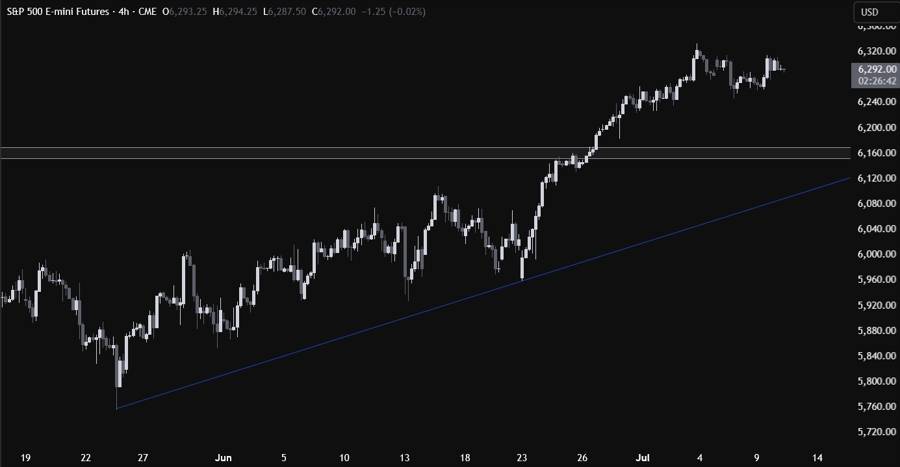
On the 4 hour chart, we cansee that we have an upward trendline defining the uptrend. If we were toget a pullback all the way into the trendline, we can expect the dip-buyers tolean on it to position for a rally into new all-time highs with a better riskto reward setup. The sellers, on the other hand, will look for a break lower toincrease the bearish bets into the 5,800 level next.
S&P 500 TechnicalAnalysis – 1 hour Timeframe
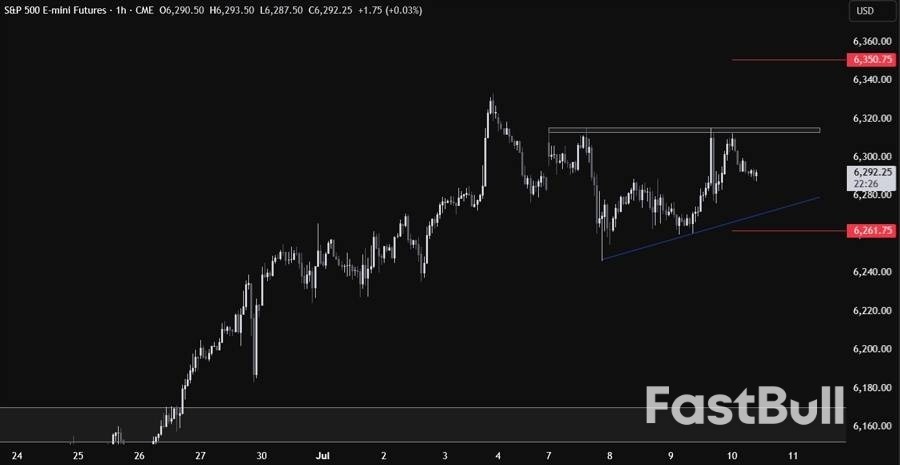
On the 1 hour chart, we cansee that we have a minor resistance around the 6,315 level. The sellers willlikely continue to step in around the resistance with a defined risk above itto keep targeting a pullback into the 6,160 level. The buyers, on the otherhand, will look for a break higher to increase the bullish bets into newall-time highs.
There’s also a minor upwardtrendline that can offer support for the dip-buyers, while the sellers willlikely increase the bearish bets into new lows on a breakout. The red linesdefine the average daily range for today.
President Donald Trump’s latest extension of tariff negotiations once again stretches out the policy limbo that US businesses are being forced to endure. In a flurry of letters this week, Trump effectively kicked the can on his much-hyped July 9 “reciprocal tariff” deadline until Aug. 1. In other words, Trump wants nations to come forward with concessions by that date. Meanwhile, American businesses and consumers are already juggling current levies that are up some 11 percentage points to around 13% on average.
Who will pay the price for Trump’s destructive policy and this persistent uncertainty? Odds are decent that the titans of the US stock market will adapt, but the nation’s small businesses could suffer lasting damage.
Small businesses, which collectively employ about half of America’s private workforce, account for about a third of the value of goods imported into the US. They include many wholesalers, some manufacturers and companies operating in a variety of other industries. (Here I define small businesses as those with fewer than 500 workers, but this group includes very small companies too, such as the 94,000 importers with just 1-19 employees.)
Unlike the publicly traded giants who can often secure a private audience at Mar-a-Lago or at least have officials lobby on their behalf, small businesses have neither the policy influence, the negotiating leverage with suppliers, nor the fat profit margins to weather large cost increases and haphazard policy implementation. So while tariffs and trade uncertainty haven’t held back the S&P 500 Index or had an obvious impact (yet) on the consumer price index, one plausible thesis is that small businesses will take the brunt of the blow.
Some of the more sobering evidence comes from surveys. Around 44% of small and medium-sized businesses say their revenues are taking a hit, according to the latest wave of a study from Alignable and researchers at the Massachusetts Institute of Technology and Harvard Business School. The National Federation of Independent Business’ monthly survey, whose small-business respondents always seem to perk up when a Republican is in office, has seen optimism swoon in 2025 (though it’s still up a lot from before Trump’s election win). Just a net 7% expect higher real sales volumes, versus 22% in December, while a net 32% plan to increase prices, the most since March 2024.
Admittedly, survey interpretation can be tricky in our age of partisan politics and social media silos, and other data seem to paint a picture of a small business ecosystem that’s hanging in there for now, but clearly not firing on all cylinders.
The Paychex Small Business Employment Watch jobs index — which focuses on businesses with under 50 workers — slipped slightly to 99.65 in June, the lowest since 2021, with values under 100 signaling that jobs are being shed. That index was consistent with similar data from the ADP National Employment Report, which showed that those under-50-employee businesses shed 47,000 jobs in June, the most since March 2022, even as larger firms continued to grow. Small business employment has mostly been treading water for a few years now, and the risk is that the tariff upheaval will turn a tenuous yet stable situation into a downright bad one with layoffs and business closures.
For now, earnings are still in decent shape. Using proprietary internal bank data, Bank of America Institute researchers use the account inflow-to-outflow ratio as a proxy for small-business profitability, and they found that the ratio has been above 1 for most of 2025. However, the study also noted that in the subset of companies that themselves pay tariffs directly to Customs and Border Protection, those payments have soared.
Like it or not, Trump appears to view all the uncertainty — the rolling deadlines, constantly changing tariff rates and blustery social media posts — as part of his negotiating strategy. Investors on Wall Street seem to be assuming, at this point, that the ultimate tariffs probably won’t be quite as bad as his threats (i.e., on the final accounting, they may “only” be as bad as the 1930s, rather than the 1890s). In the near-term, levies will probably go up as product-level investigations are completed and deadlines pass, but no one should be taking the bluster at face value, appears to be the calculus. And many of the levies are so intrinsically temporary that — worst comes to worst — they’ll never outlast the Trump administration itself, if they even make it past the 2026 midterm election.
But that’s cold comfort to small business owners, who oftentimes find themselves operating with no more than one month’s cash buffer held in reserve. To them, the existing tariffs and the months of uncertainty are a near-and-present danger, and Trump is playing with fire each time he draws it all out for another month.
728 RM B 7/F GEE LOK IND BLDG NO 34 HUNG TO RD KWUN TONG KLN HONG KONG


White Label
Data API
Web Plug-ins
Poster Maker
Affiliate Program
The risk of loss in trading financial instruments such as stocks, FX, commodities, futures, bonds, ETFs and crypto can be substantial. You may sustain a total loss of the funds that you deposit with your broker. Therefore, you should carefully consider whether such trading is suitable for you in light of your circumstances and financial resources.
No decision to invest should be made without thoroughly conducting due diligence by yourself or consulting with your financial advisors. Our web content might not suit you since we don't know your financial conditions and investment needs. Our financial information might have latency or contain inaccuracy, so you should be fully responsible for any of your trading and investment decisions. The company will not be responsible for your capital loss.
Without getting permission from the website, you are not allowed to copy the website's graphics, texts, or trademarks. Intellectual property rights in the content or data incorporated into this website belong to its providers and exchange merchants.
Not Logged In
Log in to access more features

FastBull Membership
Not yet
Purchase


Log In
Sign Up


