• Trade
  • Markets
  • Copy
  • Contests
  • News
  • 24/7
  • Calendar
  • Q&A
  • Chats
Trending
Screeners
SYMBOL
LAST
BID
ASK
HIGH
LOW
NET CHG.
%CHG.
SPREAD
SPX
S&P 500 Index
6818.62
6818.62
6818.62
6861.30
6801.50
-8.79
-0.13%
--
DJI
Dow Jones Industrial Average
48386.19
48386.19
48386.19
48679.14
48285.67
-71.85
-0.15%
--
IXIC
NASDAQ Composite Index
23107.95
23107.95
23107.95
23345.56
23012.00
-87.21
-0.38%
--
USDX
US Dollar Index
97.960
98.040
97.960
98.070
97.740
+0.010
+ 0.01%
--
EURUSD
Euro / US Dollar
1.17441
1.17449
1.17441
1.17686
1.17262
+0.00047
+ 0.04%
--
GBPUSD
Pound Sterling / US Dollar
1.33698
1.33708
1.33698
1.34014
1.33546
-0.00009
-0.01%
--
XAUUSD
Gold / US Dollar
4303.11
4303.45
4303.11
4350.16
4285.08
+3.72
+ 0.09%
--
WTI
Light Sweet Crude Oil
56.359
56.389
56.359
57.601
56.233
-0.874
-1.53%
--

Community Accounts

Signal Accounts
--
Profit Accounts
--
Loss Accounts
--
View More

Become a signal provider

Sell trading signals to earn additional income

View More

Guide to Copy Trading

Get started with ease and confidence

View More

Signal Accounts for Members

All Signal Accounts

Best Return
  • Best Return
  • Best P/L
  • Best MDD
Past 1W
  • Past 1W
  • Past 1M
  • Past 1Y

All Contests

  • All
  • Trump Updates
  • Recommend
  • Stocks
  • Cryptocurrencies
  • Central Banks
  • Featured News
Top News Only
Share

New York Fed Accepts $2.601 Billion Of $2.601 Billion Submitted To Reverse Repo Facility On Dec 15

Share

Turkey: Shoots Down A Drone In The Black Sea Using F-16 Fighter Jets

Share

Goldman Sachs Says They Believe That The Copper Price Is Vulnerable To An Ai-Linked Price Correction

Share

Goldman Sachs Upgrades 2026 Copper Price Forecast To $11400 From $10,650

Share

Attempts By Ukrainian Troops To Advance From The South-West To Outskirts Of Kupiansk Are Being Thwarted

Share

Russian Troops Control All Of Kupiansk - IFX Cites Russian Military

Share

On Monday (December 15), The South Korean Won Ultimately Rose 0.60% Against The US Dollar, Closing At 1468.91 Won. The Won Was On An Upward Trend Throughout The Day, Rising Significantly At 17:00 Beijing Time And Reaching A Daily High Of 1463.04 Won At 17:36

Share

Health Ministry: Israeli Forces Kill Palestinian Teen In West Bank

Share

New York Federal Reserve President Williams: Over Time, The Size Of Reserves Could Grow From $2.9 Trillion

Share

New York Fed President Williams: AI Valuations Are High, But There Is A Real Driving Factor

Share

New York Federal Reserve President Williams: The Job Market Is In Very Good Shape

Share

New York Fed President Williams: 'Very Supportive' Of USA Central Bank's Decision To Cut Interest Rates Last Week

Share

New York Fed President Williams: 'Too Early To Say' What Central Bank Should Do At January Meeting

Share

New York Fed President Williams: Strong Markets Part Of Reason Why Economy Will Grow Robustly In 2026

Share

New York Fed President Williams: What Constitutes Ample Reserves Will Change Over Time

Share

New York Fed President Williams: Market Valuations 'Elevated,' But There Are Reasons For Pricing

Share

New York Fed President Williams: Ample Reserves System Working Very Well

Share

New York Fed President Williams: Some Signs That Parts Of Underlying Economy Not As Strong As GDP Data Suggests

Share

New York Fed President Williams: Expects Coming Job Data Will Show Gradual Cooling

Share

Ukraine President Zelenskiy: Monitoring Of Ceasefire Should Be Part Of Security Guarantees

TIME
ACT
FCST
PREV
Japan Tankan Small Manufacturing Outlook Index (Q4)

A:--

F: --

P: --

Japan Tankan Large Non-Manufacturing Outlook Index (Q4)

A:--

F: --

P: --

Japan Tankan Large Manufacturing Outlook Index (Q4)

A:--

F: --

P: --

Japan Tankan Small Manufacturing Diffusion Index (Q4)

A:--

F: --

P: --

Japan Tankan Large-Enterprise Capital Expenditure YoY (Q4)

A:--

F: --

P: --

U.K. Rightmove House Price Index YoY (Dec)

A:--

F: --

P: --

China, Mainland Industrial Output YoY (YTD) (Nov)

A:--

F: --

P: --

China, Mainland Urban Area Unemployment Rate (Nov)

A:--

F: --

P: --

Saudi Arabia CPI YoY (Nov)

A:--

F: --

P: --

Euro Zone Industrial Output YoY (Oct)

A:--

F: --

P: --

Euro Zone Industrial Output MoM (Oct)

A:--

F: --

P: --

Canada Existing Home Sales MoM (Nov)

A:--

F: --

P: --

Canada National Economic Confidence Index

A:--

F: --

P: --

Canada New Housing Starts (Nov)

A:--

F: --

P: --
U.S. NY Fed Manufacturing Employment Index (Dec)

A:--

F: --

P: --

U.S. NY Fed Manufacturing Index (Dec)

A:--

F: --

P: --

Canada Core CPI YoY (Nov)

A:--

F: --

P: --

Canada Manufacturing Unfilled Orders MoM (Oct)

A:--

F: --

P: --

U.S. NY Fed Manufacturing Prices Received Index (Dec)

A:--

F: --

P: --

U.S. NY Fed Manufacturing New Orders Index (Dec)

A:--

F: --

P: --

Canada Manufacturing New Orders MoM (Oct)

A:--

F: --

P: --

Canada Core CPI MoM (Nov)

A:--

F: --

P: --

Canada Trimmed CPI YoY (SA) (Nov)

A:--

F: --

P: --

Canada Manufacturing Inventory MoM (Oct)

A:--

F: --

P: --

Canada CPI YoY (Nov)

A:--

F: --

P: --

Canada CPI MoM (Nov)

A:--

F: --

P: --

Canada CPI YoY (SA) (Nov)

A:--

F: --

P: --

Canada Core CPI MoM (SA) (Nov)

A:--

F: --

P: --

Canada CPI MoM (SA) (Nov)

A:--

F: --

P: --

Federal Reserve Board Governor Milan delivered a speech
U.S. NAHB Housing Market Index (Dec)

A:--

F: --

P: --

Australia Composite PMI Prelim (Dec)

--

F: --

P: --

Australia Services PMI Prelim (Dec)

--

F: --

P: --

Australia Manufacturing PMI Prelim (Dec)

--

F: --

P: --

Japan Manufacturing PMI Prelim (SA) (Dec)

--

F: --

P: --

U.K. 3-Month ILO Employment Change (Oct)

--

F: --

P: --

U.K. Unemployment Claimant Count (Nov)

--

F: --

P: --

U.K. Unemployment Rate (Nov)

--

F: --

P: --

U.K. 3-Month ILO Unemployment Rate (Oct)

--

F: --

P: --

U.K. Average Weekly Earnings (3-Month Average, Including Bonuses) YoY (Oct)

--

F: --

P: --

U.K. Average Weekly Earnings (3-Month Average, Excluding Bonuses) YoY (Oct)

--

F: --

P: --

France Services PMI Prelim (Dec)

--

F: --

P: --

France Composite PMI Prelim (SA) (Dec)

--

F: --

P: --

France Manufacturing PMI Prelim (Dec)

--

F: --

P: --

Germany Services PMI Prelim (SA) (Dec)

--

F: --

P: --

Germany Manufacturing PMI Prelim (SA) (Dec)

--

F: --

P: --

Germany Composite PMI Prelim (SA) (Dec)

--

F: --

P: --

Euro Zone Composite PMI Prelim (SA) (Dec)

--

F: --

P: --

Euro Zone Services PMI Prelim (SA) (Dec)

--

F: --

P: --

Euro Zone Manufacturing PMI Prelim (SA) (Dec)

--

F: --

P: --

U.K. Services PMI Prelim (Dec)

--

F: --

P: --

U.K. Manufacturing PMI Prelim (Dec)

--

F: --

P: --

U.K. Composite PMI Prelim (Dec)

--

F: --

P: --

Euro Zone ZEW Economic Sentiment Index (Dec)

--

F: --

P: --

Germany ZEW Current Conditions Index (Dec)

--

F: --

P: --

Germany ZEW Economic Sentiment Index (Dec)

--

F: --

P: --

Euro Zone Trade Balance (Not SA) (Oct)

--

F: --

P: --

Euro Zone ZEW Current Conditions Index (Dec)

--

F: --

P: --

Euro Zone Trade Balance (SA) (Oct)

--

F: --

P: --

Euro Zone Total Reserve Assets (Nov)

--

F: --

P: --

U.K. Inflation Rate Expectations

--

F: --

P: --

Q&A with Experts
    • All
    • Chatrooms
    • Groups
    • Friends
    Connecting
    .
    .
    .
    Type here...
    Add Symbol or Code

      No matching data

      All
      Trump Updates
      Recommend
      Stocks
      Cryptocurrencies
      Central Banks
      Featured News
      • All
      • Russia-Ukraine Conflict
      • Middle East Flashpoint
      • All
      • Russia-Ukraine Conflict
      • Middle East Flashpoint
      Search
      Products

      Charts Free Forever

      Chats Q&A with Experts
      Screeners Economic Calendar Data Tools
      Membership Features
      Data Warehouse Market Trends Institutional Data Policy Rates Macro

      Market Trends

      Market Sentiment Order Book Forex Correlations

      Top Indicators

      Charts Free Forever
      Markets

      News

      News Analysis 24/7 Columns Education
      From Institutions From Analysts
      Topics Columnists

      Latest Views

      Latest Views

      Trending Topics

      Top Columnists

      Latest Update

      Signals

      Copy Rankings Latest Signals Become a signal provider AI Rating
      Contests
      Brokers

      Overview Brokers Assessment Rankings Regulators News Claims
      Broker listing Forex Brokers Comparison Tool Live Spread Comparison Scam
      Q&A Complaint Scam Alert Videos Tips to Detect Scam
      More

      Business
      Events
      Careers About Us Advertising Help Center

      White Label

      Data API

      Web Plug-ins

      Affiliate Program

      Awards Institution Evaluation IB Seminar Salon Event Exhibition
      Vietnam Thailand Singapore Dubai
      Fans Party Investment Sharing Session
      FastBull Summit BrokersView Expo
      Recent Searches
        Top Searches
          Markets
          News
          Analysis
          User
          24/7
          Economic Calendar
          Education
          Data
          • Names
          • Latest
          • Prev

          View All

          No data

          Scan to Download

          Faster Charts, Chat Faster!

          Download App
          English
          • English
          • Español
          • العربية
          • Bahasa Indonesia
          • Bahasa Melayu
          • Tiếng Việt
          • ภาษาไทย
          • Français
          • Italiano
          • Türkçe
          • Русский язык
          • 简中
          • 繁中
          Open Account
          Search
          Products
          Charts Free Forever
          Markets
          News
          Signals

          Copy Rankings Latest Signals Become a signal provider AI Rating
          Contests
          Brokers

          Overview Brokers Assessment Rankings Regulators News Claims
          Broker listing Forex Brokers Comparison Tool Live Spread Comparison Scam
          Q&A Complaint Scam Alert Videos Tips to Detect Scam
          More

          Business
          Events
          Careers About Us Advertising Help Center

          White Label

          Data API

          Web Plug-ins

          Affiliate Program

          Awards Institution Evaluation IB Seminar Salon Event Exhibition
          Vietnam Thailand Singapore Dubai
          Fans Party Investment Sharing Session
          FastBull Summit BrokersView Expo

          Russia’s Metals Exports to China Hit $1 Billion in 2025

          Michelle

          Economic

          Commodity

          Summary:

          Russia’s got one trading partner left that still writes big checks:- China. And those checks just got a hell of a lot bigger.

          Russia’s got one trading partner left that still writes big checks:- China. And those checks just got a hell of a lot bigger.

          Russia’s precious metals exports to China nearly doubled in the first half of 2025, pulling in $1 billion, with gold leading the charge as prices rip through the roof. That figure came straight from Trade Data Monitor, which tracks Chinese customs filings.

          Shipments of Russian gold, silver, and other ores sent to China shot up by 80% compared to the same period last year. The jump lines up with a sharp rally in bullion prices, which have gained around 28% so far this year.

          The rally is getting help from central banks stacking reserves, trade friction between the U.S. and its partners, and investors pouring into exchange-traded funds trying to shield themselves from market chaos.

          Russia leans on China after being locked out of Western gold trade

          Ever since Russia’s 2022 invasion of Ukraine, the Kremlin’s been cut out of the world’s top trading venues like London and New York. That shut the door on Western demand, but China’s stayed open.

          With the Bank of Russia, once the biggest central bank buyer of gold, not returning to the market in any major way, Russian miners are now banking hard on Asian demand.

          Russia still pumps out over 300 tons of gold annually, making it the second-largest gold producer in the world. That supply needs a home. For now, it’s getting one in China. And not just gold, Russia’s also moving more palladium and platinum, thanks to demand coming out of China’s manufacturing sectors.

          MMC Norilsk Nickel PJSC, the country’s major producer of both metals, has turned its focus entirely eastward. That play seems to be working. Prices for palladium are up 38%, and platinum has jumped 59% so far this year. China’s taking that in stride, expanding imports as the West keeps its sanctions tight.

          Inside Russia, miners are getting an extra push from locals. As trust in the ruble drops, Russian retail demand for gold has hit record highs in 2024, with people buying coins, bars, and any physical metal they can stash. Precious metals have basically become the savings account for Russian households trying to survive inflation and a volatile currency.

          Global drama and weak dollar push gold to new highs

          Gold prices didn’t just spike because of mining. They’re also reacting to global politics. On Monday morning, spot gold rose to $3,369.02 per ounce, while U.S. gold futures hit $3,376.40. The jump was helped by a weakening U.S. dollar, which slipped 0.2% against other major currencies. That drop made it easier for non-dollar holders to jump in and buy gold.

          Tim Waterer, Chief Market Analyst at KCM Trade, explained the rally clearly: “Dollar has made a subdued start to the week, which has left the door open for gold to post gains early doors with tariff deadlines looming large.” He added:

          “The closer we move towards the key August 1 deadline without any new trade deals emerging, the more likely gold is to start fancying another run towards the $3,400 level and perhaps beyond.”

          Tensions are running high with U.S. President Donald Trump’s tariff deadline just days away. His Commerce Secretary, Howard Lutnick, is still hopeful about locking in a deal with the European Union, but so far, no handshake.

          Trump is also rumored to be considering a visit to China ahead of the APEC summit, which takes place from October 30 to November 1. Another option would be to meet Chinese President Xi Jinping at the APEC gathering in South Korea.

          Over in Europe, the European Central Bank is expected to hold its interest rate steady at 2.0% after a series of recent cuts. In the U.S., Federal Reserve Governor Christopher Waller said last week that the Fed should move ahead with a rate cut at its next meeting. Both of those moves make gold more attractive, especially with traditional yields falling and uncertainty mounting.

          In Japan, the ruling coalition lost its majority in the upper house during Sunday’s vote, dealing another political shock just as global trade talks stall out. That instability only adds more fuel to the metals market.

          And it’s not just gold on fire. Other metals are following suit. Spot silver gained 0.4% to hit $38.33 per ounce, platinum added 1.1% to reach $1,437.53, and palladium climbed 1.3% to $1,256.98.

          Source: CryptoSlate

          To stay updated on all economic events of today, please check out our Economic calendar
          Risk Warnings and Disclaimers
          You understand and acknowledge that there is a high degree of risk involved in trading. Following any strategies or investment methods may lead to potential losses. The content on the site is provided by our contributors and analysts for information purposes only. You are solely responsible for determining whether any trading assets, securities, strategy, or any other product is suitable for investing based on your own investment objectives and financial situation.
          Add to Favorites
          Share

          China’s Stock Rally Reflects Hopes for End to Price Wars and Industrial Overcapacity

          Gerik

          Economic

          Investor Optimism Rises on Government Promises

          China’s equity markets are showing signs of recovery as domestic investors respond to government statements aiming to rein in price wars and overcapacity in key manufacturing sectors. This new wave of confidence is particularly visible in industries such as solar panel materials, steel, and electric vehicles, all of which have endured years of cut-throat price competition driven by excessive production capabilities and soft domestic demand.
          The shift in sentiment reflects what analysts and officials are now calling a campaign against “involution,” a Chinese term describing the self-defeating cycle of hypercompetition. This concept, once applied to the struggles of students and workers in saturated job markets, is now being used to describe economic sectors where too many producers are chasing too little demand.

          Rising Trade Frictions and Industrial Strain

          The roots of the current economic strain can be traced to both internal and external pressures. Domestically, weak consumption has failed to absorb industrial output, prompting manufacturers to slash prices and sacrifice margins. Internationally, the persistent dumping of low-cost goods has aggravated trade tensions. For nearly three years, China’s producer price index has registered deflation, highlighting the sustained weakness in pricing power across industrial sectors.
          As a result, countries including the United States and members of the European Union have raised tariffs and threatened additional trade barriers. Even emerging markets such as Mexico and India are pushing back against Chinese overproduction. The interplay between domestic oversupply and foreign resistance has amplified the need for China to restructure its industrial strategy.

          Early Signs of Industry Response and Market Reaction

          In response, both government agencies and industry bodies have issued public commitments to curb excessive competition. On June 30, the top ten producers of solar panel glass agreed to cut output by 30%, a rare coordinated production reduction. At the same time, authorities have launched a nationwide inspection campaign focused on auto safety, reflecting concerns that automakers were sacrificing product quality to reduce costs.
          These developments triggered immediate market reactions. Shares of Liuzhou Iron & Steel Co. surged by 10% on a single day and have risen over 70% since late June. Solar materials company Changzhou Almaden Co. also posted a 50% increase, despite some volatility. Broader sector indices in solar and steel climbed approximately 10%, outpacing the Shanghai Composite’s 3.2% gain over the same period.
          However, performance remains uneven in the electric vehicle segment. While Li Auto and Nio reported double-digit stock gains, BYD the sector’s dominant player declined, likely due to its continued aggressive pricing strategy.

          Policy Messaging Gains Credibility but Execution Uncertain

          The turning point in public messaging came on June 29, when the People’s Daily published a front-page editorial condemning “disorderly” competition. Soon after, Chinese President Xi Jinping echoed these concerns at a private economic meeting, emphasizing the need to regulate local government incentives that have contributed to factory oversupply.
          These statements indicate that top policymakers acknowledge the structural challenges facing China’s manufacturing economy. Analysts at UBS interpreted the rhetoric as a positive signal for profit stabilization, particularly in autos. They also noted that while a complete market overhaul is unlikely, a temporary ceasefire in price wars could offer firms short-term breathing room.

          Structural Barriers to Long-Term Reform

          Despite the favorable tone, deep-rooted obstacles remain. Overcapacity is not a new issue for China it has plagued sectors such as steel and cement for decades. The government's recent push into green technologies has only replicated these patterns in newer sectors, such as solar panels and EVs. A critical factor impeding reform is the role of provincial governments, which often shield local firms to preserve employment and regional economic output.
          Economists argue that only consolidation through mergers or bankruptcies will resolve overcapacity at its core. Yet this process is slow, politically sensitive, and economically disruptive. As Alicia García-Herrero of Natixis noted, the central government’s recognition of the problem is significant, but whether rhetoric translates into meaningful structural change remains uncertain.
          The recent rebound in Chinese equities reflects renewed investor optimism, underpinned by strong government rhetoric and early production cuts in targeted sectors. However, the rally remains sentiment-driven, as core issues of overcapacity and local government protectionism continue to constrain long-term industrial reform. Until concrete steps are taken to balance supply with real demand, the risk of recurring price wars and trade backlash will continue to shadow China’s path toward “high-quality development.”

          Source: Reuters

          To stay updated on all economic events of today, please check out our Economic calendar
          Risk Warnings and Disclaimers
          You understand and acknowledge that there is a high degree of risk involved in trading. Following any strategies or investment methods may lead to potential losses. The content on the site is provided by our contributors and analysts for information purposes only. You are solely responsible for determining whether any trading assets, securities, strategy, or any other product is suitable for investing based on your own investment objectives and financial situation.
          Add to Favorites
          Share

          China's Strategic Export Crackdown Sends Germanium and Antimony Supplies into Freefall

          Gerik

          Economic

          Export Restrictions Deepen as Surveillance Intensifies

          Over the past three months, China’s exports of two vital minerals germanium and antimony have plunged to historic lows, reflecting a strategic enforcement campaign tied to national security and geopolitical maneuvering. According to customs data published Sunday, germanium exports fell 95% and antimony 88% compared to January, sharply contracting global supply of materials essential to sectors such as defense, telecommunications, and renewable energy.
          China remains the world’s dominant source for both minerals in terms of mining and refining. Their inclusion on Beijing’s export control list in 2023 (germanium) and 2024 (antimony), alongside rare earths in April, marked a significant escalation in China’s trade policy. These measures were not isolated administrative actions but part of a retaliatory framework in response to U.S. semiconductor restrictions. The formal ban on exports of germanium and antimony to the United States in December 2024 solidified their role in China’s trade strategy.

          Contrasting Trajectories: Rare Earths Rebound, Others Collapse

          While rare earth exports initially collapsed following their control listing, volumes rebounded last month following a bilateral agreement between Beijing and Washington. This recovery reflects the responsiveness of rare earth exports to diplomatic negotiations, suggesting a conditional flexibility in China’s enforcement model.
          Germanium and antimony, however, remain suppressed. Their export levels have not followed rare earths into recovery, indicating that these markets are subject to stricter enforcement protocols. This divergence suggests that rare earth volumes are influenced by high-level diplomacy, while germanium and antimony remain more tightly shielded due to their immediate strategic relevance and lower global production redundancy.

          Transshipment Crackdown Reshapes Trade Routes

          A significant factor behind the continued suppression of exports is China’s crackdown on transshipment practices where controlled minerals are rerouted through third countries to evade export bans. The Ministry of State Security disclosed last week that it had uncovered several smuggling operations involving such bypass methods. These operations involved rerouting cargo through Southeast Asia or Latin America to disguise final destinations, especially the United States.
          Reuters investigations reported that abnormally large shipments of antimony were sent to the U.S. from Thailand and Mexico, likely through indirect trade channels established by at least one Chinese company. However, recent data shows China’s antimony exports to Thailand fell by 90% following an April peak, and exports to Mexico ceased entirely after that month. This collapse underscores the effectiveness of Beijing’s enforcement and surveillance, narrowing the possibilities for unauthorized export routing.

          Global Market Reactions and Price Volatility

          The restricted supply of these strategic minerals has caused significant market upheaval. Since China imposed germanium export limits in mid-2023, the spot price for high-purity germanium has more than doubled, underscoring the scarcity of alternative supply channels. Antimony prices have risen even more sharply nearly quadrupling since May 2024.
          These price increases are not simply reactions to policy headlines but reflect an actual physical tightening of global inventory. The market’s response confirms the critical role China plays in maintaining supply continuity and price stability in niche but essential raw material markets.

          Long-Term Strategic Realignment on Critical Minerals

          China’s firm clampdown on germanium and antimony exports signals a shift toward stricter control of minerals with immediate military and industrial applications. Unlike rare earths, which benefited from a negotiated reset in trade flows, germanium and antimony continue to reflect a high-security posture and enforcement-focused policy.
          The sustained suppression of these exports not only disrupts global supply chains but also raises the urgency for downstream users and policymakers to seek long-term alternatives. In the absence of diversified supply or meaningful diplomatic progress, volatility and dependence will remain defining features of the germanium and antimony markets. For now, China’s grip on these critical resources remains unchallenged, reinforcing its leverage in an increasingly fragmented global trade system.

          Source: Reuters

          To stay updated on all economic events of today, please check out our Economic calendar
          Risk Warnings and Disclaimers
          You understand and acknowledge that there is a high degree of risk involved in trading. Following any strategies or investment methods may lead to potential losses. The content on the site is provided by our contributors and analysts for information purposes only. You are solely responsible for determining whether any trading assets, securities, strategy, or any other product is suitable for investing based on your own investment objectives and financial situation.
          Add to Favorites
          Share

          Strategic Clampdown Reshapes China’s Critical Mineral Exports as Prices Soar

          Gerik

          Economic

          Sharp Decline in Strategic Mineral Exports Amid Enforcement Surge

          China’s exports of two key strategic minerals antimony and germanium have plummeted over the past three months, reflecting both intensified enforcement of export controls and Beijing’s broader geopolitical calculus. According to customs data released on Sunday, exports of germanium fell by 95% and antimony by 88% from their January levels, marking some of the lowest monthly volumes on record. These two minerals are critical inputs for defense systems, telecommunications, and solar cell manufacturing, and their restricted availability presents both industrial and strategic risks for import-dependent countries.
          The dramatic fall comes after China added antimony and germanium to its export control list in 2023 and 2024, respectively. This regulatory shift formed part of Beijing’s response to U.S. semiconductor and chip equipment sanctions, culminating in a formal export ban to the United States in December. This retaliatory measure immediately constrained global supply and redirected the flow of trade.

          Differentiated Impact Compared to Rare Earths

          In contrast to the sustained decline in germanium and antimony exports, rare earth shipments from China staged a strong recovery last month. This divergence appears directly linked to diplomatic progress between Washington and Beijing, which reached an agreement on rare earth trade. The rebound suggests that while strategic minerals are broadly subject to export controls, selective easing is possible when supported by high-level negotiations. This pattern suggests a correlation rather than a causative link between trade diplomacy and volume recovery export restrictions are not immutable but subject to geopolitical negotiation.
          However, germanium and antimony exports show no such sign of recovery, underscoring that these two markets remain tightly sealed under current policy. Their steep decline correlates with a high-profile crackdown on export control violations, especially involving transshipment. China’s Ministry of State Security has publicly disclosed several instances of export evasion attempts involving cargo routed through third countries to disguise their final destinations. These revelations coincide with trade data showing a collapse in Chinese shipments to nations previously implicated in such practices, notably Thailand and Mexico.

          Market Distortion and Price Volatility

          The enforcement measures have triggered significant price distortions in the global spot markets. Since the initial restrictions on germanium in July 2023, spot prices for high-purity germanium have more than doubled, reflecting constrained supply and growing demand from high-tech sectors. Antimony prices have responded even more dramatically, nearly quadrupling since May 2024. These movements are not just speculative reactions but are tied directly to physical scarcity, confirmed by dwindling export volumes and the absence of alternative major suppliers.
          While some countries have tried to maintain flows by importing indirectly from Southeast Asia or Latin America, the data strongly suggests that such routes are increasingly ineffective under China’s surveillance. For example, exports of antimony to Thailand dropped by 90% after peaking in April, and no antimony has been shipped to Mexico since that same month. These figures provide empirical support for the effectiveness of Beijing’s enforcement campaign in curtailing unauthorized re-export activities.

          Geopolitical Strategy Behind Export Discipline

          China’s actions are not merely about trade compliance but reflect a broader strategy of resource leverage. As the dominant global supplier of antimony and germanium both in mining and refining Beijing holds considerable pricing and volume-setting power. By tightening control over strategic minerals while selectively negotiating rare earth access, China is both reinforcing its geopolitical influence and signaling the costs of adversarial trade policies.
          This deliberate use of export restrictions as a tool of foreign policy mirrors patterns seen in other strategic industries. The fact that China’s top spy agency is directly involved in enforcement highlights how the country treats critical mineral flows as a national security issue rather than a commercial matter. This positions China’s mineral policy within a broader framework of asymmetric economic statecraft.

          A Dual-Track Future for Strategic Mineral Trade

          The latest export data reflects a bifurcation in China’s trade policy toward critical minerals. Rare earth exports are now on a path to recovery due to strategic compromise, while antimony and germanium remain tightly restricted, likely due to their heightened sensitivity and smaller market size. The consequences are twofold: a surge in global spot prices due to genuine supply shortages, and a rising urgency among Western nations to diversify sources and develop strategic stockpiles.
          Unless diplomatic conditions change or alternative suppliers emerge, countries dependent on these materials for defense and technology face prolonged volatility. In this context, China's enforcement campaign not only serves its national interests but reshapes global trade dynamics in minerals critical to future industries.

          Source: Reuters

          To stay updated on all economic events of today, please check out our Economic calendar
          Risk Warnings and Disclaimers
          You understand and acknowledge that there is a high degree of risk involved in trading. Following any strategies or investment methods may lead to potential losses. The content on the site is provided by our contributors and analysts for information purposes only. You are solely responsible for determining whether any trading assets, securities, strategy, or any other product is suitable for investing based on your own investment objectives and financial situation.
          Add to Favorites
          Share

          Dogecoin Price Prediction – Will DOGE Price Surge to $0.42 Or Drop to $0.20?

          Glendon

          Cryptocurrency

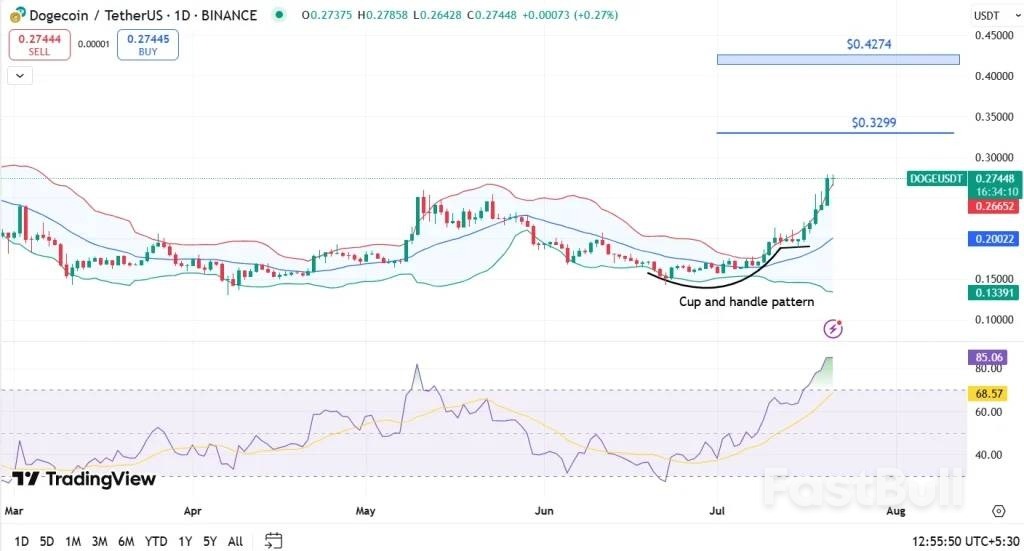
          Dogecoin has staged a powerful comeback, surging over 32% in the past seven days and climbing 8.57% in the last 24 hours alone, reaching $0.2727. DOGE has once again captured market attention, with its market cap zooming to $41.01 billion and daily volume rocketing past $6 billion. The rally comes amid a technical breakout, whale accumulation, and a significant capital injection by Bit Origin Ltd.

          However, not everything is bright, as the risk of $442 million worth of token unlocks and overleveraged positions may test the rally’s future. If DOGE is under your watchlist, this short-term Dogecoin price prediction is a must-read for you.

          Why is DOGE Price Going Up?

          The moonish DOGE price rally is being driven by the following bullish catalysts:

          • Technical Breakout: The completion of a textbook cup and handle pattern has triggered a breakout above the crucial $0.25 resistance level. This has resulted in the liquidation of nearly $19.94 million in short positions, further fueling the rally.
          • Altcoin Rotation: DOGE’s surge coincides with the breakout of the TOTAL2 chart, which tracks the total crypto market cap excluding Bitcoin, above an 8-year resistance..
          • Whale Accumulation: Wallets holding 100 million to 1 billion DOGE have added 1.08 billion DOGE in July alone. This includes a notable 48-hour spree that saw massive inflows.
          • Institutional Backing: Bit Origin Ltd.’s $500 million fundraising round, aimed specifically at investing in Dogecoin, has added credibility to the meme token.

          Dogecoin Price Analysis

          As evident from the chart that I have shared, the breakout from the cup and handle formation suggests a measured target near $0.3299. Successively, Dogecoin could also have a further upside potential toward $0.4274 if momentum sustains. Talking about indicators, the Bollinger Bands are expanding rapidly, confirming rising volatility and buying pressure. RSI stands at 85.06, signaling extreme overbought conditions.

          However, caution is advised, as a $442 million token unlock scheduled this week may lead to short-term selling pressure. This could drag the price down to $0.20 if the support at $0.20 is broken.

          FAQs

          Why is Doge’s price up today?

          A cup-and-handle breakout, whale accumulation, and Bit Origin’s $500M fund have triggered the surge

          Should I buy Dogecoin now?

          It is worth noting that despite bullish momentum, high RSI, token unlocks, and leveraged longs pose short-term risks.

          Source: CryptoSlate

          Risk Warnings and Disclaimers
          You understand and acknowledge that there is a high degree of risk involved in trading. Following any strategies or investment methods may lead to potential losses. The content on the site is provided by our contributors and analysts for information purposes only. You are solely responsible for determining whether any trading assets, securities, strategy, or any other product is suitable for investing based on your own investment objectives and financial situation.
          Add to Favorites
          Share

          Europe’s Chemical Industry at the Brink: Can It Reclaim Strategic Ground?

          Gerik

          Economic

          Industrial Retreat Under Economic and Competitive Pressures

          Europe’s petrochemical sector is in an increasingly precarious position. Years of mounting financial losses, paired with aging facilities and soaring production costs, have accelerated the closure of steam crackers the backbone of chemical processing across the region. These facilities, essential for transforming hydrocarbons into core materials like ethylene and propylene, are being dismantled or mothballed as the region becomes more reliant on imports to meet industrial demand.
          The situation reflects structural disadvantage, not temporary strain. Most European plants still rely on naphtha, a costlier feedstock compared to the ethane used in the United States and Middle East. Ethylene production in Europe can cost up to $800 per metric ton, while the same process in the U.S. and Middle East costs under $400 and $200 respectively. This stark difference in input costs results in European producers being outpriced both domestically and internationally.

          Global Supply Shift and Import Reliance

          While Europe shuts plants, the rest of the world is accelerating expansion. China's petrochemical capacity is growing annually by 6.5 percent and is set to reach nearly 87 million metric tons of ethylene by 2030 more than three times the EU’s current capacity of 24.5 million. North America is also expanding its ethylene infrastructure, targeting 58 million metric tons by the end of the decade. These developments fundamentally shift supply dynamics, increasing Europe’s exposure to import dependency.
          The geographical spread of production is also becoming more complex. Chinese firms are establishing manufacturing hubs in Southeast Asia to circumvent tariffs and carbon border adjustments in Western markets. This tactic directly targets Europe’s vulnerable position, placing additional pressure on policymakers to either incentivize local production or surrender cost advantages to external producers.

          Policy Recognition and Strategic Response

          Faced with mounting evidence of industrial erosion, European policymakers have begun acknowledging the strategic threat. In March, eight EU countries, including major economies like France and Italy, called for a “Critical Chemicals Act.” The European Commission has since pledged new state aid schemes to modernize domestic facilities and give preference to EU-made goods in public procurement an approach similar to its metals and minerals policy introduced in 2023.
          While these initiatives signal a shift toward industrial intervention, their late arrival raises concerns about their practical impact. Steam crackers in Europe are, on average, more than 40 years old. Their continued operation often falls below the 80 percent utilization threshold considered necessary for profitability. Consultancy Wood Mackenzie estimates that up to 40 percent of Europe’s current ethylene capacity is now at medium or high risk of shutdown. This creates an environment where political action may stabilize only a fragment of the sector, rather than reverse its overall contraction.

          Corporate Strategy and Sector Consolidation

          In response to collapsing margins, companies are diverging in strategy. Some, like Eni, are shifting investment toward renewable and circular models, including bio-refineries and chemical recycling. Eni’s Versalis unit has already closed Italy’s last two steam crackers after incurring over 3 billion euros in losses over the past five years. Meanwhile, global giants such as Dow, ExxonMobil, TotalEnergies, and Shell are scaling back European operations or reviewing their chemical portfolios entirely.
          Others are making aggressive plays to remain relevant. INEOS, one of the region’s few vertically integrated petrochemical firms, is constructing a 4 billion euro ethane cracker in Antwerp Europe’s first new facility of this kind in three decades. Designed to produce 1.45 million metric tons of ethylene per year by 2026, the facility is engineered to rival Chinese efficiency while maintaining a lower environmental footprint. Still, its success will depend on a delicate balance between energy prices, trade policy, and downstream demand.

          Geopolitical Stakes and Market Futures

          European leaders now face a decision that transcends economics. As EU Industry Commissioner Stéphane Séjourné framed it, retaining domestic chemical capacity is a matter of sovereignty. Losing steam crackers may not immediately paralyze Europe’s economy, but it creates long-term vulnerability by tying core industrial capabilities to geopolitical tensions and global market fluctuations.
          Yet this sovereignty is costly. Without coordinated upgrades and long-term support, only a small cluster of dominant players will have the scale and capital to weather global pricing pressures. Academic observers suggest that Europe’s chemical future will be marked by consolidation, with a few firms setting market prices while others transition to import-dependent models or alternative energy paths.
          Europe’s chemical industry is not disappearing overnight, but the conditions shaping its decline are now clearly visible. The interplay between high input costs, old infrastructure, and global overcapacity has created a structural imbalance that threatens to hollow out domestic production. While recent policy gestures suggest an awareness of the stakes, reversing this decline will require more than reactive aid. It demands a cohesive industrial strategy that reconciles cost disadvantages with the broader imperative of strategic autonomy. The window for decisive action is narrow, and failure to act soon may result in long-term industrial retreat.

          Source: Reuters

          To stay updated on all economic events of today, please check out our Economic calendar
          Risk Warnings and Disclaimers
          You understand and acknowledge that there is a high degree of risk involved in trading. Following any strategies or investment methods may lead to potential losses. The content on the site is provided by our contributors and analysts for information purposes only. You are solely responsible for determining whether any trading assets, securities, strategy, or any other product is suitable for investing based on your own investment objectives and financial situation.
          Add to Favorites
          Share

          Japan’s Expanding Fiscal Leeway Underpinned by Growth and Foreign Capital Inflows

          Gerik

          Economic

          Economic Expansion Softens the Impact of Fiscal Slippage

          The recent upper house election in Japan has shaken the country’s political landscape, weakening Prime Minister Shigeru Ishiba’s ruling coalition and increasing the likelihood of broader fiscal stimulus, including potential tax cuts. While such a scenario would typically raise alarm over public debt sustainability, current market conditions paint a more nuanced picture. Japan’s debt burden remains staggering in gross terms, surpassing $8 trillion and amounting to roughly 250 percent of GDP. However, the nation’s steady growth and inflationary recovery over the past three years are contributing to a more stable macroeconomic backdrop that offsets the dangers associated with a wider deficit.
          One key reason bond yields have not surged in tandem with fiscal risks is Japan’s relatively low net debt. Unlike many other developed economies, Japan is a net creditor, with considerable overseas assets managed by institutions like GPIF and life insurers. The presence of this external wealth enables Japan to avoid dramatic market dislocations in its bond market, even when fiscal spending increases. Moreover, these macroeconomic trends are not just coincidental but are structurally interlinked: economic recovery and inflation make the real debt burden more manageable and help sustain investor confidence.

          Yield Stability Supported by Domestic and Foreign Demand

          Despite the potential for fiscal expansion, Japanese government bond (JGB) yields remain contained. Thirty-year bond yields hover near 3 percent, and while the yield curve has steepened significantly with a 150-basis-point spread between 10-year and 30-year maturities this reflects gradual normalization rather than panic. Analysts expect 10-year JGB yields to reach 2 percent by 2026, assuming a shift toward more hawkish monetary policy.
          Foreign investors have played a crucial role in this dynamic. Attracted by the interest rate differential and a weak yen, they have injected more than 15 trillion yen (approximately $101 billion) into Japanese bonds in 2025 alone. This investment behavior reflects a relative value strategy, as Japan’s yield curve provides better swap-adjusted returns than many other developed markets. For example, converting dollars into yen to purchase one-year JGBs currently offers a yield advantage over similar-duration U.S. Treasuries, even after factoring in currency swaps.
          The combination of yield curve steepness and stable long-term inflation expectations positions Japan as an attractive destination for global fixed-income portfolios. Portfolio managers are not merely responding to opportunistic yield-chasing but are engaging in rational, value-driven reallocation, further anchoring the JGB market.

          Currency and Policy Dynamics Remain Central

          The Japanese yen, while weak, is described by institutional investors like Invesco as a “very attractive currency.” This reflects not only currency fundamentals but also strategic investor behavior in response to global monetary divergence. As the U.S. Federal Reserve holds rates higher for longer and the Bank of Japan maintains relatively dovish positioning, the yen offers substantial advantages for foreign capital seeking yield differentials through swap mechanisms.
          However, while these structural and market-based supports currently mask fiscal vulnerabilities, they do not eliminate them. Any deviation in growth trajectory, domestic inflation moderation, or significant political instability could alter investor sentiment and spark a sharper repricing of risk in the JGB market.
          Japan’s current fiscal and yield environment is the product of a confluence of growth recovery, investor confidence, and international positioning. The relationship between fiscal expansion and bond yields appears moderated not by coincidence, but by structural factors such as creditor status, domestic savings behavior, and global market positioning. Nevertheless, these stabilizing influences depend on a delicate balance. Sustaining investor appetite and macroeconomic momentum will be critical if Japan continues down the path of fiscal loosening, particularly in a volatile geopolitical and trade environment.

          Source: Reuters

          To stay updated on all economic events of today, please check out our Economic calendar
          Risk Warnings and Disclaimers
          You understand and acknowledge that there is a high degree of risk involved in trading. Following any strategies or investment methods may lead to potential losses. The content on the site is provided by our contributors and analysts for information purposes only. You are solely responsible for determining whether any trading assets, securities, strategy, or any other product is suitable for investing based on your own investment objectives and financial situation.
          Add to Favorites
          Share
          FastBull
          Copyright © 2025 FastBull Ltd

          728 RM B 7/F GEE LOK IND BLDG NO 34 HUNG TO RD KWUN TONG KLN HONG KONG

          TelegramInstagramTwitterfacebooklinkedin
          App Store Google Play Google Play
          Products
          Charts

          Chats

          Q&A with Experts
          Screeners
          Economic Calendar
          Data
          Tools
          Membership
          Features
          Function
          Markets
          Copy Trading
          Latest Signals
          Contests
          News
          Analysis
          24/7
          Columns
          Education
          Company
          Careers
          About Us
          Contact Us
          Advertising
          Help Center
          Feedback
          User Agreement
          Privacy Policy
          Business

          White Label

          Data API

          Web Plug-ins

          Poster Maker

          Affiliate Program

          Risk Disclosure

          The risk of loss in trading financial instruments such as stocks, FX, commodities, futures, bonds, ETFs and crypto can be substantial. You may sustain a total loss of the funds that you deposit with your broker. Therefore, you should carefully consider whether such trading is suitable for you in light of your circumstances and financial resources.

          No decision to invest should be made without thoroughly conducting due diligence by yourself or consulting with your financial advisors. Our web content might not suit you since we don't know your financial conditions and investment needs. Our financial information might have latency or contain inaccuracy, so you should be fully responsible for any of your trading and investment decisions. The company will not be responsible for your capital loss.

          Without getting permission from the website, you are not allowed to copy the website's graphics, texts, or trademarks. Intellectual property rights in the content or data incorporated into this website belong to its providers and exchange merchants.

          Not Logged In

          Log in to access more features

          FastBull Membership

          Not yet

          Purchase

          Become a signal provider
          Help Center
          Customer Service
          Dark Mode
          Price Up/Down Colors

          Log In

          Sign Up

          Position
          Layout
          Fullscreen
          Default to Chart
          The chart page opens by default when you visit fastbull.com