Markets
News
Analysis
User
24/7
Economic Calendar
Education
Data
- Names
- Latest
- Prev


Signal Accounts for Members
All Signal Accounts
All Contests


U.K. Trade Balance Non-EU (SA) (Oct)A:--
F: --
P: --
U.K. Trade Balance (Oct)A:--
F: --
P: --
U.K. Services Index MoMA:--
F: --
P: --
U.K. Construction Output MoM (SA) (Oct)A:--
F: --
P: --
U.K. Industrial Output YoY (Oct)A:--
F: --
P: --
U.K. Trade Balance (SA) (Oct)A:--
F: --
P: --
U.K. Trade Balance EU (SA) (Oct)A:--
F: --
P: --
U.K. Manufacturing Output YoY (Oct)A:--
F: --
P: --
U.K. GDP MoM (Oct)A:--
F: --
P: --
U.K. GDP YoY (SA) (Oct)A:--
F: --
P: --
U.K. Industrial Output MoM (Oct)A:--
F: --
P: --
U.K. Construction Output YoY (Oct)A:--
F: --
P: --
France HICP Final MoM (Nov)A:--
F: --
P: --
China, Mainland Outstanding Loans Growth YoY (Nov)A:--
F: --
P: --
China, Mainland M2 Money Supply YoY (Nov)A:--
F: --
P: --
China, Mainland M0 Money Supply YoY (Nov)A:--
F: --
P: --
China, Mainland M1 Money Supply YoY (Nov)A:--
F: --
P: --
India CPI YoY (Nov)A:--
F: --
P: --
India Deposit Gowth YoYA:--
F: --
P: --
Brazil Services Growth YoY (Oct)A:--
F: --
P: --
Mexico Industrial Output YoY (Oct)A:--
F: --
P: --
Russia Trade Balance (Oct)A:--
F: --
P: --
Philadelphia Fed President Henry Paulson delivers a speech
Canada Building Permits MoM (SA) (Oct)A:--
F: --
P: --
Canada Wholesale Sales YoY (Oct)A:--
F: --
P: --
Canada Wholesale Inventory MoM (Oct)A:--
F: --
P: --
Canada Wholesale Inventory YoY (Oct)A:--
F: --
P: --
Canada Wholesale Sales MoM (SA) (Oct)A:--
F: --
P: --
Germany Current Account (Not SA) (Oct)A:--
F: --
P: --
U.S. Weekly Total Rig CountA:--
F: --
P: --
U.S. Weekly Total Oil Rig CountA:--
F: --
P: --
Japan Tankan Large Non-Manufacturing Diffusion Index (Q4)--
F: --
P: --
Japan Tankan Small Manufacturing Outlook Index (Q4)--
F: --
P: --
Japan Tankan Large Non-Manufacturing Outlook Index (Q4)--
F: --
P: --
Japan Tankan Large Manufacturing Outlook Index (Q4)--
F: --
P: --
Japan Tankan Small Manufacturing Diffusion Index (Q4)--
F: --
P: --
Japan Tankan Large Manufacturing Diffusion Index (Q4)--
F: --
P: --
Japan Tankan Large-Enterprise Capital Expenditure YoY (Q4)--
F: --
P: --
U.K. Rightmove House Price Index YoY (Dec)--
F: --
P: --
China, Mainland Industrial Output YoY (YTD) (Nov)--
F: --
P: --
China, Mainland Urban Area Unemployment Rate (Nov)--
F: --
P: --
Saudi Arabia CPI YoY (Nov)--
F: --
P: --
Euro Zone Industrial Output YoY (Oct)--
F: --
P: --
Euro Zone Industrial Output MoM (Oct)--
F: --
P: --
Canada Existing Home Sales MoM (Nov)--
F: --
P: --
Euro Zone Total Reserve Assets (Nov)--
F: --
P: --
U.K. Inflation Rate Expectations--
F: --
P: --
Canada National Economic Confidence Index--
F: --
P: --
Canada New Housing Starts (Nov)--
F: --
P: --
U.S. NY Fed Manufacturing Employment Index (Dec)--
F: --
P: --
U.S. NY Fed Manufacturing Index (Dec)--
F: --
P: --
Canada Core CPI YoY (Nov)--
F: --
P: --
Canada Manufacturing Unfilled Orders MoM (Oct)--
F: --
P: --
Canada Manufacturing New Orders MoM (Oct)--
F: --
P: --
Canada Core CPI MoM (Nov)--
F: --
P: --
Canada Manufacturing Inventory MoM (Oct)--
F: --
P: --
Canada CPI YoY (Nov)--
F: --
P: --
Canada CPI MoM (Nov)--
F: --
P: --
Canada CPI YoY (SA) (Nov)--
F: --
P: --
Canada Core CPI MoM (SA) (Nov)--
F: --
P: --


No matching data
Latest Views
Latest Views
Trending Topics
Top Columnists
Latest Update
White Label
Data API
Web Plug-ins
Affiliate Program
View All

No data
Bank of England’s Catherine Mann wary of firms looking to rebuild profit margins after a squeeze
Bitcoin (BTC) remained largely stable after the release of the US Consumer Price Index (CPI) for April 2025, which came in below expectations. The data suggests inflation is continuing to cool, a potentially positive sign for risk-on assets like BTC.
The Bureau of Labor Statistics reported a 0.2% increase in April CPI, slightly under the 0.3% forecast. While the figure marked a rebound from the -0.1% decline recorded in March 2025, it still pointed to subdued inflationary pressures.
Year-over-year (YoY), CPI rose by 2.3% – the slowest annual increase since February 2021. Core CPI, which excludes volatile food and energy prices, rose by 0.2% in April compared to 0.1% in March. This was also below the consensus estimate of 0.3%. On a YoY basis, Core CPI remained steady at 2.8%, in line with expectations.
The lower-than-expected inflation data supports the Federal Reserve’s cautious “wait and watch” stance on interest rate cuts, bolstering the case for holding current policy until further macroeconomic clarity emerges.
Despite the positive macro backdrop, Bitcoin’s price reaction was muted. At the time of writing, BTC is trading in the low $100,000 range – approximately 5.1% below its all-time high (ATH) of $108,786 set in January 2025.
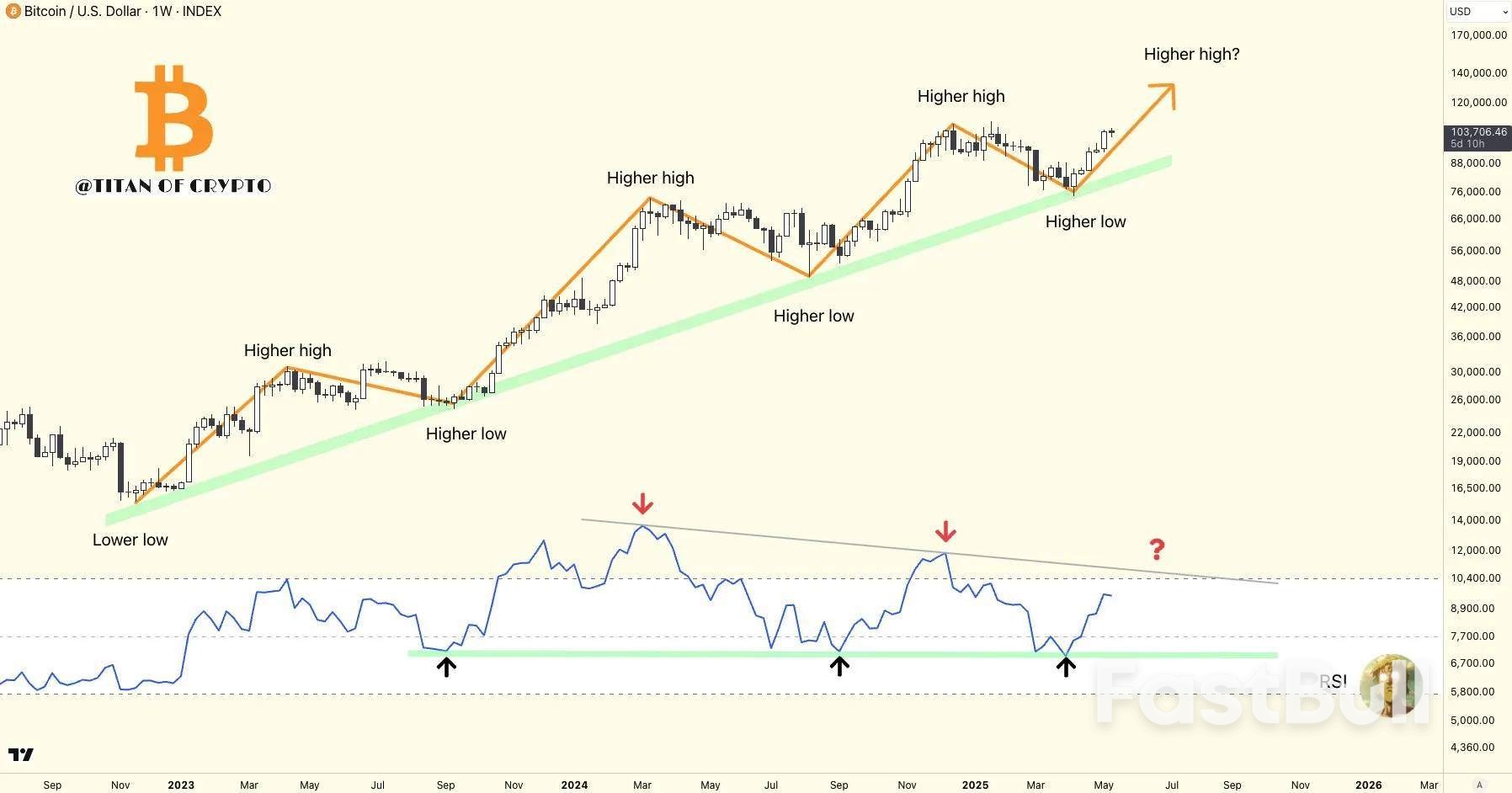
Although the price response was mild, technical analysts remain optimistic. Noted crypto analyst Titan of Crypto shared the following chart indicating a potential move to new all-time highs, driven by a strengthening weekly Relative Strength Index (RSI).
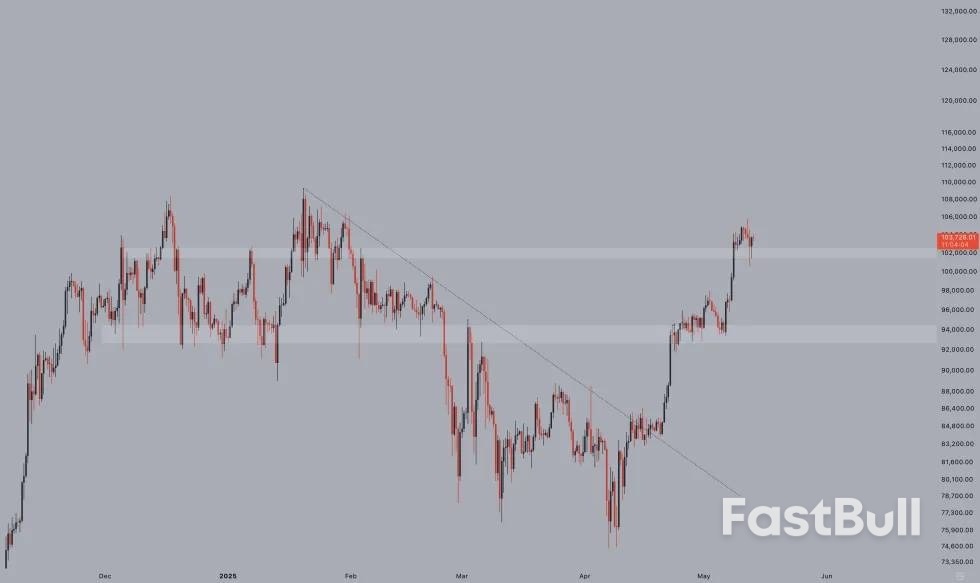
Source: Titan of Crypto on XSimilarly, crypto analyst Jelle commented on BTC’s resilience around the $102,000 level, suggesting this may act as a strong support zone. “Not much is left to hold BTC back now,” the analyst noted, indicating confidence in a continued rally.
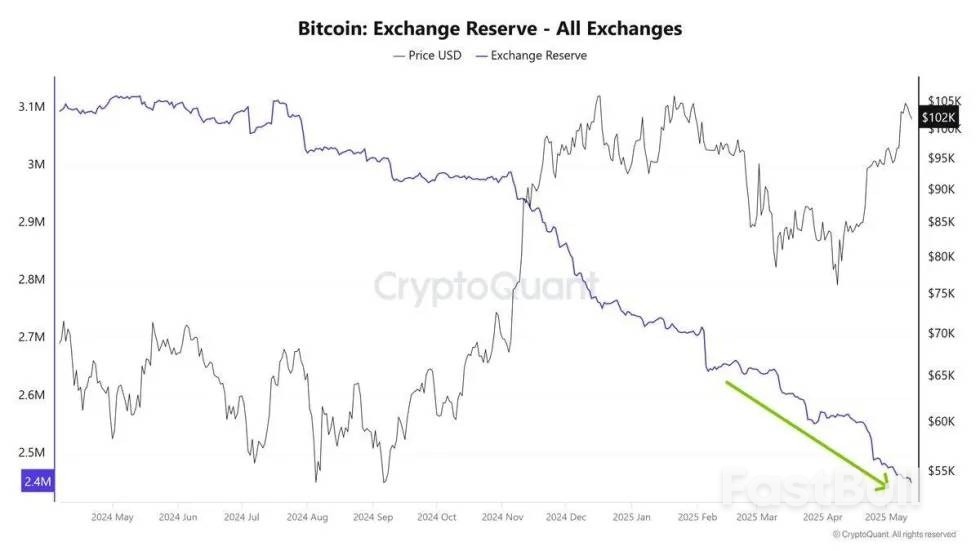
Source: Jelle on XOn-chain data also supports the bullish outlook. Crypto influencer Davinci Jeremie pointed out in a recent X post that Bitcoin reserves on centralized exchanges have dropped significantly and are now hovering around 2.4 million BTC – a level that could contribute to a looming supply shock.
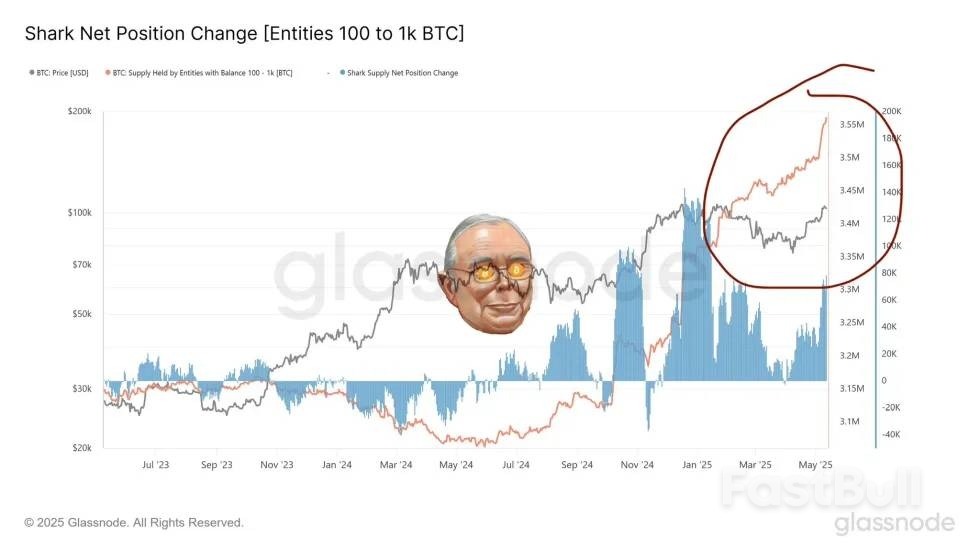
Source: Davinci Jeremie on XLower BTC reserves on crypto exchanges are likely to bolster the supply shock narrative for the flagship cryptocurrency, which may lead to a parabolic price action. Data also shows that large investors are accumulating BTC.
In a separate X post, crypto analyst Bitcoin Munger shared the following chart which shows that BTC sharks – wallets holding 100 to 1,000 BTC – have been accumulating BTC at a rapid pace. Currently, these entities hold more than 3.55 BTC collectively.
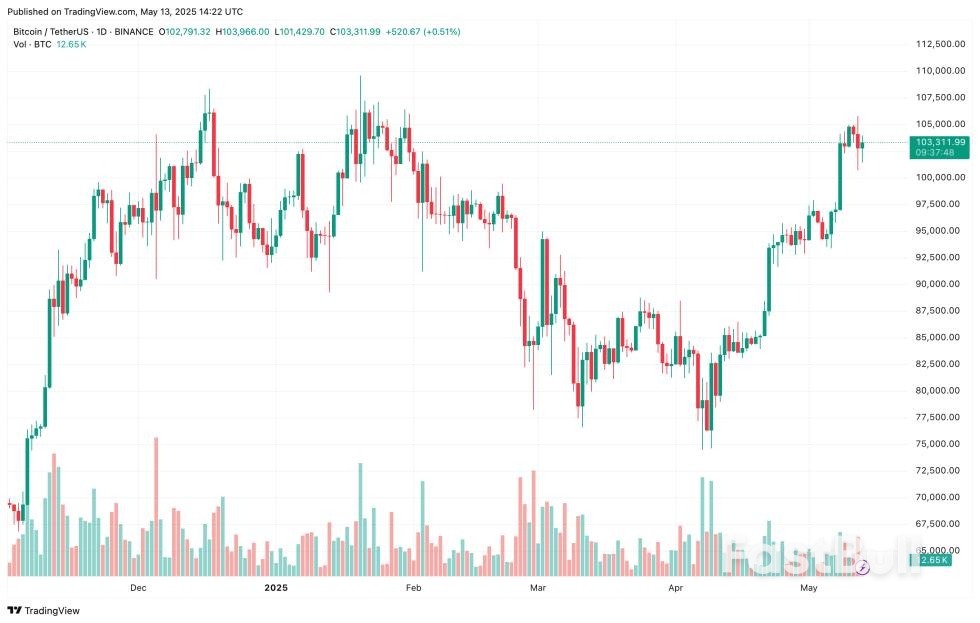
Source: Bitcoin Munger on XThat said, recent data shows that open interest has not risen in tandem with the rise in BTC price, which may be a cause for concern. At press time, BTC trades at $103,311, up a modest 0.1% in the past 24 hours.
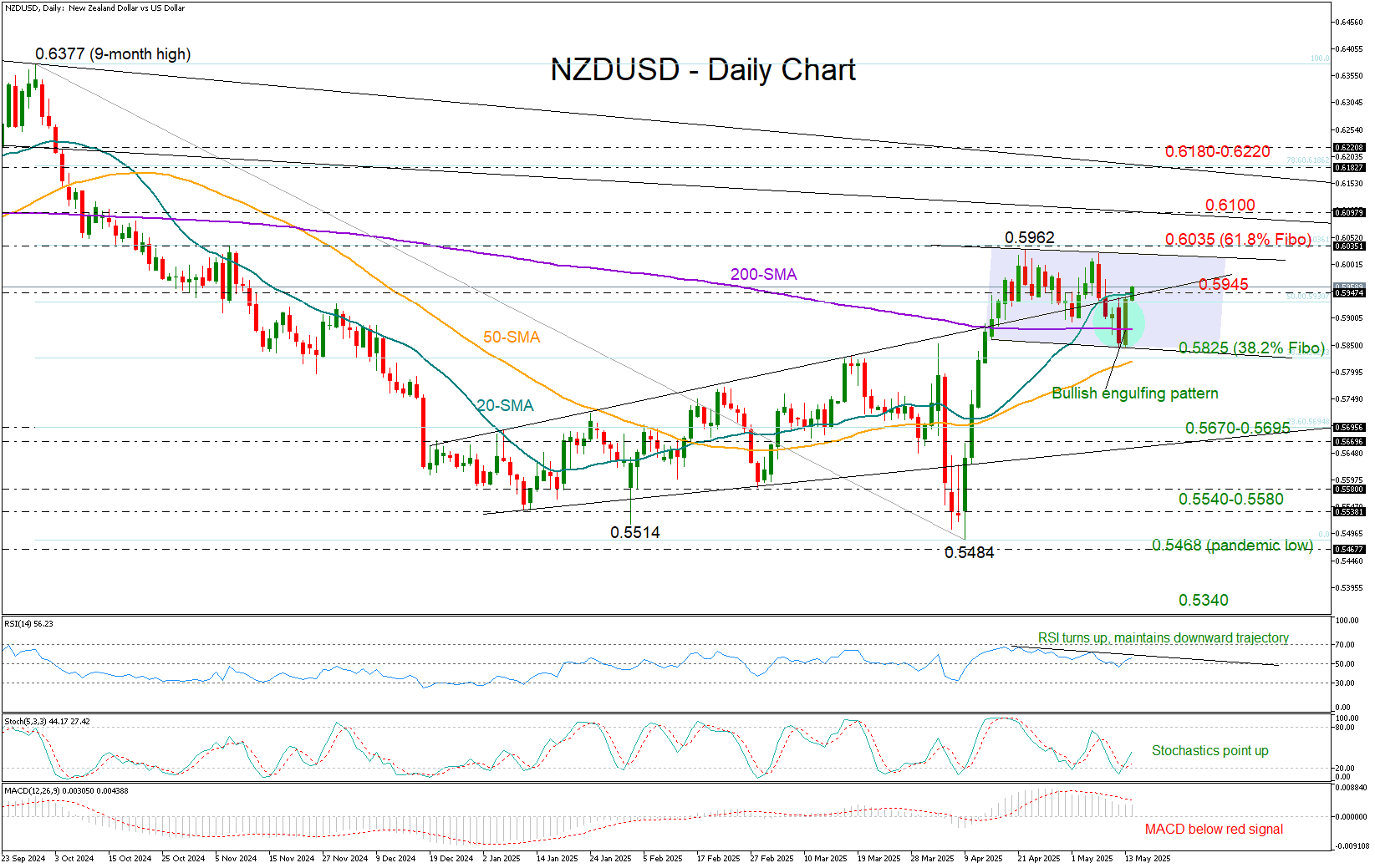
BTC trades at $103,311 on the daily chart | Source: BTCUSDT on TradingView.comNZD/USD dropped to Monday’s low of 0.5845 before bouncing back to retest its 20-day simple moving average (SMA) at 0.5945, as the euphoria about the US-China trade deal faded, weighing on the US dollar. With the price still hovering around this line and near the 50% Fibonacci retracement level of the September–April downleg, the key question now is whether the bulls have enough momentum to break through that resistance and push into the 0.6000 area.
The positive rotation in the RSI and the stochastic oscillator, coupled with the bullish engulfing candlestick pattern formed on Tuesday, may help sustain buying interest. However, some caution is warranted, as the RSI remains on a downward slope, and the MACD continues to ease below its red signal line.
A continuation above the 61.8% Fibonacci level at 0.6020-0.6035 could place the pair back on a bullish track in the short-term picture, with resistance likely emerging near the 0.6100 level or even higher in the 0.6180–0.6220 region. Further gains beyond that could pave the way toward the October 2024 high of 0.6377.
In a bearish scenario, where the pair falls below the 38.2% Fibonacci level at 0.5825, the sell-off could accelerate toward the 0.5670–0.5695 region. A failure to stabilize there could drag the price further down to 0.5540–0.5580 and potentially toward the pandemic low of 0.5468.
Overall, NZD/USD may remain supported in the short term, though a sustained move above 0.6020 is needed to confirm a return to a bullish trajectory.
The 2.80% spike in the overall crypto market cap has pushed it to $3.38 trillion, with the greedy sentiment lingering as the fear and greed index value positioned at 74. All the major assets have been charted in green, reclaiming their recent highs. Notably, the largest altcoin, Ethereum, has achieved its recovery attempt.
ETH has escaped the downside pressure by securing an 8.97% gain over the last 24 hours. The altcoin could continue trading on the upside if the bulls sustain. Also, a breakout above the $3K threshold is essential to fuel an aggressive upward move.
The altcoin opened the day trading at the bottom range of $2,453. After the bulls came into command, the price rose toward the $2,736 mark, breaking the crucial resistances at $2,577 and $2,706.
Ethereum trades at around $2,675 at press time, with a market cap of $322 billion. The daily trading volume has increased by over 11.94%, reaching $36.64 billion. Furthermore, the market has seen a liquidation of $158.04 million in ETH, as per Coinglass data.
The four-hour trading chart has exhibited a brief upside pressure, lighting up the green candle. Ethereum could likely climb to the crucial resistance at the $2,710 range. An extended upside correction might send the price toward $2.8K. A sustained bullish momentum triggers a prolonged upward move.
Assuming the bears came in command, the price could retrace to the $2,606 support level. Further downside price action triggers the death cross to emerge, and Ethereum might fall back to the former low at $2.5K or even lower. Additional setbacks could slow down and complicate the recovery.
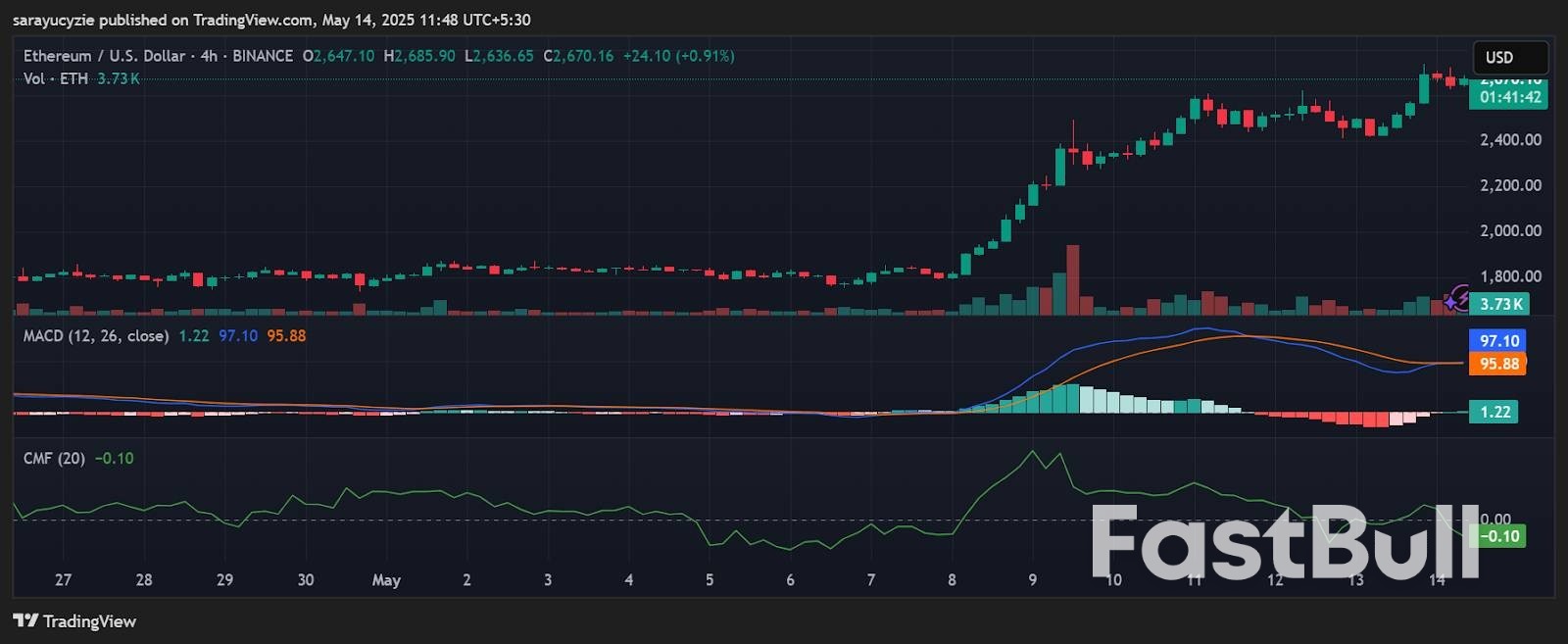
ETH chart (Source: TradingView)ETH’s Moving Average Convergence Divergence (MACD) line is settled above the signal line. This implies a bullish crossover, and the asset’s price may gain upward strength. It is often seen as a buy signal. Moreover, the Chaikin Money Flow (CMF) indicator value is found at -0.10 hints at mild selling pressure in the market, with the capital flowing out of the asset.
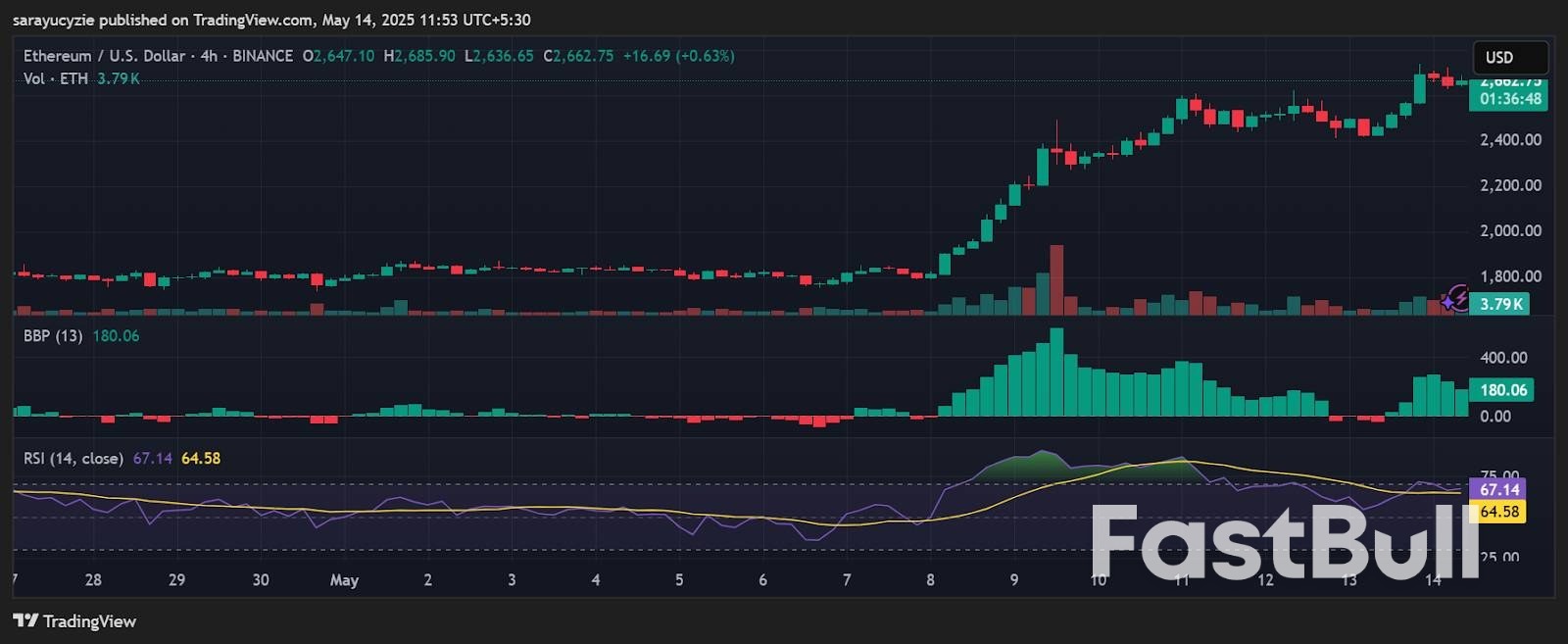
ETH chart (Source: TradingView)The altcoin’s daily relative strength index (RSI) at 67.14 indicates that the asset is approaching the overbought territory. This bullish momentum may face resistance or a potential pullback. Besides, Ethereum’s Bull Bear Power (BBP) reading of 180.06 suggests sturdy dominance of bulls in the market.
Bitcoin has surged back to $100,000 in May 2025, primarily driven by increased institutional adoption and ETF flows fueling liquidity.
This resurgence underscores the significant role institutional capital plays in driving cryptocurrency markets, attracting 'smart money' and amplifying associated altcoin volatility.
The recent rally in Bitcoin reaching $100,000 owes much to ETF flows and increased institutional participation. The price surge reflects growing confidence in Bitcoin's role in mainstream finance and strong market momentum.
Investors, including major institutional asset managers, have focused on Bitcoin, infusing substantial capital. The emphasis on ETF-driven liquidity has accentuated Bitcoin's market dominance, altering traditional asset classes.
The surge has led to increased attention from market analysts who view the $100,000 mark as critical. "For May 2025, Bitcoin is holding firm above major resistance turned support at $100,000, signaling trend continuation. Momentum indicators, price structure, and trend overlays all support further upside." Analysts forecast that institutional ETF inflows will continue driving Bitcoin's momentum. The shift may impact regulatory perspectives and prompt technological adaptations. Continued high-volume trading is expected to influence altcoin volatility.
Historically, Bitcoin rallies have correlated with strong institutional narratives, evident in past ETF speculation phases. Major gains were observed during the 2020-21 rise and previous halving cycles, driven by similar market forces.
Drawing insights from past events, experts suggest that structural ETF flows and macroeconomic factors play as significant drivers of current trends. The continuous capital infusion points to a sustained long-term Bitcoin trajectory.
U.S. stock futures edged marginally lower Wednesday, handing back some gains after the positive start to the week on optimism around the U.S.-China trade deal.
At 05:15 ET (09:15 GMT), Dow Jones Futures dropped 10 points, or 0.1%, S&P 500 Futures fell 5 points, or 0.1%, and Nasdaq 100 Futures slipped 20 points, or 0.1%.
The Dow Jones Industrial Average closed 0.6% lower Tuesday, dragged by a nearly 18% slump in UnitedHealth (NYSE:UNH), but the S&P 500 index rose 0.7%, while theNASDAQ Composite jumped 1.6%.
The main Wall Street indices have rebounded strongly on relief after the announcement of a U.S.-China trade deal, with the broad-based S&P 500 now turning positive for the year, for the first time since February.
Investors appear to be pausing for breath after volatile trading since the start of April, when U.S. President Donald Trump started the trade war with the announcement of his widespread "reciprocal" tariffs.
That said, any news over the potential for more deals will be studied carefully.
Additionally, Reuters reported that the Trump administration will slash the so-called "de minimis" tariff on low-value imported packages from China to as low as 30%.
On Monday, the White House unveiled an executive order bringing down the duty on these direct-to-consumer packaged items valued at $800 or less to 54% from 120%, adding to optimism spurred on by an earlier trade truce between Washington and Beijing. A flat fee of $100 remained in effect, although a planned increase to $200 in June was scrapped.
The U.S. economic data slate is largely empty Wednesday, but there are a number of Fed officials set to speak. Their comments will be followed closely as investors attempt to gauge the future path of interest rates this year, especially after monthly inflation figures undershot expectations on Tuesday.
“So while the de-escalation of trade tensions is helpful for growth, it also makes it more likely that inflation will be less of an issue for the Federal Reserve and the scope for Fed rate cuts remains,” ING analysts said in a note.
ING still expects the Fed to wait until September to cut rates, but said a cut of 25 basis points seems more likely now than the previously anticipated 50 bps.
Highlighting the earnings calendar on Wednesday will be quarterly results from Cisco Systems (NASDAQ:CSCO), with analysts curious to see how the technology equipment firm views the impact from U.S. duties on its finances.
The tech sector was in the spotlight on Tuesday, with Nvidia (NASDAQ:NVDA) posting strong gains, after announcing the sale of 18,000 AI chips to Saudi Arabian company Humain. The Saudi-based company intends to use the chips to build its 500 megawatt data center.
Elsewhere, several other firms are due to announce results, including DXC Technology (NYSE:DXC), Hawkins (NASDAQ:HWKN) and Jack In The Box (NASDAQ:JACK).
Oil prices edged lower Wednesday from the recent two-week high after a sharp jump in U.S. oil inventories raised demand concerns.
At 05:15 ET, Brent futures slipped 0.5% to $66.27 a barrel, and U.S. West Texas Intermediate crude futures fell 0.5% to $63.33 a barrel.
U.S. crude stocks rose 4.3 million barrels in the week ended May 9, according to data from the industry body American Petroleum Institute, released on Tuesday.
Official weekly inventory figures from the U.S. Energy Information Administration are due later in the session, and could indicate that the demand side is still grappling with significant challenges.
Both benchmarks had climbed more than 2.5% in the previous session, adding to Monday’s gains, after China and the U.S., the two largest crude consumers, agreed to pause their trade war for at least 90 days while cutting their respective tariffs.
White Label
Data API
Web Plug-ins
Poster Maker
Affiliate Program
The risk of loss in trading financial instruments such as stocks, FX, commodities, futures, bonds, ETFs and crypto can be substantial. You may sustain a total loss of the funds that you deposit with your broker. Therefore, you should carefully consider whether such trading is suitable for you in light of your circumstances and financial resources.
No decision to invest should be made without thoroughly conducting due diligence by yourself or consulting with your financial advisors. Our web content might not suit you since we don't know your financial conditions and investment needs. Our financial information might have latency or contain inaccuracy, so you should be fully responsible for any of your trading and investment decisions. The company will not be responsible for your capital loss.
Without getting permission from the website, you are not allowed to copy the website's graphics, texts, or trademarks. Intellectual property rights in the content or data incorporated into this website belong to its providers and exchange merchants.
Not Logged In
Log in to access more features

FastBull Membership
Not yet
Purchase
Log In
Sign Up