• Trade
  • Markets
  • Copy
  • Contests
  • News
  • 24/7
  • Calendar
  • Q&A
  • Chats
Trending
Screeners
SYMBOL
LAST
BID
ASK
HIGH
LOW
NET CHG.
%CHG.
SPREAD
SPX
S&P 500 Index
6827.42
6827.42
6827.42
6899.86
6801.80
-73.58
-1.07%
--
DJI
Dow Jones Industrial Average
48458.04
48458.04
48458.04
48886.86
48334.10
-245.98
-0.51%
--
IXIC
NASDAQ Composite Index
23195.16
23195.16
23195.16
23554.89
23094.51
-398.69
-1.69%
--
USDX
US Dollar Index
97.890
97.970
97.890
98.070
97.870
-0.060
-0.06%
--
EURUSD
Euro / US Dollar
1.17464
1.17471
1.17464
1.17486
1.17262
+0.00070
+ 0.06%
--
GBPUSD
Pound Sterling / US Dollar
1.33854
1.33863
1.33854
1.33895
1.33546
+0.00147
+ 0.11%
--
XAUUSD
Gold / US Dollar
4341.25
4341.68
4341.25
4350.16
4294.68
+41.86
+ 0.97%
--
WTI
Light Sweet Crude Oil
56.944
56.974
56.944
57.601
56.878
-0.289
-0.50%
--

Community Accounts

Signal Accounts
--
Profit Accounts
--
Loss Accounts
--
View More

Become a signal provider

Sell trading signals to earn additional income

View More

Guide to Copy Trading

Get started with ease and confidence

View More

Signal Accounts for Members

All Signal Accounts

Best Return
  • Best Return
  • Best P/L
  • Best MDD
Past 1W
  • Past 1W
  • Past 1M
  • Past 1Y

All Contests

  • All
  • Trump Updates
  • Recommend
  • Stocks
  • Cryptocurrencies
  • Central Banks
  • Featured News
Top News Only
Share

Garanti Bank CEO Tells Reuters He Expects Turkish Credit Curbs To Largely Remain In 2026, Limiting Sector Growth

Share

EU Commission Spokersperson: EU Commission President Set To Travel To Berlin Monday Evening

Share

Brazil Economists See Brazilian Real At 5.40 Per Dollar By Year-End 2025 Versus 5.40 In Previous Estimate - Central Bank Poll

Share

Brazil Economists See Year-End 2026 Interest Rate Selic At 12.13% Versus 12.25% In Previous Estimate - Central Bank Poll

Share

Indonesia Minister: Final Agreement With USA On Tariffs Will Be Signed By Both Leaders And It Likely Would Not Happened This Year

Share

EU Commission Spokesperson: EU Commission Still Expects To Sign EU MERCOSUR Agreement By The End Of The Year

Share

New Czech Finance Minister Schillerova: Aiming For 2026 Budget To Be Approved By Cabinet In Second Half Of January

Share

Capital One Financial-30+ Day Performing Delinquencies Rate For Domestic Credit Card 4.01% At November End

Share

Capital One Financial- November Domestic Credit Card Net Charge-Offs Rate 5.02%

Share

Capital One Financial - November Auto Net Charge-Offs Rate 1.71%

Share

Capital One Financial - 30+ Day Performing Delinquencies Rate For Auto 5.02% At November End

Share

Brazil's Igp-10 Price Index Rises 0.04% In Dec

Share

Ukraine President Zelenskiy Will Meet Dutch Prime Minister Schoof And Dutch King In The Hague On Tuesday

Share

Pakistan Central Bank: Cuts Key Rate By 50 Bps To 10.50%

Share

German Government Spokesperson: Russian Central Bank Lawsuit Has No Impact On EU Plans To Use Frozen Russian State Assets For Ukraine

Share

German Government Spokesperson: United States Is Also Invited To This Evening's Talks Between The Europeans And Ukraine President Zelenskiy

Share

EU Official: EU Foreign Ministers Adopt Sanctions Targeting 14 Persons, Entities Under Russia Hybrid Threats Regime

Share

Polish Zloty Firms To 4.2175 Versus Euro, Strongest Since Early April

Share

China Npc Standing Committee Meeting To Review Draft Revision To Foreign Trade Law

Share

China Npc Standing Committee To Hold Meeting Dec 22-27

TIME
ACT
FCST
PREV
China, Mainland M0 Money Supply YoY (Nov)

A:--

F: --

P: --

China, Mainland M1 Money Supply YoY (Nov)

A:--

F: --

P: --

India CPI YoY (Nov)

A:--

F: --

P: --

India Deposit Gowth YoY

A:--

F: --

P: --

Brazil Services Growth YoY (Oct)

A:--

F: --

P: --

Mexico Industrial Output YoY (Oct)

A:--

F: --

P: --

Russia Trade Balance (Oct)

A:--

F: --

P: --

Philadelphia Fed President Henry Paulson delivers a speech
Canada Building Permits MoM (SA) (Oct)

A:--

F: --

P: --

Canada Wholesale Sales YoY (Oct)

A:--

F: --

P: --

Canada Wholesale Inventory MoM (Oct)

A:--

F: --

P: --

Canada Wholesale Inventory YoY (Oct)

A:--

F: --

P: --

Canada Wholesale Sales MoM (SA) (Oct)

A:--

F: --

P: --

Germany Current Account (Not SA) (Oct)

A:--

F: --

P: --

U.S. Weekly Total Rig Count

A:--

F: --

P: --

U.S. Weekly Total Oil Rig Count

A:--

F: --

P: --

Japan Tankan Small Manufacturing Outlook Index (Q4)

A:--

F: --

P: --

Japan Tankan Large Non-Manufacturing Diffusion Index (Q4)

A:--

F: --

P: --

Japan Tankan Large Non-Manufacturing Outlook Index (Q4)

A:--

F: --

P: --

Japan Tankan Large Manufacturing Outlook Index (Q4)

A:--

F: --

P: --

Japan Tankan Small Manufacturing Diffusion Index (Q4)

A:--

F: --

P: --

Japan Tankan Large Manufacturing Diffusion Index (Q4)

A:--

F: --

P: --

Japan Tankan Large-Enterprise Capital Expenditure YoY (Q4)

A:--

F: --

P: --

U.K. Rightmove House Price Index YoY (Dec)

A:--

F: --

P: --

China, Mainland Industrial Output YoY (YTD) (Nov)

A:--

F: --

P: --

China, Mainland Urban Area Unemployment Rate (Nov)

A:--

F: --

P: --

Saudi Arabia CPI YoY (Nov)

A:--

F: --

P: --

Euro Zone Industrial Output YoY (Oct)

A:--

F: --

P: --

Euro Zone Industrial Output MoM (Oct)

A:--

F: --

P: --

Canada Existing Home Sales MoM (Nov)

A:--

F: --

P: --

Canada National Economic Confidence Index

--

F: --

P: --

Canada New Housing Starts (Nov)

--

F: --

P: --

U.S. NY Fed Manufacturing Employment Index (Dec)

--

F: --

P: --

U.S. NY Fed Manufacturing Index (Dec)

--

F: --

P: --

Canada Core CPI YoY (Nov)

--

F: --

P: --

Canada Manufacturing Unfilled Orders MoM (Oct)

--

F: --

P: --

U.S. NY Fed Manufacturing Prices Received Index (Dec)

--

F: --

P: --

U.S. NY Fed Manufacturing New Orders Index (Dec)

--

F: --

P: --

Canada Manufacturing New Orders MoM (Oct)

--

F: --

P: --

Canada Core CPI MoM (Nov)

--

F: --

P: --

Canada Trimmed CPI YoY (SA) (Nov)

--

F: --

P: --

Canada Manufacturing Inventory MoM (Oct)

--

F: --

P: --

Canada CPI YoY (Nov)

--

F: --

P: --

Canada CPI MoM (Nov)

--

F: --

P: --

Canada CPI YoY (SA) (Nov)

--

F: --

P: --

Canada Core CPI MoM (SA) (Nov)

--

F: --

P: --

Canada CPI MoM (SA) (Nov)

--

F: --

P: --

Federal Reserve Board Governor Milan delivered a speech
U.S. NAHB Housing Market Index (Dec)

--

F: --

P: --

Australia Composite PMI Prelim (Dec)

--

F: --

P: --

Australia Services PMI Prelim (Dec)

--

F: --

P: --

Australia Manufacturing PMI Prelim (Dec)

--

F: --

P: --

Japan Manufacturing PMI Prelim (SA) (Dec)

--

F: --

P: --

U.K. 3-Month ILO Employment Change (Oct)

--

F: --

P: --

U.K. Unemployment Claimant Count (Nov)

--

F: --

P: --

U.K. Unemployment Rate (Nov)

--

F: --

P: --

U.K. 3-Month ILO Unemployment Rate (Oct)

--

F: --

P: --

U.K. Average Weekly Earnings (3-Month Average, Including Bonuses) YoY (Oct)

--

F: --

P: --

U.K. Average Weekly Earnings (3-Month Average, Excluding Bonuses) YoY (Oct)

--

F: --

P: --

France Services PMI Prelim (Dec)

--

F: --

P: --

France Manufacturing PMI Prelim (Dec)

--

F: --

P: --

Q&A with Experts
    • All
    • Chatrooms
    • Groups
    • Friends
    Connecting
    .
    .
    .
    Type here...
    Add Symbol or Code

      No matching data

      All
      Trump Updates
      Recommend
      Stocks
      Cryptocurrencies
      Central Banks
      Featured News
      • All
      • Russia-Ukraine Conflict
      • Middle East Flashpoint
      • All
      • Russia-Ukraine Conflict
      • Middle East Flashpoint
      Search
      Products

      Charts Free Forever

      Chats Q&A with Experts
      Screeners Economic Calendar Data Tools
      Membership Features
      Data Warehouse Market Trends Institutional Data Policy Rates Macro

      Market Trends

      Market Sentiment Order Book Forex Correlations

      Top Indicators

      Charts Free Forever
      Markets

      News

      News Analysis 24/7 Columns Education
      From Institutions From Analysts
      Topics Columnists

      Latest Views

      Latest Views

      Trending Topics

      Top Columnists

      Latest Update

      Signals

      Copy Rankings Latest Signals Become a signal provider AI Rating
      Contests
      Brokers

      Overview Brokers Assessment Rankings Regulators News Claims
      Broker listing Forex Brokers Comparison Tool Live Spread Comparison Scam
      Q&A Complaint Scam Alert Videos Tips to Detect Scam
      More

      Business
      Events
      Careers About Us Advertising Help Center

      White Label

      Data API

      Web Plug-ins

      Affiliate Program

      Awards Institution Evaluation IB Seminar Salon Event Exhibition
      Vietnam Thailand Singapore Dubai
      Fans Party Investment Sharing Session
      FastBull Summit BrokersView Expo
      Recent Searches
        Top Searches
          Markets
          News
          Analysis
          User
          24/7
          Economic Calendar
          Education
          Data
          • Names
          • Latest
          • Prev

          View All

          No data

          Scan to Download

          Faster Charts, Chat Faster!

          Download App
          English
          • English
          • Español
          • العربية
          • Bahasa Indonesia
          • Bahasa Melayu
          • Tiếng Việt
          • ภาษาไทย
          • Français
          • Italiano
          • Türkçe
          • Русский язык
          • 简中
          • 繁中
          Open Account
          Search
          Products
          Charts Free Forever
          Markets
          News
          Signals

          Copy Rankings Latest Signals Become a signal provider AI Rating
          Contests
          Brokers

          Overview Brokers Assessment Rankings Regulators News Claims
          Broker listing Forex Brokers Comparison Tool Live Spread Comparison Scam
          Q&A Complaint Scam Alert Videos Tips to Detect Scam
          More

          Business
          Events
          Careers About Us Advertising Help Center

          White Label

          Data API

          Web Plug-ins

          Affiliate Program

          Awards Institution Evaluation IB Seminar Salon Event Exhibition
          Vietnam Thailand Singapore Dubai
          Fans Party Investment Sharing Session
          FastBull Summit BrokersView Expo

          Powell Warns of Prolonged High Interest Rates as Fed Launches Five-Year Policy Framework

          Gerik

          Economic

          Summary:

          Fed Chair Jerome Powell signaled that the U.S. may be entering an era of structurally higher interest rates due to frequent supply shocks, while the central bank begins developing a five-year strategic policy...

          Powell Flags Structural Shift in Interest Rate Outlook

          Speaking at the Thomas Laubach Research Conference in Washington on May 15, Federal Reserve Chair Jerome Powell warned that long-term interest rates are likely to remain elevated due to a changing economic landscape and persistent monetary uncertainty. Powell noted that the U.S. is transitioning out of the ultra-low rate environment that defined the 2010s, and that “the era of near-zero rates is unlikely to return soon.”
          The Fed’s benchmark interest rate currently sits at 4.25–4.5%, with recent trades near 4.33%. This is a stark contrast to the 2008–2015 period, when rates were effectively zero for seven years. Powell’s remarks come amid lingering inflation pressures and the potential for recurring global supply disruptions, which he described as “major shocks” that could persistently affect both inflation and central bank policy responses.

          Supply Shocks, Inflation, and the Trump Trade Effect

          Powell emphasized that the Federal Reserve now views inflation volatility and supply-side disturbances—such as those seen during the pandemic and energy crises—as more structural than previously assumed. While he did not directly reference President Trump’s trade policies, Powell acknowledged in prior remarks that tariffs can both slow growth and fuel inflation, adding to the policy dilemma the Fed faces.
          Currently, the U.S. is in a 90-day tariff de-escalation period with China, but further trade uncertainty looms. Powell stressed that the central bank must remain cautious in loosening policy, especially after previously misjudging the persistence of inflation in 2021.

          Fed’s Five-Year Strategic Policy Framework

          To guide decision-making in this complex environment, the Fed will undertake a comprehensive five-year review of its policy framework. This initiative will revisit key elements such as how the Fed forecasts economic conditions, how it communicates uncertainty to markets, and how it responds to deviations from inflation and employment targets.
          The last major framework overhaul occurred in 2020 during the height of the COVID-19 pandemic, when the Fed adopted a flexible average inflation targeting (FAIT) strategy—allowing inflation to exceed 2% temporarily to support job growth. However, this strategy came under fire after inflation surged far beyond expectations, forcing the Fed into one of its most aggressive rate-hiking cycles in decades.
          In the upcoming review, Powell noted that there will be particular attention paid to how the Fed defines and responds to “shortfalls” in inflation or employment, and whether those terms create confusion or policy inertia. Many Fed officials have since conceded that the 2021 inflation spike was initially mischaracterized as "transitory."

          Improving Policy Communication in a Volatile Era

          Powell emphasized that improving how the Fed communicates with markets and the public will be a central focus of the new framework. While the Fed is widely praised for its transparency, Powell admitted that during turbulent periods, “conveying the degree of uncertainty clearly becomes essential.”
          He added that clarity around how the Fed interprets economic shocks—particularly those related to supply constraints, labor markets, and geopolitical instability—will be crucial to maintaining credibility and anchoring expectations.

          Preparing for an Era of Complexity

          Powell’s remarks reflect a broader institutional realization that the post-pandemic economy is less predictable, more shock-prone, and structurally different from the past. The Federal Reserve’s new five-year strategic review signals a commitment to adapting its tools, language, and flexibility in response to an evolving economic environment.
          The full details of the framework are expected to be released “in the coming months.” While Powell did not confirm the venue, speculation suggests the Jackson Hole Symposium, where the 2020 policy pivot was first unveiled, may again serve as the platform for announcing the Fed’s next chapter.

          Source: CNBC

          To stay updated on all economic events of today, please check out our Economic calendar
          Risk Warnings and Disclaimers
          You understand and acknowledge that there is a high degree of risk involved in trading. Following any strategies or investment methods may lead to potential losses. The content on the site is provided by our contributors and analysts for information purposes only. You are solely responsible for determining whether any trading assets, securities, strategy, or any other product is suitable for investing based on your own investment objectives and financial situation.
          Add to Favorites
          Share

          Wall Street Rides High—But Powell’s Warning and Geopolitical Risks Temper Market Optimism

          Gerik

          Economic

          Stocks

          Stock Markets Enjoy Momentum, But Clouds Gather

          The S&P 500 climbed 0.41% on Thursday, marking its fourth straight session of gains and capping a 4.54% rise over four days. The Dow Jones Industrial Average gained 0.65%, while the Nasdaq dipped 0.18%. European stocks also joined the rally, with the pan-European Stoxx 600 and FTSE 100 rising 0.56% and 0.57% respectively, aided by better-than-expected U.K. GDP data.
          Yet beneath this rally lies a current of unresolved uncertainty. While investors welcomed the temporary U.S.-China tariff truce, unresolved disputes over rare earth exports, high interest rates, and tense diplomacy still pose downside risks.

          Powell Flags Structural Risks Ahead

          Fed Chair Jerome Powell delivered a sobering counterpoint to the upbeat market sentiment during a speech at a central bank conference. He warned that interest rates may remain higher for longer due to increased risk of persistent and frequent supply shocks. Though he did not reference U.S. tariffs directly, Powell’s remarks echo concerns that protectionist measures—like those advanced by President Trump—could disrupt supply chains and feed into long-term inflation volatility.
          These remarks come as the Fed balances its inflation-fighting mandate with managing external shocks, including energy volatility, geopolitical disruptions, and trade restrictions.

          Rare Earth Exports Still a Flashpoint

          Despite last weekend’s U.S.-China trade deal, China continues to block exports of seven key rare earth elements to the U.S., materials vital for sectors including defense, EVs, and clean energy. This undercuts the short-term optimism around bilateral trade improvements and highlights the fragility of the current détente.
          Beijing has only partially lifted restrictions, allowing 28 U.S. companies to apply for export licenses, but the most strategic materials remain restricted, leaving American manufacturers vulnerable.

          Trump’s Trade Policy and the Apple Friction

          President Trump’s personal intervention in trade negotiations has added another layer of complexity. His rebuke of Apple CEO Tim Cook for expanding production in India—despite ongoing U.S.-India trade talks—has raised eyebrows. Trump reportedly said, “I don’t want you building in India,” suggesting a push for reshoring U.S. manufacturing that could disrupt corporate global strategies and sour bilateral deals.
          While India remains an attractive manufacturing base, Trump’s stance could strain tech supply chains and further complicate trade negotiations with New Delhi.

          Geopolitical Pressures and Diplomatic Signals

          Both President Trump and Russian President Vladimir Putin opted to skip Ukraine-Russia peace talks in Turkey, sending lower-level delegations instead. Ukraine’s President Zelenskyy interpreted this as a sign that Moscow isn’t serious about ending the war. The absence of the U.S. president also limits the weight Washington brings to de-escalation efforts.
          Meanwhile, U.S.-U.K. trade deals are reportedly poised to benefit a European automaker with U.K. operations—underscoring how individual companies may benefit from political realignments while the broader EU still awaits its own bilateral arrangement with Washington.

          India’s Resilience Amid Regional Tensions

          Despite recent military tensions with Pakistan, India’s stock market has rebounded above pre-conflict levels. This resilience reflects investor confidence in India’s long-term fundamentals. For many global investors, border skirmishes, though significant, are now seen as manageable variables within a broader investment calculus that favors India’s scale, reforms, and demographic advantages.
          The U.S. stock market is enjoying a moment of strength, powered by easing trade rhetoric and optimism around tech and global growth. However, Fed warnings on inflation volatility, strategic tensions over rare earths, and Trump’s unpredictable trade moves suggest that tailwinds could quickly become turbulence. Investors would be wise to temper their enthusiasm and brace for a market environment shaped as much by diplomacy and policy as by earnings and economic data.

          Source: CNBC

          To stay updated on all economic events of today, please check out our Economic calendar
          Risk Warnings and Disclaimers
          You understand and acknowledge that there is a high degree of risk involved in trading. Following any strategies or investment methods may lead to potential losses. The content on the site is provided by our contributors and analysts for information purposes only. You are solely responsible for determining whether any trading assets, securities, strategy, or any other product is suitable for investing based on your own investment objectives and financial situation.
          Add to Favorites
          Share

          Japan's Economy Contracts Sharply as U.S. Tariff Threat Adds Pressure

          Gerik

          Economic

          GDP Contraction Underscores Fragile Recovery

          Japan’s economy contracted for the first time in a year, with real GDP shrinking 0.7% on an annualized basis in the first quarter of 2025, significantly worse than the 0.2% decline forecast by economists. This pullback followed a strong 2.4% expansion in Q4 2024, highlighting the fragile nature of Japan’s recovery as it braces for the impact of fresh U.S. trade tariffs.
          The quarter-on-quarter contraction of 0.2%—double market expectations—was largely driven by flat private consumption and declining exports. Private consumption, which makes up over half of Japan’s GDP, showed no growth, reflecting subdued domestic sentiment. At the same time, exports fell by 0.6% while imports rose by 2.9%, resulting in external demand dragging GDP growth down by 0.8 percentage points.

          Capital Spending Rises, But May Not Last

          In contrast, capital expenditure increased by 1.4%, well above the 0.8% forecast. Analysts believe this rise reflects front-loading by firms preparing for upcoming U.S. tariffs, particularly in sectors like automobiles and electronics. However, the temporary nature of this uptick suggests that investment momentum may fade as trade tensions escalate.
          Takeshi Minami of Norinchukin Research Institute warned that while Q2 might avoid negative growth, the absence of strong demand drivers could leave the economy directionless. The true impact of tariffs, he noted, will likely determine whether Japan’s modest recovery can be sustained or derailed.

          Trump Tariffs Cast Long Shadow

          The economic data was compiled before the April 2 announcement by U.S. President Donald Trump of sweeping "reciprocal" tariffs. With Japan’s economy heavily reliant on exports, particularly to the U.S., these tariffs pose a significant downside risk. Analysts like Yoshiki Shinke of Dai-ichi Life Research emphasized that Japan’s economy lacks strong internal momentum, making it particularly susceptible to external shocks.
          If these tariffs intensify and dampen exports further, it could force policymakers to reconsider their strategy. Already, the Bank of Japan (BOJ) faces growing pressure as it tries to chart a course for monetary normalization.

          BOJ Caught Between Recovery Hopes and Global Risks

          The BOJ raised rates to 0.5% in January 2025, the first hike in over a decade, after ending its ultra-loose policy stance. Officials had signaled further hikes contingent on a steady recovery and inflation anchored above 2%. However, the latest GDP figures and global trade risks may delay this trajectory.
          At its April 30–May 1 meeting, the BOJ cut its growth forecasts, acknowledging that rising global uncertainty could weaken the wage-led consumption recovery it had been banking on. If the Trump tariffs deliver a serious blow to business confidence or trade volumes, any further rate hikes could be postponed until late 2025 or even shelved altogether.

          Fiscal Stimulus Debate Reignites

          The contraction is also expected to trigger political pressure on Prime Minister Shigeru Ishiba to act. Lawmakers are calling for either a consumption tax cut or a new stimulus package to offset the potential economic damage from trade tensions. With no strong rebound in domestic demand and global headwinds building, fiscal expansion may become a necessary complement to BOJ's cautious monetary stance.
          Japan’s worse-than-expected GDP decline reflects a delicate and vulnerable recovery, now exposed to mounting global risk factors. The looming U.S. tariff regime threatens to further undermine export-driven sectors, while domestic consumption shows no signs of compensating. As both the BOJ and the government reassess their strategies, the coming quarters will be critical in determining whether Japan can stabilize its growth trajectory—or slip back into stagnation.

          Source: Reuters

          To stay updated on all economic events of today, please check out our Economic calendar
          Risk Warnings and Disclaimers
          You understand and acknowledge that there is a high degree of risk involved in trading. Following any strategies or investment methods may lead to potential losses. The content on the site is provided by our contributors and analysts for information purposes only. You are solely responsible for determining whether any trading assets, securities, strategy, or any other product is suitable for investing based on your own investment objectives and financial situation.
          Add to Favorites
          Share

          May 16th Financial News

          FastBull Featured

          Daily News

          [Quick Facts]

          1. Trump announces $200 billion in deals with UAE as Middle East tour concludes.
          2. Barr: Tariff-Related supply chain disruptions may lead to rising inflation.
          3. Powell hints at Fed 'Scrapping' its monetary policy framework revamp, revisits average inflation targeting.
          4. Japan's economy contracts for the first time in a year.
          5. U.S. Homebuilder Sentiment drops to its lowest level since 2023.
          6. U.S. April PPI delivers major 'Surprise' to the downside.
          7. U.S. retail sales decline, suffer 'Waterloo' in April after March buying spree.
          8. New round of Israel-Hamas negotiations begins, significant differences limit progress.

          [News Details]

          Trump announces $200 billion in deals with UAE as Middle East tour concludes
          The White House announced that U.S. President Donald Trump finalized a $200 billion cooperation agreement with the UAE during his visit, including projects in artificial intelligence, which will boost the Gulf nation's technological ambitions. "These deals will significantly expand investment in the United States and U.S. market access in the United Arab Emirates," the White House said in a statement on Thursday. The announcement came during the third and final leg of Trump's Middle East tour. Earlier this week, he unveiled a $600 billion investment plan with Saudi Arabia and a 243 billion cooperation agreement with Qatar. The commercial deals have been a highlight of Trump's first foreign trip since returning to the White House. Thursday's agreement further solidifies the UAE's commitment, following a March meeting between Trump and Mohammed bin Zayed al-Nahyan, the UAE's national security advisor, to invest $1.4 trillion in the U.S. over the next decade, covering AI infrastructure, semiconductors, energy, and manufacturing.
          Barr: Tariff-related supply chain disruptions may lead to rising inflation
          Federal Reserve official Barr stated that the U.S. economy remains solid but warned that supply chain disruptions caused by tariffs could slow growth and increase inflation. Barr emphasized the importance of small businesses and their role in supply chains and the broader economy. He noted that trade policy has cast a shadow over the outlook, adding uncertainty. For small businesses, Potential disruptions to supply chains and distribution networks are "particularly acute", partly due to their limited access to credit. He added that small businesses often provide specialized inputs not easily sourced elsewhere, and their closures could further disrupt supply chains.
          ​Powell hints at Fed 'Scrapping' its monetary policy framework revamp, revisits average inflation targeting
          Federal Reserve Chair Jerome Powell indicated that policymakers are considering adjustments to the core elements of monetary policy guidance, including how they think about shortfalls in US employment and approach their inflation target. The Fed in 2020 revamped its approach to steering the economy in two important ways: After periods when inflation ran persistently below 2%, they would allow it to rise moderately higher for “some time.” They also signaled they wouldn’t preemptively raise interest rates during periods of low unemployment to head off potential inflationary pressures, an effort to mitigate “shortfalls” from their maximum employment goal. Speaking at a research conference on monetary policy frameworks on Thursday, Powell said Officials "have indicated that they thought it would be appropriate to reconsider the language around shortfalls. And at our meeting last week, we had a similar take on average inflation targeting."
          Japan's economy contracts for the first time in a year
          Japan's economy contracted in the first quarter of 2025 for the first time in a year, facing a bumpy road ahead due to the impact of U.S. trade policies. Preliminary data released by the Japanese government on Friday showed that real GDP fell 0.2% quarter-on-quarter in January-March, raising the risk of a technical recession. This contraction contrasts with a 0.1% decline expected by economists surveyed by Quick and follows 0.6% growth in the October-December quarter.
          On an annualized basis, Japan's economy shrank 0.7% in Q1. The data comes amid concerns that U.S. tariffs could pressure Japanese exports and lead businesses to cut investment, potentially undermining Japan's hard-won economic recovery. In Q1, external demand (exports minus imports) dragged growth down by 0.8%. Capital expenditure rose 1.4% quarter-on-quarter, while private consumption was flat. Against a backdrop of strong corporate earnings, businesses have steadily increased investment and raised wages. Although food inflation has dampened household confidence, wage growth is expected to support a consumption recovery.
          U.S. Homebuilder Sentiment drops to its lowest level since 2023
          U.S. homebuilder sentiment fell in May to its lowest level since late 2023, as tariffs made it harder to price homes and anxious consumers hesitated to buy. The NAHB/Wells Fargo Housing Market Index dropped 6 points this month to 34, below all economists' estimates in a Bloomberg survey. All three sub-indices declined, with the gauge for expected sales over the next six months hitting an 18-month low. A current sales indicator fell to its lowest since late 2022, while buyer traffic hit a 1.5-year low.
          U.S. April PPI delivers major 'Surprise' to the downside
          Data from the U.S. Bureau of Labor Statistics on Thursday showed the PPI fell 0.5%, against expectations of a 0.2% rise. Excluding food and energy, the PPI dropped 0.4%, the largest decline since 2015. Stripping out food, energy, and trade, the PPI fell 0.1%, the first drop in five years.
          The unexpected decline, the largest in five years, largely reflects shrinking profit margins, suggesting businesses are absorbing some of the impact of higher tariffs. It indicates U.S. manufacturers and service providers have yet to pass on the full cost of higher import tariffs to consumers. While producers feel the pressure of U.S. tariffs on imported materials and other inputs, the effect on consumers remains relatively muted.
          U.S. retail sales decline, suffer 'Waterloo' in April after March buying spree
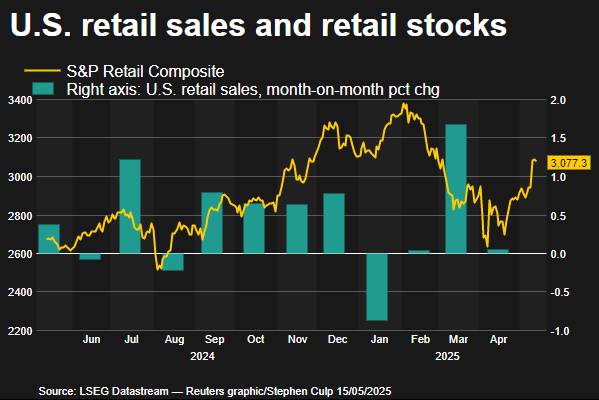
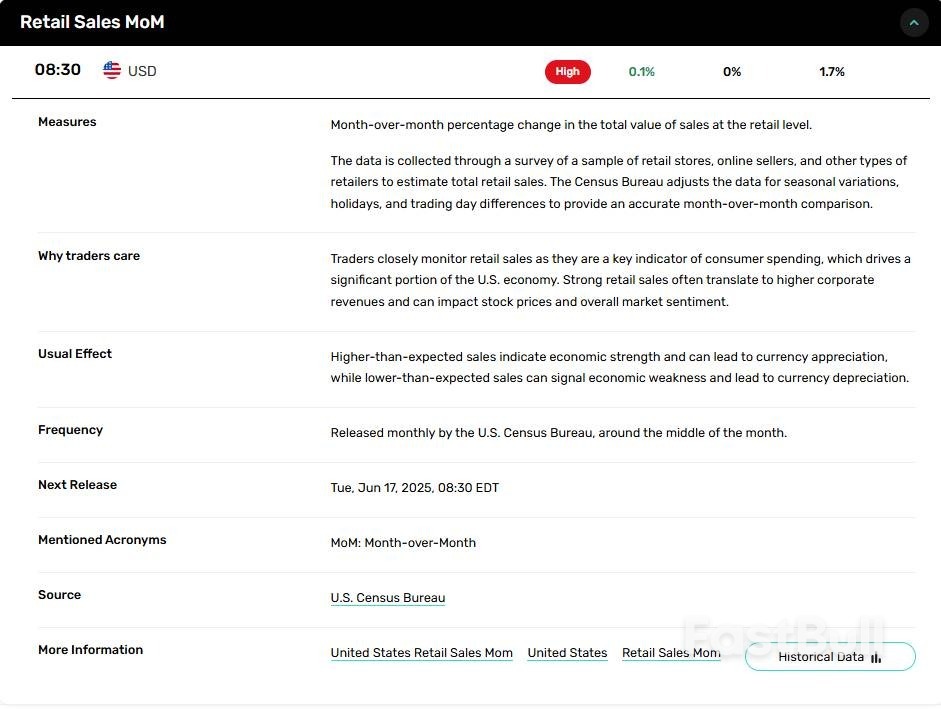
          U.S. retail sales rose just 0.1% month-on-month in April, compared with expectations of 0% and a previous reading of 1.4%. The data showed virtually no growth in April retail sales, suggesting consumers scaled back spending amid concerns about tariff-driven price increases.
          The April figures followed a surge in March, when sales posted their largest gain in over two years as consumers rushed to buy goods ahead of the implementation of most U.S. tariffs.
          Strong consumer spending at the end of Q1 laid the groundwork for Q2 consumption growth. Despite a robust labor market and steady wage growth, households cut discretionary spending on services like airfare and hotel stays amid economic uncertainty and stock market declines.
          New round of Israel-Hamas negotiations begins, significant differences limit progress
          A new round of indirect talks between Israel and Hamas began on May 14th in Doha, Qatar. Based on signals from the first day, progress has been limited, with significant differences on key issues complicating the outlook. Qatar's Prime Minister and Foreign Minister, Mohammed, acting as a mediator, told media that Israel's ongoing large-scale military operations in Gaza, while participating in talks, suggest little interest in a ceasefire, and he expects no quick breakthroughs.
          Israel, as usual, has taken a hardline stance, hoping to "negotiate through force." In recent days, Israel has escalated military operations in Gaza, causing heavy casualties. Netanyahu has repeatedly emphasized that talks can only proceed "under fire."
          Hamas has explicitly rejected Israel's proposals, insisting on guarantees to end the war before releasing more hostages. However, Hamas has shown more flexibility in negotiations. Mediators say that if Israel agrees to end the war and withdraw from Gaza, Hamas is willing to compromise on disarmament and accept governance of Gaza by an independent committee.
          While this round of talks has resumed, it appears more like a "gesture of consultation" with no immediate signs of a breakthrough. A real impasse-breaker will require more compromises, especially from Israel, which must clarify its strategic goals and soften its military stance-otherwise, these talks may again end in failure.

          [Today's Focus]

          UTC+8 20:30 U.S. April Building Permits MoM
          UTC+8 20:30 U.S. April Housing Starts Annualized MoM
          UTC+8 22:00 U.S. May UoM Consumer Sentiment
          UTC+8 23:00 ECB Chief Economist Lane Speaks
          UTC+8 23:00 BoE Deputy Governor Lombardelli Speaks
          Risk Warnings and Disclaimers
          You understand and acknowledge that there is a high degree of risk involved in trading. Following any strategies or investment methods may lead to potential losses. The content on the site is provided by our contributors and analysts for information purposes only. You are solely responsible for determining whether any trading assets, securities, strategy, or any other product is suitable for investing based on your own investment objectives and financial situation.
          Add to Favorites
          Share

          U.S. Stocks Are Buoyant For Now — But Lurking Dangers Could Weigh Them Down

          Daniel Carter

          Stocks

          Economic

          There's a lightness in the air in Wall Street. Stocks have been rising throughout the week. The S&P 500 has just ended its fourth straight session in the green, giving it a 4.54% bump so far over the past four days.
          Tariffs are looking less thorny, for sure, as the U.S. negotiates agreements with other countries. But that's not to say it'll be a perfectly smooth path ahead.
          For instance, despite its agreement with the U.S., China is still withholding rare earth metals, crucial for important industries such as defense and energy, from being exported to the U.S.
          Similarly, even as India negotiates a deal with America, U.S. President Donald Trump appears to want more than just levies on U.S. imports cut. Trump told Apple CEO Tim Cook he doesn't want the Cupertino-based company "building in India." It's hard to imagine India agreeing to keep Apple's manufacturing out — or for The Big Apple to actually start producing Apple products.
          U.S. Federal Reserve Chair Jerome Powell seemed cognizant of such complications and warned on Thursday that "supply shocks" could be "more frequent, and potentially more persistent" in the future.
          The sense of buoyancy in markets, then, could be a head rush — evoked by the U.S.-China trade deal over the weekend — that could dissipate once the gravity of the economic headwinds takes over again.

          What you need to know today

          Powell warns of potential supply shocksU.S. Federal Reserve Chair Jerome Powell said Thursday at a Fed conference that longer-term interest rates are likely to be higher, given that "inflation could be more volatile going forward" because of the possibility of "more frequent, and potentially more persistent, supply shock" to the economy. Powell didn't name Trump's tariffs, but flagged risks around them at the Fed's May meeting.
          S&P clocks fourth day of winsOn Thursday, the S&P 500 gained 0.41%, its fourth positive session, the Dow Jones Industrial Average rose 0.65% but the Nasdaq Composite underperformed, dropping 0.18%. The pan-European Stoxx 600 climbed 0.56%, recouping losses from early trading. The FTSE 100 added 0.57% as data showed that the U.K. economy grew by an unexpectedly strong 0.7% in the first quarter.
          'A little problem with Tim Cook': TrumpWhile discussing on Thursday Washington's trade relations with India, Trump said that he doesn't want Apple CEO Tim Cook to build factories in India. "I had a little problem with Tim Cook yesterday," Trump said. "I said to him, 'my friend, I treated you very good. You're coming here with $500 billion, but now I hear you're building all over India.' I don't want you building in India."
          Rare earth exports from China still blockedChina has temporarily paused export restrictions targeting 28 American companies following the trade agreement reached by Beijing and the Trump administration over the weekend. But it is continuing to block exports of seven rare earth metals to the United States. Those metals are essential for the U.S.' defense, energy and automotive industries.
          Putin and Trump skip peace meetingRussia leader Vladimir Putin and his White House counterpart Trump opted to skip Ukraine-Russia peace talks in Turkey. Responding to the diplomatic slight as he arrived in Ankara on Thursday to meet Turkish President Recep Tayyip Erdogan, Ukraine President Volodymyr Zelenskyy said that the delegation of lower-ranking officials that Russia had sent to Turkey showed Moscow wasn't serious about talks.
          U.K.-U.S. deal to benefit European automakerBritish businesses are still hashing out exactly what the recently-unveiled U.K.-U.S. trade deal means for them. The European Union is yet to strike its own deal. Despite this, one automaker from the bloc's biggest economy is about to see benefits due to its U.K. presence.
          Indian Border Security Force (BSF) soldiers stand guard at the entrance of the India-Pakistan Wagah border post, about 35kms from Amritsar on April 24, 2025. India took a raft of punitive diplomatic measures against Pakistan on April 23, accusing Islamabad of supporting "cross-border terrorism" after a deadly attack on civilians in Kashmir.

          India economic story not impacted by tensions with Pakistan

          The Indian stock market has emerged from a volatile few weeks and soared past the level it was before the latest India-Pakistan flare-ups.
          It shouldn't come as a surprise, though, because for a growing cohort of global investors focused on India, such border crises, while serious, are viewed as just one variable in a far more complex equation — for now.
          Indeed, the risks from recent military flare-ups appear to have been offset by the fact that India is considered by many to be an attractive investment destination.

          Source: CNBC

          To stay updated on all economic events of today, please check out our Economic calendar
          Risk Warnings and Disclaimers
          You understand and acknowledge that there is a high degree of risk involved in trading. Following any strategies or investment methods may lead to potential losses. The content on the site is provided by our contributors and analysts for information purposes only. You are solely responsible for determining whether any trading assets, securities, strategy, or any other product is suitable for investing based on your own investment objectives and financial situation.
          Add to Favorites
          Share

          US Retail Sales Rise Slightly As Tariffs Start To Curb Demand

          Fiona Harper

          U.S. retail sales growth slowed in April as the boost from households front-loading motor vehicle purchases ahead of tariffs faded and consumers pulled back on spending elsewhere against the backdrop of an uncertain economic outlook.

          The apprehension over the economy's prospects, sparked by President Donald Trump's on-again, off-again tariffs policy, was underscored by retail giant Walmart (WMT.N), opens new tab, which on Thursday joined the list of companies from airlines to auto manufacturers that have either withdrawn or refrained from giving financial guidance.

          Wholesale prices for services like airline tickets and hotel rooms fell last month, other data showed, also flagging softening demand, which does not bode well for an anticipated rebound in growth this quarter after the economy contracted in the January-March period for the first time in three years.

          "We are now witnessing the first-order effects of tariffs on the economy through reduced spending," said Tuan Nguyen, a U.S. economist at RSM US. "While a recession is no longer our base case over the next 12 months due to the recent reduction in tariffs, the likelihood has increased that the U.S. economy will experience several quarters of sluggish growth."

          Retail sales edged up 0.1% last month after an upwardly revised 1.7% surge in March, the Commerce Department's Census Bureau said. Economists polled by Reuters had forecast retail sales, which are mostly goods and are not adjusted for inflation, would be unchanged after a previously reported 1.5% jump in March. Estimates ranged from a 0.6% decline to a 0.4% gain.

          Retail sales have see-sawed this year amid Trump's announcements of import duties. Though Washington and Beijing struck a 90-day truce in their trade war last weekend, slashing tariffs on imports, uncertainty remained over what happens thereafter.

          Sales at auto dealerships dipped 0.1% after accelerating by 5.5% in March. Receipts at sporting goods, hobby and musical instrument stores slumped 2.5%, while receipts at miscellaneous store retailers fell 2.1%.

          Online retail store sales rose 0.2% while receipts at food services and drinking places, the only services component in the report, increased 1.2% after rebounding by 3.0% in March.

          Retail sales

          Economists view dining out as a key indicator of household finances. An analysis of Bank of America credit card data suggested most households remained financially sound, thanks to a resilient labor market characterized by low layoffs.

          Bank of America Institute, however, noted "we see some increase in the share of households making only the minimum payment on their credit cards, suggesting building pressures for some households."

          Stocks on Wall Street were trading lower. The dollar fell against a basket of currencies. U.S. Treasury yields declined.

          WEAK UNDERLYING SALES

          Retail sales excluding automobiles, gasoline, building materials and food services fell 0.2% in April after an upwardly revised 0.5% gain in March.

          These so-called core retail sales correspond most closely with the consumer spending component of gross domestic product. Economists had forecast core retail sales would climb 0.3% after a previously reported 0.4% advance in March.

          Consumer spending ended the first quarter on a strong note, putting consumption on a higher growth trajectory heading into the second quarter.

          Economists expect a modest rebound after the economy contracted at a 0.3% rate pace last quarter amid a flood of imports, triggered by businesses trying to beat tariffs.

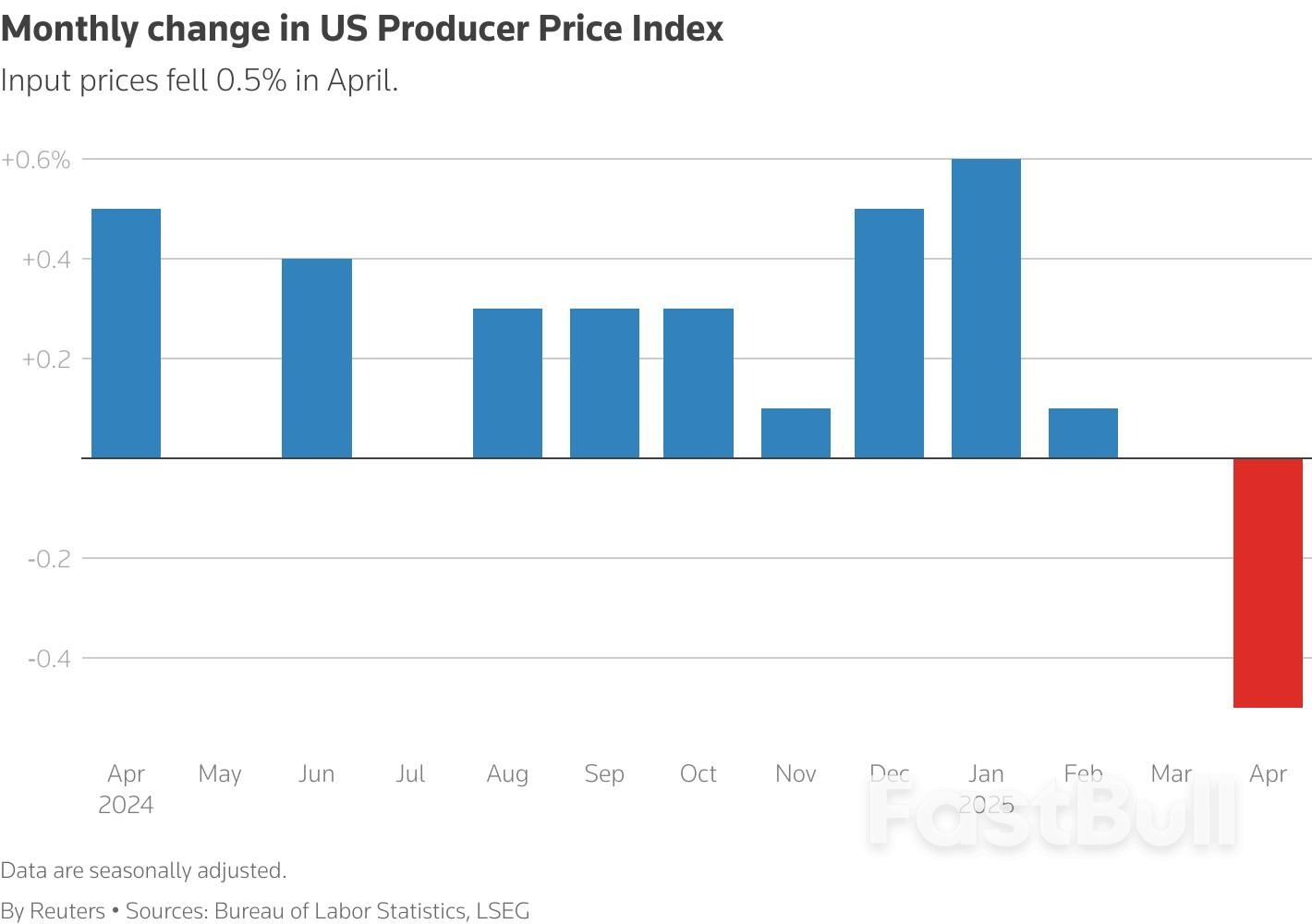
          A separate report from the Labor Department showed the Producer Price Index for final demand dropped 0.5% in April as the cost of services declined by the most since 2009, pulled down by ebbing demand for air travel and hotel accommodation.

          The PPI was unchanged in March. Economists had forecast the PPI would rise 0.2%. In the 12 months through April, the PPI increased 2.4% after climbing 3.4% in March.

          A column chart titled "Monthly change in US Producer Price Index" that tracks the metric over the past year.

          In addition to his protectionist trade policy, Trump has cracked down on immigration and repeatedly expressed his desire to make Canada the 51st U.S. state and acquire Greenland. Those actions have been followed by a sharp drop in tourism, with lower airline ticket sales and hotel and motel bookings.

          Wholesale services prices dropped 0.7%, the largest decline since the government started tracking the series in December 2009, after rising 0.4% in March. Prices for hotel and motel rooms dropped 3.1% after easing 0.5% in March. Portfolio management fees plunged 6.9%, while airline fares fell 1.5%.

          Portfolio management fees, hotel and motel accommodation and airline fares are among the components that go into the calculation of the core Personal Consumption Expenditures (PCE) Price Index, one of the inflation measures tracked by the Federal Reserve for its 2% target.

          Combined with tame consumer price readings in April, economists estimated that core PCE inflation rose 0.1% after being unchanged in March. Core PCE inflation was forecast to have increased 2.5% on a year-over-year basis in April after rising 2.6% in March. With retailers like Walmart and automakers like Ford Motor, however, raising prices in response to tariffs, any moderation in inflation is likely to be temporary.

          Fed Chair Jerome Powell warned on Thursday that "we may be entering a period of more frequent, and potentially more persistent, supply shocks - a difficult challenge for the economy and for central banks."

          Economists expected core PCE inflation to peak at around 3.6% this year and that the U.S. central bank would resume cutting interest rates either in September or December. The Fed left its benchmark overnight interest rate in the 4.24%-4.50% range earlier this month.

          "The pendulum keeps swinging in a hawkish direction as Powell talks about supply shocks and reiterates the importance of keeping inflation expectations anchored," said David Russell, global head of market strategy at TradeStation. "While recent data has been benign, there could be pressures building toward higher inflation."

          Reporting by Lucia Mutikani; Editing by Chizu Nomiyama, Nick Zieminski and Paul Simao

          Source: Reuters

          Risk Warnings and Disclaimers
          You understand and acknowledge that there is a high degree of risk involved in trading. Following any strategies or investment methods may lead to potential losses. The content on the site is provided by our contributors and analysts for information purposes only. You are solely responsible for determining whether any trading assets, securities, strategy, or any other product is suitable for investing based on your own investment objectives and financial situation.
          Add to Favorites
          Share

          Retail Sales Stall As PPI And Fed Surveys Signal Uneven Consumer Demand

          Alice Winters

          Is Consumer Strength Slipping? Retail Sales Growth Hits the Brakes

          U.S. retail sales rose just 0.1% in April, sharply down from March’s revised 1.7% surge, according to Commerce Department data released Thursday. Economists had anticipated flat sales, and the weak print underscores consumer fatigue as tariff-induced buying fades. Households, previously front-loading vehicle purchases ahead of a 25% global car tariff, appear to be retreating, particularly on discretionary spending.

          Stripping out autos, gasoline, building materials, and food services, core retail sales fell 0.2%—a disappointment versus the 0.3% gain forecast. This core measure, key to GDP calculations, suggests consumer momentum may be stalling as broader economic uncertainty weighs on sentiment.

          Producer Price Index Slides: Does Soft Wholesale Pricing Confirm Demand Weakness?

          The Producer Price Index (PPI) for final demand fell 0.5% in April, its largest drop in over a year. Final demand services drove the decline, down 0.7%, led by steep margin compression in trade services—especially machinery and vehicle wholesaling, which sank 6.1%. Goods prices were flat, despite notable declines in energy (-0.4%) and food (-1.0%).

          Core PPI, which excludes volatile food, energy, and trade services, edged down 0.1%—its first decline since April 2020. Year-over-year, the index rose 2.4%, suggesting producer inflation remains moderate. For traders, the combination of weakening services pricing and soft core readings raises red flags for corporate margins, especially in the retail and transportation sectors.

          Federal Reserve District Surveys Paint Mixed Regional Outlook

          The Philadelphia Fed’s May Manufacturing Business Outlook Survey signaled ongoing weakness, with the current activity index at -4.0—up from -26.4 in April, yet still in contraction. New orders rebounded into positive territory, but shipments declined again, and elevated input costs remain a concern. Still, expectations for future growth rose sharply, with the six-month outlook index climbing to 47.2.

          In contrast, the NY Fed’s Empire State index dropped to -9.2 from -8.1, marking a third consecutive monthly decline. While new orders improved, hiring and confidence lagged. Prices paid surged to 59.0, the highest in over two years, complicating any dovish outlook from the Federal Reserve.

          Labor Market Steady but Not Strengthening

          Initial jobless claims held steady at 229,000 for the week ending May 10, while the four-week average edged up to 230,500. Continued claims also rose marginally, suggesting the labor market remains stable but is not tightening further—a critical input for Fed policy expectations.

          Outlook: Cautiously Bearish on Consumer and Retail-Driven Equities

          The combination of soft retail sales, a declining PPI, and weak regional manufacturing data suggests headwinds for consumer demand and corporate revenue growth. Despite isolated signs of resilience, such as steady employment and future business optimism in Philadelphia, the broader signal leans bearish in the short term for consumer discretionary and retail sectors. Traders should monitor further consumer data and Fed commentary closely, especially with inflation pressures diverging between goods and services.

          Source: FX Empire

          Risk Warnings and Disclaimers
          You understand and acknowledge that there is a high degree of risk involved in trading. Following any strategies or investment methods may lead to potential losses. The content on the site is provided by our contributors and analysts for information purposes only. You are solely responsible for determining whether any trading assets, securities, strategy, or any other product is suitable for investing based on your own investment objectives and financial situation.
          Add to Favorites
          Share
          FastBull
          Copyright © 2025 FastBull Ltd

          728 RM B 7/F GEE LOK IND BLDG NO 34 HUNG TO RD KWUN TONG KLN HONG KONG

          TelegramInstagramTwitterfacebooklinkedin
          App Store Google Play Google Play
          Products
          Charts

          Chats

          Q&A with Experts
          Screeners
          Economic Calendar
          Data
          Tools
          Membership
          Features
          Function
          Markets
          Copy Trading
          Latest Signals
          Contests
          News
          Analysis
          24/7
          Columns
          Education
          Company
          Careers
          About Us
          Contact Us
          Advertising
          Help Center
          Feedback
          User Agreement
          Privacy Policy
          Business

          White Label

          Data API

          Web Plug-ins

          Poster Maker

          Affiliate Program

          Risk Disclosure

          The risk of loss in trading financial instruments such as stocks, FX, commodities, futures, bonds, ETFs and crypto can be substantial. You may sustain a total loss of the funds that you deposit with your broker. Therefore, you should carefully consider whether such trading is suitable for you in light of your circumstances and financial resources.

          No decision to invest should be made without thoroughly conducting due diligence by yourself or consulting with your financial advisors. Our web content might not suit you since we don't know your financial conditions and investment needs. Our financial information might have latency or contain inaccuracy, so you should be fully responsible for any of your trading and investment decisions. The company will not be responsible for your capital loss.

          Without getting permission from the website, you are not allowed to copy the website's graphics, texts, or trademarks. Intellectual property rights in the content or data incorporated into this website belong to its providers and exchange merchants.

          Not Logged In

          Log in to access more features

          FastBull Membership

          Not yet

          Purchase

          Become a signal provider
          Help Center
          Customer Service
          Dark Mode
          Price Up/Down Colors

          Log In

          Sign Up

          Position
          Layout
          Fullscreen
          Default to Chart
          The chart page opens by default when you visit fastbull.com