• Trade
  • Markets
  • Copy
  • Contests
  • News
  • 24/7
  • Calendar
  • Q&A
  • Chats
Trending
Screeners
SYMBOL
LAST
BID
ASK
HIGH
LOW
NET CHG.
%CHG.
SPREAD
SPX
S&P 500 Index
6827.42
6827.42
6827.42
6899.86
6801.80
-73.58
-1.07%
--
DJI
Dow Jones Industrial Average
48458.04
48458.04
48458.04
48886.86
48334.10
-245.98
-0.51%
--
IXIC
NASDAQ Composite Index
23195.16
23195.16
23195.16
23554.89
23094.51
-398.69
-1.69%
--
USDX
US Dollar Index
97.950
98.030
97.950
98.500
97.950
-0.370
-0.38%
--
EURUSD
Euro / US Dollar
1.17394
1.17409
1.17394
1.17496
1.17192
+0.00011
+ 0.01%
--
GBPUSD
Pound Sterling / US Dollar
1.33707
1.33732
1.33707
1.33997
1.33419
-0.00148
-0.11%
--
XAUUSD
Gold / US Dollar
4299.39
4299.39
4299.39
4353.41
4257.10
+20.10
+ 0.47%
--
WTI
Light Sweet Crude Oil
57.233
57.485
57.233
58.011
56.969
-0.408
-0.71%
--

Community Accounts

Signal Accounts
--
Profit Accounts
--
Loss Accounts
--
View More

Become a signal provider

Sell trading signals to earn additional income

View More

Guide to Copy Trading

Get started with ease and confidence

View More

Signal Accounts for Members

All Signal Accounts

Best Return
  • Best Return
  • Best P/L
  • Best MDD
Past 1W
  • Past 1W
  • Past 1M
  • Past 1Y

All Contests

  • All
  • Trump Updates
  • Recommend
  • Stocks
  • Cryptocurrencies
  • Central Banks
  • Featured News
Top News Only
Share

Ukraine's Navy Says Russian Drone Attack Hit Civilian Turkish Vessel Carrying Sunflower Oil To Egypt On Saturday

Share

Israeli Military Says It Put Planned Strike On South Lebanon Site On Hold After Lebanese Army Requested Access

Share

Norwegian Nobel Committee: Calls On The Belarusian Authorities To Release All Political Prisoners

Share

Norwegian Nobel Committee: His Freedom Is A Deeply Welcome And Long-Awaited Moment

Share

Ukraine Says It Received 114 Prisoners From Belarus

Share

USA Embassy In Lithuania: Maria Kalesnikava Is Not Going To Vilnius

Share

USA Embassy In Lithuania: Other Prisoners Are Being Sent From Belarus To Ukraine

Share

Ukraine President Zelenskiy: Five Ukrainians Released By Belarus In US-Brokered Deal

Share

USA Vilnius Embassy: USA Stands Ready For "Additional Engagement With Belarus That Advances USA Interests"

Share

USA Vilnius Embassy: Belarus, USA, Other Citizens Among The Prisoners Released Into Lithuania

Share

USA Vilnius Embassy: USA Will Continue Diplomatic Efforts To Free The Remaining Political Prisoners In Belarus

Share

USA Vilnius Embassy: Belarus Releases 123 Prisoners Following Meeting Of President Trump's Envoy Coale And Belarus President Lukashenko

Share

USA Vilnius Embassy: Masatoshi Nakanishi, Aliaksandr Syrytsa Are Among The Prisoners Released By Belarus

Share

USA Vilnius Embassy: Maria Kalesnikava And Viktor Babaryka Are Among The Prisoners Released By Belarus

Share

USA Vilnius Embassy: Nobel Peace Prize Laureate Ales Bialiatski Is Among The Prisoners Released By Belarus

Share

Belarusian Presidential Administration Telegram Channel: Lukashenko Has Pardoned 123 Prisoners As Part Of Deal With US

Share

Two Local Syrian Officials: Joint US-Syrian Military Patrol In Central Syria Came Under Fire From Unknown Assailants

Share

Israeli Military Says It Targeted 'Key Hamas Terrorist' In Gaza City

Share

Rwanda's Actions In Eastern Drc Are A Clear Violation Of Washington Accords Signed By President Trump - Secretary Of State Rubio

Share

Israeli Military Issues Evacuation Warning In Southern Lebanon Village Ahead Of Strike - Spokesperson On X

TIME
ACT
FCST
PREV
U.K. Trade Balance Non-EU (SA) (Oct)

A:--

F: --

P: --

U.K. Trade Balance (Oct)

A:--

F: --

P: --

U.K. Services Index MoM

A:--

F: --

P: --

U.K. Construction Output MoM (SA) (Oct)

A:--

F: --

P: --

U.K. Industrial Output YoY (Oct)

A:--

F: --

P: --

U.K. Trade Balance (SA) (Oct)

A:--

F: --

P: --

U.K. Trade Balance EU (SA) (Oct)

A:--

F: --

P: --

U.K. Manufacturing Output YoY (Oct)

A:--

F: --

P: --

U.K. GDP MoM (Oct)

A:--

F: --

P: --

U.K. GDP YoY (SA) (Oct)

A:--

F: --

P: --

U.K. Industrial Output MoM (Oct)

A:--

F: --

P: --

U.K. Construction Output YoY (Oct)

A:--

F: --

P: --

France HICP Final MoM (Nov)

A:--

F: --

P: --

China, Mainland Outstanding Loans Growth YoY (Nov)

A:--

F: --

P: --

China, Mainland M2 Money Supply YoY (Nov)

A:--

F: --

P: --

China, Mainland M0 Money Supply YoY (Nov)

A:--

F: --

P: --

China, Mainland M1 Money Supply YoY (Nov)

A:--

F: --

P: --

India CPI YoY (Nov)

A:--

F: --

P: --

India Deposit Gowth YoY

A:--

F: --

P: --

Brazil Services Growth YoY (Oct)

A:--

F: --

P: --

Mexico Industrial Output YoY (Oct)

A:--

F: --

P: --

Russia Trade Balance (Oct)

A:--

F: --

P: --

Philadelphia Fed President Henry Paulson delivers a speech
Canada Building Permits MoM (SA) (Oct)

A:--

F: --

P: --

Canada Wholesale Sales YoY (Oct)

A:--

F: --

P: --

Canada Wholesale Inventory MoM (Oct)

A:--

F: --

P: --

Canada Wholesale Inventory YoY (Oct)

A:--

F: --

P: --

Canada Wholesale Sales MoM (SA) (Oct)

A:--

F: --

P: --

Germany Current Account (Not SA) (Oct)

A:--

F: --

P: --

U.S. Weekly Total Rig Count

A:--

F: --

P: --

U.S. Weekly Total Oil Rig Count

A:--

F: --

P: --

Japan Tankan Large Non-Manufacturing Diffusion Index (Q4)

--

F: --

P: --

Japan Tankan Small Manufacturing Outlook Index (Q4)

--

F: --

P: --

Japan Tankan Large Non-Manufacturing Outlook Index (Q4)

--

F: --

P: --

Japan Tankan Large Manufacturing Outlook Index (Q4)

--

F: --

P: --

Japan Tankan Small Manufacturing Diffusion Index (Q4)

--

F: --

P: --

Japan Tankan Large Manufacturing Diffusion Index (Q4)

--

F: --

P: --

Japan Tankan Large-Enterprise Capital Expenditure YoY (Q4)

--

F: --

P: --

U.K. Rightmove House Price Index YoY (Dec)

--

F: --

P: --

China, Mainland Industrial Output YoY (YTD) (Nov)

--

F: --

P: --

China, Mainland Urban Area Unemployment Rate (Nov)

--

F: --

P: --

Saudi Arabia CPI YoY (Nov)

--

F: --

P: --

Euro Zone Industrial Output YoY (Oct)

--

F: --

P: --

Euro Zone Industrial Output MoM (Oct)

--

F: --

P: --

Canada Existing Home Sales MoM (Nov)

--

F: --

P: --

Euro Zone Total Reserve Assets (Nov)

--

F: --

P: --

U.K. Inflation Rate Expectations

--

F: --

P: --

Canada National Economic Confidence Index

--

F: --

P: --

Canada New Housing Starts (Nov)

--

F: --

P: --

U.S. NY Fed Manufacturing Employment Index (Dec)

--

F: --

P: --

U.S. NY Fed Manufacturing Index (Dec)

--

F: --

P: --

Canada Core CPI YoY (Nov)

--

F: --

P: --

Canada Manufacturing Unfilled Orders MoM (Oct)

--

F: --

P: --

Canada Manufacturing New Orders MoM (Oct)

--

F: --

P: --

Canada Core CPI MoM (Nov)

--

F: --

P: --

Canada Manufacturing Inventory MoM (Oct)

--

F: --

P: --

Canada CPI YoY (Nov)

--

F: --

P: --

Canada CPI MoM (Nov)

--

F: --

P: --

Canada CPI YoY (SA) (Nov)

--

F: --

P: --

Canada Core CPI MoM (SA) (Nov)

--

F: --

P: --

Q&A with Experts
    • All
    • Chatrooms
    • Groups
    • Friends
    Connecting
    .
    .
    .
    Type here...
    Add Symbol or Code

      No matching data

      All
      Trump Updates
      Recommend
      Stocks
      Cryptocurrencies
      Central Banks
      Featured News
      • All
      • Russia-Ukraine Conflict
      • Middle East Flashpoint
      • All
      • Russia-Ukraine Conflict
      • Middle East Flashpoint
      Search
      Products

      Charts Free Forever

      Chats Q&A with Experts
      Screeners Economic Calendar Data Tools
      Membership Features
      Data Warehouse Market Trends Institutional Data Policy Rates Macro

      Market Trends

      Market Sentiment Order Book Forex Correlations

      Top Indicators

      Charts Free Forever
      Markets

      News

      News Analysis 24/7 Columns Education
      From Institutions From Analysts
      Topics Columnists

      Latest Views

      Latest Views

      Trending Topics

      Top Columnists

      Latest Update

      Signals

      Copy Rankings Latest Signals Become a signal provider AI Rating
      Contests
      Brokers

      Overview Brokers Assessment Rankings Regulators News Claims
      Broker listing Forex Brokers Comparison Tool Live Spread Comparison Scam
      Q&A Complaint Scam Alert Videos Tips to Detect Scam
      More

      Business
      Events
      Careers About Us Advertising Help Center

      White Label

      Data API

      Web Plug-ins

      Affiliate Program

      Awards Institution Evaluation IB Seminar Salon Event Exhibition
      Vietnam Thailand Singapore Dubai
      Fans Party Investment Sharing Session
      FastBull Summit BrokersView Expo
      Recent Searches
        Top Searches
          Markets
          News
          Analysis
          User
          24/7
          Economic Calendar
          Education
          Data
          • Names
          • Latest
          • Prev

          View All

          No data

          Scan to Download

          Faster Charts, Chat Faster!

          Download App
          English
          • English
          • Español
          • العربية
          • Bahasa Indonesia
          • Bahasa Melayu
          • Tiếng Việt
          • ภาษาไทย
          • Français
          • Italiano
          • Türkçe
          • Русский язык
          • 简中
          • 繁中
          Open Account
          Search
          Products
          Charts Free Forever
          Markets
          News
          Signals

          Copy Rankings Latest Signals Become a signal provider AI Rating
          Contests
          Brokers

          Overview Brokers Assessment Rankings Regulators News Claims
          Broker listing Forex Brokers Comparison Tool Live Spread Comparison Scam
          Q&A Complaint Scam Alert Videos Tips to Detect Scam
          More

          Business
          Events
          Careers About Us Advertising Help Center

          White Label

          Data API

          Web Plug-ins

          Affiliate Program

          Awards Institution Evaluation IB Seminar Salon Event Exhibition
          Vietnam Thailand Singapore Dubai
          Fans Party Investment Sharing Session
          FastBull Summit BrokersView Expo

          Pakistan Says Trade Talks With US to Conclude Next Week

          Glendon

          Economic

          Forex

          Summary:

          Pakistan and the U.S. have resolved to conclude trade talks next week, the South Asian nation said on Wednesday after a meeting between its Finance Minister Muhammad Aurangzeb and U.S. Commerce Secretary Howard Lutnick.

          Pakistan and the U.S. have resolved to conclude trade talks next week, the South Asian nation said on Wednesday after a meeting between its Finance Minister Muhammad Aurangzeb and U.S. Commerce Secretary Howard Lutnick.

          The negotiations, focused on reciprocal tariffs, are part of a broader push to reset economic ties at a time of shifting geopolitical alignments and Pakistan’s efforts to avoid steep U.S. duties on exports.

          “Both sides showed satisfaction on the ongoing negotiations and resolved to conclude the trade negotiations next week,” Pakistan's finance ministry said in a statement, adding that a longer-term strategic and investment partnership is also under discussion.

          Pakistan faces a 29% tariff on exports to the U.S. under President Donald Trump’s measures to target countries with large trade surpluses with the U.S.

          Pakistan’s surplus was around $3 billion in 2024.

          To offset the imbalance and ease tariff pressures, Islamabad has offered to import more U.S. goods, including crude oil, and to open up investment opportunities through concessions for U.S. firms in Pakistan's mining sector.

          Earlier this week, the two countries co-hosted a webinar promoting investment in Pakistan’s mineral sector, including the $7 billion Reko Diq copper-gold project.

          Senior officials from both governments and U.S. investors discussed public-private partnerships and regulatory reforms.

          The U.S. Export-Import Bank is reviewing financing proposals worth $500 million to $1 billion in Reko Diq.

          Trump, who hosted Pakistan's army chief Field Marshal Asim Munir at the White House last week, has earlier said trade helped avert a deeper conflict between Pakistan and India.

          Source: Yahoo Finance

          To stay updated on all economic events of today, please check out our Economic calendar
          Risk Warnings and Disclaimers
          You understand and acknowledge that there is a high degree of risk involved in trading. Following any strategies or investment methods may lead to potential losses. The content on the site is provided by our contributors and analysts for information purposes only. You are solely responsible for determining whether any trading assets, securities, strategy, or any other product is suitable for investing based on your own investment objectives and financial situation.
          Add to Favorites
          Share

          Bitcoin Price Live, Traders Eye $97K Dip As Key Entry Point

          Olivia Brooks

          Cryptocurrency

          Following Bitcoin’s drop below the $100,000 mark over the weekend, fresh narratives are surfacing about where the top crypto might be headed next. Despite more than $63 billion flowing into the crypto market in 2024, Bitcoin has only managed a modest 13% gain year-to-date, raising questions about what’s holding back the top cryptocurrency.

          According to 10x Research, the usual catalysts such as ETF inflows, stablecoin activity, and corporate accumulation are in play, yet Bitcoin is no longer reacting the way it did during last year’s rally. Unlike the booming reaction in 2024, Bitcoin is now behaving differently, suggesting something deeper is shifting.

          Bitcoin Price Prediction Today

          LevelPriceTypeDescription
          Resistance$110,000Bullish TargetNext key upside level if $97K support holds; seen as a potential rebound zone.
          Resistance$106,000Recovery LevelBTC has bounced to this level after the weekend dip; signals renewed interest.
          Neutral$100,000 – $106,000Consolidation ZoneBTC may range between these levels until CPI or macro catalysts emerge.
          Support$100,000Psychological SupportFormer key level now acting as minor support after the recent drop.
          Support$97,000Key Entry PointClosely watched as a final dip zone; considered a solid re-entry point.

          Traders Are Shifting Tactics

          Instead of sparking a big rally, 10x Research says traders are showing their bullishness in quieter ways. They’re adapting to lower market volatility and putting their money into fewer top coins. This shift in strategy might be slowing down Bitcoin’s short-term gains, even though there’s still plenty of money flowing into the market.

          Why the Disconnect?

          The report also revisits the Fed’s surprise 50 bps rate cut in September 2024, which was met with skepticism. Bond yields surged, indicating investors weren’t convinced it was the right move. Meanwhile, inflation, which dropped from 3.5% in April 2024 to a stable 2.4%, has remained steady for three straight months. However, the expert’s warnings that tariffs would reignite inflation have so far proven inaccurate.

          Meanwhile, unemployment has held steady at 4.2% for nearly a year, defying recession fears. With macro fundamentals stabilizing and the Fed’s tone becoming more dovish, many expected a stronger Bitcoin rally. Yet, the market seems to be waiting for clearer signals.

          All Eyes on July CPI and Bitcoin’s Next Move

          With inflation steady and liquidity still flowing, all eyes are now on the July 15 CPI report as the next big market catalyst. 10x Research hints that Bitcoin’s next move may depend less on money flowing in and more on how market participants continue to adapt to these changing geopolitical and financial scenarios.

          Looking at the current sentiment, Analyst Astronomer suggests the decline may not be over yet, with a possible final dip before the price bounces back. The $97,000 zone is being watched closely as a key level for buyers to re-enter the market.

          If support holds, Bitcoin could aim for a rebound toward $110,000. Weekend lows tend to be retested, and with sentiment shifting following a ceasefire deal between Israel and Iran, Bitcoin has already climbed back to $106,000.

          This geopolitical development, along with improving market mood, has brought renewed buying interest. The overall outlook remains cautiously bullish, with investors eyeing $97,000 as a solid entry point if another dip happens.

          Source: CryptoSlate

          Risk Warnings and Disclaimers
          You understand and acknowledge that there is a high degree of risk involved in trading. Following any strategies or investment methods may lead to potential losses. The content on the site is provided by our contributors and analysts for information purposes only. You are solely responsible for determining whether any trading assets, securities, strategy, or any other product is suitable for investing based on your own investment objectives and financial situation.
          Add to Favorites
          Share

          Euro’s Rally Faces Inflection Point As It Climbs Toward $1.20

          Michelle

          Economic

          Forex

          The euro’s latest rally is approaching a pivotal level that could either stall its momentum or unlock the next leg toward $1.20, a target strategists and traders have circled for months.

          After climbing as much as 1.6% in the past three days, the common currency is closing in on $1.17 — a zone that holds the heaviest notional volume in euro-bullish options so far this month, according to Depository Trust & Clearing Corporation data. That makes it a potential inflection point.

          A break and hold above $1.17 could open the door for an accelerated push toward $1.20, a level last seen four years ago. If resistance holds, however, expect some profit-taking or flow-rebalancing first.

          HSBC strategists increased their year-end forecast for the euro to $1.20 from $1.15 last week as they predict broad dollar weakness in the coming months. Danske Bank A/S analysts reiterated their 12-month euro forecast of $1.20 last month while Deutsche Bank AG strategists see a rally to that level by December.

          The euro climbed as high as $1.1641 on Tuesday, its strongest intraday level since October 2021, as easing geopolitical tensions and softer US economic data fueled fresh demand for the common currency. The announcement of a ceasefire between Iran and Israel, along with cautious remarks from Federal Reserve Chair Jerome Powell, helped spark the latest push.

          Money markets are pricing in a total of 59 basis points of Fed easing by year-end, compared with 25 basis points by the European Central Bank. The process of bringing inflation back to 2% is almost over, ECB Chief Economist Philip Lane said Tuesday, despite some remaining price pressures.

          Options markets suggest investors retain conviction in a stronger euro. Risk reversals — which reflect the difference in pricing between bullish and bearish bets — jumped Tuesday by the fourth-largest margin in more than three years, signaling a decisive return of bullish sentiment. The shift followed a brief period in which the dollar found support from rising oil prices.

          The broader picture remains constructive. DTCC data shows more than 60% of notional euro options volume this month has favored calls. The euro was trading little changed near $1.1610 on Wednesday.

          Source: Bloomberg Europe

          To stay updated on all economic events of today, please check out our Economic calendar
          Risk Warnings and Disclaimers
          You understand and acknowledge that there is a high degree of risk involved in trading. Following any strategies or investment methods may lead to potential losses. The content on the site is provided by our contributors and analysts for information purposes only. You are solely responsible for determining whether any trading assets, securities, strategy, or any other product is suitable for investing based on your own investment objectives and financial situation.
          Add to Favorites
          Share

          Fed Division Deepens as Trump-Backed Voices Push for July Rate Cut

          Gerik

          Economic

          Emerging Consensus for Rate Cuts as Trump Gains Unlikely Allies Inside the Fed

          The Federal Reserve is facing an unusual degree of internal disagreement over the direction of monetary policy, as senior officials increasingly align with President Donald Trump’s call for lower interest rates. In recent days, Vice Chair for Supervision Michelle Bowman and Governor Christopher Waller, both Trump appointees, have publicly stated their support for policy easing if inflation remains under control.
          Bowman’s remarks on Monday marked a clear shift in tone. She emphasized that with limited inflationary pressure and relatively muted price impacts from Trump’s new tariffs, it may be time to recalibrate policy toward neutrality. Her support for a rate cut in the next meeting comes despite earlier Fed consensus to hold steady.

          Fed’s Tactical Shift: From Patience to Conditional Readiness

          While not all officials have taken as clear a stance, several are now signaling a readiness to act. Chicago Fed President Austan Goolsbee said in a Milwaukee event that if tariffs don’t result in significant inflation, monetary easing should be considered a viable option. He hinted that the post-April tariff landscape might not be as disruptive as anticipated.
          Chair Jerome Powell, despite Trump's increasingly aggressive personal attacks—including calling him “dumb” and “stubborn”—remains cautious. He reiterated that the Fed prefers to see more summer data before committing to any rate adjustment. Yet even Powell has acknowledged that energy shocks from geopolitical tensions, like the recent Israel-Iran conflict, have so far been short-lived in the past, unlike the structural shocks of the 1970s.

          Geopolitical Risks and Energy Prices: Limited Reaction from Fed So Far

          The recent U.S. airstrikes on Iran’s nuclear facilities and a shaky ceasefire agreement with Israel have raised global energy price concerns. Still, Fed officials remain calm. Bowman noted that while commodity prices may rise, weak consumer demand—especially from low-income groups—and stable supply chains are keeping retailers cautious about price hikes.
          Powell reinforced this view, stating that U.S. dependence on foreign oil is far lower than in previous decades, reducing the pass-through effects of oil shocks. The Fed sees current events as manageable unless full-scale regional conflict breaks out, which would pose greater risks.

          Political Pressure Meets Institutional Independence

          Trump’s direct criticism of Powell has escalated, yet Fed officials insist that political interference does not impact policy decisions. Powell, in particular, has repeatedly stated that the central bank will continue to operate independently and base its decisions strictly on economic data.
          Nonetheless, market sentiment is tilting toward the expectation of a rate cut. CME Group’s FedWatch tool reflects a rising probability of a policy shift at the July 29–30 meeting. Analysts warn that while current inflation trends are subdued, the Fed must also weigh potential second-round effects of tariffs, wage growth, and geopolitical instability.
          As inflation remains modest and the labor market shows resilience, calls for monetary easing—particularly from Trump-aligned officials—are growing louder. The Fed's internal divergence reflects broader tensions between maintaining long-term credibility and responding swiftly to evolving risks. Whether July becomes the turning point for U.S. monetary policy will depend not just on inflation data but also on how much pressure the Fed can resist from both markets and politics.

          Source: CNN

          To stay updated on all economic events of today, please check out our Economic calendar
          Risk Warnings and Disclaimers
          You understand and acknowledge that there is a high degree of risk involved in trading. Following any strategies or investment methods may lead to potential losses. The content on the site is provided by our contributors and analysts for information purposes only. You are solely responsible for determining whether any trading assets, securities, strategy, or any other product is suitable for investing based on your own investment objectives and financial situation.
          Add to Favorites
          Share

          Bento Businesses Buckle as Japan's Soaring Rice Prices Threaten Small Eateries

          Gerik

          Economic

          Commodity

          Japan’s Fourth-Largest Economy Wavers as Bento Shops Fall Victim to Soaring Rice Prices

          Japan’s bento economy—once a reliable staple for busy office workers and students—is faltering under the weight of stagflation. With core input costs, especially rice, rising at an unprecedented pace, many small businesses are now closing down or facing mounting losses.
          According to Teikoku Databank, 22 bento shops declared bankruptcy between January and May 2025—already surpassing last year’s same-period figure. In 2024, a record 52 shops folded, and experts predict that 2025 could set a new high.
          Daisuke Iijima, an analyst at Teikoku, commented that “many small bento vendors are barely hanging on,” with most opting to operate at a loss or raise prices despite customer resistance.

          From Affordable Meals to Margin Killers: Rice Costs Spark Crisis

          Once celebrated for affordability and convenience, bento meals are becoming harder to sustain. Rice—making up the bulk of ingredient costs—has more than doubled in price year-on-year as of May 2025. This steep rise is compressing margins across the board.
          Bento consumption had already weakened during the pandemic as remote work reduced foot traffic and customer frequency. Now, a brutal combination of lower demand and spiraling costs is devastating a sector reliant on volume and affordability.
          Data shows that in fiscal 2024, 45% of bento shops reported increased profits, but 30% suffered losses, and 22% saw profit declines. Larger chains are weathering the storm thanks to supply chain leverage, but mom-and-pop vendors lack the same financial cushion.

          Raising Prices, Losing Customers: A No-Win Dilemma

          Many bento sellers have had no choice but to raise prices. However, the speed and scale of price increases still lag behind input inflation. Worse, the bento market is hypersensitive to pricing—customers view it as the cheapest meal option, meaning even slight hikes can reduce demand.
          This puts small businesses in a bind: raise prices and risk losing loyal customers, or absorb the costs and risk financial ruin. Iijima warns that “without greater resilience, more small bento shops will inevitably close.”

          Uncertainty Over Rice and Consumer Prices

          Japan’s inflation rate is expected to hover around 3% in 2025, a moderate figure by global standards but high enough to challenge a deflation-habituated economy. Industry insiders remain split on whether rice prices will normalize or remain elevated in the longer term.
          While larger chains are adapting through scale, digital ordering, and diversified menus, many traditional bento shops lack both capital and innovation capability. Unless government or industry-level interventions ease the cost burden—or inflation retreats—the outlook remains bleak for this once-thriving segment of Japan’s food service economy.

          Source: JPT

          To stay updated on all economic events of today, please check out our Economic calendar
          Risk Warnings and Disclaimers
          You understand and acknowledge that there is a high degree of risk involved in trading. Following any strategies or investment methods may lead to potential losses. The content on the site is provided by our contributors and analysts for information purposes only. You are solely responsible for determining whether any trading assets, securities, strategy, or any other product is suitable for investing based on your own investment objectives and financial situation.
          Add to Favorites
          Share

          Addressing FDI Distortions: Vietnam Seeks Quality Over Quantity in Investment Strategy

          Gerik

          Economic

          Chronic Profit Loss and Transfer Pricing: A Structural Weakness in Vietnam’s FDI Sector

          According to Report No. 229/BC-BTC released by the Ministry of Finance, many foreign-invested companies in Vietnam register billions of dollars in capital but contribute minimal equity. Instead, they primarily use debt financing, which inflates financial expenses and depreciation costs, leading to years of reported losses. Experts argue this creates significant space for transfer pricing tactics, allowing firms to shift profits abroad, evade taxes, and erode state revenues.
          These manipulative practices are not only a fiscal concern but also distort Vietnam’s investment climate. As capital outflows and tax avoidance persist, the credibility of Vietnam’s FDI environment and its equitable regulatory framework is increasingly at stake.

          Regional and Sectoral Imbalances Continue to Undermine Investment Potential

          Despite boasting over 43,000 active FDI projects as of May 2025—with over $517 billion in registered capital—the geographical distribution remains lopsided. Most projects are concentrated in industrial hubs like Ho Chi Minh City, Hanoi, and Binh Duong, while rural and mountainous regions such as the Mekong Delta and Central Highlands attract little attention.
          Sectorally, the dominance of manufacturing, real estate, and electricity production continues. Manufacturing alone accounts for over $316 billion in registered capital, or 61.2% of all FDI. This concentration risks unsustainable development, overburdens urban infrastructure, and overlooks the diverse growth potential across sectors like high-tech, renewable energy, and digital services.

          Weak Linkages Between FDI and Domestic Firms: Missed Opportunities in Value Creation

          The report also highlights the limited integration between FDI firms and local enterprises. While a few foreign firms have helped transfer technology and build human capital, many still rely on importing raw materials and executing only low-value-added stages of production. This restricts knowledge spillovers and local value creation. Localization rates remain modest despite years of policy support for Vietnam’s supporting industries.
          Such dynamics trap Vietnam in the low-value end of global supply chains and prevent the domestic private sector from upgrading capabilities. The potential for productivity gains, innovation, and export competitiveness is thus curtailed.

          Structural Challenges Behind Inefficient FDI Utilization

          Several systemic barriers compound the problem. These include a shortage of industrial land with adequate infrastructure, high logistics costs, uneven labor quality, and weak adaptive capacity among domestic firms. The lack of targeted investment promotion further contributes to misallocation of FDI capital, where large volumes of investment do not translate into commensurate socio-economic gains.

          Toward a New FDI Strategy: From Volume to Value

          Acknowledging these inefficiencies, Vietnam’s Ministry of Finance has committed to recalibrating its FDI attraction policies. Future FDI strategies will prioritize quality, efficiency, and sustainability over mere project count or capital volume. New criteria will focus on technological spillovers, domestic supply chain integration, environmental responsibility, and long-term economic contributions.
          Infrastructure upgrades, labor upskilling, and institutional reforms will form the backbone of Vietnam’s “new-generation FDI” policy. Investment promotion will be more selective, targeting large corporations capable of driving innovation and management excellence into the domestic economy.
          Priority sectors identified include high-tech manufacturing, renewable energy, semiconductor production, artificial intelligence, and digital finance. Instead of mass promotion, Vietnam aims for strategic alignment with global supply chain realignment, particularly in light of rising U.S.-China tensions and emerging Indo-Pacific economic dynamics.
          While foreign capital continues to play a critical role in Vietnam’s development, the country now faces a turning point. The shift from quantity to quality is not only a policy imperative but also a strategic necessity in a more competitive and uncertain global landscape. To truly capitalize on FDI, Vietnam must close regulatory loopholes, boost domestic enterprise readiness, and build an ecosystem that values long-term, inclusive growth over short-term capital inflows.
          To stay updated on all economic events of today, please check out our Economic calendar
          Risk Warnings and Disclaimers
          You understand and acknowledge that there is a high degree of risk involved in trading. Following any strategies or investment methods may lead to potential losses. The content on the site is provided by our contributors and analysts for information purposes only. You are solely responsible for determining whether any trading assets, securities, strategy, or any other product is suitable for investing based on your own investment objectives and financial situation.
          Add to Favorites
          Share

          Bitcoin Sentiment Turns Greedy Again—Time to Be Cautious?

          Glendon

          Cryptocurrency

          As Bitcoin and other digital assets recover, data shows the sentiment among cryptocurrency investors has returned to a state of greed.

          Bitcoin Fear & Greed Index Is Pointing At Greed Again

          The “Fear & Greed Index” refers to an indicator made by Alternative that measures the net sentiment held by the average trader in the Bitcoin and wider cryptocurrency spaces.

          The index uses the data of the following five factors to determine the market sentiment: trading volume, volatility, market cap dominance, social media sentiment, and Google Trends.

          The metric represents the calculated mentality as a score lying between 0 and 100. The former end point corresponds to a state of maximum fear, while the latter one to that of maximum greed.

          Here’s what the index says regarding the current sentiment among the investors:

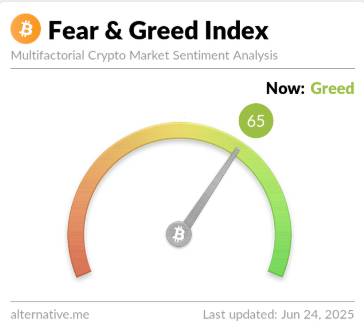
          Looks like the value of the metric is 65 at the moment | Source: Alternative

          As displayed above, the Bitcoin Fear & Greed Index has a value of 65, which suggests the traders currently share a majority sentiment of greed. This is a notable change compared to yesterday, when the indicator was sitting at 47, meaning that the investor mentality was overall neutral.

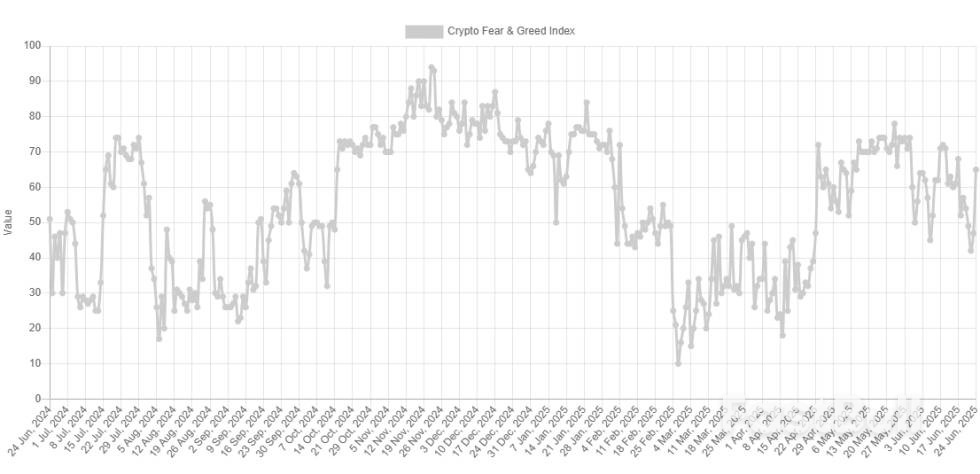
          The trend in the Fear & Greed Index over the past twelve months | Source: Alternative

          The holder sentiment earlier declined as a result of the geopolitical situation surrounding the Israel-Iran conflict. Following the announcement of a ceasefire between the nations, prices bounced back and it would appear that with them, so did the investor mood.

          The ceasefire has since been violated, so it’s possible that tomorrow’s Fear & Greed Index would be less bullish. That said, Bitcoin has held surprisingly well despite the news, which could imply that the sentiment may also remain the same.

          Historically, BTC and digital assets in general have tended to move in the direction that goes against the expectations of the investors. This means that an overly greedy market makes tops likely, while an extremely fearful one bottoms.

          At present, the level of greed in the market isn’t too strong, but the fact that it has seen a notable jump alongside the recovery run could still be to take note off. In the scenario that hype keeps increasing in the coming days, another reversal could turn more probable for Bitcoin and company.

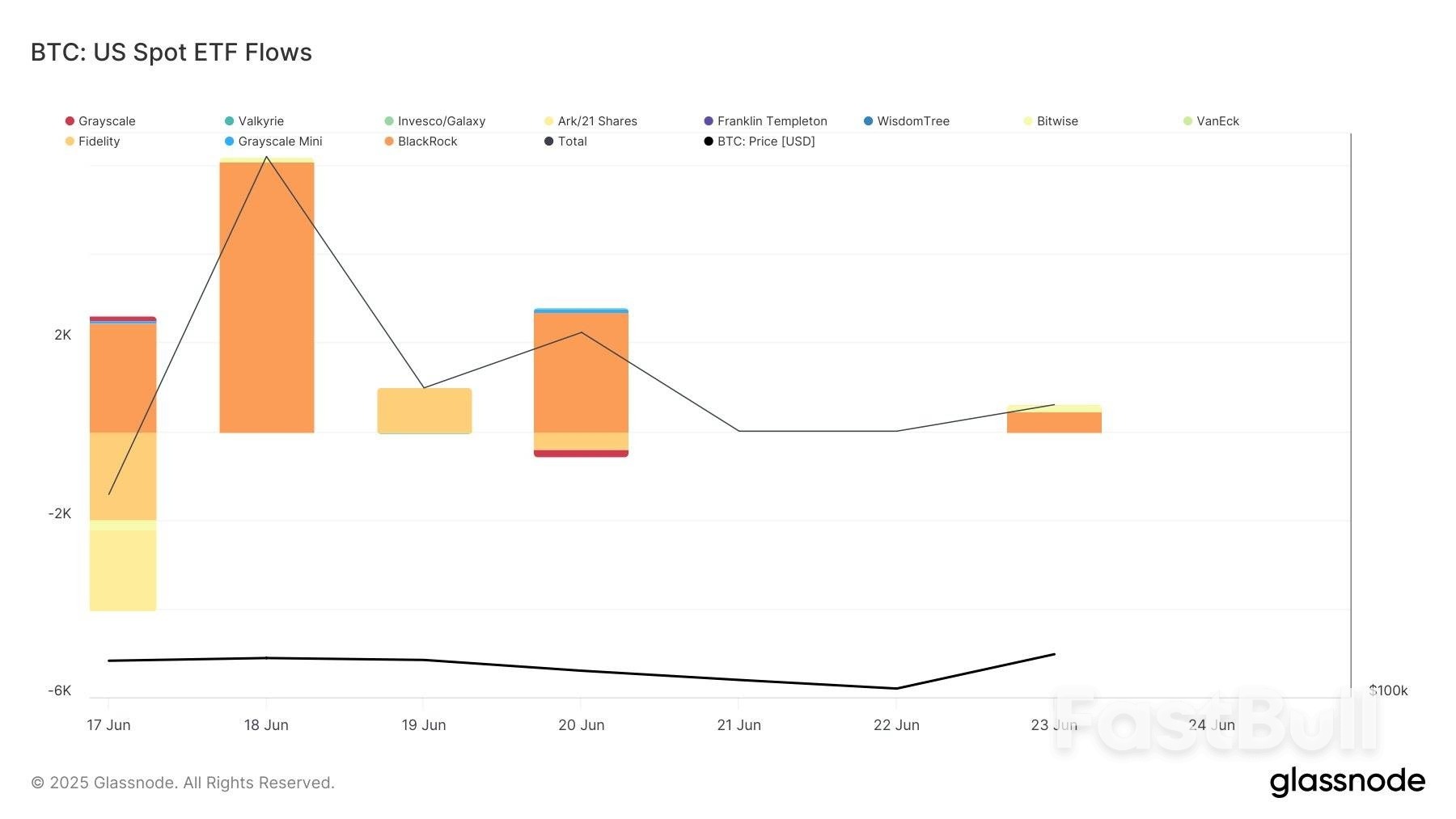
          In some other news, the US-based Bitcoin spot exchange-traded funds (ETFs) saw net inflows yesterday, 23rd June, as pointed out by the analytics firm Glassnode in an X post.

          The data for the netflows associated with the US spot ETFs | Source: Glassnode on X

          As displayed in the above graph, the US Bitcoin spot ETFs saw net inflows of around 598 BTC on this date, despite the geopolitical tensions. “Although the inflows were modest, no major outflows were recorded either, which is notable signal of investor confidence,” notes Glassnode.

          BTC Price

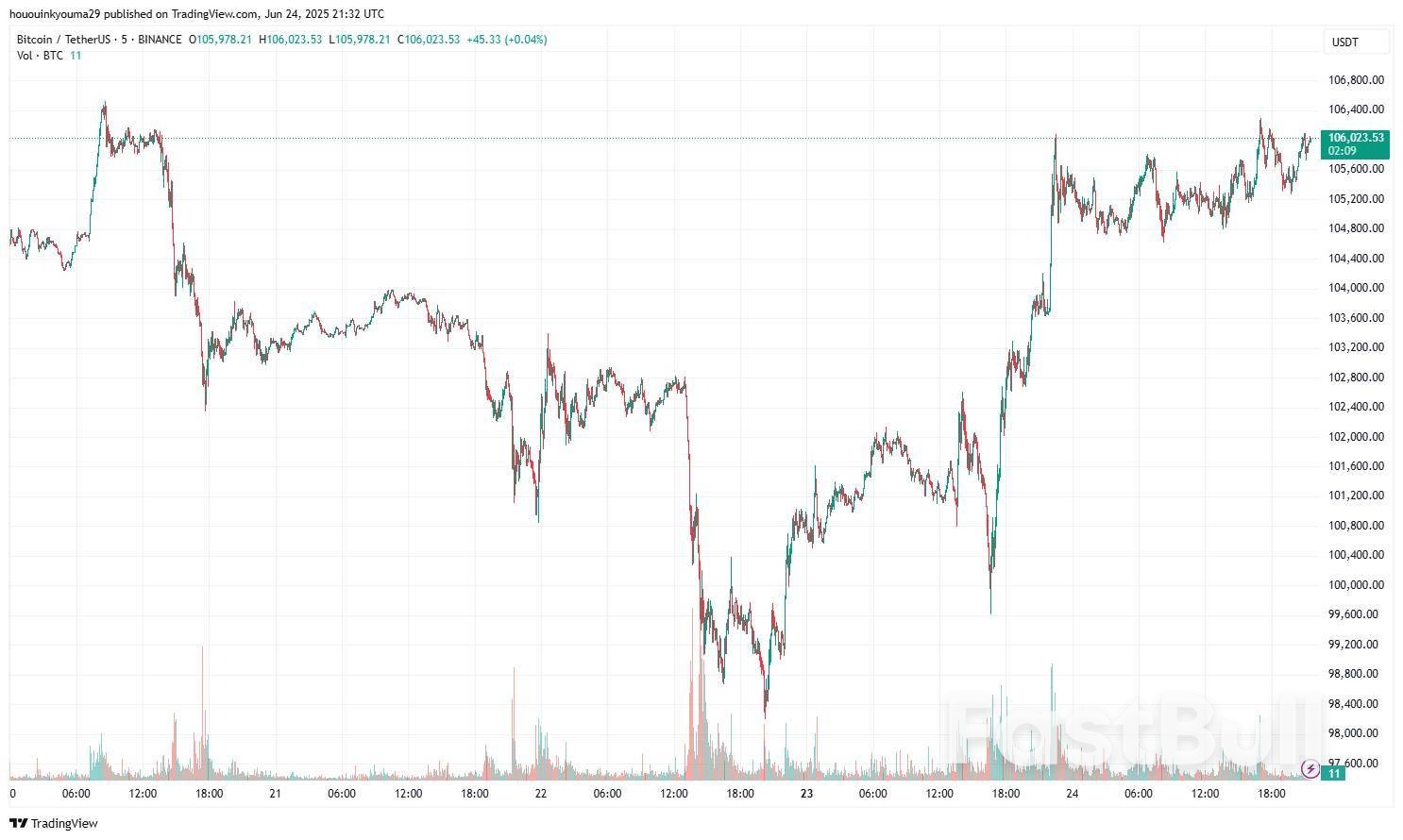
          Bitcoin has already made recovery beyond the level it was trading at before the plunge, as its price is now back at $106,000.

          The asset seems to have shot up during the past day | Source: BTCUSDT on TradingView

          Source: CoinGecko

          Risk Warnings and Disclaimers
          You understand and acknowledge that there is a high degree of risk involved in trading. Following any strategies or investment methods may lead to potential losses. The content on the site is provided by our contributors and analysts for information purposes only. You are solely responsible for determining whether any trading assets, securities, strategy, or any other product is suitable for investing based on your own investment objectives and financial situation.
          Add to Favorites
          Share
          FastBull
          Copyright © 2025 FastBull Ltd

          728 RM B 7/F GEE LOK IND BLDG NO 34 HUNG TO RD KWUN TONG KLN HONG KONG

          TelegramInstagramTwitterfacebooklinkedin
          App Store Google Play Google Play
          Products
          Charts

          Chats

          Q&A with Experts
          Screeners
          Economic Calendar
          Data
          Tools
          Membership
          Features
          Function
          Markets
          Copy Trading
          Latest Signals
          Contests
          News
          Analysis
          24/7
          Columns
          Education
          Company
          Careers
          About Us
          Contact Us
          Advertising
          Help Center
          Feedback
          User Agreement
          Privacy Policy
          Business

          White Label

          Data API

          Web Plug-ins

          Poster Maker

          Affiliate Program

          Risk Disclosure

          The risk of loss in trading financial instruments such as stocks, FX, commodities, futures, bonds, ETFs and crypto can be substantial. You may sustain a total loss of the funds that you deposit with your broker. Therefore, you should carefully consider whether such trading is suitable for you in light of your circumstances and financial resources.

          No decision to invest should be made without thoroughly conducting due diligence by yourself or consulting with your financial advisors. Our web content might not suit you since we don't know your financial conditions and investment needs. Our financial information might have latency or contain inaccuracy, so you should be fully responsible for any of your trading and investment decisions. The company will not be responsible for your capital loss.

          Without getting permission from the website, you are not allowed to copy the website's graphics, texts, or trademarks. Intellectual property rights in the content or data incorporated into this website belong to its providers and exchange merchants.

          Not Logged In

          Log in to access more features

          FastBull Membership

          Not yet

          Purchase

          Become a signal provider
          Help Center
          Customer Service
          Dark Mode
          Price Up/Down Colors

          Log In

          Sign Up

          Position
          Layout
          Fullscreen
          Default to Chart
          The chart page opens by default when you visit fastbull.com