
• Trade
  • Markets
  • Copy
  • Contests
  • News
  • 24/7
  • Calendar
  • Q&A
  • Chats
Trending
Screeners
SYMBOL
LAST
BID
ASK
HIGH
LOW
NET CHG.
%CHG.
SPREAD
SPX
S&P 500 Index
6827.42
6827.42
6827.42
6899.86
6801.80
-73.58
-1.07%
--
DJI
Dow Jones Industrial Average
48458.04
48458.04
48458.04
48886.86
48334.10
-245.98
-0.51%
--
IXIC
NASDAQ Composite Index
23195.16
23195.16
23195.16
23554.89
23094.51
-398.69
-1.69%
--
USDX
US Dollar Index
97.840
97.920
97.840
98.070
97.810
-0.110
-0.11%
--
EURUSD
Euro / US Dollar
1.17562
1.17569
1.17562
1.17590
1.17262
+0.00168
+ 0.14%
--
GBPUSD
Pound Sterling / US Dollar
1.33886
1.33894
1.33886
1.33940
1.33546
+0.00179
+ 0.13%
--
XAUUSD
Gold / US Dollar
4338.45
4338.88
4338.45
4350.16
4294.68
+39.06
+ 0.91%
--
WTI
Light Sweet Crude Oil
57.150
57.180
57.150
57.601
56.878
-0.083
-0.15%
--

Community Accounts

Signal Accounts
--
Profit Accounts
--
Loss Accounts
--
View More

Become a signal provider

Sell trading signals to earn additional income

View More

Guide to Copy Trading

Get started with ease and confidence

View More

Signal Accounts for Members

All Signal Accounts

Best Return
  • Best Return
  • Best P/L
  • Best MDD
Past 1W
  • Past 1W
  • Past 1M
  • Past 1Y

All Contests

  • All
  • Trump Updates
  • Recommend
  • Stocks
  • Cryptocurrencies
  • Central Banks
  • Featured News
Top News Only
Share

Canada Nov CPI Common +2.8%, CPI Median +2.8%, CPI Trim +2.8% On Year

Share

NY Fed's Empire State Prices Paid Index +37.6 In December Versus+49.0 In November

Share

Canada Nov Consumer Prices +0.1% On Month, +2.2% On Year

Share

Canada Nov CPI Core -0.1% On Month, +2.9% On Year

Share

Canada Nov Core CPI, Seasonally Adjusted +0.2% On Month, Oct +0.3% (Unrevised)

Share

UK Health Minister Streeting On Doctors' Strike: Vote To Go Ahead Reveals The Bma's Shocking Disregard For Patient Safety

Share

Venezuelan State Oil Company Pdvsa Says Was Subject To Cyber Attack But Operations Unaffected

Share

Russia Central Bank Says January-October Current Account Surplus At $37.1 Billion

Share

Polish Current Account Balance At +1924 Million Euros In October Versus+130 Million Euros Seen In Reuters Poll

Share

Statement: Germany, Ukraine Propose 10-Point Plan To Strengthen Armament Cooperation

Share

London Metal Exchange Three Month Copper Falls More Than 3% To $11541.50 A Metric Ton

Share

[Market Update] Spot Silver Surged $2.00 During The Day, Returning To $64/ounce, A Gain Of 3.23%

Share

European Central Bank: Italy's Recurrent Ad Hoc Tax Provisions Cause Uncertainty, Damage Investor Confidence, And May Affect Banks' Funding Costs

Share

Stats Office: Nigeria Consumer Inflation At 14.45% Year-On-Year In November

Share

European Central Bank: Italy's Budget Measures Weighing On Domestic Banks Could Have "Negative Implications" On Their Credit Liquidity

Share

Azerbaijan's January-November Oil Exports Via Btc Pipeline Down 7.1% Year-On-Year Data Shows

Share

Azerbaijan's Aliyev Plans A Large-Scale Prisoner Amnesty, Azertac Reports

Share

EU Commission Chief Von Der Leyen, NATO's Rutte Join Ukraine Talks In Berlin

Share

EU Announces Sanctions On Companies, Individuals For Moving Russian Oil

Share

ICE New York Cocoa Futures Fall More Than 5% To $5945 Per Metric Ton

TIME
ACT
FCST
PREV
Japan Tankan Small Manufacturing Outlook Index (Q4)

A:--

F: --

P: --

Japan Tankan Large Non-Manufacturing Outlook Index (Q4)

A:--

F: --

P: --

Japan Tankan Large Manufacturing Outlook Index (Q4)

A:--

F: --

P: --

Japan Tankan Small Manufacturing Diffusion Index (Q4)

A:--

F: --

P: --

Japan Tankan Large Manufacturing Diffusion Index (Q4)

A:--

F: --

P: --

Japan Tankan Large-Enterprise Capital Expenditure YoY (Q4)

A:--

F: --

P: --

U.K. Rightmove House Price Index YoY (Dec)

A:--

F: --

P: --

China, Mainland Industrial Output YoY (YTD) (Nov)

A:--

F: --

P: --

China, Mainland Urban Area Unemployment Rate (Nov)

A:--

F: --

P: --

Saudi Arabia CPI YoY (Nov)

A:--

F: --

P: --

Euro Zone Industrial Output YoY (Oct)

A:--

F: --

P: --

Euro Zone Industrial Output MoM (Oct)

A:--

F: --

P: --

Canada Existing Home Sales MoM (Nov)

A:--

F: --

P: --

Canada National Economic Confidence Index

A:--

F: --

P: --

Canada New Housing Starts (Nov)

A:--

F: --

P: --
U.S. NY Fed Manufacturing Employment Index (Dec)

A:--

F: --

P: --

U.S. NY Fed Manufacturing Index (Dec)

A:--

F: --

P: --

Canada Core CPI YoY (Nov)

A:--

F: --

P: --

Canada Manufacturing Unfilled Orders MoM (Oct)

A:--

F: --

P: --

U.S. NY Fed Manufacturing Prices Received Index (Dec)

A:--

F: --

P: --

U.S. NY Fed Manufacturing New Orders Index (Dec)

A:--

F: --

P: --

Canada Manufacturing New Orders MoM (Oct)

A:--

F: --

P: --

Canada Core CPI MoM (Nov)

A:--

F: --

P: --

Canada Trimmed CPI YoY (SA) (Nov)

A:--

F: --

P: --

Canada Manufacturing Inventory MoM (Oct)

A:--

F: --

P: --

Canada CPI YoY (Nov)

A:--

F: --

P: --

Canada CPI MoM (Nov)

A:--

F: --

P: --

Canada CPI YoY (SA) (Nov)

--

F: --

P: --

Canada Core CPI MoM (SA) (Nov)

A:--

F: --

P: --

Canada CPI MoM (SA) (Nov)

A:--

F: --

P: --

Federal Reserve Board Governor Milan delivered a speech
U.S. NAHB Housing Market Index (Dec)

--

F: --

P: --

Australia Composite PMI Prelim (Dec)

--

F: --

P: --

Australia Services PMI Prelim (Dec)

--

F: --

P: --

Australia Manufacturing PMI Prelim (Dec)

--

F: --

P: --

Japan Manufacturing PMI Prelim (SA) (Dec)

--

F: --

P: --

U.K. 3-Month ILO Employment Change (Oct)

--

F: --

P: --

U.K. Unemployment Claimant Count (Nov)

--

F: --

P: --

U.K. Unemployment Rate (Nov)

--

F: --

P: --

U.K. 3-Month ILO Unemployment Rate (Oct)

--

F: --

P: --

U.K. Average Weekly Earnings (3-Month Average, Including Bonuses) YoY (Oct)

--

F: --

P: --

U.K. Average Weekly Earnings (3-Month Average, Excluding Bonuses) YoY (Oct)

--

F: --

P: --

France Services PMI Prelim (Dec)

--

F: --

P: --

France Composite PMI Prelim (SA) (Dec)

--

F: --

P: --

France Manufacturing PMI Prelim (Dec)

--

F: --

P: --

Germany Services PMI Prelim (SA) (Dec)

--

F: --

P: --

Q&A with Experts
    • All
    • Chatrooms
    • Groups
    • Friends
    Connecting
    .
    .
    .
    Type here...
    Add Symbol or Code

      No matching data

      All
      Trump Updates
      Recommend
      Stocks
      Cryptocurrencies
      Central Banks
      Featured News
      • All
      • Russia-Ukraine Conflict
      • Middle East Flashpoint
      • All
      • Russia-Ukraine Conflict
      • Middle East Flashpoint
      Search
      Products

      Charts Free Forever

      Chats Q&A with Experts
      Screeners Economic Calendar Data Tools
      Membership Features
      Data Warehouse Market Trends Institutional Data Policy Rates Macro

      Market Trends

      Market Sentiment Order Book Forex Correlations

      Top Indicators

      Charts Free Forever
      Markets

      News

      News Analysis 24/7 Columns Education
      From Institutions From Analysts
      Topics Columnists

      Latest Views

      Latest Views

      Trending Topics

      Top Columnists

      Latest Update

      Signals

      Copy Rankings Latest Signals Become a signal provider AI Rating
      Contests
      Brokers

      Overview Brokers Assessment Rankings Regulators News Claims
      Broker listing Forex Brokers Comparison Tool Live Spread Comparison Scam
      Q&A Complaint Scam Alert Videos Tips to Detect Scam
      More

      Business
      Events
      Careers About Us Advertising Help Center

      White Label

      Data API

      Web Plug-ins

      Affiliate Program

      Awards Institution Evaluation IB Seminar Salon Event Exhibition
      Vietnam Thailand Singapore Dubai
      Fans Party Investment Sharing Session
      FastBull Summit BrokersView Expo
      Recent Searches
        Top Searches
          Markets
          News
          Analysis
          User
          24/7
          Economic Calendar
          Education
          Data
          • Names
          • Latest
          • Prev

          View All

          No data

          Scan to Download

          Faster Charts, Chat Faster!

          Download App
          English
          • English
          • Español
          • العربية
          • Bahasa Indonesia
          • Bahasa Melayu
          • Tiếng Việt
          • ภาษาไทย
          • Français
          • Italiano
          • Türkçe
          • Русский язык
          • 简中
          • 繁中
          Open Account
          Search
          Products
          Charts Free Forever
          Markets
          News
          Signals

          Copy Rankings Latest Signals Become a signal provider AI Rating
          Contests
          Brokers

          Overview Brokers Assessment Rankings Regulators News Claims
          Broker listing Forex Brokers Comparison Tool Live Spread Comparison Scam
          Q&A Complaint Scam Alert Videos Tips to Detect Scam
          More

          Business
          Events
          Careers About Us Advertising Help Center

          White Label

          Data API

          Web Plug-ins

          Affiliate Program

          Awards Institution Evaluation IB Seminar Salon Event Exhibition
          Vietnam Thailand Singapore Dubai
          Fans Party Investment Sharing Session
          FastBull Summit BrokersView Expo

          OPEC+ Output Hike Boosts Saudi Market Share And Political Capital

          James Whitman

          Commodity

          Economic

          Summary:

          OPEC+’s surprise announcement that it will further accelerate oil production may seem like a threat to an already oversupplied market, but the actual market impact is likely to be limited.

          Key points:

          ● OPEC+ to increase production target by 137,000 bpd in October
          ● Group's actual output unlikely to grow much as some members exceed quotas
          ● Move allows Saudi Arabia to increase market share

          OPEC+’s surprise announcement that it will further accelerate oil production may seem like a threat to an already oversupplied market, but the actual market impact is likely to be limited.

          The same cannot be said of the political benefits for the group's leader Saudi Arabia, which is seeking to reassert group discipline while expanding its market share and solidifying its relationship with the United States.

          The Organization of the Petroleum Exporting Countries plus Russia and other allies, the group collectively known as OPEC+, agreed on Sunday to begin unwinding 1.65 million barrels per day of production cuts that were set to remain in place until the end of 2026.

          The group of eight core OPEC+ members said it will raise its oil output target by 137,000 bpd in October.

          At this pace, it will take the group 12 months to remove the full tranche of 1.65 million bpd of cuts, leaving the alliance with another 2 million bpd of production cuts still in place until the end of 2026. OPEC+ said it retained options to accelerate, pause or reverse hikes at future meetings. It scheduled the next meeting of the eight countries for October 5.

          The group had already raised production quotas by about 2.5 million bpd, around 2.4% of global demand, between April and September. This put downward pressure on oil prices, which have declined by about 18% from their 2025 high in mid-January to $67 a barrel.

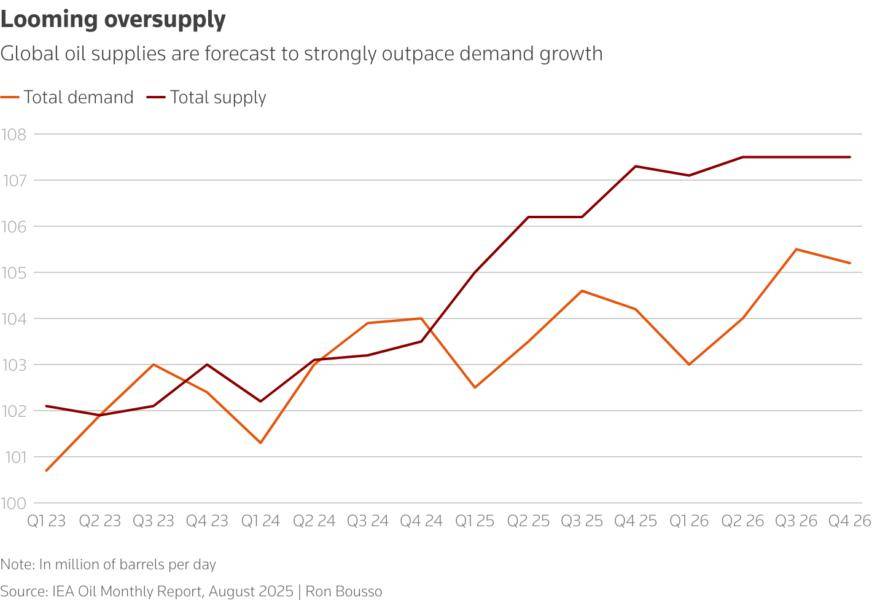
          The new additions seemingly come at the worst possible moment for the market, which is widely expected to have already entered an extended period of oversupply due to production increases in Argentina, Canada, the United States and elsewhere.

          The International Energy Agency previously forecast that supply would outstrip demand by an average of 3 million bpd between October 2025 and the end of 2026 – and that was before Sunday’s announcement.
          OPEC+ Output Hike Boosts Saudi Market Share And Political Capital_1

          Global oil supplies are forecast to strongly outpace demand

          DISCIPLINE

          In theory, adding more barrels in this environment should weigh heavily on oil prices.

          In practice, however, the impact may be muted.

          An analysis of OPEC+ production suggests the actual additions are likely to be far more modest than advertised, as most members are already producing at or near full capacity.

          In March 2025, just before the group began unwinding its first layer of cuts, joint production reached 31.83 million bpd, only 1 million bpd below its 32.88 million bpd production target for September, according to IEA figures.

          That was largely because several OPEC+ members, notably Kazakhstan, the United Arab Emirates and Iraq, had already far exceeded their OPEC+ production quotas. In July, that trio jointly outpaced their September quotas by some 500,000 bpd.

          The new quotas are therefore not actually going to add many additional barrels to the market because, for the most part, these guidelines are simply catching up with the reality on the ground.

          For Saudi Arabia, however, the changes are significant. The Kingdom’s output is set to increase from 9.07 million bpd in March to 9.98 million in September. This will leave it with around 2.2 million bpd of spare capacity, according to IEA estimates, far more than any other OPEC+ member.

          Under the tranche of cuts that are now being unwound, Saudi Arabia and Russia each reduced output by roughly 500,000 bpd. But Russia has little, if any, spare capacity, given that strict Western sanctions have limited investments in new production.

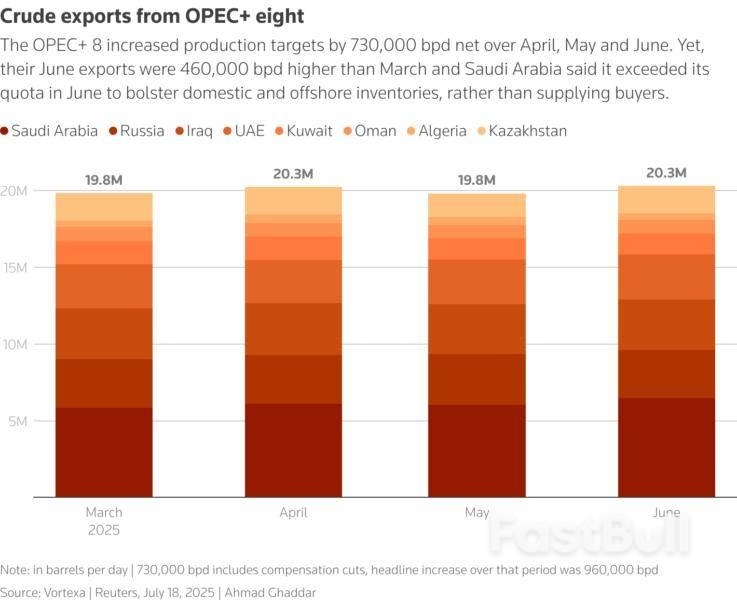
          Saudi Arabia therefore stands to benefit the most from this rollback, with Riyadh well positioned to capture more market share, in particular from U.S. shale firms that will need to slow down drilling activity in the face of lower oil prices.
          OPEC+ Output Hike Boosts Saudi Market Share And Political Capital_2

          The OPEC+ 8 increased production targets by 960,000 bpd over April, May and June. Yet, their June exports were 460,000 bpd higher than March.

          TRUMP CARD

          Saudi Energy Minister Prince Abdulaziz bin Salman, the architect of the original OPEC+ supply cuts, now appears to be firmly back in the driver's seat after spending years battling the group’s breakdown in internal discipline.

          And, importantly, this new move gives Riyadh the ability to garner valuable political capital, as U.S. President Donald Trump has urged OPEC to lower oil prices. The Saudis can now show that they are trying to do just that.

          The Saudis therefore appear willing to withstand an environment of low oil prices for an extended period of time both to make long-term gains in market share and to support its relationship with its key ally.

          Indeed, Saudi Crown Prince Mohammed bin Salman is reportedly scheduled to visit Washington, D.C., in November. This follows Trump's visit to the Gulf nation in May when Riyadh pledged to invest $600 billion in the United States while Washington agreed to sell Saudi Arabia an arms package worth $142 billion. It's safe to say that supply cuts and crude prices will be on the agenda for the new meeting in November.

          OPEC+’s new production targets are therefore unlikely to significantly disrupt the oil market – and thus probably will not massively shift prices – but they could still have long-term consequences because of the geopolitical backdrop.

          Source: TradingView

          To stay updated on all economic events of today, please check out our Economic calendar
          Risk Warnings and Disclaimers
          You understand and acknowledge that there is a high degree of risk involved in trading. Following any strategies or investment methods may lead to potential losses. The content on the site is provided by our contributors and analysts for information purposes only. You are solely responsible for determining whether any trading assets, securities, strategy, or any other product is suitable for investing based on your own investment objectives and financial situation.
          Add to Favorites
          Share

          Japan PM Ishiba Resigns After Bruising Election Losses

          James Whitman

          Political

          Japanese Prime Minister Shigeru Ishiba resigned on Sunday, ushering in a potentially lengthy period of policy uncertainty at a shaky moment for the world's fourth-largest economy.

          Having just ironed out final details of a trade deal with the United States to lower President Donald Trump's punishing tariffs, Ishiba, 68, told a press conference he must take responsibility for a series of bruising election losses.

          Since coming to power less than a year ago, the unlikely premier has overseen his ruling coalition lose its majorities in elections for both houses of parliament amid voter anger over rising living costs.

          He instructed his Liberal Democratic Party - which has ruled Japan for almost all of the post-war period - to hold an emergency leadership race, adding he would continue his duties until his successor was elected.

          "With Japan having signed the trade agreement and the president having signed the executive order, we have passed a key hurdle," Ishiba said, his voice seeming to catch with emotion. "I would like to pass the baton to the next generation."

          Ishiba has faced calls to resign since the latest of those losses in an election for the upper house in July. The LDP had been scheduled to hold a vote on whether to hold an extraordinary leadership election on Monday.

          KOIZUMI, TAKAICHI AMONG POSSIBLE SUCCESSORS

          Concern over political uncertainty prompted a sell-off in Japan's yen currency and its government bonds last week, with the yield on the 30-year bond hitting a record high on Wednesday.

          Investors are focusing on the chance of Ishiba being replaced by an advocate of looser fiscal and monetary policy, such as LDP veteran Sanae Takaichi, who has criticised the Bank of Japan's interest rate hikes.

          Ishiba narrowly defeated Takaichi in last year's LDP leadership run-off. Shinjiro Koizumi, the telegenic political scion who has gained prominence as Ishiba's farm minister tasked with trying to cap soaring prices, is another possible successor.

          "Given the political pressure mounting on Ishiba after the LDP's repeated election losses, his resignation was inevitable," said Kazutaka Maeda, economist at Meiji Yasuda Research Institute.

          "As for potential successors, Koizumi and Takaichi are seen as the most likely candidates. While Koizumi is not expected to bring major changes, Takaichi’s stance on expansionary fiscal policy and her cautious approach to interest rate hikes could draw scrutiny from financial markets," Maeda said.

          Since the ruling coalition has lost its parliamentary majority, the next LDP president is not guaranteed to become prime minister, although that is likely as the party remains by far the largest in the lower house.

          Whoever becomes the next leader may choose to call a snap election to seek a mandate, analysts said. While Japan's opposition remains fractured, the far-right, anti-immigration Sanseito party made big gains in July's upper house election, bringing once-fringe ideas into the political mainstream.

          Nearly 55% of respondents to a poll by Kyodo news agency published on Sunday said there was no need to hold an early election.

          Michael Brown, senior research strategist at financial markets brokerage Pepperstone, said there was likely to be further selling pressure on the yen and long-dated bonds on Monday.

          "That selling pressure is likely to come first from the market now needing to price a greater degree of political risk, not only in terms of the LDP leadership contest, but also the potential for a general election to be held if the new leader seeks a mandate of their own," Brown said.

          'NO TIME TO LOSE'

          Ishiba, a party outsider who became leader on his fifth attempt last September, wrapped up his brief tenure by completing the trade deal with Japan's biggest trading partner, pledging $550 billion of investments in return for lower tariffs.

          Trump's tariffs, especially those targeted at Japan's critical automotive sector, had forced Japan to downgrade its already weak growth outlook for the year.

          Ishiba said he hoped his successor could ensure the deal is executed and Japan continues generating wage gains to assuage voter concerns over living costs.

          He also expressed concern about the security environment his successor will inherit, pointing to an unprecedented gathering of Chinese, Russian and North Korean leaders in Beijing for a massive military parade last week.

          Yoshinobu Tsutsui, chairman of Japan's biggest business lobby, Keidanren, said there was "no time to lose" with mounting domestic and international challenges.

          "We hope the new leader will foster unity within the party, establish stable political conditions, and move swiftly to implement necessary policies," Tsutsui said.

          Some voters too are hoping for a steady hand in uncertain times.

          "With all the turmoil around tariffs right now, I hope the next prime minister will be someone who can properly manage the tariff issues and handle diplomacy more effectively," Maki Utsuno, a 48-year-old chemistry researcher, told Reuters outside a busy train station in downtown Tokyo on Sunday.

          Source: Reuters

          Risk Warnings and Disclaimers
          You understand and acknowledge that there is a high degree of risk involved in trading. Following any strategies or investment methods may lead to potential losses. The content on the site is provided by our contributors and analysts for information purposes only. You are solely responsible for determining whether any trading assets, securities, strategy, or any other product is suitable for investing based on your own investment objectives and financial situation.
          Add to Favorites
          Share

          France’s Debt Spiral Raises Fears of a Eurozone Crisis

          Gerik

          Economic

          Debt Levels at Critical Highs

          France’s national debt has reached €3.35 trillion, equivalent to 113% of GDP, and projections suggest it could climb to 125% by 2030. This places France in the same league as Greece and Italy, the only other EU members to historically exceed such debt-to-GDP levels. The country also faces the highest budget deficit in the EU at 5.4%–5.8% of GDP, far above the bloc’s 3% target.
          The debt crisis comes as Prime Minister François Bayrou’s government risks collapse ahead of a September 8 confidence vote. Without a parliamentary majority to pass austerity measures, France may soon face either snap elections or a fragile minority government under President Emmanuel Macron.

          Political and Market Pressures

          Attempts to rein in spending are deeply unpopular domestically, with both left- and right-wing parties mobilizing against austerity. This political impasse has fueled market anxiety, reflected in higher borrowing costs: France now pays about 3.5% interest on its bonds, compared with Germany’s 2.7%. Rising risk premiums underscore investor unease with France’s fiscal trajectory.
          Economists warn that if France Europe’s second-largest economy loses fiscal control, the eurozone itself could face instability. “Yes, we should worry,” said Friedrich Heinemann of Germany’s ZEW research institute. “The eurozone is already fragile, and further French political turmoil could push it into dangerous territory.”

          A Fragile Backdrop for Europe

          The French crisis comes at a particularly inopportune moment for the EU, which is grappling with trade tensions with the U.S. under President Donald Trump. Paris has proposed higher taxes on American tech giants, intensifying disputes with Washington. A weakened France could undermine Europe’s bargaining power and credibility at a time when geopolitical pressures are mounting.
          France’s ballooning debt, political deadlock, and growing investor skepticism pose risks not only to its domestic economy but also to the eurozone’s stability. Unless Paris can implement credible fiscal reforms while maintaining political support, the crisis may evolve into a wider European challenge at precisely the moment the EU can least afford weakness.
          To stay updated on all economic events of today, please check out our Economic calendar
          Risk Warnings and Disclaimers
          You understand and acknowledge that there is a high degree of risk involved in trading. Following any strategies or investment methods may lead to potential losses. The content on the site is provided by our contributors and analysts for information purposes only. You are solely responsible for determining whether any trading assets, securities, strategy, or any other product is suitable for investing based on your own investment objectives and financial situation.
          Add to Favorites
          Share

          ASEAN Solar Industry at a Crossroads: Navigating U.S. Tariffs and China Dependence

          Gerik

          Economic

          Rising Pressure from U.S. Tariffs

          For over a decade, ASEAN countries have ridden the wave of global demand for renewable energy, with solar photovoltaics (PV) leading the surge. From 2013 to 2023, ASEAN’s solar module exports jumped nearly 300%, doubling its global market share to 27%, second only to China. Much of that growth, however, has come from one market: the United States.
          Between 2013 and 2023, ASEAN’s solar exports to the U.S. rose nearly 1,000%, and by last year, the U.S. absorbed 62% of ASEAN’s shipments, compared with just 23% a decade earlier. In countries like Malaysia, Thailand, and Cambodia, America now accounts for as much as 80% of export demand.
          This reliance has turned into a major liability. Washington’s antidumping and countervailing duty (AD/CVD) probes have already slashed ASEAN imports by 83% in a year for four key producers. Although Indonesia and Laos briefly benefited, with exports to the U.S. soaring 675%, they too are now under investigation.

          China’s Grip on Inputs

          If reliance on the U.S. for demand is one vulnerability, dependence on China for inputs is another. ASEAN manufacturers rely heavily on Chinese wafers the backbone of solar PV cells. Chinese wafer imports accounted for 66% of ASEAN’s supply in 2023, up from just 8% a decade earlier. In Cambodia, over 99% of wafers come from China.
          This dependence is central to U.S. trade complaints. Under U.S. trade law, even partial use of Chinese components (the so-called “wafer + three parts” rule) can trigger duties, effectively labeling ASEAN exports as Chinese-origin. This places ASEAN producers in a precarious position, caught between American trade policy and Chinese supply dominance.

          Diversification Imperatives

          Experts argue that ASEAN’s solar industry is “playing a dangerous game” by restructuring supply chains merely to dodge tariffs. Instead, two diversification strategies are critical.
          First, ASEAN must broaden export markets. While the U.S. takes 62% of exports, India the next largest buyer accounts for just 8%, with Brazil, Mexico, Germany, France, and Spain barely registering. These emerging markets are rapidly scaling up solar deployment, offering a chance to balance ASEAN’s overreliance on Washington.
          Second, ASEAN should deepen intra-regional trade. Singapore and Vietnam already rank among the world’s top 10 wafer exporters, while Malaysia and Thailand are major global importers. In fact, 85% of Vietnam’s wafer exports go to Malaysia, showing that regional integration is underway. Building a self-contained, ASEAN-centric supply chain would reduce exposure to U.S. and Chinese policy shocks, while advancing ASEAN’s Carbon Neutrality Strategy.

          From Risk to Resilience

          The solar industry is one of ASEAN’s flagship “green growth” sectors, yet its future is threatened by overdependence on external players. If diversification stalls, U.S. tariffs and Chinese supply dominance could choke off growth just as ASEAN seeks to lead in renewable energy.
          By expanding trade with emerging solar markets, strengthening regional value chains, and investing in upstream capabilities, ASEAN can transform vulnerability into resilience. Otherwise, the region’s much-touted solar boom risks dimming under the shadow of geopolitical and trade uncertainty.
          To stay updated on all economic events of today, please check out our Economic calendar
          Risk Warnings and Disclaimers
          You understand and acknowledge that there is a high degree of risk involved in trading. Following any strategies or investment methods may lead to potential losses. The content on the site is provided by our contributors and analysts for information purposes only. You are solely responsible for determining whether any trading assets, securities, strategy, or any other product is suitable for investing based on your own investment objectives and financial situation.
          Add to Favorites
          Share

          Kremlin Sets Conditions for Western Companies’ Return to Russia

          Gerik

          Economic

          Conditional Welcome from the Kremlin

          Speaking at the Eastern Economic Forum in Vladivostok, Kremlin spokesperson Dmitry Peskov said Russia still welcomes foreign businesses back despite the mass exodus triggered by the Ukraine war and Western sanctions in 2022. “It would be wrong to say we are not interested in their return,” Peskov stated, noting that many companies had left with an option to re-enter the market.
          Moscow’s stance is nuanced: firms that left while paying staff and fulfilling tax or social obligations will be treated respectfully, though on terms that safeguard Russian interests. By contrast, companies that abandoned employees without compensation may still be allowed to return, but only after rectifying past damages.

          The Key Red Line: Support for Ukraine

          The only explicit exclusion applies to firms that directly supported Ukraine’s armed forces. Peskov emphasized that such businesses “have become enemies” and will not be welcomed back. This mirrors Moscow’s broader strategy of distinguishing between politically neutral businesses and those deemed hostile.
          Western corporations that pulled out of Russia have already suffered huge write-downs. BP recorded losses of more than $25 billion after giving up its Rosneft stake, while McDonald’s reported a $1.3 billion hit when selling its restaurants to a local franchisee. According to a Reuters analysis, cumulative foreign corporate losses from leaving Russia exceed $107 billion.
          Returning would also be expensive. Assets sold or written off would need to be reacquired under less favorable conditions, while companies might face stricter regulatory or financial hurdles designed to ensure Russia extracts maximum value from any comeback.
          President Vladimir Putin echoed Peskov’s remarks, stressing that Russia “has never closed its doors” and remains open to cooperation, especially with “friendly” nations. He added that many Western firms are “waiting eagerly” for political restrictions to ease, hinting at a pragmatic future where business ties might resume once geopolitical conditions stabilize.
          To stay updated on all economic events of today, please check out our Economic calendar
          Risk Warnings and Disclaimers
          You understand and acknowledge that there is a high degree of risk involved in trading. Following any strategies or investment methods may lead to potential losses. The content on the site is provided by our contributors and analysts for information purposes only. You are solely responsible for determining whether any trading assets, securities, strategy, or any other product is suitable for investing based on your own investment objectives and financial situation.
          Add to Favorites
          Share

          Trump’s Billion-Dollar Meeting with Big Tech: AI, Energy, and Policy Bargains

          Gerik

          Economic

          Massive Investment Pledges in AI and Energy

          The gathering brought together Silicon Valley’s most powerful figures Mark Zuckerberg (Meta), Tim Cook (Apple), Satya Nadella (Microsoft), Sundar Pichai and Sergey Brin (Alphabet), Sam Altman (OpenAI), and Bill Gates. Together, they committed hundreds of billions of dollars to strengthen America’s AI and data infrastructure.
          Meta pledged at least $600 billion in U.S. investments by 2028, with Trump spotlighting its $50 billion Louisiana data center as a symbol of America’s AI lead. Apple matched the scale, boosting its U.S. investment plan to $600 billion after adding another $100 billion last month. In a telling exchange, Trump hinted that Apple could gain partial relief from upcoming 100% tariffs on imported chips in return for its domestic commitments.
          Trump emphasized that AI was not merely a new industry but a strategic weapon in global competition with China, promising expedited permits and energy supply to power electricity-hungry data centers. The administration’s AI push is being shaped by David Sacks, Trump’s handpicked “AI czar,” who is combining deregulation with a surge in domestic energy production. Complementing these efforts, Japan’s Hitachi Energy announced a $1 billion upgrade to the U.S. power grid.

          Big Tech’s Political Bargain with Washington

          Beyond AI, Bill Gates focused on vaccines and public health, praising Operation Warp Speed and urging expanded research into diseases like HIV. His remarks stood out, given the confirmation of vaccine-skeptic Robert F. Kennedy Jr. as Health Secretary earlier that day.
          Elon Musk was absent but sent a representative, with Trump quipping that Musk was “80% super genius, 20% problematic” and predicting his eventual return to the Republican fold.
          For Big Tech, the meeting was also about protection abroad. U.S. tech firms face increasingly strict regulation in Europe, from digital taxes to advertising and content controls. Executives like Zuckerberg have pressed Trump to shield them from EU measures, especially as Brussels weighs penalties against platforms like Musk’s X. Analysts suggest EU regulators may hesitate for fear of provoking Trump, who has threatened retaliatory tariffs and export restrictions.

          Strategic Alignment Between Trump and Tech Giants

          The meeting illustrated an unusually close alignment between government and industry. Trump needs the financial support and media reach of Big Tech heading into the 2026 elections, while the companies seek a White House willing to confront Brussels and Beijing.
          In exchange for investment, they receive promises of tariff relief, regulatory flexibility, and infrastructure support. For Trump, this partnership serves his “America First” agenda by re-industrializing the U.S. and reshaping global supply chains around AI and energy security.
          To stay updated on all economic events of today, please check out our Economic calendar
          Risk Warnings and Disclaimers
          You understand and acknowledge that there is a high degree of risk involved in trading. Following any strategies or investment methods may lead to potential losses. The content on the site is provided by our contributors and analysts for information purposes only. You are solely responsible for determining whether any trading assets, securities, strategy, or any other product is suitable for investing based on your own investment objectives and financial situation.
          Add to Favorites
          Share

          Belgium Warns of “Terrible Systemic Shock” if Frozen Russian Assets Are Seized

          Gerik

          Economic

          Belgium’s Reluctance Amid Calls for Tougher Action

          Since the EU froze around €200 billion of Russian central bank assets in 2022, following Moscow’s invasion of Ukraine, the bloc has faced increasing pressure particularly from hardline member states to fully seize these funds. The assets are largely held at Euroclear, an international securities depository based in Belgium, giving Brussels a central role in determining their fate.
          Belgian Foreign Minister Maxime Prevot stated unequivocally that confiscation is “not an option,” stressing that political decisions without a strong legal or judicial foundation could trigger a “horrific systemic shock across the European financial market.” Such an act, he warned, would gravely damage the euro’s reputation and risk setting off a chain reaction of capital flight.

          Risks to European Financial Stability

          Prevot’s concern centers on trust. If sovereign assets can be confiscated for political reasons, countries investing billions into European markets might view them as unsafe. “Do you think global investors would not consider pulling out their funds and moving them elsewhere?” he asked, pointing to the dangers of eroding confidence in Europe as a secure investment destination.
          Belgium has also pushed back against proposals to invest the frozen funds in higher-risk assets to generate more revenue, warning that such a move could leave Belgium solely liable for potential losses. “We will not accept taking risks for everyone else with nothing more than a pat on the back,” Prevot emphasized.

          EU Divisions and Current Approach

          While some EU states favor aggressive use of the assets, including outright confiscation, Belgium and Germany remain opposed, making major policy shifts unlikely in the short term. For now, the EU is using only the interest generated from the frozen funds already backing a $50 billion loan package for Ukraine that is being disbursed gradually.
          Instead of pursuing riskier strategies, EU policymakers are expected to focus on ensuring that the assets remain frozen until Russia compensates Ukraine for war damages. This cautious stance reflects both legal complexity and fears of financial instability.

          Strategic and Diplomatic Implications

          The debate comes as the U.S. steps up efforts to broker an end to the war, where the frozen assets could play a pivotal role in any settlement talks. For Brussels, the challenge lies in balancing solidarity with Ukraine against safeguarding the eurozone’s financial system.
          Belgium’s stance underscores a fundamental dilemma: using Russian sovereign assets more aggressively may provide short-term financial relief for Ukraine, but at the risk of undermining Europe’s long-term financial credibility and stability.
          To stay updated on all economic events of today, please check out our Economic calendar
          Risk Warnings and Disclaimers
          You understand and acknowledge that there is a high degree of risk involved in trading. Following any strategies or investment methods may lead to potential losses. The content on the site is provided by our contributors and analysts for information purposes only. You are solely responsible for determining whether any trading assets, securities, strategy, or any other product is suitable for investing based on your own investment objectives and financial situation.
          Add to Favorites
          Share
          FastBull
          Copyright © 2025 FastBull Ltd

          728 RM B 7/F GEE LOK IND BLDG NO 34 HUNG TO RD KWUN TONG KLN HONG KONG

          TelegramInstagramTwitterfacebooklinkedin
          App Store Google Play Google Play
          Products
          Charts

          Chats

          Q&A with Experts
          Screeners
          Economic Calendar
          Data
          Tools
          Membership
          Features
          Function
          Markets
          Copy Trading
          Latest Signals
          Contests
          News
          Analysis
          24/7
          Columns
          Education
          Company
          Careers
          About Us
          Contact Us
          Advertising
          Help Center
          Feedback
          User Agreement
          Privacy Policy
          Business

          White Label

          Data API

          Web Plug-ins

          Poster Maker

          Affiliate Program

          Risk Disclosure

          The risk of loss in trading financial instruments such as stocks, FX, commodities, futures, bonds, ETFs and crypto can be substantial. You may sustain a total loss of the funds that you deposit with your broker. Therefore, you should carefully consider whether such trading is suitable for you in light of your circumstances and financial resources.

          No decision to invest should be made without thoroughly conducting due diligence by yourself or consulting with your financial advisors. Our web content might not suit you since we don't know your financial conditions and investment needs. Our financial information might have latency or contain inaccuracy, so you should be fully responsible for any of your trading and investment decisions. The company will not be responsible for your capital loss.

          Without getting permission from the website, you are not allowed to copy the website's graphics, texts, or trademarks. Intellectual property rights in the content or data incorporated into this website belong to its providers and exchange merchants.

          Not Logged In

          Log in to access more features

          FastBull Membership

          Not yet

          Purchase

          Become a signal provider
          Help Center
          Customer Service
          Dark Mode
          Price Up/Down Colors

          Log In

          Sign Up

          Position
          Layout
          Fullscreen
          Default to Chart
          The chart page opens by default when you visit fastbull.com