• Trade
  • Markets
  • Copy
  • Contests
  • News
  • 24/7
  • Calendar
  • Q&A
  • Chats
Trending
Screeners
SYMBOL
LAST
BID
ASK
HIGH
LOW
NET CHG.
%CHG.
SPREAD
SPX
S&P 500 Index
6827.42
6827.42
6827.42
6899.86
6801.80
-73.58
-1.07%
--
DJI
Dow Jones Industrial Average
48458.04
48458.04
48458.04
48886.86
48334.10
-245.98
-0.51%
--
IXIC
NASDAQ Composite Index
23195.16
23195.16
23195.16
23554.89
23094.51
-398.69
-1.69%
--
USDX
US Dollar Index
97.910
97.990
97.910
98.070
97.890
-0.040
-0.04%
--
EURUSD
Euro / US Dollar
1.17403
1.17410
1.17403
1.17447
1.17262
+0.00009
+ 0.01%
--
GBPUSD
Pound Sterling / US Dollar
1.33803
1.33810
1.33803
1.33856
1.33546
+0.00096
+ 0.07%
--
XAUUSD
Gold / US Dollar
4345.68
4346.11
4345.68
4350.16
4294.68
+46.29
+ 1.08%
--
WTI
Light Sweet Crude Oil
57.356
57.386
57.356
57.601
57.194
+0.123
+ 0.21%
--

Community Accounts

Signal Accounts
--
Profit Accounts
--
Loss Accounts
--
View More

Become a signal provider

Sell trading signals to earn additional income

View More

Guide to Copy Trading

Get started with ease and confidence

View More

Signal Accounts for Members

All Signal Accounts

Best Return
  • Best Return
  • Best P/L
  • Best MDD
Past 1W
  • Past 1W
  • Past 1M
  • Past 1Y

All Contests

  • All
  • Trump Updates
  • Recommend
  • Stocks
  • Cryptocurrencies
  • Central Banks
  • Featured News
Top News Only
Share

EU Official: Witkoff And Kushner Begin Briefing EU Foreign Ministers On Gaza Via Videoconference

Share

Russian Defence Ministry Says Russian Forces Capture Pishchane In Ukraine's Dnipropetrovsk Region

Share

Cronos Group Up 4%, Sndl Up 1.4%

Share

London Metal Exchange: Intends To Publish A Consultation On The Proposed Changes To Our Rules In Response To The Regime Early In2026

Share

London Metal Exchange: Announces Publication Of Update Describing How The London Metal Exchange Plans To Implement The Fca Policy Statement 25/1 On Commodity Reform

Share

USA - Listed Shares Of Gold Miners Rise Premarket After Gold Rises About 1%

Share

The Council Of The European Union: In Light Of The Situation In Venezuela, The Council Decided Today To Extend The Existing Restrictions For Another Year, Until 10 January 2027

Share

Ivory Coast 2025/26 Cocoa Arrivals Reached 894000 T By December 14 Versus 895000 T Year Ago - Exporters' Estimate

Share

Ishares MSCI Chile ETF Up 3.9% Premarket After Jose Antonio Kast Wins Chile's Presidential Election On Sunday

Share

Spain's Debt-To-GDP Ratio Falls To 103.2% In Third Quarter 2025

Share

China's Central Bank: Authorises DBS Bank As Yuan Clearing Bank In Singapore

Share

Bank Of Korea - South Korea Central Bank, Nps Agree To Extend Currency Swap Agreement For Another Year

Share

Poland's CPI At 0.1% Month-On-Month In November Versus 0.1% Released Earlier

Share

London Metal Exchange (LME): Copper Inventories Decreased By 25 Tons, Aluminum Inventories Decreased By 50 Tons, Nickel Inventories Increased By 360 Tons, Zinc Inventories Increased By 2,550 Tons, Lead Inventories Increased By 17,725 Tons, And Tin Inventories Increased By 125 Tons

Share

Polish Inflation At 2.5% Year-On-Year In November

Share

Poland's January-October Import Up 5.4% To 309.3 Billion Euros

Share

Poland's January-October Trade Balance At -5.1 Billion Euros

Share

Poland's January-October Export Up 2.8% To 304.3 Billion Euros

Share

Ceasefire Negotiations Between Ukraine And US Representatives In Berlin To Continue Monday Morning - German Source Familiar With The Schedule

Share

Spain's IBEX Hits Fresh Record High, Up Over 1%

TIME
ACT
FCST
PREV
France HICP Final MoM (Nov)

A:--

F: --

P: --

China, Mainland Outstanding Loans Growth YoY (Nov)

A:--

F: --

P: --

China, Mainland M2 Money Supply YoY (Nov)

A:--

F: --

P: --

China, Mainland M0 Money Supply YoY (Nov)

A:--

F: --

P: --

China, Mainland M1 Money Supply YoY (Nov)

A:--

F: --

P: --

India CPI YoY (Nov)

A:--

F: --

P: --

India Deposit Gowth YoY

A:--

F: --

P: --

Brazil Services Growth YoY (Oct)

A:--

F: --

P: --

Mexico Industrial Output YoY (Oct)

A:--

F: --

P: --

Russia Trade Balance (Oct)

A:--

F: --

P: --

Philadelphia Fed President Henry Paulson delivers a speech
Canada Building Permits MoM (SA) (Oct)

A:--

F: --

P: --

Canada Wholesale Sales YoY (Oct)

A:--

F: --

P: --

Canada Wholesale Inventory MoM (Oct)

A:--

F: --

P: --

Canada Wholesale Inventory YoY (Oct)

A:--

F: --

P: --

Canada Wholesale Sales MoM (SA) (Oct)

A:--

F: --

P: --

Germany Current Account (Not SA) (Oct)

A:--

F: --

P: --

U.S. Weekly Total Rig Count

A:--

F: --

P: --

U.S. Weekly Total Oil Rig Count

A:--

F: --

P: --

Japan Tankan Small Manufacturing Outlook Index (Q4)

A:--

F: --

P: --

Japan Tankan Large Non-Manufacturing Diffusion Index (Q4)

A:--

F: --

P: --

Japan Tankan Large Non-Manufacturing Outlook Index (Q4)

A:--

F: --

P: --

Japan Tankan Large Manufacturing Outlook Index (Q4)

A:--

F: --

P: --

Japan Tankan Small Manufacturing Diffusion Index (Q4)

A:--

F: --

P: --

Japan Tankan Large Manufacturing Diffusion Index (Q4)

A:--

F: --

P: --

Japan Tankan Large-Enterprise Capital Expenditure YoY (Q4)

A:--

F: --

P: --

U.K. Rightmove House Price Index YoY (Dec)

A:--

F: --

P: --

China, Mainland Industrial Output YoY (YTD) (Nov)

A:--

F: --

P: --

China, Mainland Urban Area Unemployment Rate (Nov)

A:--

F: --

P: --

Saudi Arabia CPI YoY (Nov)

A:--

F: --

P: --

Euro Zone Industrial Output YoY (Oct)

--

F: --

P: --

Euro Zone Industrial Output MoM (Oct)

--

F: --

P: --

Canada Existing Home Sales MoM (Nov)

--

F: --

P: --

Euro Zone Total Reserve Assets (Nov)

--

F: --

P: --

U.K. Inflation Rate Expectations

--

F: --

P: --

Canada National Economic Confidence Index

--

F: --

P: --

Canada New Housing Starts (Nov)

--

F: --

P: --

U.S. NY Fed Manufacturing Employment Index (Dec)

--

F: --

P: --

U.S. NY Fed Manufacturing Index (Dec)

--

F: --

P: --

Canada Core CPI YoY (Nov)

--

F: --

P: --

Canada Manufacturing Unfilled Orders MoM (Oct)

--

F: --

P: --

U.S. NY Fed Manufacturing Prices Received Index (Dec)

--

F: --

P: --

U.S. NY Fed Manufacturing New Orders Index (Dec)

--

F: --

P: --

Canada Manufacturing New Orders MoM (Oct)

--

F: --

P: --

Canada Core CPI MoM (Nov)

--

F: --

P: --

Canada Trimmed CPI YoY (SA) (Nov)

--

F: --

P: --

Canada Manufacturing Inventory MoM (Oct)

--

F: --

P: --

Canada CPI YoY (Nov)

--

F: --

P: --

Canada CPI MoM (Nov)

--

F: --

P: --

Canada CPI YoY (SA) (Nov)

--

F: --

P: --

Canada Core CPI MoM (SA) (Nov)

--

F: --

P: --

Canada CPI MoM (SA) (Nov)

--

F: --

P: --

Federal Reserve Board Governor Milan delivered a speech
U.S. NAHB Housing Market Index (Dec)

--

F: --

P: --

Australia Composite PMI Prelim (Dec)

--

F: --

P: --

Australia Services PMI Prelim (Dec)

--

F: --

P: --

Australia Manufacturing PMI Prelim (Dec)

--

F: --

P: --

Japan Manufacturing PMI Prelim (SA) (Dec)

--

F: --

P: --

U.K. Unemployment Claimant Count (Nov)

--

F: --

P: --

U.K. Unemployment Rate (Nov)

--

F: --

P: --

U.K. 3-Month ILO Unemployment Rate (Oct)

--

F: --

P: --

Q&A with Experts
    • All
    • Chatrooms
    • Groups
    • Friends
    Connecting
    .
    .
    .
    Type here...
    Add Symbol or Code

      No matching data

      All
      Trump Updates
      Recommend
      Stocks
      Cryptocurrencies
      Central Banks
      Featured News
      • All
      • Russia-Ukraine Conflict
      • Middle East Flashpoint
      • All
      • Russia-Ukraine Conflict
      • Middle East Flashpoint
      Search
      Products

      Charts Free Forever

      Chats Q&A with Experts
      Screeners Economic Calendar Data Tools
      Membership Features
      Data Warehouse Market Trends Institutional Data Policy Rates Macro

      Market Trends

      Market Sentiment Order Book Forex Correlations

      Top Indicators

      Charts Free Forever
      Markets

      News

      News Analysis 24/7 Columns Education
      From Institutions From Analysts
      Topics Columnists

      Latest Views

      Latest Views

      Trending Topics

      Top Columnists

      Latest Update

      Signals

      Copy Rankings Latest Signals Become a signal provider AI Rating
      Contests
      Brokers

      Overview Brokers Assessment Rankings Regulators News Claims
      Broker listing Forex Brokers Comparison Tool Live Spread Comparison Scam
      Q&A Complaint Scam Alert Videos Tips to Detect Scam
      More

      Business
      Events
      Careers About Us Advertising Help Center

      White Label

      Data API

      Web Plug-ins

      Affiliate Program

      Awards Institution Evaluation IB Seminar Salon Event Exhibition
      Vietnam Thailand Singapore Dubai
      Fans Party Investment Sharing Session
      FastBull Summit BrokersView Expo
      Recent Searches
        Top Searches
          Markets
          News
          Analysis
          User
          24/7
          Economic Calendar
          Education
          Data
          • Names
          • Latest
          • Prev

          View All

          No data

          Scan to Download

          Faster Charts, Chat Faster!

          Download App
          English
          • English
          • Español
          • العربية
          • Bahasa Indonesia
          • Bahasa Melayu
          • Tiếng Việt
          • ภาษาไทย
          • Français
          • Italiano
          • Türkçe
          • Русский язык
          • 简中
          • 繁中
          Open Account
          Search
          Products
          Charts Free Forever
          Markets
          News
          Signals

          Copy Rankings Latest Signals Become a signal provider AI Rating
          Contests
          Brokers

          Overview Brokers Assessment Rankings Regulators News Claims
          Broker listing Forex Brokers Comparison Tool Live Spread Comparison Scam
          Q&A Complaint Scam Alert Videos Tips to Detect Scam
          More

          Business
          Events
          Careers About Us Advertising Help Center

          White Label

          Data API

          Web Plug-ins

          Affiliate Program

          Awards Institution Evaluation IB Seminar Salon Event Exhibition
          Vietnam Thailand Singapore Dubai
          Fans Party Investment Sharing Session
          FastBull Summit BrokersView Expo

          Michigan Consumer Sentiment Drops to 52.2, Beating Analyst Expectations

          Michelle

          Economic

          Forex

          Stocks

          Summary:

          Index of Consumer Sentiment declined from 57.0 to 52.2. Current Economic Conditions decreased from 63.8 to 59.8. Index Of Consumer Expectations pulled back from 52.6 to 47.3.

          On April 25, 2025, the University of Michigan released the final reading of Michigan Consumer Sentiment report for April. The report indicated that Consumer Sentiment decreased from 57.0 in March to 52.2 in April, compared to analyst forecast of 50.8.

          Current Economic Conditions declined from 63.8 in March to 59.8 in April, while Index of Consumer Expectations pulled back from 52.6 to 47.3.

          Year-ahead inflation expectations increased from 5.0% in March to 6.5% in April, reaching the highest level since 1981. Long-run inflation expectations grew from 4.1% to 4.4%.

          The University of Michigan commented: “Consumers perceived risks to multiple aspects of the economy, in large part due to ongoing uncertainty around trade policy and the potential for a resurgence of inflation looming ahead.”

          U.S. Dollar Index settled near the 99.60 level as traders reacted to Consumer Sentiment data. The Index remains stuck below the psychologically important 100.00 level amid tariff uncertainty.

          Gold settled near session lows at $3285 after the release of the report. Gold traders continue to take profits after the strong rally.

          SP500 gained some ground after the release of the better-than-expected Michigan Consumer Sentiment report. Currently, SP500 is trying to settle above the 5500 level. Traders stay bullish amid hopes for a trade deal between the U.S. and China.

          Source: FX Empire

          To stay updated on all economic events of today, please check out our Economic calendar
          Risk Warnings and Disclaimers
          You understand and acknowledge that there is a high degree of risk involved in trading. Following any strategies or investment methods may lead to potential losses. The content on the site is provided by our contributors and analysts for information purposes only. You are solely responsible for determining whether any trading assets, securities, strategy, or any other product is suitable for investing based on your own investment objectives and financial situation.
          Add to Favorites
          Share

          Asia-Pacific Growth Outlook Cut as Trade Tensions and Global Uncertainty Mount

          Gerik

          Economic

          World Bank and IMF align on downward revision

          On April 24, the World Bank (WB) and the International Monetary Fund (IMF) jointly revised their growth forecasts for the Asia–Pacific region, citing mounting global trade frictions, weakening demand, and structural vulnerabilities. According to the WB’s latest East Asia and Pacific economic update, regional growth is now projected at 4.0% for 2025, down from 5.0% in 2024. The IMF’s revision is even sharper, cutting its outlook for 2025 to 3.9%—a 0.5 percentage point drop from its previous forecast and the steepest revision since the COVID-19 pandemic.
          These parallel downgrades reflect a clear correlation between rising global protectionism and weakening regional investment, consumption, and export performance. The synchronized nature of the revisions signals a structural shift rather than a temporary cyclical dip.

          Trade-based growth model under pressure

          At the heart of the slowdown is Asia’s heavy reliance on open trade and global supply chain integration. According to the IMF, Asia contributed nearly 60% of global growth in 2024, making its current deceleration particularly concerning. However, the traditional model—built on export-driven momentum and liberalized trade regimes—is showing signs of fatigue amid tighter financial conditions and growing geopolitical uncertainty.
          Both institutions underscore that declining global demand, rising trade barriers, and financial tightening have significantly constrained the region’s external growth engines. This suggests a causal relationship: as external trade shrinks, Asia’s high-growth economies face constrained fiscal space and productivity pressures, especially in aging societies and economies with limited domestic consumption bases.

          Divergent outlooks between emerging and advanced economies

          The IMF’s breakdown reveals a more granular picture: growth in advanced economies in the region is forecast to slow to just 1.2% in 2025, a significant 0.7 percentage point downgrade. Meanwhile, emerging and developing economies are expected to grow at a more robust 4.5%, but this too marks a 0.5 percentage point decrease. The broad-based nature of these revisions—across income levels and country profiles—suggests that no segment of the region is fully insulated from the global downturn.
          The divergence between advanced and emerging Asia illustrates both a correlation and contrast in economic resilience. Advanced economies, more exposed to global capital markets and trade volatility, are suffering sharper slowdowns. In contrast, developing economies retain more momentum but remain vulnerable to structural constraints such as aging demographics and underdeveloped consumer markets.
          Policy response: From export dependency to balanced growth
          To counter these headwinds, both the WB and IMF are urging governments to pivot toward more balanced growth models. Key recommendations include investing in productivity-enhancing technologies, promoting domestic demand, and diversifying export markets. The WB highlights reform progress in Malaysia and Thailand, where new technologies are being integrated into labor markets, and in Vietnam, where service-sector competition is being liberalized.
          The IMF, meanwhile, emphasizes regional integration and resilience through agreements like RCEP, which could enhance intra-Asian trade in goods, services, and digital economy sectors. Such frameworks could also help harmonize regulatory standards, creating buffers against future global shocks.
          This reflects a strategic shift: rather than waiting for global demand to recover, Asia is being advised to build internally driven and more shock-resilient economies.

          Navigating fragility with reform and regional cooperation

          The 2025 growth downgrades by both the World Bank and IMF mark a sobering moment for Asia–Pacific policymakers. While not yet signaling a regional recession, the downward momentum reveals that structural shifts—both global and internal—are weakening Asia’s traditional growth foundations.
          To preserve long-term growth, governments must rethink dependence on export-led development, strengthen domestic demand engines, and invest in cross-border frameworks that support economic integration and stability. In a post-globalization world of rising uncertainty, the region’s future resilience will depend not just on reactive policy, but on proactive structural transformation.

          Source: IMF

          To stay updated on all economic events of today, please check out our Economic calendar
          Risk Warnings and Disclaimers
          You understand and acknowledge that there is a high degree of risk involved in trading. Following any strategies or investment methods may lead to potential losses. The content on the site is provided by our contributors and analysts for information purposes only. You are solely responsible for determining whether any trading assets, securities, strategy, or any other product is suitable for investing based on your own investment objectives and financial situation.
          Add to Favorites
          Share

          Gold Down 2% As US-China Trade Tensions Ease, Dollar Rises

          Glendon

          Commodity

          Forex

          Economic

          China–U.S. Trade War

          Gold prices fell 2% on Friday and were en route for a weekly dip as the dollar rose and signs of easing U.S.-China trade tensions after a report that Beijing has exempted some U.S. goods from its tariffs weighed on bullion.

          Spot goldwas down 1.9% at $3,284.13 an ounce as of 09:10 a.m. EDT (1310 GMT). Bullion is down 1.2% for the week.

          U.S. gold futuresslipped 1.6% to $3,294.50.

          "The apparent detente on tariffs is negatively affecting gold prices ... But so far we've not seen substantial liquidations," said TD Securities commodity strategist Daniel Ghali.

          "However, we know that they've continued to buy the dip over the last few sessions, so we think gold can resume its upward trajectory."

          China is considering exempting some U.S. imports from its 125% tariffs and is asking businesses to identify goods that could be eligible, according to businesses notified.

          Earlier this week, U.S. President Donald Trump suggested a de-escalation of their tit-for-tat tariff battle , saying direct talks were already underway.

          The U.S. dollar, meanwhile, rose and was on track for its first weekly gain since March, making bullion more expensive for overseas buyers.

          Gold, traditionally seen as a hedge against geopolitical and economic uncertainties, scaled a record high of $3,500.05 per ounce and has gained more than 25% so far this year, owing to US-China trade tensions and strong central bank demand.

          Gold Down 2% As US-China Trade Tensions Ease, Dollar Rises_1

          "Trade war concerns were the main reason behind all the prior gold buying. But it could still be a while before we see actual progress and so those concerns are not completely gone just yet," said Fawad Razaqzada, market analyst at City Index and FOREX.com.

          Elsewhere, spot silverslipped 1.1% to $33.21 an ounce, but was heading for its third straight weekly gains.

          Platinumfell 0.5% to $965.75 and palladiumdipped 1.5% to $939.82.
          Source: TradingView

          To stay updated on all economic events of today, please check out our Economic calendar
          Risk Warnings and Disclaimers
          You understand and acknowledge that there is a high degree of risk involved in trading. Following any strategies or investment methods may lead to potential losses. The content on the site is provided by our contributors and analysts for information purposes only. You are solely responsible for determining whether any trading assets, securities, strategy, or any other product is suitable for investing based on your own investment objectives and financial situation.
          Add to Favorites
          Share

          Xi Announces Plan for Chinese Economy to Counter Impact of US Trade War

          Warren Takunda

          Economic

          China–U.S. Trade War

          Xi Jinping has announced a plan to counter China’s continuing economic problems and the impact of the US trade war, as reports swirl that it could drop tariffs on some US products, including semiconductors.
          Friday’s meeting of the politburo was convened to discuss China’s economy, which since the pandemic has faced difficulties fuelled by a housing sector crisis, youth unemployment and Donald Trump’s tariffs on all Chinese imports to the US.
          A readout of the meeting published by the official state media outlet Xinhua said China’s economy had showed a “positive trend” with increasing social confidence in 2025, but “the impact of external shocks has increased”.
          “We must strengthen bottom-line thinking, fully prepare emergency plans and do a solid job in economic work,” it said.
          In a reference to Trump’s global tariffs, the readout said Beijing would “work with the international community to actively uphold multilateralism and oppose unilateral bullying practices”.
          he US president has again insisted that Xi has called him to discuss the border taxes, despite Beijing denying any contact between the two countries over their bitter trade dispute.
          In an interview conducted on Tuesday with Time magazine and published on Friday, Trump repeated the claim but did not say when the call took place or specify what was discussed. “He’s called,” Trump said of Xi. “And I don’t think that’s a sign of weakness on his behalf.”
          On Thursday, a spokesperson for China’s foreign affairs ministry, Guo Jiakun, said of the reports of talks: “None of that is true.”
          Friday’s poliburo readout proposed a series of interventions to bolster the domestic economy and protect people and businesses from the impact of Trump’s tariffs, including increasing unemployment insurance payouts. It promised to increase low and middle incomes, develop the service industry and boost consumption.
          “We should take multiple measures to help enterprises in difficulties,” it said. “We should strengthen financing support. We should accelerate the integration of domestic and foreign trade.”
          It stressed the need for more proactive macroeconomic policies, faster development of a new real estate model and increased housing stock, and “stepping up” city renewal programmes and urban renovation.
          Wen-ti Sung, a non-resident fellow at the Atlantic Council’s Global China Hub, said the politburo’s decisions showed Beijing “clearly views the international macroeconomic environment as hostile” and was willing to take on high domestic inflation to weather the tariffs.
          “[This] hints that China will be digging into the trenches and is preparing for a long trade fight with Trump,” he said.
          Sung said Beijing was “doubling down on boosting domestic demand” and bolstering fiscal stimulus as the international market showed no signs of significant improvement.
          The meeting was held amid reports that Chinese authorities were considering a list of US products to exempt from the 125% tariffs imposed on all US imports. Earlier reports from Bloomberg and Reuters said medical equipment, semiconductors and some industrial chemicals such as ethane were being considered.
          On Thursday, a Shenzhen-based supplier posted online that it had been notified by the customs agency that eight semiconductor products would no longer attract the 125% duty.
          On Friday, the head of the American Chamber of Commerce in China, Michael Hart, said the Chinese authorities had been asking members what products they imported from the US that they could not find anywhere else.
          He welcomed the early signs that both sides were reviewing tariffs and starting to produce lists of excluded items. Stock markets across the Asia Pacific region rose after the reports.
          The trade war has hit the US and Chinese economies, and the tariff exemptions are likely to be a sign of the parties trying to ease their way out. The US had already exempted some categories of Chinese-made products from tariffs, including smartphones and laptops. This week, Trump said his tariffs on China would “come down substantially but it won’t be zero”.
          But in public the two governments have given different accounts on the status of negotiations on ending the trade war.

          On Friday afternoon, China’s foreign ministry reiterated its claim that the US and China were not engaged in any negotiations on tariffs, contradicting Trump’s claims on Thursday.
          Speaking to reporters at the White House, Trump said the two sides were talking. “We may reveal it later, but they had meetings this morning, and we’ve been meeting with China,” he said, declining to say who “they” were.
          The remarks appeared to be in response to the Chinese commerce ministry’s spokesperson, He Yadong, earlier saying there were “currently no economic and trade negotiations between China and the United States”.

          Source: Theguardian

          To stay updated on all economic events of today, please check out our Economic calendar
          Risk Warnings and Disclaimers
          You understand and acknowledge that there is a high degree of risk involved in trading. Following any strategies or investment methods may lead to potential losses. The content on the site is provided by our contributors and analysts for information purposes only. You are solely responsible for determining whether any trading assets, securities, strategy, or any other product is suitable for investing based on your own investment objectives and financial situation.
          Add to Favorites
          Share

          Global Equity Funds See Second Week of Inflows on Easing US-China Tariff Tensions

          Glendon

          Forex

          Economic

          China–U.S. Trade War

          Global Equity Funds See Second Week of Inflows on Easing US-China Tariff Tensions_1

          Global equity funds attracted inflows for a second straight week through April 23, supported by signs of a potential de-escalation in the tariff war between the U.S. and China, which boosted demand for riskier assets.

          According to LSEG Lipper data, global equity funds saw a net $9.11 billion inflow during the week after having witnessed a net $5.58 billion worth of net purchases in the previous week.

          The Trump administration is considering lowering tariffs on Chinese imports pending talks with Beijing, a source said on Wednesday, as the U.S. noted this week that China is weighing exemptions for some American goods from its 125% tariffs.

          European equity funds witnessed robust demand as they drew $8.08 billion worth of inflows following $11.79 billion in net purchases in the prior week.

          Investors also snapped up $3.65 billion worth of Asian funds but ditched U.S. funds to the tune of $1.35 billion, much less than $10.44 billion in the previous week.

          Sectoral equity funds, meanwhile, remained out of favor for a fourth successive week as investors pulled a net $1.6 billion out of these funds.

          The financial, consumer staples and healthcare sectors saw major outflows at $1.27 billion, $425 million and $353 million, respectively.

          Meanwhile, global investors bought a net $1.94 billion worth of bond funds following heavy net selling in the previous two weeks as the recent selloff in U.S. bond markets eased somewhat.

          The dollar-denominated mortgage bond funds attracted a net $4.79 billion in inflows after three weekly outflows in a row. Investors also racked up $5.59 billion worth of short-term bond funds but shed a net $1.61 billion worth of high-yield bond funds.

          Global money market funds, meanwhile, saw a net $15.83 billion worth of inflows after a net $113.12 billion worth of weekly selloff a week ago.

          Gold and precious metals commodity funds were popular for an 11th straight week as they gained a net $676 million in net purchases.

          Data covering 29,609 emerging market funds showed weekly outflows from bond funds cooled to a four-week low of $606 million. Equity funds, meanwhile, had a marginal $50 million worth of net selling.
          Source: Reuters

          To stay updated on all economic events of today, please check out our Economic calendar
          Risk Warnings and Disclaimers
          You understand and acknowledge that there is a high degree of risk involved in trading. Following any strategies or investment methods may lead to potential losses. The content on the site is provided by our contributors and analysts for information purposes only. You are solely responsible for determining whether any trading assets, securities, strategy, or any other product is suitable for investing based on your own investment objectives and financial situation.
          Add to Favorites
          Share

          Can the dollar lose its status?

          Adam

          Forex

          With the dollar in sharp decline since the beginning of the year, some observers are questioning the sustainability of its status as the global reserve currency. While reducing exposure to US assets could prolong this downward trend, a change in the dollar's status would require a credible alternative.
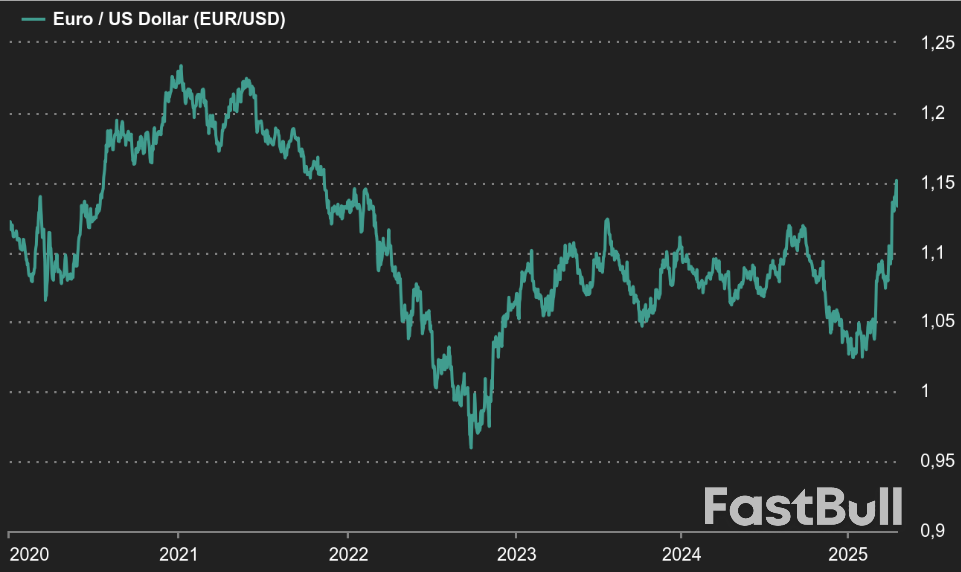
          Not so long ago, the rise of the dollar was a consensus view on the markets, and many investors were betting on a return to euro-dollar parity. That was at the end of last year, in the wake of Donald Trump's election. But as is often the case, the consensus has been reversed. As a result, the eurodollar crossed the 1.15 threshold again at the beginning of the week. This is the first time since the end of 2021.
          Can the dollar lose its status?_1
          As we explained earlier this week, it is not only the dollar that has been falling in recent weeks, but all US assets (stocks and bonds). Focusing on the currency, the dollar index – the dollar against a basket of reference currencies – is down 8.5% since January 1.
          Behind this decline is probably a movement away from US assets. This is because the Trump administration's economic policy is likely to weigh on global growth, and US growth in particular. This is shown by the IMF's new growth forecasts, published this week. Beyond the growth figures themselves, the unpredictability of the United States on the one hand, and the questioning of the rule of law and therefore of the long-term investment framework on the other, are leading to a loss of confidence among investors.

          A burden for the US?

          But is this a problem for the Trump administration? Although Scott Bessent often reiterates his commitment to a strong dollar policy, Donald Trump's goal is to weaken the dollar. This should stimulate US exports and give greater weight to the manufacturing sector. In the White House, this issue is being championed by Stephen Miran, who heads the Council of Economic Advisers. He believes that the chronic overvaluation of the dollar is the main cause of US trade imbalances. An overvalued dollar is therefore a burden for the US, which provides liquidity to the entire world and military protection to its allies.
          His main battle is therefore "burden sharing." The idea is that other countries should buy more US products or provide more financing to the US, for example by issuing perpetual zero-coupon bonds. All of this would be formalized in the Mar-a-Lago agreements—named after Donald Trump's residence in Florida. The name refers to the Plaza Accords of 1985, when France, the United Kingdom, Japan, Germany, and the United States agreed to devalue the dollar.
          All this remains theoretical for the time being. To quote a note from the Edmond de Rothschild team, the Mar-a-Lago agreements are a project "so unfinished and so out of the box that it remains speculative." Indeed, the world has changed somewhat since 1985, and dollar assets are no longer concentrated in the few countries that signed the Plaza Accords.
          Finally, it is important to remember the implications of a currency devaluation. On the one hand, it boosts the competitiveness of US exports. But it also makes imports more expensive, which is likely to fuel inflation. Another important point to mention is that a currency decline is in principle positive for financial conditions and therefore for growth. But if it reflects a significant outflow of US assets, higher bond yields would offset the positive effect on financial conditions.

          The dollar for lack of anything better

          It is important to distinguish between two issues: the decline of the dollar and the loss of the dollar's status. If investors continue to reduce their exposure to US assets, the dollar may continue to fall. Indeed, US markets have attracted flows for decades. According to the most recent data published by the US Treasury Department, the value of US assets held by non-residents exceeds $31 trillion.
          The dollar may therefore continue to decline. But for it to lose its status as a reference currency, there would have to be an alternative. However, we do not really see one. The two other major economic zones are Europe and China. The yuan is a currency controlled by the Chinese authorities, not to say manipulated. As for the euro, the debt markets lack depth and the eurozone is not yet fully integrated.
          For the time being, the dollar is undoubtedly the reference currency. To give a few figures that illustrate this dominant role, the dollar is currently used in 88% of trade and 59% of central bank foreign exchange reserves. And the United States has the most structured, deepest, and most liquid financial markets in the world.
          The conclusion is therefore that even if the United States is currently doing everything wrong, the dollar will not lose its status anytime soon. When you take into account the political equation and the depth and liquidity of the capital markets, there is really no alternative to the dollar. A large proportion of global savings will therefore continue to be invested in the United States.

          Source: marketscreener

          Risk Warnings and Disclaimers
          You understand and acknowledge that there is a high degree of risk involved in trading. Following any strategies or investment methods may lead to potential losses. The content on the site is provided by our contributors and analysts for information purposes only. You are solely responsible for determining whether any trading assets, securities, strategy, or any other product is suitable for investing based on your own investment objectives and financial situation.
          Add to Favorites
          Share

          World Bank Is Not an American Bank, German Development Minister Says

          Warren Takunda

          Economic

          The Trump administration cannot determine the mission of the World Bank because the global lender's goals are based on agreement by many countries, Svenja Schulze, Germany's minister for economic cooperation and development, told Reuters.
          "This is not an American bank, it's a world bank," Schulze said in an interview on Thursday on the sidelines of the International Monetary Fund and World Bank spring meetings in Washington.
          U.S. Treasury Secretary Scott Bessent on Wednesday called on the IMF and World Bank to refocus on their core missions of macroeconomic stability and development, arguing they have strayed too far into vanity projects such as climate change.
          Certain euphemisms are starting to be used in international institutions, such as "weather developments" instead of "climate change," and words like "gender" or "climate" or "inclusion" are being avoided.
          "That is the founding mission of this bank, to take care of exactly these issues, and therefore we will now have to talk about what the U.S. actually wants," Schulze said.
          The U.S. is the largest single shareholder of the World Bank, with just under 16%.
          President Donald Trump's administration has cancelled billions of dollars in foreign aid, including funding for projects that provide lifesaving care for millions of people in some of the world's poorest countries.
          Schulze noted that these cuts have caused "a very large loss of trust" in developing countries, adding that rebuilding trust and showing that the World Bank and Germany are reliable partners were her goals for this week's meetings.
          Schulze's Social Democrats will retain control of the German development ministry as part of the coalition agreement reached by the parties forming Germany's next government. It is not clear who the next minister will be, though Schulze said she would like to remain in the position.
          Could the trade war between China and the US be easing?
          "We want to continue investing in development," she said. "Investment in development policy is also part of our security policy. It's not just foreign policy and defence, but also development."
          Germany provided 30 billion euros ($34.16 billion), or 0.67% of its gross national income, for development aid in 2024, but failed to meet the agreed United Nations target of 0.7% of GDP, the Official Development Assistance (ODA) quota.
          The agreement reached by the incoming German coalition includes an "appropriate reduction in the ODA quota," which comes after years in which the budget was constantly reduced, according to the agreement.

          Source: Reuters

          To stay updated on all economic events of today, please check out our Economic calendar
          Risk Warnings and Disclaimers
          You understand and acknowledge that there is a high degree of risk involved in trading. Following any strategies or investment methods may lead to potential losses. The content on the site is provided by our contributors and analysts for information purposes only. You are solely responsible for determining whether any trading assets, securities, strategy, or any other product is suitable for investing based on your own investment objectives and financial situation.
          Add to Favorites
          Share
          FastBull
          Copyright © 2025 FastBull Ltd

          728 RM B 7/F GEE LOK IND BLDG NO 34 HUNG TO RD KWUN TONG KLN HONG KONG

          TelegramInstagramTwitterfacebooklinkedin
          App Store Google Play Google Play
          Products
          Charts

          Chats

          Q&A with Experts
          Screeners
          Economic Calendar
          Data
          Tools
          Membership
          Features
          Function
          Markets
          Copy Trading
          Latest Signals
          Contests
          News
          Analysis
          24/7
          Columns
          Education
          Company
          Careers
          About Us
          Contact Us
          Advertising
          Help Center
          Feedback
          User Agreement
          Privacy Policy
          Business

          White Label

          Data API

          Web Plug-ins

          Poster Maker

          Affiliate Program

          Risk Disclosure

          The risk of loss in trading financial instruments such as stocks, FX, commodities, futures, bonds, ETFs and crypto can be substantial. You may sustain a total loss of the funds that you deposit with your broker. Therefore, you should carefully consider whether such trading is suitable for you in light of your circumstances and financial resources.

          No decision to invest should be made without thoroughly conducting due diligence by yourself or consulting with your financial advisors. Our web content might not suit you since we don't know your financial conditions and investment needs. Our financial information might have latency or contain inaccuracy, so you should be fully responsible for any of your trading and investment decisions. The company will not be responsible for your capital loss.

          Without getting permission from the website, you are not allowed to copy the website's graphics, texts, or trademarks. Intellectual property rights in the content or data incorporated into this website belong to its providers and exchange merchants.

          Not Logged In

          Log in to access more features

          FastBull Membership

          Not yet

          Purchase

          Become a signal provider
          Help Center
          Customer Service
          Dark Mode
          Price Up/Down Colors

          Log In

          Sign Up

          Position
          Layout
          Fullscreen
          Default to Chart
          The chart page opens by default when you visit fastbull.com
