• Trade
  • Markets
  • Copy
  • Contests
  • News
  • 24/7
  • Calendar
  • Q&A
  • Chats
Trending
Screeners
SYMBOL
LAST
BID
ASK
HIGH
LOW
NET CHG.
%CHG.
SPREAD
SPX
S&P 500 Index
6827.42
6827.42
6827.42
6899.86
6801.80
-73.58
-1.07%
--
DJI
Dow Jones Industrial Average
48458.04
48458.04
48458.04
48886.86
48334.10
-245.98
-0.51%
--
IXIC
NASDAQ Composite Index
23195.16
23195.16
23195.16
23554.89
23094.51
-398.69
-1.69%
--
USDX
US Dollar Index
97.920
98.000
97.920
98.070
97.810
-0.030
-0.03%
--
EURUSD
Euro / US Dollar
1.17446
1.17453
1.17446
1.17596
1.17262
+0.00052
+ 0.04%
--
GBPUSD
Pound Sterling / US Dollar
1.33843
1.33853
1.33843
1.33961
1.33546
+0.00136
+ 0.10%
--
XAUUSD
Gold / US Dollar
4331.66
4332.07
4331.66
4350.16
4294.68
+32.27
+ 0.75%
--
WTI
Light Sweet Crude Oil
56.843
56.873
56.843
57.601
56.789
-0.390
-0.68%
--

Community Accounts

Signal Accounts
--
Profit Accounts
--
Loss Accounts
--
View More

Become a signal provider

Sell trading signals to earn additional income

View More

Guide to Copy Trading

Get started with ease and confidence

View More

Signal Accounts for Members

All Signal Accounts

Best Return
  • Best Return
  • Best P/L
  • Best MDD
Past 1W
  • Past 1W
  • Past 1M
  • Past 1Y

All Contests

  • All
  • Trump Updates
  • Recommend
  • Stocks
  • Cryptocurrencies
  • Central Banks
  • Featured News
Top News Only
Share

Portugal Treasury Expects 2026 Net Financing Needs At 29.4 Billion Euros, Up From 25.8 Billion In 2025

Share

Bank Of America Says With Indonesia's Smelter Now Ramping Up, It Expects Aluminium Supply Growth To Accelerate To 2.6% Year On Year In 2026

Share

Bank Of America Expects A Deficit In Aluminium Next Year And Sees Prices Pushing Above $3000/T

Share

Fed Data - USA Effective Federal Funds Rate At 3.64 Percent On 12 December On $102 Billion In Trades Versus 3.64 Percent On $99 Billion On 11 December

Share

Brazil's Petrobras Says No Impact Seen On Oil, Petroleum Products Output As Workers Start Planned Strike

Share

Statement: US Travel Group Warns New Proposed Trump Administration Requirements For Foreign Tourists To Provide Social Media Histories Could Mean Millions Of People Opting Not To Visit

Share

Blackrock: Kerry White Will Become Head Of Citi Investment Management At Citi Wealth

Share

Blackrock: Rob Jasminski, Head Of Citi Investment Management, Has Joined With Team

Share

Blackrock: Effective Dec 15, Citi Investment Management Employees Will Join Blackrock

Share

Blackrock: Formally Launch Citi Portfolio Solutions Powered By Blackrock

Share

According To Data From The Federal Reserve Bank Of New York, The Secured Overnight Funding Rate (Sofr) Was 3.67% On The Previous Trading Day (December 15), Compared To 3.66% The Day Before

Share

Peru Energy And Mines Ministry: Copper Production Up 4.8% Year-On-Year In October To 248192 Metric Tons

Share

Security Source: Ukrainian Drones Hits Russian Oil Infrastructure In Caspian Sea For Third Time

Share

Spot Palladium Extends Gains, Last Up 5% To $1562.7/Oz

Share

Mexico's Economy Ministry Announces Start Of Anti-Dumping Investigation And Anti-Subsidy Investigations Into USA Pork Imports

Share

Canada Nov CPI Common +2.8%, CPI Median +2.8%, CPI Trim +2.8% On Year

Share

NY Fed's Empire State Prices Paid Index +37.6 In December Versus+49.0 In November

Share

Canada Nov Consumer Prices +0.1% On Month, +2.2% On Year

Share

Canada Nov CPI Core -0.1% On Month, +2.9% On Year

Share

Canada Nov Core CPI, Seasonally Adjusted +0.2% On Month, Oct +0.3% (Unrevised)

TIME
ACT
FCST
PREV
Japan Tankan Small Manufacturing Outlook Index (Q4)

A:--

F: --

P: --

Japan Tankan Large Non-Manufacturing Outlook Index (Q4)

A:--

F: --

P: --

Japan Tankan Large Manufacturing Outlook Index (Q4)

A:--

F: --

P: --

Japan Tankan Small Manufacturing Diffusion Index (Q4)

A:--

F: --

P: --

Japan Tankan Large Manufacturing Diffusion Index (Q4)

A:--

F: --

P: --

Japan Tankan Large-Enterprise Capital Expenditure YoY (Q4)

A:--

F: --

P: --

U.K. Rightmove House Price Index YoY (Dec)

A:--

F: --

P: --

China, Mainland Industrial Output YoY (YTD) (Nov)

A:--

F: --

P: --

China, Mainland Urban Area Unemployment Rate (Nov)

A:--

F: --

P: --

Saudi Arabia CPI YoY (Nov)

A:--

F: --

P: --

Euro Zone Industrial Output YoY (Oct)

A:--

F: --

P: --

Euro Zone Industrial Output MoM (Oct)

A:--

F: --

P: --

Canada Existing Home Sales MoM (Nov)

A:--

F: --

P: --

Canada National Economic Confidence Index

A:--

F: --

P: --

Canada New Housing Starts (Nov)

A:--

F: --

P: --
U.S. NY Fed Manufacturing Employment Index (Dec)

A:--

F: --

P: --

U.S. NY Fed Manufacturing Index (Dec)

A:--

F: --

P: --

Canada Core CPI YoY (Nov)

A:--

F: --

P: --

Canada Manufacturing Unfilled Orders MoM (Oct)

A:--

F: --

P: --

U.S. NY Fed Manufacturing Prices Received Index (Dec)

A:--

F: --

P: --

U.S. NY Fed Manufacturing New Orders Index (Dec)

A:--

F: --

P: --

Canada Manufacturing New Orders MoM (Oct)

A:--

F: --

P: --

Canada Core CPI MoM (Nov)

A:--

F: --

P: --

Canada Trimmed CPI YoY (SA) (Nov)

A:--

F: --

P: --

Canada Manufacturing Inventory MoM (Oct)

A:--

F: --

P: --

Canada CPI YoY (Nov)

A:--

F: --

P: --

Canada CPI MoM (Nov)

A:--

F: --

P: --

Canada CPI YoY (SA) (Nov)

A:--

F: --

P: --

Canada Core CPI MoM (SA) (Nov)

A:--

F: --

P: --

Canada CPI MoM (SA) (Nov)

A:--

F: --

P: --

Federal Reserve Board Governor Milan delivered a speech
U.S. NAHB Housing Market Index (Dec)

--

F: --

P: --

Australia Composite PMI Prelim (Dec)

--

F: --

P: --

Australia Services PMI Prelim (Dec)

--

F: --

P: --

Australia Manufacturing PMI Prelim (Dec)

--

F: --

P: --

Japan Manufacturing PMI Prelim (SA) (Dec)

--

F: --

P: --

U.K. 3-Month ILO Employment Change (Oct)

--

F: --

P: --

U.K. Unemployment Claimant Count (Nov)

--

F: --

P: --

U.K. Unemployment Rate (Nov)

--

F: --

P: --

U.K. 3-Month ILO Unemployment Rate (Oct)

--

F: --

P: --

U.K. Average Weekly Earnings (3-Month Average, Including Bonuses) YoY (Oct)

--

F: --

P: --

U.K. Average Weekly Earnings (3-Month Average, Excluding Bonuses) YoY (Oct)

--

F: --

P: --

France Services PMI Prelim (Dec)

--

F: --

P: --

France Composite PMI Prelim (SA) (Dec)

--

F: --

P: --

France Manufacturing PMI Prelim (Dec)

--

F: --

P: --

Germany Services PMI Prelim (SA) (Dec)

--

F: --

P: --

Germany Manufacturing PMI Prelim (SA) (Dec)

--

F: --

P: --

Germany Composite PMI Prelim (SA) (Dec)

--

F: --

P: --

Euro Zone Composite PMI Prelim (SA) (Dec)

--

F: --

P: --

Euro Zone Services PMI Prelim (SA) (Dec)

--

F: --

P: --

Euro Zone Manufacturing PMI Prelim (SA) (Dec)

--

F: --

P: --

U.K. Services PMI Prelim (Dec)

--

F: --

P: --

U.K. Manufacturing PMI Prelim (Dec)

--

F: --

P: --

U.K. Composite PMI Prelim (Dec)

--

F: --

P: --

Euro Zone ZEW Economic Sentiment Index (Dec)

--

F: --

P: --

Germany ZEW Current Conditions Index (Dec)

--

F: --

P: --

Germany ZEW Economic Sentiment Index (Dec)

--

F: --

P: --

Euro Zone Trade Balance (Not SA) (Oct)

--

F: --

P: --

Euro Zone ZEW Current Conditions Index (Dec)

--

F: --

P: --

Euro Zone Trade Balance (SA) (Oct)

--

F: --

P: --

U.S. Retail Sales MoM (Excl. Automobile) (SA) (Oct)

--

F: --

P: --

Q&A with Experts
    • All
    • Chatrooms
    • Groups
    • Friends
    Connecting
    .
    .
    .
    Type here...
    Add Symbol or Code

      No matching data

      All
      Trump Updates
      Recommend
      Stocks
      Cryptocurrencies
      Central Banks
      Featured News
      • All
      • Russia-Ukraine Conflict
      • Middle East Flashpoint
      • All
      • Russia-Ukraine Conflict
      • Middle East Flashpoint
      Search
      Products

      Charts Free Forever

      Chats Q&A with Experts
      Screeners Economic Calendar Data Tools
      Membership Features
      Data Warehouse Market Trends Institutional Data Policy Rates Macro

      Market Trends

      Market Sentiment Order Book Forex Correlations

      Top Indicators

      Charts Free Forever
      Markets

      News

      News Analysis 24/7 Columns Education
      From Institutions From Analysts
      Topics Columnists

      Latest Views

      Latest Views

      Trending Topics

      Top Columnists

      Latest Update

      Signals

      Copy Rankings Latest Signals Become a signal provider AI Rating
      Contests
      Brokers

      Overview Brokers Assessment Rankings Regulators News Claims
      Broker listing Forex Brokers Comparison Tool Live Spread Comparison Scam
      Q&A Complaint Scam Alert Videos Tips to Detect Scam
      More

      Business
      Events
      Careers About Us Advertising Help Center

      White Label

      Data API

      Web Plug-ins

      Affiliate Program

      Awards Institution Evaluation IB Seminar Salon Event Exhibition
      Vietnam Thailand Singapore Dubai
      Fans Party Investment Sharing Session
      FastBull Summit BrokersView Expo
      Recent Searches
        Top Searches
          Markets
          News
          Analysis
          User
          24/7
          Economic Calendar
          Education
          Data
          • Names
          • Latest
          • Prev

          View All

          No data

          Scan to Download

          Faster Charts, Chat Faster!

          Download App
          English
          • English
          • Español
          • العربية
          • Bahasa Indonesia
          • Bahasa Melayu
          • Tiếng Việt
          • ภาษาไทย
          • Français
          • Italiano
          • Türkçe
          • Русский язык
          • 简中
          • 繁中
          Open Account
          Search
          Products
          Charts Free Forever
          Markets
          News
          Signals

          Copy Rankings Latest Signals Become a signal provider AI Rating
          Contests
          Brokers

          Overview Brokers Assessment Rankings Regulators News Claims
          Broker listing Forex Brokers Comparison Tool Live Spread Comparison Scam
          Q&A Complaint Scam Alert Videos Tips to Detect Scam
          More

          Business
          Events
          Careers About Us Advertising Help Center

          White Label

          Data API

          Web Plug-ins

          Affiliate Program

          Awards Institution Evaluation IB Seminar Salon Event Exhibition
          Vietnam Thailand Singapore Dubai
          Fans Party Investment Sharing Session
          FastBull Summit BrokersView Expo

          Mexico’s Diplomatic Strategy Strained as Trump Escalates Tariff Threats

          Gerik

          Economic

          Summary:

          Despite ongoing cooperation with US officials, Mexico faces renewed pressure from President Trump’s threat of 30% tariffs, testing its calm diplomatic approach amid rising trade and security tensions....

          A Setback to Quiet Diplomacy

          Mexico's policy of diplomatic restraint and constructive dialogue with the US administration faces a critical test following President Donald Trump’s unexpected threat to impose 30% tariffs on Mexican exports. This announcement stunned Mexican negotiators, who had invested months building a cooperative rapport with Washington. Despite reassurances from US officials about Mexico’s role in border security and anti-narcotics efforts, Trump’s letter delivered a stark reversal, claiming that Mexico’s actions against drug cartels remain insufficient.
          The shift comes as Mexico had been banking on its collaborative image, emphasized by regular high-level visits to Washington and public goodwill gestures, to stave off harsh trade measures. Trump’s comments suggested that such goodwill, however sincere or strategic, may carry limited influence when weighed against his broader tariff agenda.

          Limited Room for Retaliation, High Stakes for Trade

          Though the proposed 30% tariff appears severe, its actual economic disruption may be limited in the short term. Bloomberg Economics notes that over 80% of US imports from Mexico were exempt from tariffs as of May, largely protected by provisions under the United States-Mexico-Canada Agreement (USMCA). Trump’s letter outlined that the new tariff would spare certified USMCA goods, preserving some continuity in trade.
          Nonetheless, the symbolic weight of this escalation matters. Mexico has deliberately taken a less confrontational tone than Canada, which received a similar 35% tariff threat. The Mexican government is keen to avoid retaliatory cycles that could damage its critical status as the United States’ largest trade partner.

          High-Level Engagement and Public Assurances

          On Saturday, the US Ambassador to Mexico, Ronald Johnson, attempted to smooth tensions by emphasizing the “wonderful relationship” between President Trump and President Claudia Sheinbaum. Speaking at a formal gala in Mexico City, Johnson stressed mutual respect and the importance of cooperation, asserting that “America First doesn’t mean America alone.” However, the contrast between such diplomatic remarks and the substance of Trump’s tariff threats has heightened confusion among policymakers and business leaders alike.
          Mexico continues to rely on high-level engagement as its primary tool. Minister Marcelo Ebrard has remained in Washington to pursue negotiations with the White House, the Office of the US Trade Representative, and the Department of Commerce. The Mexican Economy Ministry called the proposed tariff hike “unfair” and reiterated its commitment to finding a solution that preserves economic stability and employment across the border.

          Security Commitments Amid Trade Uncertainty

          The Mexican government has made visible efforts to address US concerns about drug trafficking. These include the extradition of major cartel figures, enhanced border busts, and a push for new legislation to intensify investigations into unsolved crimes. Mexico's security minister has played a leading role in bilateral meetings in Washington, aiming to demonstrate goodwill and proactive engagement.
          However, trust has been undermined by recent US actions targeting three Mexican financial institutions allegedly linked to drug-related money laundering. This parallel development has strained bilateral cooperation and complicated Mexico’s efforts to present itself as a reliable security partner.

          Strategic Response to Preserve Market Access

          Looking forward, analysts expect Mexico to continue pursuing a pragmatic and composed approach. According to Goldman Sachs’ Alberto Ramos, Mexican authorities are likely to maintain constructive engagement while showing some willingness to intensify measures against cartel-related activity. Their ultimate goal is to safeguard access to the US market under competitive terms and protect domestic industry from sudden shocks.
          The Economy Ministry’s statement reaffirmed this objective, noting that Mexico seeks an “alternative that allows us to protect businesses and jobs on both sides of the border.” This framing underscores the deeply integrated nature of the North American supply chain, in which disruptions to Mexican exports could have adverse effects on US companies and consumers as well.

          Stability Through Engagement or Confrontation?

          Mexico now finds itself navigating a precarious position. Its strategy of calm, proactive diplomacy has bought time and preserved important trade exemptions, but its long-term effectiveness is under question in the face of unilateral US actions. Whether this posture can continue to deliver results or whether a shift toward more assertive negotiation is necessary will depend largely on Trump’s next moves and the ability of Mexican officials to secure concrete assurances before the August 1 deadline.
          The coming weeks will determine if mutual economic interdependence can override political maneuvering, or if the escalation of tariffs will reshape US-Mexico trade dynamics in more adversarial terms.

          Source: Bloomberg

          To stay updated on all economic events of today, please check out our Economic calendar
          Risk Warnings and Disclaimers
          You understand and acknowledge that there is a high degree of risk involved in trading. Following any strategies or investment methods may lead to potential losses. The content on the site is provided by our contributors and analysts for information purposes only. You are solely responsible for determining whether any trading assets, securities, strategy, or any other product is suitable for investing based on your own investment objectives and financial situation.
          Add to Favorites
          Share

          European Union Rallies Allies as Trump Tariff Threats Escalate

          Gerik

          Economic

          China–U.S. Trade War

          EU Seeks Strategic Coordination Amid Growing Tariff Risks

          The European Union is intensifying diplomatic engagement with nations similarly affected by the United States' escalating tariff policies under President Donald Trump. According to individuals close to the matter, this outreach includes advanced economies such as Canada and Japan, aiming to explore potential coordination in trade defense strategies. The move reflects growing anxiety within the EU over the stalled nature of negotiations with the US and the increasing scale of potential retaliatory measures.
          While discussions between Brussels and Washington continue, unresolved issues particularly on automobiles and agricultural tariffs have stalled progress. The EU’s member states were briefed on these developments on Sunday, as the timeline for resolution shortens.

          Temporary Suspension of Countermeasures Amid Extended Talks

          European Commission President Ursula von der Leyen announced a further extension of the suspension of retaliatory tariffs on the US, now delayed until August 1. This delay is designed to give one final window for negotiations. These countermeasures, originally adopted in response to Trump-era tariffs on EU steel and aluminum, had previously been paused and were scheduled to resume at midnight on Tuesday.
          Von der Leyen emphasized that the EU prefers a diplomatic outcome, but made clear that preparations for retaliation are ongoing. The EU’s current list of countermeasures targets approximately €21 billion worth of US goods, with an expanded list worth €72 billion being considered, including proposed export restrictions. These plans may be presented to member states early this week.
          Despite this, von der Leyen ruled out the immediate deployment of the EU’s anti-coercion instrument, which is regarded as its most powerful trade defense tool. While acknowledging its strategic value, she clarified that its use is reserved for more extreme scenarios. This position may reflect both tactical restraint and a desire to avoid preemptively escalating tensions.

          Rising Political Pressure Within the EU

          European leaders are increasingly voicing concern. French President Emmanuel Macron used social media to advocate for a faster rollout of robust countermeasures including the anti-coercion tool if talks do not yield results by August 1. Meanwhile, German Chancellor Friedrich Merz warned that a 30% US tariff could severely damage Germany’s export-driven economy. He underscored the need for European unity and emphasized ongoing direct communications with the US administration.
          Trump’s latest round of letters to US trading partners including Mexico and the EU outlined revised tariff proposals and an invitation to resume dialogue. While intended as leverage, this approach appears to have deepened skepticism in Brussels. A prior sense of optimism for a last-minute deal has now given way to renewed strategic caution.

          Negotiation Scope and Points of Contention

          Current proposals involve a baseline 10% US tariff on most EU goods, with limited exemptions in key sectors such as aviation and medical equipment. Brussels is simultaneously pushing for reduced tariffs on wines and spirits, and is attempting to soften the impact of 50% levies on steel and aluminum by negotiating product quotas.
          A major point of friction remains the proposed 17% US tariff on EU agricultural exports. The EU aims to cap this rate at 10%, rejecting more complex proposals such as an offset mechanism that would offer tariff relief in exchange for foreign direct investment in the US. EU officials reportedly fear such a system would disincentivize European production and accelerate industrial relocation to America.
          Talks have also explored broader trade themes including non-tariff barriers, strategic supply chain partnerships, and potential cooperation in areas of economic security. However, no proposal currently on the table would shield the EU from Trump’s announced sectoral levies on cars, car parts, metals, copper, pharmaceuticals, and semiconductors.

          Trade Outlook Remains Uncertain

          The European bloc finds itself in a delicate balancing act: maintaining negotiation momentum while preparing for a possible full-scale trade confrontation. This dual-track strategy extending diplomatic engagement and quietly developing punitive instruments mirrors the complex economic stakes involved. EU negotiators are aware that failing to act decisively could result in deep structural harm to the bloc’s key industries.
          Even if a limited deal is reached in the coming weeks, it may offer only partial relief. With the US intent on maintaining leverage through sector-specific duties, the EU continues to seek exemptions and preferential treatment. Whether these goals can be achieved before August remains uncertain, but what is increasingly clear is that the EU is bracing itself for a broader realignment of transatlantic trade dynamics in the months ahead.

          Source: Bloomberg

          To stay updated on all economic events of today, please check out our Economic calendar
          Risk Warnings and Disclaimers
          You understand and acknowledge that there is a high degree of risk involved in trading. Following any strategies or investment methods may lead to potential losses. The content on the site is provided by our contributors and analysts for information purposes only. You are solely responsible for determining whether any trading assets, securities, strategy, or any other product is suitable for investing based on your own investment objectives and financial situation.
          Add to Favorites
          Share

          Trump's 30% Tariffs On Mexico And EU Imports

          Daniel Carter

          Economic

          Political

          Key Points:
          ● US President Trump's 30% tariffs on Mexico and EU imports.
          ● Experts warn of rising prices and potential economic downturn.
          ● Uncertainty impacts global markets and trade relationships.
          Donald Trump announced new 30% tariffs on Mexico and European Union imports effective August 1, 2025, raising broad concerns. Experts warn these tariffs could raise prices and fuel unemployment, affecting the US and global economies.
          The announcement of a 30% tariff on imports from Mexico and the European Union, set to commence on August 1, 2025, has drawn significant attention. President Donald Trump, known for using tariffs as a policy tool, announced the move without immediate detailed justification, although they have often served broad policy purposes in the past.

          US Tariff Hike Sparks Global Economic Concerns

          Experts speculate about potential economic impacts, with Mary Lovely of the Peterson Institute for International Economics suggesting it could trigger a recession, reducing consumption and closing the trade deficit. Stock and bond markets have reacted negatively, reflecting investor unease over rising risks associated with US financial assets.
          Key figures like Alan Sykes from Stanford express doubts about the US's credibility in future negotiations, while industry experts from the Brookings Institution also highlight the complexity and unforeseen consequences of the tariffs, indicating the lack of a clear strategic framework.
          "It could trigger a recession, in which case we will see the trade deficit close because our consumption will fall. That’s really not the policy that anybody, I’m sure, even including the Trump administration, wants to see." Mary E. Lovely, Senior Fellow, Peterson Institute for International Economics.

          Cryptocurrency and Market Impact Amid Tariff Announcements

          Did you know? US tariffs during the 2018–2020 trade war led to notable short-term volatility in major cryptocurrencies, with BTC experiencing increased safe-haven inflows.
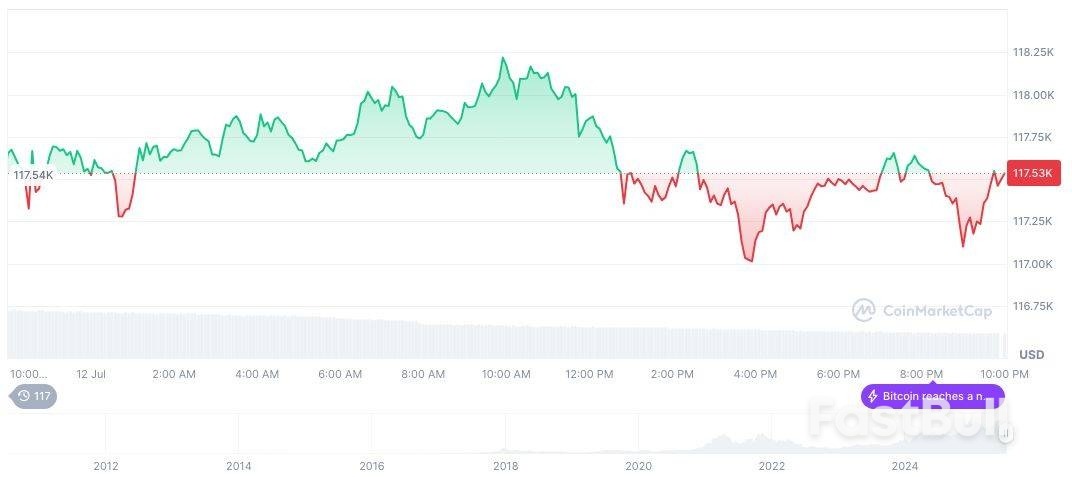
          Bitcoin, trading at $117,790.43, exhibits a market cap of $2.34 trillion and dominance at 63.73%, according to CoinMarketCap. Its 24-hour trading volume has decreased by 31.63% to $41.75 billion while the price dropped 0.28% over the same timeframe.

          Bitcoin(BTC), daily chart, screenshot on CoinMarketCap at 10:59 UTC on July 13, 2025.

          Researchers indicate potential fallout, such as inflation and recession if tariffs provoke retaliatory action from trading partners. While crypto markets show minimal volatility linked to such macro events now, the absence of specific moves reflects a broader cautious investor climate.

          Source: CryptoSlate

          To stay updated on all economic events of today, please check out our Economic calendar
          Risk Warnings and Disclaimers
          You understand and acknowledge that there is a high degree of risk involved in trading. Following any strategies or investment methods may lead to potential losses. The content on the site is provided by our contributors and analysts for information purposes only. You are solely responsible for determining whether any trading assets, securities, strategy, or any other product is suitable for investing based on your own investment objectives and financial situation.
          Add to Favorites
          Share

          Cautious Optimism in Bond Markets as CPI Data Looms Large on Fed's September Decision

          Gerik

          Economic

          Bond

          Shifting Sentiment in Bond Markets

          Earlier in 2025, confidence among fixed-income investors in a September interest rate cut by the Federal Reserve was near absolute. However, recent labor market strength and uncertainty surrounding inflation have begun to erode that certainty. Now, as traders recalibrate their expectations, the release of June's Consumer Price Index (CPI) data has taken center stage. This report may provide crucial evidence on whether inflation remains stubbornly persistent or is softening, thereby directly influencing the Fed's next steps.
          The broader context includes a robust first half for Treasuries, with performance reaching a five-year high despite episodic volatility. Yet optimism has been tempered. According to Zachary Griffiths at CreditSights, the CPI outcome could redefine market sentiment and shape the trajectory of monetary policy through the end of 2025.

          Jobs Data Complicates Policy Outlook

          A series of strong employment figures released in early July significantly diminished the probability of a July rate cut. The odds for a September cut have now dropped to approximately 70%, down from near certainty in late June. This retreat indicates increasing caution in the bond market. Traders are holding back from aggressive positioning until the inflation picture becomes clearer.
          Barclays strategists highlight that June’s CPI release is particularly crucial, historically averaging the largest absolute surprises among recent monthly reports. Any upside deviation in inflation, especially amid ongoing tariff implementation under President Trump, could challenge the case for near-term monetary easing.

          Tariffs and the Inflation Trajectory

          The tariff agenda has introduced an additional layer of complexity. While President Trump’s deferral of broad punitive tariffs until August 1 provides temporary clarity, the longer-term implications for inflation are still unfolding. The Federal Reserve is awaiting more evidence to determine whether the tariff measures will result in sustained consumer price pressures. Fed Chair Jerome Powell has stressed the need for patience, even as political pressure for lower rates intensifies.
          Tracy Chen of Brandywine Global suggests that inflationary pressures from tariffs may soon manifest in CPI prints, making a September cut difficult to justify. She points to the enduring strength of the labor market and elevated valuations in risk assets as further reasons to maintain current rates. A steepening yield curve may result if inflation expectations rise, particularly for longer-dated Treasuries, driven by anticipated fiscal expansion and shifting international demand.

          Market Positioning and Volatility Trends

          In recent weeks, traders have unwound previous bullish positions on Treasuries, contributing to a consolidation in yields. Two-year Treasury rates have oscillated within a narrow band of 3.7% to 4% since early May, underscoring the absence of a clear directional trend. Simultaneously, volatility indicators in Treasury markets have declined to their lowest point in over three years, following a tariff-related surge in April.
          Forecasts compiled by Bloomberg anticipate annual core CPI reaching 2.9% in June, the highest since February. This potential acceleration adds urgency to upcoming inflation data releases, especially as they could reset expectations for interest rate paths.

          Policymakers Remain Divided

          Despite holding rates steady since December, the Federal Reserve remains internally divided. While the median projection in the June dot plot anticipates two rate cuts by year-end, seven officials foresee no further easing in 2025. At the same time, ten policymakers project two or more cuts. Governors Waller and Bowman have indicated openness to an earlier reduction, possibly as soon as this month, although recent developments suggest that such action is becoming less probable.
          Griffiths of CreditSights notes that any concrete signs of tariff-driven price hikes would likely prompt a repricing of the Fed’s rate trajectory, pushing yields higher across the curve through a mild flattening dynamic.

          Outlook Beyond September

          Even if the Federal Reserve delays its next rate cut beyond September, bond strategists argue that the broader easing narrative remains intact. John Lloyd of Janus Henderson believes that while one of the two projected cuts may be postponed, it would likely shift into the first quarter of 2026 rather than be removed entirely. This belief may help limit downside risks for bonds, even in the face of stronger inflation data.
          As investors await the CPI report, their stance reflects growing caution rather than panic. The bond market’s reaction to upcoming inflation and consumer data will shape not only September’s policy meeting but also the outlook for the rest of the year. A mild inflation print could restore rate-cut expectations, while hotter-than-expected figures may push yields higher and delay monetary easing. Until clarity emerges, the Treasury market appears locked in a holding pattern, with yield movements tethered tightly to incoming data.

          Source: Bloomberg


          To stay updated on all economic events of today, please check out our Economic calendar
          Risk Warnings and Disclaimers
          You understand and acknowledge that there is a high degree of risk involved in trading. Following any strategies or investment methods may lead to potential losses. The content on the site is provided by our contributors and analysts for information purposes only. You are solely responsible for determining whether any trading assets, securities, strategy, or any other product is suitable for investing based on your own investment objectives and financial situation.
          Add to Favorites
          Share

          Trump's 200% Tariff on Pharmaceuticals: Strategic Leverage or Policy Miscalculation?

          Gerik

          Economic

          China–U.S. Trade War

          Shock Factor: A 200% Tariff That Hits Where It Hurts Most

          Unlike tariffs on consumer goods or industrial inputs, the proposed 200% import tax on pharmaceuticals strikes at a uniquely sensitive sector healthcare. The announcement triggered immediate alarm among both pharmaceutical firms and public policy analysts, with many viewing the move as overly aggressive and poorly timed.
          Financial institutions like Barclays warn that such a tax would directly inflate production costs, compress profit margins, and severely strain global supply chains. This in turn could lead to reduced availability of essential medicines and significantly higher prices for U.S. consumers. According to estimates from PhRMA, even a 25% tariff would raise consumer costs by $51 billion annually, potentially inflating domestic drug prices by up to 12.9%. A 200% rate would exacerbate these effects exponentially.

          Political Messaging Meets Industrial Complexity

          The Trump administration’s rationale centers on perceived unfair pricing and the desire to “reshore” pharmaceutical production. Trump has framed the tariff as a lever to compel drugmakers to bring manufacturing back to U.S. soil. However, stakeholders argue that the plan overlooks the structural and regulatory complexity of pharmaceutical supply chains.
          Afsaneh Beschloss, CEO of RockCreek Group, called the policy “potentially catastrophic,” citing the time and technical requirements needed to produce medications domestically. Industry experts note that essential drugs and medical devices are often exempt from tariffs due to their critical nature, making this proposed blanket policy a sharp departure from established norms.
          While firms such as Novartis, Roche, Eli Lilly, Sanofi, and Johnson & Johnson have announced major investment plans in the U.S., these are long-term strategies that are not likely to respond immediately to tariff pressure. UBS analysts warn that even with strong incentives, a 12–18 month tariff grace period is far too short; commercial-scale relocation typically requires 4–5 years.

          Economic Fallout and Sectoral Pushback

          Although the administration seeks to frame the policy as a growth opportunity for U.S. manufacturing, industry representatives strongly disagree. Alex Schriver, Vice President of Public Affairs at PhRMA, argued that every dollar spent on tariffs is a dollar diverted from research, development, and domestic expansion.
          Multinational pharmaceutical firms have already begun signaling their concerns. Swiss drugmaker Roche indicated that Trump’s price-control and tariff policies could undermine its U.S. investment plans. Bayer has similarly expressed unease, focusing efforts on supply chain risk mitigation. While stock prices for major pharmaceutical firms showed little immediate reaction possibly reflecting investor desensitization to Trump’s rhetoric the underlying strategic concerns remain acute.
          There is a clear causal pathway: tariffs raise operational uncertainty and increase costs, which discourages further capital investment. Rather than attracting new pharmaceutical infrastructure, these policies may shift expansion to more predictable regulatory environments abroad.

          Is the U.S. Manufacturing Goal Realistically Aligned?

          Trump’s policy rests on the assumption that fiscal pressure will rapidly repatriate production. However, drug manufacturing is not a frictionless, mobile process. It requires FDA approvals, specialized facilities, talent pools, and reliable raw material inputs. These factors collectively constrain the feasibility of fast domestic ramp-up.
          The policy, therefore, risks being counterproductive punishing consumers and firms alike without yielding short-term gains in domestic output. Even if tariffs succeed in shifting production over the long term, the interim period could be marked by volatility, supply gaps, and political fallout.
          The mismatch between political urgency and industrial reality raises questions about whether the administration has underestimated the complexity of its own objectives.

          A High-Stakes Gamble with Uncertain Returns

          President Trump’s proposed 200% tariff on pharmaceutical imports represents a dramatic policy escalation one that seeks to force reshoring through blunt economic coercion. While it aligns rhetorically with domestic manufacturing goals, its practical implications threaten to destabilize a vital sector with far-reaching consequences for public health and market stability.
          Industry experts and institutional analysts caution that the strategy may backfire unless paired with credible long-term support for domestic production capacity. Without such scaffolding, the tariff risks becoming a costly political gesture rather than a sustainable industrial solution. In this context, Trump's move may ultimately test not only market patience but also the resilience of America’s healthcare infrastructure.

          Source: CNBC

          To stay updated on all economic events of today, please check out our Economic calendar
          Risk Warnings and Disclaimers
          You understand and acknowledge that there is a high degree of risk involved in trading. Following any strategies or investment methods may lead to potential losses. The content on the site is provided by our contributors and analysts for information purposes only. You are solely responsible for determining whether any trading assets, securities, strategy, or any other product is suitable for investing based on your own investment objectives and financial situation.
          Add to Favorites
          Share

          Thai Industry Federation Urges Emergency Measures as U.S. Tariff Threat Looms

          Gerik

          Economic

          U.S. Tariff Hike Sparks Alarm Across Thai Manufacturing Sectors

          With the U.S. government preparing to impose a 36% countervailing duty on Thai exports, the Federation of Thai Industries (FTI) has raised urgent concerns about the scale of economic disruption this move could trigger. FTI President Kriengkrai Thiennukul reported that after consultations with 47 industry groups and 11 industrial clusters, the federation concluded that multiple key sectors especially machinery, electronics, rubber, furniture, automotive parts, toys, steel, leather goods, and ceramics face critical exposure, given their 28–35% reliance on the U.S. market.
          FTI views the looming tariff escalation not simply as a trade policy challenge but as a systemic economic risk. With Thailand’s manufacturing base heavily export-driven, sudden tariff-induced supply shocks could lead to production cuts, job losses, and deteriorating investor confidence.

          A Four-Pillar Proposal for Shock Absorption

          In response to the looming threat, FTI has outlined a four-pronged strategy aimed at insulating exporters from immediate harm and fostering longer-term resilience:
          Direct Relief for Affected Exporters
          The federation recommends implementing urgent financial relief, including preferential loans, debt deferments, and interest rate reductions. Additional proposals include corporate tax cuts, government subsidies, reductions in customs-related service fees, and tripled tax deductions for legal expenses incurred in U.S.-based negotiations and trade dispute resolution.
          The rationale behind these measures is causal: easing liquidity constraints and reducing regulatory burdens will increase firms’ ability to maintain operations and negotiate more favorable outcomes in hostile trade environments.

          Market Diversification and Domestic Demand Stimulation

          FTI urges the Thai government to accelerate Free Trade Agreement (FTA) negotiations, strengthen export promotion programs, and lead trade missions to unlock alternative markets. On the domestic front, the federation advocates for mandatory use of “Made in Thailand” (MiT) certified goods in public procurement, double tax deductions for certified producers, and year-end MiT incentives tied to localization and employment generation.
          These recommendations aim to reconfigure Thailand’s trade dependency, reducing its vulnerability to concentrated export markets such as the U.S.
          Enhanced Localization and Supply Chain Resilience
          To strengthen internal supply chains, FTI calls for further tax incentives for firms sourcing over 90% of their inputs domestically. This not only promotes domestic industry but also shields manufacturers from import-related shocks and foreign exchange risks. Additional support is proposed for firms investing in productivity upgrades and value-added production.

          Currency Management to Preserve Export Price Competitiveness

          FTI emphasizes the importance of preventing the Thai baht from appreciating against regional currencies. A stronger baht would erode the price advantage of Thai goods abroad, particularly when competitors’ currencies remain weak. Ensuring currency stability is thus viewed as a key mechanism to maintain export momentum amid heightened tariff pressures.
          The federation’s warning is not merely about immediate damage control. Kriengkrai stressed the need for a national-level transformation leveraging this crisis as a catalyst for economic restructuring. By aligning fiscal, trade, and industrial policy under a unified response, Thailand could use this disruption to accelerate domestic capability-building and reposition its economy for long-term competitiveness.
          Yet the urgency remains: the time lag between policy implementation and trade impact means delays could worsen Thailand’s trade position and deepen the potential economic contraction. The U.S. tariff, if enacted without diplomatic resolution, will likely serve as a litmus test for Thailand’s policy agility and industrial resilience.

          A Tipping Point for Thai Industry Policy

          As Thailand faces its most significant trade policy shock in recent years, the FTI’s four-point strategy offers a comprehensive roadmap for buffering the initial impact while sowing the seeds for future self-reliance. The extent to which these proposals are adopted and how swiftly they are implemented may determine whether Thailand’s export economy merely survives the current tariff wave or emerges stronger from it.
          In this high-stakes scenario, coordinated action between government, industry, and financial institutions will be essential. Without it, the looming tariff risk may not just undermine export volumes but could also disrupt Thailand’s broader growth trajectory in an already volatile global economic landscape.

          Source: Nation Thailand

          To stay updated on all economic events of today, please check out our Economic calendar
          Risk Warnings and Disclaimers
          You understand and acknowledge that there is a high degree of risk involved in trading. Following any strategies or investment methods may lead to potential losses. The content on the site is provided by our contributors and analysts for information purposes only. You are solely responsible for determining whether any trading assets, securities, strategy, or any other product is suitable for investing based on your own investment objectives and financial situation.
          Add to Favorites
          Share

          Wall Street’s Resilience to Tariff Threats: Confidence or Complacency?

          Gerik

          Economic

          China–U.S. Trade War

          U.S. Markets Stay Calm Amid Tariff Volatility

          In a week marked by bold tariff declarations including a proposed 35% tax on Canadian imports and a 50% levy on copper the U.S. stock market has shown little sign of distress. Major indices such as the S&P 500 hovered near all-time highs, cryptocurrency markets surged past $118,000 for Bitcoin, and volatility across bonds and commodities remained subdued.
          This reaction or lack thereof has puzzled many. Historically, aggressive trade measures would trigger sharp market corrections. Yet this time, despite Bloomberg’s global trade policy uncertainty index rising to levels not seen since the April crisis, investors appear unfazed. The market’s tranquil response suggests that a new form of psychological immunity may be at play.

          Experience and Adaptation Shape Investor Behavior

          Experts suggest that this resilience stems from a decade marked by frequent crises trade wars, pandemics, rate shocks, and geopolitical instability. Investors have learned to navigate through noise and adapt quickly to policy fluctuations.
          Max Kettner, multi-asset strategist at HSBC, explained that the ongoing rally extends beyond equities. “Risk appetite is broadly healthy it’s not just stocks. We’re seeing strength across crypto, ETFs, and commodities. That’s a sign of investor confidence, not ignorance,” he noted.
          Josh Kutin of Columbia Threadneedle Investments echoed this view, attributing market stability to a disciplined investor base. “Markets now show strong resistance to macro shocks. The muted reaction to tariffs suggests investors are more focused on fundamentals than headlines.”

          The Rise of “TACO” Logic and Strategic Optimism

          A key behavioral driver behind this market calm is the increasing reliance on what traders call the “TACO” assumption short for "Tariffs Announced, Changes Optional." This emerging Wall Street mindset presumes that Trump’s bold policy threats are often reversed or watered down before real damage occurs. The underlying logic is not rooted in trust, but in precedent: past threats were frequently dialed back in response to negative market feedback.
          This creates a feedback loop: investors bet on policy moderation, markets stay stable, and policymakers face less pressure to moderate. The TACO logic becomes self-reinforcing until it fails.

          Is the Market Underestimating Risk?

          While investor calm may reflect strategic maturity, some analysts caution it may also signal excessive complacency. Kristina Hooper of Man Group warned that markets may have “overrun” their fundamental value, driven by optimism that lacks grounding in policy clarity. “It’s hard to model the real impact of tariffs, so many investors just ignore them,” she said.
          She recommends reallocating capital to undervalued markets like Europe, China, or the UK, where asset pricing reflects more realistic risk assessments. This perspective is shared by Jamie Dimon of JPMorgan Chase, who previously warned that Wall Street’s record-breaking rally was masking serious unresolved tensions in trade and monetary policy.

          A Market That May Be Testing Its Limits

          Some voices are beginning to question whether markets are overestimating their own resilience. David Lebovitz of JPMorgan Asset Management noted that sentiment has swung from cautious ignorance to overconfidence: “We’ve moved from ‘no one knows anything’ to ‘everyone thinks they know everything.’ That’s when markets are most vulnerable to surprises.”
          This potential overextension could make markets highly sensitive to even minor shocks. As the gap between market expectations and policy reality narrows, the margin for error shrinks. In such an environment, any unexpected development whether a tariff actually enforced or an external geopolitical flare-up could trigger sharp corrections.

          Confidence or Fragility in Disguise?

          The current calm in U.S. financial markets may reflect a more seasoned investor psyche, one conditioned by repeated exposure to macro shocks. Yet it may also signal a growing disconnect between financial optimism and geopolitical reality.
          The belief that policy risks are reversible and short-lived has helped buoy asset prices, but this confidence may prove brittle if tested by sustained economic consequences. For investors, maintaining optimism must be balanced with diversification and vigilance. With markets at historic highs, the cost of underestimating a shock no matter how small could be greater than expected.

          Source: The Economic Times

          To stay updated on all economic events of today, please check out our Economic calendar
          Risk Warnings and Disclaimers
          You understand and acknowledge that there is a high degree of risk involved in trading. Following any strategies or investment methods may lead to potential losses. The content on the site is provided by our contributors and analysts for information purposes only. You are solely responsible for determining whether any trading assets, securities, strategy, or any other product is suitable for investing based on your own investment objectives and financial situation.
          Add to Favorites
          Share
          FastBull
          Copyright © 2025 FastBull Ltd

          728 RM B 7/F GEE LOK IND BLDG NO 34 HUNG TO RD KWUN TONG KLN HONG KONG

          TelegramInstagramTwitterfacebooklinkedin
          App Store Google Play Google Play
          Products
          Charts

          Chats

          Q&A with Experts
          Screeners
          Economic Calendar
          Data
          Tools
          Membership
          Features
          Function
          Markets
          Copy Trading
          Latest Signals
          Contests
          News
          Analysis
          24/7
          Columns
          Education
          Company
          Careers
          About Us
          Contact Us
          Advertising
          Help Center
          Feedback
          User Agreement
          Privacy Policy
          Business

          White Label

          Data API

          Web Plug-ins

          Poster Maker

          Affiliate Program

          Risk Disclosure

          The risk of loss in trading financial instruments such as stocks, FX, commodities, futures, bonds, ETFs and crypto can be substantial. You may sustain a total loss of the funds that you deposit with your broker. Therefore, you should carefully consider whether such trading is suitable for you in light of your circumstances and financial resources.

          No decision to invest should be made without thoroughly conducting due diligence by yourself or consulting with your financial advisors. Our web content might not suit you since we don't know your financial conditions and investment needs. Our financial information might have latency or contain inaccuracy, so you should be fully responsible for any of your trading and investment decisions. The company will not be responsible for your capital loss.

          Without getting permission from the website, you are not allowed to copy the website's graphics, texts, or trademarks. Intellectual property rights in the content or data incorporated into this website belong to its providers and exchange merchants.

          Not Logged In

          Log in to access more features

          FastBull Membership

          Not yet

          Purchase

          Become a signal provider
          Help Center
          Customer Service
          Dark Mode
          Price Up/Down Colors

          Log In

          Sign Up

          Position
          Layout
          Fullscreen
          Default to Chart
          The chart page opens by default when you visit fastbull.com