Markets
News
Analysis
User
24/7
Economic Calendar
Education
Data
- Names
- Latest
- Prev


Signal Accounts for Members
All Signal Accounts
All Contests


U.K. Trade Balance Non-EU (SA) (Oct)A:--
F: --
P: --
U.K. Trade Balance (Oct)A:--
F: --
P: --
U.K. Services Index MoMA:--
F: --
P: --
U.K. Construction Output MoM (SA) (Oct)A:--
F: --
P: --
U.K. Industrial Output YoY (Oct)A:--
F: --
P: --
U.K. Trade Balance (SA) (Oct)A:--
F: --
P: --
U.K. Trade Balance EU (SA) (Oct)A:--
F: --
P: --
U.K. Manufacturing Output YoY (Oct)A:--
F: --
P: --
U.K. GDP MoM (Oct)A:--
F: --
P: --
U.K. GDP YoY (SA) (Oct)A:--
F: --
P: --
U.K. Industrial Output MoM (Oct)A:--
F: --
P: --
U.K. Construction Output YoY (Oct)A:--
F: --
P: --
France HICP Final MoM (Nov)A:--
F: --
P: --
China, Mainland Outstanding Loans Growth YoY (Nov)A:--
F: --
P: --
China, Mainland M2 Money Supply YoY (Nov)A:--
F: --
P: --
China, Mainland M0 Money Supply YoY (Nov)A:--
F: --
P: --
China, Mainland M1 Money Supply YoY (Nov)A:--
F: --
P: --
India CPI YoY (Nov)A:--
F: --
P: --
India Deposit Gowth YoYA:--
F: --
P: --
Brazil Services Growth YoY (Oct)A:--
F: --
P: --
Mexico Industrial Output YoY (Oct)A:--
F: --
P: --
Russia Trade Balance (Oct)A:--
F: --
P: --
Philadelphia Fed President Henry Paulson delivers a speech
Canada Building Permits MoM (SA) (Oct)A:--
F: --
P: --
Canada Wholesale Sales YoY (Oct)A:--
F: --
P: --
Canada Wholesale Inventory MoM (Oct)A:--
F: --
P: --
Canada Wholesale Inventory YoY (Oct)A:--
F: --
P: --
Canada Wholesale Sales MoM (SA) (Oct)A:--
F: --
P: --
Germany Current Account (Not SA) (Oct)A:--
F: --
P: --
U.S. Weekly Total Rig CountA:--
F: --
P: --
U.S. Weekly Total Oil Rig CountA:--
F: --
P: --
Japan Tankan Large Non-Manufacturing Diffusion Index (Q4)--
F: --
P: --
Japan Tankan Small Manufacturing Outlook Index (Q4)--
F: --
P: --
Japan Tankan Large Non-Manufacturing Outlook Index (Q4)--
F: --
P: --
Japan Tankan Large Manufacturing Outlook Index (Q4)--
F: --
P: --
Japan Tankan Small Manufacturing Diffusion Index (Q4)--
F: --
P: --
Japan Tankan Large Manufacturing Diffusion Index (Q4)--
F: --
P: --
Japan Tankan Large-Enterprise Capital Expenditure YoY (Q4)--
F: --
P: --
U.K. Rightmove House Price Index YoY (Dec)--
F: --
P: --
China, Mainland Industrial Output YoY (YTD) (Nov)--
F: --
P: --
China, Mainland Urban Area Unemployment Rate (Nov)--
F: --
P: --
Saudi Arabia CPI YoY (Nov)--
F: --
P: --
Euro Zone Industrial Output YoY (Oct)--
F: --
P: --
Euro Zone Industrial Output MoM (Oct)--
F: --
P: --
Canada Existing Home Sales MoM (Nov)--
F: --
P: --
Euro Zone Total Reserve Assets (Nov)--
F: --
P: --
U.K. Inflation Rate Expectations--
F: --
P: --
Canada National Economic Confidence Index--
F: --
P: --
Canada New Housing Starts (Nov)--
F: --
P: --
U.S. NY Fed Manufacturing Employment Index (Dec)--
F: --
P: --
U.S. NY Fed Manufacturing Index (Dec)--
F: --
P: --
Canada Core CPI YoY (Nov)--
F: --
P: --
Canada Manufacturing Unfilled Orders MoM (Oct)--
F: --
P: --
Canada Manufacturing New Orders MoM (Oct)--
F: --
P: --
Canada Core CPI MoM (Nov)--
F: --
P: --
Canada Manufacturing Inventory MoM (Oct)--
F: --
P: --
Canada CPI YoY (Nov)--
F: --
P: --
Canada CPI MoM (Nov)--
F: --
P: --
Canada CPI YoY (SA) (Nov)--
F: --
P: --
Canada Core CPI MoM (SA) (Nov)--
F: --
P: --


No matching data
Latest Views
Latest Views
Trending Topics
Top Columnists
Latest Update
White Label
Data API
Web Plug-ins
Affiliate Program
View All

No data
Markets remain upbeat despite the U.S. shutdown and weak hiring. Investors see it as noise, focusing instead on earnings, liquidity, and policy support, which keep equities at record highs globally.
Canadian Dollar remains the weakest major currency this week, pressured by a combination of falling oil prices and dovish stance of the BoC. Canada’s key export driver slumped to a four-month low with WTI crude threatening to break below 60 handle. That decline comes just as the BoC’s own communications reinforced expectations of more easing ahead.
The oil market itself is under heavy pressure from expectations of a large OPEC+ output hike. Reports suggest the group could raise production by as much as 500,000 barrels per day in November—triple the October increase—in a bid to reclaim lost market share. Such a move would come at a time when analysts already warn the market may be tipping into sizeable surplus through Q4 and into 2026.
For the BoC, September summary of deliberations confirmed concerns that the economy is losing momentum. Policymakers noted further softening in the labor market and more convincing signs that core inflation pressures are easing. In addition, the removal of most retaliatory tariffs has reduced the risk of renewed cost-push inflation. Against that backdrop, the decision to cut rates to 2.50% was straightforward, and officials left the door open to additional easing.
Still, not all forecasts are bearish for the Canadian Dollar. A recent Reuters poll of 38 FX analysts showed a median projection for the Loonie to strengthen around 2.8% to 1.36 per U.S. Dollar by the end of 2025. That view rests on the assumption that the Fed will embark on a more aggressive easing path in 2026, while the BoC, having moved earlier, may conclude the cycle sooner.
Canada’s growth backdrop remains fragile but not disastrous. GDP contracted at an annualized pace of -1.6% in Q2, but subsequent monthly data suggest the economy may have avoided slipping into a technical recession.
So far this week, Loonie is at the bottom of the FX performance table, followed by Dollar and Swiss Franc. Yen continues to lead despite today’s mild retreat, with Kiwi and Aussie also among the outperformers. Euro and Sterling remain stuck in the middle of the pack.
In Europe, at the time of writing, FTSE is up 0.54%. DAX is down -0.17%. CAC is down -0.10%. UK 10-year yield is down -0.026 at 4.688. Germany 10-year yield is down -0.008 at 2.696. Earlier in Asia, Nikkei rose 1.85%. Hong Kong HSI fell -0.54%. China was on holiday. Singapore Strait Times rose 0.38%. Japan 10-year JGB yield fell -0.002 to 1.665.
Eurozone producer prices fell by -0.3% mom and -0.6% yoy in August, weaker than expectations of flat monthly growth and a smaller -0.4% yoy decline. The drop underscores the continued disinflationary forces in the pipeline, particularly as energy prices remain soft.
Breaking down the Eurozone data, prices fell -1.3% mom for energy and -0.1% for both intermediate and durable consumer goods. In contrast, modest increases were seen in capital goods (+0.1%) and non-durable consumer goods (+0.1%).
Across the EU as a whole, PPI slipped -0.4% mom and -0.4% yoy. At the country level, the steepest monthly declines were recorded in Denmark (-1.3%), the Netherlands and Romania (both -1.0%), and Austria (-0.8%). Meanwhile, Estonia (+5.4%), Finland (+1.9%) and Slovakia (+1.3%) bucked the trend with notable gains.
Eurozone services activity strengthened in September, with PMI Services finalized at 51.3, up from 50.5 in August and marking an eight-month high. Composite PMI also edged higher to 51.2, the best in 16 months.
Country breakdowns in Composite highlighted broad-based improvement. Spain led with a 53.8 reading, while Germany and Ireland both came in at 52.0, representing multi-month highs. Italy held at 51.7, while France lagged with a decline to 48.1, its weakest in five months.
Cyrus de la Rubia, Chief Economist at Hamburg Commercial Bank, noted that business activity “picked up more strongly” in September, and that the rebound was “broad-based geographically.” The uptick in new business suggests expansion could continue into October, though backlogs have yet to recover.
Crucially, price pressures eased but remained slightly above average. De la Rubia said the data support policymakers who resist further cuts, as inflation in services is still sticky. With the composite PMI holding in expansionary territory throughout Q3, HCOB’s nowcast points to quarterly GDP growth of around 0.4%.
UK business activity slowed sharply in September, with the final Services PMI dropping to 50.8 from August’s 16-month high of 54.2, marking a five-month low. The Composite PMI mirrored the downturn, slipping to 50.1 from 53.5, also a five-month trough.
Tim Moore, Economics Director at S&P Global Market Intelligence, said service providers saw a “disappointing end” to Q3 as weak consumer confidence, postponed investment decisions, and falling exports weighed on demand. He warned that the summer’s output surge now looks like a “flash in the pan,” with political and economic uncertainty again restraining the sector. Export orders were particularly weak, as European demand remained subdued.
The report also flagged another month of job losses, extending a year-long trend, alongside weaker business confidence and softer cost pressures. These signs of slackening labor conditions and easing inflation are likely to reinforce the “more dovish shift” in the BoE’s policy debate, with calls growing for further rate cuts into 2025.
BoJ Governor Kazuo Ueda said in a speech today that Japan’s real interest rates remain “significantly low,” and if the Bank’s baseline scenario holds, policy rates will continue to rise. He highlighted that rising labor shortages and firmer medium- to long-term inflation expectations should eventually push underlying CPI toward 2% in the second half of the Bank’s forecast horizon.
Ueda acknowledged, however, that uncertainties remain significant. Chief among them are US economic developments, tariff impact on Japan, and food price inflation.
He warned that tariffs could hurt US firms’ profits and in turn slow employment and income growth — risks that may already be showing in weaker US job data. If firms pass on costs instead, higher consumer prices could sap private demand.
At home, the Tankan survey suggested resilience in services, where the tariff impact is limited, but profit projections for export-heavy industries such as autos showed steep declines.
Food prices are another area of concern. While much of the recent rise has been driven by temporary factors, Ueda cautioned that wage and distribution cost pass-through is increasingly evident. That raises the possibility of more persistent inflation in food.
Japan’s unemployment rate rose more than expected in August, climbing to 2.6% from 2.3% a month earlier. That marked the highest reading since July 2024 and exceeded expectations of 2.4%.
Number of unemployed increased by 150k to 1.79 million, a 13-month high, while employment fell by -210k to 68.10 million. The labor force edged down by -40k to 69.89 million, though the participation rate improved to 64.0% from 63.9%. Still, the data underscored growing strain in the labor market as job creation weakens and unemployment rises.
Complementary data from the labor ministry showed the job-to-applicant ratio slipping to 1.20 from 1.22, its lowest since January 2022. The decline points to waning demand for labor.
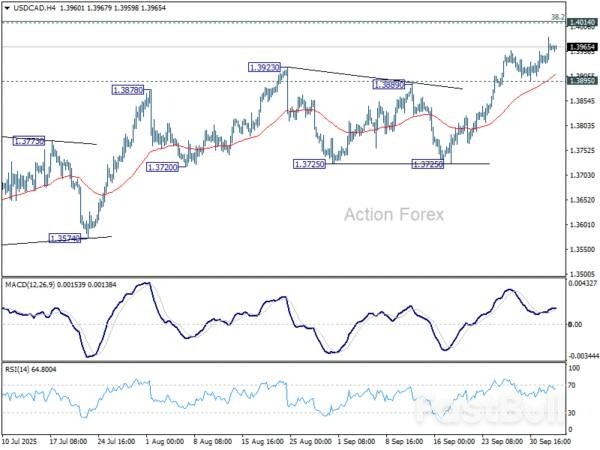
Daily Pivots: (S1) 1.3938; (P) 1.3962; (R1) 1.3991; More…
Intraday bias in USD/CAD remains on the upside and further rise could be seen. But strong resistance is expected from 1.4014 cluster to complete the corrective rebound from 1.3538. On the downside, break of 1.3895 support will turn bias back to the downside for 1.3725. However, sustained break of 1.4014 will carry larger bullish implications.

In the bigger picture, price actions from 1.4791 medium term top could either be a correction to rise from 1.2005 (2021 low), or trend reversal. In either case, further decline is expected as long as 1.4014 cluster resistance (38.2% retracement of 1.4791 to 1.3538 at 1.4017) holds. Next target is 61.8% retracement of 1.2005 (2021 low) to 1.4791 (2025 high) at 1.3069. However, sustained break of 1.4014 will argue that fall from 1.4791 has completed, and bring stronger rally to 61.8% retracement at 1.4312.
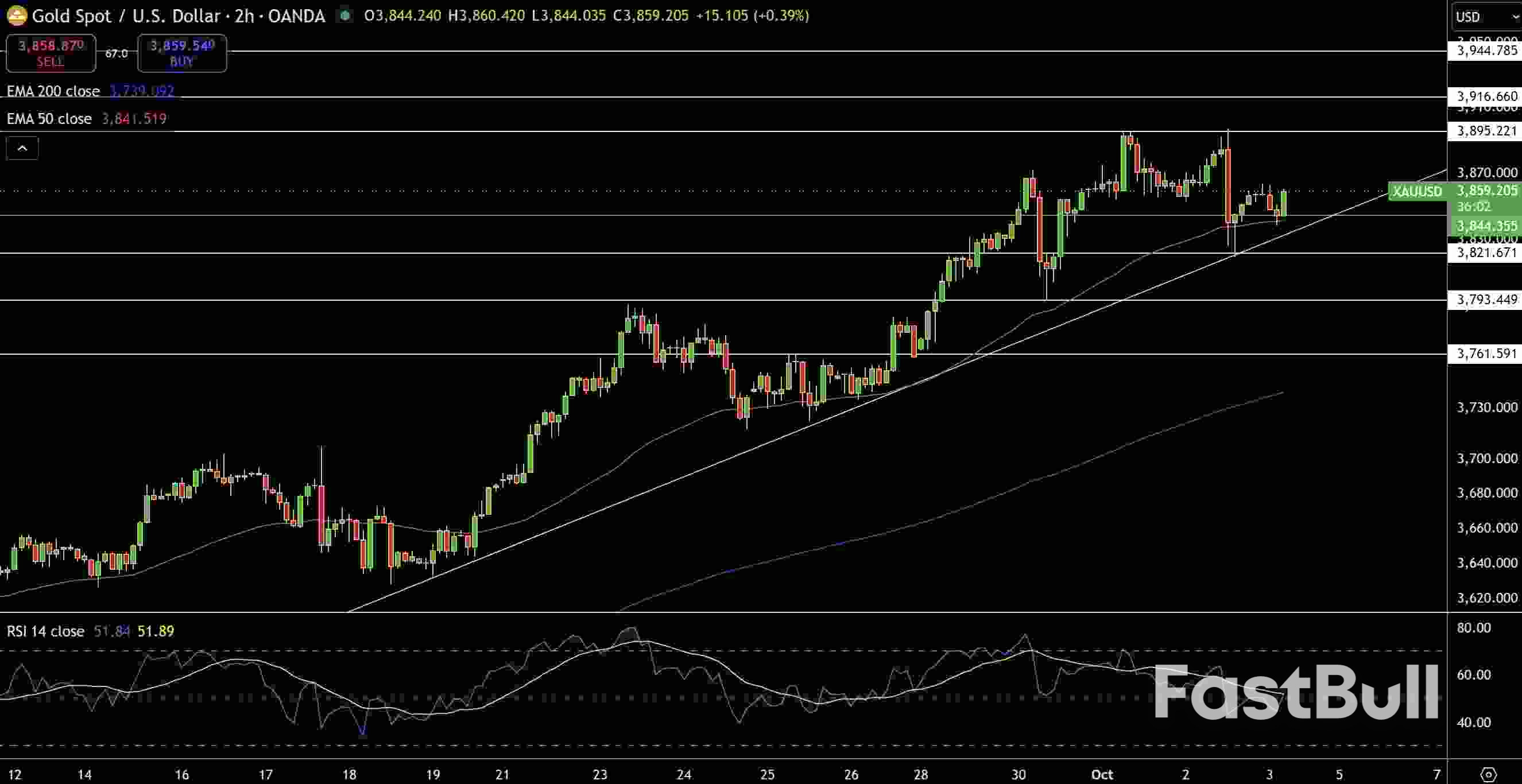
Gold – Chart
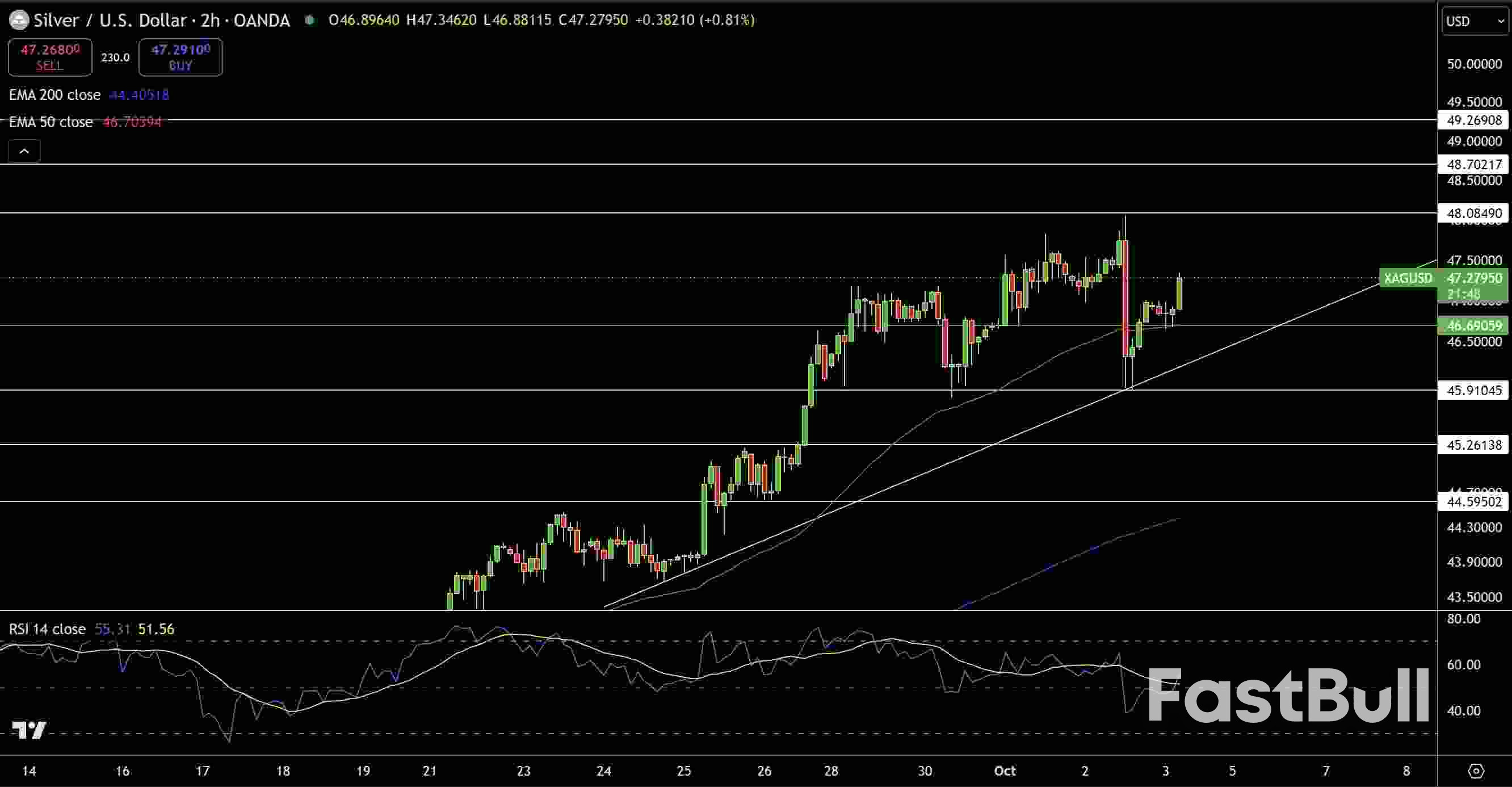
Silver – ChartGerman Chancellor Friedrich Merz on Friday implored Germans to either embrace uncomfortable reforms or watch their economy fade.
“Our nation is in the midst of an important, perhaps decisive phase in its modern history,” Merz said in a speech in Saarbruecken marking 35 years since German reunification. “Many things must change if they are to remain as good as they are, or even to improve.”
Merz’s plea reflects Germany’s deep-rooted fear that its once-powerful business model is eroding, with high energy prices, cheap Chinese electric vehicles and spiraling defense costs all battering the country’s industries.
Despite this, the chancellor has struggled to unite his coalition on a solution, as his conservative camp butts heads with its center-left partners.
The remarks were unusual given the setting — an event to celebrate German reunification. German chancellors typically use the anniversary — which this year featured French President Emmanuel Macron — to discuss the still-difficult relationship between the former West Germany and the ex-communist eastern states.
Merz nodded at the history, encouraging Germans to come together once again in the present.
“After 35 years of German unity — and in a difficult time for our country — we should regroup and look forward with confidence and energy,” Merz said. “Let us make a joint effort for new unity in our country.”
But he also used the speech to sell some political priorities, including rebuilding Germany’s military.
“We must learn to defend ourselves again,” Merz said, following a series of drone sightings near critical infrastructure sites that have alarmed German authorities. European leaders discussed similar airspace violations during two summits in Copenhagen this week, calling the incidents part of Russia’s hybrid war on western allies.
Merz’s latest pitch for reform, which the chancellery carefully orchestrated, reveals the deepening anxiety in Berlin about the country’s economic weakness and divisive mood.
Germany’s struggling economy has faced repeated setbacks of late, complicating Merz’s promise to reignite growth. After a strong start to 2025, output shrank 0.3% in the second quarter and is only likely to edge up slightly over the year as a whole.
The Bundesbank sees gross domestic product rising slightly between July and September as drags from trade with the US fade. With a US-European Union tariff accord reducing uncertainty, the outlook for Germany’s economy among firms has been improving.
Still, Merz’s coalition is mired in divisions, especially over potential reforms to Germany’s welfare state. The chancellor’s Christian Democratic Union and its sister party, the Christian Social Union, are pushing for revisions, while the Social Democratic Party remains reluctant.
A two-day coalition retreat this week failed to produce any decisions on basic reforms.
The ruling alliance has also failed to stall the rise of the Alternative for Germany (AfD), the far-right party that has successfully tapped into voters’ migration concerns.
A Forsa survey published Tuesday showed the AfD had stretched its lead over Merz’s bloc to three percentage points for the first time, with 27% backing to the CDU/CSU’s 24%.
The SPD trailed in third at 13%, just ahead of the Greens and the Left party.
Additionally, Merz’s personal ratings have been consistently poor, even before the government took office in early May. In the Forsa poll, only 26% of respondents said they were satisfied with his performance as chancellor.
White Label
Data API
Web Plug-ins
Poster Maker
Affiliate Program
The risk of loss in trading financial instruments such as stocks, FX, commodities, futures, bonds, ETFs and crypto can be substantial. You may sustain a total loss of the funds that you deposit with your broker. Therefore, you should carefully consider whether such trading is suitable for you in light of your circumstances and financial resources.
No decision to invest should be made without thoroughly conducting due diligence by yourself or consulting with your financial advisors. Our web content might not suit you since we don't know your financial conditions and investment needs. Our financial information might have latency or contain inaccuracy, so you should be fully responsible for any of your trading and investment decisions. The company will not be responsible for your capital loss.
Without getting permission from the website, you are not allowed to copy the website's graphics, texts, or trademarks. Intellectual property rights in the content or data incorporated into this website belong to its providers and exchange merchants.
Not Logged In
Log in to access more features

FastBull Membership
Not yet
Purchase
Log In
Sign Up