• Trade
  • Markets
  • Copy
  • Contests
  • News
  • 24/7
  • Calendar
  • Q&A
  • Chats
Trending
Screeners
SYMBOL
LAST
BID
ASK
HIGH
LOW
NET CHG.
%CHG.
SPREAD
SPX
S&P 500 Index
6827.42
6827.42
6827.42
6899.86
6801.80
-73.58
-1.07%
--
DJI
Dow Jones Industrial Average
48458.04
48458.04
48458.04
48886.86
48334.10
-245.98
-0.51%
--
IXIC
NASDAQ Composite Index
23195.16
23195.16
23195.16
23554.89
23094.51
-398.69
-1.69%
--
USDX
US Dollar Index
97.950
98.030
97.950
98.500
97.950
-0.370
-0.38%
--
EURUSD
Euro / US Dollar
1.17394
1.17409
1.17394
1.17496
1.17192
+0.00011
+ 0.01%
--
GBPUSD
Pound Sterling / US Dollar
1.33707
1.33732
1.33707
1.33997
1.33419
-0.00148
-0.11%
--
XAUUSD
Gold / US Dollar
4299.39
4299.39
4299.39
4353.41
4257.10
+20.10
+ 0.47%
--
WTI
Light Sweet Crude Oil
57.233
57.485
57.233
58.011
56.969
-0.408
-0.71%
--

Community Accounts

Signal Accounts
--
Profit Accounts
--
Loss Accounts
--
View More

Become a signal provider

Sell trading signals to earn additional income

View More

Guide to Copy Trading

Get started with ease and confidence

View More

Signal Accounts for Members

All Signal Accounts

Best Return
  • Best Return
  • Best P/L
  • Best MDD
Past 1W
  • Past 1W
  • Past 1M
  • Past 1Y

All Contests

  • All
  • Trump Updates
  • Recommend
  • Stocks
  • Cryptocurrencies
  • Central Banks
  • Featured News
Top News Only
Share

Norwegian Nobel Committee: Calls On The Belarusian Authorities To Release All Political Prisoners

Share

Norwegian Nobel Committee: His Freedom Is A Deeply Welcome And Long-Awaited Moment

Share

Ukraine Says It Received 114 Prisoners From Belarus

Share

USA Embassy In Lithuania: Maria Kalesnikava Is Not Going To Vilnius

Share

USA Embassy In Lithuania: Other Prisoners Are Being Sent From Belarus To Ukraine

Share

Ukraine President Zelenskiy: Five Ukrainians Released By Belarus In US-Brokered Deal

Share

USA Vilnius Embassy: USA Stands Ready For "Additional Engagement With Belarus That Advances USA Interests"

Share

USA Vilnius Embassy: Belarus, USA, Other Citizens Among The Prisoners Released Into Lithuania

Share

USA Vilnius Embassy: USA Will Continue Diplomatic Efforts To Free The Remaining Political Prisoners In Belarus

Share

USA Vilnius Embassy: Belarus Releases 123 Prisoners Following Meeting Of President Trump's Envoy Coale And Belarus President Lukashenko

Share

USA Vilnius Embassy: Masatoshi Nakanishi, Aliaksandr Syrytsa Are Among The Prisoners Released By Belarus

Share

USA Vilnius Embassy: Maria Kalesnikava And Viktor Babaryka Are Among The Prisoners Released By Belarus

Share

USA Vilnius Embassy: Nobel Peace Prize Laureate Ales Bialiatski Is Among The Prisoners Released By Belarus

Share

Belarusian Presidential Administration Telegram Channel: Lukashenko Has Pardoned 123 Prisoners As Part Of Deal With US

Share

Two Local Syrian Officials: Joint US-Syrian Military Patrol In Central Syria Came Under Fire From Unknown Assailants

Share

Israeli Military Says It Targeted 'Key Hamas Terrorist' In Gaza City

Share

Rwanda's Actions In Eastern Drc Are A Clear Violation Of Washington Accords Signed By President Trump - Secretary Of State Rubio

Share

Israeli Military Issues Evacuation Warning In Southern Lebanon Village Ahead Of Strike - Spokesperson On X

Share

Belarusian State Media Cites US Envoy Coale As Saying He Discussed Ukraine And Venezuela With Lukashenko

Share

Belarusian State Media Cites US Envoy Coale As Saying That US Removes Sanctions On Belarusian Potassium

TIME
ACT
FCST
PREV
U.K. Trade Balance Non-EU (SA) (Oct)

A:--

F: --

P: --

U.K. Trade Balance (Oct)

A:--

F: --

P: --

U.K. Services Index MoM

A:--

F: --

P: --

U.K. Construction Output MoM (SA) (Oct)

A:--

F: --

P: --

U.K. Industrial Output YoY (Oct)

A:--

F: --

P: --

U.K. Trade Balance (SA) (Oct)

A:--

F: --

P: --

U.K. Trade Balance EU (SA) (Oct)

A:--

F: --

P: --

U.K. Manufacturing Output YoY (Oct)

A:--

F: --

P: --

U.K. GDP MoM (Oct)

A:--

F: --

P: --

U.K. GDP YoY (SA) (Oct)

A:--

F: --

P: --

U.K. Industrial Output MoM (Oct)

A:--

F: --

P: --

U.K. Construction Output YoY (Oct)

A:--

F: --

P: --

France HICP Final MoM (Nov)

A:--

F: --

P: --

China, Mainland Outstanding Loans Growth YoY (Nov)

A:--

F: --

P: --

China, Mainland M2 Money Supply YoY (Nov)

A:--

F: --

P: --

China, Mainland M0 Money Supply YoY (Nov)

A:--

F: --

P: --

China, Mainland M1 Money Supply YoY (Nov)

A:--

F: --

P: --

India CPI YoY (Nov)

A:--

F: --

P: --

India Deposit Gowth YoY

A:--

F: --

P: --

Brazil Services Growth YoY (Oct)

A:--

F: --

P: --

Mexico Industrial Output YoY (Oct)

A:--

F: --

P: --

Russia Trade Balance (Oct)

A:--

F: --

P: --

Philadelphia Fed President Henry Paulson delivers a speech
Canada Building Permits MoM (SA) (Oct)

A:--

F: --

P: --

Canada Wholesale Sales YoY (Oct)

A:--

F: --

P: --

Canada Wholesale Inventory MoM (Oct)

A:--

F: --

P: --

Canada Wholesale Inventory YoY (Oct)

A:--

F: --

P: --

Canada Wholesale Sales MoM (SA) (Oct)

A:--

F: --

P: --

Germany Current Account (Not SA) (Oct)

A:--

F: --

P: --

U.S. Weekly Total Rig Count

A:--

F: --

P: --

U.S. Weekly Total Oil Rig Count

A:--

F: --

P: --

Japan Tankan Large Non-Manufacturing Diffusion Index (Q4)

--

F: --

P: --

Japan Tankan Small Manufacturing Outlook Index (Q4)

--

F: --

P: --

Japan Tankan Large Non-Manufacturing Outlook Index (Q4)

--

F: --

P: --

Japan Tankan Large Manufacturing Outlook Index (Q4)

--

F: --

P: --

Japan Tankan Small Manufacturing Diffusion Index (Q4)

--

F: --

P: --

Japan Tankan Large Manufacturing Diffusion Index (Q4)

--

F: --

P: --

Japan Tankan Large-Enterprise Capital Expenditure YoY (Q4)

--

F: --

P: --

U.K. Rightmove House Price Index YoY (Dec)

--

F: --

P: --

China, Mainland Industrial Output YoY (YTD) (Nov)

--

F: --

P: --

China, Mainland Urban Area Unemployment Rate (Nov)

--

F: --

P: --

Saudi Arabia CPI YoY (Nov)

--

F: --

P: --

Euro Zone Industrial Output YoY (Oct)

--

F: --

P: --

Euro Zone Industrial Output MoM (Oct)

--

F: --

P: --

Canada Existing Home Sales MoM (Nov)

--

F: --

P: --

Euro Zone Total Reserve Assets (Nov)

--

F: --

P: --

U.K. Inflation Rate Expectations

--

F: --

P: --

Canada National Economic Confidence Index

--

F: --

P: --

Canada New Housing Starts (Nov)

--

F: --

P: --

U.S. NY Fed Manufacturing Employment Index (Dec)

--

F: --

P: --

U.S. NY Fed Manufacturing Index (Dec)

--

F: --

P: --

Canada Core CPI YoY (Nov)

--

F: --

P: --

Canada Manufacturing Unfilled Orders MoM (Oct)

--

F: --

P: --

Canada Manufacturing New Orders MoM (Oct)

--

F: --

P: --

Canada Core CPI MoM (Nov)

--

F: --

P: --

Canada Manufacturing Inventory MoM (Oct)

--

F: --

P: --

Canada CPI YoY (Nov)

--

F: --

P: --

Canada CPI MoM (Nov)

--

F: --

P: --

Canada CPI YoY (SA) (Nov)

--

F: --

P: --

Canada Core CPI MoM (SA) (Nov)

--

F: --

P: --

Q&A with Experts
    • All
    • Chatrooms
    • Groups
    • Friends
    Connecting
    .
    .
    .
    Type here...
    Add Symbol or Code

      No matching data

      All
      Trump Updates
      Recommend
      Stocks
      Cryptocurrencies
      Central Banks
      Featured News
      • All
      • Russia-Ukraine Conflict
      • Middle East Flashpoint
      • All
      • Russia-Ukraine Conflict
      • Middle East Flashpoint
      Search
      Products

      Charts Free Forever

      Chats Q&A with Experts
      Screeners Economic Calendar Data Tools
      Membership Features
      Data Warehouse Market Trends Institutional Data Policy Rates Macro

      Market Trends

      Market Sentiment Order Book Forex Correlations

      Top Indicators

      Charts Free Forever
      Markets

      News

      News Analysis 24/7 Columns Education
      From Institutions From Analysts
      Topics Columnists

      Latest Views

      Latest Views

      Trending Topics

      Top Columnists

      Latest Update

      Signals

      Copy Rankings Latest Signals Become a signal provider AI Rating
      Contests
      Brokers

      Overview Brokers Assessment Rankings Regulators News Claims
      Broker listing Forex Brokers Comparison Tool Live Spread Comparison Scam
      Q&A Complaint Scam Alert Videos Tips to Detect Scam
      More

      Business
      Events
      Careers About Us Advertising Help Center

      White Label

      Data API

      Web Plug-ins

      Affiliate Program

      Awards Institution Evaluation IB Seminar Salon Event Exhibition
      Vietnam Thailand Singapore Dubai
      Fans Party Investment Sharing Session
      FastBull Summit BrokersView Expo
      Recent Searches
        Top Searches
          Markets
          News
          Analysis
          User
          24/7
          Economic Calendar
          Education
          Data
          • Names
          • Latest
          • Prev

          View All

          No data

          Scan to Download

          Faster Charts, Chat Faster!

          Download App
          English
          • English
          • Español
          • العربية
          • Bahasa Indonesia
          • Bahasa Melayu
          • Tiếng Việt
          • ภาษาไทย
          • Français
          • Italiano
          • Türkçe
          • Русский язык
          • 简中
          • 繁中
          Open Account
          Search
          Products
          Charts Free Forever
          Markets
          News
          Signals

          Copy Rankings Latest Signals Become a signal provider AI Rating
          Contests
          Brokers

          Overview Brokers Assessment Rankings Regulators News Claims
          Broker listing Forex Brokers Comparison Tool Live Spread Comparison Scam
          Q&A Complaint Scam Alert Videos Tips to Detect Scam
          More

          Business
          Events
          Careers About Us Advertising Help Center

          White Label

          Data API

          Web Plug-ins

          Affiliate Program

          Awards Institution Evaluation IB Seminar Salon Event Exhibition
          Vietnam Thailand Singapore Dubai
          Fans Party Investment Sharing Session
          FastBull Summit BrokersView Expo

          Malaysia Defies Expectations with Q3 Growth Surge Led by Domestic Demand and Broad-Based Sector Recovery

          Gerik

          Economic

          Summary:

          Malaysia’s economy grew 5.2% in Q3 2025, the highest rate in a year, surpassing forecasts due to robust domestic consumption, broad sector recovery, and resilient exports despite external tariff pressures....

          Stronger-Than-Expected Growth Amid Global Headwinds

          Malaysia’s economic performance in the third quarter of 2025 has exceeded market expectations, expanding by 5.2% year-on-year according to preliminary estimates from the Department of Statistics Malaysia (DOSM). This growth rate outpaced the 4.4% increase recorded in the previous two quarters and surpassed the highest projection in Bloomberg’s survey. The acceleration is particularly notable given ongoing global trade uncertainties and persistent tariff pressures stemming from US trade policy, suggesting that the Malaysian economy is demonstrating both resilience and flexibility.
          The central engine behind this growth remains robust domestic demand. DOSM Chief Statistician Mohd Uzir Mahidin emphasized that consumer spending, especially during holiday and school break periods, played a vital role in sustaining momentum. Fiscal interventions such as the July interest rate cut and a one-off cash handout in August further supported household expenditure. This illustrates a causal relationship between government stimulus and consumer behavior, wherein targeted fiscal measures directly bolstered domestic demand and economic activity.

          Sectoral Performance Reflects Broad-Based Recovery

          Malaysia’s Q3 growth was underpinned by simultaneous rebounds across key industries. The services sector expanded by 5.1%, manufacturing grew 4.0%, and the mining sector reversed its previous quarter’s contraction with a significant 10.9% increase. Construction output also rose by 11.2%, showing the strongest growth among all sectors. This indicates a synchronized recovery, where each sector’s rebound collectively strengthened the economy’s overall performance rather than relying on any singular industry. While correlation exists between these gains and broader macroeconomic stabilization, it is likely that structural policy support and renewed confidence after pandemic disruptions contributed causally.
          External trade also provided a strong boost. Malaysia’s exports surged 12.2% in September compared to the same month in 2024, up from just 1.9% in August. This exceeded analysts’ expectations of a 3.4% increase, with electrical and electronic goods leading the export portfolio. Notably, exports to the US climbed 24.4% while exports to China increased 2.9%, even as US tariffs on Malaysian goods rose to 19% in August. According to the Ministry of Investment, Trade and Industry (MITI), these tariffs had a limited impact, with bilateral trade flows remaining stable. The ability of Malaysian exporters to maintain and diversify demand suggests a strong underlying competitive advantage, rather than mere circumstantial fluctuation.

          Trade Surplus and Import Growth Reinforce Stability

          Imports also expanded by 7.3% in September, contributing to a healthy trade surplus of 19.86 billion Ringgit (approximately USD 4.6 billion). This reinforces the narrative of a well-balanced recovery, where increased import activity reflects growing domestic production and consumption needs, rather than overreliance on exports alone. The causal link between internal consumption and import levels highlights the strength of Malaysia’s domestic cycle.
          Malaysia’s government projects full-year GDP growth between 4% and 4.8% in 2025, slightly slower than the 5.1% achieved in 2024, acknowledging risks from global trade volatility. Projections for 2026 have been adjusted slightly lower to between 4% and 4.5%, reflecting anticipated drag from external developments. Nonetheless, Q3 data suggest the economy is on track to meet its 2025 target, with domestic demand providing a reliable cushion against any future export shocks.

          Regional Context Highlights Malaysia’s Relative Strength

          Compared to its ASEAN peers, Malaysia’s performance stands out. Vietnam reported a remarkable 8.23% growth rate, the highest since 2022, while Singapore posted a modest 2.9% expansion, still ahead of forecasts. Data from Thailand, the Philippines, and Indonesia are expected in November. This positions Malaysia as one of the more stable and adaptable economies in Southeast Asia, with an effective balance between domestic strength and external competitiveness.
          Malaysia’s stronger-than-expected economic expansion in Q3 2025 reflects the effective interplay of domestic consumption, sectoral revival, and trade resilience. Government stimulus played a pivotal causal role in sustaining demand, while strategic export orientation softened the impact of external headwinds. As global uncertainties persist, Malaysia’s ability to maintain this balanced growth model will be crucial to securing its economic trajectory in the coming year.
          To stay updated on all economic events of today, please check out our Economic calendar
          Risk Warnings and Disclaimers
          You understand and acknowledge that there is a high degree of risk involved in trading. Following any strategies or investment methods may lead to potential losses. The content on the site is provided by our contributors and analysts for information purposes only. You are solely responsible for determining whether any trading assets, securities, strategy, or any other product is suitable for investing based on your own investment objectives and financial situation.
          Add to Favorites
          Share

          China's Growth Falters as Consumer Demand and Property Market Struggles Persist

          Gerik

          Economic

          Sluggish Consumption Undermines Post-Pandemic Recovery

          Despite a wide array of fiscal and monetary stimulus efforts implemented since the pandemic, China continues to face difficulty in revitalizing consumer spending. The latest survey by AFP anticipates the nation's GDP to grow by only 4.8% in the third quarter of 2025, marking the lowest expansion rate in the past year and falling short of the government’s full-year target of approximately 5%.
          This moderation in growth follows a previous quarter’s expansion of 5.2%, revealing a sustained decline in momentum. The causal relationship between weak consumer confidence and limited retail activity is evident; despite loosened restrictions and targeted policy incentives, households remain cautious, which directly reduces consumption's contribution to GDP.

          Property Market Troubles Continue to Cast a Shadow

          A core structural weakness remains the property sector, historically a critical pillar supporting China’s urbanization-led growth. The debt crisis that began in 2020 continues to suppress investor sentiment. Multiple housing projects remain incomplete, and developers struggle with cash flow constraints. Although regulatory easing has been introduced to encourage home purchases, these measures have not significantly reversed the market's downtrend.
          The correlation between this sector’s health and broader economic performance is strong; property-related industries account for substantial employment and materials demand, so prolonged weakness in this area exerts downward pressure on national growth figures.

          Inflation Trends Indicate Deflationary Risks

          China’s consumer price index showed continued decline in September 2025, following a six-month low recorded in August. This deflationary trajectory raises serious macroeconomic concerns. Alicia Garcia-Herrero from Natixis highlights weakening consumption as the most pressing issue, warning that persistent downward pressure on prices could trigger a deflationary spiral. While this price behavior might appear to relieve consumers in the short term, it discourages spending and investment, creating a feedback loop that further drags on growth.
          Another structural constraint is local government debt. Numerous provinces and municipalities are struggling to meet debt obligations, illustrating the limits of China’s decentralized fiscal model. Although these fiscal vulnerabilities are not fully reflected in the current GDP data largely thanks to robust export performance and continued infrastructure investment the underlying financial stress is mounting. This situation suggests a causal risk of future contraction if defaults or credit disruptions spread.

          Trade Resilience and Supply Chain Adaptation

          On the external front, trade continues to serve as a buffer. The renewed trade confrontation initiated by US President Donald Trump in 2025 has revived tariff tensions, yet China’s exports have proven resilient. Shipments to Southeast Asia have accelerated, helping compensate for reduced US-bound volumes. The latest data reveals an 8.3% year-on-year export increase in September, the strongest since March 2025. Analysts like Heron Lim from ESSEC note that supply chain reconfiguration has helped maintain factory utilization. This adaptation illustrates a non-causal, adaptive correlation between geopolitical friction and trade redirection suggesting flexibility rather than a collapse in trade reliance.
          Guo Shan from Hutong Research emphasizes that achieving the 5% growth target for 2025 remains possible but will require additional policy interventions. Expected focal points in the upcoming policymaking session include stimulating household consumption, expanding services, and promoting innovation. Shifting the growth model away from infrastructure and property dependency toward domestic demand is seen as a structural necessity, not merely a short-term fix. This transition, while logical, may yield uneven outcomes in the short term due to entrenched institutional and behavioral patterns.
          In summary, China’s economic performance in Q3 2025 underscores a complex interplay of internal fragility and external resilience. Weak consumer sentiment, entrenched property sector malaise, local government debt, and creeping deflation all act as structural brakes on growth. However, adaptability in trade and continued government willingness to intervene provide a cushion. The outlook for the remainder of 2025 hinges on the effectiveness of upcoming measures to revive domestic demand and steer the economy toward a more sustainable model.
          To stay updated on all economic events of today, please check out our Economic calendar
          Risk Warnings and Disclaimers
          You understand and acknowledge that there is a high degree of risk involved in trading. Following any strategies or investment methods may lead to potential losses. The content on the site is provided by our contributors and analysts for information purposes only. You are solely responsible for determining whether any trading assets, securities, strategy, or any other product is suitable for investing based on your own investment objectives and financial situation.
          Add to Favorites
          Share

          China Seeks to Ease Global Concerns Over Rare Earth Export Controls

          Gerik

          Economic

          Market Overview

          During the annual IMF meeting, Chinese officials privately told their international counterparts that the country’s new export controls on rare earths are part of a long-term regulatory framework and a response to U.S. provocations, rather than a shift toward economic aggression. Despite these reassurances, the impact has already become visible. September’s rare earth exports dropped to 6,538 tonnes from 7,338 tonnes in August, reversing a steady upward trend and marking a sharp break from the highest monthly export level since 2012.
          This unprecedented move has stirred concern in Europe and Japan, raising alarms about potential supply chain vulnerabilities. The tension is simultaneously giving the U.S. an opening to solidify alliances. However, the G7 and other global actors appear to be adopting a wait-and-see approach, pending the outcome of an expected meeting between U.S. President Donald Trump and Chinese President Xi Jinping.

          Diplomatic Outlook

          Japan’s Finance Minister Katsunobu Kato warned against a retaliatory spiral that could destabilize the global economy and markets. Meanwhile, in a sign of cautious diplomacy, U.S. Treasury Secretary Scott Bessent held phone talks with Chinese Vice Premier He Lifeng and is scheduled to meet in person next week. President Trump remains publicly optimistic about reaching a resolution.
          The rare earth market is highly sensitive to geopolitical signals due to China’s dominant position as a global supplier. A sharp drop in export volume, even if framed as regulatory recalibration, signals potential supply risks that could disrupt industries from electronics to defense manufacturing. While diplomatic communications are ongoing, markets may remain volatile until concrete resolutions or trade frameworks emerge from upcoming bilateral meetings.
          For traders and analysts focused on rare earth-linked equities or materials (such as REE ETFs or companies like Lynas, MP Materials), monitor upcoming U.S.-China meetings closely. Should no easing be signaled, defensive positions or supply chain diversification plays may become more attractive in anticipation of further tightening or retaliatory measures.
          To stay updated on all economic events of today, please check out our Economic calendar
          Risk Warnings and Disclaimers
          You understand and acknowledge that there is a high degree of risk involved in trading. Following any strategies or investment methods may lead to potential losses. The content on the site is provided by our contributors and analysts for information purposes only. You are solely responsible for determining whether any trading assets, securities, strategy, or any other product is suitable for investing based on your own investment objectives and financial situation.
          Add to Favorites
          Share

          China’s EV Charging Ambitions Double by 2027: A Push Toward Nationwide Accessibility

          Gerik

          Economic

          Expanding Infrastructure and Capacity Goals

          The National Energy Administration (NEA) of China, in collaboration with five other state-level departments, has unveiled a strategic roadmap titled the “Three-Year Action Plan to Double the Service Capacity of EV Charging Infrastructure (2025–2027).” This initiative targets more than 300 million kilowatts (300 GWh) in public charging capacity and plans to grow the nationwide network to 28 million charging points by 2027. This expansion is intended to support a projected EV fleet of 80 million vehicles.
          Despite China's relatively mature EV charging market, several challenges persist, especially in rural areas where coverage remains limited. The current average charging power at public stations stands at 45.5 kW insufficient during peak traffic hours. To address this, the government plans to deploy 1.6 million new DC fast chargers in urban zones, including 100,000 high-capacity units. Additionally, the plan outlines improvements to geographical distribution, power supply reliability, and rural infrastructure deployment.

          Upgrading Aging Infrastructure and Highway Expansion

          To enhance grid reliability, China will retrofit stations older than eight years and upgrade those with sub-800V capacity to meet current safety and performance standards. Furthermore, 40,000 new ultra-fast chargers (60 kW+) will be added across major highway service zones, ensuring rapid charging access along critical travel routes. All expressways except in extreme terrains will be equipped with fast-charging facilities.
          To ensure full national coverage, at least 14,000 new DC chargers will be deployed in towns currently lacking public infrastructure. Moreover, the government is piloting private charging projects across 1,000 residential communities, providing regulatory and financial support for home-based infrastructure planning, construction, and operation.

          Innovation: Bi-Directional Charging and Grid Integration

          A key innovation in this action plan is Vehicle-Grid Integration (VGI), where electric vehicles actively participate in balancing power grid loads and storing surplus energy. Under this model, around 5,000 bidirectional chargers will be installed nationwide, representing a shift toward smarter and more interactive energy ecosystems.
          Implementation responsibility is distributed across national and local authorities. While the National Development and Reform Commission (NDRC) and NEA lead the strategy at the macro level, local governments are tasked with tailoring regional plans and supporting grid upgrades. Power operators and industry stakeholders must also align with this national vision.
          China's NEV (new energy vehicle) sales reached record levels in September, with 1.6 million units sold, including 1.06 million fully electric vehicles. Nearly 50% of all new cars sold in China are now capable of electric charging. However, this figure includes both domestic use and exports, further amplifying the demand for robust and scalable charging infrastructure.
          China's three-year EV charging action plan reflects its ambition not only to accommodate the explosive growth of electric vehicles but also to create a globally leading infrastructure model. By integrating rural accessibility, grid innovation, and cross-agency coordination, the country aims to lead the next era of sustainable transport infrastructure development.
          To stay updated on all economic events of today, please check out our Economic calendar
          Risk Warnings and Disclaimers
          You understand and acknowledge that there is a high degree of risk involved in trading. Following any strategies or investment methods may lead to potential losses. The content on the site is provided by our contributors and analysts for information purposes only. You are solely responsible for determining whether any trading assets, securities, strategy, or any other product is suitable for investing based on your own investment objectives and financial situation.
          Add to Favorites
          Share

          What If India and China Stop Buying Russian Oil? A Global Energy Shock in the Making

          Gerik

          Economic

          Commodity

          Geopolitical Tensions Over Oil Intensify

          The Trump administration's revival of secondary sanctions targeting countries that trade with sanctioned states like Russia has reignited tensions. India and China, the two largest buyers of Russian oil since the Ukraine invasion, rejected recent pressure from former President Trump. While Trump claimed Indian Prime Minister Narendra Modi had promised to stop Russian energy imports, India reaffirmed its stance: national energy security and affordability remain top priorities. China echoed a firm response, defending its Russian oil purchases as legal and warning against unilateral US coercion.
          From 2021 to 2024, India’s Russian oil imports skyrocketed from 0.1 to 1.9 million barrels per day, while China’s rose to 2.4 million barrels. India saved an estimated USD 33 billion over this period thanks to steep Russian discounts following Western sanctions. For both economies, the cheap supply has proven vital. Russia, meanwhile, benefited from redirecting exports eastward to maintain revenue amid sanctions.

          The Threat of Sanctions: Economic and Inflationary Fallout

          Trump’s new 25% tariffs on Indian imports, tied to their oil trade with Russia, already risk raising India’s oil import costs by USD 11 billion. If fully enforced, further secondary sanctions could severely harm Russia’s already fragile economy, which is grappling with high inflation (potentially 15–20%), military overspending, and a shrinking fiscal base. For global markets, the loss of over 5 million barrels per day from Russia would be catastrophic.
          Oil expert Sumit Ritolia told DW that if India had not bought Russian oil in 2022, oil prices could have soared to USD 100–300 per barrel. The US Federal Reserve estimates that every USD 10/barrel increase raises US inflation by 0.2%. Thus, a global surge to USD 110–120/barrel would stoke inflation, raise living costs, and disrupt key sectors such as transport, energy, and food.

          India's Diminishing Oil Discount, China’s Strategic Edge

          Although India continues importing heavily (2.08 million barrels/day in June 2025), discounts have narrowed to just USD 5/barrel down from USD 15–20/barrel in 2022. Meanwhile, China leverages its dominant position in rare earth exports as geopolitical leverage, strengthening its negotiation power. Unlike India, which faces intensified US tariffs and lacks similar counterweights, China’s vast trade scale allows greater resilience.
          Replacing Russia’s 5 million barrels/day won’t be easy. OPEC’s limited spare capacity and logistical barriers make rapid substitution unlikely. CEPA expert Alexander Kolyandr emphasized that no producer can quickly replace Russia’s volume, risking a major energy shock.
          India, while facing more flexible import options than China, will struggle to completely cut Russian oil. Ritolia notes it may take a year for Indian refiners to significantly diversify. Yet, a full stop is improbable.
          India and China are recalibrating strategic autonomy in energy amid mounting Western pressure. Both are unlikely to abandon Russian oil entirely at least not without major market alternatives. For now, their decisions will shape not only Russia’s war chest, but the direction of inflation, trade, and power in the 21st-century global energy order.
          To stay updated on all economic events of today, please check out our Economic calendar
          Risk Warnings and Disclaimers
          You understand and acknowledge that there is a high degree of risk involved in trading. Following any strategies or investment methods may lead to potential losses. The content on the site is provided by our contributors and analysts for information purposes only. You are solely responsible for determining whether any trading assets, securities, strategy, or any other product is suitable for investing based on your own investment objectives and financial situation.
          Add to Favorites
          Share

          Japan Bets on Massive Undersea Rare Earth Reserve to Counter China’s Dominance

          Gerik

          Commodity

          Economic

          A Game-Changing Discovery Beneath the Pacific

          Discovered in 2013 beneath waters near Minamitorishima Japan’s easternmost island the rare earth deposit contains an estimated 16 million tons of high-quality minerals. Scientists believe this reserve could meet global demand for centuries. Rare earth elements (REEs), which include 17 essential metals, are crucial to producing electric vehicles, jet engines, semiconductors, wind turbines, medical lasers, and military weapon systems.
          Given China’s near-monopoly on rare earth processing and frequent use of export restrictions for geopolitical leverage, the discovery represents a potential strategic breakthrough for Japan and its allies.

          Costly and Complex Extraction Plans

          Japan aims to begin small-scale seabed mining operations in January 2026 and offer supply to the private sector by 2028. However, extracting REEs from depths of 6,000 meters presents enormous technological and economic hurdles. Each exploration mission is expected to cost over 150 million yen (approximately USD 1 million), according to Takahide Kiuchi of Nomura Research Institute.
          Furthermore, Japan currently lacks the domestic refining infrastructure to handle these deep-sea materials. Experts emphasize the need to build new processing plants near the island to realize commercial potential.

          Long-Term Geopolitical and Economic Strategy

          Kazuto Suzuki of the University of Tokyo’s Graduate School of Public Policy warns that while fluctuations in REE prices or stronger government support could make the project viable, it remains commercially unfeasible for now. However, improved technology could turn this resource into a medium- to long-term counterweight to China’s dominance.
          China recently expanded export restrictions on rare earths limiting seven types in April and adding five more in October tightening control over global supply chains. These moves have drawn strong criticism from the U.S., including tariff threats by former President Donald Trump.
          Though Minamitorishima’s undersea deposit won’t immediately alter the global rare earth landscape, it symbolizes Japan’s long-term strategy to strengthen resource independence and mitigate economic security risks.
          To stay updated on all economic events of today, please check out our Economic calendar
          Risk Warnings and Disclaimers
          You understand and acknowledge that there is a high degree of risk involved in trading. Following any strategies or investment methods may lead to potential losses. The content on the site is provided by our contributors and analysts for information purposes only. You are solely responsible for determining whether any trading assets, securities, strategy, or any other product is suitable for investing based on your own investment objectives and financial situation.
          Add to Favorites
          Share

          Argentine FX Traders Estimate US Treasury Sold Over $200 Million

          Manuel

          Bond

          Forex

          The US Treasury bought more Argentine pesos Friday than it had in any other session, traders estimated, as the currency continued to lose value despite American support.
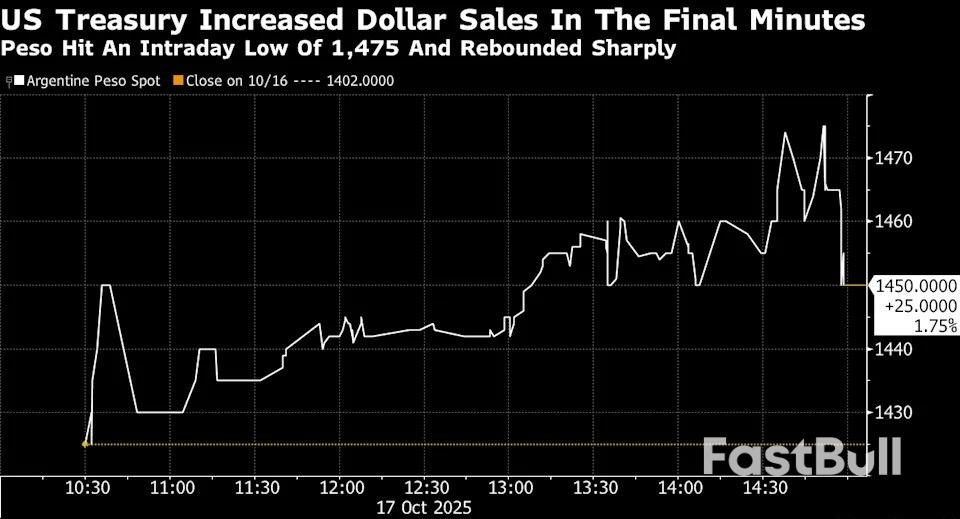
          Traders estimated that Secretary Scott Bessent’s Treasury sold more than $200 million during the trading session Friday, with roughly half coming in the final 10 minutes, according to people with direct knowledge. That approximate figure wasn’t seen in prior sessions, at least in the official spot market, the people added, asking not to be named discussing specific transactions.
          The Treasury Department’s press office didn’t respond to multiple requests for comment Friday on the scale of its peso purchases. Bessent disclosed earlier that the US had also bought pesos Thursday in Argentina’s parallel exchange rate known by investors as the “blue-chip swap.”
          “Treasury is monitoring all markets, and we have the capacity to act with flexibility and with force to stabilize Argentina,” Bessent wrote on X Friday morning.Argentine FX Traders Estimate US Treasury Sold Over $200 Million_1
          The intensified effort underscores Washington’s determination to stabilize markets ahead of Argentina’s midterm elections on Oct. 26. President Javier Milei’s party is trying to boost its representation in Congress where it only holds about 15% of seats. In addition to buying pesos, Bessent is also offering a $20 billion currency swap line, and organizing private lending of the same amount with banks and sovereign wealth funds.
          In a rare move, the Trump administration last week began buying the peso, which is down about 30% so far this year, in a bid to stabilize markets, yet Argentines continue to buy dollars for fear of a post-election currency devaluation.
          The peso’s slide accelerated Friday, tumbling as much as 5.2% intraday to 1,475 per dollar before closing around 1,450, while the parallel rate weakened as much as 3.7%. Bonds spiked briefly before giving back gains.

          Source: Bloomberg

          Risk Warnings and Disclaimers
          You understand and acknowledge that there is a high degree of risk involved in trading. Following any strategies or investment methods may lead to potential losses. The content on the site is provided by our contributors and analysts for information purposes only. You are solely responsible for determining whether any trading assets, securities, strategy, or any other product is suitable for investing based on your own investment objectives and financial situation.
          Add to Favorites
          Share
          FastBull
          Copyright © 2025 FastBull Ltd

          728 RM B 7/F GEE LOK IND BLDG NO 34 HUNG TO RD KWUN TONG KLN HONG KONG

          TelegramInstagramTwitterfacebooklinkedin
          App Store Google Play Google Play
          Products
          Charts

          Chats

          Q&A with Experts
          Screeners
          Economic Calendar
          Data
          Tools
          Membership
          Features
          Function
          Markets
          Copy Trading
          Latest Signals
          Contests
          News
          Analysis
          24/7
          Columns
          Education
          Company
          Careers
          About Us
          Contact Us
          Advertising
          Help Center
          Feedback
          User Agreement
          Privacy Policy
          Business

          White Label

          Data API

          Web Plug-ins

          Poster Maker

          Affiliate Program

          Risk Disclosure

          The risk of loss in trading financial instruments such as stocks, FX, commodities, futures, bonds, ETFs and crypto can be substantial. You may sustain a total loss of the funds that you deposit with your broker. Therefore, you should carefully consider whether such trading is suitable for you in light of your circumstances and financial resources.

          No decision to invest should be made without thoroughly conducting due diligence by yourself or consulting with your financial advisors. Our web content might not suit you since we don't know your financial conditions and investment needs. Our financial information might have latency or contain inaccuracy, so you should be fully responsible for any of your trading and investment decisions. The company will not be responsible for your capital loss.

          Without getting permission from the website, you are not allowed to copy the website's graphics, texts, or trademarks. Intellectual property rights in the content or data incorporated into this website belong to its providers and exchange merchants.

          Not Logged In

          Log in to access more features

          FastBull Membership

          Not yet

          Purchase

          Become a signal provider
          Help Center
          Customer Service
          Dark Mode
          Price Up/Down Colors

          Log In

          Sign Up

          Position
          Layout
          Fullscreen
          Default to Chart
          The chart page opens by default when you visit fastbull.com