Markets
News
Analysis
User
24/7
Economic Calendar
Education
Data
- Names
- Latest
- Prev


Signal Accounts for Members
All Signal Accounts
All Contests


France Trade Balance (SA) (Oct)A:--
F: --
Euro Zone Employment YoY (SA) (Q3)A:--
F: --
Canada Part-Time Employment (SA) (Nov)A:--
F: --
P: --
Canada Unemployment Rate (SA) (Nov)A:--
F: --
P: --
Canada Full-time Employment (SA) (Nov)A:--
F: --
P: --
Canada Labor Force Participation Rate (SA) (Nov)A:--
F: --
P: --
Canada Employment (SA) (Nov)A:--
F: --
P: --
U.S. PCE Price Index MoM (Sept)A:--
F: --
P: --
U.S. Personal Income MoM (Sept)A:--
F: --
P: --
U.S. Core PCE Price Index MoM (Sept)A:--
F: --
P: --
U.S. PCE Price Index YoY (SA) (Sept)A:--
F: --
P: --
U.S. Core PCE Price Index YoY (Sept)A:--
F: --
P: --
U.S. Personal Outlays MoM (SA) (Sept)A:--
F: --
U.S. 5-10 Year-Ahead Inflation Expectations (Dec)A:--
F: --
P: --
U.S. Real Personal Consumption Expenditures MoM (Sept)A:--
F: --
U.S. Weekly Total Rig CountA:--
F: --
P: --
U.S. Weekly Total Oil Rig CountA:--
F: --
P: --
U.S. Consumer Credit (SA) (Oct)A:--
F: --
China, Mainland Foreign Exchange Reserves (Nov)A:--
F: --
P: --
Japan Trade Balance (Oct)A:--
F: --
P: --
Japan Nominal GDP Revised QoQ (Q3)A:--
F: --
P: --
China, Mainland Imports YoY (CNH) (Nov)A:--
F: --
P: --
China, Mainland Exports (Nov)A:--
F: --
P: --
China, Mainland Imports (CNH) (Nov)A:--
F: --
P: --
China, Mainland Trade Balance (CNH) (Nov)A:--
F: --
P: --
China, Mainland Exports YoY (USD) (Nov)A:--
F: --
P: --
China, Mainland Imports YoY (USD) (Nov)A:--
F: --
P: --
Germany Industrial Output MoM (SA) (Oct)A:--
F: --
Euro Zone Sentix Investor Confidence Index (Dec)A:--
F: --
P: --
Canada National Economic Confidence IndexA:--
F: --
P: --
U.K. BRC Like-For-Like Retail Sales YoY (Nov)--
F: --
P: --
U.K. BRC Overall Retail Sales YoY (Nov)--
F: --
P: --
Australia Overnight (Borrowing) Key Rate--
F: --
P: --
RBA Rate Statement
RBA Press Conference
Germany Exports MoM (SA) (Oct)--
F: --
P: --
U.S. NFIB Small Business Optimism Index (SA) (Nov)--
F: --
P: --
Mexico 12-Month Inflation (CPI) (Nov)--
F: --
P: --
Mexico Core CPI YoY (Nov)--
F: --
P: --
Mexico PPI YoY (Nov)--
F: --
P: --
U.S. Weekly Redbook Index YoY--
F: --
P: --
U.S. JOLTS Job Openings (SA) (Oct)--
F: --
P: --
China, Mainland M1 Money Supply YoY (Nov)--
F: --
P: --
China, Mainland M0 Money Supply YoY (Nov)--
F: --
P: --
China, Mainland M2 Money Supply YoY (Nov)--
F: --
P: --
U.S. EIA Short-Term Crude Production Forecast For The Year (Dec)--
F: --
P: --
U.S. EIA Natural Gas Production Forecast For The Next Year (Dec)--
F: --
P: --
U.S. EIA Short-Term Crude Production Forecast For The Next Year (Dec)--
F: --
P: --
EIA Monthly Short-Term Energy Outlook
U.S. API Weekly Gasoline Stocks--
F: --
P: --
U.S. API Weekly Cushing Crude Oil Stocks--
F: --
P: --
U.S. API Weekly Crude Oil Stocks--
F: --
P: --
U.S. API Weekly Refined Oil Stocks--
F: --
P: --
South Korea Unemployment Rate (SA) (Nov)--
F: --
P: --
Japan Reuters Tankan Non-Manufacturers Index (Dec)--
F: --
P: --
Japan Reuters Tankan Manufacturers Index (Dec)--
F: --
P: --
Japan Domestic Enterprise Commodity Price Index MoM (Nov)--
F: --
P: --
Japan Domestic Enterprise Commodity Price Index YoY (Nov)--
F: --
P: --
China, Mainland PPI YoY (Nov)--
F: --
P: --
China, Mainland CPI MoM (Nov)--
F: --
P: --


No matching data
Latest Views
Latest Views
Trending Topics
Top Columnists
Latest Update
White Label
Data API
Web Plug-ins
Affiliate Program
View All

No data
London stocks steadied as weak UK data and escalating US-China trade tensions hit sentiment. Gold and defence stocks gained amid safe-haven demand.
Oil ministers from OPEC+ members agreed on another big increase in production targets for July. But is there room for those barrels without crashing prices?
A third straight boost of 411,000 barrels a day will see the group adding a combined 1.37 million barrels to supply between March and July — at least in theory.
Not everyone agrees there’s enough room for this extra oil, even within the group itself. Russia wanted to pause the increases to assess the impact of the hikes already made.
Moscow saw the price of its key Urals export grade tumble below $50 a barrel in early May, recovering to slightly above that level in the second half of the month. And, unlike Saudi Arabia, it doesn’t benefit from big increases in its production target.
While the kingdom’s allowance will rise by 556,000 barrels a day during the period, Russia’s increases by just 150,000 barrels after taking into account the deeper compensation cuts it promised to offset past overproduction.
But the real cumulative increase in group production is likely to be much smaller than the headline figure, with perhaps as little as half actually reaching global markets.
Some of the nations permitted to produce more are already pumping as hard as they can and, in the case of Kazakhstan, are already well above their July allocation.
Much of the extra expected from Saudi Arabia will be used locally to generate electricity for the summer surge in air conditioning, which could soak up more than 80% of its new allocation.
South Sudan, where production is recovering after a key export pipeline was repaired, and Libya, which is under threat from rising internal unrest, create other supply uncertainties.
Analysts at the Organization of the Petroleum Exporting Countries see the market short of about 1 million barrels a day of supply in the third quarter — even with Kazakhstan’s cheating — and say their counterparts at the International Energy Agency underestimate demand.
That view was given some credence last month when the Paris-based agency increased historical demand estimates, wiping out all the stockbuilds it had previously seen for the past three years.
Analysts outside OPEC, including Goldman Sachs Group Inc. and Morgan Stanley, see the group continuing to raise output targets aggressively, keeping Brent crude at, or below, $60 a barrel in the second half of this year.
--Julian Lee, Bloomberg News
Gold surged on revived demand for safer assets as the US and China accused each other of reneging on a recent trade deal, while a dramatic series of attacks clouded the prospects for peace between Russia and Ukraine. Meanwhile, US President Donald Trump vows to double import tariffs on foreign steel and aluminum. Goldman Sachs predicts gold will remain a hedge against inflation.
Oil advanced after a weekend that saw OPEC+ increase production by less than some expected, Ukraine attack Russian air bases and Iran criticize a report it’s adding enriched uranium.
The Trump administration is moving to repeal Biden-era curbs blocking drilling across most of the mammoth petroleum reserve in Alaska that’s home to an estimated 8.7 billion barrels of recoverable oil.


Amid ongoing tariff uncertainty, the Eurozone’s credit growth continued its recovery in April, according to a report by UBS on Monday.
The report examined the newly released monetary and credit data for April, revealing that private sector credit growth is on the rise compared to the same period last year, up 0.1 percentage points to 2.7% year-on-year.
This includes loans to households and non-financial corporations (NFCs), which both increased by 0.2 percentage points to 1.9% and 2.6% year-on-year, respectively.
The growth rate of M3, a measure of money supply, also saw an increase of 0.2 percentage points to 3.9% year-on-year. Meanwhile, growth in total credit by Monetary and Financial Institutions (MFI) was up by 0.1 percentage points to 1.8% year-on-year in April.
Public sector credit remained unchanged at 0.5% year-on-year, while overall private sector lending, adjusted for loan sales and securitization, also saw a 0.1 percentage point increase to 2.7% year-on-year.
In terms of household sector lending, mortgages saw a 0.2 percentage point increase to 1.9% year-on-year, while consumer loans were up 0.1 percentage points to 4.3% year-on-year.
Sequential momentum in credit growth remained steady across the board, with the three-month moving average of month-on-month private credit growth, NFC credit and household credit all at 0.2%.
UBS also highlighted that Eurozone bank lending rates for new corporate loans fell by 19 basis points month-on-month to 3.93%, down 135 basis points from the peak in October 2023, but still up 257 basis points from the low in December 2021.
The highest corporate lending rates were found in Ireland and the Baltic nations, while the lowest were in Luxembourg and the Netherlands.
The loan-to-deposit ratio in the Eurozone rose by 0.1 percentage points to 93.3% in April, still well below the 104.5% mark seen in early 2020. Private sector deposit growth remained unchanged at 3.2% year-on-year in April.
UBS noted that private sector credit growth was particularly strong in Greece and Estonia, and weak in Finland and Luxembourg, as well as Austria, Germany, and Italy.
The growth rate of M3, a measure of money supply, increased by 0.2 percentage points to 3.9% year-on-year in April. The growth in M1, which includes the most liquid components of M3, such as currency in circulation and overnight deposits, was up by 0.8 percentage points to 4.7% year-on-year.
According to April’s money and lending figures, UK consumers’ willingness to borrow and spend remains unhindered despite the ongoing US trade war and a weakening jobs market.
Capital Economics suggests that this resilience may lead to a healthy 0.4% quarter-on-quarter growth in consumer spending in Q2 of 2025.
In April, there was a £3.0bn increase in households’ bank deposits, a figure smaller than the average £8.0bn gain observed over the past six months.
However, a record £14.0bn rise in cash ISA deposits was noted, possibly due to speculation of the Chancellor contemplating a reduction in the cash ISA tax-free allowance.
Furthermore, consumer credit in April saw a £1.6bn rise, slightly more than the £1.1bn increase in March and the average £1.2bn growth over the past six months.
This rise in consumer credit indicates that the uncertainty surrounding US tariffs did not deter consumers from borrowing last month. It also suggests that the boost in retail sales in April did not negatively affect non-retail spending.
On the other hand, net mortgage lending, calculated as gross advances minus repayments, saw a significant drop from +£13.0bn in March to -£0.8bn in April.
This decline is likely a reversal of the surge in March when buyers advanced purchases before the stamp duty became more burdensome from April 1st.
The third consecutive monthly decrease in mortgage approvals, from 63,603 in March to 60,463 in April, implies that the recent slowdown in house price growth may not be entirely due to temporary timing effects related to the stamp duty increase.
This could potentially increase the downside risks to Capital Economics’ prediction of a 3.5% rise in house prices in the year to Q4 2025.
Despite a blow to consumer confidence, Capital Economics reports little evidence of global tariff uncertainty making households more cautious with their borrowing and spending.
This finding offers some optimism that the UK economy might steer clear of a contraction in Q2.
The USD/JPY pair fell to 143.58, marking its third consecutive day of losses. The Japanese yen continues to gain ground as demand for safe-haven assets rises amid escalating global trade tensions.
Demand for safe-haven currencies surged after US President Donald Trump threatened to double tariffs on steel and aluminium imports to 50% from 4 June. This announcement weighed on Japanese steelmakers, with JFE Holdings and Kobe Steel potentially facing headwinds. Nippon Steel may fare better, thanks to Trump’s favourable comments regarding its planned merger with US Steel.
Meanwhile, tensions between the US and China escalated further as Beijing rejected Trump’s accusations of breaching the recently negotiated trade agreement in Geneva.
Japan’s latest data revealed stronger-than-expected capital expenditure growth in Q1. Investment activity increased across both the manufacturing and non-manufacturing sectors, reinforcing domestic fundamentals amid global headwinds.
With uncertainty lingering and market preference shifting towards defensive assets, the yen continues to show resilience and may remain firm if current conditions persist.
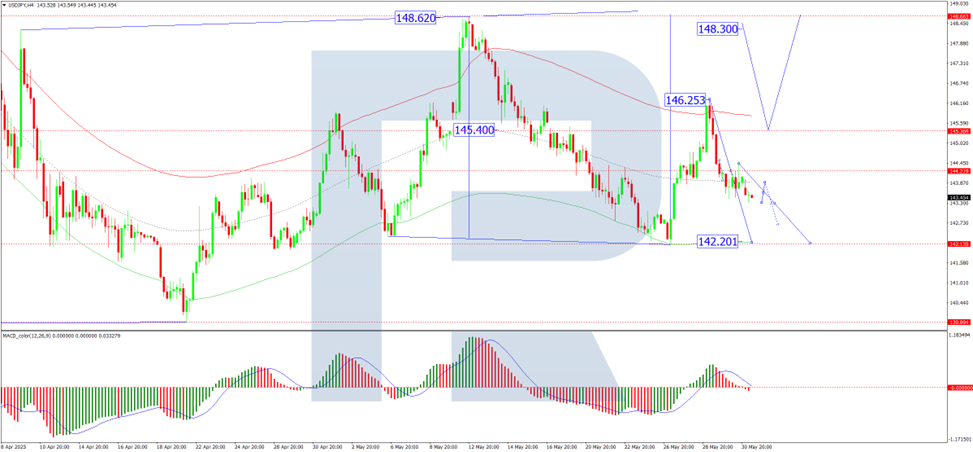
On the H4 chart, USD/JPY formed a narrow consolidation range around 144.22, which the market broke below earlier today. This breakout opens the way for a continued move down towards 142.20. After reaching this level, a corrective rebound to 144.22 is possible. The MACD indicator confirms this scenario, with its signal line below zero and pointing steeply downwards, indicating strong bearish momentum.
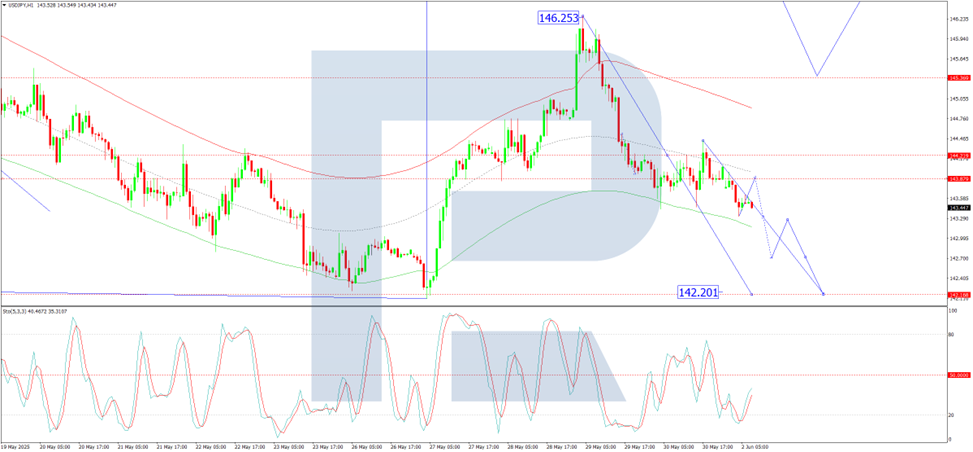
On the H1 chart, the pair is forming the fifth wave of the current downtrend, targeting 142.20. A temporary rebound to 143.88 is expected today, followed by a continuation of the decline to 142.70, with the potential for further movement down to 142.20. The Stochastic oscillator supports this outlook, with its signal line rising above 20 towards 50, suggesting a brief corrective move before further downside.
The USD/JPY pair remains under pressure due to heightened trade-related risk and growing demand for safe-haven assets such as the Japanese yen. Technically, the pair is poised for further decline, with 142.20 as the next key target. While a short-lived rebound may occur, broader sentiment continues to favour yen strength as long as global trade concerns persist.
White Label
Data API
Web Plug-ins
Poster Maker
Affiliate Program
The risk of loss in trading financial instruments such as stocks, FX, commodities, futures, bonds, ETFs and crypto can be substantial. You may sustain a total loss of the funds that you deposit with your broker. Therefore, you should carefully consider whether such trading is suitable for you in light of your circumstances and financial resources.
No decision to invest should be made without thoroughly conducting due diligence by yourself or consulting with your financial advisors. Our web content might not suit you since we don't know your financial conditions and investment needs. Our financial information might have latency or contain inaccuracy, so you should be fully responsible for any of your trading and investment decisions. The company will not be responsible for your capital loss.
Without getting permission from the website, you are not allowed to copy the website's graphics, texts, or trademarks. Intellectual property rights in the content or data incorporated into this website belong to its providers and exchange merchants.
Not Logged In
Log in to access more features

FastBull Membership
Not yet
Purchase
Log In
Sign Up