Markets
News
Analysis
User
24/7
Economic Calendar
Education
Data
- Names
- Latest
- Prev



Signal Accounts for Members
All Signal Accounts
All Contests


U.K. Trade Balance Non-EU (SA) (Oct)A:--
F: --
P: --
U.K. Trade Balance (Oct)A:--
F: --
P: --
U.K. Services Index MoMA:--
F: --
P: --
U.K. Construction Output MoM (SA) (Oct)A:--
F: --
P: --
U.K. Industrial Output YoY (Oct)A:--
F: --
P: --
U.K. Trade Balance (SA) (Oct)A:--
F: --
P: --
U.K. Trade Balance EU (SA) (Oct)A:--
F: --
P: --
U.K. Manufacturing Output YoY (Oct)A:--
F: --
P: --
U.K. GDP MoM (Oct)A:--
F: --
P: --
U.K. GDP YoY (SA) (Oct)A:--
F: --
P: --
U.K. Industrial Output MoM (Oct)A:--
F: --
P: --
U.K. Construction Output YoY (Oct)A:--
F: --
P: --
France HICP Final MoM (Nov)A:--
F: --
P: --
China, Mainland Outstanding Loans Growth YoY (Nov)A:--
F: --
P: --
China, Mainland M2 Money Supply YoY (Nov)A:--
F: --
P: --
China, Mainland M0 Money Supply YoY (Nov)A:--
F: --
P: --
China, Mainland M1 Money Supply YoY (Nov)A:--
F: --
P: --
India CPI YoY (Nov)A:--
F: --
P: --
India Deposit Gowth YoYA:--
F: --
P: --
Brazil Services Growth YoY (Oct)A:--
F: --
P: --
Mexico Industrial Output YoY (Oct)A:--
F: --
P: --
Russia Trade Balance (Oct)A:--
F: --
P: --
Philadelphia Fed President Henry Paulson delivers a speech
Canada Building Permits MoM (SA) (Oct)A:--
F: --
P: --
Canada Wholesale Sales YoY (Oct)A:--
F: --
P: --
Canada Wholesale Inventory MoM (Oct)A:--
F: --
P: --
Canada Wholesale Inventory YoY (Oct)A:--
F: --
P: --
Canada Wholesale Sales MoM (SA) (Oct)A:--
F: --
P: --
Germany Current Account (Not SA) (Oct)A:--
F: --
P: --
U.S. Weekly Total Rig CountA:--
F: --
P: --
U.S. Weekly Total Oil Rig CountA:--
F: --
P: --
Japan Tankan Large Non-Manufacturing Diffusion Index (Q4)--
F: --
P: --
Japan Tankan Small Manufacturing Outlook Index (Q4)--
F: --
P: --
Japan Tankan Large Non-Manufacturing Outlook Index (Q4)--
F: --
P: --
Japan Tankan Large Manufacturing Outlook Index (Q4)--
F: --
P: --
Japan Tankan Small Manufacturing Diffusion Index (Q4)--
F: --
P: --
Japan Tankan Large Manufacturing Diffusion Index (Q4)--
F: --
P: --
Japan Tankan Large-Enterprise Capital Expenditure YoY (Q4)--
F: --
P: --
U.K. Rightmove House Price Index YoY (Dec)--
F: --
P: --
China, Mainland Industrial Output YoY (YTD) (Nov)--
F: --
P: --
China, Mainland Urban Area Unemployment Rate (Nov)--
F: --
P: --
Saudi Arabia CPI YoY (Nov)--
F: --
P: --
Euro Zone Industrial Output YoY (Oct)--
F: --
P: --
Euro Zone Industrial Output MoM (Oct)--
F: --
P: --
Canada Existing Home Sales MoM (Nov)--
F: --
P: --
Euro Zone Total Reserve Assets (Nov)--
F: --
P: --
U.K. Inflation Rate Expectations--
F: --
P: --
Canada National Economic Confidence Index--
F: --
P: --
Canada New Housing Starts (Nov)--
F: --
P: --
U.S. NY Fed Manufacturing Employment Index (Dec)--
F: --
P: --
U.S. NY Fed Manufacturing Index (Dec)--
F: --
P: --
Canada Core CPI YoY (Nov)--
F: --
P: --
Canada Manufacturing Unfilled Orders MoM (Oct)--
F: --
P: --
Canada Manufacturing New Orders MoM (Oct)--
F: --
P: --
Canada Core CPI MoM (Nov)--
F: --
P: --
Canada Manufacturing Inventory MoM (Oct)--
F: --
P: --
Canada CPI YoY (Nov)--
F: --
P: --
Canada CPI MoM (Nov)--
F: --
P: --
Canada CPI YoY (SA) (Nov)--
F: --
P: --
Canada Core CPI MoM (SA) (Nov)--
F: --
P: --


No matching data
Latest Views
Latest Views
Trending Topics
Top Columnists
Latest Update
White Label
Data API
Web Plug-ins
Affiliate Program
View All

No data
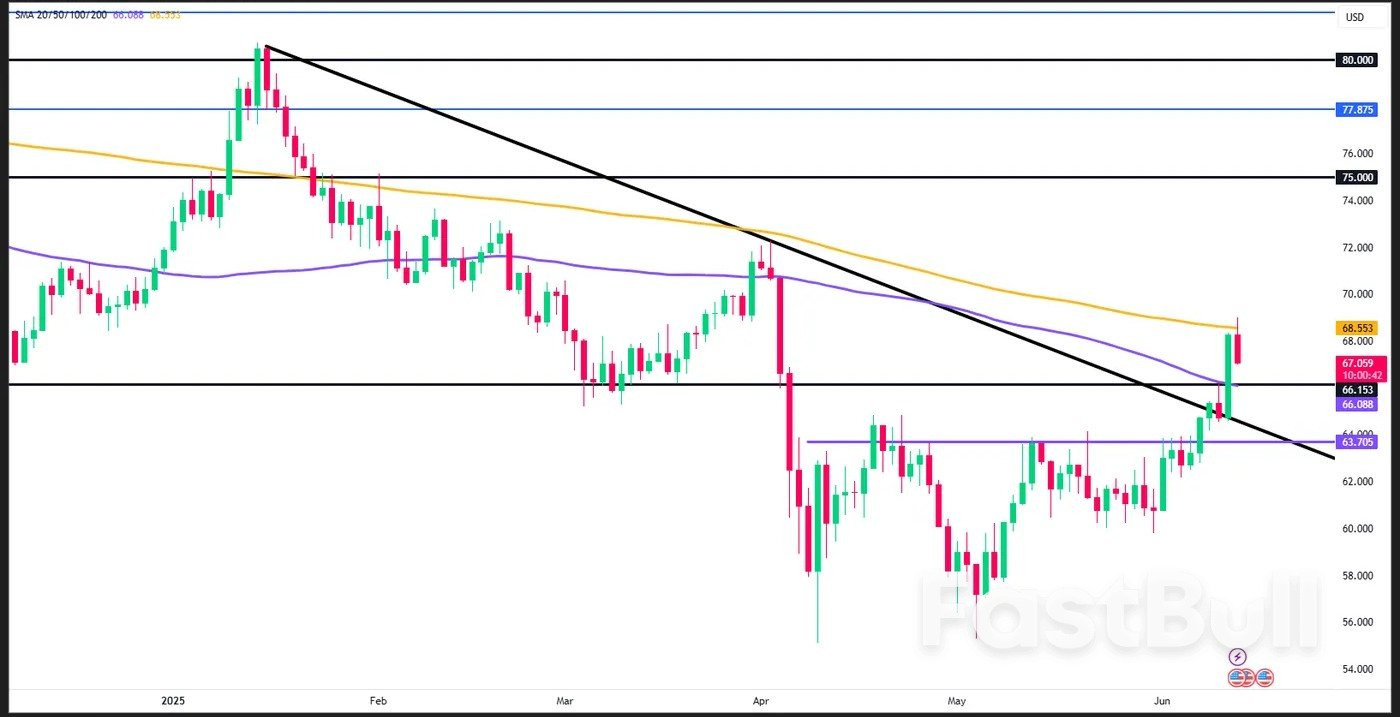
J.P. Morgan expects oil prices to stay in the low-to-mid $60s through 2025, but warns that worst-case scenarios could push prices as high as $130 amid rising Iran tensions.

The Federal Reserve's path to interest rate cuts starting in September appeared to widen on Thursday, after a pair of government reports pointed to cooler inflation and signs of potential weakening in the labor market.
U.S. producer prices advanced 2.6% in May from a year earlier, after rising 2.5% in April, the Labor Department reported. Taken together with tamer-than-expected increases in the Consumer Price Index in May, economists estimated that inflation by the Fed's preferred gauge of underlying price pressures, the core Personal Consumption Expenditures Price Index, likely rose in line with the Fed's 2% goal last month.Economists still expect the Trump administration's tariffs to push up prices and lift inflation later this year, but "the near-term trend remains favorable, enabling the (Fed) to signal next week that it still intends to begin easing policy again later this year," economists at Pantheon Macroeconomics wrote.
They estimate that core PCE rose by just 0.12% in May from April, based on the latest PPI and CPI data. Economists at other Wall Street firms issued similar estimates.
The Fed is nearly universally expected to leave its policy rate in the 4.25%-4.50% range at its June 17-18 meeting. Futures that settle to the Fed's policy rate show traders now expect a quarter-percentage-point reduction by September, with another such move likely in October. Before Thursday's data, traders had expected the Fed to wait until December to deliver a second rate cut. The U.S. central bank cut rates three times in 2024.A separate Labor Department report on Thursday showed initial weekly claims for jobless benefits held steady at a seasonally adjusted 248,000 for the week ended June 7, while continuing claims jumped to 1.951 million, their highest level since November 2021 and a sign that it is getting harder for unemployed workers to find a new job.
"Americans, especially recent graduates, are worried about how hard it is to find a job," said Heather Long, chief economist at Navy Federal Credit Union. "If layoffs worsen this summer, it will heighten fears of a recession and consumer spending pullback."


Britain's government is planning to ramp up public spending — but market watchers warn the proposals risk sending jitters through the bond market further inflating the country's $143 billion-a-year interest payments.
U.K. Finance Minister Rachel Reeves on Wednesday announced the government would inject billions of pounds into defense, healthcare, infrastructure, and other areas of the economy, in the coming years. A day later, however, official data showed the U.K. economy shrank by a greater-than-expected 0.3% in April.
Funding public spending in the absence of a growing economy, leaves the government with two options: raise money through taxation, or take on more debt.
One way it can borrow is to issue bonds, known as gilts in the U.K., into the public market. By purchasing gilts, investors are essentially lending money to the government, with the yield on the bond representing the return the investor can expect to receive.
Gilt yields and prices move in opposite directions — so rising prices move yields lower, and vice versa. This year, gilt yields have seen volatile moves, with investors sensitive to geopolitical and macroeconomic instability.
The U.K. government's long-term borrowing costs spiked to multi-decade highs in January, and the yield on 20- and 30-year gilts continues to hover firmly above 5%.
Official estimates show the government is expected to spend more than £105 billion ($142.9 billion) paying interest on its national debt in the 2025 fiscal year — £9.4 billion higher than at the the time of the Autumn budget last year — and £111 billion in annual interest in 2026.
The government did not say on Wednesday how its newly unveiled spending hikes will be funded, and did not respond to CNBC's request for comment about where the money will come from. However, in her Autumn Budget last year, Reeves outlined plans to hike both taxes and borrowing. Following the budget, the finance minister pledged not to raise taxes again during the current Labour government's term in office, saying that the government "won't have to do a budget like this ever again."
Andrew Goodwin, chief U.K. economist at Oxford Economics, said Britain's government may be forced to go even further with its spending plans, with NATO poised to hike its defense spending target for member states to 5% of GDP, and once a U-turn on winter fuel payments for the elderly and other possible welfare reforms are factored in.
Additionally, Goodwin said, the U.K.'s Office for Budget Responsibility is likely to make "unfavorable revisions" to its economic forecasts in July, which would lead to lower tax receipts and higher borrowing.
"If recent movements in financial market pricing hold, debt servicing costs will be around £2.5bn ($3.4 billion) higher than they were at the time of the Spring Statement," Goodwin warned in a note on Wednesday.
Mel Stride, who serves as the shadow Chancellor in the U.K.'s opposition government, told CNBC's "Squawk Box Europe" on Thursday that the Spending Review raised questions about whether "a huge amount of borrowing" will be involved in funding the government's fiscal strategies.
"[Government] borrowing is having consequences in terms of higher inflation in the U.K. … and therefore interest rates [are] higher for longer," he said. "It's adding to the debt mountain, the servicing costs upon which are running at 100 billion [pounds] a year, that's twice what we spend on defense."
"I'm afraid the overall economy is in a very weak position to withstand the kind of spending and borrowing that this government is announcing," Stride added.
Stride argued that Reeves will "almost certainly" have to raise taxes again in her next budget announcement due in the autumn.
"We've ended up in a very fragile situation, particularly when you've got the tariffs around the world," he said.
Rufaro Chiriseri, head of fixed income for the British Isles at RBC Wealth Management, told CNBC that rising borrowing costs were putting Reeves' "already small fiscal headroom at risk."
"This reduced headroom could create a snowball effect, as investors could potentially become nervous to hold UK debt, which could lead to a further selloff until fiscal stability is restored," he said.
Iain Barnes, Chief Investment Officer at Netwealth, also told CNBC on Thursday that the U.K. was in "a state of fiscal fragility, so room for manoeuvre is limited."
"The market knows that if growth disappoints, then this year's Budget may have to deliver higher taxes and increased borrowing to fund spending plans," Barnes said.
White Label
Data API
Web Plug-ins
Poster Maker
Affiliate Program
The risk of loss in trading financial instruments such as stocks, FX, commodities, futures, bonds, ETFs and crypto can be substantial. You may sustain a total loss of the funds that you deposit with your broker. Therefore, you should carefully consider whether such trading is suitable for you in light of your circumstances and financial resources.
No decision to invest should be made without thoroughly conducting due diligence by yourself or consulting with your financial advisors. Our web content might not suit you since we don't know your financial conditions and investment needs. Our financial information might have latency or contain inaccuracy, so you should be fully responsible for any of your trading and investment decisions. The company will not be responsible for your capital loss.
Without getting permission from the website, you are not allowed to copy the website's graphics, texts, or trademarks. Intellectual property rights in the content or data incorporated into this website belong to its providers and exchange merchants.
Not Logged In
Log in to access more features

FastBull Membership
Not yet
Purchase
Log In
Sign Up