• Trade
  • Markets
  • Copy
  • Contests
  • News
  • 24/7
  • Calendar
  • Q&A
  • Chats
Trending
Screeners
SYMBOL
LAST
BID
ASK
HIGH
LOW
NET CHG.
%CHG.
SPREAD
SPX
S&P 500 Index
6857.13
6857.13
6857.13
6865.94
6827.13
+7.41
+ 0.11%
--
DJI
Dow Jones Industrial Average
47850.93
47850.93
47850.93
48049.72
47692.96
-31.96
-0.07%
--
IXIC
NASDAQ Composite Index
23505.13
23505.13
23505.13
23528.53
23372.33
+51.04
+ 0.22%
--
USDX
US Dollar Index
98.850
98.930
98.850
98.980
98.740
-0.130
-0.13%
--
EURUSD
Euro / US Dollar
1.16575
1.16584
1.16575
1.16715
1.16408
+0.00130
+ 0.11%
--
GBPUSD
Pound Sterling / US Dollar
1.33526
1.33535
1.33526
1.33622
1.33165
+0.00255
+ 0.19%
--
XAUUSD
Gold / US Dollar
4223.59
4224.00
4223.59
4230.62
4194.54
+16.42
+ 0.39%
--
WTI
Light Sweet Crude Oil
59.391
59.421
59.391
59.480
59.187
+0.008
+ 0.01%
--

Community Accounts

Signal Accounts
--
Profit Accounts
--
Loss Accounts
--
View More

Become a signal provider

Sell trading signals to earn additional income

View More

Guide to Copy Trading

Get started with ease and confidence

View More

Signal Accounts for Members

All Signal Accounts

Best Return
  • Best Return
  • Best P/L
  • Best MDD
Past 1W
  • Past 1W
  • Past 1M
  • Past 1Y

All Contests

  • All
  • Trump Updates
  • Recommend
  • Stocks
  • Cryptocurrencies
  • Central Banks
  • Featured News
Top News Only
Share

Kremlin Aide Ushakov Says USA Kushner Is Working Very Actively On Ukrainian Settlement

Share

Norway To Acquire 2 More Submarines, Long-Range Missiles, Daily Vg Reports

Share

Ucb Sa Shares Open Up 7.3% After 2025 Guidance Upgrade, Top Of Bel 20 Index

Share

Shares In Italy's Mediobanca Down 1.3% After Barclays Cuts To Underweight From Equal-Weight

Share

Stats Office - Austrian November Wholesale Prices +0.9% Year-On-Year

Share

Britain's FTSE 100 Up 0.15%

Share

Europe's STOXX 600 Up 0.1%

Share

Taiwan November PPI -2.8% Year-On-Year

Share

Stats Office - Austrian September Trade -230.8 Million EUR

Share

Swiss National Bank Forex Reserves Revised To Chf 724906 Million At End Of October - SNB

Share

Swiss National Bank Forex Reserves At Chf 727386 Million At End Of November - SNB

Share

Shanghai Warehouse Rubber Stocks Up 8.54% From Week Earlier

Share

Turkey's Main Banking Index Up 2%

Share

French October Trade Balance -3.92 Billion Euros Versus Revised -6.35 Billion Euros In September

Share

Kremlin Aide Says Russia Is Ready To Work Further With Current USA Team

Share

Kremlin Aide Says Russia And USA Are Moving Forward In Ukraine Talks

Share

Shanghai Rubber Warehouse Stocks Up 7336 Tons

Share

Shanghai Tin Warehouse Stocks Up 506 Tons

Share

Reserve Bank Of India Chief Malhotra: Goal Is To Have Inflation Be Around 4%

Share

Ukmto Says Master Has Confirmed That The Small Crafts Have Left The Scene, Vessel Is Proceeding To Its Next Port Of Call

TIME
ACT
FCST
PREV
France 10-Year OAT Auction Avg. Yield

A:--

F: --

P: --

Euro Zone Retail Sales MoM (Oct)

A:--

F: --

P: --

Euro Zone Retail Sales YoY (Oct)

A:--

F: --

P: --

Brazil GDP YoY (Q3)

A:--

F: --

P: --

U.S. Challenger Job Cuts (Nov)

A:--

F: --

P: --

U.S. Challenger Job Cuts MoM (Nov)

A:--

F: --

P: --

U.S. Challenger Job Cuts YoY (Nov)

A:--

F: --

P: --

U.S. Initial Jobless Claims 4-Week Avg. (SA)

A:--

F: --

P: --

U.S. Weekly Initial Jobless Claims (SA)

A:--

F: --

P: --

U.S. Weekly Continued Jobless Claims (SA)

A:--

F: --

P: --

Canada Ivey PMI (SA) (Nov)

A:--

F: --

P: --

Canada Ivey PMI (Not SA) (Nov)

A:--

F: --

P: --

U.S. Non-Defense Capital Durable Goods Orders Revised MoM (Excl. Aircraft) (SA) (Sept)

A:--

F: --

P: --
U.S. Factory Orders MoM (Excl. Transport) (Sept)

A:--

F: --

P: --

U.S. Factory Orders MoM (Sept)

A:--

F: --

P: --

U.S. Factory Orders MoM (Excl. Defense) (Sept)

A:--

F: --

P: --

U.S. EIA Weekly Natural Gas Stocks Change

A:--

F: --

P: --

Saudi Arabia Crude Oil Production

A:--

F: --

P: --

U.S. Weekly Treasuries Held by Foreign Central Banks

A:--

F: --

P: --

Japan Foreign Exchange Reserves (Nov)

A:--

F: --

P: --

India Repo Rate

A:--

F: --

P: --

India Benchmark Interest Rate

A:--

F: --

P: --

India Reverse Repo Rate

A:--

F: --

P: --

India Cash Reserve Ratio

A:--

F: --

P: --

Japan Leading Indicators Prelim (Oct)

A:--

F: --

P: --

U.K. Halifax House Price Index YoY (SA) (Nov)

A:--

F: --

P: --

U.K. Halifax House Price Index MoM (SA) (Nov)

A:--

F: --

P: --

France Current Account (Not SA) (Oct)

A:--

F: --

P: --

France Trade Balance (SA) (Oct)

A:--

F: --

P: --

France Industrial Output MoM (SA) (Oct)

A:--

F: --

P: --

Italy Retail Sales MoM (SA) (Oct)

--

F: --

P: --

Euro Zone Employment YoY (SA) (Q3)

--

F: --

P: --

Euro Zone GDP Final YoY (Q3)

--

F: --

P: --

Euro Zone GDP Final QoQ (Q3)

--

F: --

P: --

Euro Zone Employment Final QoQ (SA) (Q3)

--

F: --

P: --

Euro Zone Employment Final (SA) (Q3)

--

F: --

P: --
Brazil PPI MoM (Oct)

--

F: --

P: --

Mexico Consumer Confidence Index (Nov)

--

F: --

P: --

Canada Unemployment Rate (SA) (Nov)

--

F: --

P: --

Canada Labor Force Participation Rate (SA) (Nov)

--

F: --

P: --

Canada Employment (SA) (Nov)

--

F: --

P: --

Canada Part-Time Employment (SA) (Nov)

--

F: --

P: --

Canada Full-time Employment (SA) (Nov)

--

F: --

P: --

U.S. Personal Income MoM (Sept)

--

F: --

P: --

U.S. Dallas Fed PCE Price Index YoY (Sept)

--

F: --

P: --

U.S. PCE Price Index YoY (SA) (Sept)

--

F: --

P: --

U.S. PCE Price Index MoM (Sept)

--

F: --

P: --

U.S. Personal Outlays MoM (SA) (Sept)

--

F: --

P: --

U.S. Core PCE Price Index MoM (Sept)

--

F: --

P: --

U.S. UMich 5-Year-Ahead Inflation Expectations Prelim YoY (Dec)

--

F: --

P: --

U.S. Core PCE Price Index YoY (Sept)

--

F: --

P: --

U.S. Real Personal Consumption Expenditures MoM (Sept)

--

F: --

P: --

U.S. 5-10 Year-Ahead Inflation Expectations (Dec)

--

F: --

P: --

U.S. UMich Current Economic Conditions Index Prelim (Dec)

--

F: --

P: --

U.S. UMich Consumer Sentiment Index Prelim (Dec)

--

F: --

P: --

U.S. UMich 1-Year-Ahead Inflation Expectations Prelim (Dec)

--

F: --

P: --

U.S. UMich Consumer Expectations Index Prelim (Dec)

--

F: --

P: --

U.S. Weekly Total Rig Count

--

F: --

P: --

U.S. Weekly Total Oil Rig Count

--

F: --

P: --

U.S. Consumer Credit (SA) (Oct)

--

F: --

P: --

Q&A with Experts
    • All
    • Chatrooms
    • Groups
    • Friends
    Connecting
    .
    .
    .
    Type here...
    Add Symbol or Code

      No matching data

      All
      Trump Updates
      Recommend
      Stocks
      Cryptocurrencies
      Central Banks
      Featured News
      • All
      • Russia-Ukraine Conflict
      • Middle East Flashpoint
      • All
      • Russia-Ukraine Conflict
      • Middle East Flashpoint
      Search
      Products

      Charts Free Forever

      Chats Q&A with Experts
      Screeners Economic Calendar Data Tools
      Membership Features
      Data Warehouse Market Trends Institutional Data Policy Rates Macro

      Market Trends

      Market Sentiment Order Book Forex Correlations

      Top Indicators

      Charts Free Forever
      Markets

      News

      News Analysis 24/7 Columns Education
      From Institutions From Analysts
      Topics Columnists

      Latest Views

      Latest Views

      Trending Topics

      Top Columnists

      Latest Update

      Signals

      Copy Rankings Latest Signals Become a signal provider AI Rating
      Contests
      Brokers

      Overview Brokers Assessment Rankings Regulators News Claims
      Broker listing Forex Brokers Comparison Tool Live Spread Comparison Scam
      Q&A Complaint Scam Alert Videos Tips to Detect Scam
      More

      Business
      Events
      Careers About Us Advertising Help Center

      White Label

      Data API

      Web Plug-ins

      Affiliate Program

      Awards Institution Evaluation IB Seminar Salon Event Exhibition
      Vietnam Thailand Singapore Dubai
      Fans Party Investment Sharing Session
      FastBull Summit BrokersView Expo
      Recent Searches
        Top Searches
          Markets
          News
          Analysis
          User
          24/7
          Economic Calendar
          Education
          Data
          • Names
          • Latest
          • Prev

          View All

          No data

          Scan to Download

          Faster Charts, Chat Faster!

          Download App
          English
          • English
          • Español
          • العربية
          • Bahasa Indonesia
          • Bahasa Melayu
          • Tiếng Việt
          • ภาษาไทย
          • Français
          • Italiano
          • Türkçe
          • Русский язык
          • 简中
          • 繁中
          Open Account
          Search
          Products
          Charts Free Forever
          Markets
          News
          Signals

          Copy Rankings Latest Signals Become a signal provider AI Rating
          Contests
          Brokers

          Overview Brokers Assessment Rankings Regulators News Claims
          Broker listing Forex Brokers Comparison Tool Live Spread Comparison Scam
          Q&A Complaint Scam Alert Videos Tips to Detect Scam
          More

          Business
          Events
          Careers About Us Advertising Help Center

          White Label

          Data API

          Web Plug-ins

          Affiliate Program

          Awards Institution Evaluation IB Seminar Salon Event Exhibition
          Vietnam Thailand Singapore Dubai
          Fans Party Investment Sharing Session
          FastBull Summit BrokersView Expo

          Japan's Service Growth Picks Up In July On Upbeat Demand, PMI Shows

          Nathaniel Wright
          Summary:

          Japan's service sector activity rose at the fastest pace in five months in July, thanks to brisk domestic demand that offset a sharp drop in export orders and weaker tourist numbers, a private sector survey reported on Tuesday.

          Japan's service sector activity rose at the fastest pace in five months in July, thanks to brisk domestic demand that offset a sharp drop in export orders and weaker tourist numbers, a private sector survey reported on Tuesday.

          The S&P Global final Japan Services purchasing managers' index (PMI) climbed to 53.6 in July from 51.7 in June, marking the strongest expansion since February. A PMI reading above 50.0 indicates growth in activity, while that below the threshold points to contraction.

          New service business orders grew at the quickest pace in three months, supported by improved customer numbers, according to the survey.

          However, new export orders fell for the first time since December and at the fastest rate in over three years due to low tourist numbers in July, it showed.

          Some survey respondents attributed the weak tourist figures to speculative concerns about an earthquake in July.

          Employment in the service sector was unchanged from the previous month, ending a 21-month growth streak, with some respondents citing labour shortages and budget constraints as challenges to hiring.

          Price pressures continued to ease in July. Input cost inflation was the slowest in 17 months, while output costs rose at the softest pace in nine months.

          The composite PMI, which combines manufacturing and services, rose slightly to 51.6 in July from 51.5 in June, marking the strongest overall business activity growth since February.

          "However, this reflected a steep increase in business activity at service providers, as factory output fell back into contraction...forward-looking indicators were a little less upbeat in July," said Annabel Fiddes, economics associate director at S&P Global Market Intelligence.

          The U.S.-Japan trade deal announced last month could lift Japanese firms' confidence and consumption to offer "a much-needed boost to the manufacturing economy", Fiddes added.

          Source: Yahoo Finance

          Risk Warnings and Disclaimers
          You understand and acknowledge that there is a high degree of risk involved in trading. Following any strategies or investment methods may lead to potential losses. The content on the site is provided by our contributors and analysts for information purposes only. You are solely responsible for determining whether any trading assets, securities, strategy, or any other product is suitable for investing based on your own investment objectives and financial situation.
          Add to Favorites
          Share

          Oil Little Changed After Hitting One-week Low, Oversupply Concerns Linger

          LinoCapital

          Oil prices were little changed on Tuesday after three days of declines on mounting oversupply concerns after OPEC+ agreed to another large output increase in September, though the potential for more Russian supply disruptions supported the market.

          Brent crude futureswere unchanged at $68.76 a barrel by 0036 GMT while U.S. West Texas Intermediate crudewas at $66.27 a barrel, down 2 cents, or 0.03%.

          Both contracts fell by more than 1% in the previous session to settle at their lowest in a week.

          The Organization of the Petroleum Exporting Countries and its allies, together known as OPEC+, pumps about half of the world's oil and had been curtailing production for several years to support the market, but the group introduced a series of accelerated output hikes this year to regain market share.

          In its latest decision, OPEC+ agreed on Sunday to raise oil production by 547,000 barrels per day for September.

          It marks a full and early reversal of the group's largest tranche of output cuts, amounting to about 2.5 million bpd, or about 2.4% of global demand, though analysts caution the actual amount returning to the market will be less.

          At the same time, U.S. demands for India to stop buying Russian oil as Washington seeks ways to push Moscow for a peace deal with Ukraine is increasing concerns of a disruption to supply flows.

          U.S. President Donald Trump is threatening to impose 100% secondary tariffs on Russian crude buyers. This follows a 25% tariff on Indian imports announced in July.

          India is the biggest buyer of seaborne crude from Russia, importing about 1.75 million bpd of Russian oil from January to June this year, up 1% from a year ago, according to data provided to Reuters by trade sources.

          "India has become a major buyer of the Kremlin's oil since the 2022 invasion of Ukraine. Any disruption to those purchases would force Russia to find alternative buyers from an increasingly small group of allies," ANZ senior commodity strategist Daniel Hynes wrote in a note.

          Traders are also awaiting any developments on the latest U.S. tariffs on its trading partners, which analysts fear could slow down economic growth and dampen fuel demand growth.

          Source: Reuters

          Risk Warnings and Disclaimers
          You understand and acknowledge that there is a high degree of risk involved in trading. Following any strategies or investment methods may lead to potential losses. The content on the site is provided by our contributors and analysts for information purposes only. You are solely responsible for determining whether any trading assets, securities, strategy, or any other product is suitable for investing based on your own investment objectives and financial situation.
          Add to Favorites
          Share

          Goldman Sachs Predicts Fed Rate Cuts Starting September 2025

          Daniel Carter

          Central Bank

          Economic

          Key Points:
          ● Goldman Sachs anticipates Federal Reserve interest rate cuts from September 2025.
          ● Cryptocurrencies may be positively influenced by dollar weakness.
          ● Market reactions are centered around U.S. economic data reliability.
          Goldman Sachs anticipates the Federal Reserve will initiate three 25 basis point interest rate cuts from September, potentially increasing to 50 basis points if unemployment rises.
          The forecast by Goldman Sachs affects market sentiment, weakening the U.S. dollar and potentially boosting cryptocurrencies like Bitcoin and Ethereum as investors adjust their positions.

          Goldman Sachs Eyes September 2025 for Fed Rate Cuts

          Goldman Sachs, through its Chief U.S. Economist David Mericle, anticipates that the Federal Reserve will initiate a series of interest rate reductions beginning in September 2025. These reductions could involve three 25 basis point cuts. Speculation grows around a possible 50 basis point cut if unemployment increases significantly.
          Immediate market impacts include a weakening U.S. dollar, which could enhance cryptocurrency valuations as these assets typically gain strength when fiat currencies decline. This expectation has heightened market sensitivity towards forthcoming economic indicators.
          "Estimates the odds of a September cut are 'somewhat above' 50%, with 25 basis point cuts pencilled in for the coming meetings..."
          Community reactions, primarily within financial and crypto circles, revolve around the reliability of U.S. economic data assessments. Concerns arise due to recent changes within the Bureau of Labor Statistics, impacting how market participants view potential financial outcomes.

          Crypto Market Set to Benefit from Dollar Weakness

          Did you know? In past instances, when the Federal Reserve signaled rate cuts, both equities and major cryptocurrencies such as BTC and ETH experienced upticks, highlighting investor optimism towards risk assets during easing cycles.
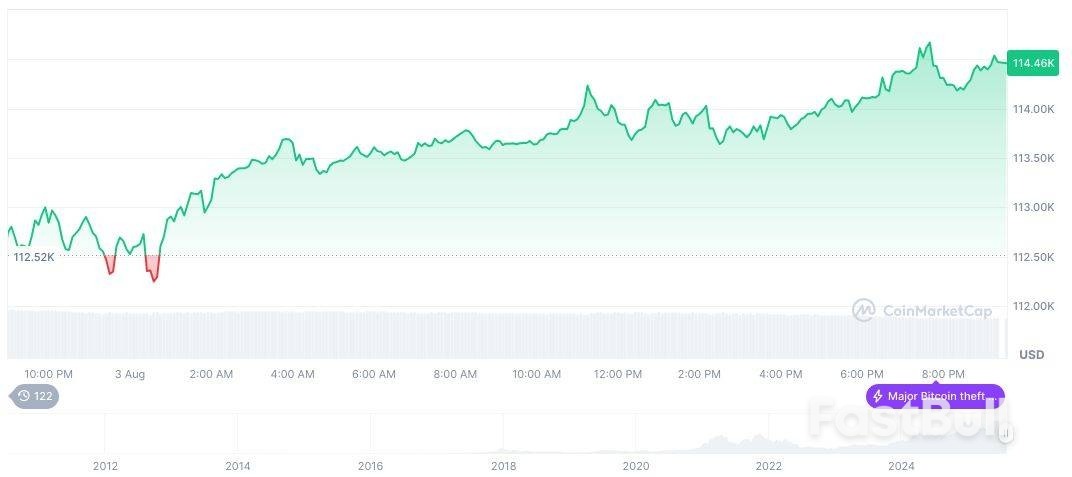
          Bitcoin (BTC) currently trades at $114,708.40 with a market capitalization of 2,282,917,205,331 and a market dominance of 60.78%. Recent data shows a 20.97% increase over the last 90 days. Trading volumes hit 54,982,641,934 in a 24-hour span, reflecting volatile market sentiment.

          Bitcoin(BTC), daily chart, screenshot on CoinMarketCap at 20:28 UTC on August 4, 2025.

          Expert suggests that forthcoming rate adjustments could further stimulate investor interest in digital assets, yet market players remain cautious over the evolving regulatory landscape and economic data integrity. Continued vigilance on macroeconomic shifts remains critical for stakeholders.

          Source: CryptoSlate

          To stay updated on all economic events of today, please check out our Economic calendar
          Risk Warnings and Disclaimers
          You understand and acknowledge that there is a high degree of risk involved in trading. Following any strategies or investment methods may lead to potential losses. The content on the site is provided by our contributors and analysts for information purposes only. You are solely responsible for determining whether any trading assets, securities, strategy, or any other product is suitable for investing based on your own investment objectives and financial situation.
          Add to Favorites
          Share

          Korean Inflation Cools, Boosting Case For BOK To Cut Rate Again

          Daniel Carter

          Economic

          Central Bank

          The pace of consumer inflation in South Korea slowed, giving the central bank added incentive to resume its rate-cut cycle as the trade-reliant economy braces for the impact from higher US tariffs.
          Consumer prices rose 2.1% in July from a year earlier, slowing from a 2.2% clip in June, the statistics office reported Tuesday. The result matched consensus estimates of economists surveyed by Bloomberg.
          A gauge of prices that excludes food and energy rose 2% in July, the same as in June, according to Statistics Korea.
          The softer figures come just days after the US agreed last week to assess 15% tariffs on most Korean imports. The last-minute deal helped South Korea avoid the worst-case scenario of 25% import levies that President Donald Trump had threatened, but it still represents an increase of across-the-board tariffs from 10% in recent months. Annual exports are equivalent to more than 40% of the country's gross domestic product.
          The central bank's board next sets policy on Aug. 28, after having paused its rate-cut cycle in June and July, and some economists forecast a quarter-point reduction this month. At its July meeting, the board noted it must weigh the case for shielding the economy from the effects of US tariffs, while also attempting to forestall a further rally in housing prices in the capital that risks spurring debt levels.
          Governor Rhee Chang Yong has recently highlighted the BOK's commitment to maintaining economic stability amid external shocks, while cautioning that excessive stimulus could fuel real estate speculation and add to the country's already high household debt load.
          The housing market stayed hot last month, but the pace of price increases continued to ease — a development that offered relief to policymakers trying to stabilize costs of living. Apartment prices in Seoul slowed to 0.12% gain in the week of July 28, which was less than half the recent peak of 0.43% set in June, according to data from the Korea Real Estate Board.
          The won's advance in recent months has also made it easier for authorities to consider looser policy settings, with the currency among the biggest gainers against the dollar this year.
          Prices of food and non-alcoholic beverages rose 3.5% from a year earlier in July, while transportation costs slipped 0.2%. Education prices gained 2.6%. Housing, water, electricity and fuel costs climbed 1.8%. Prices for food and lodging gained 3.2%.

          Source: Bloomberg Europe

          To stay updated on all economic events of today, please check out our Economic calendar
          Risk Warnings and Disclaimers
          You understand and acknowledge that there is a high degree of risk involved in trading. Following any strategies or investment methods may lead to potential losses. The content on the site is provided by our contributors and analysts for information purposes only. You are solely responsible for determining whether any trading assets, securities, strategy, or any other product is suitable for investing based on your own investment objectives and financial situation.
          Add to Favorites
          Share

          How Reliable is The Jobs Data? Economists and Wall Street Still Trust it

          Manuel

          Economic

          The monthly jobs report is already closely-watched on Wall Street and in Washington but has taken on a new importance after President Donald Trump on Friday fired the official who oversees it.
          Trump claimed that June's employment figures were “RIGGED” to make him and other Republicans “look bad.” Yet he provided no evidence and even the official Trump had appointed in his first term to oversee the report, William Beach, condemned the firing of Erika McEntarfer, the director of the Bureau of Labor Statistics appointed by former President Joe Biden. The firing followed Friday's jobs report that showed hiring was weak in July and had come to nearly a standstill in May and June, right after Trump rolled out sweeping tariffs.
          Economists and Wall Street investors have long considered the job figures reliable, with share prices and bond yields often reacting sharply when they are released. Yet Friday’s revisions were unusually large — the largest, outside of a recession, in five decades. And the surveys used to compile the report are facing challenges from declining response rates, particularly since COVID, as fewer companies complete the surveys.
          Nonetheless, that hasn't led most economists to doubt them.
          “The bottom line for me is, I wouldn’t take the low collection rate as any evidence that the numbers are less reliable,” Omair Sharif, founder and chief economist at Inflation Insights, a consulting firm, said.
          Many academics, statisticians and economists have warned for some time that declining budgets were straining the government's ability to gather economic data. There were several government commissions studying ways to improve things like survey response rates, but the Trump administration disbanded them earlier this year.
          Heather Boushey, a top economic adviser in the Biden White House, noted that without Trump's firing of McEntarfer, there would be more focus on last week's data, which points to a slowing economy.
          “We’re having this conversation about made-up issues to distract us from what the data is showing," Boushey said. “Revisions of this magnitude in a negative direction may indicate bad things to come for the labor market.”
          Here are some things to know about the jobs report:

          Economists and Wall Street trust the data

          Most economists say that the Bureau of Labor Statistics is a nonpolitical agency staffed by people obsessed with getting the numbers right. The only political appointee is the commissioner, who doesn't see the data until it's finalized, two days before it is issued to the public.
          Erica Groshen, the BLS commissioner from 2013 to 2017, said she suggested different language in the report to "liven it up", but was shot down. She was told that if asked to describe a cup as half-empty or half-full, BLS says “it is an eight ounce cup with four ounces of liquid.”
          The revised jobs data that has attracted Trump's ire is actually more in line with other figures than before the revision. For example, payroll processor ADP uses data from its millions of clients to calculate its own jobs report, and it showed a sharp hiring slowdown in May and June that is closer to the revised BLS data.
          Trump and his White House have a long track record of celebrating the jobs numbers — when they are good.

          These are the figures is Trump attacking

          Trump has focused on the revisions to the May and June data, which on Friday were revised lower, with job gains in May reduced to 19,000 from 144,000, and for June to just 14,000 from 147,000. Every month's jobs data is revised in the following two months.
          Trump also repeated a largely inaccurate attack from the campaign about an annual revision last August, which reduced total employment in the United States by 818,000, or about 0.5%. The government also revises employment figures every year.
          Trump charged the annual revision was released before the 2024 presidential election to “boost” Vice President Kamala Harris's "chances of Victory," yet it was two months before the election and widely reported at the time that the revision lowered hiring during the Biden-Harris administration and pointed to a weaker economy.

          Here's why the government revises the data

          The monthly revisions occur because many companies that respond to the government's surveys send their data in late, or correct the figures they've already submitted. The proportion of companies sending in their data later has risen in the past decade.
          Every year, the BLS does an additional revision based on actual job counts that are derived from state unemployment insurance records. Those figures cover 95% of U.S. businesses and aren't derived from a survey but are not available in real time.

          These are the factors that cause revisions

          Figuring out how many new jobs have been added or lost each month is more complicated than it may sound. For example, if one person takes a second job, should you focus on the number of jobs, which has increased, or the number of employed people, which hasn't? (The government measures both: The unemployment rate is based on how many people either have or don't have jobs, while the number of jobs added or lost is counted separately).
          Each month, the government surveys about 121,000 businesses and government agencies at over 630,000 locations — including multiple locations for the same business — covering about one-third of all workers.
          Still, the government also has to make estimates: What if a company goes out of business? It likely won't fill out any forms showing the jobs lost. And what about new businesses? They can take a while to get on the government's radar.
          The BLS seeks to capture these trends by estimating their impact on employment. Those estimates can be wrong, of course, until they are fixed by the annual revisions.
          The revisions are often larger around turning points in the economy. For example, when the economy is growing, there may be more startups than the government expects, so revisions will be higher. If the economy is slowing or slipping into a recession, the revisions may be larger on the downside.

          Here's why the May and June revisions may have been so large

          Ernie Tedeschi, an economic adviser to the Biden administration, points to the current dynamics of the labor market: Both hiring and firing have sharply declined, and fewer Americans are quitting their jobs to take other work. As a result, most of the job gains or losses each month are probably occurring at new companies, or those going out of business.
          And those are the ones the government uses models to estimate, which can make them more volatile.
          Groshen also points out that since the pandemic there has been a surge of new start-up companies, after many Americans lost their jobs or sought more independence. Yet they may not have created as many jobs as startups did pre-COVID, which throws off the government’s models.

          Revisions seem to be getting bigger

          The revisions to May and June's job totals, which reduced hiring by a total of 258,000, were the largest — outside recessions — since 1967, according to economists at Goldman Sachs.
          Kevin Hassett, Trump's top economic adviser, went on NBC's “Meet the Press” on Sunday and said, “What we’ve seen over the last few years is massive revisions to the jobs numbers.”
          Hassett blamed a sharp drop in response rates to the government's surveys during and after the pandemic: “When COVID happened, because response rates went down a lot, then revision rates skyrocketed.”
          Yet calculations by Tedeschi show that while revisions spiked after the pandemic, they have since declined and are much smaller than in the 1960s and 1970s.

          Other concerns about the government's data

          Many economists and statisticians have sounded the alarm about things like declining response rates for years. A decade ago, about 60% of companies surveyed by BLS responded. Now, only about 40% do.
          The decline has been an international phenomenon, particularly since COVID. The United Kingdom has even suspended publication of an official unemployment rate because of falling responses.
          And earlier this year the BLS said that it was cutting back on its collection of inflation data because of the Trump administration's hiring freeze, raising concerns about the robustness of price data just as economists are trying to gauge the impact of tariffs on inflation.
          U.S. government statistical agencies have seen an inflation-adjusted 16% drop in funding since 2009, according to a July report from the American Statistical Association.
          “We are at an inflection point,” the report said. “To meet current and future challenges requires thoughtful, well-planned investment ... In contrast, what we have observed is uncoordinated and unplanned reductions with no visible plan for the future.

          Source: AP

          To stay updated on all economic events of today, please check out our Economic calendar
          Risk Warnings and Disclaimers
          You understand and acknowledge that there is a high degree of risk involved in trading. Following any strategies or investment methods may lead to potential losses. The content on the site is provided by our contributors and analysts for information purposes only. You are solely responsible for determining whether any trading assets, securities, strategy, or any other product is suitable for investing based on your own investment objectives and financial situation.
          Add to Favorites
          Share

          Republican Lawmakers Slow Trump Treasury Picks Over Wind, Solar Credits

          Manuel

          Political

          Two Republican senators have put holds on three of U.S. President Donald Trump's Treasury Department nominees over a White House effort to make it harder for companies to claim tax credits for wind and solar energy projects, according to a government document and a source familiar with the matter.
          The senators, Chuck Grassley of Iowa and John Curtis of Utah, hail from states with large renewable energy industries and support federal tax credits that bring down the cost of wind farms and solar arrays.
          Grassley published his announcement in the Congressional Record on Friday. A source familiar with the situation confirmed Curtis' hold to Reuters on Monday.
          In his announcement, Grassley said he was putting a hold on the Treasury nominees - Brian Morrissey, who was nominated to serve as Treasury's general counsel, Francis Brooke, nominated to be assistant secretary, and Jonathan McKernan - until he was certain the tax credit rules adhered to the law.
          The senators had tried to negotiate a longer timeline for wind and solar tax credits ahead of the passage of the One Big Beautiful Bill Act, but ultimately joined Republicans in backing a final draft that phases out clean energy subsidies years earlier than planned as part of their budget megabill.
          The new law requires projects to begin construction within a year or enter service by the end of 2027 to qualify for the credits. Under longstanding Treasury Department rules, a project is considered to have begun construction after spending just 5% of project costs.
          But days after signing the legislation into law, Trump last month directed Treasury to limit that "safe harbor" provision unless a substantial portion of a facility has been built, reportedly a promise he made to conservative Republicans. The agency has until August 18 to write new rules.
          "What it means for a project to 'begin construction' has been well established by Treasury guidance for more than a decade. Moreover, Congress specifically references current Treasury guidance to set that term's meaning in law," Grassley wrote. "This is a case where both the law and congressional intent are clear."
          Under Senate rules, a single senator can hold up a nominee even if the other 99 want to move forward.

          Source: Reuters

          Risk Warnings and Disclaimers
          You understand and acknowledge that there is a high degree of risk involved in trading. Following any strategies or investment methods may lead to potential losses. The content on the site is provided by our contributors and analysts for information purposes only. You are solely responsible for determining whether any trading assets, securities, strategy, or any other product is suitable for investing based on your own investment objectives and financial situation.
          Add to Favorites
          Share

          Brazil Supreme Court Justice Orders House Arrest of Former President Bolsonaro

          Manuel

          Political

          Brazil's Supreme Court on Monday issued an house arrest order for former President Jair Bolsonaro, who is standing trial for allegedly plotting a coup, in a move that could escalate tensions with the administration of U.S. President Donald Trump.
          Justice Alexandre de Moraes said in his decision that the right-wing firebrand did not comply with judicial restraining orders imposed on him last month.
          Moraes also banned Bolsonaro from receiving visits, with exceptions for lawyers and people authorized by the court, and use of a cell phone either directly or through third parties.
          The restrictions on Bolsonaro were imposed over allegations that he courted the interference of Trump, who recently tied steep new tariffs on Brazilian goods to what he called a "witch hunt" against Bolsonaro.
          The former Brazilian leader is facing charges that he conspired with dozens of his allies to overturn his 2022 electoral loss.
          Bolsonaro's press representative confirmed the house arrest order and restrictions on using a cell phone.

          Source: Reuters

          Risk Warnings and Disclaimers
          You understand and acknowledge that there is a high degree of risk involved in trading. Following any strategies or investment methods may lead to potential losses. The content on the site is provided by our contributors and analysts for information purposes only. You are solely responsible for determining whether any trading assets, securities, strategy, or any other product is suitable for investing based on your own investment objectives and financial situation.
          Add to Favorites
          Share
          FastBull
          Copyright © 2025 FastBull Ltd

          728 RM B 7/F GEE LOK IND BLDG NO 34 HUNG TO RD KWUN TONG KLN HONG KONG

          TelegramInstagramTwitterfacebooklinkedin
          App Store Google Play Google Play
          Products
          Charts

          Chats

          Q&A with Experts
          Screeners
          Economic Calendar
          Data
          Tools
          Membership
          Features
          Function
          Markets
          Copy Trading
          Latest Signals
          Contests
          News
          Analysis
          24/7
          Columns
          Education
          Company
          Careers
          About Us
          Contact Us
          Advertising
          Help Center
          Feedback
          User Agreement
          Privacy Policy
          Business

          White Label

          Data API

          Web Plug-ins

          Poster Maker

          Affiliate Program

          Risk Disclosure

          The risk of loss in trading financial instruments such as stocks, FX, commodities, futures, bonds, ETFs and crypto can be substantial. You may sustain a total loss of the funds that you deposit with your broker. Therefore, you should carefully consider whether such trading is suitable for you in light of your circumstances and financial resources.

          No decision to invest should be made without thoroughly conducting due diligence by yourself or consulting with your financial advisors. Our web content might not suit you since we don't know your financial conditions and investment needs. Our financial information might have latency or contain inaccuracy, so you should be fully responsible for any of your trading and investment decisions. The company will not be responsible for your capital loss.

          Without getting permission from the website, you are not allowed to copy the website's graphics, texts, or trademarks. Intellectual property rights in the content or data incorporated into this website belong to its providers and exchange merchants.

          Not Logged In

          Log in to access more features

          FastBull Membership

          Not yet

          Purchase

          Become a signal provider
          Help Center
          Customer Service
          Dark Mode
          Price Up/Down Colors

          Log In

          Sign Up

          Position
          Layout
          Fullscreen
          Default to Chart
          The chart page opens by default when you visit fastbull.com