• Trade
  • Markets
  • Copy
  • Contests
  • News
  • 24/7
  • Calendar
  • Q&A
  • Chats
Trending
Screeners
SYMBOL
LAST
BID
ASK
HIGH
LOW
NET CHG.
%CHG.
SPREAD
SPX
S&P 500 Index
6870.39
6870.39
6870.39
6895.79
6858.28
+13.27
+ 0.19%
--
DJI
Dow Jones Industrial Average
47954.98
47954.98
47954.98
48133.54
47871.51
+104.05
+ 0.22%
--
IXIC
NASDAQ Composite Index
23578.12
23578.12
23578.12
23680.03
23506.00
+72.99
+ 0.31%
--
USDX
US Dollar Index
98.950
99.030
98.950
99.060
98.740
-0.030
-0.03%
--
EURUSD
Euro / US Dollar
1.16426
1.16443
1.16426
1.16715
1.16277
-0.00019
-0.02%
--
GBPUSD
Pound Sterling / US Dollar
1.33312
1.33342
1.33312
1.33622
1.33159
+0.00041
+ 0.03%
--
XAUUSD
Gold / US Dollar
4197.91
4197.91
4197.91
4259.16
4191.87
-9.26
-0.22%
--
WTI
Light Sweet Crude Oil
59.809
60.061
59.809
60.236
59.187
+0.426
+ 0.72%
--

Community Accounts

Signal Accounts
--
Profit Accounts
--
Loss Accounts
--
View More

Become a signal provider

Sell trading signals to earn additional income

View More

Guide to Copy Trading

Get started with ease and confidence

View More

Signal Accounts for Members

All Signal Accounts

Best Return
  • Best Return
  • Best P/L
  • Best MDD
Past 1W
  • Past 1W
  • Past 1M
  • Past 1Y

All Contests

  • All
  • Trump Updates
  • Recommend
  • Stocks
  • Cryptocurrencies
  • Central Banks
  • Featured News
Top News Only
Share

India's Ministry Of Civil Aviation: Mandated That Refund Process For All Cancelled Or Disrupted Flights Must Be Fully Completed By 8:00 PM On 7 Dec 2025

Share

Turkey Says Talks Continue On Gaza Stabilisation Force Mandate

Share

Qatar Prime Minister: Gaza Peace Negotiations Are At A Critical Moment

Share

EU Foreign Policy Chief Kallas On US National Security Strategy: US Is Still Our Biggest Ally

Share

Ukraine's Energy Ministry Says Russian Attack Overnight Hit Energy Infrastructure In Eight Regions

Share

Ethiopia Inflation At 10.9% Year On Year In Nov Versus 11.7% In Oct

Share

Governors: Ukraine Drones Hit Russia's Ryazan, Voronezh Regions

Share

India's Ministry Of Civil Aviation: Any Deviation From Prescribed Norms Will Attract Immediate Corrective Action In The Larger Public Interest

Share

India's Ministry Of Civil Aviation - These Caps Will Remain In Force Until The Situation Fully Stabilises

Share

[The Probability Of A 25 Basis Point Fed Rate Cut In December Has Increased To 94% On Polymarket.] December 6Th, Polymarket Data Shows That The Probability Of "Fed 25 Basis Point Rate Cut In December" Has Risen To 94%, With Only A 6% Probability Of Unchanged Rates. Some Users Have Even Started Betting On A "50 Basis Point Rate Cut" (Currently 1% Probability), And The Trading Volume For This Prediction Event Has Reached $260 Million

Share

UN Agency Says Chornobyl Nuclear Plant's Protective Shield Damaged

Share

Vietnam November Rice Exports Down 49.1% Year-On-Year At 358000 Tons

Share

Vietnam November Exports Down 7.1% From October

Share

Vietnam November Consumer Prices Up 3.58% Year-On-Year

Share

Vietnam November Retail Sales Up 7.1% Year-On-Year

Share

Vietnam November Industrial Production Up 10.8% Year-On-Year

Share

[Oregon Community Sues Immigration And Customs Enforcement For Tear Gas Misuse] A Community In Portland, Oregon, Filed A Lawsuit On December 5th Against U.S. Immigration And Customs Enforcement (ICE) For Allegedly Misusing Tear Gas. The Community Is Located Near The ICE Building, Which Has Been A Focal Point Of Protests Almost Every Night Since June Due To The U.S. Government's Hardline Immigration Enforcement Policies. The Lawsuit Alleges That Law Enforcement Officers Misused Tear Gas During Protests Outside The Building, Causing Contamination Of Apartments And Illnesses Among Residents

Share

White House: Trump Signs Bill That Nullifies A Bureau Of Land Management Rule Relating To "National Petroleum Reserve In Alaska Integrated Activity Plan Record Of Decision"

Share

Putin, Modi Agree To Expand And Widen India-Russia Trade, Strengthen Friendship

Share

Colombia Inflation Was +0.07% In November -Government Statistics Agency (Reuters Poll: +0.20%)

TIME
ACT
FCST
PREV
Italy Retail Sales MoM (SA) (Oct)

A:--

F: --

P: --

Euro Zone Employment YoY (SA) (Q3)

A:--

F: --

P: --

Euro Zone GDP Final YoY (Q3)

A:--

F: --

P: --

Euro Zone GDP Final QoQ (Q3)

A:--

F: --

P: --

Euro Zone Employment Final QoQ (SA) (Q3)

A:--

F: --

P: --

Euro Zone Employment Final (SA) (Q3)

A:--

F: --

P: --
Brazil PPI MoM (Oct)

A:--

F: --

P: --

Mexico Consumer Confidence Index (Nov)

A:--

F: --

P: --

Canada Unemployment Rate (SA) (Nov)

A:--

F: --

P: --

Canada Labor Force Participation Rate (SA) (Nov)

A:--

F: --

P: --

Canada Employment (SA) (Nov)

A:--

F: --

P: --

Canada Part-Time Employment (SA) (Nov)

A:--

F: --

P: --

Canada Full-time Employment (SA) (Nov)

A:--

F: --

P: --

U.S. Personal Income MoM (Sept)

A:--

F: --

P: --

U.S. PCE Price Index YoY (SA) (Sept)

A:--

F: --

P: --

U.S. PCE Price Index MoM (Sept)

A:--

F: --

P: --

U.S. Personal Outlays MoM (SA) (Sept)

A:--

F: --

P: --

U.S. Core PCE Price Index MoM (Sept)

A:--

F: --

P: --

U.S. Core PCE Price Index YoY (Sept)

A:--

F: --

P: --

U.S. UMich 5-Year-Ahead Inflation Expectations Prelim YoY (Dec)

A:--

F: --

P: --

U.S. Real Personal Consumption Expenditures MoM (Sept)

A:--

F: --

P: --

U.S. 5-10 Year-Ahead Inflation Expectations (Dec)

A:--

F: --

P: --

U.S. UMich Current Economic Conditions Index Prelim (Dec)

A:--

F: --

P: --

U.S. UMich Consumer Sentiment Index Prelim (Dec)

A:--

F: --

P: --

U.S. UMich 1-Year-Ahead Inflation Expectations Prelim (Dec)

A:--

F: --

P: --

U.S. UMich Consumer Expectations Index Prelim (Dec)

A:--

F: --

P: --

U.S. Weekly Total Rig Count

A:--

F: --

P: --

U.S. Weekly Total Oil Rig Count

A:--

F: --

P: --

U.S. Unit Labor Cost Prelim (SA) (Q3)

--

F: --

P: --

U.S. Consumer Credit (SA) (Oct)

A:--

F: --

P: --

China, Mainland Foreign Exchange Reserves (Nov)

--

F: --

P: --

China, Mainland Exports YoY (USD) (Nov)

--

F: --

P: --

China, Mainland Imports YoY (CNH) (Nov)

--

F: --

P: --

China, Mainland Imports YoY (USD) (Nov)

--

F: --

P: --

China, Mainland Imports (CNH) (Nov)

--

F: --

P: --

China, Mainland Trade Balance (CNH) (Nov)

--

F: --

P: --

China, Mainland Exports (Nov)

--

F: --

P: --

Japan Wages MoM (Oct)

--

F: --

P: --

Japan Trade Balance (Oct)

--

F: --

P: --

Japan Nominal GDP Revised QoQ (Q3)

--

F: --

P: --

Japan Trade Balance (Customs Data) (SA) (Oct)

--

F: --

P: --

Japan GDP Annualized QoQ Revised (Q3)

--

F: --

P: --
China, Mainland Exports YoY (CNH) (Nov)

--

F: --

P: --

China, Mainland Trade Balance (USD) (Nov)

--

F: --

P: --

Germany Industrial Output MoM (SA) (Oct)

--

F: --

P: --

Euro Zone Sentix Investor Confidence Index (Dec)

--

F: --

P: --

Canada Leading Index MoM (Nov)

--

F: --

P: --

Canada National Economic Confidence Index

--

F: --

P: --

U.S. Dallas Fed PCE Price Index YoY (Sept)

--

F: --

P: --

U.S. 3-Year Note Auction Yield

--

F: --

P: --

U.K. BRC Overall Retail Sales YoY (Nov)

--

F: --

P: --

U.K. BRC Like-For-Like Retail Sales YoY (Nov)

--

F: --

P: --

Australia Overnight (Borrowing) Key Rate

--

F: --

P: --

RBA Rate Statement
RBA Press Conference
Germany Exports MoM (SA) (Oct)

--

F: --

P: --

U.S. NFIB Small Business Optimism Index (SA) (Nov)

--

F: --

P: --

Mexico Core CPI YoY (Nov)

--

F: --

P: --

Mexico 12-Month Inflation (CPI) (Nov)

--

F: --

P: --

Mexico PPI YoY (Nov)

--

F: --

P: --

Mexico CPI YoY (Nov)

--

F: --

P: --

Q&A with Experts
    • All
    • Chatrooms
    • Groups
    • Friends
    Connecting
    .
    .
    .
    Type here...
    Add Symbol or Code

      No matching data

      All
      Trump Updates
      Recommend
      Stocks
      Cryptocurrencies
      Central Banks
      Featured News
      • All
      • Russia-Ukraine Conflict
      • Middle East Flashpoint
      • All
      • Russia-Ukraine Conflict
      • Middle East Flashpoint
      Search
      Products

      Charts Free Forever

      Chats Q&A with Experts
      Screeners Economic Calendar Data Tools
      Membership Features
      Data Warehouse Market Trends Institutional Data Policy Rates Macro

      Market Trends

      Market Sentiment Order Book Forex Correlations

      Top Indicators

      Charts Free Forever
      Markets

      News

      News Analysis 24/7 Columns Education
      From Institutions From Analysts
      Topics Columnists

      Latest Views

      Latest Views

      Trending Topics

      Top Columnists

      Latest Update

      Signals

      Copy Rankings Latest Signals Become a signal provider AI Rating
      Contests
      Brokers

      Overview Brokers Assessment Rankings Regulators News Claims
      Broker listing Forex Brokers Comparison Tool Live Spread Comparison Scam
      Q&A Complaint Scam Alert Videos Tips to Detect Scam
      More

      Business
      Events
      Careers About Us Advertising Help Center

      White Label

      Data API

      Web Plug-ins

      Affiliate Program

      Awards Institution Evaluation IB Seminar Salon Event Exhibition
      Vietnam Thailand Singapore Dubai
      Fans Party Investment Sharing Session
      FastBull Summit BrokersView Expo
      Recent Searches
        Top Searches
          Markets
          News
          Analysis
          User
          24/7
          Economic Calendar
          Education
          Data
          • Names
          • Latest
          • Prev

          View All

          No data

          Scan to Download

          Faster Charts, Chat Faster!

          Download App
          English
          • English
          • Español
          • العربية
          • Bahasa Indonesia
          • Bahasa Melayu
          • Tiếng Việt
          • ภาษาไทย
          • Français
          • Italiano
          • Türkçe
          • Русский язык
          • 简中
          • 繁中
          Open Account
          Search
          Products
          Charts Free Forever
          Markets
          News
          Signals

          Copy Rankings Latest Signals Become a signal provider AI Rating
          Contests
          Brokers

          Overview Brokers Assessment Rankings Regulators News Claims
          Broker listing Forex Brokers Comparison Tool Live Spread Comparison Scam
          Q&A Complaint Scam Alert Videos Tips to Detect Scam
          More

          Business
          Events
          Careers About Us Advertising Help Center

          White Label

          Data API

          Web Plug-ins

          Affiliate Program

          Awards Institution Evaluation IB Seminar Salon Event Exhibition
          Vietnam Thailand Singapore Dubai
          Fans Party Investment Sharing Session
          FastBull Summit BrokersView Expo

          Japan’s Finance Minister Signals Unity with BOJ as Markets Brace for Potential Rate Hike

          Gerik

          Economic

          Summary:

          Japan’s Finance Minister Satsuki Katayama affirmed positive communication with Bank of Japan Governor Kazuo Ueda, signaling policy coordination ahead of a likely interest rate hike..

          Finance-Governor Coordination Suggests Policy Alignment

          Japanese Finance Minister Satsuki Katayama emphasized a constructive working relationship with BOJ Governor Kazuo Ueda, noting “very good” communication since assuming office in October. Speaking at a routine press conference on Friday, Katayama reiterated that the specifics of monetary operations remain under the purview of the central bank, but her tone suggested strong institutional alignment.
          This message comes at a critical time: markets expect the BOJ to raise interest rates soon, and Katayama’s remarks signal that such a move would not face resistance from the fiscal authorities. The comment reflects more than diplomatic cordiality, it suggests a deliberate effort to reduce friction between monetary tightening and fiscal strategy, especially as Japan exits years of ultra-loose monetary policy.

          Bond Yields Climb Amid Fiscal Stimulus and Rate Expectations

          The 10-year Japanese government bond (JGB) yield climbed to 1.94% on Friday, the highest level since July 2007. This surge reflects investor concern over the dual pressures of rising interest rates and expansive fiscal policy under Prime Minister Sanae Takaichi’s stimulus agenda. The stimulus, which is expected to be financed primarily through new borrowing, has reignited fears over Japan’s already-heavy debt load.
          The market’s response is not coincidental, it is causally linked to the perceived lack of synchronization between increased spending and looming monetary tightening. However, Katayama attempted to counter this narrative by underscoring the government’s commitment to fiscal responsibility. She affirmed that the recently announced supplementary budget was formulated “with sustainability in mind,” and that similar discipline will guide the FY2026 budget process.

          Balancing Fiscal Ambition with Market Confidence

          Katayama also acknowledged recent volatility in the bond market, stating that the government would closely monitor developments and maintain dialogue with market participants to safeguard confidence. Her comments reflect growing awareness that policy credibility is now under scrutiny, not just from domestic investors but also from global markets that track Japan’s fiscal-monetary dynamics closely.
          The challenge lies in maintaining a delicate balance: the government must stimulate growth while avoiding destabilization of its bond market, especially as the BOJ signals an end to its yield curve control (YCC) framework and moves toward normalization.

          Subtle Shift Toward Policy Coordination in Post-Yield Curve Control Era

          As Japan approaches a likely interest rate hike, Katayama’s comments serve to pre-empt market volatility and reinforce a narrative of institutional coordination. The message is clear: while the BOJ remains independent, the Ministry of Finance is prepared to cooperate in navigating Japan’s transition out of ultra-loose policy.
          With bond yields climbing and debt-funded stimulus in motion, the path ahead will test both monetary flexibility and fiscal restraint. The early signals from Katayama’s tenure suggest that policymakers are aware of these pressures and are actively working to present a unified front crucial for sustaining confidence in Japan’s policy credibility during a period of historic transition.

          Source: Reuters

          To stay updated on all economic events of today, please check out our Economic calendar
          Risk Warnings and Disclaimers
          You understand and acknowledge that there is a high degree of risk involved in trading. Following any strategies or investment methods may lead to potential losses. The content on the site is provided by our contributors and analysts for information purposes only. You are solely responsible for determining whether any trading assets, securities, strategy, or any other product is suitable for investing based on your own investment objectives and financial situation.
          Add to Favorites
          Share

          China’s Housing Market to Extend Downturn Through 2026 Amid Structural Drags and Tepid Policy Response

          Gerik

          Economic

          Home Prices Slide as Structural Pressures Persist

          China’s real estate sector remains mired in prolonged weakness, with average home prices expected to fall by 3.7% in 2025, according to a Reuters survey conducted between November 17 and December 3. This extends the market’s decline from previous years, reflecting enduring structural challenges. Forecasts for 2026 have been revised downward as well, with prices now expected to contract another 2.8% a sharper drop than the 0.5% previously projected. The market is now anticipated to stabilize only in 2027, and even then, prices are forecast to stay flat, rather than recover.
          This continuous decline reflects a causal dynamic driven by deep-seated issues: overbuilt housing stock, weak consumer confidence, unfavorable demographics, and tight labor market conditions. The property market’s trajectory is no longer shaped by cyclical fluctuations alone but by structural dislocations that have yet to be meaningfully addressed by Beijing’s policy apparatus.

          Policy Responses Remain Inadequate Amid Mounting Risks

          Despite a series of modest policy efforts including mortgage rate cuts and regulatory easing Chinese authorities have so far refrained from launching large-scale stimulus to absorb excess housing inventory or rescue heavily indebted developers. Analysts, including Zichun Huang from Capital Economics, argue that while a significant government intervention could engineer a temporary rebound, there is little evidence to suggest policymakers are prepared to take such steps.
          Instead, housing support continues to underwhelm, especially in the face of a deepening supply glut. Fitch Ratings’ Lulu Shi highlights that structural headwinds such as falling birth rates, job insecurity, and affordability constraints continue to weigh down demand, amplifying the downward pressure on prices. These factors collectively create a feedback loop, where price declines dampen sentiment, reducing buying activity and extending the cycle of market stagnation.
          This reveals a causal pattern: without substantial fiscal support or demand-side recovery, housing prices are unlikely to find a floor. Supply-side excess alone is now sufficient to depress valuations, even as other economic indicators attempt to stabilize.

          Investment and Sales Slump Reflects Broader Sectoral Weakness

          Beyond price pressures, the Reuters poll also revealed that property investment is expected to decline by 15% in 2025, while sales may drop by 8% steeper than prior forecasts. These figures indicate that developers are not only facing financing constraints but also a loss of operational viability as unsold inventory mounts and buyer interest fades.
          The downturn in investment is both a symptom and a cause of weaker market confidence. Developers scaling back projects to preserve cash flow are reinforcing the perception that the market lacks direction. Simultaneously, sales declines reflect both a drop in effective demand and a growing perception among consumers that waiting may yield better value, which perpetuates the slump.
          This cycle of falling prices, reduced investment, and waning sales underscores the sector’s ongoing contraction. Without stronger macroeconomic stimulus or confidence-building reforms, these trends are likely to persist well into 2026.

          Downside Risks: Mortgage Stress and Negative Equity

          Looking ahead, the outlook could worsen if macroeconomic support fails to materialize. Fitch’s Shi warns that falling prices may push more homeowners into negative equity, potentially triggering a rise in mortgage delinquencies and wider financial instability. This scenario would pose risks not just to the real estate sector but to the banking system and broader consumer spending.
          Such risks underscore the urgency of a coordinated policy approach that goes beyond piecemeal real estate measures. Structural reforms to labor markets, income distribution, and social safety nets may be necessary to rebuild the foundation for long-term housing demand.

          Stabilization Unlikely Before 2027 Without Bolder Action

          China’s housing market remains on a multi-year downward path, with no recovery in sight before 2027. The causes are deeply structural, and current policy responses have not proven sufficient to restore confidence or absorb oversupply. The decline in prices, investment, and sales reflects more than just post-COVID turbulence it signals a sector grappling with a long-term reset.
          Unless Beijing shifts toward a more aggressive, coordinated stimulus strategy, the risk of continued price deflation, investment stagnation, and financial stress will remain elevated. For now, the sector’s trajectory continues to point downward, with stabilization still two years away and a full recovery dependent on broader economic transformation.

          Source: Reuters

          To stay updated on all economic events of today, please check out our Economic calendar
          Risk Warnings and Disclaimers
          You understand and acknowledge that there is a high degree of risk involved in trading. Following any strategies or investment methods may lead to potential losses. The content on the site is provided by our contributors and analysts for information purposes only. You are solely responsible for determining whether any trading assets, securities, strategy, or any other product is suitable for investing based on your own investment objectives and financial situation.
          Add to Favorites
          Share

          USD Rebounds: Technical Overview For EUR/USD, USD/CAD And USD/CHF

          MarketPulse by OANDA Group

          Forex

          Technical Analysis

          Despite a rough monthly open, the US Dollar is currently trading within a key technical range, a factor that holds FX Markets firmly in balance despite some individual breakouts seen in pairs like NZD/USD or GBP/USD.

          As is often the case ahead of pivotal events like the FOMC, the Dollar may test relative extremes, but it rarely poses definitive breakout situations.

          The best example of this was ahead of the September Fed Meeting, where the Dollar rushed to make new lows but was inevitably constrained by the bounds of its previous yearly support zones.

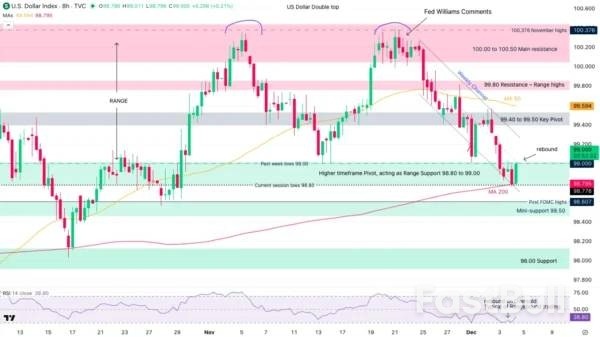
          The catalyst for the current downside came from NY Fed President John Williams' speech on November 21, which fundamentally shook markets by reintroducing rate cut hopes.

          His dovish comments took the 25 basis point cut pricing from 20% all the way to the current stable 87%. This rapid repricing triggered a swift selloff in the Dollar over the past two weeks of trading.

          Dollar Index (DXY) 8H Chart. December 4, 2025– Source: TradingView

          But, as mentioned in our recent in-depth analysis of the Greenback, the Dollar Index is still maintaining a broad range on the bigger picture, having tested its 200-period Moving Average (and range lows) and currently bouncing above 99.00.

          The range highs on the Dollar Index is located at the 100.00 level.

          Today, we will look at three key FX Majors and their intraday timeframes to see how the range in the Dollar Index affects their own currency pairs: EUR/USD, USD/CHF, and USD/CAD.

          EUR/USD 8H Chart and Technical Levels

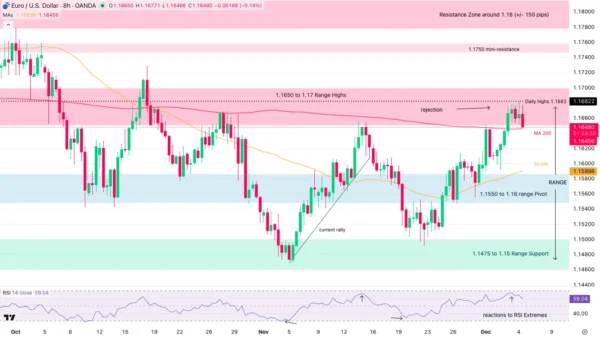
          EUR/USD 8H Chart. December 4, 2025– Source: TradingView

          As mentioned in our November 25 post (On the US Dollar rejecting its range highs), EUR/USD is maintaining a wide Range between 1.15 to 1.17.

          As often, the range gets confirmed with:

          · Rejection of price after reaching overbought/oversold levels in the RSI
          · Flatlining Moving Averages, particularly the MA 200

          Currently rejecting its highs, the current setup is one of a sell with a potential stop at range extremes (Above 1.17).

          Sellers are currently pushing below the 200-period Moving Average (1.16455), the rejection confirms with a 1H Close below.

          Levels of interest for EUR/USD Trading

          Resistance levels

          · 1.1630 to 1.1670 Pivot zone (range Highs)
          · 1.1750 mini-resistance
          · Resistance Zone around 1.18 (+/- 150 pips)
          · Sep 2021 Highs – Resistance 1.19 to 1.1950 Zone
          · Weekly highs 1.1656

          Support levels

          · 1.1470 to 1.15 range support
          · 4H MA 200 Mini-support 1.16190
          · 1.1475 to 1.15 Support Zone
          · 1.1350 to 1.14 Support
          · Session lows 1.14966

          USD/CAD 8H Chart and Technical Levels

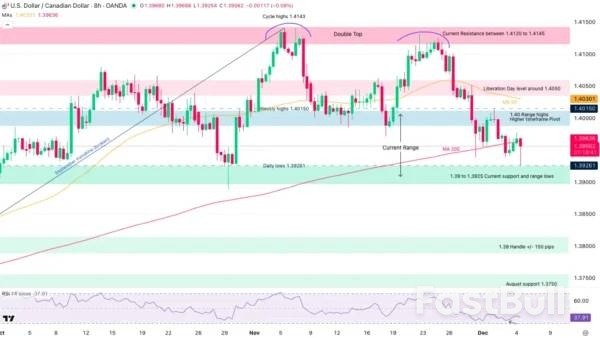
          USD/CAD 8H Chart. December 4, 2025– Source: TradingView

          The rangebound characteristics of USD/CAD are less obvious, but taking a step back, the North American pair has stopped trending since reaching its November and cycle highs.

          Holding firmly between 1.39 and 1.40, the currency pair has been seesawing within the 1,000 pip range since the final days of November.

          With traders not knowing what to do with the US-Canada deal (it seems like the Canadian government also doesn't know), rangebound conditions also make fundamental sense.

          In the case of a break, watch for a daily close above or below to avoid getting trapped.

          Note to traders that news on a trade-deal might move things in a flash.

          Levels of interest for USD/CAD Trading

          Resistance Levels

          · 1.40 Major Pivot acting as resistance
          · Cycle highs 1.4143 and Double top
          · Resistance between 1.4120 to 1.4145
          · Key resistance 1.4250

          Support Levels

          · 1.39 to 1.3925 Higher timeframe pivot, current support
          · 1.38 Major support +/- 150 pips
          · August range support 1.3750
          · 1.3550 Main 2025 Support

          USD/CHF 8H Chart and Technical Levels

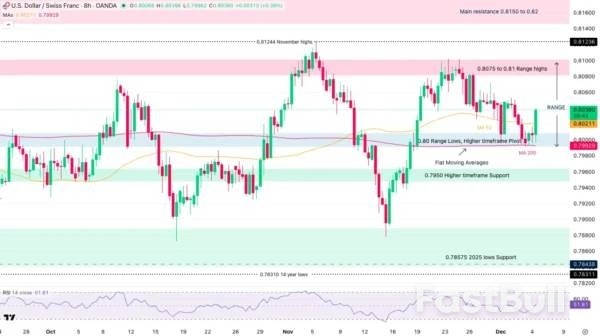
          USD/CHF 8H Chart. December 4, 2025– Source: TradingView

          USD/CHF is also stuck within two ranges – A large half-year range between 0.7850 to 0.8140 and another, smaller one but more active: 0.80 to 0.81

          We will focus on the smaller timeframe consolidation, also 1,000 pip large.

          Buyers are stepping in from the 0.80 Zone after bouncing on the 200-period Moving Average (1.79930).

          The current candle is strong, with the ongoing rebound in the USD.

          Check out reactions at the highs of the range.

          Levels of interest for USD/CHF Trading

          Resistance levels

          · 0.8075 to 0.81 Range highs
          · 0.81244 November highs
          · Main resistance 0.8150 to 0.82
          · 0.82144 June Highs

          Support levels

          · 0.80 Range Lows, Higher timeframe Pivot
          · 0.7950 Higher timeframe Support
          · 0.78575 2025 lows support

          Source: MarketPulse by OANDA Group

          Risk Warnings and Disclaimers
          You understand and acknowledge that there is a high degree of risk involved in trading. Following any strategies or investment methods may lead to potential losses. The content on the site is provided by our contributors and analysts for information purposes only. You are solely responsible for determining whether any trading assets, securities, strategy, or any other product is suitable for investing based on your own investment objectives and financial situation.
          Add to Favorites
          Share

          Putin’s India Visit Aims to Deepen Strategic Ties as Trade Balancing Act Intensifies

          Gerik

          Economic

          Summit Signals Resilience in Russia–India Strategic Partnership

          Russian President Vladimir Putin arrived in New Delhi for a high-level summit with Indian Prime Minister Narendra Modi, marking his first visit to India in four years. The visit underscores Moscow’s efforts to reinforce its strategic relationship with New Delhi as Western sanctions, particularly from the U.S. and Europe, continue to limit Russia’s global trade options.
          At the heart of this visit is a concerted push to increase bilateral trade, which Russia hopes to elevate to $100 billion by 2030. Currently, the trade balance heavily favors Moscow due to India’s large-scale imports of discounted Russian crude oil since the onset of the Ukraine conflict. In response, Russia is now seeking to import more Indian goods in an effort to rebalance the trade flow.
          The bilateral summit reflects a causal strategy: Russia’s energy isolation in the West has elevated India’s role as a critical buyer, while India is leveraging this position to strengthen defense partnerships and push for favorable terms in its own trade negotiations.

          Navigating the U.S.–Russia Tightrope

          India’s position is increasingly complex. While Washington remains a key strategic and economic partner, recent tensions have emerged over India’s energy trade with Russia. The Trump administration re-imposed punitive tariffs on Indian goods earlier this year in response to India’s growing imports of Russian oil, complicating New Delhi’s desire to maintain balanced relations with both major powers.
          As noted by Michael Kugelman of the Atlantic Council, India faces a diplomatic “conundrum”: deepening its engagement with either Moscow or Washington risks straining ties with the other. This is not merely a correlation of tensions it reflects a causal dilemma driven by overlapping geopolitical and economic priorities.
          Modi’s warm personal reception of Putin, including a red carpet welcome and private dinner at his residence, signals India’s intent to maintain its long-standing strategic ties with Russia, even while continuing trade negotiations with the U.S.

          Defense and Civil Nuclear Cooperation Take Center Stage

          Defense remains a cornerstone of the Russia–India partnership. Russia has long been India’s largest arms supplier, and this visit featured renewed discussions on defense industrial collaboration. Russian Defence Minister Andrei Belousov met with Indian counterpart Rajnath Singh, offering support for India’s self-reliance goals in domestic weapons production.
          This is a strategic alignment that serves both nations: Russia seeks stable defense export markets amid sanctions, while India is accelerating its “Make in India” agenda for defense modernization. The result is a mutually reinforcing relationship with high stakes in security and industrial development.
          Additionally, civil nuclear energy and labor agreements are reportedly on the agenda, with announcements of new deals expected, highlighting the multifaceted nature of the partnership.

          Geopolitics: India’s Diplomatic Neutrality and Strategic Hedging

          Putin’s visit follows inconclusive discussions with U.S. envoys over the Ukraine conflict. India has maintained a policy of neutrality, refusing to directly condemn Russia’s invasion while advocating for peace through diplomacy. This stance reflects India’s geopolitical strategy of “multi-alignment,” aiming to preserve flexibility and autonomy in a polarized international environment.
          India has criticized Western double standards, noting that some countries continue economic engagements with Moscow when it suits their interests, even while pressuring others to cut ties. This critique strengthens India’s justification for sustaining its Russia relationship.

          Strategic Diversification or Strategic Tightrope?

          Putin’s summit with Modi is more than a ceremonial visit it is a reaffirmation of strategic intent between two nations facing distinct but overlapping pressures. Russia seeks to circumvent isolation by expanding ties with cooperative partners, while India walks a tightrope between great powers to preserve its autonomy.
          Whether India can continue to balance these relationships without diplomatic fallout remains an open question. What is clear, however, is that the India–Russia axis remains resilient, adaptive, and central to the evolving power dynamics of Eurasia in a sanctions-era world.

          Source: Reuters

          To stay updated on all economic events of today, please check out our Economic calendar
          Risk Warnings and Disclaimers
          You understand and acknowledge that there is a high degree of risk involved in trading. Following any strategies or investment methods may lead to potential losses. The content on the site is provided by our contributors and analysts for information purposes only. You are solely responsible for determining whether any trading assets, securities, strategy, or any other product is suitable for investing based on your own investment objectives and financial situation.
          Add to Favorites
          Share

          Cliff Notes: The State Of The Nnation

          Westpac

          Forex

          Economic

          In Australia, Q3 GDP fell short of expectations, rising just 0.4% (2.1%yr). However, much of the disappointment was tied to a run-down of inventories, masking a much stronger showing for domestic demand, up 1.2% (2.6%yr). The public sector added to growth via consumption and investment, although the scale of support offered through both channels is easing as cost-of-living relief measures wind up and existing infrastructure projects progress.

          New business investment was in the spotlight in the private sector, surging 3.4% (3.8%yr). Data centres and aircraft were key drivers, but there are some early hints of a broadening in the investment pulse across both consumer and business-facing sub-sectors. This trend has positive implications for supply capacity and productivity which are explored in more detail by Chief Economist Luci Ellis in this week's essay.

          Consumer spending was also a key contributor, lifting 0.5% (2.5%yr), spot on our expectation. This was mostly driven by spending on essentials, including electricity and superannuation fees – the latter owing to Q3's superannuation guarantee increase. Although discretionary spending was a touch softer, both our internal data and recent ABS data point to a pick-up in this category into year end. Going forward, one of the key risks is the fading of the tailwinds associated with easing inflation, interest rate reductions and tax cuts for disposable incomes and spending.

          The boost to wealth from rising house prices is also important to keep in mind, the Cotality index surging another 1.0% (7.1%yr) in November. Recent gains have been driven by lower cost tiers of the market, suggesting affordability remains a constraint but that households continue to adjust expectations to transact. Dwelling approvals have largely moved sideways this year, but the pipeline remains robust and should go some way to alleviating tight supply in coming years. For our in-depth view of the housing market, see the latest Housing Pulse.

          Before moving offshore, a final note on trade. Partial data released earlier this week showed the current account balance widened slightly in Q3, from –$16.2bn to –$16.6bn, chiefly driven by a larger trade surplus, a trend that looks to have persisted in the goods balance into October. In real terms, the external sector subtracted 0.1ppts from GDP in Q3. This speaks to the longer-run structural headwinds for 'traditional' commodity export channels; however, that does not preclude burgeoning areas of opportunity gaining scale – services exports of software licensing being an example.

          In the US, the ISM Services PMI rose 0.2pts to 52.6pts in November, although that still leaves all sub-components excluding prices well below their ten-year pre-COVID average. There were notable increases in the backlog of orders (+8.3pts), imports (+5.2pts), inventories (+3.9pts) and supplier deliveries (+3.3pts), while new orders (-3.3pts) and prices (-4.6pts) both exhibited falls. The sizeable fall in the prices component primarily reflected declines in gasoline prices. The manufacturing PMI meanwhile declined 0.5pts to 48.2pts, reflecting falls in new orders (-2pts), employment (-2pts), supplier deliveries (-4.9pts) and the order backlog (-3.9pts). The prices component increased by 0.5pts to 58.5pts but remains well off its highs. All told, both surveys point to sub-par momentum, but not aggregate contraction.

          In Europe meanwhile, the flash estimate for November indicated prices fell 0.3% in the month, reflecting falling energy costs. In annual terms, inflation accelerated to 2.2%, backed by a 3.5% gain in services prices. Looking ahead, there are some downside risks to the headline component following a decline in wholesale gas prices. In a speech this week, ECB President Lagarde noted that underlying inflation pressures are consistent with achieving the inflation target, but that risks to the outlook remain two-sided.

          Source: Westpac Banking Corporation

          To stay updated on all economic events of today, please check out our Economic calendar
          Risk Warnings and Disclaimers
          You understand and acknowledge that there is a high degree of risk involved in trading. Following any strategies or investment methods may lead to potential losses. The content on the site is provided by our contributors and analysts for information purposes only. You are solely responsible for determining whether any trading assets, securities, strategy, or any other product is suitable for investing based on your own investment objectives and financial situation.
          Add to Favorites
          Share

          China’s Exports Rebound in November as US Tariff Truce Offers Short-Term Relief

          Gerik

          Economic

          Temporary Truce Drives Short-Term Export Rebound

          China’s exports likely returned to positive growth in November, following a 1.1% contraction in October the worst since February. According to a Reuters poll of 20 economists, outbound shipments are expected to have grown 3.8% year-on-year, driven by a temporary reprieve in US-China trade tensions.
          In late October, Presidents Donald Trump and Xi Jinping agreed to scale back tariffs and suspend further punitive measures. This detente prompted Chinese manufacturers to accelerate shipments, taking advantage of the window before trade conditions could shift again. The surge in activity reflects a causal relationship: reduced tariff threats directly stimulated export flows, at least temporarily.

          Import Growth Remains Modest as Domestic Demand Lags

          Imports were forecast to rise 2.8% year-on-year in November, a modest increase from the 1.0% growth in October. However, this uptick remains subdued in the context of a persistent domestic economic drag largely driven by China’s protracted property sector downturn, which continues to erode consumer and business confidence.
          This illustrates a divergent dynamic: while external demand (especially via the US truce) offered a short-term export lift, internal demand remains structurally weakened. The rebound in imports thus appears more correlational than causally tied to a broader economic recovery.

          Manufacturing Weakness Undermines Export Momentum

          Despite the expected export rebound, China’s underlying industrial health remains fragile. Official data for November show factory activity contracted for the eighth consecutive month. Both new orders and export orders declined, indicating that manufacturers are struggling to sustain momentum beyond the short-term trade boost.
          These indicators highlight a deeper issue: access to global markets remains volatile, and trade diversification efforts into Europe, Latin America, and Africa have so far failed to fully compensate for diminished US demand. Economists estimate that limited US market access has shaved approximately 2 percentage points off China’s export growth equivalent to about 0.3% of national GDP.
          This decline is a direct consequence of enduring tariff pressures. Despite the October truce, the majority of US tariffs remain in place averaging around 50% on $400+ billion worth of Chinese exports. The truce merely paused further escalation, not reversed existing trade barriers.

          Beijing’s Strategic Focus: Domestic Demand and Self-Reliance

          Looking ahead, China is expected to maintain its GDP growth target of around 5% for 2026. Policymakers are preparing to launch a new five-year plan aimed at boosting domestic consumption and accelerating technological self-reliance an acknowledgment that global trade volatility is now a structural reality.
          This policy direction indicates a causal shift in China’s economic strategy: instead of overrelying on export-led growth, Beijing is positioning its economy to reduce vulnerability to foreign trade disruptions. However, executing this pivot amid a sluggish property market and fading consumer sentiment will require sustained fiscal and monetary support.

          Trade Surplus Grows, But Below Historical Average

          China’s trade surplus is projected to rise to $100.15 billion in November, up from $90.07 billion in October, but still below the monthly average of $110.7 billion in 2025. While the surplus expansion reflects the rebound in exports, the shortfall from the year’s average highlights lingering demand weakness from global partners.
          The data suggests that while tactical gains from the US tariff truce offer temporary relief, they are insufficient to lift China’s trade performance back to pre-2023 strength.

          Truce Offers Breathing Room, Not Resolution

          China’s November export growth is a welcome reprieve from October’s decline, reflecting agile manufacturing responses to temporary tariff relief. However, the rebound is likely short-lived. Core structural issues including weak global demand, persistent US tariffs, and contracting factory activity continue to constrain sustainable trade growth.
          Without a long-term resolution to trade tensions or a significant recovery in domestic demand, China's external sector will remain volatile. The November data is better interpreted as a tactical rebound rather than a turning point. Beijing’s future success will depend on its ability to recalibrate economic growth drivers toward internal resilience and diversified export strategies.

          Source: Reuters

          To stay updated on all economic events of today, please check out our Economic calendar
          Risk Warnings and Disclaimers
          You understand and acknowledge that there is a high degree of risk involved in trading. Following any strategies or investment methods may lead to potential losses. The content on the site is provided by our contributors and analysts for information purposes only. You are solely responsible for determining whether any trading assets, securities, strategy, or any other product is suitable for investing based on your own investment objectives and financial situation.
          Add to Favorites
          Share

          Building A Weapons Industry In Russia’s Shadow

          Winkelmann

          Political

          Russia-Ukraine Conflict

          After Russia launched its full-scale invasion of Ukraine almost four years ago, neighboring Estonia quickly ramped up defense spending. Next year, it's expected to be the highest in the European Union relative to the size of its economy, at over 5% of gross domestic product. But the Baltic state doesn't just stand out for its procurement of military equipment, it's also making its mark when it comes to manufacturing.

          The war prompted Estonia to build up a defense industry that was pretty much non-existent. Companies weren't allowed to manufacture weapons until 2018. Now, the country of 1.3 million people is nurturing a growing ecosystem of local defense startups, as my colleague Ott Tammik reports. With governments across Europe beefing up their military budgets, the hope is that Estonian companies will start to attract foreign customers.

          The sector has grown quickly. There are almost 200 companies in the Estonian Defence and Aerospace Industry Association, including drone maker Threod and unmanned vehicle producer Milrem. Some were founded by Ukrainians or use the war to test out products. The government in Tallinn said early this year it would set aside €100 million to start one of Europe's first funds explicitly focused on investing in weapons.

          Estonia's tiny size and the fact that it's so new to the industry, however, pose challenges. European governments typically purchase weapons from US manufacturers or their own domestic defense giants. Despite broad public support for bulking up Estonia's military, some of the efforts have also run into red tape and community resistance. The concern is that legal and bureaucratic obstacles to arms production could slow things down at a critical moment.

          But the numbers are stacking up. Sales by Estonian defense companies doubled between 2022 and 2024 to €500 million ($582 million), the most recent data available. The government spent a similar sum on investment in the industry last year. And when it comes to demand for weapons and equipment, the trajectory is definitely upward.

          Poland: OpenAI agreed to buy Neptune, a Warsaw-based startup that makes tools for analyzing different versions of artificial intelligence models. The ChatGPT developer has been using Neptune's products for more than a year and now plans to keep them exclusively for its own use.

          Bulgaria: Tens of thousands of people protested against the government's tax and spending plans in the biggest show of dissent for more than a decade. After a group clashed with police, the minority administration withdrew its budget to revise it. Prime Minister Rosen Zhelyazkov refused to resign, saying the Balkan country needs stable leadership as it prepares to join the euro on Jan. 1. A no-confidence vote may take place next week.

          Ukraine: The EU proposed two options to cover Ukraine's financial needs, suggesting either a loan backed by frozen Russian assets or one backed by the bloc's own budget. Meanwhile, Vladimir Putin held "very useful" talks with US envoys, though they failed to reach agreement on a plan to end his war.

          Hungary: Prime Minister Viktor Orban said he's ready to throw a financial lifeline to Budapest, where the opposition leadership blames the government's tax policies for pushing the capital city to the brink of insolvency.

          Poland: The country should prioritize cheaper onshore wind energy over offshore projects to stay competitive in the global economy, according to the head of the power grid operator.

          As we head deeper into winter, people might be thinking of where to go skiing. Appetite to hit the slopes has been great for Polish ski-lift operator PKL. Now the state-controlled company is looking at going public, with an IPO possibly in the first quarter of next year, people familiar with the plans said.

          As the US pushed to impose its peace plan on Ukraine, Europe was getting a glimpse of what NATO's eastern frontier might look like should the Americans disengage. The lush, mountainous region of Transylvania in Romania showcased how the continent might be defended with less US involvement should Russian troops cross into NATO territory. The brigade of soldiers participating in the exercise was all from Europe and commanded by the French. Indeed, NATO's deterrence on its eastern flank needs to be increased, not decreased, Romania's foreign minister told Bloomberg in an interview.

          Source: Bloomberg Europe

          Risk Warnings and Disclaimers
          You understand and acknowledge that there is a high degree of risk involved in trading. Following any strategies or investment methods may lead to potential losses. The content on the site is provided by our contributors and analysts for information purposes only. You are solely responsible for determining whether any trading assets, securities, strategy, or any other product is suitable for investing based on your own investment objectives and financial situation.
          Add to Favorites
          Share
          FastBull
          Copyright © 2025 FastBull Ltd

          728 RM B 7/F GEE LOK IND BLDG NO 34 HUNG TO RD KWUN TONG KLN HONG KONG

          TelegramInstagramTwitterfacebooklinkedin
          App Store Google Play Google Play
          Products
          Charts

          Chats

          Q&A with Experts
          Screeners
          Economic Calendar
          Data
          Tools
          Membership
          Features
          Function
          Markets
          Copy Trading
          Latest Signals
          Contests
          News
          Analysis
          24/7
          Columns
          Education
          Company
          Careers
          About Us
          Contact Us
          Advertising
          Help Center
          Feedback
          User Agreement
          Privacy Policy
          Business

          White Label

          Data API

          Web Plug-ins

          Poster Maker

          Affiliate Program

          Risk Disclosure

          The risk of loss in trading financial instruments such as stocks, FX, commodities, futures, bonds, ETFs and crypto can be substantial. You may sustain a total loss of the funds that you deposit with your broker. Therefore, you should carefully consider whether such trading is suitable for you in light of your circumstances and financial resources.

          No decision to invest should be made without thoroughly conducting due diligence by yourself or consulting with your financial advisors. Our web content might not suit you since we don't know your financial conditions and investment needs. Our financial information might have latency or contain inaccuracy, so you should be fully responsible for any of your trading and investment decisions. The company will not be responsible for your capital loss.

          Without getting permission from the website, you are not allowed to copy the website's graphics, texts, or trademarks. Intellectual property rights in the content or data incorporated into this website belong to its providers and exchange merchants.

          Not Logged In

          Log in to access more features

          FastBull Membership

          Not yet

          Purchase

          Become a signal provider
          Help Center
          Customer Service
          Dark Mode
          Price Up/Down Colors

          Log In

          Sign Up

          Position
          Layout
          Fullscreen
          Default to Chart
          The chart page opens by default when you visit fastbull.com