• Trade
  • Markets
  • Copy
  • Contests
  • News
  • 24/7
  • Calendar
  • Q&A
  • Chats
Trending
Screeners
SYMBOL
LAST
BID
ASK
HIGH
LOW
NET CHG.
%CHG.
SPREAD
SPX
S&P 500 Index
6827.42
6827.42
6827.42
6899.86
6801.80
-73.58
-1.07%
--
DJI
Dow Jones Industrial Average
48458.04
48458.04
48458.04
48886.86
48334.10
-245.98
-0.51%
--
IXIC
NASDAQ Composite Index
23195.16
23195.16
23195.16
23554.89
23094.51
-398.69
-1.69%
--
USDX
US Dollar Index
97.950
98.030
97.950
98.500
97.950
-0.370
-0.38%
--
EURUSD
Euro / US Dollar
1.17394
1.17409
1.17394
1.17496
1.17192
+0.00011
+ 0.01%
--
GBPUSD
Pound Sterling / US Dollar
1.33707
1.33732
1.33707
1.33997
1.33419
-0.00148
-0.11%
--
XAUUSD
Gold / US Dollar
4299.39
4299.39
4299.39
4353.41
4257.10
+20.10
+ 0.47%
--
WTI
Light Sweet Crude Oil
57.233
57.485
57.233
58.011
56.969
-0.408
-0.71%
--

Community Accounts

Signal Accounts
--
Profit Accounts
--
Loss Accounts
--
View More

Become a signal provider

Sell trading signals to earn additional income

View More

Guide to Copy Trading

Get started with ease and confidence

View More

Signal Accounts for Members

All Signal Accounts

Best Return
  • Best Return
  • Best P/L
  • Best MDD
Past 1W
  • Past 1W
  • Past 1M
  • Past 1Y

All Contests

  • All
  • Trump Updates
  • Recommend
  • Stocks
  • Cryptocurrencies
  • Central Banks
  • Featured News
Top News Only
Share

Pentagon Says Two USA Army Soldiers And One Civilian USA Interpreter Were Killed, And Three Were Wounded In Syria

Share

Israel Says It Kills Senior Hamas Commander Raed Saed In Gaza

Share

Ukraine's Navy Says Russian Drone Attack Hit Civilian Turkish Vessel Carrying Sunflower Oil To Egypt On Saturday

Share

Israeli Military Says It Put Planned Strike On South Lebanon Site On Hold After Lebanese Army Requested Access

Share

Norwegian Nobel Committee: Calls On The Belarusian Authorities To Release All Political Prisoners

Share

Norwegian Nobel Committee: His Freedom Is A Deeply Welcome And Long-Awaited Moment

Share

Ukraine Says It Received 114 Prisoners From Belarus

Share

USA Embassy In Lithuania: Maria Kalesnikava Is Not Going To Vilnius

Share

USA Embassy In Lithuania: Other Prisoners Are Being Sent From Belarus To Ukraine

Share

Ukraine President Zelenskiy: Five Ukrainians Released By Belarus In US-Brokered Deal

Share

USA Vilnius Embassy: USA Stands Ready For "Additional Engagement With Belarus That Advances USA Interests"

Share

USA Vilnius Embassy: Belarus, USA, Other Citizens Among The Prisoners Released Into Lithuania

Share

USA Vilnius Embassy: USA Will Continue Diplomatic Efforts To Free The Remaining Political Prisoners In Belarus

Share

USA Vilnius Embassy: Belarus Releases 123 Prisoners Following Meeting Of President Trump's Envoy Coale And Belarus President Lukashenko

Share

USA Vilnius Embassy: Masatoshi Nakanishi, Aliaksandr Syrytsa Are Among The Prisoners Released By Belarus

Share

USA Vilnius Embassy: Maria Kalesnikava And Viktor Babaryka Are Among The Prisoners Released By Belarus

Share

USA Vilnius Embassy: Nobel Peace Prize Laureate Ales Bialiatski Is Among The Prisoners Released By Belarus

Share

Belarusian Presidential Administration Telegram Channel: Lukashenko Has Pardoned 123 Prisoners As Part Of Deal With US

Share

Two Local Syrian Officials: Joint US-Syrian Military Patrol In Central Syria Came Under Fire From Unknown Assailants

Share

Israeli Military Says It Targeted 'Key Hamas Terrorist' In Gaza City

TIME
ACT
FCST
PREV
U.K. Trade Balance Non-EU (SA) (Oct)

A:--

F: --

P: --

U.K. Trade Balance (Oct)

A:--

F: --

P: --

U.K. Services Index MoM

A:--

F: --

P: --

U.K. Construction Output MoM (SA) (Oct)

A:--

F: --

P: --

U.K. Industrial Output YoY (Oct)

A:--

F: --

P: --

U.K. Trade Balance (SA) (Oct)

A:--

F: --

P: --

U.K. Trade Balance EU (SA) (Oct)

A:--

F: --

P: --

U.K. Manufacturing Output YoY (Oct)

A:--

F: --

P: --

U.K. GDP MoM (Oct)

A:--

F: --

P: --

U.K. GDP YoY (SA) (Oct)

A:--

F: --

P: --

U.K. Industrial Output MoM (Oct)

A:--

F: --

P: --

U.K. Construction Output YoY (Oct)

A:--

F: --

P: --

France HICP Final MoM (Nov)

A:--

F: --

P: --

China, Mainland Outstanding Loans Growth YoY (Nov)

A:--

F: --

P: --

China, Mainland M2 Money Supply YoY (Nov)

A:--

F: --

P: --

China, Mainland M0 Money Supply YoY (Nov)

A:--

F: --

P: --

China, Mainland M1 Money Supply YoY (Nov)

A:--

F: --

P: --

India CPI YoY (Nov)

A:--

F: --

P: --

India Deposit Gowth YoY

A:--

F: --

P: --

Brazil Services Growth YoY (Oct)

A:--

F: --

P: --

Mexico Industrial Output YoY (Oct)

A:--

F: --

P: --

Russia Trade Balance (Oct)

A:--

F: --

P: --

Philadelphia Fed President Henry Paulson delivers a speech
Canada Building Permits MoM (SA) (Oct)

A:--

F: --

P: --

Canada Wholesale Sales YoY (Oct)

A:--

F: --

P: --

Canada Wholesale Inventory MoM (Oct)

A:--

F: --

P: --

Canada Wholesale Inventory YoY (Oct)

A:--

F: --

P: --

Canada Wholesale Sales MoM (SA) (Oct)

A:--

F: --

P: --

Germany Current Account (Not SA) (Oct)

A:--

F: --

P: --

U.S. Weekly Total Rig Count

A:--

F: --

P: --

U.S. Weekly Total Oil Rig Count

A:--

F: --

P: --

Japan Tankan Large Non-Manufacturing Diffusion Index (Q4)

--

F: --

P: --

Japan Tankan Small Manufacturing Outlook Index (Q4)

--

F: --

P: --

Japan Tankan Large Non-Manufacturing Outlook Index (Q4)

--

F: --

P: --

Japan Tankan Large Manufacturing Outlook Index (Q4)

--

F: --

P: --

Japan Tankan Small Manufacturing Diffusion Index (Q4)

--

F: --

P: --

Japan Tankan Large Manufacturing Diffusion Index (Q4)

--

F: --

P: --

Japan Tankan Large-Enterprise Capital Expenditure YoY (Q4)

--

F: --

P: --

U.K. Rightmove House Price Index YoY (Dec)

--

F: --

P: --

China, Mainland Industrial Output YoY (YTD) (Nov)

--

F: --

P: --

China, Mainland Urban Area Unemployment Rate (Nov)

--

F: --

P: --

Saudi Arabia CPI YoY (Nov)

--

F: --

P: --

Euro Zone Industrial Output YoY (Oct)

--

F: --

P: --

Euro Zone Industrial Output MoM (Oct)

--

F: --

P: --

Canada Existing Home Sales MoM (Nov)

--

F: --

P: --

Euro Zone Total Reserve Assets (Nov)

--

F: --

P: --

U.K. Inflation Rate Expectations

--

F: --

P: --

Canada National Economic Confidence Index

--

F: --

P: --

Canada New Housing Starts (Nov)

--

F: --

P: --

U.S. NY Fed Manufacturing Employment Index (Dec)

--

F: --

P: --

U.S. NY Fed Manufacturing Index (Dec)

--

F: --

P: --

Canada Core CPI YoY (Nov)

--

F: --

P: --

Canada Manufacturing Unfilled Orders MoM (Oct)

--

F: --

P: --

Canada Manufacturing New Orders MoM (Oct)

--

F: --

P: --

Canada Core CPI MoM (Nov)

--

F: --

P: --

Canada Manufacturing Inventory MoM (Oct)

--

F: --

P: --

Canada CPI YoY (Nov)

--

F: --

P: --

Canada CPI MoM (Nov)

--

F: --

P: --

Canada CPI YoY (SA) (Nov)

--

F: --

P: --

Canada Core CPI MoM (SA) (Nov)

--

F: --

P: --

Q&A with Experts
    • All
    • Chatrooms
    • Groups
    • Friends
    Connecting
    .
    .
    .
    Type here...
    Add Symbol or Code

      No matching data

      All
      Trump Updates
      Recommend
      Stocks
      Cryptocurrencies
      Central Banks
      Featured News
      • All
      • Russia-Ukraine Conflict
      • Middle East Flashpoint
      • All
      • Russia-Ukraine Conflict
      • Middle East Flashpoint
      Search
      Products

      Charts Free Forever

      Chats Q&A with Experts
      Screeners Economic Calendar Data Tools
      Membership Features
      Data Warehouse Market Trends Institutional Data Policy Rates Macro

      Market Trends

      Market Sentiment Order Book Forex Correlations

      Top Indicators

      Charts Free Forever
      Markets

      News

      News Analysis 24/7 Columns Education
      From Institutions From Analysts
      Topics Columnists

      Latest Views

      Latest Views

      Trending Topics

      Top Columnists

      Latest Update

      Signals

      Copy Rankings Latest Signals Become a signal provider AI Rating
      Contests
      Brokers

      Overview Brokers Assessment Rankings Regulators News Claims
      Broker listing Forex Brokers Comparison Tool Live Spread Comparison Scam
      Q&A Complaint Scam Alert Videos Tips to Detect Scam
      More

      Business
      Events
      Careers About Us Advertising Help Center

      White Label

      Data API

      Web Plug-ins

      Affiliate Program

      Awards Institution Evaluation IB Seminar Salon Event Exhibition
      Vietnam Thailand Singapore Dubai
      Fans Party Investment Sharing Session
      FastBull Summit BrokersView Expo
      Recent Searches
        Top Searches
          Markets
          News
          Analysis
          User
          24/7
          Economic Calendar
          Education
          Data
          • Names
          • Latest
          • Prev

          View All

          No data

          Scan to Download

          Faster Charts, Chat Faster!

          Download App
          English
          • English
          • Español
          • العربية
          • Bahasa Indonesia
          • Bahasa Melayu
          • Tiếng Việt
          • ภาษาไทย
          • Français
          • Italiano
          • Türkçe
          • Русский язык
          • 简中
          • 繁中
          Open Account
          Search
          Products
          Charts Free Forever
          Markets
          News
          Signals

          Copy Rankings Latest Signals Become a signal provider AI Rating
          Contests
          Brokers

          Overview Brokers Assessment Rankings Regulators News Claims
          Broker listing Forex Brokers Comparison Tool Live Spread Comparison Scam
          Q&A Complaint Scam Alert Videos Tips to Detect Scam
          More

          Business
          Events
          Careers About Us Advertising Help Center

          White Label

          Data API

          Web Plug-ins

          Affiliate Program

          Awards Institution Evaluation IB Seminar Salon Event Exhibition
          Vietnam Thailand Singapore Dubai
          Fans Party Investment Sharing Session
          FastBull Summit BrokersView Expo

          Japan Flags Rising Concerns Over U.S. Tariff Risks Amid Fragile Recovery

          Gerik

          Economic

          Summary:

          Japan’s June economic report underscores growing caution over the potential impact of upcoming U.S. tariffs on corporate earnings and consumer sentiment...

          Cautious Optimism Meets Trade Anxiety

          Despite maintaining its assessment that Japan’s economy is “recovering moderately,” the Cabinet Office’s June report reveals a more nuanced outlook. The warning comes as Japan braces for a 24% U.S. import tariff set to take effect in July, alongside a looming 25% duty specifically targeting vehicle exports. These measures threaten to derail the momentum of corporate profits and consumer demand, especially as Japan is still absorbing the effects of earlier inflationary pressures.
          GDP contracted at an annualized rate of 0.2% in Q1 2025—before the latest U.S. tariff announcements—suggesting underlying vulnerabilities. The government's unchanged language over the past three months now feels more fragile in light of pending trade barriers and their delayed, yet potentially severe, impact on earnings and sentiment.

          Delayed Impact Likely to Show in Q2 and Beyond

          Officials acknowledged that while export volumes haven’t yet shown a marked decline due to tariffs, the full financial impact is likely to emerge in second-quarter data or later. Some firms have reportedly withheld earnings forecasts, reflecting deep uncertainty surrounding trade policy. This behavior suggests that corporate caution, rather than visible losses, may be the first manifestation of tariff effects.
          The uncertainty also comes at a time when household consumption is under strain from continued price increases, which the report cites as a secondary but compounding threat to growth. If price pressures persist without real wage gains, consumer spending—one of the pillars of Japan’s fragile recovery—could stall further.

          Mixed Signals from the Labour Market

          On the surface, wage growth offers a bright spot. The spring labor negotiations yielded an average increase above 5%, which is a significant uptick from last year and aligns with government efforts to stimulate domestic demand. However, the Cabinet Office noted disparities in wage outcomes, with small and medium-sized enterprises (SMEs) lagging behind their larger counterparts. This uneven wage growth could limit its broader economic multiplier effect, particularly in regions or industries dominated by smaller firms.
          Prime Minister Shigeru Ishiba’s recent campaign pledge—to increase Japan’s average income by more than 50% by 2040—appears designed to reassure voters ahead of upper house elections. Yet, the feasibility of this target depends heavily on whether Japan can navigate current headwinds, including protectionism abroad and domestic structural constraints.
          Negotiations with Washington are ongoing, but Japan’s ability to secure exemptions for its auto sector remains uncertain. In the absence of diplomatic breakthroughs, Japanese firms could face higher costs, squeezed margins, and potential offshoring considerations—all of which would weaken the current recovery trajectory.
          The June economic report does not revise Japan’s core economic assessment but subtly shifts tone by emphasizing trade uncertainty and delayed earnings risk. With export-oriented sectors exposed and consumer sentiment under pressure from inflation, Japan’s near-term outlook hinges on the outcome of trade negotiations and the pace of wage-driven domestic consumption. The real test, as the Cabinet Office notes, will begin in the April–June data cycle.

          Source: Reuters

          To stay updated on all economic events of today, please check out our Economic calendar
          Risk Warnings and Disclaimers
          You understand and acknowledge that there is a high degree of risk involved in trading. Following any strategies or investment methods may lead to potential losses. The content on the site is provided by our contributors and analysts for information purposes only. You are solely responsible for determining whether any trading assets, securities, strategy, or any other product is suitable for investing based on your own investment objectives and financial situation.
          Add to Favorites
          Share

          Trump vs. Musk: A Fractured Alliance Signals Silicon Valley’s Shaky Ties with the White House

          Gerik

          Economic

          Political

          Shifting Tides: From Inaugural Invitations to Public Feuds

          Elon Musk’s inclusion at President Trump’s second-term inauguration, alongside figures like Zuckerberg, Bezos, Pichai, and Cook, once symbolized a strategic alliance between the tech elite and the Oval Office. But five months into Trump’s renewed presidency, nearly every one of these executives has faced legal challenges, political pressure, or tariff threats—reflecting a sharply adversarial stance despite earlier cooperation.
          The Musk-Trump split, which escalated publicly through hostile social media exchanges, has crystallized this broader unraveling. Their fallout was dramatic, yet emblematic of the deeper fault lines between Silicon Valley's power brokers and a populist administration that sees unchecked tech influence as a political liability.

          Continued Legal Pressure Despite Political Realignments

          Contrary to expectations that Trump’s administration might scale back antitrust efforts launched under Biden, it has instead doubled down. Meta’s ongoing antitrust trial has been greenlit; Apple faces renewed tariff threats and litigation over its market practices; Amazon is under FTC scrutiny; and Google remains entangled in a DOJ-led breakup effort. Even Trump’s own Justice Department has advanced investigations initially launched by Democratic regulators.
          The continuation of these legal battles—despite a more business-friendly regulatory narrative—reflects bipartisan consensus in Washington that Big Tech’s concentration of power must be curtailed. Trump’s FTC Chair Andrew Ferguson directly rejected comparisons to the more laissez-faire Bush era, affirming that current enforcement tactics will persist or even intensify.

          Regulatory Retreat in AI Contrasts with Legal Aggression

          However, Trump has rolled back regulatory safeguards in areas seen as strategically vital—most notably in artificial intelligence. The administration scrapped Biden’s executive order on AI safety, replacing it with a deregulatory initiative designed to ensure American AI leadership. This signals that while traditional tech platforms are under scrutiny, emerging sectors like AI are being actively cultivated under the Trump doctrine of innovation dominance.
          This dual approach—legal crackdowns on entrenched platforms coupled with regulatory leniency for growth sectors—offers tech companies mixed incentives. They benefit from streamlined compliance in frontier industries but remain entangled in legacy legal conflicts that challenge their core business models.

          Microsoft’s Temporary Relief and Ongoing Risk

          Microsoft emerged as one of the few early winners, as Trump’s FTC dropped a Biden-era lawsuit attempting to block its $69 billion acquisition of Activision Blizzard. Yet, even this win may be short-lived. A new probe into Microsoft’s partnership with OpenAI, inherited from Biden’s team, remains active. Similarly, Nvidia’s dominant role in AI chip markets is still under DOJ investigation, and Trump has upheld export restrictions on its products to China.
          These developments highlight that while enforcement styles may evolve, the fundamental posture toward tech dominance has not softened.

          Political Calculus Meets Personal Rivalries

          Trump’s threat to penalize Musk for supporting Republican dissenters marks a shift from policy-driven disagreement to political retaliation. Yet by Monday, Trump hinted at reconciliation, suggesting he’d be open to speaking with Musk and wishing him well. Analysts like Dan Ives of Wedbush suggest a transactional détente may re-emerge, driven by mutual dependence: Trump needs Musk’s economic influence; Musk needs access to favorable regulatory and political frameworks.
          The Trump-Musk conflict, while headline-grabbing, is only the most visible symptom of a broader tension between Silicon Valley and Washington. As the administration juggles deregulatory ambitions in AI with aggressive antitrust action in legacy tech, the message to the industry is clear: political proximity no longer guarantees protection. The road ahead will likely be defined by a precarious balancing act between innovation incentives and institutional scrutiny.

          Source: Yahoo Finance

          To stay updated on all economic events of today, please check out our Economic calendar
          Risk Warnings and Disclaimers
          You understand and acknowledge that there is a high degree of risk involved in trading. Following any strategies or investment methods may lead to potential losses. The content on the site is provided by our contributors and analysts for information purposes only. You are solely responsible for determining whether any trading assets, securities, strategy, or any other product is suitable for investing based on your own investment objectives and financial situation.
          Add to Favorites
          Share

          Dollar’s Decline Fails to Elevate Euro as Reserve Currency: ECB Report Highlights Gold and Smaller Currencies Instead

          Gerik

          Economic

          Forex

          Dollar’s Erosion in Global Dominance Accelerates

          The latest European Central Bank (ECB) report confirms a continued erosion of the U.S. dollar’s dominance in global foreign exchange reserves, with its share slipping by 2 percentage points in 2024 alone, reaching 58%. While the dollar remains the primary reserve currency, its global role has diminished by nearly 10 percentage points over the past decade, driven by erratic U.S. economic policies and increased geopolitical uncertainties. This trend is reinforced by recent investor selloffs of dollar-denominated assets since April 2025, fueled by rising U.S. yields and concerns about long-term debt sustainability.
          Contrary to expectations that the euro would emerge as the dollar’s primary rival, the ECB report reveals that the euro’s share in global foreign exchange reserves has stagnated just below 20%. Even as ECB President Christine Lagarde frames the dollar’s retreat as a “historic opportunity” for the euro, the data suggests otherwise. The euro was overtaken in popularity by the Japanese yen and the Canadian dollar in 2024, and it now trails gold in terms of global reserve share.
          The eurozone’s inability to capitalize on this shift stems from deep-rooted structural limitations. Chief among these is the lack of a unified and liquid safe asset comparable to U.S. Treasuries. Since each member state issues its own sovereign debt, the euro area remains fragmented, deterring global investors seeking stability and scale. Moreover, the absence of a capital markets union, harmonized banking regulation, and collective fiscal discipline hampers the euro’s credibility as a reserve currency.

          Gold and Non-Traditional Currencies Gain Traction

          Amid rising global risks and weakening trust in traditional financial hegemons, central banks have turned to gold and smaller, more stable currencies. Gold’s share in global reserves surged to 20%, surpassing the euro’s 16%, as over 1,000 tonnes were added to central bank holdings in 2024—twice the annual average of the previous decade. According to the ECB, this surge is primarily driven by diversification motives (two-thirds of respondents) and hedging against geopolitical volatility (40%).
          Meanwhile, the Japanese yen and Canadian dollar saw significant increases in their reserve shares, highlighting a shift toward diversified but liquid alternatives. These currencies offer relatively stable macroeconomic fundamentals and are not burdened by the systemic political fragmentation of the euro area.

          Recent Signs of Euro Resurgence Remain Inconclusive

          Post-April 2025 market dynamics show some unusual signals: the euro has strengthened against the dollar despite rising U.S. yields—an atypical inverse correlation. This could suggest a growing risk premium attached to U.S. assets as markets question fiscal sustainability. The increase in euro-denominated debt issuance by U.S. corporations (so-called “reverse Yankee bonds”) further points to shifting preferences among global borrowers and investors.
          Still, these trends do not yet reflect a structural shift in reserve behavior. Economists argue that unless the EU commits to deeper integration—including a unified debt framework, consolidated banking rules, and stronger geopolitical presence—the euro will struggle to displace the dollar’s supremacy.
          The ECB report underscores a slow but visible transition toward a multipolar reserve asset environment. The dollar’s grip is loosening, not to the euro’s benefit, but in favor of gold and select smaller currencies. For the euro to seize this moment, the EU must address its structural limitations and build the necessary fiscal, financial, and geopolitical infrastructure. Until then, the fragmentation of trust in the dollar may produce a more decentralized—and potentially volatile—global currency regime.

          Source: Reuters

          To stay updated on all economic events of today, please check out our Economic calendar
          Risk Warnings and Disclaimers
          You understand and acknowledge that there is a high degree of risk involved in trading. Following any strategies or investment methods may lead to potential losses. The content on the site is provided by our contributors and analysts for information purposes only. You are solely responsible for determining whether any trading assets, securities, strategy, or any other product is suitable for investing based on your own investment objectives and financial situation.
          Add to Favorites
          Share

          AUD/USD & NZD/USD Aim Steady Increase

          Blue River

          Economic

          Forex

          Technical Analysis

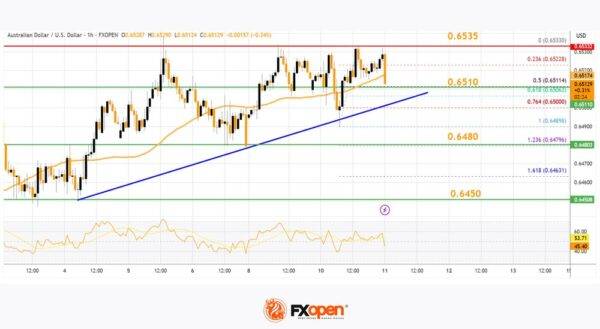
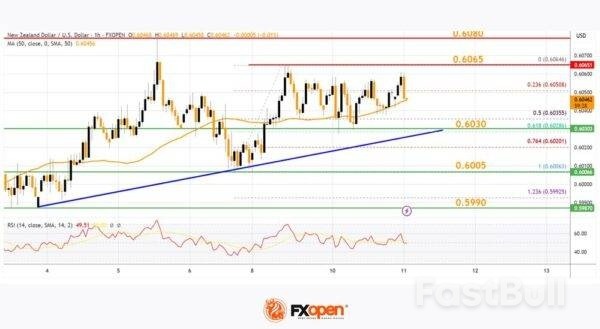
          AUD/USD started a decent increase above the 0.6450 and 0.6500 levels. NZD/USD is also rising and might aim for more gains above 0.6080.

          Important Takeaways for AUD USD and NZD USD Analysis Today

          ● The Aussie Dollar rebounded after forming a base above the 0.6400 level against the US Dollar.
          ● There is a connecting bullish trend line forming with support at 0.6510 on the hourly chart of AUD/USD.
          ● NZD/USD is consolidating gains above the 0.6030 zone.
          ● There is a key bullish trend line forming with support at 0.6030 on the hourly chart of NZD/USD.

          AUD/USD Technical Analysis

          On the hourly chart of AUD/USD, the pair started a fresh increase from the 0.6450 support. The Aussie Dollar was able to clear the 0.6500 resistance to move into a positive zone against the US Dollar.

          There was a close above the 0.6500 resistance and the 50-hour simple moving average. Finally, the pair tested the 0.6535 zone. A high was formed near 0.6533 and the pair recently started a consolidation phase.

          There was a move below the 0.6520 level. The pair dipped below the 23.6% Fib retracement level of the upward move from the 0.6489 swing low to the 0.6533 high.

          On the downside, initial support is near the 0.6510 level. There is also a connecting bullish trend line forming with support at 0.6510. It is close to the 50% Fib retracement level of the upward move from the 0.6489 swing low to the 0.6533 high.

          The next major support is near the 0.6480 zone. If there is a downside break below the 0.6480 support, the pair could extend its decline toward the 0.6450 level.

          Any more losses might signal a move toward 0.6420. On the upside, the AUD/USD chart indicates that the pair is now facing resistance near 0.6535. The first major resistance might be 0.6550. An upside break above the 0.6580 resistance might send the pair further higher.

          The next major resistance is near the 0.6600 level. Any more gains could clear the path for a move toward the 0.6650 resistance zone.

          NZD/USD Technical Analysis

          On the hourly chart of NZD/USD on, the pair started a steady increase from the 0.5990 zone. The New Zealand Dollar broke the 0.6020 resistance to start the recent increase against the US Dollar.

          The pair settled above 0.6030 and the 50-hour simple moving average. It tested the 0.6065 zone and is currently consolidating gains. The pair corrected lower below the 0.6050 level and the 23.6% Fib retracement level of the upward move from the 0.6006 swing low to the 0.6064 high.

          However, the bulls are active above the 0.6030 level. The NZD/USD chartsuggests that the RSI is stable near 50. On the upside, the pair might struggle near 0.6065. The next major resistance is near the 0.6080 level.

          A clear move above the 0.6080 level might even push the pair toward the 0.6120 level. Any more gains might clear the path for a move toward the 0.6200 resistance zone in the coming days.

          On the downside, immediate support is near the 0.6030 level. There is also a key bullish trend line forming with support at 0.6030. It is close to the 61.8% Fib retracement level of the upward move from the 0.6006 swing low to the 0.6064 high.

          The first key support is near the 0.6005 level. The next major support is near the 0.5990 level. If there is a downside break below the 0.5990 support, the pair might slide toward the 0.5970 support. Any more losses could lead NZD/USD in a bearish zone to 0.5950.

          Source: FXOpen

          To stay updated on all economic events of today, please check out our Economic calendar
          Risk Warnings and Disclaimers
          You understand and acknowledge that there is a high degree of risk involved in trading. Following any strategies or investment methods may lead to potential losses. The content on the site is provided by our contributors and analysts for information purposes only. You are solely responsible for determining whether any trading assets, securities, strategy, or any other product is suitable for investing based on your own investment objectives and financial situation.
          Add to Favorites
          Share

          U.S. Tariffs Begin to Stoke Underlying Inflation as CPI Edges Higher in May

          Gerik

          Economic

          Tariff-Led Inflation Begins to Show in Core CPI

          The U.S. Consumer Price Index (CPI) report for May 2025 is beginning to reflect the initial inflationary consequences of President Trump’s sweeping import tariffs. According to economists surveyed by Reuters, while the overall CPI is expected to have increased by 0.2%—matching April’s pace—the more consequential development lies in the underlying inflation trend. Core CPI, which excludes food and energy, is forecast to rise 0.3%, the largest monthly increase since January. This reflects the gradual pass-through of tariffs to consumer prices, especially in retail sectors now depleting pre-duty inventories.
          Large retailers like Walmart, which had initially held off on price increases, have begun adjusting prices as tariff-laden goods reach shelves. This indicates that the brunt of tariff-induced inflation is likely to emerge more clearly in the June and July CPI figures.

          Fuel Costs Limit Headline Inflation, but Pressure Builds Elsewhere

          The relatively mild 0.2% headline CPI gain is attributed largely to lower gasoline prices, supported by declining global oil demand due to economic uncertainty. However, this masks the broader inflationary undercurrent in non-energy categories, where price rigidity is giving way under cost pressures from tariffs on imported consumer goods and manufacturing inputs.
          Year-over-year, overall CPI is projected to increase 2.5%, up from April’s 2.3%, while core CPI is expected to tick up to 2.9% from 2.8%. This uptick reflects not only new cost structures but also a base effect as weaker readings from 2024 drop out of the calculation.
          The Federal Reserve remains in a holding pattern, with markets anticipating no interest rate changes at next week’s policy meeting. The Fed’s preferred inflation gauges differ from CPI, but the uptick in core CPI may add to its internal debate, especially if further tariff-induced inflation proves more persistent. The Fed’s benchmark rate remains in the 4.25%–4.50% range, and forward guidance is likely to emphasize patience while monitoring supply-side disruptions and price dynamics.
          Institutional Challenges: BLS Staffing and Data Quality Risks
          Beneath the surface of these inflation numbers lies a growing challenge for data reliability. The Bureau of Labor Statistics (BLS) has announced the suspension of CPI data collection in three cities due to staffing shortfalls, linked to sweeping federal downsizing measures by the Trump administration. A hiring freeze, voluntary resignations, and early retirements have reportedly reduced BLS staffing by at least 15%.
          Despite BLS reassurances that national-level data remains statistically robust, experts caution that at a disaggregated or regional level, the loss of granular data could weaken the precision of future releases. Former BLS commissioner Erica Groshen emphasized that while headline CPI remains dependable, reduced publication standards for sub-indexes could erode transparency and limit analytical insights.

          Inflation Risks Likely to Worsen Before Easing

          May 2025 marks the beginning of what many economists believe will be a prolonged phase of elevated inflation readings driven by trade policy rather than traditional demand-side overheating. While lower fuel costs have dampened the headline rate, the structural effects of import tariffs—especially those impacting consumer durables, apparel, and electronics—are only starting to emerge.
          If tariffs remain in place through the second half of the year, retailers and manufacturers may increasingly pass along costs, and the core CPI could remain well above the Fed’s comfort zone. Combined with weakening data infrastructure, the challenge for policymakers will be balancing transparency, stability, and forward-looking credibility in an increasingly politicized economic landscape.

          Source: Reuters

          To stay updated on all economic events of today, please check out our Economic calendar
          Risk Warnings and Disclaimers
          You understand and acknowledge that there is a high degree of risk involved in trading. Following any strategies or investment methods may lead to potential losses. The content on the site is provided by our contributors and analysts for information purposes only. You are solely responsible for determining whether any trading assets, securities, strategy, or any other product is suitable for investing based on your own investment objectives and financial situation.
          Add to Favorites
          Share

          Bullish Crypto Exchange Quietly Files for U.S. IPO Amid Regulatory Shift

          Gerik

          Cryptocurrency

          Bullish Reignites Public Listing Ambitions in Friendlier Regulatory Climate

          Peter Thiel-backed cryptocurrency exchange Bullish has confidentially submitted paperwork to the U.S. Securities and Exchange Commission (SEC) for an initial public offering, according to a Financial Times report. This marks a renewed effort to enter public markets after its previous attempt via a SPAC merger collapsed in 2022, largely due to unfavorable macroeconomic conditions and regulatory scrutiny during the Biden administration.
          Now, under the Trump administration, which has taken a more supportive stance toward digital asset markets, Bullish appears poised to benefit from both political tailwinds and renewed investor appetite for crypto-related equities. The SEC has reportedly softened its posture, having dropped several investigations into cryptocurrency firms — a marked departure from the aggressive oversight seen during the previous administration.

          From SPAC Failure to Strategic Reset

          Bullish, a subsidiary of Block.one, originally sought to go public in 2021 via a merger with Far Peak Acquisition Corp. at a valuation exceeding $9 billion. That deal unraveled in late 2022, as rising interest rates, declining equity valuations, and mounting regulatory hurdles eroded investor confidence in crypto ventures. The failure also aligned with a broader industry reckoning, including collapses like FTX and scrutiny of stablecoins.
          Since then, Bullish has recalibrated. The company has reportedly focused on compliance infrastructure, liquidity provisioning, and expanding institutional partnerships, aiming to distance itself from the speculative excesses that plagued the industry during the last bull run.

          IPO Wave Signals Crypto Sector Reawakening

          Bullish's confidential filing follows a similar move by Gemini, the cryptocurrency exchange led by Tyler and Cameron Winklevoss. The back-to-back filings suggest a reawakening in IPO interest across the digital asset sector — buoyed by shifting political winds and a broader thaw in regulatory attitudes. Both firms aim to tap into a capital market that is warming again to crypto, especially as token prices and trading volumes have shown signs of recovery in 2025.
          With the SEC now taking a more accommodating approach and institutional capital slowly reentering the space, crypto exchanges are seizing what may be a narrow window of opportunity before the next regulatory or market cycle turns.
          While Bullish has not confirmed the filing or commented publicly, its confidential IPO submission could signal a cautious but deliberate return of crypto exchanges to mainstream equity markets. The company’s valuation, proposed share structure, and timeline remain under wraps, but the filing itself underscores growing confidence in a more predictable regulatory environment — at least for now. Whether this translates into long-term stability for digital asset firms remains to be seen, especially in an industry prone to volatility, both technical and political.

          Source: Reuters

          Risk Warnings and Disclaimers
          You understand and acknowledge that there is a high degree of risk involved in trading. Following any strategies or investment methods may lead to potential losses. The content on the site is provided by our contributors and analysts for information purposes only. You are solely responsible for determining whether any trading assets, securities, strategy, or any other product is suitable for investing based on your own investment objectives and financial situation.
          Add to Favorites
          Share

          BOJ Seen Delaying Rate Hike to Early 2026 Amid Global Trade Uncertainty

          Gerik

          Economic

          Cautious BOJ to Hold Rates Through 2025

          The Bank of Japan is expected to delay further interest rate hikes until early 2026, according to a slight majority of economists surveyed in a Reuters poll conducted from June 2 to 10. Amid global trade instability and concerns about Japan’s fiscal health, the central bank appears likely to maintain its benchmark short-term interest rate at 0.50% through year-end 2025.
          This cautious stance comes despite the BOJ’s continued hawkish rhetoric. Governor Kazuo Ueda has reiterated the bank’s readiness to raise rates if inflationary pressures build. However, economists suggest that external uncertainty, especially U.S. trade policies under President Trump, and internal market fragility are prompting the BOJ to act more conservatively.
          Only 17 basis points of tightening are priced in by bond markets for the remainder of the year, reinforcing the perception that significant hikes are unlikely in 2025. January 2026 now emerges as the consensus timing for a potential 25-basis-point increase, although some economists still consider October 2025 or March 2026 as plausible windows.

          Tapering to Slow, Super-Long Bond Issuance to Fall

          In addition to the rate outlook, the BOJ is also expected to decelerate its quantitative tightening. Over half of the economists polled (17 out of 31) predict that the BOJ will slow its tapering of Japanese government bond (JGB) purchases beyond April 2026, reducing from the current pace of roughly 400 billion yen per quarter. Forecasted reductions vary widely, from 200 billion yen to 370 billion yen.
          This policy shift is driven by concerns over Japan’s public debt dynamics and the weakening demand for ultra-long duration bonds. Around three-quarters of economists (21 out of 28) expect the Ministry of Finance to trim issuance of 20-, 30-, and 40-year bonds, with the 30-year category being most frequently identified for cuts.
          The drop in demand for long-duration debt, particularly from life insurers, has driven yields on super-long JGBs to record highs. In response, the Japanese government is reportedly weighing bond buybacks to manage debt maturities and reduce refinancing risks — a signal of potential fiscal recalibration in light of shifting interest rate conditions.

          Trade Tensions Cloud Monetary Outlook

          The broader macroeconomic landscape remains complicated by global trade frictions. Unpredictable tariff policies from the U.S. — including recent retaliatory threats — have shaken Japan’s export-driven economy and raised concerns about the durability of current growth momentum. While the BOJ maintains a medium-term inflation target of 2%, the foundation for consistent price gains is far from secure.
          Takumi Tsunoda from Shinkin Central Bank Research Institute emphasized that global trade progress could revive economic momentum, but the timing remains uncertain. As such, the BOJ is unlikely to act aggressively until there is greater clarity on external demand and inflation stability.
          The June Reuters poll indicates a subtle but clear shift in sentiment toward policy patience. Although Japan was among the last to exit ultra-loose monetary settings, the fragile post-pandemic recovery, volatile trade environment, and structural debt challenges are forcing the BOJ into a cautious mode. While inflation remains on the radar, domestic and international vulnerabilities are likely to keep policy rates steady through at least Q1 2026. The next few quarters will test the BOJ’s ability to balance normalization with market stability, particularly as bond markets signal mounting stress.

          Source: Reuters

          To stay updated on all economic events of today, please check out our Economic calendar
          Risk Warnings and Disclaimers
          You understand and acknowledge that there is a high degree of risk involved in trading. Following any strategies or investment methods may lead to potential losses. The content on the site is provided by our contributors and analysts for information purposes only. You are solely responsible for determining whether any trading assets, securities, strategy, or any other product is suitable for investing based on your own investment objectives and financial situation.
          Add to Favorites
          Share
          FastBull
          Copyright © 2025 FastBull Ltd

          728 RM B 7/F GEE LOK IND BLDG NO 34 HUNG TO RD KWUN TONG KLN HONG KONG

          TelegramInstagramTwitterfacebooklinkedin
          App Store Google Play Google Play
          Products
          Charts

          Chats

          Q&A with Experts
          Screeners
          Economic Calendar
          Data
          Tools
          Membership
          Features
          Function
          Markets
          Copy Trading
          Latest Signals
          Contests
          News
          Analysis
          24/7
          Columns
          Education
          Company
          Careers
          About Us
          Contact Us
          Advertising
          Help Center
          Feedback
          User Agreement
          Privacy Policy
          Business

          White Label

          Data API

          Web Plug-ins

          Poster Maker

          Affiliate Program

          Risk Disclosure

          The risk of loss in trading financial instruments such as stocks, FX, commodities, futures, bonds, ETFs and crypto can be substantial. You may sustain a total loss of the funds that you deposit with your broker. Therefore, you should carefully consider whether such trading is suitable for you in light of your circumstances and financial resources.

          No decision to invest should be made without thoroughly conducting due diligence by yourself or consulting with your financial advisors. Our web content might not suit you since we don't know your financial conditions and investment needs. Our financial information might have latency or contain inaccuracy, so you should be fully responsible for any of your trading and investment decisions. The company will not be responsible for your capital loss.

          Without getting permission from the website, you are not allowed to copy the website's graphics, texts, or trademarks. Intellectual property rights in the content or data incorporated into this website belong to its providers and exchange merchants.

          Not Logged In

          Log in to access more features

          FastBull Membership

          Not yet

          Purchase

          Become a signal provider
          Help Center
          Customer Service
          Dark Mode
          Price Up/Down Colors

          Log In

          Sign Up

          Position
          Layout
          Fullscreen
          Default to Chart
          The chart page opens by default when you visit fastbull.com