• Trade
  • Markets
  • Copy
  • Contests
  • News
  • 24/7
  • Calendar
  • Q&A
  • Chats
Trending
Screeners
SYMBOL
LAST
BID
ASK
HIGH
LOW
NET CHG.
%CHG.
SPREAD
SPX
S&P 500 Index
6870.39
6870.39
6870.39
6895.79
6858.28
+13.27
+ 0.19%
--
DJI
Dow Jones Industrial Average
47954.98
47954.98
47954.98
48133.54
47871.51
+104.05
+ 0.22%
--
IXIC
NASDAQ Composite Index
23578.12
23578.12
23578.12
23680.03
23506.00
+72.99
+ 0.31%
--
USDX
US Dollar Index
98.830
98.910
98.830
98.960
98.810
-0.120
-0.12%
--
EURUSD
Euro / US Dollar
1.16553
1.16560
1.16553
1.16554
1.16341
+0.00127
+ 0.11%
--
GBPUSD
Pound Sterling / US Dollar
1.33391
1.33398
1.33391
1.33420
1.33151
+0.00079
+ 0.06%
--
XAUUSD
Gold / US Dollar
4215.11
4215.54
4215.11
4215.81
4190.61
+17.20
+ 0.41%
--
WTI
Light Sweet Crude Oil
59.982
60.019
59.982
60.063
59.752
+0.173
+ 0.29%
--

Community Accounts

Signal Accounts
--
Profit Accounts
--
Loss Accounts
--
View More

Become a signal provider

Sell trading signals to earn additional income

View More

Guide to Copy Trading

Get started with ease and confidence

View More

Signal Accounts for Members

All Signal Accounts

Best Return
  • Best Return
  • Best P/L
  • Best MDD
Past 1W
  • Past 1W
  • Past 1M
  • Past 1Y

All Contests

  • All
  • Trump Updates
  • Recommend
  • Stocks
  • Cryptocurrencies
  • Central Banks
  • Featured News
Top News Only
Share

Thai Prime Minister: Thailand Does Not Want Violence

Share

Thai Prime Minister: Ready To Take Necessary Measures To Maintain Security, Sovereignty Of Country

Share

China Politburo: Will Better Coordinate Between China's Economic Work And International Economic And Trade Battle Next Year

Share

China Politburo: Moderately Loose Monetary Policy

Share

China Politburo:Continue To Implement More Active Fiscal Policies

Share

India's SEBI Chair: If Any Entity Wants To Advertise Any Past Return They Can Do Only Via The Platform

Share

Vietnam's Plans To Have Nuclear Power Plant Ready By 2035 Are Too Tight - Ambassador

Share

Japan Still Exploring Options For Future Vietnam Nuclear Projects Involving Small Reactors - Ambassador

Share

Ambassador In Hanoi: Japan Pulls Out Of Plans For Vietnam Nuclear Power Plant Ninh Thuan 2

Share

India's SEBI Chair: Platform Will Allow Investors To Access Verified Returns Of Registered Entities

Share

Governor: Russian Drone Strike On Ukraine's Sumy Injures At Least Seven

Share

Inida's Nifty Psu Bank Index Down 1.3%

Share

India Markets Regulator Official: Have Created A Platform For Real Time Monitoring Of Algo Returns

Share

Cambodia Provincial Official: 3 Cambodian Civilians Seriously Injured In Thai-Cambodia Fighting

Share

Russia's Air Defences Destroy 67 Ukrainian Drones Overnight, RIA Agency Reports

Share

India's Nifty 50 Index Down 0.37%

Share

Hsi Down 287 Pts, Hsti Down 13 Pts, Pop Mart Down Over 8%, Ping An Hit New Highs

Share

China's November Coal Imports Down 20% Year-On-Year

Share

At Least One Thai Soldier Killed And 7 Wounded - Thai Army Spokesman

Share

India's Nifty Bank Futures Up 0.73% In Pre-Open Trade

TIME
ACT
FCST
PREV
U.S. Personal Income MoM (Sept)

A:--

F: --

P: --

U.S. PCE Price Index YoY (SA) (Sept)

A:--

F: --

P: --

U.S. PCE Price Index MoM (Sept)

A:--

F: --

P: --

U.S. Personal Outlays MoM (SA) (Sept)

A:--

F: --

P: --

U.S. Core PCE Price Index MoM (Sept)

A:--

F: --

P: --

U.S. Core PCE Price Index YoY (Sept)

A:--

F: --

P: --

U.S. UMich 5-Year-Ahead Inflation Expectations Prelim YoY (Dec)

A:--

F: --

P: --

U.S. Real Personal Consumption Expenditures MoM (Sept)

A:--

F: --

P: --

U.S. UMich Current Economic Conditions Index Prelim (Dec)

A:--

F: --

P: --

U.S. UMich Consumer Sentiment Index Prelim (Dec)

A:--

F: --

P: --

U.S. UMich 1-Year-Ahead Inflation Expectations Prelim (Dec)

A:--

F: --

P: --

U.S. UMich Consumer Expectations Index Prelim (Dec)

A:--

F: --

P: --

U.S. Weekly Total Rig Count

A:--

F: --

P: --

U.S. Weekly Total Oil Rig Count

A:--

F: --

P: --

U.S. Unit Labor Cost Prelim (SA) (Q3)

--

F: --

P: --

U.S. Consumer Credit (SA) (Oct)

A:--

F: --

P: --

China, Mainland Foreign Exchange Reserves (Nov)

A:--

F: --

P: --

Japan Wages MoM (Oct)

A:--

F: --

P: --

Japan Trade Balance (Oct)

A:--

F: --

P: --

Japan Nominal GDP Revised QoQ (Q3)

A:--

F: --

P: --

Japan Trade Balance (Customs Data) (SA) (Oct)

A:--

F: --

P: --

Japan GDP Annualized QoQ Revised (Q3)

A:--

F: --

P: --
China, Mainland Exports YoY (CNH) (Nov)

A:--

F: --

P: --

China, Mainland Trade Balance (USD) (Nov)

A:--

F: --

P: --

China, Mainland Imports YoY (CNH) (Nov)

A:--

F: --

P: --

China, Mainland Exports (Nov)

A:--

F: --

P: --

China, Mainland Imports (CNH) (Nov)

A:--

F: --

P: --

China, Mainland Trade Balance (CNH) (Nov)

A:--

F: --

P: --

China, Mainland Imports YoY (USD) (Nov)

A:--

F: --

P: --

China, Mainland Exports YoY (USD) (Nov)

A:--

F: --

P: --

Germany Industrial Output MoM (SA) (Oct)

--

F: --

P: --

Euro Zone Sentix Investor Confidence Index (Dec)

--

F: --

P: --

Canada Leading Index MoM (Nov)

--

F: --

P: --

Canada National Economic Confidence Index

--

F: --

P: --

U.S. Dallas Fed PCE Price Index YoY (Sept)

--

F: --

P: --

China, Mainland Trade Balance (USD) (Nov)

--

F: --

P: --

U.S. 3-Year Note Auction Yield

--

F: --

P: --

U.K. BRC Overall Retail Sales YoY (Nov)

--

F: --

P: --

U.K. BRC Like-For-Like Retail Sales YoY (Nov)

--

F: --

P: --

Australia Overnight (Borrowing) Key Rate

--

F: --

P: --

RBA Rate Statement
RBA Press Conference
Germany Exports MoM (SA) (Oct)

--

F: --

P: --

U.S. NFIB Small Business Optimism Index (SA) (Nov)

--

F: --

P: --

Mexico Core CPI YoY (Nov)

--

F: --

P: --

Mexico 12-Month Inflation (CPI) (Nov)

--

F: --

P: --

Mexico PPI YoY (Nov)

--

F: --

P: --

Mexico CPI YoY (Nov)

--

F: --

P: --

U.S. Weekly Redbook Index YoY

--

F: --

P: --

U.S. JOLTS Job Openings (SA) (Oct)

--

F: --

P: --

China, Mainland M2 Money Supply YoY (Nov)

--

F: --

P: --

China, Mainland M0 Money Supply YoY (Nov)

--

F: --

P: --

China, Mainland M1 Money Supply YoY (Nov)

--

F: --

P: --

U.S. EIA Short-Term Crude Production Forecast For The Next Year (Dec)

--

F: --

P: --

U.S. EIA Short-Term Crude Production Forecast For The Year (Dec)

--

F: --

P: --

U.S. EIA Natural Gas Production Forecast For The Next Year (Dec)

--

F: --

P: --

EIA Monthly Short-Term Energy Outlook
U.S. 10-Year Note Auction Avg. Yield

--

F: --

P: --

U.S. API Weekly Cushing Crude Oil Stocks

--

F: --

P: --

U.S. API Weekly Crude Oil Stocks

--

F: --

P: --

U.S. API Weekly Refined Oil Stocks

--

F: --

P: --

Q&A with Experts
    • All
    • Chatrooms
    • Groups
    • Friends
    Connecting
    .
    .
    .
    Type here...
    Add Symbol or Code

      No matching data

      All
      Trump Updates
      Recommend
      Stocks
      Cryptocurrencies
      Central Banks
      Featured News
      • All
      • Russia-Ukraine Conflict
      • Middle East Flashpoint
      • All
      • Russia-Ukraine Conflict
      • Middle East Flashpoint
      Search
      Products

      Charts Free Forever

      Chats Q&A with Experts
      Screeners Economic Calendar Data Tools
      Membership Features
      Data Warehouse Market Trends Institutional Data Policy Rates Macro

      Market Trends

      Market Sentiment Order Book Forex Correlations

      Top Indicators

      Charts Free Forever
      Markets

      News

      News Analysis 24/7 Columns Education
      From Institutions From Analysts
      Topics Columnists

      Latest Views

      Latest Views

      Trending Topics

      Top Columnists

      Latest Update

      Signals

      Copy Rankings Latest Signals Become a signal provider AI Rating
      Contests
      Brokers

      Overview Brokers Assessment Rankings Regulators News Claims
      Broker listing Forex Brokers Comparison Tool Live Spread Comparison Scam
      Q&A Complaint Scam Alert Videos Tips to Detect Scam
      More

      Business
      Events
      Careers About Us Advertising Help Center

      White Label

      Data API

      Web Plug-ins

      Affiliate Program

      Awards Institution Evaluation IB Seminar Salon Event Exhibition
      Vietnam Thailand Singapore Dubai
      Fans Party Investment Sharing Session
      FastBull Summit BrokersView Expo
      Recent Searches
        Top Searches
          Markets
          News
          Analysis
          User
          24/7
          Economic Calendar
          Education
          Data
          • Names
          • Latest
          • Prev

          View All

          No data

          Scan to Download

          Faster Charts, Chat Faster!

          Download App
          English
          • English
          • Español
          • العربية
          • Bahasa Indonesia
          • Bahasa Melayu
          • Tiếng Việt
          • ภาษาไทย
          • Français
          • Italiano
          • Türkçe
          • Русский язык
          • 简中
          • 繁中
          Open Account
          Search
          Products
          Charts Free Forever
          Markets
          News
          Signals

          Copy Rankings Latest Signals Become a signal provider AI Rating
          Contests
          Brokers

          Overview Brokers Assessment Rankings Regulators News Claims
          Broker listing Forex Brokers Comparison Tool Live Spread Comparison Scam
          Q&A Complaint Scam Alert Videos Tips to Detect Scam
          More

          Business
          Events
          Careers About Us Advertising Help Center

          White Label

          Data API

          Web Plug-ins

          Affiliate Program

          Awards Institution Evaluation IB Seminar Salon Event Exhibition
          Vietnam Thailand Singapore Dubai
          Fans Party Investment Sharing Session
          FastBull Summit BrokersView Expo

          It’s not just AI — China’s quickly gaining an edge over the U.S. in biotech

          Adam

          Economic

          Summary:

          China is rapidly narrowing the biotech gap with the U.S., driven by state-led strategies, faster regulation, and growing talent, raising concerns in Washington over losing global leadership in critical technologies.

          For all the attention on U.S.-China competition in artificial intelligence, new studies point to China’s rapid rise in biotechnology, especially for drug and agricultural development.
          Out of five critical tech sectors, “China has the most immediate opportunity to overtake the United States in biotechnology,” the Harvard Belfer Center for Science and International Affairs said Thursday in its release of a “Critical and Emerging Technologies Index,” covering AI, biotech, semiconductors, space and quantum.
          While the U.S. is still the leader in all five, “the narrow U.S.-China gap [in biotech] suggests that future developments could quickly shift the global balance of power,” the report said.
          The assessment echoes growing concerns in Washington. In fact, the U.S. National Security Commission on Emerging Biotechnology struck a more urgent tone in an April report, citing two years of research.
          “There will be a ChatGPT moment for biotechnology, and if China gets there first, no matter how fast we run, we will never catch up,” the bipartisan Congressional commission said in the report, referring to the transformative chatbot released by U.S.-based OpenAI.
          “Our window to act is closing. We need a two-track strategy: make America innovate faster, and slow China down,” the commission said. It recommends that the U.S. government spend at least $15 billion over the next five years to support the domestic biotech sector.
          China’s biotech industry has evolved to the point that U.S. and European pharmaceutical giants in the last several months have spent billions to acquire China-developed drugs that could treat cancer if commercialized with regulatory approval. In March, British pharmaceutical giant AstraZeneca announced it will invest $2.5 billion in a research and development center in Beijing.
          The Harvard Belfer Center pointed out that China’s biotech strengths stem from its “dominance in pharmaceutical production and manufacturing,” in addition to having more human talent than the U.S.
          China also has a “more flexible regulatory regime and the ability to push things out faster,” Cynthia Y. Tong, one of the Harvard report’s authors, told CNBC in an interview Thursday. She noted that the U.S. tends to have a longer approval process, as well as more drawn out research and development period.
          And just as China is developing its biotech sector, reports from the U.S. biotech hub of Cambridge and Boston are revealing layoffs and empty labs.

          A big strategy

          China has long used multi-year plans and preferential state policies to encourage the development of key technologies. Biotech is no different, gaining high-level support back in 2007.
          “Currently, the U.S. government has no cohesive, intentional biotechnology strategy, while China is gaining ground thanks to its aggressive and carefully coordinated state-led initiatives,” the U.S. security commission said.
          The worry is that just as Chinese restrictions on rare earths start to hit car manufacturers, Chinese dominance in biotech could become yet another form of leverage for Beijing over the U.S. and other countries.
          “The likelihood there’s going to be cooperation [between the] U.S. and China on anything is very low, in some ways least likely on biotech and AI” because of the congressional report, said Eric Rosenbach, director of the defense, emerging technology, and strategy program at Harvard’s Belfer Center. He was chief of staff at the U.S. Department of Defense from 2015 to 2017.
          He expects more U.S. pressure on China.
          It remains to be seen what that would mean in practice for businesses — though some say the future of biotech development is inherently global.
          Insilico Medicine, a startup using AI to cut drug discovery costs, relies on a global team spread across China, North America and the Middle East, according to its founder and CEO Alex Zhavoronkov. On Tuesday, the company announced with a paper in Nature Medicine that it was the first to see successful clinical testing with an AI-discovered drug.
          While Insilico’s AI work typically happens in Canada and Abu Dhabi, the chemical testing and experiments are done in China, Zhavoronkov said, adding that the head of clinical development is in Boston. He declined to comment on a commercialization timeline in light of conversations with regulators.
          Other data shows that China has surpassed the U.S. in the number of clinical trials conducted, seen significant patent growth and boasts the most life sciences construction activity in the world.
          China-based Capital O venture partner Yang Fan, who previously worked in the pharmaceutical industry, said he expects the best biotech companies of the future will navigate different countries’ regulations and use resources across the globe, if not benefit from arbitrage opportunities given different requirements and cost of entry in various markets.
          “The Chinese market is like a big supermarket for anything that can be commoditized, AI or biotechnology,” he said, adding that new startups in China have to be “really good” to stand out. As AI drives innovation costs down, Fan predicts that in biotech, “the real DeepSeek moment is probably going to happen in five years.”

          Source: cnbc

          To stay updated on all economic events of today, please check out our Economic calendar
          Risk Warnings and Disclaimers
          You understand and acknowledge that there is a high degree of risk involved in trading. Following any strategies or investment methods may lead to potential losses. The content on the site is provided by our contributors and analysts for information purposes only. You are solely responsible for determining whether any trading assets, securities, strategy, or any other product is suitable for investing based on your own investment objectives and financial situation.
          Add to Favorites
          Share

          Fed's Kugler: With Upside Risks To Inflation, Rates Should Stay Where They Are

          James Whitman

          Central Bank

          Economic

          Federal Reserve Governor Adriana Kugler on Thursday said she supports keeping short-term U.S. borrowing costs at their current "moderately restrictive" level as long as tariffs continue to threaten to lift inflation.

          "Disinflation has slowed, and we are already seeing the effects of higher tariffs, which I expect will continue to raise inflation over 2025," Kugler said in remarks prepared for delivery to the Economic Club of New York. "I see greater upside risks to inflation at this juncture and potential downside risks to employment and output growth down the road, and this leads me to continue to support maintaining the FOMC’s policy rate at its current setting if upside risks to inflation remain."

          Kugler's remarks, among the last of public comments from Fed policymakers ahead of their June 17-18 meeting, indicate that she sees inflation as the more pressing worry for the Fed. The central bank is widely expected to leave the policy rate in its current 4.25%-4.50% range for the next couple of meetings.

          While trade and other policy changes from the Trump administration may increase the jobless rate from its current 4.2% level, she said, so far the labor market looks stable. April spending data and many surveys -- including the Fed's own Beige Book, published on Wednesday -- show a softening in economic activity, she said, but "not yet a significant slowdown."

          The inflationary effects of tariffs, on the other hand, are already evident in a reversal of core goods inflation, and research shows not only that tariffs have already added to overall price increases but are likely to continue to do so, and relatively quickly. Meanwhile short-term inflation expectations have increased, and though most readings of long-term inflation expectations have remained stable, she said she is closely monitoring the jump in the University of Michigan survey.

          "I view our current stance of monetary policy as well-positioned for any changes in the macroeconomic environment," she said.

          Source: Reuters

          To stay updated on all economic events of today, please check out our Economic calendar
          Risk Warnings and Disclaimers
          You understand and acknowledge that there is a high degree of risk involved in trading. Following any strategies or investment methods may lead to potential losses. The content on the site is provided by our contributors and analysts for information purposes only. You are solely responsible for determining whether any trading assets, securities, strategy, or any other product is suitable for investing based on your own investment objectives and financial situation.
          Add to Favorites
          Share

          Wall Street's potential winners and losers from Trump's tax bill

          Adam

          Economic

          China–U.S. Trade War

          As President Donald Trump's sweeping tax-cut and spending bill heads to the Senate, analysts examine how his broad-ranging policies could turn the fortunes of U.S. companies if the package is enacted as law.
          What Trump has dubbed a "big, beautiful bill", narrowly passed the Republican-controlled House on May 22.
          The bill seeks to extend tax breaks, set during Trump's first term in 2017 and on track to expire at the end of 2025, for multinational corporations. It is also expected to fulfill many of Trump's populist campaign pledges, including an immigration crackdown and ending some green energy incentives.
          The tax breaks are largely expected to be positive for the U.S. stock markets, but some analysts see only a modest upside.
          "Since the 2025 tax cuts are primarily an extension of the current tax code, we expect changes to provide only marginal benefits to equity performance," Morgan Stanley analysts said in a note last month.
          Overall, the bill is expected to add about $2.4 trillion to the $36.2 trillion U.S. debt pile, the Congressional Budget Office said on Wednesday.
          Here is a list of industries and companies that are likely to be affected by the bill:
          AEROSPACE AND DEFENSE - WINNERS
          Defense companies could see renewed interest from investors as the new bill looks to step up spending on air and missile defense, munitions and border security.
          "There should be some benefit there to the defense contractors," said Chris Haverland, global equity strategist at Wells Fargo Investment Institute.
          "We currently rate industrials at a neutral. There'll be some offsets there, but there should be some benefits to the defense area."
          Brian Mulberry, client portfolio manager at Zacks Investment Management, named defense contractors RTX and General Dynamics as potential beneficiaries. The iShares US Aerospace & Defense ETF is trading at all-time highs.
          RENEWABLE ENERGY - LOSERS
          Shares of U.S. solar companies slumped on May 22, as the bill aims to cancel funding for green-energy grant programs, which were established under the Biden administration in the 2022 Inflation Reduction Act.
          "If the bill passes, that's going to be a huge negative for renewable (energy stocks)," said Dave Grecsek, managing director of investment strategy and research at wealth management firm Aspiriant.
          "We could have a little bit more downside to the renewable energy space, but a lot of it is already priced in."
          Companies including First Solar, Enphase Energy and Sunrun are all in the red for the year.
          HEALTH INSURERS - LOSERS
          The bill includes substantial funding cuts for the U.S. Medicaid program, with fiscal hawks pushing for cuts to partly offset the cost of the bill's tax components.
          "Reductions to Medicaid funding also shift the cost to state and local governments that may be burdened by increased health care costs. This may cause notable revenue losses for hospitals, potentially pressuring (the) credit quality of both state and nonprofit health care municipal bonds," Morgan Stanley said.
          Shares of major health insurers CVS, Humana, UnitedHealth, Elevance and Cigna would be in focus. The S&P 500 managed healthcare index is down 30.6% year to date.
          HOUSING & REAL ESTATE - LOSERS
          BofA Global Research said it expects interest rates to remain high if the bill does not meaningfully address deficit reduction, and flagged several companies that could be hurt by higher rates.
          SBA Communications, Equinix and Alexandria Real Estate Equities are some of the real estate-linked companies that are at risk, BofA Global Research said.
          "Homebuilders need to take a margin hit on the house to increase affordability. So that's a very simple translation of how fiscal stimulus is leading to a negative consequence for the stock market," said Viresh Kanabar, macro strategist - asset allocation at Macro Hive.
          DOMESTIC PRODUCERS - WINNERS
          The bill also includes legislation to extend or expand Tax Cuts and Jobs Act (TCJA) provisions that are set to expire at the end of 2025.
          The provisions include 100% bonus depreciation for equipment investment, immediate deduction of domestic research and development (R&D) expenses and looser business interest expensing through 2029.
          BofA Global Research named a slew of S&P 500 companies with no overseas sales that could benefit from these items, including utility firms Alliant Energy, Ameren Corp and American Electric Power Company.

          Source: Reuters

          To stay updated on all economic events of today, please check out our Economic calendar
          Risk Warnings and Disclaimers
          You understand and acknowledge that there is a high degree of risk involved in trading. Following any strategies or investment methods may lead to potential losses. The content on the site is provided by our contributors and analysts for information purposes only. You are solely responsible for determining whether any trading assets, securities, strategy, or any other product is suitable for investing based on your own investment objectives and financial situation.
          Add to Favorites
          Share

          Aide To EU Chief Joins Tariff Negotiation Team To Spur US Talks, Sources Say

          Thomas

          Economic

          Central Bank

          The European Union has changed its team locked in trade talks with the Trump administration, bringing in a close aide to European Commission President Ursula von der Leyen to deal more swiftly with political questions arising from the technical negotiations, three sources familiar with the talks said.

          The move follows frequent outbursts of frustration by U.S. President Donald Trump at what the White House perceives as slow progress in talks with the EU. Late in May he recommended a 50% tariff on most European goods from June, before backtracking.

          The move to bring more political decision-making to the EU team reflects challenges confronting the bloc as it negotiates a trading relationship with a U.S. president who has said repeatedly the EU was established to screw the United States.

          It also reflects the difficulties negotiating trade terms in isolation when Trump has sought to fold non-tariff barriers such as digital services taxes and food standards into the talks.

          "If you are a trade negotiator you need to be sure you have full political backing, so if the top level is there you feel stronger," one of the sources said.

          The expanded team, which apart from the von der Leyen aide now also includes a cabinet member of Trade Commissioner Maros Sefcovic, was dispatched to Washington this week after a call between Trump and von der Leyen in which they agreed to fast-track negotiations.

          Following that call Trump agreed to allow more time for talks between Washington and the 27-nation bloc to produce a deal by July 9.

          "It was a merger of Commission layers to reinforce and act fast," a second of the sources said of the team's expansion, adding the team's shape could change again as talks continue.

          U.S. Trade Representative Jamieson Greer said a meeting with Sefcovic in Paris on Wednesday had been constructive and that he was pleased negotiations were advancing quickly. He noted "a willingness by the EU to work with us to find a concrete way forward to achieve reciprocal trade".

          Sefcovic told reporters that both sides had concluded talks were "advancing in the right direction, at pace," and that high-level contacts would follow shortly. He and Greer had agreed how to "restructure" the focus of negotiations with the United States, he added.

          Washington was focused on four areas in its negotiations with other countries: tariffs, non-tariff barriers, purchases and economic security, one of the sources said.

          Trump has already hit Europe with a 50% tariff on steel and aluminium as well as a heightened levy on car imports. The EU is racing to secure a deal before July 9 when "reciprocal" tariffs on most other goods could surge from 10% to as high as 50%.

          Unlike Britain, the first major economy to reach a narrow trade agreement with the Trump administration, the EU is pushing for a comprehensive deal, with a baseline tariff rate below the 10% now in force.

          Two of the three sources said additional technical expertise had also been added to the negotiating team, but there had been no changes to the team's leadership.

          "I think it suits everyone to have the political cover," the first source said.

          Source: TradingView

          To stay updated on all economic events of today, please check out our Economic calendar
          Risk Warnings and Disclaimers
          You understand and acknowledge that there is a high degree of risk involved in trading. Following any strategies or investment methods may lead to potential losses. The content on the site is provided by our contributors and analysts for information purposes only. You are solely responsible for determining whether any trading assets, securities, strategy, or any other product is suitable for investing based on your own investment objectives and financial situation.
          Add to Favorites
          Share

          Goldman Sachs pares risk after tariff move, braces for more uncertainty

          Adam

          Economic

          China–U.S. Trade War

          Goldman Sachs has moderated its risk-taking since U.S. President Donald Trump's April tariff announcement, and the Wall Street bank is braced for more uncertainty, a top executive said.
          "We have moderated our risk positioning since April 2nd - I think that's a sensible thing for us to do," Goldman President John Waldron said in a podcast released by the investment bank on Thursday.
          "We're absorbing a lot of risk from our clients. We want to continue to do that, but we also, where we can, we (pare) our risk and stay a little bit closer to home."
          Goldman is readying for continued uncertainty in the coming months, which means keeping a greater liquidity cushion, he said.
          Financial markets have been turbulent since Trump's so-called "Liberation Day," when he announced plans to increase tariffs on trading partners.
          Waldron, who is widely seen as the likely successor to Goldman CEO David Solomon, said the tariff move was "very, very disruptive."
          Some companies are now starting to make business decisions based on assumptions that tariffs will be raised to a range of 10% to 15%, he said.
          "We're moving into now an adjustment phase, and you'll see, I think, some more decision-making on capital spend, M&A transactions, capital return, stock buybacks," Waldron said.
          The U.S. economy is still strong, backed by a solid labor market and consumer spending, he said.
          "All those factors in the U.S. to me lead to a likely scenario where we don't have a recession," he said.
          Meanwhile, Waldron warned investors were getting concerned about an unsustainable U.S. fiscal deficit.
          "The bond market is starting to be heard, and I hope that gets some attention in the halls of Congress," he said.
          Rating agency Moody's cut the pristine U.S. sovereign credit rating by one notch last month, the last of the major ratings agencies to downgrade the country, citing concerns about the nation's growing $36 trillion debt pile.
          The biggest question for markets is the path of interest rates, particularly in the long term, Waldron said.
          "We're seeing a lot of increase in duration in the rate curves in the United States and Japan and many other countries - and I think that could be a brake on economic growth," he said.

          Source: Reuters

          To stay updated on all economic events of today, please check out our Economic calendar
          Risk Warnings and Disclaimers
          You understand and acknowledge that there is a high degree of risk involved in trading. Following any strategies or investment methods may lead to potential losses. The content on the site is provided by our contributors and analysts for information purposes only. You are solely responsible for determining whether any trading assets, securities, strategy, or any other product is suitable for investing based on your own investment objectives and financial situation.
          Add to Favorites
          Share

          ECB Cuts Rates But Lagarde Hints At Pause

          Thomas

          Central Bank

          Economic

          The European Central Bank cut interest rates as expected on Thursday but hinted at a pause in its year-long easing cycle after inflation finally returned to its 2% target.

          The ECB has lowered borrowing costs eight times, or by 2 percentage points, since last June, seeking to prop up a euro zone economy that was struggling even before erratic U.S. economic and trade policies dealt it further blows.

          With inflation now just below 2%, ECB President Christine Lagarde said the central bank for the 20 countries that share the euro was in a "good position", which investors took as signalling a break in cuts, if not an end to policy easing.

          "We are well-positioned after that 25 basis point rate cut and with the rate path as it is," Lagarde told a press conference. "With today's cut, at the current level of interest rates, we believe we are in a good position."

          The interest rate path implied by markets sees a pause in July and anticipates just one more cut in the deposit rate toward the end of the year, possibly in December.

          "I think we are getting to the end of a monetary policy cycle that was responding to compounded shocks, including COVID, including the war in Ukraine, the illegitimate war in Ukraine, and the energy crisis," Lagarde said.

          Economists also saw her words as a clear indication of a pause and some even bet that the ECB's most aggressive easing cycle since the global financial crisis of 2008-2009 might be at a close.

          "We think the ECB is done cutting rates now, but this view is contingent on no major negative surprises surfacing and economic outlook to gradually become more robust in line with the ECB's forecasts," Nordea said in a note to clients.

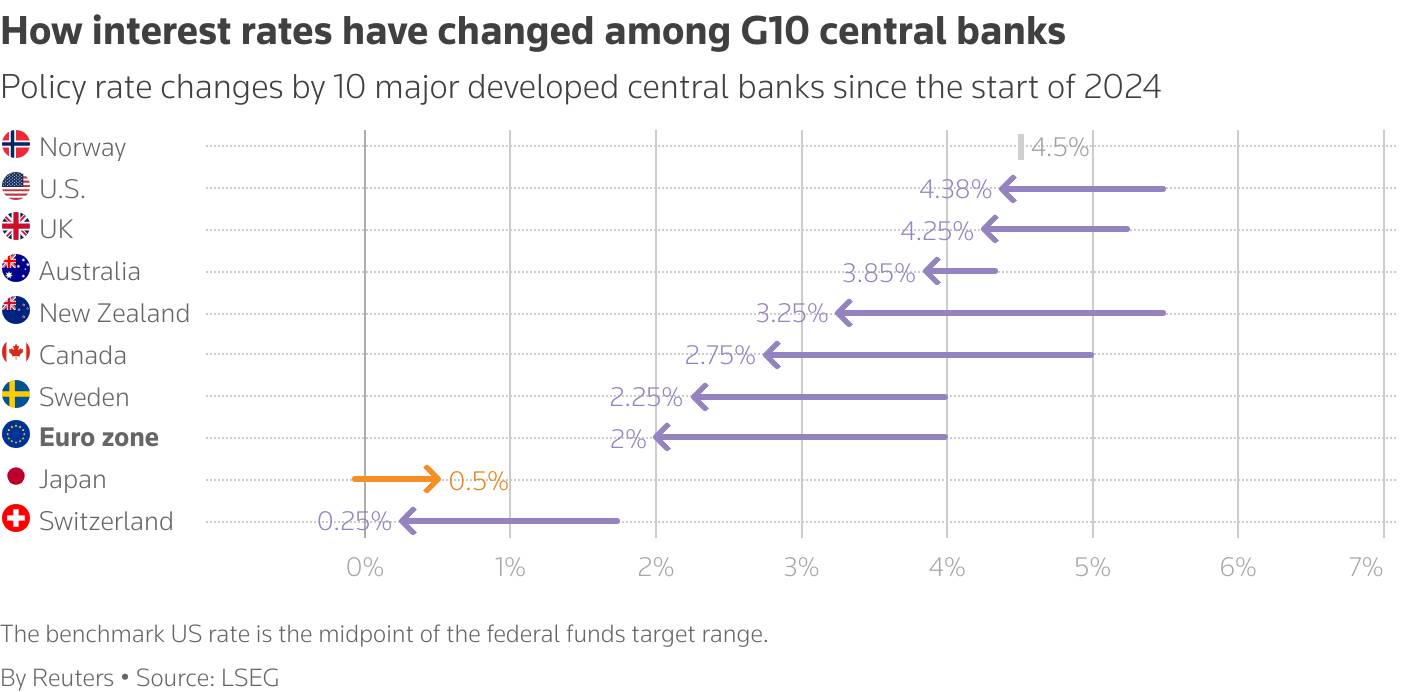
          Change in policy rates by 10 major developed central banks since March

          Lagarde said the decision on Thursday was virtually unanimous, with only one policymaker objecting to a cut.

          "Our central view is that today's cut is likely the last for some time," HSBC said in a note.

          Lagarde also said the euro zone appeared to be attracting more foreign investment, a sign of growing investor confidence and part of the reason why the euro has firmed so much since the U.S. administration embarked on its global trade war.

          But there is exceptional uncertainty in the outlook.

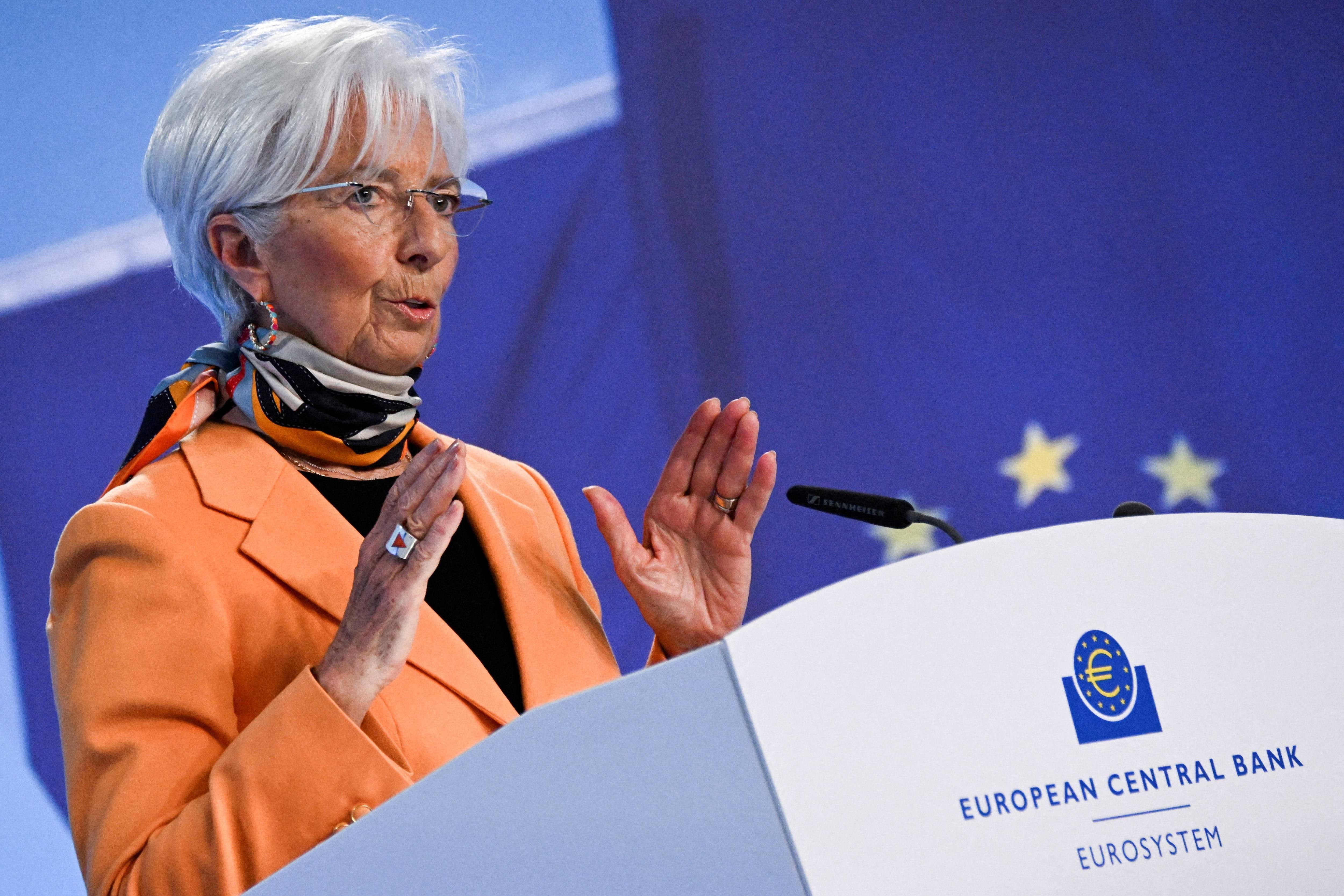
          European Central Bank (ECB) President Christine Lagarde speaks to the media following the Governing Council's monthly monetary policy meeting in Frankfurt, Germany, March 6, 2025. REUTERS/Jana Rodenbusch/File Photo Purchase Licensing Rights, opens new tab

          Falling energy prices and a stronger euro could put further downward pressure on inflation, said Lagarde, adding that effect could be reinforced if higher tariffs led to lower demand for euro exports and re-routing of overcapacity to Europe.

          Depending on the outcome of the trade war with the United States, inflation and growth could significantly differ from projections, the ECB said, as it took the unusual step of releasing alternative scenarios to its forecasts.

          PAUSE CASE

          The case for a pause rests on the premise that the short- and medium-term prospects for the currency bloc differ greatly and may require different policy responses.

          Inflation is set to dip in the short term and undershoot the ECB's target next year, but increased government spending and higher trade barriers will add to price pressures later.

          The added complication is that monetary policy impacts the economy with a 12-to-18 month lag, so support approved now could be giving help to a bloc that no longer needs it.

          "In our baseline, we expect the ECB to pause at the July meeting and deliver a final rate cut in September," PIMCO portfolio manager Konstantin Veit said. "A more recessionary configuration will likely be needed for the ECB to go faster and further in this cutting cycle."

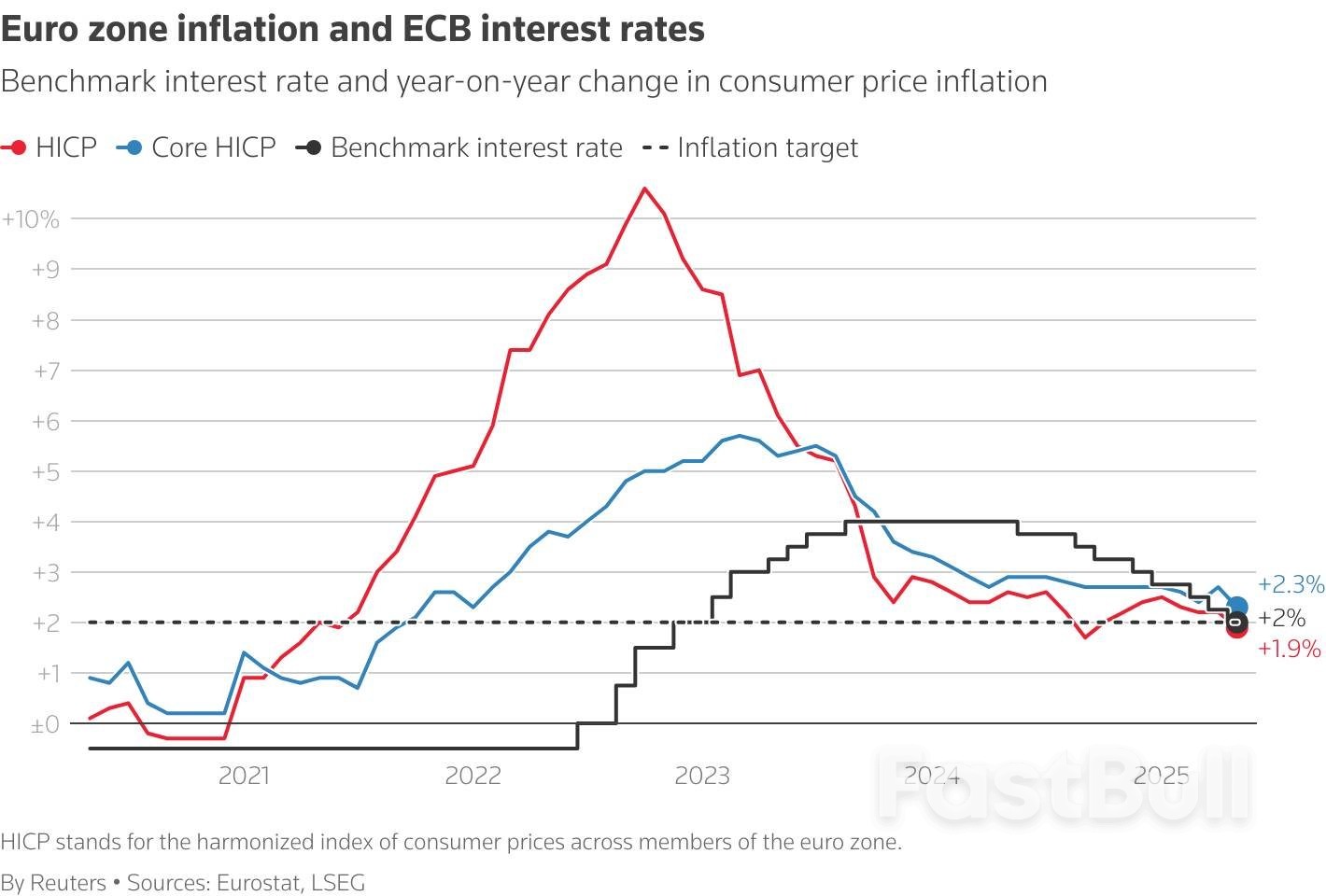
          A line chart comparing inflation metrics over the past five years.

          Acknowledging near-term weakness, the ECB cut its inflation projection for next year.

          U.S. President Donald Trump's tariffs are already damaging activity and will have a lasting impact even if an amicable resolution is found, given the hit to confidence and investment.

          Most economists think inflation could fall below the ECB's 2% target next year, triggering memories of the pre-pandemic decade when price growth persistently undershot 2%, even if projections show it back at target in 2027.

          Further ahead, the outlook changes significantly.

          The European Union is likely to retaliate against any permanent U.S. tariffs, raising the cost of trade. Firms could relocate some activity to avoid trade barriers but changes to corporate value chains are also likely to raise costs.

          Higher European defence spending, particularly by Germany, and the cost of the green transition could add to inflation while a shrinking workforce due to an ageing population will keep wage pressures elevated.

          Source: Reuters

          To stay updated on all economic events of today, please check out our Economic calendar
          Risk Warnings and Disclaimers
          You understand and acknowledge that there is a high degree of risk involved in trading. Following any strategies or investment methods may lead to potential losses. The content on the site is provided by our contributors and analysts for information purposes only. You are solely responsible for determining whether any trading assets, securities, strategy, or any other product is suitable for investing based on your own investment objectives and financial situation.
          Add to Favorites
          Share

          Big central banks' forecasting lens gets fogged by US tariffs

          Adam

          Economic

          Central Bank

          China–U.S. Trade War

          Unpredictable White House tariff rhetoric and its impact on currency markets, oil prices and the inflation outlook have put central banks across the world in a tight spot.
          The European Central Bank cut interest rates on Thursday and looks set to pause, Switzerland appears to be moving back towards negative rates, Japan's resolve to drop ultra-easy monetary policy is wobbling, and baffling U.S. data could keep the Federal Reserve in wait-and-see mode.
          Here's a look at where 10 developed-market central banks stand.

          SWITZERLAND

          The Swiss National Bank next meets on June 19, and traders see a one in three chance that it will pull rates back into negative territory from 0.25% currently after consumer prices fell for the first time in four years.
          The safe-haven Swiss franc has gained 10% against the dollar so far this year on geopolitical and market volatility. That's challenging Switzerland's export-heavy economy and cheapened imports, giving the SNB reasons to be wary about deflation.

          CANADA

          The Bank of Canada held rates at 2.75% on Wednesday and said another cut might be necessary if the economy weakened in the face of tariffs.
          The BoC has held rates for a second time in a row after an aggressive cutting cycle which shrunk rates by 225 basis points over nine months. Markets price in a roughly 85% chance of another quarter-point cut by September.

          NEW ZEALAND

          Money markets expect the Reserve Bank of New Zealand to hold steady on July 9 after a 25 bps rate cut to 3.25% in May to protect the China-focused economy. The RBNZ also warned that global trade uncertainties made future moves unclear.

          SWEDEN

          Sweden's central bank left its key rate unchanged at 2.25% in May but with on-again-off-again U.S. tariffs now having contributed to an economic contraction in the first quarter, the Riksbank has signaled more easing ahead. Its next rate decision is on June 18.

          EURO ZONE

          The ECB cut rates as expected on Thursday and kept all options on the table for its next meetings even as the case grows for a summer pause in its year-long easing cycle.
          It has lowered rates eight times in the last year, and markets price in one more rate cut by year-end.

          UNITED STATES

          The Fed, under consistent fire from President Donald Trump for resisting rate cuts, is expected to hold steady at its next June 18 meeting as tariff uncertainty makes wait-and-see its best option for now.
          With businesses spooked by Trump's aggressive trade talk, layoffs have increased, manufacturing orders have slumped and factory gate prices have surged, indicating stagflation risks that could moderate if the White House softens its stance.
          The Fed has held rates in the 4.25%-4.5% range since December, following 100 bps of cuts last year. Money markets price roughly 50 bps of further easing by year-end.

          BRITAIN

          The Bank of England, which has lowered borrowing costs slowly to accommodate bumpy inflation trends, cut rates by 25 bps to 4.25% last month and revealed an unexpected three-way split among its policymakers that signaled uncertainty ahead.
          Governor Andrew Bailey says the BoE was staying cautious amid unpredictable global trends. Traders expect no move in June and a 60% chance of a cut by August.

          AUSTRALIA

          Weak growth data and fears of Aussie commodities producers and miners taking big blows from a U.S.-China trade war means the Reserve Bank of Australia stands ready to ride to the rescue with rapid rate cuts.
          The RBA cut rates by 25 bps to 3.85% in May and traders see borrowing costs dropping to about 3% by year-end.

          NORWAY

          Norway's central bank has ditched plans to ease monetary policy as its oil-linked currency weakens amid global trade uncertainty, posing a fresh inflationary threat.
          The Norges Bank kept rates on hold at a 17-year high of 4.50% in May, and markets anticipate no change at the June 19 meeting.

          JAPAN

          The Bank of Japan, long expected to pursue rate hikes, faces a challenging mix of economic trends if tariffs hurt exports but inflation keeps rising.
          After the BoJ held borrowing costs steady at 0.5% in May, Governor Kazuo Ueda steadfastly refused to comment on the possible timing of the next increase.

          Source: Reuters

          To stay updated on all economic events of today, please check out our Economic calendar
          Risk Warnings and Disclaimers
          You understand and acknowledge that there is a high degree of risk involved in trading. Following any strategies or investment methods may lead to potential losses. The content on the site is provided by our contributors and analysts for information purposes only. You are solely responsible for determining whether any trading assets, securities, strategy, or any other product is suitable for investing based on your own investment objectives and financial situation.
          Add to Favorites
          Share
          FastBull
          Copyright © 2025 FastBull Ltd

          728 RM B 7/F GEE LOK IND BLDG NO 34 HUNG TO RD KWUN TONG KLN HONG KONG

          TelegramInstagramTwitterfacebooklinkedin
          App Store Google Play Google Play
          Products
          Charts

          Chats

          Q&A with Experts
          Screeners
          Economic Calendar
          Data
          Tools
          Membership
          Features
          Function
          Markets
          Copy Trading
          Latest Signals
          Contests
          News
          Analysis
          24/7
          Columns
          Education
          Company
          Careers
          About Us
          Contact Us
          Advertising
          Help Center
          Feedback
          User Agreement
          Privacy Policy
          Business

          White Label

          Data API

          Web Plug-ins

          Poster Maker

          Affiliate Program

          Risk Disclosure

          The risk of loss in trading financial instruments such as stocks, FX, commodities, futures, bonds, ETFs and crypto can be substantial. You may sustain a total loss of the funds that you deposit with your broker. Therefore, you should carefully consider whether such trading is suitable for you in light of your circumstances and financial resources.

          No decision to invest should be made without thoroughly conducting due diligence by yourself or consulting with your financial advisors. Our web content might not suit you since we don't know your financial conditions and investment needs. Our financial information might have latency or contain inaccuracy, so you should be fully responsible for any of your trading and investment decisions. The company will not be responsible for your capital loss.

          Without getting permission from the website, you are not allowed to copy the website's graphics, texts, or trademarks. Intellectual property rights in the content or data incorporated into this website belong to its providers and exchange merchants.

          Not Logged In

          Log in to access more features

          FastBull Membership

          Not yet

          Purchase

          Become a signal provider
          Help Center
          Customer Service
          Dark Mode
          Price Up/Down Colors

          Log In

          Sign Up

          Position
          Layout
          Fullscreen
          Default to Chart
          The chart page opens by default when you visit fastbull.com