• Trade
  • Markets
  • Copy
  • Contests
  • News
  • 24/7
  • Calendar
  • Q&A
  • Chats
Trending
Screeners
SYMBOL
LAST
BID
ASK
HIGH
LOW
NET CHG.
%CHG.
SPREAD
SPX
S&P 500 Index
6839.41
6839.41
6839.41
6878.28
6827.18
-30.99
-0.45%
--
DJI
Dow Jones Industrial Average
47692.44
47692.44
47692.44
47971.51
47611.93
-262.54
-0.55%
--
IXIC
NASDAQ Composite Index
23510.84
23510.84
23510.84
23698.93
23455.05
-67.27
-0.29%
--
USDX
US Dollar Index
99.010
99.090
99.010
99.160
98.730
+0.060
+ 0.06%
--
EURUSD
Euro / US Dollar
1.16393
1.16400
1.16393
1.16717
1.16162
-0.00033
-0.03%
--
GBPUSD
Pound Sterling / US Dollar
1.33266
1.33276
1.33266
1.33462
1.33053
-0.00046
-0.03%
--
XAUUSD
Gold / US Dollar
4186.13
4186.54
4186.13
4218.85
4175.92
-11.78
-0.28%
--
WTI
Light Sweet Crude Oil
58.597
58.627
58.597
60.084
58.495
-1.212
-2.03%
--

Community Accounts

Signal Accounts
--
Profit Accounts
--
Loss Accounts
--
View More

Become a signal provider

Sell trading signals to earn additional income

View More

Guide to Copy Trading

Get started with ease and confidence

View More

Signal Accounts for Members

All Signal Accounts

Best Return
  • Best Return
  • Best P/L
  • Best MDD
Past 1W
  • Past 1W
  • Past 1M
  • Past 1Y

All Contests

  • All
  • Trump Updates
  • Recommend
  • Stocks
  • Cryptocurrencies
  • Central Banks
  • Featured News
Top News Only
Share

Trump: Farming Equipment Has Gotten Too Expensive

Share

Trump: We Will Take Off A Lot Of Environment Rules That Affect Tractor Companies

Share

Kremlin Says Still No Word On US-Ukraine Talks In Florida

Share

Trump: USA Will Take Small Portion Of Tariff Revenues To Give It To Farmers

Share

Trump: Taking Action To Protect Farmers

Share

Nymex January Gasoline Futures Closed At $1.7981 Per Gallon, And Nymex January Heating Oil Futures Closed At $2.2982 Per Gallon

Share

USA Crude Oil Futures Settle At $58.88/Bbl, Down $1.20, 2.00 Percent

Share

Netflix Co-CEO On Warner Bros Deal: We Are Very Confident That Regulators Should And Will Approve It

Share

Alina Habba, The Interim Federal Prosecutor For New Jersey, Has Resigned. This Follows An Appeals Court Ruling That President Trump's Nomination Of Her Was Illegitimate

Share

Netflix Co-CEO On Paramount Skydance Bid For Warner Bros Says The Move Was Entirely Expected- UBS Conf

Share

U.S. Senate Democratic Member And Antitrust Activist Warren Stated That Paramount Skydance's Hostile Takeover Offer Triggered A "Level 5 Antitrust Alert."

Share

Benin Government: Coup Plotters Kidnapped Two Senior Military Officials Who Were Later Freed

Share

Canada: G7 Finance Ministers Discussed Export Controls And Critical Minerals In Call

Share

Benin Government: Nigeria Carried Out Air Strikes To Help Thwart Coup Bid

Share

Fitch: Expects General Government (Gg) Deficit To Fall Modestly In Canada And But Rise Modestly In USA In 2026

Share

An Important Point Of Consensus Was Concern Regarding Application Of Non-Market Policies, Including Export Controls, To Critical Minerals Supply Chains

Share

Fitch: Despite Full-Year Impact Of Tariffs, We Expect USA Fiscal Deficit To Widen In 2026 Due To Additional Tax Cuts Under One Big Beautiful Bill Act

Share

Private Equity Firm Cinven Has Signed A £190 Million Deal To Acquire A Majority Stake In UK Advisory Firm Flint Global

Share

Bank Of England's Taylor Expects Inflation To Fall To Target 'In The Near Term'

Share

Ukraine President Zelenskiy: He Will Travel To Italy On Tuesday

TIME
ACT
FCST
PREV
France Trade Balance (SA) (Oct)

A:--

F: --

P: --
Euro Zone Employment YoY (SA) (Q3)

A:--

F: --

P: --
Canada Part-Time Employment (SA) (Nov)

A:--

F: --

P: --

Canada Unemployment Rate (SA) (Nov)

A:--

F: --

P: --

Canada Full-time Employment (SA) (Nov)

A:--

F: --

P: --

Canada Labor Force Participation Rate (SA) (Nov)

A:--

F: --

P: --

Canada Employment (SA) (Nov)

A:--

F: --

P: --

U.S. PCE Price Index MoM (Sept)

A:--

F: --

P: --

U.S. Personal Income MoM (Sept)

A:--

F: --

P: --

U.S. Core PCE Price Index MoM (Sept)

A:--

F: --

P: --

U.S. PCE Price Index YoY (SA) (Sept)

A:--

F: --

P: --

U.S. Core PCE Price Index YoY (Sept)

A:--

F: --

P: --

U.S. Personal Outlays MoM (SA) (Sept)

A:--

F: --

P: --
U.S. 5-10 Year-Ahead Inflation Expectations (Dec)

A:--

F: --

P: --

U.S. Real Personal Consumption Expenditures MoM (Sept)

A:--

F: --

P: --
U.S. Weekly Total Rig Count

A:--

F: --

P: --

U.S. Weekly Total Oil Rig Count

A:--

F: --

P: --

U.S. Consumer Credit (SA) (Oct)

A:--

F: --

P: --
China, Mainland Foreign Exchange Reserves (Nov)

A:--

F: --

P: --

Japan Trade Balance (Oct)

A:--

F: --

P: --

Japan Nominal GDP Revised QoQ (Q3)

A:--

F: --

P: --

China, Mainland Imports YoY (CNH) (Nov)

A:--

F: --

P: --

China, Mainland Exports (Nov)

A:--

F: --

P: --

China, Mainland Imports (CNH) (Nov)

A:--

F: --

P: --

China, Mainland Trade Balance (CNH) (Nov)

A:--

F: --

P: --

China, Mainland Exports YoY (USD) (Nov)

A:--

F: --

P: --

China, Mainland Imports YoY (USD) (Nov)

A:--

F: --

P: --

Germany Industrial Output MoM (SA) (Oct)

A:--

F: --

P: --
Euro Zone Sentix Investor Confidence Index (Dec)

A:--

F: --

P: --

Canada National Economic Confidence Index

A:--

F: --

P: --

U.K. BRC Like-For-Like Retail Sales YoY (Nov)

--

F: --

P: --

U.K. BRC Overall Retail Sales YoY (Nov)

--

F: --

P: --

Australia Overnight (Borrowing) Key Rate

--

F: --

P: --

RBA Rate Statement
RBA Press Conference
Germany Exports MoM (SA) (Oct)

--

F: --

P: --

U.S. NFIB Small Business Optimism Index (SA) (Nov)

--

F: --

P: --

Mexico 12-Month Inflation (CPI) (Nov)

--

F: --

P: --

Mexico Core CPI YoY (Nov)

--

F: --

P: --

Mexico PPI YoY (Nov)

--

F: --

P: --

U.S. Weekly Redbook Index YoY

--

F: --

P: --

U.S. JOLTS Job Openings (SA) (Oct)

--

F: --

P: --

China, Mainland M1 Money Supply YoY (Nov)

--

F: --

P: --

China, Mainland M0 Money Supply YoY (Nov)

--

F: --

P: --

China, Mainland M2 Money Supply YoY (Nov)

--

F: --

P: --

U.S. EIA Short-Term Crude Production Forecast For The Year (Dec)

--

F: --

P: --

U.S. EIA Natural Gas Production Forecast For The Next Year (Dec)

--

F: --

P: --

U.S. EIA Short-Term Crude Production Forecast For The Next Year (Dec)

--

F: --

P: --

EIA Monthly Short-Term Energy Outlook
U.S. API Weekly Gasoline Stocks

--

F: --

P: --

U.S. API Weekly Cushing Crude Oil Stocks

--

F: --

P: --

U.S. API Weekly Crude Oil Stocks

--

F: --

P: --

U.S. API Weekly Refined Oil Stocks

--

F: --

P: --

South Korea Unemployment Rate (SA) (Nov)

--

F: --

P: --

Japan Reuters Tankan Non-Manufacturers Index (Dec)

--

F: --

P: --

Japan Reuters Tankan Manufacturers Index (Dec)

--

F: --

P: --

Japan Domestic Enterprise Commodity Price Index MoM (Nov)

--

F: --

P: --

Japan Domestic Enterprise Commodity Price Index YoY (Nov)

--

F: --

P: --

China, Mainland PPI YoY (Nov)

--

F: --

P: --

China, Mainland CPI MoM (Nov)

--

F: --

P: --

Italy Industrial Output YoY (SA) (Oct)

--

F: --

P: --

Q&A with Experts
    • All
    • Chatrooms
    • Groups
    • Friends
    Connecting
    .
    .
    .
    Type here...
    Add Symbol or Code

      No matching data

      All
      Trump Updates
      Recommend
      Stocks
      Cryptocurrencies
      Central Banks
      Featured News
      • All
      • Russia-Ukraine Conflict
      • Middle East Flashpoint
      • All
      • Russia-Ukraine Conflict
      • Middle East Flashpoint
      Search
      Products

      Charts Free Forever

      Chats Q&A with Experts
      Screeners Economic Calendar Data Tools
      Membership Features
      Data Warehouse Market Trends Institutional Data Policy Rates Macro

      Market Trends

      Market Sentiment Order Book Forex Correlations

      Top Indicators

      Charts Free Forever
      Markets

      News

      News Analysis 24/7 Columns Education
      From Institutions From Analysts
      Topics Columnists

      Latest Views

      Latest Views

      Trending Topics

      Top Columnists

      Latest Update

      Signals

      Copy Rankings Latest Signals Become a signal provider AI Rating
      Contests
      Brokers

      Overview Brokers Assessment Rankings Regulators News Claims
      Broker listing Forex Brokers Comparison Tool Live Spread Comparison Scam
      Q&A Complaint Scam Alert Videos Tips to Detect Scam
      More

      Business
      Events
      Careers About Us Advertising Help Center

      White Label

      Data API

      Web Plug-ins

      Affiliate Program

      Awards Institution Evaluation IB Seminar Salon Event Exhibition
      Vietnam Thailand Singapore Dubai
      Fans Party Investment Sharing Session
      FastBull Summit BrokersView Expo
      Recent Searches
        Top Searches
          Markets
          News
          Analysis
          User
          24/7
          Economic Calendar
          Education
          Data
          • Names
          • Latest
          • Prev

          View All

          No data

          Scan to Download

          Faster Charts, Chat Faster!

          Download App
          English
          • English
          • Español
          • العربية
          • Bahasa Indonesia
          • Bahasa Melayu
          • Tiếng Việt
          • ภาษาไทย
          • Français
          • Italiano
          • Türkçe
          • Русский язык
          • 简中
          • 繁中
          Open Account
          Search
          Products
          Charts Free Forever
          Markets
          News
          Signals

          Copy Rankings Latest Signals Become a signal provider AI Rating
          Contests
          Brokers

          Overview Brokers Assessment Rankings Regulators News Claims
          Broker listing Forex Brokers Comparison Tool Live Spread Comparison Scam
          Q&A Complaint Scam Alert Videos Tips to Detect Scam
          More

          Business
          Events
          Careers About Us Advertising Help Center

          White Label

          Data API

          Web Plug-ins

          Affiliate Program

          Awards Institution Evaluation IB Seminar Salon Event Exhibition
          Vietnam Thailand Singapore Dubai
          Fans Party Investment Sharing Session
          FastBull Summit BrokersView Expo

          Iran’s Khamenei Says US Nuclear Talks Unlikely to Yield Results

          Glendon

          Political

          Summary:

          Iranian Supreme Leader Ayatollah Ali Khamenei said he doesn’t think negotiations with the US over his country’s nuclear program will succeed and urged the Trump administration to stop “talking nonsense.”

          Iranian Supreme Leader Ayatollah Ali Khamenei said he doesn’t think negotiations with the US over his country’s nuclear program will succeed and urged the Trump administration to stop “talking nonsense.”

          Referring to the fact that talks with the US hadn’t succeeded under former President Ebrahim Raisi, Khamenei said “there were indirect negotiations during his time as well, just like now, but they were without result. We also don’t think they’ll lead to a result now. We don’t know what will happen.”

          Benchmark Brent oil rose as the comments threw fresh uncertainty on the prospect of Washington and Tehran reaching a deal to lift sanctions on Iran’s oil exports and broader economy in exchange for caps on its atomic activity.

          Khamenei, who’s the ultimate decision maker in the Islamic Republic, said it was “outrageous” that the US has demanded that Iran dismantle its uranium-enrichment program.

          “No one is waiting for this or that party’s permission. The Islamic Republic has its own policies, its own approach, and it follows its own path,” he said in comments on Iranian state TV.

          Source: Bloomberg Europe

          Risk Warnings and Disclaimers
          You understand and acknowledge that there is a high degree of risk involved in trading. Following any strategies or investment methods may lead to potential losses. The content on the site is provided by our contributors and analysts for information purposes only. You are solely responsible for determining whether any trading assets, securities, strategy, or any other product is suitable for investing based on your own investment objectives and financial situation.
          Add to Favorites
          Share

          Trump Mediates Ceasefire Talks as Russia and Ukraine Signal Openness, But Substantive Progress Eludes

          Gerik

          Russia-Ukraine Conflict

          Trump Steps into Peace Mediation with Bold Ceasefire Claim

          Former President Donald Trump declared that Russia and Ukraine would begin negotiations for a ceasefire “immediately” following a phone call with President Vladimir Putin. Trump, who subsequently briefed Ukrainian President Volodymyr Zelenskiy and key European leaders, emphasized potential progress toward ending the war. Yet, the Kremlin's statements struck a more cautious tone, noting that talks would be gradual and without deadlines.
          Putin acknowledged the resumption of dialogue with Ukraine and expressed willingness to work on a memorandum defining principles for a possible peace accord. While Trump painted the talks as a breakthrough, Putin’s response merely suggested they were “on the right track”—highlighting a discrepancy in both narrative and urgency.

          Differing Strategic Approaches Between Washington and Europe

          Despite Trump's optimistic framing, his hesitation to impose new sanctions drew concern from European leaders. While German Chancellor Friedrich Merz announced increased sanctions on Russia after the call, Trump defended his softer approach by arguing that pressure tactics might derail peace efforts. He stated bluntly, “This is not my war,” signaling that his involvement could remain conditional.
          This divergence reflects more than tactical differences; it reveals a growing strategic disconnect. European leaders, aiming to corner Moscow economically, are frustrated by Washington’s perceived passivity. Ursula von der Leyen diplomatically described the conversation with Trump as “good,” but internal reports suggest EU leaders were “shocked” at Trump’s leniency.

          Memorandum Discussions Begin, But Peace Remains Distant

          Both Moscow and Kyiv have agreed to draft a memorandum outlining the foundations for peace. Kremlin officials confirmed that negotiations are set to begin, but emphasized the complexity of reaching a unified document. Kremlin spokesperson Dmitry Peskov noted the absence of any deadlines, adding that “the devil is in the details.”
          Trump had initially sought a 30-day ceasefire commitment, but Putin rejected the imposition of timeframes, reiterating that specific conditions must be met before hostilities can end. His insistence on Ukrainian troop withdrawals from four occupied regions remains a core obstacle.
          Moreover, the Trump-Putin discussion also touched on a potential prisoner swap—nine Russians for nine Americans—showcasing a dual-track negotiation approach covering both battlefield and diplomatic fronts.

          Kyiv Seeks Broader Diplomatic Framework

          President Zelenskiy responded to Trump’s outreach by calling for a high-level international summit involving Ukraine, Russia, the U.S., EU countries, and the UK. He proposed that such talks could be hosted by Turkey, Switzerland, or the Vatican. Trump mentioned Pope Leo had shown interest in hosting the negotiations, but no formal arrangements have been confirmed.
          Zelenskiy reiterated Kyiv’s willingness to participate in direct negotiations “in any format that brings results,” signaling flexibility despite skepticism about Moscow’s sincerity. The lack of clarity about whether this broader meeting is part of Trump’s proposed process leaves key diplomatic architecture undefined.

          Putin’s Strategic Positioning Amid Ongoing Offensives

          Despite participating in talks, Russia continues its military operations. Putin currently holds control over one-fifth of Ukraine and shows no sign of yielding ground. Analysts such as former Swedish PM Carl Bildt warned that the Kremlin is leveraging negotiations to deflect pressure while maintaining its battlefield advantage. This dual strategy enables Moscow to extract concessions without halting its advance.
          Putin emphasized that the coming memorandum would not only set out potential timelines for peace but also focus on “eliminating the root causes” of the war. This framing suggests that Moscow seeks a structural settlement on its terms, rather than immediate de-escalation.
          While Trump’s announcement of ceasefire talks has injected momentum into stalled diplomatic efforts, the lack of a clear framework, differing strategic interests, and Russia’s continued offensives all point to a complex road ahead. Without binding commitments or timelines, and with Trump’s reluctance to apply pressure on Moscow, the initiative risks becoming more symbolic than substantive. The coming weeks will test whether this opening leads to durable negotiations or merely prolongs the status quo under the guise of dialogue.

          Source: Reuters

          Risk Warnings and Disclaimers
          You understand and acknowledge that there is a high degree of risk involved in trading. Following any strategies or investment methods may lead to potential losses. The content on the site is provided by our contributors and analysts for information purposes only. You are solely responsible for determining whether any trading assets, securities, strategy, or any other product is suitable for investing based on your own investment objectives and financial situation.
          Add to Favorites
          Share

          RBA Lowers Cash Rate to 3.85% Amid Global Uncertainty and Domestic Inflation Ease

          Gerik

          Economic

          Australia Responds to Global Headwinds with Rate Cut

          On May 20, 2025, the Reserve Bank of Australia (RBA) lowered its main cash rate by 25 basis points to 3.85%, a two-year low, citing diminishing inflationary pressure and increased external risks. This decision, anticipated by financial markets, reflects the RBA’s strategic recalibration in light of a more fragile global economic environment—particularly the fallout from the United States' aggressive tariff regime.
          The Australian dollar reacted by dropping 0.4% to USD 0.6430, while bond futures and interest rate swaps adjusted to price in further easing, implying as much as 57 basis points in cumulative rate reductions by year-end.

          Inflation Returns to Target, But Labour Market Remains Tight

          Inflation figures provided further support for the rate cut. Headline consumer price inflation was recorded at 2.4% for Q1 2025, while core inflation, represented by the trimmed mean measure, dropped to 2.9%. These are the first readings within the RBA’s 2%–3% target range since late 2021.
          Despite these favorable trends, the RBA remains cautious, noting persistent structural challenges. A tight labor market—with unemployment holding steady at 4.1%—continues to exert upward pressure on wages. However, recent wage growth was largely driven by public sector adjustments, suggesting limited spillover into broader wage-price inflation.

          Global Trade Instability a Key Consideration

          The external environment has become more volatile since the RBA’s April meeting. U.S. President Donald Trump’s sweeping 10% tariffs on global imports have destabilized financial markets and triggered uncertainty across global supply chains. Although a temporary tariff truce with China has been reached, lasting only 90 days, the lingering threat of renewed escalation remains high.
          Australia’s exposure to global trade, particularly through its commodity exports to China, places it in a vulnerable position. A slowdown in Chinese demand for resources such as iron ore could transmit a direct negative shock to Australia's export-driven growth model.

          Domestic Economic Data Offers Mixed Signals

          While inflation is cooling, other domestic indicators present a complex picture. Consumer spending has been weaker than anticipated, undermining hopes for a demand-led recovery. In contrast, employment remains resilient, and wage gains—although sector-specific—suggest there is still latent demand in the economy.
          The RBA's updated quarterly Statement on Monetary Policy projects softer inflation and higher unemployment, even assuming further monetary easing. This cautious outlook reflects the expected downstream effects of trade disruptions and reduced global demand, reinforcing the bank’s emphasis on risk management over aggressive stimulus.

          Forward Guidance: Easing Bias, But Not Complacency

          According to Sean Langcake of Oxford Economics Australia, the current rate remains mildly restrictive. He anticipates at least two additional rate cuts in the second half of 2025, assuming no significant deterioration in the external environment. The RBA’s own language—"somewhat less restrictive"—signals an openness to further easing but with clear conditionality. Productivity remains weak, and any unexpected inflationary shock could stall the easing cycle.
          Australia’s rate cut to 3.85% reflects a balance between domestic inflation moderation and growing global economic threats. While the RBA is easing policy to buffer against external shocks and support consumer demand, its cautious tone indicates that future moves will be contingent on evolving data. With global trade uncertainty and internal structural fragilities at play, the path ahead remains finely poised between stabilization and renewed volatility.

          Source: Reuters


          To stay updated on all economic events of today, please check out our Economic calendar
          Risk Warnings and Disclaimers
          You understand and acknowledge that there is a high degree of risk involved in trading. Following any strategies or investment methods may lead to potential losses. The content on the site is provided by our contributors and analysts for information purposes only. You are solely responsible for determining whether any trading assets, securities, strategy, or any other product is suitable for investing based on your own investment objectives and financial situation.
          Add to Favorites
          Share

          Gold (XAUUSD) At A Crossroads: Bostic’s Speech Could Change Everything

          James Whitman

          Economic

          Commodity

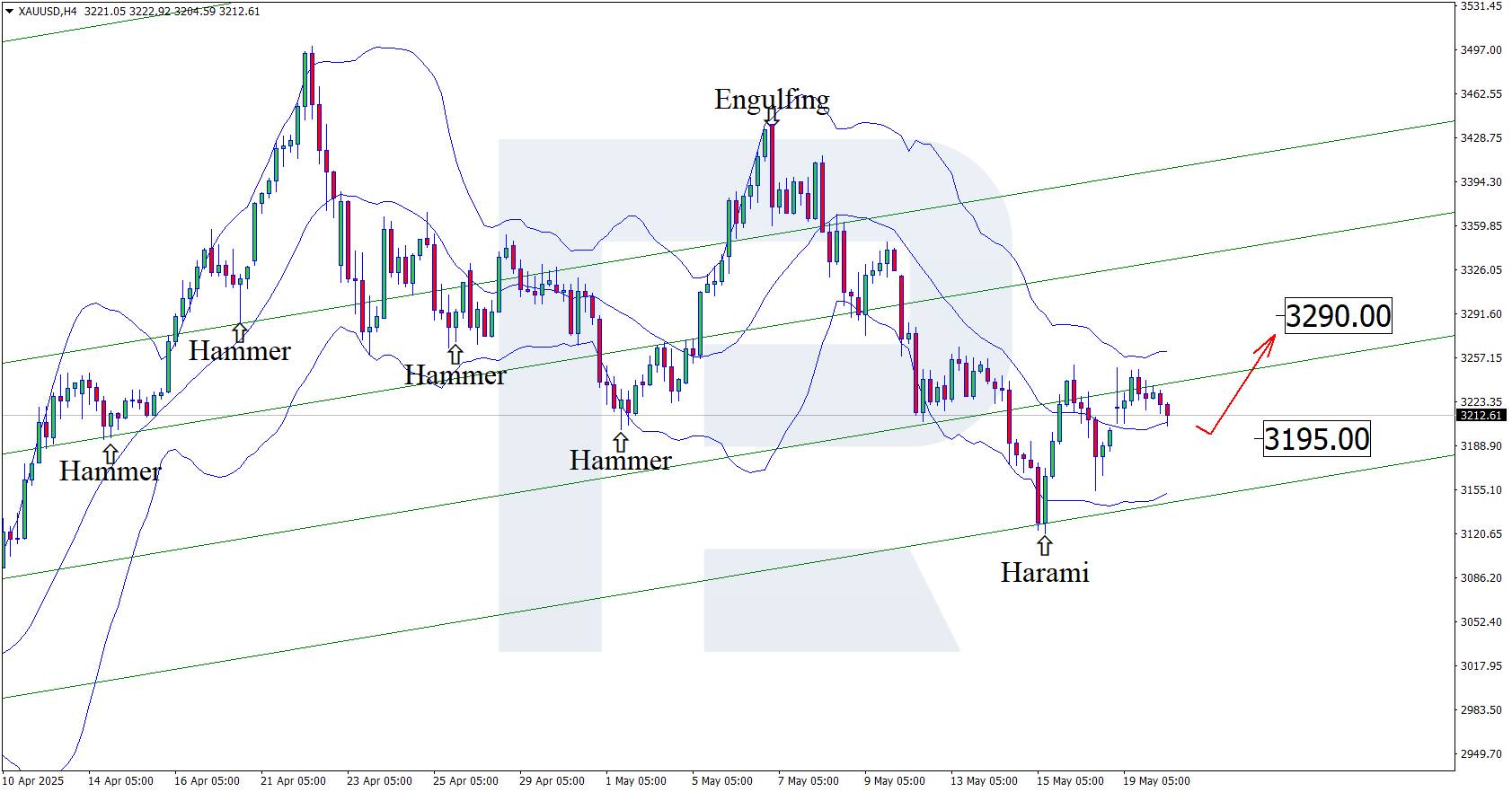
          FOMC member Raphael W. Bostic’s upcoming speech may trigger a rise in XAUUSD quotes towards 3,290 USD.

          XAUUSD forecast: key trading points

          ● FOMC member Raphael W. Bostic’s speech
          ● Current trend: moving upwards
          ● XAUUSD forecast for 20 May 2025: 3,290 and 3,195

          Fundamental analysis

          As of today, gold (XAUUSD) is trading around 3,215 USD per ounce, showing moderate losses as the US dollar strengthens. However, the downgrade of the US credit rating by Moody’s to Aa1 restrains further declines and supports safe-haven demand for gold.

          On 20 May 2025, Federal Reserve Bank of Atlanta President and FOMC member Raphael Bostic will speak at the Financial Markets Conference. His speech is expected to provide key signals about future US monetary policy.

          What to watch in Bostic’s remarks:

          ● Cautious stance on rate cuts: Bostic has previously said he expects only one rate cut in 2025, stressing the need for more time to assess the economic effects of new tariffs
          ● Inflation concerns: he expressed concern about persistent inflation, especially in the housing sector, noting that despite progress, the 2% inflation target has yet to be achieved
          ● Economic resilience: Bostic stated that the economy remains resilient, though less so than expected at the start of the year, highlighting considerable uncertainty in the current outlook

          Near-term XAUUSD price forecasts suggest a possible correction towards 3,195 USD. However, in the long term, XAUUSD quotes are expected to rise to 3,900 USD by the end of the year.

          XAUUSD technical analysis

          On the H4 chart, XAUUSD prices have formed a Harami reversal pattern near the lower Bollinger Band. They are currently developing an upward wave based on that signal. Since XAUUSD quotes stay within the ascending channel, the bullish trend is expected to develop further. The immediate upside target could be the 3,290 USD resistance level.

          At the same time, today’s XAUUSD technical analysis also considers an alternative scenario, with prices correcting towards 3,195 USD before the next upward move.

          Once the correction completes, XAUUSD prices could aim for a new all-time high, targeting the 3,900 USD level.

          Summary

          The US credit rating downgrade, combined with technical analysis, supports a potential XAUUSD rise towards 3,290 USD following a correction.

          Source: RoboForex

          To stay updated on all economic events of today, please check out our Economic calendar
          Risk Warnings and Disclaimers
          You understand and acknowledge that there is a high degree of risk involved in trading. Following any strategies or investment methods may lead to potential losses. The content on the site is provided by our contributors and analysts for information purposes only. You are solely responsible for determining whether any trading assets, securities, strategy, or any other product is suitable for investing based on your own investment objectives and financial situation.
          Add to Favorites
          Share

          India Races Against Time to Secure Trade Pact with Trump Before July Tariffs

          Gerik

          Economic

          Strategic Push for a Bilateral Breakthrough

          India is intensifying its diplomatic and economic engagements with the United States in pursuit of a phased trade agreement, aiming to pre-emptively soften the impact of a new round of retaliatory tariffs expected from the Trump administration by July. This urgency highlights India’s desire to secure a framework that preserves its export competitiveness while gaining improved access to the American market.
          The proposed structure of negotiations includes three distinct stages. The first phase—considered a temporary but critical breakthrough—focuses on market liberalization for industrial goods, select agricultural commodities, and the removal of key non-tariff barriers such as stringent quality standards. This short-term deal, though limited in scope, could serve as a stabilizing bridge to more comprehensive agreements later in the year.

          Diplomatic Engagements and Tactical Coordination

          Commerce Minister Piyush Goyal’s four-day visit to Washington underscores the weight India places on this initiative. His scheduled meetings with U.S. Trade Representative Jamieson Greer and Commerce Secretary Howard Lutnick are aimed at accelerating progress, though official confirmation from either government remains elusive. The visit, occurring in parallel with active tariff threats, reflects the dual-track nature of pressure and partnership that currently defines Indo-U.S. trade relations.
          Although Indian negotiators have embraced the phased approach, it is not yet clear whether the Trump administration is aligned with this format. Washington’s position remains ambiguous as talks continue behind closed doors.

          Roadmap to a Comprehensive Pact

          The second phase of the negotiations is designed to be broader and more institutional, potentially encompassing up to 19 sectors. This stage, according to Indian officials, may reach completion between September and November 2025, aligning with a planned visit by President Trump to India for the Quad Leaders Summit. The alignment of timelines suggests a deliberate effort by New Delhi to anchor economic diplomacy within wider strategic dialogues in the Indo-Pacific.
          The final and most ambitious phase envisions a full-spectrum bilateral trade agreement. However, progress here is contingent upon approval from the U.S. Congress, introducing a layer of political uncertainty that could delay completion well into 2026.

          Mutual Interests Amid Rising Tensions

          India has been among the first nations to initiate bilateral trade discussions with the Trump administration following the latter’s assumption of office in February. The momentum from Prime Minister Narendra Modi’s early visit to the White House provided an initial boost, with both sides expressing shared ambitions for enhanced economic cooperation. At that time, both leaders articulated the goal of finalizing the first stage of the agreement before autumn.
          However, recent developments signal a more contentious undercurrent. Last week, New Delhi threatened retaliatory tariffs on American imports—marking a shift toward a tougher negotiating posture. In parallel, President Trump claimed that India had offered to remove tariffs on U.S. products entirely, although he also noted that he was under no pressure to finalize a deal quickly. This disparity between negotiation timelines and political signaling from both sides adds complexity to the outlook.
          India’s pursuit of a phased trade deal with the United States is driven by a pragmatic blend of geopolitical necessity and economic foresight. While short-term agreements may mitigate tariff shocks, the path to a comprehensive bilateral trade pact remains uncertain, shaped by internal politics in Washington and strategic recalibrations in New Delhi. The ability of both sides to navigate mutual expectations in the coming months will determine whether this initiative results in substantive gains or stalls under rising pressures.

          Source: The Economic Times

          To stay updated on all economic events of today, please check out our Economic calendar
          Risk Warnings and Disclaimers
          You understand and acknowledge that there is a high degree of risk involved in trading. Following any strategies or investment methods may lead to potential losses. The content on the site is provided by our contributors and analysts for information purposes only. You are solely responsible for determining whether any trading assets, securities, strategy, or any other product is suitable for investing based on your own investment objectives and financial situation.
          Add to Favorites
          Share

          Exchange Rate Update May 20: USD Edges Up Domestically, Falls Sharply on Global Markets; Yuan Holds Steady

          Gerik

          Forex

          Domestic Market: USD Rises Slightly, CNY Stable

          At 8:15 AM, Vietcombank and BIDV both listed the USD at 25,760 VND/USD (buy) and 26,120 VND/USD (sell), an increase of 20 VND in both directions compared to the morning of May 19.
          The central exchange rate set by the State Bank of Vietnam decreased slightly by 2 VND to 24,968 VND/USD. With a ±5% trading band, the allowable ceiling rate is 26,216 VND/USD and the floor is 23,720 VND/USD. At the State Bank's Exchange, the reference rates remained at 23,772 VND/USD (buy) and 26,168 VND/USD (sell).
          Meanwhile, the yuan held steady. Vietcombank quoted it at 3,539–3,653 VND/CNY, and BIDV at 3,557–3,654 VND/CNY, with no changes from the previous day.
          On the free market, the USD traded at 26,344–26,444 VND/USD, rising 25 VND on the buying side and 5 VND on the selling side.

          Global Market: USD Plunges as Risk Sentiment Shifts

          The U.S. Dollar Index (DXY) dropped by 0.71% to 100.38, hitting its lowest level in more than a week. The dollar weakened across the board due to growing global trade tensions and a flight to safe-haven assets following the U.S. credit rating downgrade and trade war escalation.
          Against key currencies:
          The USD fell 0.5% to 144.98 yen, with an intraday low of 144.665 — its weakest level since May 8.
          It dropped to 0.8317 Swiss franc, also a one-week low.
          The euro strengthened 0.6% to 1.1232 USD, while the British pound rose to 1.3355 USD, its highest since late April, buoyed by renewed UK–EU relations.

          Analyst Commentary: Short-Term USD Pressure Expected

          Experts believe the recent dollar weakness reflects growing risk aversion in financial markets and concerns over long-term U.S. fiscal sustainability. The downgrade by Moody’s and rising geopolitical risks are pushing investors toward currencies perceived as safer, such as the yen, franc, and euro.
          While the USD had enjoyed a prolonged rally, this correction indicates market skepticism about Washington’s trade policies and budget management under President Trump, especially as talks with major trading partners remain uncertain.
          Domestically, the USD shows slight strength, but internationally, investors are increasingly turning away from dollar assets in favor of safer alternatives amid a complex mix of fiscal, political, and trade-related headwinds. As markets watch for further developments in U.S.–China negotiations and Fed policy signals, exchange rate volatility is likely to persist.
          Risk Warnings and Disclaimers
          You understand and acknowledge that there is a high degree of risk involved in trading. Following any strategies or investment methods may lead to potential losses. The content on the site is provided by our contributors and analysts for information purposes only. You are solely responsible for determining whether any trading assets, securities, strategy, or any other product is suitable for investing based on your own investment objectives and financial situation.
          Add to Favorites
          Share

          Germany Tightens Budget Despite €500 Billion Special Fund

          Gerik

          Economic

          Germany’s Fiscal Strain and Political Backdrop

          Germany's budget process for 2025 is unfolding under unusual political and economic pressures. Following the collapse of the previous "traffic light" coalition in November 2024 due to irreconcilable differences over fiscal policy, the new grand coalition between the Social Democratic Party (SPD) and the Christian Democratic bloc (CDU/CSU) has inherited a complex fiscal landscape. Since the Bundestag has yet to pass a formal budget for the current year, the federal government is operating under a temporary budget that allows only essential expenditures.
          Finance Minister Lars Klingbeil, also the SPD leader, is pushing for budget cuts and expenditure control, emphasizing that the existence of a special €500 billion fund should not justify complacency. "We cannot sit back just because we have a special fund for infrastructure and defense outside the debt brake," Klingbeil told dpa.

          The Role of the €500 Billion Special Fund

          Established through an amendment to Germany’s Basic Law (constitution), the special fund is designed to modernize critical infrastructure and boost defense spending in response to security and geopolitical pressures, including the war in Ukraine. The fund is exempt from the national debt brake, which constitutionally limits new borrowing. However, Klingbeil stressed that this fund is meant for future-oriented investment, not as a stopgap for structural budget shortfalls.
          The draft federal budget for 2025 is scheduled for cabinet approval on June 25. This will be followed by a first reading in the Bundestag before the summer recess, with final parliamentary approval expected by September. Planning for the 2026 budget will also begin soon and is anticipated to conclude by the end of this year.
          Klingbeil faces the difficult task of reconciling investment ambitions with constitutional debt limits and declining tax revenue projections. The most recent fiscal estimates suggest a shortfall of €33.3 billion by 2029 compared to projections made in October 2024, further fueling concerns about the sustainability of public finances.
          As Germany attempts to navigate post-coalition instability and long-term structural deficits, Klingbeil’s call for austerity—even with a substantial special fund—signals a cautious approach to governance. The emphasis on not using the fund to patch budget holes underlines a broader commitment to fiscal prudence while maintaining Germany’s economic and defense commitments. The months ahead will test the coalition’s ability to strike a balance between fiscal restraint and investment in national resilience.
          Source: Reuters
          To stay updated on all economic events of today, please check out our Economic calendar
          Risk Warnings and Disclaimers
          You understand and acknowledge that there is a high degree of risk involved in trading. Following any strategies or investment methods may lead to potential losses. The content on the site is provided by our contributors and analysts for information purposes only. You are solely responsible for determining whether any trading assets, securities, strategy, or any other product is suitable for investing based on your own investment objectives and financial situation.
          Add to Favorites
          Share
          FastBull
          Copyright © 2025 FastBull Ltd

          728 RM B 7/F GEE LOK IND BLDG NO 34 HUNG TO RD KWUN TONG KLN HONG KONG

          TelegramInstagramTwitterfacebooklinkedin
          App Store Google Play Google Play
          Products
          Charts

          Chats

          Q&A with Experts
          Screeners
          Economic Calendar
          Data
          Tools
          Membership
          Features
          Function
          Markets
          Copy Trading
          Latest Signals
          Contests
          News
          Analysis
          24/7
          Columns
          Education
          Company
          Careers
          About Us
          Contact Us
          Advertising
          Help Center
          Feedback
          User Agreement
          Privacy Policy
          Business

          White Label

          Data API

          Web Plug-ins

          Poster Maker

          Affiliate Program

          Risk Disclosure

          The risk of loss in trading financial instruments such as stocks, FX, commodities, futures, bonds, ETFs and crypto can be substantial. You may sustain a total loss of the funds that you deposit with your broker. Therefore, you should carefully consider whether such trading is suitable for you in light of your circumstances and financial resources.

          No decision to invest should be made without thoroughly conducting due diligence by yourself or consulting with your financial advisors. Our web content might not suit you since we don't know your financial conditions and investment needs. Our financial information might have latency or contain inaccuracy, so you should be fully responsible for any of your trading and investment decisions. The company will not be responsible for your capital loss.

          Without getting permission from the website, you are not allowed to copy the website's graphics, texts, or trademarks. Intellectual property rights in the content or data incorporated into this website belong to its providers and exchange merchants.

          Not Logged In

          Log in to access more features

          FastBull Membership

          Not yet

          Purchase

          Become a signal provider
          Help Center
          Customer Service
          Dark Mode
          Price Up/Down Colors

          Log In

          Sign Up

          Position
          Layout
          Fullscreen
          Default to Chart
          The chart page opens by default when you visit fastbull.com
