• Trade
  • Markets
  • Copy
  • Contests
  • News
  • 24/7
  • Calendar
  • Q&A
  • Chats
Trending
Screeners
SYMBOL
LAST
BID
ASK
HIGH
LOW
NET CHG.
%CHG.
SPREAD
SPX
S&P 500 Index
6870.39
6870.39
6870.39
6895.79
6858.28
+13.27
+ 0.19%
--
DJI
Dow Jones Industrial Average
47954.98
47954.98
47954.98
48133.54
47871.51
+104.05
+ 0.22%
--
IXIC
NASDAQ Composite Index
23578.12
23578.12
23578.12
23680.03
23506.00
+72.99
+ 0.31%
--
USDX
US Dollar Index
98.900
98.980
98.900
98.960
98.730
-0.050
-0.05%
--
EURUSD
Euro / US Dollar
1.16519
1.16526
1.16519
1.16717
1.16341
+0.00093
+ 0.08%
--
GBPUSD
Pound Sterling / US Dollar
1.33207
1.33216
1.33207
1.33462
1.33151
-0.00105
-0.08%
--
XAUUSD
Gold / US Dollar
4208.90
4209.24
4208.90
4218.85
4190.61
+10.99
+ 0.26%
--
WTI
Light Sweet Crude Oil
59.651
59.681
59.651
60.084
59.645
-0.158
-0.26%
--

Community Accounts

Signal Accounts
--
Profit Accounts
--
Loss Accounts
--
View More

Become a signal provider

Sell trading signals to earn additional income

View More

Guide to Copy Trading

Get started with ease and confidence

View More

Signal Accounts for Members

All Signal Accounts

Best Return
  • Best Return
  • Best P/L
  • Best MDD
Past 1W
  • Past 1W
  • Past 1M
  • Past 1Y

All Contests

  • All
  • Trump Updates
  • Recommend
  • Stocks
  • Cryptocurrencies
  • Central Banks
  • Featured News
Top News Only
Share

[Trump Considering Fired Homeland Security Secretary Noem? White House Denies] According To Reports From US Media Outlets Such As The Daily Beast And The UK's Independent, The White House Has Denied Reports That US President Trump Is Considering Firing Homeland Security Secretary Noem. White House Spokesperson Abigail Jackson Posted On Social Media On The 7th Local Time, Calling The Claims "fake News" And Stating That "Secretary Noem Has Done An Excellent Job Implementing The President's Agenda And 'making America Safe Again'."

Share

Standard Chartered Bought Back 571604 Total Shares On Other Exchanges For Gbp9.5 Million On Dec 5 - HKEX

Share

Morgan Stanley Reiterates Bullish Outlook On US Stocks Due To Fed Rate Cut Expectations. Morgan Stanley Strategists Believe That The US Stock Market Faces A "bullish Outlook" Given Improved Earnings Expectations And Anticipated Fed Rate Cuts. They Expect Strong Corporate Earnings By 2026, And Anticipate The Fed Will Cut Rates Based On Lagging Or Mildly Weak Labor Markets. They Expect The US Consumer Discretionary Sector And Small-cap Stocks To Continue To Outperform

Share

China's National Development And Reform Commission Announced That Starting From 24:00 On December 8, The Retail Price Limit For Gasoline And Diesel In China Will Be Reduced By 55 Yuan Per Ton, Which Translates To A Reduction Of 0.04 Yuan Per Liter For 92-octane Gasoline, 0.05 Yuan Per Liter For 95-octane Gasoline, And 0.05 Yuan Per Liter For 0# Diesel

Share

Tkms CEO: US Security Strategy Highlights Need For Europe To Take Care Of Its Own Defences

Share

USA S&P 500 E-Mini Futures Up 0.1%, NASDAQ 100 Futures Up 0.18%, Dow Futures Down 0.02%

Share

London Metal Exchange (LME): Copper Inventories Increased By 2,000 Tons, Aluminum Inventories Decreased By 2,500 Tons, Nickel Inventories Increased By 228 Tons, Zinc Inventories Increased By 2,375 Tons, Lead Inventories Decreased By 3,725 Tons, And Tin Inventories Decreased By 10 Tons

Share

Swiss Sight Deposits Of Domestic Banks At 440.519 Billion Sfr In Week Ending December 5 Versus 437.298 Billion Sfr A Week Earlier

Share

Czech November Jobless Rate 4.6% Versus Mkt Fcast 4.7%

Share

Czech Jobless Rate Unchanged At 4.6% In November

Share

Central Bank Data - Singapore November Foreign Exchange Reserves At $400.0 Billion

Share

Fitch On EMEA Homebuilders Says Weak Demand Is Likely To Constrain Completions And New Starts, Despite Easing Inflation And Gradual Rate Cuts

Share

French Otc Day-Ahead Baseload Power Price At 22.50 EUR/Mwh, Down 35.3% From The Price Paid Friday For Monday Delivery - Lseg Data

Share

Cambodia Information Minister: 4 Cambodian Civilians Killed, 9 Injured Amid Conflict With Thailand

Share

Tkms CEO: With Meko Frigates We Are Offering To German Government An Alternative To Delayed F126 Frigates

Share

Tkms CEO: Expect Decision On Canadian Submarine Order In 2026

Share

EU's Costa: Normal We Do Not Share Vision On Different Issues With The USA, But Interference In Political Life Is Unacceptable

Share

Swiss Six Exchange: Several Derivatives From UBS Are Under Mistrade Investigation

Share

Hsi Down 319 Pts, Hsti Closes Flat At 5662, Ccb Down Over 4%, Ping An, Hansoh Pharma, Global New Mat Hit New Highs, Market Turnover Rises

Share

It Was Gazprom's First Such LNG Delivery Since Sanctions Introduced In January, Lseg Data Shows

TIME
ACT
FCST
PREV
Japan Retail Sales (Oct)

A:--

F: --

P: --

Japan Retail Sales YoY (Oct)

A:--

F: --

P: --
Japan Industrial Inventory MoM (Oct)

A:--

F: --

P: --

Japan New Housing Starts YoY (Oct)

A:--

F: --

P: --

Japan Construction Orders YoY (Oct)

A:--

F: --

P: --

Germany Actual Retail Sales MoM (Oct)

A:--

F: --

P: --
France PPI MoM (Oct)

A:--

F: --

P: --
Germany Unemployment Rate (SA) (Nov)

A:--

F: --

P: --

Canada GDP MoM (SA) (Sept)

A:--

F: --

P: --
Canada GDP YoY (Sept)

A:--

F: --

P: --

U.S. Weekly Treasuries Held by Foreign Central Banks

A:--

F: --

P: --

China, Mainland NBS Manufacturing PMI (Nov)

A:--

F: --

P: --

China, Mainland Composite PMI (Nov)

A:--

F: --

P: --

China, Mainland NBS Non-manufacturing PMI (Nov)

A:--

F: --

P: --

South Korea Trade Balance Prelim (Nov)

A:--

F: --

P: --
South Korea IHS Markit Manufacturing PMI (SA) (Nov)

A:--

F: --

P: --

BOJ Gov Ueda Speaks
China, Mainland Caixin Manufacturing PMI (SA) (Nov)

A:--

F: --

P: --

India HSBC Manufacturing PMI Final (Nov)

A:--

F: --

P: --

Italy Manufacturing PMI (SA) (Nov)

A:--

F: --

P: --

U.K. Mortgage Lending (Oct)

A:--

F: --

P: --
U.K. M4 Money Supply YoY (Oct)

A:--

F: --

P: --

U.K. M4 Money Supply MoM (Oct)

A:--

F: --

P: --

U.K. Mortgage Approvals (Oct)

A:--

F: --

P: --
Canada National Economic Confidence Index

A:--

F: --

P: --

Canada Manufacturing PMI (SA) (Nov)

A:--

F: --

P: --

U.S. ISM Inventories Index (Nov)

A:--

F: --

P: --

U.S. ISM Manufacturing New Orders Index (Nov)

A:--

F: --

P: --

U.S. ISM Manufacturing Employment Index (Nov)

A:--

F: --

P: --

U.S. ISM Output Index (Nov)

A:--

F: --

P: --

U.S. ISM Manufacturing PMI (Nov)

A:--

F: --

P: --

Q&A with Experts
    • All
    • Chatrooms
    • Groups
    • Friends
    Connecting
    .
    .
    .
    Type here...
    Add Symbol or Code

      No matching data

      All
      Trump Updates
      Recommend
      Stocks
      Cryptocurrencies
      Central Banks
      Featured News
      • All
      • Russia-Ukraine Conflict
      • Middle East Flashpoint
      • All
      • Russia-Ukraine Conflict
      • Middle East Flashpoint
      Search
      Products

      Charts Free Forever

      Chats Q&A with Experts
      Screeners Economic Calendar Data Tools
      Membership Features
      Data Warehouse Market Trends Institutional Data Policy Rates Macro

      Market Trends

      Market Sentiment Order Book Forex Correlations

      Top Indicators

      Charts Free Forever
      Markets

      News

      News Analysis 24/7 Columns Education
      From Institutions From Analysts
      Topics Columnists

      Latest Views

      Latest Views

      Trending Topics

      Top Columnists

      Latest Update

      Signals

      Copy Rankings Latest Signals Become a signal provider AI Rating
      Contests
      Brokers

      Overview Brokers Assessment Rankings Regulators News Claims
      Broker listing Forex Brokers Comparison Tool Live Spread Comparison Scam
      Q&A Complaint Scam Alert Videos Tips to Detect Scam
      More

      Business
      Events
      Careers About Us Advertising Help Center

      White Label

      Data API

      Web Plug-ins

      Affiliate Program

      Awards Institution Evaluation IB Seminar Salon Event Exhibition
      Vietnam Thailand Singapore Dubai
      Fans Party Investment Sharing Session
      FastBull Summit BrokersView Expo
      Recent Searches
        Top Searches
          Markets
          News
          Analysis
          User
          24/7
          Economic Calendar
          Education
          Data
          • Names
          • Latest
          • Prev

          View All

          No data

          Scan to Download

          Faster Charts, Chat Faster!

          Download App
          English
          • English
          • Español
          • العربية
          • Bahasa Indonesia
          • Bahasa Melayu
          • Tiếng Việt
          • ภาษาไทย
          • Français
          • Italiano
          • Türkçe
          • Русский язык
          • 简中
          • 繁中
          Open Account
          Search
          Products
          Charts Free Forever
          Markets
          News
          Signals

          Copy Rankings Latest Signals Become a signal provider AI Rating
          Contests
          Brokers

          Overview Brokers Assessment Rankings Regulators News Claims
          Broker listing Forex Brokers Comparison Tool Live Spread Comparison Scam
          Q&A Complaint Scam Alert Videos Tips to Detect Scam
          More

          Business
          Events
          Careers About Us Advertising Help Center

          White Label

          Data API

          Web Plug-ins

          Affiliate Program

          Awards Institution Evaluation IB Seminar Salon Event Exhibition
          Vietnam Thailand Singapore Dubai
          Fans Party Investment Sharing Session
          FastBull Summit BrokersView Expo

          Iran Proposes Framework Agreement in Nuclear Talks With US

          Glendon

          Political

          Summary:

          Iran is set to propose a framework agreement in its ongoing nuclear discussions with the United States, according...

          Iran is set to propose a framework agreement in its ongoing nuclear discussions with the United States, according to a senior official. This raises the possibility of an interim agreement, which could pave the way for more comprehensive negotiations in the future.

          The Deputy Foreign Minister of Iran, Majid Takht-Ravanchi, announced this development during an interview with the state-run Islamic Republic News Agency on Tuesday. He revealed that Tehran is preparing a fresh proposal concerning its nuclear activities. This proposal will be presented during the sixth round of talks with Washington, scheduled to take place in Oman on Sunday.

          Takht-Ravanchi explained that the current proposal doesn’t consist of a lengthy text, as they aim to avoid presenting a comprehensive and extensive agreement or memorandum that could be challenging and time-consuming to prepare. He added that if an agreement is reached on this proposed framework, more detailed discussions about its specifics will commence.

          Source: Investing

          Risk Warnings and Disclaimers
          You understand and acknowledge that there is a high degree of risk involved in trading. Following any strategies or investment methods may lead to potential losses. The content on the site is provided by our contributors and analysts for information purposes only. You are solely responsible for determining whether any trading assets, securities, strategy, or any other product is suitable for investing based on your own investment objectives and financial situation.
          Add to Favorites
          Share

          Silver And Platinum Are Ready to Rally Further

          Michelle

          Commodity

          While gold prices remain heated and volatile at the top, its precious counterparts—silver and platinum—are attracting bullish interest and surging toward multi-year highs.
          Platinum has gained about 35% from its lows at the beginning of the year at $900, reaching $1,225 at the start of the day on Tuesday. The latest rally brought the price back to the 2021 highs, ending a three-year sideways trend. Bulls intensified their push after successfully breaking through the $1,000 level in the middle of last month.

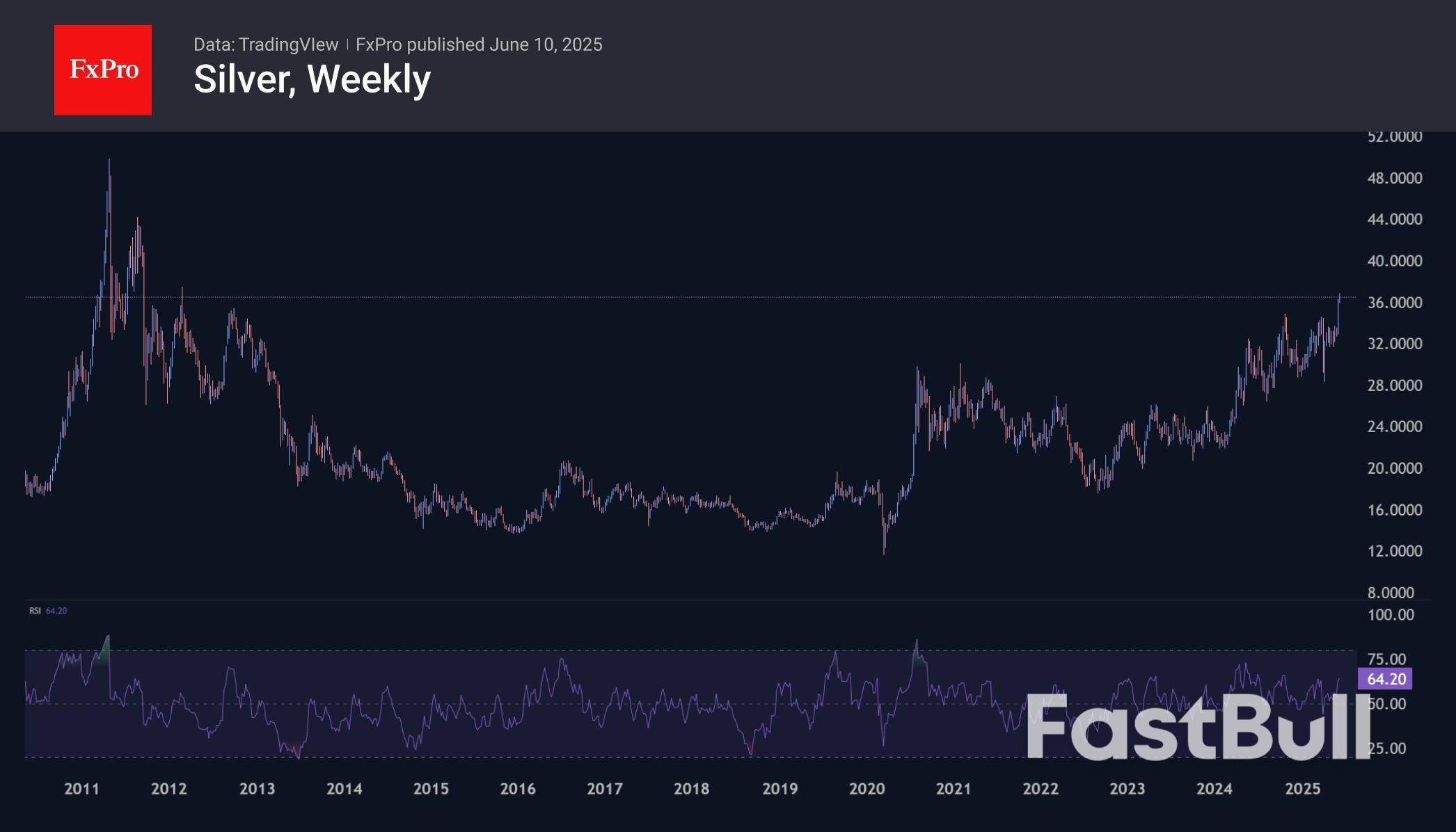
          Silver is up 27% since the beginning of the year, accelerating its growth in the last couple of weeks after an 18% correction in early April. With the price reaching $36.9 on Monday, silver is trading at its highest level since February 2012.

          In both cases, bulls were encouraged by the rapid correction in gold, which did not turn into a prolonged decline. This was a signal that gold was seeing profit-taking rather than a reversal of sentiment. In such conditions, traders look for alternatives. Since the platinum and silver markets are less liquid, price movements here are usually more significant.

          In 2011, the silver rally pushed the price from less than $18 to almost $50. If the momentum that has been driving precious metals since the beginning of the year continues, bulls may aim to repeat the peaks of fifteen years ago or even try to exceed them. On weekly timeframes, silver is not overheated, with an RSI of 64. In 2011 and 2018–2019, only an RSI above 80 was a signal for a reversal.
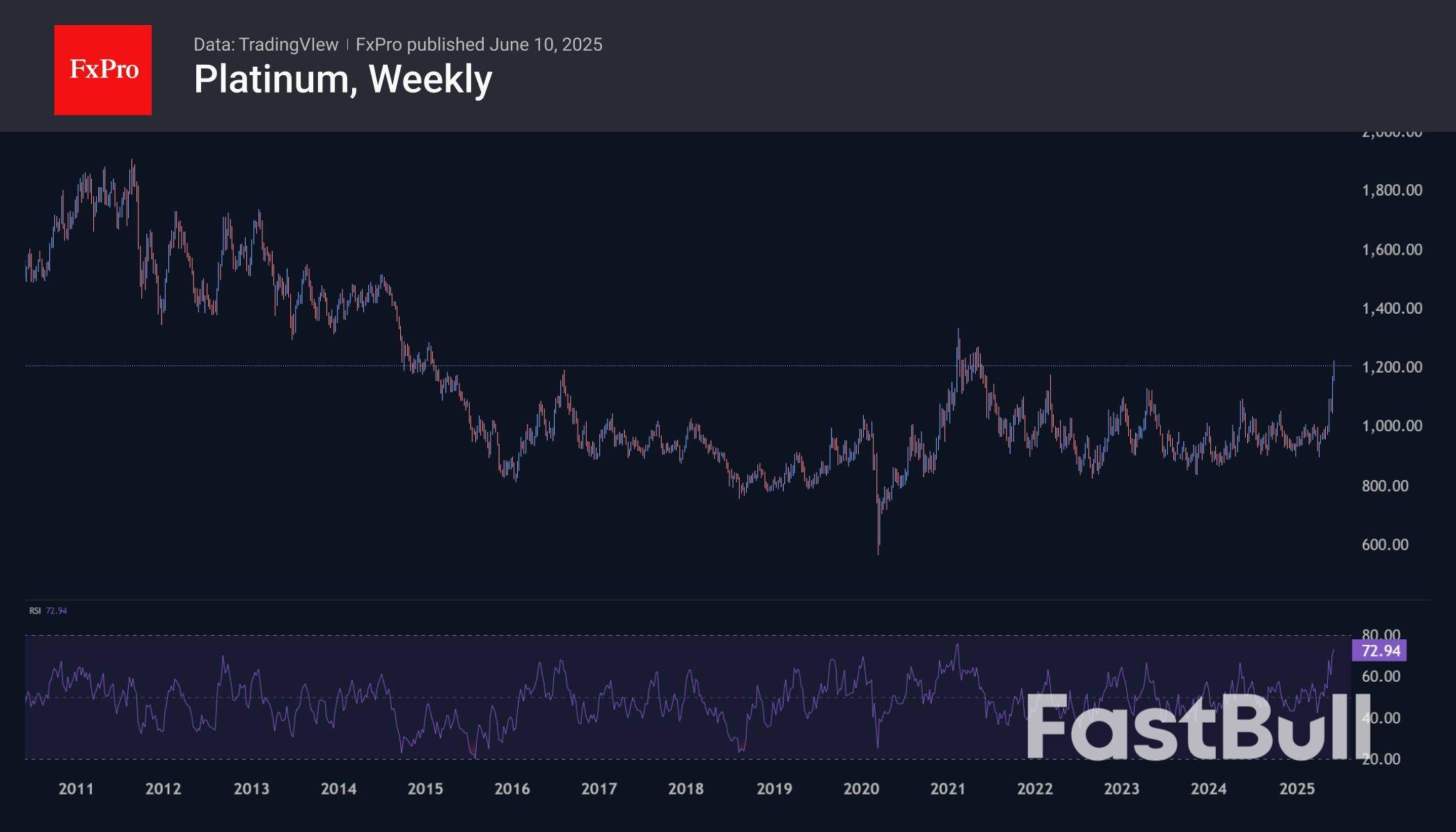
          Platinum has fallen sharply in recent years, falling out of focus for investors as the automotive industry has sought to move away from internal combustion engines, where platinum is actively used. In recent weeks, however, platinum has emerged as an alternative to gold as a metal for gold reserves. However, it has yet to prove its potential. The 2021 turning point is in the $1,200–1,300 range. Successfully overcoming this resistance level opens the way to $1,500 and then $1,900, which, in a bullish scenario, could well be reached by the end of the year.

          Source: FxPro

          Risk Warnings and Disclaimers
          You understand and acknowledge that there is a high degree of risk involved in trading. Following any strategies or investment methods may lead to potential losses. The content on the site is provided by our contributors and analysts for information purposes only. You are solely responsible for determining whether any trading assets, securities, strategy, or any other product is suitable for investing based on your own investment objectives and financial situation.
          Add to Favorites
          Share

          ECB Likely to Hold Interest Rates Steady Until Autumn 2025, Says Governing Council Member

          Gerik

          Economic

          Tightening Voice Within ECB Warns Against Early Easing

          European Central Bank (ECB) Governing Council member Robert Holzmann has signaled that the ECB may refrain from further interest rate cuts until at least autumn 2025, despite mounting speculation over the bank’s next policy move. Speaking in a live interview with Austria’s ORF broadcaster, Holzmann emphasized that inflation targets are within reach, but premature easing could trigger a resurgence in inflation during a period of ongoing economic fragility.
          Holzmann, who also serves as the Governor of Austria’s central bank, stood out as the lone dissenter during the ECB’s June 5 meeting, where the deposit rate was cut to 2%—the eighth reduction in the current easing cycle. His hawkish stance reflects broader internal divisions at the ECB as policymakers weigh the risks of undercutting inflation control versus supporting sluggish growth.

          Summer Pause or Longer? ECB Adopts Data-Dependent Approach

          Holzmann reiterated that all ECB decisions remain contingent on evolving economic data. While a rate pause through the summer appears likely, he did not rule out a prolonged freeze or even resumed cuts if macroeconomic conditions deteriorate further. This conditionality echoes the ECB’s shift toward a meeting-by-meeting strategy, aligning future decisions with real-time inflation, employment, and growth indicators.
          The Austrian policymaker is set to retire at the end of August, with the July 24 monetary policy meeting expected to be his final one. His successor, Austrian Economy Minister Martin Kocher, will attend the subsequent meeting in early September. The transition may also influence the balance of views within the ECB Governing Council going forward.

          Lagarde Hints at End of Easing Cycle

          While Holzmann adopts a cautious stance, ECB President Christine Lagarde recently suggested that the rate-cutting campaign may be nearing its end. At the same June 5 meeting, Lagarde stated that the central bank was approaching the conclusion of its monetary easing cycle. Some ECB officials have gone further, hinting that no more cuts may be necessary barring a substantial downturn in economic activity or inflation expectations.
          This suggests a growing consensus within the ECB for a “wait-and-see” period, consolidating the impact of prior cuts before moving further. It also reflects a strategic effort to avoid missteps that could reignite inflationary pressures at a time when core inflation remains sticky and wage growth has yet to moderate meaningfully in several eurozone economies.
          While inflation in the eurozone appears to be stabilizing, economic uncertainties—ranging from geopolitical risks to weak consumer demand and sluggish investment—continue to cloud the ECB’s policy path. Holzmann’s remarks serve as a reminder that any further loosening will be highly conditional and measured. As the ECB approaches its July and September meetings, it is increasingly clear that maintaining credibility and ensuring price stability will take precedence over aggressive rate adjustments. The summer may bring a pause, but not yet a pivot.
          Source:
          To stay updated on all economic events of today, please check out our Economic calendar
          Risk Warnings and Disclaimers
          You understand and acknowledge that there is a high degree of risk involved in trading. Following any strategies or investment methods may lead to potential losses. The content on the site is provided by our contributors and analysts for information purposes only. You are solely responsible for determining whether any trading assets, securities, strategy, or any other product is suitable for investing based on your own investment objectives and financial situation.
          Add to Favorites
          Share

          China Deploys $1.5 Trillion Provident Fund to Rescue Ailing Housing Market

          Gerik

          Economic

          Beijing Turns to Provident Fund as Mortgage Alternative

          Facing mounting pressure from a prolonged property downturn, Beijing has turned to its massive 10.9 trillion yuan ($1.5 trillion) housing provident fund as a key tool to support the domestic housing market. As banks tighten mortgage issuance amid shrinking profit margins and rising defaults, the fund is emerging as a primary source of low-interest financing, offering a state-backed alternative to increasingly cautious commercial lenders.
          Originally modeled on Singapore’s system, China’s housing provident fund is a compulsory savings scheme to which both employees and employers contribute monthly. These pooled savings can then be used to issue mortgages—typically at below-market interest rates. With the banking sector constrained, the fund’s role has become more prominent: it now accounts for a growing share of mortgage lending, financing over 8.1 trillion yuan in outstanding home loans by 2024.

          Policy Response to a Demand Crisis, Not a Credit Shortage

          While the provident fund gives homebuyers a more affordable path to ownership, analysts argue it is addressing a symptom, not the root cause of the property crisis. Demand remains weak. Residential transactions fell again in May, with major developers like Country Garden reporting a 28% monthly drop in sales—underscoring persistent buyer hesitation amid economic uncertainty and developer distress.
          Bloomberg Intelligence analysts Kristy Hung and Monica Si noted that while the expansion of the provident fund offers an alternative to bank financing, it does little to revive buyer confidence or address the structural oversupply weighing down the market. The underlying issue remains a chronic demand shortfall, not a lack of credit.

          Fund Usage Expands Through Policy Easing

          To stimulate housing activity, local governments are relaxing long-standing restrictions on the fund’s usage. In the past, the amount one could borrow was capped based on income, marital status, and fund contributions. Furthermore, many cities prohibited using fund savings for down payments.
          That is now changing. At least 50 municipalities have eased these rules in 2024 alone. For example, Shenzhen—China’s most unaffordable city—recently allowed fund withdrawals for down payments, while in March the city doubled its annual mortgage loan quota. In Beijing, the fund now covers 33% of all residential mortgages, up from less than 30% just four years ago.

          Cheaper Mortgages Offer Modest Relief

          The central bank has also reduced interest rates on fund-backed mortgages, which now sit roughly 0.9 percentage points below bank rates. This lowers borrowing costs by around 3% for borrowers, a marginal gain that nevertheless reflects official efforts to revive the market.
          While this rate cut may ease the burden for current borrowers like Eli Zhang, a 30-year-old Beijing resident paying just 2.85% interest on her mortgage, analysts caution that these incentives alone are insufficient to reverse the market’s trajectory. According to UOB Kay Hian analyst Liu Jieqi, the initiatives are symbolic of government commitment, but “a broad property recovery hinges on effective implementation and stronger economic fundamentals.”

          Liquidity Advantage Gives the Fund Flexibility

          Unlike commercial banks, which are now retrenching under pressure from bad loans and profit erosion, the provident fund remains well-capitalized and capable of expanding lending. With contributions from roughly 180 million employees and employers nationwide, the fund has a deep financial buffer. It currently holds more in contributions than it has lent out—indicating potential for further deployment.
          In 2024, loans from the fund rose 3.4%, while mortgage issuance from banks declined 1.3%. This divergence illustrates the fund’s growing importance in stabilizing housing finance, even as broader indicators such as residential sales and developer revenues continue to fall.
          China’s use of the $1.5 trillion housing provident fund marks a significant shift in its housing policy toolkit, offering targeted relief to homebuyers in a deteriorating credit environment. However, while this mechanism alleviates borrowing costs, it does not restore demand or resolve the confidence crisis plaguing China’s real estate sector. Without stronger macroeconomic support, job security, and regulatory reform, the current measures may ease the fall but not reverse it.

          Source: Bloomberg

          To stay updated on all economic events of today, please check out our Economic calendar
          Risk Warnings and Disclaimers
          You understand and acknowledge that there is a high degree of risk involved in trading. Following any strategies or investment methods may lead to potential losses. The content on the site is provided by our contributors and analysts for information purposes only. You are solely responsible for determining whether any trading assets, securities, strategy, or any other product is suitable for investing based on your own investment objectives and financial situation.
          Add to Favorites
          Share

          AmCham Urges U.S. to Recalibrate Taiwan Policy Amid Tariff Tensions

          Gerik

          Economic

          Business Leaders Call for Strategic Partnership, Not Punishment

          In a firm message to Washington, the American Chamber of Commerce in Taiwan (AmCham) has urged the U.S. government to shift its posture toward Taiwan from one of punitive trade measures to strategic economic partnership. Speaking in Taipei on Tuesday during the release of AmCham’s 2025 White Paper, President Carl Wegner criticized recent tariff proposals and pressed for deeper bilateral engagement through diplomatic and fiscal reforms.
          The call follows U.S. President Donald Trump's April proposal to impose a 32% tariff on Taiwanese imports as part of a wider global tariff campaign. Although implementation was delayed by 90 days to allow for negotiations, the threat remains unresolved, casting a shadow over Taiwan-U.S. economic relations. No major developments have been announced since the talks began.

          Tariffs Designed for Rivals Now Target Allies

          Wegner emphasized that trade measures originally designed to confront strategic adversaries like China are now harming key democratic allies. “Taiwan is a reliable friend of the United States, an essential democratic partner in the Indo-Pacific,” he stated, highlighting Taiwan's role in bolstering American industry and global supply chain resilience.
          This misapplication of trade enforcement, he warned, risks eroding trust and damaging investor confidence in both economies. Taiwan’s technology sector—especially its dominance in semiconductor manufacturing—plays a crucial role in U.S. supply chains and national security. Framing Taiwan as a competitor in the tariff regime undermines decades of bilateral cooperation.

          Policy Recommendations: Restore High-Level Diplomacy and Finalize Tax Treaty

          AmCham’s White Paper laid out several policy recommendations aimed at rebuilding mutual trust. First, it urged the immediate resumption of high-level cabinet visits from Washington to Taipei. These diplomatic engagements were normalized under Trump's previous term and continued under Biden but have recently stagnated. Their revival would send a strong signal of strategic alignment at a time of regional uncertainty.
          Second, AmCham called on the U.S. Senate to pass the long-delayed double taxation agreement between the two sides. The absence of such a treaty complicates investment flows and adds administrative burdens to cross-border operations. With growing demand for nearshoring and secure supply chains, resolving this tax issue could unlock new channels of bilateral growth.

          Strategic Implications for U.S. Indo-Pacific Policy

          The Chamber’s appeal also touches a broader strategic nerve. Taiwan's position as a stable democracy with advanced industrial capacity gives it a unique role in the Indo-Pacific, especially as U.S.-China tensions escalate. Treating Taiwan under the same lens as economic adversaries could alienate one of Washington’s most important regional partners and send mixed signals to other allies in Asia.
          Carl Wegner is set to lead a delegation to Washington for “door knock” meetings with policymakers to personally advocate for Taiwan’s case. The aim is to realign U.S. trade and economic policy with its strategic rhetoric—a shift that many in the business community believe is overdue.
          AmCham’s message is clear: U.S. policy toward Taiwan must reflect its role not only as a trading partner but as a democratic bulwark in Asia. As the tariff pause nears expiration and diplomatic engagement remains subdued, the Biden administration—or any incoming leadership—faces a test of strategic consistency. Removing trade barriers, finalizing investment protections, and restoring high-level dialogue are not just economic priorities but necessary steps to reinforce a partnership central to U.S. interests in the Indo-Pacific.

          Source: Reuters

          To stay updated on all economic events of today, please check out our Economic calendar
          Risk Warnings and Disclaimers
          You understand and acknowledge that there is a high degree of risk involved in trading. Following any strategies or investment methods may lead to potential losses. The content on the site is provided by our contributors and analysts for information purposes only. You are solely responsible for determining whether any trading assets, securities, strategy, or any other product is suitable for investing based on your own investment objectives and financial situation.
          Add to Favorites
          Share

          Tesla Faces Autonomous Showdown as Chinese EV Makers Accelerate Past in Self-Driving Race

          Gerik

          Economic

          China’s Smart-EV Surge Threatens Tesla’s Autonomy Strategy

          Tesla, once seen as the unchallenged leader in the electric vehicle (EV) and self-driving space, is now confronting a critical threat from Chinese competitors that are rapidly scaling advanced autonomous technology at lower costs. Firms like BYD, Xpeng, and Huawei have not only disrupted the EV affordability narrative but are now aggressively encroaching on the technological front, offering sophisticated driver-assistance systems that rival or exceed Tesla’s Full Self-Driving (FSD) package—at a fraction of the price.
          BYD's “God’s Eye” system exemplifies this challenge. Offered for free in some models, it provides real-world functionality comparable to Tesla’s FSD, which costs nearly $9,000 in China. Tesla’s reliance on camera-only systems is being directly contrasted with China’s sensor-rich approaches incorporating lidar, radar, and ultrasonic technologies—an approach now gaining traction as both more effective and cost-efficient.

          Price, Scale, and Policy: The Three-Pronged Advantage

          Chinese automakers' advantage in autonomy stems from three converging forces: competitive pricing, manufacturing scale, and state-backed policy support. BYD, which sold over 4.2 million vehicles last year, benefits from economies of scale that allow it to produce and integrate driver-assistance hardware at costs comparable to Tesla, even though its systems include more expensive sensor arrays. For example, BYD’s comparable God’s Eye hardware setup is estimated to cost $2,105—just under Tesla’s $2,360 FSD hardware cost, despite including lidar and radar that Tesla omits.
          Chinese manufacturers also benefit from local supply chains where sensors and components are significantly cheaper—up to 40% lower for cameras, radar, and ultrasonic sensors, and around 20% for lidar, according to A2MAC1, a Paris-based teardown analysis firm. The aggressive competition within China’s smart-EV sector has further compressed margins, forcing suppliers and OEMs to drive costs down while broadening adoption.
          Meanwhile, Tesla’s autonomy-first strategy, centered around its upcoming robotaxi launch in Austin, is encountering mounting geopolitical friction. China’s regulations prevent Tesla from transferring locally gathered vehicle data abroad, blocking its ability to train AI models using Chinese driving behavior. This regulatory roadblock significantly slows Tesla’s development cycle, especially when Chinese firms benefit from real-time, localized data and regulatory alignment.

          From Competitive Threat to Strategic Disadvantage

          Elon Musk’s pivot away from affordable EVs toward robotaxis is now being tested. Tesla’s robotaxi pilot in Austin—featuring just 10 to 20 vehicles—is a modest effort by comparison, especially as Chinese firms deploy driver-assistance technologies at scale in high-density cities like Shenzhen. Huawei’s partnership ecosystem, which spans over a dozen automakers, further exemplifies this shift, as its Level 3-capable systems already navigate urban congestion with confidence.
          BYD’s sales strategy of offering God’s Eye for free may temporarily compress margins, but it is expected to enhance vehicle sales and training data collection—both of which are essential for improving autonomy. The more cars on the road equipped with these systems, the more real-world driving data companies like BYD and Huawei gather, thus fueling AI advancement at scale. This self-reinforcing loop puts Tesla at risk of falling behind in both technological precision and market adoption.

          Tesla’s Constraints in a Shifting Landscape

          Tesla’s autonomy ambitions are further constrained by its limited sensor suite. Musk’s insistence on camera-only systems—while cost-saving—faces practical limitations in dynamic driving environments, particularly where depth perception and object identification are critical. In contrast, Chinese brands are gaining regulatory approval for Level 3 autonomy—systems where drivers can divert attention from the road—while Tesla’s FSD still requires hands-on supervision.
          Moreover, Tesla’s supply chain lacks the same price leverage seen in BYD’s operations. In a letter to suppliers, BYD demanded a 10% cost cut across all systems to start 2025, signaling its confidence in cost leadership and supplier discipline. The result is a formidable structural advantage that Tesla, operating in higher-cost regions and battling political fallout from Musk’s disengagement with the Trump administration, may struggle to replicate.

          Tesla’s Market Dominance Under Pressure

          Tesla’s strategic bet on robotaxis and vision-only autonomy is facing its stiffest test yet. As Chinese smart-EV players rapidly converge advanced technology, affordability, and data at scale, Tesla’s position is increasingly squeezed—especially in China, the world’s largest and most competitive auto market. Without access to local data, lower component costs, or policy support, Tesla may find itself playing catch-up in the very domain it helped define.
          The coming quarters will determine whether Tesla can adapt and compete on these evolving terms—or whether the future of self-driving belongs to a new generation of sensor-heavy, cost-efficient challengers from China.

          Source: Reuters

          To stay updated on all economic events of today, please check out our Economic calendar
          Risk Warnings and Disclaimers
          You understand and acknowledge that there is a high degree of risk involved in trading. Following any strategies or investment methods may lead to potential losses. The content on the site is provided by our contributors and analysts for information purposes only. You are solely responsible for determining whether any trading assets, securities, strategy, or any other product is suitable for investing based on your own investment objectives and financial situation.
          Add to Favorites
          Share

          Trump Says Iran Pushing To Enrich Uranium In ‘tough’ Talks

          James Whitman

          Political

          US President Donald Trump said Iran was pressing to be allowed to enrich uranium in a potential nuclear deal with the US, expressing worry that Tehran was seeking too much.

          “They’re just asking for things that you can’t do. They don’t want to give up what they have to give up. You know what that is. They seek enrichment. We can’t have enrichment,” Trump said on Monday at a White House event.

          The president said there would be another meeting on Thursday (June 12) with Iranian negotiators. A spokesman for Iran’s foreign ministry during a press conference earlier Monday, said Tehran would send a counteroffer in the “coming days” via Oman, in response to a US proposal on its nuclear programme.

          “They are good negotiators, but they’re tough. Sometimes, they can be too tough, that’s the problem,” Trump added. “So we’re trying to make a deal, so that there’s no destruction and death.”

          Trump has previously said that he would not allow Iran to continue producing the material, while Tehran in the past has characterised that demand as a sticking point.

          Trump’s comments followed a call earlier Monday with Israeli Prime Minister Benjamin Netanyahu, where he said the two discussed the nuclear talks, as well as the war in Gaza.

          Trump has vowed to stop Tehran from acquiring nuclear weapons but Netanyahu has been skeptical of diplomatic efforts to curb Iran’s nuclear ambitions.

          Trump in May said he told Netanyahu that a military strike against Iran would be “inappropriate to do right now” because it could jeopardise negotiations he said were close to an agreement. The New York Times had reported that Israel was weighing potential strikes on Iranian nuclear sites, a move officials in Tehran have warned could trigger a response and derail the talks.

          Tensions are already high between Israel and Iran since the start of the war in Gaza, and amid Israeli strikes on Iran-backed groups.

          The war in Gaza is also another flash point that is high on the agenda, following Israel’s move to intensify military operations against Hamas. Israel has been at war with Hamas since Oct 7, 2023, when the group — declared a terrorist organisation by the US and European Union — launched a surprise attack that killed about 1,200 people and resulted in 250 hostages being taken. More than 50 of those captives remain in Gaza, and Israel believes about 20 are alive.

          Trump said the situation in Gaza was among the discussion points on the call.

          “We discussed a lot of things, and it went very well, very smooth,” Trump said.

          Israel’s response, aimed at rooting out Hamas from Gaza, has destroyed much of the territory and sparked a humanitarian crisis. Israel controls limited deliveries of aid assistance to Gaza’s population, which numbers about two million, and has blamed Hamas for diverting needed aid under a prior distribution system.

          The war has also sparked a surge in antisemitic violence in the US, including an attack with Molotov cocktails, and a flamethrower on peaceful demonstrators in Colorado who were marching in support of Israeli hostages in Gaza.

          Trump’s administration has seized on worries about antisemitism, including the wave of campus protests over the war, pressuring universities to overhaul their policies. And Trump last week unveiled a new travel ban, citing the terror attack in Boulder, Colorado, as justification for his administration’s hardline immigration policies and ramped-up deportations.

          Source: Bloomberg

          Risk Warnings and Disclaimers
          You understand and acknowledge that there is a high degree of risk involved in trading. Following any strategies or investment methods may lead to potential losses. The content on the site is provided by our contributors and analysts for information purposes only. You are solely responsible for determining whether any trading assets, securities, strategy, or any other product is suitable for investing based on your own investment objectives and financial situation.
          Add to Favorites
          Share
          FastBull
          Copyright © 2025 FastBull Ltd

          728 RM B 7/F GEE LOK IND BLDG NO 34 HUNG TO RD KWUN TONG KLN HONG KONG

          TelegramInstagramTwitterfacebooklinkedin
          App Store Google Play Google Play
          Products
          Charts

          Chats

          Q&A with Experts
          Screeners
          Economic Calendar
          Data
          Tools
          Membership
          Features
          Function
          Markets
          Copy Trading
          Latest Signals
          Contests
          News
          Analysis
          24/7
          Columns
          Education
          Company
          Careers
          About Us
          Contact Us
          Advertising
          Help Center
          Feedback
          User Agreement
          Privacy Policy
          Business

          White Label

          Data API

          Web Plug-ins

          Poster Maker

          Affiliate Program

          Risk Disclosure

          The risk of loss in trading financial instruments such as stocks, FX, commodities, futures, bonds, ETFs and crypto can be substantial. You may sustain a total loss of the funds that you deposit with your broker. Therefore, you should carefully consider whether such trading is suitable for you in light of your circumstances and financial resources.

          No decision to invest should be made without thoroughly conducting due diligence by yourself or consulting with your financial advisors. Our web content might not suit you since we don't know your financial conditions and investment needs. Our financial information might have latency or contain inaccuracy, so you should be fully responsible for any of your trading and investment decisions. The company will not be responsible for your capital loss.

          Without getting permission from the website, you are not allowed to copy the website's graphics, texts, or trademarks. Intellectual property rights in the content or data incorporated into this website belong to its providers and exchange merchants.

          Not Logged In

          Log in to access more features

          FastBull Membership

          Not yet

          Purchase

          Become a signal provider
          Help Center
          Customer Service
          Dark Mode
          Price Up/Down Colors

          Log In

          Sign Up

          Position
          Layout
          Fullscreen
          Default to Chart
          The chart page opens by default when you visit fastbull.com
