Markets
News
Analysis
User
24/7
Economic Calendar
Education
Data
- Names
- Latest
- Prev


Signal Accounts for Members
All Signal Accounts
All Contests


France Trade Balance (SA) (Oct)A:--
F: --
Euro Zone Employment YoY (SA) (Q3)A:--
F: --
Canada Part-Time Employment (SA) (Nov)A:--
F: --
P: --
Canada Unemployment Rate (SA) (Nov)A:--
F: --
P: --
Canada Full-time Employment (SA) (Nov)A:--
F: --
P: --
Canada Labor Force Participation Rate (SA) (Nov)A:--
F: --
P: --
Canada Employment (SA) (Nov)A:--
F: --
P: --
U.S. PCE Price Index MoM (Sept)A:--
F: --
P: --
U.S. Personal Income MoM (Sept)A:--
F: --
P: --
U.S. Core PCE Price Index MoM (Sept)A:--
F: --
P: --
U.S. PCE Price Index YoY (SA) (Sept)A:--
F: --
P: --
U.S. Core PCE Price Index YoY (Sept)A:--
F: --
P: --
U.S. Personal Outlays MoM (SA) (Sept)A:--
F: --
U.S. 5-10 Year-Ahead Inflation Expectations (Dec)A:--
F: --
P: --
U.S. Real Personal Consumption Expenditures MoM (Sept)A:--
F: --
U.S. Weekly Total Rig CountA:--
F: --
P: --
U.S. Weekly Total Oil Rig CountA:--
F: --
P: --
U.S. Consumer Credit (SA) (Oct)A:--
F: --
China, Mainland Foreign Exchange Reserves (Nov)A:--
F: --
P: --
Japan Trade Balance (Oct)A:--
F: --
P: --
Japan Nominal GDP Revised QoQ (Q3)A:--
F: --
P: --
China, Mainland Imports YoY (CNH) (Nov)A:--
F: --
P: --
China, Mainland Exports (Nov)A:--
F: --
P: --
China, Mainland Imports (CNH) (Nov)A:--
F: --
P: --
China, Mainland Trade Balance (CNH) (Nov)A:--
F: --
P: --
China, Mainland Exports YoY (USD) (Nov)A:--
F: --
P: --
China, Mainland Imports YoY (USD) (Nov)A:--
F: --
P: --
Germany Industrial Output MoM (SA) (Oct)A:--
F: --
Euro Zone Sentix Investor Confidence Index (Dec)A:--
F: --
P: --
Canada National Economic Confidence IndexA:--
F: --
P: --
U.K. BRC Like-For-Like Retail Sales YoY (Nov)--
F: --
P: --
U.K. BRC Overall Retail Sales YoY (Nov)--
F: --
P: --
Australia Overnight (Borrowing) Key Rate--
F: --
P: --
RBA Rate Statement
RBA Press Conference
Germany Exports MoM (SA) (Oct)--
F: --
P: --
U.S. NFIB Small Business Optimism Index (SA) (Nov)--
F: --
P: --
Mexico 12-Month Inflation (CPI) (Nov)--
F: --
P: --
Mexico Core CPI YoY (Nov)--
F: --
P: --
Mexico PPI YoY (Nov)--
F: --
P: --
U.S. Weekly Redbook Index YoY--
F: --
P: --
U.S. JOLTS Job Openings (SA) (Oct)--
F: --
P: --
China, Mainland M1 Money Supply YoY (Nov)--
F: --
P: --
China, Mainland M0 Money Supply YoY (Nov)--
F: --
P: --
China, Mainland M2 Money Supply YoY (Nov)--
F: --
P: --
U.S. EIA Short-Term Crude Production Forecast For The Year (Dec)--
F: --
P: --
U.S. EIA Natural Gas Production Forecast For The Next Year (Dec)--
F: --
P: --
U.S. EIA Short-Term Crude Production Forecast For The Next Year (Dec)--
F: --
P: --
EIA Monthly Short-Term Energy Outlook
U.S. API Weekly Gasoline Stocks--
F: --
P: --
U.S. API Weekly Cushing Crude Oil Stocks--
F: --
P: --
U.S. API Weekly Crude Oil Stocks--
F: --
P: --
U.S. API Weekly Refined Oil Stocks--
F: --
P: --
South Korea Unemployment Rate (SA) (Nov)--
F: --
P: --
Japan Reuters Tankan Non-Manufacturers Index (Dec)--
F: --
P: --
Japan Reuters Tankan Manufacturers Index (Dec)--
F: --
P: --
Japan Domestic Enterprise Commodity Price Index MoM (Nov)--
F: --
P: --
Japan Domestic Enterprise Commodity Price Index YoY (Nov)--
F: --
P: --
China, Mainland PPI YoY (Nov)--
F: --
P: --
China, Mainland CPI MoM (Nov)--
F: --
P: --
Italy Industrial Output YoY (SA) (Oct)--
F: --
P: --


No matching data
Latest Views
Latest Views
Trending Topics
Top Columnists
Latest Update
White Label
Data API
Web Plug-ins
Affiliate Program
View All

No data
ING on Wednesday provided an analysis of the latest U.K. inflation data, which indicated a significant rise in...
ING on Wednesday provided an analysis of the latest U.K. inflation data, which indicated a significant rise in services inflation, driven largely by an increase in road tax and the timing of Easter.
According to ING, this inflationary spike is expected to recede, with services inflation likely to fall back from April’s 5.4% figure to around 4.5% this summer. This forecast aligns with the Bank of England’s (BoE) trajectory for quarterly rate cuts extending into 2026.
The recent inflation data showed a jump from 4.7% to 5.4% in services inflation during April, a larger increase than anticipated by both ING and the BoE. However, ING’s analysis suggests that this rise is less concerning upon closer examination.
They estimate that half of the increase is attributable to the change in road tax, which will persist for a year before dropping from the annual comparison. The BoE is expected to overlook this change, as it typically does with tax adjustments.
The remainder of the inflation surge is largely due to higher airfares and package holiday costs, influenced by Easter’s timing. Last year, Easter occurred in March, affecting the annual rate comparison.
This year, the data was collected just before Good Friday, amplifying the monthly increase in plane ticket prices by 28%. These effects are predicted to diminish in the coming months.
Further analysis by ING highlights disinflation in several other service sectors in April, including restaurants, medical care, and rents. The contribution of rent to services inflation, currently at a full percentage point, is expected to halve by early next year due to a lower government cap on social housing costs.
Surveys also indicate a decline in pricing power, supporting ING’s expectation that services inflation will decrease to the 4.5% region this summer and continue to lower by 2026.
Despite inflation levels remaining above the BoE’s comfort zone, ING maintains that policymakers are unlikely to accelerate the easing process in 2023.
However, they anticipate a rate cut in August, with the BoE continuing its quarterly pace of rate reductions through the year and into 2026.
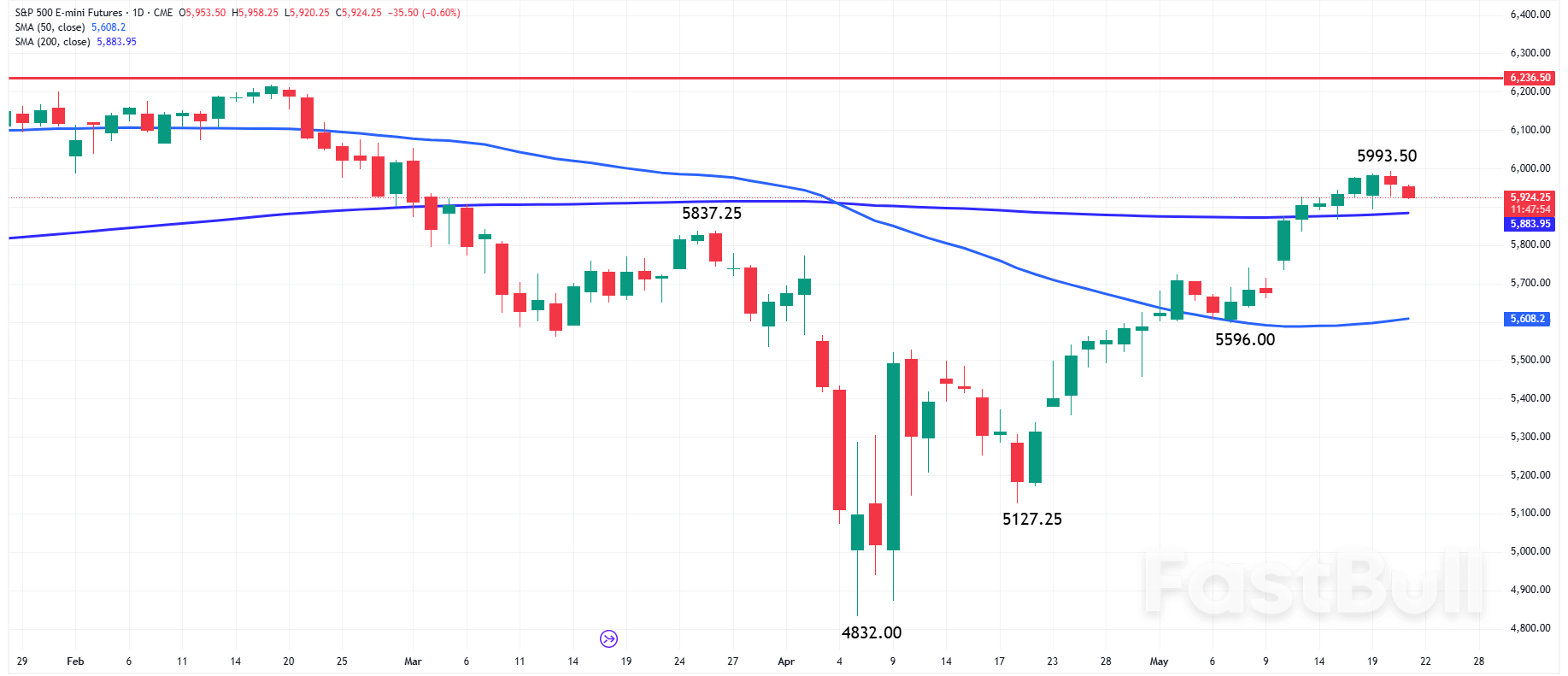
Dow Industrial average futures are down -325 points after falling -114.83 points or -0.27% yesterdayS&P index futures are implying a decline of -35 points after yesterday's -23.14 points or -0.39% declineNasdaq futures are implying a decline of -131 points after falling -72.75 points or -0.38%
German Dax, -0.21%France's CAC, -0.66%UK FTSE 100, -0.02%Spain's Ibex, -0.36%Italy's FTSE MIB, -0.24%
2-year yield 4.002%, +3.2 basis points5-year yield 4.119%, +5.2 basis points10-year yield 4.544%, +6.4 basis points30-year yield 5.035%, +6.8 basis points
Crude oil up $0.65 at $62.86Gold is up $20.44 or 0.62% at $3310.34Bitcoin is trading down $353 at $106,502. Intraday high price reached $108,035

As Bitcoin has climbed back above the $100,000 level, investors are tempted to liken the rally to the short-lived rallies in January, but recent data and market dynamics suggest that this time the rally is more grounded.
Financial conditions, one of the basic indicators that determine the risk appetite of the markets, present a picture in favor of Bitcoin this time. While the dollar index (DXY) fell by 9% from 109 in January to 99.60, the 10-year US Treasury bond interest rate fell from 4.8% to 4.52%.
These softening conditions are creating a more favorable environment for risky assets. Although 30-year bond yields have risen above 5%, this development is perceived positively for inflation hedge assets such as gold and Bitcoin.
The total market value of stablecoins pegged to the US dollar, such as USDT and USDC, broke the record by reaching $151 billion. This is an increase of about 9% from the average level of $139 billion in the December-January period. The presence of a large capital reserve that can be invested is considered a positive signal for Bitcoin and crypto markets.
Bitcoin’s recent rally from $75,000 has largely been driven by directional buying by institutional investors via spot ETFs.
Open interest in CME Bitcoin futures rose to $17 billion, the most since February, but is still below the $22.79 billion peak in December. In comparison, total inflows into spot Bitcoin ETFs reached $42.7 billion, surpassing the $39.8 billion level in January.
In the past, during Bitcoin’s peaks, there was speculative excitement in memecoins such as Dogecoin (DOGE) and Shiba Inu (SHIB). However, there is currently no significant movement or bubble effect in such altcoins. This shows that the market is moving more cautiously this time.
There is demand for long (bullish) positions in Bitcoin’s perpetual futures market, but funding rates are well below December highs, suggesting leveraged positions are not overdone and the market is not “heating up” yet.
It is not investment advice.
Euro zone government bond yields rose on Wednesday as higher oil prices added further pressure to longer-dated bonds, already struggling globally due to worries about countries' fiscal positions, particularly the U.S.
Germany's 10-year yield, the benchmark for the euro zone, rose 6 basis points to 2.66%, while Italy's 10-year yield climbed nearly 9 basis points to 3.7%. (DE10YT=RR),
Partly responsible for the move was oil, as Brent futuresrose more than 1% on Wednesday after reports that Israel could be preparing to strike Iranian nuclear facilities.
This, combined with above expectations British inflation data were "helping to hoist bond yields across the curve", said Kenneth Broux, head of corporate research FX and rates at Societe Generale, said in a note.
Britain's annual inflation rate hit 3.5% in April, its highest reading since January 2024.
Even with inflation near the European Central Bank's 2% target, rate setters are still keeping a wary eye on it when setting policy.
Markets expect the ECB to cut its key rate to 1.75% by the end of this year; those expectations had been nearer 1.5% last month at the height of worries about the global economic hit from tariffs. (EURESTECBM5X6=ICAP)
Yields in Europe have been moving higher this week, dragged along by U.S. Treasury yields, which have been rising on concerns about the U.S. fiscal position as a tax cutting bill works its way through Congress.
The U.S. 10-year yield was last up nearly 6 bps at 4.54%.
In addition, longer-dated bond yields have been rising more than shorter-dated ones as investors demand a greater premium to hold longer-dated debt.
That has caused yield curves to steepen, in market parlance, and the German two-10 yield curve was at its steepest in over a month, with the 10-year yield 79 bps higher than the two year. (DE2DE10=RR)
If energy prices stay permanently higher, "it is potentially another stone in the sticky inflation and bear steepening pond", Broux said.
Curves "bear steepen" when the gap between longer and shorter dated yields increases because longer-dated yields are rising.
Japanese super-long yields have also moved sharply higher this week, and the 30- and 40-year yields hit new all-time peaks on Wednesday.
Trading Wednesday was also complicated by a Bloomberg Terminal outage which disrupted numerous government bond sales according to several European debt management offices.
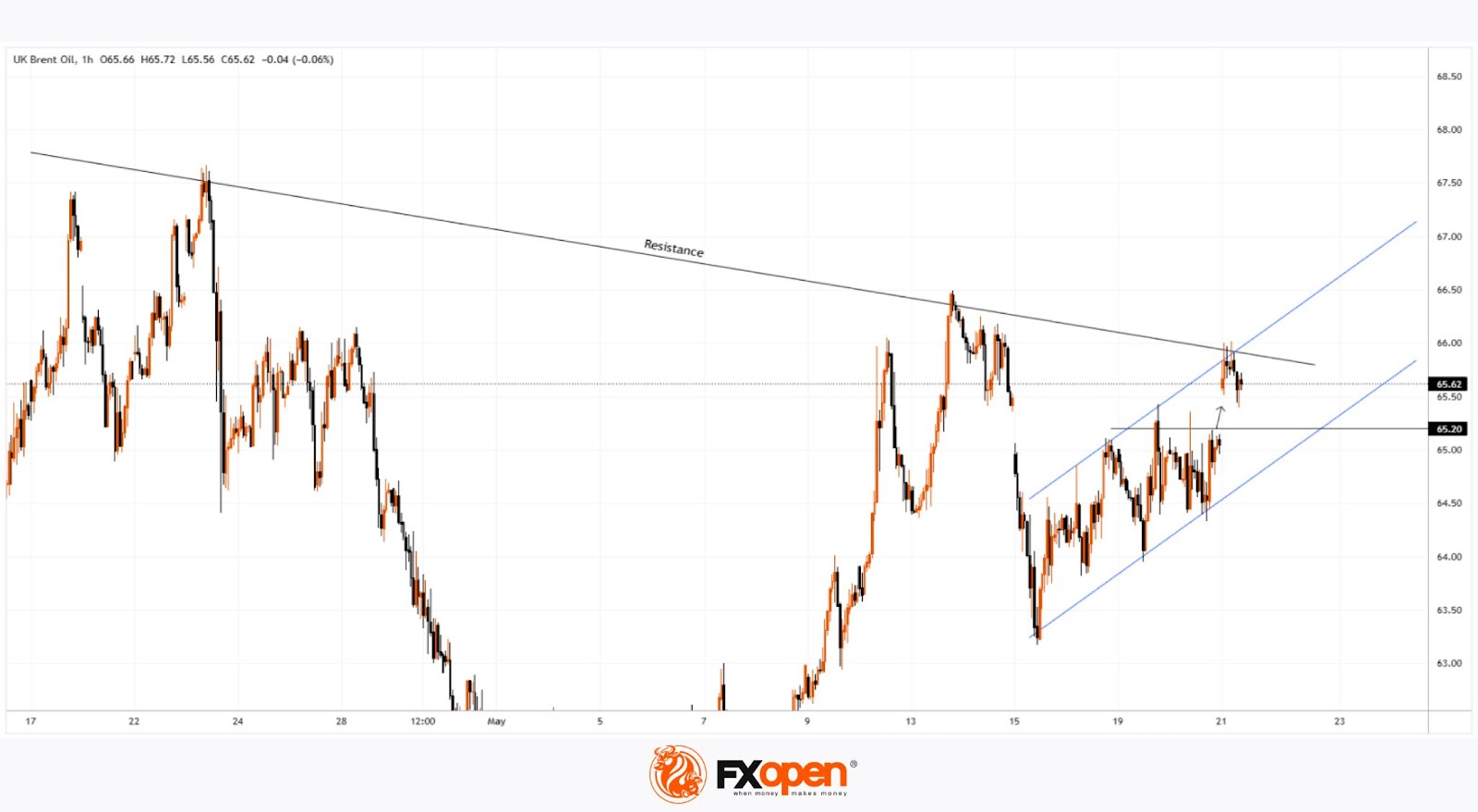
As shown on today’s XBR/USD chart, Brent crude oil prices have jumped (as indicated by the arrow) to a one-week high. This surge follows U.S. intelligence reports suggesting that Israel may be preparing to strike Iran’s nuclear facilities.
Although CNN, citing officials, noted that it remains unclear whether Israeli leaders have made a final decision, oil prices are rising as markets price in the risk of escalation disrupting Middle Eastern oil supply chains:
→ Iran is the third-largest oil producer within OPEC.
→ There is concern that Iran could retaliate by blocking the Strait of Hormuz in the Persian Gulf — a key shipping route used by Saudi Arabia, Kuwait, and others to export oil products.
Brent crude oil price has climbed towards the descending trendline (marked in black), drawn through key highs from April and mid-May. From a bearish perspective, this key resistance could trigger a downward pullback.
On the other hand, recent price action in Brent suggests upward momentum (indicated by blue lines), with the $65.20 level — previously a cap — potentially turning into support after a breakout.
Whether the black resistance line is broken will largely depend on geopolitical developments. It is possible that reports of an imminent missile strike on Iran may later be refuted.
White Label
Data API
Web Plug-ins
Poster Maker
Affiliate Program
The risk of loss in trading financial instruments such as stocks, FX, commodities, futures, bonds, ETFs and crypto can be substantial. You may sustain a total loss of the funds that you deposit with your broker. Therefore, you should carefully consider whether such trading is suitable for you in light of your circumstances and financial resources.
No decision to invest should be made without thoroughly conducting due diligence by yourself or consulting with your financial advisors. Our web content might not suit you since we don't know your financial conditions and investment needs. Our financial information might have latency or contain inaccuracy, so you should be fully responsible for any of your trading and investment decisions. The company will not be responsible for your capital loss.
Without getting permission from the website, you are not allowed to copy the website's graphics, texts, or trademarks. Intellectual property rights in the content or data incorporated into this website belong to its providers and exchange merchants.
Not Logged In
Log in to access more features

FastBull Membership
Not yet
Purchase
Log In
Sign Up