• Trade
  • Markets
  • Copy
  • Contests
  • News
  • 24/7
  • Calendar
  • Q&A
  • Chats
Trending
Screeners
SYMBOL
LAST
BID
ASK
HIGH
LOW
NET CHG.
%CHG.
SPREAD
SPX
S&P 500 Index
6827.42
6827.42
6827.42
6899.86
6801.80
-73.58
-1.07%
--
DJI
Dow Jones Industrial Average
48458.04
48458.04
48458.04
48886.86
48334.10
-245.98
-0.51%
--
IXIC
NASDAQ Composite Index
23195.16
23195.16
23195.16
23554.89
23094.51
-398.69
-1.69%
--
USDX
US Dollar Index
97.950
98.030
97.950
98.500
97.950
-0.370
-0.38%
--
EURUSD
Euro / US Dollar
1.17394
1.17409
1.17394
1.17496
1.17192
+0.00011
+ 0.01%
--
GBPUSD
Pound Sterling / US Dollar
1.33707
1.33732
1.33707
1.33997
1.33419
-0.00148
-0.11%
--
XAUUSD
Gold / US Dollar
4299.39
4299.39
4299.39
4353.41
4257.10
+20.10
+ 0.47%
--
WTI
Light Sweet Crude Oil
57.233
57.485
57.233
58.011
56.969
-0.408
-0.71%
--

Community Accounts

Signal Accounts
--
Profit Accounts
--
Loss Accounts
--
View More

Become a signal provider

Sell trading signals to earn additional income

View More

Guide to Copy Trading

Get started with ease and confidence

View More

Signal Accounts for Members

All Signal Accounts

Best Return
  • Best Return
  • Best P/L
  • Best MDD
Past 1W
  • Past 1W
  • Past 1M
  • Past 1Y

All Contests

  • All
  • Trump Updates
  • Recommend
  • Stocks
  • Cryptocurrencies
  • Central Banks
  • Featured News
Top News Only
Share

Incoming Czech Prime Minister Babis: Czech Republic Will Not Take On Guarantees For Ukraine Financing, European Commission Must Find Alternatives

Share

Turkey President Erdogan: Hopes To Discuss Ukraine-Russia Peace Plan With Trump After Meeting With Putin

Share

Turkey President Erdogan: Peace Is Not Far Away, Black Sea Should Not Be Used As A Battleground, Safe Navigation Needed

Share

IAEA: Ukraine's Znpp Temporarily Lost All Offsite Power Overnight Due To Widespread Military Activities Affecting The Electrical Grid

Share

Iranian Media Says 18 Crew Members Of Foreign Tanker Seized In Gulf Of Oman Over Carrying 'Smuggled Fuel' Detained

Share

Regional Governor: Two Killed In Ukrainian Drone Strike On Russia's Saratov

Share

Chinese Foreign Ministry - China Foreign Minister Met With United Arab Emirates Counterpart On Dec 12

Share

China's Central Financial And Economic Affairs Commission Deputy Director: Will Expand Export And Increase Import In 2026

Share

Thai Leader Anutin: Landmine Blast That Killed Thai Soldiers 'Not A Roadside Accident'

Share

Thai Leader Anutin: Thailand To Continue Military Action Until 'We Feel No More Harm'

Share

Cambodian Prime Minister Hun Manet Says He Had Phone Calls With Trump And Malaysian Leader Anwar About Ceasefire

Share

Cambodia's Hun Manet Says USA, Malaysia Should Verify 'Which Side Fired First' In Latest Conflict

Share

Cambodia's Hun Manet: Cambodia Maintains Its Stance In Seeking Peaceful Resolution Of Disputes

Share

Nasdaq Companies: Allergan, Ferrovia, Insmed, Monolithic Power Systems, Seagate Technology, And Western Digital Will Be Added To The NASDAQ 100 Index. Biogen, CdW, GlobalFoundries, Lululemon, ON Semiconductor, And Tradedesk Will Be Removed From The NASDAQ 100 Index

Share

Witkoff Headed To Berlin This Weekend To Meet With Zelenskiy, European Leaders -Wsj Reporter On X

Share

Russia Attacks Two Ukrainian Ports, Damaging Three Turkish-Owned Vessels

Share

[Historic Flooding Occurs In At Least Four Rivers In Washington State Due To Days Of Torrential Rains] Multiple Areas In Washington State Have Been Hit By Severe Flooding Due To Days Of Torrential Rains, With At Least Four Rivers Experiencing Historic Flooding. Reporters Learned On The 12th That The Floods Caused By The Torrential Rains In Washington State Have Destroyed Homes And Closed Several Highways. Experts Warn That Even More Severe Flooding May Occur In The Future. A State Of Emergency Has Been Declared In Washington State

Share

Trump Says Proposed Free Economic Zone In Donbas Would Work

Share

Trump: I Think My Voice Should Be Heard

Share

Trump Says Will Be Choosing New Fed Chair In Near Future

TIME
ACT
FCST
PREV
U.K. Trade Balance Non-EU (SA) (Oct)

A:--

F: --

P: --

U.K. Trade Balance (Oct)

A:--

F: --

P: --

U.K. Services Index MoM

A:--

F: --

P: --

U.K. Construction Output MoM (SA) (Oct)

A:--

F: --

P: --

U.K. Industrial Output YoY (Oct)

A:--

F: --

P: --

U.K. Trade Balance (SA) (Oct)

A:--

F: --

P: --

U.K. Trade Balance EU (SA) (Oct)

A:--

F: --

P: --

U.K. Manufacturing Output YoY (Oct)

A:--

F: --

P: --

U.K. GDP MoM (Oct)

A:--

F: --

P: --

U.K. GDP YoY (SA) (Oct)

A:--

F: --

P: --

U.K. Industrial Output MoM (Oct)

A:--

F: --

P: --

U.K. Construction Output YoY (Oct)

A:--

F: --

P: --

France HICP Final MoM (Nov)

A:--

F: --

P: --

China, Mainland Outstanding Loans Growth YoY (Nov)

A:--

F: --

P: --

China, Mainland M2 Money Supply YoY (Nov)

A:--

F: --

P: --

China, Mainland M0 Money Supply YoY (Nov)

A:--

F: --

P: --

China, Mainland M1 Money Supply YoY (Nov)

A:--

F: --

P: --

India CPI YoY (Nov)

A:--

F: --

P: --

India Deposit Gowth YoY

A:--

F: --

P: --

Brazil Services Growth YoY (Oct)

A:--

F: --

P: --

Mexico Industrial Output YoY (Oct)

A:--

F: --

P: --

Russia Trade Balance (Oct)

A:--

F: --

P: --

Philadelphia Fed President Henry Paulson delivers a speech
Canada Building Permits MoM (SA) (Oct)

A:--

F: --

P: --

Canada Wholesale Sales YoY (Oct)

A:--

F: --

P: --

Canada Wholesale Inventory MoM (Oct)

A:--

F: --

P: --

Canada Wholesale Inventory YoY (Oct)

A:--

F: --

P: --

Canada Wholesale Sales MoM (SA) (Oct)

A:--

F: --

P: --

Germany Current Account (Not SA) (Oct)

A:--

F: --

P: --

U.S. Weekly Total Rig Count

A:--

F: --

P: --

U.S. Weekly Total Oil Rig Count

A:--

F: --

P: --

Japan Tankan Large Non-Manufacturing Diffusion Index (Q4)

--

F: --

P: --

Japan Tankan Small Manufacturing Outlook Index (Q4)

--

F: --

P: --

Japan Tankan Large Non-Manufacturing Outlook Index (Q4)

--

F: --

P: --

Japan Tankan Large Manufacturing Outlook Index (Q4)

--

F: --

P: --

Japan Tankan Small Manufacturing Diffusion Index (Q4)

--

F: --

P: --

Japan Tankan Large Manufacturing Diffusion Index (Q4)

--

F: --

P: --

Japan Tankan Large-Enterprise Capital Expenditure YoY (Q4)

--

F: --

P: --

U.K. Rightmove House Price Index YoY (Dec)

--

F: --

P: --

China, Mainland Industrial Output YoY (YTD) (Nov)

--

F: --

P: --

China, Mainland Urban Area Unemployment Rate (Nov)

--

F: --

P: --

Saudi Arabia CPI YoY (Nov)

--

F: --

P: --

Euro Zone Industrial Output YoY (Oct)

--

F: --

P: --

Euro Zone Industrial Output MoM (Oct)

--

F: --

P: --

Canada Existing Home Sales MoM (Nov)

--

F: --

P: --

Euro Zone Total Reserve Assets (Nov)

--

F: --

P: --

U.K. Inflation Rate Expectations

--

F: --

P: --

Canada National Economic Confidence Index

--

F: --

P: --

Canada New Housing Starts (Nov)

--

F: --

P: --

U.S. NY Fed Manufacturing Employment Index (Dec)

--

F: --

P: --

U.S. NY Fed Manufacturing Index (Dec)

--

F: --

P: --

Canada Core CPI YoY (Nov)

--

F: --

P: --

Canada Manufacturing Unfilled Orders MoM (Oct)

--

F: --

P: --

Canada Manufacturing New Orders MoM (Oct)

--

F: --

P: --

Canada Core CPI MoM (Nov)

--

F: --

P: --

Canada Manufacturing Inventory MoM (Oct)

--

F: --

P: --

Canada CPI YoY (Nov)

--

F: --

P: --

Canada CPI MoM (Nov)

--

F: --

P: --

Canada CPI YoY (SA) (Nov)

--

F: --

P: --

Canada Core CPI MoM (SA) (Nov)

--

F: --

P: --

Q&A with Experts
    • All
    • Chatrooms
    • Groups
    • Friends
    Connecting
    .
    .
    .
    Type here...
    Add Symbol or Code

      No matching data

      All
      Trump Updates
      Recommend
      Stocks
      Cryptocurrencies
      Central Banks
      Featured News
      • All
      • Russia-Ukraine Conflict
      • Middle East Flashpoint
      • All
      • Russia-Ukraine Conflict
      • Middle East Flashpoint
      Search
      Products

      Charts Free Forever

      Chats Q&A with Experts
      Screeners Economic Calendar Data Tools
      Membership Features
      Data Warehouse Market Trends Institutional Data Policy Rates Macro

      Market Trends

      Market Sentiment Order Book Forex Correlations

      Top Indicators

      Charts Free Forever
      Markets

      News

      News Analysis 24/7 Columns Education
      From Institutions From Analysts
      Topics Columnists

      Latest Views

      Latest Views

      Trending Topics

      Top Columnists

      Latest Update

      Signals

      Copy Rankings Latest Signals Become a signal provider AI Rating
      Contests
      Brokers

      Overview Brokers Assessment Rankings Regulators News Claims
      Broker listing Forex Brokers Comparison Tool Live Spread Comparison Scam
      Q&A Complaint Scam Alert Videos Tips to Detect Scam
      More

      Business
      Events
      Careers About Us Advertising Help Center

      White Label

      Data API

      Web Plug-ins

      Affiliate Program

      Awards Institution Evaluation IB Seminar Salon Event Exhibition
      Vietnam Thailand Singapore Dubai
      Fans Party Investment Sharing Session
      FastBull Summit BrokersView Expo
      Recent Searches
        Top Searches
          Markets
          News
          Analysis
          User
          24/7
          Economic Calendar
          Education
          Data
          • Names
          • Latest
          • Prev

          View All

          No data

          Scan to Download

          Faster Charts, Chat Faster!

          Download App
          English
          • English
          • Español
          • العربية
          • Bahasa Indonesia
          • Bahasa Melayu
          • Tiếng Việt
          • ภาษาไทย
          • Français
          • Italiano
          • Türkçe
          • Русский язык
          • 简中
          • 繁中
          Open Account
          Search
          Products
          Charts Free Forever
          Markets
          News
          Signals

          Copy Rankings Latest Signals Become a signal provider AI Rating
          Contests
          Brokers

          Overview Brokers Assessment Rankings Regulators News Claims
          Broker listing Forex Brokers Comparison Tool Live Spread Comparison Scam
          Q&A Complaint Scam Alert Videos Tips to Detect Scam
          More

          Business
          Events
          Careers About Us Advertising Help Center

          White Label

          Data API

          Web Plug-ins

          Affiliate Program

          Awards Institution Evaluation IB Seminar Salon Event Exhibition
          Vietnam Thailand Singapore Dubai
          Fans Party Investment Sharing Session
          FastBull Summit BrokersView Expo

          IMF Warns of ‘Significant Risk’ to Global Economy from Trump Tariffs as Markets Slide

          Warren Takunda

          Economic

          Summary:

          Fund boss Kristalina Georgieva says it is important that US and trading partners avoid escalating trade war

          The International Monetary Fund has warned that Donald Trump’s implementation of swingeing tariffs poses a “significant risk” to the global economy, as stock markets continue to be hit by a brutal sell-off by investors.
          Kristalina Georgieva, the managing director of the IMF, said it was important that the US and its trading partners avoided further escalating the global trade war, while markets in Asia and Australia suffered further declines on Friday.
          “We are still assessing the macroeconomic implications of the announced tariff measures, but they clearly represent a significant risk to the global outlook at a time of sluggish growth,” Georgieva said. “It is important to avoid steps that could further harm the world economy. We appeal to the United States and its trading partners to work constructively to resolve trade tensions and reduce uncertainty.”
          The US president’s “liberation day” tariff policies, which have resulted in sweeping border taxes of between 10% and 50% imposed on almost every nation, wiped more than $2.5tn (£1.9tn) off Wall Street stocks and share prices in other financial centres across the globe on Thursday.
          The sell-off continued into Friday, with Asian and European markets falling. Japan’s Nikkei index fell almost 3% on Friday, ending the week down 9%, while Tokyo’s Topix was down 4.5%. South Korea’s Kospi closed down 1.3%.
          In London, the FTSE 100 – which fell by 1.5% on Thursday in its worst day since last August – tumbled another 99 points, or 1.17%, to 8,375 points, the lowest since mid-January. Banking stocks were among the heavier fallers, with the Asia-focused Standard Chartered dropping by about 4%.
          Elsewhere in Europe, the French Cac 40 index was 0.68% lower and the German Dax fell 0.71%.
          Australia’s S&P/ASX 200 index fell 2.2% amid fears of a global recession after Trump’s announcement of the steepest trade barriers in more than 100 years.
          Brent crude, the international benchmark, fell by 3.6% on Friday, down to $67.56 a barrel. That is the lowest level since early December 2021.
          Futures prices indicate that the S&P 500 and the Dow Jones industrial average will drop by 0.7% when trading resumes in New York, while the Nasdaq is expected to open down 0.5%.
          Derren Nathan, the head of equity research at Hargreaves Lansdown, said: “Despite months of sabre-rattling by Donald Trump, markets appear to have been unprepared for the depth and breadth of tariffs announced by the White House.
          “The tech-heavy Nasdaq saw the worst of it, falling nearly 6%, but there were hefty drops among the banks, industrials and energy sectors. Traditional defensive havens offered some refuge, with gains seen in consumer staples and utilities.”
          Shares in Indian pharmaceutical companies also slumped after Trump said that US tariffs on drugmakers were still under consideration.
          The NSE Nifty Pharma Index fell more than 6% on Friday and is on track for its biggest decline since the onset of the Covid pandemic in March 2020.
          Pharmaceutical companies had experienced a boost on Thursday as the sector was believed to have been exempted from the US import duties. Europe and the US account for 55% of India’s pharmaceutical exports.
          In the UK, a Treasury minister said the government was “negotiating intensively” and “at pace” to secure a deal with the US. The government is also consulting on possible retaliatory action.
          The exchequer secretary to the Treasury, James Murray, told Sky News: “The next stage of engagement is to ask [for companies’] input about what possible measures would look like in terms of the UK response because we want to involve businesses in that decision, and we need to be clear that we keep all options on the table … We reserve the right to retaliate but we want a deal, and our full focus is on that.”
          The Japanese prime minister, Shigeru Ishiba, who has been in post a matter of months and met Trump in February, called the 24% tariff the country now faces on US exports a “national crisis”.
          Japan exports $143bn of good to the US annually, nearly 80% higher than imports from the US.
          Some Asian countries facing some of the steepest tariffs are seeking to negotiate and placate the US.
          Prabowo Subianto, the president of Indonesia, has instructed his cabinet to eliminate regulations that hinder trade and enter negotiations with the US. Indonesia, the largest economy in south-east Asia, is facing a 32% tariff rate.
          Bangladesh, which has been slapped with a 37% tariff on its goods, is also hoping to hold talks with the Trump administration.

          Source: Theguardian

          To stay updated on all economic events of today, please check out our Economic calendar
          Risk Warnings and Disclaimers
          You understand and acknowledge that there is a high degree of risk involved in trading. Following any strategies or investment methods may lead to potential losses. The content on the site is provided by our contributors and analysts for information purposes only. You are solely responsible for determining whether any trading assets, securities, strategy, or any other product is suitable for investing based on your own investment objectives and financial situation.
          Add to Favorites
          Share

          US Job Growth Beats Expectations In March

          Catherine Richards

          Forex

          Economic

          WASHINGTON (Reuters) - The U.S. economy added far more jobs than expected in March, but President Donald Trump's sweeping import tariffs could test the labor market's resilience in the months ahead amid sagging business confidence and a stock market selloff.

          Nonfarm payrolls increased by 228,000 jobs last month after a downwardly revised 117,000 rise in February, the Labor Department said in its closely watched employment report on Friday. Economists polled by Reuters had forecast payrolls advancing by 135,000 jobs after a previously reported 151,000 rise in February. Estimates ranged from 50,000 to 185,000.

          The unemployment rate rose to 4.2% from 4.1% in February. The labor market is being underpinned by low layoffs, generating solid wage gains that are helping to sustain the economic expansion.

          But businesses have been hesitant to hire because of an uncertain trade policy. That caution could give way to job cuts after Trump unveiled on Wednesday a 10% minimum tariff on most goods imported into the U.S., unleashing threats of retaliation and rattling global financial markets.

          Economists estimated that Trump's sweeping import duties had boosted the nation's effective tariff rate to the highest level in more than a century. They warned of snarled supply chains and high prices, culminating in layoffs as spending by both households and consumers retrenches.

          Trump's tariffs blitz since returning to the White House has already unnerved businesses, who had cheered his electoral victory in November. The report could offer some short-term relief to financial markets roiled by the import duties.

          Data and sentiment surveys have suggested the economy stalled in the first quarter because of trade policy uncertainty and winter storms. Gross domestic product growth estimates for the first quarter are below a 0.5% annualized rate, with high odds of a contraction. Economists are not ruling out a recession in the next 12 months.

          They expect the effects of the reciprocal tariffs could be evident as soon as with April's employment report. Retail payrolls are most likely to decline as consumers hunker down amid price increases.

          Financial market expect the Federal Reserve to resume cutting interest rates no later than June after pausing its policy easing cycle in January. U.S. central bank officials last month projected two interest rate cuts this year. The Fed's policy rate is currently in the 4.25%-4.50% range.

          Source: Yahoo Finance

          To stay updated on all economic events of today, please check out our Economic calendar
          Risk Warnings and Disclaimers
          You understand and acknowledge that there is a high degree of risk involved in trading. Following any strategies or investment methods may lead to potential losses. The content on the site is provided by our contributors and analysts for information purposes only. You are solely responsible for determining whether any trading assets, securities, strategy, or any other product is suitable for investing based on your own investment objectives and financial situation.
          Add to Favorites
          Share

          One of The Fed's Top Recession Alarms Sends 2008-Style Signal

          Bethany Sullivan

          Economic

          Forex

          LONDON (April 4): One of the Federal Reserve's preferred recession indicators has this week deteriorated as fast as it did in 2008, the latest sign that bond investors are bracing for a sharp economic slowdown as a result of US President Donald Trump's sweeping tariffs.

          There are many metrics economists and investors use to try to predict a downturn. The gap between two-year and 10-year Treasury yields for instance, is a bond market favourite.

          Fed Chair Jerome Powell is said to favour the difference between the yield on three-month Treasury bills and their expected yield in 18 months.

          The rationale is that this spread best reflects very near-term rate expectations in a way the gap between two-year and 10-year Treasuries does not.

          When recession is looming, the spread narrows and turns negative. However, the Fed's rate-hiking cycle that started in March 2022 flipped this spread into negative territory and kept it there as yields on T-bills were still high.

          On Friday, this spread was at minus 113 basis points, its most negative since last October, but crucially, set for its biggest one-day increase since late 2008, when the global financial crisis roiled markets.

          "It's usually 3-18 months after the last Fed hike until the start of the recession ... we are at 21 months and counting so far — no more soft landing folks?" Jordan Rochester head of fixed income, currencies and commodities strategy for EMEA at Mizuho, said in a note on Friday.

          Investment bank JPMorgan on Friday said the risk of a US and global recession this year has risen to 60% from 40% based on Trump's reciprocal tariffs.

          Just last week, US rate futures suggested traders were assuming the Fed would cut rates by another 65 basis points this year and then hit the pause button.

          They now price in 100 bps of cuts by December, and another 25 bps over the first quarter of 2026, which, if it materialised, would bring US rates to a range of 2.75-3.35%, roughly where they were 2½ years ago.

          Banking stocks, which tend to perform well when interest rates are rising, fell sharply around the world on Friday, as recession fears and expectations for deeper rate cuts took hold.

          Derivative markets for other central banks painted a similar picture, with the European Central Bank and the Bank of England expected to chop rates three more times this year, from around twice previously.

          Zurich Insurance Group chief market strategist Guy Miller said many investors had thought Trump would use tariffs as a negotiating tool and then scale back his threats, but that clearly was not the case.

          "These are fairly brutal and clunky weapons that are trying to change the shape of trade but are likely to backfire," he said.

          "It is going to lead to inflation and squeeze real incomes in the US. So it creates a vicious circle and a dangerous one."

          Source: Theedgemarkets

          To stay updated on all economic events of today, please check out our Economic calendar
          Risk Warnings and Disclaimers
          You understand and acknowledge that there is a high degree of risk involved in trading. Following any strategies or investment methods may lead to potential losses. The content on the site is provided by our contributors and analysts for information purposes only. You are solely responsible for determining whether any trading assets, securities, strategy, or any other product is suitable for investing based on your own investment objectives and financial situation.
          Add to Favorites
          Share

          Japanese Stocks in Bear Market as Banks Slump on Tariff Jitters

          Warren Takunda

          Economic

          Japanese stocks sank on Friday to their lowest since last August, marking their sharpest weekly drop in five years, as fears of a global recession in the wake of U.S. President Donald Trump's sweeping tariffs gripped markets.
          The Nikkei average closed down 2.75%, registering a 9% drop for the week, its steepest weekly decline since March 2020. The index also hit its lowest since early August during the session.
          The index is down 20% from its peak in July, meaning it is in bear market territory per some market definitions.
          The brutal selloff came after Trump announced on Wednesday Washington's steepest trade barriers in more than 100 years, sending investors scrambling for safe-haven assets, including the yen , which added further pressure on Japanese stocks.
          The rout was led by banking stocks as the spectre of tariffs and their potential impact on economic growth stoked speculation that the Bank of Japan may need to delay rising interest rates.
          The banking index fell over 8% on Friday, recording a 20% decline for the week, its worst weekly performance on record, according to LSEG data.
          The broader Topix closed down 3.3% and clocked a 10% drop for the week, its biggest weekly decline since March 2020.
          Japanese bank shares recently gained popularity among investors betting on rising BOJ rates.
          All but three of the Tokyo Stock Exchange's 33 industry sub-indexes dropped on Friday, with the banking index down 11%, making it the worst performer and triggering a circuit breaker.
          The banking index was on track for a decline of more than 20% this week, its worst weekly performance on record. Shares of Mitsubishi UFJ Financial Group, one of Japan's biggest banking groups, fell 11.6%, their sharpest one-day drop since August 5.
          Wall Street's main indexes suffered their biggest one-day percentage losses since 2020 on Thursday, the day after President Donald Trump's Liberation Day.
          "There was quite a bit of froth in this market going into this Trump tariff announcement," said Kei Okamura, a portfolio manager at Neuberger Berman in Tokyo.
          Banks had been doing well, and it appeared hedge funds had big exposure to the sector, hence the volatility, he said.
          "The Trump tariff announcement is obviously creating uncertainties about the outlook for the currency because of what's happening in terms of the discussions within the BOJ."
          "With that uncertainty about the potential for how many more rate hikes we can see this year, that's why we're seeing this reversal not just for JGB yields, but also in terms of the (banking) sector," Okamura said.
          BOJ Governor Kazuo Ueda said the central bank would scrutinise the impact of U.S. tariffs on the country's economy when setting monetary policy, warning the higher levies will likely weigh on global and domestic economic growth.
          Wall Street benchmarks slumped on Thursday, ending with the largest single-day losses in years. S&P 500 companies lost a combined $2.4 trillion in stock market value.
          Takamasa Ikeda, a senior portfolio manager at GCI Asset Management, said the Nikkei has "double headwind – the tariff and the stronger yen" and could fall to as low as 32,000 this month.

          Source: Reuters

          To stay updated on all economic events of today, please check out our Economic calendar
          Risk Warnings and Disclaimers
          You understand and acknowledge that there is a high degree of risk involved in trading. Following any strategies or investment methods may lead to potential losses. The content on the site is provided by our contributors and analysts for information purposes only. You are solely responsible for determining whether any trading assets, securities, strategy, or any other product is suitable for investing based on your own investment objectives and financial situation.
          Add to Favorites
          Share

          Crude Oil Prices Drop 6% as OPEC Output Rises and Trump's Tariffs Hit

          Warren Takunda

          Commodity

          Crude oil futures slumped to near multi-year lows after the Organisation of the Petroleum Exporting Countries (OPEC) and its allies announced a larger-than-expected production increase on Thursday, compounding the Trump tariff-driven sell-off in energy markets. The decline erased all the geopolitical risk-driven gains since the US struck Houthi militants in mid-March.
          Brent futures fell 6.42% to $70.14 per barrel, while West Texas Intermediate (WTI) declined 6.64% to $66.95 per barrel on Thursday. Both benchmark prices extended losses during Friday’s Asian session, nearing their lowest levels since December 2021.
          OPEC’s decision followed US President Donald Trump’s “Liberation Day” announcement of reciprocal tariffs, which rattled financial markets. Investors feared the measures could spark an all-out global trade war, tipping the world economy into recession. Growth-sensitive commodities, including copper and crude oil, were already under pressure, with oil prices falling by 4% after the announcement. The decision by eight OPEC members to raise output exacerbated the fragile sentiment, driving crude prices lower. Notably, the White House confirmed that oil, gas, and refined products were exempt from the new tariffs.

          OPEC to hike production

          Eight key members of the OPEC group, including Saudi Arabia, Russia, Iraq, Kuwait, Kazakhstan, Algeria, and Oman, agreed to increase their joint oil output by 411,000 barrels per day in May, speeding up their unwinding of the production cuts. “This comprises the increment originally planned for May in addition to two monthly increments,” stated OPEC’s official website.
          The increase is well above the market estimated 140,000 barrels per day next month. In April, the oil producer cartel is already set to increase output by 135,000 barrels per day after months of delay in easing its voluntary oil production cuts of 2.2 million barrels per day. Market participants expected the organization to maintain a similar volume of production hikes in May.
          “The gradual increases may be paused or reversed subject to evolving market conditions. This flexibility will allow the group to continue to support oil market stability,” the organisation added. “The eight OPEC+ countries also noted that this measure will provide an opportunity for the participating countries to accelerate their compensation.” Some members are required to reduce supplies to compensate for overproduction compared to their output targets, totalling 4.2 million barrels per day. Kazakhstan, the United Arab Emirates, Nigeria, and Gabon have been identified s countries exceeding their output targets in recent months.
          The eight cartel members will meet on 5 May to decide on June production levels.

          Geopolitical tensions remain a bullish factor

          However, Trump’s tariff threats against key OPEC+ members, including Russia, Iran, and Venezuela, may reduce their supplies, potentially offsetting the planned output increases.
          Trump imposed 25% tariffs on countries importing Venezuelan oil, effective this week. Last week, he also threatened to impose tariffs of 25% to 50% on Russia’s oil buyers and warned of “bombing” and the implementation of “secondary tariffs” on Iran. These “secondary tariffs” represent a new form of sanction through import levies, with China and India—major buyers of oil from these countries—likely to be significantly affected.
          Potential reductions in Venezuelan and Iranian oil exports could be material to global supply. According to the US Energy Information Administration (EIA), Iran’s oil output has been rising since 2022, currently reaching 1.5 million barrels per day, equivalent to 1.4% of global production. According to OPEC’s secondary sources, Venezuela’s production hit 900,000 barrels per day in the first quarter of 2025, with exports to the US reaching 250,000 barrels per day in January. Reuters reported that Venezuelan crude and fuel exports fell 11.5% in March compared to February, largely due to the latest US sanctions.

          Source: Euronews

          Risk Warnings and Disclaimers
          You understand and acknowledge that there is a high degree of risk involved in trading. Following any strategies or investment methods may lead to potential losses. The content on the site is provided by our contributors and analysts for information purposes only. You are solely responsible for determining whether any trading assets, securities, strategy, or any other product is suitable for investing based on your own investment objectives and financial situation.
          Add to Favorites
          Share

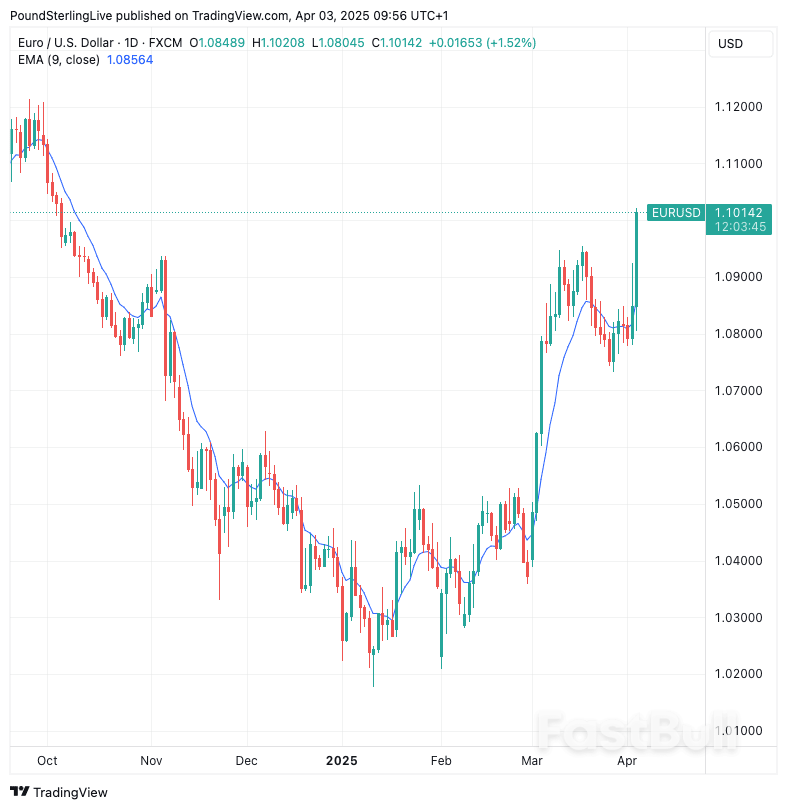
          Trump Sends Euro-Dollar Above 1.10

          Warren Takunda

          Economic

          The FX market has punished the U.S. Dollar and bought the Euro, confirming that it is the U.S. economy that will bear the brunt of the new tariffs announced by the White House on April 02.
          At the time of writing Thursday, the Euro-to-Dollar exchange rate is 1.40% higher on the day at 1.10.
          The currency market's behaviour reflects the reality that domestic consumers and businesses pay for tariffs and the arithmetic suggests the negative hit to the U.S. economy outweighs any losses suffered by the EU via lower exports.
          "While a global trade war in theory is a euro-negative, the soft underbelly of the US economy is the dominant factor for EUR/USD right now. A much sharper sell-off in US equities, dragging US rates even lower, adds another nail in the coffin of US exceptionalism and could send EUR/USD over 1.10," says Chris Turner, head of FX research at ING.
          Looking ahead, the rally's sustainability will depend on how the European Union reacts to U.S. tariffs, say some analysts.
          "If Europe and China do symbolic retaliation and focus more on domestic support measures we could avoid a broad-based global risk reduction event," says Namik Immelbäck, Chief Strategist at SEB, the Swedish bank.
          Under a U.S.-focussed selloff, the Dollar would likely stay under pressure, he explains. "Avoiding further escalation makes this a US negative event."
          The European Commission President Ursula von der Leyen said on Thursday the EU is finalising a response to tariffs placed on steel and aluminium, suggesting it is still some way off from announcing a response to the April 02 tariffs.
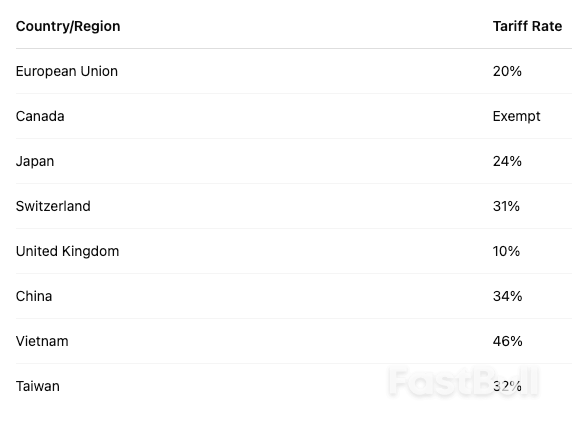
          The U.S. announced a 20% flat tariff rate on all EU imports. In response, Von der Leyen said the EU was preparing further countermeasures if negotiations fail.
          This is a hard hint that the EU will negotiate on the matter as a preference to upping the ante.
          SEB's view is that this path would prove supportive of European assets.
          "Harder retaliation benefits no one – this is the game theory outcome the U.S. administration is betting on," says Immelbäck. "So far the comments from Brussels imply a tempered response / avoiding escalation."
          Trump Sends Euro-Dollar Above 1.10_1

          Above: EURUSD at daily intervals.

          He says such an approach increases the probability of a U.S. recession, the selling of U.S. equities, "and rate convergence leads to short USD vs Europe in particular."
          George Saravelos, chief FX strategist at Deutsche Bank, says the U.S. "administration's approach to calculating the tariffs raises serious concerns about policy credibility, undermining the USD."
          The tariffs the U.S. announced on various countries were based on crude calculus: The U.S. took into account its trade deficit with a given country and divided it by that country's exports to the U.S. to arrive at an alleged tariff rate.
          For example, the U.S. has a $17.9BN trade deficit with Indonesia via imports amounting to $28BN. $17.9/$28 = 64%. That figure of 64% is claimed by the White House to be a tariff rate imposed by Indonesia on U.S. exports, which it clearly isn't.
          Trump Sends Euro-Dollar Above 1.10_2
          The process undermines U.S. credibility and raises investor uncertainty towards U.S. policy and the domestic outlook.
          Because tariffs are a tax on consumers, the U.S. economy is effectively facing a massive tax hike.
          This is disinflationary, which will make the Federal Reserve's job of containing inflation a whole lot easier.
          "The U.S. Treasury Secretary’s communication to the market right after the announcement emphasised fiscal tightening, while fiscal support from the rest of the world looks likely, further undermining relative US growth expectations," says Saravelos.
          This implies the U.S. central bank now has more scope to cut interest rates, while other central banks have less scope.
          This creates a convergence in interest rates that would drag on the Dollar relative to other global currencies, most notably the Euro.
          Looking to potential targets, ING's Turner says major medium-term resistance sits in the 1.11/12 area. "It's hard to call a major break of that unless US activity craters."

          Source: Euronews

          To stay updated on all economic events of today, please check out our Economic calendar
          Risk Warnings and Disclaimers
          You understand and acknowledge that there is a high degree of risk involved in trading. Following any strategies or investment methods may lead to potential losses. The content on the site is provided by our contributors and analysts for information purposes only. You are solely responsible for determining whether any trading assets, securities, strategy, or any other product is suitable for investing based on your own investment objectives and financial situation.
          Add to Favorites
          Share

          World Stocks Slide as Investors Count Potential Costs of Trump’s Tariffs

          Warren Takunda

          Stocks

          World shares slid further Friday after U.S. President Donald Trump’s tariffs sent shudders through Wall Street at a level of shock unseen since the COVID-19 pandemic pummeled world markets in 2020.
          Everything from crude oil to Big Tech stocks to the value of the U.S. dollar against other currencies has fallen. Even gold, a traditional safe haven that recently hit record highs, pulled lower after Trump announced his “Liberation Day” set of tariffs,’ which economists say carries the risk of a potentially toxic mix of weakening economic growth and higher inflation.
          In early European trading, Germany’s DAX lost 0.7% to 21,568.78 while the CAC 40 in Paris slipped 0.7% to 7,547.19. Britain’s FTSE 100 gave up 0.6% to 8,426.10.
          The future for the S&P 500 lost 0.4% while that for the Dow Jones Industrial Average shed 0.5%.
          Markets in Shanghai, Taiwan, Hong Kong and Indonesia were closed for holidays, limiting the scope of Friday’s sell-offs in Asia.
          Tokyo’s Nikkei 225 lost 2.8% to 33,780.58, while South Korea’s Kospi sank 0.9% to 2,465.42.
          The two U.S. allies said they were focused on negotiating lower tariffs with Trump’s administration.
          Australia’s S&P/ASX 200 dropped 2.4%, closing at 7,667.80. Bangkok’s SET fell 2.6%.
          In other trading early Friday, the U.S. dollar fell to 145.87 Japanese yen from 146.06. The yen is often used as a refuge in uncertain times, while Trump’s policies are meant in part to weaken the dollar to make goods made in the U.S. more price competitive overseas. The euro edged lower, to $1.1054 from $1.1055.
          Trump announced a minimum tariff of 10% on global imports, with the tax rate running much higher on products from certain countries like China and those from the European Union. Smaller, poorer countries in Asia were slapped with tariffs as high as 49%.
          It’s “plausible” the tariffs altogether, which would rival levels unseen in more than a century, could knock down U.S. economic growth by 2 percentage points this year and raise inflation close to 5%, according to UBS.
          That’s such a big hit it “makes one’s rational mind regard the possibility of them sticking as low,” according to Bhanu Baweja and other strategists at UBS.
          Trump has previously said tariffs could cause “a little disturbance” in the economy and markets. On Thursday he downplayed the impact.
          “The markets are going to boom, the stock is going to boom and the country is going to boom,” Trump said as he left the White House to fly to Florida.
          The S&P 500 sank 4.8% to 5,396.52 and the Dow Jones Industrial Average dropped 4% to 40,545.93. The Nasdaq composite tumbled 6% to 16,550.61.
          Some of the worst hits walloped smaller U.S. companies, and the Russell 2000 index of smaller stocks dropped 6.6% to pull more than 20% below its record.
          Investors knew Trump was going to announce sweeping new tariffs, and fears surrounding it had already pulled Wall Street’s main measure of health, the S&P 500 index, 10% below its all-time high.
          Some analysts and investors believed Trump might use tariffs simply as a tool for negotiations, rather than as a long-term policy. But he indicated Wednesday that he sees them as a way to bring factory jobs back to the United States, which could take years.
          The Federal Reserve could cut interest rates to support the economy, but lower rates can push up inflation, already a worry given that U.S. households are bracing for sharp increases to their bills due to the tariffs.
          Yields on Treasurys tumbled in part on rising expectations for coming cuts to rates, along with general fear about the health of the U.S. economy. The yield on the 10-year Treasury fell to 4.04% from 4.20% late Wednesday and from roughly 4.80% in January.
          A report Thursday said fewer U.S. workers applied for unemployment benefits last week, better than economists were expecting. A separate report said activity for U.S. transportation, finance and other businesses in the services industry grew last month, but by less than forecast.
          Also early Friday, U.S. benchmark crude oil shed $1.27 to $65.68 a barrel. Brent crude, the international standard, was down $1.26 at $68.88 a barrel.

          Source: AP

          Risk Warnings and Disclaimers
          You understand and acknowledge that there is a high degree of risk involved in trading. Following any strategies or investment methods may lead to potential losses. The content on the site is provided by our contributors and analysts for information purposes only. You are solely responsible for determining whether any trading assets, securities, strategy, or any other product is suitable for investing based on your own investment objectives and financial situation.
          Add to Favorites
          Share
          FastBull
          Copyright © 2025 FastBull Ltd

          728 RM B 7/F GEE LOK IND BLDG NO 34 HUNG TO RD KWUN TONG KLN HONG KONG

          TelegramInstagramTwitterfacebooklinkedin
          App Store Google Play Google Play
          Products
          Charts

          Chats

          Q&A with Experts
          Screeners
          Economic Calendar
          Data
          Tools
          Membership
          Features
          Function
          Markets
          Copy Trading
          Latest Signals
          Contests
          News
          Analysis
          24/7
          Columns
          Education
          Company
          Careers
          About Us
          Contact Us
          Advertising
          Help Center
          Feedback
          User Agreement
          Privacy Policy
          Business

          White Label

          Data API

          Web Plug-ins

          Poster Maker

          Affiliate Program

          Risk Disclosure

          The risk of loss in trading financial instruments such as stocks, FX, commodities, futures, bonds, ETFs and crypto can be substantial. You may sustain a total loss of the funds that you deposit with your broker. Therefore, you should carefully consider whether such trading is suitable for you in light of your circumstances and financial resources.

          No decision to invest should be made without thoroughly conducting due diligence by yourself or consulting with your financial advisors. Our web content might not suit you since we don't know your financial conditions and investment needs. Our financial information might have latency or contain inaccuracy, so you should be fully responsible for any of your trading and investment decisions. The company will not be responsible for your capital loss.

          Without getting permission from the website, you are not allowed to copy the website's graphics, texts, or trademarks. Intellectual property rights in the content or data incorporated into this website belong to its providers and exchange merchants.

          Not Logged In

          Log in to access more features

          FastBull Membership

          Not yet

          Purchase

          Become a signal provider
          Help Center
          Customer Service
          Dark Mode
          Price Up/Down Colors

          Log In

          Sign Up

          Position
          Layout
          Fullscreen
          Default to Chart
          The chart page opens by default when you visit fastbull.com