• Trade
  • Markets
  • Copy
  • Contests
  • News
  • 24/7
  • Calendar
  • Q&A
  • Chats
Trending
Screeners
SYMBOL
LAST
BID
ASK
HIGH
LOW
NET CHG.
%CHG.
SPREAD
SPX
S&P 500 Index
6827.42
6827.42
6827.42
6899.86
6801.80
-73.58
-1.07%
--
DJI
Dow Jones Industrial Average
48458.04
48458.04
48458.04
48886.86
48334.10
-245.98
-0.51%
--
IXIC
NASDAQ Composite Index
23195.16
23195.16
23195.16
23554.89
23094.51
-398.69
-1.69%
--
USDX
US Dollar Index
97.950
98.030
97.950
98.500
97.950
-0.370
-0.38%
--
EURUSD
Euro / US Dollar
1.17394
1.17409
1.17394
1.17496
1.17192
+0.00011
+ 0.01%
--
GBPUSD
Pound Sterling / US Dollar
1.33707
1.33732
1.33707
1.33997
1.33419
-0.00148
-0.11%
--
XAUUSD
Gold / US Dollar
4299.39
4299.39
4299.39
4353.41
4257.10
+20.10
+ 0.47%
--
WTI
Light Sweet Crude Oil
57.233
57.485
57.233
58.011
56.969
-0.408
-0.71%
--

Community Accounts

Signal Accounts
--
Profit Accounts
--
Loss Accounts
--
View More

Become a signal provider

Sell trading signals to earn additional income

View More

Guide to Copy Trading

Get started with ease and confidence

View More

Signal Accounts for Members

All Signal Accounts

Best Return
  • Best Return
  • Best P/L
  • Best MDD
Past 1W
  • Past 1W
  • Past 1M
  • Past 1Y

All Contests

  • All
  • Trump Updates
  • Recommend
  • Stocks
  • Cryptocurrencies
  • Central Banks
  • Featured News
Top News Only
Share

Trump Isn't Certain His Economic Policies Will Translate To Midterm Wins

Share

The United States And Mexico Have Reached An Agreement On How To Resolve The Water Dispute In The Rio Grande Basin (which Borders Texas). Starting December 15, Mexico Will Supply The U.S. With An Additional 20.2 Acre-feet (a Unit Of Volume For Irrigation). The Agreement Seeks To “strengthen Water Management In The Rio Grande Basin” Within The Framework Of The 1944 Water Treaty

Share

U.S. Transportation Secretary Duffy: The Engine Of United Airlines Flight 803 That Malfunctioned Caught Fire

Share

Ukraine President Zelenskiy: He Will Meet US, European Representatives About Peace

Share

UK Prime Minister Office: Prime Minister Starmer Spoke To The President Of The European Commission Ursula Von Der Leyen This Evening - Downing Street Spokesperson

Share

Trump: We Will Retaliate Against ISIS

Share

Trump Says We Mourn The Loss Of Three Great Patriots In Syria In An Ambush

Share

Syrian Interior Ministry Spokesperson Confirms Attacker Was Member Of Security Forces With Extremist Ideology

Share

Syrian Interior Ministry Says Attacker Did Not Have Leadership Role In Security Forces, Did Not Say If He Was Junior Member

Share

Man Who Attacked Syrian, US Military Was Member Of Syrian Security Forces -Three Local Syrian Officials

Share

US Envoy Coale Says Belarus President Lukashenko Agreed To Do All He Can To Stop Weather Balloons Flying Into Lithuania

Share

Ukraine Says Russian Drone Attack Hit Civilian Turkish Vessel

Share

Islamic State Attacker In Syria Was Lone Gunman, Who Was Killed -USA Central Command

Share

US Envoy John Coale Says Around 1000 Remaining Political Prisoners In Belarus Could Be Released In Coming Months

Share

US Defense Secretary Hegseth: Attacker Was Killed By Partner Forces

Share

Pentagon Says Two USA Army Soldiers And One Civilian USA Interpreter Were Killed, And Three Were Wounded In Syria

Share

Israel Says It Kills Senior Hamas Commander Raed Saed In Gaza

Share

Ukraine's Navy Says Russian Drone Attack Hit Civilian Turkish Vessel Carrying Sunflower Oil To Egypt On Saturday

Share

Israeli Military Says It Put Planned Strike On South Lebanon Site On Hold After Lebanese Army Requested Access

Share

Norwegian Nobel Committee: Calls On The Belarusian Authorities To Release All Political Prisoners

TIME
ACT
FCST
PREV
U.K. Trade Balance (Oct)

A:--

F: --

P: --

U.K. Services Index MoM

A:--

F: --

P: --

U.K. Construction Output MoM (SA) (Oct)

A:--

F: --

P: --

U.K. Industrial Output YoY (Oct)

A:--

F: --

P: --

U.K. Trade Balance (SA) (Oct)

A:--

F: --

P: --

U.K. Trade Balance EU (SA) (Oct)

A:--

F: --

P: --

U.K. Manufacturing Output YoY (Oct)

A:--

F: --

P: --

U.K. GDP MoM (Oct)

A:--

F: --

P: --

U.K. GDP YoY (SA) (Oct)

A:--

F: --

P: --

U.K. Industrial Output MoM (Oct)

A:--

F: --

P: --

U.K. Construction Output YoY (Oct)

A:--

F: --

P: --

France HICP Final MoM (Nov)

A:--

F: --

P: --

China, Mainland Outstanding Loans Growth YoY (Nov)

A:--

F: --

P: --

China, Mainland M2 Money Supply YoY (Nov)

A:--

F: --

P: --

China, Mainland M0 Money Supply YoY (Nov)

A:--

F: --

P: --

China, Mainland M1 Money Supply YoY (Nov)

A:--

F: --

P: --

India CPI YoY (Nov)

A:--

F: --

P: --

India Deposit Gowth YoY

A:--

F: --

P: --

Brazil Services Growth YoY (Oct)

A:--

F: --

P: --

Mexico Industrial Output YoY (Oct)

A:--

F: --

P: --

Russia Trade Balance (Oct)

A:--

F: --

P: --

Philadelphia Fed President Henry Paulson delivers a speech
Canada Building Permits MoM (SA) (Oct)

A:--

F: --

P: --

Canada Wholesale Sales YoY (Oct)

A:--

F: --

P: --

Canada Wholesale Inventory MoM (Oct)

A:--

F: --

P: --

Canada Wholesale Inventory YoY (Oct)

A:--

F: --

P: --

Canada Wholesale Sales MoM (SA) (Oct)

A:--

F: --

P: --

Germany Current Account (Not SA) (Oct)

A:--

F: --

P: --

U.S. Weekly Total Rig Count

A:--

F: --

P: --

U.S. Weekly Total Oil Rig Count

A:--

F: --

P: --

Japan Tankan Large Non-Manufacturing Diffusion Index (Q4)

--

F: --

P: --

Japan Tankan Small Manufacturing Outlook Index (Q4)

--

F: --

P: --

Japan Tankan Large Non-Manufacturing Outlook Index (Q4)

--

F: --

P: --

Japan Tankan Large Manufacturing Outlook Index (Q4)

--

F: --

P: --

Japan Tankan Small Manufacturing Diffusion Index (Q4)

--

F: --

P: --

Japan Tankan Large Manufacturing Diffusion Index (Q4)

--

F: --

P: --

Japan Tankan Large-Enterprise Capital Expenditure YoY (Q4)

--

F: --

P: --

U.K. Rightmove House Price Index YoY (Dec)

--

F: --

P: --

China, Mainland Industrial Output YoY (YTD) (Nov)

--

F: --

P: --

China, Mainland Urban Area Unemployment Rate (Nov)

--

F: --

P: --

Saudi Arabia CPI YoY (Nov)

--

F: --

P: --

Euro Zone Industrial Output YoY (Oct)

--

F: --

P: --

Euro Zone Industrial Output MoM (Oct)

--

F: --

P: --

Canada Existing Home Sales MoM (Nov)

--

F: --

P: --

Euro Zone Total Reserve Assets (Nov)

--

F: --

P: --

U.K. Inflation Rate Expectations

--

F: --

P: --

Canada National Economic Confidence Index

--

F: --

P: --

Canada New Housing Starts (Nov)

--

F: --

P: --

U.S. NY Fed Manufacturing Employment Index (Dec)

--

F: --

P: --

U.S. NY Fed Manufacturing Index (Dec)

--

F: --

P: --

Canada Core CPI YoY (Nov)

--

F: --

P: --

Canada Manufacturing Unfilled Orders MoM (Oct)

--

F: --

P: --

Canada Manufacturing New Orders MoM (Oct)

--

F: --

P: --

Canada Core CPI MoM (Nov)

--

F: --

P: --

Canada Manufacturing Inventory MoM (Oct)

--

F: --

P: --

Canada CPI YoY (Nov)

--

F: --

P: --

Canada CPI MoM (Nov)

--

F: --

P: --

Canada CPI YoY (SA) (Nov)

--

F: --

P: --

Canada Core CPI MoM (SA) (Nov)

--

F: --

P: --

Canada CPI MoM (SA) (Nov)

--

F: --

P: --

Q&A with Experts
    • All
    • Chatrooms
    • Groups
    • Friends
    Connecting
    .
    .
    .
    Type here...
    Add Symbol or Code

      No matching data

      All
      Trump Updates
      Recommend
      Stocks
      Cryptocurrencies
      Central Banks
      Featured News
      • All
      • Russia-Ukraine Conflict
      • Middle East Flashpoint
      • All
      • Russia-Ukraine Conflict
      • Middle East Flashpoint
      Search
      Products

      Charts Free Forever

      Chats Q&A with Experts
      Screeners Economic Calendar Data Tools
      Membership Features
      Data Warehouse Market Trends Institutional Data Policy Rates Macro

      Market Trends

      Market Sentiment Order Book Forex Correlations

      Top Indicators

      Charts Free Forever
      Markets

      News

      News Analysis 24/7 Columns Education
      From Institutions From Analysts
      Topics Columnists

      Latest Views

      Latest Views

      Trending Topics

      Top Columnists

      Latest Update

      Signals

      Copy Rankings Latest Signals Become a signal provider AI Rating
      Contests
      Brokers

      Overview Brokers Assessment Rankings Regulators News Claims
      Broker listing Forex Brokers Comparison Tool Live Spread Comparison Scam
      Q&A Complaint Scam Alert Videos Tips to Detect Scam
      More

      Business
      Events
      Careers About Us Advertising Help Center

      White Label

      Data API

      Web Plug-ins

      Affiliate Program

      Awards Institution Evaluation IB Seminar Salon Event Exhibition
      Vietnam Thailand Singapore Dubai
      Fans Party Investment Sharing Session
      FastBull Summit BrokersView Expo
      Recent Searches
        Top Searches
          Markets
          News
          Analysis
          User
          24/7
          Economic Calendar
          Education
          Data
          • Names
          • Latest
          • Prev

          View All

          No data

          Scan to Download

          Faster Charts, Chat Faster!

          Download App
          English
          • English
          • Español
          • العربية
          • Bahasa Indonesia
          • Bahasa Melayu
          • Tiếng Việt
          • ภาษาไทย
          • Français
          • Italiano
          • Türkçe
          • Русский язык
          • 简中
          • 繁中
          Open Account
          Search
          Products
          Charts Free Forever
          Markets
          News
          Signals

          Copy Rankings Latest Signals Become a signal provider AI Rating
          Contests
          Brokers

          Overview Brokers Assessment Rankings Regulators News Claims
          Broker listing Forex Brokers Comparison Tool Live Spread Comparison Scam
          Q&A Complaint Scam Alert Videos Tips to Detect Scam
          More

          Business
          Events
          Careers About Us Advertising Help Center

          White Label

          Data API

          Web Plug-ins

          Affiliate Program

          Awards Institution Evaluation IB Seminar Salon Event Exhibition
          Vietnam Thailand Singapore Dubai
          Fans Party Investment Sharing Session
          FastBull Summit BrokersView Expo

          Gold Technical Analysis – Global Market Rout Weighs on The Precious Metal

          Michelle

          Commodity

          Summary:

          Gold came under some pressure amid the global market rout as the precious metal ceases to be a safe haven during very stressed times. What’s next?

          Fundamental Overview

          The global stock marketrout didn’t spare gold as the precious metal fell alongside equities although ona much lesser scale. There's a common misconception with gold. People thinkit's a safe haven in crises times. But history suggests otherwise. If you lookback at the most recent recessions, you will notice that gold sold offalongside the stock market. It's not a protection against a market selloff.

          When there's a tighteningin financial conditions stemming from an aggressive stock market selloff,widening credit spreads and recessionary fears, then all correlations go toone. The best times for gold is when the central bank cuts interest rates andthe market prices in better growth ahead.

          But the absolute best timethough is during stagflationary expectations which we had in the past weeks andmonths. Those expectations got crushed by the tariffs announcement as it was sobad that the expectations switched to price in a recession.

          We are now having atightening in financial conditions and this is going to weigh both on growthand inflation despite the expectations of more inflation from tariffs. In fact,market-based inflation expectations are going down now.

          The risk of more inflationcould come only if the central banks start to ease aggressively and the currenttariffs remain in place, in which case, gold will rally hard. Conversely, if thecentral banks don't ease fast and the markets continue to sell off, then wewill just get a recession and potentially deflation which is a byproduct ofsuch crises and in this case, gold will collapse.

          Of course, this doesn't take in consideration what happens with tariffs but an easing in fears and de-escalation should give gold a boost, while further escalation is likely to weigh more on the precious metal as it would increase recessionary fears.
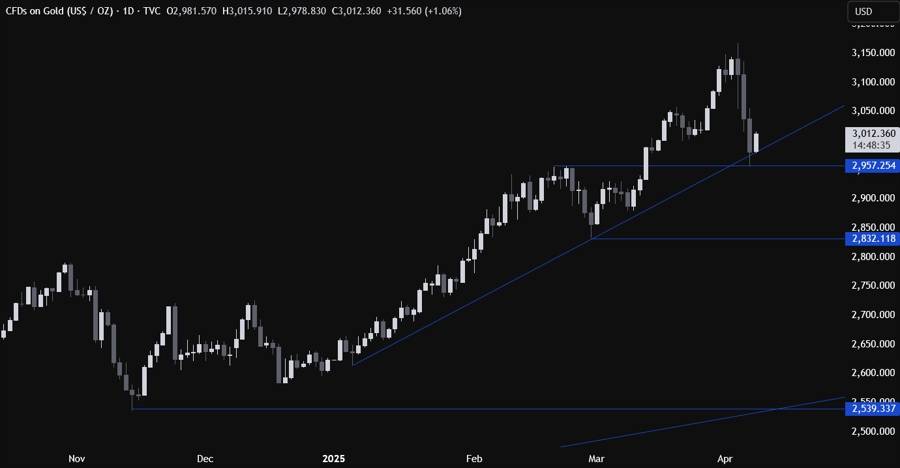
          GoldTechnical Analysis – Daily Timeframe

          Gold Daily

          On the daily chart, we cansee that pulled all the way back to the major trendline around the 2957 level. Thisis where the buyers piled in with a defined risk below the trendline toposition for a rally into new all-time highs. The sellers, on the other hand,will want to see the price breaking lower to increase the bearish bets into the2832 level next.
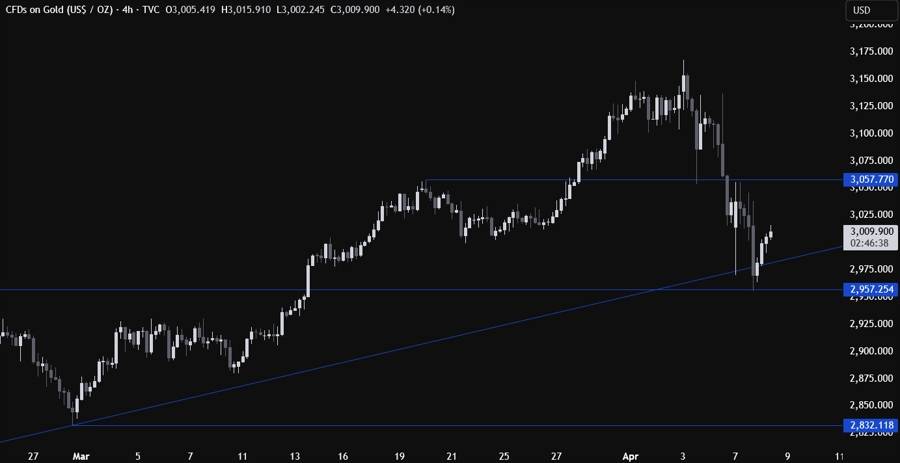
          Gold Technical Analysis– 4 hour Timeframe

          Gold 4 hour

          On the 4 hour chart, we cansee that we have also a key resistancearound the 3057 level. From a risk management perspective, the sellers willhave a better risk to reward setup around the resistance to target a breakbelow the trendline. The buyers, on the other hand, will want to see the pricebreaking above the resistance to increase the bullish bets into new highs.
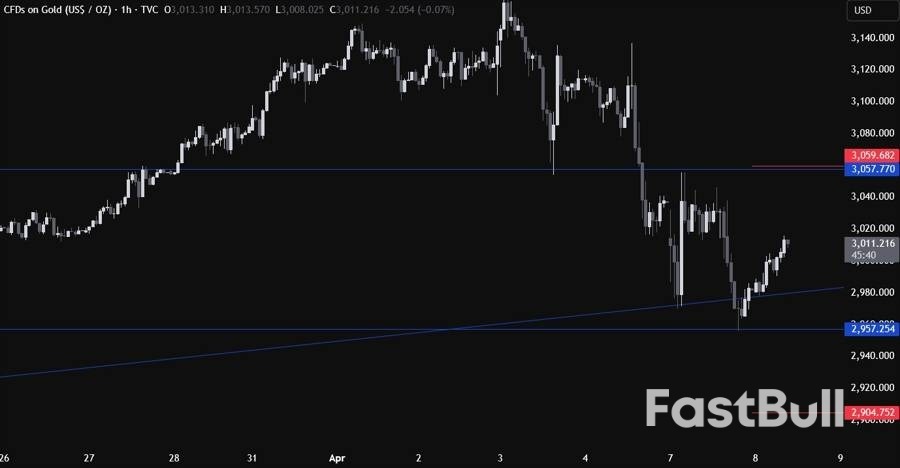
          Gold Technical Analysis– 1 hour Timeframe

          Gold 1 hour

          On the 1 hour chart, there’snot much we can add here as we could remain stuck in a range between the 2957support and the 3057 resistance. Nonetheless, the market participants will likelylean on the levels to position for the opposite moves and increase the bets onbreakouts. The red lines define the average daily range for today.

          Source: ForexLive

          Risk Warnings and Disclaimers
          You understand and acknowledge that there is a high degree of risk involved in trading. Following any strategies or investment methods may lead to potential losses. The content on the site is provided by our contributors and analysts for information purposes only. You are solely responsible for determining whether any trading assets, securities, strategy, or any other product is suitable for investing based on your own investment objectives and financial situation.
          Add to Favorites
          Share

          Deutsche Bank Predicts Double RBA Rate Cut in May as Trump Tariff Threat Looms

          Warren Takunda

          Economic

          Deutsche Bank says the Reserve Bank of Australia will follow the script from previous crises and deliver a double rate cut when it next meets in May, as Donald Trump’s threats of even higher tariffs on China added to fears of a looming global trade war.
          Financial markets and economists were in agreement the RBA would lower the cash rate from 4.1% to 3.85% in five weeks’ time, saying the decision is “locked in” after the US president’s “liberation day” trade on 2 April sent financial markets tumbling late last week.
          A 50 basis-point RBA rate cut would offer some silver lining to indebted households by lowering the monthly repayments on a $500,000 home loan by $152, assuming a home loan rate of 6% now.
          If rates were to drop by one percentage point by the end of this year – as more economists now predict – then families with big mortgages will be saving hundreds of dollars a month in lower interest payments.
          As investors struggle to divine the next move in what many fear is an escalating trade war, Deutsche Bank’s chief economist, Phil O’Donaghoe, said the “global shock” from the most protectionist US trade policy in more than a century justified a more aggressive move from the RBA.
          O’Donaghoe said while Australia had escaped the worst of the additional reciprocal tariffs imposed on the European Union and countries such as China and Japan, “Australia does not fly under the radar in a global risk-off environment of the scale demonstrated by moves in financial markets in the past few days”.
          He drew parallels with RBA’s response during previous crises, including the global financial crisis and, more recently, the Covid-19 pandemic.
          “Unless there is a sudden reversal – or significant watering down – of US tariff rates on Australia’s key trading partners in Asia, especially China, the consequences for business confidence, consumer confidence and domestic growth justify the RBA making an outsized shift away from its ‘restrictive’ policy stance,” O’Donaghoe said.
          “This is one of the few occasions in history where a global ‘shock’ outweighs prevailing domestic economic considerations.”
          O’Donaghoe said he still believed the cash-rate cuts would end at 3.1% – from 4.1% now – although the central bank would get there more quickly, by late this year rather than in early 2026.
          Financial markets have priced in a chance of a 50 basis point rate cut next month, but, like most economists, traders believe a more orthodox 25 basis point cut is more likely.
          The latest rates prediction comes as share markets settled following days of near-panicked selling on Wall Street and on bourses around the world.
          The Australian dollar steadied at a little over US60 cents on Tuesday, while the benchmark S&P/ASX 200 share market index bounced 2.3% to 7510 points, to still be more than 5% lower over the past week.
          The return of uneasy calm was despite Trump threatening an extra 50% lift in duties on Chinese goods on Monday night.
          NAB chief economist Sally Auld said a rate cut at the May RBA monetary policy board meeting still remained the most likely outcome.
          Auld, however, said she had expected four cuts to 3.1% by early next year, but that the trade turmoil meant the cash rate would reach that level by late 2025 instead.
          If the trade war escalated, the RBA may need to deliver deeper cuts into the “mid to high twos”, she said.
          “A big piece of this is how China fares in all of this. I do think the Chinese will respond with fiscal and monetary stimulus to put a floor under growth. And our starting point is pretty favourable: we have a low unemployment and inflation, and plenty of scope to ease policy.”
          Whatever unfolds over coming weeks and months, “we are not going back to a world of zero tariffs,” Auld said.

          Source: Theguardian

          To stay updated on all economic events of today, please check out our Economic calendar
          Risk Warnings and Disclaimers
          You understand and acknowledge that there is a high degree of risk involved in trading. Following any strategies or investment methods may lead to potential losses. The content on the site is provided by our contributors and analysts for information purposes only. You are solely responsible for determining whether any trading assets, securities, strategy, or any other product is suitable for investing based on your own investment objectives and financial situation.
          Add to Favorites
          Share

          World Shares Advance, Led by 6% Jump in Tokyo as Markets Calm Somewhat After Trump’s Tariff Shocks

          Warren Takunda

          Stocks

          World shares and U.S. futures advanced Tuesday, led by gains in Tokyo where the Nikkei 225 shot up just over 6% as markets calmed somewhat after the shocks from President Donald Trump ’s tariff hikes.
          The modest rebound for most markets followed a wild day on Wall Street, where stocks careened after Trump threatened to crank his double-digit tariffs higher.
          Early Tuesday, China’s Commerce Ministry said it would “fight to the end” and take unspecified countermeasures against the United States after Trump threatened another 50% tariff on Chinese imports.
          Germany’s DAX gained 0.9% to 19,975.81 while the CAC 40 in Paris was up 1.3% at 7,018.79. Britain’s FTSE 100 also picked up 1.3%, to 7,804.73.
          The future for the S&P 500 gained 1.5% early Tuesday while that for the Dow Jones Industrial Average was up 1.9%.
          In Tokyo, the Nikkei 225 closed a smidgen over 6% higher, at 33,012.58.
          Hong Kong also recovered some lost ground, but nothing close to the 13.2% dive Monday that gave the Hang Seng its worst day since 1997, during the Asian financial crisis.
          The Hang Seng gained 1% to 20,036.03. The Shanghai Composite index jumped 1.4% to 3,140.15 after the government investment fund Central Huijin directed state-owned companies to help support the market with share purchases.
          South Korea’s Kospi picked up 0.3% to 2,334.23, while the S&P/ASX 200 in Australia climbed 2.3% to 7,510.00.
          Markets in Thailand and Indonesia tumbled, however, as they reopened after holidays. Trading was suspended briefly in Jakarta when the JSX index fell more than 9%. It was down 7.6% by mid-afternoon. Thailand’s SET lost 4.2%.
          In Taiwan, the Taiex lost 4%, pulled lower by losses for Taiwan Semiconductor Manufacturing Corp., or TSMC, the world’s largest computer chip maker. Its shares fell 3.8% on Tuesday.
          On Monday, the S&P 500 sagged 0.2% as shell-shocked investors watched to see what Trump will do next in his trade war. If other countries agree to trade deals, he could lower his tariffs and avoid a possible recession. But if he sticks with tariffs for the long haul, stock prices may fall further.
          The Dow sank 0.9%, and the Nasdaq composite edged up by 0.1%.
          All three indexes started the day sharply lower. But a false rumor that Trump was considering a 90-day pause on his tariffs caused the Dow and S&P 500 to shoot higher in the late morning. A White House account on X quickly labeled as “fake news” the rumor that raised hopes Trump may let up on tariffs, causing shifts in trillions of dollars of investments.
          Soon afterward, Trump dug in further, saying he may raise tariffs more against China after the world’s second-largest economy retaliated last week with its own set of tariffs against U.S. products.
          Trump’s trade war is an attack on the globalization that’s shaped today’s world economy and helped bring down prices but also caused manufacturing jobs to leave for other countries.
          He has said he wants to bring factory jobs back to the United States, a process that could take years. Trump also says he wants to narrow trade deficits with other countries, but it’s unclear how much room for negotiation there is on the U.S. side or among its trading partners.
          Indexes swung between losses and gains Monday, partly because investors are still hoping negotiations may forestall actual implementation of the stiff duties on all imports.
          All that seemed certain Monday was the financial pain hammering investments around the world.
          Hurt by worries that a global economy weakened by trade barriers will burn less fuel, the price of a barrel of benchmark U.S. crude oil dipped below $60 on Monday for the first time since 2021. Early Tuesday, it was up 67 cents at $61.37 per barrel.
          Brent crude, the international standard, gained 65 cents to $64.86 per barrel.
          In currency trading, the U.S. dollar fell to 147.32 Japanese yen from 147.85 yen. The euro fell to $1.0982 from $1.0905.
          The price of gold rose $54 to about $3,028.00 an ounce.
          Bitcoin gained 6.2% to about $79,400. On Monday it sank below $79,000, down from its record above $100,000 set in January.

          Source: AP

          Risk Warnings and Disclaimers
          You understand and acknowledge that there is a high degree of risk involved in trading. Following any strategies or investment methods may lead to potential losses. The content on the site is provided by our contributors and analysts for information purposes only. You are solely responsible for determining whether any trading assets, securities, strategy, or any other product is suitable for investing based on your own investment objectives and financial situation.
          Add to Favorites
          Share

          The Fed Must Resist Repeating Past Mistakes

          Natalie Gordon

          Economic

          Forex

          It’s easy to think that the Jerome Powell-led Federal Reserve has been one of the unluckiest on record. From the 2020 pandemic and its messy aftermath to the current tariff-induced economic and financial volatility, it has faced one big external shock after the other. Powell has had repeated run-ins with President Donald Trump, lost key officials over insider trading allegations, seen the institution’s credibility eroded by the misguided 2021 transitory inflation judgement, and more.

          Yet what has made this bad luck worse and more consequential for overall economic wellbeing is that it has interacted with self-created weaknesses. Unlike other Feds, those have extended to analysis, forecasts, communication, and policy responses, repeated missteps that were aggravated by a distinct lack of humility and learning. The result is a Fed whose political independence and market credibility are as shaky as they have been since the late 1970s and early 1980s. And that is bad news for a central bank that, in the next few months, will face difficult policy judgements. It’s also bad news for the world’s largest economy that has lost other anchors and is suffering its own period of instability at the center of the global economic and financial order.

          The Fed’s latest stroke of bad luck is highlighted by the recent rush of major Wall Street firms to revise US economic forecasts. One after the other has lowered its growth projections, hiked up inflation, and warned that the balance of risks to the economy remains unfavorable even after these revisions. The policy dilemma for the Fed’s pursuit of its dual mandate was made vivid by JPMorgan Chase & Co.’s upward revisions in unemployment to 5.3% and inflation all the way up to 4.4%, an adverse move of 1.4 percentage points.

          While the Fed navigated under the first Trump administration the main driver of these revisions — the effects of higher tariffs on America’s trading partners — this round is significantly more challenging. It involves much more extensive surcharges, can trigger a range of possible reactions from trading partners, and it confronts companies with a spaghetti bowl of dynamic supply and demand uncertainties to deal with.

          Also, whereas the required Fed policy response was obvious when the pandemic imposed a sudden stop on the economy, and unlike the aftermath when the central bank’s initial mischaracterization of inflation left no doubt as to what needed to follow interest rate wise, the Fed’s current policy formulation is fraught with uncertainties and danger. Managing the challenges got off to a troubling start when, in his March press conference, Powell eagerly dismissed the information content of the weakening soft data and reintroduced the concept of “transitory” when opining on the inflationary effects of the tariffs. Fortunately, he walked back both statements last week rather than wait for many months as he did in 2021.

          Now the Fed needs to judge whether it should respond to the prospects of higher unemployment by cutting interest rates aggressively, or to hotter inflation by staying put or even opening the door to considering the possibility of a rate hike. For their part, market participants have rushed to price in more than four reductions this year, with some even calling for an emergency inter-meeting cut.

          The reaction of traders and investors should not come as a surprise. It reflects how they have been trained repeatedly by the Fed to expect looser financial conditions the minute there are any signs of unusual market volatility or economic weakness. And, judging from its history, it is probably what this Fed will be tempted to do.

          Yet the expected rise in inflation makes such a policy response far from straightforward. Indeed, it could even be dangerous.

          Having failed to bring inflation back down to its often-repeated target three years after annual consumer price rises topped 9%, the Fed faces the risk of protracted inflation that would quickly undermine its efforts to counter the potential rise in unemployment. Moreover, lessons from central banking history suggest that when faced with both parts of the dual mandate going against it, the Fed should give priority to putting the inflation genie back in the bottle.

          This is a particularly relevant consideration in the current situation where the sensitivity of unemployment to interest rates pales in comparison to the uncertainties companies and households feel due to the manner tariff policy has been designed, communicated and implemented. Indeed, to quote the guidance provided on Bloomberg Television last week by Eric Rosengren, the former president of the Boston Fed, the issue of rate cuts should be approached “slowly, gradually and reluctantly.”

          What the Fed needs more than ever is a good dose of humility, something that it has lacked in recent years to its and the economy’s detriment. Such humility would help reduce the risk of another bout of slippages in analysis, forecasts, communication and policy design. It would also help counter the threat of a prolonged and damaging period of stagflation.

          Source: Bloomberg Europe

          To stay updated on all economic events of today, please check out our Economic calendar
          Risk Warnings and Disclaimers
          You understand and acknowledge that there is a high degree of risk involved in trading. Following any strategies or investment methods may lead to potential losses. The content on the site is provided by our contributors and analysts for information purposes only. You are solely responsible for determining whether any trading assets, securities, strategy, or any other product is suitable for investing based on your own investment objectives and financial situation.
          Add to Favorites
          Share

          Strong Data From Japan Keeps USDJPY From Rising Further

          Michelle Reid

          Economic

          Forex

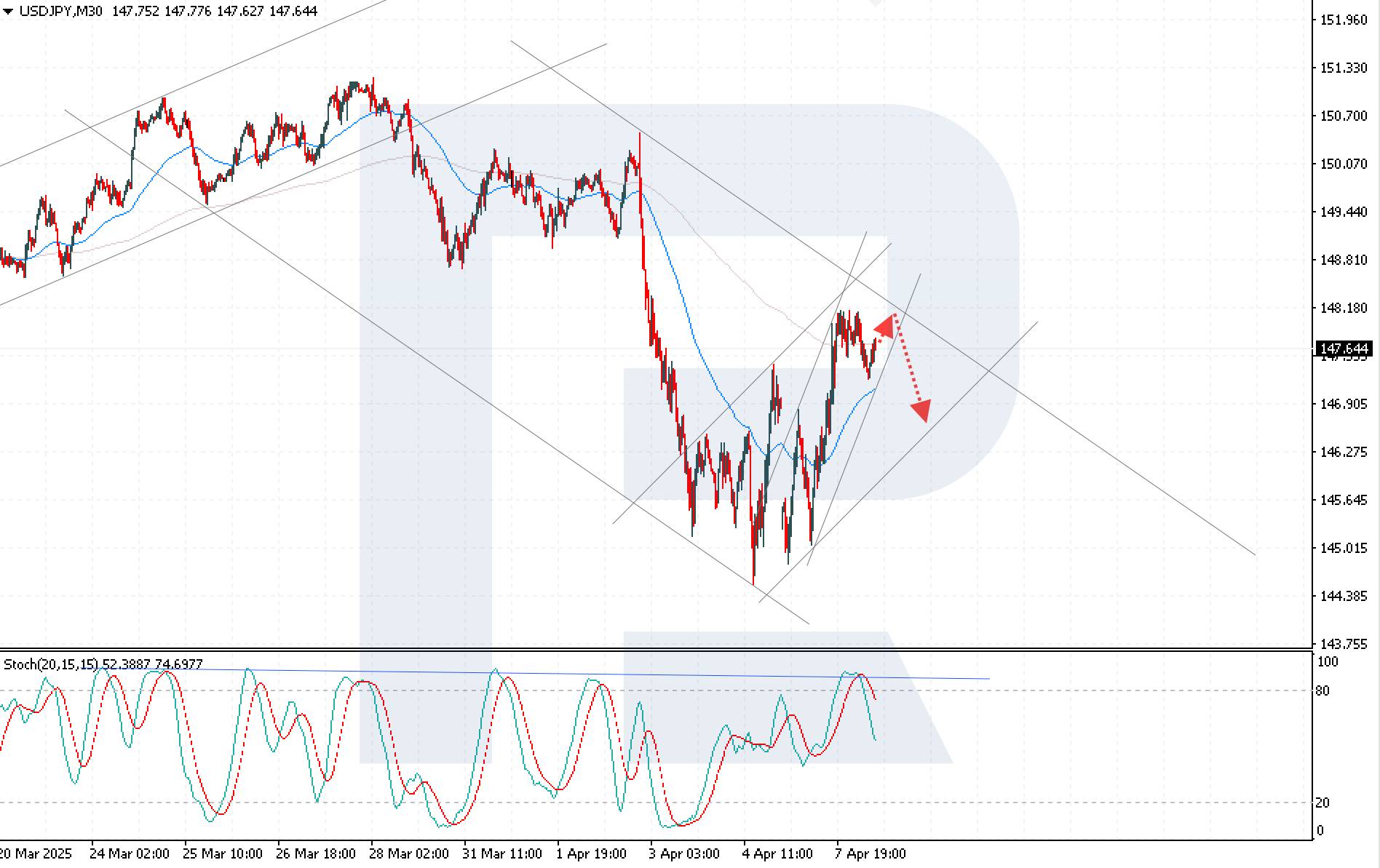
          The USDJPY pair is slightly declining, currently trading at 147.70. Find more details in our analysis for 8 April 2025.

          USDJPY forecast: key trading points

          • Donald Trump announces readiness to begin trade talks with Japan
          • Japan posts a record current account surplus in February 2025
          • USDJPY forecast for 8 April 2025: 146.25

          Fundamental analysis

          The USDJPY rate is retreating after Monday’s sharp rally, where the pair tested the key resistance level at 148.00. The Japanese yen temporarily weakened against the US dollar amid growing uncertainty around global trade — typically a driver of safe-haven demand.

          On the political front, Donald Trump confirmed his readiness to start trade negotiations with Japan following a phone call with Prime Minister Shigeru Ishiba. The upcoming talks will address a wide range of issues, including tariffs, currency policy, and state subsidies.

          Robust economic data keeps the yen from further weakening. In February 2025, Japan recorded a record current account surplus of 4.0607 trillion yen, driven by strong export growth amid high external demand and a decline in imports due to lower energy prices and subdued domestic consumption.

          USDJPY technical analysis

          The USDJPY rate is falling after rebounding from the 148.00 resistance level, remaining within the boundaries of an ascending corrective channel. The USDJPY forecast for today suggests a potential breakout below the lower boundary of this channel and a decline to the 146.25 support level. Technical indicators support the bearish outlook, with Moving Averages indicating a downtrend and the Stochastic Oscillator turning downwards from the overbought area, signalling a fading bullish impulse and a possible price reversal.

          Summary

          The USDJPY rate is undergoing a short-term correction, with strong Japanese economic data limiting further yen weakness. The USDJPY technical analysis points to a potential bearish move, with the price likely to break below the lower boundary of the ascending channel and dip to 146.25.

          Source: RoboForex

          To stay updated on all economic events of today, please check out our Economic calendar
          Risk Warnings and Disclaimers
          You understand and acknowledge that there is a high degree of risk involved in trading. Following any strategies or investment methods may lead to potential losses. The content on the site is provided by our contributors and analysts for information purposes only. You are solely responsible for determining whether any trading assets, securities, strategy, or any other product is suitable for investing based on your own investment objectives and financial situation.
          Add to Favorites
          Share

          London Open: FTSE Recovers but US-China Tensions Escalate

          Warren Takunda

          Stocks

          London stocks rose in early trade on Tuesday, recovering from whopping losses in the previous session, as investors mulled the latest developments in the Trump trade war.
          At 0830 BST, the FTSE 100 was up 1.2% at 7,796.42, having closed down 4.4% on Monday as the Trump tariff selloff continued.
          The early gains came despite escalating tensions between the US and China, after the latter said it would "fight to the end" as Washington threatened an additional 50% tariff if Beijing went ahead with retaliatory measures of its own against American imports.
          US President Donald Trump made the threat late on Monday, a move described as "a mistake on top of a mistake, which once again exposes the US’s blackmailing nature", Agence France-Presse quoted a Commerce Ministry spokesperson as saying on Tuesday.
          "China will never accept this. If the US insists on going its own way, China will fight it to the end. If the US escalates its tariff measures, China will resolutely take countermeasures to safeguard its own rights and interests."
          Matt Britzman, senior equity analyst at Hargreaves Lansdown, said: "Investors are waking up to a positive sight for once, with markets opening higher across a broad range of European indices and the FTSE 100 up 0.9% at the open.
          "However, this should hardly be seen as the end of the trouble, especially with President Trump showing no signs of easing his stance on perceived trade imbalances, having doubled down on China.
          "Still, there is a glimmer of hope, as Japanese markets are up nearly 6% following news that trade talks will begin in a few days. The sooner deals are reached, the quicker companies and investors can gain some clarity on the lay of the land."
          In equity markets, BA and Iberia owner IAG flew to the top of the FTSE 100, closely followed by engine maker Rolls-Royce.
          Scottish Mortgage Investment Trust, which is heavily- exposed to the US tech sector, was also a high riser.
          Building materials group CRH - which has a large exposure to the US market - advanced.
          Hilton Foods was in focus as it said it was on track to deliver 2025 earnings in line with guidance after a sharp jump in profits last year, driven by its core retail meat business which outperformed total market growth in every region.
          The company posted a 25% rise in pre-tax earnings to £61m and hiked its dividend 7.8% to 34.5p.
          Elsewhere, Howden Joinery announced that its chief financial officer was set to step down and be replaced by Coats Group's Jackie Callaway. Paul Hayes, 58, will retire as finance chief and from the board at the end of May, following five years in the role.
          Recruiter Hays jumped after an upgrade to ‘equalweight’ at Morgan Stanley. The bank previously had an ‘underweight’ rating on the shares as it saw risk from Hays' large exposure to Germany combined with a weaker balance sheet and higher likelihood of a dividend cut.
          "While these risks remain, we think they are now better reflected in the valuation, and our price target implies limited further downside," it said. "We therefore neutralise our rating."

          Source: Sharecast

          Risk Warnings and Disclaimers
          You understand and acknowledge that there is a high degree of risk involved in trading. Following any strategies or investment methods may lead to potential losses. The content on the site is provided by our contributors and analysts for information purposes only. You are solely responsible for determining whether any trading assets, securities, strategy, or any other product is suitable for investing based on your own investment objectives and financial situation.
          Add to Favorites
          Share

          U.S. Tariffs Impact on Global Auto Industry

          Laura Fletcher

          Economic

          U.S. President Donald Trump’s newly confirmed 25% global tariffs on foreign autos and parts are set to disrupt the global automotive landscape, triggering production shifts, halting asset sales, and pressuring margins across regions.

          Analysts at JPMorgan expect widespread earnings downgrades and strategic adjustments as companies react to what they call “a net negative for the earnings momentum” of the automakers.

          European and Japanese automakers appear especially vulnerable. Analysts forecast average earnings cuts of around 30% for Toyota (NYSE:TM), Honda (NYSE:HMC), and most EU OEMs, excluding Volvo (ST:VOLVb).

          German automakers and Stellantis (NYSE:STLA) face ~25% reductions in fiscal year 2025 (FY25) earnings projections, driven largely by vehicle exports to the U.S. that are now subject to the full tariff.

          Mass-market automakers are expected to struggle to pass on higher costs, unlike premium and luxury brands that may preserve margins through price increases. General Motors Company (NYSE:GM) and Ford face differing exposures, with GM “worst positioned of all companies in our coverage,” according to JPMorgan analysts.

          The carmaker imports about 40% of its U.S. vehicle sales from Canada and Mexico, compared to just 7% for Ford. Analysts estimate GM’s total tariff cost could reach $13 billion, while Ford’s may rise to $4.5 billion.

          Meanwhile, the pressure on U.S. truckmakers is compounded by softening demand. “Order intake in North America has been slowing over the past few months owing to the economic uncertainty created by the U.S. tariff negotiations,” analysts noted, expecting this to weigh on Q2 results.

          In response to the new tariffs, automakers are accelerating localization efforts. Honda is shifting Civic hybrid production from Mexico to Indiana.

          Volvo Cars is expanding output in South Carolina. Mercedes Benz (ETR:MBGn) is considering U.S. production shifts, while Volkswagen (ETR:VOWG_p) has paused imports and is working on long-term backup plans.

          Asian and Latin American suppliers are also adjusting. Tariffs on key auto parts, including transmissions and engines, are likely to be felt unevenly, with suppliers like Aptiv (NYSE:APTV) seen as more vulnerable.

          On the other hand, JPMorgan sees Brazil-based parts firms relatively well-positioned, given their exposure to heavy vehicles and exemptions under the USMCA.

          Although OEMs are generally well-capitalized, with ~15% net cash to sales ratios, the Wall Street firm warns that “production stoppages and high levels of inventory in transit” may strain balance sheets and force delays in share buybacks and dividends in the first half.

          In the near term, some planned asset disposals in the auto sector are likely to be put on hold due to tariff uncertainty, while automakers are expected to modestly increase capital spending to support production shifts from Mexico to the U.S.

          Source: Investing

          To stay updated on all economic events of today, please check out our Economic calendar
          Risk Warnings and Disclaimers
          You understand and acknowledge that there is a high degree of risk involved in trading. Following any strategies or investment methods may lead to potential losses. The content on the site is provided by our contributors and analysts for information purposes only. You are solely responsible for determining whether any trading assets, securities, strategy, or any other product is suitable for investing based on your own investment objectives and financial situation.
          Add to Favorites
          Share
          FastBull
          Copyright © 2025 FastBull Ltd

          728 RM B 7/F GEE LOK IND BLDG NO 34 HUNG TO RD KWUN TONG KLN HONG KONG

          TelegramInstagramTwitterfacebooklinkedin
          App Store Google Play Google Play
          Products
          Charts

          Chats

          Q&A with Experts
          Screeners
          Economic Calendar
          Data
          Tools
          Membership
          Features
          Function
          Markets
          Copy Trading
          Latest Signals
          Contests
          News
          Analysis
          24/7
          Columns
          Education
          Company
          Careers
          About Us
          Contact Us
          Advertising
          Help Center
          Feedback
          User Agreement
          Privacy Policy
          Business

          White Label

          Data API

          Web Plug-ins

          Poster Maker

          Affiliate Program

          Risk Disclosure

          The risk of loss in trading financial instruments such as stocks, FX, commodities, futures, bonds, ETFs and crypto can be substantial. You may sustain a total loss of the funds that you deposit with your broker. Therefore, you should carefully consider whether such trading is suitable for you in light of your circumstances and financial resources.

          No decision to invest should be made without thoroughly conducting due diligence by yourself or consulting with your financial advisors. Our web content might not suit you since we don't know your financial conditions and investment needs. Our financial information might have latency or contain inaccuracy, so you should be fully responsible for any of your trading and investment decisions. The company will not be responsible for your capital loss.

          Without getting permission from the website, you are not allowed to copy the website's graphics, texts, or trademarks. Intellectual property rights in the content or data incorporated into this website belong to its providers and exchange merchants.

          Not Logged In

          Log in to access more features

          FastBull Membership

          Not yet

          Purchase

          Become a signal provider
          Help Center
          Customer Service
          Dark Mode
          Price Up/Down Colors

          Log In

          Sign Up

          Position
          Layout
          Fullscreen
          Default to Chart
          The chart page opens by default when you visit fastbull.com