• Trade
  • Markets
  • Copy
  • Contests
  • News
  • 24/7
  • Calendar
  • Q&A
  • Chats
Trending
Screeners
SYMBOL
LAST
BID
ASK
HIGH
LOW
NET CHG.
%CHG.
SPREAD
SPX
S&P 500 Index
6827.42
6827.42
6827.42
6899.86
6801.80
-73.58
-1.07%
--
DJI
Dow Jones Industrial Average
48458.04
48458.04
48458.04
48886.86
48334.10
-245.98
-0.51%
--
IXIC
NASDAQ Composite Index
23195.16
23195.16
23195.16
23554.89
23094.51
-398.69
-1.69%
--
USDX
US Dollar Index
97.910
97.990
97.910
98.070
97.810
-0.040
-0.04%
--
EURUSD
Euro / US Dollar
1.17454
1.17461
1.17454
1.17596
1.17262
+0.00060
+ 0.05%
--
GBPUSD
Pound Sterling / US Dollar
1.33856
1.33863
1.33856
1.33961
1.33546
+0.00149
+ 0.11%
--
XAUUSD
Gold / US Dollar
4331.97
4332.40
4331.97
4350.16
4294.68
+32.58
+ 0.76%
--
WTI
Light Sweet Crude Oil
56.839
56.869
56.839
57.601
56.789
-0.394
-0.69%
--

Community Accounts

Signal Accounts
--
Profit Accounts
--
Loss Accounts
--
View More

Become a signal provider

Sell trading signals to earn additional income

View More

Guide to Copy Trading

Get started with ease and confidence

View More

Signal Accounts for Members

All Signal Accounts

Best Return
  • Best Return
  • Best P/L
  • Best MDD
Past 1W
  • Past 1W
  • Past 1M
  • Past 1Y

All Contests

  • All
  • Trump Updates
  • Recommend
  • Stocks
  • Cryptocurrencies
  • Central Banks
  • Featured News
Top News Only
Share

Portugal Treasury Expects 2026 Net Financing Needs At 29.4 Billion Euros, Up From 25.8 Billion In 2025

Share

Bank Of America Says With Indonesia's Smelter Now Ramping Up, It Expects Aluminium Supply Growth To Accelerate To 2.6% Year On Year In 2026

Share

Bank Of America Expects A Deficit In Aluminium Next Year And Sees Prices Pushing Above $3000/T

Share

Fed Data - USA Effective Federal Funds Rate At 3.64 Percent On 12 December On $102 Billion In Trades Versus 3.64 Percent On $99 Billion On 11 December

Share

Brazil's Petrobras Says No Impact Seen On Oil, Petroleum Products Output As Workers Start Planned Strike

Share

Statement: US Travel Group Warns New Proposed Trump Administration Requirements For Foreign Tourists To Provide Social Media Histories Could Mean Millions Of People Opting Not To Visit

Share

Blackrock: Kerry White Will Become Head Of Citi Investment Management At Citi Wealth

Share

Blackrock: Rob Jasminski, Head Of Citi Investment Management, Has Joined With Team

Share

Blackrock: Effective Dec 15, Citi Investment Management Employees Will Join Blackrock

Share

Blackrock: Formally Launch Citi Portfolio Solutions Powered By Blackrock

Share

According To Data From The Federal Reserve Bank Of New York, The Secured Overnight Funding Rate (Sofr) Was 3.67% On The Previous Trading Day (December 15), Compared To 3.66% The Day Before

Share

Peru Energy And Mines Ministry: Copper Production Up 4.8% Year-On-Year In October To 248192 Metric Tons

Share

Security Source: Ukrainian Drones Hits Russian Oil Infrastructure In Caspian Sea For Third Time

Share

Spot Palladium Extends Gains, Last Up 5% To $1562.7/Oz

Share

Mexico's Economy Ministry Announces Start Of Anti-Dumping Investigation And Anti-Subsidy Investigations Into USA Pork Imports

Share

Canada Nov CPI Common +2.8%, CPI Median +2.8%, CPI Trim +2.8% On Year

Share

NY Fed's Empire State Prices Paid Index +37.6 In December Versus+49.0 In November

Share

Canada Nov Consumer Prices +0.1% On Month, +2.2% On Year

Share

Canada Nov CPI Core -0.1% On Month, +2.9% On Year

Share

Canada Nov Core CPI, Seasonally Adjusted +0.2% On Month, Oct +0.3% (Unrevised)

TIME
ACT
FCST
PREV
Japan Tankan Small Manufacturing Outlook Index (Q4)

A:--

F: --

P: --

Japan Tankan Large Non-Manufacturing Outlook Index (Q4)

A:--

F: --

P: --

Japan Tankan Large Manufacturing Outlook Index (Q4)

A:--

F: --

P: --

Japan Tankan Small Manufacturing Diffusion Index (Q4)

A:--

F: --

P: --

Japan Tankan Large Manufacturing Diffusion Index (Q4)

A:--

F: --

P: --

Japan Tankan Large-Enterprise Capital Expenditure YoY (Q4)

A:--

F: --

P: --

U.K. Rightmove House Price Index YoY (Dec)

A:--

F: --

P: --

China, Mainland Industrial Output YoY (YTD) (Nov)

A:--

F: --

P: --

China, Mainland Urban Area Unemployment Rate (Nov)

A:--

F: --

P: --

Saudi Arabia CPI YoY (Nov)

A:--

F: --

P: --

Euro Zone Industrial Output YoY (Oct)

A:--

F: --

P: --

Euro Zone Industrial Output MoM (Oct)

A:--

F: --

P: --

Canada Existing Home Sales MoM (Nov)

A:--

F: --

P: --

Canada National Economic Confidence Index

A:--

F: --

P: --

Canada New Housing Starts (Nov)

A:--

F: --

P: --
U.S. NY Fed Manufacturing Employment Index (Dec)

A:--

F: --

P: --

U.S. NY Fed Manufacturing Index (Dec)

A:--

F: --

P: --

Canada Core CPI YoY (Nov)

A:--

F: --

P: --

Canada Manufacturing Unfilled Orders MoM (Oct)

A:--

F: --

P: --

U.S. NY Fed Manufacturing Prices Received Index (Dec)

A:--

F: --

P: --

U.S. NY Fed Manufacturing New Orders Index (Dec)

A:--

F: --

P: --

Canada Manufacturing New Orders MoM (Oct)

A:--

F: --

P: --

Canada Core CPI MoM (Nov)

A:--

F: --

P: --

Canada Trimmed CPI YoY (SA) (Nov)

A:--

F: --

P: --

Canada Manufacturing Inventory MoM (Oct)

A:--

F: --

P: --

Canada CPI YoY (Nov)

A:--

F: --

P: --

Canada CPI MoM (Nov)

A:--

F: --

P: --

Canada CPI YoY (SA) (Nov)

A:--

F: --

P: --

Canada Core CPI MoM (SA) (Nov)

A:--

F: --

P: --

Canada CPI MoM (SA) (Nov)

A:--

F: --

P: --

Federal Reserve Board Governor Milan delivered a speech
U.S. NAHB Housing Market Index (Dec)

--

F: --

P: --

Australia Composite PMI Prelim (Dec)

--

F: --

P: --

Australia Services PMI Prelim (Dec)

--

F: --

P: --

Australia Manufacturing PMI Prelim (Dec)

--

F: --

P: --

Japan Manufacturing PMI Prelim (SA) (Dec)

--

F: --

P: --

U.K. 3-Month ILO Employment Change (Oct)

--

F: --

P: --

U.K. Unemployment Claimant Count (Nov)

--

F: --

P: --

U.K. Unemployment Rate (Nov)

--

F: --

P: --

U.K. 3-Month ILO Unemployment Rate (Oct)

--

F: --

P: --

U.K. Average Weekly Earnings (3-Month Average, Including Bonuses) YoY (Oct)

--

F: --

P: --

U.K. Average Weekly Earnings (3-Month Average, Excluding Bonuses) YoY (Oct)

--

F: --

P: --

France Services PMI Prelim (Dec)

--

F: --

P: --

France Composite PMI Prelim (SA) (Dec)

--

F: --

P: --

France Manufacturing PMI Prelim (Dec)

--

F: --

P: --

Germany Services PMI Prelim (SA) (Dec)

--

F: --

P: --

Germany Manufacturing PMI Prelim (SA) (Dec)

--

F: --

P: --

Germany Composite PMI Prelim (SA) (Dec)

--

F: --

P: --

Euro Zone Composite PMI Prelim (SA) (Dec)

--

F: --

P: --

Euro Zone Services PMI Prelim (SA) (Dec)

--

F: --

P: --

Euro Zone Manufacturing PMI Prelim (SA) (Dec)

--

F: --

P: --

U.K. Services PMI Prelim (Dec)

--

F: --

P: --

U.K. Manufacturing PMI Prelim (Dec)

--

F: --

P: --

U.K. Composite PMI Prelim (Dec)

--

F: --

P: --

Euro Zone ZEW Economic Sentiment Index (Dec)

--

F: --

P: --

Germany ZEW Current Conditions Index (Dec)

--

F: --

P: --

Germany ZEW Economic Sentiment Index (Dec)

--

F: --

P: --

Euro Zone Trade Balance (Not SA) (Oct)

--

F: --

P: --

Euro Zone ZEW Current Conditions Index (Dec)

--

F: --

P: --

Euro Zone Trade Balance (SA) (Oct)

--

F: --

P: --

U.S. Retail Sales MoM (Excl. Automobile) (SA) (Oct)

--

F: --

P: --

Q&A with Experts
    • All
    • Chatrooms
    • Groups
    • Friends
    Connecting
    .
    .
    .
    Type here...
    Add Symbol or Code

      No matching data

      All
      Trump Updates
      Recommend
      Stocks
      Cryptocurrencies
      Central Banks
      Featured News
      • All
      • Russia-Ukraine Conflict
      • Middle East Flashpoint
      • All
      • Russia-Ukraine Conflict
      • Middle East Flashpoint
      Search
      Products

      Charts Free Forever

      Chats Q&A with Experts
      Screeners Economic Calendar Data Tools
      Membership Features
      Data Warehouse Market Trends Institutional Data Policy Rates Macro

      Market Trends

      Market Sentiment Order Book Forex Correlations

      Top Indicators

      Charts Free Forever
      Markets

      News

      News Analysis 24/7 Columns Education
      From Institutions From Analysts
      Topics Columnists

      Latest Views

      Latest Views

      Trending Topics

      Top Columnists

      Latest Update

      Signals

      Copy Rankings Latest Signals Become a signal provider AI Rating
      Contests
      Brokers

      Overview Brokers Assessment Rankings Regulators News Claims
      Broker listing Forex Brokers Comparison Tool Live Spread Comparison Scam
      Q&A Complaint Scam Alert Videos Tips to Detect Scam
      More

      Business
      Events
      Careers About Us Advertising Help Center

      White Label

      Data API

      Web Plug-ins

      Affiliate Program

      Awards Institution Evaluation IB Seminar Salon Event Exhibition
      Vietnam Thailand Singapore Dubai
      Fans Party Investment Sharing Session
      FastBull Summit BrokersView Expo
      Recent Searches
        Top Searches
          Markets
          News
          Analysis
          User
          24/7
          Economic Calendar
          Education
          Data
          • Names
          • Latest
          • Prev

          View All

          No data

          Scan to Download

          Faster Charts, Chat Faster!

          Download App
          English
          • English
          • Español
          • العربية
          • Bahasa Indonesia
          • Bahasa Melayu
          • Tiếng Việt
          • ภาษาไทย
          • Français
          • Italiano
          • Türkçe
          • Русский язык
          • 简中
          • 繁中
          Open Account
          Search
          Products
          Charts Free Forever
          Markets
          News
          Signals

          Copy Rankings Latest Signals Become a signal provider AI Rating
          Contests
          Brokers

          Overview Brokers Assessment Rankings Regulators News Claims
          Broker listing Forex Brokers Comparison Tool Live Spread Comparison Scam
          Q&A Complaint Scam Alert Videos Tips to Detect Scam
          More

          Business
          Events
          Careers About Us Advertising Help Center

          White Label

          Data API

          Web Plug-ins

          Affiliate Program

          Awards Institution Evaluation IB Seminar Salon Event Exhibition
          Vietnam Thailand Singapore Dubai
          Fans Party Investment Sharing Session
          FastBull Summit BrokersView Expo

          Gold Prices Surge to New Heights as Federal Reserve Expected to Cut Rates

          Gerik

          Economic

          Commodity

          Summary:

          Gold prices have reached an all-time high, surpassing $3,685 an ounce, driven by investor expectations of an impending rate cut by the Federal Reserve and a weaker U.S. dollar....

          Gold Prices Hit Record High Amid Rate Cut Expectations

          As of September 16, 2025, gold prices have surged to new all-time highs, with bullion surpassing the previous record of $3,685 an ounce. This surge is largely attributed to growing investor speculation that the Federal Reserve will implement a rate cut during its upcoming meeting. The anticipation surrounding the Fed's decision has significantly impacted the gold market, which is traditionally viewed as a hedge against economic uncertainty and low interest rates.
          The rise in gold prices comes as the U.S. dollar weakens, falling to its lowest level in over seven weeks. This decline in the dollar, combined with expectations of a dovish monetary policy from the Federal Reserve, has further supported gold’s rally. While markets have priced in the possibility of a rate cut, the focus now shifts to the Fed’s updated economic and rate forecasts, which will be revealed in the upcoming quarterly "dot plot" update. Additionally, Federal Reserve Chairman Jerome Powell’s post-decision press conference is expected to provide further clarity on future monetary policy, particularly concerning the scope for additional easing.

          Inflation and Labor Data Boost Gold Outlook

          One of the key drivers of gold's rally this year has been the combination of weak labor market data and the lack of significant inflationary pressures. These factors have increased the likelihood of further rate cuts by the Federal Reserve, which could be beneficial for gold, as it does not generate interest income. Furthermore, a strong push for more accommodative monetary policies from U.S. President Donald Trump, including his efforts to influence the Fed's leadership, has reinforced market expectations of continued dovish actions from the central bank.
          Goldman Sachs has forecast that gold prices could potentially reach $5,000 an ounce if a small percentage of privately-held U.S. Treasury bonds were shifted into the precious metal. This projection is based on the ongoing demand from central banks, which have increased their gold reserves in response to persistent geopolitical and trade uncertainties. Additionally, gold-backed exchange-traded funds (ETFs) have seen significant inflows, further contributing to the precious metal's strong performance this year.

          Strong Performance Amid Economic Uncertainty

          In 2025, gold has outperformed many other major assets, including the S&P 500 index, rising by more than 40% year-to-date. The metal's performance has also recently surpassed its inflation-adjusted peak reached in 1980. As investors continue to seek refuge in safe-haven assets, gold remains a key beneficiary of the current global economic environment, which is marked by uncertainty surrounding trade tensions, geopolitical risks, and inflation concerns.
          While silver has also seen a notable increase in price, approaching a 14-year high, platinum has experienced a slight decline, and palladium has edged higher. As of the latest trading data, gold has risen by 0.2% to $3,686.39 an ounce, continuing its positive momentum from the previous trading day.
          The gold market’s recent surge underscores the strong correlation between expectations of monetary policy shifts and the behavior of safe-haven assets, highlighting the ongoing impact of global economic uncertainty on investor sentiment.

          Source: Bloomberg

          To stay updated on all economic events of today, please check out our Economic calendar
          Risk Warnings and Disclaimers
          You understand and acknowledge that there is a high degree of risk involved in trading. Following any strategies or investment methods may lead to potential losses. The content on the site is provided by our contributors and analysts for information purposes only. You are solely responsible for determining whether any trading assets, securities, strategy, or any other product is suitable for investing based on your own investment objectives and financial situation.
          Add to Favorites
          Share

          GBP/USD Rate At 2-Month High

          FXOpen

          Economic

          Forex

          Technical Analysis

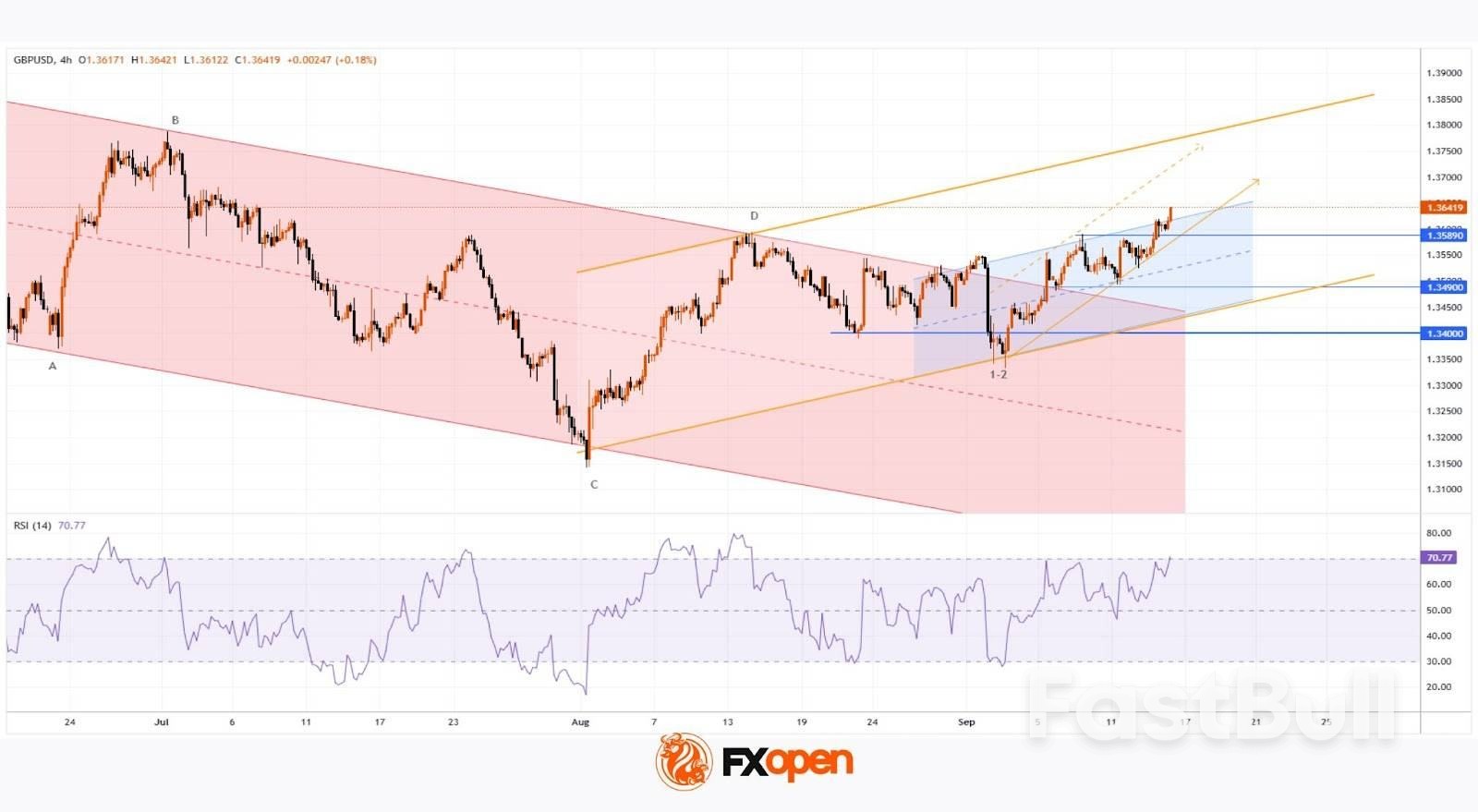
          As the GBP/USD chart shows, the pair is trading this morning above 1.3620 – its highest level since the beginning of July.

          The bullish sentiment is driven by the divergence in central bank policies:

          → United States: Traders are betting on an interest rate cut, supported by President Trump. The Federal Reserve will announce its decision tomorrow at 21:00 GMT+3, and the market expects a reduction of at least 0.25%, from 4.25%–4.50% to 4.00%–4.25%.

          → United Kingdom: Traders anticipate the rate will remain at 4.00%. The Bank of England will announce its decision on Thursday at 14:00 GMT+3.

          Although the rates of the two central banks are comparable, the situation differs: in the UK, inflation is more persistent and rate cuts are seen as risky, while in the US, President Trump is exerting pressure on the Fed’s leadership.An additional boost for the pound comes from a wave of investment optimism linked to US President Donald Trump’s state visit to the UK. According to media reports, agreements worth around $10 billion are expected to be announced during the visit.

          GBP/USD Technical Analysis

          Looking at the price movements earlier this month, we noted lower highs and lower lows forming a bearish A→B→C→D structure. We also assumed that:
          → bulls could rely on support at the psychological level of 1.3400;
          → but if bearish pressure intensified, GBP/USD could fall towards the median of the descending channel.

          Since then, the situation has changed considerably: bears failed to consolidate below 1.3400, and after a bullish double bottom pattern (1–2) formed, the price surged upwards.

          At the same time, the GBP/USD chart highlights key signs of strong demand:
          → the descending (red) channel has been broken, and the bearish A→B→C→D structure is no longer relevant;
          → higher highs and higher lows confirm buyer dominance – providing grounds to outline a rising (blue) channel.

          On the other hand, the RSI indicator is close to overbought territory, which suggests a possible pullback.

          Potential support levels:
          → 1.34900: the breakout point where bulls started their advance;
          → 1.35890: a level that lost its resistance role this week;
          → the upper boundary and median of the blue ascending channel.

          Taking all this into account, we could assume that in the near term, bulls may aim to lift GBP/USD towards the upper boundary of the yellow channel. It is also possible that news from the Fed and the Bank of England will aid them on this path.

          Source: FXOpen

          To stay updated on all economic events of today, please check out our Economic calendar
          Risk Warnings and Disclaimers
          You understand and acknowledge that there is a high degree of risk involved in trading. Following any strategies or investment methods may lead to potential losses. The content on the site is provided by our contributors and analysts for information purposes only. You are solely responsible for determining whether any trading assets, securities, strategy, or any other product is suitable for investing based on your own investment objectives and financial situation.
          Add to Favorites
          Share

          Foreign Investors Eye Return to China’s $19 Trillion Stock Market Amid Tech Opportunities

          Gerik

          Economic

          Investor Sentiment Shifts

          Foreign interest is being driven by China’s progress in artificial intelligence, semiconductor production, and innovative drug development. The U.S.-China tariff truce and domestic monetary easing have further buoyed confidence. Early foreign entrants are focusing on the onshore A-share market, which offers lower correlation to global equities.
          Brett Barna, managing two New York-based family offices, highlighted China as an “uncorrelated” investment and plans a platform to channel U.S. and European capital into China. Allianz Global Investors’ Zheng Yucheng noted China is increasingly treated as a standalone asset class rather than being excluded from indices.

          Evidence of Renewed Capital Interest

          August 2025 saw the largest monthly hedge fund purchases of Chinese stocks in six months, according to Morgan Stanley. Polar Capital increased its China allocation to over 30% from low 20% within its emerging market portfolio, reflecting strong investor appetite. Demand for emerging market funds excluding China has cooled, underscoring China’s growing appeal.
          Cambridge Associates reported roughly 30 client inquiries about China-focused funds this year, a stark contrast to 2023. Many non-Asian investors are planning visits to China and Hong Kong to explore opportunities in tech, AI, biotech, and robotics.

          Caveats and Structural Concerns

          Despite the optimism, China’s broader economy shows signs of weakness. Factory output, retail sales, and foreign direct investment (down 13.2% in the first five months of 2025) remain subdued. Analysts warn that early inflows have not yet translated into sustained capital, and the AI boom must benefit the broader economy to maintain market momentum.
          CLSA strategist Alexander Redman cites deflationary pressures as a reason to avoid overweighting the market. Polar Capital’s Jerry Wu emphasizes that while innovative sectors are booming, broader economic improvement is crucial for long-term gains.
          Foreign capital is “standing at the door,” evaluating China’s long-term competitiveness and potential returns. Early signs suggest a rerating of Chinese innovative assets, but significant, sustained inflows may depend on economic stabilization and tangible benefits from technology and industrial advances.
          The overall picture is one of cautious optimism: markets are attracting attention, but structural challenges persist.

          Source: Reuters

          To stay updated on all economic events of today, please check out our Economic calendar
          Risk Warnings and Disclaimers
          You understand and acknowledge that there is a high degree of risk involved in trading. Following any strategies or investment methods may lead to potential losses. The content on the site is provided by our contributors and analysts for information purposes only. You are solely responsible for determining whether any trading assets, securities, strategy, or any other product is suitable for investing based on your own investment objectives and financial situation.
          Add to Favorites
          Share

          Gold Rally Remains Strong, Set for Short-Term Correction Before Hitting $4,000 in 2026

          Gerik

          Economic

          Current Market Trends

          Spot gold traded around $3,680 per ounce on Tuesday after hitting a record $3,689.27 earlier in the session. The metal has gained roughly 40% this year, following a 27% increase in 2024. Investors are drawn to gold as a hedge against geopolitical and economic risks, particularly amid low interest rates.
          Renisha Chainani of Augmont noted that although gold is currently overbought, strong demand from central banks and ETFs supports the long-term bullish outlook. Philip Newman from Metals Focus echoed that gold is in “uncharted territory” and predicted prices could rise above $4,000 in 2026.

          Drivers Behind the Rally

          Key factors fueling gold’s rally include: expectations for a Federal Reserve interest rate cut at the September 17 policy meeting, continued geopolitical tensions, and a growing appetite among institutional and retail investors. Pressure from U.S. President Trump on the Fed to accelerate rate cuts has heightened market attention on gold as a safe haven.
          Analysts expect a near-term 5-6% correction, which could serve as a buying opportunity for sidelined investors. Nicholas Frappell of ABC Refinery highlighted that price projections have been consistently met faster than expected, underscoring the momentum behind the rally.

          Silver’s Strength

          Silver has also surged, trading at $42.50 per ounce its highest level in 14 years supported by both industrial demand (electronics and solar panels) and investor interest. Growing physical demand amid concerns about supply deficits is contributing to silver’s price gains, mirroring gold’s bullish trend.
          In summary, gold and silver remain in strong uptrends, with a brief correction likely for gold before prices potentially exceed $4,000 in 2026, while silver benefits from both investment and industrial demand.

          Source: Reuters

          To stay updated on all economic events of today, please check out our Economic calendar
          Risk Warnings and Disclaimers
          You understand and acknowledge that there is a high degree of risk involved in trading. Following any strategies or investment methods may lead to potential losses. The content on the site is provided by our contributors and analysts for information purposes only. You are solely responsible for determining whether any trading assets, securities, strategy, or any other product is suitable for investing based on your own investment objectives and financial situation.
          Add to Favorites
          Share

          Altcoin Leverage Surges Ahead of Fed Decision, Raising Volatility Risks

          Gerik

          Economic

          Cryptocurrency

          Rising Leverage in Altcoins

          Open interest for altcoins has surged from $30 billion on September 1 to $38.6 billion as of Monday, now approaching Bitcoin’s $40 billion and surpassing Ethereum’s $30 billion, according to Coinalyze. While open interest alone does not predict price direction, it signals that sophisticated traders are positioning ahead of the Fed’s expected rate cut.
          Stephen Gregory, founder of crypto trading platform Vtrader, noted that the increase in altcoin leverage reflects traders’ anticipation of an “alt season,” with funds temporarily rotating out of Bitcoin into altcoins in the short term.

          Potential Market Dynamics

          Gregory cautioned that larger traders may attempt to “front run” the Fed’s anticipated rate cut on Wednesday, which could trigger complex dynamics: retail investors may interpret the cut as bullish, while whales could leverage shorts to force liquidation events.
          Shawn Young, chief analyst at MEXC Research, highlighted rising one-week at-the-money implied volatility and 25-delta skews as indicators of expected short-term price fluctuations. Traders should prepare for heightened activity and adjust strategies to navigate potential volatility.

          Macro Context

          The Fed faces pressure from President Donald Trump and Treasury Secretary Scott Bessent, who have publicly called for substantial rate cuts, even urging Fed Chair Jerome Powell’s resignation at times this year. This political backdrop contributes to uncertainty in both traditional and crypto markets, amplifying the stakes for leveraged trading positions.
          In summary, crypto markets are entering a potentially turbulent period, with altcoin leverage surging and the Fed’s policy decision poised to be a catalyst for significant short-term volatility.
          To stay updated on all economic events of today, please check out our Economic calendar
          Risk Warnings and Disclaimers
          You understand and acknowledge that there is a high degree of risk involved in trading. Following any strategies or investment methods may lead to potential losses. The content on the site is provided by our contributors and analysts for information purposes only. You are solely responsible for determining whether any trading assets, securities, strategy, or any other product is suitable for investing based on your own investment objectives and financial situation.
          Add to Favorites
          Share

          Vietnamese Feed Makers Tap Canadian Canola Meal After China Duties

          Gerik

          Economic

          Canadian Canola Redirected to Vietnam

          Three traders attending an international industry conference in Jakarta said that Vietnamese feed mills have been importing around 30,000 metric tons of Canadian canola meal per month over the past few months. While this volume is smaller than what China previously bought, it represents an opportunity for Vietnamese companies to take advantage of discounted prices.
          Currently, Vietnamese feed makers are paying around $220 per metric ton, including cost and freight, compared to $300–310 per ton that Chinese buyers paid before the duties were imposed in March.

          Reason for the Shift

          China, the world’s largest importer of canola, imposed preliminary anti-dumping duties of 75.8% on Canadian canola seed in August, following a 100% retaliatory tariff on Canadian rapeseed meal and oil, effective March 20. Many shipments that arrived in China after the 100% duty took effect are now stuck in bonded warehouses. Trading companies are seeking to redirect these shipments to Vietnam to avoid the high duties.
          Up to 400,000 metric tons of canola meal are currently held in secure warehouses near Chinese ports, where importers would face a 100% tariff if released into the domestic market. Redirecting this supply to Vietnam offers a temporary solution to move the stock and reduce financial risk.

          Impact and Outlook

          Although Vietnam’s demand is smaller than China’s, traders expect more deals in the coming months. This presents an opportunity for Vietnamese feed producers to lower their input costs, while Canada can access alternative markets for its excess supply.
          Ongoing discussions between Canadian and Chinese officials regarding the duties continue, but redirecting shipments to Vietnam serves as an effective short-term workaround for both sides.

          Source: Reuters

          To stay updated on all economic events of today, please check out our Economic calendar
          Risk Warnings and Disclaimers
          You understand and acknowledge that there is a high degree of risk involved in trading. Following any strategies or investment methods may lead to potential losses. The content on the site is provided by our contributors and analysts for information purposes only. You are solely responsible for determining whether any trading assets, securities, strategy, or any other product is suitable for investing based on your own investment objectives and financial situation.
          Add to Favorites
          Share

          IC Markets Europe Fundamental Forecast | 16 September 2025

          IC Markets

          Commodity

          Forex

          Economic

          What happened in the Asia session?

          The Asia trading session on September 16, 2025, was dominated by optimism surrounding expected Federal Reserve rate cuts, which drove major stock indices to historic highs in Japan and South Korea. However, China’s disappointing economic data served as a reminder of underlying regional challenges. The combination of Fed dovishness, improving US-China trade dynamics, and strong corporate earnings supported risk assets, while safe-haven flows into gold reflected ongoing global uncertainties.

          What does it mean for the Europe & US sessions?

          Today’s trading environment is dominated by Fed expectations, with traders positioned for the first rate cut of 2025. While markets appear confident in a 25bp reduction, the real focus will be on Fed guidance for future policy paths. Economic data, particularly retail sales, will provide insights into consumer resilience amid this monetary policy transition. The combination of dovish Fed expectations, record-low yields, and geopolitical uncertainties creates a complex backdrop requiring careful risk management across all asset classes.

          The Dollar Index (DXY)

          The US Dollar faced its most significant challenge in months on September 16, 2025, as a confluence of factors – including dovish Fed expectations, intensifying political pressure from President Trump, and technical selling momentum – pushed the currency to multi-month lows. With the Fed’s rate cut decision virtually certain, focus has shifted to the magnitude of the reduction and forward guidance about future policy moves. The dollar’s near-term trajectory will likely depend on the Fed’s ability to balance economic data with political pressures while maintaining its independence, alongside upcoming economic indicators that could either support or challenge the current dovish narrative.Central Bank Notes:

          ● The Federal Open Market Committee (FOMC) voted, by majority, to lower the federal funds rate target range by 25 basis points to 4.00%–4.25% at its September 16–17, 2025, meeting, marking the first policy rate adjustment since December 2024 after five consecutive holds.
          ● The Committee maintained its long-term objective of achieving maximum employment and 2% inflation, acknowledging recent labor market softening and continued tariff-driven price pressures.
          ● Policymakers expressed elevated concern about downside risks to growth, citing a stalling labor market, modest job creation, and an unemployment rate drifting up toward 4.4%. At the same time, inflation remains above target, with CPI at 3.2% and core inflation at 3.1% as of August 2025; higher energy and food prices, largely attributable to tariffs, continue to weigh on headline measures.
          ● Although economic activity expanded at a moderate pace in the third quarter, the growth outlook has weakened. Q3 GDP growth is estimated near 1.0% (annualized), with full-year 2025 GDP growth guidance revised to 1.2%, reflecting slowing household consumption and tighter financial conditions.
          ● In the updated Summary of Economic Projections, the unemployment rate is projected to average 4.5% for the year, with headline PCE inflation revised up slightly to 3.1% for 2025. The Committee anticipates core PCE inflation to remain stubborn, requiring sustained vigilance and a flexible approach to risk management.
          ● The Committee reiterated its data-dependent approach and openness to further adjustments should employment or inflation deviate meaningfully from current forecasts. Several members dissented, either advocating a larger 50 basis point cut or preferring no adjustment at this meeting, revealing heightened divergence within the Committee.
          ● Balance sheet reduction continues at a measured pace. The monthly Treasury redemption cap remains at $5B and the agency MBS cap at $35B, as the Board aims to support orderly market conditions in the face of evolving global and domestic uncertainty
          ● The next meeting is scheduled for 28 to 29 October 2025.

          Next 24 Hours BiasMedium Bearish

          Gold (XAU)

          Gold’s record-breaking performance on September 16, 2025, reflects a confluence of supportive factors, including near-certain Fed rate cut expectations, US dollar weakness, robust ETF inflows, and ongoing geopolitical tensions. While central bank purchases have moderated due to high prices, they remain positive, and technical indicators suggest further upside potential toward the $3,700-$3,800 range. The metal’s 43% year-to-date gain underscores its continued appeal as both an inflation hedge and safe-haven asset in an environment of monetary policy uncertainty and global instability.Next 24 Hours Bias Strong Bullish

          The Euro (EUR)

          The Euro demonstrated resilience on September 16, 2025, reaching $1.1778 despite significant regional challenges. The ECB’s hawkish pivot, signaling an end to rate cuts, provided fundamental support for the currency. However, persistent concerns remain around France’s fiscal crisis, German economic weakness, and escalating trade tensions with both the US and China.Central Bank Notes:

          ● The Governing Council kept the three key ECB interest rates unchanged at its September 11, 2025, meeting. The main refinancing rate remains at 2.15%, the marginal lending facility at 2.40%, and the deposit facility at 2.00%. These levels have been maintained after the cuts earlier in 2025, reflecting the Council’s confidence that the current stance is consistent with the price stability mandate.
          ● Evidence that inflation is running close to the ECB’s medium-term target of 2% supported the decision to hold rates steady. Domestic price pressures are easing as wage growth continues to moderate, and financing conditions remain accommodative. Policymakers reaffirmed a data-dependent, meeting-by-meeting approach to further policy moves, with no pre-commitment to a predetermined path amid ongoing global and domestic risks.
          ● Eurosystem staff projections foresee headline inflation averaging 2.0% for 2025, 1.8% for 2026, and 2.0% in 2027. The 2025 and 2026 forecasts reflect a downward revision, primarily on lower energy costs and exchange rate effects, even as food inflation remains persistent. Core inflation (excluding energy and food) is expected at 2.0% for both 2026 and 2027, with only minor changes since prior rounds.
          ● Real GDP growth in the euro area is projected at 1.1% for 2025, 1.1% for 2026, and 1.4% for 2027. A robust first quarter—partly due to firms accelerating exports ahead of anticipated tariff hikes—cushioned a weaker outlook for the remainder of 2025. While business investment continues to face uncertainty from ongoing global trade disputes, especially with the US, government investment and infrastructure spending are expected to provide some support to the outlook..
          ● Household spending is backed by rising real incomes and continued strength in the labor market. Despite some fading tailwind from previous rate cuts, financing conditions remain broadly favorable and are expected to underpin the resilience of private consumption and investment against outside shocks. Moderating wage growth and profit margin adjustments are helping to absorb residual cost pressures.
          ● Household spending is backed by rising real incomes and continued strength in the labor market. Despite some fading tailwind from previous rate cuts, financing conditions remain broadly favorable and are expected to underpin the resilience of private consumption and investment against outside shocks. Moderating wage growth and profit margin adjustments are helping to absorb residual cost pressures.
          ● All future interest rate decisions will continue to be guided by the integrated assessment of economic and financial data, the inflation outlook, and underlying inflation dynamics, and the effectiveness of monetary policy transmission—without any pre-commitment to a specific future rate path.
          ● The ECB’s Asset Purchase Programme (APP) and Pandemic Emergency Purchase Programme (PEPP) portfolios are declining predictably, as reinvestment of maturities has ceased. Balance-sheet normalization continues in line with the ECB’s previously communicated schedule.
          ● The next meeting is on 29 to 30 October 2025

          Next 24 Hours BiasWeak Bullish

          The Swiss Franc (CHF)

          The Swiss Franc enters mid-September 2025 from a position of considerable strength, supported by safe-haven flows, contained inflation, and Switzerland’s economic stability. While the upcoming SNB meeting on September 25 is expected to maintain current policy settings, the central bank’s new transparency measures signal an important communication evolution. US trade tensions remain a significant economic challenge, though Switzerland’s diversified economy and the franc’s reserve currency status continue to provide resilience in an uncertain global environment.Central Bank Notes:

          ● The SNB eased monetary policy by lowering its key policy rate by 25 basis points, from 0.25% to 0% on 19 June 2025, marking the sixth consecutive reduction.
          ● Inflationary pressure has decreased further as compared to the previous quarter, decreasing from 0.3% in February to -0.1% in May, mainly attributable to lower prices in tourism and oil products.
          ● Compared to March, the new conditional inflation forecast is lower in the short term. In the medium term, there is hardly any change from March, putting the average annual inflation at 0.2% for 2025, 0.5% for 2026, and 0.7% for 2027.
          ● The global economy continued to grow at a moderate pace in the first quarter of 2025, but the global economic outlook for the coming quarters has deteriorated due to the increase in trade tensions.
          ● Swiss GDP growth was strong in the first quarter of 2025, but this development was largely because, as in other countries, exports to the U.S. were brought forward.
          ● Following the strong first quarter, growth is likely to slow again and remain rather subdued over the remainder of the year; the SNB expects GDP growth of 1% to 1.5% for 2025 as a whole, while also anticipating GDP growth of 1% to 1.5% for 2026.
          ● The SNB will continue to monitor the situation closely and will adjust its monetary policy if necessary to ensure inflation remains within the range consistent with price stability over the medium term.
          ● The next meeting is on 25 September 2025.

          Next 24 Hours BiasMedium Bullish

          The Pound (GBP)

          Sterling’s strength on Tuesday reflects broad US Dollar weakness ahead of the Fed’s anticipated rate cut, despite concerning domestic economic fundamentals. While the Pound benefits from relative outperformance against other major currencies, underlying challenges include stagnant growth, elevated inflation, and a cautious Bank of England. The combination of a dovish Fed and resilient UK inflation expectations continues to support Sterling in the near term, though technical resistance levels and domestic economic headwinds present potential challenges ahead.Central Bank Notes:
          ● The Bank of England’s Monetary Policy Committee (MPC) voted on 7 August 2025 by a majority (exact split likely 5–3–1 or similar, based on expectations) to cut the Bank Rate by 25 basis points to 4.00%. Multiple members supported the move, citing fragile economic growth and signs of disinflation, while others preferred a larger reduction, and at least one member voted to hold the rate steady due to concerns about persistent inflation.
          ● The Committee unanimously decided to continue reducing the stock of UK government bond purchases held for monetary policy purposes by £100 billion over the next 12 months, targeting a balance of £558 billion by October 2025. As of 7 August, the gilt stock stands at £590 billion.
          ● Disinflation has been substantial since 2023 owing to policy tightening and the fading of external shocks. However, an unexpected uptick in headline CPI inflation—to 3.6% in June—reflects pass-through from regulated prices and earlier energy price rises, as well as signs of sticky core inflation.
          ● Headline CPI inflation is now 3.6%, above the Bank’s 2% target, reflecting regulated and energy price effects. The Committee expects inflation to remain around this level through Q3 before resuming its downward trend into 2026.
          ● UK GDP growth remains weak. Business and consumer surveys point to lackluster activity, and the labor market continues to loosen, with increasing evidence of slack. Wage growth has softened but remains above pre-pandemic norms.
          ● Pay growth and employment indicators have moderated further, and the Committee expects a significant slowing in pay settlements over the rest of 2025.
          ● Global uncertainty remains elevated, especially with rising energy prices and supply disruptions linked to conflict in the Middle East and renewed trade tensions. These factors prompt the MPC to remain vigilant in monitoring cost and wage shocks.
          ● The risks to inflation are considered two-sided. With the outlook for growth subdued and inflation persistence less clear, the Committee argues that a gradual and careful approach to further easing is warranted, with future policy decisions highly data-dependent.
          ● The Committee’s bias is still towards maintaining monetary policy at a restrictive stance until there is firmer evidence that inflation will return sustainably to the 2% target over the medium term. Further adjustments to policy will be decided on a meeting-by-meeting basis, with scrutiny of developments in demand, costs, and inflation expectations.
          ● The next meeting is on 18 September 2025.Next 24 Hours BiasMedium Bullish

          The Canadian Dollar (CAD)

          Tuesday’s developments reflect a Canadian dollar caught between supportive factors like higher oil prices and manufacturing resilience, versus significant headwinds from labor market deterioration and expected monetary easing. The currency’s performance in the coming days will largely depend on the Bank of Canada’s communication strategy and whether policymakers signal a prolonged easing cycle. With both the BoC and Fed expected to cut rates on Wednesday, the relative magnitude and forward guidance from each central bank will be crucial for the USD/CAD direction.Central Bank Notes:

          ● The Bank of Canada maintained its target for the overnight rate at 2.75%, with the Bank Rate at 3% and the deposit rate at 2.70% as of July 30, marking the third consecutive meeting with rates on hold.
          ● The Council cited ongoing U.S. tariff adjustments and unresolved trade negotiations as key drivers of elevated economic uncertainty. The persistence of tariffs at levels well above those of early 2025 continues to present downside risks to growth and keeps inflation expectations elevated, supporting a cautious approach to monetary easing.
          ● The lack of a clear U.S. policy path, plus frequent threats of additional tariffs, led the Bank to highlight risks to Canadian exports and broader demand, amplifying uncertainty about future growth.
          ● Canada’s economic growth in the first quarter came in at 2.2%, slightly stronger than the original forecast, while the composition of GDP growth was largely as expected. Consumption slowed from its very strong fourth-quarter pace, but continued to grow despite a large drop in consumer confidence.
          ● Canadian GDP growth is expected to be near 0% in Q2 2025, closely aligned with the more optimistic scenario outlined earlier in the year. Weakness in manufacturing activity—driven by both U.S. trade disruptions and sector-specific challenges like wildfires—contributed to softer output. A partial recovery is anticipated in Q3 due to rebuilding efforts and stronger retail sales in June.
          ● Consumer spending slowed, especially as households front-loaded durable goods purchases ahead of tariffs. Housing activity remains subdued, with resales and construction still soft despite some government tax relief measures.
          ● Headline CPI inflation continued to ease, holding close to 1.7% in June, aided by declines in energy prices following the removal of the fuel charge. However, the Bank’s measures of core inflation and underlying price pressures moved up further due to higher import costs from tariffs and lingering supply disruptions.
          ● The Governing Council reiterated that it will carefully weigh ongoing upward inflation pressure from tariffs and cost shocks against the gradual downward pull from economic weakness. While additional rate cuts remain possible, timing and scale will depend on trade policy developments and inflation’s path.
          ● The next meeting is on 17 September 2025.

          Next 24 Hours BiasMedium Bearish

          Oil

          Oil markets on September 16, 2025, are caught between conflicting forces. While immediate supply disruption risks from Ukrainian attacks on Russian infrastructure and anticipated Federal Reserve rate cuts are providing near-term price support, fundamental market conditions point to significant oversupply ahead. The EIA’s projection of massive inventory builds and OPEC+’s continued production increases suggest substantial downward price pressure through 2026, with Brent potentially falling to $50 per barrel despite current geopolitical tensions. The market is essentially pricing in short-term disruption risks while bracing for longer-term oversupply challenges.

          Next 24 Hours BiasWeak Bearish

          Source: IC Markets

          To stay updated on all economic events of today, please check out our Economic calendar
          Risk Warnings and Disclaimers
          You understand and acknowledge that there is a high degree of risk involved in trading. Following any strategies or investment methods may lead to potential losses. The content on the site is provided by our contributors and analysts for information purposes only. You are solely responsible for determining whether any trading assets, securities, strategy, or any other product is suitable for investing based on your own investment objectives and financial situation.
          Add to Favorites
          Share
          FastBull
          Copyright © 2025 FastBull Ltd

          728 RM B 7/F GEE LOK IND BLDG NO 34 HUNG TO RD KWUN TONG KLN HONG KONG

          TelegramInstagramTwitterfacebooklinkedin
          App Store Google Play Google Play
          Products
          Charts

          Chats

          Q&A with Experts
          Screeners
          Economic Calendar
          Data
          Tools
          Membership
          Features
          Function
          Markets
          Copy Trading
          Latest Signals
          Contests
          News
          Analysis
          24/7
          Columns
          Education
          Company
          Careers
          About Us
          Contact Us
          Advertising
          Help Center
          Feedback
          User Agreement
          Privacy Policy
          Business

          White Label

          Data API

          Web Plug-ins

          Poster Maker

          Affiliate Program

          Risk Disclosure

          The risk of loss in trading financial instruments such as stocks, FX, commodities, futures, bonds, ETFs and crypto can be substantial. You may sustain a total loss of the funds that you deposit with your broker. Therefore, you should carefully consider whether such trading is suitable for you in light of your circumstances and financial resources.

          No decision to invest should be made without thoroughly conducting due diligence by yourself or consulting with your financial advisors. Our web content might not suit you since we don't know your financial conditions and investment needs. Our financial information might have latency or contain inaccuracy, so you should be fully responsible for any of your trading and investment decisions. The company will not be responsible for your capital loss.

          Without getting permission from the website, you are not allowed to copy the website's graphics, texts, or trademarks. Intellectual property rights in the content or data incorporated into this website belong to its providers and exchange merchants.

          Not Logged In

          Log in to access more features

          FastBull Membership

          Not yet

          Purchase

          Become a signal provider
          Help Center
          Customer Service
          Dark Mode
          Price Up/Down Colors

          Log In

          Sign Up

          Position
          Layout
          Fullscreen
          Default to Chart
          The chart page opens by default when you visit fastbull.com