• Trade
  • Markets
  • Copy
  • Contests
  • News
  • 24/7
  • Calendar
  • Q&A
  • Chats
Trending
Screeners
SYMBOL
LAST
BID
ASK
HIGH
LOW
NET CHG.
%CHG.
SPREAD
SPX
S&P 500 Index
6827.42
6827.42
6827.42
6899.86
6801.80
-73.58
-1.07%
--
DJI
Dow Jones Industrial Average
48458.04
48458.04
48458.04
48886.86
48334.10
-245.98
-0.51%
--
IXIC
NASDAQ Composite Index
23195.16
23195.16
23195.16
23554.89
23094.51
-398.69
-1.69%
--
USDX
US Dollar Index
97.950
98.030
97.950
98.500
97.950
-0.370
-0.38%
--
EURUSD
Euro / US Dollar
1.17394
1.17409
1.17394
1.17496
1.17192
+0.00011
+ 0.01%
--
GBPUSD
Pound Sterling / US Dollar
1.33707
1.33732
1.33707
1.33997
1.33419
-0.00148
-0.11%
--
XAUUSD
Gold / US Dollar
4299.39
4299.39
4299.39
4353.41
4257.10
+20.10
+ 0.47%
--
WTI
Light Sweet Crude Oil
57.233
57.485
57.233
58.011
56.969
-0.408
-0.71%
--

Community Accounts

Signal Accounts
--
Profit Accounts
--
Loss Accounts
--
View More

Become a signal provider

Sell trading signals to earn additional income

View More

Guide to Copy Trading

Get started with ease and confidence

View More

Signal Accounts for Members

All Signal Accounts

Best Return
  • Best Return
  • Best P/L
  • Best MDD
Past 1W
  • Past 1W
  • Past 1M
  • Past 1Y

All Contests

  • All
  • Trump Updates
  • Recommend
  • Stocks
  • Cryptocurrencies
  • Central Banks
  • Featured News
Top News Only
Share

Thai Leader Anutin: Landmine Blast That Killed Thai Soldiers 'Not A Roadside Accident'

Share

Thai Leader Anutin: Thailand To Continue Military Action Until 'We Feel No More Harm'

Share

Cambodian Prime Minister Hun Manet Says He Had Phone Calls With Trump And Malaysian Leader Anwar About Ceasefire

Share

Cambodia's Hun Manet Says USA, Malaysia Should Verify 'Which Side Fired First' In Latest Conflict

Share

Cambodia's Hun Manet: Cambodia Maintains Its Stance In Seeking Peaceful Resolution Of Disputes

Share

Nasdaq Companies: Allergan, Ferrovia, Insmed, Monolithic Power Systems, Seagate Technology, And Western Digital Will Be Added To The NASDAQ 100 Index. Biogen, CdW, GlobalFoundries, Lululemon, ON Semiconductor, And Tradedesk Will Be Removed From The NASDAQ 100 Index

Share

Witkoff Headed To Berlin This Weekend To Meet With Zelenskiy, European Leaders -Wsj Reporter On X

Share

Russia Attacks Two Ukrainian Ports, Damaging Three Turkish-Owned Vessels

Share

[Historic Flooding Occurs In At Least Four Rivers In Washington State Due To Days Of Torrential Rains] Multiple Areas In Washington State Have Been Hit By Severe Flooding Due To Days Of Torrential Rains, With At Least Four Rivers Experiencing Historic Flooding. Reporters Learned On The 12th That The Floods Caused By The Torrential Rains In Washington State Have Destroyed Homes And Closed Several Highways. Experts Warn That Even More Severe Flooding May Occur In The Future. A State Of Emergency Has Been Declared In Washington State

Share

Trump Says Proposed Free Economic Zone In Donbas Would Work

Share

Trump: I Think My Voice Should Be Heard

Share

Trump Says Will Be Choosing New Fed Chair In Near Future

Share

Trump Says Proposed Free Economic Zone In Donbas Complex But Would Work

Share

Trump Says Land Strikes In Venezuela Will Start Happening

Share

US President Trump: Thailand And Cambodia Are In A Good Situation

Share

State Media: North Korean Leader Kim Hails Troops Returning From Russia Mission

Share

The 10-year Treasury Yield Rose About 5 Basis Points During The "Fed Rate Cut Week," And The 2/10-year Yield Spread Widened By About 9 Basis Points. On Friday (December 12), In Late New York Trading, The Yield On The Benchmark 10-year US Treasury Note Rose 2.75 Basis Points To 4.1841%, A Cumulative Increase Of 4.90 Basis Points For The Week, Trading Within A Range Of 4.1002%-4.2074%. It Rose Steadily From Monday To Wednesday (before The Fed Announced Its Rate Cut And Treasury Bill Purchase Program), Subsequently Exhibiting A V-shaped Recovery. The 2-year Treasury Yield Fell 1.82 Basis Points To 3.5222%, A Cumulative Decrease Of 3.81 Basis Points For The Week, Trading Within A Range Of 3.6253%-3.4989%

Share

Trump: Lots Of Progress Being Made On Russia-Ukraine

Share

NOPA November US Soybean Crush Estimated At 220.285 Million Bushels

Share

SPDR Gold Trust Reports Holdings Up 0.22%, Or 2.28 Tonnes, To 1053.11 Tonnes By Dec 12

TIME
ACT
FCST
PREV
U.K. Trade Balance Non-EU (SA) (Oct)

A:--

F: --

P: --

U.K. Trade Balance (Oct)

A:--

F: --

P: --

U.K. Services Index MoM

A:--

F: --

P: --

U.K. Construction Output MoM (SA) (Oct)

A:--

F: --

P: --

U.K. Industrial Output YoY (Oct)

A:--

F: --

P: --

U.K. Trade Balance (SA) (Oct)

A:--

F: --

P: --

U.K. Trade Balance EU (SA) (Oct)

A:--

F: --

P: --

U.K. Manufacturing Output YoY (Oct)

A:--

F: --

P: --

U.K. GDP MoM (Oct)

A:--

F: --

P: --

U.K. GDP YoY (SA) (Oct)

A:--

F: --

P: --

U.K. Industrial Output MoM (Oct)

A:--

F: --

P: --

U.K. Construction Output YoY (Oct)

A:--

F: --

P: --

France HICP Final MoM (Nov)

A:--

F: --

P: --

China, Mainland Outstanding Loans Growth YoY (Nov)

A:--

F: --

P: --

China, Mainland M2 Money Supply YoY (Nov)

A:--

F: --

P: --

China, Mainland M0 Money Supply YoY (Nov)

A:--

F: --

P: --

China, Mainland M1 Money Supply YoY (Nov)

A:--

F: --

P: --

India CPI YoY (Nov)

A:--

F: --

P: --

India Deposit Gowth YoY

A:--

F: --

P: --

Brazil Services Growth YoY (Oct)

A:--

F: --

P: --

Mexico Industrial Output YoY (Oct)

A:--

F: --

P: --

Russia Trade Balance (Oct)

A:--

F: --

P: --

Philadelphia Fed President Henry Paulson delivers a speech
Canada Building Permits MoM (SA) (Oct)

A:--

F: --

P: --

Canada Wholesale Sales YoY (Oct)

A:--

F: --

P: --

Canada Wholesale Inventory MoM (Oct)

A:--

F: --

P: --

Canada Wholesale Inventory YoY (Oct)

A:--

F: --

P: --

Canada Wholesale Sales MoM (SA) (Oct)

A:--

F: --

P: --

Germany Current Account (Not SA) (Oct)

A:--

F: --

P: --

U.S. Weekly Total Rig Count

A:--

F: --

P: --

U.S. Weekly Total Oil Rig Count

A:--

F: --

P: --

Japan Tankan Large Non-Manufacturing Diffusion Index (Q4)

--

F: --

P: --

Japan Tankan Small Manufacturing Outlook Index (Q4)

--

F: --

P: --

Japan Tankan Large Non-Manufacturing Outlook Index (Q4)

--

F: --

P: --

Japan Tankan Large Manufacturing Outlook Index (Q4)

--

F: --

P: --

Japan Tankan Small Manufacturing Diffusion Index (Q4)

--

F: --

P: --

Japan Tankan Large Manufacturing Diffusion Index (Q4)

--

F: --

P: --

Japan Tankan Large-Enterprise Capital Expenditure YoY (Q4)

--

F: --

P: --

U.K. Rightmove House Price Index YoY (Dec)

--

F: --

P: --

China, Mainland Industrial Output YoY (YTD) (Nov)

--

F: --

P: --

China, Mainland Urban Area Unemployment Rate (Nov)

--

F: --

P: --

Saudi Arabia CPI YoY (Nov)

--

F: --

P: --

Euro Zone Industrial Output YoY (Oct)

--

F: --

P: --

Euro Zone Industrial Output MoM (Oct)

--

F: --

P: --

Canada Existing Home Sales MoM (Nov)

--

F: --

P: --

Euro Zone Total Reserve Assets (Nov)

--

F: --

P: --

U.K. Inflation Rate Expectations

--

F: --

P: --

Canada National Economic Confidence Index

--

F: --

P: --

Canada New Housing Starts (Nov)

--

F: --

P: --

U.S. NY Fed Manufacturing Employment Index (Dec)

--

F: --

P: --

U.S. NY Fed Manufacturing Index (Dec)

--

F: --

P: --

Canada Core CPI YoY (Nov)

--

F: --

P: --

Canada Manufacturing Unfilled Orders MoM (Oct)

--

F: --

P: --

Canada Manufacturing New Orders MoM (Oct)

--

F: --

P: --

Canada Core CPI MoM (Nov)

--

F: --

P: --

Canada Manufacturing Inventory MoM (Oct)

--

F: --

P: --

Canada CPI YoY (Nov)

--

F: --

P: --

Canada CPI MoM (Nov)

--

F: --

P: --

Canada CPI YoY (SA) (Nov)

--

F: --

P: --

Canada Core CPI MoM (SA) (Nov)

--

F: --

P: --

Q&A with Experts
    • All
    • Chatrooms
    • Groups
    • Friends
    Connecting
    .
    .
    .
    Type here...
    Add Symbol or Code

      No matching data

      All
      Trump Updates
      Recommend
      Stocks
      Cryptocurrencies
      Central Banks
      Featured News
      • All
      • Russia-Ukraine Conflict
      • Middle East Flashpoint
      • All
      • Russia-Ukraine Conflict
      • Middle East Flashpoint
      Search
      Products

      Charts Free Forever

      Chats Q&A with Experts
      Screeners Economic Calendar Data Tools
      Membership Features
      Data Warehouse Market Trends Institutional Data Policy Rates Macro

      Market Trends

      Market Sentiment Order Book Forex Correlations

      Top Indicators

      Charts Free Forever
      Markets

      News

      News Analysis 24/7 Columns Education
      From Institutions From Analysts
      Topics Columnists

      Latest Views

      Latest Views

      Trending Topics

      Top Columnists

      Latest Update

      Signals

      Copy Rankings Latest Signals Become a signal provider AI Rating
      Contests
      Brokers

      Overview Brokers Assessment Rankings Regulators News Claims
      Broker listing Forex Brokers Comparison Tool Live Spread Comparison Scam
      Q&A Complaint Scam Alert Videos Tips to Detect Scam
      More

      Business
      Events
      Careers About Us Advertising Help Center

      White Label

      Data API

      Web Plug-ins

      Affiliate Program

      Awards Institution Evaluation IB Seminar Salon Event Exhibition
      Vietnam Thailand Singapore Dubai
      Fans Party Investment Sharing Session
      FastBull Summit BrokersView Expo
      Recent Searches
        Top Searches
          Markets
          News
          Analysis
          User
          24/7
          Economic Calendar
          Education
          Data
          • Names
          • Latest
          • Prev

          View All

          No data

          Scan to Download

          Faster Charts, Chat Faster!

          Download App
          English
          • English
          • Español
          • العربية
          • Bahasa Indonesia
          • Bahasa Melayu
          • Tiếng Việt
          • ภาษาไทย
          • Français
          • Italiano
          • Türkçe
          • Русский язык
          • 简中
          • 繁中
          Open Account
          Search
          Products
          Charts Free Forever
          Markets
          News
          Signals

          Copy Rankings Latest Signals Become a signal provider AI Rating
          Contests
          Brokers

          Overview Brokers Assessment Rankings Regulators News Claims
          Broker listing Forex Brokers Comparison Tool Live Spread Comparison Scam
          Q&A Complaint Scam Alert Videos Tips to Detect Scam
          More

          Business
          Events
          Careers About Us Advertising Help Center

          White Label

          Data API

          Web Plug-ins

          Affiliate Program

          Awards Institution Evaluation IB Seminar Salon Event Exhibition
          Vietnam Thailand Singapore Dubai
          Fans Party Investment Sharing Session
          FastBull Summit BrokersView Expo

          Gold Price Continues to Tread Water Above $3,300 Following Unchanged US PPI

          Michelle

          Economic

          Commodity

          Summary:

          The gold market remains stuck in neutral, holding solid support above $3,300 an ounce but unable to gain significant traction, even as wholesale inflation pressures remained unchanged last month.
          The gold market remains stuck in neutral, holding solid support above $3,300 an ounce but unable to gain significant traction, even as wholesale inflation pressures remained unchanged last month.

          The headline Producer Price Index (PPI) was flat in June, following a 0.1% increase in May, the U.S. Labor Department announced on Thursday. The latest inflation data came in cooler than expected, as the consensus forecast had called for a 0.2% increase.

          Over the past 12 months, headline wholesale inflation rose 2.3%, according to the report. Annual inflation was also weaker than expected, with economists anticipating a 2.5% increase. The prior month’s annual inflation figure was revised higher to 2.7%, up from the initial estimate of 2.6%.

          Excluding volatile food and energy prices, core PPI was also unchanged last month, following a 0.1% rise in May. According to consensus estimates, economists had forecast a 0.2% increase.

          According to some analysts, the headline inflation data should provide some support for gold, as it indicates inflation pressures are relatively under control—potentially giving the Federal Reserve room to cut interest rates later this year.

          However, some economists also note that economic uncertainty and inflation fears remain elevated due to President Donald Trump’s import tariffs and the ongoing global trade war. PPI is considered a leading inflation indicator, as producers typically pass higher input costs on to consumers.

          Spot gold last traded at $3,333 an ounce, up 0.31% on the day.

          Source: Kitco

          To stay updated on all economic events of today, please check out our Economic calendar
          Risk Warnings and Disclaimers
          You understand and acknowledge that there is a high degree of risk involved in trading. Following any strategies or investment methods may lead to potential losses. The content on the site is provided by our contributors and analysts for information purposes only. You are solely responsible for determining whether any trading assets, securities, strategy, or any other product is suitable for investing based on your own investment objectives and financial situation.
          Add to Favorites
          Share

          London Midday: FTSE Nudges Up; Investors Mull Hotter-Than-Expected Inflation Print

          Warren Takunda

          Economic

          London stocks had nudged into the black by midday on Wednesday, as investors mulled a hotter-than-expected UK inflation print.
          The FTSE 100 was 0.1% firmer at 8,950.13.
          Figures released earlier by the Office for National Statistics showed that annual inflation rose to 3.6% in June from 3.4% in May, versus expectations for it to remain unchanged. This marked the highest since January 2024, when it was 4.0%.
          The ONS said transport, particularly motor fuels, made the largest upward contribution.
          Food price inflation also increased for the third consecutive month, to 4.5% - its highest annual rate since February 2024.
          Core inflation - which excludes energy, food, alcohol and tobacco - increased to 3.7% from 3.5%. Analysts were expecting it to remain unchanged.
          ONS acting chief economist Richard Heys said: "Inflation ticked up in June driven mainly by motor fuel prices which fell only slightly, compared with a much larger decrease at this time last year.
          "Food price inflation has increased for the third consecutive month to its highest annual rate since February of last year. However, it remains well below the peak seen in early 2023."
          Martin Sartorius, principal economist at the Confederation of British Industry, said: "June’s stronger-than-expected inflation print will raise concerns that recent price pressures - driven by higher household energy prices and the passthrough of increased employment costs - could potentially re-entrench inflation in the economy.
          "While we still expect the Bank of England’s Monetary Policy Committee to continue gradually cutting rates, today’s upside inflation surprise means its August decision will be finely balanced. Underlying price pressures show signs of easing as the labour market cools, which should support a rate cut. However, some members of the MPC will be wary of loosening too quickly and, consequently, risk inflation remaining above target for longer."
          In equity markets, Intermediate Capital Group was the standout performer on the FTSE 100 as it said assets under management rose 3% in the first quarter to $123bn, with fee-earning AUM up 4% to $82bn.
          Elsewhere, Hiscox jumped after an upgrade to ‘overweight’ by Morgan Stanley.
          Rio Tinto gained as it revealed that US tariffs added $300m in first half costs on aluminium exports from Canada, but also said that annual copper output would be at the higher end of estimates.
          Rio said that while a "substantial" part of the extra cost was offset by higher premiums on US sales when the 25% tariff was introduced in March, the premium could no longer fully compensate when President Donald Trump doubled duties on Canadian aluminium to 50% in June.
          The mining giant also said annual copper production was now expected to be at the higher end of estimates after a 13% rise in output during the second quarter due to the successful ramp up of the Oyu Tolgoi underground mine and good performance at Escondida.
          Bloomsbury Publishing advanced as it said full-year results were on track to meet targets, driven by the ongoing popularity of blockbuster authors such as Sarah J Maas and JK Rowling.
          Bytes Technology was boosted by an upgrade to ‘buy’ from ‘hold’ at Jefferies, which cited an attractive risk/reward.
          On the downside, AstraZeneca fell after it said its investigational treatment for amyloidosis failed to show a statistical significance in late-stage trials. AL amyloidosis is a rare, progressive disorder caused by defective plasma cells in bone marrow.
          Recruiter Hays was knocked lower by a downgrade to ‘underweight’ from ‘equalweight’ at Morgan Stanley.

          Source: Sharecast

          To stay updated on all economic events of today, please check out our Economic calendar
          Risk Warnings and Disclaimers
          You understand and acknowledge that there is a high degree of risk involved in trading. Following any strategies or investment methods may lead to potential losses. The content on the site is provided by our contributors and analysts for information purposes only. You are solely responsible for determining whether any trading assets, securities, strategy, or any other product is suitable for investing based on your own investment objectives and financial situation.
          Add to Favorites
          Share

          USD/JPY Clears 200-EMA Ahead of Japan’s Election

          Blue River

          Technical Analysis

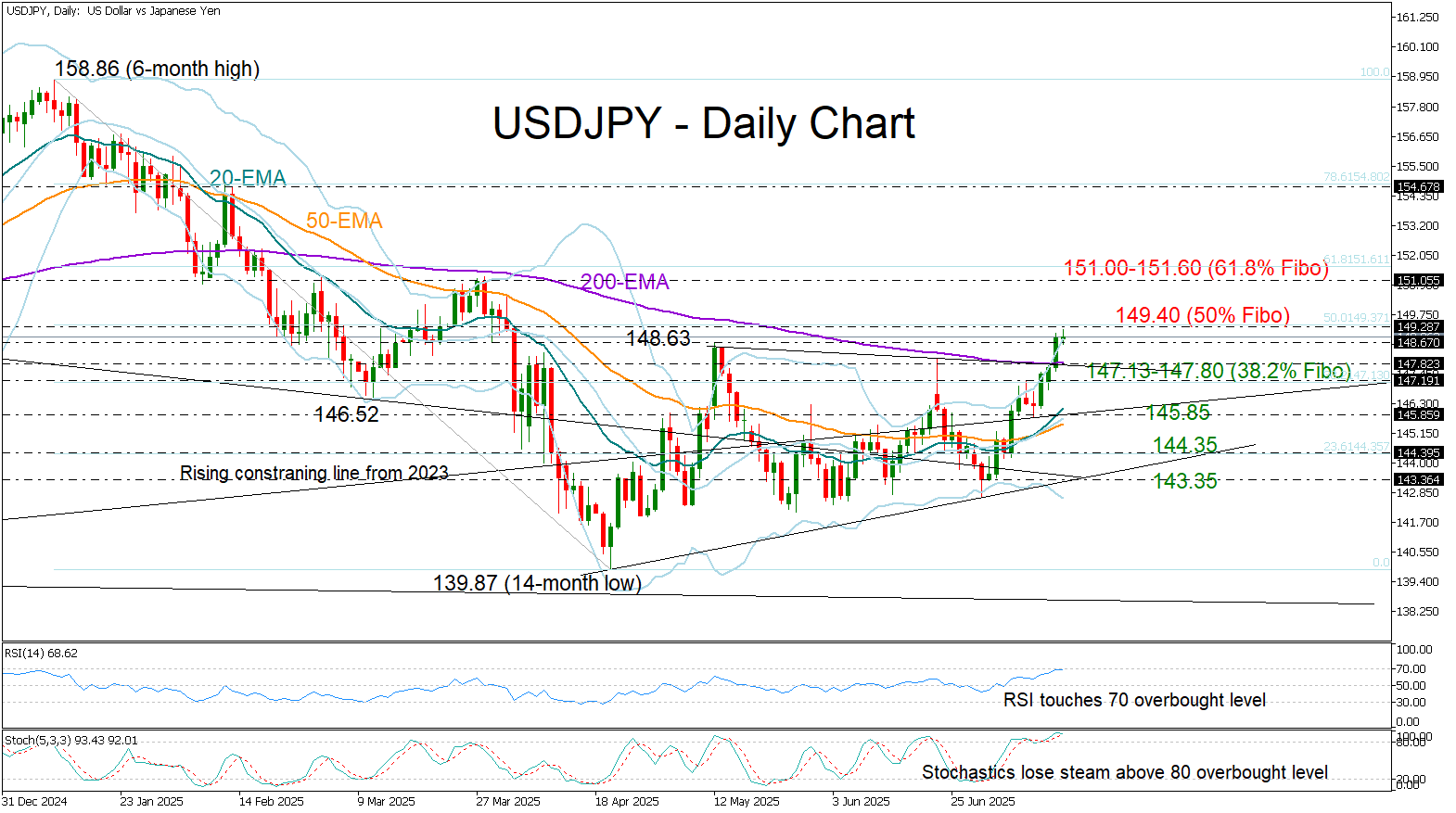
          USD/JPY advanced above its 200-day exponential moving average (EMA) for the first time since February on Tuesday, while slightly extending its ascent to a new three-month high of 149.17 earlier today before losing momentum.

          The bullish price action coincides with growing political uncertainty in Japan, as the ruling Liberal Democratic Party and its coalition partner face the risk of losing their majority in the upper house in Sunday’s election. However, a sustained move higher remains uncertain, given that the price has closed above the upper Bollinger Band and both the RSI and stochastic oscillator are signaling overbought conditions.

          A decisive breakout above the 50% Fibonacci retracement of the January–April downleg could pave the way for an extension toward the 151.00 barrier and the 61.8% Fibonacci level at 151.60. A move beyond that point may open the door for a rally toward 154.70.

          On the downside, if bullish pressure fades, the price could find immediate support between the 200-day EMA at 147.85 and the 38.2% Fibonacci level at 147.13. Further declines may stabilize near 145.85. However, only a drop below 143.35 would signal a bearish trend reversal.

          Overall, USD/JPY appears cautious, as overbought conditions hint at a possible pullback or consolidation in the short term. The next bullish phase is likely to resume above 149.40.

          Source: ACTIONFOREX

          Risk Warnings and Disclaimers
          You understand and acknowledge that there is a high degree of risk involved in trading. Following any strategies or investment methods may lead to potential losses. The content on the site is provided by our contributors and analysts for information purposes only. You are solely responsible for determining whether any trading assets, securities, strategy, or any other product is suitable for investing based on your own investment objectives and financial situation.
          Add to Favorites
          Share

          Israel Steps Up Strikes on Syria, Hitting Military Headquarters

          Michelle

          Political

          Israel intensified its attacks on Syria, striking the country’s military headquarters in Damascus around midday on Wednesday.

          The Israel Defense Forces, which announced the strike on the gates of the facility, said it is also hitting southern Syria and is “prepared for various scenarios.”

          Israel has stepped operations in Syria since Monday and says it’s acting in defense of the Druze community, a minority group the Jewish state has pledged to protect.

          Syria’s state-run agency reported an explosion in Damascus and drone attacks in Suwayda, a southern part of the country close to Israel. There have been deadly clashes in Suwayda in recent days between Druze and Bedouin groups. Syria’s government has moved troops into the area and says it’s trying to quell the violence.

          Earlier on Wednesday, Israeli Defense Minister Israel Katz said the military will “continue to attack regime forces until they withdraw” from Suwayda and “will also soon raise the bar of responses against the regime if the message is not understood.”

          The US asked Israel to stop its strikes on Syria, an Axios reporter said on Tuesday. The reporter, citing an unnamed US official, said Israel promised to cease strikes on Tuesday evening.

          Source: Bloomberg Europe

          Risk Warnings and Disclaimers
          You understand and acknowledge that there is a high degree of risk involved in trading. Following any strategies or investment methods may lead to potential losses. The content on the site is provided by our contributors and analysts for information purposes only. You are solely responsible for determining whether any trading assets, securities, strategy, or any other product is suitable for investing based on your own investment objectives and financial situation.
          Add to Favorites
          Share

          The Fed's Tariff Trap: Inflation Risks Keep Rate Cuts on Hold

          Gerik

          Economic

          Tariffs Revive Inflation Fears, Complicating Fed’s Timing

          The Federal Reserve now finds itself in a familiar yet precarious position. After months of warnings from economists and businesses, the June inflation data confirmed that tariffs are pushing up prices for imported goods. While the increase was modest, its confirmation in official metrics signals a material change in the inflation landscape that the Fed can no longer ignore.
          This development directly challenges the Fed’s 2% inflation target. Price increases have already appeared in consumer goods such as furniture, clothing, and appliances areas sensitive to tariff-related cost shocks. Although overall inflation remains contained, the composition and trajectory of price growth suggest a structural threat, particularly if more tariffs are implemented or prolonged.

          Policy Paralysis as Markets Price in Fed Inaction

          Markets responded by locking in expectations that the Fed will remain on hold through at least the summer. According to the CME FedWatch tool, the probability of no rate change in July rose to 97%. Similarly, expectations of a September cut dropped from 63% to 56% in one week. These shifts reflect investor sentiment that the Fed must remain cautious, not because inflation is soaring, but because of growing uncertainty surrounding its trajectory.
          Scott Anderson from BMO Capital Markets described the June report as “a step in the wrong direction,” reinforcing the view that the Fed will need more time to evaluate whether current inflation pressures are temporary or persistent. This logic is rooted in lessons from the post-COVID inflation cycle, during which the Fed’s delayed response allowed inflation to entrench itself, necessitating aggressive rate hikes that followed.

          Transitory or Persistent? Fed Risks Repeating Past Mistakes

          Some market participants argue that tariff-induced inflation may be a one-time adjustment akin to a reset in relative prices rather than a structural shift. In this view, the Fed should look through the data and treat it as a temporary deviation, not a long-term threat. This narrative, however, carries echoes of the Fed’s 2021 misjudgment, when officials labeled post-pandemic inflation as “transitory,” only to find themselves behind the curve.
          The risk now is not just from current tariffs, but from the uncertainty surrounding future ones. Each round of tariff announcements creates a new potential inflation shock, making it harder for the Fed to distinguish noise from signal. Ryan Sweet of Oxford Economics noted that if these tariff threats materialize, inflation could build gradually over several months, requiring the Fed to extend its wait-and-see posture unless the labor market weakens sharply.

          Waiting Without Acting: A Policy Stalemate

          The Fed currently faces a classic policy dilemma: inflation isn’t high enough to justify rate hikes, but it’s also not falling fast enough to warrant cuts. Meanwhile, the labor market remains resilient, removing any urgency for dovish action. This stalemate forces the central bank into a reactive stance, dependent on lagging indicators, and vulnerable to future inflation surprises.
          The danger lies not in the current numbers, but in the uncertainty they represent. A single inflation report may not shift policy, but a pattern of incremental increases driven by protectionist trade policy could catch the Fed off guard again. In that case, waiting too long to act could result in a repeat of the post-COVID policy error, where inflation gained momentum while the Fed hoped it would dissipate on its own.

          Inflation Moderation or Policy Paralysis?

          In the coming months, the Federal Reserve’s credibility may rest on its ability to differentiate between transient price pressures and entrenched inflation. If tariffs continue to generate modest, recurring price increases, the risk of inflation reacceleration becomes real. But without a clear labor market downturn, the Fed may remain sidelined.
          For now, financial markets are calm, but that calm reflects indecision rather than confidence. The Fed’s challenge is not merely economic; it is one of judgment, timing, and avoiding a déjà vu scenario that could once again test the limits of its policy toolkit.

          Source: Yahoo Finance

          To stay updated on all economic events of today, please check out our Economic calendar
          Risk Warnings and Disclaimers
          You understand and acknowledge that there is a high degree of risk involved in trading. Following any strategies or investment methods may lead to potential losses. The content on the site is provided by our contributors and analysts for information purposes only. You are solely responsible for determining whether any trading assets, securities, strategy, or any other product is suitable for investing based on your own investment objectives and financial situation.
          Add to Favorites
          Share

          Trump’s Tariffs Threaten 100,000 Jobs in South Africa, Central Bank Warns

          Gerik

          Economic

          Tariff Shock Hits Fragile Sectors in a High-Unemployment Economy

          South African Reserve Bank Governor Lesetja Kganyago has issued a stark warning: President Trump’s incoming 30% tariff on South African goods could cause severe job losses across key export sectors. Scheduled to begin on August 1, the tariffs are expected to particularly impact agriculture and automotive exports two of the country’s most labor-intensive and trade-dependent industries.
          In a radio interview with station 702, Kganyago emphasized the threat is not abstract but immediate and quantifiable. The projected toll approximately 100,000 jobs is significant in an economy where unemployment already stands at 32.9% officially, and at 43.1% under broader measures. This suggests a strong causal relationship between the tariffs and potential employment losses, especially in vulnerable communities.

          Agricultural Sector Faces Direct Risk of Collapse

          The agricultural sector is poised to bear the brunt of the impact, due to its reliance on low-skilled labor and high export orientation. Citrus fruits, table grapes, wine, fruit juices, macadamia nuts, and ostrich leather are all part of the export basket now exposed to steep U.S. tariffs. These goods are vital not just to national GDP but to the livelihood of rural economies, especially in the Western Cape.
          In Citrusdal, a farming town in the Western Cape heavily reliant on U.S. demand, the citrus industry alone accounts for an estimated 35,000 jobs. The tariffs threaten to collapse local economies built around these export pipelines. This reflects a direct linkage between trade policy shifts and employment destabilization in export-oriented agricultural communities.

          Automotive Industry Experiences Immediate Decline

          The impact on the automotive sector is already visible. Kganyago cited an 80% drop in car exports to the U.S. since Trump’s initial tariff imposition in April. This figure illustrates a rapid response in trade flow, with measurable consequences for manufacturers and their supply chains. As automotive production is concentrated in regions with high labor dependence, the ripple effect is likely to exacerbate unemployment and stall industrial investment.
          The decline in exports reflects a cause-effect dynamic where cost-driven import disincentives in the U.S. translate to sudden demand shocks for South African producers, highlighting the vulnerability of small and mid-sized economies in global trade realignments.

          Broader Economic Implications and Policy Uncertainty

          While farmer groups and industry bodies raise alarms over sector-specific fallout, the broader macroeconomic concern is how this tariff escalation could compound existing structural weaknesses. With youth unemployment persistently high and economic growth sluggish, South Africa lacks the policy flexibility to absorb a sudden contraction in its export earnings.
          The central bank’s warning coincides with a global environment where trade tensions are reshaping supply chains and forcing countries to reevaluate market dependencies. Without alternative trade agreements or rapid market diversification, South Africa may struggle to mitigate the impact of U.S. protectionism.

          Structural Fragility Meets External Shock

          The potential job losses illustrate not only the harsh consequences of unilateral tariff action but also the structural fragility of South Africa’s labor market. With few domestic buffers and limited fiscal space, the country could see localized recessions in export-reliant regions if alternative markets are not secured swiftly.
          The effectiveness of South Africa’s response diplomatic or trade-driven will determine whether this shock is temporary or becomes a catalyst for deeper socio-economic instability. The risk is no longer theoretical; the countdown to August 1 has made it immediate.

          Source: Reuters

          To stay updated on all economic events of today, please check out our Economic calendar
          Risk Warnings and Disclaimers
          You understand and acknowledge that there is a high degree of risk involved in trading. Following any strategies or investment methods may lead to potential losses. The content on the site is provided by our contributors and analysts for information purposes only. You are solely responsible for determining whether any trading assets, securities, strategy, or any other product is suitable for investing based on your own investment objectives and financial situation.
          Add to Favorites
          Share

          Trump Tariffs Live Updates: Trump Signals Drug Tariffs May Come By Aug. 1, Announces Deal With Indonesia

          Glendon

          Economic

          Forex

          President Trump has flagged that US tariffs on pharmaceutical imports are likely to kick in on Aug. 1, with duties on semiconductors also in line for implementation then too.

          “Probably at the end of the month, and we’re going to start off with a low tariff and give the pharmaceutical companies a year or so to build, and then we’re going to make it a very high tariff,” Trump told reporters on Tuesday.

          The timing means the drug and chip levies would come in alongside the paused "reciprocal" tariffs laid out in April.

          Also on Tuesday, Trump said his team has struck a trade deal with Indonesia that will see goods from the country face a 19% tariff.

          The announcement comes after Trump unveiled a new batch of letters to over 20 trade partners outlining tariffs on goods imported from their countries beginning in August. The letters set new baseline tariff levels at 20% to 40% — except for a 50% levy on goods from Brazil in a move that waded into the country's domestic politics.

          Indonesian goods faced a 32% tariff rate on Aug. 1, according to the July 7 letter Trump sent to Indonesia's President Prabowo Subianto. Trump on Tuesday said US goods would face no import tax in Indonesia.

          Trump has also escalated tariff tensions with Canada, Mexico, and the European Union recently. Last week, Trump announced a 35% tariff on Canadian goods and followed that up with promises of 30% duties on Mexico and the EU.

          The EU has been preparing options for a trade deal, while also preparing an extensive list of counter-tariffs that would affect 72 billion euros ($84 billion USD) of American products should talks fail.

          "There will be a huge impact on trade,” the EU's chief negotiator said Monday. "It will be almost impossible to continue trading as we are used to in a transatlantic relationship."

          As markets focus on US talks, here is where things stand with other key partners:

          • Vietnam: Trump said a deal with Vietnam will see the country's imports face a 20% tariff — lower than the 46% Trump had threatened in April. He also said Vietnamese goods would face a higher 40% tariff "on any transshipping" — when goods shipped from Vietnam originate from another country, like China. According to reports, Vietnam's leadership was caught off guard by Trump's announcement last week that it agreed to a 20% tariff and is now seeking to lower the rate.

          • India: Trump's tariffs on Brazil have raised the stakes for India, another member of the BRICS coalition. Bloomberg reported that the countries are working toward a framework deal that could see US tariffs on goods from India drop below 20%.

          • Russia: Trump threatened "secondary" tariffs on Russia of up to 100% as he attempts to pressure the country into negotiating an end to the war in Ukraine.

          Source: Yahoo Finance

          To stay updated on all economic events of today, please check out our Economic calendar
          Risk Warnings and Disclaimers
          You understand and acknowledge that there is a high degree of risk involved in trading. Following any strategies or investment methods may lead to potential losses. The content on the site is provided by our contributors and analysts for information purposes only. You are solely responsible for determining whether any trading assets, securities, strategy, or any other product is suitable for investing based on your own investment objectives and financial situation.
          Add to Favorites
          Share
          FastBull
          Copyright © 2025 FastBull Ltd

          728 RM B 7/F GEE LOK IND BLDG NO 34 HUNG TO RD KWUN TONG KLN HONG KONG

          TelegramInstagramTwitterfacebooklinkedin
          App Store Google Play Google Play
          Products
          Charts

          Chats

          Q&A with Experts
          Screeners
          Economic Calendar
          Data
          Tools
          Membership
          Features
          Function
          Markets
          Copy Trading
          Latest Signals
          Contests
          News
          Analysis
          24/7
          Columns
          Education
          Company
          Careers
          About Us
          Contact Us
          Advertising
          Help Center
          Feedback
          User Agreement
          Privacy Policy
          Business

          White Label

          Data API

          Web Plug-ins

          Poster Maker

          Affiliate Program

          Risk Disclosure

          The risk of loss in trading financial instruments such as stocks, FX, commodities, futures, bonds, ETFs and crypto can be substantial. You may sustain a total loss of the funds that you deposit with your broker. Therefore, you should carefully consider whether such trading is suitable for you in light of your circumstances and financial resources.

          No decision to invest should be made without thoroughly conducting due diligence by yourself or consulting with your financial advisors. Our web content might not suit you since we don't know your financial conditions and investment needs. Our financial information might have latency or contain inaccuracy, so you should be fully responsible for any of your trading and investment decisions. The company will not be responsible for your capital loss.

          Without getting permission from the website, you are not allowed to copy the website's graphics, texts, or trademarks. Intellectual property rights in the content or data incorporated into this website belong to its providers and exchange merchants.

          Not Logged In

          Log in to access more features

          FastBull Membership

          Not yet

          Purchase

          Become a signal provider
          Help Center
          Customer Service
          Dark Mode
          Price Up/Down Colors

          Log In

          Sign Up

          Position
          Layout
          Fullscreen
          Default to Chart
          The chart page opens by default when you visit fastbull.com